

- Industry Size (2026)
- USD 43.8 Mn
- Forecast (2036)
- USD 183.5 Mn
- CAGR (2026 to 2036)
- 15.4%
Solid-State Battery Fast-Charge Degradation Test Systems Market Size, Market Forecast and Outlook By FMI
The solid-state battery fast-charge degradation test systems market was valued at USD 38.0 million in 2025. FMI estimates indicate the market is anticipated to reach USD 43.8 million in 2026 and advance to USD 183.5 million by 2036, which reflects a CAGR of 15.4% over the forecast period.
Summary of Solid-State Battery Fast-Charge Degradation Test Systems Market
- The market is forecast to reach USD 183.5 million by 2036.
- The market is expected to grow at a CAGR of 15.4% from 2026 to 2036.
- The market was estimated at USD 38.0 million in 2025.
- The market represents an incremental opportunity of USD 139.7 million over the forecast period.
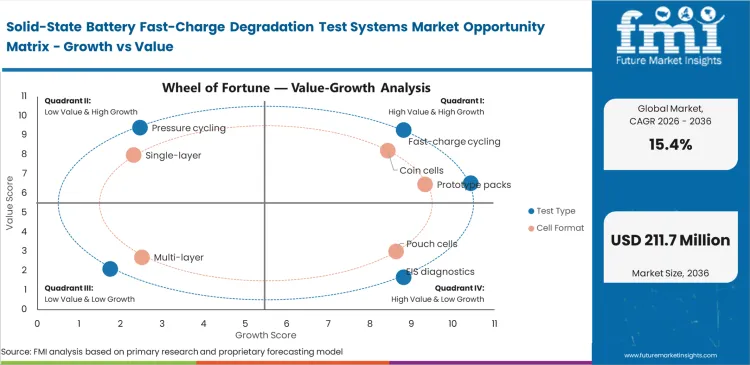
- Fast-charge cycling leads by test type with a 38.0% share.
- Coin cells lead by cell format with a 34.0% share.
- Full cells dominate by component focus with a 41.0% share.
- Battery developers lead by end user with a 36.0% share.
- Bench-top systems lead by deployment with a 46.0% share.
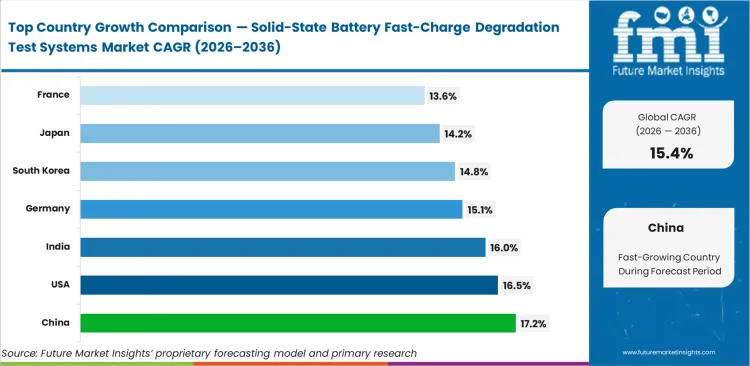
- China is the fastest-growing market at 17.2%, followed by the United States at 16.5% and India at 16.0%.
- The market is driven by rising demand for fast-charge validation, increasing solid-state battery R&D activity, and the need for advanced degradation diagnostics under extreme charging conditions.
- Key companies in the market include Chroma ATE, Keysight Technologies, Arbin Instruments, BioLogic, NEWARE, and NOVONIX.
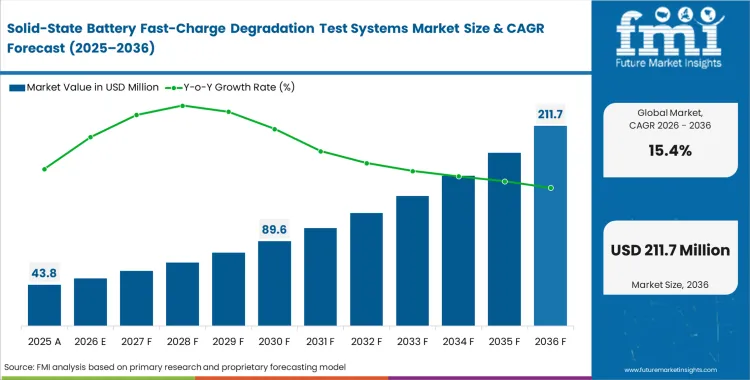
Testing capacity is becoming more important as solid-state battery programs move closer to automotive qualification. Fast-charging claims cannot rest on broad assumptions around thermal behavior, cycle stability, or mechanical response when those factors directly affect commercial viability. Conventional lithium-ion cyclers are less suited to capturing the combined electrochemical stress, interface instability, and structural loading that emerge under high-rate charging in solid-state formats. Dedicated solid-state battery mechanical and safety test equipment is therefore gaining importance where developers need to assess crack formation, swelling behavior, failure limits, and charge-rate tolerance under realistic operating stress. Without this level of validation, performance targets are more likely to be reduced to keep qualification risk within a manageable range.
Laboratory demand also changes once short-duration charging is demonstrated at the multilayer pouch-cell stage. Focus then shifts from proving a result once to proving it repeatedly across more channels, longer cycle counts, and wider operating conditions. This transition is increasing demand for specialized battery test equipment with higher channel density, longer continuous run capability, and stronger data capture around degradation pathways. Throughput becomes nearly as important as measurement precision because qualification programs cannot scale efficiently on single-station research setups. Test infrastructure is therefore moving from a research support role toward a more central position in validation planning.
China is projected to expand at a CAGR of 17.2% in solid-state battery mechanical and safety test equipment during 2026 to 2036, supported by continued pilot-line and validation buildout ahead of broader commercialization. Demand in the United States is expected to rise at a CAGR of 16.5% over the same period, reflecting stronger laboratory investment and more intensive testing across funded battery programs. India is likely to record a CAGR of 16.0% during 2026 to 2036 as engineering capacity expands and the domestic validation base strengthens. Germany is anticipated to grow at 15.1% CAGR through the forecast period, supported by close development links between battery suppliers and automotive manufacturers. South Korea and Japan are estimated to expand at CAGRs of 14.8% and 14.2%, respectively, during 2026 to 2036, reflecting steady additions to test capability across established battery development networks. France is projected to register a CAGR of 13.6% over the forecast period, where pilot-line qualification activity remains more concentrated than broad-based capacity expansion.
Segmental Analysis
Solid-State Battery Fast-Charge Degradation Test Systems Market Analysis by Test Type
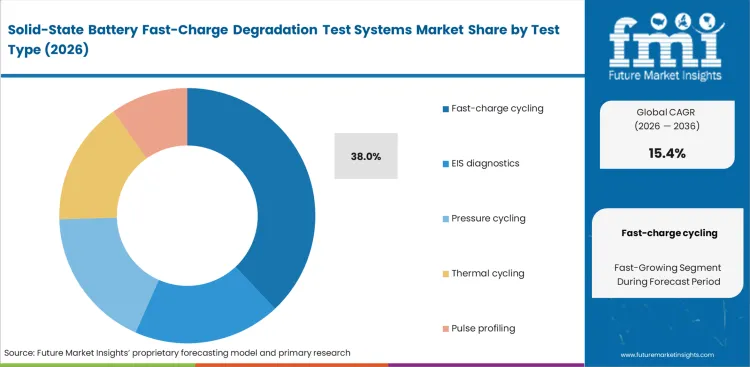
Fast-charge cycling is estimated to account for 38.0% of the market share in 2026. This test category remains important because it addresses a core commercial question in solid-state battery development: whether cells can absorb repeated rapid charging without early performance breakdown. It is widely used to establish baseline feasibility before broader automotive qualification begins. Cycling data on its own, though, rarely explains the exact mechanism behind later degradation. Programs that rely on throughput alone without pairing cycling results with deeper inspection and certification layers may overlook internal cracking, interface instability, or resistance build-up until failure becomes harder to diagnose. This limitation becomes more important as prototype cells move closer to vehicle integration, where validation standards and warranty exposure both become more demanding.
- Endurance validation: Engineers run repeated rapid-charge cycles to define cycle-life limits under aggressive operating conditions and build stronger confidence around durability expectations.
- Thermal tracking: Temperature monitoring helps identify the point at which internal resistance begins rising and supports safer control of high-stress test conditions.
- Protocol optimization: Current profiles are adjusted across repeated runs to identify charging conditions that reduce degradation while preserving acceptable charging speed.
Solid-State Battery Fast-Charge Degradation Test Systems Market Analysis by Cell Format
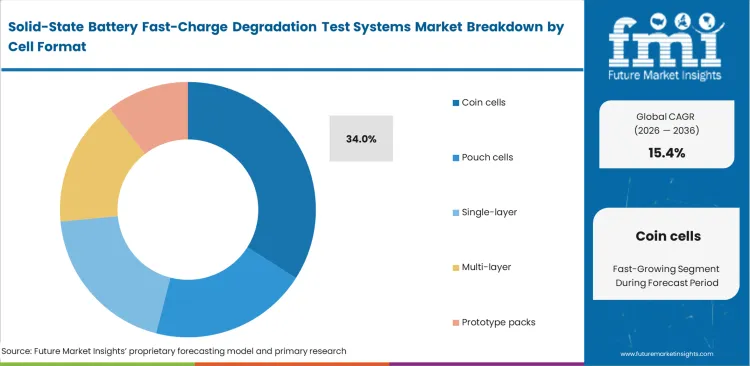
Coin cells are projected to secure 34.0% share in 2026 because they remain the fastest and most practical format for broad electrolyte and interface screening. Companies rely on them to reject unstable chemistries before committing time and capital to more complex development stages. High test volume is part of the advantage, especially when laboratories need to compare large numbers of material combinations in parallel. Limits appear once performance insights from small cells are carried too far into applied design assumptions, since scale-up often introduces thermal gradients and behavior that early formats do not reflect. Laboratories that fail to extend electric vehicle test equipment toward multilayer and larger-format validation risk producing data that automotive partners treat as too narrow for commercial use.
- Material screening: Researchers use small-format cells to assess electrolyte and electrode compatibility before shifting resources into larger validation programs.
- Baseline calibration: Controlled early-stage testing helps establish the theoretical operating range of new solid-state chemistries.
- Throughput scaling: Dense small-cell test layouts allow laboratories to generate broad comparative data sets with relatively efficient channel utilization.
Solid-State Battery Fast-Charge Degradation Test Systems Market Analysis by Component Focus
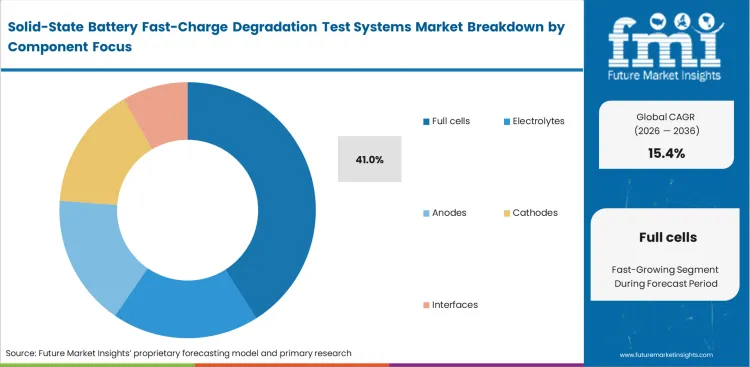
Material-level testing provides useful early signals, but rapid-charging stress often reveals problems only when the full electrochemical stack is evaluated together. Whole-cell data is required to understand how anodes, cathodes, separators, and solid electrolytes behave under realistic pressure and charge conditions. Full cells are expected to hold 41.0% share in 2026, reflecting the market’s shift toward integrated validation rather than isolated material screening alone. Complete assemblies reveal interaction effects that single-component studies often miss, especially where mechanical stress and electrochemical change build simultaneously. That requirement is also raising the importance of protocol validation hardware, since full-cell testing depends on fixtures that can maintain pressure, manage expansion, and preserve repeatable conditions through demanding cycles. Weak control at that level can distort degradation curves and lead to dismissal of cell designs that may still be commercially workable.
- System interactions: Full-cell testing shows how individual materials influence one another under rapid charging and repeated electrochemical strain.
- Pressure response: Controlled fixtures help measure how full cells behave when internal expansion meets rigid external containment.
- Lifespan projection: Aggregated full-cell behavior supports more realistic estimates of durability under intended application conditions.
Solid-State Battery Fast-Charge Degradation Test Systems Market Analysis by End User
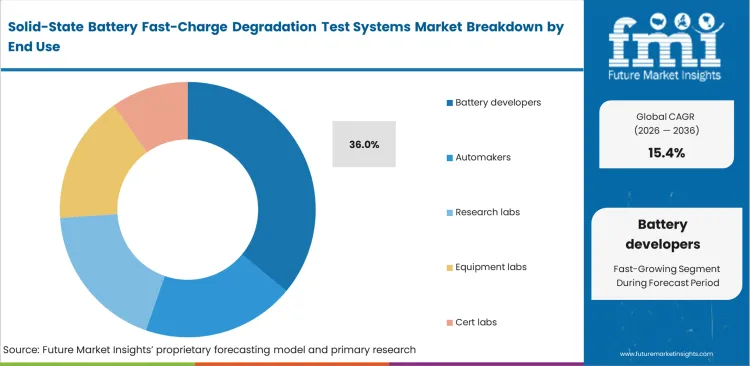
Startups and established battery developers sit closest to that obligation, since core chemistry must be validated before external partners are willing to absorb design risk. Capital requirements strengthen this position, as in-house test capability is increasingly treated as a competitive asset rather than a secondary support function. Battery developers are estimated to account for 36.0% of end-user demand in 2026, supported by growing investment in proprietary validation infrastructure and application-specific measurement workflows. Many development programs are refining test rigs around internal priorities instead of relying only on standard platforms. Exclusive dependence on generic battery cell, module, and pack swelling measurement systems can leave important mechanical behavior insufficiently examined, especially in a category where small material shifts can influence performance outcomes much more than early test data may suggest.
- Chemistry validation: Internal testing programs are used to establish credible evidence around baseline stability and fast-charge durability.
- Process refinement: Repeated testing across manufacturing variations helps identify how process shifts affect long-cycle behavior.
- Hardware co-development: Close collaboration with equipment providers allows developers to tailor rigs around proprietary measurement needs and internal validation methods.
Solid-State Battery Fast-Charge Degradation Test Systems Market Analysis by Deployment
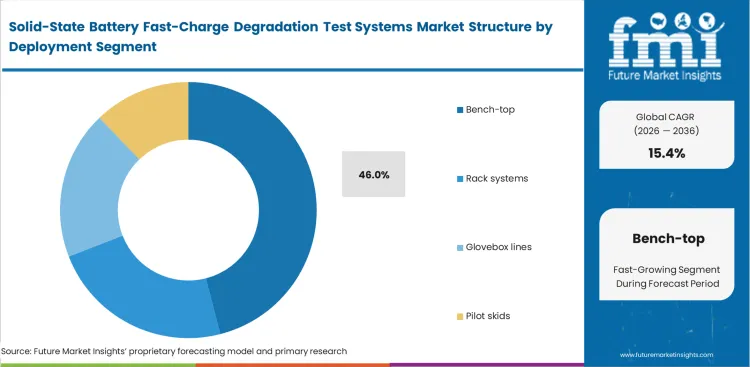
Physical lab limits, project turnover, and the need for early-stage workflow flexibility continue to influence deployment decisions across this market. Bench-top platforms remain widely preferred because they can be repositioned, reconfigured, and expanded without requiring large fixed installations at the start of each development program. Research teams also rely on them when work is still shifting across chemistries, cell formats, and validation protocols. Modular deployment is estimated to account for 46.0% share in 2026, reflecting its practical fit in experimental settings where adaptability matters more than permanent infrastructure. That advantage still brings operating challenges when multiple test stations run at the same time without unified control architecture. Distributed layouts can split data streams, make result comparison harder, and reduce reporting consistency unless laboratories integrate those systems carefully. Battery and fire explosion containment test chambers are becoming more important in such environments, since safety control must expand in step with testing flexibility rather than remain tied to a single fixed setup.
- Modular expansion: Facilities can add test capacity gradually without committing to large centralized installations too early in the development cycle.
- Flexible reconfiguration: Bench-top units are easier to shift across projects as internal research priorities change.
- Data integration: Networked software helps combine results from separate units into a more consistent facility-level degradation view.
Solid-State Battery Fast-Charge Degradation Test Systems Market Drivers, Restraints, and Opportunities
Automotive launch timelines require proven 10-minute charge capabilities, forcing equipment engineering leads to secure high-channel-count testing capacity immediately. Delaying this sourcing means prototype cells will not undergo required thousands of cycles before vehicle design freeze dates. Urgency stems from physical realities that solid-state accelerated aging cannot be accurately simulated; it must be empirically measured under exact pressure and thermal conditions. Major OEMs are handing down strict qualification mandates, compelling cell developers to rapidly transition from basic material validation to high-throughput EV battery R&D test equipment deployment. Commercial pressures lead to immediate capital allocation into specialized testing infrastructure capable of isolating subtle mechanical failures before they cascade into shorts.
Primary operational friction slowing adoption involves extreme lack of standardization in solid-state cell geometries and pressure requirements. Unlike cylindrical lithium-ion testing, where fixtures are universal, solid-state cells require custom-machined containment jigs that actively manage stack pressure during volume expansion. Laboratories face severe bottlenecks because every new cell iteration demands redesigned testing fixtures, compounding solid-state battery validation platform pricing. Mechanical incompatibility restricts throughput and forces expensive delays. While some instrument manufacturers introduce adaptive pressure mechanisms, solutions remain expensive and struggle maintaining uniform force distribution across larger prototype formats.
Opportunities in the Solid-State Battery Fast-Charge Degradation Test Systems Market
- Integrated Multiphysics software: Developing platforms synchronizing electrochemical data with mechanical stress mapping. Software engineers gain recurring revenue by offering battery test software for degradation analytics.
- Adaptive pressure fixturing: Engineering universal test jigs automatically adjusting to varying pouch cell dimensions. Equipment providers capture battery module vent gas & propagation test systems contracts by implementing pressure-assisted cycling for solid-state batteries.
- High-frequency impedance integration: Embedding in-situ diagnostic hardware directly into standard cycling channels. Testing companies allow cell developers to spot early degradation using battery EIS analyzer for degradation studies without pausing endurance runs.
Regional Analysis
Based on regional analysis, Solid-State Battery Fast-Charge Degradation Test Systems is segmented into North America, Europe, Asia Pacific, and other key markets across 40 plus countries.
.webp "Top Country Growth Comparison Solid State Battery Fast Charge Degradation Test Systems Market Cagr (2026 2036)")
| Country | CAGR (2026 to 2036) |
|---|---|
| China | 17.2% |
| United States | 16.5% |
| India | 16.0% |
| Germany | 15.1% |
| South Korea | 14.8% |
| Japan | 14.2% |
| France | 13.6% |
Source: Future Market Insights (FMI) analysis, based on proprietary forecasting model and primary research
Asia Pacific Solid-State Battery Fast-Charge Degradation Test Systems Market Analysis
Rapid cell scale-up activity is pushing testing infrastructure demand higher across Asia Pacific. Domestic manufacturers are moving from laboratory-stage prototypes to pilot-line production, which is increasing the need for high-throughput test capacity across regional facilities. Installed test channel volumes are likely to stay ahead of other regions as commercialization programs widen. Demand is also supported by the need for equipment designed around local cell formats, operating conditions, and qualification priorities.
- China: China is projected to expand at a CAGR of 17.2% in solid-state battery fast-charge degradation test systems during 2026 to 2036. Large pilot-line buildouts are shortening validation cycles as battery producers increase work on solid electrolytes and related cell architectures. Domestic manufacturers require synchronized test channels at meaningful scale to compare materials, monitor degradation patterns, and reduce delay before qualification. Supplier positioning in this market depends on delivering channel density, control stability, and service support that can hold up under heavy development volumes.
- India: India is expected to record a CAGR of 16.0% in solid-state battery test systems over the 2026 to 2036 period. Engineering investment continues to support new battery research capacity, with laboratories evaluating a wide mix of materials under demanding thermal and charge conditions. Flexible test platforms remain important in this setting because development paths are still evolving across chemistries and formats. Early infrastructure buildout is creating room for suppliers that can provide adaptable systems aligned with changing laboratory requirements.
- South Korea: South Korea is anticipated to grow at a CAGR of 14.8% in degradation test systems from 2026 to 2036. Expansion in this market remains measured, with battery developers favoring controlled testing rollouts tied closely to internal qualification plans. Customized test regimens carry high importance because evaluation work is often matched to proprietary cell design and strict performance targets. Equipment suppliers need strong engineering depth in this market, since qualification standards leave little room for gaps in system precision or technical support.
- Japan: Japan is likely to witness a CAGR of 14.2% in solid-state battery test equipment during 2026 to 2036. Validation activity in the country is shaped by a steady development approach, with laboratories placing greater value on in-situ diagnostic precision than on maximum channel count. Measurement accuracy, long-run stability, and instrument reliability remain central to purchasing decisions in this environment. Supplier success here depends less on scale alone and more on maintaining dependable performance across long testing cycles.
North America Solid-State Battery Fast-Charge Degradation Test Systems Market Analysis
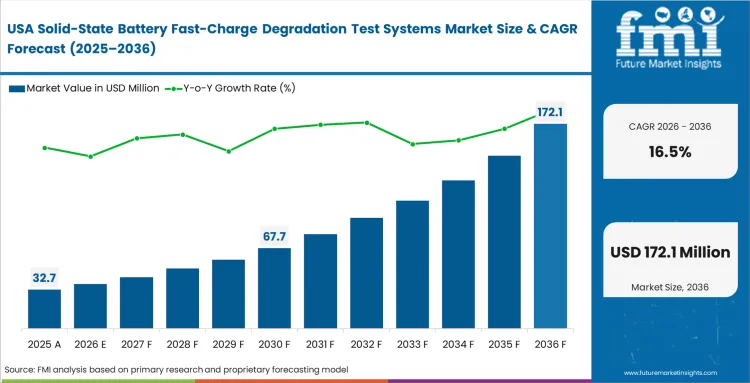
Public funding support and automotive startup activity are influencing how testing hardware is selected across North America. Laboratories and battery developers are placing greater weight on systems that can validate commercial potential with credible performance data in a shorter timeframe. Preference is shifting toward advanced diagnostic equipment that combines physical testing with deeper analytical visibility. Stronger interest is also building around software-linked platforms that improve interpretation of fast-charge behavior, deformation patterns, and failure signals during development.
- United States: Demand for solid-state battery test systems in the United States is projected to rise at a CAGR of 16.5% during 2026 to 2036. Publicly supported research activity is contributing to higher instrument intensity across laboratories, especially where fast-charge validation and mechanical response tracking are being handled together. Research environments in the country place clear value on systems that can run complex charge protocols while capturing deformation behavior with consistent accuracy. Supplier acceptance in this market is likely to depend on data compatibility, testing precision, and the ability to fit into established laboratory reporting structures.
Europe Solid-State Battery Fast-Charge Degradation Test Systems Market Analysis
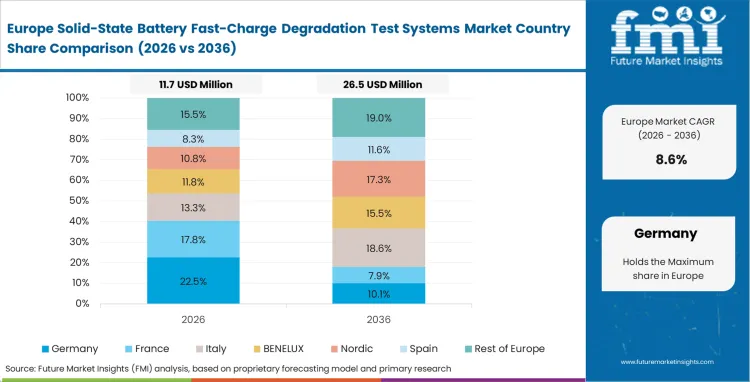
Automotive qualification standards continue to shape equipment needs across Europe. Battery manufacturers and validation centers need clear proof of safety, cycle life, and operating stability before cells move closer to vehicle integration. Test facilities across the region place greater value on systems that can handle thermal, electrical, and mechanical stress within one validation setup. European laboratories also hold an important position in late-stage qualification, where commercialization depends on consistent evidence rather than isolated lab results.
- Germany: Germany is projected to expand at a CAGR of 15.1% in solid-state battery test systems during 2026 to 2036. Demand in the country is supported by close alignment between vehicle programs, manufacturing scale-up work, and validation requirements tied to quality control. Laboratories in Germany place strong emphasis on test capability that can support both development-stage learning and production-stage consistency. Equipment adoption remains closely linked to how well systems match evolving vehicle architectures and demanding qualification standards.
- France: France is anticipated to grow at a CAGR of 13.6% in solid-state battery validation equipment from 2026 to 2036. Market activity in the country remains more selective, with testing efforts focused on failure analysis, degradation tracking, and targeted validation work rather than broad channel expansion alone. Laboratories value systems that improve visibility into localized performance loss under demanding operating conditions. Demand is likely to remain strongest for equipment that helps connect cell behavior with qualification decisions in a more precise way.
Detailed analysis also covers battery manufacturing machines and testing adoption trends across the United Kingdom, Italy, Canada, and selected emerging segments in Southeast Asia. Regional differences in grid integration testing and validation practices continue to require changes in standard cycling hardware. Such variation increases execution complexity for equipment suppliers and keeps local application fit central to deployment success.
Competitive Aligners for Market Players
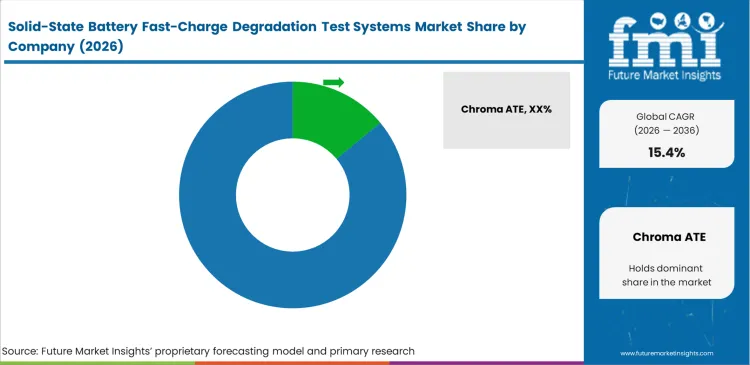
Competition in solid-state testing hardware is increasingly shaped by how well systems can synchronize measurement under changing mechanical load. Buyers evaluating a solid-state battery degradation test bench are not focused on voltage accuracy alone. Greater attention is placed on whether the system can connect micro-ohm impedance shifts with real-time pressure movement inside cell fixtures. Purchasing decisions in advanced battery laboratories are often influenced by this level of integration, since disconnected data streams make degradation behavior harder to interpret. Suppliers relying on separate software layers for alignment can lose ground when laboratories prefer a unified platform that captures electrical and mechanical behavior together.
Established suppliers hold an advantage when their systems already fit into laboratory routines, data environments, and test protocol structures built over time. Existing control software integration and proven workflow compatibility can reduce friction for laboratories that do not want to rebuild daily testing practices around new hardware. Entry barriers remain high for challengers because success depends on more than instrument accuracy alone. Mechanical fixturing must also handle battery material expansion in a controlled way, which adds design complexity for suppliers adapting older lithium-ion platforms to newer solid-state requirements. Capability in test fixture design remains closely tied to early-stage material screening, where equipment limits can affect how quickly developers compare performance across candidate materials.
Battery developers and internal automotive laboratories also push back against vendor lock-in by requiring open control environments and flexible data access from hardware suppliers. Proprietary data structures can restrict advanced automation work, limit model development, and reduce freedom in fast-charge routine design. Laboratories running specialized validation programs usually prefer systems that can be adapted around internal methods rather than forcing teams into closed software logic. Commercial preference is therefore shifting toward hardware platforms that support custom scripting, open architecture, and direct integration with laboratory-specific workflows. Suppliers that make room for that flexibility are better positioned to stay relevant as testing requirements become more specialized.
Key Players in Solid-State Battery Fast-Charge Degradation Test Systems Market
- Chroma ATE
- Keysight Technologies
- Arbin Instruments
- BioLogic
- NEWARE
- NOVONIX
Scope of the Report
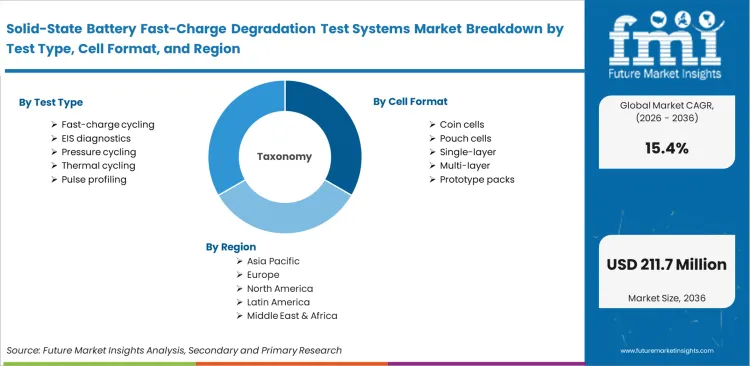
| Metric | Value |
|---|---|
| Quantitative Units | USD 43.8 million to USD 183.5 million, at a CAGR of 15.4% |
| Market Definition | This category represents specialized instrumentation designed to apply electrical, thermal, and mechanical stress simultaneously to solid electrolyte architectures. It isolates specific failure modes initiated by high C-rate charging. These systems perform solid-state battery interface degradation testing to map precise pathways of lithium plating, interfacial impedance growth, and mechanical fracturing over thousands of accelerated cycles. |
| Segmentation | Test Type, Cell Format, Component Focus, End User, Deployment, and Region |
| Regions Covered | North America, Latin America, Europe, East Asia, South Asia & Pacific, and Middle East & Africa (MEA) |
| Countries Covered | United States, Canada, Brazil, Mexico, Germany, United Kingdom, France, Spain, Italy, China, Japan, South Korea, India, ASEAN, GCC Countries, South Africa |
| Key Companies Profiled | Chroma ATE, Keysight Technologies, Arbin Instruments, BioLogic, NEWARE, NOVONIX |
| Forecast Period | 2026 to 2036 |
| Approach | Hardware channel shipment volumes multiplied by average per-channel capital expenditure |
Source: Future Market Insights (FMI) analysis, based on proprietary forecasting model and primary research
Solid-State Battery Fast-Charge Degradation Test Systems Market Analysis by Segments
Test Type
- Fast-charge cycling
- EIS diagnostics
- Pressure cycling
- Thermal cycling
- Pulse profiling
Cell Format
- Coin cells
- Pouch cells
- Single-layer
- Multi-layer
- Prototype packs
Component Focus
- Full cells
- Electrolytes
- Anodes
- Cathodes
- Interfaces
End User
- Battery developers
- Automakers
- Research labs
- Equipment labs
- Cert labs
Deployment
- Bench-top
- Rack systems
- Glovebox lines
- Pilot skids
Region:
- North America
- United States
- Canada
- Europe
- Germany
- United Kingdom
- France
- Italy
- Spain
- Asia Pacific
- China
- Japan
- South Korea
- Taiwan
- Singapore
- Latin America
- Brazil
- Mexico
- Argentina
- Middle East & Africa
- GCC Countries
- South Africa
Bibliography
- Ahmad, N., Fan, C., Faheem, M., Liang, X., Xiao, Y., Cao, X., Zeng, C., Dong, Q., & Yang, W. (2024). Key challenges and advancements toward fast-charging all-solid-state lithium batteries. Green Chemistry, 26, 9529-9553.
- Liu, J., Song, Y., Liu, Q., Zhao, W., An, H., Zhou, Z., Xu, Z., Li, M., Deng, B., & Wang, J. (2024). Origin of fast charging in solid-state batteries revealed by Cryo-transmission X-ray microscopy. Proceedings of the National Academy of Sciences, 121(51), e2410406121.
- Aktekin, B., Kataev, E., Riegger, L. M., Garcia-Diez, R., Chalkley, Z., Becker, J., Wilks, R. G., Henss, A., Bär, M., & Janek, J. (2024). Operando Photoelectron Spectroscopy Analysis of Li6PS5Cl Electrochemical Decomposition Reactions in Solid-State Batteries. ACS Energy Letters, 9(7), 3492-3500.
- Wang, M., Wu, Y., Cao, Y., Li, G., Miao, X., & Li, X. (2025). Real-time artificial intelligence for solid-state lithium metal batteries. Nature Communications, 16(1), 11160.
- Dorri, M., Kumar, A. M. R., & Zaghib, K. (2025). In operando and in situ characterization tools for advanced rechargeable batteries: Effects of electrode origin and electrolyte. Journal of Power Sources, 658, 238188.
- Ping, W. Z., & Chao, Z. (2025). Enhanced state of charge estimation for solid-state batteries using a stacked ensemble machine learning model. Discover Artificial Intelligence, 5, Article 246.
This bibliography is provided for reader reference. The full FMI report contains the complete reference list with primary source documentation.
This Report Addresses
- Hardware requirements isolating specific failure modes initiated by lithium battery formation and testing equipment high C-rate charging protocols.
- Capital expenditure trajectories for laboratory equipment upgrades across tier-1 battery developers.
- Custom test jig demands needed to accommodate extreme mechanical stress during rapid lithium stripping.
- Software integration trends connecting disparate bench-top validation units into cohesive data networks.
- Regulatory and OEM mandates dictating full lifecycle degradation models before pack integration.
- Bottlenecks in high-throughput fast-charge testing caused by lack of standardized pouch cell geometries.
- Sourcing strategies implemented by automotive engineering leads facing rigid vehicle launch windows.
- Competitive maneuvers by legacy instrument builders transitioning from lithium-ion cyclers to solid-state formats.
Frequently Asked Questions
What equipment is used to test solid-state battery fast charging?
Automotive OEMs demand empirical proof that cells can survive 10-minute charge routines without dendrite penetration. This requirement forces suppliers to abandon legacy cyclers and invest in high-throughput solid-state battery fast charging test equipment capable of simultaneous mechanical and electrical stress mapping.
How do you measure degradation in solid-state batteries?
Engineers execute continuous rapid charging to map ultimate cycle life limits. Battery developers build massive statistical confidence to satisfy strict OEM warranty requirements using dedicated electrochemical test systems for battery labs.
Why is pressure control important in solid-state battery testing?
Transitioning from coin to multi-layer formats completely changes thermal and mechanical dynamics. Equipment engineers must deploy specialized adaptive pressure fixtures maintaining uniform force distribution across larger surface areas during rapid expansion.
Can standard battery cyclers test solid-state batteries?
Evaluating dedicated solid-state battery tester vs general battery cycler setups reveals severe limitations in legacy hardware. Standard units lacking localized pressure control mechanisms cannot monitor sheer mechanical stress generated by solid electrolytes during rapid lithium stripping.
What is the best test method for solid-state battery interface degradation?
Electrochemical impedance spectroscopy actively pulses cells at varying frequencies identifying specific internal resistance sources without halting charge routines. This provides live views of interfacial decay that standard constant-current cycling obscures entirely.
How to validate fast-charge capability in solid-state batteries?
Stable coulombic efficiency must remain consistent under high stack pressure across continuous 5C charge rates. Materials scientists use this specific data point during solid-state battery charge-rate validation application to confirm solid electrolytes resist dendrite formation effectively.
What causes impedance growth in solid-state batteries?
Rapid lithium transfer frequently causes mechanical fracturing and delamination at internal interfaces. Full-stack cycling data pinpointing is required exactly where these resistance spikes occur during rapid energy absorption.
Which companies make solid-state battery test fixtures?
Specialized engineering firms and leading solid-state battery lab equipment vendors manufacture custom-machined containment jigs. These fixtures actively manage stack pressure during volume expansion, preventing premature cell failure during validation.
Are glovebox-integrated test systems needed for solid-state batteries?
Early-stage material discovery workflows necessitate modular, reconfigurable equipment setups within controlled inert atmospheres. Firms maintain capital flexibility by expanding testing capacity incrementally using bench-top units inside gloveboxes.
How much does a battery degradation test system cost?
Sector valuation stands at USD 43.8 million in 2026. This figure establishes baseline capital expenditure currently required by tier-1 battery developers equipping early-stage pilot lines with high-fidelity validation hardware.
Explain the difference between solid-state battery safety testing and degradation testing?
Safety validation forces failures to measure containment, whereas degradation mapping applies combined electrical, thermal, and mechanical stresses over thousands of cycles. Both isolate failure mechanisms but serve completely different regulatory mandates.
Give me the top growth drivers for solid-state battery test equipment?
Automotive launch timelines require proven 10-minute charge capabilities, forcing equipment engineering leads to secure high-channel-count testing capacity immediately. Delaying purchase means prototype cells will not undergo required thousands of cycles before vehicle design freeze dates.
Which country will lead solid-state battery fast-charge validation demand?
China domestic manufacturers move rapidly from laboratory prototypes to massive pilot-line facilities. Immediate scale-up requires thousands of synchronized testing channels, providing local equipment vendors with unmatched volume and iterative design feedback.
Create a supplier shortlist for solid-state battery testing platforms?
Leading manufacturers include Chroma ATE, Keysight Technologies, Arbin Instruments, BioLogic, NEWARE, and NOVONIX. These suppliers provide advanced in-situ diagnostics generating investor-grade performance data rapidly.
What should buyers compare in a solid-state battery test system RFQ?
Companies must evaluate measurement synchronization under dynamic mechanical load. Instrument providers forcing technicians exporting data to third-party software for alignment lose contracts to competitors offering unified multiphysics platforms out of the box.
What segments define the solid-state battery degradation testing market?
Core dimensions include Test Type, Cell Format, Component Focus, End User, Deployment, and Region. These parameters categorize specialized instrumentation designed applying electrical, thermal, and mechanical stress simultaneously to solid electrolyte architectures.
What role do battery developers play in testing adoption?
Startups and dedicated chemistry firms hold primary responsibility for demonstrating core viability. Comprehensive degradation models securing scaling capital, forcing early and heavy investment must be presented in a highly customized diagnostic infrastructure.
How does United States funding alter sourcing strategies?
Targeted federal grants translate directly into higher instrument intensity per research facility. National laboratories and private startups prioritize high-end next-generation battery validation equipment featuring advanced diagnostics.
What prevents faster adoption of high-throughput testing?
Severe lack of standardized cell geometries requires nearly every testing fixture to be custom-machined. Laboratories face constant bottlenecks as mechanical incompatibility limits continuous cycles run simultaneously.
How are incumbents maintaining competitive edges?
Established solid-state battery test system suppliers leverage deep API integrations with major laboratory information management systems. Organizations heavily entrenched in specific software ecosystems resist switching vendors avoiding rebuilding data analysis pipelines.
Why is data synchronization critical for new test hardware?
Simply measuring voltage drop remains insufficient for solid-state degradation tracking. Engineering leads require platforms perfectly aligning micro-ohm impedance shifts with real-time stack pressure variations building accurate predictive failure models.
What changes when testing moves from bench-top to rack systems?
Primary challenges shift from measurement precision to extreme thermal management. Facility planners must upgrade HVAC infrastructure significantly handling heat loads generated by hundreds of high-amperage channels operating concurrently.
How do automakers influence equipment design?
OEMs dictate exact lifecycle parameters battery packs must eventually meet. Testing equipment manufacturers reverse-engineer warranty requirements building diagnostic sequences simulating ten years of aggressive road use.
Why do testing delays present severe commercial risks?
Automotive pack designs freeze years before actual vehicle production begins. Cell developers failing to provide statistically significant solid-state battery coulombic efficiency testing data in time force automakers reverting to proven lithium-ion chemistries.
Preview the report firsthand - request a free sample
Get SampleGet the brochure for pricing and purchase details.
Get PDFTable of Content
- Executive Summary
- Global Market Outlook
- Demand-side Trends
- Supply-side Trends
- Technology Roadmap Analysis
- Analysis and Recommendations
- Market Overview
- Market Coverage / Taxonomy
- Market Definition / Scope / Limitations
- Research Methodology
- Chapter Orientation
- Analytical Lens and Working Hypotheses
- Market Structure, Signals, and Trend Drivers
- Benchmarking and Cross-market Comparability
- Market Sizing, Forecasting, and Opportunity Mapping
- Research Design and Evidence Framework
- Desk Research Programme (Secondary Evidence)
- Company Annual and Sustainability Reports
- Peer-reviewed Journals and Academic Literature
- Corporate Websites, Product Literature, and Technical Notes
- Earnings Decks and Investor Briefings
- Statutory Filings and Regulatory Disclosures
- Technical White Papers and Standards Notes
- Trade Journals, Industry Magazines, and Analyst Briefs
- Conference Proceedings, Webinars, and Seminar Materials
- Government Statistics Portals and Public Data Releases
- Press Releases and Reputable Media Coverage
- Specialist Newsletters and Curated Briefings
- Sector Databases and Reference Repositories
- FMI Internal Proprietary Databases and Historical Market Datasets
- Subscription Datasets and Paid Sources
- Social Channels, Communities, and Digital Listening Inputs
- Additional Desk Sources
- Expert Input and Fieldwork (Primary Evidence)
- Primary Modes
- Qualitative Interviews and Expert Elicitation
- Quantitative Surveys and Structured Data Capture
- Blended Approach
- Why Primary Evidence is Used
- Field Techniques
- Interviews
- Surveys
- Focus Groups
- Observational and In-context Research
- Social and Community Interactions
- Stakeholder Universe Engaged
- C-suite Leaders
- Board Members
- Presidents and Vice Presidents
- R&D and Innovation Heads
- Technical Specialists
- Domain Subject-matter Experts
- Scientists
- Physicians and Other Healthcare Professionals
- Governance, Ethics, and Data Stewardship
- Research Ethics
- Data Integrity and Handling
- Primary Modes
- Tooling, Models, and Reference Databases
- Desk Research Programme (Secondary Evidence)
- Data Engineering and Model Build
- Data Acquisition and Ingestion
- Cleaning, Normalisation, and Verification
- Synthesis, Triangulation, and Analysis
- Quality Assurance and Audit Trail
- Market Background
- Market Dynamics
- Drivers
- Restraints
- Opportunity
- Trends
- Scenario Forecast
- Demand in Optimistic Scenario
- Demand in Likely Scenario
- Demand in Conservative Scenario
- Opportunity Map Analysis
- Product Life Cycle Analysis
- Supply Chain Analysis
- Investment Feasibility Matrix
- Value Chain Analysis
- PESTLE and Porter’s Analysis
- Regulatory Landscape
- Regional Parent Market Outlook
- Production and Consumption Statistics
- Import and Export Statistics
- Market Dynamics
- Global Market Analysis 2021 to 2025 and Forecast, 2026 to 2036
- Historical Market Size Value (USD Million) Analysis, 2021 to 2025
- Current and Future Market Size Value (USD Million) Projections, 2026 to 2036
- Y-o-Y Growth Trend Analysis
- Absolute $ Opportunity Analysis
- Global Market Pricing Analysis 2021 to 2025 and Forecast 2026 to 2036
- Global Market Analysis 2021 to 2025 and Forecast 2026 to 2036, By Test Type
- Introduction / Key Findings
- Historical Market Size Value (USD Million) Analysis By Test Type , 2021 to 2025
- Current and Future Market Size Value (USD Million) Analysis and Forecast By Test Type , 2026 to 2036
- Fast-charge cycling
- EIS diagnostics
- Pressure cycling
- Thermal cycling
- Pulse profiling
- Fast-charge cycling
- Y-o-Y Growth Trend Analysis By Test Type , 2021 to 2025
- Absolute $ Opportunity Analysis By Test Type , 2026 to 2036
- Global Market Analysis 2021 to 2025 and Forecast 2026 to 2036, By Cell Format
- Introduction / Key Findings
- Historical Market Size Value (USD Million) Analysis By Cell Format, 2021 to 2025
- Current and Future Market Size Value (USD Million) Analysis and Forecast By Cell Format, 2026 to 2036
- Coin cells
- Pouch cells
- Single-layer
- Multi-layer
- Prototype packs
- Coin cells
- Y-o-Y Growth Trend Analysis By Cell Format, 2021 to 2025
- Absolute $ Opportunity Analysis By Cell Format, 2026 to 2036
- Global Market Analysis 2021 to 2025 and Forecast 2026 to 2036, By Component Focus
- Introduction / Key Findings
- Historical Market Size Value (USD Million) Analysis By Component Focus, 2021 to 2025
- Current and Future Market Size Value (USD Million) Analysis and Forecast By Component Focus, 2026 to 2036
- Full cells
- Electrolytes
- Anodes
- Cathodes
- Interfaces
- Full cells
- Y-o-Y Growth Trend Analysis By Component Focus, 2021 to 2025
- Absolute $ Opportunity Analysis By Component Focus, 2026 to 2036
- Global Market Analysis 2021 to 2025 and Forecast 2026 to 2036, By End Use
- Introduction / Key Findings
- Historical Market Size Value (USD Million) Analysis By End Use, 2021 to 2025
- Current and Future Market Size Value (USD Million) Analysis and Forecast By End Use, 2026 to 2036
- Battery developers
- Automakers
- Research labs
- Equipment labs
- Cert labs
- Battery developers
- Y-o-Y Growth Trend Analysis By End Use, 2021 to 2025
- Absolute $ Opportunity Analysis By End Use, 2026 to 2036
- Global Market Analysis 2021 to 2025 and Forecast 2026 to 2036, By Deployment
- Introduction / Key Findings
- Historical Market Size Value (USD Million) Analysis By Deployment, 2021 to 2025
- Current and Future Market Size Value (USD Million) Analysis and Forecast By Deployment, 2026 to 2036
- Bench-top
- Rack systems
- Glovebox lines
- Pilot skids
- Bench-top
- Y-o-Y Growth Trend Analysis By Deployment, 2021 to 2025
- Absolute $ Opportunity Analysis By Deployment, 2026 to 2036
- Global Market Analysis 2021 to 2025 and Forecast 2026 to 2036, By Region
- Introduction
- Historical Market Size Value (USD Million) Analysis By Region, 2021 to 2025
- Current Market Size Value (USD Million) Analysis and Forecast By Region, 2026 to 2036
- North America
- Latin America
- Western Europe
- Eastern Europe
- East Asia
- South Asia and Pacific
- Middle East & Africa
- Market Attractiveness Analysis By Region
- North America Market Analysis 2021 to 2025 and Forecast 2026 to 2036, By Country
- Historical Market Size Value (USD Million) Trend Analysis By Market Taxonomy, 2021 to 2025
- Market Size Value (USD Million) Forecast By Market Taxonomy, 2026 to 2036
- By Country
- USA
- Canada
- Mexico
- By Test Type
- By Cell Format
- By Component Focus
- By End Use
- By Deployment
- By Country
- Market Attractiveness Analysis
- By Country
- By Test Type
- By Cell Format
- By Component Focus
- By End Use
- By Deployment
- Key Takeaways
- Latin America Market Analysis 2021 to 2025 and Forecast 2026 to 2036, By Country
- Historical Market Size Value (USD Million) Trend Analysis By Market Taxonomy, 2021 to 2025
- Market Size Value (USD Million) Forecast By Market Taxonomy, 2026 to 2036
- By Country
- Brazil
- Chile
- Rest of Latin America
- By Test Type
- By Cell Format
- By Component Focus
- By End Use
- By Deployment
- By Country
- Market Attractiveness Analysis
- By Country
- By Test Type
- By Cell Format
- By Component Focus
- By End Use
- By Deployment
- Key Takeaways
- Western Europe Market Analysis 2021 to 2025 and Forecast 2026 to 2036, By Country
- Historical Market Size Value (USD Million) Trend Analysis By Market Taxonomy, 2021 to 2025
- Market Size Value (USD Million) Forecast By Market Taxonomy, 2026 to 2036
- By Country
- Germany
- UK
- Italy
- Spain
- France
- Nordic
- BENELUX
- Rest of Western Europe
- By Test Type
- By Cell Format
- By Component Focus
- By End Use
- By Deployment
- By Country
- Market Attractiveness Analysis
- By Country
- By Test Type
- By Cell Format
- By Component Focus
- By End Use
- By Deployment
- Key Takeaways
- Eastern Europe Market Analysis 2021 to 2025 and Forecast 2026 to 2036, By Country
- Historical Market Size Value (USD Million) Trend Analysis By Market Taxonomy, 2021 to 2025
- Market Size Value (USD Million) Forecast By Market Taxonomy, 2026 to 2036
- By Country
- Russia
- Poland
- Hungary
- Balkan & Baltic
- Rest of Eastern Europe
- By Test Type
- By Cell Format
- By Component Focus
- By End Use
- By Deployment
- By Country
- Market Attractiveness Analysis
- By Country
- By Test Type
- By Cell Format
- By Component Focus
- By End Use
- By Deployment
- Key Takeaways
- East Asia Market Analysis 2021 to 2025 and Forecast 2026 to 2036, By Country
- Historical Market Size Value (USD Million) Trend Analysis By Market Taxonomy, 2021 to 2025
- Market Size Value (USD Million) Forecast By Market Taxonomy, 2026 to 2036
- By Country
- China
- Japan
- South Korea
- By Test Type
- By Cell Format
- By Component Focus
- By End Use
- By Deployment
- By Country
- Market Attractiveness Analysis
- By Country
- By Test Type
- By Cell Format
- By Component Focus
- By End Use
- By Deployment
- Key Takeaways
- South Asia and Pacific Market Analysis 2021 to 2025 and Forecast 2026 to 2036, By Country
- Historical Market Size Value (USD Million) Trend Analysis By Market Taxonomy, 2021 to 2025
- Market Size Value (USD Million) Forecast By Market Taxonomy, 2026 to 2036
- By Country
- India
- ASEAN
- Australia & New Zealand
- Rest of South Asia and Pacific
- By Test Type
- By Cell Format
- By Component Focus
- By End Use
- By Deployment
- By Country
- Market Attractiveness Analysis
- By Country
- By Test Type
- By Cell Format
- By Component Focus
- By End Use
- By Deployment
- Key Takeaways
- Middle East & Africa Market Analysis 2021 to 2025 and Forecast 2026 to 2036, By Country
- Historical Market Size Value (USD Million) Trend Analysis By Market Taxonomy, 2021 to 2025
- Market Size Value (USD Million) Forecast By Market Taxonomy, 2026 to 2036
- By Country
- Kingdom of Saudi Arabia
- Other GCC Countries
- Turkiye
- South Africa
- Other African Union
- Rest of Middle East & Africa
- By Test Type
- By Cell Format
- By Component Focus
- By End Use
- By Deployment
- By Country
- Market Attractiveness Analysis
- By Country
- By Test Type
- By Cell Format
- By Component Focus
- By End Use
- By Deployment
- Key Takeaways
- Key Countries Market Analysis
- USA
- Pricing Analysis
- Market Share Analysis, 2025
- By Test Type
- By Cell Format
- By Component Focus
- By End Use
- By Deployment
- Canada
- Pricing Analysis
- Market Share Analysis, 2025
- By Test Type
- By Cell Format
- By Component Focus
- By End Use
- By Deployment
- Mexico
- Pricing Analysis
- Market Share Analysis, 2025
- By Test Type
- By Cell Format
- By Component Focus
- By End Use
- By Deployment
- Brazil
- Pricing Analysis
- Market Share Analysis, 2025
- By Test Type
- By Cell Format
- By Component Focus
- By End Use
- By Deployment
- Chile
- Pricing Analysis
- Market Share Analysis, 2025
- By Test Type
- By Cell Format
- By Component Focus
- By End Use
- By Deployment
- Germany
- Pricing Analysis
- Market Share Analysis, 2025
- By Test Type
- By Cell Format
- By Component Focus
- By End Use
- By Deployment
- UK
- Pricing Analysis
- Market Share Analysis, 2025
- By Test Type
- By Cell Format
- By Component Focus
- By End Use
- By Deployment
- Italy
- Pricing Analysis
- Market Share Analysis, 2025
- By Test Type
- By Cell Format
- By Component Focus
- By End Use
- By Deployment
- Spain
- Pricing Analysis
- Market Share Analysis, 2025
- By Test Type
- By Cell Format
- By Component Focus
- By End Use
- By Deployment
- France
- Pricing Analysis
- Market Share Analysis, 2025
- By Test Type
- By Cell Format
- By Component Focus
- By End Use
- By Deployment
- India
- Pricing Analysis
- Market Share Analysis, 2025
- By Test Type
- By Cell Format
- By Component Focus
- By End Use
- By Deployment
- ASEAN
- Pricing Analysis
- Market Share Analysis, 2025
- By Test Type
- By Cell Format
- By Component Focus
- By End Use
- By Deployment
- Australia & New Zealand
- Pricing Analysis
- Market Share Analysis, 2025
- By Test Type
- By Cell Format
- By Component Focus
- By End Use
- By Deployment
- China
- Pricing Analysis
- Market Share Analysis, 2025
- By Test Type
- By Cell Format
- By Component Focus
- By End Use
- By Deployment
- Japan
- Pricing Analysis
- Market Share Analysis, 2025
- By Test Type
- By Cell Format
- By Component Focus
- By End Use
- By Deployment
- South Korea
- Pricing Analysis
- Market Share Analysis, 2025
- By Test Type
- By Cell Format
- By Component Focus
- By End Use
- By Deployment
- Russia
- Pricing Analysis
- Market Share Analysis, 2025
- By Test Type
- By Cell Format
- By Component Focus
- By End Use
- By Deployment
- Poland
- Pricing Analysis
- Market Share Analysis, 2025
- By Test Type
- By Cell Format
- By Component Focus
- By End Use
- By Deployment
- Hungary
- Pricing Analysis
- Market Share Analysis, 2025
- By Test Type
- By Cell Format
- By Component Focus
- By End Use
- By Deployment
- Kingdom of Saudi Arabia
- Pricing Analysis
- Market Share Analysis, 2025
- By Test Type
- By Cell Format
- By Component Focus
- By End Use
- By Deployment
- Turkiye
- Pricing Analysis
- Market Share Analysis, 2025
- By Test Type
- By Cell Format
- By Component Focus
- By End Use
- By Deployment
- South Africa
- Pricing Analysis
- Market Share Analysis, 2025
- By Test Type
- By Cell Format
- By Component Focus
- By End Use
- By Deployment
- USA
- Market Structure Analysis
- Competition Dashboard
- Competition Benchmarking
- Market Share Analysis of Top Players
- By Region
- By Test Type
- By Cell Format
- By Component Focus
- By End Use
- By Deployment
- Competition Analysis
- Competition Deep Dive
- Chroma ATE
- Overview
- Product Portfolio
- Profitability by Market Segments (Product/Age /Sales Channel/Region)
- Sales Footprint
- Strategy Overview
- Marketing Strategy
- Product Strategy
- Channel Strategy
- Keysight Technologies
- Arbin Instruments
- BioLogic
- NEWARE
- NOVONIX
- Chroma ATE
- Competition Deep Dive
- Assumptions & Acronyms Used


