

- Industry Size (2026)
- USD 2.2 Bn
- Forecast (2036)
- USD 5.1 Bn
- CAGR (2026 to 2036)
- 8.70%
Residential Microgrid LFP Battery Systems Market Forecast and Outlook 2026 to 2036
The residential microgrid LFP battery systems market is set to reach USD 2.2 billion in 2026 and is projected to reach USD 5.1 billion by 2036, expanding at a CAGR of 8.70% over the forecast period. Value capture across this market is being shaped less by shipment volume and more by control over cell manufacturing, system integration, and software-enabled energy management. Cost structures are dominated by battery cells, power electronics, and installation labor, with suppliers that internalize cell production retaining greater pricing leverage. Margin concentration is increasingly visible among vendors that bundle hardware with proprietary control platforms, allowing recurring value through monitoring, optimization, and grid-interactive services.
Pricing power is also influenced by safety certifications, warranty coverage, and demonstrated cycle-life performance, which justify premium positioning in residential settings. Integrators reliant on third-party cells face tighter margins and higher sensitivity to raw material volatility. Between 2026 and 2036, financial performance is expected to favor participants that stabilize input costs, control system architecture, and monetize long-term service relationships rather than one-time equipment sales.
Quick Stats for Residential Microgrid LFP Battery Systems Market
- Residential Microgrid LFP Battery Systems Market Value (2026): USD 2.2 Billion
- Residential Microgrid LFP Battery Systems Market Forecast Value (2036): USD 5.1 Billion
- Residential Microgrid LFP Battery Systems Market Forecast CAGR 2026 to 2036: 8.70%
- Leading System Size in Residential Microgrid LFP Battery Systems Market: 10-20 kWh
- Leading Application in Residential Microgrid LFP Battery Systems Market: Backup Power
- Key Growth Regions in Residential Microgrid LFP Battery Systems Market: Asia Pacific, North America, Europe
- Top Key Players in Residential Microgrid LFP Battery Systems Market: BYD, CATL, Tesla Energy, LG Energy Solution, Sonnen, Enphase Energy
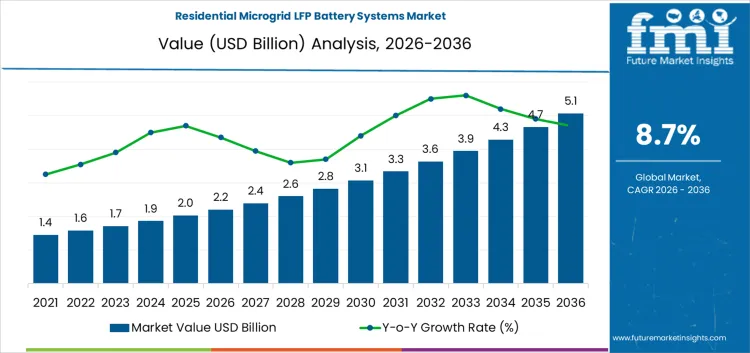
Residential Microgrid LFP Battery Systems Market Key Takeaways
| Metric | Value |
|---|---|
| Industry Value (2026) | USD 2.2 Billion |
| Forecast Value (2036) | USD 5.1 Billion |
| Forecast CAGR 2026 to 2036 | 8.70% |
How Is the Global Residential Microgrid LFP Battery Systems Market Advancing?
-
International Renewable Energy Agency (IRENA). (2023). Battery Storage for Residential and Distributed Energy Systems. IRENA Technical Report.
-
International Electrotechnical Commission (IEC). (2024). IEC 62933-5-2 – Electrical Energy Storage Systems: Safety Considerations and Testing Procedures. IEC Standards Publications.
-
United States Department of Energy (DOE). (2024). Residential Energy Storage and Microgrid Deployment: 2024 Technical Assessment. Office of Electricity, DOE Publications.
-
European Commission. (2024). Energy Storage and Distributed Generation in the EU: Policy and Market Outlook 2024. Directorate-General for Energy (DG ENER).
-
International Energy Agency (IEA). (2023). Energy Storage Tracking Report 2023: Distributed Battery Systems and Grid Integration. IEA Publications.
-
What Is the Segment-Wise Overview of the Residential Microgrid LFP Battery Systems Market?
The residential microgrid LFP battery systems market is shaped by mid-capacity system adoption and reliability-driven applications. Systems sized 10-20 kWh lead with a 44% share, as they closely match typical household energy demand while maintaining manageable installation and equipment costs. These systems integrate efficiently with rooftop solar installations and support frequent charge-discharge cycles due to the long service life and thermal stability of LFP chemistry. On the application side, backup power accounts for 41% of demand, reflecting increasing concerns around grid reliability and outage frequency. Homeowners prioritize uninterrupted electricity for essential loads, making backup-focused installations the most common entry point for residential microgrids.
Why Do 10-20 kWh Systems Lead the Residential Microgrid LFP Battery Systems Market?
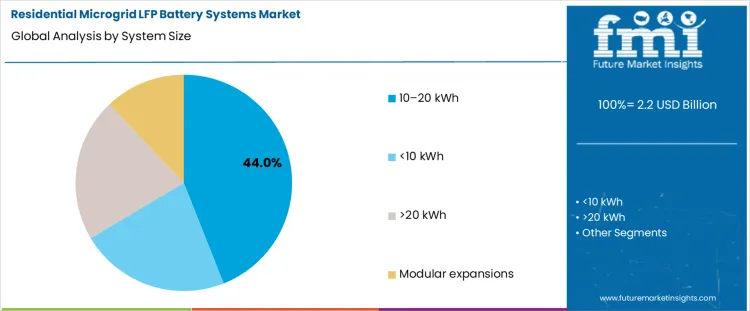
Battery systems in the 10-20 kWh range account for 44% of market demand in the Residential Microgrid LFP Battery Systems Market, as they offer an optimal balance between capacity, cost, and household energy needs. This size range is well suited for typical residential loads, supporting essential appliances, lighting, and HVAC systems during grid outages while remaining economically viable for homeowners. LFP chemistry enhances safety, thermal stability, and cycle life, making mid-sized systems attractive for long-term residential deployment. These systems also integrate effectively with rooftop solar installations, enabling daily charge-discharge cycles without accelerated degradation. As homeowners increasingly seek reliable energy resilience without oversizing investments, 10-20 kWh LFP systems continue to dominate residential microgrid configurations.
Why Does Backup Power Dominate Applications in the Residential Microgrid LFP Battery Systems Market?
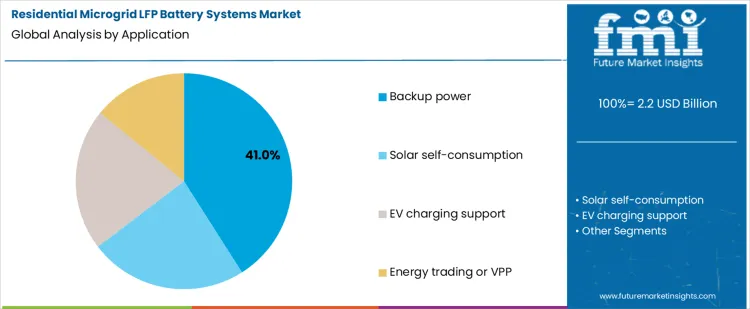
Backup power applications represent 41% of total demand, positioning them as the leading use case in the Residential Microgrid LFP Battery Systems Market. Increasing grid instability, weather-related outages, and aging power infrastructure have heightened homeowner demand for reliable backup solutions. LFP battery systems provide fast response, consistent output, and long operational life, making them ideal for emergency power supply. Residential users prioritize uninterrupted power for critical loads such as refrigeration, medical equipment, and communication systems. Backup-focused installations also serve as an entry point into broader microgrid adoption, with many systems later expanded to support solar self-consumption or EV charging. This strong emphasis on energy reliability continues to drive backup power as the primary application segment.
What Are the Key Dynamics for the Residential Microgrid LFP Battery Systems Market?
The residential microgrid LFP (lithium iron phosphate) battery systems market is driven by the increasing adoption of decentralized energy solutions that enhance energy reliability, resilience, and cost efficiency for homes and small communities. Residential microgrid systems incorporating LFP batteries support energy storage from renewable sources like solar PV, ensuring stable power supply during grid interruptions and peak demand. Key market dynamics include rising investments in residential energy independence, growing demand for backup power solutions, and expanded consumer interest in controlling energy usage and costs. LFP battery technology, known for its safety profile and long cycle life, is increasingly preferred for residential microgrid applications.
Why Is the Residential Microgrid LFP Battery Systems Market Growing?
The market is growing as homeowners and communities seek reliable energy storage solutions to complement distributed renewable generation and manage power intermittency. Falling costs of solar installations and LFP batteries, combined with favorable financing options and incentives for home energy storage, are making residential microgrid systems more accessible. Advances in battery management systems (BMS), improved energy density, and enhanced system integration with smart inverters and energy management platforms are also boosting adoption. Increased awareness of potential grid instability, extreme weather events, and the desire for energy autonomy are encouraging investments in LFP-based microgrid battery solutions.
How Are the Key Drivers Shaping the Residential Microgrid LFP Battery Systems Market?
Key drivers shaping the market include supportive policies and rebate programs that encourage home energy storage installations, particularly in regions with time-of-use tariffs and demand charges. LFP batteries offer improved safety, thermal stability, and longer cycle life compared to alternative chemistries, making them attractive for residential settings where safety and longevity are priorities. Technological improvements in battery design, system monitoring, and predictive energy optimization are enhancing system performance and user experience. Growing integration of Internet of Things (IoT) platforms and smart home energy management systems is enabling homeowners to optimize energy usage and reduce dependency on traditional utility supply.
What Is the Growth Outlook for the Residential Microgrid LFP Battery Systems Market by Country?
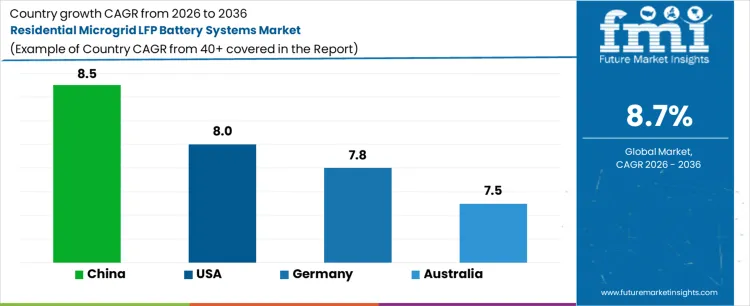
| Country | CAGR (%) |
|---|---|
| China | 8.5% |
| USA | 8.0% |
| Germany | 7.8% |
| Australia | 7.5% |
The residential microgrid LFP battery systems market is expanding steadily as households seek reliable, decentralized energy solutions. China leads with an 8.5% CAGR, driven by strong battery manufacturing capabilities and rapid deployment of residential energy storage. The USA follows at 8.0%, supported by grid resilience needs and growing solar-plus-storage adoption. Germany grows at 7.8%, benefiting from high rooftop solar penetration and demand for energy autonomy. Australia expands at 7.5%, driven by remote energy needs and widespread solar adoption. As residential energy independence gains importance, LFP-based microgrid battery systems are expected to see continued growth across these regions.
What Is Driving the Growth of the Residential Microgrid LFP Battery Systems Market in China?
The residential microgrid LFP battery systems market in China is growing at a CAGR of 8.5%, driven by rapid deployment of distributed energy systems and strong domestic battery manufacturing capacity. China’s large-scale adoption of rooftop solar, combined with increasing residential energy storage installations, is accelerating demand for lithium iron phosphate (LFP) batteries due to their safety, long cycle life, and cost advantages. Government programs supporting distributed renewable energy and grid resilience are encouraging homeowners to adopt microgrid solutions. Frequent grid load management challenges in certain regions are also increasing interest in self-sufficient residential energy systems. In addition, China’s vertically integrated battery supply chain enables competitive pricing and faster technology upgrades. As residential users prioritize reliability, energy independence, and long-term system durability, adoption of LFP-based microgrid battery systems is expected to continue growing steadily.
How Is the Residential Microgrid LFP Battery Systems Market Expanding in the USA?
The residential microgrid LFP battery systems market in the USA is expanding at a CAGR of 8.0%, supported by growing demand for energy resilience and backup power solutions. Increasing frequency of grid outages caused by extreme weather events is encouraging homeowners to invest in residential microgrids paired with LFP battery storage. LFP batteries are gaining preference due to their thermal stability, long service life, and suitability for daily cycling in home energy systems. Rising adoption of rooftop solar and community microgrids is further supporting demand for integrated battery solutions. Federal and state-level incentives for energy storage and clean energy adoption are also improving system affordability. Growing awareness of energy independence and long-term cost savings is influencing purchasing decisions. As residential energy systems become more decentralized, demand for LFP-based microgrid battery systems in the USA is expected to grow steadily.
What Is Supporting Growth of the Residential Microgrid LFP Battery Systems Market in Germany?
The residential microgrid LFP battery systems market in Germany is growing at a CAGR of 7.8%, driven by strong adoption of residential solar-plus-storage systems. Germany’s well-established rooftop solar market creates a natural demand for battery storage solutions that enable self-consumption optimization and grid balancing. LFP batteries are increasingly favored for residential microgrids due to their safety profile and long operational lifespan. Rising electricity prices and regulatory incentives encouraging decentralized energy use are further supporting market growth. German homeowners are also prioritizing energy autonomy and stable power supply, increasing interest in microgrid configurations. In addition, Germany’s strong focus on system reliability and compliance aligns well with LFP battery technologies. As residential energy storage becomes a standard component of home solar installations, demand for LFP-based microgrid battery systems is expected to remain strong.
How Is the Residential Microgrid LFP Battery Systems Market Developing in Australia?
The residential microgrid LFP battery systems market in Australia is expanding at a CAGR of 7.5%, supported by high rooftop solar penetration and geographic factors influencing grid reliability. Many Australian households, particularly in regional and remote areas, are adopting residential microgrids to reduce dependence on centralized power networks. LFP batteries are well suited for Australia’s residential energy needs due to their durability, safety, and performance in high-temperature environments. Increasing electricity costs and strong interest in energy self-sufficiency are encouraging investment in home battery systems. Growth in virtual power plant programs and community energy initiatives is also supporting adoption. In addition, supportive regulatory frameworks and falling battery costs are improving accessibility. As homeowners seek reliable and cost-effective energy storage solutions, demand for LFP-based residential microgrid systems is expected to grow steadily.
How Are Companies Competing in the Residential Microgrid LFP Battery Systems Market?
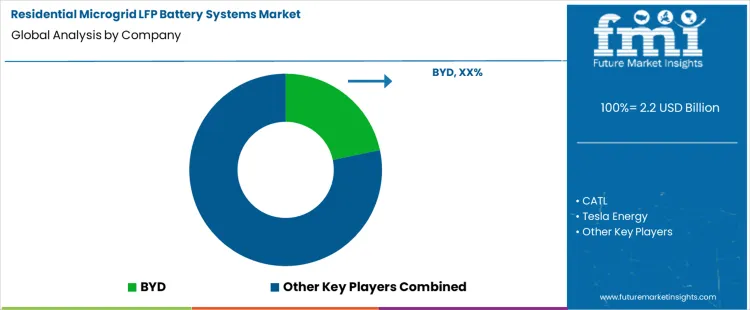
Competition in the residential microgrid LFP battery systems market is shaped by system reliability, safety, lifecycle performance, and seamless integration with rooftop solar and home energy management platforms. Lithium iron phosphate (LFP) chemistry is favored in residential microgrids due to its thermal stability, long cycle life, and suitability for daily charge-discharge operation. Vendors differentiate by offering modular battery architectures, intelligent energy management software, and installer-friendly designs that simplify deployment while ensuring stable backup power and optimized self-consumption.
BYD, CATL, and Tesla Energy compete through manufacturing scale, chemistry optimization, and vertically integrated system design. BYD leverages deep expertise in LFP cell production and pack engineering to deliver robust residential storage systems with high cycle durability and safety margins. CATL competes by applying advanced cell chemistry and manufacturing consistency to support long service life and high energy density in compact residential systems. Tesla Energy differentiates through tightly integrated battery hardware, power electronics, and software, emphasizing automated energy optimization, remote monitoring, and seamless operation within home microgrid environments.
LG Energy Solution, Sonnen, and Enphase Energy compete through system intelligence, brand positioning, and ecosystem integration. LG Energy Solution focuses on high-quality battery modules paired with advanced inverters and control systems to deliver dependable residential microgrid performance. Sonnen differentiates by positioning LFP batteries as part of intelligent energy communities, highlighting long lifespan and grid-interactive capabilities. Enphase Energy competes by integrating LFP battery systems with its microinverter and energy management ecosystem, enabling granular control, scalability, and simplified installation. Across the market, competitive advantage is defined by safety performance, software intelligence, modular scalability, and the ability to deliver reliable, user-centric residential microgrid solutions.
Key Players in Residential Microgrid LFP Battery Systems Market
- BYD
- CATL
- Tesla Energy
- LG Energy Solution
- Sonnen
- Enphase Energy
Scope of Report
| Attributes | Description |
|---|---|
| Quantitative Unit (2026) | USD Billion |
| System Size | <10 kWh, 10-20 kWh, >20 kWh, Modular Expansions |
| Application | Backup Power, Solar Self-Consumption, EV Charging Support, Energy Trading or VPP |
| Regions Covered | Asia Pacific, Europe, North America, Latin America, Middle East & Africa |
| Countries Covered | China, Japan, South Korea, India, Australia & New Zealand, ASEAN, Rest of Asia Pacific, Germany, United Kingdom, France, Italy, Spain, Nordic, BENELUX, Rest of Europe, United States, Canada, Mexico, Brazil, Chile, Rest of Latin America, Kingdom of Saudi Arabia, Other GCC Countries, Turkey, South Africa, Other African Union, Rest of Middle East & Africa |
| Key Companies Profiled | BYD, CATL, Tesla Energy, LG Energy Solution, Sonnen, Enphase Energy |
| Additional Attributes | Dollar sales by system size and application; regional market size and forecast analysis; growth outlook across major regions; adoption trends for LFP-based residential microgrid battery systems; assessment of demand drivers linked to energy resilience, rooftop solar integration, EV charging support, and participation in virtual power plant and energy trading programs. |
Residential Microgrid LFP Battery Systems Market by Key Segments
System Size
- 10-20 kWh
- <10 kWh
- >20 kWh
- Modular expansions
Application
- Backup power
- Solar self-consumption
- EV charging support
- Energy trading or VPP
Region
- Asia Pacific
- China
- Japan
- South Korea
- India
- Australia & New Zealand
- ASEAN
- Rest of Asia Pacific
- Europe
- Germany
- United Kingdom
- France
- Italy
- Spain
- Nordic
- BENELUX
- Rest of Europe
- North America
- United States
- Canada
- Mexico
- Latin America
- Brazil
- Chile
- Rest of Latin America
- Middle East & Africa
- Kingdom of Saudi Arabia
- Other GCC Countries
- Turkey
- South Africa
- Other African Union
- Rest of Middle East & Africa
Bibliography
- International Renewable Energy Agency (IRENA). (2023). Battery Storage for Residential and Distributed Energy Systems. IRENA Technical Report.
- International Electrotechnical Commission (IEC). (2024). IEC 62933-5-2 – Electrical Energy Storage Systems: Safety Considerations and Testing Procedures. IEC Standards Publications.
- United States Department of Energy (DOE). (2024). Residential Energy Storage and Microgrid Deployment: 2024 Technical Assessment. Office of Electricity, DOE Publications.
- European Commission. (2024). Energy Storage and Distributed Generation in the EU: Policy and Market Outlook 2024. Directorate-General for Energy (DG ENER).
- International Energy Agency (IEA). (2023). Energy Storage Tracking Report 2023: Distributed Battery Systems and Grid Integration. IEA Publications.
Frequently Asked Questions
How big is the residential microgrid lfp battery systems market in 2026?
The global residential microgrid lfp battery systems market is estimated to be valued at USD 2.2 billion in 2026.
What will be the size of residential microgrid lfp battery systems market in 2036?
The market size for the residential microgrid lfp battery systems market is projected to reach USD 5.1 billion by 2036.
How much will be the residential microgrid lfp battery systems market growth between 2026 and 2036?
The residential microgrid lfp battery systems market is expected to grow at a 8.7% CAGR between 2026 and 2036.
What are the key product types in the residential microgrid lfp battery systems market?
The key product types in residential microgrid lfp battery systems market are 10–20 kwh, <10 kwh, >20 kwh and modular expansions.
Which application segment to contribute significant share in the residential microgrid lfp battery systems market in 2026?
In terms of application, backup power segment to command 41.0% share in the residential microgrid lfp battery systems market in 2026.
Preview the report firsthand - request a free sample
Get SampleGet the brochure for pricing and purchase details.
Get PDFTable of Content
- Executive Summary
- Global Market Outlook
- Demand-side Trends
- Supply-side Trends
- Technology Roadmap Analysis
- Analysis and Recommendations
- Market Overview
- Market Coverage / Taxonomy
- Market Definition / Scope / Limitations
- Market Background
- Market Dynamics
- Drivers
- Restraints
- Opportunity
- Trends
- Scenario Forecast
- Demand in Optimistic Scenario
- Demand in Likely Scenario
- Demand in Conservative Scenario
- Opportunity Map Analysis
- Product Life Cycle Analysis
- Supply Chain Analysis
- Investment Feasibility Matrix
- Value Chain Analysis
- PESTLE and Porter’s Analysis
- Regulatory Landscape
- Regional Parent Market Outlook
- Production and Consumption Statistics
- Import and Export Statistics
- Market Dynamics
- Global Market Analysis 2021 to 2025 and Forecast, 2026 to 2036
- Historical Market Size Value (USD Million) Analysis, 2021 to 2025
- Current and Future Market Size Value (USD Million) Projections, 2026 to 2036
- Y-o-Y Growth Trend Analysis
- Absolute $ Opportunity Analysis
- Global Market Pricing Analysis 2021 to 2025 and Forecast 2026 to 2036
- Global Market Analysis 2021 to 2025 and Forecast 2026 to 2036, By System Size
- Introduction / Key Findings
- Historical Market Size Value (USD Million) Analysis By System Size , 2021 to 2025
- Current and Future Market Size Value (USD Million) Analysis and Forecast By System Size , 2026 to 2036
- 10-20 kWh
- <10 kWh
- >20 kWh
- Modular expansions
- 10-20 kWh
- Y-o-Y Growth Trend Analysis By System Size , 2021 to 2025
- Absolute $ Opportunity Analysis By System Size , 2026 to 2036
- Global Market Analysis 2021 to 2025 and Forecast 2026 to 2036, By Application
- Introduction / Key Findings
- Historical Market Size Value (USD Million) Analysis By Application, 2021 to 2025
- Current and Future Market Size Value (USD Million) Analysis and Forecast By Application, 2026 to 2036
- Backup power
- Solar self-consumption
- EV charging support
- Energy trading or VPP
- Backup power
- Y-o-Y Growth Trend Analysis By Application, 2021 to 2025
- Absolute $ Opportunity Analysis By Application, 2026 to 2036
- Global Market Analysis 2021 to 2025 and Forecast 2026 to 2036, By Region
- Introduction
- Historical Market Size Value (USD Million) Analysis By Region, 2021 to 2025
- Current Market Size Value (USD Million) Analysis and Forecast By Region, 2026 to 2036
- North America
- Latin America
- Western Europe
- Eastern Europe
- East Asia
- South Asia and Pacific
- Middle East & Africa
- Market Attractiveness Analysis By Region
- North America Market Analysis 2021 to 2025 and Forecast 2026 to 2036, By Country
- Historical Market Size Value (USD Million) Trend Analysis By Market Taxonomy, 2021 to 2025
- Market Size Value (USD Million) Forecast By Market Taxonomy, 2026 to 2036
- By Country
- USA
- Canada
- Mexico
- By System Size
- By Application
- By Country
- Market Attractiveness Analysis
- By Country
- By System Size
- By Application
- Key Takeaways
- Latin America Market Analysis 2021 to 2025 and Forecast 2026 to 2036, By Country
- Historical Market Size Value (USD Million) Trend Analysis By Market Taxonomy, 2021 to 2025
- Market Size Value (USD Million) Forecast By Market Taxonomy, 2026 to 2036
- By Country
- Brazil
- Chile
- Rest of Latin America
- By System Size
- By Application
- By Country
- Market Attractiveness Analysis
- By Country
- By System Size
- By Application
- Key Takeaways
- Western Europe Market Analysis 2021 to 2025 and Forecast 2026 to 2036, By Country
- Historical Market Size Value (USD Million) Trend Analysis By Market Taxonomy, 2021 to 2025
- Market Size Value (USD Million) Forecast By Market Taxonomy, 2026 to 2036
- By Country
- Germany
- UK
- Italy
- Spain
- France
- Nordic
- BENELUX
- Rest of Western Europe
- By System Size
- By Application
- By Country
- Market Attractiveness Analysis
- By Country
- By System Size
- By Application
- Key Takeaways
- Eastern Europe Market Analysis 2021 to 2025 and Forecast 2026 to 2036, By Country
- Historical Market Size Value (USD Million) Trend Analysis By Market Taxonomy, 2021 to 2025
- Market Size Value (USD Million) Forecast By Market Taxonomy, 2026 to 2036
- By Country
- Russia
- Poland
- Hungary
- Balkan & Baltic
- Rest of Eastern Europe
- By System Size
- By Application
- By Country
- Market Attractiveness Analysis
- By Country
- By System Size
- By Application
- Key Takeaways
- East Asia Market Analysis 2021 to 2025 and Forecast 2026 to 2036, By Country
- Historical Market Size Value (USD Million) Trend Analysis By Market Taxonomy, 2021 to 2025
- Market Size Value (USD Million) Forecast By Market Taxonomy, 2026 to 2036
- By Country
- China
- Japan
- South Korea
- By System Size
- By Application
- By Country
- Market Attractiveness Analysis
- By Country
- By System Size
- By Application
- Key Takeaways
- South Asia and Pacific Market Analysis 2021 to 2025 and Forecast 2026 to 2036, By Country
- Historical Market Size Value (USD Million) Trend Analysis By Market Taxonomy, 2021 to 2025
- Market Size Value (USD Million) Forecast By Market Taxonomy, 2026 to 2036
- By Country
- India
- ASEAN
- Australia & New Zealand
- Rest of South Asia and Pacific
- By System Size
- By Application
- By Country
- Market Attractiveness Analysis
- By Country
- By System Size
- By Application
- Key Takeaways
- Middle East & Africa Market Analysis 2021 to 2025 and Forecast 2026 to 2036, By Country
- Historical Market Size Value (USD Million) Trend Analysis By Market Taxonomy, 2021 to 2025
- Market Size Value (USD Million) Forecast By Market Taxonomy, 2026 to 2036
- By Country
- Kingdom of Saudi Arabia
- Other GCC Countries
- Turkiye
- South Africa
- Other African Union
- Rest of Middle East & Africa
- By System Size
- By Application
- By Country
- Market Attractiveness Analysis
- By Country
- By System Size
- By Application
- Key Takeaways
- Key Countries Market Analysis
- USA
- Pricing Analysis
- Market Share Analysis, 2025
- By System Size
- By Application
- Canada
- Pricing Analysis
- Market Share Analysis, 2025
- By System Size
- By Application
- Mexico
- Pricing Analysis
- Market Share Analysis, 2025
- By System Size
- By Application
- Brazil
- Pricing Analysis
- Market Share Analysis, 2025
- By System Size
- By Application
- Chile
- Pricing Analysis
- Market Share Analysis, 2025
- By System Size
- By Application
- Germany
- Pricing Analysis
- Market Share Analysis, 2025
- By System Size
- By Application
- UK
- Pricing Analysis
- Market Share Analysis, 2025
- By System Size
- By Application
- Italy
- Pricing Analysis
- Market Share Analysis, 2025
- By System Size
- By Application
- Spain
- Pricing Analysis
- Market Share Analysis, 2025
- By System Size
- By Application
- France
- Pricing Analysis
- Market Share Analysis, 2025
- By System Size
- By Application
- India
- Pricing Analysis
- Market Share Analysis, 2025
- By System Size
- By Application
- ASEAN
- Pricing Analysis
- Market Share Analysis, 2025
- By System Size
- By Application
- Australia & New Zealand
- Pricing Analysis
- Market Share Analysis, 2025
- By System Size
- By Application
- China
- Pricing Analysis
- Market Share Analysis, 2025
- By System Size
- By Application
- Japan
- Pricing Analysis
- Market Share Analysis, 2025
- By System Size
- By Application
- South Korea
- Pricing Analysis
- Market Share Analysis, 2025
- By System Size
- By Application
- Russia
- Pricing Analysis
- Market Share Analysis, 2025
- By System Size
- By Application
- Poland
- Pricing Analysis
- Market Share Analysis, 2025
- By System Size
- By Application
- Hungary
- Pricing Analysis
- Market Share Analysis, 2025
- By System Size
- By Application
- Kingdom of Saudi Arabia
- Pricing Analysis
- Market Share Analysis, 2025
- By System Size
- By Application
- Turkiye
- Pricing Analysis
- Market Share Analysis, 2025
- By System Size
- By Application
- South Africa
- Pricing Analysis
- Market Share Analysis, 2025
- By System Size
- By Application
- USA
- Market Structure Analysis
- Competition Dashboard
- Competition Benchmarking
- Market Share Analysis of Top Players
- By Regional
- By System Size
- By Application
- Competition Analysis
- Competition Deep Dive
- BYD
- Overview
- Product Portfolio
- Profitability by Market Segments (Product/Age /Sales Channel/Region)
- Sales Footprint
- Strategy Overview
- Marketing Strategy
- Product Strategy
- Channel Strategy
- CATL
- Tesla Energy
- LG Energy Solution
- Sonnen
- Enphase Energy
- BYD
- Competition Deep Dive
- Assumptions & Acronyms Used
- Research Methodology


