

- Industry Size (2026)
- USD 698.1 Mn
- Forecast (2036)
- USD 2287.2 Mn
- CAGR (2026 to 2036)
- 12.6%
EV Coolant Filters and Strainers Market Forecast and Outlook 2026 to 2036
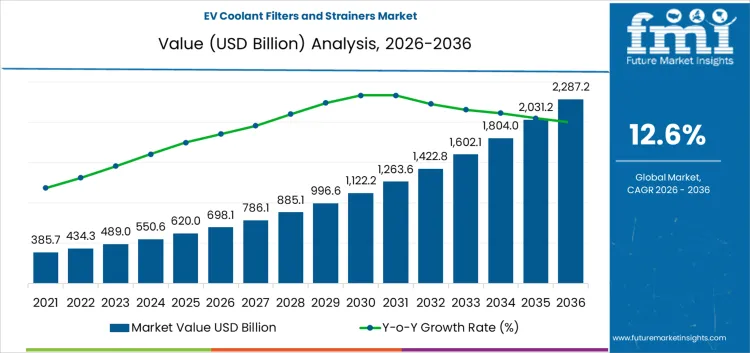
The EV coolant filters and strainers market is likely to be valued at USD 698.1 million in 2026 and is projected to reach USD 2,287.2 million by 2036, reflecting a CAGR of 12.6%. Early demand is driven by engineering risk management inside battery and power electronics cooling loops. Particle control protects pumps, cold plates, and narrow channels where blockage causes rapid thermal stress. Specifications are written at the platform design stage, which fixes filter geometry and media grade before production begins. Volume growth follows EV platform launches, while value per unit reflects system pressure, flow rate, and cleanliness targets rather than cosmetic differences.
In the later years, market behavior is shaped by installed base expansion and by service policies tied to cooling system integrity. Vehicle makers align coolant component sourcing with warranty exposure, which limits supplier substitution. Field data begins to influence change intervals and stocking policies, shifting sales toward predictable service schedules. Pricing discipline remains because components are audited against failure risk, not comfort features. Capacity planning tracks regional EV parc growth and factory localization rules. Growth remains strong, supported by thermal management standardization across architectures and by the rising cost of cooling system failures in high energy density battery packs.
Quick Stats of the EV Coolant Filters and Strainers Market
- EV Coolant Filters and Strainers Market Value (2026): USD 698.1 million
- EV Coolant Filters and Strainers Forecast Value (2036): USD 2,287.2 million
- EV Coolant Filters and Strainers Forecast CAGR 2026 to 2036: 12.6%
- Leading Cooling Circuit in EV Coolant Filters and Strainers Market: Battery Cooling Circuit (44 % share)
- Leading Product Type in EV Coolant Filters and Strainers Market: Inline Coolant Filters (52 % share)
- Key Growth Regions in EV Coolant Filters and Strainers Market: China, India, USA, South Korea, Germany
- Top Players in EV Coolant Filters and Strainers Market: MANN+HUMMEL, MAHLE, Parker Hannifin, Donaldson, Hengst, Freudenberg Filtration, UFI Filters, Sogefi, Denso, Bosch
What is the Growth Forecast for EV Coolant Filters and Strainers Market through 2036?
Between 2026 and 2031, the EV coolant filters and strainers market is projected to rise from USD 698.1 million along a steep trajectory consistent with a 12.6% CAGR, reflecting the rapid multiplication of liquid cooling loops inside electric vehicles. Battery packs, e-motors, and power electronics increasingly rely on closed-loop thermal management systems where particle control directly affects efficiency and component life. Filtration is specified not as a maintenance accessory but as a design requirement integrated into cooling architecture. Inline filters dominate early adoption because they fit modular cooling layouts used across platforms. Growth is driven by OEM and Tier 1 programs rather than service demand, with design engineers prioritizing pressure drop control, material compatibility, and long-life performance over unit cost considerations.
From 2031 to 2036, the market is expected to expand to USD 2,287.2 million, with value growth accelerating as cooling systems become more segmented and thermally loaded. Higher energy-density batteries and faster charging rates increase sensitivity to contamination and flow restriction, which raises filtration content per vehicle even when platforms are shared. Serviceable housings and strainers gain relevance in fleets and long-life applications, though most volumes remain embedded at the factory level. Purchasing decisions increasingly sit within thermal system design teams rather than commodity sourcing groups. Competitive positioning depends on fluid dynamics expertise, material science, and integration capability with pump and heat exchanger suppliers. This favors established filtration specialists such as MANN+HUMMEL, MAHLE, Parker Hannifin, Donaldson, Hengst, Freudenberg Filtration, UFI Filters, Sogefi, Denso, and Bosch.
EV Coolant Filters and Strainers Market Key Takeaways
| Metric | Value |
|---|---|
| Market Value (2026) | USD 698.1 million |
| Forecast Value (2036) | USD 2,287.2 million |
| Forecast CAGR 2026 to 2036 | 12.6% |
How Are EV Coolant Filters and Strainers Enhancing Thermal Management Systems?
EV coolant filters and strainers are increasingly adopted to maintain clean and efficient thermal management in electric vehicles, protecting battery packs, power electronics, and motors from contaminants. Historically, thermal systems relied on basic fluid circulation without dedicated filtration, increasing the risk of clogging, corrosion, and reduced cooling efficiency. Modern filters and strainers incorporate high-efficiency media, corrosion-resistant housings, and precision mesh to capture debris and particles while maintaining consistent coolant flow. EV manufacturers, thermal system suppliers, and component integrators prioritize filtration performance, durability, and compatibility with glycol-based and dielectric coolants. Early adoption focused on high-performance EVs, while current demand spans passenger EVs, commercial electric fleets, and hybrid vehicles, driven by thermal management requirements, battery longevity, and reliability expectations. Flow rate, media efficiency, and material resistance influence supplier selection.
Rising EV adoption, increased battery energy densities, and thermal system complexity are shaping market growth. Compared with conventional fluid systems, contemporary EV coolant filters and strainers emphasize particle removal, consistent flow, and chemical compatibility to maintain cooling efficiency. Cost structures depend on filter media quality, housing design, and production precision, concentrating margins among suppliers capable of delivering reliable, high-performance components. EV manufacturers adopt these solutions to prevent coolant system failures, optimize thermal performance, and extend battery and component life. By 2036, coolant filters and strainers are expected to become standard across passenger, commercial, and hybrid electric vehicles, supporting system reliability, thermal efficiency, and safe operation.
What Factors Are Shaping the Demand for EV Coolant Filters and Strainers by Cooling Circuit and Product Architecture in 2026?
The EV coolant filters and strainers market in 2026 is segmented by cooling circuit and by product type. By cooling circuit, demand is divided into battery, e motor, power electronics, and cabin heat pump or other loops, each with different contamination risks and thermal stability requirements. By product type, demand is organized around inline coolant filters, coolant strainers, serviceable filter housings, and other formats that differ in service access, pressure drop, and packaging constraints. These segments reflect how EV thermal systems are engineered for reliability, how failure risk is distributed across subsystems, and how manufacturers plan maintenance concepts for sealed versus serviceable cooling architectures across vehicle platforms.
Why Does the Battery Cooling Circuit Represent the Largest Application Segment?
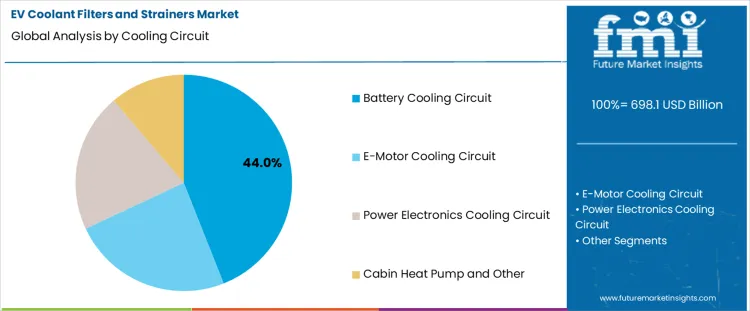
The battery cooling circuit accounts for about 44% of demand in 2026, reflecting the high cost and sensitivity of battery packs to particulate and chemical contamination. Any blockage or degradation in this loop affects cell temperature uniformity, which directly influences performance, aging, and safety margins. Manufacturers treat this circuit as a protected zone, where filtration is specified as a risk control measure rather than a routine maintenance item. Battery packs also operate across wide thermal ranges, which increases stress on seals and hoses and raises the probability of debris generation over time. The financial impact of battery failure justifies more conservative filtration strategies, which anchors this circuit as the primary volume driver for coolant filtration components.
E motor, power electronics, and cabin heat pump circuits face different risk profiles and cost trade offs. These loops manage components that are easier to replace and less likely to trigger catastrophic vehicle level outcomes if contamination occurs. Their thermal loads and flow rates also vary by architecture, which changes how much filtration is required. Some manufacturers integrate shared cooling loops, which reduces the number of discrete filtration points. In other cases, these circuits rely on strainers or coarse protection rather than full filtration. Demand in these segments follows platform design philosophy rather than uniform safety logic, which keeps their combined volumes below that of the battery loop despite their importance to overall thermal management performance.
Why Do Inline Coolant Filters Dominate Product Selection in EV Thermal Systems?
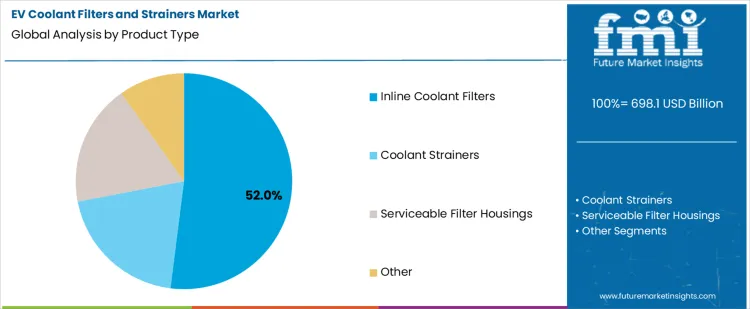
Inline coolant filters represent about 52% of demand in 2026 because they offer continuous protection without requiring frequent service access. These units are integrated directly into hoses or rigid lines, which allows them to capture particles throughout the operating life of the vehicle. EV manufacturers favor sealed or low maintenance cooling systems, and inline filters support this approach by minimizing user intervention. Their packaging flexibility allows placement near sensitive components, which shortens the contamination path. From an assembly perspective, they fit well into automated line processes and do not require separate housings or service ports. This combination of protection coverage, packaging adaptability, and maintenance simplicity sustains their leading position.
Coolant strainers and serviceable housings serve different engineering and ownership models. Strainers focus on catching larger debris and are often used as a first barrier during early life or break in periods. Serviceable housings support scheduled maintenance concepts, which are less common in EV cooling systems designed for long sealed intervals. These solutions add access points, seals, and potential leak paths, which increases validation and warranty exposure. Their adoption depends on whether a manufacturer expects periodic coolant service or full life fill strategies. As a result, they remain secondary choices, specified in selected platforms or subsystems rather than forming the dominant architecture across the broader EV fleet.
Why Are Thermal Management Architectures, Not Vehicle Volumes, Creating a New Demand Base for EV Coolant Filters and Strainers through 2036?
Demand originates from how electric powertrains are cooled rather than from how many vehicles are sold. Battery packs, inverters, and power electronics require tightly controlled coolant cleanliness because small particles can block microchannels and degrade heat transfer. As cooling plates, cold plates, and compact heat exchangers become more densely packed, tolerance for contamination narrows. OEMs also want long life coolant loops to avoid battery pack disassembly during service. This shifts filtration from optional protection to a designed in safeguard. Even modest EV volume growth creates disproportionate demand for filtration components because each vehicle contains multiple closed loop cooling circuits.
What Design Tradeoffs and Cost Discipline Are Slowing Widespread Standardization of These Components?
Restraints come from integration choices and cost targets. Every filter or strainer adds pressure drop, housing cost, and service complexity to a cooling loop. Some OEMs attempt to rely on cleaner manufacturing processes instead of in line filtration to save cost and space. Packaging is tight, especially in compact platforms where routing is already constrained. Validation cycles are long because any flow restriction risk must be tested across temperature extremes. Suppliers also face fragmented specifications since each platform uses different coolant chemistries and loop layouts. These factors delay convergence toward standard parts and limit rapid, high volume adoption across all vehicle segments.
How Are Battery Service Strategies and Cooling System Integration Changing the Long Term Role of Filtration?
The trend is moving toward deeper integration and lower visibility. Battery packs are increasingly treated as sealed lifetime units, which increases the value of internal cleanliness control. This pushes filtration and straining functions closer to heat exchangers and cold plates, sometimes inside subassemblies rather than as serviceable parts. At the same time, centralized thermal management modules are replacing separate loops, which changes flow paths and filtration points. OEMs also want fewer service interventions over the vehicle life, shifting focus from replaceable filters to long life strainers. The category evolves from aftermarket items to embedded reliability components.
What is the Demand for EV Coolant Filters and Strainers by Country?
| Country | CAGR (%) |
|---|---|
| China | 14.8% |
| India | 13.6% |
| USA | 12.2% |
| South Korea | 12.0% |
| Germany | 11.4% |
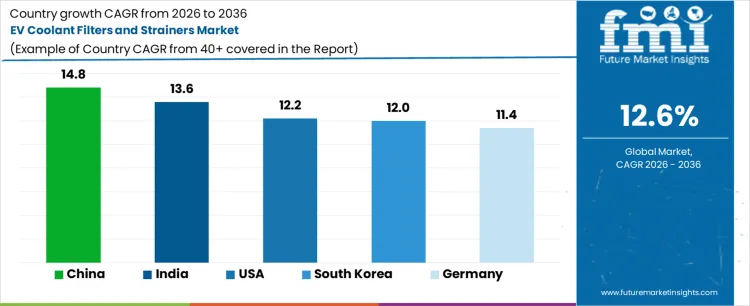
Demand for EV coolant filters and strainers is rising as electric vehicle manufacturers focus on battery thermal management, reliability, and longevity of cooling systems. China leads with a 14.8% CAGR, driven by rapid EV adoption, large-scale battery production, and integration of advanced thermal management systems. India follows at 13.6%, supported by growing domestic EV production and adoption of high-performance cooling components. The USA grows at 12.2%, shaped by fleet electrification programs and advanced EV designs. South Korea records 12.0% growth, influenced by domestic battery and EV manufacturers. Germany shows 11.4% CAGR, reflecting steady adoption in European EV production and focus on efficient thermal management solutions.
How is China experiencing growth in the EV coolant filters and strainers market?
China is experiencing growth at a CAGR of 14.8%, supported by adoption of EV coolant filters and strainers market solutions to enhance battery thermal management, cooling system reliability, and electric vehicle performance. Manufacturers and suppliers are producing filters and strainers optimized for high filtration efficiency, thermal stability, and integration with EV cooling circuits. Demand is concentrated in EV manufacturing hubs, battery assembly plants, and R&D centers. Investments focus on material durability, system reliability, and compliance with automotive and battery safety standards rather than large-scale deployment. Growth reflects rising EV production, industrial adoption of advanced cooling solutions, and increasing focus on battery longevity and efficiency.
- Battery thermal management drives adoption.
- Filters optimize filtration efficiency and thermal stability.
- EV hubs and battery assembly centers concentrate demand.
- Material durability and compliance guide investment.
How is India witnessing growth in the EV coolant filters and strainers market?
India is witnessing growth at a CAGR of 13.6%, fueled by adoption of EV coolant filters and strainers market solutions to improve battery cooling efficiency, system reliability, and operational safety. Manufacturers and suppliers are deploying filters and strainers optimized for thermal tolerance, high filtration performance, and integration with EV battery modules. Demand is concentrated in EV production hubs, battery assembly facilities, and R&D centers. Investments prioritize material quality, system reliability, and adherence to automotive and battery safety standards rather than fleet-scale deployment. Growth reflects increasing EV adoption, industrial focus on cooling system performance, and integration of advanced filtration solutions.
- Battery cooling efficiency drives adoption.
- Filters enhance thermal tolerance and filtration performance.
- EV hubs and battery assembly facilities concentrate demand.
- Material quality and compliance guide investment.
How is the United States experiencing growth in the EV coolant filters and strainers market?
United States is experiencing growth at a CAGR of 12.2%, supported by adoption of EV coolant filters and strainers market solutions to improve thermal management, cooling system reliability, and battery performance. Manufacturers and suppliers are producing filters and strainers optimized for filtration efficiency, high-temperature resistance, and compatibility with EV cooling circuits. Demand is concentrated in EV manufacturing hubs, battery module production centers, and R&D facilities. Investments focus on material durability, system reliability, and compliance with automotive and battery safety standards rather than large-scale deployment. Growth reflects industrial adoption of EV technologies and increasing demand for efficient thermal management.
- Thermal management drives adoption.
- Filters optimize filtration efficiency and high-temperature resistance.
- EV hubs and battery production centers concentrate demand.
- Material durability and compliance guide investment.
How is South Korea witnessing growth in the EV coolant filters and strainers market?
South Korea is witnessing growth at a CAGR of 12%, fueled by adoption of EV coolant filters and strainers market solutions to enhance battery cooling efficiency, system reliability, and EV performance. Manufacturers and suppliers are deploying filters and strainers optimized for thermal stability, high filtration performance, and integration with battery cooling systems. Demand is concentrated in EV manufacturing hubs, battery assembly facilities, and R&D centers. Investments prioritize material durability, system reliability, and adherence to automotive and battery safety standards rather than fleet-scale deployment. Growth reflects industrial adoption of advanced EV cooling technologies and focus on battery efficiency.
- Battery cooling drives adoption.
- Filters enhance thermal stability and filtration performance.
- EV hubs and battery assembly centers concentrate demand.
- Material durability and compliance guide investment.
How is Germany experiencing growth in the EV coolant filters and strainers market?
Germany is experiencing growth at a CAGR of 11.4%, supported by adoption of EV coolant filters and strainers market solutions to improve battery thermal management, cooling system reliability, and operational safety. Manufacturers and suppliers are producing filters and strainers optimized for high-temperature resistance, filtration efficiency, and compatibility with EV battery modules. Demand is concentrated in EV production hubs, battery assembly facilities, and R&D centers. Investments focus on material durability, system performance, and compliance with automotive and battery safety standards rather than large-scale deployment. Growth reflects industrial adoption of advanced EV cooling solutions and rising EV production.
- Battery thermal management drives adoption.
- Filters optimize high-temperature resistance and filtration efficiency.
- EV hubs and battery assembly centers concentrate demand.
- Material durability and compliance guide investment.
Who Competes in the EV Coolant Filters and Strainers Market and What Defines Their Capabilities?
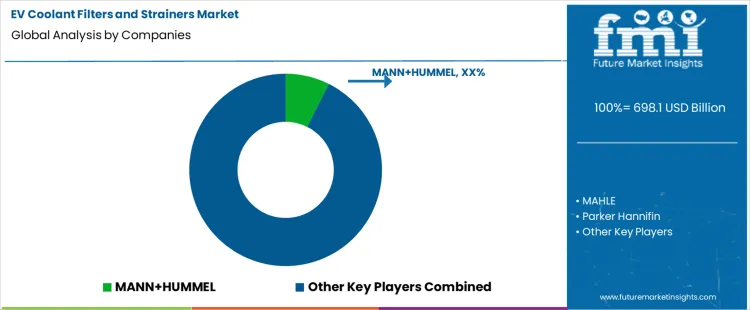
Competition in the EV coolant filters and strainers market is defined by filtration efficiency, thermal stability, and compatibility with electric vehicle thermal management systems. MANN+HUMMEL supplies filters engineered for high particle retention, stable flow, and durability under varying coolant temperatures. MAHLE develops coolant filters optimized for thermal resistance, low pressure drop, and integration with battery and power electronics cooling circuits. Parker Hannifin provides strainers and filtration systems designed for high reliability in EV thermal management loops. Donaldson delivers filters with advanced media for contaminant removal and long service life. Hengst supplies high-performance filters suitable for thermal circuit stability and flow optimization.
Freudenberg Filtration provides strainers and filters engineered for consistent performance and thermal resilience in EV systems. UFI Filters delivers compact filters designed for battery and powertrain coolant loops. Sogefi supplies filtration solutions optimized for flow control and particle capture. Denso develops coolant filters compatible with electric vehicle cooling modules and thermal circuits. Bosch provides high-efficiency coolant filters and strainers engineered for EV battery and power electronics cooling. Other regional and specialty suppliers focus on lightweight, compact, and thermally stable solutions. Competitive differentiation arises from filtration efficiency, thermal tolerance, flow stability, integration with EV thermal management systems, and durability under continuous operation in high-temperature conditions.
Key Players in the EV Coolant Filters and Strainers Market
- MANN+HUMMEL
- MAHLE
- Parker Hannifin
- Donaldson
- Hengst
- Freudenberg Filtration
- UFI Filters
- Sogefi
- Denso
- Bosch
Scope of the Report
| Items | Values |
|---|---|
| Quantitative Units (2026) | USD million |
| Cooling Circuit | Battery Cooling Circuit, E-Motor Cooling Circuit, Power Electronics Cooling Circuit, Cabin Heat Pump/Other |
| Product Type | Inline Coolant Filters, Coolant Strainers, Serviceable Filter Housings, Other |
| Vehicle Type | Battery Electric Vehicles, Plug-in Hybrids, Fuel Cell Electric Vehicles, Other |
| Sales Channel | OEM and Tier 1 Supply, Aftermarket Service, Fleet/Service Networks, Other |
| Regions Covered | Asia Pacific, Europe, North America, Latin America, Middle East & Africa |
| Countries Covered | China, Japan, South Korea, India, Australia & New Zealand, ASEAN, Germany, United Kingdom, France, Italy, Spain, Nordic, BENELUX, United States, Canada, Mexico, Brazil, Chile, Saudi Arabia, Turkey, South Africa, and other regional markets |
| Key Companies Profiled | MANN+HUMMEL, MAHLE, Parker Hannifin, Donaldson, Hengst, Freudenberg Filtration, UFI Filters, Sogefi, Denso, Bosch |
| Additional Attributes | Dollar sales by cooling circuit, product type, vehicle type, and sales channel, content growth driven by EV thermal management architecture rather than vehicle volumes, integration of filtration into sealed coolant loops for battery and power electronics protection, platform-level specification locking filter geometry and media grades, dominance of OEM and Tier 1 sourcing over service replacement, and regional demand aligned with EV parc growth and battery manufacturing localization. |
EV Coolant Filters and Strainers Market Segmentation
Cooling Circuit:
- Battery Cooling Circuit
- E-Motor Cooling Circuit
- Power Electronics Cooling Circuit
- Cabin Heat Pump/Other
Product Type:
- Inline Coolant Filters
- Coolant Strainers
- Serviceable Filter Housings
- Other
Vehicle Type:
- Battery Electric Vehicles
- Plug-in Hybrids
- Fuel Cell Electric Vehicles
- Other
Sales Channel:
- OEM and Tier 1 Supply
- Aftermarket Service
- Fleet/Service Networks
- Other
Region:
- Asia Pacific
- China
- Japan
- South Korea
- India
- Australia & New Zealand
- ASEAN
- Rest of Asia Pacific
- Europe
- Germany
- United Kingdom
- France
- Italy
- Spain
- Nordic
- BENELUX
- Rest of Europe
- North America
- United States
- Canada
- Mexico
- Latin America
- Brazil
- Chile
- Rest of Latin America
- Middle East & Africa
- Kingdom of Saudi Arabia
- Other GCC Countries
- Turkey
- South Africa
- Other African Union
- Rest of Middle East & Africa
Bibliography
- California Air Resources Board. (2024). Advanced Clean Cars II regulations. California Environmental Protection Agency.
- European Commission. (2024). Regulation (EU) 2019/2144 on the approval and market surveillance of motor vehicles. Official Journal of the European Union.
- Government of India, Ministry of Heavy Industries. (2025). Faster Adoption and Manufacturing of Hybrid and Electric Vehicles (FAME India Phase II) program report.
Frequently Asked Questions
How big is the ev coolant filters and strainers market in 2026?
The global ev coolant filters and strainers market is estimated to be valued at USD 698.1 billion in 2026.
What will be the size of ev coolant filters and strainers market in 2036?
The market size for the ev coolant filters and strainers market is projected to reach USD 2,287.2 billion by 2036.
How much will be the ev coolant filters and strainers market growth between 2026 and 2036?
The ev coolant filters and strainers market is expected to grow at a 12.6% CAGR between 2026 and 2036.
What are the key product types in the ev coolant filters and strainers market?
The key product types in ev coolant filters and strainers market are battery cooling circuit, e-motor cooling circuit, power electronics cooling circuit and cabin heat pump and other.
Which product type segment to contribute significant share in the ev coolant filters and strainers market in 2026?
In terms of product type, inline coolant filters segment to command 52.0% share in the ev coolant filters and strainers market in 2026.
Preview the report firsthand - request a free sample
Get SampleGet the brochure for pricing and purchase details.
Get PDFTable of Content
- Executive Summary
- Global Market Outlook
- Demand-side Trends
- Supply-side Trends
- Technology Roadmap Analysis
- Analysis and Recommendations
- Market Overview
- Market Coverage / Taxonomy
- Market Definition / Scope / Limitations
- Market Background
- Market Dynamics
- Drivers
- Restraints
- Opportunity
- Trends
- Scenario Forecast
- Demand in Optimistic Scenario
- Demand in Likely Scenario
- Demand in Conservative Scenario
- Opportunity Map Analysis
- Product Life Cycle Analysis
- Supply Chain Analysis
- Investment Feasibility Matrix
- Value Chain Analysis
- PESTLE and Porter’s Analysis
- Regulatory Landscape
- Regional Parent Market Outlook
- Production and Consumption Statistics
- Import and Export Statistics
- Market Dynamics
- Global Market Analysis 2021 to 2025 and Forecast, 2026 to 2036
- Historical Market Size Value (USD Million) Analysis, 2021 to 2025
- Current and Future Market Size Value (USD Million) Projections, 2026 to 2036
- Y-o-Y Growth Trend Analysis
- Absolute $ Opportunity Analysis
- Global Market Pricing Analysis 2021 to 2025 and Forecast 2026 to 2036
- Global Market Analysis 2021 to 2025 and Forecast 2026 to 2036, By Cooling Circuit
- Introduction / Key Findings
- Historical Market Size Value (USD Million) Analysis By Cooling Circuit , 2021 to 2025
- Current and Future Market Size Value (USD Million) Analysis and Forecast By Cooling Circuit , 2026 to 2036
- Battery Cooling Circuit
- E-Motor Cooling Circuit
- Power Electronics Cooling Circuit
- Cabin Heat Pump and Other
- Battery Cooling Circuit
- Y-o-Y Growth Trend Analysis By Cooling Circuit , 2021 to 2025
- Absolute $ Opportunity Analysis By Cooling Circuit , 2026 to 2036
- Global Market Analysis 2021 to 2025 and Forecast 2026 to 2036, By Product Type
- Introduction / Key Findings
- Historical Market Size Value (USD Million) Analysis By Product Type, 2021 to 2025
- Current and Future Market Size Value (USD Million) Analysis and Forecast By Product Type, 2026 to 2036
- Inline Coolant Filters
- Coolant Strainers
- Serviceable Filter Housings
- Other
- Inline Coolant Filters
- Y-o-Y Growth Trend Analysis By Product Type, 2021 to 2025
- Absolute $ Opportunity Analysis By Product Type, 2026 to 2036
- Global Market Analysis 2021 to 2025 and Forecast 2026 to 2036, By Vehicle Type
- Introduction / Key Findings
- Historical Market Size Value (USD Million) Analysis By Vehicle Type, 2021 to 2025
- Current and Future Market Size Value (USD Million) Analysis and Forecast By Vehicle Type, 2026 to 2036
- Battery Electric Vehicles
- Plug-in Hybrids
- Fuel Cell Electric Vehicles
- Other
- Battery Electric Vehicles
- Y-o-Y Growth Trend Analysis By Vehicle Type, 2021 to 2025
- Absolute $ Opportunity Analysis By Vehicle Type, 2026 to 2036
- Global Market Analysis 2021 to 2025 and Forecast 2026 to 2036, By Sales Channel
- Introduction / Key Findings
- Historical Market Size Value (USD Million) Analysis By Sales Channel, 2021 to 2025
- Current and Future Market Size Value (USD Million) Analysis and Forecast By Sales Channel, 2026 to 2036
- OEM and Tier 1 Supply
- Aftermarket Service
- Fleet and Service Networks
- Other
- OEM and Tier 1 Supply
- Y-o-Y Growth Trend Analysis By Sales Channel, 2021 to 2025
- Absolute $ Opportunity Analysis By Sales Channel, 2026 to 2036
- Global Market Analysis 2021 to 2025 and Forecast 2026 to 2036, By Region
- Introduction
- Historical Market Size Value (USD Million) Analysis By Region, 2021 to 2025
- Current Market Size Value (USD Million) Analysis and Forecast By Region, 2026 to 2036
- North America
- Latin America
- Western Europe
- Eastern Europe
- East Asia
- South Asia and Pacific
- Middle East & Africa
- Market Attractiveness Analysis By Region
- North America Market Analysis 2021 to 2025 and Forecast 2026 to 2036, By Country
- Historical Market Size Value (USD Million) Trend Analysis By Market Taxonomy, 2021 to 2025
- Market Size Value (USD Million) Forecast By Market Taxonomy, 2026 to 2036
- By Country
- USA
- Canada
- Mexico
- By Cooling Circuit
- By Product Type
- By Vehicle Type
- By Sales Channel
- By Country
- Market Attractiveness Analysis
- By Country
- By Cooling Circuit
- By Product Type
- By Vehicle Type
- By Sales Channel
- Key Takeaways
- Latin America Market Analysis 2021 to 2025 and Forecast 2026 to 2036, By Country
- Historical Market Size Value (USD Million) Trend Analysis By Market Taxonomy, 2021 to 2025
- Market Size Value (USD Million) Forecast By Market Taxonomy, 2026 to 2036
- By Country
- Brazil
- Chile
- Rest of Latin America
- By Cooling Circuit
- By Product Type
- By Vehicle Type
- By Sales Channel
- By Country
- Market Attractiveness Analysis
- By Country
- By Cooling Circuit
- By Product Type
- By Vehicle Type
- By Sales Channel
- Key Takeaways
- Western Europe Market Analysis 2021 to 2025 and Forecast 2026 to 2036, By Country
- Historical Market Size Value (USD Million) Trend Analysis By Market Taxonomy, 2021 to 2025
- Market Size Value (USD Million) Forecast By Market Taxonomy, 2026 to 2036
- By Country
- Germany
- UK
- Italy
- Spain
- France
- Nordic
- BENELUX
- Rest of Western Europe
- By Cooling Circuit
- By Product Type
- By Vehicle Type
- By Sales Channel
- By Country
- Market Attractiveness Analysis
- By Country
- By Cooling Circuit
- By Product Type
- By Vehicle Type
- By Sales Channel
- Key Takeaways
- Eastern Europe Market Analysis 2021 to 2025 and Forecast 2026 to 2036, By Country
- Historical Market Size Value (USD Million) Trend Analysis By Market Taxonomy, 2021 to 2025
- Market Size Value (USD Million) Forecast By Market Taxonomy, 2026 to 2036
- By Country
- Russia
- Poland
- Hungary
- Balkan & Baltic
- Rest of Eastern Europe
- By Cooling Circuit
- By Product Type
- By Vehicle Type
- By Sales Channel
- By Country
- Market Attractiveness Analysis
- By Country
- By Cooling Circuit
- By Product Type
- By Vehicle Type
- By Sales Channel
- Key Takeaways
- East Asia Market Analysis 2021 to 2025 and Forecast 2026 to 2036, By Country
- Historical Market Size Value (USD Million) Trend Analysis By Market Taxonomy, 2021 to 2025
- Market Size Value (USD Million) Forecast By Market Taxonomy, 2026 to 2036
- By Country
- China
- Japan
- South Korea
- By Cooling Circuit
- By Product Type
- By Vehicle Type
- By Sales Channel
- By Country
- Market Attractiveness Analysis
- By Country
- By Cooling Circuit
- By Product Type
- By Vehicle Type
- By Sales Channel
- Key Takeaways
- South Asia and Pacific Market Analysis 2021 to 2025 and Forecast 2026 to 2036, By Country
- Historical Market Size Value (USD Million) Trend Analysis By Market Taxonomy, 2021 to 2025
- Market Size Value (USD Million) Forecast By Market Taxonomy, 2026 to 2036
- By Country
- India
- ASEAN
- Australia & New Zealand
- Rest of South Asia and Pacific
- By Cooling Circuit
- By Product Type
- By Vehicle Type
- By Sales Channel
- By Country
- Market Attractiveness Analysis
- By Country
- By Cooling Circuit
- By Product Type
- By Vehicle Type
- By Sales Channel
- Key Takeaways
- Middle East & Africa Market Analysis 2021 to 2025 and Forecast 2026 to 2036, By Country
- Historical Market Size Value (USD Million) Trend Analysis By Market Taxonomy, 2021 to 2025
- Market Size Value (USD Million) Forecast By Market Taxonomy, 2026 to 2036
- By Country
- Kingdom of Saudi Arabia
- Other GCC Countries
- Turkiye
- South Africa
- Other African Union
- Rest of Middle East & Africa
- By Cooling Circuit
- By Product Type
- By Vehicle Type
- By Sales Channel
- By Country
- Market Attractiveness Analysis
- By Country
- By Cooling Circuit
- By Product Type
- By Vehicle Type
- By Sales Channel
- Key Takeaways
- Key Countries Market Analysis
- USA
- Pricing Analysis
- Market Share Analysis, 2025
- By Cooling Circuit
- By Product Type
- By Vehicle Type
- By Sales Channel
- Canada
- Pricing Analysis
- Market Share Analysis, 2025
- By Cooling Circuit
- By Product Type
- By Vehicle Type
- By Sales Channel
- Mexico
- Pricing Analysis
- Market Share Analysis, 2025
- By Cooling Circuit
- By Product Type
- By Vehicle Type
- By Sales Channel
- Brazil
- Pricing Analysis
- Market Share Analysis, 2025
- By Cooling Circuit
- By Product Type
- By Vehicle Type
- By Sales Channel
- Chile
- Pricing Analysis
- Market Share Analysis, 2025
- By Cooling Circuit
- By Product Type
- By Vehicle Type
- By Sales Channel
- Germany
- Pricing Analysis
- Market Share Analysis, 2025
- By Cooling Circuit
- By Product Type
- By Vehicle Type
- By Sales Channel
- UK
- Pricing Analysis
- Market Share Analysis, 2025
- By Cooling Circuit
- By Product Type
- By Vehicle Type
- By Sales Channel
- Italy
- Pricing Analysis
- Market Share Analysis, 2025
- By Cooling Circuit
- By Product Type
- By Vehicle Type
- By Sales Channel
- Spain
- Pricing Analysis
- Market Share Analysis, 2025
- By Cooling Circuit
- By Product Type
- By Vehicle Type
- By Sales Channel
- France
- Pricing Analysis
- Market Share Analysis, 2025
- By Cooling Circuit
- By Product Type
- By Vehicle Type
- By Sales Channel
- India
- Pricing Analysis
- Market Share Analysis, 2025
- By Cooling Circuit
- By Product Type
- By Vehicle Type
- By Sales Channel
- ASEAN
- Pricing Analysis
- Market Share Analysis, 2025
- By Cooling Circuit
- By Product Type
- By Vehicle Type
- By Sales Channel
- Australia & New Zealand
- Pricing Analysis
- Market Share Analysis, 2025
- By Cooling Circuit
- By Product Type
- By Vehicle Type
- By Sales Channel
- China
- Pricing Analysis
- Market Share Analysis, 2025
- By Cooling Circuit
- By Product Type
- By Vehicle Type
- By Sales Channel
- Japan
- Pricing Analysis
- Market Share Analysis, 2025
- By Cooling Circuit
- By Product Type
- By Vehicle Type
- By Sales Channel
- South Korea
- Pricing Analysis
- Market Share Analysis, 2025
- By Cooling Circuit
- By Product Type
- By Vehicle Type
- By Sales Channel
- Russia
- Pricing Analysis
- Market Share Analysis, 2025
- By Cooling Circuit
- By Product Type
- By Vehicle Type
- By Sales Channel
- Poland
- Pricing Analysis
- Market Share Analysis, 2025
- By Cooling Circuit
- By Product Type
- By Vehicle Type
- By Sales Channel
- Hungary
- Pricing Analysis
- Market Share Analysis, 2025
- By Cooling Circuit
- By Product Type
- By Vehicle Type
- By Sales Channel
- Kingdom of Saudi Arabia
- Pricing Analysis
- Market Share Analysis, 2025
- By Cooling Circuit
- By Product Type
- By Vehicle Type
- By Sales Channel
- Turkiye
- Pricing Analysis
- Market Share Analysis, 2025
- By Cooling Circuit
- By Product Type
- By Vehicle Type
- By Sales Channel
- South Africa
- Pricing Analysis
- Market Share Analysis, 2025
- By Cooling Circuit
- By Product Type
- By Vehicle Type
- By Sales Channel
- USA
- Market Structure Analysis
- Competition Dashboard
- Competition Benchmarking
- Market Share Analysis of Top Players
- By Regional
- By Cooling Circuit
- By Product Type
- By Vehicle Type
- By Sales Channel
- Competition Analysis
- Competition Deep Dive
- MANN+HUMMEL
- Overview
- Product Portfolio
- Profitability by Market Segments (Product/Age /Sales Channel/Region)
- Sales Footprint
- Strategy Overview
- Marketing Strategy
- Product Strategy
- Channel Strategy
- MAHLE
- Parker Hannifin
- Donaldson
- Hengst
- Freudenberg Filtration
- UFI Filters
- Sogefi
- Denso
- Bosch
- MANN+HUMMEL
- Competition Deep Dive
- Assumptions & Acronyms Used
- Research Methodology


