

- Market Size (2026)
- USD 800.0 Mn
- Forecast (2036)
- 1800.0 Mn
- CAGR (2026 to 2036)
- 8.5%
Electric Coolant Pump Replacement Parts Market Size, Forecast, and Outlook By FMI
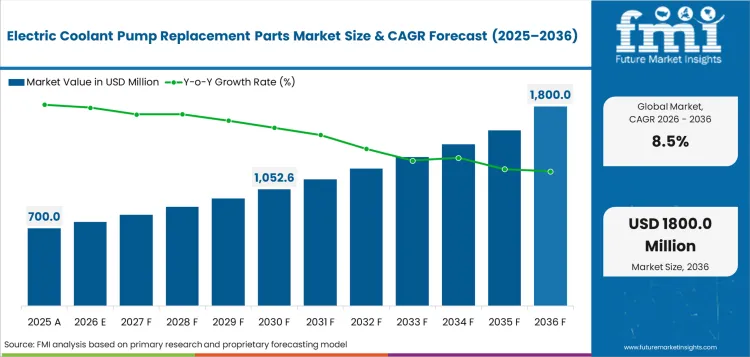
Electric coolant pump replacement parts market was valued at USD 700.0 million in 2025 and is expected to reach USD 800.0 million in 2026. Demand is forecast to rise to USD 1,800.0 million by 2036 at 8.5% CAGR from 2026 to 2036.
Summary of the Electric Coolant Pump Replacement Parts Market
- Demand and Growth Drivers
- Electric coolant pump replacement demand is rising as vehicles use separate coolant loops around batteries and power electronics.
- Hybrid vehicles need auxiliary pumps for engine after-run cooling after shutdown.
- Repair workshops prefer direct-fit pumps since connector mismatch can create repeat faults and warranty returns.
- Product and Segment View
- Passenger cars are expected to lead vehicle type demand as daily use creates broad replacement volume across compact models.
- Composite housing units are gaining preference since molded housings reduce weight and support cleaner connector placement.
- 12V pumps keep broad use as auxiliary circuits across hybrids use low-voltage electrical systems.
- Geography and Competitive Outlook
- China and India are expected to expand at a steady rate during the forecast period as electric vehicle parc expansion raises thermal loop replacement needs.
- United States stays commercially important due to hybrid share gains and a wide independent repair network.
- Suppliers with OE fitment data and thermal durability testing can gain an advantage in high-volume service channels.
- Analyst Opinion
- Nikhil Kaitwade of FMI says, “Electric coolant pump replacement has become a fitment accuracy decision for workshops. Repair channels need pumps with the right connector and housing design for each thermal loop. Suppliers with OE cross-reference depth and lower return rates will hold stronger positions as electrified vehicles age.”
- Electric Coolant Pump Replacement Parts Market Value Analysis
- The electric coolant pump replacement parts market is moving from basic pump replacement into a more defined thermal repair sector.
- Demand is rising as electric and hybrid vehicles need stable coolant flow for batteries and power electronics.
- Repair workshops are using direct-fit pumps to reduce connector mismatch and repeat service issues.
- Market value is supported by aging electrified vehicles that need reliable pump replacement during regular maintenance cycles.
Key Takeaways, Market Size, and Forecast
- Electric coolant pump replacement parts market stood at USD 700.0 million in 2025.
- By 2036, industry revenue is forecast to reach USD 1,800.0 million.
- Industry value is expected to rise at 8.5% CAGR from 2026 to 2036.
- Market is expected to add USD 1,000.0 million in incremental opportunity over the forecast decade.
- Passenger cars are expected to represent 61.0% of vehicle type demand in 2026.
- Composite housing units are forecast to hold 58.0% of material demand in 2026.
- China at 9.8% CAGR and India at 9.5% CAGR are expected to outpace global demand by 2036.
Electric coolant pump replacement is becoming more practical as EV cooling systems use connected thermal modules. In September 2024, Valeo said smart coolant modules support cabin heating and battery cooling. Power electronics cooling also sits within the module scope. The same system can include coolant heaters. It can also use multiway valves and more than one pump. Workshops need matched pump assemblies because one wrong part can affect cooling flow and repair time.
Aftermarket supply is becoming more organized. In May 2025, HELLA Aftermarket returned to thermal management with around 1,200 spare parts. The range is planned to expand to 6,000 parts by 2027. The company named coolant control hubs and medium pumps for later IAM introduction. Repair quality will depend on electrical connections and coolant control. In January 2025, BMW placed certain 2012 to 2018 vehicles to coolant pump connector inspection. In April 2025, Isuzu reported 8 propulsion-loss cases tied to coolant-derived deposits that seized EV cooling pumps. These cases support demand for pump kits with connector parts and approved coolant guidance.
Electric Coolant Pump Replacement Parts Market Definition
The electric coolant pump replacement parts market covers service parts used to replace failed or worn electric coolant pumps in passenger cars and commercial vehicles.
Electric Coolant Pump Replacement Parts Market Inclusions
Scope includes direct-fit electric coolant pumps and repair-ready pump modules. Pump kits supplied to independent workshops or OES networks are included. Replacement demand covers passenger cars and light commercial vehicles. Heavy commercial vehicles with hybrid or electric thermal circuits are included. Related service parts such as battery thermal pump couplings are included once sold with pump replacement work.
Electric Coolant Pump Replacement Parts Market Exclusions
Scope excludes belt driven mechanical water pumps unless sold in a kit with an electric auxiliary pump. Complete thermal management modules are excluded unless pump replacement is sold as a service part. General automotive hoses are excluded unless sold as pump-specific fitting kits.
Electric Coolant Pump Replacement Parts Market Research Methodology
- Primary Research: FMI analysts reviewed aftermarket catalog coverage and repair workshop feedback across major automotive countries.
- Desk Research: Public vehicle production and electric vehicle sales data were used for country demand checks.
- Market Sizing and Forecasting: Sizing combined vehicle parc assumptions and pump average selling prices with electric drivetrain adoption.
- Data Validation: Forecast checks compared OE pump orders and catalog releases with electrified vehicle penetration.
Why is the Electric Coolant Pump Replacement Parts Market Growing?
- Electric and hybrid vehicles need coolant pumps to control battery and power electronics temperature during daily use.
- Aging vehicles are increasing replacement demand as electric pumps face wear and connector faults.
- Repair workshops need direct-fit pumps because wrong voltage or connector mismatch can create repeat service problems.
Electric coolant pump replacement demand is rising as modern vehicles depend on controlled coolant flow across more systems. Battery packs and inverters need stable heat control to protect performance. Engine circuits and turbochargers need coolant movement after engine shutdown. A failed pump can raise temperature quickly, so workshops treat the part as a critical repair item.
Electric vehicle expansion is creating a larger future repair pool. IEA reported electric car sales of 21.0 million units in 2025. More vehicles with battery cooling loops will need pump replacement as mileage builds. OICA reported 96.4 million vehicles produced in 2025, which supports wider service demand for replacement suppliers. Brands with direct-fit pumps and clear fitment data can reduce returns for repair channels.
Market Segmentation Analysis
- 12V pumps are expected to hold 57.0% share in 2026.
- Passenger cars are forecast to account for 61.0% share in the same year.
- In 2026, independent aftermarket channels are expected to represent 52.0% share.
- Auxiliary cooling pumps are forecast to hold 46.0% share in 2026.
- Composite housing units are expected to capture 58.0% share during 2026.
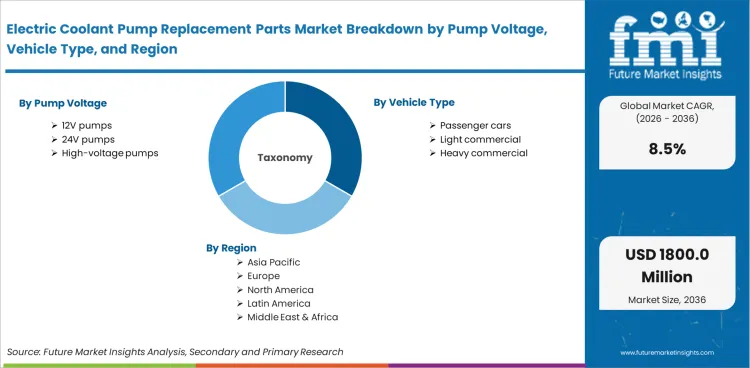
The market for electric coolant pump replacement parts is divided into groups based on pump voltage, vehicle type, replacement channel, pump function, material, and region. Pump voltage includes 12V pumps, 24V pumps, and high-voltage pumps. By vehicle type, the market covers passenger cars, light commercial vehicles, and heavy commercial vehicles. Replacement channel includes independent aftermarket, OES networks, and online retail. Pump function covers auxiliary cooling, battery cooling, engine cooling, and turbo cooling. By material, the market includes composite housing, aluminum housing, and hybrid housing.
Insights into Electric Coolant Pump Replacement Parts Market by Pump Voltage
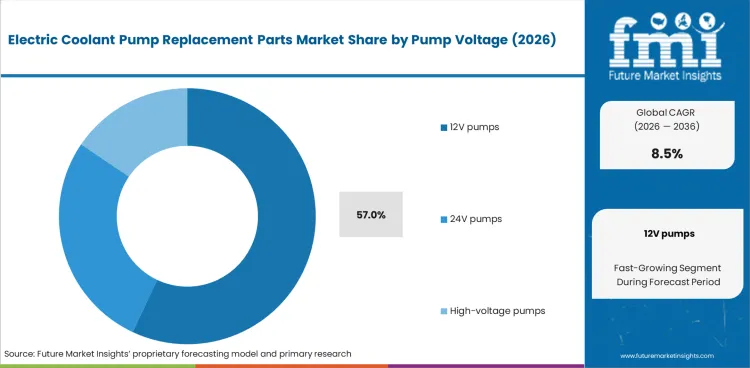
- 12V pumps are expected to account for 57.0% share in 2026. These pumps are widely used in auxiliary cooling circuits, so workshops can replace them faster with direct-fit parts.
- High-voltage pumps are gaining value as electric trucks need stronger coolant flow for battery and power electronics cooling. Demand for automotive electric water pump systems supports higher-value replacement work in electric platforms.
Insights into Electric Coolant Pump Replacement Parts Market by Vehicle Type
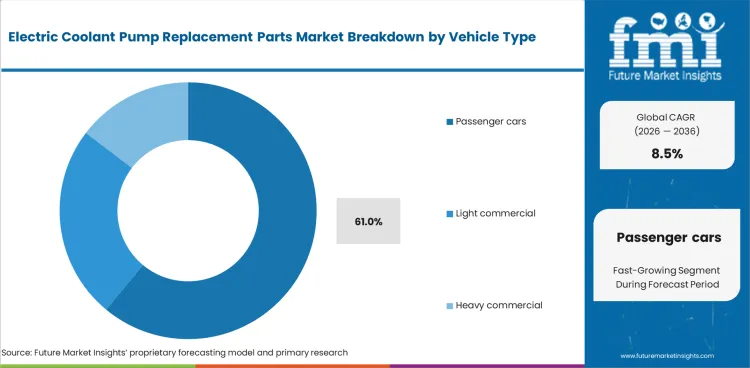
- During 2026, passenger cars are forecast to represent 61.0% share. Higher vehicle use creates frequent repair need, especially in hybrid and electric cars with separate coolant loops.
- Light commercial vehicles need durable pumps for delivery routes and stop-start duty. Heavy commercial vehicles are generating higher-value demand as electric drivetrain components use stronger thermal control systems.
Insights into Electric Coolant Pump Replacement Parts Market by Replacement Channel
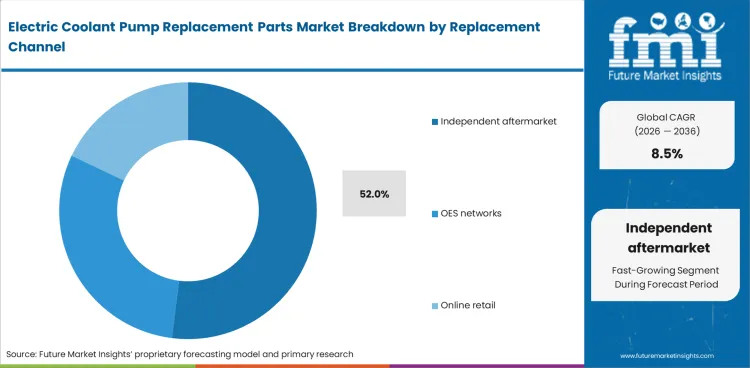
- Independent aftermarket channels are anticipated to capture 52.0% share in 2026. Older vehicles usually move outside warranty coverage, which sends more pump repair work to local workshops.
- OES networks are important for newer electric vehicles under service plans. Online retail is expanding as repairers use VIN-based lookup for liquid cooling quick coupler parts and pump fittings.
Insights into Electric Coolant Pump Replacement Parts Market by Pump Function
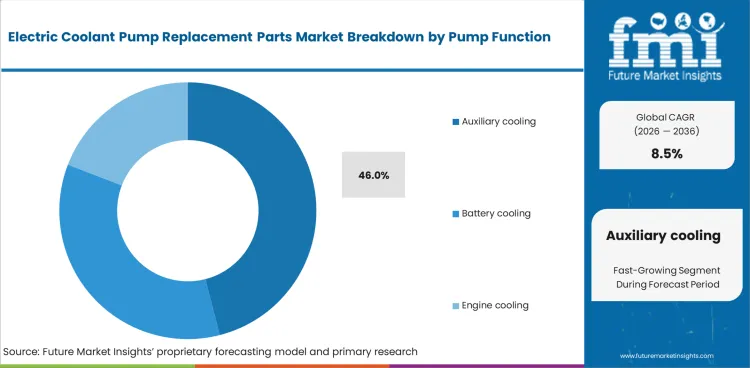
- Auxiliary cooling pumps are forecast to make up 46.0% of pump function demand in 2026. Hybrid engines and turbocharged vehicles need coolant flow after shutdown, so pump failure can quickly affect drivability.
- Battery cooling pumps are becoming more important as electric vehicles age. Repairers check coolant flow around packs, and battery thermal plates can reveal cooling issues during service.
Insights into Electric Coolant Pump Replacement Parts Market by Material
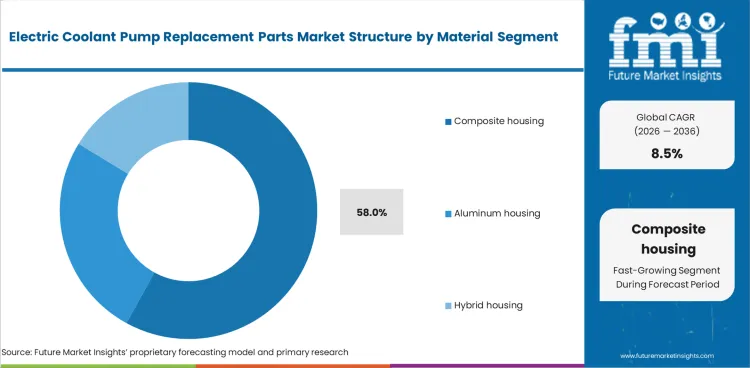
- Composite housing units are expected to hold 58.0% of material demand during 2026. Molded housings reduce weight and make connector placement easier in tight engine bays.
- Aluminum housing units keep use in hotter repair areas and heavy-duty vehicles. Hybrid housing designs support compact thermal layouts, especially where active purge pump parts sit near coolant circuits.
Electric Coolant Pump Replacement Parts Market Drivers and Limits with Opportunities
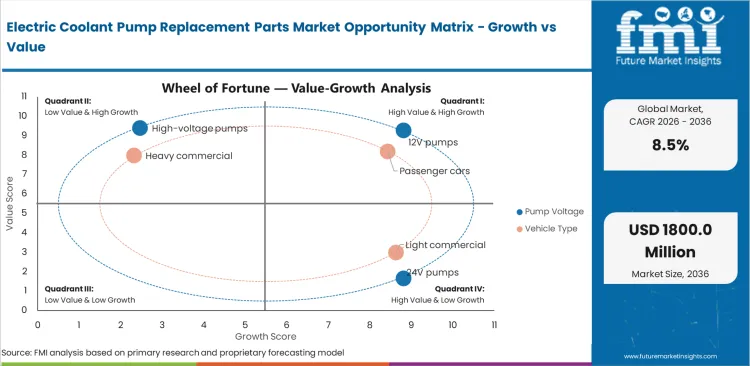
- Electric and hybrid vehicles are increasing pump replacement demand because batteries need steady coolant flow during daily use.
- Fitment errors can slow replacement work because wrong voltage checks can damage a new pump.
- Wider repair-part coverage gives workshops better access to direct-fit pumps for older vehicles.
Electrified Thermal Loops Raise Pump Demand
Electric and hybrid vehicles need controlled cooling across battery and power electronics systems. Coolant pumps keep temperature stable during driving and charging. A failed pump can affect vehicle performance and create urgent repair work. Replacement suppliers get value when each pump matches the vehicle voltage and connector layout.
Fitment Errors Slow Workshop Uptake
Replacement pumps need the right connector and stable electrical supply. Poor voltage checks can damage a new pump after fitting. Weak grounding can create repeat service work for repairers. Clear fitting guides and direct-fit parts reduce return risk across workshop channels.
Repair-part Coverage Builds Workshop Confidence
Aftermarket coverage is becoming more important as vehicles move closer to warranty expiration. In March 2025, Dorman released 164.0 new light-duty repair solutions for its repair parts range. Wider repair coverage gives workshops faster access to vehicle-specific parts. Suppliers with clear catalog data can help repairers finish pump-related work with fewer delays.
Analysis of Electric Coolant Pump Replacement Parts Market by Key Countries
.webp "Top Country Growth Comparison Electric Coolant Pump Replacement Parts Market Cagr (2026 2036)")
| Country | CAGR |
|---|---|
| China | 9.8% |
| India | 9.5% |
| South Korea | 8.9% |
| Mexico | 8.7% |
| Germany | 8.4% |
| United States | 7.6% |
| Japan | 7.2% |
Source: Future Market Insights, 2026.
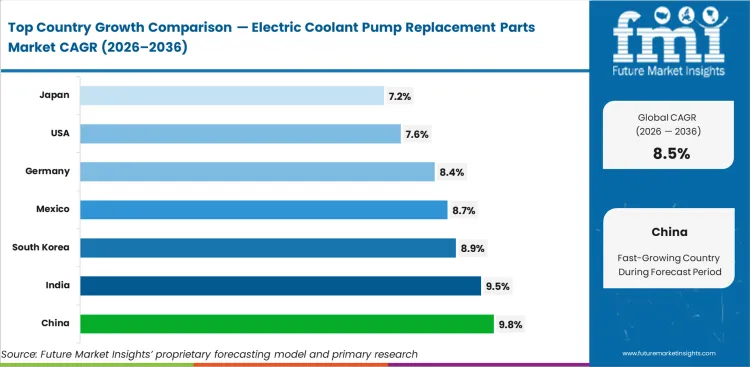
Electric Coolant Pump Replacement Parts Market CAGR Analysis by Country
- China is forecast to expand at 9.8% CAGR through 2036 as domestic vehicle output supports deeper pump replacement demand.
- India is expected to move ahead at 9.5% CAGR during the forecast period due to wider electric passenger vehicle service coverage.
- By 2036, South Korea is anticipated to rise at 8.9% CAGR with EV registrations increasing battery cooling repair needs.
- Mexico is expected to advance at 8.7% CAGR through 2036 with vehicle production scale improving aftermarket pump availability.
- During the forecast period, Germany is forecast to hold 8.4% CAGR with BEV service readiness improving across repair networks.
- United States is expected to expand at 7.6% CAGR by 2036 as hybrid sales support auxiliary pump replacement.
- Japan is expected to move at 7.2% CAGR through 2036 as hybrid vehicle maturity sustains pump replacement work.
- Global electric coolant pump replacement parts demand is forecast to advance at 8.5% CAGR during the forecast period.
Sales Analysis of Electric Coolant Pump Replacement Parts Market in China
From 2026 to 2036, China is expected to record 9.8% CAGR as vehicle production supports a wide repair base. China produced 34.5 million vehicles in 2025 and sold 34.4 million vehicles in the same year. Large vehicle flow creates more service need for battery and auxiliary cooling pumps. Local suppliers can support faster part availability for domestic models and export platforms.
- Battery cooling repairs will rise as high-volume EV models move into later ownership.
- Independent repair channels need connector-specific pumps for fast-moving domestic platforms.
- High-voltage pump demand will benefit from electric commercial vehicle use.
Demand Outlook for Electric Coolant Pump Replacement Parts Market in the United States
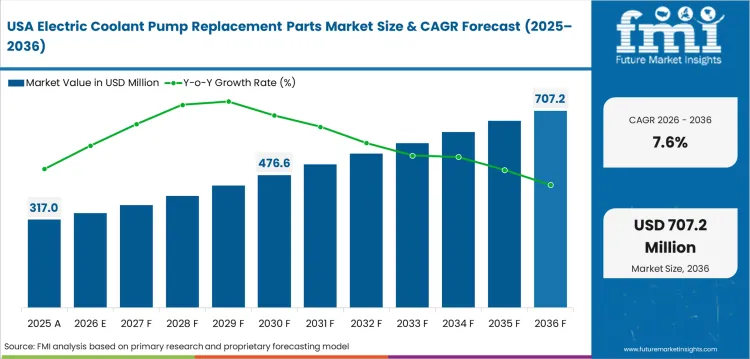
Hybrid powertrains keep auxiliary coolant pump use active in the United States. EIA reported that electrified light-duty vehicles made up about 22.0% of light-duty sales in 2025. These vehicles use electric pumps for heat control during engine-off driving. The United States is expected to rise at 7.6% CAGR through 2036. National parts distributors benefit from broad catalog coverage and faster warranty support.
- Hybrid repair volume supports 12V auxiliary pump replacement in independent workshops.
- Fleet operators need durable pumps for delivery vans with high stop-start use.
- OES networks keep newer EV pump replacement within service plan coverage.
Opportunity Analysis of Electric Coolant Pump Replacement Parts Market in India
India’s EV service base is expanding through policy-backed sales. PM E-DRIVE data recorded 22.12 lakh EVs sold under the scheme as of January 27, 2026. Two-wheelers lead volume in 2026, but passenger EV launches are widening thermal repair needs. India is forecast to expand at 9.5% CAGR to 2036. Affordable direct-fit pumps can help suppliers build workshop trust early.
- Urban service centers need low-cost pumps for high-use electric vehicles.
- Local assembly can reduce lead time for common pump references.
- Diagnostic support will help repairers handle battery cooling faults.
Demand Outlook for Electric Coolant Pump Replacement Parts Market in Germany
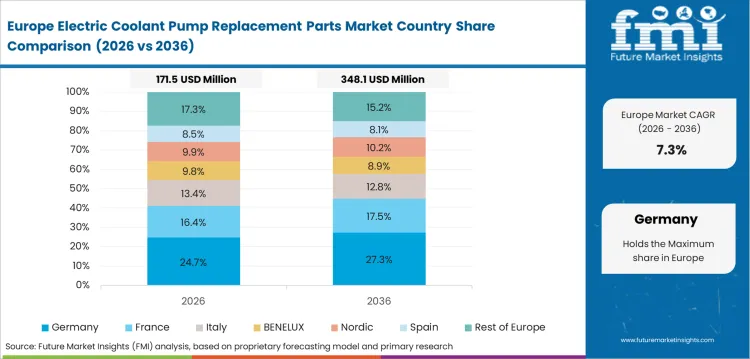
Germany benefits from a repair system built around complex passenger vehicles. Fully electric vehicles accounted for 19.1% of new car registrations in 2025. Workshops are adding high-voltage repair skills as electric vehicle use expands. By 2036, demand in Germany is expected to move at 8.4% CAGR. Premium vehicle complexity favors suppliers with tested electronics and OE-level fitment data.
- Premium plug-in vehicles need pumps matched to software and cooling circuit behavior.
- Parts brands with German application coverage can support faster workshop turnaround.
- Thermal repair demand will expand from batteries into power electronics cooling.
Future Outlook for Electric Coolant Pump Replacement Parts Market in Japan
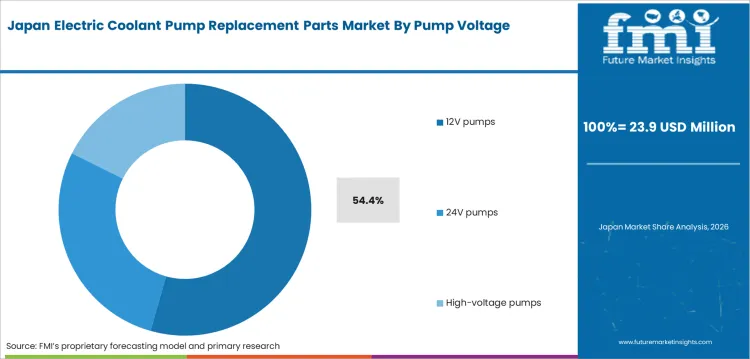
Japan is expected to move at 7.2% CAGR through 2036 as hybrid vehicles support thermal service demand. JAMA reported 4.42 million new motor vehicle registrations in Japan in 2024. Mature hybrid use creates a steady pool of auxiliary pump repairs. Domestic service channels prefer reliable parts with low noise and long electronic control life.
- Hybrid passenger cars create repeat demand for auxiliary cooling pumps.
- Compact engine bays favor precise housings and quiet brushless motors.
- Aftermarket suppliers must meet strict fitment needs across Japanese platforms.
Future Outlook for Electric Coolant Pump Replacement Parts Market in South Korea
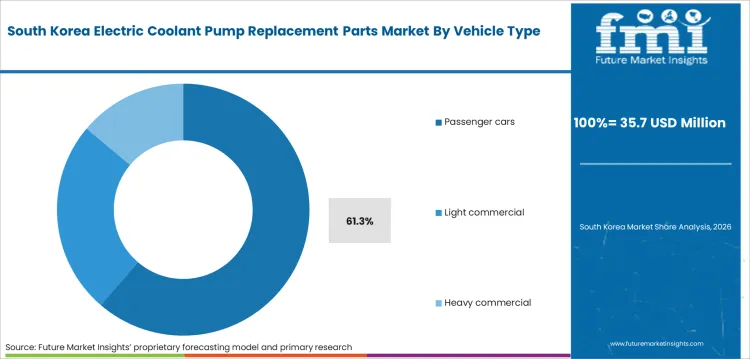
EV service demand is rising in South Korea as battery cooling needs expand. Government data indicated new EV registrations crossed 100,000.0 vehicles by the third week of April 2026. Faster EV adoption raises demand for coolant pumps used around batteries and inverters. South Korea is expected to advance at 8.9% CAGR through 2036. Local repair networks need safe high-voltage handling and verified replacement parts.
- Domestic EV platforms create demand for exact connector and bracket matching.
- Battery service work supports higher-value cooling pump replacement.
- Export-focused suppliers can use local EV knowledge to support global service demand.
Sales Analysis of Electric Coolant Pump Replacement Parts Market in Mexico
Mexico’s vehicle manufacturing base improves replacement part availability across North America. INEGI data indicated 343,520.0 light vehicles were built in March 2026. Local production supports service part supply for passenger cars and light commercial vehicles. Mexico is forecast at 8.7% CAGR to 2036 as regional platform coverage improves. Replacement demand will benefit from distributors with strong inventory depth.
- Manufacturing scale improves access to pumps for North American vehicle platforms.
- Independent distributors can serve cross-border demand with regional inventory.
- Commercial vehicle assembly supports 24V and heavy-duty auxiliary pump demand.
Competitive Landscape and Strategic Positioning
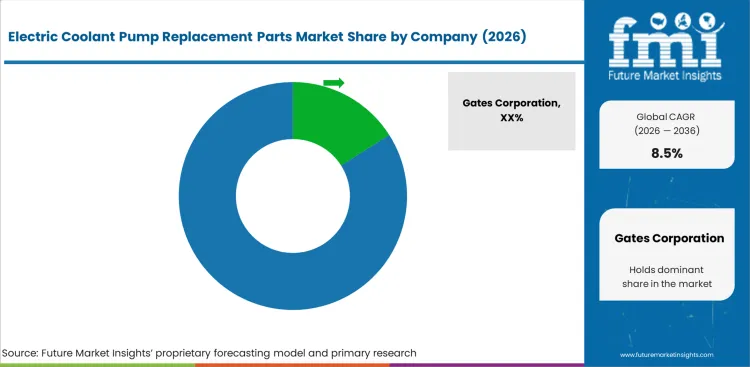
- Competition is shaped by how well a pump matches the vehicle’s voltage, connector, and housing design. Poor fit can lead to repeat repairs.
- Aftermarket brands need wide vehicle coverage so workshops can find the right pump quickly for older hybrid and electric vehicles.
- OE thermal specialists have an advantage because newer vehicles use coolant pumps as part of wider battery and power electronics cooling systems.
- Repair-channel suppliers can build trust through clear fitment data and warranty support. These factors reduce returns and help workshops finish repairs faster.
Competitive positioning in the market depends on how well pumps match vehicle specifications and how reliable their electronics are. Companies that offer precise, direct-fit solutions have a clear advantage. For example, Gates supports replacement work through direct-fit electric water pump coverage. Bosch has electric coolant pump capability for hybrid and EV cooling systems. AISIN adds OE thermal system depth, which helps service channels handle aging hybrid vehicles.
Players such as MAHLE also plays an important role asthermal control is becoming more complex across electric mobility systems. In February 2025, MAHLE received its first series order for a cooling module used in megawatt charging stations for electric commercial vehicles. The order reflects higher cooling needs around electric mobility hardware. Suppliers with thermal system knowledge are better placed as coolant pump replacement becomes more technical.
Key Companies in the Electric Coolant Pump Replacement Parts Market
- Aftermarket Coverage Leaders: Gates Corporation and Dayco support replacement demand through direct-fit water pump lines.
- OE Thermal Specialists: Bosch and AISIN support electric coolant pump technology through vehicle thermal systems.
- Repair Program Specialists: Dorman Products and Continental Aftermarket support service demand through catalog expansion.
Competitive Benchmarking: Electric Coolant Pump Replacement Parts Market
| Company | Direct Fit Coverage | Thermal Electronics Depth | Aftermarket Reach | Geographic Footprint |
|---|---|---|---|---|
| Gates Corporation | High | Medium | High | Global aftermarket network |
| Robert Bosch GmbH | High | High | High | Europe and Asia centered |
| AISIN Corporation | High | High | Medium | Japan-centered global supply |
| MAHLE GmbH | Medium | High | Medium | Europe and India strength |
| Rheinmetall AG | Medium | High | Low | Europe-centered OE supply |
| Dorman Products Inc. | High | Low | High | North America centered |
| Dayco | Medium | Medium | High | Global aftermarket reach |
Source: Future Market Insights competitive analysis, 2026.
Key Developments in Electric Coolant Pump Replacement Parts Market
- In February 2025, Rheinmetall won a EUR 26.0 million order for CWA2000 high-voltage coolant pumps for fuel cell vans and trucks. Development supports future aftermarket need for durable high-output pump modules.
- In February 2025, TI Fluid Systems introduced its 12V eCP electric coolant pump for BEV thermal management. Product relevance sits in low-voltage brushless pump designs for electrified vehicle service.
Key Players in the Electric Coolant Pump Replacement Parts Market
Major Global Players
- Gates Corporation
- Robert Bosch GmbH
- AISIN Corporation
- MAHLE GmbH
- Rheinmetall AG
Specialist and Regional Players
- Dorman Products Inc.
- Dayco
- Continental AG
- TI Fluid Systems
Electric Coolant Pump Replacement Parts Market Scope
| Parameter | Details |
|---|---|
| Quantitative Units | USD 800.0 million to USD 1,800.0 million, at an 8.5% CAGR |
| Market Definition | The electric coolant pump replacement parts market covers service pumps used to replace failed or worn electric coolant pumps in passenger cars and commercial vehicles. |
| Regions Covered | North America, Latin America, Europe, East Asia, South Asia and Pacific, Middle East and Africa |
| Countries Covered | China, India, South Korea, Mexico, Germany, United States, Japan, and more than 30 countries |
| Key Companies Profiled | Gates Corporation, Robert Bosch GmbH, AISIN Corporation, MAHLE GmbH, Rheinmetall AG, Dorman Products Inc., Dayco, Continental AG, TI Fluid Systems |
| Forecast Period | 2026 to 2036 |
| Approach | Hybrid bottom-up and top-down methodology starting with vehicle parc, electrified vehicle adoption, replacement channel demand, and pump fitment data across key regions. |
Electric Coolant Pump Replacement Parts Market Breakdown by Main Segments and Region
Electric Coolant Pump Replacement Parts Market Segmented by Pump Voltage
- 12V pumps
- 24V pumps
- High-voltage pumps
Electric Coolant Pump Replacement Parts Market Segmented by Vehicle Type
- Passenger cars
- Light commercial
- Heavy commercial
Electric Coolant Pump Replacement Parts Market Segmented by Replacement Channel
- Independent aftermarket
- OES networks
- Online retail
Electric Coolant Pump Replacement Parts Market Segmented by Pump Function
- Auxiliary cooling
- Battery cooling
- Engine cooling
- Turbo cooling
Electric Coolant Pump Replacement Parts Market Segmented by Material
- Composite housing
- Aluminum housing
- Hybrid housing
Electric Coolant Pump Replacement Parts Market by Region
- North America
- United States
- Canada
- Mexico
- Latin America
- Brazil
- Chile
- Rest of Latin America
- Western Europe
- Germany
- United Kingdom
- Italy
- Spain
- France
- Nordics
- BENELUX
- Rest of Western Europe
- Eastern Europe
- Poland
- Hungary
- Rest of Eastern Europe
- East Asia
- China
- Japan
- South Korea
- South Asia and Pacific
- India
- ASEAN
- Australia and New Zealand
- Rest of South Asia and Pacific
- Middle East and Africa
- Kingdom of Saudi Arabia
- Other GCC Countries
- Turkiye
- South Africa
- Rest of Middle East and Africa
Research Sources and Bibliography
- International Energy Agency. (2026). Global Energy Review 2026: Technology: Electric vehicles. International Energy Agency.
- International Organization of Motor Vehicle Manufacturers. (2026, April 23). Auto industry growth shifted east in 2025 amid global repositioning. International Organization of Motor Vehicle Manufacturers.
- The State Council of the People’s Republic of China. (2026, January 14). China’s auto output, sales reach new highs in 2025. The State Council of the People’s Republic of China.
- USA Energy Information Administration. (2026, February 9). Electric vehicle sales fell as hybrid vehicle sales continued to rise in 2025. USA Energy Information Administration.
- Ministry of Heavy Industries. (2026, February 3). PM e-DRIVE SCHEME. Press Information Bureau, Government of India.
- Kraftfahrt-Bundesamt. (2026, January 16). Neuzulassungen von Personenkraftwagen insgesamt im Jahresverlauf 2025 sowie mit Elektro (BEV). Kraftfahrt-Bundesamt.
- Japan Automobile Manufacturers Association. (2025, September 26). The motor industry of Japan 2025. Japan Automobile Manufacturers Association.
- Ministry of Climate, Energy and Environment. (2026, April 21). Early milestone: 100,000 new EV registrations... Government backs the 1 million EV era. Ministry of Climate, Energy and Environment, Republic of Korea.
- Instituto Nacional de Estadística y Geografía. (2026, April 9). Registro administrativo de la industria automotriz de vehículos ligeros (RAIAVL): Reporte de resultados. Instituto Nacional de Estadística y Geografía.
- Dorman Products, Inc. (2025, March 13). Dorman releases more Dorman® OE FIX™ auto repair innovations and dozens of first-to-the-aftermarket solutions. Dorman Products, Inc.
- MAHLE. (2025, February 19). Series order: MAHLE to supply cooling module for megawatt charging stations. MAHLE Newsroom.
- Rheinmetall AG. (2025, February 10). Rheinmetall wins new order worth over €26 million for high-voltage coolant pumps for use in fuel cell vehicles and stationary power plants. Rheinmetall AG.
- TI Fluid Systems. (2025, February 11). Introducing eCP: The next generation of electric coolant pumps. TI Fluid Systems.
- Valeo. (2024, September 2). Smart coolant modules. Valeo.
- FORVIA HELLA. (2025, May 6). Back to Cool: HELLA Aftermarket returns to the thermal management components business. FORVIA HELLA.
- National Highway Traffic Safety Administration. (2025, January 24). Remedy instructions for safety recall 24V608: Water pump electrical connector retrofit. USA Department of Transportation.
- National Highway Traffic Safety Administration. (2025, April). Part 573 safety recall report 25V217: Isuzu NRR EV cooling pump failure. USA Department of Transportation.
This Report Answers
- What is the forecast value of the electric coolant pump replacement parts market by 2036?
- What is the expected market size in 2026?
- Which vehicle type is expected to lead demand in 2026?
- Which material type holds a strong share in demand?
- Which replacement part type is expected to see higher demand?
- Which sales channel is important for suppliers?
- Which end user group is expected to account for major demand?
- Which country records the faster forecast pace?
- Which region is expected to remain attractive for suppliers?
- What are the key factors driving replacement demand?
Frequently Asked Questions
What is the electric coolant pump replacement parts market size in 2026?
Electric coolant pump replacement parts demand is forecast to reach USD 800.0 million in 2026.
What is the expected CAGR for the electric coolant pump replacement parts market?
Electric coolant pump replacement parts demand is expected to rise at 8.5% CAGR from 2026 to 2036 as electrified vehicle service expands.
Which pump voltage segment leads electric coolant pump replacement parts demand?
12V pumps are expected to hold 57.0% share in 2026 since auxiliary cooling circuits use low-voltage service parts.
Why are composite housing pumps important in electric coolant pump replacement parts demand?
Composite housing pumps are important since molded bodies reduce weight and support connector placement for direct-fit repair work.
Which companies compete in electric coolant pump replacement parts supply?
Gates and Bosch compete through broad fitment data. AISIN and MAHLE add OE thermal depth. Dorman Products and Dayco support replacement channel reach.
What is the forecast value of the electric coolant pump replacement parts market by 2036?
Electric coolant pump replacement parts demand is forecast to reach USD 1,800.0 million by 2036.
Which vehicle type is expected to lead electric coolant pump replacement parts demand in 2026?
Passenger cars are forecast to account for 61.0% share in 2026 due to broad repair volume.
Which material type holds a strong share in electric coolant pump replacement parts demand?
Composite housing units are expected to hold 58.0% share in 2026 as molded designs support lighter direct-fit pumps.
Which country records the faster forecast pace in electric coolant pump replacement parts demand?
China is expected to record 9.8% CAGR to 2036 as vehicle output and EV service needs expand.
Which channel is important for electric coolant pump replacement parts suppliers?
Independent aftermarket channels are expected to represent 52.0% share in 2026 as out-of-warranty repair volume expands.
Preview the report firsthand - request a free sample
Get SampleGet the brochure for pricing and purchase details.
Get PDFTable of Content
- Key Takeaways
- Market Size and CAGR
- Top Growth Driver
- Fastest Growing Segment
- Leading Region
- Key Companies
- Emerging Opportunities
- Executive Summary
- Global Market Outlook
- Demand-side Trends
- Supply-side Trends
- Technology Roadmap Analysis
- Analysis and Recommendations
- Analyst Perspective (What is happening? Why now? What should investors know?)
- Key Questions Answered
- How large is the market?
- What is the CAGR?
- What are key trends?
- Which region dominates?
- Who are the leaders?
- Market Overview
- Market Coverage / Taxonomy
- Market Definition / Scope / Limitations
- Research Methodology
- Chapter Orientation
- Analytical Lens and Working Hypotheses
- Market Structure, Signals, and Trend Drivers
- Benchmarking and Cross-market Comparability
- Market Sizing, Forecasting, and Opportunity Mapping
- Research Design and Evidence Framework
- Desk Research Programme (Secondary Evidence)
- Expert Input and Fieldwork (Primary Evidence)
- Tooling, Models, and Reference Databases
- Data Engineering and Model Build
- Quality Assurance and Audit Trail
- Market Background
- Market Dynamics (Drivers, Restraints, Opportunity, Trends)
- Scenario Forecast (Optimistic, Likely, Conservative)
- Impact Analysis
- AI Impact
- Sustainability Impact
- Regulatory Impact
- Technology Impact
- Consumer / Buyer Analysis
- Purchase Drivers
- Adoption Barriers
- Buyer Journey
- Opportunity Map Analysis
- Product Life Cycle Analysis
- Supply Chain Analysis
- Investment Feasibility Matrix
- Value Chain Analysis
- PESTLE and Porter's Analysis
- Regulatory Landscape
- Regional Parent Market Outlook
- Production and Consumption Statistics
- Import and Export Statistics
- Global Market Analysis and Forecast, 2021 to 2036
- Historical Market Size Value (USD Million) & Volume (Unit) Analysis, 2021 to 2025
- Current and Future Market Size Value (USD Million) & Volume (Unit) Projections, 2026 to 2036
- Y-o-Y Growth Trend Analysis
- Absolute $ Opportunity Analysis
- Global Market Pricing Analysis, 2021 to 2036
- Global Market Analysis and Forecast, By Pump Voltage, 2021 to 2036
- Introduction / Key Findings
- Historical Market Size Value (USD Million) & Volume (Unit) Analysis By Pump Voltage, 2021 to 2025
- Current and Future Market Size Value (USD Million) & Volume (Unit) Analysis and Forecast By Pump Voltage, 2026 to 2036
- 12V pumps
- 24V pumps
- High-voltage pumps
- 12V pumps
- Y-o-Y Growth Trend Analysis By Pump Voltage, 2021 to 2025
- Absolute $ Opportunity Analysis By Pump Voltage, 2026 to 2036
- Global Market Analysis and Forecast, By Vehicle Type, 2021 to 2036
- Introduction / Key Findings
- Historical Market Size Value (USD Million) & Volume (Unit) Analysis By Vehicle Type, 2021 to 2025
- Current and Future Market Size Value (USD Million) & Volume (Unit) Analysis and Forecast By Vehicle Type, 2026 to 2036
- Passenger cars
- Light commercial
- Heavy commercial
- Passenger cars
- Y-o-Y Growth Trend Analysis By Vehicle Type, 2021 to 2025
- Absolute $ Opportunity Analysis By Vehicle Type, 2026 to 2036
- Global Market Analysis and Forecast, By Replacement Channel, 2021 to 2036
- Introduction / Key Findings
- Historical Market Size Value (USD Million) & Volume (Unit) Analysis By Replacement Channel, 2021 to 2025
- Current and Future Market Size Value (USD Million) & Volume (Unit) Analysis and Forecast By Replacement Channel, 2026 to 2036
- Independent aftermarket
- OES networks
- Online retail
- Independent aftermarket
- Y-o-Y Growth Trend Analysis By Replacement Channel, 2021 to 2025
- Absolute $ Opportunity Analysis By Replacement Channel, 2026 to 2036
- Global Market Analysis and Forecast, By Pump Function, 2021 to 2036
- Introduction / Key Findings
- Historical Market Size Value (USD Million) & Volume (Unit) Analysis By Pump Function, 2021 to 2025
- Current and Future Market Size Value (USD Million) & Volume (Unit) Analysis and Forecast By Pump Function, 2026 to 2036
- Auxiliary cooling
- Battery cooling
- Engine cooling
- Turbo cooling
- Auxiliary cooling
- Y-o-Y Growth Trend Analysis By Pump Function, 2021 to 2025
- Absolute $ Opportunity Analysis By Pump Function, 2026 to 2036
- Global Market Analysis and Forecast, By Material, 2021 to 2036
- Introduction / Key Findings
- Historical Market Size Value (USD Million) & Volume (Unit) Analysis By Material, 2021 to 2025
- Current and Future Market Size Value (USD Million) & Volume (Unit) Analysis and Forecast By Material, 2026 to 2036
- Composite housing
- Aluminum housing
- Hybrid housing
- Composite housing
- Y-o-Y Growth Trend Analysis By Material, 2021 to 2025
- Absolute $ Opportunity Analysis By Material, 2026 to 2036
- Global Market Analysis and Forecast, By Region, 2021 to 2036
- Introduction
- Historical Market Size Value (USD Million) & Volume (Unit) Analysis By Region, 2021 to 2025
- Current Market Size Value (USD Million) & Volume (Unit) Analysis and Forecast By Region, 2026 to 2036
- North America
- Latin America
- Western Europe
- Eastern Europe
- East Asia
- South Asia and Pacific
- Middle East & Africa
- Market Attractiveness Analysis By Region
- North America Market Analysis and Forecast, By Country, 2021 to 2036
- Historical Market Size Value (USD Million) & Volume (Unit) Trend Analysis By Market Taxonomy, 2021 to 2025
- Market Size Value (USD Million) & Volume (Unit) Forecast By Market Taxonomy, 2026 to 2036
- By Country
- USA
- Canada
- Mexico
- By Pump Voltage
- By Vehicle Type
- By Replacement Channel
- By Pump Function
- By Material
- By Country
- Market Attractiveness Analysis
- By Country
- By Pump Voltage
- By Vehicle Type
- By Replacement Channel
- By Pump Function
- By Material
- Key Takeaways
- Latin America Market Analysis and Forecast, By Country
- Historical Market Size Value (USD Million) & Volume (Unit) Trend Analysis By Market Taxonomy, 2021 to 2025
- Market Size Value (USD Million) & Volume (Unit) Forecast By Market Taxonomy, 2026 to 2036
- By Country
- Brazil
- Chile
- Rest of Latin America
- By Pump Voltage
- By Vehicle Type
- By Replacement Channel
- By Pump Function
- By Material
- By Country
- Market Attractiveness Analysis
- By Country
- By Pump Voltage
- By Vehicle Type
- By Replacement Channel
- By Pump Function
- By Material
- Key Takeaways
- Western Europe Market Analysis and Forecast, By Country
- Historical Market Size Value (USD Million) & Volume (Unit) Trend Analysis By Market Taxonomy, 2021 to 2025
- Market Size Value (USD Million) & Volume (Unit) Forecast By Market Taxonomy, 2026 to 2036
- By Country
- Germany
- UK
- Italy
- Spain
- France
- Nordic
- BENELUX
- Rest of Western Europe
- By Pump Voltage
- By Vehicle Type
- By Replacement Channel
- By Pump Function
- By Material
- By Country
- Market Attractiveness Analysis
- By Country
- By Pump Voltage
- By Vehicle Type
- By Replacement Channel
- By Pump Function
- By Material
- Key Takeaways
- Eastern Europe Market Analysis and Forecast, By Country
- Historical Market Size Value (USD Million) & Volume (Unit) Trend Analysis By Market Taxonomy, 2021 to 2025
- Market Size Value (USD Million) & Volume (Unit) Forecast By Market Taxonomy, 2026 to 2036
- By Country
- Russia
- Poland
- Hungary
- Balkan & Baltic
- Rest of Eastern Europe
- By Pump Voltage
- By Vehicle Type
- By Replacement Channel
- By Pump Function
- By Material
- By Country
- Market Attractiveness Analysis
- By Country
- By Pump Voltage
- By Vehicle Type
- By Replacement Channel
- By Pump Function
- By Material
- Key Takeaways
- East Asia Market Analysis and Forecast, By Country
- Historical Market Size Value (USD Million) & Volume (Unit) Trend Analysis By Market Taxonomy, 2021 to 2025
- Market Size Value (USD Million) & Volume (Unit) Forecast By Market Taxonomy, 2026 to 2036
- By Country
- China
- Japan
- South Korea
- By Pump Voltage
- By Vehicle Type
- By Replacement Channel
- By Pump Function
- By Material
- By Country
- Market Attractiveness Analysis
- By Country
- By Pump Voltage
- By Vehicle Type
- By Replacement Channel
- By Pump Function
- By Material
- Key Takeaways
- South Asia and Pacific Market Analysis and Forecast, By Country
- Historical Market Size Value (USD Million) & Volume (Unit) Trend Analysis By Market Taxonomy, 2021 to 2025
- Market Size Value (USD Million) & Volume (Unit) Forecast By Market Taxonomy, 2026 to 2036
- By Country
- India
- ASEAN
- Australia & New Zealand
- Rest of South Asia and Pacific
- By Pump Voltage
- By Vehicle Type
- By Replacement Channel
- By Pump Function
- By Material
- By Country
- Market Attractiveness Analysis
- By Country
- By Pump Voltage
- By Vehicle Type
- By Replacement Channel
- By Pump Function
- By Material
- Key Takeaways
- Middle East & Africa Market Analysis and Forecast, By Country
- Historical Market Size Value (USD Million) & Volume (Unit) Trend Analysis By Market Taxonomy, 2021 to 2025
- Market Size Value (USD Million) & Volume (Unit) Forecast By Market Taxonomy, 2026 to 2036
- By Country
- Kingdom of Saudi Arabia
- Other GCC Countries
- Türkiye
- South Africa
- Other African Union
- Rest of Middle East & Africa
- By Pump Voltage
- By Vehicle Type
- By Replacement Channel
- By Pump Function
- By Material
- By Country
- Market Attractiveness Analysis
- By Country
- By Pump Voltage
- By Vehicle Type
- By Replacement Channel
- By Pump Function
- By Material
- Key Takeaways
- Key Countries Market Analysis
- USA
- Pricing Analysis
- Market Share Analysis, 2025
- By Pump Voltage
- By Vehicle Type
- By Replacement Channel
- By Pump Function
- By Material
- Canada
- Pricing Analysis
- Market Share Analysis, 2025
- By Pump Voltage
- By Vehicle Type
- By Replacement Channel
- By Pump Function
- By Material
- Mexico
- Pricing Analysis
- Market Share Analysis, 2025
- By Pump Voltage
- By Vehicle Type
- By Replacement Channel
- By Pump Function
- By Material
- Brazil
- Pricing Analysis
- Market Share Analysis, 2025
- By Pump Voltage
- By Vehicle Type
- By Replacement Channel
- By Pump Function
- By Material
- Chile
- Pricing Analysis
- Market Share Analysis, 2025
- By Pump Voltage
- By Vehicle Type
- By Replacement Channel
- By Pump Function
- By Material
- Germany
- Pricing Analysis
- Market Share Analysis, 2025
- By Pump Voltage
- By Vehicle Type
- By Replacement Channel
- By Pump Function
- By Material
- UK
- Pricing Analysis
- Market Share Analysis, 2025
- By Pump Voltage
- By Vehicle Type
- By Replacement Channel
- By Pump Function
- By Material
- Italy
- Pricing Analysis
- Market Share Analysis, 2025
- By Pump Voltage
- By Vehicle Type
- By Replacement Channel
- By Pump Function
- By Material
- Spain
- Pricing Analysis
- Market Share Analysis, 2025
- By Pump Voltage
- By Vehicle Type
- By Replacement Channel
- By Pump Function
- By Material
- France
- Pricing Analysis
- Market Share Analysis, 2025
- By Pump Voltage
- By Vehicle Type
- By Replacement Channel
- By Pump Function
- By Material
- India
- Pricing Analysis
- Market Share Analysis, 2025
- By Pump Voltage
- By Vehicle Type
- By Replacement Channel
- By Pump Function
- By Material
- ASEAN
- Pricing Analysis
- Market Share Analysis, 2025
- By Pump Voltage
- By Vehicle Type
- By Replacement Channel
- By Pump Function
- By Material
- Australia & New Zealand
- Pricing Analysis
- Market Share Analysis, 2025
- By Pump Voltage
- By Vehicle Type
- By Replacement Channel
- By Pump Function
- By Material
- China
- Pricing Analysis
- Market Share Analysis, 2025
- By Pump Voltage
- By Vehicle Type
- By Replacement Channel
- By Pump Function
- By Material
- Japan
- Pricing Analysis
- Market Share Analysis, 2025
- By Pump Voltage
- By Vehicle Type
- By Replacement Channel
- By Pump Function
- By Material
- South Korea
- Pricing Analysis
- Market Share Analysis, 2025
- By Pump Voltage
- By Vehicle Type
- By Replacement Channel
- By Pump Function
- By Material
- Russia
- Pricing Analysis
- Market Share Analysis, 2025
- By Pump Voltage
- By Vehicle Type
- By Replacement Channel
- By Pump Function
- By Material
- Poland
- Pricing Analysis
- Market Share Analysis, 2025
- By Pump Voltage
- By Vehicle Type
- By Replacement Channel
- By Pump Function
- By Material
- Hungary
- Pricing Analysis
- Market Share Analysis, 2025
- By Pump Voltage
- By Vehicle Type
- By Replacement Channel
- By Pump Function
- By Material
- Kingdom of Saudi Arabia
- Pricing Analysis
- Market Share Analysis, 2025
- By Pump Voltage
- By Vehicle Type
- By Replacement Channel
- By Pump Function
- By Material
- Türkiye
- Pricing Analysis
- Market Share Analysis, 2025
- By Pump Voltage
- By Vehicle Type
- By Replacement Channel
- By Pump Function
- By Material
- South Africa
- Pricing Analysis
- Market Share Analysis, 2025
- By Pump Voltage
- By Vehicle Type
- By Replacement Channel
- By Pump Function
- By Material
- USA
- Market Structure Analysis
- Competition Dashboard
- Competition Benchmarking
- Market Share Analysis of Top Players
- By Regional
- By Pump Voltage
- By Vehicle Type
- By Replacement Channel
- By Pump Function
- By Material
- Emerging Startups
- Innovation Benchmarking
- Competition Analysis
- Competition Deep Dive
- Gates Corporation
- Overview
- Product Portfolio
- Profitability by Market Segments (Product/Region/Sales Channel)
- Sales Footprint
- Strategy Overview
- Marketing Strategy
- Product Strategy
- Channel Strategy
- Robert Bosch GmbH
- AISIN Corporation
- MAHLE GmbH
- Rheinmetall AG
- Dorman Products Inc.
- Dayco
- Continental AG
- TI Fluid Systems
- Gates Corporation
- Case Studies
- Success Stories
- Recent Developments
- Competition Deep Dive
- Assumptions & Acronyms Used


