

- Market Size (2026)
- USD 0.60 Bn
- Forecast (2036)
- USD 1.43 Bn
- CAGR (2026 to 2036)
- 9.1%
Thermal Ruggedized Illumination Market Size, Forecast, and Outlook By FMI
Summary of the Thermal Ruggedized Illumination Market
- Demand and Growth Drivers
- Glass and cement plants need fixtures that tolerate radiant heat near kilns and batch processing lines.
- Steel and foundry users are moving replacement orders toward housings with stronger thermal paths.
- Oil and gas buyers keep certified lighting in scope as process areas combine heat and ignition risk.
- Power generation sites need fixed bay fixtures that reduce maintenance work around elevated structures.
- Product and Segment View
- High-temperature rated fixtures are projected to lead ruggedization demand with 36.0% share in 2026 due to furnace-zone use.
- Glass and cement is expected to lead end-use demand with 34.0% share in 2026 as kilns create constant thermal stress.
- Fixed bay lighting is projected to account for 52.0% share in 2026 as overhead replacements form the main order route.
- Industrial safety compliant fixtures are expected to account for 47.0% share in 2026 since buyers need documented site acceptance.
- Heat-sink enhanced LED modules connect this sector to solid-state lighting as thermal design decides useful lifetime.
- Geography and Competitive Outlook
- Saudi Arabia is expected to record 11.3% CAGR through 2036 as oil and mineral projects raise heat-rated lighting needs.
- Brazil is projected at 10.7% CAGR through 2036 as metals and cement users extend rugged fixture replacement.
- Eaton and Dialight hold strong specification positions through hazardous and high-temperature fixture portfolios.
- Signify and ABB are some of the companies focusing on lighting breadth. Glamox and Hubbell add channel access whereas WEG and Legrand extend regional reach.
- Analyst Opinion
- As per Nikhil Kaitwade, Principal Analyst for Industrial Automation at Future Market Insights, "Demand for thermal ruggedized illumination is driven by routine fixture replacement. Industrial buyers are investing in lighting that reduces maintenance risk in high‑heat environments and meets strict site safety requirements. Suppliers that clearly demonstrate temperature tolerance and effective heat management are gaining stronger alignment with plant engineering teams. Decisions increasingly hinge on glare performance and certification compatibility."
- Thermal Ruggedized Illumination Market Value Analysis
- Steel plants and high-heat facilities need lighting systems that operate reliably near hot equipment.
- Harsh industrial environments drive replacement of standard fixtures with heat-resistant illumination products.
- Maintenance teams prefer ruggedized lighting because longer service life reduces shutdown-related replacement work.
- Outdoor industrial sites use thermal-resistant fixtures to handle temperature swings across seasonal operations.
- Larger retrofit programs can evaluate lighting as a service when budgets favor operating payments.
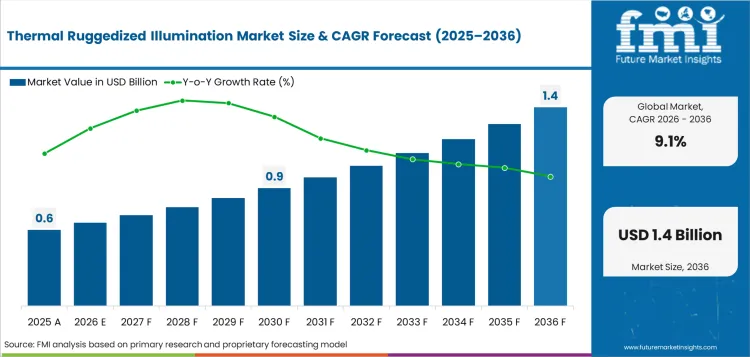
Key Takeaways, Market Size, and Forecast
- The thermal ruggedized illumination market was valued at USD 0.55 billion in 2025 after adjusting the 2026 anchor for the stated rate.
- By 2036, the thermal ruggedized illumination market is expected to reach USD 1.43 billion as heavy industrial lighting shifts toward heat-rated LED fixtures.
- From 2026 to 2036, the market is projected to expand at 9.1% CAGR across high-temperature and hazardous work zones.
- The market is projected to create an incremental opportunity of USD 0.83 billion between 2026 and 2036.
- High-temperature rated fixtures are projected to account for 36.0% share of ruggedization demand in 2026 due to furnace-adjacent use.
- Fixed bay lighting is expected to account for 52.0% share in 2026 as plants replace overhead fixtures in repeat zones.
- Saudi Arabia at 11.3% CAGR and Brazil at 10.7% CAGR are forecast to exceed the global pace through heavy industry expansion.
Heat, dust and electrical disturbance make rugged illumination a reliability purchase, which was earlier a basic lighting replacement. Dialight’s July 2024 catalog states that many products are engineered with a 10-year warranty and harsh-environment design. Long warranty language supports buyer interest in reducing work-at-height maintenance. Raytec Warrior Linear documentation from 2024 lists IP66 and IP67 ratings with IK10 impact protection. Enclosure survival matters in washdown and vibration-prone locations. Emerson Appleton documentation from 2024 lists 6 kV surge suppression and power factor above 0.95. Electrical resilience gives suppliers another way to justify premium rugged fixtures in plants with unstable power conditions. Certification coverage and fit with metallurgical lighting applications will influence specification access.
Thermal Ruggedized Illumination Market Definition
The thermal ruggedized illumination market covers luminaires and lighting modules designed for hot and dusty industrial areas. Vibration-prone and process-risk spaces are included. Scope includes high-temperature rated fixtures and thermal shock resistant housings. Heat-sink enhanced LED modules and flame proof lighting are included. Certified fixtures sold for heavy industrial service are included. Power and nuclear-adjacent sites can overlap with radiation tolerant LED light needs. Revenue covers new installations and replacement fixtures. Fixture-ready modules are included when sold for industrial use.
Thermal Ruggedized Illumination Market Inclusions
Market scope includes fixed bay lighting and portable task lighting. Machine-mounted luminaires used in heat-exposed industrial zones are included. Ruggedization includes high-temperature rating and thermal shock resistance. Heat-sink enhanced design and other rugged formats complete the scope. End use includes glass and cement. Steel and foundries are included with oil and gas. Power generation completes the scope. Certification scope includes industrial safety compliant and hazardous-area compatible formats. General purpose formats are included when tied to hazardous area equipment.
Thermal Ruggedized Illumination Market Exclusions
The scope excludes residential fixtures and normal office luminaires. Decorative lighting and road lighting are outside scope. Vehicle lamps are excluded from the product boundary. Consumer work lights are excluded unless they carry defined industrial heat or safety requirements.
Thermal Ruggedized Illumination Market Research Methodology
- Primary Research: FMI analysts reviewed heavy industrial lighting users and electrical contractors. Plant safety teams and channel specialists were consulted for approval routes. Interviews focused on temperature rating needs and mounting access. Certification checks and shutdown cost exposure were tested during validation.
- Desk Research: The study used public data from energy agencies and industrial output sources. Steel bodies and cement statistics supported scope checks. Company technical pages were used for product boundary checks. Supplier portfolios were used for heat-rated and hazardous lighting checks.
- Market Sizing and Forecasting: The model combined supplied values and replacement density. Fixture pricing and end-use exposure were used for forecast checks. Country-level industrial activity shaped regional estimates. Segment shares were assigned from visible buyer specification patterns and supplier portfolio fit.
- Data Validation: Forecast checks compared industrial lighting shipments and heavy industry output. Safety needs and company product coverage were reviewed before finalisation. The CAGR was tested against adjacent rugged lighting and heat-resistant LED categories.
Why is the Thermal Ruggedized Illumination Market Growing?
- Industrial plants are replacing heat-stressed fixtures where repeated maintenance creates access risk and downtime cost.
- LED high bay efficiency targets make retrofit cases stronger when sites compare energy use with relamping work.
- Hazardous areas need lighting with certification records that site safety teams can approve before installation.
- Heavy industries are specifying better thermal paths as dust and radiant heat shorten fixture life.
Thermal ruggedized illumination is rising as buyers treat lighting as part of plant reliability work. The United States Census Bureau reported USD 1.558 billion in electric lighting equipment shipments for March 2026. This confirms that lighting remains a large industrial replacement category in the United States. Hot work sites convert only a narrow part of that pool into rugged fixtures. Suppliers that prove higher ambient temperature tolerance can capture repeat orders from plants that already budget for replacement. The same pattern supports adjacent specialty lighting demand in heavy facilities.
Efficiency regulation is shifting buyer discussion from fixture price to lifetime energy use. The United States Department of Energy lists 175 lumens per watt as the federal efficiency level for industrial high bay LED luminaires. That number gives plant teams a practical threshold when comparing high-bay options. In hot spaces, energy performance needs to hold while the housing controls temperature around the driver. The result is a stronger case for thermally managed products over basic heavy-duty lights. This also connects with inspection lighting fixture needs around process quality checks.
Market Segmentation Analysis
- High-temperature rated fixtures are projected to account for 36.0% share of ruggedization demand in 2026 as furnace-adjacent zones need temperature proof.
- Glass and cement is expected to represent 34.0% share of end-use demand in 2026 as kiln and batch lines need constant lighting.
- Fixed bay lighting is projected to capture 52.0% share of mounting demand in 2026 because overhead replacement gives scale.
- Industrial safety compliant fixtures are expected to hold 47.0% share of certification demand in 2026 as site acceptance drives orders.
- High-output LED is estimated to account for 64.0% share of light source demand in 2026 as buyers reduce energy and relamping work.
The market is structured into five core segment categories that reflect how buyers evaluate and specify rugged industrial lighting. Ruggedization captures requirements related to heat resistance and shock tolerance. End‑use segmentation highlights industrial environments where fixture failure risk is greatest. Mounting defines how luminaires are installed or deployed across work areas. Certification outlines the safety and compliance pathway required before installation approval. Light source segmentation explains how thermal design considerations influence module and technology selection.
Insights into the High-temperature Rated Ruggedization Segment
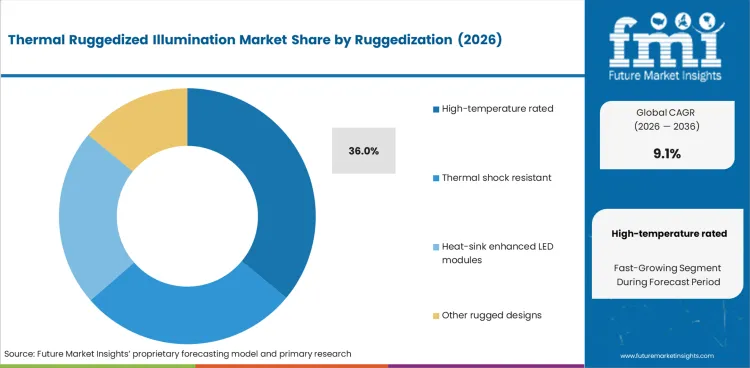
- High-temperature rated fixtures are projected to account for 36.0% share of ruggedization demand in 2026. Buyers choose this format when fixtures face radiant heat near furnaces and kilns.
- Annealing lines and turbine halls add another use setting. The purchasing issue is not brightness alone. Plant engineers need ambient temperature ratings that protect drivers and lenses during long operating cycles.
Insights into the Glass and Cement End Use Segment
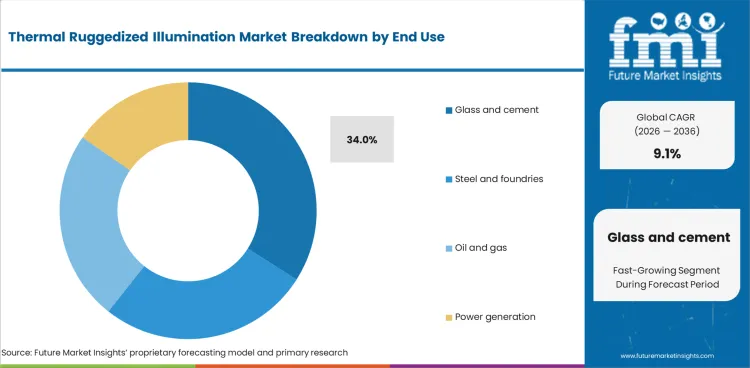
- Glass and cement is expected to account for 34.0% share of end-use demand in 2026. Kilns and material handling zones expose lighting to heat and vibration.
- Dust and cleaning cycles add to fixture stress. These sites use lighting for safety routes and inspection points. The practical result is a steady replacement pool for fixed rugged fixtures.
Insights into the Fixed Bay Lighting Mounting Segment
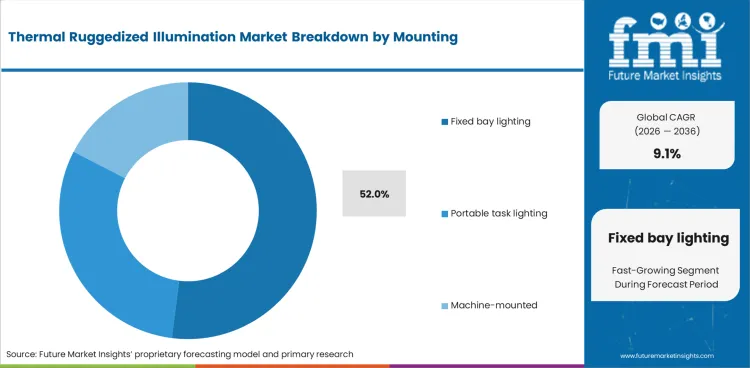
- Fixed bay lighting is projected to account for 52.0% share of mounting demand in 2026. Overhead fixtures cover wider plant areas and carry greater replacement value than portable task lights.
- Buyers prefer fixed layouts so that electricians can plan shutdown windows. This creates a natural link with outdoor LED lighting for plants that share yard and process-area maintenance teams.
Insights into the Industrial Safety Compliant Certification Segment
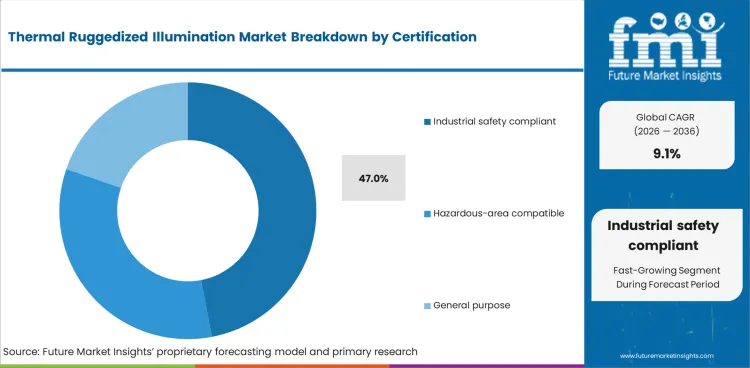
- Industrial safety compliant fixtures are expected to account for 47.0% share of certification demand in 2026.
- Many heavy plants do not need full explosion-proof scope in every zone. They do need documented product safety and electrical acceptance. That keeps general industrial compliance ahead of narrow hazardous-area use.
Insights into the High-output LED Light Source Segment
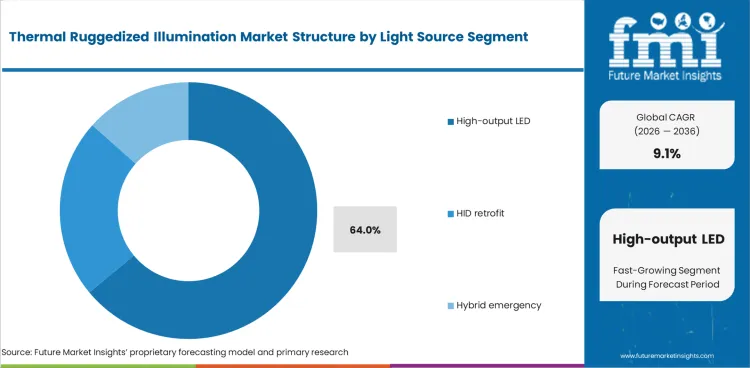
- High-output LED is estimated to account for 64.0% share of light source demand in 2026. This segment benefits from lower energy use and longer service intervals.
- High thermal load makes module design more important than normal lumen output. The same buyer reasoning supports LED displays, lighting and fixtures in industrial facilities.
Thermal Ruggedized Illumination Market Drivers Restraints and Opportunities
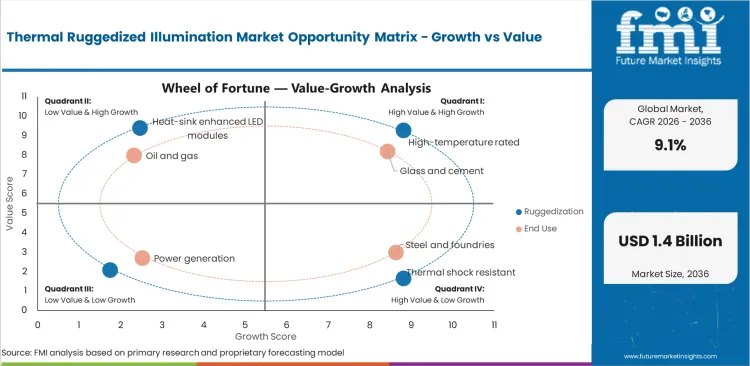
- Heat-rated fixture replacement is the primary driver as plants lower maintenance work in hard-to-access zones.
- Certification cost is the main restraint since hazardous and heat-rated designs need deeper testing evidence.
- Machine-mounted lighting creates opportunity as equipment makers add compact lights near inspection and service points.
Heavy industry gives this sector a clear demand anchor. World Steel Association reported global crude steel output of 159.9 million tonnes in March 2026. That production setting includes hot mills and foundries that need reliable lighting around raised platforms. The number shows why rugged fixtures have a durable application pool even when steel output varies by country. It also explains why mobile light tower demand overlaps with shutdown and repair work.
The main restraint is the proof burden for harsh service. Buyers need product data on ambient temperature and ingress protection. Vibration and hazardous zone fit are checked before approval. This raises supplier cost and lengthens the buying route. It favors larger suppliers with tested portfolios and limits low-cost entrants that cannot support plant safety files.
Thermal Path Reliability
Effective heat‑path engineering is a primary value driver in thermal ruggedized illumination. Fixtures operating near kilns, furnaces, and molten material zones must be designed to actively dissipate heat away from LED modules and electronic drivers. Poor thermal management accelerates lumen depreciation and shortens driver life, increasing unplanned maintenance and work‑at‑height exposure. According to the USA Department of Energy, federal efficiency guidance updated in 2024 highlights that industrial high‑bay LED luminaires must maintain performance at ≥175 lumens per watt, a requirement that places greater emphasis on thermal design to protect drivers under high ambient temperatures.
Certification Burden
Certification requirements remain a key constraint in the adoption of rugged and hazardous‑area lighting. In process‑risk environments, plant safety teams must verify electrical safety and surface temperature limits before approving installation. This burden is increasing as standards evolve. In February 2025, the National Electrical Manufacturers Association published ANSI/NEMA C136.25‑2025, tightening ingress‑protection requirements for luminaires exposed to dust and washdown conditions. The update reinforces the need for verified documentation at procurement stage rather than post‑installation review.
Machine‑Zone Lighting Opportunity
Machine‑mounted lighting is emerging as a distinct growth opportunity within industrial illumination. Compact luminaires installed near inspection points and control interfaces improve task visibility without adding large overhead fixtures. Productivity data supports this shift. The USA Bureau of Labor Statistics reported in its 2024 to 2025 manufacturing productivity update that improved workstation visibility contributes to measurable efficiency gains, with manufacturing labor productivity remaining a key focus area as facilities adopt targeted lighting and automation improvements.
Analysis of Thermal Ruggedized Illumination Market by Key Countries
.webp "Top Country Growth Comparison Thermal Ruggedized Illumination Market Cagr (2026 2036)")
| Country | CAGR |
|---|---|
| Saudi Arabia | 11.3% |
| Brazil | 10.7% |
| Japan | 10.0% |
| Germany | 9.4% |
| India | 8.5% |
| China | 8.2% |
| United States | 7.7% |
Source: Future Market Insights, 2026.
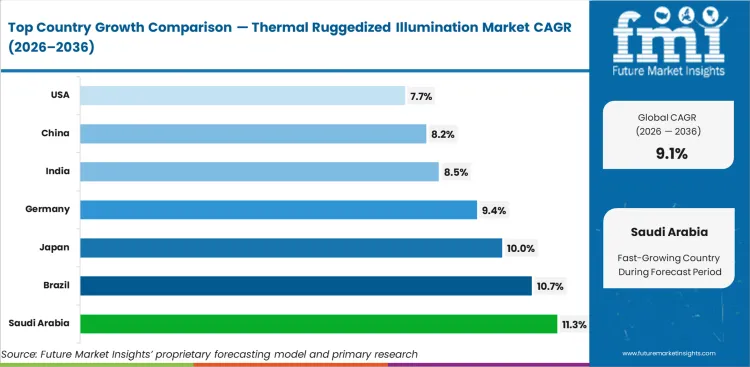
Thermal Ruggedized Illumination Market CAGR Analysis by Country
- Saudi Arabia is projected to record an 11.3% CAGR through 2036 as oil and gas projects. Mineral projects widen harsh-area lighting use.
- Brazil is expected to expand at 10.7% CAGR through 2036 as steel and cement users extend rugged fixture replacement.
- Japan is forecast to grow at 10.0% CAGR through 2036 as older industrial sites replace heat-stressed luminaires.
- Germany is expected to advance at 9.4% CAGR through 2036 as engineered heavy industry keeps safety documentation central.
- India is projected to rise at 8.5% CAGR through 2036 as steel and cement output supports volume replacement.
- China is forecast at 8.2% CAGR through 2036 as large process industries continue selective retrofit spending.
- The United States is expected to post 7.7% CAGR through 2036 as mature plants focus on safety and energy returns.
Demand Outlook for Thermal Ruggedized Illumination in Saudi Arabia
Saudi Arabia records the fastest forecast pace as hot oil and mineral sites keep rugged lighting in core project specifications. The General Authority for Statistics reported that the Industrial Production Index rose 8.9% year on year in February 2026. This industrial rise points to more operating areas that need lighting suited to heat and dust. Suppliers with hazardous-area certificates should gain earlier access to refinery and mining orders.
- Refinery maintenance teams need fixed lights that can handle heat and cleaning exposure during shutdown work.
- Mining and mineral projects add demand for fixtures that tolerate dust and vibration in remote sites.
- Project buyers favor suppliers that can show certification files before electrical packages are approved.
Sales Analysis of Thermal Ruggedized Illumination in Brazil
Brazil is expected to expand at 10.7% CAGR through 2036 as metalmaking and cement activity support harsh-zone replacements. World Steel Association reported Brazil at 2.8 million tonnes of crude steel in March 2026. This output creates lighting needs around melt shops and caster zones. Maintenance routes need rugged fixtures during shutdown work. Local channels can gain when they stock rugged fixtures with shorter lead times for plant buyers.
- Steel mills need luminaires that protect light output around heat and airborne dust.
- Cement plants create steady replacement demand near kilns and enclosed conveyors.
- Regional distributors can win by holding certified models for shutdown windows.
Future Outlook for Thermal Ruggedized Illumination in Japan
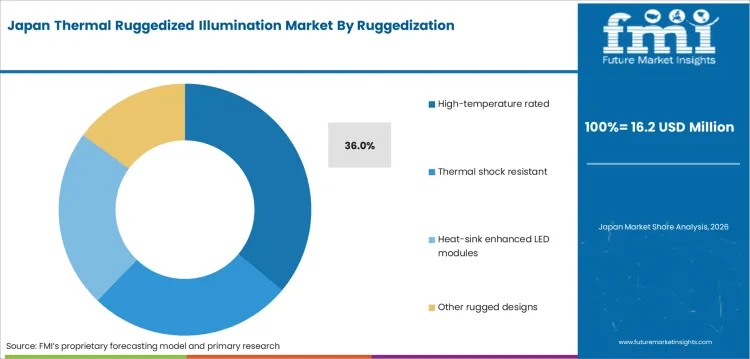
Japan is forecast to grow at 10.0% CAGR through 2036 as older industrial plants focus on reliability upgrades. World Steel Association reported Japan at 6.9 million tonnes of crude steel in March 2026. That production scale keeps heat-rated lighting relevant even as output shifts by cycle. Buyers are likely to value long life and fit with plant safety practice.
- Steel and foundry users need replacements that fit existing mounting points with limited redesign.
- Power and process sites value compact fixtures where access work is costly.
- Japanese buyers often expect detailed product data before approval for harsh operating areas.
Opportunity Analysis of Thermal Ruggedized Illumination in Germany
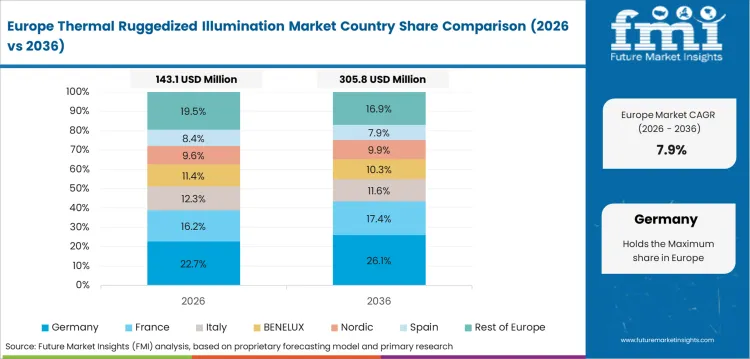
Germany has a deeper specification culture for industrial safety and engineered lighting packages. World Steel Association reported Germany at 3.3 million tonnes of crude steel in March 2026. That activity supports replacement demand in hot mills and metalworking plants. The market should favor suppliers with tested housings and clear European documentation.
- Steel and foundry plants use rugged fixtures where heat and dust shorten normal luminaire life.
- Cement and glass sites need bay lighting that holds output during long operating cycles.
- Engineering buyers give weight to certification records and thermal data during supplier review.
Demand Analysis for Thermal Ruggedized Illumination in India
India is projected to rise at 8.5% CAGR through 2036 as industrial capacity broadens across steel and cement. India’s Ministry of Steel reported crude steel production of 168.4 million tonnes during April 2025 to March 2026. This large industrial footprint supports demand for heat-rated fixtures in mills and allied process sites. The price-sensitive market will reward durable products with clear payback through lower relamping work.
- Steel plants need high bay lighting that works around heat and dust exposure.
- Cement clusters require fixtures with strong ingress protection near grinding and kiln zones.
- Domestic integrators can gain by combining certified fixtures with installation support.
Sales Outlook for Thermal Ruggedized Illumination in China
China is forecast at 8.2% CAGR through 2036 as large process industries continue selective retrofit work. The National Bureau of Statistics of China reported cement output of 144.16 million tonnes in December 2025. This scale creates a large installed replacement pool around high-heat cement lines. Local LED supply depth should keep pricing competitive while higher-end sites seek better thermal design.
- Cement and glass plants need fixtures that hold performance around kilns and dust.
- Steel sites use rugged lighting around platforms and conveyors. Maintenance corridors need reliable fixtures during shift work.
- Local suppliers compete on price while global brands compete on certification depth.
Demand Outlook for Thermal Ruggedized Illumination in the United States
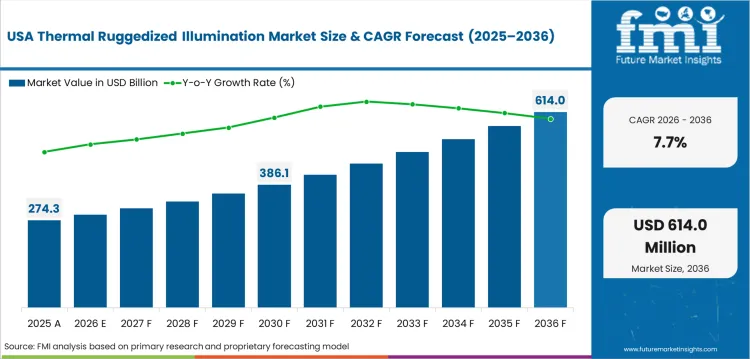
The United States is expected to post 7.7% CAGR through 2036 as mature plants focus on energy returns and safety files. The USA Geological Survey reported that cement shipments fell 2.1% during the first nine months of 2025. Lower shipment growth does not remove replacement needs in active plants. It shifts buying toward projects with clear maintenance savings and energy benefits.
- Gulf Coast oil and gas facilities keep hazardous-area lighting in the replacement pool.
- Steel and cement plants evaluate fixed bay retrofits when access work requires planned shutdowns.
- Federal efficiency guidance supports LED high bay selection in public and industrial facilities.
Competitive Landscape and Strategic Positioning
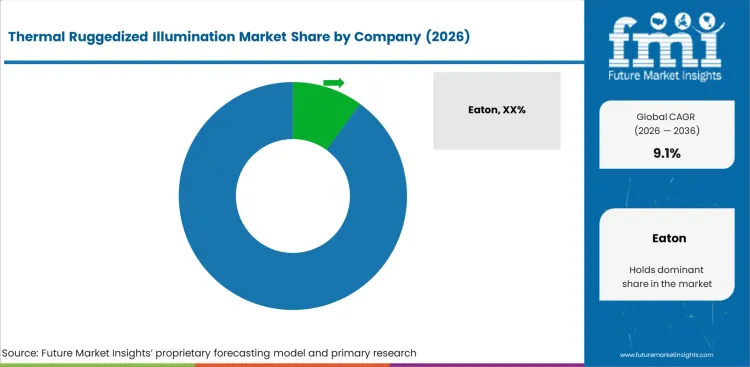
- The market is moderately concentrated around certified industrial lighting suppliers with heat-rated and hazardous-area portfolios.
- Eaton and Dialight hold stronger positions in harsh lighting. ABB and Hubbell add hazardous-area depth.
- Signify and Glamox compete through channel reach. WEG and Legrand add fixture breadth. Schréder and Trilux support European reach.
- Entry barriers include certification files and thermal design proof. Distributor access and plant acceptance history add difficulty.
Competition in the industry is shaped by proof of thermal reliability. Eaton explains that its harsh and hazardous LED luminaires use die-cast aluminum housings to move heat toward heat sinks. That design point is central for buyers who operate near furnaces and process heat. The practical effect is a stronger role for engineering data during selection. Suppliers without clear temperature data lose early in the approval process. Adjacent emergency lighting work can support the same plant safety channel.
Dialight competes from a high-durability lighting position. In October 2025, the company introduced a high output LED area light with factory sealing and ingress protection up to IP69. That matters for process plants that combine heat and washdown. Dust and corrosive exposure strengthen the case. It gives Dialight a practical selling point beyond basic lumen output. The offer suits buyers that want fewer replacements in hard-to-reach areas.
ABB and Hubbell compete where hazardous-area certification changes the buyer shortlist. ABB positions its XSL3 LED series around heat dissipation and multiple mounting options. Hubbell Killark offers hazardous location high and low bay fixtures for certified configurations. These portfolios create stronger fit for oil and gas sites. Chemical and metal sites add related demand. The same safety route links with emergency venting system investment in process-risk facilities.
Lighting groups with wider portfolios compete through channels and plant relationships. Signify and Trilux can address industrial bay areas that do not need full hazardous scope. Glamox is stronger in marine and offshore applications. Harsh-area projects add industrial overlap. WEG and Legrand add electrical infrastructure access in selected regions. Smaller companies can win custom orders when they offer fast support for LED light tower and temporary site needs.
Key Companies in the Thermal Ruggedized Illumination Market
Competition is best read by role because certification and thermal design differ by supplier type. Channel reach creates another split.
- Harsh and hazardous specialists include Eaton and Dialight. ABB and Hubbell add certified product depth. These companies have direct evidence of certified industrial lighting and heat dissipation design. Hazardous-area formats and heavy-duty housings support their position.
- Broad lighting and electrical infrastructure groups include Signify and Legrand. WEG and Schréder add regional reach. Trilux supports professional lighting access.
- Marine and offshore specialists include Glamox and selected Hubbell brands. Glamox has strong proof in offshore and marine lighting projects, which often need corrosion resistance and safety-ready documentation.
Competitive Benchmarking: Thermal Ruggedized Illumination Market
| Company | Thermal Rating Depth | Certification Coverage | Heavy-Industry Channel Fit | Geographic Footprint |
|---|---|---|---|---|
| Eaton | High | Strong | Strong | Global with Crouse-Hinds harsh-area reach |
| Dialight | High | Strong | Strong | Global with industrial LED focus |
| ABB | High | Strong | Medium | Global with Ex-Solutions portfolio |
| Hubbell | High | Strong | Medium | North America and global hazardous brands |
| Signify | Medium | Medium | Strong | Global lighting integration footprint |
| Glamox | Medium | Strong | Medium | Europe and offshore-centered reach |
| WEG | Medium | Medium | Medium | Latin America centered industrial access |
| Legrand | Low | Medium | Strong | Global electrical infrastructure channels |
| Schréder | Low | Medium | Medium | Europe centered lighting network |
| Trilux | Low | Medium | Medium | Europe centered professional lighting |
Source: Future Market Insights competitive analysis, 2026. Ratings reflect relative positioning based on thermal rating depth and certification coverage. Heavy-industry channel fit completes the assessment.
Key Developments in Thermal Ruggedized Illumination Market
- In October 2025, Dialight launched a high output LED area light with factory sealing and up to IP69 protection for harsh industrial sites.
- In February 2025, ABB published XSL3 hazardous lighting documentation with heat dissipation features. The product range lists 5 600 to 20 100 lumen options.
- In February 2026, Signify issued its 2025 annual report and reaffirmed professional lighting as a core global business line.
Key Players in the Thermal Ruggedized Illumination Market
Major Global Players:
- Eaton
- Signify
- ABB
- Dialight
- Hubbell
- Legrand
- Glamox
Specialist and Regional Players:
- WEG
- Schréder
- Trilux
Report Scope and Coverage
| Parameter | Details |
|---|---|
| Quantitative Units | USD 0.60 billion to USD 1.43 billion at 9.1% CAGR |
| Market Definition | Rugged luminaires and lighting modules used in hot and harsh industrial areas |
| Ruggedization | High-temperature rated; Thermal shock resistant; Heat-sink enhanced LED modules; Other rugged designs |
| End Use | Glass and cement; Steel and foundries; Oil and gas; Power generation |
| Mounting | Fixed bay lighting; Portable task lighting; Machine-mounted |
| Certification | Industrial safety compliant; Hazardous-area compatible; General purpose |
| Light Source | High-output LED; HID retrofit; Hybrid emergency |
| Regions Covered | North America; Latin America; Western Europe; Eastern Europe; East Asia; South Asia and Pacific; Middle East and Africa |
| Countries Covered | Saudi Arabia; Brazil; Japan; Germany; India; China; United States; 30+ countries |
| Key Companies Profiled | Eaton; Signify; ABB; Dialight; Glamox; WEG; Legrand; Hubbell; Schréder; Trilux |
| Forecast Period | 2026 to 2036 |
| Approach | Hybrid bottom-up and top-down methodology using supplied values, industrial output signals, and portfolio checks |
Source: Future Market Insights, 2026.
Thermal Ruggedized Illumination Market by Segments
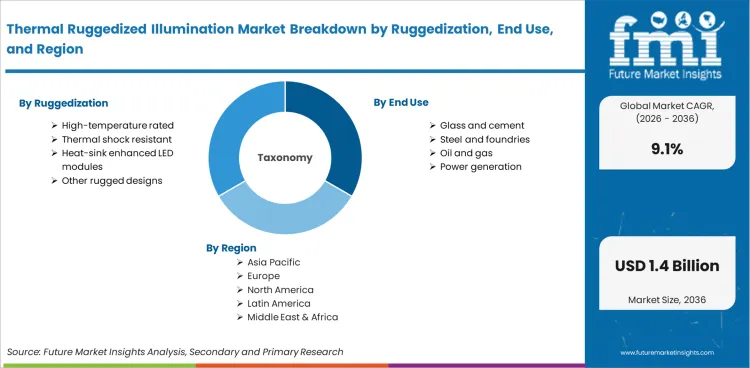
Thermal Ruggedized Illumination Market Segmented by Ruggedization:
- High-temperature rated
- Thermal shock resistant
- Heat-sink enhanced LED modules
- Other rugged designs
Thermal Ruggedized Illumination Market Segmented by End Use:
- Glass and cement
- Steel and foundries
- Oil and gas
- Power generation
Thermal Ruggedized Illumination Market Segmented by Mounting:
- Fixed bay lighting
- Portable task lighting
- Machine-mounted
Thermal Ruggedized Illumination Market Segmented by Certification:
- Industrial safety compliant
- Hazardous-area compatible
- General purpose
Thermal Ruggedized Illumination Market Segmented by Light Source:
- High-output LED
- HID retrofit
- Hybrid emergency
Thermal Ruggedized Illumination Market by Region:
- North America
- United States
- Canada
- Mexico
- Latin America
- Brazil
- Chile
- Rest of Latin America
- Western Europe
- Germany
- United Kingdom
- Italy
- Spain
- France
- Nordic
- BENELUX
- Rest of Western Europe
- Eastern Europe
- Russia
- Poland
- Hungary
- Balkan and Baltic
- Rest of Eastern Europe
- East Asia
- China
- Japan
- South Korea
- South Asia and Pacific
- India
- ASEAN
- Australia and New Zealand
- Rest of South Asia and Pacific
- Middle East and Africa
- Kingdom of Saudi Arabia
- Other GCC Countries
- Turkiye
- South Africa
- Other African Union
- Rest of Middle East and Africa
Research Sources and Bibliography
- USA Census Bureau. (2026, May 4). Monthly full report on manufacturers' shipments, inventories and orders: March 2026. USA Department of Commerce.
- USA Department of Energy. (2026, April). Purchasing energy-efficient commercial and industrial LED luminaires. Federal Energy Management Program.
- World Steel Association. (2026, April 23). March 2026 crude steel production. World Steel Association.
- USA Geological Survey. (2026, January). Cement: Mineral Commodity Summaries 2026. USA Geological Survey.
- National Bureau of Statistics of China. (2026, January 20). Industrial production operation in December 2025. National Bureau of Statistics of China.
- National Bureau of Statistics of China. (2026, April 17). Industrial production operation in March 2026. National Bureau of Statistics of China.
- Ministry of Steel. (2026, April). Monthly economic report for the month of March 2026. Government of India.
- General Authority for Statistics. (2026, April 9). Industrial Production Index increases by 8.9% in February 2026. Kingdom of Saudi Arabia.
- Dialight. (2025, October 28). Dialight unveils new high output LED area light. Dialight.
- ABB. (2025, February). Ex-Solutions XSL3 LED series. ABB.
- Glamox. (2024, October 1). Glamox lands contracts to light up to 19 Canadian Coast Guard ships. Glamox.
- Signify. (2026, February 24). Annual report 2025. Signify.
The bibliography is provided for reader reference and uses government, regulatory, trade body, and official company sources relevant to rugged industrial lighting.
This Report Answers
- What is the current and future value of the thermal ruggedized illumination market from 2026 to 2036?
- What CAGR is expected for the thermal ruggedized illumination market during the forecast period?
- Which ruggedization segment is projected to lead thermal ruggedized illumination demand in 2026?
- Which end-use segment is expected to hold the leading share in thermal ruggedized illumination?
- What factors are driving use of heat-rated luminaires in heavy industrial process areas?
- How do certification and thermal data affect supplier selection for rugged industrial lighting?
- Which countries are expected to grow faster in thermal ruggedized illumination during the forecast period?
- Which companies are positioned across hazardous and high-temperature rugged lighting portfolios?
- How does FMI define the revenue scope for thermal ruggedized illumination?
- What forecasting approach was used to estimate demand from 2026 to 2036?
Frequently Asked Questions
What is the global market demand for Thermal Ruggedized Illumination in 2026?
In 2026, the global thermal ruggedized illumination market is expected to be worth USD 0.60 billion as heat-rated fixtures gain industrial use.
How big will the Thermal Ruggedized Illumination Market be in 2036?
By 2036, the thermal ruggedized illumination market is expected to reach USD 1.43 billion as heavy plants upgrade harsh-area lighting.
How much is demand for Thermal Ruggedized Illumination expected to expand between 2026 and 2036?
Between 2026 and 2036, thermal ruggedized illumination demand is projected to expand at 9.1% CAGR as heat-rated LED fixtures spread.
Which ruggedization type is expected to lead the Thermal Ruggedized Illumination Market by 2026?
High-temperature rated fixtures are projected to lead ruggedization demand with 36.0% share in 2026 due to furnace and kiln exposure.
Which end use is expected to lead Thermal Ruggedized Illumination demand in 2026?
Glass and cement is expected to lead end-use demand with 34.0% share in 2026 as kiln zones need rugged lighting.
Which country is forecast to grow fastest in the Thermal Ruggedized Illumination Market?
Saudi Arabia is expected to record 11.3% CAGR through 2036 as oil and gas projects. Mineral projects need harsh-area lighting.
What does the Thermal Ruggedized Illumination Market include?
The market includes luminaires and lighting modules built for hot and dusty industrial work areas. Vibration-prone and safety-sensitive areas are included.
How does FMI estimate the Thermal Ruggedized Illumination Market forecast?
FMI uses supplied market anchors and industrial output checks. Fixture replacement patterns and segment shares validate the forecast. Supplier portfolio evidence supports the same result.
How does thermal ruggedized lighting differ from normal industrial lighting?
Thermal ruggedized lighting is built for heat and dust. Vibration and safety review separate it from normal fixtures. Normal industrial lighting often lacks the same temperature and certification proof.
Who buys thermal ruggedized illumination products?
Typical buyers include cement plants and glass factories. Steel mills and oil and gas sites form another buyer pool. Power plants and industrial contractors manage many upgrades.
How much does thermal ruggedized illumination cost compared with normal LED lighting?
It costs more than normal LED lighting since housings and heat sinks are stronger. Lenses and certification files are built for harder operating conditions.
How long can thermal ruggedized lighting last in heavy industrial sites?
Service life depends on heat exposure and cleaning cycles. Better thermal design can reduce relamping work and extend useful operation in difficult zones.
Preview the report firsthand - request a free sample
Get SampleGet the brochure for pricing and purchase details.
Get PDFTable of Content
- Key Takeaways
- Market Size and CAGR
- Top Growth Driver
- Fastest Growing Segment
- Leading Region
- Key Companies
- Emerging Opportunities
- Executive Summary
- Global Market Outlook
- Demand-side Trends
- Supply-side Trends
- Technology Roadmap Analysis
- Analysis and Recommendations
- Analyst Perspective (What is happening? Why now? What should investors know?)
- Key Questions Answered
- How large is the market?
- What is the CAGR?
- What are key trends?
- Which region dominates?
- Who are the leaders?
- Market Overview
- Market Coverage / Taxonomy
- Market Definition / Scope / Limitations
- Research Methodology
- Chapter Orientation
- Analytical Lens and Working Hypotheses
- Market Structure, Signals, and Trend Drivers
- Benchmarking and Cross-market Comparability
- Market Sizing, Forecasting, and Opportunity Mapping
- Research Design and Evidence Framework
- Desk Research Programme (Secondary Evidence)
- Expert Input and Fieldwork (Primary Evidence)
- Tooling, Models, and Reference Databases
- Data Engineering and Model Build
- Quality Assurance and Audit Trail
- Market Background
- Market Dynamics (Drivers, Restraints, Opportunity, Trends)
- Scenario Forecast (Optimistic, Likely, Conservative)
- Impact Analysis
- AI Impact
- Sustainability Impact
- Regulatory Impact
- Technology Impact
- Consumer / Buyer Analysis
- Purchase Drivers
- Adoption Barriers
- Buyer Journey
- Opportunity Map Analysis
- Product Life Cycle Analysis
- Supply Chain Analysis
- Investment Feasibility Matrix
- Value Chain Analysis
- PESTLE and Porter's Analysis
- Regulatory Landscape
- Regional Parent Market Outlook
- Production and Consumption Statistics
- Import and Export Statistics
- Global Market Analysis and Forecast, 2021 to 2036
- Historical Market Size Value (USD Million) & Volume (Unit) Analysis, 2021 to 2025
- Current and Future Market Size Value (USD Million) & Volume (Unit) Projections, 2026 to 2036
- Y-o-Y Growth Trend Analysis
- Absolute $ Opportunity Analysis
- Global Market Pricing Analysis, 2021 to 2036
- Global Market Analysis and Forecast, By Ruggedization, 2021 to 2036
- Introduction / Key Findings
- Historical Market Size Value (USD Million) & Volume (Unit) Analysis By Ruggedization, 2021 to 2025
- Current and Future Market Size Value (USD Million) & Volume (Unit) Analysis and Forecast By Ruggedization, 2026 to 2036
- High-temperature rated
- Thermal shock resistant
- Heat-sink enhanced LED modules
- Other rugged designs
- High-temperature rated
- Y-o-Y Growth Trend Analysis By Ruggedization, 2021 to 2025
- Absolute $ Opportunity Analysis By Ruggedization, 2026 to 2036
- Global Market Analysis and Forecast, By End Use, 2021 to 2036
- Introduction / Key Findings
- Historical Market Size Value (USD Million) & Volume (Unit) Analysis By End Use, 2021 to 2025
- Current and Future Market Size Value (USD Million) & Volume (Unit) Analysis and Forecast By End Use, 2026 to 2036
- Glass and cement
- Steel and foundries
- Oil and gas
- Power generation
- Glass and cement
- Y-o-Y Growth Trend Analysis By End Use, 2021 to 2025
- Absolute $ Opportunity Analysis By End Use, 2026 to 2036
- Global Market Analysis and Forecast, By Mounting, 2021 to 2036
- Introduction / Key Findings
- Historical Market Size Value (USD Million) & Volume (Unit) Analysis By Mounting, 2021 to 2025
- Current and Future Market Size Value (USD Million) & Volume (Unit) Analysis and Forecast By Mounting, 2026 to 2036
- Fixed bay lighting
- Portable task lighting
- Machine-mounted
- Fixed bay lighting
- Y-o-Y Growth Trend Analysis By Mounting, 2021 to 2025
- Absolute $ Opportunity Analysis By Mounting, 2026 to 2036
- Global Market Analysis and Forecast, By Certification, 2021 to 2036
- Introduction / Key Findings
- Historical Market Size Value (USD Million) & Volume (Unit) Analysis By Certification, 2021 to 2025
- Current and Future Market Size Value (USD Million) & Volume (Unit) Analysis and Forecast By Certification, 2026 to 2036
- Industrial safety compliant
- Hazardous-area compatible
- General purpose
- Industrial safety compliant
- Y-o-Y Growth Trend Analysis By Certification, 2021 to 2025
- Absolute $ Opportunity Analysis By Certification, 2026 to 2036
- Global Market Analysis and Forecast, By Light Source, 2021 to 2036
- Introduction / Key Findings
- Historical Market Size Value (USD Million) & Volume (Unit) Analysis By Light Source, 2021 to 2025
- Current and Future Market Size Value (USD Million) & Volume (Unit) Analysis and Forecast By Light Source, 2026 to 2036
- High-output LED
- HID retrofit
- Hybrid emergency
- High-output LED
- Y-o-Y Growth Trend Analysis By Light Source, 2021 to 2025
- Absolute $ Opportunity Analysis By Light Source, 2026 to 2036
- Global Market Analysis and Forecast, By Region, 2021 to 2036
- Introduction
- Historical Market Size Value (USD Million) & Volume (Unit) Analysis By Region, 2021 to 2025
- Current Market Size Value (USD Million) & Volume (Unit) Analysis and Forecast By Region, 2026 to 2036
- North America
- Latin America
- Western Europe
- Eastern Europe
- East Asia
- South Asia and Pacific
- Middle East & Africa
- Market Attractiveness Analysis By Region
- North America Market Analysis and Forecast, By Country, 2021 to 2036
- Historical Market Size Value (USD Million) & Volume (Unit) Trend Analysis By Market Taxonomy, 2021 to 2025
- Market Size Value (USD Million) & Volume (Unit) Forecast By Market Taxonomy, 2026 to 2036
- By Country
- USA
- Canada
- Mexico
- By Ruggedization
- By End Use
- By Mounting
- By Certification
- By Light Source
- By Country
- Market Attractiveness Analysis
- By Country
- By Ruggedization
- By End Use
- By Mounting
- By Certification
- By Light Source
- Key Takeaways
- Latin America Market Analysis and Forecast, By Country
- Historical Market Size Value (USD Million) & Volume (Unit) Trend Analysis By Market Taxonomy, 2021 to 2025
- Market Size Value (USD Million) & Volume (Unit) Forecast By Market Taxonomy, 2026 to 2036
- By Country
- Brazil
- Chile
- Rest of Latin America
- By Ruggedization
- By End Use
- By Mounting
- By Certification
- By Light Source
- By Country
- Market Attractiveness Analysis
- By Country
- By Ruggedization
- By End Use
- By Mounting
- By Certification
- By Light Source
- Key Takeaways
- Western Europe Market Analysis and Forecast, By Country
- Historical Market Size Value (USD Million) & Volume (Unit) Trend Analysis By Market Taxonomy, 2021 to 2025
- Market Size Value (USD Million) & Volume (Unit) Forecast By Market Taxonomy, 2026 to 2036
- By Country
- Germany
- UK
- Italy
- Spain
- France
- Nordic
- BENELUX
- Rest of Western Europe
- By Ruggedization
- By End Use
- By Mounting
- By Certification
- By Light Source
- By Country
- Market Attractiveness Analysis
- By Country
- By Ruggedization
- By End Use
- By Mounting
- By Certification
- By Light Source
- Key Takeaways
- Eastern Europe Market Analysis and Forecast, By Country
- Historical Market Size Value (USD Million) & Volume (Unit) Trend Analysis By Market Taxonomy, 2021 to 2025
- Market Size Value (USD Million) & Volume (Unit) Forecast By Market Taxonomy, 2026 to 2036
- By Country
- Russia
- Poland
- Hungary
- Balkan & Baltic
- Rest of Eastern Europe
- By Ruggedization
- By End Use
- By Mounting
- By Certification
- By Light Source
- By Country
- Market Attractiveness Analysis
- By Country
- By Ruggedization
- By End Use
- By Mounting
- By Certification
- By Light Source
- Key Takeaways
- East Asia Market Analysis and Forecast, By Country
- Historical Market Size Value (USD Million) & Volume (Unit) Trend Analysis By Market Taxonomy, 2021 to 2025
- Market Size Value (USD Million) & Volume (Unit) Forecast By Market Taxonomy, 2026 to 2036
- By Country
- China
- Japan
- South Korea
- By Ruggedization
- By End Use
- By Mounting
- By Certification
- By Light Source
- By Country
- Market Attractiveness Analysis
- By Country
- By Ruggedization
- By End Use
- By Mounting
- By Certification
- By Light Source
- Key Takeaways
- South Asia and Pacific Market Analysis and Forecast, By Country
- Historical Market Size Value (USD Million) & Volume (Unit) Trend Analysis By Market Taxonomy, 2021 to 2025
- Market Size Value (USD Million) & Volume (Unit) Forecast By Market Taxonomy, 2026 to 2036
- By Country
- India
- ASEAN
- Australia & New Zealand
- Rest of South Asia and Pacific
- By Ruggedization
- By End Use
- By Mounting
- By Certification
- By Light Source
- By Country
- Market Attractiveness Analysis
- By Country
- By Ruggedization
- By End Use
- By Mounting
- By Certification
- By Light Source
- Key Takeaways
- Middle East & Africa Market Analysis and Forecast, By Country
- Historical Market Size Value (USD Million) & Volume (Unit) Trend Analysis By Market Taxonomy, 2021 to 2025
- Market Size Value (USD Million) & Volume (Unit) Forecast By Market Taxonomy, 2026 to 2036
- By Country
- Kingdom of Saudi Arabia
- Other GCC Countries
- Türkiye
- South Africa
- Other African Union
- Rest of Middle East & Africa
- By Ruggedization
- By End Use
- By Mounting
- By Certification
- By Light Source
- By Country
- Market Attractiveness Analysis
- By Country
- By Ruggedization
- By End Use
- By Mounting
- By Certification
- By Light Source
- Key Takeaways
- Key Countries Market Analysis
- USA
- Pricing Analysis
- Market Share Analysis, 2025
- By Ruggedization
- By End Use
- By Mounting
- By Certification
- By Light Source
- Canada
- Pricing Analysis
- Market Share Analysis, 2025
- By Ruggedization
- By End Use
- By Mounting
- By Certification
- By Light Source
- Mexico
- Pricing Analysis
- Market Share Analysis, 2025
- By Ruggedization
- By End Use
- By Mounting
- By Certification
- By Light Source
- Brazil
- Pricing Analysis
- Market Share Analysis, 2025
- By Ruggedization
- By End Use
- By Mounting
- By Certification
- By Light Source
- Chile
- Pricing Analysis
- Market Share Analysis, 2025
- By Ruggedization
- By End Use
- By Mounting
- By Certification
- By Light Source
- Germany
- Pricing Analysis
- Market Share Analysis, 2025
- By Ruggedization
- By End Use
- By Mounting
- By Certification
- By Light Source
- UK
- Pricing Analysis
- Market Share Analysis, 2025
- By Ruggedization
- By End Use
- By Mounting
- By Certification
- By Light Source
- Italy
- Pricing Analysis
- Market Share Analysis, 2025
- By Ruggedization
- By End Use
- By Mounting
- By Certification
- By Light Source
- Spain
- Pricing Analysis
- Market Share Analysis, 2025
- By Ruggedization
- By End Use
- By Mounting
- By Certification
- By Light Source
- France
- Pricing Analysis
- Market Share Analysis, 2025
- By Ruggedization
- By End Use
- By Mounting
- By Certification
- By Light Source
- India
- Pricing Analysis
- Market Share Analysis, 2025
- By Ruggedization
- By End Use
- By Mounting
- By Certification
- By Light Source
- ASEAN
- Pricing Analysis
- Market Share Analysis, 2025
- By Ruggedization
- By End Use
- By Mounting
- By Certification
- By Light Source
- Australia & New Zealand
- Pricing Analysis
- Market Share Analysis, 2025
- By Ruggedization
- By End Use
- By Mounting
- By Certification
- By Light Source
- China
- Pricing Analysis
- Market Share Analysis, 2025
- By Ruggedization
- By End Use
- By Mounting
- By Certification
- By Light Source
- Japan
- Pricing Analysis
- Market Share Analysis, 2025
- By Ruggedization
- By End Use
- By Mounting
- By Certification
- By Light Source
- South Korea
- Pricing Analysis
- Market Share Analysis, 2025
- By Ruggedization
- By End Use
- By Mounting
- By Certification
- By Light Source
- Russia
- Pricing Analysis
- Market Share Analysis, 2025
- By Ruggedization
- By End Use
- By Mounting
- By Certification
- By Light Source
- Poland
- Pricing Analysis
- Market Share Analysis, 2025
- By Ruggedization
- By End Use
- By Mounting
- By Certification
- By Light Source
- Hungary
- Pricing Analysis
- Market Share Analysis, 2025
- By Ruggedization
- By End Use
- By Mounting
- By Certification
- By Light Source
- Kingdom of Saudi Arabia
- Pricing Analysis
- Market Share Analysis, 2025
- By Ruggedization
- By End Use
- By Mounting
- By Certification
- By Light Source
- Türkiye
- Pricing Analysis
- Market Share Analysis, 2025
- By Ruggedization
- By End Use
- By Mounting
- By Certification
- By Light Source
- South Africa
- Pricing Analysis
- Market Share Analysis, 2025
- By Ruggedization
- By End Use
- By Mounting
- By Certification
- By Light Source
- USA
- Market Structure Analysis
- Competition Dashboard
- Competition Benchmarking
- Market Share Analysis of Top Players
- By Regional
- By Ruggedization
- By End Use
- By Mounting
- By Certification
- By Light Source
- Emerging Startups
- Innovation Benchmarking
- Competition Analysis
- Competition Deep Dive
- Eaton
- Overview
- Product Portfolio
- Profitability by Market Segments (Product/Region/Sales Channel)
- Sales Footprint
- Strategy Overview
- Marketing Strategy
- Product Strategy
- Channel Strategy
- Signify
- ABB
- Dialight
- Hubbell
- Legrand
- Glamox
- WEG
- Schréder
- Trilux
- Eaton
- Case Studies
- Success Stories
- Recent Developments
- Competition Deep Dive
- Assumptions & Acronyms Used


