

- Industry Size (2026)
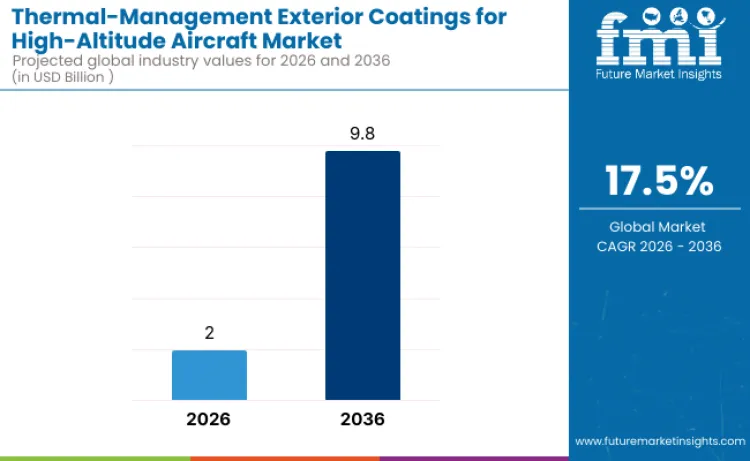
- USD 2.0 Bn
- Forecast (2036)
- USD 9.8 Bn
- CAGR (2026 to 2036)
- 4.3%
Thermal-Management Exterior Coatings for High-Altitude Aircraft Market Forecast and Outlook 2026 to 2036
The thermal-management exterior coatings for high-altitude aircraft market is valued at USD 2.0 billion in 2026 and is projected to reach USD 9.8 billion by 2036, reflecting a CAGR of 17.5%. Demand increases as high-altitude and long-endurance aircraft platforms require advanced thermal-control solutions to manage extreme solar exposure and temperature fluctuations. Growth aligns with expanded use of HALE UAVs, surveillance aircraft, and scientific platforms operating in stratospheric conditions.
Solar-reflective thermal-management coatings lead coating-type adoption because engineered pigment systems and reflective ceramic structures reduce solar heat absorption while maintaining durability and low mass. These coatings stabilize skin temperatures, protect onboard electronics, and improve operational efficiency across long-duration missions. Formulations are optimized for UV resistance, emissivity balance, and adhesion to composite airframes.
China, India, USA, and Japan act as key growth regions due to active high-altitude aircraft programs, defense modernization, and investment in long-endurance unmanned systems. AkzoNobel, PPG Aerospace, Mankiewicz, Sherwin-Williams Aerospace Coatings, and 3M drive competitive progress through high-reflectance coating systems, radiation-hardened polymer technologies, and thermal-control solutions engineered for extreme-altitude operational environments.
Quick Stats for Thermal-Management Exterior Coatings for High-Altitude Aircraft Market
- Market Value (2026): USD 2.0 billion
- Market Forecast Value (2036): USD 9.8 billion
- Market Forecast CAGR (2026 to 2036): 17.5%
- Leading Coating Type in Global Demand: Solar-reflective thermal-management coatings
- Key Growth Regions in Global Demand: China, India, USA, Japan
- Top Players in Global Demand: AkzoNobel, PPG Aerospace, Mankiewicz, Sherwin-Williams Aerospace Coatings, 3M
Thermal-Management Exterior Coatings for High-Altitude Aircraft Market Key Takeaways
| Metric | Value |
|---|---|
| Market Value (2026) | USD 2.0 billion |
| Market Forecast Value (2036) | USD 9.8 billion |
| Forecast CAGR (2026 to 2036) | 17.5% |
How Are the Segments Classified in the Thermal-Management Exterior Coatings for High-Altitude Aircraft Market?
Demand for thermal-management exterior coatings is shaped by high-altitude temperature extremes, solar loading, and the need to maintain structural integrity and systems performance during long-duration operations. Buyers evaluate solar reflectivity, IR emissivity, thermal-shock tolerance, and compatibility with composite and metallic airframes. Adoption patterns reflect increased deployment of high-altitude platforms, UAVs, and specialized aircraft requiring coatings that stabilize temperature gradients across exposed surfaces.
Which Coating Type Accounts for the Largest Share of Global Demand?
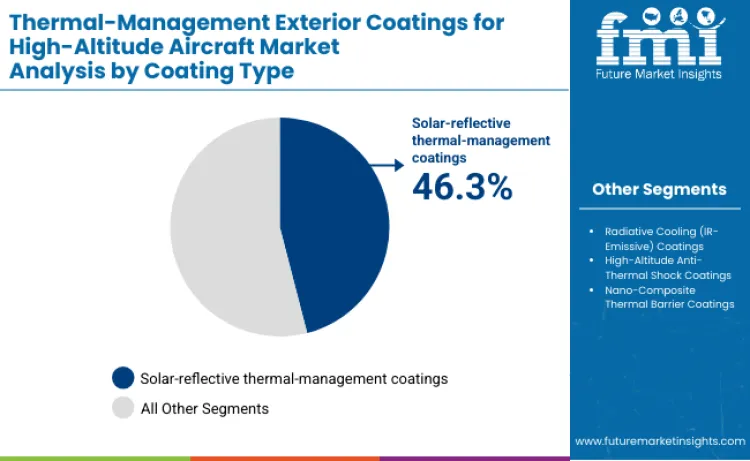
Solar-reflective thermal-management coatings hold 46.3%, making them the leading coating-type segment globally. These coatings reduce solar heat absorption, limit surface-temperature rise, and maintain thermal balance in high-irradiance conditions. Radiative cooling coatings enhance IR emissivity to dissipate heat passively during extended high-altitude operation. High-altitude anti-thermal-shock coatings protect structures exposed to rapid temperature transitions. Nano-composite thermal-barrier coatings provide enhanced insulation and abrasion resistance. Coating-type distribution reflects strong reliance on solar-reflective systems due to their broad performance advantages.
Key Points:
- Solar-reflective coatings reduce solar heating at altitude.
- Radiative coatings dissipate heat through IR emission.
- Anti-thermal-shock coatings protect against rapid temperature shifts.
- Nano-composite barriers enhance insulation and durability.
Which Functional Property Represents the Largest Share of Global Demand?
Heat-rejection and surface-cooling coatings hold 44.9%, making them the largest functional-property segment. These systems combine solar reflectivity and IR emissivity to maintain stable surface temperatures and protect sensitive components. Thermal-insulating coatings minimize heat transfer into structural materials. Anti-icing plus thermal-management hybrids combine surface cooling with ice-adhesion mitigation for cold-soak operations. UV and extreme-environment coatings protect against high-altitude radiation and environmental degradation. Functional-property distribution reflects priority placed on passive heat-rejection capability.
Key Points:
- Heat-rejection coatings stabilize surface temperatures.
- Insulating systems limit heat transfer into airframe structures.
- Hybrid coatings provide cooling with anti-icing protection.
- UV-resistant systems protect under high-altitude radiation exposure.
Which Application Area Accounts for the Largest Share of Global Demand?
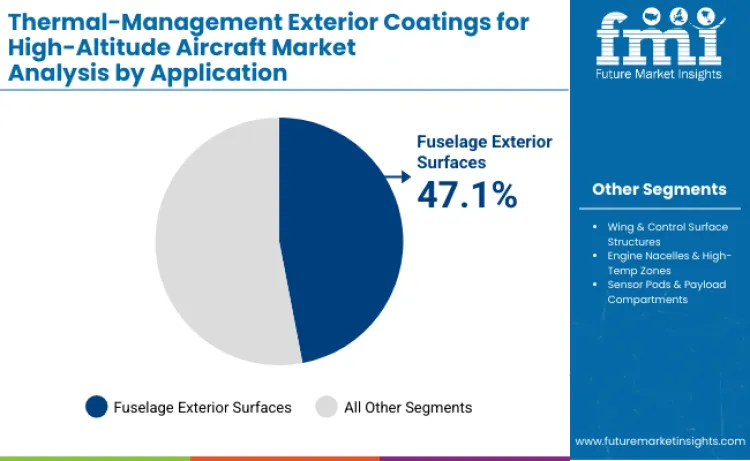
Fuselage exterior surfaces hold 47.1%, making them the leading application-area segment. These surfaces experience continuous solar exposure and require coatings that maintain thermal stability without compromising aerodynamic performance. Wing and control surfaces rely on coatings that preserve structural stiffness under thermal cycling. Engine nacelles and high-temperature zones require coatings with enhanced thermal-shock resistance and durability. Sensor pods and payload compartments depend on stable thermal environments to protect sensitive electronics. Application distribution reflects high exposure and thermal-load concentration on fuselage surfaces.
Key Points:
- Fuselage surfaces face highest sustained solar exposure.
- Wings and control surfaces require thermal-cycling resilience.
- Nacelles need thermal-shock-resistant coatings.
- Sensor pods require stable temperatures for mission payloads.
What are the Key Dynamics in the Thermal-Management Exterior Coatings for High-Altitude Aircraft Market?
Global demand rises as defence programs, research aircraft operators, and high-altitude commercial platforms evaluate exterior coatings engineered to regulate thermal loads in low-pressure, high-radiation environments. These coatings minimize temperature fluctuations across aircraft surfaces, support structural stability, and protect avionics sensitive to thermal variance. Interest increases as long-endurance UAVs and stratospheric platforms expand missions requiring predictable thermal behaviour across extended flight durations.
How are high-altitude operating conditions and thermal protection needs shaping coating development?
Aircraft flying at high altitude experience intense solar radiation, limited convective cooling, and rapid shifts in skin temperature. Coating developers engineer formulations that reflect solar energy while maintaining emissivity characteristics suited to controlled heat dissipation. Thermal management coatings stabilize surface temperature gradients, reducing stress on composites, adhesives, and embedded electronics. Defence and research platforms assess coatings that minimize infrared signatures and protect sensitive equipment. Long-endurance UAV operators require coatings that maintain performance across prolonged exposure to UV and low-pressure conditions. Material scientists test durability under cyclic heating to validate suitability for missions conducted in the upper atmosphere.
How do qualification requirements, durability constraints, and integration challenges influence scalability?
Aerospace certification requires performance validation under extreme thermal cycling, UV exposure, and environmental stress, extending qualification timelines. Coatings must retain adhesion and stability across composite and metallic substrates commonly used in high-altitude platforms. Application processes demand controlled curing to avoid defects that change emissivity or reflectivity. Operators evaluate long-term erosion resistance when aircraft encounter particulate or moisture at lower altitudes. Compatibility with maintenance workflows influences adoption, as reapplication requires consistent optical and thermal properties. Regional variations in regulatory frameworks governing coating chemistry affect global deployment strategies. Performance consistency across diverse climatic conditions shapes procurement decisions for specialized aircraft fleets.
How is Demand for Thermal-Management Exterior Coatings for High-Altitude Aircraft Market Evolving Across Key Countries?
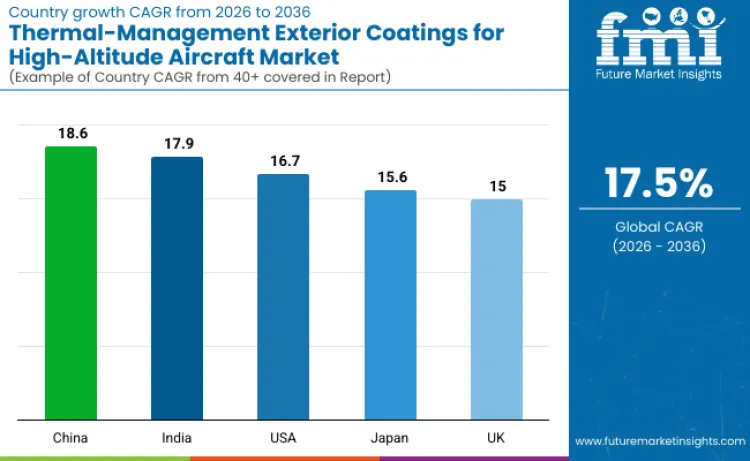
Demand for the thermal-management exterior coatings for high-altitude aircraft market is rising due to increased operational exposure to extreme thermal gradients, broader use of advanced composite structures, and strong interest in coatings enhancing thermal stability at altitude. China records a CAGR of 18.6% supported by rapid aerospace expansion. India shows a 17.9% CAGR driven by defense and regional aviation growth. USA posts a 16.7% CAGR supported by advanced materials research. Japan holds a 15.6% CAGR linked with precision coating development. UK records a 15.0% CAGR supported by aerospace-efficiency and high-altitude performance programs.
| Country | CAGR (%) |
|---|---|
| China | 18.6% |
| India | 17.9% |
| USA | 16.7% |
| Japan | 15.6% |
| UK | 15.0% |
How is China driving demand for Thermal-Management Exterior Coatings for High-Altitude Aircraft?
China drives demand due to rapid growth in high-altitude aviation, increased use of composite airframes, and focus on thermal-protection technologies enabling stable performance in extreme atmospheric conditions. The country’s CAGR of 18.6% reflects adoption of coatings engineered to manage temperature fluctuations, dissipate heat, and protect surfaces from thermal cycling stress. Research institutes develop ceramic–polymer hybrid systems improving emissivity and thermal resistance. Aerospace manufacturers integrate thermal-management coatings into fuselage, nacelle, and wing structures. National aerospace modernization programs strengthen long-term adoption.
- Expansion of high-altitude aviation programs
- Development of ceramic-polymer hybrid thermal coatings
- Integration of coatings into composite aircraft structures
- National initiatives supporting advanced thermal-protection technologies
How is India driving demand for Thermal-Management Exterior Coatings for High-Altitude Aircraft?
India supports rising demand due to increasing defense-aircraft deployment in high-altitude regions, expansion of regional aviation, and interest in material systems improving thermal resilience. The country’s CAGR of 17.9% reflects adoption of coatings enhancing thermal stability during operations in cold, low-density atmospheres. Research organizations develop polymer-based and ceramic-infused coatings tailored for temperature-shock resistance. Defense aviation programs evaluate thermal-management solutions for extended high-altitude missions. Growth in MRO infrastructure supports integration of advanced exterior coatings in domestic fleets.
- Defense-aircraft operation in extreme-altitude environments
- Development of temperature-shock-resistant coating chemistries
- MRO expansion supporting coating integration
- Increased interest in high-altitude aviation performance
How is the USA driving demand for Thermal-Management Exterior Coatings for High-Altitude Aircraft?
USA drives demand through advanced aerospace-materials R&D, high-altitude defense programs, and focus on improving thermal-performance margins for composite aircraft. The country’s CAGR of 16.7% reflects development of coatings with controlled emissivity, improved infrared signature management, and resistance to thermal cycling. Aerospace firms test nano-structured and ceramic-enhanced coatings to maintain structural stability. Defense programs integrate thermal-management coatings into high-altitude and long-endurance platforms. Commercial aviation research evaluates heat-dissipation coatings to enhance reliability under temperature extremes.
- Strong R&D on nano-structured thermal coatings
- Defense-program integration of thermal-management systems
- Coatings supporting composite-airframe thermal stability
- Commercial testing of heat-dissipation surface technologies
How is Japan driving demand for Thermal-Management Exterior Coatings for High-Altitude Aircraft?
Japan drives demand due to precise engineering requirements, expansion of advanced-materials research, and interest in ensuring stable aircraft performance across harsh thermal environments. The country’s CAGR of 15.6% reflects adoption of high-accuracy thermal-control coatings designed for durability and temperature-uniformity. Research institutes develop thin-film ceramic coatings supporting emissivity control. Aerospace manufacturers integrate thermal-management coatings into high-altitude prototypes and composite structures. National focus on aerothermal reliability strengthens deployment.
- Development of thin-film ceramic thermal-control coatings
- Integration into composite high-altitude platforms
- Precision durability testing across thermal gradients
- Emphasis on aerothermal reliability supporting adoption
How is the UK driving demand for Thermal-Management Exterior Coatings for High-Altitude Aircraft?
The UK supports demand through aerospace innovation programs, expansion of high-altitude research initiatives, and strong focus on improving thermal efficiency in advanced aircraft. The country’s CAGR of 15.0% reflects interest in coatings optimizing heat dissipation, thermal cycling stability, and environmental durability. Research institutions evaluate emissivity-controlled coatings for next-generation airframes. Aerospace firms adopt thermal-management coatings to enhance performance during extended high-altitude operations. National strategies emphasizing fuel efficiency and advanced materials support system integration.
- Aerospace innovation supporting advanced thermal coatings
- Evaluation of emissivity-controlled coatings
- Adoption in extended high-altitude aircraft operations
- National materials and efficiency strategies reinforcing demand
What is the competitive landscape of demand for thermal-management exterior coatings for high-altitude aircraft globally?
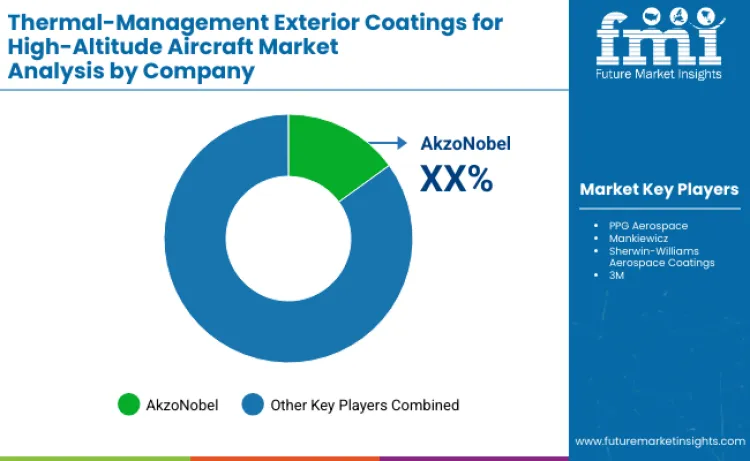
Demand for thermal-management exterior coatings for high-altitude aircraft grows as aerospace operators address extreme temperature gradients, UV intensity, and thermal loading on composite and metallic structures. Requirements center on controlled solar reflectance, infrared emissivity, erosion resistance, and adhesion stability across altitude-related thermal cycles. Buyers evaluate coating film uniformity, pigment stability, surface durability, and compatibility with aircraft skins operating in thin-air environments. Procurement teams prioritize certification pathways, maintenance predictability, and integration with existing exterior coating systems used on specialized platforms. Trend in the global market reflects increased interest in lightweight thermal-control materials that help manage structural temperature while supporting aerodynamic cleanliness.
AkzoNobel leads through aerospace coatings engineered for thermal-control performance, UV stability, and long-term exterior durability. PPG Aerospace participates with functional thermal-management topcoats applied across high-altitude and surveillance platforms requiring predictable emissivity behavior. Mankiewicz maintains visibility with aviation coatings offering enhanced solar-reflective properties and controlled film characteristics suited for environmental extremes. Sherwin-Williams Aerospace Coatings contributes with high-performance exterior systems designed for temperature moderation on composite skins. 3M supports demand with advanced pigments and functional surface technologies incorporated into thermal-management coating formulations. Competitive positioning globally reflects thermal-control effectiveness, weathering performance, certification readiness, and compatibility with fleet maintenance programs operating at high altitude.
Key Players in the Thermal-Management Exterior Coatings for High-Altitude Aircraft Market
- AkzoNobel
- PPG Aerospace
- Mankiewicz
- Sherwin-Williams Aerospace Coatings
- 3M
Scope of the Report
| Items | Values |
|---|---|
| Quantitative Units | USD billion |
| Coating Type | Solar-Reflective Thermal Management Coatings; Radiative Cooling (IR-Emissive) Coatings; High-Altitude Anti-Thermal Shock Coatings; Nano-Composite Thermal Barrier Coatings |
| Functional Property | Heat Rejection & Surface Cooling Coatings; Thermal-Insulating Coatings; Anti-Icing + Thermal Management Hybrid Coatings; UV & Extreme-Environment Protection Coatings |
| Application Area | Fuselage Exterior Surfaces; Wing & Control Surface Structures; Engine Nacelles & High-Temp Zones; Sensor Pods & Payload Compartments |
| End-User | High-Altitude Aircraft OEMs; Defense & Aerospace Agencies; MRO & Maintenance Operators; Aerospace Material & Coating Manufacturers |
| Regions Covered | Asia Pacific, Europe, North America, Latin America, Middle East & Africa |
| Countries Covered | India, China, USA, Germany, South Korea, Japan, Italy, and 40+ countries |
| Key Companies Profiled | AkzoNobel; PPG Aerospace; Mankiewicz; Sherwin-Williams Aerospace Coatings; 3M |
| Additional Attributes | Dollar sales by coating type and functional property; adoption trends in high-altitude and extreme-environment aircraft programs; compatibility with composite and metallic airframes; integration of radiative-cooling technologies for reduced thermal load; innovations in nano-composite thermal barrier systems; performance evaluation under low-pressure, high-UV, and thermal-cycling conditions. |
Thermal-Management Exterior Coatings for High-Altitude Aircraft Market by Segment
By Coating Type:
- Solar-Reflective Thermal Management Coatings
- Radiative Cooling (IR-Emissive) Coatings
- High-Altitude Anti-Thermal Shock Coatings
- Nano-Composite Thermal Barrier Coatings
By Functional Property:
- Heat Rejection & Surface Cooling Coatings
- Thermal-Insulating Coatings
- Anti-Icing + Thermal Management Hybrid Coatings
- UV & Extreme-Environment Protection Coatings
By Application Area:
- Fuselage Exterior Surfaces
- Wing & Control Surface Structures
- Engine Nacelles & High-Temp Zones
- Sensor Pods & Payload Compartments
By End-User:
- High-Altitude Aircraft OEMs
- Defense & Aerospace Agencies
- MRO & Maintenance Operators
- Aerospace Material & Coating Manufacturers
By Region:
- Asia Pacific
- China
- Japan
- South Korea
- India
- Australia & New Zealand
- ASEAN
- Rest of Asia Pacific
- Europe
- Germany
- United Kingdom
- France
- Italy
- Spain
- Nordic
- BENELUX
- Rest of Europe
- North America
- United States
- Canada
- Mexico
- Latin America
- Brazil
- Chile
- Rest of Latin America
- Middle East & Africa
- Kingdom of Saudi Arabia
- Other GCC Countries
- Turkey
- South Africa
- Other African Union
- Rest of Middle East & Africa
Frequently Asked Questions
What is the size of the thermal-management exterior coatings for high-altitude aircraft market in 2026?
The market is valued at USD 2.0 billion in 2026 due to rising need for coatings that mitigate temperature fluctuations on aircraft surfaces.
What will be the industry size by 2036?
Industry value will reach USD 9.8 billion by 2036 as aerospace operators adopt advanced thermal-management coatings to improve durability and performance.
What is the CAGR for 2026 to 2036?
The thermal-management exterior coatings for high-altitude aircraft market expands at a 17.5% CAGR during the forecast period.
Which coating-type segment leads in 2026?
Solar-reflective thermal management coatings hold 46.3% share due to their ability to minimize heat absorption and maintain stable temperatures.
Which functional-property segment holds the highest share?
Heat rejection and surface cooling coatings lead with 44.9% share, reflecting demand for reduced thermal loading during extended high-altitude operations.
Preview the report firsthand - request a free sample
Get SampleGet the brochure for pricing and purchase details.
Get PDFTable of Content
- Executive Summary
- Thermal-Management Exterior Coatings for High-Altitude Aircraft Market Overview
- Global Market Size and Value Analysis, 2020 to 2026
- Global Market Forecast and Growth Outlook, 2026 to 2036
- Thermal Load Challenges in High-Altitude Flight Environments
- Role of Exterior Thermal-Management Coatings in Temperature Control
- Market Dynamics and Industry Fundamentals
- Key Market Drivers
- Qualification, Durability, and Integration Constraints
- Opportunities in High-Altitude and Long-Endurance Aircraft Programs
- Regulatory, Defense, and Aerospace Certification Landscape
- Market Segmentation Analysis by Coating Type
- Solar-Reflective Thermal Management Coatings
- Radiative Cooling IR-Emissive Coatings
- High-Altitude Anti-Thermal Shock Coatings
- Nano-Composite Thermal Barrier Coatings
- Market Segmentation Analysis by Functional Property
- Heat Rejection and Surface Cooling Coatings
- Thermal-Insulating Coatings
- Anti-Icing Plus Thermal Management Hybrid Coatings
- UV and Extreme-Environment Protection Coatings
- Market Segmentation Analysis by Application Area
- Fuselage Exterior Surfaces
- Wing and Control Surface Structures
- Engine Nacelles and High-Temperature Zones
- Sensor Pods and Payload Compartments
- Regional Market Analysis
- North America Market Analysis
- Latin America Market Analysis
- Western Europe Market Analysis
- Eastern Europe Market Analysis
- South Asia and Pacific Market Analysis
- East Asia Market Analysis
- Middle East and Africa Market Analysis
- Country-Level Market Analysis
- United States
- Canada
- Mexico
- Brazil
- Argentina
- Germany
- France
- United Kingdom
- Italy
- Spain
- Netherlands
- China
- India
- Japan
- South Korea
- ANZ
- GCC Countries
- South Africa
- Competitive Landscape Analysis
- Global Competitive Structure
- Market Share Analysis of Aerospace Coating Suppliers
- Thermal-Control Chemistry and Pigment-System Differentiation
- OEM Qualification and High-Altitude Platform Integration Strategies
- Company Profiles
- Scope of the Report
- Research Methodology
- Assumptions and Acronyms


