

- Industry Size (2026)
- USD 2.40 Bn
- Forecast (2036)
- USD 11.70 Bn
- CAGR (2026 to 2036)
- 17.30%
Aircraft Structural Health Monitoring Coatings Market Size, Market Forecast and Outlook By FMI
The Aircraft Structural Health Monitoring Coatings Market was valued at USD 2.05 Billion in 2025. The industry is poised to reach USD 2.40 Billion in 2026 at a CAGR of 17.30% during the forecast period. Revenue expansion propels the total opportunity to USD 11.70 Billion through 2036 as fleet operators transition from reactive, schedule-based maintenance to predictive, condition-based maintenance protocols that utilize the aircraft skin as a primary data source.
Fleet managers are moving away from a binary decision of "fly or inspect" toward a continuous monitoring state where the airframe provides its own health telemetry. The shift is forced by the aging of commercial long-haul fleets where hidden fatigue and corrosion in multi-layer joints cannot be captured by traditional visual or manual ultrasonic methods without significant disassembly. The stakes for delay are not merely higher maintenance costs, but the loss of aircraft availability during peak seasonal windows. Modern integrated sensor ready coatings allow operators to qualify structural integrity in real-time. FMI notes that practitioners often struggle with data noise, yet the ability to detect microscopic crack propagation before it reaches critical length provides a safety margin that legacy paint systems simply cannot offer.
Summary of Aircraft Structural Health Monitoring Coatings Market
- Aircraft Structural Health Monitoring Coatings Market Definition
- The market defines a class of intelligent materials that transform the external and internal surfaces of an aircraft into a sensing network. By embedding active materials into the coating, operators can monitor sub-surface structural health without the weight penalty of traditional wired sensor systems.
- Demand Drivers in the Market
- The imperative to reduce AOG (Aircraft on Ground) time compels maintenance directors to adopt real-time monitoring solutions.
- Increasing utilization of advanced aerospace coatings on aging fleets is required to manage the rising risk of hidden corrosion.
- The transition toward autonomous and remotely piloted aircraft requires onboard structural self-reporting systems to ensure flight safety without human inspectors.
- Key Segments Analyzed in the FMI Report
- Conductive Sensor-Integrated Coatings is expected to hold 45.9% share in 2026, as it offers the most direct path to replacing legacy wired strain gauges.
- Crack & Fatigue Detection Coatings is projected to garner 44.1% of the functionality segment due to the critical nature of fatigue monitoring in pressurized fuselages.
- Fuselage & Wing Structures is set to lead the application dimension with 46.7% share, reflecting the vast surface area requiring monitoring on wide-body jets.
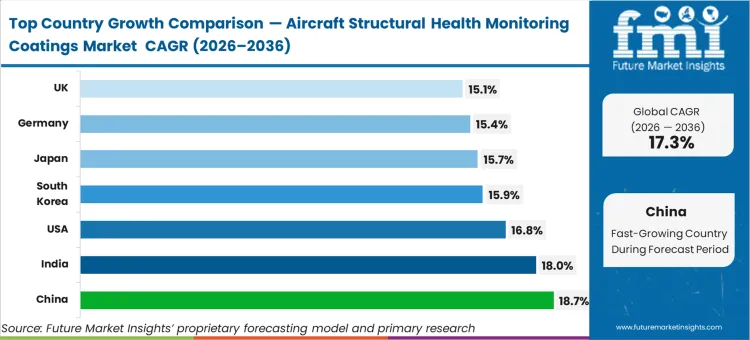
- China leads geographic growth with 18.7% compound growth, fueled by the rapid expansion of domestic aerospace manufacturing clusters.
- Analyst Opinion at FMI
- Nikhil Kaitwade, Principal Analyst at FMI, opines, "The industry focuses heavily on the technical sensitivity of these coatings, but the real measurement gap lies in the data-to-decision pipeline. We have found that while a coating can detect a micron-level crack, the structural logic required to filter that data from environmental noise remains the primary hurdle for MRO adoption. The true value is not in the sensing itself, but in the confidence it provides to skip a physical teardown inspection."
- Strategic Implications / Executive Takeaways
- Fleet operators must synchronize their smart coating adoption with existing surface treatment chemicals refresh cycles to minimize incremental costs.
- MRO providers should invest in data analytics capabilities to interpret the high-frequency telemetry generated by intelligent airframes.
- Tier-1 coating suppliers face a structural shift from being material providers to becoming data-enabling technology partners for OEMs.
- Methodology
- FMI utilizes a bottom-up fleet analysis model combined with material-intensity factors for different aircraft categories.
- Desk research focused on regulatory filings and patent trends in smart materials and advanced coating technologies.
- Market sizing anchors to the annual MRO spend on airframe maintenance and coating refresh rates globally.
- Validation includes cross-referencing OEM delivery backlogs with the expected uptake of sensor-integrated materials.
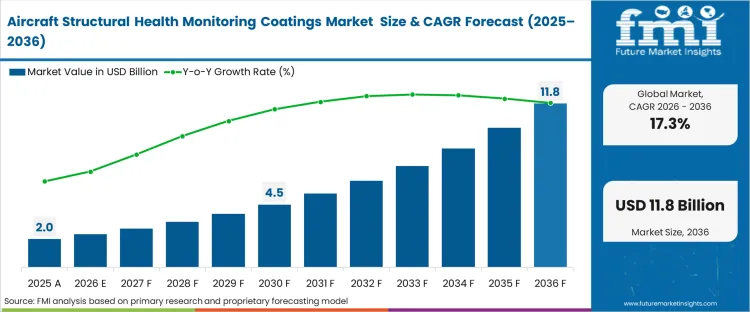
Aircraft Structural Health Monitoring Coatings Market Key Takeaways
| Metric | Details |
|---|---|
| Industry Size (2026) | USD 2.40 Billion |
| Industry Value (2036) | USD 11.70 Billion |
| CAGR (2026–2036) | 17.30% |
Source: Future Market Insights (FMI) analysis, based on proprietary forecasting model and primary research
Achieving widespread commercial deployment hinges on aviation safety authorities formally qualifying smart coatings as primary inspection tools. At present, these systems serve as secondary indicators, necessitating manual verification for any detected structural anomaly. Once a coating-based sensor is certified to supersede physical inspection tasks, the fiscal justification for adoption shifts from a safety-related capital expense to a direct operational cost-reduction strategy. This fundamental transition is currently being catalyzed by the integration of digital twin frameworks capable of ingesting real-time coating data directly into predictive prognostic models.
China is anticipated to record a 18.7% CAGR as the region aggressively expands its domestic narrow-body manufacturing and MRO infrastructure. Demand in India is projected to rise at 18.0% compound growth, driven by massive fleet acquisitions and the establishment of local technical centers. The United States market is likely to post a 16.8% CAGR through 2036, reflecting the high concentration of advanced stealth materials and military adoption. South Korea's industry is expected to demonstrate a 15.9% growth rate, while Japan is set to achieve a 15.7% CAGR over the forecast period. Germany is forecast to register a CAGR of 15.4%, and the United Kingdom sector is poised to expand at 15.1%. The structural divergence in these rates is primarily a function of fleet age and the pace of local regulatory approval for automated inspection technologies.
Aircraft Structural Health Monitoring Coatings Market Definition
The Aircraft Structural Health Monitoring (SHM) Coatings Market comprises specialized surface treatments that integrate sensing capabilities directly into the coating matrix. Unlike passive decorative or protective paints, these materials utilize conductive particles, piezoelectric elements, or micro-encapsulated indicators to detect and report structural changes such as fatigue cracks, strain, corrosion, or impact damage. They serve as an "electronic skin" for the airframe, providing continuous monitoring of structural integrity.
Aircraft Structural Health Monitoring Coatings Market Inclusions
This market includes conductive sensor-integrated coatings, smart polymer matrices, and damage-indicating materials used on commercial, military, and general aviation aircraft. It encompasses coatings designed for specific sensing functions like delamination detection in composite airframes and moisture sensing in honeycomb structures. Service components related to the application and calibration of these intelligent coatings within the MRO environment are also included in the structural scope.
Aircraft Structural Health Monitoring Coatings Market Exclusions
Explicitly excluded are traditional aerospace primers and topcoats that lack active sensing or reporting functionalities. Stand-alone hardware sensors, such as fiber-optic cables or traditional piezoelectric patches that are bonded to the surface rather than integrated into the coating, are outside the scope. External non-destructive testing (NDT) equipment that does not remain on the aircraft is excluded, as are coatings designed solely for aesthetic purposes or basic chemical resistance without structural monitoring capabilities.
Aircraft Structural Health Monitoring Coatings Market Research Methodology
- Primary Research: FMI conducted interviews with MRO Directors, Aerospace Materials Engineers, and Chief Technology Officers at tier-1 coating manufacturers and airframe OEMs regarding aircraft sensors.
- Desk Research: Analysis involved reviewing aviation safety databases, aerospace certification registries, and procurement specification archives from major international carriers.
- Market-Sizing and Forecasting: The baseline anchors to the active global fleet count and the current rate of scheduled heavy maintenance cycles (C and D checks).
- Data Validation and Update Cycle: Forecasts were cross-validated using independent satellite data on flight cycles and publicized fleet renewal timelines to triangulate coating demand.
Segmental Analysis
Aircraft Structural Health Monitoring Coatings Market Analysis by Coating Type
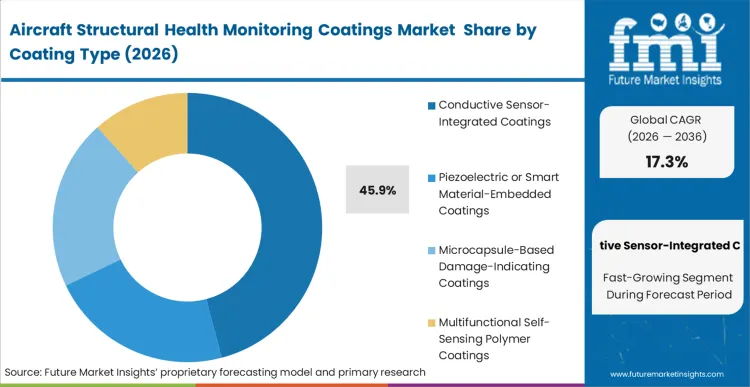
The move toward Conductive Sensor-Integrated Coatings is not merely a material upgrade; it is a displacement of the heavy, labor-intensive wiring harnesses required for legacy structural health monitoring. Traditional patch-based sensors create aerodynamic disturbances and parasitic weight, which have long been the primary obstacles to permanent SHM installation. By integrating the conductive network directly into the primer or topcoat, engineers achieve a weight-neutral sensing capability that covers entire surfaces. FMI notes that this segment captures 45.9% of the market because it simplifies the qualification process for fleet managers who are already familiar with conductive smart coatings used for lightning strike protection. The operational consequence of this choice is a significant reduction in the complexity of the onboard electronic architecture, as the aircraft skin itself becomes the circuit.
- Conductive continuity: Conductive pathways embedded in the polymer matrix allow for the detection of resistivity changes caused by material stretching or fracturing. Maintenance crews can identify the exact coordinates of a potential failure without a visual search.
- Surface sensitivity: These coatings provide a higher spatial resolution than point sensors, ensuring that edge-case stress concentrations at rivet holes are not missed.
- Application parity: Modern sensor coatings are formulated to be applied with standard spray equipment, allowing for rapid integration during scheduled 2k coatings refresh windows.
Aircraft Structural Health Monitoring Coatings Market Analysis by Sensing Functionality
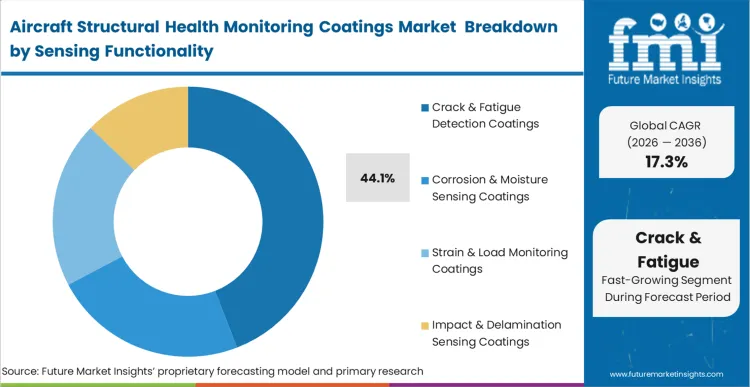
The commercial consequence of an undetected fatigue crack in a pressurized fuselage is so severe that crack and fatigue detection functionality has naturally claimed the lead in buyer priority. In high-cycle short-haul operations, the repetitive cabin pressurization cycles place a structural burden on the fuselage that visual inspections often struggle to quantify accurately. By utilizing coatings that provide real-time fatigue telemetry, operators can extend the intervals between heavy maintenance checks with high confidence. According to FMI's estimates, this segment accounts for 44.1% of functionality demand because it addresses the single most expensive failure mode in commercial aviation. Buyers are increasingly specifying these coatings for aero engine coatings and critical wing spars where access for traditional inspection is physically constrained.
- Micro-crack alerting: The system triggers an alert when microscopic fissures begin to break the integrated sensor circuit, long before they are visible to the human eye.
- Signal persistence: Unlike traditional NDT which provides a snapshot, smart coatings provide a cumulative history of structural stress and damage accumulation.
- Environment isolation: Modern sensing matrices are designed to differentiate between mechanical strain and environmental factors like temperature or icephobic nano coatings interference.
Aircraft Structural Health Monitoring Coatings Market Analysis by Application Area
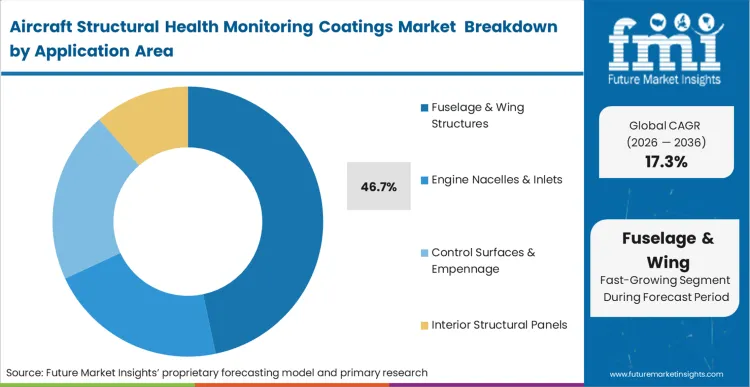
The reason Fuselage & Wing Structures hold a dominant 46.7% share comes down to the sheer surface area and the intensity of cyclic loading these components endure. Wings are the most structurally complex parts of an aircraft, undergoing massive flexural stress during every flight phase. The transition to composite airframes has made this even more critical, as composites can hide internal delamination after an impact that leaves no visible surface trace. FMI analysts opine that the decision to use SHM coatings on these structures is driven by the desire to eliminate the "look and see" maintenance philosophy. Fleet directors who adopt these coatings for their primary structures can reduce their dependency on external inspection contractors and internalize structural integrity management within their digital fleet operations.
- Wingbox monitoring: Monitoring the internal stress of the wingbox through external coatings allows for the detection of structural overload during turbulence.
- Fuselage integrity: Continuous reporting of fuselage skin health reduces the risk of explosive decompression caused by fatigue-induced skin failure.
- Load validation: Real-time load data from wing coatings allows for the validation of actual flight loads against the original design assumptions for life-extension programs.
Aircraft Structural Health Monitoring Coatings Market Drivers, Restraints, and Opportunities
The structural forcing condition driving this market is the aging of global narrow-body and wide-body fleets combined with the increasing cost of technical labor. Maintenance directors face a decision point: either continue with labor-intensive manual inspections that keep aircraft grounded for weeks, or invest in self-reporting airframes that can be inspected digitally in hours. The commercial stakes are immense, as even a 5% reduction in AOG time can translate to millions in recovered revenue for a major carrier. FMI notes that the deployment of aircraft sensors within the coating layer is the only scalable way to achieve this.
The primary structural friction slowing adoption is the qualification cycle within the MRO environment. Unlike traditional paints, SHM coatings require the integration of data-gathering hardware and software, creating a secondary ecosystem that many maintenance shops are not yet equipped to handle. This friction is structural because it involves not just a change in material, but a change in the certifications and skills required by maintenance personnel. While aerospace maintenance chemical providers are simplifying application, the data validation remains a bottleneck for many smaller operators.
Opportunities in the Aircraft Structural Health Monitoring Coatings Market
- Digital Twin Integration: The ability to feed coating-based sensor data into a structural digital twin allows for real-time prognostics and life-extension of legacy airframes.
- Military Fleet Readiness: Special mission aircraft requiring radar signature control can benefit from coatings that monitor surface health without compromising stealth properties.
- Predictive Maintenance Contracts: Coating manufacturers can move toward "surface-as-a-service" models where they guarantee airframe health monitoring through long-term aerospace adhesives and sealants supply agreements.
Regional Analysis
Based on the regional analysis, the Aircraft Structural Health Monitoring Coatings Market is segmented into North America, Europe, Asia Pacific, Middle East & Africa, and Latin America across 40 plus countries.
.webp "Top Country Growth Comparison Aircraft Structural Health Monitoring Coatings Market Cagr (2026 2036)")
| Country | CAGR (2026 to 2036) |
|---|---|
| China | 18.7% |
| India | 18.0% |
| United States | 16.8% |
| South Korea | 15.9% |
| Japan | 15.7% |
| Germany | 15.4% |
| United Kingdom | 15.1% |
Source: Future Market Insights (FMI) analysis, based on proprietary forecasting model and primary research
Asia Pacific Aircraft Structural Health Monitoring Coatings Market Analysis
The Asia Pacific region's trajectory is defined by the massive induction of new-generation aircraft and the rapid build-out of a centralized MRO infrastructure that is "digital-native." Unlike North America or Europe, which must manage legacy fleets, APAC carriers are frequently operating the youngest fleets in the world, allowing for the integration of SHM coatings from the point of delivery. FMI notes that the procurement concentration in this region, particularly with state-owned carriers, allows for a rapid standardization of advanced surface treatment chemical protocols. The infrastructure-led lens shows that the region is positioning itself not just as a consumer, but as a manufacturing hub for smart aerospace components.
- China: China's domestic aircraft manufacturing programs, such as the COMAC C919, are incorporating structural monitoring capabilities as a core competitive differentiator against Western incumbents. The market advances at a 18.7% CAGR, reflecting a rate of infrastructure-led capital refresh that tracks the brand sourcing review calendar. Practitioners in this market are focused on domesticating the entire supply chain for integrated sensor ready coatings.
- India: Massive orders from Indian low-cost carriers have created a demand for high-cycle maintenance solutions that can handle the harsh environmental conditions of the subcontinent. Demand for SHM coatings in India is set to grow at 18.0% through 2036, providing a commercial opportunity for vendors who can demonstrate moisture and contaminant resistance. Operators that move first capture preferred supplier status in procurement frameworks that are unlikely to reopen.
- Japan: Japanese aerospace material suppliers are leaders in the development of piezoelectric smart materials, which are being integrated into regional jet programs. The Japanese industry is expected to demonstrate a CAGR of 15.7%, as domestic manufacturers focus on high-precision uv resistant aircraft exterior paints for long-haul structures. The structural trajectory points toward a deep integration of sensing materials into the primary carbon-fiber airframes produced locally.
- South Korea: South Korea's aircraft structural health monitoring coatings sector is projected to witness growth at a CAGR of 15.9% through 2036. The country's investment in indigenous fighter programs and narrow-body components has fostered a local ecosystem capable of qualifying advanced coating systems. Domestic operators who successfully implement these self-reporting airframes achieve a significant operational outcome by reducing the reliance on external technical labor for routine structural checks. This positioning ensures that South Korean MRO facilities remain competitive against regional low-cost alternatives by offering higher technical precision.
North America Aircraft Structural Health Monitoring Coatings Market Analysis
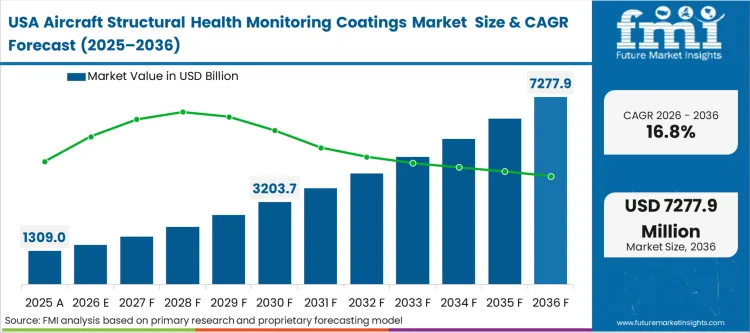
In North America, the market is driven by the economic necessity of extending the life of a massive legacy fleet while managing the highest technical labor rates in the world. The economics-led lens reveals that the primary buyer is the major carrier looking to slash its unscheduled maintenance bill. FMI analysts observe that the region is the primary testbed for stealth materials and military SHM applications, which eventually trickle down to the commercial sector. The integration of structural monitoring is viewed here as a capital investment to offset rising variable maintenance costs.
- United States: The U.S. market is defined by a high concentration of defense-related R&D and a mature commercial MRO ecosystem that is increasingly adopting predictive analytics. The market for SHM coatings in the United States is forecast to register a CAGR of 16.8%, driven by the need for fleet-wide reliability in both passenger and cargo operations. A mill or MRO facility that cannot produce a verifiable structural transparency file is being removed from the approved vendor list entirely.
Europe Aircraft Structural Health Monitoring Coatings Market Analysis
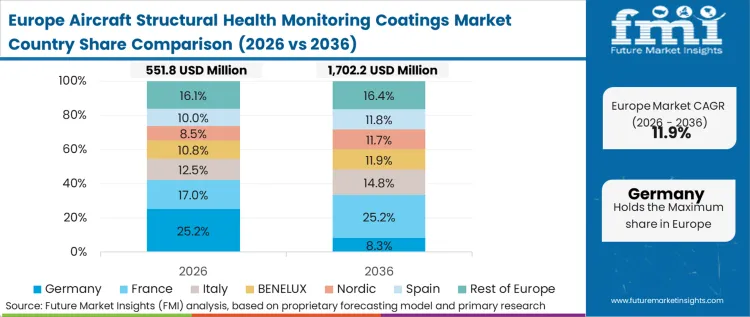
European adoption is heavily shaped by the policy-led environment, specifically EASA's focus on sustainable aviation and the reduction of chemical waste in the MRO process. FMI's assessment is that the region's focus on bio-based aircraft coatings and the elimination of hexavalent chromium has opened a window for smart coatings to be qualified alongside new eco-friendly primers. The regional dynamic is one of regulatory push rather than purely economic pull.
- Germany: Germany's high density of aerospace engineering and its updated environmental requirements create a direct cost differential between legacy sensing methods and integrated coatings. The German market is likely to post a CAGR of 15.4%, as Lufthansa Technik and other regional leaders integrate advanced coating systems. This country's buyers relate to competitors by creating a lead in the qualification of repulpable and smart materials.
- United Kingdom: The UK aerospace sector is focused on advanced composites and engine nacelles, where impact detection is a critical safety requirement. Over the forecast period, the UK is set for a CAGR of 15.1%, as operators focus on contaminant resistant coatings for trans-Atlantic routes. The operational outcome is a process simplified, where resource-heavy inspections are replaced by digital reporting.
Competitive Aligners for Market Players
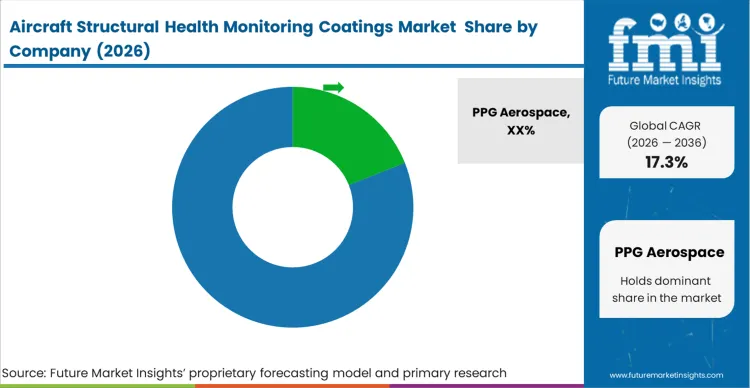
The competitive structure of the Aircraft Structural Health Monitoring Coatings Market is characterized by high concentration, driven by the extreme capital requirements for material qualification and the deep IP barriers surrounding sensor integration. Leading companies like PPG Aerospace and AkzoNobel Aerospace Coatings dominate because they own the existing qualification on the majority of the world's airframes. For a buyer, the primary variable for distinguishing a vendor is not the sensitivity of the sensor, but the "certifiability" of the coating system within the existing aviation regulatory framework. A high-performance sensor coating that has not undergone the multi-year FAA or EASA flight-testing process is effectively non-marketable.
Incumbents maintain their advantage through their established relationships with airframe OEMs and their presence on the approved material lists (AMLs) of major airlines. A challenger must not only build a sensing material but also replicate the global distribution and technical support infrastructure required to service a fleet across multiple continents. Leading players are increasingly embedding ultra low drag riblet surface coatings with sensing capabilities to provide a dual benefit of fuel efficiency and structural monitoring. This bundling makes it difficult for pure-play sensor companies to displace the traditional coating giants who control the surface chemistry.
Buyer power is concentrated among a handful of global carriers and leasing companies, who are increasingly resistant to vendor lock-in. To maintain their position through 2036, vendors must prove that their data outputs are "interoperable" with the various health management platforms used by different airlines. The structural tension lies between a vendor's desire for a proprietary data ecosystem and a carrier's need for a unified fleet view. The market is expected to remain moderately concentrated as the complexity of the sensor-to-software pipeline acts as a barrier to smaller participants.
Key Players in Aircraft Structural Health Monitoring Coatings Market
- PPG Aerospace
- AkzoNobel Aerospace Coatings
- 3M
- Mankiewicz
- Sherwin-Williams Aerospace Coatings
- Henkel
- Hentzen Coatings
- Boeing (Boeing Specter)
- Airbus (Structural Health Monitoring division)
- Embraer
- Bombardier
- Lockheed Martin
- Northrop Grumman
Scope of the Report
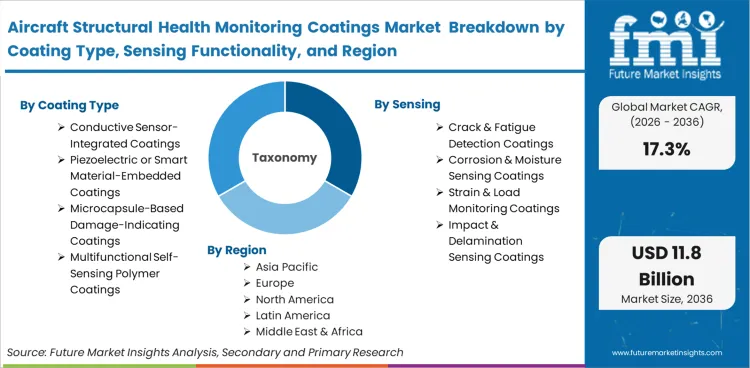
| Metric | Value |
|---|---|
| Quantitative Units | USD 2.40 Billion to USD 11.70 Billion, at a CAGR of 17.30% |
| Market Definition | A specialized class of aerospace coatings that integrate conductive or smart materials to provide real-time sensing of airframe health, fatigue, and damage. |
| Coating Type Segmentation | Conductive Sensor-Integrated Coatings, Piezoelectric or Smart Material-Embedded Coatings, Microcapsule-Based Damage-Indicating Coatings, Multifunctional Self-Sensing Polymer Coatings |
| Sensing Functionality Segmentation | Crack & Fatigue Detection Coatings, Corrosion & Moisture Sensing Coatings, Strain & Load Monitoring Coatings, Impact & Delamination Sensing Coatings |
| Application Area Segmentation | Fuselage & Wing Structures, Engine Nacelles & Inlets, Control Surfaces & Empennage, Interior Structural Panels |
| Regions Covered | North America, Europe, Asia Pacific, Middle East & Africa, Latin America |
| Countries Covered | China, India, United States, South Korea, Japan, Germany, United Kingdom, and 40 plus countries |
| Key Companies Profiled | PPG Aerospace, AkzoNobel, 3M, Mankiewicz, Sherwin-Williams, Henkel, Hentzen Coatings |
| Forecast Period | 2026 to 2036 |
| Approach | Based on global fleet utilization data, annual MRO coating refresh cycles, and primary interviews with airframe structural engineers. |
Source: Future Market Insights (FMI) analysis, based on proprietary forecasting model and primary research
Aircraft Structural Health Monitoring Coatings Market Analysis by Segments
Coating Type:
- Conductive Sensor-Integrated Coatings
- Piezoelectric or Smart Material-Embedded Coatings
- Microcapsule-Based Damage-Indicating Coatings
- Multifunctional Self-Sensing Polymer Coatings
Sensing Functionality:
- Crack & Fatigue Detection Coatings
- Corrosion & Moisture Sensing Coatings
- Strain & Load Monitoring Coatings
- Impact & Delamination Sensing Coatings
Application Area:
- Fuselage & Wing Structures
- Engine Nacelles & Inlets
- Control Surfaces & Empennage
- Interior Structural Panels
Region:
- North America
- United States
- Europe
- Germany
- United Kingdom
- Asia Pacific
- China
- India
- Japan
- South Korea
Bibliography
- Kosova, F. (2025, January). Structural health monitoring in aviation: A comprehensive review of systems, regulation, application, and future trends. Journal of Intelligent Material Systems and Structures.
- Naguib, H. E. (2024, May). Progress nano-hybrid smart coatings for aerospace applications. American Chemical Society.
- Czabaj, M. W. (2024, June). Advanced sensors and sensing systems for structural health monitoring in aerospace applications: A review. Advanced Engineering Materials.
- Ballarin, P. (2025, February). Cost-effectiveness of structural health monitoring in aviation: A literature review. Sensors.
- Chia, J. W. Y. (2024, August). A review and outlook of airframe digital twins for structural prognostics and health management in the aviation industry. Robotics and Computer-Integrated Manufacturing.
This bibliography is provided for reader reference. The full FMI report contains the complete reference list with primary source documentation.
Frequently Asked Questions
How large is the Aircraft Structural Health Monitoring Coatings Market in 2025?
The market was valued at USD 2.05 Billion in 2025, signaling its transition from a niche experimental technology to a critical component of advanced airframe maintenance strategies.
What will it be valued at by 2036?
The market is projected to reach USD 11.70 Billion by 2036, as the "sensing skin" becomes a standard specification for both new aircraft deliveries and mid-life fleet upgrades.
What CAGR is projected for the market?
A CAGR of 17.30% is expected between 2026 and 2036, reflecting the pace of digital transformation in the MRO sector rather than the slower growth of traditional paint markets.
Which Coating Type segment leads the market?
Conductive Sensor-Integrated Coatings leads with 45.9% share because it provides the most seamless replacement for traditional wired sensors without the weight or aerodynamic penalties.
Which Sensing Functionality segment leads?
Crack & Fatigue Detection Coatings leads with 44.1% share due to the safety-critical nature of monitoring fatigue in high-cycle commercial aircraft fuselages.
Which Application Area segment leads?
Fuselage & Wing Structures leads with 46.7% share, reflecting the vast surface area and the intensity of structural stress these components experience during flight.
What drives rapid growth in this market?
The primary driver is the shift toward Condition-Based Maintenance (CBM), which allows airlines to significantly reduce unscheduled downtime by identifying structural issues before they require major repairs.
What is the primary restraint for the market?
The structural friction is the long and rigorous certification process required by aviation authorities to allow coating-based data to replace traditional physical inspections.
Which country grows fastest in the SHM coatings space?
China grows fastest at 18.7% CAGR, structurally different from the USA due to its focus on building new, digital-ready manufacturing hubs for domestic aircraft like the C919.
How do smart coatings differ from traditional NDT?
Smart coatings provide continuous, real-time telemetry while traditional NDT provides a periodic snapshot; this allows for the capture of transient events like heavy landings or turbulence stress.
Can these coatings be used on composite airframes?
Yes, they are particularly critical for composite airframes as they can detect internal delamination and moisture ingress that are otherwise invisible to the human eye.
What is the role of digital twins in this market?
Digital twins ingest the high-frequency data from SHM coatings to create a real-time structural health model, enabling accurate predictions of remaining useful life.
How does lightning strike protection overlap with this market?
Many conductive SHM coatings also provide lightning strike protection, allowing OEMs to achieve multi-functional benefits from a single coating layer.
Who are the primary buyers of these coatings?
The primary buyers are tier-1 aerospace OEMs like Boeing and Airbus, along with large-scale MRO providers and commercial airline fleet managers.
Are there bio-based options for these smart coatings?
The industry is moving toward bio-based aircraft coatings resins to meet sustainability goals, though sensing performance parity remains the primary qualification hurdle.
What is the impact of aging fleets on this market?
Aging fleets create a high-demand scenario for SHM coatings as a life-extension tool to monitor corrosion and fatigue in structures reaching their design life limit.
How are the sensors powered within the coating?
Most systems are passive or utilize energy harvesting from the aircraft's vibration, though some require integration with the onboard power bus.
Does the coating affect the aerodynamics of the aircraft?
No, unlike traditional bonded sensors, integrated coatings maintain the aerodynamic profile of the airframe, and some even incorporate ultra low drag riblet surface coatings.
How long do these sensing coatings last?
They are designed to match the 5-to-7-year refresh cycle of standard aerospace topcoats, ensuring they are replaced during scheduled heavy maintenance.
What is the analyst's non-obvious insight for this market?
The real bottleneck is not sensing sensitivity but "data fatigue" among MRO operators; the winners will be those who provide automated data filtering at the coating-edge.
Which regional market is most policy-driven?
Europe is the most policy-driven market, where EASA's sustainability and safety mandates are forcing the adoption of advanced monitoring and eco-friendly materials.
What is the scope of countries covered in the report?
The report covers over 40 countries, including major aerospace hubs like the U.S., China, India, Germany, and Japan.
Preview the report firsthand - request a free sample
Get SampleGet the brochure for pricing and purchase details.
Get PDFTable of Content
- Executive Summary
- Demand-side Trends
- Supply-side Trends
- Technology Roadmap Analysis
- Analysis and Recommendations
- Market Overview
- Market Coverage / Taxonomy
- Market Definition / Scope / Limitations
- Research Methodology
- Chapter Orientation
- Analytical Lens and Working Hypotheses
- Market Structure, Signals, and Trend Drivers
- Benchmarking and Cross-market Comparability
- Market Sizing, Forecasting, and Opportunity Mapping
- Research Design and Evidence Framework
- Desk Research Programme (Secondary Evidence)
- Company Annual and Sustainability Reports
- Peer-reviewed Journals and Academic Literature
- Corporate Websites, Product Literature, and Technical Notes
- Earnings Decks and Investor Briefings
- Statutory Filings and Regulatory Disclosures
- Technical White Papers and Standards Notes
- Trade Journals, Industry Magazines, and Analyst Briefs
- Conference Proceedings, Webinars, and Seminar Materials
- Government Statistics Portals and Public Data Releases
- Sector Databases and Reference Repositories
- FMI Internal Proprietary Databases and Historical Market Datasets
- Subscription Datasets and Paid Sources
- Social Channels, Communities, and Digital Listening Inputs
- Additional Desk Sources
- Expert Input and Fieldwork (Primary Evidence)
- Primary Modes
- Qualitative Interviews and Expert Elicitation
- Quantitative Surveys and Structured Data Capture
- Blended Approach
- Why Primary Evidence is Used
- Field Techniques
- Interviews
- Surveys
- Focus Groups
- Observational and In-context Research
- Social and Community Interactions
- Stakeholder Universe Engaged
- C-suite Leaders
- Board Members
- Presidents and Vice Presidents
- R&D and Innovation Heads
- Technical Specialists
- Domain Subject-matter Experts
- Scientists
- Physicians and Other Healthcare Professionals
- Governance, Ethics, and Data Stewardship
- Research Ethics
- Data Integrity and Handling
- Primary Modes
- Tooling, Models, and Reference Databases
- Desk Research Programme (Secondary Evidence)
- Data Engineering and Model Build
- Data Acquisition and Ingestion
- Cleaning, Normalisation, and Verification
- Synthesis, Triangulation, and Analysis
- Quality Assurance and Audit Trail
- Market Background
- Market Dynamics
- Drivers
- Restraints
- Opportunity
- Trends
- Scenario Forecast
- Demand in Optimistic Scenario
- Demand in Likely Scenario
- Demand in Conservative Scenario
- Opportunity Map Analysis
- Product Life Cycle Analysis
- Supply Chain Analysis
- Investment Feasibility Matrix
- Value Chain Analysis
- PESTLE and Porter’s Analysis
- Regulatory Landscape
- Regional Parent Market Outlook
- Production and Consumption Statistics
- Import and Export Statistics
- Market Dynamics
- Global Market Analysis 2021 to 2025 and Forecast, 2026 to 2036
- Historical Market Size Value (USD Million) Analysis, 2021 to 2025
- Current and Future Market Size Value (USD Million) Projections, 2026 to 2036
- Y-o-Y Growth Trend Analysis
- Absolute $ Opportunity Analysis
- Global Market Pricing Analysis 2021 to 2025 and Forecast 2026 to 2036
- Global Market Analysis 2021 to 2025 and Forecast 2026 to 2036, By Coating Type
- Introduction / Key Findings
- Historical Market Size Value (USD Million) Analysis By Coating Type , 2021 to 2025
- Current and Future Market Size Value (USD Million) Analysis and Forecast By Coating Type , 2026 to 2036
- Conductive Sensor-Integrated Coatings
- Piezoelectric or Smart Material-Embedded Coatings
- Microcapsule-Based Damage-Indicating Coatings
- Multifunctional Self-Sensing Polymer Coatings
- Conductive Sensor-Integrated Coatings
- Y-o-Y Growth Trend Analysis By Coating Type , 2021 to 2025
- Absolute $ Opportunity Analysis By Coating Type , 2026 to 2036
- Global Market Analysis 2021 to 2025 and Forecast 2026 to 2036, By Sensing Functionality
- Introduction / Key Findings
- Historical Market Size Value (USD Million) Analysis By Sensing Functionality, 2021 to 2025
- Current and Future Market Size Value (USD Million) Analysis and Forecast By Sensing Functionality, 2026 to 2036
- Crack & Fatigue Detection Coatings
- Corrosion & Moisture Sensing Coatings
- Strain & Load Monitoring Coatings
- Impact & Delamination Sensing Coatings
- Crack & Fatigue Detection Coatings
- Y-o-Y Growth Trend Analysis By Sensing Functionality, 2021 to 2025
- Absolute $ Opportunity Analysis By Sensing Functionality, 2026 to 2036
- Global Market Analysis 2021 to 2025 and Forecast 2026 to 2036, By Application Area
- Introduction / Key Findings
- Historical Market Size Value (USD Million) Analysis By Application Area, 2021 to 2025
- Current and Future Market Size Value (USD Million) Analysis and Forecast By Application Area, 2026 to 2036
- Fuselage & Wing Structures
- Engine Nacelles & Inlets
- Control Surfaces & Empennage
- Interior Structural Panels
- Fuselage & Wing Structures
- Y-o-Y Growth Trend Analysis By Application Area, 2021 to 2025
- Absolute $ Opportunity Analysis By Application Area, 2026 to 2036
- Global Market Analysis 2021 to 2025 and Forecast 2026 to 2036, By Region
- Introduction
- Historical Market Size Value (USD Million) Analysis By Region, 2021 to 2025
- Current Market Size Value (USD Million) Analysis and Forecast By Region, 2026 to 2036
- North America
- Latin America
- Western Europe
- Eastern Europe
- East Asia
- South Asia and Pacific
- Middle East & Africa
- Market Attractiveness Analysis By Region
- North America Market Analysis 2021 to 2025 and Forecast 2026 to 2036, By Country
- Historical Market Size Value (USD Million) Trend Analysis By Market Taxonomy, 2021 to 2025
- Market Size Value (USD Million) Forecast By Market Taxonomy, 2026 to 2036
- By Country
- USA
- Canada
- Mexico
- By Coating Type
- By Sensing Functionality
- By Application Area
- By Country
- Market Attractiveness Analysis
- By Country
- By Coating Type
- By Sensing Functionality
- By Application Area
- Key Takeaways
- Latin America Market Analysis 2021 to 2025 and Forecast 2026 to 2036, By Country
- Historical Market Size Value (USD Million) Trend Analysis By Market Taxonomy, 2021 to 2025
- Market Size Value (USD Million) Forecast By Market Taxonomy, 2026 to 2036
- By Country
- Brazil
- Chile
- Rest of Latin America
- By Coating Type
- By Sensing Functionality
- By Application Area
- By Country
- Market Attractiveness Analysis
- By Country
- By Coating Type
- By Sensing Functionality
- By Application Area
- Key Takeaways
- Western Europe Market Analysis 2021 to 2025 and Forecast 2026 to 2036, By Country
- Historical Market Size Value (USD Million) Trend Analysis By Market Taxonomy, 2021 to 2025
- Market Size Value (USD Million) Forecast By Market Taxonomy, 2026 to 2036
- By Country
- Germany
- UK
- Italy
- Spain
- France
- Nordic
- BENELUX
- Rest of Western Europe
- By Coating Type
- By Sensing Functionality
- By Application Area
- By Country
- Market Attractiveness Analysis
- By Country
- By Coating Type
- By Sensing Functionality
- By Application Area
- Key Takeaways
- Eastern Europe Market Analysis 2021 to 2025 and Forecast 2026 to 2036, By Country
- Historical Market Size Value (USD Million) Trend Analysis By Market Taxonomy, 2021 to 2025
- Market Size Value (USD Million) Forecast By Market Taxonomy, 2026 to 2036
- By Country
- Russia
- Poland
- Hungary
- Balkan & Baltic
- Rest of Eastern Europe
- By Coating Type
- By Sensing Functionality
- By Application Area
- By Country
- Market Attractiveness Analysis
- By Country
- By Coating Type
- By Sensing Functionality
- By Application Area
- Key Takeaways
- East Asia Market Analysis 2021 to 2025 and Forecast 2026 to 2036, By Country
- Historical Market Size Value (USD Million) Trend Analysis By Market Taxonomy, 2021 to 2025
- Market Size Value (USD Million) Forecast By Market Taxonomy, 2026 to 2036
- By Country
- China
- Japan
- South Korea
- By Coating Type
- By Sensing Functionality
- By Application Area
- By Country
- Market Attractiveness Analysis
- By Country
- By Coating Type
- By Sensing Functionality
- By Application Area
- Key Takeaways
- South Asia and Pacific Market Analysis 2021 to 2025 and Forecast 2026 to 2036, By Country
- Historical Market Size Value (USD Million) Trend Analysis By Market Taxonomy, 2021 to 2025
- Market Size Value (USD Million) Forecast By Market Taxonomy, 2026 to 2036
- By Country
- India
- ASEAN
- Australia & New Zealand
- Rest of South Asia and Pacific
- By Coating Type
- By Sensing Functionality
- By Application Area
- By Country
- Market Attractiveness Analysis
- By Country
- By Coating Type
- By Sensing Functionality
- By Application Area
- Key Takeaways
- Middle East & Africa Market Analysis 2021 to 2025 and Forecast 2026 to 2036, By Country
- Historical Market Size Value (USD Million) Trend Analysis By Market Taxonomy, 2021 to 2025
- Market Size Value (USD Million) Forecast By Market Taxonomy, 2026 to 2036
- By Country
- Kingdom of Saudi Arabia
- Other GCC Countries
- Turkiye
- South Africa
- Other African Union
- Rest of Middle East & Africa
- By Coating Type
- By Sensing Functionality
- By Application Area
- By Country
- Market Attractiveness Analysis
- By Country
- By Coating Type
- By Sensing Functionality
- By Application Area
- Key Takeaways
- Key Countries Market Analysis
- USA
- Pricing Analysis
- Market Share Analysis, 2025
- By Coating Type
- By Sensing Functionality
- By Application Area
- Canada
- Pricing Analysis
- Market Share Analysis, 2025
- By Coating Type
- By Sensing Functionality
- By Application Area
- Mexico
- Pricing Analysis
- Market Share Analysis, 2025
- By Coating Type
- By Sensing Functionality
- By Application Area
- Brazil
- Pricing Analysis
- Market Share Analysis, 2025
- By Coating Type
- By Sensing Functionality
- By Application Area
- Chile
- Pricing Analysis
- Market Share Analysis, 2025
- By Coating Type
- By Sensing Functionality
- By Application Area
- Germany
- Pricing Analysis
- Market Share Analysis, 2025
- By Coating Type
- By Sensing Functionality
- By Application Area
- UK
- Pricing Analysis
- Market Share Analysis, 2025
- By Coating Type
- By Sensing Functionality
- By Application Area
- Italy
- Pricing Analysis
- Market Share Analysis, 2025
- By Coating Type
- By Sensing Functionality
- By Application Area
- Spain
- Pricing Analysis
- Market Share Analysis, 2025
- By Coating Type
- By Sensing Functionality
- By Application Area
- France
- Pricing Analysis
- Market Share Analysis, 2025
- By Coating Type
- By Sensing Functionality
- By Application Area
- India
- Pricing Analysis
- Market Share Analysis, 2025
- By Coating Type
- By Sensing Functionality
- By Application Area
- ASEAN
- Pricing Analysis
- Market Share Analysis, 2025
- By Coating Type
- By Sensing Functionality
- By Application Area
- Australia & New Zealand
- Pricing Analysis
- Market Share Analysis, 2025
- By Coating Type
- By Sensing Functionality
- By Application Area
- China
- Pricing Analysis
- Market Share Analysis, 2025
- By Coating Type
- By Sensing Functionality
- By Application Area
- Japan
- Pricing Analysis
- Market Share Analysis, 2025
- By Coating Type
- By Sensing Functionality
- By Application Area
- South Korea
- Pricing Analysis
- Market Share Analysis, 2025
- By Coating Type
- By Sensing Functionality
- By Application Area
- Russia
- Pricing Analysis
- Market Share Analysis, 2025
- By Coating Type
- By Sensing Functionality
- By Application Area
- Poland
- Pricing Analysis
- Market Share Analysis, 2025
- By Coating Type
- By Sensing Functionality
- By Application Area
- Hungary
- Pricing Analysis
- Market Share Analysis, 2025
- By Coating Type
- By Sensing Functionality
- By Application Area
- Kingdom of Saudi Arabia
- Pricing Analysis
- Market Share Analysis, 2025
- By Coating Type
- By Sensing Functionality
- By Application Area
- Turkiye
- Pricing Analysis
- Market Share Analysis, 2025
- By Coating Type
- By Sensing Functionality
- By Application Area
- South Africa
- Pricing Analysis
- Market Share Analysis, 2025
- By Coating Type
- By Sensing Functionality
- By Application Area
- USA
- Market Structure Analysis
- Competition Dashboard
- Competition Benchmarking
- Market Share Analysis of Top Players
- By Regional
- By Coating Type
- By Sensing Functionality
- By Application Area
- Competition Analysis
- Competition Deep Dive
- PPG Aerospace
- Overview
- Product Portfolio
- Profitability by Market Segments (Product/Age /Sales Channel/Region)
- Sales Footprint
- Strategy Overview
- Marketing Strategy
- Product Strategy
- Channel Strategy
- AkzoNobel Aerospace Coatings
- 3M
- Mankiewicz
- Sherwin-Williams Aerospace Coatings
- Henkel
- Hentzen Coatings
- Boeing (Boeing Specter)
- Airbus (Structural Health Monitoring division)
- Embraer
- Bombardier
- Lockheed Martin
- Northrop Grumman
- PPG Aerospace
- Competition Deep Dive
- Assumptions & Acronyms Used


