

- Industry Size (2026)
- USD 13.27 Bn
- Forecast (2036)
- USD 30.85 Bn
- CAGR (2026 to 2036)
- 8.80%
Surface Treatment Chemicals Market size, market forecast and outlook by FMI
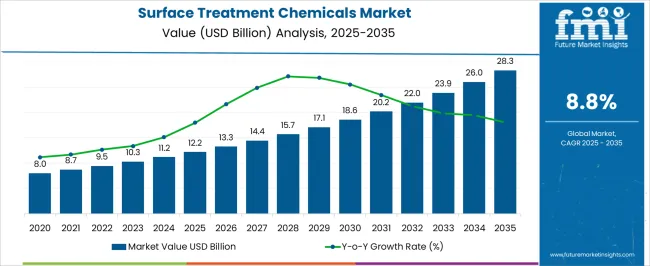
The surface treatment chemicals market was valued at USD 12.20 billion in 2025, projected to reach USD 13.27 billion in 2026, and is forecast to expand to USD 30.85 billion by 2036 at a 8.80% CAGR. Based on Future Market Insights analysis, the market is set to add an incremental opportunity worth USD 17.58 billion over the forecast period. As per FMI, the procurement landscape for surface treatment chemicals is being reshaped by evolving specification requirements, regional capacity investments, and shifting end-use demand patterns across established and emerging buyer segments.
Summary of Surface Treatment Chemicals Market
- Surface Treatment Chemicals Market definition
- Surface treatment chemicals are formulated chemical solutions and compounds applied to metal, plastic, and composite substrates to modify surface properties including corrosion resistance, adhesion promotion, wear resistance, and aesthetic appearance, encompassing anodising chemicals, conversion coatings, electroplating chemicals, cleaning agents, and etching solutions used across electronics, automotive, aerospace, and industrial manufacturing.
- Demand drivers in the market
- Electronics miniaturization and semiconductor packaging complexity are increasing the number of surface treatment process steps per device, as each layer in multi-chip module and advanced packaging architectures requires precision cleaning, etching, and metallization chemistry.
- Automotive lightweighting programs are expanding aluminum and mixed-material vehicle body construction, driving demand for conversion coating and anodising chemicals that provide corrosion protection and paint adhesion on aluminum substrates replacing traditional steel.
- Aerospace MRO activity is generating sustained consumption of specialty surface treatment chemicals for turbine blade and structural component overhaul processes where chromate-free alternatives are replacing hexavalent chromium formulations under REACH regulation timelines.
- Key segments analyzed in the FMI report
- Anodising Chemicals product type: 22.2% share in 2026, reflecting established procurement specifications and supply chain infrastructure favoring this variant.
- Electronics And Electrical application: 32.8% share in 2026, driven by end-use requirements in the primary application channels.
- China: 11.90% compound growth, supported by domestic investment and rising consumption.
- Analyst opinion at FMI
- Nikhil Kaitwade, Principal Consultant for Chemicals and Materials, opines, the surface treatment chemicals market is structurally tied to manufactured goods production volumes and the regulatory timeline for hexavalent chromium elimination. FMI analysts observe that the chemical suppliers capturing incremental share are those offering complete process packages, including chemistry, equipment specification, and bath management services, rather than standalone chemical formulations. The risk for the industry is regulatory acceleration: if REACH restriction timelines for chromium compounds compress, the reformulation cost burden will fall disproportionately on small and mid-size job shops that lack the R&D resources to validate alternative chemistries independently.
- Strategic implications / executive takeaways
- Surface treatment chemical suppliers must accelerate chromate-free conversion coating and passivation product development to capture the procurement transition as aerospace and automotive OEMs enforce hexavalent chromium phase-out timelines.
- Automotive Tier 1 suppliers expanding aluminum body-in-white production should specify integrated surface treatment chemical and equipment packages that guarantee process consistency across new production line commissioning.
- Electronics manufacturers should evaluate surface treatment chemical suppliers based on technical service and bath management capability rather than chemical unit pricing alone, because process stability determines yield economics in high-value semiconductor packaging applications.
Surface Treatment Chemicals Market key takeaways
| Metric | Details |
|---|---|
| Industry Size (2026) | USD 13.27 billion |
| Industry Value (2036) | USD 30.85 billion |
| CAGR (2026 to 2036) | 8.80% |
Source: Future Market Insights, 2026
Three structural forces are reshaping the surface treatment chemicals market. First, the transition from hexavalent chromium to trivalent chromium and chromate-free alternatives is the defining regulatory-driven reformulation cycle, affecting conversion coatings, anodising processes, and passivation chemistries across automotive, aerospace, and electronics sectors simultaneously. Second, the expansion of electric vehicle production is increasing per-vehicle surface treatment chemical consumption because battery housings, motor components, and power electronics require multiple treatment steps that internal combustion powertrain components did not. Third, the geographic shift of electronics and automotive manufacturing toward India, Vietnam, and Mexico is creating greenfield surface treatment line installations where entire chemical supply contracts are awarded during facility commissioning.
Across tracked geographies, China sets the pace at 11.90% CAGR. India follows at 11.00%. Germany follows at 10.10%. France follows at 9.20%. UK follows at 8.40%. USA follows at 7.50%. Brazil follows at 6.60%.
Surface Treatment Chemicals Market definition
Surface treatment chemicals represent the specialty chemicals category used in controlled industrial processes to alter the physical, chemical, or electrochemical properties of substrate surfaces prior to coating, bonding, or assembly. These chemicals operate within tightly specified process parameters for bath composition, temperature, and dwell time to deliver consistent surface modification outcomes across high-volume production environments.
Surface Treatment Chemicals Market inclusions
Market scope includes all commercially traded surface treatment chemicals segmented by product type (anodising chemicals, conversion coatings, electroplating chemicals, cleaning and degreasing agents, etching solutions, passivation chemicals) and application (electronics and electrical, automotive, aerospace, general industrial, construction). Revenue sizing spans the 2026 to 2036 forecast period.
Surface Treatment Chemicals Market exclusions
The scope excludes paint and coating formulations applied over treated surfaces, welding consumables, adhesives, and sealants. Wastewater treatment chemicals used to process surface treatment effluent are outside the defined boundary. Raw commodity chemicals (sulfuric acid, sodium hydroxide) sold without surface treatment formulation are also excluded.
Surface Treatment Chemicals Market research methodology
- Primary research: FMI analysts conducted interviews with procurement directors, product managers, and supply chain leads across key surface treatment chemicals organizations to map decision gates and sourcing specifications.
- Desk research: Data collection phases aggregated regulatory filings, trade association publications, standards body documentation, and company annual reports to establish verifiable baseline parameters.
- Market sizing and forecasting: Baseline values derive from a bottom-up aggregation of surface treatment chemicals transaction volumes, applying region-specific adoption curves and pricing indices to project forward demand through 2036.
- Data validation and update cycle: Projections are tested against publicly reported procurement volumes, trade flow statistics, and company financial disclosures on a quarterly refresh schedule.
Why is the Surface Treatment Chemicals Market Growing?
The Surface Treatment Chemicals market is experiencing steady growth, driven by the increasing demand for high-performance coatings and chemical treatments across industrial and manufacturing sectors. Rising adoption is being supported by the need to enhance corrosion resistance, surface durability, and aesthetic appeal of metal and alloy components in automotive, electronics, aerospace, and construction applications. Technological advancements in chemical formulations, eco-friendly treatments, and precision surface engineering have improved operational efficiency while minimizing environmental impact.
The growing emphasis on energy efficiency, component longevity, and regulatory compliance is further shaping the market landscape. As industries increasingly rely on lightweight and high-strength materials, surface treatment chemicals are being integrated to maintain structural integrity and functional performance.
Continuous innovation in application techniques and treatment processes, including automation and environmentally compliant solutions, is creating new growth opportunities Increasing investments in electronics and industrial manufacturing, combined with the focus on product quality, are expected to drive sustained adoption and expansion of the market over the coming decade.
Segmental Analysis
The surface treatment chemicals market is segmented by product type, application, and geographic regions. By product type, surface treatment chemicals market is divided into Anodising Chemicals, Alkaline Degreaser, Etchants And Additives, Electrolytic Colouring And Brightening, Cleaners, Paint Strippers, Passivation, Additives And Sealants, Corrosion Protection, and Others (Primers, Coatings, Etc.). In terms of application, surface treatment chemicals market is classified into Electronics And Electrical, Automotive And Components, Industrial Machinery, Aerospace And Other Transportation, Construction And Infrastructure, and Others. Regionally, the surface treatment chemicals industry is classified into North America, Latin America, Western Europe, Eastern Europe, Balkan & Baltic Countries, Russia & Belarus, Central Asia, East Asia, South Asia & Pacific, and the Middle East & Africa.
Insights into the Anodising Chemicals Product Type Segment
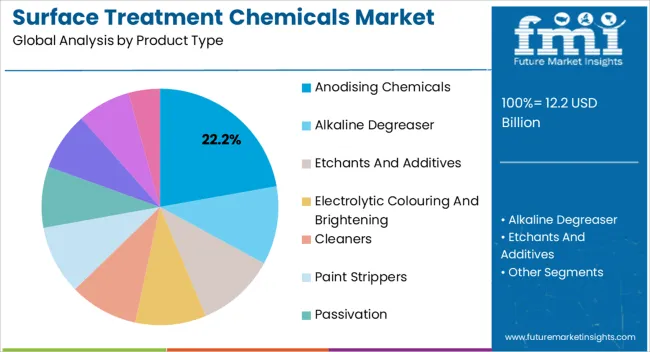
The anodising chemicals product type segment is projected to hold 22.2% of the market revenue in 2026, establishing it as the leading product type. Growth in this segment is being driven by the increasing demand for surface oxidation treatments that improve corrosion resistance, wear resistance, and electrical insulation properties. Anodising chemicals enable the creation of protective oxide layers on metals such as aluminum, enhancing durability and surface performance without altering base material characteristics.
These chemicals are widely adopted in industries requiring precise surface engineering, where uniformity and long-term stability are critical. Advancements in eco-friendly formulations, optimized treatment processes, and automation have enhanced operational efficiency while reducing environmental impact.
Organizations are increasingly leveraging anodising chemicals to improve product lifecycle, reduce maintenance costs, and ensure regulatory compliance As demand grows for high-quality components in electronics, automotive, and aerospace sectors, the anodising chemicals segment is expected to maintain market leadership, supported by technological innovation and operational effectiveness.
Insights into the Electronics and Electrical Application Segment
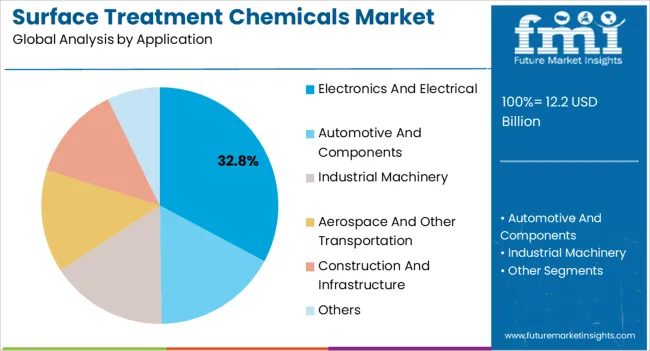
The electronics and electrical application segment is anticipated to account for 32.8% of the market revenue in 2026, making it the leading application area. Its growth is being driven by the increasing need for corrosion-resistant and durable surface treatments for electronic devices, components, and electrical equipment. Surface treatment chemicals enhance the performance, reliability, and lifespan of circuit boards, connectors, and enclosures by providing insulation, anti-oxidation properties, and improved thermal stability.
Rising adoption of consumer electronics, industrial automation, and high-performance electrical systems is further supporting market expansion. Regulatory emphasis on safety, compliance, and environmental standards is encouraging the use of high-quality surface treatment chemicals to meet stringent operational requirements.
Technological advancements in chemical formulations and process automation have improved application precision, uniformity, and efficiency As electronics and electrical systems continue to evolve in complexity and demand higher reliability, the sector is expected to remain the primary driver of growth in the Surface Treatment Chemicals market, reinforcing the importance of advanced chemical solutions.
Market Overview
Surface Treatment Chemicals Market Overview
Surface finish aka surface texture is a significant property for machines, component structures and materials, which are exposed to harsh operation conditions and environment. Surface finish aids in controlling friction and transferring layer formation during sliding.
Subject to extreme temperatures, corrosive environment, or abrasive conditions, the surface of the material may get critically damaged. The application of surface treatment chemical increases hardness, wear resistance and improves adhesion of other chemical treatments such as photosensitive and other coating.
Surface treatment is majorly utilized for treatment of metals and alloys, however not only limited to metal, but surface treatment are also utilized for treatment of printed circuit boards, which are composed of plastic and metal.
Metal profiles prefer surface treatments such as electroplating, which engages in the formation of metallic coating on surfaces and anodic oxidation for light metals such as titanium and aluminium. Additives and sealants are also used to ensure efficient application of other chemicals.
Analysis of Surface Treatment Chemicals Market By Key Countries
.webp "Top Country Growth Comparison Surface Treatment Chemicals Market Cagr (2026 2036)")
| Country | CAGR |
|---|---|
| China | 11.9% |
| India | 11.0% |
| Germany | 10.1% |
| France | 9.2% |
| UK | 8.4% |
| USA | 7.5% |
| Brazil | 6.6% |
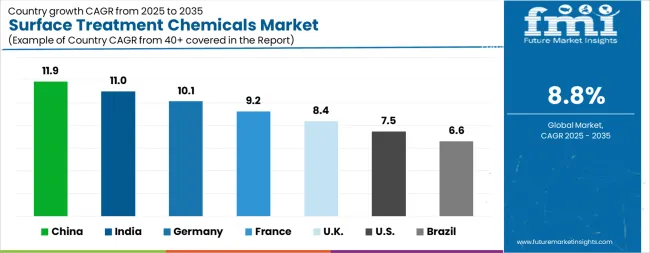
The Surface Treatment Chemicals Market is expected to register a CAGR of 8.8% during the forecast period, exhibiting varied country level momentum. China leads with the highest CAGR of 11.9%, followed by India at 11.0%. Developed markets such as Germany, France, and the UK continue to expand steadily, while the USA is likely to grow at consistent rates. Brazil posts the lowest CAGR at 6.6%, yet still underscores a broadly positive trajectory for the global Surface Treatment Chemicals Market. In 2024, Germany held a dominant revenue in the Western Europe market and is expected to grow with a CAGR of 10.1%. Sales are projected to rise at a CAGR of 7.5% over the forecast period between 2026 and 2036. While Japan and South Korea markets are estimated to be valued at USD 569.0 million and USD 348.3 million respectively in 2026.
Key Players in the Surface Treatment Chemicals Market
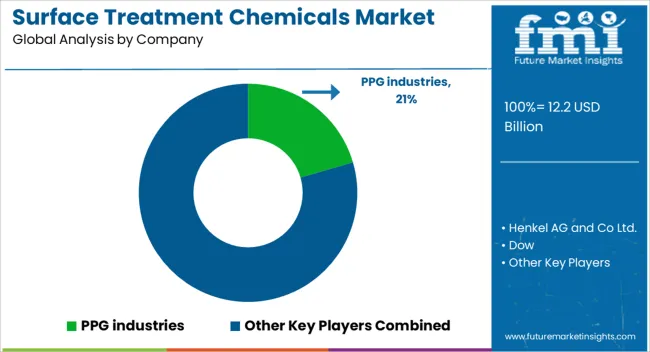
- PPG industries
- Henkel AG and Co Ltd.
- Dow
- Chemetall Inc.
- NOF Corporation
- Atotech
- Quacker Chemical Corporation
- Platform Specialty Products Corporation
Scope of the report
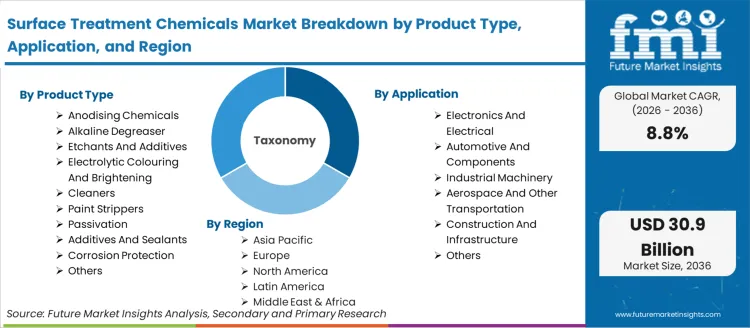
| Metric | Value |
|---|---|
| Quantitative Units | USD 13.27 billion to USD 30.85 billion, at a CAGR of 8.80% |
| Market Definition | Surface treatment chemicals are formulated chemical solutions and compounds applied to metal, plastic, and composite substrates to modify surface properties including corrosion resistance, adhesion promotion, wear resistance, and aesthetic appearance, encompassing anodising chemicals, conversion coatings, electroplating chemicals, cleaning agents, and etching solutions used across electronics, automotive, aerospace, and industrial manufacturing. |
| Segmentation | Product Type (Anodising Chemicals), Application (Electronics And Electrical) |
| Regions Covered | North America, Latin America, Europe, East Asia, South Asia, Oceania, Middle East and Africa |
| Countries Covered | India, China, USA, Canada, UK, Germany, Japan, and 40 plus countries |
| Key Companies Profiled | PPG industries, Henkel AG and Co Ltd., Dow, Chemetall Inc., NOF Corporation, Atotech, Quacker Chemical Corporation, Platform Specialty Products Corporation |
| Forecast Period | 2026 to 2036 |
| Approach | Forecasting models apply a hybrid bottom-up and top-down methodology starting with verified surface treatment chemicals transaction data and projecting adoption velocity across defined segments and regions. |
Surface Treatment Chemicals Market by Segments
Product Type:
- Anodising Chemicals
- Alkaline Degreaser
- Etchants And Additives
- Electrolytic Colouring And Brightening
- Cleaners
- Paint Strippers
- Passivation
- Additives And Sealants
- Corrosion Protection
- Others (Primers, Coatings, Etc.)
Application:
- Electronics And Electrical
- Automotive And Components
- Industrial Machinery
- Aerospace And Other Transportation
- Construction And Infrastructure
- Others
Region:
- North America
- USA
- Canada
- Mexico
- Latin America
- Brazil
- Chile
- Rest of Latin America
- Western Europe
- Germany
- UK
- Italy
- Spain
- France
- Nordic
- BENELUX
- Rest of Western Europe
- Eastern Europe
- Russia
- Poland
- Hungary
- Balkan & Baltic
- Rest of Eastern Europe
- East Asia
- China
- Japan
- South Korea
- South Asia and Pacific
- India
- ASEAN
- Australia & New Zealand
- Rest of South Asia and Pacific
- Middle East & Africa
- Kingdom of Saudi Arabia
- Other GCC Countries
- Turkiye
- South Africa
- Other African Union
- Rest of Middle East & Africa
Bibliography
- European Chemicals Agency. (2024). REACH Regulation: Authorisation Decisions for Chromium Trioxide. ECHA.
- ASTM International. (2024). ASTM B117: Standard Practice for Operating Salt Spray Testing Apparatus. ASTM.
- International Organization for Standardization. (2024). ISO 9227: Corrosion Tests in Artificial Atmospheres, Salt Spray Tests. ISO.
- European Automobile Manufacturers Association. (2024). ACEA Position Paper on Surface Treatment Regulations. ACEA.
- SAE International. (2024). AMS 2700: Passivation of Corrosion Resistant Steels. SAE.
- Organisation for Economic Co-operation and Development. (2024). OECD Emission Scenario Document: Metal Finishing. OECD.
This bibliography is provided for reader reference. The full FMI report contains the complete reference list with primary research documentation.
This report addresses
- Market sizing and quantitative forecast metrics detailing precise expenditure on surface treatment chemicals across major end-use verticals through 2036.
- Segmentation analysis mapping adoption velocity of specific product type variants and evaluating structural drivers behind preference shifts.
- Regional deployment intelligence comparing growth trajectories across Asia Pacific, Europe, North America, Latin America, and Middle East and Africa.
- Regulatory compliance assessment analyzing how evolving standards and certification mandates shape procurement specifications across target geographies.
- Competitive posture evaluation tracking consolidation activity, capacity investments, and strategic partnerships among leading market participants.
- Strategic guidance defining procurement parameters and supply chain configurations required for surface treatment chemicals sourcing through the forecast period.
- Supply chain vulnerability analysis identifying concentration risks, raw material dependencies, and logistics bottlenecks affecting cost structures.
- Custom data delivery formats encompassing interactive dashboards, raw Excel datasets, and comprehensive PDF narrative reports.
Frequently Asked Questions
How large is the demand for Surface Treatment Chemicals in the global market in 2026?
Demand for surface treatment chemicals in the global market is estimated to be valued at USD 13.27 billion in 2026.
What will be the market size of Surface Treatment Chemicals by 2036?
Market size for surface treatment chemicals is projected to reach USD 30.85 billion by 2036.
What is the expected demand growth for Surface Treatment Chemicals between 2026 and 2036?
Demand for surface treatment chemicals is expected to grow at a CAGR of 8.80% between 2026 and 2036.
Which Product Type is poised to lead global sales by 2026?
Anodising Chemicals accounts for 22.2% in 2026, reflecting established procurement specifications across primary buyer channels.
How is Electronics And Electrical driving Surface Treatment Chemicals adoption in 2026?
Electronics And Electrical represents 32.8% of segment demand as end-use requirements favor this category.
What is driving demand in China?
China registers a 11.90% CAGR through 2036, propelled by domestic investment and rising end-use consumption.
What does Surface Treatment Chemicals Market definition mean in this report?
Surface treatment chemicals are formulated chemical solutions and compounds applied to metal, plastic, and composite substrates to modify surface properties including corrosion resistance, adhesion promotion, wear resistance, and aesthetic appearance, encompassing anodising chemicals, conversion coatings, electroplating chemicals, cleaning agents, and etching solutions used across electronics, automotive, aerospace, and industrial manufacturing.
How does FMI build and validate the Surface Treatment Chemicals forecast?
Forecasting models apply a hybrid bottom-up methodology starting with verified transaction data, cross-validated against publicly reported procurement volumes and company financial disclosures on a quarterly refresh schedule.
Preview the report firsthand - request a free sample
Get SampleGet the brochure for pricing and purchase details.
Get PDFTable of Content
- Executive Summary
- Global Market Outlook
- Demand-side Trends
- Supply-side Trends
- Technology Roadmap Analysis
- Analysis and Recommendations
- Market Overview
- Market Coverage / Taxonomy
- Market Definition / Scope / Limitations
- Research Methodology
- Chapter Orientation
- Analytical Lens and Working Hypotheses
- Market Structure, Signals, and Trend Drivers
- Benchmarking and Cross-market Comparability
- Market Sizing, Forecasting, and Opportunity Mapping
- Research Design and Evidence Framework
- Desk Research Programme (Secondary Evidence)
- Company Annual and Sustainability Reports
- Peer-reviewed Journals and Academic Literature
- Corporate Websites, Product Literature, and Technical Notes
- Earnings Decks and Investor Briefings
- Statutory Filings and Regulatory Disclosures
- Technical White Papers and Standards Notes
- Trade Journals, Industry Magazines, and Analyst Briefs
- Conference Proceedings, Webinars, and Seminar Materials
- Government Statistics Portals and Public Data Releases
- Press Releases and Reputable Media Coverage
- Specialist Newsletters and Curated Briefings
- Sector Databases and Reference Repositories
- FMI Internal Proprietary Databases and Historical Market Datasets
- Subscription Datasets and Paid Sources
- Social Channels, Communities, and Digital Listening Inputs
- Additional Desk Sources
- Domain Subject-matter Experts
- Scientists
- Physicians and Other Healthcare Professionals
- Desk Research Programme (Secondary Evidence)
- Governance, Ethics, and Data Stewardship
- Research Ethics
- Data Integrity and Handling
- Tooling, Models, and Reference Databases
- Data Engineering and Model Build
- Data Acquisition and Ingestion
- Cleaning, Normalisation, and Verification
- Synthesis, Triangulation, and Analysis
- Quality Assurance and Audit Trail
- Market Background
- Market Dynamics
- Drivers
- Restraints
- Opportunity
- Trends
- Scenario Forecast
- Demand in Optimistic Scenario
- Demand in Likely Scenario
- Demand in Conservative Scenario
- Opportunity Map Analysis
- Product Life Cycle Analysis
- Supply Chain Analysis
- Investment Feasibility Matrix
- Value Chain Analysis
- PESTLE and Porter’s Analysis
- Regulatory Landscape
- Regional Parent Market Outlook
- Production and Consumption Statistics
- Import and Export Statistics
- Market Dynamics
- Global Market Analysis 2021 to 2025 and Forecast, 2026 to 2036
- Historical Market Size Value (USD Million) Analysis, 2021 to 2025
- Current and Future Market Size Value (USD Million) Projections, 2026 to 2036
- Y-o-Y Growth Trend Analysis
- Absolute $ Opportunity Analysis
- Global Market Pricing Analysis 2021 to 2025 and Forecast 2026 to 2036
- Global Market Analysis 2021 to 2025 and Forecast 2026 to 2036, By Product Type
- Introduction / Key Findings
- Historical Market Size Value (USD Million) Analysis By Product Type , 2021 to 2025
- Current and Future Market Size Value (USD Million) Analysis and Forecast By Product Type , 2026 to 2036
- Anodising Chemicals
- Alkaline Degreaser
- Etchants And Additives
- Electrolytic Colouring And Brightening
- Cleaners
- Paint Strippers
- Passivation
- Additives And Sealants
- Corrosion Protection
- Others
- Anodising Chemicals
- Y-o-Y Growth Trend Analysis By Product Type , 2021 to 2025
- Absolute $ Opportunity Analysis By Product Type , 2026 to 2036
- Global Market Analysis 2021 to 2025 and Forecast 2026 to 2036, By Application
- Introduction / Key Findings
- Historical Market Size Value (USD Million) Analysis By Application, 2021 to 2025
- Current and Future Market Size Value (USD Million) Analysis and Forecast By Application, 2026 to 2036
- Electronics And Electrical
- Automotive And Components
- Industrial Machinery
- Aerospace And Other Transportation
- Construction And Infrastructure
- Others
- Electronics And Electrical
- Y-o-Y Growth Trend Analysis By Application, 2021 to 2025
- Absolute $ Opportunity Analysis By Application, 2026 to 2036
- Global Market Analysis 2021 to 2025 and Forecast 2026 to 2036, By Region
- Introduction
- Historical Market Size Value (USD Million) Analysis By Region, 2021 to 2025
- Current Market Size Value (USD Million) Analysis and Forecast By Region, 2026 to 2036
- North America
- Latin America
- Western Europe
- Eastern Europe
- East Asia
- South Asia and Pacific
- Middle East & Africa
- Market Attractiveness Analysis By Region
- North America Market Analysis 2021 to 2025 and Forecast 2026 to 2036, By Country
- Historical Market Size Value (USD Million) Trend Analysis By Market Taxonomy, 2021 to 2025
- Market Size Value (USD Million) Forecast By Market Taxonomy, 2026 to 2036
- By Country
- USA
- Canada
- Mexico
- By Product Type
- By Application
- By Country
- Market Attractiveness Analysis
- By Country
- By Product Type
- By Application
- Key Takeaways
- Latin America Market Analysis 2021 to 2025 and Forecast 2026 to 2036, By Country
- Historical Market Size Value (USD Million) Trend Analysis By Market Taxonomy, 2021 to 2025
- Market Size Value (USD Million) Forecast By Market Taxonomy, 2026 to 2036
- By Country
- Brazil
- Chile
- Rest of Latin America
- By Product Type
- By Application
- By Country
- Market Attractiveness Analysis
- By Country
- By Product Type
- By Application
- Key Takeaways
- Western Europe Market Analysis 2021 to 2025 and Forecast 2026 to 2036, By Country
- Historical Market Size Value (USD Million) Trend Analysis By Market Taxonomy, 2021 to 2025
- Market Size Value (USD Million) Forecast By Market Taxonomy, 2026 to 2036
- By Country
- Germany
- UK
- Italy
- Spain
- France
- Nordic
- BENELUX
- Rest of Western Europe
- By Product Type
- By Application
- By Country
- Market Attractiveness Analysis
- By Country
- By Product Type
- By Application
- Key Takeaways
- Eastern Europe Market Analysis 2021 to 2025 and Forecast 2026 to 2036, By Country
- Historical Market Size Value (USD Million) Trend Analysis By Market Taxonomy, 2021 to 2025
- Market Size Value (USD Million) Forecast By Market Taxonomy, 2026 to 2036
- By Country
- Russia
- Poland
- Hungary
- Balkan & Baltic
- Rest of Eastern Europe
- By Product Type
- By Application
- By Country
- Market Attractiveness Analysis
- By Country
- By Product Type
- By Application
- Key Takeaways
- East Asia Market Analysis 2021 to 2025 and Forecast 2026 to 2036, By Country
- Historical Market Size Value (USD Million) Trend Analysis By Market Taxonomy, 2021 to 2025
- Market Size Value (USD Million) Forecast By Market Taxonomy, 2026 to 2036
- By Country
- China
- Japan
- South Korea
- By Product Type
- By Application
- By Country
- Market Attractiveness Analysis
- By Country
- By Product Type
- By Application
- Key Takeaways
- South Asia and Pacific Market Analysis 2021 to 2025 and Forecast 2026 to 2036, By Country
- Historical Market Size Value (USD Million) Trend Analysis By Market Taxonomy, 2021 to 2025
- Market Size Value (USD Million) Forecast By Market Taxonomy, 2026 to 2036
- By Country
- India
- ASEAN
- Australia & New Zealand
- Rest of South Asia and Pacific
- By Product Type
- By Application
- By Country
- Market Attractiveness Analysis
- By Country
- By Product Type
- By Application
- Key Takeaways
- Middle East & Africa Market Analysis 2021 to 2025 and Forecast 2026 to 2036, By Country
- Historical Market Size Value (USD Million) Trend Analysis By Market Taxonomy, 2021 to 2025
- Market Size Value (USD Million) Forecast By Market Taxonomy, 2026 to 2036
- By Country
- Kingdom of Saudi Arabia
- Other GCC Countries
- Turkiye
- South Africa
- Other African Union
- Rest of Middle East & Africa
- By Product Type
- By Application
- By Country
- Market Attractiveness Analysis
- By Country
- By Product Type
- By Application
- Key Takeaways
- Key Countries Market Analysis
- USA
- Pricing Analysis
- Market Share Analysis, 2025
- By Product Type
- By Application
- Canada
- Pricing Analysis
- Market Share Analysis, 2025
- By Product Type
- By Application
- Mexico
- Pricing Analysis
- Market Share Analysis, 2025
- By Product Type
- By Application
- Brazil
- Pricing Analysis
- Market Share Analysis, 2025
- By Product Type
- By Application
- Chile
- Pricing Analysis
- Market Share Analysis, 2025
- By Product Type
- By Application
- Germany
- Pricing Analysis
- Market Share Analysis, 2025
- By Product Type
- By Application
- UK
- Pricing Analysis
- Market Share Analysis, 2025
- By Product Type
- By Application
- Italy
- Pricing Analysis
- Market Share Analysis, 2025
- By Product Type
- By Application
- Spain
- Pricing Analysis
- Market Share Analysis, 2025
- By Product Type
- By Application
- France
- Pricing Analysis
- Market Share Analysis, 2025
- By Product Type
- By Application
- India
- Pricing Analysis
- Market Share Analysis, 2025
- By Product Type
- By Application
- ASEAN
- Pricing Analysis
- Market Share Analysis, 2025
- By Product Type
- By Application
- Australia & New Zealand
- Pricing Analysis
- Market Share Analysis, 2025
- By Product Type
- By Application
- China
- Pricing Analysis
- Market Share Analysis, 2025
- By Product Type
- By Application
- Japan
- Pricing Analysis
- Market Share Analysis, 2025
- By Product Type
- By Application
- South Korea
- Pricing Analysis
- Market Share Analysis, 2025
- By Product Type
- By Application
- Russia
- Pricing Analysis
- Market Share Analysis, 2025
- By Product Type
- By Application
- Poland
- Pricing Analysis
- Market Share Analysis, 2025
- By Product Type
- By Application
- Hungary
- Pricing Analysis
- Market Share Analysis, 2025
- By Product Type
- By Application
- Kingdom of Saudi Arabia
- Pricing Analysis
- Market Share Analysis, 2025
- By Product Type
- By Application
- Turkiye
- Pricing Analysis
- Market Share Analysis, 2025
- By Product Type
- By Application
- South Africa
- Pricing Analysis
- Market Share Analysis, 2025
- By Product Type
- By Application
- USA
- Market Structure Analysis
- Competition Dashboard
- Competition Benchmarking
- Market Share Analysis of Top Players
- By Regional
- By Product Type
- By Application
- Competition Analysis
- Competition Deep Dive
- PPG industries
- Overview
- Product Portfolio
- Profitability by Market Segments (Product/Age /Sales Channel/Region)
- Sales Footprint
- Strategy Overview
- Marketing Strategy
- Product Strategy
- Channel Strategy
- Henkel AG and Co Ltd.
- Dow
- Chemetall Inc.
- NOF Corporation
- Atotech
- Quacker Chemical Corporation
- Platform Specialty Products Corporation
- PPG industries
- Competition Deep Dive
- Assumptions & Acronyms Used


