

- Industry Size (2026)
- USD 42.18 Bn
- Forecast (2036)
- USD 99.86 Bn
- CAGR (2026 to 2036)
- 9.00%
Surface Water Sports Equipment Market size, market forecast and outlook by FMI
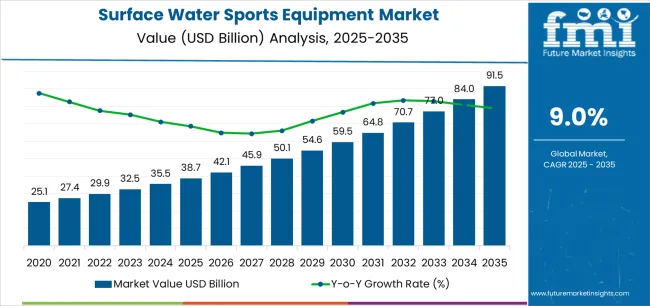
The surface water sports equipment market was valued at USD 38.70 billion in 2025, projected to reach USD 42.18 billion in 2026, and is forecast to expand to USD 99.86 billion by 2036 at a 9.00% CAGR. Based on Future Market Insights analysis, the market is set to add an incremental opportunity worth USD 57.68 billion over the forecast period. As per FMI, the procurement landscape for surface water sports equipment is being reshaped by evolving specification requirements, regional capacity investments, and shifting end-use demand patterns across established and emerging buyer segments.
Three forces are expanding the surface water sports equipment market beyond its traditional coastal and lakeside consumer base. First, the fitness-as-recreation trend is converting land-based exercise participants into water sports enthusiasts through stand-up paddle boarding and kayaking, which offer full-body workouts without the joint impact of running or cycling. Second, the inflatable equipment revolution has transformed the logistics of water sports participation: consumers can now transport a paddle board or kayak in a backpack-sized bag, eliminating the need for roof racks, trailer storage, and waterfront property that historically limited the addressable consumer base. Third, social media and content creation culture is driving aspirational equipment purchases as consumers invest in premium boards and accessories that photograph well and signal active lifestyle identity, increasing average selling prices across the paddle sports segment.
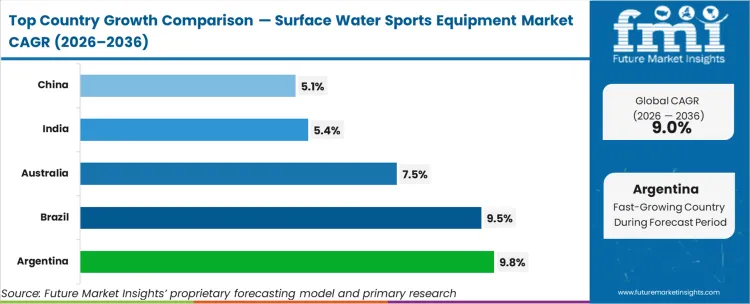
Across tracked geographies, Argentina sets the pace at 9.80% CAGR. Brazil follows at 9.50%. Australia follows at 7.50%. India follows at 5.40%. China follows at 5.10%.
Summary of Surface Water Sports Equipment Market
- Surface Water Sports Equipment Market definition
- Surface water sports equipment encompasses paddle boards, kayaks, canoes, surfboards, wakeboards, water skis, inflatable watercraft, and personal watercraft accessories designed for recreational and competitive use on lakes, rivers, oceans, and coastal waters by adult and youth consumer segments.
- Demand drivers in the market
- Stand-up paddle boarding participation rates continue to grow across North America, Europe, and Oceania as the activity attracts recreational users seeking low-impact fitness options accessible across a wide age range and skill level spectrum.
- Coastal and lake tourism infrastructure investment across Latin America, Southeast Asia, and the Middle East is creating new rental fleet demand for surface water sports equipment as resort operators expand activity offerings to attract higher-spending visitors.
- Inflatable watercraft technology improvements in drop-stitch construction and high-pressure inflation systems are making paddle boards and kayaks portable and storable in urban apartments, removing the garage storage barrier that previously limited adoption among city-dwelling consumers.
- Key segments analyzed in the FMI report
- Paddle Sports Equipment product type: 44.6% share in 2026, reflecting established procurement specifications and supply chain infrastructure favoring this variant.
- Adults consumer orientation: 62.3% share in 2026, driven by end-use requirements in the primary application channels.
- Argentina: 9.80% compound growth, supported by domestic investment and rising consumption.
- Analyst opinion at FMI
- Ronak Shah, Principal Consultant for Consumer Product observe that, the surface water sports equipment market is consumer discretionary spending dependent, making it sensitive to economic cycles and seasonal weather patterns. The companies capturing the largest share of incremental growth are those offering inflatable product lines with premium construction quality that satisfy both the portability demand of urban consumers and the performance expectations of experienced paddlers. FMI is of the opinion that brand differentiation in this category increasingly depends on direct-to-consumer digital marketing capability and influencer partnership strategy rather than traditional retail distribution leverage.
- Strategic implications / executive takeaways
- Equipment manufacturers must expand inflatable product portfolios with premium construction specifications to capture the growing urban consumer segment that prioritizes portability without accepting performance compromises.
- Brands targeting Latin American and Southeast Asian resort markets should develop B2B rental fleet programs with volume pricing and warranty structures designed for high-utilization commercial environments.
- Direct-to-consumer channel investment should prioritize social media content partnerships and seasonal promotional campaigns timed to pre-summer purchasing windows when consumer intent peaks.
Surface Water Sports Equipment Market key takeaways
| Metric | Details |
|---|---|
| Industry Size (2026) | USD 42.18 billion |
| Industry Value (2036) | USD 99.86 billion |
| CAGR (2026 to 2036) | 9.00% |
Source: Future Market Insights, 2026
Surface Water Sports Equipment Market definition
Surface water sports equipment represents the consumer sporting goods category covering all non-motorized and motorized equipment used for recreational and competitive activity on open water surfaces. The product range spans paddle-powered craft, wave-riding equipment, towed water sports gear, and inflatable recreational platforms distributed through specialty retail, mass sporting goods channels, and online commerce.
Surface Water Sports Equipment Market inclusions
Market scope includes all commercially traded surface water sports equipment segmented by product type (paddle sports equipment, surfing equipment, towed water sports equipment, inflatable watercraft, personal watercraft accessories) and consumer orientation (adults, youth). Revenue sizing spans the 2026 to 2036 forecast period with regional and country-level assessments.
Surface Water Sports Equipment Market exclusions
The scope excludes motorized personal watercraft (jet skis) sold as complete vehicles, competitive sailing vessels, fishing boats, and scuba diving equipment. Apparel, footwear, and wetsuits are outside the defined boundary unless bundled with equipment as a package.
Surface Water Sports Equipment Market research methodology
- Primary research: FMI analysts conducted interviews with procurement directors, product managers, and supply chain leads across key surface water sports equipment organizations to map decision gates and sourcing specifications.
- Desk research: Data collection phases aggregated regulatory filings, trade association publications, standards body documentation, and company annual reports to establish verifiable baseline parameters.
- Market sizing and forecasting: Baseline values derive from a bottom-up aggregation of surface water sports equipment transaction volumes, applying region-specific adoption curves and pricing indices to project forward demand through 2036.
- Data validation and update cycle: Projections are tested against publicly reported procurement volumes, trade flow statistics, and company financial disclosures on a quarterly refresh schedule.
Key Industry Highlights
Sustainability Trends has become a Key Differentiator for Success
Consumers nowadays are becoming more concerned about sustainable products and ways of production. Several water sports equipment manufacturing firms have therefore ensured they find ways and means of being sustainable.
Sustainability activities extend from buying recycled items to practicing eco-friendly methods on production floors. Firms are striving to mitigate the impact of their business on the environment to meet the growing demand of conscious consumers.
Sustainability is no longer viewed as a peripheral force within the sector’s competition and purchasing system. It is one of the most critical drivers that influence customers’ decisions towards certain products. Sustainability is creating investment opportunities in companies developing innovative water sports equipment.
To gain the most with this opportunity, HO Sports launched its new Sabre Water Ski, in November 2025. This firm partnered with California-based Checkerspot to launch the new product.
This new addition to the water-skiing equipment boasts of a biobased foam core that was designed through Checkerspot’s WING® Platform that creates algae-derived biomaterials that are tailored to stay within specific performance characteristics while using fewer fossil fuels.
This partnership aims to exhibit Checkerspot’s next-generation capabilities in the industries of biotechnology and material science for the achievement of innovative, higher-performing, and more sustainable water skis.
Democratization of Access is an Integral Revenue Booster
The penetration of water sports activities is rising, as access to the opportunities has been liberalized and provided to a larger amount of people. The rise of direct-to-consumer sales by water sports equipment brands has made it easier to obtain these products.
Establishments involved in rentals, water sports organizations, and society are making it easier for the consumer who may not afford to purchase some of the apparatus. Rental options, membership, or discounted packages are effective strategies that businesses use to attract more clients and introduce new recurring revenue models.
This improved access is increasing the scope of opportunities for water sports activities. They enable companies to gain a stronger position and increase sales of related products in a competitive environment.
eCommerce and Digital Marketing Expands the Reach of Businesses
The rise of e-commerce and its impact on brick-and-mortar stores has been incredible. Due to digitalization and the advances in technology across the world, firms in the water sports equipment industry are using e-commerce platforms and digital marketing as a means to expand access and sales.
The increased number of online retail channels allows companies to unlock new sources of demand and capture new customers and segments. Marketing strategies like SEO, social media advertisement, and influencer marketing are employed to create brand recognition engage the audience and increase conversion rates.
The role of brand ambassadors, athletes, and influencers in promoting water sports equipment is highly impactful in augmenting sales. With the help of digital technologies, companies can remain relevant and successfully adapt to modern tendencies for digital services consumption.
2021 to 2025 Global Surface Water Sports Equipment Sales Outlook Compared to Demand Forecast for 2026 to 2036
Enhanced economic situations and higher levels of disposable income in many parts of the world have made it possible for consumers to spend on leisure and related equipment. With an increase in discretionary income being put into leisure and activities, especially outdoors, the water sports equipment industry has continuously grown.
Several water sports rental services and tour operators have entered the industry hence making these activities easily available to people. Larger numbers of permanent visitors tourists and casual participants provide such services like equipment rental or guided tours, basically positively influencing the industry. Venture capital and private equity funding for promising water sports startups are also creating a positive impact.
Appeal of cultural changes relative to leisure and outdoor activities values consumer buying behavior as experience versus possessions. The fun derived from water sports are effective means of venting off accumulated stresses by engaging with nature, which in turn has made its popularity and hence, the demand for relevant equipment constant.
The increased focus on living a healthy lifestyle has made more people embrace water activities as a way of exercising and escaping stress. This trend has been beneficial for the industry.
The future of the industry looks bright, expanding at a 9% CAGR till 2035. Future advancements in materials science, manufacturing, and incorporation of technology will create new waves in water sports equipment. Integrated technologies, new lightweight materials, and environmental solutions will enhance performance and safety and make customers who use them progress hence stimulating sales.
Market Concentration
Tier 1 companies include top leaders in the surface water sports equipment market, generating around USD 16,256.5 million in revenue, which is about 50% of the global industry share.
Leading brands like BRP Inc., Yamaha Motor Co., Ltd., MasterCraft Boat Holdings, Inc., Malibu Boats, Inc., and Brunswick Corporation dominate this industry with their strong presence and quality offerings. Their products are widely available due to their extensive distribution networks.
Tier 2 companies include Correct Craft, Kawasaki Heavy Industries, Marine Products Corporation, Hobie Cat Company, and Tahe Outdoors. They have a strong reputation as they provide robust products at affordable prices. These companies cover about 35% of the global industry value share, with a valuation of USD 11,379.5 million.
They frequently co-ordinate with retailers, and online portals to improve their positioning and distribution channels. Offering customer loyalty awards and effective marketing promotions assists in creating a loyal customer base.
Naish International, Starboard, Fanatic, JP Australia and Liquid Force fall under the Tier 3 companies. These companies hold revenue of USD 4,876.9 million or around 15% of the industry shares worldwide.
These companies may be more flexible and can react to needs more effectively, often specializing in particular segments or individual product attributes. New brands tend to emphasize the core values of sustainability and ethical approaches to business and products, which younger and environmentally friendly consumers value.
Surface Water Sports Equipment Market Regional Analysis
This section gives insights into the future surface water sports equipment market forecast in top countries. Information on regions like North America, Europe, Asia Pacific, and others has been granulated, focusing on the top countries. Australia is expected to be at the forefront, expanding at a 7.5% CAGR until 2036.
India follows next, expanding at a 5.4% CAGR until 2036. Lastly, China is also on the list, thriving at a 5.1% CAGR until 2036. This data indicates that the Asia Pacific region is likely to make remarkable progress in the coming years.
.webp "Top Country Growth Comparison Surface Water Sports Equipment Market Cagr (2026 2036)")
| Countries | Value CAGR (2026 to 2036) |
|---|---|
| Australia | 7.5% |
| India | 5.4% |
| China | 5.1% |
Tourism Industry Growth Boosts Sales in Australia
The sales of surface water sports equipment in Australia are predicted to surge at a 7.5% CAGR until 2036. Travel and tourism is today one of the most dynamic industries in Australia, and it is instrumental in rallying millions of vacationing tourists to Australia’s water sports sites.
An increased number of tourists leads to increased demand for rental services, equipment, or anything associated with water activities. Australia has a long coastal line which makes it some of the most serene and unpopulated coastline, bays, and rivers for sailing and other water activities.
Such natural provision of easily accessible water bodies results in many water-related activities. Arranging international surfing championships, yachting competitions, and other water sports fosters these activities and raises the popularity of equipment locally.
Local Industry Development Surges Demand in India
The demand for surface water sports equipment in India is anticipated to increase at a 5.4% CAGR till 2036. Currently, local manufacturers and startups are seeking opportunities to supply water sports equipment, which are cheaper than imported ones.
This helps the industry expand since more people can gain access to equipment they might have been previously locked out from due to the high cost of equipment. Technological improvements have LED to the availability of water sports equipment at cheaper prices hence increased uptake.
The tourism sector in India is on the rise, proving the increased interest of both domestic and foreign travelers looking for various experiences. With states along the coastline like Goa, Kerala, and Maharashtra becoming ideal locations for water sports, there is increasing demand for apparatus and services.
Government Initiatives and Policies Raise Demand in China
The sales of surface water sports equipment in China will amplify at a 5.1% CAGR till 2036. People in China are beginning to pay more heed to their health and well-being. Aquatic sports are recommended as enjoyable and effective in promoting fitness utility for enhancing athletes’ performance, hence the rising participation rate.
To curb the rising cases of obesity and diseases that are associated with the lack of exercise, the Chinese government has been encouraging people to engage in sporting activities and recreational exercises.
Government policies designed to spur tourism and sports-related investments such as water sports have been key in expanding industry size. Marinas, water parks, and other measures related to water sports have improved owing to large investments in developing coastal and inland water sports.
Category-wise Insights
This section takes a closer look at the surface water sports equipment market segmentation by product type and consumer orientation. The research indicates that paddle sports equipment is the leading product type, holding 44.2% of industry shares in 2026. Based on consumer orientation, adults dominate with 87.3% of shares captured in 2026.
Paddle Sports Equipment is the Leading Product Type

| Segment | Paddle Sports Equipment (Product Type) |
|---|---|
| Value Share (2026) | 44.2% |
Paddle sports encompass diverse activities. These include recreational paddling. Also touring fishing, racing, and white-water adventures. This versatility caters to varying interests. It allows for different experiences with the same equipment. Paddle sports offer full-body workouts.
They improve cardiovascular health. They also enhance muscle strength and endurance. The low-impact nature of paddling makes it an excellent exercise option for people of all fitness levels.
Advances in materials technology have LED to the development of lighter and more durable paddle sports equipment. Innovations such as inflatable kayaks and SUPs have simplified transportation and storage. This has increased their accessibility significantly across the industry.
Adults Gain Top Shares as the Leading Consumer Orientation

| Segment | Adults (Consumer Orientation) |
|---|---|
| Value Share (2026) | 62.3% |
With higher disposable incomes adults possess more financial resources to spend on recreational activities. They can allocate funds towards sports equipment. This economic stability allows them to invest in quality water sports gear. A growing trend exists among adults to seek adventure sports offering thrilling and unique experiences.
Water sports cater to this desire for adventure and exploration. Their popularity is boosted by exposure in media, including social media, films, and television. Adults are inspired by influencers celebrities and peers sharing their water sports experiences online. These traits boost consumer orientation for adults in the industry.
Surface Water Sports Equipment Market Competitive Landscape
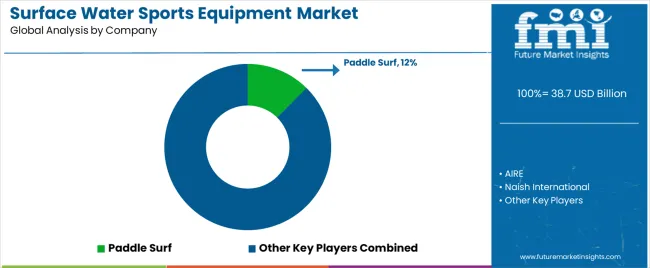
The competitive landscape of the surface water sports equipment industry is characterized by dynamic mix of established global brands emerging local manufacturers and innovative startups. International players like Hobie Cat. BIC Sport and Aqua Marina dominate the industry. They leverage their extensive research and development capabilities.
Brand recognition and extensive distribution networks bolster their position. These companies have significant competitive advantage due to their ability to innovate. They adapt to evolving consumer preferences. They offer a wide range of high-quality products. These cater to various segments of the industry from recreational users to professional athletes.
Recent Developments
- In January 2025, Andhra Pradesh government in India launched water sports in Bhavani Islands. This includes para-motoring, jeep parasailing, speed boat, and other water sport activities.
- In April 2025, Red Sea Global launched Akun, a new adventure sports company in the Kingdom of Saudi Arabia.
- In March 2025, Mad Watersports launched their surf equipment sales in Cornwall, the United Kingdom.
Scope of the report

| Metric | Value |
|---|---|
| Quantitative Units | USD 42.18 billion to USD 99.86 billion, at a CAGR of 9.00% |
| Market Definition | Surface water sports equipment encompasses paddle boards, kayaks, canoes, surfboards, wakeboards, water skis, inflatable watercraft, and personal watercraft accessories designed for recreational and competitive use on lakes, rivers, oceans, and coastal waters by adult and youth consumer segments. |
| Segmentation | Product Type (Paddle Sports Equipment), Consumer Orientation (Adults) |
| Regions Covered | North America, Latin America, Europe, East Asia, South Asia, Oceania, Middle East and Africa |
| Countries Covered | India, China, USA, Canada, UK, Germany, Japan, and 40 plus countries |
| Key Companies Profiled | Paddle Surf, AIRE, Naish International, Rave Sports, O'Brien, BIC Sports, Aqua Marine, Belassi, BomBoard, Starboard, Solstice Sports |
| Forecast Period | 2026 to 2036 |
| Approach | Forecasting models apply a hybrid bottom-up and top-down methodology starting with verified surface water sports equipment transaction data and projecting adoption velocity across defined segments and regions. |
Segmentation Analysis
By Product Type:
The sector has been classified into Paddle Sports Equipment, Ski Sports Equipment, and Board Sports Equipment.
By Consumer Orientation:
The industry bifurcates into Kids and Adults.
By Sales Channel:
The sector is segmented into Wholesalers/ Distributors, Hypermarkets/ Supermarkets, Exclusive Stores, Multi-brand Stores, Franchise Sports Chain Outlets, Independent Sports Outlets, and Online Retailers.
By End User:
The industry trifurcates into Beginner, Intermediate, and Professional.
By Price Range:
The sector bifurcated into Mass and Premium.
By Region:
Analysis of the industry has been conducted in the countries of North America, Latin America, Europe, East Asia, South Asia & Pacific, Middle East & Africa (MEA).
Bibliography
- World Surf League. (2024). Annual Participation and Economic Impact Report. WSL.
- International Canoe Federation. (2024). Global Paddle Sports Participation Statistics. ICF.
- Sport England. (2024). Active Lives Survey 2023-2024: Water Sports Participation. Sport England.
- European Outdoor Group. (2024). State of Trade Report: Water Sports Equipment. EOG.
- United Nations World Tourism Organization. (2024). Tourism and Sport: Economic Impact Assessment. UNWTO.
- Organisation for Economic Co-operation and Development. (2024). OECD Tourism Trends and Policies: Adventure Tourism. OECD.
This bibliography is provided for reader reference. The full FMI report contains the complete reference list with primary research documentation.
This report addresses
- Market sizing and quantitative forecast metrics detailing precise expenditure on surface water sports equipment across major end-use verticals through 2036.
- Segmentation analysis mapping adoption velocity of specific product type variants and evaluating structural drivers behind preference shifts.
- Regional deployment intelligence comparing growth trajectories across Asia Pacific, Europe, North America, Latin America, and Middle East and Africa.
- Regulatory compliance assessment analyzing how evolving standards and certification mandates shape procurement specifications across target geographies.
- Competitive posture evaluation tracking consolidation activity, capacity investments, and strategic partnerships among leading market participants.
- Strategic guidance defining procurement parameters and supply chain configurations required for surface water sports equipment sourcing through the forecast period.
- Supply chain vulnerability analysis identifying concentration risks, raw material dependencies, and logistics bottlenecks affecting cost structures.
- Custom data delivery formats encompassing interactive dashboards, raw Excel datasets, and comprehensive PDF narrative reports.
Frequently Asked Questions
How large is the demand for Surface Water Sports Equipment in the global market in 2026?
Demand for surface water sports equipment in the global market is estimated to be valued at USD 42.18 billion in 2026.
What will be the market size of Surface Water Sports Equipment by 2036?
Market size for surface water sports equipment is projected to reach USD 99.86 billion by 2036.
What is the expected demand growth for Surface Water Sports Equipment between 2026 and 2036?
Demand for surface water sports equipment is expected to grow at a CAGR of 9.00% between 2026 and 2036.
Which Product Type is poised to lead global sales by 2026?
Paddle Sports Equipment accounts for 44.6% in 2026, reflecting established procurement specifications across primary buyer channels.
How is Adults driving Surface Water Sports Equipment adoption in 2026?
Adults represents 62.3% of segment demand as end-use requirements favor this category.
What is driving demand in Argentina?
Argentina registers a 9.80% CAGR through 2036, propelled by domestic investment and rising end-use consumption.
What does Surface Water Sports Equipment Market definition mean in this report?
Surface water sports equipment encompasses paddle boards, kayaks, canoes, surfboards, wakeboards, water skis, inflatable watercraft, and personal watercraft accessories designed for recreational and competitive use on lakes, rivers, oceans, and coastal waters by adult and youth consumer segments.
How does FMI build and validate the Surface Water Sports Equipment forecast?
Forecasting models apply a hybrid bottom-up methodology starting with verified transaction data, cross-validated against publicly reported procurement volumes and company financial disclosures on a quarterly refresh schedule.
Preview the report firsthand - request a free sample
Get SampleGet the brochure for pricing and purchase details.
Get PDFTable of Content
- Executive Summary
- Global Market Outlook
- Demand-side Trends
- Supply-side Trends
- Technology Roadmap Analysis
- Analysis and Recommendations
- Market Overview
- Market Coverage / Taxonomy
- Market Definition / Scope / Limitations
- Research Methodology
- Chapter Orientation
- Analytical Lens and Working Hypotheses
- Market Structure, Signals, and Trend Drivers
- Benchmarking and Cross-market Comparability
- Market Sizing, Forecasting, and Opportunity Mapping
- Research Design and Evidence Framework
- Desk Research Programme (Secondary Evidence)
- Company Annual and Sustainability Reports
- Peer-reviewed Journals and Academic Literature
- Corporate Websites, Product Literature, and Technical Notes
- Earnings Decks and Investor Briefings
- Statutory Filings and Regulatory Disclosures
- Technical White Papers and Standards Notes
- Trade Journals, Industry Magazines, and Analyst Briefs
- Conference Proceedings, Webinars, and Seminar Materials
- Government Statistics Portals and Public Data Releases
- Press Releases and Reputable Media Coverage
- Specialist Newsletters and Curated Briefings
- Sector Databases and Reference Repositories
- FMI Internal Proprietary Databases and Historical Market Datasets
- Subscription Datasets and Paid Sources
- Social Channels, Communities, and Digital Listening Inputs
- Additional Desk Sources
- Expert Input and Fieldwork (Primary Evidence)
- Primary Modes
- Qualitative Interviews and Expert Elicitation
- Quantitative Surveys and Structured Data Capture
- Blended Approach
- Why Primary Evidence is Used
- Field Techniques
- Interviews
- Surveys
- Focus Groups
- Observational and In-context Research
- Social and Community Interactions
- Stakeholder Universe Engaged
- C-suite Leaders
- Board Members
- Presidents and Vice Presidents
- R&D and Innovation Heads
- Technical Specialists
- Domain Subject-matter Experts
- Scientists
- Physicians and Other Healthcare Professionals
- Governance, Ethics, and Data Stewardship
- Research Ethics
- Data Integrity and Handling
- Primary Modes
- Tooling, Models, and Reference Databases
- Desk Research Programme (Secondary Evidence)
- Data Engineering and Model Build
- Data Acquisition and Ingestion
- Cleaning, Normalisation, and Verification
- Synthesis, Triangulation, and Analysis
- Quality Assurance and Audit Trail
- Market Background
- Market Dynamics
- Drivers
- Restraints
- Opportunity
- Trends
- Scenario Forecast
- Demand in Optimistic Scenario
- Demand in Likely Scenario
- Demand in Conservative Scenario
- Opportunity Map Analysis
- Product Life Cycle Analysis
- Supply Chain Analysis
- Investment Feasibility Matrix
- Value Chain Analysis
- PESTLE and Porter’s Analysis
- Regulatory Landscape
- Regional Parent Market Outlook
- Production and Consumption Statistics
- Import and Export Statistics
- Market Dynamics
- Global Market Analysis 2021 to 2025 and Forecast, 2026 to 2036
- Historical Market Size Value (USD Million) Analysis, 2021 to 2025
- Current and Future Market Size Value (USD Million) Projections, 2026 to 2036
- Y-o-Y Growth Trend Analysis
- Absolute $ Opportunity Analysis
- Global Market Pricing Analysis 2021 to 2025 and Forecast 2026 to 2036
- Global Market Analysis 2021 to 2025 and Forecast 2026 to 2036, By Product Type
- Introduction / Key Findings
- Historical Market Size Value (USD Million) Analysis By Product Type , 2021 to 2025
- Current and Future Market Size Value (USD Million) Analysis and Forecast By Product Type , 2026 to 2036
- Paddle Sports Equipment
- Ski Sports Equipment
- Board Sports Equipment
- Paddle Sports Equipment
- Y-o-Y Growth Trend Analysis By Product Type , 2021 to 2025
- Absolute $ Opportunity Analysis By Product Type , 2026 to 2036
- Global Market Analysis 2021 to 2025 and Forecast 2026 to 2036, By Consumer Orientation
- Introduction / Key Findings
- Historical Market Size Value (USD Million) Analysis By Consumer Orientation, 2021 to 2025
- Current and Future Market Size Value (USD Million) Analysis and Forecast By Consumer Orientation, 2026 to 2036
- Adults
- Kids
- Adults
- Y-o-Y Growth Trend Analysis By Consumer Orientation, 2021 to 2025
- Absolute $ Opportunity Analysis By Consumer Orientation, 2026 to 2036
- Global Market Analysis 2021 to 2025 and Forecast 2026 to 2036, By Sales Channel
- Introduction / Key Findings
- Historical Market Size Value (USD Million) Analysis By Sales Channel, 2021 to 2025
- Current and Future Market Size Value (USD Million) Analysis and Forecast By Sales Channel, 2026 to 2036
- Wholesalers/ Distributors
- Hypermarkets/ Supermarkets
- Exclusive Stores
- Multi-brand Stores
- Franchise Sports Chain Outlets
- Independent Sports Outlets
- Online Retailers
- Wholesalers/ Distributors
- Y-o-Y Growth Trend Analysis By Sales Channel, 2021 to 2025
- Absolute $ Opportunity Analysis By Sales Channel, 2026 to 2036
- Global Market Analysis 2021 to 2025 and Forecast 2026 to 2036, By End User
- Introduction / Key Findings
- Historical Market Size Value (USD Million) Analysis By End User, 2021 to 2025
- Current and Future Market Size Value (USD Million) Analysis and Forecast By End User, 2026 to 2036
- Beginner
- Intermediate
- Professional
- Beginner
- Y-o-Y Growth Trend Analysis By End User, 2021 to 2025
- Absolute $ Opportunity Analysis By End User, 2026 to 2036
- Global Market Analysis 2021 to 2025 and Forecast 2026 to 2036, By Price Range
- Introduction / Key Findings
- Historical Market Size Value (USD Million) Analysis By Price Range, 2021 to 2025
- Current and Future Market Size Value (USD Million) Analysis and Forecast By Price Range, 2026 to 2036
- Mass
- Premium
- Mass
- Y-o-Y Growth Trend Analysis By Price Range, 2021 to 2025
- Absolute $ Opportunity Analysis By Price Range, 2026 to 2036
- Global Market Analysis 2021 to 2025 and Forecast 2026 to 2036, By Region
- Introduction
- Historical Market Size Value (USD Million) Analysis By Region, 2021 to 2025
- Current Market Size Value (USD Million) Analysis and Forecast By Region, 2026 to 2036
- North America
- Latin America
- Western Europe
- Eastern Europe
- East Asia
- South Asia and Pacific
- Middle East & Africa
- Market Attractiveness Analysis By Region
- North America Market Analysis 2021 to 2025 and Forecast 2026 to 2036, By Country
- Historical Market Size Value (USD Million) Trend Analysis By Market Taxonomy, 2021 to 2025
- Market Size Value (USD Million) Forecast By Market Taxonomy, 2026 to 2036
- By Country
- USA
- Canada
- Mexico
- By Product Type
- By Consumer Orientation
- By Sales Channel
- By End User
- By Price Range
- By Country
- Market Attractiveness Analysis
- By Country
- By Product Type
- By Consumer Orientation
- By Sales Channel
- By End User
- By Price Range
- Key Takeaways
- Latin America Market Analysis 2021 to 2025 and Forecast 2026 to 2036, By Country
- Historical Market Size Value (USD Million) Trend Analysis By Market Taxonomy, 2021 to 2025
- Market Size Value (USD Million) Forecast By Market Taxonomy, 2026 to 2036
- By Country
- Brazil
- Chile
- Rest of Latin America
- By Product Type
- By Consumer Orientation
- By Sales Channel
- By End User
- By Price Range
- By Country
- Market Attractiveness Analysis
- By Country
- By Product Type
- By Consumer Orientation
- By Sales Channel
- By End User
- By Price Range
- Key Takeaways
- Western Europe Market Analysis 2021 to 2025 and Forecast 2026 to 2036, By Country
- Historical Market Size Value (USD Million) Trend Analysis By Market Taxonomy, 2021 to 2025
- Market Size Value (USD Million) Forecast By Market Taxonomy, 2026 to 2036
- By Country
- Germany
- UK
- Italy
- Spain
- France
- Nordic
- BENELUX
- Rest of Western Europe
- By Product Type
- By Consumer Orientation
- By Sales Channel
- By End User
- By Price Range
- By Country
- Market Attractiveness Analysis
- By Country
- By Product Type
- By Consumer Orientation
- By Sales Channel
- By End User
- By Price Range
- Key Takeaways
- Eastern Europe Market Analysis 2021 to 2025 and Forecast 2026 to 2036, By Country
- Historical Market Size Value (USD Million) Trend Analysis By Market Taxonomy, 2021 to 2025
- Market Size Value (USD Million) Forecast By Market Taxonomy, 2026 to 2036
- By Country
- Russia
- Poland
- Hungary
- Balkan & Baltic
- Rest of Eastern Europe
- By Product Type
- By Consumer Orientation
- By Sales Channel
- By End User
- By Price Range
- By Country
- Market Attractiveness Analysis
- By Country
- By Product Type
- By Consumer Orientation
- By Sales Channel
- By End User
- By Price Range
- Key Takeaways
- East Asia Market Analysis 2021 to 2025 and Forecast 2026 to 2036, By Country
- Historical Market Size Value (USD Million) Trend Analysis By Market Taxonomy, 2021 to 2025
- Market Size Value (USD Million) Forecast By Market Taxonomy, 2026 to 2036
- By Country
- China
- Japan
- South Korea
- By Product Type
- By Consumer Orientation
- By Sales Channel
- By End User
- By Price Range
- By Country
- Market Attractiveness Analysis
- By Country
- By Product Type
- By Consumer Orientation
- By Sales Channel
- By End User
- By Price Range
- Key Takeaways
- South Asia and Pacific Market Analysis 2021 to 2025 and Forecast 2026 to 2036, By Country
- Historical Market Size Value (USD Million) Trend Analysis By Market Taxonomy, 2021 to 2025
- Market Size Value (USD Million) Forecast By Market Taxonomy, 2026 to 2036
- By Country
- India
- ASEAN
- Australia & New Zealand
- Rest of South Asia and Pacific
- By Product Type
- By Consumer Orientation
- By Sales Channel
- By End User
- By Price Range
- By Country
- Market Attractiveness Analysis
- By Country
- By Product Type
- By Consumer Orientation
- By Sales Channel
- By End User
- By Price Range
- Key Takeaways
- Middle East & Africa Market Analysis 2021 to 2025 and Forecast 2026 to 2036, By Country
- Historical Market Size Value (USD Million) Trend Analysis By Market Taxonomy, 2021 to 2025
- Market Size Value (USD Million) Forecast By Market Taxonomy, 2026 to 2036
- By Country
- Kingdom of Saudi Arabia
- Other GCC Countries
- Turkiye
- South Africa
- Other African Union
- Rest of Middle East & Africa
- By Product Type
- By Consumer Orientation
- By Sales Channel
- By End User
- By Price Range
- By Country
- Market Attractiveness Analysis
- By Country
- By Product Type
- By Consumer Orientation
- By Sales Channel
- By End User
- By Price Range
- Key Takeaways
- Key Countries Market Analysis
- USA
- Pricing Analysis
- Market Share Analysis, 2025
- By Product Type
- By Consumer Orientation
- By Sales Channel
- By End User
- By Price Range
- Canada
- Pricing Analysis
- Market Share Analysis, 2025
- By Product Type
- By Consumer Orientation
- By Sales Channel
- By End User
- By Price Range
- Mexico
- Pricing Analysis
- Market Share Analysis, 2025
- By Product Type
- By Consumer Orientation
- By Sales Channel
- By End User
- By Price Range
- Brazil
- Pricing Analysis
- Market Share Analysis, 2025
- By Product Type
- By Consumer Orientation
- By Sales Channel
- By End User
- By Price Range
- Chile
- Pricing Analysis
- Market Share Analysis, 2025
- By Product Type
- By Consumer Orientation
- By Sales Channel
- By End User
- By Price Range
- Germany
- Pricing Analysis
- Market Share Analysis, 2025
- By Product Type
- By Consumer Orientation
- By Sales Channel
- By End User
- By Price Range
- UK
- Pricing Analysis
- Market Share Analysis, 2025
- By Product Type
- By Consumer Orientation
- By Sales Channel
- By End User
- By Price Range
- Italy
- Pricing Analysis
- Market Share Analysis, 2025
- By Product Type
- By Consumer Orientation
- By Sales Channel
- By End User
- By Price Range
- Spain
- Pricing Analysis
- Market Share Analysis, 2025
- By Product Type
- By Consumer Orientation
- By Sales Channel
- By End User
- By Price Range
- France
- Pricing Analysis
- Market Share Analysis, 2025
- By Product Type
- By Consumer Orientation
- By Sales Channel
- By End User
- By Price Range
- India
- Pricing Analysis
- Market Share Analysis, 2025
- By Product Type
- By Consumer Orientation
- By Sales Channel
- By End User
- By Price Range
- ASEAN
- Pricing Analysis
- Market Share Analysis, 2025
- By Product Type
- By Consumer Orientation
- By Sales Channel
- By End User
- By Price Range
- Australia & New Zealand
- Pricing Analysis
- Market Share Analysis, 2025
- By Product Type
- By Consumer Orientation
- By Sales Channel
- By End User
- By Price Range
- China
- Pricing Analysis
- Market Share Analysis, 2025
- By Product Type
- By Consumer Orientation
- By Sales Channel
- By End User
- By Price Range
- Japan
- Pricing Analysis
- Market Share Analysis, 2025
- By Product Type
- By Consumer Orientation
- By Sales Channel
- By End User
- By Price Range
- South Korea
- Pricing Analysis
- Market Share Analysis, 2025
- By Product Type
- By Consumer Orientation
- By Sales Channel
- By End User
- By Price Range
- Russia
- Pricing Analysis
- Market Share Analysis, 2025
- By Product Type
- By Consumer Orientation
- By Sales Channel
- By End User
- By Price Range
- Poland
- Pricing Analysis
- Market Share Analysis, 2025
- By Product Type
- By Consumer Orientation
- By Sales Channel
- By End User
- By Price Range
- Hungary
- Pricing Analysis
- Market Share Analysis, 2025
- By Product Type
- By Consumer Orientation
- By Sales Channel
- By End User
- By Price Range
- Kingdom of Saudi Arabia
- Pricing Analysis
- Market Share Analysis, 2025
- By Product Type
- By Consumer Orientation
- By Sales Channel
- By End User
- By Price Range
- Turkiye
- Pricing Analysis
- Market Share Analysis, 2025
- By Product Type
- By Consumer Orientation
- By Sales Channel
- By End User
- By Price Range
- South Africa
- Pricing Analysis
- Market Share Analysis, 2025
- By Product Type
- By Consumer Orientation
- By Sales Channel
- By End User
- By Price Range
- USA
- Market Structure Analysis
- Competition Dashboard
- Competition Benchmarking
- Market Share Analysis of Top Players
- By Regional
- By Product Type
- By Consumer Orientation
- By Sales Channel
- By End User
- By Price Range
- Competition Analysis
- Competition Deep Dive
- Paddle Surf
- Overview
- Product Portfolio
- Profitability by Market Segments (Product/Age /Sales Channel/Region)
- Sales Footprint
- Strategy Overview
- Marketing Strategy
- Product Strategy
- Channel Strategy
- AIRE
- Naish International
- Rave Sports
- O’Brien, BIC Sports
- Aqua Marine
- Belassi
- BomBoard
- Starboard
- Solstice Sports
- Surftech
- Johnson Outdoors
- Paddle Surf
- Competition Deep Dive
- Assumptions & Acronyms Used


