

- Industry Size (2026)
- USD 6.42 Bn
- Forecast (2036)
- USD 21.23 Bn
- CAGR (2026 to 2036)
- 12.70%
Surface Mount Technology Market size, market forecast and outlook by FMI
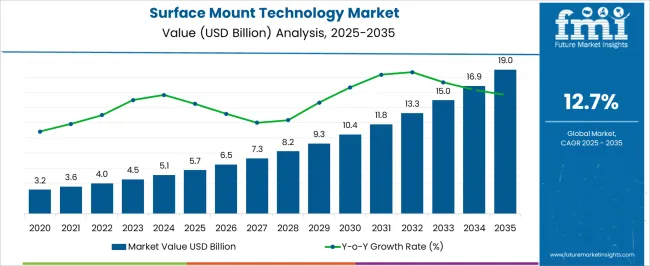
The surface mount technology market was valued at USD 5.70 billion in 2025, projected to reach USD 6.42 billion in 2026, and is forecast to expand to USD 21.23 billion by 2036 at a 12.70% CAGR. Based on Future Market Insights analysis, the market is set to add an incremental opportunity worth USD 14.81 billion over the forecast period. As per FMI, the procurement landscape for surface mount technology is being reshaped by evolving specification requirements, regional capacity investments, and shifting end-use demand patterns across established and emerging buyer segments.
Summary of Surface Mount Technology Market
- Surface Mount Technology Market definition
- Surface mount technology encompasses the automated assembly equipment, components, and process systems used to place and solder electronic components directly onto the surface of printed circuit boards, including pick-and-place machines, reflow ovens, screen printers, inspection systems, and the passive and active SMD components they process.
- Demand drivers in the market
- Consumer electronics miniaturization trends are compressing component footprints and increasing placement density per PCB, requiring higher-speed, higher-accuracy pick-and-place equipment that can handle 01005 and 008004 package sizes at production throughput rates.
- Automotive electronics content per vehicle is expanding as ADAS, infotainment, and powertrain electrification systems multiply the number of SMT-assembled PCBs required per production unit, directly scaling equipment utilization rates in Tier 1 supplier factories.
- Telecommunications 5G infrastructure deployment is generating sustained demand for high-frequency PCB assembly equipment capable of maintaining placement accuracy and soldering quality on RF substrates with tight impedance control requirements.
- Key segments analyzed in the FMI report
- Placement Equipment equipment: 29.6% share in 2026, reflecting established procurement specifications and supply chain infrastructure favoring this variant.
- Consumer Electronics application: 28.5% share in 2026, driven by end-use requirements in the primary application channels.
- China: 17.10% compound growth, supported by domestic investment and rising consumption.
- Analyst opinion at FMI
- Sudip saha, Principal Consultant for Technology observe that The surface mount technology market is entering an investment cycle driven by the simultaneous convergence of component miniaturization, geographic manufacturing diversification, and inspection technology integration. FMI analysts observe that the equipment vendors capturing incremental market share are those offering integrated line solutions where placement, soldering, and inspection systems share a common data platform, because factory directors are moving away from best-of-breed equipment procurement toward single-vendor line responsibility that simplifies commissioning and maintenance contracts. The risk for component-only SMT suppliers is that equipment-driven market sizing understates the total value creation, while equipment vendors face margin pressure from Chinese competitors achieving placement accuracy parity at lower price points.
- Strategic implications / executive takeaways
- Electronics contract manufacturers expanding into India and Vietnam should procure integrated SMT line solutions from single vendors to reduce commissioning timelines and simplify operator training across greenfield factory installations.
- Equipment procurement directors must specify placement machines capable of handling 01005 and smaller component packages to maintain production flexibility as customer PCB designs continue to adopt finer-pitch components.
- Quality engineering teams should invest in inline 3D AOI and X-ray inspection systems integrated with placement equipment feedback loops to shift from post-process defect detection to real-time process control.
Surface Mount Technology Market key takeaways
| Metric | Details |
|---|---|
| Industry Size (2026) | USD 6.42 billion |
| Industry Value (2036) | USD 21.23 billion |
| CAGR (2026 to 2036) | 12.70% |
Source: Future Market Insights, 2026
Three forces are driving capital investment acceleration in surface mount technology. First, the semiconductor packaging revolution toward system-in-package and advanced heterogeneous integration is pushing SMT equipment precision requirements into territory previously reserved for semiconductor back-end tools, forcing equipment manufacturers to close the gap between PCB assembly and chip-level placement accuracy. Second, the geographic redistribution of electronics manufacturing toward India, Vietnam, and Mexico is creating greenfield factory demand where entire SMT production lines must be procured and commissioned, generating equipment order volumes that brownfield capacity upgrades in China and Southeast Asia alone cannot match.
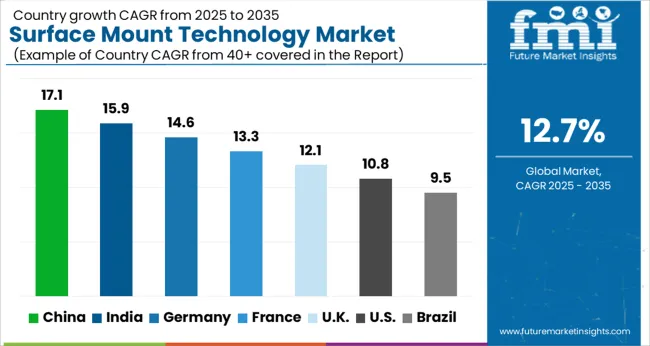
Third, automated optical inspection and X-ray inspection systems are transitioning from quality assurance tools to inline process control platforms that feed placement correction data back to pick-and-place machines in real time, increasing the per-line inspection equipment investment as a proportion of total SMT line capital expenditure. Across tracked geographies, China sets the pace at 17.10% CAGR. India follows at 15.90%. Germany follows at 14.60%. France follows at 13.30%. UK follows at 12.10%. USA follows at 10.80%. Brazil follows at 9.50%.
Surface Mount Technology Market definition
Surface mount technology represents the dominant electronics assembly methodology where miniaturized components are mounted directly onto PCB surface pads rather than inserted through drilled holes. The technology ecosystem spans placement equipment, soldering systems, inspection platforms, and the surface mount device components that collectively enable high-density, high-speed circuit board production across consumer, automotive, industrial, and telecommunications electronics.
Surface Mount Technology Market inclusions
Market scope includes all commercially traded surface mount technology equipment and components segmented by equipment type (placement equipment, soldering equipment, inspection systems, screen printers) and application (consumer electronics, automotive electronics, telecommunications, industrial, medical devices, aerospace and defense). Revenue sizing spans the 2026 to 2036 forecast period.
Surface Mount Technology Market exclusions
The scope excludes through-hole insertion equipment, bare PCB fabrication machinery, semiconductor wafer processing equipment, and cable assembly tools. Raw PCB substrates and solder paste materials sold as consumables without equipment are outside the defined boundary.
Surface Mount Technology Market research methodology
- Primary research: FMI analysts conducted interviews with procurement directors, engineering leads, and supply chain managers across key surface mount technology organizations to map decision gates and sourcing specifications.
- Desk research: Data collection phases aggregated regulatory filings, trade association publications, standards body documentation, and company annual reports to establish verifiable baseline parameters.
- Market sizing and forecasting: Baseline values derive from a bottom-up aggregation of surface mount technology transaction volumes, applying region-specific adoption curves and pricing indices to project forward demand through 2036.
- Data validation and update cycle: Projections are tested against publicly reported procurement volumes, trade flow statistics, and company financial disclosures on a quarterly refresh schedule.
Why is the Surface Mount Technology Market Growing?
The surface mount technology market is witnessing sustained growth, driven by the increasing adoption of miniaturized and high-performance electronic devices across multiple sectors. Rising demand for compact consumer electronics, automotive electronics, telecommunications equipment, and industrial automation systems is creating strong traction for advanced surface mount solutions. The integration of automated equipment and software-controlled production lines is enhancing assembly efficiency, accuracy, and reliability, leading to increased preference for surface mount technologies over traditional through-hole methods.
Industry investments in smart manufacturing, precision placement, and real-time quality control are improving production yields and reducing operational costs. Growing adoption of IoT-enabled devices and high-density printed circuit boards is further expanding the market.
The focus on reducing manufacturing defects, improving operational efficiency, and supporting rapid time-to-market requirements is influencing the strategic choices of electronics manufacturers As consumer demand for compact, high-speed, and multifunctional electronics continues to rise, the surface mount technology market is expected to sustain strong growth, supported by innovations in automated assembly equipment and intelligent process control systems.
Segmental Analysis
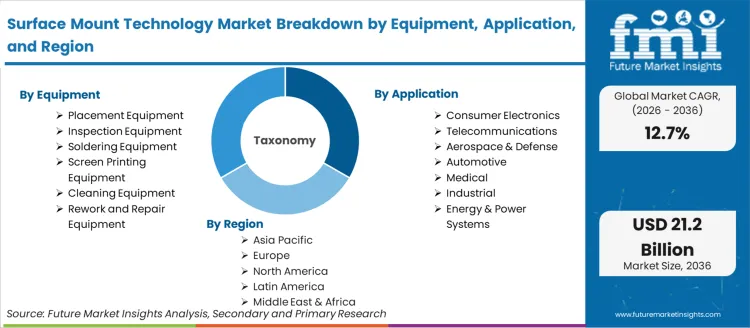
The surface mount technology market is segmented by equipment, application, and geographic regions. By equipment, surface mount technology market is divided into Placement Equipment, Inspection Equipment, Soldering Equipment, Screen Printing Equipment, Cleaning Equipment, and Rework and Repair Equipment. In terms of application, surface mount technology market is classified into Consumer Electronics, Telecommunications, Aerospace & Defense, Automotive, Medical, Industrial, and Energy & Power Systems. Regionally, the surface mount technology industry is classified into North America, Latin America, Western Europe, Eastern Europe, Balkan & Baltic Countries, Russia & Belarus, Central Asia, East Asia, South Asia & Pacific, and the Middle East & Africa.
Insights into the Placement Equipment Segment
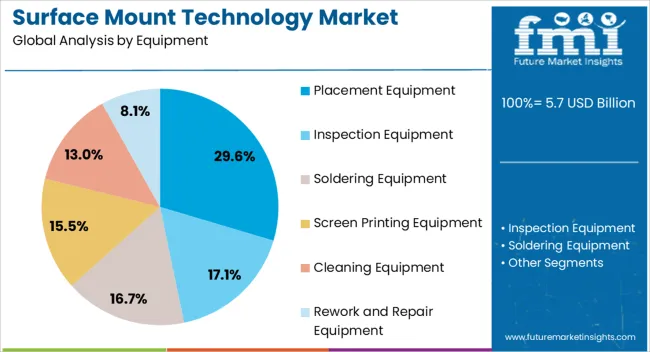
The placement equipment segment is projected to hold 29.6% of the surface mount technology market revenue share in 2026, positioning it as the leading equipment type. Its dominance is being driven by the critical role these machines play in accurately positioning components on printed circuit boards with high speed and precision, reducing assembly errors and improving overall production efficiency.
Increasing adoption of high-density board designs and miniaturized components has reinforced the reliance on automated placement equipment, as manual methods are no longer feasible for meeting volume and quality requirements. Technological advancements in vision systems, robotics, and software-controlled process optimization are enabling placement machines to handle a wide variety of components and layouts with minimal downtime.
The segment is also benefiting from strong demand in consumer electronics, automotive electronics, and telecommunications, where rapid assembly cycles and reliability are crucial As manufacturers prioritize productivity, scalability, and high throughput, placement equipment continues to maintain its leadership position in the surface mount technology market.
Insights into the Consumer Electronics Application Segment
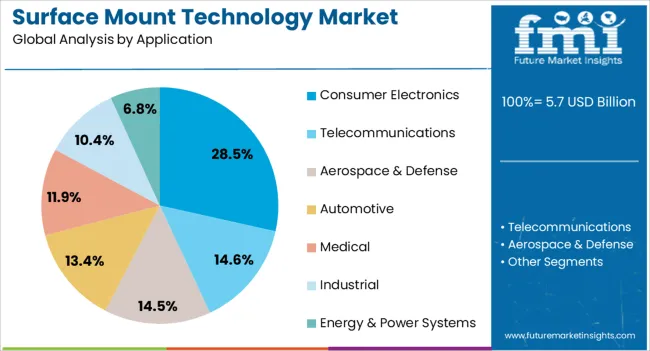
The consumer electronics application segment is expected to account for 28.5% of the surface mount technology market revenue share in 2026, establishing it as the dominant application area. This is being driven by increasing global demand for smartphones, tablets, wearable devices, laptops, and other compact electronics that require high-precision assembly. The ability of surface mount technology to support high-density boards, miniaturized components, and complex circuits has made it indispensable in the consumer electronics industry.
Rising consumer expectations for performance, reliability, and compact design are further reinforcing the adoption of automated assembly solutions. Manufacturers are leveraging surface mount technologies to achieve faster production cycles, reduce defect rates, and improve product quality, aligning with stringent time-to-market and cost-efficiency objectives.
Additionally, the proliferation of smart devices and IoT-enabled electronics has accelerated the need for scalable and flexible assembly processes that surface mount technology offers As a result, consumer electronics applications are driving significant revenue share and will continue to shape growth in the market over the coming years.
Market Overview
The push for smaller and more powerful electronic devices is a significant driver for the surface mount technology market size and growth. Consumer electronics, such as smartphones, tablets, and wearables, are becoming increasingly compact while offering more features.
This trend is driven by consumer preferences for portability and convenience. SMT technology allows manufacturers to place tiny components very close together on both sides of a printed circuit board (PCB), facilitating the creation of dense, multifunctional, and high-performance devices. Additionally, this miniaturization trend extends to other industries, including aerospace and defense, where space and weight constraints are critical, further boosting demand.
The healthcare sector is rapidly adopting electronic devices for monitoring, diagnostics, and treatment. Wearable health devices, portable monitors, and implantable medical equipment rely on compact, reliable, and high-performance electronics. SMT plays a crucial role in manufacturing these devices, enabling the miniaturization and precise placement of components.
Regulations and standards in surface mount technology are getting stricter to ensure the functionality and reliability required in critical healthcare applications. Additionally, the growing emphasis on telemedicine and remote health monitoring drives demand for sophisticated, miniaturized medical electronics, further boosting the SMT market.
The global rollout of 5G technology is transforming the telecommunications industry, necessitating sophisticated electronic components capable of handling higher data speeds and frequencies. SMT is essential for producing the compact, efficient circuit boards required for 5G infrastructure, including base stations, routers, and switches. These components must meet stringent performance and reliability standards, which SMT can provide.
As 5G networks expand, they drive demand for a wide range of new devices and technologies, all of which require advanced electronic assemblies. This continuous evolution in telecommunications is a significant growth factor for the SMT market.
Modern vehicles are increasingly reliant on advanced electronics for various functionalities, from safety systems like Advanced Driver Assistance Systems (ADAS) to infotainment and connectivity solutions. The shift towards electric and autonomous vehicles further accelerates the need for sophisticated electronic components.
SMT is crucial in manufacturing high-density, reliable electronic assemblies that can withstand the automotive environment's harsh conditions, such as temperature fluctuations and vibrations. As automotive technology evolves, incorporating more electronic systems, the demand for SMT continues to rise, driving significant growth in this market.
SMT Market Growth Drivers
Evolution of the Consumer Electronics Industry Fuels Revenues in the Market
The consumer electronics market is continuously evolving, with a focus on more features, better performance, and innovative designs. Consumers expect their devices to be multifunctional, efficient, and stylish. SMT supports this evolution by enabling the integration of complex circuits and multiple components into smaller, more efficient packages.
This capability is crucial for developing advanced devices such as smartphones, smartwatches, and smart home products. As consumer expectations rise, manufacturers rely on SMT to meet the challenge of delivering high-quality, feature-rich devices, driving growth in the SMT market. Risks and challenges facing the SMT market, such as trade wars and component shortages are being addressed, catapulting the market’s growth.
Emergence of Advanced Packaging Technologies is Boosting the Market
Advanced packaging technologies, such as System-in-Package (SiP) and 3D packaging, are becoming more prevalent as they offer significant benefits in terms of size reduction and performance enhancement. These technologies integrate multiple integrated circuits (ICs) and passive components into a single package, optimizing board space and improving electrical performance.
SMT is essential for assembling these advanced packages, which are used in applications ranging from high-performance computing to consumer electronics. The push towards smaller, faster, and more efficient electronic systems is driving the adoption of advanced packaging technologies, thus boosting the SMT market. the potential of 3D printing for advanced SMT applications is likely to amplify in the near future.
Artificial Intelligence and Machine Learning is Transforming the Industry
The integration of artificial intelligence (AI) and machine learning (ML) into SMT manufacturing processes is revolutionizing the industry. The role of Artificial intelligence (AI) in SMT equipment and automation is vast and critical. AI and ML enhance production efficiency by optimizing machine operations, reducing defects, and predicting maintenance needs.
For example, AI-driven inspection systems can identify defects in real-time with higher accuracy than traditional methods, ensuring high-quality output. Machine learning algorithms can optimize placement and soldering processes by analyzing vast amounts of production data. The adoption of these technologies leads to higher yields, lower costs, and improved product quality, driving growth in the SMT market.
SMT Market Investment Strategies
The aerospace and defense sectors require robust, reliable, and high-performance electronic assemblies for various applications, including communication systems, navigation, and surveillance. SMT's ability to produce compact and durable components is critical for these industries.
As defense budgets and aerospace innovations grow, there are opportunities for SMT manufacturers to supply advanced electronic solutions for military and aerospace applications. Sustainability initiatives in the SMT supply chain can lead to greater revenues.
The automotive industry's shift towards ADAS and autonomous vehicles creates a substantial demand for sophisticated electronic systems. SMT is crucial for assembling the complex and compact electronic assemblies required for these technologies. As automotive manufacturers invest in self-driving technology and enhanced driver assistance features, there is an opportunity for SMT providers to supply the necessary components and assemblies.
The impact of Industry 4.0 on SMT in significant. The trend towards home automation and smart appliances is driving demand for sophisticated electronic assemblies. SMT plays a key role in manufacturing the compact and reliable components required for smart thermostats, security systems, and connected kitchen appliances. As consumer interest in smart home technologies increases, manufacturers have the opportunity to develop innovative SMT solutions to meet this growing market demand.
Emerging markets, particularly in Asia, Africa, and Latin America, are experiencing rapid industrialization and technological adoption. Investing in SMT companies or establishing SMT manufacturing facilities in these regions can tap into the growing demand for electronics.
These markets offer opportunities for investors to benefit from lower production costs and expanding local consumer bases. The future of SMT in the age of Industry 4.0 is bright in these emerging markets.
Challenges in the Surface Mount Technology Market
As electronic assemblies become more densely packed, managing heat dissipation becomes increasingly challenging. Excessive heat can damage components and reduce the reliability of the product. Developing effective thermal management solutions is critical, but it adds complexity and cost to the manufacturing process.
Integrating advanced technologies such as AI, IoT, and 5G into SMT processes requires significant investment and technical expertise. While these technologies can improve efficiency and open new market opportunities, their integration involves overcoming technical hurdles and ensuring compatibility with existing systems.
The impact of Artificial Intelligence (AI) and Machine Learning (ML) on SMT is significant and businesses need to take proactive measures to overcome technical challenges.
Environmental regulations, such as restrictions on the use of hazardous substances (RoHS) and waste management requirements, pose challenges for SMT manufacturers. Compliance with these regulations requires changes in materials, processes, and waste management practices, which can increase operational costs.
Additionally, regulations vary by region, complicating compliance for companies operating globally. Investment in sustainable SMT practices and lead-free soldering can prove beneficial for manufacturers.
Surface Mount Technology Regional Market Breakdown
Strong Manufacturing Base and Government Support Augments Demand in China
China is known as the "world's factory" due to its vast manufacturing capabilities and well-established infrastructure. The country has a strong base of electronics manufacturing companies, which drives the demand for SMT technology. The presence of numerous contract manufacturers, original equipment manufacturers (OEMs), and original design manufacturers (ODMs) supports the growth of the SMT market. The impact of 3D printing on SMT manufacturing is evident in China.
The Chinese government has implemented various policies and initiatives to boost the electronics and semiconductor industries. Programs such as the "Made in China 2026" plan aim to upgrade the manufacturing sector by promoting advanced technologies, including SMT.
Government incentives, subsidies, and investments in research and development (R&D) further support the growth of the SMT market. Mergers and acquisitions in the surface mount technology industry also shape demand in China.
China's rapid urbanization and industrialization have led to increased demand for consumer electronics, automotive electronics, and industrial automation. The growing middle class and rising disposable incomes drive the consumption of electronic devices, thereby boosting the demand for SMT components and assemblies.
Emerging Technologies and Industries Boost Demand in the United States
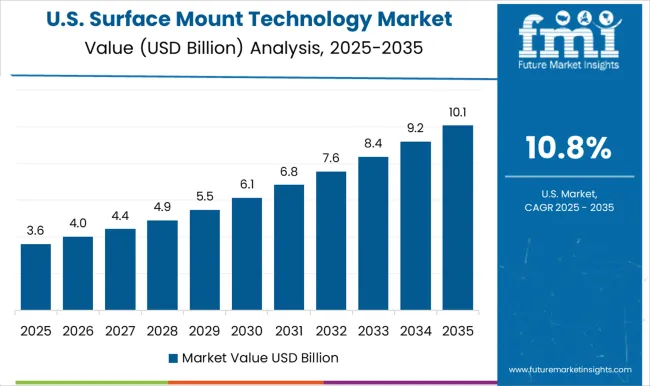
The United States is at the forefront of emerging technologies and industries such as electric vehicles (EVs), renewable energy, IoT, and advanced medical devices. These sectors rely on sophisticated electronic assemblies produced using SMT technology. The growth of these industries fuels the demand for SMT components and drives market expansion. Also, the surface mount technology market mergers and acquisition (M&A) activity boosts revenues in the country.
The increasing demand for high-performance computing (HPC) systems, data centers, and cloud computing infrastructure drives the need for advanced electronic components. SMT technology enables the production of high-density, high-speed electronic assemblies required for HPC applications. The expansion of data centers and cloud computing facilities in the United States contributes to the growth of the SMT market.
The healthcare sector in the United States demands advanced medical electronics, diagnostic devices, and healthcare technologies. SMT plays a crucial role in producing miniaturized, high-performance electronic components used in medical devices and equipment. The growing aging population, advancements in medical technology, and increasing healthcare spending drive demand for SMT solutions in the healthcare sector.
Rise of the Domestic Consumer Electronics Industry Surges Expansion in India
Surface mount technology market financial analysis indicates that India's rapidly growing middle class and increasing disposable incomes drive the demand for consumer electronics products such as smartphones, laptops, and home appliances. SMT technology is essential for producing compact, high-performance electronic assemblies used in these devices. The expansion of the domestic consumer electronics market boosts the demand for SMT components and services.
The Indian government provides various incentives and support measures to promote electronics manufacturing and technology adoption. Initiatives such as the Production Linked Incentive (PLI) scheme for electronics manufacturing attract investments and encourage the expansion of SMT facilities in India. These government efforts shape SMT market investment strategies in India.
India has ambitious goals for renewable energy adoption and sustainability. The emphasis on green technologies drives the demand for electronic components and assemblies used in renewable energy systems such as solar panels and wind turbines. SMT technology enables the production of efficient, reliable electronic assemblies for renewable energy applications, supporting market expansion.
Category-wise Insights
Repair and Rework Equipment Capture Leading Shares in the Market
Rework and repair equipment are essential for ensuring the quality and reliability of electronic assemblies. They allow manufacturers to identify and correct defects such as soldering errors, component misplacements, and connectivity issues. By implementing effective rework and repair processes, manufacturers can minimize the risk of product failures and warranty claims, thereby enhancing customer satisfaction.
With the trend towards miniaturization and high-density electronic assemblies, the risk of defects such as solder bridges, tombstoning, and insufficient solder joints increases. Rework and repair equipment are equipped with advanced technologies such as hot-air rework stations, soldering irons, and optical inspection systems to address these challenges effectively.
They enable precise, localized rework and repair of intricate assemblies, supporting the production of compact, high-performance electronics.
Consumer Electronics Continue to be the Leading Application in SMT Market Share Analysis
The proliferation of smart devices and the Internet of Things (IoT) ecosystem is fueling demand for SMT components and assemblies. Smartphones, smartwatches, smart speakers, home automation systems, and wearable devices rely on SMT technology for their functionality and connectivity. As the IoT market expands and more devices become interconnected, the demand for SMT in consumer electronics continues to grow.
The rise of e-commerce and online retail platforms has made consumer electronics products more accessible to a global audience. Consumers can easily purchase electronic devices online, driving demand for SMT components and assemblies used in these products. The convenience of online shopping, coupled with competitive pricing and fast delivery, contributes to the growth of the consumer electronics segment in the SMT market.
Surface Mount Technology Competitive Landscape
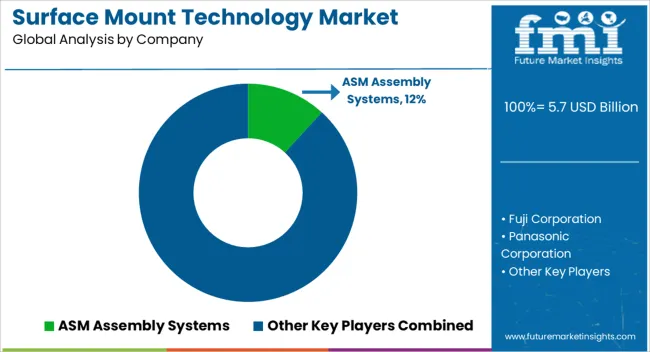
The surface mount technology (SMT) market is highly competitive, featuring global leaders like ASM Assembly Systems and Panasonic alongside regional players and niche providers. These companies offer a range of equipment, components, and services essential for electronic manufacturing.
Additionally, suppliers of materials, software, and emerging technologies contribute to the market's dynamism. Startups and innovators bring new perspectives and disruptive solutions, shaping the industry's future.
Analysis of Surface Mount Technology Market By Key Countries
.webp "Top Country Growth Comparison Surface Mount Technology Market Cagr (2026 2036)")
| Country | CAGR |
|---|---|
| China | 17.1% |
| India | 15.9% |
| Germany | 14.6% |
| France | 13.3% |
| UK | 12.1% |
| USA | 10.8% |
| Brazil | 9.5% |
Source: FMI analysis based on primary research and proprietary forecasting model
Country-wise Analysis
The Surface Mount Technology Market is expected to register a CAGR of 12.7% during the forecast period, exhibiting varied country level momentum. China leads with the highest CAGR of 17.1%, followed by India at 15.9%. Developed markets such as Germany, France, and the UK continue to expand steadily, while the USA is likely to grow at consistent rates. Brazil posts the lowest CAGR at 9.5%, yet still underscores a broadly positive trajectory for the global Surface Mount Technology Market. In 2024, Germany held a dominant revenue in the Western Europe market and is expected to grow with a CAGR of 14.6%. The USA Surface Mount Technology Market is estimated to be valued at USD 2.1 billion in 2026 and is anticipated to reach a valuation of USD 5.7 billion by 2036. Sales are projected to rise at a CAGR of 10.8% over the forecast period between 2026 and 2036. While Japan and South Korea markets are estimated to be valued at USD 274.2 million and USD 158.9 million respectively in 2026.
Key Players in the Surface Mount Technology Market
- ASM Assembly Systems
- Fuji Corporation
- Panasonic Corporation
- Mycronic AB
- Juki Corporation
- TDK Corporation
- Murata Manufacturing Co., Ltd.
- Vishay Intertechnology, Inc.
- Foxconn Technology Group
- Flex Ltd. (formerly Flextronics)
- Jabil Inc.
- Celestica Inc.
- Sanmina Corporation
- Europlacer Ltd.
- Manncorp Inc.
- Essemtec AG
- Nordson Corporation
- Siemens Digital Industries Software
- Mentor, a Siemens Business
- KIC Thermal
- Aegis Industrial Software Corporation
- Cogiscan Inc.
- Henkel AG & Co. KGaA
- Indium Corporation
- Kester (a subsidiary of Illinois Tool Works Inc.)
- Alpha Assembly Solutions (a part of MacDermid Alpha Electronics Solutions)
- AIM Solder
Scope of the report
| Metric | Value |
|---|---|
| Quantitative Units | USD 6.42 billion to USD 21.23 billion, at a CAGR of 12.70% |
| Market Definition | Surface mount technology encompasses the automated assembly equipment, components, and process systems used to place and solder electronic components directly onto the surface of printed circuit boards, including pick-and-place machines, reflow ovens, screen printers, inspection systems, and the passive and active SMD components they process. |
| Segmentation | Equipment (Placement Equipment), Application (Consumer Electronics) |
| Regions Covered | North America, Latin America, Europe, East Asia, South Asia, Oceania, Middle East and Africa |
| Countries Covered | India, China, USA, Canada, UK, Germany, Japan, and 40 plus countries |
| Key Companies Profiled | ASM Assembly Systems, Fuji Corporation, Panasonic Corporation, Mycronic AB, Juki Corporation, TDK Corporation, Murata Manufacturing Co., Ltd., Vishay Intertechnology, Inc., Foxconn Technology Group, Flex Ltd. (formerly Flextronics) |
| Forecast Period | 2026 to 2036 |
| Approach | Forecasting models apply a hybrid bottom-up and top-down methodology starting with verified surface mount technology transaction data and projecting adoption velocity across defined segments and regions. |
Surface Mount Technology Market by Segments
Equipment:
- Placement Equipment
- Inspection Equipment
- Soldering Equipment
- Screen Printing Equipment
- Cleaning Equipment
- Rework and Repair Equipment
Application:
- Consumer Electronics
- Telecommunications
- Aerospace & Defense
- Automotive
- Medical
- Industrial
- Energy & Power Systems
Region:
- North America
- USA
- Canada
- Mexico
- Latin America
- Brazil
- Chile
- Rest of Latin America
- Western Europe
- Germany
- UK
- Italy
- Spain
- France
- Nordic
- BENELUX
- Rest of Western Europe
- Eastern Europe
- Russia
- Poland
- Hungary
- Balkan & Baltic
- Rest of Eastern Europe
- East Asia
- China
- Japan
- South Korea
- South Asia and Pacific
- India
- ASEAN
- Australia & New Zealand
- Rest of South Asia and Pacific
- Middle East & Africa
- Kingdom of Saudi Arabia
- Other GCC Countries
- Turkiye
- South Africa
- Other African Union
- Rest of Middle East & Africa
Bibliography
- 1. IPC Association Connecting Electronics Industries. (2024). IPC-A-610: Acceptability of Electronic Assemblies. IPC.
- 2. International Electrotechnical Commission. (2024). IEC 61760: Surface Mounting Technology, Standard Method for the Specification of Components. IEC.
- 3. SEMI. (2024). Global Semiconductor Equipment Market Statistics Report. SEMI.
- 4. European Commission. (2024). European Chips Act: Manufacturing Capacity Assessment. EC.
- 5. Organisation for Economic Co-operation and Development. (2024). OECD Digital Economy Outlook: Electronics Manufacturing Trends. OECD.
- 6. Japan Electronics and Information Technology Industries Association. (2024). JEITA Production Statistics: SMT Equipment. JEITA.
This bibliography is provided for reader reference. The full FMI report contains the complete reference list with primary research documentation.
Frequently Asked Questions
How large is the demand for Surface Mount Technology in the global market in 2026?
Demand for surface mount technology in the global market is estimated to be valued at USD 6.42 billion in 2026.
What will be the market size of Surface Mount Technology by 2036?
Market size for surface mount technology is projected to reach USD 21.23 billion by 2036.
What is the expected demand growth for Surface Mount Technology between 2026 and 2036?
Demand for surface mount technology is expected to grow at a CAGR of 12.70% between 2026 and 2036.
Which Equipment is poised to lead global sales by 2026?
Placement Equipment accounts for 29.6% in 2026, reflecting established procurement specifications across primary buyer channels.
How is Consumer Electronics driving Surface Mount Technology adoption in 2026?
Consumer Electronics represents 28.5% of segment demand as end-use requirements favor this category.
What is driving demand in China?
China registers a 17.10% CAGR through 2036, propelled by domestic investment and rising end-use consumption.
What does Surface Mount Technology Market definition mean in this report?
Surface mount technology encompasses the automated assembly equipment, components, and process systems used to place and solder electronic components directly onto the surface of printed circuit boards, including pick-and-place machines, reflow ovens, screen printers, inspection systems, and the passive and active SMD components they process.
How does FMI build and validate the Surface Mount Technology forecast?
Forecasting models apply a hybrid bottom-up methodology starting with verified transaction data, cross-validated against publicly reported procurement volumes and company financial disclosures on a quarterly refresh schedule.
Preview the report firsthand - request a free sample
Get SampleGet the brochure for pricing and purchase details.
Get PDFTable of Content
- Executive Summary
- Global Market Outlook
- Demand-side Trends
- Supply-side Trends
- Technology Roadmap Analysis
- Analysis and Recommendations
- Market Overview
- Market Coverage / Taxonomy
- Market Definition / Scope / Limitations
- Research Methodology
- Chapter Orientation
- Analytical Lens and Working Hypotheses
- Market Structure, Signals, and Trend Drivers
- Benchmarking and Cross-market Comparability
- Company Annual and Sustainability Reports
- Peer-reviewed Journals and Academic Literature
- Corporate Websites, Product Literature, and Technical Notes
- Earnings Decks and Investor Briefings
- Statutory Filings and Regulatory Disclosures
- Technical White Papers and Standards Notes
- Trade Journals, Industry Magazines, and Analyst Briefs
- Conference Proceedings, Webinars, and Seminar Materials
- Government Statistics Portals and Public Data Releases
- Press Releases and Reputable Media Coverage
- Specialist Newsletters and Curated Briefings
- Sector Databases and Reference Repositories
- FMI Internal Proprietary Databases and Historical Market Datasets
- Subscription Datasets and Paid Sources
- Social Channels, Communities, and Digital Listening Inputs
- Additional Desk Sources
- Expert Input and Fieldwork (Primary Evidence)
- Primary Modes
- Qualitative Interviews and Expert Elicitation
- Quantitative Surveys and Structured Data Capture
- Blended Approach
- Why Primary Evidence is Used
- Field Techniques
- Interviews
- Surveys
- Focus Groups
- Observational and In-context Research
- Social and Community Interactions
- Stakeholder Universe Engaged
- C-suite Leaders
- Board Members
- Presidents and Vice Presidents
- R&D and Innovation Heads
- Technical Specialists
- Domain Subject-matter Experts
- Scientists
- Physicians and Other Healthcare Professionals
- Governance, Ethics, and Data Stewardship
- Research Ethics
- Data Integrity and Handling
- Primary Modes
- Tooling, Models, and Reference Databases
- Data Engineering and Model Build
- Data Acquisition and Ingestion
- Cleaning, Normalisation, and Verification
- Synthesis, Triangulation, and Analysis
- Quality Assurance and Audit Trail
- Market Background
- Market Dynamics
- Drivers
- Restraints
- Opportunity
- Trends
- Scenario Forecast
- Demand in Optimistic Scenario
- Demand in Likely Scenario
- Demand in Conservative Scenario
- Opportunity Map Analysis
- Product Life Cycle Analysis
- Supply Chain Analysis
- Investment Feasibility Matrix
- Value Chain Analysis
- PESTLE and Porter’s Analysis
- Regulatory Landscape
- Regional Parent Market Outlook
- Production and Consumption Statistics
- Import and Export Statistics
- Market Dynamics
- Global Market Analysis 2021 to 2025 and Forecast, 2026 to 2036
- Historical Market Size Value (USD Million) Analysis, 2021 to 2025
- Current and Future Market Size Value (USD Million) Projections, 2026 to 2036
- Y-o-Y Growth Trend Analysis
- Absolute $ Opportunity Analysis
- Global Market Pricing Analysis 2021 to 2025 and Forecast 2026 to 2036
- Global Market Analysis 2021 to 2025 and Forecast 2026 to 2036, By Equipment
- Introduction / Key Findings
- Historical Market Size Value (USD Million) Analysis By Equipment , 2021 to 2025
- Current and Future Market Size Value (USD Million) Analysis and Forecast By Equipment , 2026 to 2036
- Placement Equipment
- Inspection Equipment
- Soldering Equipment
- Screen Printing Equipment
- Cleaning Equipment
- Rework and Repair Equipment
- Placement Equipment
- Y-o-Y Growth Trend Analysis By Equipment , 2021 to 2025
- Absolute $ Opportunity Analysis By Equipment , 2026 to 2036
- Global Market Analysis 2021 to 2025 and Forecast 2026 to 2036, By Application
- Introduction / Key Findings
- Historical Market Size Value (USD Million) Analysis By Application, 2021 to 2025
- Current and Future Market Size Value (USD Million) Analysis and Forecast By Application, 2026 to 2036
- Consumer Electronics
- Telecommunications
- Aerospace & Defense
- Automotive
- Medical
- Industrial
- Energy & Power Systems
- Consumer Electronics
- Y-o-Y Growth Trend Analysis By Application, 2021 to 2025
- Absolute $ Opportunity Analysis By Application, 2026 to 2036
- Global Market Analysis 2021 to 2025 and Forecast 2026 to 2036, By Region
- Introduction
- Historical Market Size Value (USD Million) Analysis By Region, 2021 to 2025
- Current Market Size Value (USD Million) Analysis and Forecast By Region, 2026 to 2036
- North America
- Latin America
- Western Europe
- Eastern Europe
- East Asia
- South Asia and Pacific
- Middle East & Africa
- Market Attractiveness Analysis By Region
- North America Market Analysis 2021 to 2025 and Forecast 2026 to 2036, By Country
- Historical Market Size Value (USD Million) Trend Analysis By Market Taxonomy, 2021 to 2025
- Market Size Value (USD Million) Forecast By Market Taxonomy, 2026 to 2036
- By Country
- USA
- Canada
- Mexico
- By Equipment
- By Application
- By Country
- Market Attractiveness Analysis
- By Country
- By Equipment
- By Application
- Key Takeaways
- Latin America Market Analysis 2021 to 2025 and Forecast 2026 to 2036, By Country
- Historical Market Size Value (USD Million) Trend Analysis By Market Taxonomy, 2021 to 2025
- Market Size Value (USD Million) Forecast By Market Taxonomy, 2026 to 2036
- By Country
- Brazil
- Chile
- Rest of Latin America
- By Equipment
- By Application
- By Country
- Market Attractiveness Analysis
- By Country
- By Equipment
- By Application
- Key Takeaways
- Western Europe Market Analysis 2021 to 2025 and Forecast 2026 to 2036, By Country
- Historical Market Size Value (USD Million) Trend Analysis By Market Taxonomy, 2021 to 2025
- Market Size Value (USD Million) Forecast By Market Taxonomy, 2026 to 2036
- By Country
- Germany
- UK
- Italy
- Spain
- France
- Nordic
- BENELUX
- Rest of Western Europe
- By Equipment
- By Application
- By Country
- Market Attractiveness Analysis
- By Country
- By Equipment
- By Application
- Key Takeaways
- Eastern Europe Market Analysis 2021 to 2025 and Forecast 2026 to 2036, By Country
- Historical Market Size Value (USD Million) Trend Analysis By Market Taxonomy, 2021 to 2025
- Market Size Value (USD Million) Forecast By Market Taxonomy, 2026 to 2036
- By Country
- Russia
- Poland
- Hungary
- Balkan & Baltic
- Rest of Eastern Europe
- By Equipment
- By Application
- By Country
- Market Attractiveness Analysis
- By Country
- By Equipment
- By Application
- Key Takeaways
- East Asia Market Analysis 2021 to 2025 and Forecast 2026 to 2036, By Country
- Historical Market Size Value (USD Million) Trend Analysis By Market Taxonomy, 2021 to 2025
- Market Size Value (USD Million) Forecast By Market Taxonomy, 2026 to 2036
- By Country
- China
- Japan
- South Korea
- By Equipment
- By Application
- By Country
- Market Attractiveness Analysis
- By Country
- By Equipment
- By Application
- Key Takeaways
- South Asia and Pacific Market Analysis 2021 to 2025 and Forecast 2026 to 2036, By Country
- Historical Market Size Value (USD Million) Trend Analysis By Market Taxonomy, 2021 to 2025
- Market Size Value (USD Million) Forecast By Market Taxonomy, 2026 to 2036
- By Country
- India
- ASEAN
- Australia & New Zealand
- Rest of South Asia and Pacific
- By Equipment
- By Application
- By Country
- Market Attractiveness Analysis
- By Country
- By Equipment
- By Application
- Key Takeaways
- Middle East & Africa Market Analysis 2021 to 2025 and Forecast 2026 to 2036, By Country
- Historical Market Size Value (USD Million) Trend Analysis By Market Taxonomy, 2021 to 2025
- Market Size Value (USD Million) Forecast By Market Taxonomy, 2026 to 2036
- By Country
- Kingdom of Saudi Arabia
- Other GCC Countries
- Turkiye
- South Africa
- Other African Union
- Rest of Middle East & Africa
- By Equipment
- By Application
- By Country
- Market Attractiveness Analysis
- By Country
- By Equipment
- By Application
- Key Takeaways
- Key Countries Market Analysis
- USA
- Pricing Analysis
- Market Share Analysis, 2025
- By Equipment
- By Application
- Canada
- Pricing Analysis
- Market Share Analysis, 2025
- By Equipment
- By Application
- Mexico
- Pricing Analysis
- Market Share Analysis, 2025
- By Equipment
- By Application
- Brazil
- Pricing Analysis
- Market Share Analysis, 2025
- By Equipment
- By Application
- Chile
- Pricing Analysis
- Market Share Analysis, 2025
- By Equipment
- By Application
- Germany
- Pricing Analysis
- Market Share Analysis, 2025
- By Equipment
- By Application
- UK
- Pricing Analysis
- Market Share Analysis, 2025
- By Equipment
- By Application
- Italy
- Pricing Analysis
- Market Share Analysis, 2025
- By Equipment
- By Application
- Spain
- Pricing Analysis
- Market Share Analysis, 2025
- By Equipment
- By Application
- France
- Pricing Analysis
- Market Share Analysis, 2025
- By Equipment
- By Application
- India
- Pricing Analysis
- Market Share Analysis, 2025
- By Equipment
- By Application
- ASEAN
- Pricing Analysis
- Market Share Analysis, 2025
- By Equipment
- By Application
- Australia & New Zealand
- Pricing Analysis
- Market Share Analysis, 2025
- By Equipment
- By Application
- China
- Pricing Analysis
- Market Share Analysis, 2025
- By Equipment
- By Application
- Japan
- Pricing Analysis
- Market Share Analysis, 2025
- By Equipment
- By Application
- South Korea
- Pricing Analysis
- Market Share Analysis, 2025
- By Equipment
- By Application
- Russia
- Pricing Analysis
- Market Share Analysis, 2025
- By Equipment
- By Application
- Poland
- Pricing Analysis
- Market Share Analysis, 2025
- By Equipment
- By Application
- Hungary
- Pricing Analysis
- Market Share Analysis, 2025
- By Equipment
- By Application
- Kingdom of Saudi Arabia
- Pricing Analysis
- Market Share Analysis, 2025
- By Equipment
- By Application
- Turkiye
- Pricing Analysis
- Market Share Analysis, 2025
- By Equipment
- By Application
- South Africa
- Pricing Analysis
- Market Share Analysis, 2025
- By Equipment
- By Application
- USA
- Market Structure Analysis
- Competition Dashboard
- Competition Benchmarking
- Market Share Analysis of Top Players
- By Regional
- By Equipment
- By Application
- Competition Analysis
- Competition Deep Dive
- ASM Assembly Systems
- Overview
- Product Portfolio
- Profitability by Market Segments (Product/Age /Sales Channel/Region)
- Sales Footprint
- Strategy Overview
- Marketing Strategy
- Product Strategy
- Channel Strategy
- Fuji Corporation
- Panasonic Corporation
- Mycronic AB
- Juki Corporation
- TDK Corporation
- Murata Manufacturing Co., Ltd.
- Vishay Intertechnology, Inc.
- Foxconn Technology Group
- Flex Ltd. (formerly Flextronics)
- Jabil Inc.
- Celestica Inc.
- Sanmina Corporation
- Europlacer Ltd.
- Manncorp Inc.
- Essemtec AG
- Nordson Corporation
- Siemens Digital Industries Software
- Mentor, a Siemens Business
- KIC Thermal
- ASM Assembly Systems
- Competition Deep Dive
- Assumptions & Acronyms Used


