

- Industry Size (2026)
- USD 4.21 Bn
- Forecast (2036)
- USD 6.99 Bn
- CAGR (2026 to 2036)
- 5.20%
Surface Mounting Distribution Panel Market size, market forecast and outlook by FMI
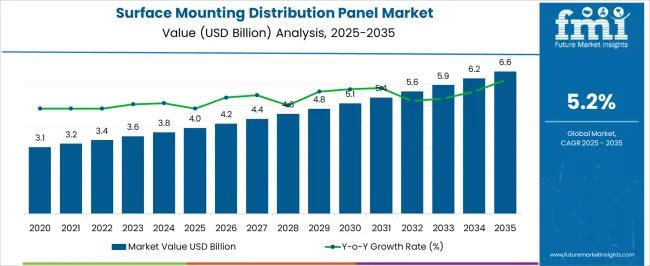
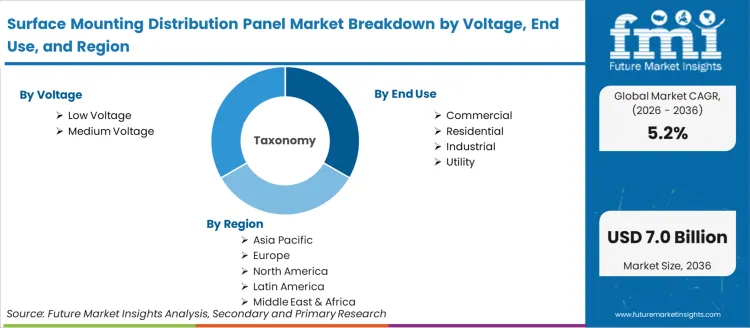
The surface mounting distribution panel market was valued at USD 4.00 billion in 2025, projected to reach USD 4.21 billion in 2026, and is forecast to expand to USD 6.99 billion by 2036 at a 5.20% CAGR. Based on Future Market Insights analysis, the market is set to add an incremental opportunity worth USD 2.78 billion over the forecast period. As per FMI, the procurement landscape for surface mounting distribution panel is being reshaped by evolving specification requirements, regional capacity investments, and shifting end-use demand patterns across established and emerging buyer segments.
Three parallel forces expand the surface mounting distribution panel addressable market. First, residential electrification intensity is rising as heat pump adoption, EV charging, and rooftop solar installations increase the per-household electrical load, requiring panel upgrades from legacy configurations to higher-amperage, higher-circuit-count enclosures. Second, commercial building renovation programs linked to energy efficiency mandates are triggering distribution panel replacements as part of electrical system modernization, creating a retrofit demand stream that supplements new construction procurement. Third, the modular panel architecture trend is enabling electricians to configure standardized enclosures with application-specific protective device combinations on site, reducing pre-wired panel ordering lead times and shifting value toward the enclosure and busbar system rather than pre-assembled complete panels.
Across tracked geographies, China sets the pace at 7.00% CAGR. India follows at 6.50%. Germany follows at 6.00%. France follows at 5.50%. UK follows at 4.90%. USA follows at 4.40%. Brazil follows at 3.90%.
Summary of Surface Mounting Distribution Panel Market
- Surface Mounting Distribution Panel Market definition
- Surface mounting distribution panels are wall-mounted electrical enclosures housing circuit breakers, residual current devices, busbars, and metering modules rated for low voltage and medium voltage distribution in commercial, industrial, and residential buildings, providing final circuit protection and load management at the point of consumption.
- Demand drivers in the market
- Residential and commercial construction activity across Asia Pacific is the primary demand driver as each new building requires surface mounting distribution panels scaled to the electrical load profile and local wiring regulation specifications.
- Electrical safety code updates across the EU, India, and the Middle East are mandating residual current protection and arc fault detection in distribution panels, driving replacement procurement in existing buildings alongside new construction demand.
- Smart building infrastructure deployments are specifying distribution panels with integrated energy metering and communication modules that enable building management system connectivity and real-time power quality monitoring.
- Key segments analyzed in the FMI report
- Low Voltage voltage: 63.5% share in 2026, reflecting established procurement specifications and supply chain infrastructure favoring this variant.
- Commercial end use: 41.8% share in 2026, driven by end-use requirements in the primary application channels.
- China: 7.00% compound growth, supported by domestic investment and rising consumption.
- Analyst opinion at FMI
- Nikhil Kaitwade, Principal Consultant for oil & gas analysts observe that, The surface mounting distribution panel market is a construction-cycle-dependent category where volume tracks building permit issuance and electrical contractor activity rather than technology adoption curves. FMI is of the opinion that the companies holding the most defensible positions are those with broad distribution networks reaching electrical wholesalers and contractor supply houses, because panel selection is frequently made by the installing electrician rather than the specifying engineer. Brand availability at the point of purchase determines market share more than product differentiation in this category.
- Strategic implications / executive takeaways
- Panel manufacturers must maintain distribution depth across electrical wholesale networks to capture contractor purchase decisions made at the point of supply rather than at the specification stage.
- Product development teams should integrate energy metering and communication modules as standard features rather than optional accessories to meet the growing smart building specification requirement without price premium resistance.
- Manufacturers targeting residential panel upgrade demand should develop marketing programs directed at electrical contractors and building inspectors who influence homeowner upgrade decisions during service calls and code compliance inspections.
Surface Mounting Distribution Panel Market key takeaways
| Metric | Details |
|---|---|
| Industry Size (2026) | USD 4.21 billion |
| Industry Value (2036) | USD 6.99 billion |
| CAGR (2026 to 2036) | 5.20% |
Source: Future Market Insights, 2026
Surface Mounting Distribution Panel Market definition
Surface mounting distribution panels represent the electrical distribution equipment category where modular enclosures are installed directly onto wall surfaces to house protective devices, switching apparatus, and metering instruments that distribute electrical power from supply feeders to individual branch circuits within buildings and facilities.
Surface Mounting Distribution Panel Market inclusions
Market scope includes all commercially traded surface mounting distribution panels segmented by voltage (low voltage, medium voltage) and end use (commercial, industrial, residential). Revenue sizing spans the 2026 to 2036 forecast period with regional and country-level assessments.
Surface Mounting Distribution Panel Market exclusions
The scope excludes flush-mounted (recessed) distribution boards, standalone consumer units without panel enclosures, and main switchboards rated above 36 kV. Individual circuit breakers and protective devices sold separately as components are outside the defined boundary.
Surface Mounting Distribution Panel Market research methodology
- Primary research: FMI analysts conducted interviews with procurement directors, engineering leads, and supply chain managers across key surface mounting distribution panel organizations to map decision gates and sourcing specifications.
- Desk research: Data collection phases aggregated regulatory filings, trade association publications, standards body documentation, and company annual reports to establish verifiable baseline parameters.
- Market sizing and forecasting: Baseline values derive from a bottom-up aggregation of surface mounting distribution panel transaction volumes, applying region-specific adoption curves and pricing indices to project forward demand through 2036.
- Data validation and update cycle: Projections are tested against publicly reported procurement volumes, trade flow statistics, and company financial disclosures on a quarterly refresh schedule.
Why is the Surface Mounting Distribution Panel Market Growing?
The Surface Mounting Distribution Panel market is experiencing significant growth driven by increasing demand for flexible, safe, and easily deployable electrical distribution solutions in both commercial and residential settings. The current market environment reflects the rising adoption of modern electrical infrastructure, with particular emphasis on energy efficiency, modularity, and compliance with safety standards. Growth is further fueled by the need for reliable power management in smart buildings, commercial complexes, and industrial setups where electrical systems must support dynamic load requirements.
Advancements in modular panel design, enhanced circuit protection, and simplified installation techniques are contributing to accelerated deployment. The increasing focus on reducing downtime and optimizing operational efficiency has reinforced the importance of surface mounting distribution panels.
In addition, regulatory emphasis on electrical safety, energy optimization, and building code compliance is shaping the market outlook As construction activity intensifies in urban regions and commercial infrastructure expands, the Surface Mounting Distribution Panel market is projected to maintain steady growth, providing solutions that integrate ease of installation with scalable power distribution and enhanced safety.
Segmental Analysis
The surface mounting distribution panel market is segmented by voltage, end use, and geographic regions. By voltage, surface mounting distribution panel market is divided into Low Voltage and Medium Voltage. In terms of end use, surface mounting distribution panel market is classified into Commercial, Residential, Industrial, and Utility. Regionally, the surface mounting distribution panel industry is classified into North America, Latin America, Western Europe, Eastern Europe, Balkan & Baltic Countries, Russia & Belarus, Central Asia, East Asia, South Asia & Pacific, and the Middle East & Africa.
Insights into the Low Voltage Segment
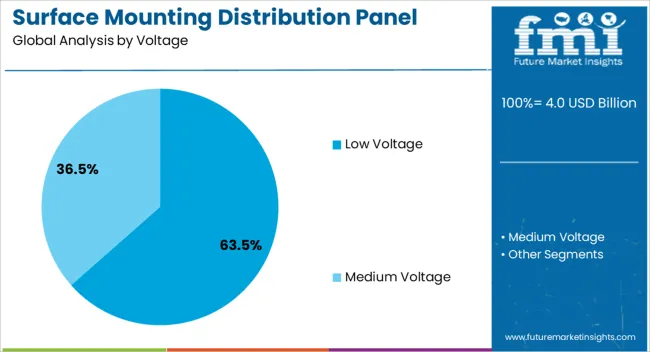
The Low Voltage type is projected to hold 63.5% of the Surface Mounting Distribution Panel market revenue share in 2026, establishing it as the leading segment. This dominance is being attributed to the widespread adoption of low voltage panels in commercial, residential, and light industrial applications, where energy efficiency and personnel safety are critical.
Low voltage panels enable safer distribution of electrical power, reduced electrical losses, and simplified maintenance procedures, which have increased their preference among installers and end users. The growth has also been supported by increasing deployment in smart buildings and energy management systems, where low voltage systems are compatible with advanced monitoring and automation technologies.
In addition, the modular nature of low voltage distribution panels allows for flexible configuration and future expansion without extensive rewiring As urban infrastructure continues to modernize, the demand for low voltage systems is expected to remain robust, driven by regulatory compliance requirements, operational efficiency priorities, and the growing need for reliable and safe electrical distribution in diverse applications.
Insights into the Commercial Segment
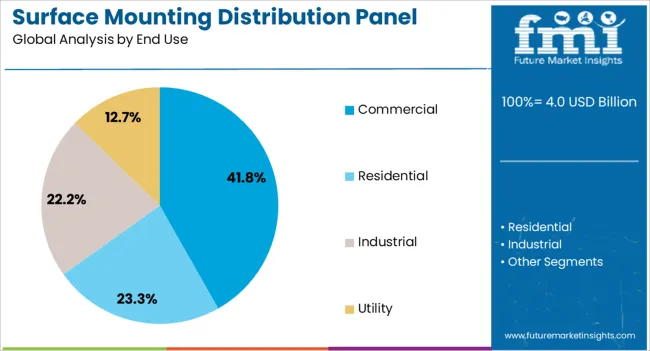
The Commercial end-use industry is anticipated to hold 41.8% of the Surface Mounting Distribution Panel market revenue in 2026, emerging as the largest end-use segment. This leading position is being supported by rising construction and retrofitting of commercial complexes, offices, shopping centers, and other high-density infrastructure projects.
The adoption of surface mounting distribution panels in commercial applications is driven by the need for rapid installation, space-efficient designs, and scalable power distribution capable of supporting dynamic electrical loads. The growth of this segment has been reinforced by increased attention to energy efficiency, operational reliability, and compliance with electrical safety regulations in commercial buildings.
Commercial facilities benefit from modular panel systems that can be upgraded or expanded through software-enabled monitoring and load management, minimizing downtime and operational risks Furthermore, as smart building solutions gain traction, commercial end users are increasingly integrating surface mounting distribution panels with building management systems, reinforcing the segment’s continued market leadership and providing long-term value through improved safety, flexibility, and energy management capabilities.
What are the Drivers, Restraints, and Key Trends of the Surface Mounting Distribution Panel Market?
The surface mounting distribution panel market is growing due to rising electrification, smart building integration, and industrial expansion. In Asia Pacific, approximately 950,000 units were installed in 2024, with China leading at 500,000 units, India 320,000 units, and Japan 130,000 units. Europe accounted for 750,000 units, led by Germany (300,000), France (225,000), and UK (225,000). North America deployed around 675,000 units, mainly in the USA, while the rest of the world contributed 125,000 units. Residential applications consumed nearly 1.2 million units, commercial buildings 900,000 units, industrial facilities 600,000 units, and data centers 300,000 units. Growth is driven by demand for compact panels supporting 100–400 A distribution capacities and rapid installation in new construction and retrofit projects
Key Drivers Supporting Surface Mounting Distribution Panel Growth
Demand for reliable power distribution in residential, commercial, and industrial applications drives market growth. Residential buildings installed approximately 1.2 million units in 2024, with average capacity of 200 A per panel. Commercial establishments adopted 900,000 units, industrial facilities 600,000 units, and data centers 300,000 units, often supporting 400–800 A loads. Smart electrical grids and home automation systems increasingly integrate IoT-enabled panels, reducing downtime by 15–20%. Rising construction of 40,000+ commercial buildings and 15,000 industrial plants annually in Asia Pacific and Europe supports adoption. Compliance with IEC 61439 and UL 67 standards ensures safety and reliability. Growing urbanization and electrification in Asia Pacific alone is expected to drive an additional 350,000 panel installations by 2027.
Emerging Trends in Surface Mounting Distribution Panel Market
Modular panel systems, IoT monitoring, and renewable energy integration are prominent trends. Modular panels allow expansion for 50–200% load increase without replacing the unit, adopted in 25% of new industrial facilities. IoT-enabled monitoring allows real-time detection of current fluctuations, voltage drop, and breaker trips in approximately 30,000 commercial and industrial units in North America and Europe. Compact panels for 100-250 A residential circuits are gaining preference. Integration with solar PV and small wind energy systems supports up to 500 kW distributed generation in commercial and industrial applications. Predictive maintenance analytics reduce downtime by 20% and operational costs by USD 1,200-1,500 per unit annually.
Opportunities Across Residential, Commercial, and Industrial Applications
Residential deployment is projected to reach 1.5 million units by 2027, supporting average 200 A loads. Commercial buildings may adopt 1.1 million units, industrial facilities 700,000 units, and data centers 350,000 units. Asia Pacific represents 40% of installations, equating to approximately 1.3 million units by 2027. Integration with renewable energy systems can support 2-5 MW per commercial building. Rapid urbanization and expansion of industrial parks in China, India, and Southeast Asia create new market opportunities. Adoption of panels compatible with smart metering and energy management systems is expected to reduce operational energy costs by 8-12% annually for large commercial and industrial facilities.
Challenges Limiting Surface Mounting Distribution Panel Market
High upfront costs, complex integration, and supply chain constraints limit adoption. Modular and smart panels cost USD 1,200-2,500 per unit, compared to USD 800-1,000 for conventional panels. Integration with legacy wiring in older buildings can increase installation time by 20-30%. Regional differences in electrical codes and IEC/UL standards increase compliance and certification costs by USD 150-300 per unit. Cold storage requirements for certain components and trained technician availability are limiting factors in Africa, Latin America, and Southeast Asia. Supply chain delays for breakers, relays, and monitoring modules can postpone installation by 4-6 weeks. These challenges constrain small-scale residential and commercial adoption despite growing demand in urban centers.
Analysis of Surface Mounting Distribution Panel Market By Key Countries
.webp "Top Country Growth Comparison Surface Mounting Distribution Panel Market Cagr (2026 2036)")
| Country | CAGR |
|---|---|
| China | 7.0% |
| India | 6.5% |
| Germany | 6.0% |
| France | 5.5% |
| UK | 4.9% |
| USA | 4.4% |
| Brazil | 3.9% |
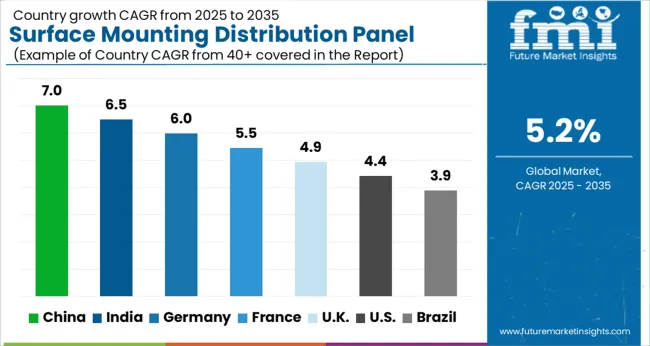
The surface mounting distribution panel market is projected to grow at a global CAGR of 5.2% through 2036, driven by rising industrial electrification, commercial infrastructure growth, and demand for reliable power distribution solutions. China leads at 7.0%, a 1.35× multiple over the global benchmark, supported by BRICS-driven expansion in industrial facilities, urban development, and electrical infrastructure projects. India follows at 6.5%, a 1.25× multiple of the global rate, reflecting increasing adoption in manufacturing units, commercial buildings, and smart power systems. Germany records 6.0%, a 1.15× multiple of the benchmark, shaped by OECD-backed innovation in distribution panels, efficiency optimization, and industrial applications. The United Kingdom posts 4.9%, 0.94× the global rate, with adoption concentrated in commercial facilities, retrofitting projects, and infrastructure upgrades. The United States stands at 4.4%, 0.85× the benchmark, with steady uptake in industrial, commercial, and utility power distribution systems. BRICS economies drive most of the market volume, OECD countries emphasize technological advancement and efficiency, while ASEAN nations contribute through growing industrial and commercial electrification.
Demand Forecast for Surface Mounting Distribution Panel Market in China
The surface mounting distribution panel market in China is projected to grow at a CAGR of 7.0%, driven by rising industrial and commercial construction, expanding smart building infrastructure, and growing demand for reliable power distribution systems. Domestic suppliers such as CHINT Group and Delixi Electric provide advanced surface mounting panels with modular designs, high load capacity, and integration with smart grid systems. Technological developments focus on enhanced safety, ease of installation, and remote monitoring capabilities. Adoption is concentrated in industrial plants, commercial complexes, and data centers.
- China installed over 140,000 surface mounting distribution panels in 2025 with industrial applications representing 55%
- Smart grid-integrated panels adoption increased by 17% year on year
- Commercial building deployments contributed to 30% of total installations
Analysis of Surface Mounting Distribution Panel Market in India
The surface mounting distribution panel market in India is expected to grow at a CAGR of 6.5%, supported by urban infrastructure expansion, industrial facility development, and increased investment in energy-efficient power distribution solutions. Key suppliers such as L&T Electrical and ABB India provide panels with modular designs, high reliability, and enhanced protection features. Adoption is concentrated in industrial zones, commercial buildings, and IT parks. Technological improvements emphasize load management, safety, and integration with automation systems.
- India installed approximately 92,000 surface mounting distribution panels in 2025 with industrial usage representing 50%
- Automation-enabled panels adoption grew by 15% year on year
- Commercial building deployments contributed to 32% of total installations
Growth Analysis of Surface Mounting Distribution Panel Market in Germany
Germany’s surface mounting distribution panel market is projected to grow at a CAGR of 6.0%, influenced by industrial automation, energy efficiency regulations, and increasing adoption in commercial infrastructure. Suppliers such as Siemens and Schneider Electric provide modular and smart panels with rapid load switching and monitoring features. Demand is concentrated in manufacturing plants, renewable energy projects, and data centers. Technological focus includes compact designs, smart monitoring, and enhanced safety features.
- Germany installed over 46,000 surface mounting distribution panels in 2025 with industrial plants representing 52%
- Smart monitoring adoption increased by 13% year on year
- Renewable energy-integrated deployments contributed to 28% of total installations
Future Outlook for Surface Mounting Distribution Panel Market in the United Kingdom
The surface mounting distribution panel market in the United Kingdom is expected to grow at a CAGR of 4.9%, driven by commercial infrastructure modernization, industrial energy management, and deployment in data centers. Suppliers focus on modular panels with enhanced protection, rapid load switching, and smart monitoring capabilities. Technological developments emphasize energy efficiency, safety, and reliability. Adoption is concentrated in commercial buildings, industrial facilities, and mission-critical infrastructure.
- United Kingdom installed approximately 27,000 surface mounting distribution panels in 2025 with commercial buildings representing 50%
- Smart monitoring-enabled panels adoption grew by 11% year on year
- Industrial facility deployments contributed to 35% of total installations
Surface Mounting Distribution Panel Market Outlook in the United States
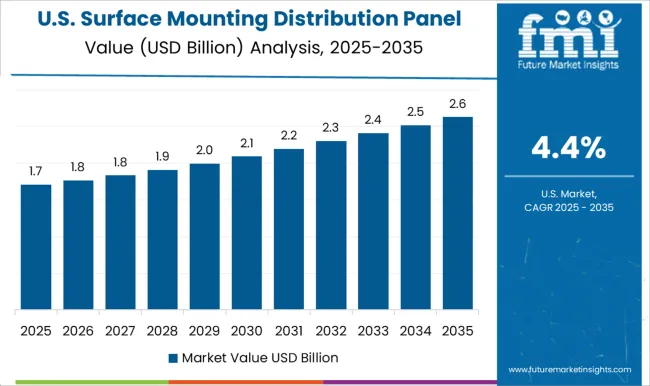
The surface mounting distribution panel market in the United States is projected to grow at a CAGR of 4.4%, supported by industrial automation, data center expansion, and commercial building development. Major suppliers such as Eaton, ABB, and Schneider Electric provide high-performance panels with modular designs, load management, and smart monitoring features. Technological improvements focus on energy efficiency, rapid load transfer, and operational reliability. Adoption is concentrated in industrial, commercial, and critical infrastructure sectors.
- United States installed over 68,000 surface mounting distribution panels in 2025 with industrial facilities representing 55%
- Smart monitoring-enabled panels adoption increased by 12% year on year
- Data center deployments contributed to 30% of total installations
Competitive Landscape of Surface Mounting Distribution Panel Market
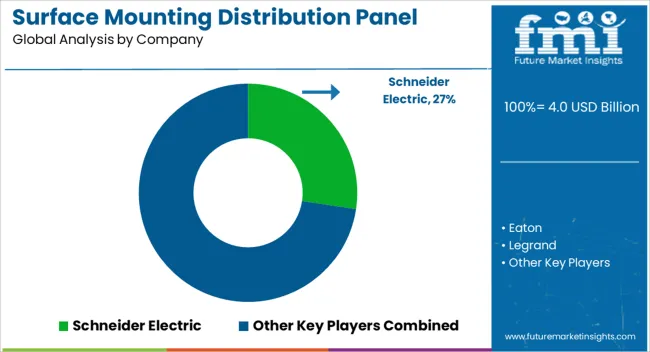
Competition in the surface mounting distribution panel market is being shaped by safety, reliability, and flexibility for residential, commercial, and industrial electrical distribution systems. Market positions are being reinforced through advanced circuit protection technologies, modular designs, and global supply networks that ensure consistent performance and compliance with international standards. Schneider Electric and Eaton are being represented with panels engineered for high-load handling, durability, and easy installation. Legrand and Siemens are being promoted with modular systems structured for scalable deployment and simplified maintenance. ABB and General Electric are being applied with panels optimized for residential and commercial power distribution, providing fault protection and operational efficiency. Larsen & Toubro Limited, NHP, ΩΤΚΑ, and ESL POWER SYSTEMS, INC. are being showcased with solutions designed for industrial applications requiring robustness and reliability. Hager Group, Ags, GEWISS, Meba Electric Co., Ltd, and Norelco are being advanced with panels structured for flexibility, compact design, and integration with smart monitoring systems. EAMFCO, alfanar Group, Chengdu Youlike Enterprise Management Co., Ltd, and Gem Switchgear are being represented with customized solutions engineered for electrical safety, modularity, and long-term operational stability. Strategies in the market are being centered on modularity, enhanced safety features, and ease of integration with electrical systems. Research and development are being allocated to improve load capacity, circuit protection, environmental resistance, and compatibility with smart monitoring technologies. Product brochures are being structured with specifications covering voltage rating, current capacity, enclosure type, number of circuits, and installation guidelines. Features such as modular construction, fault protection, compact design, and smart system integration are being emphasized to guide procurement and operational planning. Each brochure is being arranged to present technical performance, compliance certifications, and support services. Information is being provided in a clear, evaluation-ready format to assist electrical contractors, facility managers, and procurement teams in selecting surface mounting distribution panels that meet safety, efficiency, and operational requirements.
Key Players in the Surface Mounting Distribution Panel Market
- Schneider Electric
- Eaton
- Legrand
- Siemens
- ABB
- General Electric
- Larsen & Toubro Limited
- NHP
- ΩΤΚΑ
- ESL POWER SYSTEMS, INC.
- Hager Group
- Ags
- GEWISS
- Meba Electric Co., Ltd
- Norelco
- EAMFCO
- alfanar Group
- Chengdu Youlike enterprise management co.,ltd
- Gem Switchgear
Scope of the report
| Metric | Value |
|---|---|
| Quantitative Units | USD 4.21 billion to USD 6.99 billion, at a CAGR of 5.20% |
| Market Definition | Surface mounting distribution panels are wall-mounted electrical enclosures housing circuit breakers, residual current devices, busbars, and metering modules rated for low voltage and medium voltage distribution in commercial, industrial, and residential buildings, providing final circuit protection and load management at the point of consumption. |
| Segmentation | Voltage (Low Voltage), End Use (Commercial) |
| Regions Covered | North America, Latin America, Europe, East Asia, South Asia, Oceania, Middle East and Africa |
| Countries Covered | India, China, USA, Canada, UK, Germany, Japan, and 40 plus countries |
| Key Companies Profiled | Schneider Electric, Eaton, Legrand, Siemens, ABB, General Electric, Larsen & Toubro Limited, NHP, ΩΤΚΑ, ESL POWER SYSTEMS, INC. |
| Forecast Period | 2026 to 2036 |
| Approach | Forecasting models apply a hybrid bottom-up and top-down methodology starting with verified surface mounting distribution panel transaction data and projecting adoption velocity across defined segments and regions. |
Surface Mounting Distribution Panel Market by Segments
Voltage:
- Low Voltage
- Medium Voltage
End Use:
- Commercial
- Residential
- Industrial
- Utility
Region:
- North America
- USA
- Canada
- Mexico
- Latin America
- Brazil
- Chile
- Rest of Latin America
- Western Europe
- Germany
- UK
- Italy
- Spain
- France
- Nordic
- BENELUX
- Rest of Western Europe
- Eastern Europe
- Russia
- Poland
- Hungary
- Balkan & Baltic
- Rest of Eastern Europe
- East Asia
- China
- Japan
- South Korea
- South Asia and Pacific
- India
- ASEAN
- Australia & New Zealand
- Rest of South Asia and Pacific
- Middle East & Africa
- Kingdom of Saudi Arabia
- Other GCC Countries
- Turkiye
- South Africa
- Other African Union
- Rest of Middle East & Africa
Bibliography
- International Electrotechnical Commission. (2024). IEC 61439-3: Low-Voltage Switchgear and Controlgear Assemblies, Distribution Boards. IEC.
- National Fire Protection Association. (2024). NFPA 70: National Electrical Code. NFPA.
- Bureau of Indian Standards. (2024). IS 8623: Low Voltage Switchgear and Controlgear Assemblies. BIS.
- European Committee for Electrotechnical Standardization. (2024). EN 61439-3: Distribution Boards Intended to be Operated by Ordinary Persons. CENELEC.
- International Energy Agency. (2024). World Energy Outlook 2024: Building Electrification Assessment. IEA.
- Organisation for Economic Co-operation and Development. (2024). OECD Housing Outlook: Construction Activity Indicators. OECD.
This bibliography is provided for reader reference. The full FMI report contains the complete reference list with primary research documentation.
This report addresses
- Market sizing and quantitative forecast metrics detailing precise expenditure on surface mounting distribution panel across major industry verticals through 2036.
- Segmentation analysis mapping adoption velocity of specific voltage variants and evaluating structural drivers behind preference shifts.
- Regional deployment intelligence comparing growth trajectories across Asia Pacific, Europe, North America, Latin America, and Middle East and Africa.
- Regulatory compliance assessment analyzing how evolving standards and certification mandates shape procurement specifications across target geographies.
- Competitive posture evaluation tracking consolidation activity, capacity investments, and strategic partnerships among leading market participants.
- Capital project strategic guidance defining procurement parameters and supply chain configurations required for surface mounting distribution panel sourcing through the forecast period.
- Supply chain vulnerability analysis identifying concentration risks, raw material dependencies, and logistics bottlenecks affecting cost structures.
- Custom data delivery formats encompassing interactive dashboards, raw Excel datasets, and comprehensive PDF narrative reports.
Frequently Asked Questions
How large is the demand for Surface Mounting Distribution Panel in the global market in 2026?
Demand for surface mounting distribution panel in the global market is estimated to be valued at USD 4.21 billion in 2026.
What will be the market size of Surface Mounting Distribution Panel by 2036?
Market size for surface mounting distribution panel is projected to reach USD 6.99 billion by 2036.
What is the expected demand growth for Surface Mounting Distribution Panel between 2026 and 2036?
Demand for surface mounting distribution panel is expected to grow at a CAGR of 5.20% between 2026 and 2036.
Which Voltage is poised to lead global sales by 2026?
Low Voltage accounts for 63.5% in 2026, reflecting established procurement specifications across primary buyer channels.
How is Commercial driving Surface Mounting Distribution Panel adoption in 2026?
Commercial represents 41.8% of segment demand as end-use requirements favor this category.
What is driving demand in China?
China registers a 7.00% CAGR through 2036, propelled by domestic investment and rising end-use consumption.
What does Surface Mounting Distribution Panel Market definition mean in this report?
Surface mounting distribution panels are wall-mounted electrical enclosures housing circuit breakers, residual current devices, busbars, and metering modules rated for low voltage and medium voltage distribution in commercial, industrial, and residential buildings, providing final circuit protection and load management at the point of consumption.
How does FMI build and validate the Surface Mounting Distribution Panel forecast?
Forecasting models apply a hybrid bottom-up methodology starting with verified transaction data, cross-validated against publicly reported procurement volumes and company financial disclosures on a quarterly refresh schedule.
Preview the report firsthand - request a free sample
Get SampleGet the brochure for pricing and purchase details.
Get PDFTable of Content
- Executive Summary
- Global Market Outlook
- Demand-side Trends
- Supply-side Trends
- Technology Roadmap Analysis
- Analysis and Recommendations
- Market Overview
- Market Coverage / Taxonomy
- Market Definition / Scope / Limitations
- Research Methodology
- Chapter Orientation
- Analytical Lens and Working Hypotheses
- Market Structure, Signals, and Trend Drivers
- Benchmarking and Cross-market Comparability
- Market Sizing, Forecasting, and Opportunity Mapping
- Research Design and Evidence Framework
- Desk Research Programme (Secondary Evidence)
- Company Annual and Sustainability Reports
- Peer-reviewed Journals and Academic Literature
- Corporate Websites, Product Literature, and Technical Notes
- Earnings Decks and Investor Briefings
- Statutory Filings and Regulatory Disclosures
- Technical White Papers and Standards Notes
- Trade Journals, Industry Magazines, and Analyst Briefs
- Conference Proceedings, Webinars, and Seminar Materials
- Government Statistics Portals and Public Data Releases
- Press Releases and Reputable Media Coverage
- Specialist Newsletters and Curated Briefings
- Sector Databases and Reference Repositories
- FMI Internal Proprietary Databases and Historical Market Datasets
- Subscription Datasets and Paid Sources
- Social Channels, Communities, and Digital Listening Inputs
- Additional Desk Sources
- Expert Input and Fieldwork (Primary Evidence)
- Primary Modes
- Qualitative Interviews and Expert Elicitation
- Quantitative Surveys and Structured Data Capture
- Blended Approach
- Why Primary Evidence is Used
- Field Techniques
- Interviews
- Surveys
- Focus Groups
- Observational and In-context Research
- Social and Community Interactions
- Stakeholder Universe Engaged
- C-suite Leaders
- Board Members
- Presidents and Vice Presidents
- R&D and Innovation Heads
- Technical Specialists
- Domain Subject-matter Experts
- Scientists
- Physicians and Other Healthcare Professionals
- Governance, Ethics, and Data Stewardship
- Research Ethics
- Data Integrity and Handling
- Primary Modes
- Tooling, Models, and Reference Databases
- Desk Research Programme (Secondary Evidence)
- Data Engineering and Model Build
- Data Acquisition and Ingestion
- Cleaning, Normalisation, and Verification
- Synthesis, Triangulation, and Analysis
- Quality Assurance and Audit Trail
- Market Background
- Market Dynamics
- Drivers
- Restraints
- Opportunity
- Trends
- Scenario Forecast
- Demand in Optimistic Scenario
- Demand in Likely Scenario
- Demand in Conservative Scenario
- Opportunity Map Analysis
- Product Life Cycle Analysis
- Supply Chain Analysis
- Investment Feasibility Matrix
- Value Chain Analysis
- PESTLE and Porter’s Analysis
- Regulatory Landscape
- Regional Parent Market Outlook
- Production and Consumption Statistics
- Import and Export Statistics
- Market Dynamics
- Global Market Analysis 2021 to 2025 and Forecast, 2026 to 2036
- Historical Market Size Value (USD Million) Analysis, 2021 to 2025
- Current and Future Market Size Value (USD Million) Projections, 2026 to 2036
- Y-o-Y Growth Trend Analysis
- Absolute $ Opportunity Analysis
- Global Market Pricing Analysis 2021 to 2025 and Forecast 2026 to 2036
- Global Market Analysis 2021 to 2025 and Forecast 2026 to 2036, By Voltage
- Introduction / Key Findings
- Historical Market Size Value (USD Million) Analysis By Voltage , 2021 to 2025
- Current and Future Market Size Value (USD Million) Analysis and Forecast By Voltage , 2026 to 2036
- Low Voltage
- Medium Voltage
- Low Voltage
- Y-o-Y Growth Trend Analysis By Voltage , 2021 to 2025
- Absolute $ Opportunity Analysis By Voltage , 2026 to 2036
- Global Market Analysis 2021 to 2025 and Forecast 2026 to 2036, By End Use
- Introduction / Key Findings
- Historical Market Size Value (USD Million) Analysis By End Use, 2021 to 2025
- Current and Future Market Size Value (USD Million) Analysis and Forecast By End Use, 2026 to 2036
- Commercial
- Residential
- Industrial
- Utility
- Commercial
- Y-o-Y Growth Trend Analysis By End Use, 2021 to 2025
- Absolute $ Opportunity Analysis By End Use, 2026 to 2036
- Global Market Analysis 2021 to 2025 and Forecast 2026 to 2036, By Region
- Introduction
- Historical Market Size Value (USD Million) Analysis By Region, 2021 to 2025
- Current Market Size Value (USD Million) Analysis and Forecast By Region, 2026 to 2036
- North America
- Latin America
- Western Europe
- Eastern Europe
- East Asia
- South Asia and Pacific
- Middle East & Africa
- Market Attractiveness Analysis By Region
- North America Market Analysis 2021 to 2025 and Forecast 2026 to 2036, By Country
- Historical Market Size Value (USD Million) Trend Analysis By Market Taxonomy, 2021 to 2025
- Market Size Value (USD Million) Forecast By Market Taxonomy, 2026 to 2036
- By Country
- USA
- Canada
- Mexico
- By Voltage
- By End Use
- By Country
- Market Attractiveness Analysis
- By Country
- By Voltage
- By End Use
- Key Takeaways
- Latin America Market Analysis 2021 to 2025 and Forecast 2026 to 2036, By Country
- Historical Market Size Value (USD Million) Trend Analysis By Market Taxonomy, 2021 to 2025
- Market Size Value (USD Million) Forecast By Market Taxonomy, 2026 to 2036
- By Country
- Brazil
- Chile
- Rest of Latin America
- By Voltage
- By End Use
- By Country
- Market Attractiveness Analysis
- By Country
- By Voltage
- By End Use
- Key Takeaways
- Western Europe Market Analysis 2021 to 2025 and Forecast 2026 to 2036, By Country
- Historical Market Size Value (USD Million) Trend Analysis By Market Taxonomy, 2021 to 2025
- Market Size Value (USD Million) Forecast By Market Taxonomy, 2026 to 2036
- By Country
- Germany
- UK
- Italy
- Spain
- France
- Nordic
- BENELUX
- Rest of Western Europe
- By Voltage
- By End Use
- By Country
- Market Attractiveness Analysis
- By Country
- By Voltage
- By End Use
- Key Takeaways
- Eastern Europe Market Analysis 2021 to 2025 and Forecast 2026 to 2036, By Country
- Historical Market Size Value (USD Million) Trend Analysis By Market Taxonomy, 2021 to 2025
- Market Size Value (USD Million) Forecast By Market Taxonomy, 2026 to 2036
- By Country
- Russia
- Poland
- Hungary
- Balkan & Baltic
- Rest of Eastern Europe
- By Voltage
- By End Use
- By Country
- Market Attractiveness Analysis
- By Country
- By Voltage
- By End Use
- Key Takeaways
- East Asia Market Analysis 2021 to 2025 and Forecast 2026 to 2036, By Country
- Historical Market Size Value (USD Million) Trend Analysis By Market Taxonomy, 2021 to 2025
- Market Size Value (USD Million) Forecast By Market Taxonomy, 2026 to 2036
- By Country
- China
- Japan
- South Korea
- By Voltage
- By End Use
- By Country
- Market Attractiveness Analysis
- By Country
- By Voltage
- By End Use
- Key Takeaways
- South Asia and Pacific Market Analysis 2021 to 2025 and Forecast 2026 to 2036, By Country
- Historical Market Size Value (USD Million) Trend Analysis By Market Taxonomy, 2021 to 2025
- Market Size Value (USD Million) Forecast By Market Taxonomy, 2026 to 2036
- By Country
- India
- ASEAN
- Australia & New Zealand
- Rest of South Asia and Pacific
- By Voltage
- By End Use
- By Country
- Market Attractiveness Analysis
- By Country
- By Voltage
- By End Use
- Key Takeaways
- Middle East & Africa Market Analysis 2021 to 2025 and Forecast 2026 to 2036, By Country
- Historical Market Size Value (USD Million) Trend Analysis By Market Taxonomy, 2021 to 2025
- Market Size Value (USD Million) Forecast By Market Taxonomy, 2026 to 2036
- By Country
- Kingdom of Saudi Arabia
- Other GCC Countries
- Turkiye
- South Africa
- Other African Union
- Rest of Middle East & Africa
- By Voltage
- By End Use
- By Country
- Market Attractiveness Analysis
- By Country
- By Voltage
- By End Use
- Key Takeaways
- Key Countries Market Analysis
- USA
- Pricing Analysis
- Market Share Analysis, 2025
- By Voltage
- By End Use
- Canada
- Pricing Analysis
- Market Share Analysis, 2025
- By Voltage
- By End Use
- Mexico
- Pricing Analysis
- Market Share Analysis, 2025
- By Voltage
- By End Use
- Brazil
- Pricing Analysis
- Market Share Analysis, 2025
- By Voltage
- By End Use
- Chile
- Pricing Analysis
- Market Share Analysis, 2025
- By Voltage
- By End Use
- Germany
- Pricing Analysis
- Market Share Analysis, 2025
- By Voltage
- By End Use
- UK
- Pricing Analysis
- Market Share Analysis, 2025
- By Voltage
- By End Use
- Italy
- Pricing Analysis
- Market Share Analysis, 2025
- By Voltage
- By End Use
- Spain
- Pricing Analysis
- Market Share Analysis, 2025
- By Voltage
- By End Use
- France
- Pricing Analysis
- Market Share Analysis, 2025
- By Voltage
- By End Use
- India
- Pricing Analysis
- Market Share Analysis, 2025
- By Voltage
- By End Use
- ASEAN
- Pricing Analysis
- Market Share Analysis, 2025
- By Voltage
- By End Use
- Australia & New Zealand
- Pricing Analysis
- Market Share Analysis, 2025
- By Voltage
- By End Use
- China
- Pricing Analysis
- Market Share Analysis, 2025
- By Voltage
- By End Use
- Japan
- Pricing Analysis
- Market Share Analysis, 2025
- By Voltage
- By End Use
- South Korea
- Pricing Analysis
- Market Share Analysis, 2025
- By Voltage
- By End Use
- Russia
- Pricing Analysis
- Market Share Analysis, 2025
- By Voltage
- By End Use
- Poland
- Pricing Analysis
- Market Share Analysis, 2025
- By Voltage
- By End Use
- Hungary
- Pricing Analysis
- Market Share Analysis, 2025
- By Voltage
- By End Use
- Kingdom of Saudi Arabia
- Pricing Analysis
- Market Share Analysis, 2025
- By Voltage
- By End Use
- Turkiye
- Pricing Analysis
- Market Share Analysis, 2025
- By Voltage
- By End Use
- South Africa
- Pricing Analysis
- Market Share Analysis, 2025
- By Voltage
- By End Use
- USA
- Market Structure Analysis
- Competition Dashboard
- Competition Benchmarking
- Market Share Analysis of Top Players
- By Regional
- By Voltage
- By End Use
- Competition Analysis
- Competition Deep Dive
- Schneider Electric
- Overview
- Product Portfolio
- Profitability by Market Segments (Product/Age /Sales Channel/Region)
- Sales Footprint
- Strategy Overview
- Marketing Strategy
- Product Strategy
- Channel Strategy
- Eaton
- Legrand
- Siemens
- ABB
- General Electric
- Larsen & Toubro Limited
- NHP
- ΩΤΚΑ
- ESL POWER SYSTEMS, INC.
- Hager Group
- Ags
- GEWISS
- Meba Electric Co., Ltd
- Norelco
- EAMFCO
- alfanar Group
- Chengdu Youlike enterprise management co.,ltd
- Gem Switchgear
- Schneider Electric
- Competition Deep Dive
- Assumptions & Acronyms Used


