

- Industry Size (2026)
- USD 896.73 Bn
- Forecast (2036)
- USD 1683.29 Bn
- CAGR (2026 to 2036)
- 6.50%
Surface Mining Equipment Market size, market forecast and outlook by FMI
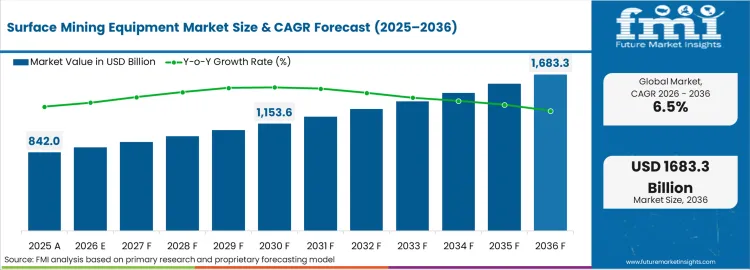
The surface mining equipment market was valued at USD 842.00 billion in 2025, projected to reach USD 896.73 billion in 2026, and is forecast to expand to USD 1683.29 billion by 2036 at a 6.50% CAGR. Based on Future Market Insights analysis, the market is set to add an incremental opportunity worth USD 786.56 billion over the forecast period. As per FMI, the procurement landscape for surface mining equipment is being reshaped by evolving specification requirements, regional capacity investments, and shifting end-use demand patterns across established and emerging buyer segments.
Summary of Surface Mining Equipment Market
- Surface Mining Equipment Market definition
- Surface mining equipment encompasses excavators, haul trucks, draglines, dozers, drills, loaders, and crushing systems deployed in open-pit, strip, and mountaintop removal mining operations to extract coal, metallic ores, and industrial minerals from surface deposits.
- Demand drivers in the market
- Coal production expansion across India and Southeast Asia is driving procurement of large-format excavators and haul trucks as new open-pit mines move from development to production phases with fleet commissioning timelines concentrated in the near term.
- Copper, lithium, and iron ore extraction volumes are rising in response to electrification and infrastructure demand, and each new open-pit project requires multi-year equipment fleet investments that lock in procurement commitments at project financial close.
- Equipment replacement cycles in mature mining regions are compressing as operators adopt Tier 4 Final and Stage V emission-compliant machines that improve fuel efficiency and reduce maintenance downtime compared to aging legacy fleet units.
- Key segments analyzed in the FMI report
- Excavators product type: 29.6% share in 2026, reflecting established procurement specifications and supply chain infrastructure favoring this variant.
- Open-pit mining method: 47.2% share in 2026, driven by end-use requirements in the primary application channels.
- China: 8.80% compound growth, supported by domestic investment and rising consumption.
- Analyst opinion at FMI
- Nikhil Kaitwade, Principal Consultant for Industrial Automation, opines, The surface mining equipment market is structurally cyclical but currently operating in the early phase of a capital expenditure recovery driven by critical mineral demand. The competitive landscape is concentrated among fewer than ten OEMs capable of manufacturing ultra-class haul trucks and mining excavators, and this concentration gives incumbents pricing power during order cycle upswings. The risk for buyers is lead time extension: during peak ordering periods, delivery timelines for large excavators and haul trucks stretch beyond 18 months, and mines that delay procurement decisions face production ramp-up delays that erode project economics.
- Strategic implications / executive takeaways
- Mine development project directors must place equipment orders at project sanction rather than construction commencement to avoid delivery delays that push first ore production beyond financing covenant deadlines.
- Fleet managers should evaluate autonomous-ready equipment specifications for all new haul truck and excavator purchases to preserve retrofit optionality as autonomous haulage system economics improve during the forecast period.
- Procurement teams in coal and metal ore mining should negotiate multi-unit fleet purchase agreements that include guaranteed spare parts availability and service level commitments to reduce unplanned downtime exposure across remote site operations.
Surface Mining Equipment Market key takeaways
| Metric | Details |
|---|---|
| Industry Size (2026) | USD 896.73 billion |
| Industry Value (2036) | USD 1683.29 billion |
| CAGR (2026 to 2036) | 6.50% |
Source: Future Market Insights, 2026
Three forces define the surface mining equipment procurement cycle. First, mining capital expenditure is recovering from a multi-year trough as commodity prices stabilize above the incentive thresholds required to sanction new open-pit developments, and each project approval triggers equipment orders measured in hundreds of millions of dollars per site. Second, the fleet electrification transition is beginning to influence procurement specifications as battery-electric haul trucks and hybrid excavators enter commercial availability, creating a parallel procurement stream alongside conventional diesel equipment.
Third, autonomous haulage system adoption is concentrating equipment purchases among OEMs that offer integrated autonomy-ready platforms, because mine operators increasingly refuse to purchase equipment that cannot be retrofitted for autonomous operation within its economic life. Across tracked geographies, China sets the pace at 8.80% CAGR. India follows at 8.10%. Germany follows at 7.50%. France follows at 6.80%. UK follows at 6.20%. USA follows at 5.50%. Brazil follows at 4.90%.
Surface Mining Equipment Market definition
Surface mining equipment represents the heavy machinery category engineered for material extraction, loading, hauling, and primary processing in above-ground mining operations. These machines operate across open-pit metallic ore deposits, coal strip mines, and quarry operations where overburden removal and bulk material movement define the production cycle.
Surface Mining Equipment Market inclusions
Market scope includes all commercially traded surface mining equipment segmented by product type (excavators, haul trucks, draglines, dozers, drills, loaders, crushers), method (open-pit mining, strip mining, mountaintop removal), and application (coal mining, metal ore mining, mineral mining). Revenue sizing spans the 2026 to 2036 forecast period.
Surface Mining Equipment Market exclusions
The scope excludes underground mining equipment, mineral processing plants beyond primary crushing, drilling rigs designed exclusively for exploration rather than production, and mining software systems. Spare parts and aftermarket services revenue are outside the defined boundary unless bundled with original equipment sales.
Surface Mining Equipment Market research methodology
- Primary research: FMI analysts conducted interviews with procurement directors, engineering leads, and supply chain managers across key surface mining equipment organizations to map decision gates and sourcing specifications.
- Desk research: Data collection phases aggregated regulatory filings, trade association publications, standards body documentation, and company annual reports to establish verifiable baseline parameters.
- Market sizing and forecasting: Baseline values derive from a bottom-up aggregation of surface mining equipment transaction volumes, applying region-specific adoption curves and pricing indices to project forward demand through 2036.
- Data validation and update cycle: Projections are tested against publicly reported procurement volumes, trade flow statistics, and company financial disclosures on a quarterly refresh schedule.
Why is the Surface Mining Equipment Market Growing?
The growth of open-pit mining, which allows for economical extraction of surface mineral deposits, has driven investments in advanced machinery. Improvements in equipment automation and durability have enhanced operational efficiency and safety in mining projects.
Rising demand for coal as an energy source in several regions has further fueled the need for robust surface mining solutions. Industry focus on cost optimization and environmental compliance has encouraged the adoption of equipment that delivers high productivity while reducing emissions and downtime.
Future market growth is expected to be supported by technological advancements and expanding mining activities in emerging economies. Segmental growth is likely to be led by Excavators in product type, Open-pit mining as the predominant method, and Coal mining as the leading application.
Segmental Analysis
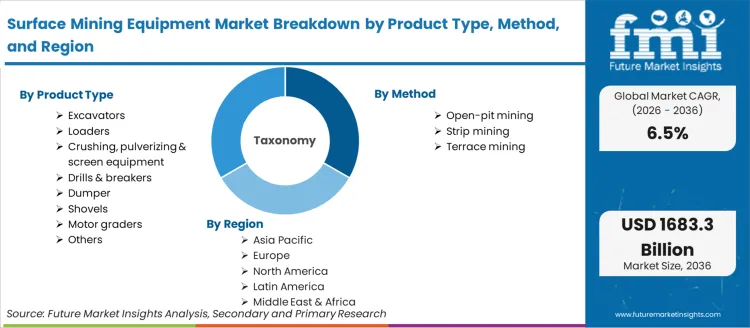
The market is segmented by Product Type, Method, and Application and region. By Product Type, the market is divided into Excavators, Loaders, Crushing, pulverizing & screen equipment, Drills & breakers, Dumper, Shovels, Motor graders, and Others.
In terms of Method, the market is classified into Open-pit mining, Strip mining, and Terrace mining. Based on Application, the market is segmented into Coal mining, Metal mining, Mineral mining, and Other (bauxite mining). Regionally, the market is classified into North America, Latin America, Western Europe, Eastern Europe, Balkan & Baltic Countries, Russia & Belarus, Central Asia, East Asia, South Asia & Pacific, and the Middle East & Africa.
Insights into the Product Type Segment: Excavators
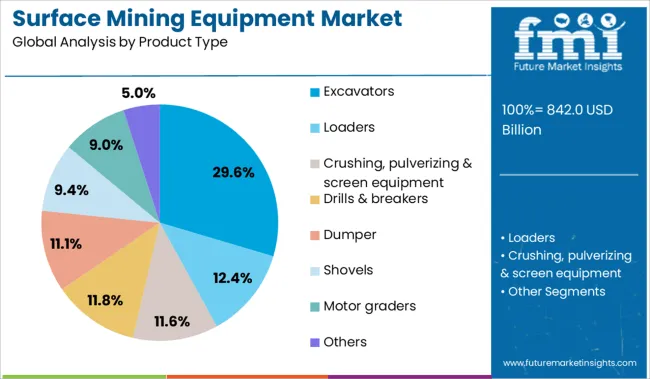
The Excavators segment is projected to represent 29.6% of the surface mining equipment market revenue in 2026, establishing its leadership in product types. This growth has been driven by the versatility and efficiency of excavators in material handling, overburden removal, and loading operations. Excavators are preferred for their adaptability to various terrains and ability to perform multiple functions with specialized attachments.
Their increased use in large-scale mining projects is supported by advancements in hydraulic technology and operator control systems, which improve precision and productivity.
As mining operations continue to scale up and focus on operational efficiency, the demand for excavators is expected to remain strong.
Insights into the Method Segment: Open-pit Mining
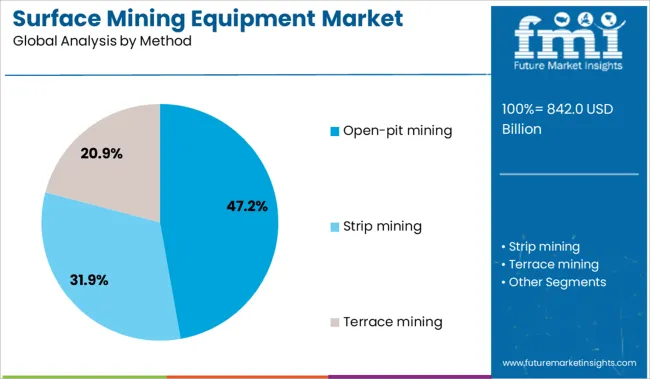
The Open-pit mining segment is expected to account for 47.2% of the market revenue in 2026, maintaining its dominance as the primary mining method. This method’s popularity stems from its cost-effectiveness and suitability for extracting near-surface mineral deposits. Open-pit mining facilitates the use of large machinery, enabling high volume extraction with relatively lower operational risks compared to underground mining.
The method also allows for continuous extraction, improving overall project timelines. Regulatory approvals and environmental considerations have also favored open-pit approaches where feasible.
As mineral demand grows, open-pit mining is poised to retain its leading role in mining operations.
Insights into the Application Segment: Coal Mining
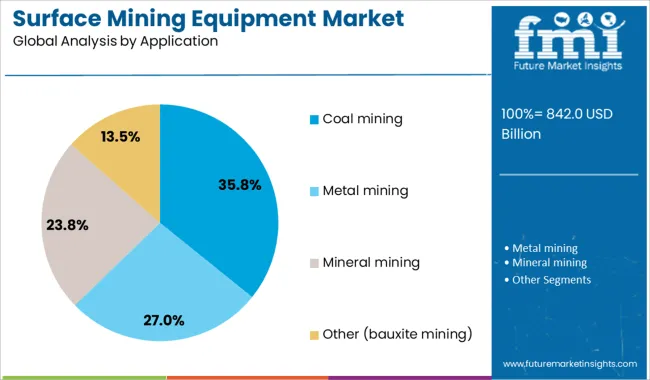
The Coal mining segment is projected to contribute 35.8% of the surface mining equipment market revenue in 2026, making it the largest application segment. This growth reflects the ongoing reliance on coal for energy production in many countries despite the rise of alternative energy sources. Surface mining equipment is essential for efficient coal extraction, especially in large open-pit mines.
The segment benefits from government infrastructure projects and energy policies supporting coal production in various regions. Additionally, modernization efforts in coal mining operations have led to increased demand for reliable and high-capacity equipment.
The Coal mining segment is expected to maintain its market dominance as coal continues to be a significant energy source in developing and developed markets.
What are the Drivers, Restraints, and Key trends of the Surface Mining Equipment Market?
Rising demand for mineral resources, infrastructure development, and efficiency needs boost surface mining equipment adoption. Opportunities lie in fuel-efficient machinery, tele-operated systems, and partnerships with mining firms and OEM financing schemes.
Resource Extraction Needs, Infrastructure Expansion, and Efficiency Pressures Driving Demand
The surface mining equipment market is expanding as global demand for metals, coal, and aggregates rises alongside infrastructure and construction projects. Mining firms need heavy-duty machinery-such as excavators, haul trucks, dozers, and drills-that deliver high uptime, load capacity, and cost-per-ton efficiency. Equipment reliability reduces downtime and supports tight project schedules. Governments' push for new roads, ports, and energy projects reinforces demand for extracted materials. Mining operators focus on lowering operational costs through higher fuel efficiency, extended service intervals, and improved parts availability. In high-demand regions such as Australia, Latin America, and parts of Africa, companies are investing in larger fleets and modern equipment to boost productivity in large open-pit operations.
Opportunities in Energy-Efficient Machinery, Automation, and Collaborative Financing
Opportunities in the surface mining equipment market center on introducing machinery with higher fuel efficiency, lower emissions, and remote-control or semi-autonomous features. Manufacturers developing tele-operated or assisted-control machines can help mining companies reduce operator fatigue and enhance safety in hazardous zones. Additionally, offering pay-per-use models, equipment rental agreements, and OEM-sponsored financing packages helps smaller mining firms access high-end machinery without heavy upfront costs. Expansion into emerging markets with new resource developments offers potential, especially when bundled with on-site training and maintenance services. Collaborations between equipment makers, mining operators, and government-supported programs for mine modernization can unlock broader adoption and support sustainable operations over long-term project cycles.
Analysis of Surface Mining Equipment Market By Key Countries
.webp "Top Country Growth Comparison Surface Mining Equipment Market Cagr (2026 2036)")
| Country | CAGR |
|---|---|
| China | 8.8% |
| India | 8.1% |
| Germany | 7.5% |
| France | 6.8% |
| UK | 6.2% |
| USA | 5.5% |
| Brazil | 4.9% |
Source: FMI analysis based on primary research and proprietary forecasting model
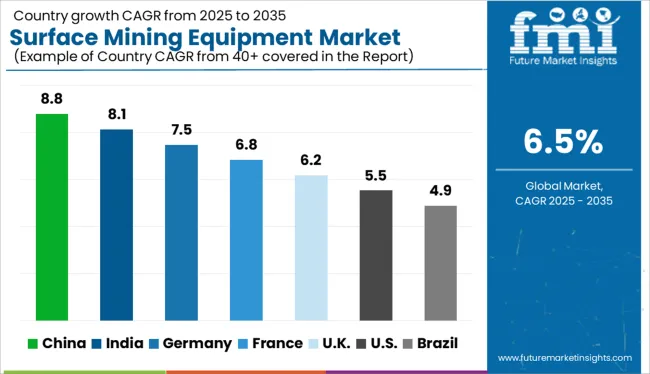
The global surface mining equipment market is projected to grow at a CAGR of 6.5% from 2026 to 2036, driven by rising demand for metals, minerals, and construction materials amid infrastructure and energy transitions. Among BRICS economies, China leads with an 8.8% CAGR, supported by vast coal and rare earth extraction, coupled with heavy investment in autonomous and electric mining fleets. India follows at 8.1%, propelled by domestic mineral exploration, government-backed mining reforms, and capacity expansion in coal production. Within the OECD group, Germany shows notable growth at 7.5% due to automation in quarry operations and sustainability mandates. The United Kingdom (6.2%) and the United States (5.5%) reflect steady replacement demand, with a focus on electrification, operator safety, and fleet digitization. This report covers detailed analysis of 40+ countries, and the top five countries have been shared as a reference.
China Drives Momentum in Surface Mining Equipment Market
Between 2026 and 2036, China surface mining equipment market is projected to grow at a CAGR of 8.8%, with annual gains fluctuating from 8.4% to 9.2%. Expansion in coal, iron ore, and rare earth mining is generating robust demand for large-scale equipment including hydraulic excavators, surface miners, and haul trucks. Domestic manufacturers are enhancing their capabilities by integrating automation, remote diagnostics, and fuel-efficient designs. Environmental concerns are also driving upgrades to cleaner and more efficient machinery across key provinces. With steady infrastructure growth and resource security strategies, investments in surface mining machinery continue to rise.
- Automation and remote tech are reshaping mining equipment operations
- Equipment upgrades are targeting improved emissions and energy use
- Rare earth mining growth is accelerating demand for precision machines
Growth of the Surface Mining Equipment Sector in India
From 2026 to 2036, India is expected to record a CAGR of 8.1% in its surface mining equipment market, with yearly growth ranging between 7.7% and 8.5%. Growing energy needs and construction activity are prompting a resurgence in coal and bauxite surface mining. Public sector undertakings and private firms alike are expanding fleets with modernized dozers, drills, and draglines. Government reforms on mineral exploration, along with digitized mine planning, are promoting greater equipment adoption in both greenfield and brownfield operations. Local production is also expanding under "Make in India" efforts.
- Government-backed mining reforms are stimulating equipment purchases
- Digitized mine planning is improving operational accuracy and efficiency
- Domestic manufacturing is expanding to reduce import dependency
Surface Mining Equipment Expansion Trends in the United Kingdom
A CAGR of 6.2% is projected for the surface mining equipment market across the United Kingdom between 2026 and 2036, with annual growth hovering between 5.9% and 6.5%. Demand is being led by quarrying, limestone, and aggregates extraction for infrastructure and commercial real estate development. Equipment suppliers are shifting toward compact, high-efficiency loaders and wheel excavators that suit mid-sized mining operations. Regulatory guidelines on emissions and land rehabilitation are pushing fleets to modernize with eco-friendly units. Data-centric equipment with telematics and GPS guidance is seeing strong uptake.
- Compact machines are rising in popularity for aggregate and quarry mining
- Emission laws are encouraging adoption of clean and efficient equipment
- GPS and telematics tools are enhancing site management and productivity
Market Outlook for Surface Mining Equipment in the United States
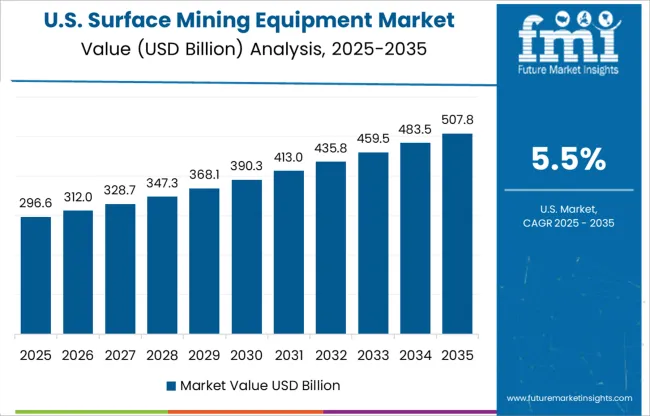
Between 2026 and 2036, the USA surface mining equipment market is projected to grow at a CAGR of 5.5%, with year-to-year increases ranging from 5.1% to 5.8%. Demand is being driven by expansion in aggregates, phosphate, and metal mining sectors. Federal investments in infrastructure and energy independence are influencing equipment modernization cycles, especially for haul trucks, blast drills, and crushing plants. Environmental compliance is encouraging the use of low-noise, fuel-efficient machinery. Tech upgrades like predictive maintenance and fleet optimization software are becoming standard.
- Infrastructure funding is spurring large-scale mining project development
- Eco-compliant machines are aligning with environmental policy trends
- Predictive analytics are being integrated into modern fleet operations
Technological Advancements Fuel Growth in Germany
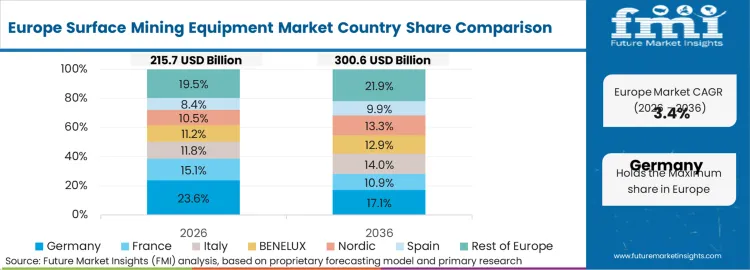
Germany’s surface mining equipment market is forecast to grow at a CAGR of 7.5% during the period of 2026 to 2036, with year-on-year growth fluctuating between 7.1% and 7.9%. A shift toward environmentally conscious open-pit mining is fueling demand for electric and hybrid equipment, particularly in lignite and industrial minerals sectors. High emphasis on precision, noise reduction, and low-emission operations is driving the need for smarter, sensor-integrated equipment. Research institutions and OEMs are collaborating to create next-generation drills, loaders, and crushing systems compatible with European mining standards.
- Low-emission and electric units are gaining traction across mining zones
- R&D collaborations are introducing cutting-edge machine intelligence
- German-made equipment is gaining favor for its durability and precision
Competitive Landscape of Surface Mining Equipment Market
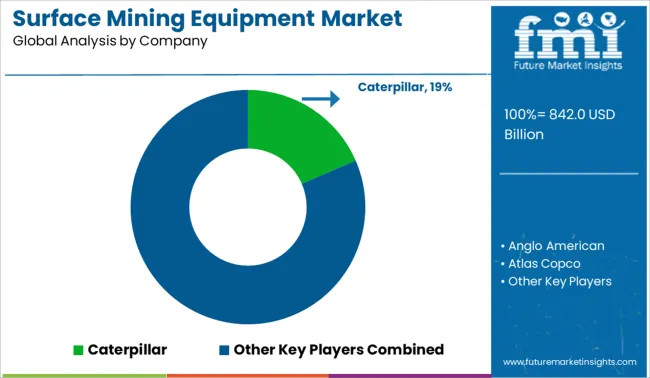
The surface mining equipment market is moderately consolidated, dominated by a few global OEMs that offer high-capacity, durable machinery tailored for large-scale mining operations. Tier 1 manufacturers like Caterpillar, Komatsu, and Hitachi Construction Machinery lead with integrated equipment portfolios-including haul trucks, excavators, and drills-backed by automation, telematics, and fuel-efficient technologies. Caterpillar holds the top position with an 18.5% share, driven by global reach and long-term supply agreements with major mining firms like BHP and Rio Tinto.
Tier 2 companies such as Liebherr, Volvo, and J.C. Bamford Excavators provide versatile and regionally optimized machines. Tier 3 players, including Boart Longyear and Atlas Copco, specialize in drilling and auxiliary systems. End users like Anglo American, Barrick Gold, and Vale significantly influence market trends through procurement strategies, digitalization goals.
Scope of the report
| Metric | Value |
|---|---|
| Quantitative Units | USD 896.73 billion to USD 1683.29 billion, at a CAGR of 6.50% |
| Market Definition | Surface mining equipment encompasses excavators, haul trucks, draglines, dozers, drills, loaders, and crushing systems deployed in open-pit, strip, and mountaintop removal mining operations to extract coal, metallic ores, and industrial minerals from surface deposits. |
| Segmentation | Product Type (Excavators), Method (Open-pit mining), Application (Coal mining) |
| Regions Covered | North America, Latin America, Europe, East Asia, South Asia, Oceania, Middle East and Africa |
| Countries Covered | India, China, USA, Canada, UK, Germany, Japan, and 40 plus countries |
| Key Companies Profiled | Caterpillar, Komatsu, Hitachi , Liebherr, Volvo, J.C. Bamford, Boart Longyear, Atlas Copco |
| Forecast Period | 2026 to 2036 |
| Approach | Forecasting models apply a hybrid bottom-up and top-down methodology starting with verified surface mining equipment transaction data and projecting adoption velocity across defined segments and regions. |
Surface Mining Equipment Market by Segments
By Product Type:
- Excavators
- Loaders
- Crushing, pulverizing & screen equipment
- Drills & breakers
- Dumper
- Shovels
- Motor graders
- Others
By Method:
- Open-pit mining
- Strip mining
- Terrace mining
By Application:
- Coal mining
- Metal mining
- Mineral mining
- Other (bauxite mining)
By Region:
- North America
- USA
- Canada
- Mexico
- Latin America
- Brazil
- Chile
- Rest of Latin America
- Western Europe
- Germany
- UK
- Italy
- Spain
- France
- Nordic
- BENELUX
- Rest of Western Europe
- Eastern Europe
- Russia
- Poland
- Hungary
- Balkan & Baltic
- Rest of Eastern Europe
- East Asia
- China
- Japan
- South Korea
- South Asia and Pacific
- India
- ASEAN
- Australia & New Zealand
- Rest of South Asia and Pacific
- Middle East & Africa
- Kingdom of Saudi Arabia
- Other GCC Countries
- Turkiye
- South Africa
- Other African Union
- Rest of Middle East & Africa
Bibliography
- 1. International Council on Mining and Metals. (2024). Mining Contribution to Sustainable Development: Equipment and Technology Assessment. ICMM.
- 2. International Energy Agency. (2024). The Role of Critical Minerals in Clean Energy Transitions. IEA.
- 3. United States Geological Survey. (2024). Mineral Commodity Summaries 2024. USGS.
- 4. Organisation for Economic Co-operation and Development. (2024). OECD Due Diligence Guidance for Responsible Supply Chains of Minerals. OECD.
- 5. European Commission. (2024). Critical Raw Materials Act: Mining Equipment Implications. EC.
- 6. International Organization for Standardization. (2024). ISO 19296: Mining, Mobile Machines Working Underground, Machine Safety. ISO.
This bibliography is provided for reader reference. The full FMI report contains the complete reference list with primary research documentation.
Frequently Asked Questions
How large is the demand for Surface Mining Equipment in the global market in 2026?
Demand for surface mining equipment in the global market is estimated to be valued at USD 896.73 billion in 2026.
What will be the market size of Surface Mining Equipment by 2036?
Market size for surface mining equipment is projected to reach USD 1683.29 billion by 2036.
What is the expected demand growth for Surface Mining Equipment between 2026 and 2036?
Demand for surface mining equipment is expected to grow at a CAGR of 6.50% between 2026 and 2036.
Which Product Type is poised to lead global sales by 2026?
Excavators accounts for 29.6% in 2026, reflecting established procurement specifications across primary buyer channels.
How is Open-pit mining driving Surface Mining Equipment adoption in 2026?
Open-pit mining represents 47.2% of segment demand as end-use requirements favor this category.
What is driving demand in China?
China registers a 8.80% CAGR through 2036, propelled by domestic investment and rising end-use consumption.
What does Surface Mining Equipment Market definition mean in this report?
Surface mining equipment encompasses excavators, haul trucks, draglines, dozers, drills, loaders, and crushing systems deployed in open-pit, strip, and mountaintop removal mining operations to extract coal, metallic ores, and industrial minerals from surface deposits.
How does FMI build and validate the Surface Mining Equipment forecast?
Forecasting models apply a hybrid bottom-up methodology starting with verified transaction data, cross-validated against publicly reported procurement volumes and company financial disclosures on a quarterly refresh schedule.
Preview the report firsthand - request a free sample
Get SampleGet the brochure for pricing and purchase details.
Get PDFTable of Content
- Executive Summary
- Global Market Outlook
- Demand-side Trends
- Supply-side Trends
- Technology Roadmap Analysis
- Analysis and Recommendations
- Market Overview
- Market Coverage / Taxonomy
- Market Definition / Scope / Limitations
- Research Methodology
- Chapter Orientation
- Analytical Lens and Working Hypotheses
- Market Structure, Signals, and Trend Drivers
- Benchmarking and Cross-market Comparability
- Market Sizing, Forecasting, and Opportunity Mapping
- Research Design and Evidence Framework
- Desk Research Programme (Secondary Evidence)
- Company Annual and Sustainability Reports
- Peer-reviewed Journals and Academic Literature
- Corporate Websites, Product Literature, and Technical Notes
- Earnings Decks and Investor Briefings
- Statutory Filings and Regulatory Disclosures
- Technical White Papers and Standards Notes
- Trade Journals, Industry Magazines, and Analyst Briefs
- Conference Proceedings, Webinars, and Seminar Materials
- Government Statistics Portals and Public Data Releases
- Press Releases and Reputable Media Coverage
- Specialist Newsletters and Curated Briefings
- Sector Databases and Reference Repositories
- FMI Internal Proprietary Databases and Historical Market Datasets
- Subscription Datasets and Paid Sources
- Social Channels, Communities, and Digital Listening Inputs
- Additional Desk Sources
- Expert Input and Fieldwork (Primary Evidence)
- Primary Modes
- Qualitative Interviews and Expert Elicitation
- Quantitative Surveys and Structured Data Capture
- Blended Approach
- Why Primary Evidence is Used
- Field Techniques
- Interviews
- Surveys
- Focus Groups
- Observational and In-context Research
- Social and Community Interactions
- Stakeholder Universe Engaged
- C-suite Leaders
- Board Members
- Presidents and Vice Presidents
- R&D and Innovation Heads
- Technical Specialists
- Domain Subject-matter Experts
- Scientists
- Physicians and Other Healthcare Professionals
- Governance, Ethics, and Data Stewardship
- Research Ethics
- Data Integrity and Handling
- Primary Modes
- Tooling, Models, and Reference Databases
- Desk Research Programme (Secondary Evidence)
- Data Engineering and Model Build
- Data Acquisition and Ingestion
- Cleaning, Normalisation, and Verification
- Synthesis, Triangulation, and Analysis
- Quality Assurance and Audit Trail
- Market Background
- Market Dynamics
- Drivers
- Restraints
- Opportunity
- Trends
- Scenario Forecast
- Demand in Optimistic Scenario
- Demand in Likely Scenario
- Demand in Conservative Scenario
- Opportunity Map Analysis
- Product Life Cycle Analysis
- Supply Chain Analysis
- Investment Feasibility Matrix
- Value Chain Analysis
- PESTLE and Porter’s Analysis
- Regulatory Landscape
- Regional Parent Market Outlook
- Production and Consumption Statistics
- Import and Export Statistics
- Market Dynamics
- Global Market Analysis 2021 to 2025 and Forecast, 2026 to 2036
- Historical Market Size Value (USD Million) Analysis, 2021 to 2025
- Current and Future Market Size Value (USD Million) Projections, 2026 to 2036
- Y-o-Y Growth Trend Analysis
- Absolute $ Opportunity Analysis
- Global Market Pricing Analysis 2021 to 2025 and Forecast 2026 to 2036
- Global Market Analysis 2021 to 2025 and Forecast 2026 to 2036, By Product Type
- Introduction / Key Findings
- Historical Market Size Value (USD Million) Analysis By Product Type , 2021 to 2025
- Current and Future Market Size Value (USD Million) Analysis and Forecast By Product Type , 2026 to 2036
- Excavators
- Loaders
- Crushing, pulverizing & screen equipment
- Drills & breakers
- Dumper
- Shovels
- Motor graders
- Others
- Excavators
- Y-o-Y Growth Trend Analysis By Product Type , 2021 to 2025
- Absolute $ Opportunity Analysis By Product Type , 2026 to 2036
- Global Market Analysis 2021 to 2025 and Forecast 2026 to 2036, By Method
- Introduction / Key Findings
- Historical Market Size Value (USD Million) Analysis By Method, 2021 to 2025
- Current and Future Market Size Value (USD Million) Analysis and Forecast By Method, 2026 to 2036
- Open-pit mining
- Strip mining
- Terrace mining
- Open-pit mining
- Y-o-Y Growth Trend Analysis By Method, 2021 to 2025
- Absolute $ Opportunity Analysis By Method, 2026 to 2036
- Global Market Analysis 2021 to 2025 and Forecast 2026 to 2036, By Application
- Introduction / Key Findings
- Historical Market Size Value (USD Million) Analysis By Application, 2021 to 2025
- Current and Future Market Size Value (USD Million) Analysis and Forecast By Application, 2026 to 2036
- Coal mining
- Metal mining
- Mineral mining
- Other
- Coal mining
- Y-o-Y Growth Trend Analysis By Application, 2021 to 2025
- Absolute $ Opportunity Analysis By Application, 2026 to 2036
- Global Market Analysis 2021 to 2025 and Forecast 2026 to 2036, By Region
- Introduction
- Historical Market Size Value (USD Million) Analysis By Region, 2021 to 2025
- Current Market Size Value (USD Million) Analysis and Forecast By Region, 2026 to 2036
- North America
- Latin America
- Western Europe
- Eastern Europe
- East Asia
- South Asia and Pacific
- Middle East & Africa
- Market Attractiveness Analysis By Region
- North America Market Analysis 2021 to 2025 and Forecast 2026 to 2036, By Country
- Historical Market Size Value (USD Million) Trend Analysis By Market Taxonomy, 2021 to 2025
- Market Size Value (USD Million) Forecast By Market Taxonomy, 2026 to 2036
- By Country
- USA
- Canada
- Mexico
- By Product Type
- By Method
- By Application
- By Country
- Market Attractiveness Analysis
- By Country
- By Product Type
- By Method
- By Application
- Key Takeaways
- Latin America Market Analysis 2021 to 2025 and Forecast 2026 to 2036, By Country
- Historical Market Size Value (USD Million) Trend Analysis By Market Taxonomy, 2021 to 2025
- Market Size Value (USD Million) Forecast By Market Taxonomy, 2026 to 2036
- By Country
- Brazil
- Chile
- Rest of Latin America
- By Product Type
- By Method
- By Application
- By Country
- Market Attractiveness Analysis
- By Country
- By Product Type
- By Method
- By Application
- Key Takeaways
- Western Europe Market Analysis 2021 to 2025 and Forecast 2026 to 2036, By Country
- Historical Market Size Value (USD Million) Trend Analysis By Market Taxonomy, 2021 to 2025
- Market Size Value (USD Million) Forecast By Market Taxonomy, 2026 to 2036
- By Country
- Germany
- UK
- Italy
- Spain
- France
- Nordic
- BENELUX
- Rest of Western Europe
- By Product Type
- By Method
- By Application
- By Country
- Market Attractiveness Analysis
- By Country
- By Product Type
- By Method
- By Application
- Key Takeaways
- Eastern Europe Market Analysis 2021 to 2025 and Forecast 2026 to 2036, By Country
- Historical Market Size Value (USD Million) Trend Analysis By Market Taxonomy, 2021 to 2025
- Market Size Value (USD Million) Forecast By Market Taxonomy, 2026 to 2036
- By Country
- Russia
- Poland
- Hungary
- Balkan & Baltic
- Rest of Eastern Europe
- By Product Type
- By Method
- By Application
- By Country
- Market Attractiveness Analysis
- By Country
- By Product Type
- By Method
- By Application
- Key Takeaways
- East Asia Market Analysis 2021 to 2025 and Forecast 2026 to 2036, By Country
- Historical Market Size Value (USD Million) Trend Analysis By Market Taxonomy, 2021 to 2025
- Market Size Value (USD Million) Forecast By Market Taxonomy, 2026 to 2036
- By Country
- China
- Japan
- South Korea
- By Product Type
- By Method
- By Application
- By Country
- Market Attractiveness Analysis
- By Country
- By Product Type
- By Method
- By Application
- Key Takeaways
- South Asia and Pacific Market Analysis 2021 to 2025 and Forecast 2026 to 2036, By Country
- Historical Market Size Value (USD Million) Trend Analysis By Market Taxonomy, 2021 to 2025
- Market Size Value (USD Million) Forecast By Market Taxonomy, 2026 to 2036
- By Country
- India
- ASEAN
- Australia & New Zealand
- Rest of South Asia and Pacific
- By Product Type
- By Method
- By Application
- By Country
- Market Attractiveness Analysis
- By Country
- By Product Type
- By Method
- By Application
- Key Takeaways
- Middle East & Africa Market Analysis 2021 to 2025 and Forecast 2026 to 2036, By Country
- Historical Market Size Value (USD Million) Trend Analysis By Market Taxonomy, 2021 to 2025
- Market Size Value (USD Million) Forecast By Market Taxonomy, 2026 to 2036
- By Country
- Kingdom of Saudi Arabia
- Other GCC Countries
- Turkiye
- South Africa
- Other African Union
- Rest of Middle East & Africa
- By Product Type
- By Method
- By Application
- By Country
- Market Attractiveness Analysis
- By Country
- By Product Type
- By Method
- By Application
- Key Takeaways
- Key Countries Market Analysis
- USA
- Pricing Analysis
- Market Share Analysis, 2025
- By Product Type
- By Method
- By Application
- Canada
- Pricing Analysis
- Market Share Analysis, 2025
- By Product Type
- By Method
- By Application
- Mexico
- Pricing Analysis
- Market Share Analysis, 2025
- By Product Type
- By Method
- By Application
- Brazil
- Pricing Analysis
- Market Share Analysis, 2025
- By Product Type
- By Method
- By Application
- Chile
- Pricing Analysis
- Market Share Analysis, 2025
- By Product Type
- By Method
- By Application
- Germany
- Pricing Analysis
- Market Share Analysis, 2025
- By Product Type
- By Method
- By Application
- UK
- Pricing Analysis
- Market Share Analysis, 2025
- By Product Type
- By Method
- By Application
- Italy
- Pricing Analysis
- Market Share Analysis, 2025
- By Product Type
- By Method
- By Application
- Spain
- Pricing Analysis
- Market Share Analysis, 2025
- By Product Type
- By Method
- By Application
- France
- Pricing Analysis
- Market Share Analysis, 2025
- By Product Type
- By Method
- By Application
- India
- Pricing Analysis
- Market Share Analysis, 2025
- By Product Type
- By Method
- By Application
- ASEAN
- Pricing Analysis
- Market Share Analysis, 2025
- By Product Type
- By Method
- By Application
- Australia & New Zealand
- Pricing Analysis
- Market Share Analysis, 2025
- By Product Type
- By Method
- By Application
- China
- Pricing Analysis
- Market Share Analysis, 2025
- By Product Type
- By Method
- By Application
- Japan
- Pricing Analysis
- Market Share Analysis, 2025
- By Product Type
- By Method
- By Application
- South Korea
- Pricing Analysis
- Market Share Analysis, 2025
- By Product Type
- By Method
- By Application
- Russia
- Pricing Analysis
- Market Share Analysis, 2025
- By Product Type
- By Method
- By Application
- Poland
- Pricing Analysis
- Market Share Analysis, 2025
- By Product Type
- By Method
- By Application
- Hungary
- Pricing Analysis
- Market Share Analysis, 2025
- By Product Type
- By Method
- By Application
- Kingdom of Saudi Arabia
- Pricing Analysis
- Market Share Analysis, 2025
- By Product Type
- By Method
- By Application
- Turkiye
- Pricing Analysis
- Market Share Analysis, 2025
- By Product Type
- By Method
- By Application
- South Africa
- Pricing Analysis
- Market Share Analysis, 2025
- By Product Type
- By Method
- By Application
- USA
- Market Structure Analysis
- Competition Dashboard
- Competition Benchmarking
- Market Share Analysis of Top Players
- By Regional
- By Product Type
- By Method
- By Application
- Competition Analysis
- Competition Deep Dive
- Caterpillar
- Overview
- Product Portfolio
- Profitability by Market Segments (Product/Age /Sales Channel/Region)
- Sales Footprint
- Strategy Overview
- Marketing Strategy
- Product Strategy
- Channel Strategy
- Komatsu
- Hitachi
- Liebherr
- Volvo
- J.C. Bamford
- Boart Longyear
- Atlas Copco
- Caterpillar
- Competition Deep Dive
- Assumptions & Acronyms Used


