

- Industry Size (2026)
- USD 1.16 Bn
- Forecast (2036)
- USD 1.94 Bn
- CAGR (2026 to 2036)
- 5.30%
Surface Contact Wire Rope Market size, market forecast and outlook by FMI
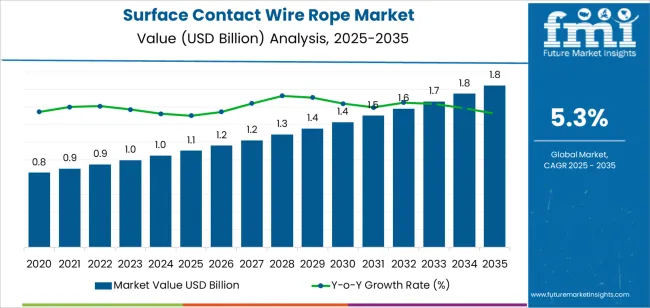
The surface contact wire rope market was valued at USD 1.10 billion in 2025, projected to reach USD 1.16 billion in 2026, and is forecast to expand to USD 1.94 billion by 2036 at a 5.30% CAGR. Based on Future Market Insights analysis, the market is set to add an incremental opportunity worth USD 0.78 billion over the forecast period. As per FMI, the procurement landscape for surface contact wire rope is being reshaped by evolving specification requirements, regional capacity investments, and shifting end-use demand patterns across established and emerging buyer segments.
Summary of Surface Contact Wire Rope Market
- Surface Contact Wire Rope Market definition
- Surface contact wire ropes are specialized steel rope constructions where the outer strand wires are shaped to present flat or profiled contact surfaces, increasing the bearing area between adjacent wires and strands to improve fatigue life, abrasion resistance, and load-bearing capacity in mining, crane, elevator, offshore, and construction hoisting applications.
- Demand drivers in the market
- Mining operators are specifying surface contact wire ropes for hoist and dragline applications where the extended fatigue life and higher breaking strength per diameter reduce rope replacement frequency and minimize production downtime in continuous extraction cycles.
- Crane and heavy-lift contractors operating under EN and ASME inspection regimes are adopting compacted strand ropes that maintain dimensional stability and sheave tracking accuracy under multi-layer spooling conditions that degrade conventional rope constructions.
- Offshore platform operators require wire ropes with maximized metallic cross-section for mooring and subsea lifting applications where corrosion allowance, fatigue endurance, and minimum breaking force specifications simultaneously constrain rope selection.
- Key segments analyzed in the FMI report
- Round shape: 58.4% share in 2026, reflecting established procurement specifications and supply chain infrastructure favoring this variant.
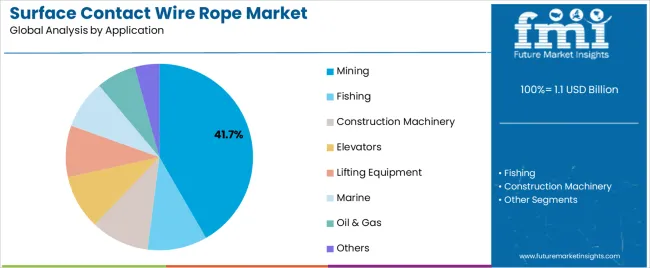
- Mining application: 41.7% share in 2026, driven by end-use requirements in the primary application channels.
- China: 7.20% compound growth, supported by domestic investment and rising consumption.
- Analyst opinion at FMI
- Nikhil Kaitwade, Principal Consultant for Industrial Automation, opines, The surface contact wire rope market is structurally tied to mining capital expenditure and crane fleet expansion cycles. The companies holding defensible positions are those with integrated wire rod drawing, strand forming, and rope closing capabilities located proximate to major mining regions. Imported rope faces a logistics cost disadvantage on heavy, low-value-density products, which means regional manufacturers serving domestic mining and construction markets hold pricing power that cross-border competitors cannot easily challenge. The risk concentration lies in raw material sourcing: high-carbon wire rod supply from a limited number of qualified steel mills creates procurement bottleneck exposure during steel market tightness.
- Strategic implications / executive takeaways
- Mining procurement teams should negotiate multi-year surface contact wire rope supply contracts with regional manufacturers to lock in pricing and guarantee allocation during mining investment cycle upswings when rope demand spikes.
- Crane fleet operators should standardize on a single surface contact rope specification across their fleet to reduce inventory carrying costs and simplify inspection and replacement scheduling.
- Wire rope manufacturers targeting growth markets in India and Brazil should evaluate local wire rod sourcing partnerships to reduce freight exposure on imported raw materials and improve delivered cost competitiveness.
Surface Contact Wire Rope Market key takeaways
| Metric | Details |
|---|---|
| Industry Size (2026) | USD 1.16 billion |
| Industry Value (2036) | USD 1.94 billion |
| CAGR (2026 to 2036) | 5.30% |
Source: Future Market Insights, 2026
Three procurement-level forces define the surface contact wire rope market trajectory. First, mining productivity pressures are compelling operators to specify longer-life rope constructions that reduce the frequency of costly hoist shutdowns for rope replacement, and surface contact geometry delivers measurably longer service intervals than round-wire alternatives of the same diameter and grade. Second, crane rental fleet operators are standardizing on compacted strand ropes across their fleet to simplify inventory management and improve utilization rates, as a single rope specification that performs across multiple crane models reduces procurement complexity.
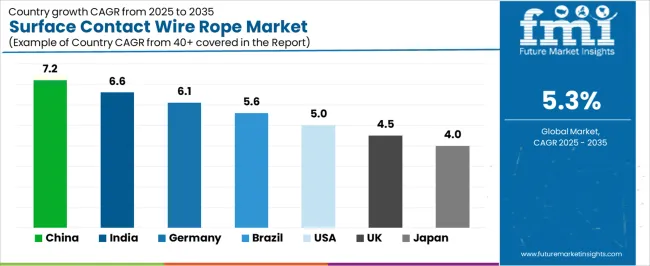
Third, the geographic distribution of mining and construction activity is shifting toward India, China, and Brazil, where infrastructure investment and mineral extraction volumes are expanding faster than mature markets, pulling wire rope demand toward regions with less established domestic manufacturing capacity. Across tracked geographies, China sets the pace at 7.20% CAGR. India follows at 6.60%. Germany follows at 6.10%. Brazil follows at 5.60%. USA follows at 5.00%. UK follows at 4.50%. Japan follows at 4.00%.
Surface Contact Wire Rope Market definition
Surface contact wire rope represents a category of engineered steel rope products where strand geometry is modified through wire drawing, rolling, or swaging to maximize inter-wire contact area. The resulting ropes deliver extended service life under cyclic bending, abrasion, and compressive loading conditions compared to conventional round-wire rope constructions of equivalent diameter and grade.
Surface Contact Wire Rope Market inclusions
Market scope includes all commercially traded surface contact wire ropes segmented by shape (round, flat, compacted) and application (mining, crane and hoisting, elevator, offshore, construction). Revenue sizing spans the 2026 to 2036 forecast period with regional and country-level assessments.
Surface Contact Wire Rope Market exclusions
The scope excludes conventional round-strand wire ropes without surface contact geometry, fiber-core ropes, synthetic fiber ropes, and wire rope slings or assemblies. Wire rod and drawn wire sold as raw material inputs to rope manufacturing are outside the defined boundary.
Surface Contact Wire Rope Market research methodology
- Primary research: FMI analysts conducted interviews with procurement directors, engineering leads, and supply chain managers across key surface contact wire rope organizations to map decision gates and sourcing specifications.
- Desk research: Data collection phases aggregated regulatory filings, trade association publications, standards body documentation, and company annual reports to establish verifiable baseline parameters.
- Market sizing and forecasting: Baseline values derive from a bottom-up aggregation of surface contact wire rope transaction volumes, applying region-specific adoption curves and pricing indices to project forward demand through 2036.
- Data validation and update cycle: Projections are tested against publicly reported procurement volumes, trade flow statistics, and company financial disclosures on a quarterly refresh schedule.
Why is the Surface Contact Wire Rope Market Growing?
| MINING EXPANSION | CONSTRUCTION GROWTH | EQUIPMENT MODERNIZATION |
|---|---|---|
| Resource Extraction Growth - Global mining operations expanding requiring specialized wire rope solutions for deep shaft hoisting, material handling systems, and heavy-duty lifting applications with enhanced load capacity performance for mineral extraction facilities, underground operations, and surface mining equipment requiring certified safety and reliability characteristics. | Infrastructure Development - Construction industry expansion and building project growth driving demand for wire rope systems in tower cranes, mobile cranes, and construction machinery requiring high-strength lifting solutions for urban development, industrial facility construction, and major infrastructure projects worldwide. | Industrial Equipment Upgrades - Manufacturing facility modernization requiring advanced wire rope technology for material handling equipment, overhead cranes, and industrial lifting systems with enhanced performance and maintenance characteristics supporting operational efficiency and safety compliance requirements. |
| Technology Advancement - Mining equipment advancement requiring integrated wire rope components for automated hoisting systems, dragline operations, and material transport applications with superior load distribution and reliability characteristics for increased operational efficiency and mining productivity enhancement. | Equipment Integration - Construction machinery manufacturers implementing comprehensive wire rope solutions for crane applications, lifting equipment, and mobile machinery with enhanced performance specifications and standardized compatibility requirements for diverse construction applications. | Safety Standards - Industrial safety regulations requiring certified wire rope performance for lifting equipment, overhead systems, and material handling applications with documented load capacity and testing validation supporting regulatory compliance and operational safety requirements. |
| Operational Efficiency - Mining companies implementing specialized wire rope systems for production optimization, equipment reliability, and facility infrastructure with proven performance characteristics and comprehensive technical support for large-scale mining operations and resource extraction facilities. | Market Demand - Construction market expansion requiring durable wire rope solutions for diverse applications, project requirements, and equipment specifications with competitive performance and reliability standards supporting construction industry growth. | Cost Effectiveness - Industrial cost reduction initiatives requiring durable wire rope solutions for equipment operations, facility maintenance, and operational efficiency with proven performance and reliability characteristics supporting long-term operational requirements. |
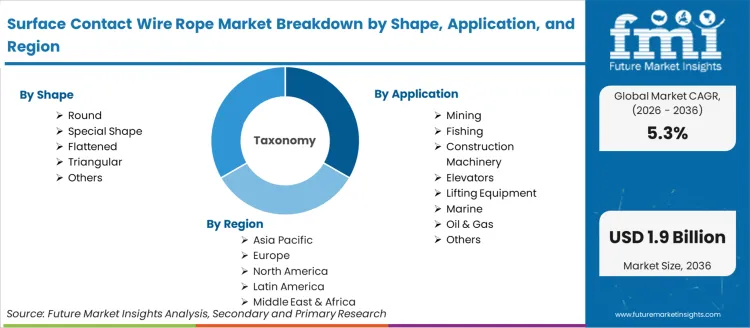
Surface Contact Wire Rope Market Segmentation
| Category | Segments / Values |
|---|---|
| By Shape | Round; Special Shape; Flattened; Triangular; Others |
| By Application | Mining; Fishing; Construction Machinery; Elevators; Lifting Equipment; Marine; Oil & Gas; Others |
| By End-User | Mining Companies; Construction Companies; Industrial Equipment Suppliers; Marine Operators; Manufacturing Facilities; Others |
| By Diameter Range | Small Diameter (6-20mm); Medium Diameter (20-40mm); Large Diameter (40+ mm); Others |
| By Construction Type | 6-Strand; 8-Strand; 19-Strand; 35-Strand; Others |
| By Region | North America; Europe; Asia Pacific; Latin America; Middle East & Africa |
Surface Contact Wire Rope Market Analysis by Shape
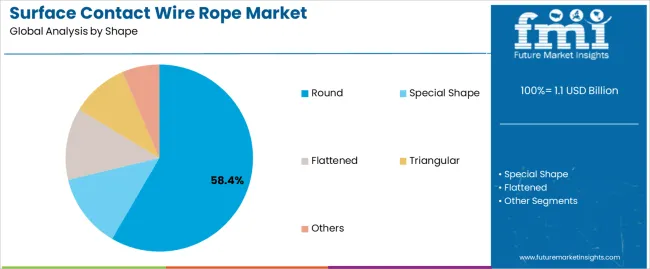
| Segment | 2026-2036 Outlook |
|---|---|
| Round |
|
| Special Shape |
|
| Flattened |
|
| Others |
|
Surface Contact Wire Rope Market Analysis by Application
| Segment | 2026-2036 Outlook |
|---|---|
| Mining |
|
| Construction Machinery |
|
| Lifting Equipment |
|
| Others |
|
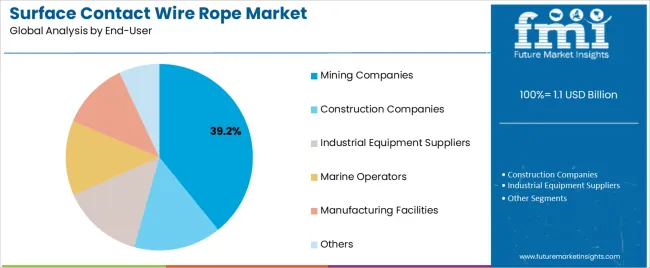
Surface Contact Wire Rope Market Analysis by End-User
| End-User | Status & Outlook (2026-2036) |
|---|---|
| Mining Companies |
|
| Construction Companies |
|
| Industrial Equipment Suppliers |
|
| Others |
|
KEY TRENDS
| KEY TRENDS | DRIVERS | RESTRAINTS |
|---|---|---|
| Advanced Construction Technology - Specialized strand configurations and surface treatment innovations delivering enhanced load distribution, improved fatigue resistance, and superior performance characteristics for demanding industrial applications with extended service life and reliability under extreme operating conditions including high-cycle operations and environmental exposure. | Global Mining Expansion across resource extraction operations and mineral processing facilities creating substantial demand for heavy-duty wire rope solutions supporting deep shaft hoisting, material transport systems, and mining equipment applications requiring exceptional load capacity and certified safety performance for operational efficiency. | Price Sensitivity in industrial procurement and budget constraints limiting adoption of premium wire rope solutions across cost-conscious mining operations and construction projects with restricted capital equipment budgets affecting specialized rope technology adoption. |
| Digital Integration - Integration with industrial IoT platforms and monitoring systems enabling predictive maintenance, load monitoring, and performance tracking capabilities for wire rope applications supporting operational optimization, safety enhancement, and maintenance scheduling for improved equipment reliability and operational efficiency. | Construction Industry Growth - Infrastructure development programs and building construction expansion driving adoption of specialized wire rope technology for crane operations, lifting equipment, and construction machinery requiring certified performance standards and safety compliance for diverse construction applications worldwide. | Technical Complexity - Application-specific requirements, installation procedures, and performance validation affecting deployment timelines and operational capabilities for industrial facilities lacking specialized rigging expertise and maintenance capabilities for advanced wire rope systems. |
| Safety Enhancement - Advanced safety monitoring systems and certification programs ensuring reliable wire rope performance while supporting regulatory compliance and operational safety requirements across critical lifting applications and regulated industrial environments with comprehensive testing and validation protocols. | Equipment Modernization - Industrial facility upgrades and equipment enhancements requiring specialized wire rope components for improved operational efficiency, reduced maintenance costs, and enhanced workplace safety with superior load capacity performance and reliability characteristics. | Market Fragmentation - Diverse industrial applications, equipment specifications, and regional requirements creating complexity for suppliers developing standardized wire rope solutions across multiple industrial sectors and international markets with varying performance standards and regulatory requirements. |
Analysis of Surface Contact Wire Rope Market by Key Countries
.webp "Top Country Growth Comparison Surface Contact Wire Rope Market Cagr (2026 2036)")
| Country | CAGR |
|---|---|
| China | 7.2% |
| India | 6.6% |
| Germany | 6.1% |
| Brazil | 5.6% |
| United States | 5.0% |
| United Kingdom | 4.5% |
| Japan | 4.0% |
Source: FMI analysis based on primary research and proprietary forecasting model
China Leads Global Market Growth with Manufacturing Excellence
China is projected to exhibit exceptional growth with a market value of USD 394.3 million by 2036, driven by extensive mining expansion programs and comprehensive industrial development initiatives creating substantial opportunities for wire rope technology suppliers across resource extraction operations, construction projects, and industrial facility development sectors. The country's ambitious mining modernization programs including national resource development initiatives and automated production facility expansion are creating consistent demand for specialized wire rope systems. Major mining companies and industrial equipment suppliers including China National Coal Group, China Shenhua Energy, and specialized wire rope manufacturers are establishing comprehensive rigging solution programs to support large-scale mining operations and heavy industrial applications.
- National mining expansion programs and resource extraction development projects are supporting widespread adoption of wire rope technologies across mining systems, driving demand for high-performance components with exceptional load capacity characteristics
- Industrial facility development initiatives and construction infrastructure programs are creating substantial opportunities for suppliers requiring consistent performance and cost-effective wire rope solutions for diverse heavy-duty applications
- Equipment modernization and facility upgrades are facilitating adoption of specialized wire rope systems throughout major industrial development regions supporting operational efficiency and safety compliance
India Demonstrates Strong Market Potential with Infrastructure Growth
India is expanding to reach USD 144.9 million by 2036, supported by extensive construction industry development programs and comprehensive mining infrastructure modernization initiatives creating demand for wire rope solutions across diverse construction equipment and mining application segments. The country's growing industrial manufacturing capabilities and expanding infrastructure development are driving demand for wire rope components that provide exceptional reliability while supporting heavy-duty lifting system requirements. Industrial companies and construction facilities are investing in wire rope technology to support growing infrastructure demand and industrial development advancement requirements.
- Construction industry expansion and infrastructure development are creating opportunities for wire rope components across diverse application segments requiring exceptional load capacity and competitive performance specifications
- Mining infrastructure development programs and industrial facility modernization are driving investments in heavy-duty lifting systems supporting operational efficiency requirements throughout major industrial regions
- Industrial facility growth and specialized construction technology development programs are enhancing demand for quality wire rope solutions throughout Indian construction and mining markets
Germany Maintains Leadership with Engineering Excellence
Germany is projected to reach USD 89.7 million by 2036, supported by the country's leadership in industrial engineering technology and advanced manufacturing systems requiring sophisticated wire rope solutions for precision lifting and industrial automation applications. German manufacturing operators are implementing cutting-edge wire rope platforms that support advanced operational capabilities, precision performance, and comprehensive quality monitoring protocols. The market is characterized by focus on engineering excellence, technology innovation, and compliance with stringent industrial safety and performance standards.
- Industrial engineering industry investments and manufacturing technology leadership are prioritizing advanced wire rope technologies that demonstrate superior performance and reliability while meeting German industrial and safety standards
- Precision manufacturing leadership programs and technology innovation initiatives are driving adoption of precision-engineered wire rope systems that support advanced industrial infrastructure and production optimization
- Manufacturing system engineering programs for facility enhancement are facilitating adoption of specialized wire rope technologies throughout major industrial manufacturing and development centers
Brazil Expands Market with Infrastructure Development
Brazil is growing to reach USD 53.0 million by 2036, driven by mining infrastructure development programs and increasing industrial capabilities creating opportunities for wire rope suppliers serving both mining operators and construction contractors. The country's expanding mining sector and growing industrial infrastructure are creating demand for wire rope components that support diverse mining requirements while maintaining performance standards. Mining companies and industrial facilities are developing technology strategies to support operational efficiency and system reliability advancement.
- Mining infrastructure development programs and industrial modernization are facilitating adoption of wire rope components capable of supporting diverse mining requirements and competitive performance standards
- Industrial expansion and resource-focused development programs are enhancing demand for quality wire rope solutions that support operational efficiency and mining system reliability
- Technology market expansion and specialized industrial system development are creating opportunities for advanced wire rope capabilities across Brazilian mining and industrial facilities
United States Focuses on Technology Innovation and Premium Applications
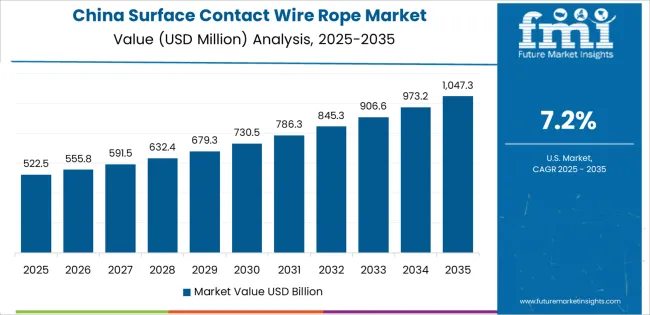
The United States is projected to reach USD 84.4 million by 2036, expanding at a CAGR of 5.0%, driven by advanced industrial technology innovation and specialized mining applications supporting resource extraction and comprehensive construction technology applications. The country's established industrial technology tradition including major equipment manufacturers and construction facilities are creating demand for high-performance wire rope components that support operational advancement and safety standards. Manufacturers and industrial system suppliers are maintaining comprehensive development capabilities to support diverse mining and construction requirements.
- Advanced industrial technology innovation including major equipment manufacturers and specialized construction programs are supporting demand for quality wire rope systems that meet contemporary performance and reliability standards
- Resource extraction advancement and industrial construction system programs are creating opportunities for specialized wire rope components that provide comprehensive operational safety support
- Industrial technology excellence and component quality enhancement programs are facilitating adoption of advanced wire rope capabilities throughout major mining and construction regions
United Kingdom Emphasizes Technology Heritage
The United Kingdom is growing to reach USD 44.9 million by 2036, supported by manufacturing technology heritage and established industrial engineering communities driving demand for premium wire rope solutions across traditional industrial systems and specialized construction applications. The country's rich industrial engineering heritage including major construction companies and established industrial system capabilities create demand for wire rope components that support both legacy system advancement and modern industrial applications.
- Manufacturing technology heritage preservation and advanced industrial system programs are supporting demand for specialized wire rope systems that meet historical excellence and contemporary performance standards
- Industrial construction collaboration and international partnership development are creating opportunities for wire rope components throughout British industrial system facilities
- Technology modernization and infrastructure advancement programs are facilitating adoption of advanced wire rope technologies across traditional construction markets
Japan Maintains Precision with Technology Leadership
Japan is projected to reach USD 36.8 million by 2036, driven by precision manufacturing technology tradition and established industrial leadership supporting both domestic construction system markets and export-oriented component production. Japanese companies maintain sophisticated wire rope development capabilities, with established manufacturers continuing to lead in rope technology and industrial equipment standards.
- Precision manufacturing technology tradition and industrial leadership including major equipment manufacturers are supporting continued demand for high-performance components that meet exacting quality standards
- Advanced manufacturing system research and traditional industrial excellence are creating opportunities for premium wire rope components throughout Japanese industrial markets
- Export manufacturing excellence and component quality programs are facilitating adoption of advanced wire rope production capabilities across specialized industrial manufacturing facilities
What is the market split by country in Europe?
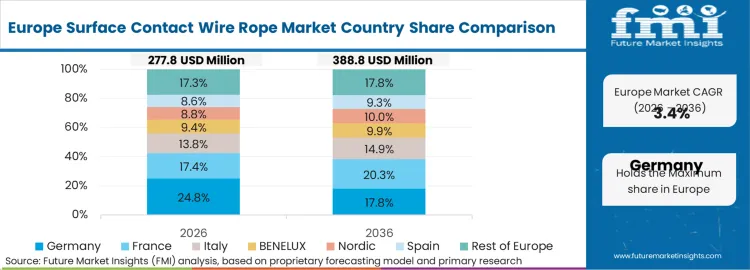
European surface contact wire rope operations are increasingly concentrated between German engineering excellence and specialized manufacturing across multiple countries. German facilities dominate high-performance wire rope production for precision industrial and construction applications, leveraging cutting-edge manufacturing technologies and strict quality protocols that command price premiums in global markets. British industrial technology operators maintain leadership in marine and specialized lifting applications, with organizations like specialized engineering companies and maritime contractors driving technical specifications that suppliers must meet to access major industrial contracts.
Eastern European operations in Czech Republic and Poland are capturing specialized production contracts through precision manufacturing expertise and EU compliance standards, particularly in component fabrication and assembly technologies for industrial applications. These facilities increasingly serve as development partners for Western European industrial programs while building their own wire rope technology expertise.
The regulatory environment presents both opportunities and constraints. European industrial safety framework requirements create quality standards that favor established European manufacturers and industrial system operators while ensuring consistent performance specifications for critical lifting infrastructure and safety applications. Brexit has created complexity for UK industrial collaboration with EU programs, driving opportunities for direct relationships between British operators and international wire rope suppliers.
Technology collaboration accelerates as industrial companies seek performance advancement to support major infrastructure development milestones and construction project timelines. Vertical integration increases, with major industrial system operators acquiring specialized manufacturing capabilities to secure component supplies and quality control for critical construction programs. Smaller industrial contractors face pressure to specialize in niche applications or risk displacement by larger, more comprehensive operations serving mainstream construction and mining requirements.
Market Dynamics Drive Innovation in South Korea
South Korean surface contact wire rope operations reflect the country's advanced manufacturing technology capabilities and export-oriented industrial development model. Major industrial system operators including Hyundai Heavy Industries and construction companies drive component procurement strategies for their construction facilities, establishing direct relationships with specialized wire rope suppliers to secure consistent quality and performance for their industrial development programs and advanced construction technology systems targeting both domestic infrastructure and international collaboration projects.
The Korean market demonstrates particular strength in integrating wire rope technologies into heavy construction platforms and advanced industrial system configurations, with engineering teams developing solutions that bridge traditional construction rope applications and next-generation industrial systems. This integration approach creates demand for specific performance specifications that differ from conventional applications, requiring suppliers to adapt wire rope capabilities and system coordination characteristics.
Regulatory frameworks emphasize industrial safety and construction system reliability, with Korean industrial standards often exceeding international requirements for wire rope systems. This creates barriers for standard component suppliers but benefits established manufacturers who can demonstrate industrial-grade performance capabilities. The regulatory environment particularly favors suppliers with Korean construction system qualification and comprehensive testing documentation systems.
Supply chain excellence remains critical given Korea's construction focus and international collaboration dynamics. Industrial system operators increasingly pursue development partnerships with suppliers in Japan, Germany, and specialized manufacturers to ensure access to cutting-edge wire rope technologies while managing infrastructure risks. Investment in industrial infrastructure supports performance advancement during extended construction development cycles.
What factors define the competitive landscape of the surface contact wire rope market?
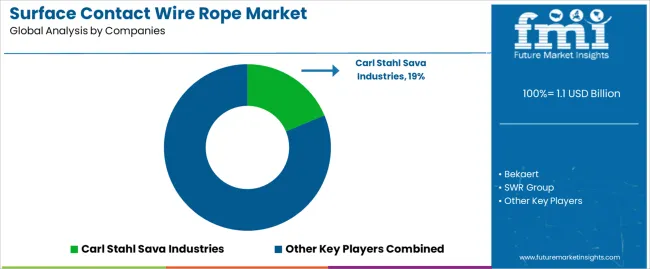
Carl Stahl Sava Industries leads the market with 18.7% share owing to its comprehensive wire rope portfolio and established industrial relationships, which manufacturers use to implement integrated lifting solutions across diverse heavy-duty applications. Profit pools are consolidating upstream in advanced material development and downstream in application-specific solutions for mining, construction, and specialized industrial markets where performance reliability, load capacity optimization, and consistent quality command substantial premiums. Value is migrating from basic wire rope production to specification-driven, application-ready lifting systems where material expertise, precision manufacturing, and reliable integration capabilities create competitive advantages.
Several archetypes define market leadership: established European component companies defending share through comprehensive industrial development and proven mining support; German industrial suppliers leveraging manufacturing excellence and engineering capabilities; American technology leaders with construction expertise and precision manufacturing heritage; and emerging Asian manufacturers pursuing cost-effective production while developing advanced material capabilities.
Switching costs - system integration, equipment compatibility validation, industrial certification - provide stability for established suppliers, while technological advancement requirements and specialized application growth create opportunities for innovative component manufacturers. Consolidation continues as companies seek manufacturing scale; direct industrial partnerships grow for specialized applications while traditional distribution remains relationship-driven. Focus areas: secure premium mining and construction market positions with application-specific performance specifications and technical collaboration; develop wire rope technology and advanced manufacturing capabilities; explore specialized applications including marine and oil & gas requirements.
| Stakeholder Type | Primary Advantage | Repeatable Plays |
|---|---|---|
| European Component Leaders | Comprehensive industrial expertise; proven construction integration; established manufacturer relationships | Precision manufacturing; technical innovation; industrial certification support |
| German Industrial Suppliers | Manufacturing excellence; comprehensive construction development programs; established customer partnerships | Engineering collaboration focus; integrated solutions; technical consultation |
| American Technology Leaders | Construction system expertise; precision technology leadership; trusted by major industrial programs | Industrial partnerships; application-specific specifications; construction infrastructure collaboration |
| Emerging Asian Producers | Manufacturing efficiency; competitive pricing; rapid technology development | Production scaling; technology advancement; market entry strategies |
| Industrial Distributors | Technical distribution networks; industrial service relationships | Industrial expertise; inventory management; technical support services |
Key Players in the Surface Contact Wire Rope Market
- Carl Stahl Sava Industries
- Bekaert
- SWR Group
- Industrial Wire Rope Supply
- Usha Martin
- Kiswire
- Teufelberger
- PFEIFER
- DSR Wire
- Gustav Wolf
- YoungWire
- Brugg
- Fasten Steel Rope
- Guizhou Steel Rope
- Shenwang Group Wire Rope
- Zhongying Wire Rope
- Taili Steel Rope
- Langshan Wire Rope
- Safety Wire Rope
- JULI Sling
Scope of the report
| Metric | Value |
|---|---|
| Quantitative Units | USD 1.16 billion to USD 1.94 billion, at a CAGR of 5.30% |
| Market Definition | Surface contact wire ropes are specialized steel rope constructions where the outer strand wires are shaped to present flat or profiled contact surfaces, increasing the bearing area between adjacent wires and strands to improve fatigue life, abrasion resistance, and load-bearing capacity in mining, crane, elevator, offshore, and construction hoisting applications. |
| Segmentation | Shape (Round), Application (Mining) |
| Regions Covered | North America, Latin America, Europe, East Asia, South Asia, Oceania, Middle East and Africa |
| Countries Covered | India, China, USA, Canada, UK, Germany, Japan, and 40 plus countries |
| Key Companies Profiled | Bekaert, Carl Stahl Sava Industries, SWR Group, Industrial Wire Rope Supply, Usha Martin, Kiswire, Teufelberger, PFEIFER, DSR Wire, Gustav Wolf |
| Forecast Period | 2026 to 2036 |
| Approach | Forecasting models apply a hybrid bottom-up and top-down methodology starting with verified surface contact wire rope transaction data and projecting adoption velocity across defined segments and regions. |
Surface Contact Wire Rope Market Segmentation
By Shape
- Round
- Special Shape
- Flattened
- Triangular
- Others
By Application
- Mining
- Fishing
- Construction Machinery
- Elevators
- Lifting Equipment
- Marine
- Oil & Gas
- Others
By End-User
- Mining Companies
- Construction Companies
- Industrial Equipment Suppliers
- Marine Operators
- Manufacturing Facilities
- Others
By Diameter Range
- Small Diameter (6-20mm)
- Medium Diameter (20-40mm)
- Large Diameter (40+ mm)
- Others
By Construction Type
- 6-Strand
- 8-Strand
- 19-Strand
- 35-Strand
- Others
By Region
- North America
- United States
- Canada
- Mexico
- Latin America
- Brazil
- Chile
- Rest of Latin America
- Western Europe
- Germany
- United Kingdom
- France
- Italy
- Spain
- Nordic
- BENELUX
- Rest of Western Europe
- Eastern Europe
- Russia
- Poland
- Rest of Eastern Europe
- East Asia
- China
- Japan
- South Korea
- South Asia Pacific
- India
- ASEAN
- Australia & New Zealand
- Rest of South Asia Pacific
- Middle East & Africa
- Kingdom of Saudi Arabia
- Other GCC Countries
- Turkey
- South Africa
- Other African Union
- Rest of Middle East & Africa
Bibliography
- 1. International Organization for Standardization. (2024). ISO 2408: Steel Wire Ropes for General Purposes, Minimum Breaking Forces. ISO.
- 2. European Committee for Standardization. (2024). EN 12385: Steel Wire Ropes, Safety Requirements. CEN.
- 3. International Labour Organization. (2024). Safety and Health in Mines Convention: Hoisting Equipment Guidelines. ILO.
- 4. American Society of Mechanical Engineers. (2024). ASME B30.5: Mobile and Locomotive Cranes, Wire Rope Inspection. ASME.
- 5. World Steel Association. (2024). Steel Statistical Yearbook 2024: Wire Rod Production Data. worldsteel.
- 6. Organisation for Economic Co-operation and Development. (2024). OECD Steel Committee: Specialty Steel Products Review. OECD.
This bibliography is provided for reader reference. The full FMI report contains the complete reference list with primary research documentation.
Frequently Asked Questions
How large is the demand for Surface Contact Wire Rope in the global market in 2026?
Demand for surface contact wire rope in the global market is estimated to be valued at USD 1.16 billion in 2026.
What will be the market size of Surface Contact Wire Rope by 2036?
Market size for surface contact wire rope is projected to reach USD 1.94 billion by 2036.
What is the expected demand growth for Surface Contact Wire Rope between 2026 and 2036?
Demand for surface contact wire rope is expected to grow at a CAGR of 5.30% between 2026 and 2036.
Which Shape is poised to lead global sales by 2026?
Round accounts for 58.4% in 2026, reflecting established procurement specifications across primary buyer channels.
How is Mining driving Surface Contact Wire Rope adoption in 2026?
Mining represents 41.7% of segment demand as end-use requirements favor this category.
What is driving demand in China?
China registers a 7.20% CAGR through 2036, propelled by domestic investment and rising end-use consumption.
What does Surface Contact Wire Rope Market definition mean in this report?
Surface contact wire ropes are specialized steel rope constructions where the outer strand wires are shaped to present flat or profiled contact surfaces, increasing the bearing area between adjacent wires and strands to improve fatigue life, abrasion resistance, and load-bearing capacity in mining, crane, elevator, offshore, and construction hoisting applications.
How does FMI build and validate the Surface Contact Wire Rope forecast?
Forecasting models apply a hybrid bottom-up methodology starting with verified transaction data, cross-validated against publicly reported procurement volumes and company financial disclosures on a quarterly refresh schedule.
Preview the report firsthand - request a free sample
Get SampleGet the brochure for pricing and purchase details.
Get PDFTable of Content
- Executive Summary
- Global Market Outlook
- Demand-side Trends
- Supply-side Trends
- Technology Roadmap Analysis
- Analysis and Recommendations
- Market Overview
- Market Coverage / Taxonomy
- Market Definition / Scope / Limitations
- Research Methodology
- Chapter Orientation
- Analytical Lens and Working Hypotheses
- Market Structure, Signals, and Trend Drivers
- Benchmarking and Cross-market Comparability
- Market Sizing, Forecasting, and Opportunity Mapping
- Research Design and Evidence Framework
- Desk Research Programme (Secondary Evidence)
- Company Annual and Sustainability Reports
- Peer-reviewed Journals and Academic Literature
- Corporate Websites, Product Literature, and Technical Notes
- Earnings Decks and Investor Briefings
- Statutory Filings and Regulatory Disclosures
- Technical White Papers and Standards Notes
- Trade Journals, Industry Magazines, and Analyst Briefs
- Conference Proceedings, Webinars, and Seminar Materials
- Government Statistics Portals and Public Data Releases
- Press Releases and Reputable Media Coverage
- Specialist Newsletters and Curated Briefings
- Sector Databases and Reference Repositories
- FMI Internal Proprietary Databases and Historical Market Datasets
- Subscription Datasets and Paid Sources
- Social Channels, Communities, and Digital Listening Inputs
- Additional Desk Sources
- Expert Input and Fieldwork (Primary Evidence)
- Primary Modes
- Qualitative Interviews and Expert Elicitation
- Quantitative Surveys and Structured Data Capture
- Blended Approach
- Why Primary Evidence is Used
- Field Techniques
- Interviews
- Surveys
- Focus Groups
- Observational and In-context Research
- Social and Community Interactions
- Stakeholder Universe Engaged
- C-suite Leaders
- Board Members
- Presidents and Vice Presidents
- R&D and Innovation Heads
- Technical Specialists
- Domain Subject-matter Experts
- Scientists
- Physicians and Other Healthcare Professionals
- Governance, Ethics, and Data Stewardship
- Research Ethics
- Data Integrity and Handling
- Primary Modes
- Tooling, Models, and Reference Databases
- Desk Research Programme (Secondary Evidence)
- Data Engineering and Model Build
- Data Acquisition and Ingestion
- Cleaning, Normalisation, and Verification
- Synthesis, Triangulation, and Analysis
- Quality Assurance and Audit Trail
- Market Background
- Market Dynamics
- Drivers
- Restraints
- Opportunity
- Trends
- Scenario Forecast
- Demand in Optimistic Scenario
- Demand in Likely Scenario
- Demand in Conservative Scenario
- Opportunity Map Analysis
- Product Life Cycle Analysis
- Supply Chain Analysis
- Investment Feasibility Matrix
- Value Chain Analysis
- PESTLE and Porter’s Analysis
- Regulatory Landscape
- Regional Parent Market Outlook
- Production and Consumption Statistics
- Import and Export Statistics
- Market Dynamics
- Global Market Analysis 2021 to 2025 and Forecast, 2026 to 2036
- Historical Market Size Value (USD Million) Analysis, 2021 to 2025
- Current and Future Market Size Value (USD Million) Projections, 2026 to 2036
- Y-o-Y Growth Trend Analysis
- Absolute $ Opportunity Analysis
- Global Market Pricing Analysis 2021 to 2025 and Forecast 2026 to 2036
- Global Market Analysis 2021 to 2025 and Forecast 2026 to 2036, By Shape
- Introduction / Key Findings
- Historical Market Size Value (USD Million) Analysis By Shape , 2021 to 2025
- Current and Future Market Size Value (USD Million) Analysis and Forecast By Shape , 2026 to 2036
- Round
- Special Shape
- Flattened
- Triangular
- Others
- Round
- Y-o-Y Growth Trend Analysis By Shape , 2021 to 2025
- Absolute $ Opportunity Analysis By Shape , 2026 to 2036
- Global Market Analysis 2021 to 2025 and Forecast 2026 to 2036, By Application
- Introduction / Key Findings
- Historical Market Size Value (USD Million) Analysis By Application, 2021 to 2025
- Current and Future Market Size Value (USD Million) Analysis and Forecast By Application, 2026 to 2036
- Mining
- Fishing
- Construction Machinery
- Elevators
- Lifting Equipment
- Marine
- Oil & Gas
- Others
- Mining
- Y-o-Y Growth Trend Analysis By Application, 2021 to 2025
- Absolute $ Opportunity Analysis By Application, 2026 to 2036
- Global Market Analysis 2021 to 2025 and Forecast 2026 to 2036, By End-User
- Introduction / Key Findings
- Historical Market Size Value (USD Million) Analysis By End-User, 2021 to 2025
- Current and Future Market Size Value (USD Million) Analysis and Forecast By End-User, 2026 to 2036
- Mining Companies
- Construction Companies
- Industrial Equipment Suppliers
- Marine Operators
- Manufacturing Facilities
- Others
- Mining Companies
- Y-o-Y Growth Trend Analysis By End-User, 2021 to 2025
- Absolute $ Opportunity Analysis By End-User, 2026 to 2036
- Global Market Analysis 2021 to 2025 and Forecast 2026 to 2036, By Diameter Range
- Introduction / Key Findings
- Historical Market Size Value (USD Million) Analysis By Diameter Range, 2021 to 2025
- Current and Future Market Size Value (USD Million) Analysis and Forecast By Diameter Range, 2026 to 2036
- Small Diameter
- Medium Diameter
- Large Diameter
- Others
- Small Diameter
- Y-o-Y Growth Trend Analysis By Diameter Range, 2021 to 2025
- Absolute $ Opportunity Analysis By Diameter Range, 2026 to 2036
- Global Market Analysis 2021 to 2025 and Forecast 2026 to 2036, By Construction Type
- Introduction / Key Findings
- Historical Market Size Value (USD Million) Analysis By Construction Type, 2021 to 2025
- Current and Future Market Size Value (USD Million) Analysis and Forecast By Construction Type, 2026 to 2036
- 6-Strand
- 8-Strand
- 19-Strand
- 35-Strand
- Others
- 6-Strand
- Y-o-Y Growth Trend Analysis By Construction Type, 2021 to 2025
- Absolute $ Opportunity Analysis By Construction Type, 2026 to 2036
- Global Market Analysis 2021 to 2025 and Forecast 2026 to 2036, By Region
- Introduction
- Historical Market Size Value (USD Million) Analysis By Region, 2021 to 2025
- Current Market Size Value (USD Million) Analysis and Forecast By Region, 2026 to 2036
- North America
- Latin America
- Western Europe
- Eastern Europe
- East Asia
- South Asia and Pacific
- Middle East & Africa
- Market Attractiveness Analysis By Region
- North America Market Analysis 2021 to 2025 and Forecast 2026 to 2036, By Country
- Historical Market Size Value (USD Million) Trend Analysis By Market Taxonomy, 2021 to 2025
- Market Size Value (USD Million) Forecast By Market Taxonomy, 2026 to 2036
- By Country
- USA
- Canada
- Mexico
- By Shape
- By Application
- By End-User
- By Diameter Range
- By Construction Type
- By Country
- Market Attractiveness Analysis
- By Country
- By Shape
- By Application
- By End-User
- By Diameter Range
- By Construction Type
- Key Takeaways
- Latin America Market Analysis 2021 to 2025 and Forecast 2026 to 2036, By Country
- Historical Market Size Value (USD Million) Trend Analysis By Market Taxonomy, 2021 to 2025
- Market Size Value (USD Million) Forecast By Market Taxonomy, 2026 to 2036
- By Country
- Brazil
- Chile
- Rest of Latin America
- By Shape
- By Application
- By End-User
- By Diameter Range
- By Construction Type
- By Country
- Market Attractiveness Analysis
- By Country
- By Shape
- By Application
- By End-User
- By Diameter Range
- By Construction Type
- Key Takeaways
- Western Europe Market Analysis 2021 to 2025 and Forecast 2026 to 2036, By Country
- Historical Market Size Value (USD Million) Trend Analysis By Market Taxonomy, 2021 to 2025
- Market Size Value (USD Million) Forecast By Market Taxonomy, 2026 to 2036
- By Country
- Germany
- UK
- Italy
- Spain
- France
- Nordic
- BENELUX
- Rest of Western Europe
- By Shape
- By Application
- By End-User
- By Diameter Range
- By Construction Type
- By Country
- Market Attractiveness Analysis
- By Country
- By Shape
- By Application
- By End-User
- By Diameter Range
- By Construction Type
- Key Takeaways
- Eastern Europe Market Analysis 2021 to 2025 and Forecast 2026 to 2036, By Country
- Historical Market Size Value (USD Million) Trend Analysis By Market Taxonomy, 2021 to 2025
- Market Size Value (USD Million) Forecast By Market Taxonomy, 2026 to 2036
- By Country
- Russia
- Poland
- Hungary
- Balkan & Baltic
- Rest of Eastern Europe
- By Shape
- By Application
- By End-User
- By Diameter Range
- By Construction Type
- By Country
- Market Attractiveness Analysis
- By Country
- By Shape
- By Application
- By End-User
- By Diameter Range
- By Construction Type
- Key Takeaways
- East Asia Market Analysis 2021 to 2025 and Forecast 2026 to 2036, By Country
- Historical Market Size Value (USD Million) Trend Analysis By Market Taxonomy, 2021 to 2025
- Market Size Value (USD Million) Forecast By Market Taxonomy, 2026 to 2036
- By Country
- China
- Japan
- South Korea
- By Shape
- By Application
- By End-User
- By Diameter Range
- By Construction Type
- By Country
- Market Attractiveness Analysis
- By Country
- By Shape
- By Application
- By End-User
- By Diameter Range
- By Construction Type
- Key Takeaways
- South Asia and Pacific Market Analysis 2021 to 2025 and Forecast 2026 to 2036, By Country
- Historical Market Size Value (USD Million) Trend Analysis By Market Taxonomy, 2021 to 2025
- Market Size Value (USD Million) Forecast By Market Taxonomy, 2026 to 2036
- By Country
- India
- ASEAN
- Australia & New Zealand
- Rest of South Asia and Pacific
- By Shape
- By Application
- By End-User
- By Diameter Range
- By Construction Type
- By Country
- Market Attractiveness Analysis
- By Country
- By Shape
- By Application
- By End-User
- By Diameter Range
- By Construction Type
- Key Takeaways
- Middle East & Africa Market Analysis 2021 to 2025 and Forecast 2026 to 2036, By Country
- Historical Market Size Value (USD Million) Trend Analysis By Market Taxonomy, 2021 to 2025
- Market Size Value (USD Million) Forecast By Market Taxonomy, 2026 to 2036
- By Country
- Kingdom of Saudi Arabia
- Other GCC Countries
- Turkiye
- South Africa
- Other African Union
- Rest of Middle East & Africa
- By Shape
- By Application
- By End-User
- By Diameter Range
- By Construction Type
- By Country
- Market Attractiveness Analysis
- By Country
- By Shape
- By Application
- By End-User
- By Diameter Range
- By Construction Type
- Key Takeaways
- Key Countries Market Analysis
- USA
- Pricing Analysis
- Market Share Analysis, 2025
- By Shape
- By Application
- By End-User
- By Diameter Range
- By Construction Type
- Canada
- Pricing Analysis
- Market Share Analysis, 2025
- By Shape
- By Application
- By End-User
- By Diameter Range
- By Construction Type
- Mexico
- Pricing Analysis
- Market Share Analysis, 2025
- By Shape
- By Application
- By End-User
- By Diameter Range
- By Construction Type
- Brazil
- Pricing Analysis
- Market Share Analysis, 2025
- By Shape
- By Application
- By End-User
- By Diameter Range
- By Construction Type
- Chile
- Pricing Analysis
- Market Share Analysis, 2025
- By Shape
- By Application
- By End-User
- By Diameter Range
- By Construction Type
- Germany
- Pricing Analysis
- Market Share Analysis, 2025
- By Shape
- By Application
- By End-User
- By Diameter Range
- By Construction Type
- UK
- Pricing Analysis
- Market Share Analysis, 2025
- By Shape
- By Application
- By End-User
- By Diameter Range
- By Construction Type
- Italy
- Pricing Analysis
- Market Share Analysis, 2025
- By Shape
- By Application
- By End-User
- By Diameter Range
- By Construction Type
- Spain
- Pricing Analysis
- Market Share Analysis, 2025
- By Shape
- By Application
- By End-User
- By Diameter Range
- By Construction Type
- France
- Pricing Analysis
- Market Share Analysis, 2025
- By Shape
- By Application
- By End-User
- By Diameter Range
- By Construction Type
- India
- Pricing Analysis
- Market Share Analysis, 2025
- By Shape
- By Application
- By End-User
- By Diameter Range
- By Construction Type
- ASEAN
- Pricing Analysis
- Market Share Analysis, 2025
- By Shape
- By Application
- By End-User
- By Diameter Range
- By Construction Type
- Australia & New Zealand
- Pricing Analysis
- Market Share Analysis, 2025
- By Shape
- By Application
- By End-User
- By Diameter Range
- By Construction Type
- China
- Pricing Analysis
- Market Share Analysis, 2025
- By Shape
- By Application
- By End-User
- By Diameter Range
- By Construction Type
- Japan
- Pricing Analysis
- Market Share Analysis, 2025
- By Shape
- By Application
- By End-User
- By Diameter Range
- By Construction Type
- South Korea
- Pricing Analysis
- Market Share Analysis, 2025
- By Shape
- By Application
- By End-User
- By Diameter Range
- By Construction Type
- Russia
- Pricing Analysis
- Market Share Analysis, 2025
- By Shape
- By Application
- By End-User
- By Diameter Range
- By Construction Type
- Poland
- Pricing Analysis
- Market Share Analysis, 2025
- By Shape
- By Application
- By End-User
- By Diameter Range
- By Construction Type
- Hungary
- Pricing Analysis
- Market Share Analysis, 2025
- By Shape
- By Application
- By End-User
- By Diameter Range
- By Construction Type
- Kingdom of Saudi Arabia
- Pricing Analysis
- Market Share Analysis, 2025
- By Shape
- By Application
- By End-User
- By Diameter Range
- By Construction Type
- Turkiye
- Pricing Analysis
- Market Share Analysis, 2025
- By Shape
- By Application
- By End-User
- By Diameter Range
- By Construction Type
- South Africa
- Pricing Analysis
- Market Share Analysis, 2025
- By Shape
- By Application
- By End-User
- By Diameter Range
- By Construction Type
- USA
- Market Structure Analysis
- Competition Dashboard
- Competition Benchmarking
- Market Share Analysis of Top Players
- By Regional
- By Shape
- By Application
- By End-User
- By Diameter Range
- By Construction Type
- Competition Analysis
- Competition Deep Dive
- Bekaert
- Overview
- Product Portfolio
- Profitability by Market Segments (Product/Age /Sales Channel/Region)
- Sales Footprint
- Strategy Overview
- Marketing Strategy
- Product Strategy
- Channel Strategy
- Carl Stahl Sava Industries
- SWR Group
- Industrial Wire Rope Supply
- Usha Martin
- Kiswire
- Teufelberger
- PFEIFER
- DSR Wire
- Gustav Wolf
- YoungWire
- Brugg
- Fasten Steel Rope
- Guizhou Steel Rope
- Shenwang Group Wire Rope
- Zhongying Wire Rope
- Taili Steel Rope
- Langshan Wire Rope
- Safety Wire Rope
- JULI Sling
- Bekaert
- Competition Deep Dive
- Assumptions & Acronyms Used


