

- Market Size (2026)
- USD 0.90 Bn
- Forecast (2036)
- USD 2.90 Bn
- CAGR (2026 to 2036)
- 12.4%
Embedded Structural Health Monitoring Networks for Aircraft Skins Market Size, Market Forecast and Outlook By FMI
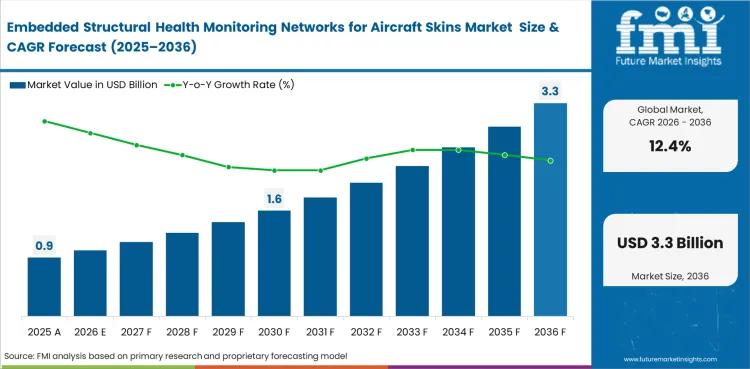
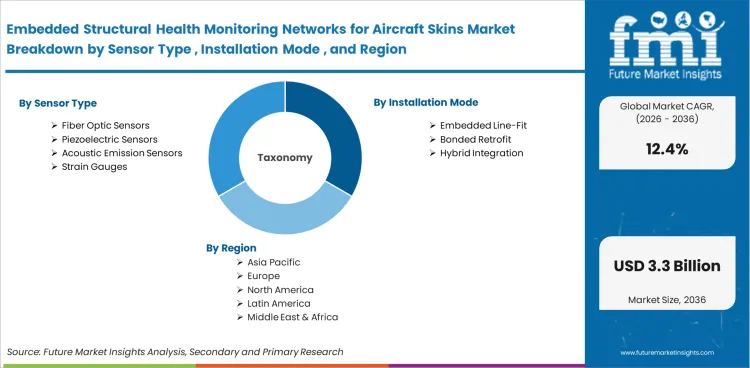
The embedded structural health monitoring networks for aircraft skins market was valued at USD 0.8 billion in 2025. The market is set to reach USD 0.9 billion by 2026-end and grow at a CAGR of 12.4% between 2026 and 2036 to reach USD 2.9 billion by 2036. Embedded line-fit will dominate with a 58.0% installation mode share, while fiber optic sensors will lead the sensor type segment with a 36.0% share.
Summary of the Embedded Structural Health Monitoring Networks for Aircraft Skins Market
- Demand and Growth Drivers
- Wider aircraft digitization and rising composite content in exterior structures are likely to support demand for embedded structural health monitoring networks during the forecast period, with adoption moving alongside engineering work in composite airframes.
- Build-stage integration is likely to remain a major growth driver as OEMs seek earlier visibility into strain, fatigue, impact, and delamination across aircraft skins.
- Condition-based maintenance and lower dependence on manual inspection are expected to support adoption of permanent sensing layouts through the forecast period.
- Product and Segment View
- Fiber optic sensors are likely to remain a leading sensor type segment, supported by their long sensing paths, lower added mass, and suitability for large composite skin structures.
- Embedded line-fit is likely to lead, driven by demand for cleaner routing, stronger validation, and lower modification work during original aircraft build stages.
- Fuselage panels are likely to remain an important high-value segment as large continuous exterior surfaces benefit from permanent sensing and long-service structural tracking, while product direction is also moving with broader aerospace work in aircraft sensors.
- Geography and Competitive Outlook
- China is likely to remain a key market owing to local aircraft manufacturing scale, rising composite structure activity, and stronger line-fit integration opportunity.
- India is likely to sustain strong demand on account of newer aerospace programs, lower installed base, and earlier design-stage adoption of embedded sensing layouts.
- Companies that can combine sensing capability, aerospace engineering support, and strong installation coordination are likely to gain traction during the forecast period.
- Analyst Opinion
- Nikhil Kaitwade, Principal Analyst at FMI says, “Suppliers that can support build-stage integration while delivering reliable structural data across composite and hybrid aircraft skins are likely to strengthen their position over the forecast period.”
- Embedded Structural Health Monitoring Networks for Aircraft Skins Market Value Analysis
- The market is moving from specialist aerospace monitoring programs into a more defined sensing category tied to high-value exterior structural applications.
- Adoption is being supported by build-stage integration as OEMs seek permanent visibility into strain, fatigue, impact, and delamination across composite airframes.
- The market is also gaining from wider use of condition-based maintenance systems that can reduce inspection burden and improve long-term structural tracking.
- Demand is further supported by the need for certified low-mass monitoring layouts that deliver reliable data transmission and stronger decision support across aircraft sensors.
Key Takeaways
- The embedded structural health monitoring networks for aircraft skins market was valued at USD 0.80 billion in 2025.
- By 2036, the embedded structural health monitoring networks for aircraft skins market is expected to be worth USD 2.90 billion.
- From 2026 to 2036, the market is projected to expand at a CAGR of 12.4%.
- The market is projected to create an incremental opportunity of USD 2.00 billion between 2026 and 2036.
- In 2026, embedded line-fit is expected to account for 58.0% of the installation mode segment, driven by stronger demand for build-stage integration across aircraft skin structures.
- China (13.6%) and India (13.1%) are the two of the fastest growing markets in the world.
Embedded Structural Health Monitoring Networks for Aircraft Skins Market Definition
Embedded structural health monitoring networks for aircraft skins refer to permanently installed sensing systems used to monitor structural condition in exterior airframe skins. Scope includes sensors, interrogators, data acquisition units, monitoring software, routing architecture, and integration support used to track strain, fatigue, impact events, delamination, and similar conditions in fuselage panels, wing skins, radomes, and empennage skins.
Embedded Structural Health Monitoring Networks for Aircraft Skins Market Inclusions
Market scope includes fiber optic sensors, piezoelectric sensors, acoustic emission sensors, strain gauges, embedded and bonded network layouts, onboard structural data modules, analytics software, and installation support tied directly to aircraft skin monitoring. Coverage extends across commercial aircraft, military aircraft, business jets, and research platforms.
Embedded Structural Health Monitoring Networks for Aircraft Skins Market Exclusions
Scope excludes handheld non-destructive testing tools, cabin-only sensing systems, engine condition monitoring, generic aircraft sensors without structural skin purpose, and standard coatings or materials without embedded sensing function. Standalone laboratory instruments sold without aircraft skin integration are outside this market assessment.
Embedded Structural Health Monitoring Networks for Aircraft Skins Market Research Methodology
- Primary Research: FMI analysts interacted with aerospace sensing suppliers, aircraft OEM engineering teams, MRO specialists, and structural monitoring experts across key aviation markets.
- Desk Research: The study combined data from aerospace structure monitoring trends, aircraft integration practices, certification requirements, and supplier-level technology developments.
- Market sizing and forecasting: Market value was derived through bottom-up assessment of sensor type, installation mode, skin zone, aircraft platform, monitoring function, network architecture, end user, and sales channel adoption across regions.
- Data validation: Findings were cross-checked at regular intervals against aerospace production activity, supplier developments, and aircraft structure monitoring adoption patterns.
Why is the Embedded Structural Health Monitoring Networks for Aircraft Skins Market Growing?
- Rising aircraft digitization is creating demand for permanent sensing networks that can track strain, fatigue, impact, and delamination across exterior skin structures through long service cycles.
- Build-stage integration is supporting market expansion because embedded line-fit layouts reduce later modification work and give OEMs earlier structural visibility during aircraft production.
- China leads growth at 13.6% because domestic aircraft manufacturing is expanding, composite structure activity is increasing, and line-fit sensing adoption has stronger room to scale.
The market is expanding steadily because aircraft OEMs and operators need better structural visibility across large exterior surfaces that face repeated loading and inspection pressure. Permanent monitoring networks help detect damage earlier and reduce dependence on manual inspection alone. Commercial direction in this segment is also moving close to aircraft exterior thermal gradient monitoring systems.
Installation during original aircraft build remains the strongest growth route because it supports cleaner routing, lower retrofit burden, and stronger validation across fuselage panels, wing skins, radomes, and empennage structures. Embedded line-fit also fits better with aircraft-specific engineering workflows than late-stage bonded modification programs. This preference follows technical movement seen in aircraft radome impact detection systems.
Composite-rich aircraft structures are adding more support because wider skin sections need dependable sensing over long operating periods. Fiber optic sensors remain well placed since they suit long sensing paths and add less weight to high-value structural areas. Material and integration conditions in this market remain closely linked with advanced composites.
Market Segmentation Analysis
- Embedded line-fit holds 58.0% of the installation mode segment, and it remains the leading route because aircraft OEMs prefer build-stage integration for cleaner routing and stronger validation.
- Fiber optic sensors account for the largest sensor type share at 36.0%, with long sensing paths and lower added mass supporting use across wide aircraft skin structures.
- Direct programs lead the sales channel segment, which reflects the project-led nature of aerospace sensing supply and the need for long-cycle engineering coordination.
The market for embedded structural health monitoring networks for aircraft skins is divided into groups based on sensor type, installation mode, skin zone, aircraft platform, monitoring function, network architecture, end user, sales channel, and region. There are Fiber Optic Sensors, Piezoelectric Sensors, Acoustic Emission Sensors, and Strain Gauges under sensor type. By installation mode, the market includes Embedded Line-Fit, Bonded Retrofit, and Hybrid Integration. By skin zone, it covers Fuselage Panels, Wing Skins, Radomes, and Empennage Skins. By aircraft platform, it includes Narrowbody Aircraft, Widebody Aircraft, Military Aircraft, and Business Jets.
Insights into the Sensor Type Segment
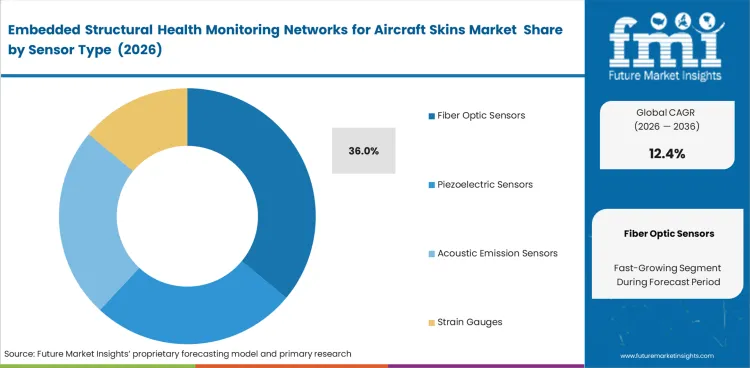
- In 2026, fiber optic sensors will account for 36.0% of the sensor type segment. They lead because they support long sensing paths and add less weight across large aircraft skin structures.
- Piezoelectric sensors and acoustic emission sensors remain relevant for localized event detection, while strain gauges continue to support focused structural load measurement in selected aircraft sections.
Insights into the Installation Mode Segment
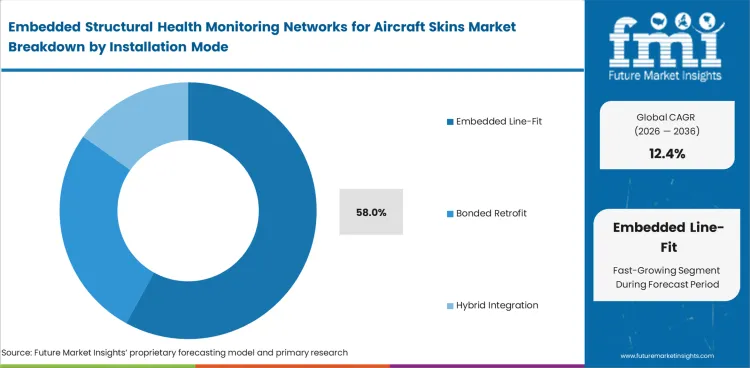
- In 2026, embedded line-fit will account for 58.0% of the installation mode segment. It leads because installation during original aircraft build reduces later modification work and supports cleaner structural routing.
- Bonded retrofit remains important in older fleets where sensing is added after production, while hybrid integration suits programs that combine embedded and added-on monitoring layouts.
Insights into the Skin Zone Segment
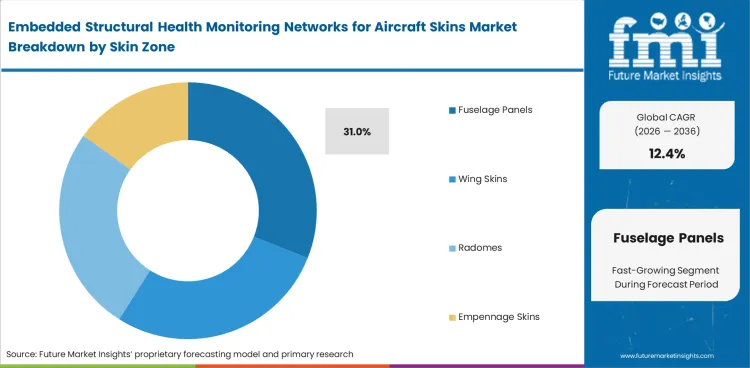
- In 2026, fuselage panels will account for 31.0% of the skin zone segment. They lead because large continuous exterior surfaces benefit from permanent sensing and long-service structural tracking.
- Wing skins, radomes, and empennage skins also create demand because these areas face repeated loading and need dependable monitoring through long operating periods.
Insights into the Aircraft Platform Segment
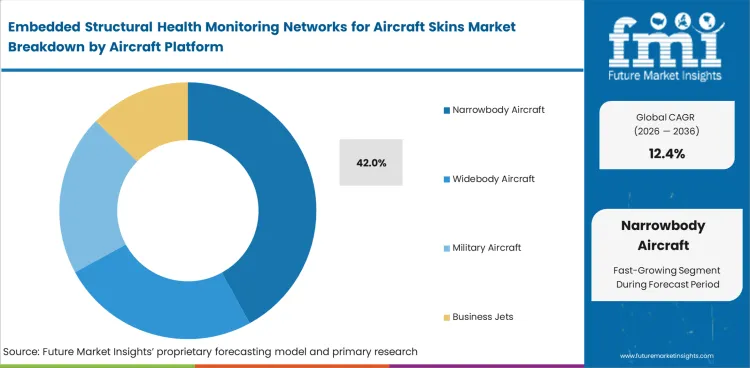
- In 2026, narrowbody aircraft will make up 42.0% of the aircraft platform segment. High fleet volume and repeated short-haul flight cycles support stronger need for strain and fatigue monitoring.
- Widebody aircraft, military aircraft, and business jets remain relevant sub-segments because each platform needs structural monitoring in selected high-value exterior sections.
Insights into the Monitoring Function Segment
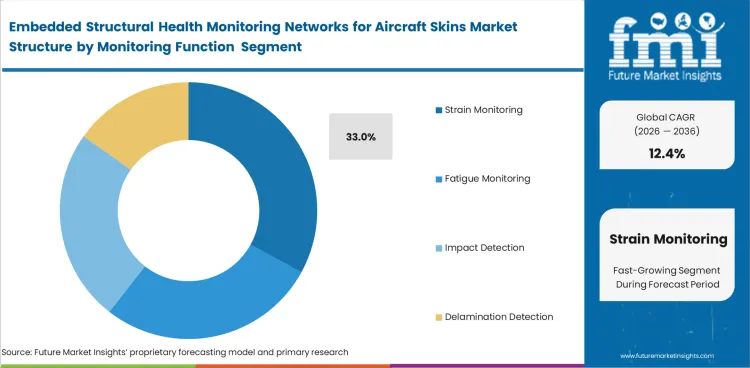
- In 2026, strain monitoring will account for 33.0% of the monitoring function segment. It leads because most embedded network designs begin with structural load tracking and long-term fatigue assessment.
- Fatigue monitoring, impact detection, and delamination detection continue to expand because aircraft operators need wider visibility into damage risk across exterior skin structures.
Insights into the Network Architecture Segment
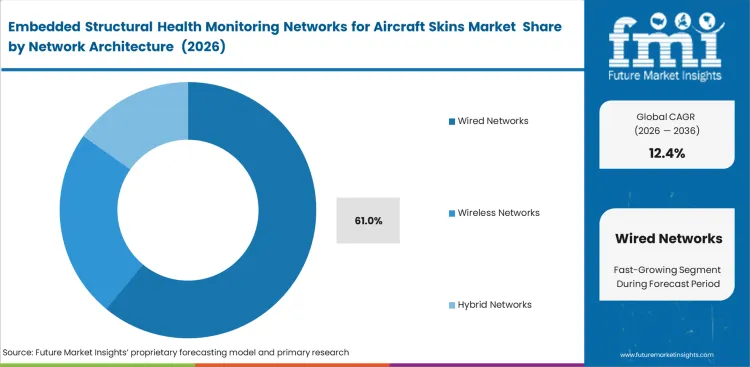
- In 2026, wired networks will secure 61.0% of the network architecture segment. They lead because certification comfort and signal stability still favor routed architectures in aircraft structures.
- Wireless and hybrid networks are progressing in selected programs, though current aerospace practice continues to prefer proven hard-linked structural monitoring layouts.
Insights into the End User Segment
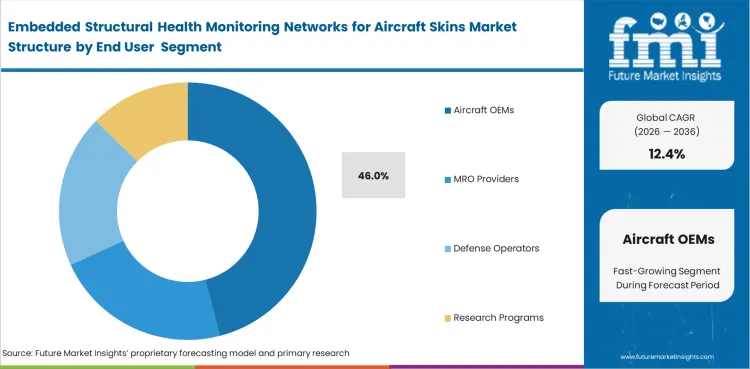
- In 2026, aircraft OEMs will account for 46.0% of the end user segment. They lead because embedded sensing is easier to place during structure design and assembly than during later service modification.
- MRO providers, defense operators, and research programs remain active because they support retrofit evaluation, specialist deployment, and new structural sensing validation work.
Insights into the Sales Channel Segment
- In 2026, direct programs will account for 64.0% of the sales channel segment. This channel leads because embedded sensing systems are usually sold through long-cycle engineering contracts and aircraft-specific validation work.
- Tier-1 supply and engineering contracts remain relevant because aerospace monitoring projects often need specialized integration support and structured supplier coordination.
Embedded Structural Health Monitoring Networks for Aircraft Skins Market Drivers, Restraints, and Opportunities
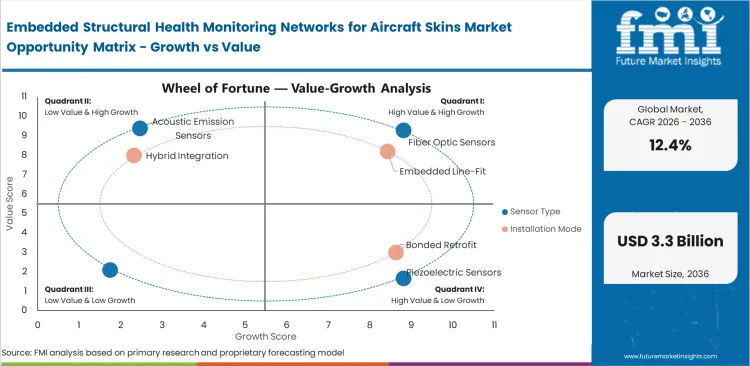
- Rising composite structure adoption and wider aircraft digitization are creating a structured need for permanent sensing networks across exterior skin sections.
- Certification effort, installation complexity, and integration cost continue to slow adoption in retrofit-heavy programs, which keeps rollout more selective in legacy fleets.
- Build-stage integration in new aircraft programs is opening stronger opportunities for suppliers that can support routing, validation, and long-service structural data performance.
The market for embedded structural health monitoring networks for aircraft skins is expanding because aircraft OEMs and operators need better visibility into strain, fatigue, impact, and delamination across exterior structures. Even with barriers such as certification burden and higher integration cost, the market continues to create room for growth in line-fit deployment, condition-based maintenance, and composite-rich airframe programs.
Build-stage structural integration demand
Demand shows that aircraft manufacturers are moving toward permanent sensing layouts that can be installed during original airframe production. Embedded line-fit supports cleaner routing, lower rework, and better validation across fuselage panels, wing skins, radomes, and empennage structures. This route also improves long-service data collection and helps suppliers align with aircraft-specific engineering workflows.
Certification and retrofit cost constraints
Adoption remains limited by qualification requirements, aircraft integration effort, and the cost of adding sensing networks into existing fleets. Retrofit work is harder because routing access is more constrained and validation effort is usually higher than in original production programs. These limits keep deployment more concentrated in new aircraft builds, defense applications, and selected high-value structural sections.
Condition-based maintenance opportunity
Opportunity is rising because permanent sensing networks can support earlier damage detection and reduce dependence on manual inspection alone. Aircraft operators are placing more value on systems that improve structural visibility over long service cycles and help focus maintenance activity where it is most needed. This creates a stronger opening for suppliers that can combine sensing hardware, aerospace engineering support, and dependable structural analytics.
Analysis of Embedded Structural Health Monitoring Networks for Aircraft Skins Market by Key Countries
.webp "Top Country Growth Comparison Embedded Structural Health Monitoring Networks For Aircraft Skins Market Cagr (2026 2036)")
| Country | CAGR (2026-2036) |
|---|---|
| China | 13.6% |
| India | 13.1% |
| United States | 12.2% |
| France | 11.5% |
| Germany | 11.2% |
| Japan | 10.9% |
| United Kingdom | 10.7% |
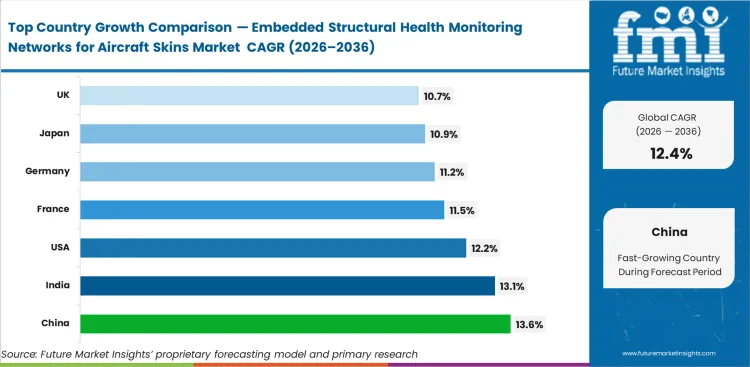
Source: FMI analysis based on primary research and proprietary forecasting model
Embedded Structural Health Monitoring Networks for Aircraft Skins Market CAGR Analysis by Country
- China is in first place with a 13.6% CAGR. This is because local aircraft manufacturing is expanding, composite structure activity is rising, and line-fit sensing adoption has stronger room to scale.
- India at 13.1% shows strong growth potential because newer aerospace programs are expanding from a smaller installed base and embedded sensing can be adopted earlier in the design cycle.
- The United States at 12.2% shows steady demand because major OEM programs, defense engineering depth, and active structural sensing suppliers support commercial development.
The global embedded structural health monitoring networks for aircraft skins market is expected to grow at a 12.4% CAGR from 2026 to 2036. The study highlights the key country markets listed below.
Demand Outlook for Embedded Structural Health Monitoring Networks for Aircraft Skins Market in the United States
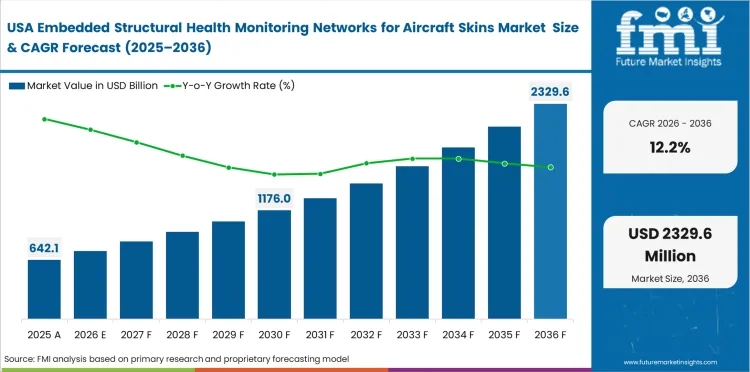
The United States market is projected to grow at a CAGR of 12.2% through 2036. This is because of major OEM programs, strong defense engineering depth, and the presence of active structural sensing suppliers. Luna Innovations and Acellent Technologies have visible positions in the United States market.
- Demand for embedded sensing is supported by major OEM program activity.
- Defense engineering work supports advanced structural monitoring use cases.
- Supplier presence strengthens commercialization and validation capability.
Future Outlook for Embedded Structural Health Monitoring Networks for Aircraft Skins Market in the United Kingdom
The United Kingdom market is projected to grow at a CAGR of 10.7% through 2036. This is supported by aerospace design capability, composite structure work, and stronger airframe analytics activity.
- Aerospace design depth supports demand for structural sensing.
- Composite structure programs create need for permanent monitoring layouts.
- Analytics capability improves the value of long-service structural data.
Opportunity Analysis of Embedded Structural Health Monitoring Networks for Aircraft Skins Market in Germany
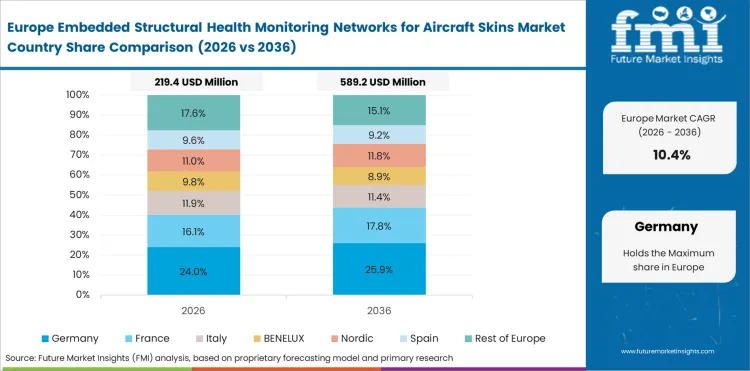
The Germany market is projected to grow at a CAGR of 11.2% through 2036. This is due to advanced aerospace engineering, strong measurement capability, and strict qualification standards in aircraft applications.
- Aerospace engineering depth supports steady technical demand.
- Measurement capability improves deployment in structural skin programs.
- Qualification standards keep adoption selective but commercially relevant.
In-depth Analysis of Embedded Structural Health Monitoring Networks for Aircraft Skins Market in Japan
The Japan market is projected to grow at a CAGR of 10.9% through 2036. This is supported by precision aerospace manufacturing, higher-value structural programs, and continued interest in specialist sensing deployment.
- Precision manufacturing supports demand in higher-value applications.
- Specialist aircraft structures create need for focused monitoring systems.
- Functional sensing development supports adoption in selective programs.
Sales Analysis of Embedded Structural Health Monitoring Networks for Aircraft Skins Market in China
The China market is projected to grow at a CAGR of 13.6% through 2036. This is because local aircraft manufacturing is expanding, composite structure activity is rising, and new programs create stronger line-fit opportunity.
- Local aircraft production supports early sensing integration.
- Composite structure activity increases demand for permanent monitoring.
- New programs create better scope for embedded line-fit layouts.
In-depth Analysis of Embedded Structural Health Monitoring Networks for Aircraft Skins Market in India
The India market is projected to grow at a CAGR of 13.1% through 2036. This is due to expanding aerospace manufacturing, a lower installed base, and earlier design-stage adoption in newer programs.
- Aerospace manufacturing growth supports faster adoption potential.
- Lower installed base creates room for stronger expansion.
- Design-stage work favors embedded sensing layouts in new aircraft programs.
Competitive Landscape and Strategic Positioning
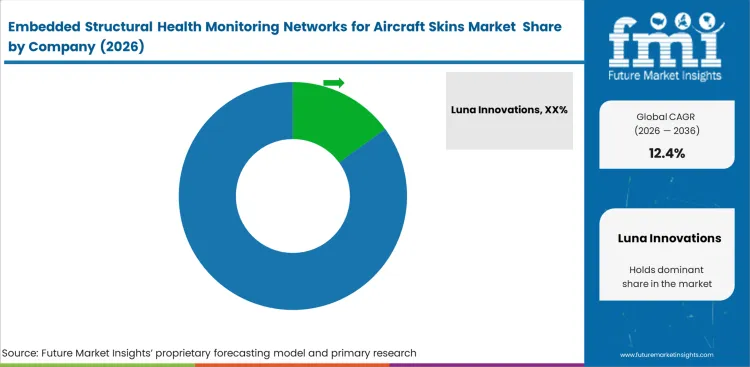
- Luna Innovations is the leading specialist in this market because of its strong fiber optic sensing profile, aerospace structural monitoring presence, and visible role in aircraft skin monitoring applications.
- Acellent Technologies, HBK FiberSensing, and PhotonFirst offer strong sensing capability and aerospace relevance, with positions supported by structural monitoring expertise and integration work in aircraft applications.
- Newer and specialist participants are focusing on high-value structural monitoring applications such as strain tracking, fatigue assessment, impact detection, and long-service data interpretation for composite and hybrid aircraft skins.
Luna Innovations is estimated to lead this market preview space with about 15.0% share because it has an active position in fiber optic sensing and a stronger aerospace structural monitoring profile. Acellent Technologies remains visible in aircraft monitoring activity with strong engineering alignment. HBK FiberSensing and PhotonFirst add depth through sensing capability and aerospace-focused deployment. Metis Design Corporation has a specialist role in structural skin monitoring projects. Safran and TE Connectivity remain relevant because of their broader aerospace system presence and integration capability.
Barriers include certification effort, installation complexity, integration cost, and the need for aircraft-specific validation before broader deployment. Structural monitoring systems also face long qualification cycles and dependence on OEM-led program timing. Strategic priorities include improving build-stage integration, strengthening structural analytics, reducing retrofit burden, and expanding condition-based maintenance value.
Key Companies in the Embedded Structural Health Monitoring Networks for Aircraft Skins Market
Key global companies leading the embedded structural health monitoring networks for aircraft skins market include:
- Luna Innovations (USA), Acellent Technologies (USA), and HBK FiberSensing (Portugal). These companies have strong sensing capability, visible aerospace monitoring activity, and technical depth in structural data applications.
- PhotonFirst (Netherlands), Metis Design Corporation (USA), and Safran (France) have developed positions through aerospace engineering relevance, structural monitoring specialization, and integration support in aircraft programs.
- TE Connectivity (Switzerland/Ireland operational footprint) and other specialist participants remain active through component capability, aerospace connectivity strength, and project-led support for aircraft-specific monitoring layouts.
Competitive Benchmarking in the Embedded Structural Health Monitoring Networks for Aircraft Skins Market
| Company | Sensor Breadth | Aerospace Focus | Skin Integration Depth | Geographic Footprint |
|---|---|---|---|---|
| Luna Innovations | High | High | High | Global |
| Acellent Technologies | High | High | High | North America / Global |
| HBK FiberSensing | High | Medium | Medium | Europe / Global |
| PhotonFirst | Medium | High | Medium | Europe |
| Metis Design Corporation | Medium | High | High | North America |
| Safran | Medium | Medium | Medium | Global |
| TE Connectivity | Medium | Medium | Low | Global |
Source: Future Market Insights competitive analysis, 2026.
Key Developments in Embedded Structural Health Monitoring Networks for Aircraft Skins Market
- June 2025: NLR and PhotonFirst partnered to jointly develop a real-time SHUMS solution for helicopter condition monitoring, focused on structural loads and fatigue during flight.
- October 2025: TransDigm completed its acquisition of Simmonds Precision Products from RTX, adding fuel and proximity sensing and structural health monitoring solutions for aerospace and defense markets.
Key players in the Embedded Structural Health Monitoring Networks for Aircraft Skins Market
- Luna Innovations
- Acellent Technologies
- HBK FiberSensing
- PhotonFirst
- Metis Design Corporation
- Safran
- TE Connectivity
Report Scope and Coverage
| Parameter | Details |
|---|---|
| Quantitative Units | USD 0.90 billion to USD 2.90 billion, at a CAGR of 12.4% |
| Market Definition | The embedded structural health monitoring networks for aircraft skins market covers permanently installed sensing systems used to monitor strain, fatigue, impact, and delamination across exterior airframe skin structures. |
| Regions Covered | North America, Latin America, Europe, East Asia, South Asia and Pacific, Middle East and Africa |
| Countries Covered | United States, United Kingdom, France, Germany, Japan, China, India, and other key aerospace markets |
| Key Companies Profiled | Luna Innovations, Acellent Technologies, HBK FiberSensing, PhotonFirst, Metis Design Corporation, Safran, TE Connectivity |
| Forecast Period | 2026 to 2036 |
| Approach | Hybrid bottom-up and top-down methodology based on supplier activity, aircraft program adoption, structural integration trends, and regional demand forecasting across segments |
Embedded Structural Health Monitoring Networks for Aircraft Skins Market by Segments
Embedded Structural Health Monitoring Networks for Aircraft Skins Market Segmented by Sensor Type
- Fiber Optic Sensors
- Piezoelectric Sensors
- Acoustic Emission Sensors
- Strain Gauges
Embedded Structural Health Monitoring Networks for Aircraft Skins Market Segmented by Installation Mode
- Embedded Line-Fit
- Bonded Retrofit
- Hybrid Integration
Embedded Structural Health Monitoring Networks for Aircraft Skins Market Segmented by Skin Zone
- Fuselage Panels
- Wing Skins
- Radomes
- Empennage Skins
Embedded Structural Health Monitoring Networks for Aircraft Skins Market Segmented by Aircraft Platform
- Narrowbody Aircraft
- Widebody Aircraft
- Military Aircraft
- Business Jets
Embedded Structural Health Monitoring Networks for Aircraft Skins Market Segmented by Monitoring Function
- Strain Monitoring
- Fatigue Monitoring
- Impact Detection
- Delamination Detection
Embedded Structural Health Monitoring Networks for Aircraft Skins Market Segmented by Network Architecture
- Wired Networks
- Wireless Networks
- Hybrid Networks
Embedded Structural Health Monitoring Networks for Aircraft Skins Market Segmented by End User
- Aircraft OEMs
- MRO Providers
- Defense Operators
- Research Programs
Embedded Structural Health Monitoring Networks for Aircraft Skins Market Segmented by Sales Channel
- Direct Programs
- Tier-1 Supply
- Engineering Contracts
Embedded Structural Health Monitoring Networks for Aircraft Skins Market Segmented by Region
- North America
- USA
- Canada
- Mexico
- Latin America
- Brazil
- Chile
- Rest of Latin America
- Western Europe
- Germany
- UK
- Italy
- Spain
- France
- Nordic
- BENELUX
- Rest of Western Europe
- Eastern Europe
- Russia
- Poland
- Hungary
- Balkan & Baltic
- Rest of Eastern Europe
- East Asia
- China
- Japan
- South Korea
- South Asia and Pacific
- India
- ASEAN
- Australia & New Zealand
- Rest of South Asia and Pacific
- Middle East & Africa
- Kingdom of Saudi Arabia
- Other GCC Countries
- Turkiye
- South Africa
- Other African Union
- Rest of Middle East & Africa
Bibliography
- Airbus. (2025). Airbus annual report overview 2024.
- International Air Transport Association. (2025). Reviving the commercial aircraft supply chain.
- Luna Innovations. (2026). Fiber optic sensing and measurement systems.
- Federal Aviation Administration. (2024). National aviation research plan 2025-2029.
This Report Addresses
- Which installation mode is expected to lead this market through 2036.
- Which sensor type is likely to hold the top share in aircraft skin monitoring.
- Which aircraft skin zone creates the biggest installed sensing base.
- Which countries are likely to record the fastest expansion through the forecast period.
- Which companies hold the strongest specialist position in this market.
- How composite structure growth supports embedded monitoring demand.
- What continues to slow broader rollout across aircraft fleets.
Frequently Asked Questions
What is the projected market value in 2026?
The market is projected to be valued at USD 0.90 billion in 2026.
How large can the market reach by 2036?
Demand is likely to reach USD 2.90 billion by 2036.
What is the forecast CAGR for the market?
The market is forecast to rise at a CAGR of 12.4% from 2026 to 2036.
Which installation mode is likely to lead by 2026?
Embedded line-fit is expected to lead with 58.0% share in 2026.
Which sensor type is projected to stay ahead?
Fiber optic sensors are projected to lead with 36.0% share in 2026.
Which country is expected to record the fastest growth?
China is projected to record the fastest CAGR at 13.6% through 2036.
Who are the leading companies in this market?
Luna Innovations, Acellent Technologies, HBK FiberSensing, PhotonFirst, and Metis Design are among the leading names.
Preview the report firsthand - request a free sample
Get SampleGet the brochure for pricing and purchase details.
Get PDFTable of Content
- Executive Summary
- Global Market Outlook
- Demand-side Trends
- Supply-side Trends
- Technology Roadmap Analysis
- Analysis and Recommendations
- Market Overview
- Market Coverage / Taxonomy
- Market Definition / Scope / Limitations
- Research Methodology
- Chapter Orientation
- Analytical Lens and Working Hypotheses
- Market Structure, Signals, and Trend Drivers
- Benchmarking and Cross-market Comparability
- Market Sizing, Forecasting, and Opportunity Mapping
- Research Design and Evidence Framework
- Desk Research Programme (Secondary Evidence)
- Company Annual and Sustainability Reports
- Peer-reviewed Journals and Academic Literature
- Corporate Websites, Product Literature, and Technical Notes
- Earnings Decks and Investor Briefings
- Statutory Filings and Regulatory Disclosures
- Technical White Papers and Standards Notes
- Trade Journals, Industry Magazines, and Analyst Briefs
- Conference Proceedings, Webinars, and Seminar Materials
- Government Statistics Portals and Public Data Releases
- Press Releases and Reputable Media Coverage
- Specialist Newsletters and Curated Briefings
- Sector Databases and Reference Repositories
- FMI Internal Proprietary Databases and Historical Market Datasets
- Subscription Datasets and Paid Sources
- Social Channels, Communities, and Digital Listening Inputs
- Additional Desk Sources
- Expert Input and Fieldwork (Primary Evidence)
- Primary Modes
- Qualitative Interviews and Expert Elicitation
- Quantitative Surveys and Structured Data Capture
- Blended Approach
- Why Primary Evidence is Used
- Field Techniques
- Interviews
- Surveys
- Focus Groups
- Observational and In-context Research
- Social and Community Interactions
- Stakeholder Universe Engaged
- C-suite Leaders
- Board Members
- Presidents and Vice Presidents
- R&D and Innovation Heads
- Technical Specialists
- Domain Subject-matter Experts
- Scientists
- Physicians and Other Healthcare Professionals
- Governance, Ethics, and Data Stewardship
- Research Ethics
- Data Integrity and Handling
- Primary Modes
- Tooling, Models, and Reference Databases
- Desk Research Programme (Secondary Evidence)
- Data Engineering and Model Build
- Data Acquisition and Ingestion
- Cleaning, Normalisation, and Verification
- Synthesis, Triangulation, and Analysis
- Quality Assurance and Audit Trail
- Market Background
- Market Dynamics
- Drivers
- Restraints
- Opportunity
- Trends
- Scenario Forecast
- Demand in Optimistic Scenario
- Demand in Likely Scenario
- Demand in Conservative Scenario
- Opportunity Map Analysis
- Product Life Cycle Analysis
- Supply Chain Analysis
- Investment Feasibility Matrix
- Value Chain Analysis
- PESTLE and Porter’s Analysis
- Regulatory Landscape
- Regional Parent Market Outlook
- Production and Consumption Statistics
- Import and Export Statistics
- Market Dynamics
- Global Market Analysis 2021 to 2025 and Forecast, 2026 to 2036
- Historical Market Size Value (USD Million) Analysis, 2021 to 2025
- Current and Future Market Size Value (USD Million) Projections, 2026 to 2036
- Y-o-Y Growth Trend Analysis
- Absolute $ Opportunity Analysis
- Global Market Pricing Analysis 2021 to 2025 and Forecast 2026 to 2036
- Global Market Analysis 2021 to 2025 and Forecast 2026 to 2036, By Sensor Type
- Introduction / Key Findings
- Historical Market Size Value (USD Million) Analysis By Sensor Type , 2021 to 2025
- Current and Future Market Size Value (USD Million) Analysis and Forecast By Sensor Type , 2026 to 2036
- Fiber Optic Sensors
- Piezoelectric Sensors
- Acoustic Emission Sensors
- Strain Gauges
- Fiber Optic Sensors
- Y-o-Y Growth Trend Analysis By Sensor Type , 2021 to 2025
- Absolute $ Opportunity Analysis By Sensor Type , 2026 to 2036
- Global Market Analysis 2021 to 2025 and Forecast 2026 to 2036, By Installation Mode
- Introduction / Key Findings
- Historical Market Size Value (USD Million) Analysis By Installation Mode, 2021 to 2025
- Current and Future Market Size Value (USD Million) Analysis and Forecast By Installation Mode, 2026 to 2036
- Embedded Line-Fit
- Bonded Retrofit
- Hybrid Integration
- Embedded Line-Fit
- Y-o-Y Growth Trend Analysis By Installation Mode, 2021 to 2025
- Absolute $ Opportunity Analysis By Installation Mode, 2026 to 2036
- Global Market Analysis 2021 to 2025 and Forecast 2026 to 2036, By Skin Zone
- Introduction / Key Findings
- Historical Market Size Value (USD Million) Analysis By Skin Zone, 2021 to 2025
- Current and Future Market Size Value (USD Million) Analysis and Forecast By Skin Zone, 2026 to 2036
- Fuselage Panels
- Wing Skins
- Radomes
- Empennage Skins
- Fuselage Panels
- Y-o-Y Growth Trend Analysis By Skin Zone, 2021 to 2025
- Absolute $ Opportunity Analysis By Skin Zone, 2026 to 2036
- Global Market Analysis 2021 to 2025 and Forecast 2026 to 2036, By Aircraft Platform
- Introduction / Key Findings
- Historical Market Size Value (USD Million) Analysis By Aircraft Platform, 2021 to 2025
- Current and Future Market Size Value (USD Million) Analysis and Forecast By Aircraft Platform, 2026 to 2036
- Narrowbody Aircraft
- Widebody Aircraft
- Military Aircraft
- Business Jets
- Narrowbody Aircraft
- Y-o-Y Growth Trend Analysis By Aircraft Platform, 2021 to 2025
- Absolute $ Opportunity Analysis By Aircraft Platform, 2026 to 2036
- Global Market Analysis 2021 to 2025 and Forecast 2026 to 2036, By Monitoring Function
- Introduction / Key Findings
- Historical Market Size Value (USD Million) Analysis By Monitoring Function, 2021 to 2025
- Current and Future Market Size Value (USD Million) Analysis and Forecast By Monitoring Function, 2026 to 2036
- Strain Monitoring
- Fatigue Monitoring
- Impact Detection
- Delamination Detection
- Strain Monitoring
- Y-o-Y Growth Trend Analysis By Monitoring Function, 2021 to 2025
- Absolute $ Opportunity Analysis By Monitoring Function, 2026 to 2036
- Global Market Analysis 2021 to 2025 and Forecast 2026 to 2036, By Network Architecture
- Introduction / Key Findings
- Historical Market Size Value (USD Million) Analysis By Network Architecture, 2021 to 2025
- Current and Future Market Size Value (USD Million) Analysis and Forecast By Network Architecture, 2026 to 2036
- Wired Networks
- Wireless Networks
- Hybrid Networks
- Wired Networks
- Y-o-Y Growth Trend Analysis By Network Architecture, 2021 to 2025
- Absolute $ Opportunity Analysis By Network Architecture, 2026 to 2036
- Global Market Analysis 2021 to 2025 and Forecast 2026 to 2036, By End User
- Introduction / Key Findings
- Historical Market Size Value (USD Million) Analysis By End User, 2021 to 2025
- Current and Future Market Size Value (USD Million) Analysis and Forecast By End User, 2026 to 2036
- Aircraft OEMs
- MRO Providers
- Defense Operators
- Research Programs
- Aircraft OEMs
- Y-o-Y Growth Trend Analysis By End User, 2021 to 2025
- Absolute $ Opportunity Analysis By End User, 2026 to 2036
- Global Market Analysis 2021 to 2025 and Forecast 2026 to 2036, By Region
- Introduction
- Historical Market Size Value (USD Million) Analysis By Region, 2021 to 2025
- Current Market Size Value (USD Million) Analysis and Forecast By Region, 2026 to 2036
- North America
- Latin America
- Western Europe
- Eastern Europe
- East Asia
- South Asia and Pacific
- Middle East & Africa
- Market Attractiveness Analysis By Region
- North America Market Analysis 2021 to 2025 and Forecast 2026 to 2036, By Country
- Historical Market Size Value (USD Million) Trend Analysis By Market Taxonomy, 2021 to 2025
- Market Size Value (USD Million) Forecast By Market Taxonomy, 2026 to 2036
- By Country
- USA
- Canada
- Mexico
- By Sensor Type
- By Installation Mode
- By Skin Zone
- By Aircraft Platform
- By Monitoring Function
- By Network Architecture
- By End User
- By Country
- Market Attractiveness Analysis
- By Country
- By Sensor Type
- By Installation Mode
- By Skin Zone
- By Aircraft Platform
- By Monitoring Function
- By Network Architecture
- By End User
- Key Takeaways
- Latin America Market Analysis 2021 to 2025 and Forecast 2026 to 2036, By Country
- Historical Market Size Value (USD Million) Trend Analysis By Market Taxonomy, 2021 to 2025
- Market Size Value (USD Million) Forecast By Market Taxonomy, 2026 to 2036
- By Country
- Brazil
- Chile
- Rest of Latin America
- By Sensor Type
- By Installation Mode
- By Skin Zone
- By Aircraft Platform
- By Monitoring Function
- By Network Architecture
- By End User
- By Country
- Market Attractiveness Analysis
- By Country
- By Sensor Type
- By Installation Mode
- By Skin Zone
- By Aircraft Platform
- By Monitoring Function
- By Network Architecture
- By End User
- Key Takeaways
- Western Europe Market Analysis 2021 to 2025 and Forecast 2026 to 2036, By Country
- Historical Market Size Value (USD Million) Trend Analysis By Market Taxonomy, 2021 to 2025
- Market Size Value (USD Million) Forecast By Market Taxonomy, 2026 to 2036
- By Country
- Germany
- UK
- Italy
- Spain
- France
- Nordic
- BENELUX
- Rest of Western Europe
- By Sensor Type
- By Installation Mode
- By Skin Zone
- By Aircraft Platform
- By Monitoring Function
- By Network Architecture
- By End User
- By Country
- Market Attractiveness Analysis
- By Country
- By Sensor Type
- By Installation Mode
- By Skin Zone
- By Aircraft Platform
- By Monitoring Function
- By Network Architecture
- By End User
- Key Takeaways
- Eastern Europe Market Analysis 2021 to 2025 and Forecast 2026 to 2036, By Country
- Historical Market Size Value (USD Million) Trend Analysis By Market Taxonomy, 2021 to 2025
- Market Size Value (USD Million) Forecast By Market Taxonomy, 2026 to 2036
- By Country
- Russia
- Poland
- Hungary
- Balkan & Baltic
- Rest of Eastern Europe
- By Sensor Type
- By Installation Mode
- By Skin Zone
- By Aircraft Platform
- By Monitoring Function
- By Network Architecture
- By End User
- By Country
- Market Attractiveness Analysis
- By Country
- By Sensor Type
- By Installation Mode
- By Skin Zone
- By Aircraft Platform
- By Monitoring Function
- By Network Architecture
- By End User
- Key Takeaways
- East Asia Market Analysis 2021 to 2025 and Forecast 2026 to 2036, By Country
- Historical Market Size Value (USD Million) Trend Analysis By Market Taxonomy, 2021 to 2025
- Market Size Value (USD Million) Forecast By Market Taxonomy, 2026 to 2036
- By Country
- China
- Japan
- South Korea
- By Sensor Type
- By Installation Mode
- By Skin Zone
- By Aircraft Platform
- By Monitoring Function
- By Network Architecture
- By End User
- By Country
- Market Attractiveness Analysis
- By Country
- By Sensor Type
- By Installation Mode
- By Skin Zone
- By Aircraft Platform
- By Monitoring Function
- By Network Architecture
- By End User
- Key Takeaways
- South Asia and Pacific Market Analysis 2021 to 2025 and Forecast 2026 to 2036, By Country
- Historical Market Size Value (USD Million) Trend Analysis By Market Taxonomy, 2021 to 2025
- Market Size Value (USD Million) Forecast By Market Taxonomy, 2026 to 2036
- By Country
- India
- ASEAN
- Australia & New Zealand
- Rest of South Asia and Pacific
- By Sensor Type
- By Installation Mode
- By Skin Zone
- By Aircraft Platform
- By Monitoring Function
- By Network Architecture
- By End User
- By Country
- Market Attractiveness Analysis
- By Country
- By Sensor Type
- By Installation Mode
- By Skin Zone
- By Aircraft Platform
- By Monitoring Function
- By Network Architecture
- By End User
- Key Takeaways
- Middle East & Africa Market Analysis 2021 to 2025 and Forecast 2026 to 2036, By Country
- Historical Market Size Value (USD Million) Trend Analysis By Market Taxonomy, 2021 to 2025
- Market Size Value (USD Million) Forecast By Market Taxonomy, 2026 to 2036
- By Country
- Kingdom of Saudi Arabia
- Other GCC Countries
- Turkiye
- South Africa
- Other African Union
- Rest of Middle East & Africa
- By Sensor Type
- By Installation Mode
- By Skin Zone
- By Aircraft Platform
- By Monitoring Function
- By Network Architecture
- By End User
- By Country
- Market Attractiveness Analysis
- By Country
- By Sensor Type
- By Installation Mode
- By Skin Zone
- By Aircraft Platform
- By Monitoring Function
- By Network Architecture
- By End User
- Key Takeaways
- Key Countries Market Analysis
- USA
- Pricing Analysis
- Market Share Analysis, 2025
- By Sensor Type
- By Installation Mode
- By Skin Zone
- By Aircraft Platform
- By Monitoring Function
- By Network Architecture
- By End User
- Canada
- Pricing Analysis
- Market Share Analysis, 2025
- By Sensor Type
- By Installation Mode
- By Skin Zone
- By Aircraft Platform
- By Monitoring Function
- By Network Architecture
- By End User
- Mexico
- Pricing Analysis
- Market Share Analysis, 2025
- By Sensor Type
- By Installation Mode
- By Skin Zone
- By Aircraft Platform
- By Monitoring Function
- By Network Architecture
- By End User
- Brazil
- Pricing Analysis
- Market Share Analysis, 2025
- By Sensor Type
- By Installation Mode
- By Skin Zone
- By Aircraft Platform
- By Monitoring Function
- By Network Architecture
- By End User
- Chile
- Pricing Analysis
- Market Share Analysis, 2025
- By Sensor Type
- By Installation Mode
- By Skin Zone
- By Aircraft Platform
- By Monitoring Function
- By Network Architecture
- By End User
- Germany
- Pricing Analysis
- Market Share Analysis, 2025
- By Sensor Type
- By Installation Mode
- By Skin Zone
- By Aircraft Platform
- By Monitoring Function
- By Network Architecture
- By End User
- UK
- Pricing Analysis
- Market Share Analysis, 2025
- By Sensor Type
- By Installation Mode
- By Skin Zone
- By Aircraft Platform
- By Monitoring Function
- By Network Architecture
- By End User
- Italy
- Pricing Analysis
- Market Share Analysis, 2025
- By Sensor Type
- By Installation Mode
- By Skin Zone
- By Aircraft Platform
- By Monitoring Function
- By Network Architecture
- By End User
- Spain
- Pricing Analysis
- Market Share Analysis, 2025
- By Sensor Type
- By Installation Mode
- By Skin Zone
- By Aircraft Platform
- By Monitoring Function
- By Network Architecture
- By End User
- France
- Pricing Analysis
- Market Share Analysis, 2025
- By Sensor Type
- By Installation Mode
- By Skin Zone
- By Aircraft Platform
- By Monitoring Function
- By Network Architecture
- By End User
- India
- Pricing Analysis
- Market Share Analysis, 2025
- By Sensor Type
- By Installation Mode
- By Skin Zone
- By Aircraft Platform
- By Monitoring Function
- By Network Architecture
- By End User
- ASEAN
- Pricing Analysis
- Market Share Analysis, 2025
- By Sensor Type
- By Installation Mode
- By Skin Zone
- By Aircraft Platform
- By Monitoring Function
- By Network Architecture
- By End User
- Australia & New Zealand
- Pricing Analysis
- Market Share Analysis, 2025
- By Sensor Type
- By Installation Mode
- By Skin Zone
- By Aircraft Platform
- By Monitoring Function
- By Network Architecture
- By End User
- China
- Pricing Analysis
- Market Share Analysis, 2025
- By Sensor Type
- By Installation Mode
- By Skin Zone
- By Aircraft Platform
- By Monitoring Function
- By Network Architecture
- By End User
- Japan
- Pricing Analysis
- Market Share Analysis, 2025
- By Sensor Type
- By Installation Mode
- By Skin Zone
- By Aircraft Platform
- By Monitoring Function
- By Network Architecture
- By End User
- South Korea
- Pricing Analysis
- Market Share Analysis, 2025
- By Sensor Type
- By Installation Mode
- By Skin Zone
- By Aircraft Platform
- By Monitoring Function
- By Network Architecture
- By End User
- Russia
- Pricing Analysis
- Market Share Analysis, 2025
- By Sensor Type
- By Installation Mode
- By Skin Zone
- By Aircraft Platform
- By Monitoring Function
- By Network Architecture
- By End User
- Poland
- Pricing Analysis
- Market Share Analysis, 2025
- By Sensor Type
- By Installation Mode
- By Skin Zone
- By Aircraft Platform
- By Monitoring Function
- By Network Architecture
- By End User
- Hungary
- Pricing Analysis
- Market Share Analysis, 2025
- By Sensor Type
- By Installation Mode
- By Skin Zone
- By Aircraft Platform
- By Monitoring Function
- By Network Architecture
- By End User
- Kingdom of Saudi Arabia
- Pricing Analysis
- Market Share Analysis, 2025
- By Sensor Type
- By Installation Mode
- By Skin Zone
- By Aircraft Platform
- By Monitoring Function
- By Network Architecture
- By End User
- Turkiye
- Pricing Analysis
- Market Share Analysis, 2025
- By Sensor Type
- By Installation Mode
- By Skin Zone
- By Aircraft Platform
- By Monitoring Function
- By Network Architecture
- By End User
- South Africa
- Pricing Analysis
- Market Share Analysis, 2025
- By Sensor Type
- By Installation Mode
- By Skin Zone
- By Aircraft Platform
- By Monitoring Function
- By Network Architecture
- By End User
- USA
- Market Structure Analysis
- Competition Dashboard
- Competition Benchmarking
- Market Share Analysis of Top Players
- By Regional
- By Sensor Type
- By Installation Mode
- By Skin Zone
- By Aircraft Platform
- By Monitoring Function
- By Network Architecture
- By End User
- Competition Analysis
- Competition Deep Dive
- Luna Innovations
- Overview
- Product Portfolio
- Profitability by Market Segments (Product/Age /Sales Channel/Region)
- Sales Footprint
- Strategy Overview
- Marketing Strategy
- Product Strategy
- Channel Strategy
- Acellent Technologies
- HBK FiberSensing
- PhotonFirst
- Metis Design Corporation
- Safran
- TE Connectivity
- Luna Innovations
- Competition Deep Dive
- Assumptions & Acronyms Used


