

- Industry Size (2026)
- USD 174.4 Mn
- Forecast (2036)
- USD 398.1 Mn
- CAGR (2026 to 2036)
- 8.60%
Metallic-Composite Hybrid Aircraft Exterior Components Market Size, Market Forecast and Outlook By FMI
The metallic-composite hybrid aircraft exterior components market was valued at USD 160.6 million in 2025. The industry is expected to cross USD 174.4 million in 2026 at a CAGR of 8.60% during the forecast period. Demand outlook propels the total valuation to USD 398.1 million through 2036 as structural requirements to mitigate lightning strike risks and impact damage in next-gen airframes sustain growth while maintaining strict weight targets.
Tier-1 aerostructures procurement teams are currently forced to look beyond simple weight-to-cost ratios as they evaluate the total lifecycle value of integrated aerospace lightweight materials. This shift in buyer behavior requires a transition to multi-functional skin capabilities, where a single layer provides impact resistance and EMI shielding. The adoption of integrated composite airframe specialty fasteners within these hybrid stacks significantly reduces maintenance man-hours. FMI observes that practitioners who ignore the qualification window for next-generation narrow-body platforms face exclusion from high-bypass engine programs that exceed the limits of monolithic systems. A non-obvious hurdle remains the management of galvanic corrosion at the foil-composite interface, which serves as the primary bottleneck in skin longevity.
Summary of Metallic-Composite Hybrid Aircraft Exterior Components Market
- Metallic-Composite Hybrid Aircraft Exterior Components Market Definition: The market focuses on structural hybrid laminates that combine the ductility of metals with the specific strength of advanced composites to enhance aircraft exterior durability. This structural boundary is defined by the integration of foils and fibers into a single, high-performance skin material.
- Demand Drivers in the Market
- High-intensity lightning strike requirements force aerostructures leads to integrate conductive metallic layers into non-conductive composite fuselages.
- Increasing bird-strike and foreign object damage (FOD) standards require airframe designers to utilize the impact-absorbing properties of hybrid laminates in leading edges.
- Extended maintenance intervals for long-haul aircraft obligate fleet managers to select materials with superior fatigue crack growth resistance compared to pure aluminum.
- Key Segments Analyzed in the FMI Report
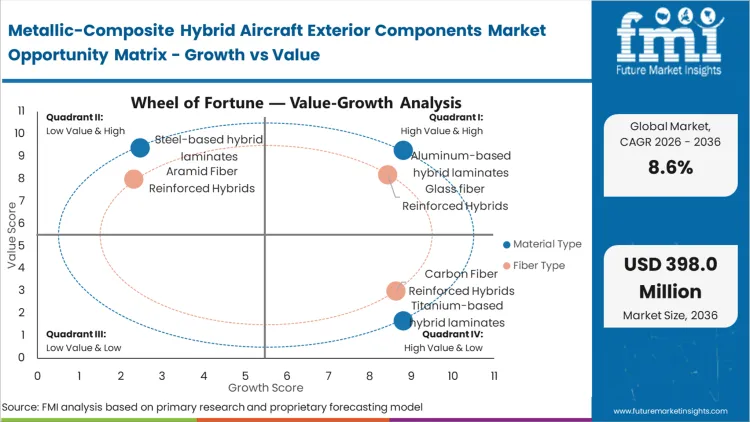
- Aluminum-based hybrid laminates: This segment is expected to hold 67.2% share in 2026, driven by its established performance data in pressurized fuselage skins.
- Glass fiber reinforced hybrids: Account for 42.3% of the fiber segment, primarily due to their compatibility with aluminum foils and lower cost compared to carbon alternatives.
- Commercial aircraft: Captures 54.0% of the platform share as OEMs increase the use of FMLs in narrow-body skin panels to reduce weight without sacrificing safety.
- India: Anticipated to grow at 10.2% compound growth, reflecting the rapid expansion of domestic aerostructures manufacturing for global supply chains.
- Analyst Opinion at FMI
- Nikhil Kaitwade, Principal Analyst, Automotive, at FMI, suggests, "The aerospace industry is moving past the binary choice between metal and composite. The real practitioner paradox lies in the fact that while composites save weight, they introduce significant secondary costs in lightning protection and impact shielding. Hybrid laminates resolve this by embedding the protection directly into the structure. However, the true technical hurdle that analysts often overlook is the management of moisture ingress at the foil-composite interface, which requires a level of surface preparation precision that traditional metal-bonding shops are still struggling to industrialize at scale."
- Strategic Implications / Executive Takeaways
- Aerostructures procurement heads must invest in specialized surface treatment lines to ensure the long-term interfacial bond strength required for hybrid laminate certification.
- Material suppliers should prioritize the development of titanium-based hybrids to address the thermal mismatch issues found in high-performance supersonic exterior components.
- MRO providers face a structural requirement to retrain technicians in hybrid repair techniques, as traditional patch repairs for pure aluminum or carbon fiber are insufficient for multi-material systems.
- Methodology
- Primary Research: Detailed roles such as Materials Qualification Managers and Airframe Design Leads were targeted for depth interviews to understand adoption triggers.
- Desk Research: Analysis focused on aerospace manufacturing certifications and regulatory filings from the FAA and EASA regarding new material approvals.
- Market-Sizing and Forecasting: The model is anchored to aircraft production rates and the specific material bill-of-materials (BOM) for each major platform.
- Data Validation and Update Cycle: FMI uses a quarterly triangulation process involving supply chain audits and material shipment tracking to ensure forecast accuracy.
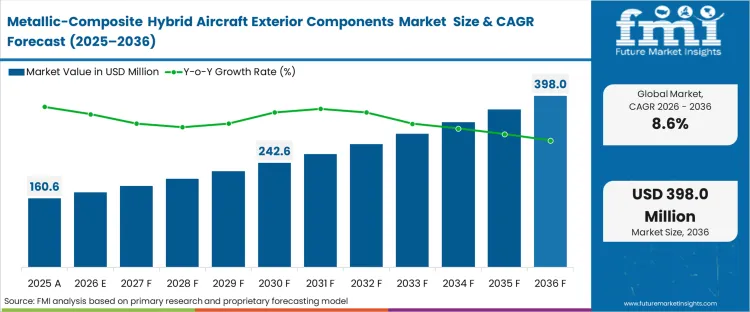
Metallic-Composite Hybrid Aircraft Exterior Components Market Key Takeaways
| Metric | Details |
|---|---|
| Industry Size (2026) | USD 174.4 million |
| Industry Value (2036) | USD 398.1 million |
| CAGR (2026-2036) | 8.60% |
Source: Future Market Insights (FMI) analysis, based on proprietary forecasting model and primary research
The inflection point for rapid market scaling depends on the industrialization of robotic systems that can move production away from labor-intensive manual processes. Once automated placement of fiber-metal laminates reaches parity with pure carbon fiber layup speeds, the cost-per-unit for large fuselage sections will drop significantly. Tier-1 suppliers who trigger this transition will enable the mass-market application of hybrids in regional jets that currently rely on traditional aluminum rivets.
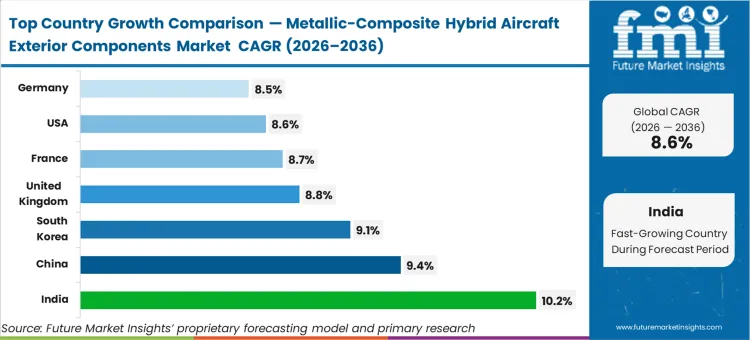
India is expected to advance at 10.2% as domestic aerostructures manufacturing scales under national industrial initiatives. China is anticipated to record 9.4% growth, driven by the domestic production ramp-up of indigenous commercial jet programs. South Korea is projected to register 9.1% following increased investment in advanced air mobility fuselage structures. United Kingdom follows at 8.8% while France is expected to garner 8.7% compound growth. United States is likely to post a CAGR of 8.6% as defense contractors integrate high-strength laminates into stealth platforms. Germany is estimated to grow at 8.5% through 2036. This divergence reflects the varying rates of capital investment in automated curing infrastructure across major aerospace manufacturing hubs.
Metallic-Composite Hybrid Aircraft Exterior Components Market Definition
The market covers structural materials and components that integrate metallic foils or sheets with fiber-reinforced polymer layers to create a unified hybrid laminate. These components are specifically designed for the exterior of aircraft, providing high fatigue resistance, impact tolerance, and burn-through protection that surpasses the performance of individual constituents. The defining boundary is the co-cured or bonded interface within a single structural part.
Metallic-Composite Hybrid Aircraft Exterior Components Market Inclusions
This market includes Fiber Metal Laminates (FMLs) such as GLARE and TiGr used for fuselage skins and wing leading edges. It covers composite airframes components specifically engineered as hybrid systems, along with the specialized bonding agents and surface treatments required to ensure interfacial integrity. Components used across commercial, military, and emerging advanced air mobility platforms are within the scope.
Metallic-Composite Hybrid Aircraft Exterior Components Market Exclusions
The scope excludes purely monolithic metallic parts and standard fiber-reinforced polymers that do not contain integrated metallic layers within the laminate stack. It also excludes interior cabin components, engine internals, and non-structural decorative exterior elements. Fasteners and adhesives are excluded unless they are part of a pre-integrated hybrid sub-assembly.
Metallic-Composite Hybrid Aircraft Exterior Components Market Research Methodology
- Primary Research: FMI conducted interviews with Aerostructures Lead Engineers, Procurement Directors at Tier-1 suppliers, and Composite Material Scientists from global aerospace OEMs.
- Desk Research: Data was aggregated from civil aviation certification registries, technical standards documentation from SAE International, and aerospace manufacturing procurement specification archives.
- Market-Sizing and Forecasting: The baseline anchors to the reported tonnage and surface area of hybrid laminates integrated into active and backlogged aircraft delivery schedules.
- Data Validation and Update Cycle: Forecasts were cross-validated against independent aircraft delivery projections and triangulated with raw material consumption data for specialized aerospace foils.
Segmental Analysis
Metallic-Composite Hybrid Aircraft Exterior Components Market Analysis by Material Type
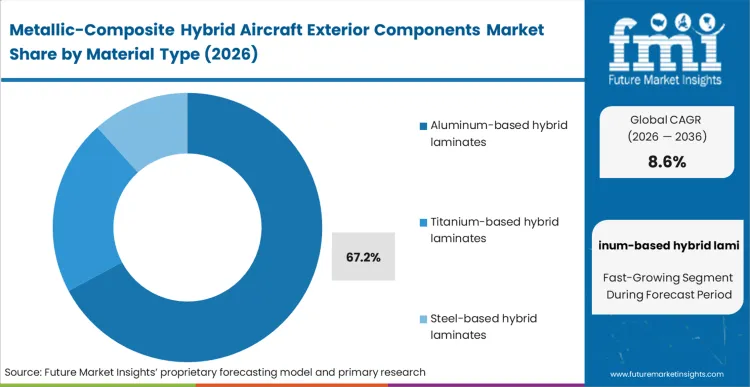
The reason aluminum-based hybrid laminates hold 67.2% of this market comes down to a single structural mechanism: they offer the most predictable fatigue resistance profile for pressurized fuselage skins. This material is not chosen solely for its weight reduction, but because it allows airframe designers to use existing aluminum assembly techniques while significantly slowing the rate of crack propagation.
Dominance of this segment is reinforced by the maturity of the GLARE supply chain, which has been qualified for wide-body fuselage applications over decades. Buyers who select these hybrids reduce the frequency of heavy structural inspections, as the metallic foils act as a natural barrier to the catastrophic failure modes seen in monolithic materials. As per FMI's projection, the market is shifting toward aerospace titanium hybrids for high-heat zones where aluminum’s structural integrity degrades. Procurement directors who delay the transition to these high-temperature hybrids risk exclusion from next-generation supersonic and high-speed regional jet programs.
- Foil thickness optimization: Aluminum foils used in exterior hybrids are gauged to balance weight with the energy absorption required to resist high-velocity debris impacts on the runway.
- Corrosion inhibition: Chemical milling and specialized primer applications at the metal-composite interface prevent internal delamination during high-altitude thermal cycling.
- Lifecycle cost parity: While the initial acquisition cost of hybrid laminates is higher, the reduction in scheduled structural repairs provides a net positive return within five years of operation.
Metallic-Composite Hybrid Aircraft Exterior Components Market Analysis by Fiber Type
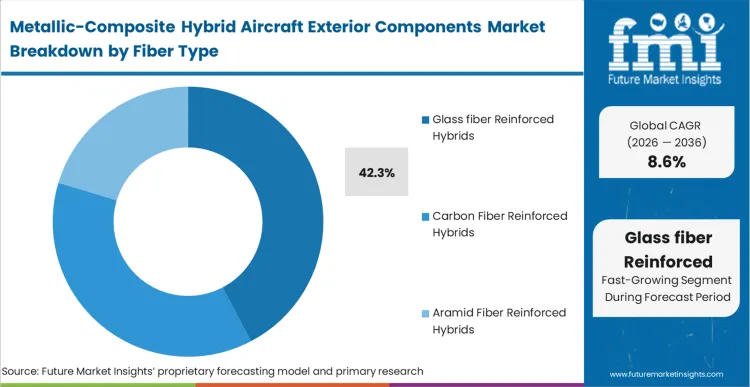
Displacement of carbon fiber by glass fiber in many aluminum-based applications is occurring because glass eliminates the risk of galvanic corrosion that occurs when carbon is placed in direct contact with aluminum. This functional compatibility is the primary driver behind its 42.3% share, as it allows for the use of standard aluminum foils without the need for expensive insulating plies. FMI analysts opine that the choice of glass fiber is also an economic decision for regional aircraft manufacturers who need the fatigue benefits of hybrid skins but cannot justify the cost premium of aramid or cf peek composites for secondary parts. The operational consequence of this fiber choice is a slightly higher weight penalty compared to carbon, but with a significant gain in impact toughness and ease of manufacturing. As aircraft skin requirements evolve toward higher moisture resistance, the integration of aramid honeycomb core material into fiber-metal hybrids is becoming a standard for cargo doors.
- Upfront material expense: Glass fiber reinforced hybrids provide a lower entry cost for Tier-2 suppliers entering the hybrid market compared to carbon-heavy laminates.
- Processing overhead: The thermal expansion compatibility between glass fibers and aluminum foils reduces the cost of specialized cooling fixtures during the curing cycle.
- Repairability economics: Standard MRO facilities can repair glass-aluminum hybrids using existing skill sets, reducing the total lifecycle cost for airline operators.
Metallic-Composite Hybrid Aircraft Exterior Components Market Analysis by Manufacturing Process
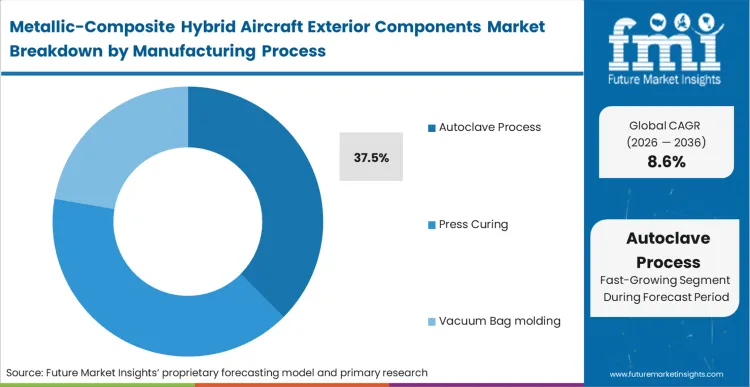
Airframe structural leads must decide between the high capital expenditure of autoclave systems and the lower performance of out-of-autoclave alternatives. The decision to utilize the autoclave process for 37.5% of production is driven by the absolute requirement for void-free bonding at the metal-composite interface. Based on FMI's assessment, the autoclave remains the structural gate for primary fuselage panels because only high-pressure curing can ensure that the resin fully wets the treated metallic foils. As production rates for narrow-body aircraft increase, manufacturers are forced to evaluate smart composite layup machines to feed these autoclaves more efficiently. The stakes for choosing an inferior curing process are immediate: a single batch of delaminated skin panels can ground an entire assembly line and trigger a multi-million dollar recertification effort.
- Initial purchase trigger: The requirement for civil aviation certification for primary structures often mandates autoclave use, forcing the initial purchase of high-pressure equipment.
- Qualification validation: Consistent bond strength data from autoclave batches validates the manufacturing process for long-term production contracts with major OEMs.
- Expansion incentives: As Tier-1 suppliers prove autoclave reliability, they gain the ability to expand their contract scope to include more complex hybrid geometries.
Metallic-Composite Hybrid Aircraft Exterior Components Market Analysis by Exterior Component Type
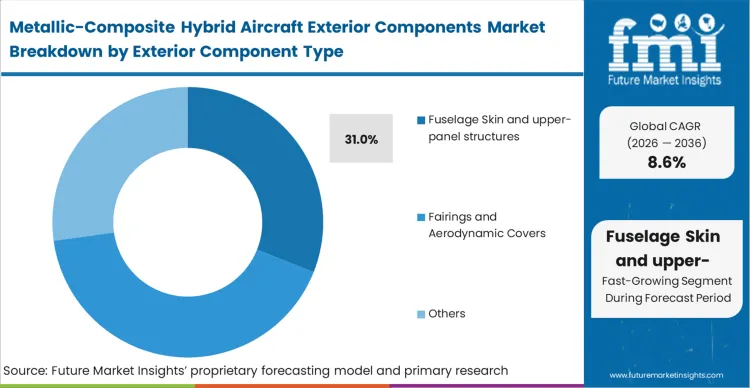
The operational consequence for airlines using hybrid-skinned fuselages is a "fail-safe" structure where cracks are arrested by the internal fiber layers. The tension between weight targets and impact protection is most visible in aircraft fairings and fuselage skins, where hybrid materials are increasingly replacing monolithic aluminum. Fuselage skin and upper-panel structures lead with 31.0% share because they represent the largest surface area where fatigue resistance and lightning protection are critical. FMI notes that the structural requirement for fuselage pressure hulls is shifting toward materials that can handle higher pressurization cycles as regional airlines fly longer routes. This dynamic is also influencing the design of winglets, which must withstand extreme vibration and aerodynamic stress without suffering from metal fatigue.
- Decompression risk: Failure of the bond between foils and fibers in a fuselage skin can lead to localized bubbling, necessitating immediate grounding and structural repair.
- Edge delamination: Residual stress at the edges of hybrid wing skin panels remains a risk that requires specialized edge-sealing techniques to prevent moisture ingress.
- Maintenance protocols: Buyers must implement ultrasonic inspection regimes specifically calibrated for multi-layer hybrid stacks to capture full durability benefits.
Metallic-Composite Hybrid Aircraft Exterior Components Market Analysis by Aircraft Platform
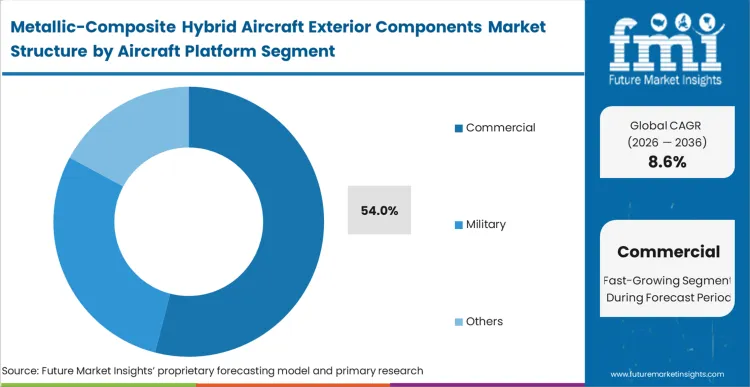
Commercial aircraft lead the trajectory of this market, accounting for 54.0% of the platform share as the industry shifts toward long haul sustainable composite wings and hybrid fuselages. The structural change over the next three years will be defined by the mass integration of fiber-metal laminates into narrow-body programs that were previously all-aluminum. FMI analysts observe that the move toward aerospace composite materials using pcr content is beginning to influence platform design, though hybrid laminates remain the priority for critical structural zones. The adoption of hybrids in advanced air mobility platforms is also emerging as a high-growth trajectory, where the need for crashworthy yet lightweight hulls is paramount.
- Defense tier adoption: Military platforms were the first to adopt hybrids, driven by the need for stealth-compatible materials that survive extreme thermal environments.
- Commercial qualification: Following military success, commercial OEMs have begun qualifying hybrids for narrow-body skins to capitalize on proven fatigue resistance.
- General aviation conversion: Business jet and regional manufacturers are the latest to arrive at this segment as production costs for hybrid fairings decrease.
Metallic-Composite Hybrid Aircraft Exterior Components Market Drivers, Restraints, and Opportunities
The structural forcing condition driving this market is the mandate for enhanced lightning strike protection in composite-intensive airframes. As OEMs move away from metallic fuselages, the loss of the "Faraday Cage" effect necessitates the integration of conductive foils directly into the structure. Procurement directors face the decision to either add weight via heavy copper meshes or transition to multi-functional hybrid laminates that provide both structural strength and electrical conductivity. The commercial stakes are clear: aircraft that fail to meet updated EMI and lightning strike standards cannot be certified for transoceanic routes.
The primary structural restraint is the high non-recurring engineering (NRE) cost associated with certifying hybrid material interfaces. Unlike monolithic alloys, hybrid laminates require extensive testing to prove that the bond between the metallic foil and the composite layer will not degrade over 30 years of thermal and pressure cycling. This friction is structural because it stems from the inherent complexity of multi-material behavior under edge conditions. The emerging solution is the development of standardized aerospace fasteners designed specifically for hybrid stacks, but the lack of a universal testing database continues to slow adoption among smaller regional aircraft manufacturers.
Opportunities in the Metallic-Composite Hybrid Aircraft Exterior Components Market
- Aerospace radome optimization: The integration of thin metallic meshes into aerospace radome structures provides an opportunity to enhance signal clarity while protecting sensitive electronics from lightning damage.
- Additive manufacturing integration: Using aerospace 3d printing materials to create complex metallic skeletons that can be over-molded with composites allows for the production of highly optimized, localized hybrid reinforcements.
- Surface drag reduction: Implementing ultra low drag riblet aircraft coatings onto hybrid skin panels enables airlines to combine structural durability with a significant reduction in fuel consumption.
Regional Analysis
Based on the regional analysis, the Metallic-Composite Hybrid Aircraft Exterior Components market is segmented into North America, Latin America, Europe, East Asia, South Asia, Oceania, and Middle East & Africa across 40 plus countries.
.webp "Top Country Growth Comparison Metallic Composite Hybrid Aircraft Exterior Components Market Cagr (2026 2036)")
| Country | CAGR (2026 to 2036) |
|---|---|
| India | 10.2% |
| China | 9.4% |
| South Korea | 9.1% |
| United Kingdom | 8.8% |
| France | 8.7% |
| United States | 8.6% |
| Germany | 8.5% |
Source: Future Market Insights (FMI) analysis, based on proprietary forecasting model and primary research
Asia Pacific Metallic-Composite Hybrid Aircraft Exterior Components Market Analysis
The structural adoption pattern in the Asia Pacific region is infrastructure-led, characterized by the rapid construction of high-capacity aerostructures manufacturing hubs in India and China. Unlike mature Western markets, this region is building its manufacturing baseline around automated curing and aerospace forging materials technologies from the outset. FMI analysts opine that the region's trajectory is defined by the domestic production of indigenous aircraft programs, which are utilizing hybrid laminates to compete on performance with global OEMs. According to FMI's view, the scaling of this market is directly linked to the expansion of regional MRO capacity, which must now support a new class of multi-material aircraft.
- India: India's rapid expansion of Tier-1 aerostructures facilities enables the country to absorb migrating production volumes for narrow-body skin panels. The market for hybrid components in India is forecast to register a CAGR of 10.2% over the forecast period. Companies that establish localized bonding and curing facilities gain a significant operational advantage in the expanding domestic aerospace supply chain.
- China: China's investment in domestic wide-body programs creates a structural demand for high-strength radome and hybrid fuselage skins that meet global certification standards. Demand for hybrid components in China is set to grow at 9.4%, positioning Chinese manufacturers as critical competitors in the global aerostructures market.
- South Korea: South Korea's focus on advanced air mobility platforms requires the development of lightweight, crash-resilient hybrid hulls for urban air taxis. The South Korean hybrid component sector is poised to expand at 9.1%, ensuring a structural trajectory toward high-tech mobility structures.
North America Metallic-Composite Hybrid Aircraft Exterior Components Market Analysis
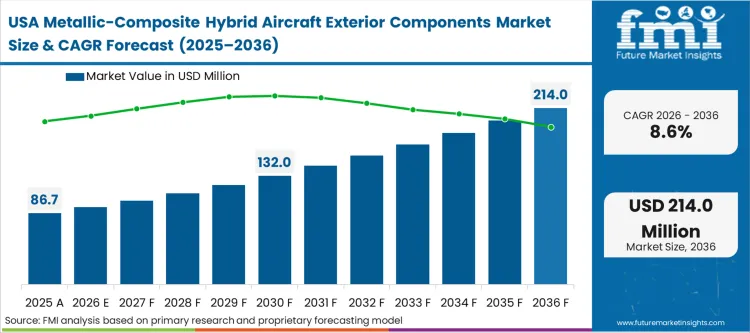
The North American market is policy-led, with defense spending and FAA certification standards acting as the primary catalysts for hybrid material adoption. Military aircraft programs are the early adopters, using metallic-composite hybrids to achieve high thermal stability and impact resistance in stealth-capable exterior skins. FMI notes that the structural condition here is the tight integration between defense contractors and material scientists, which accelerates the transition from lab-scale prototypes to certified airframe components. Based on FMI's projection, the commercial sector follows this lead, utilizing the data generated by military programs to qualify hybrids for civilian aircraft nacelle and wing skins.
- United States: The United States market is defined by the procurement cycles of major defense programs and the need to retrofit aging fleets with more durable hybrid skin panels. A CAGR of 8.6% is expected for the United States over the forecast period. Aerospace firms that act now to secure material supply chains create an operational outcome of long-term stability for upcoming military platform refreshes.
Europe Metallic-Composite Hybrid Aircraft Exterior Components Market Analysis
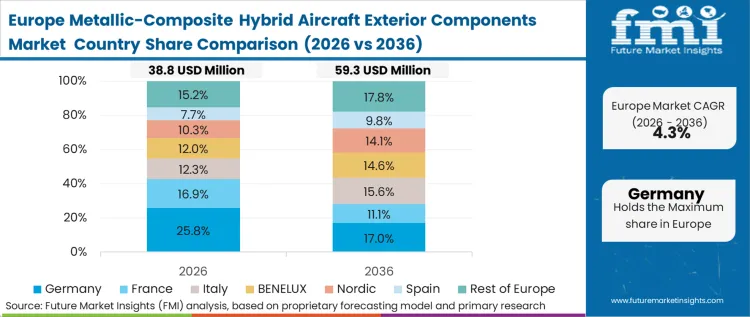
Buyer behavior in Europe is increasingly shaped by sustainability mandates and the need for high-frequency short-haul efficiency. The structural dynamic is driven by European OEMs who are moving toward "clean sky" initiatives, prioritizing materials that reduce weight and fuel burn. FMI's assessment suggests that European airlines are more willing to accept the higher initial cost of hybrid laminates if they can demonstrate a reduction in long-term maintenance cycles and carbon emissions. One FMI attribution phrase is that the region's engineering base is uniquely focused on the recyclability of hybrid systems, which is becoming a qualification standard for new suppliers.
- United Kingdom: The UK's aerospace sector is leveraging its expertise in composite R&D to lead the development of hybrid wing leading edges that can survive extreme icing conditions. The UK industry is expected to demonstrate a CAGR of 8.8%, resulting in a competitive positioning as a high-value, specialized aerostructures exporter.
- France: France's aerospace hub in Toulouse drives the adoption of aluminum-glass fiber hybrids for wide-body fuselage sections, focusing on long-term fatigue resistance. Demand for hybrid components in France is estimated to expand at a CAGR of 8.7%, highlighting the practitioner reality that hybrid skins are essential for the next generation of efficient long-haul travel.
- Germany: Germany's updated manufacturing standards for automated fiber placement ensure that hybrid laminates can be produced with the precision required for high-speed regional jets. The German market for hybrid components is likely to post a CAGR of 8.5%, illustrating where this country's market dynamic is heading next.
Competitive Aligners for Market Players
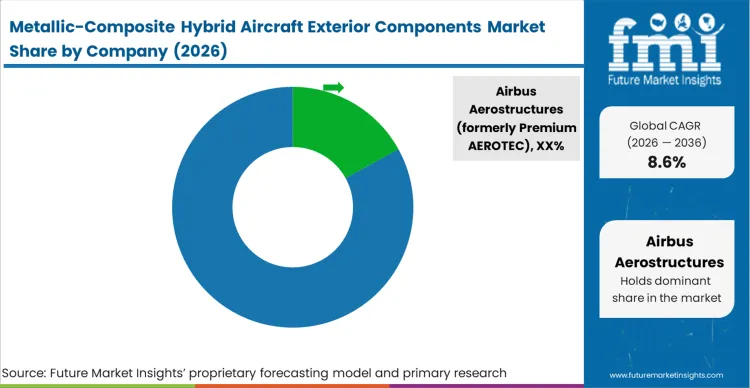
The competitive structure of the hybrid aircraft exterior components market is highly concentrated, governed by the extreme capital requirements of autoclave curing and the specialized IP required for metal-to-composite bonding. Major players like Airbus Aerostructures and Spirit AeroSystems maintain their dominance not just through volume, but through their role as co-developers of new material certifications with aerospace OEMs. Buyers distinguish qualified vendors based on their ability to provide verifiable long-term fatigue data and their capacity to integrate hybrid components into existing assembly lines. This high barrier to entry ensures that only firms with deep engineering benches and extensive qualification histories can compete for primary structural contracts.
Incumbents like GKN Aerospace and Daher Aerospace hold a structural advantage through their proprietary surface treatment processes, which are essential for preventing moisture ingress and delamination in hybrid laminates. A challenger must build a comparable laboratory infrastructure for material characterization and prove that their bonding process can withstand 50,000 thermal cycles to replicate this advantage. This structural persistence is reinforced by the "lock-in" effect of aircraft program lifecycles, where a material selected during the design phase is unlikely to be replaced for 20 years. One FMI hyperlink within this context highlights how the adoption of high performance composites is often tied to these long-term vendor-OEM partnerships.
Buyer power is concentrated among a handful of global aircraft OEMs who resist vendor lock-in by mandating second-source qualifications for all critical skin materials. The structural tension between these buyers and dominant vendors will define the trajectory toward 2036, as OEMs push for lower-cost manufacturing processes while vendors seek to protect their investments in autoclave infrastructure. FMI estimates that the market will remain concentrated, but with an increasing number of specialized Tier-2 players emerging to provide high-precision sub-components like hybrid fairings and cargo doors.
Key Players in Metallic-Composite Hybrid Aircraft Exterior Components Market
- Airbus Aerostructures (formerly Premium AEROTEC)
- Spirit AeroSystems
- GKN Aerospace
- Daher Aerospace
- FACC AG
- Leonardo Aerostructures
- Avior Integrated Products
Scope of the Report
| Metric | Value |
|---|---|
| Quantitative Units | USD 174.4 million in 2026 to USD 398.1 million in 2036, at a CAGR of 8.60% |
| Market Definition | Structural materials that integrate metallic foils with fiber-reinforced polymer layers to create unified, high-performance exterior skins for aircraft. |
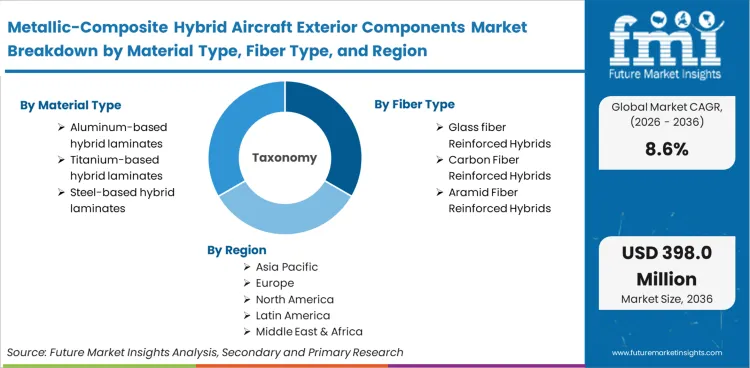
| Material Type Segmentation | Aluminum-based hybrid laminates, Titanium-based hybrid laminates, Steel-based hybrid laminates, Magnesium-based hybrid laminates, Other metallic-composite hybrids |
| Fiber Type Segmentation | Glass fiber reinforced hybrids, Carbon fiber reinforced hybrids, Aramid fiber reinforced hybrids, Other fiber reinforced hybrids |
| Manufacturing Process Segmentation | Autoclave process, Press curing, Vacuum bag molding, Filament winding, Pultrusion |
| Exterior Component Type Segmentation | Fuselage skin and upper-panel structures, Fairings and aerodynamic covers, Wing leading-edge and wing skin panels, Empennage skins and stabilizer surfaces, Cargo door and access panel structures |
| Aircraft Platform Segmentation | Commercial aircraft, Military aircraft, Business jets, Regional aircraft, Advanced air mobility / UAV platforms |
| Regions Covered | North America, Latin America, Europe, East Asia, South Asia, Oceania, Middle East & Africa |
| Countries Covered | India, China, South Korea, United Kingdom, France, United States, Germany, and 40 plus countries |
| Key Companies Profiled | Airbus Aerostructures, Spirit AeroSystems, GKN Aerospace, Daher Aerospace, FACC AG, Leonardo Aerostructures, Avior Integrated Products |
| Forecast Period | 2026 to 2036 |
| Approach | FMI utilized a bottom-up approach anchored to aircraft platform production rates and material BOMs. Forecasts were validated through supply chain audits and interviews with lead aerostructures qualification engineers. |
Source: Future Market Insights (FMI) analysis, based on proprietary forecasting model and primary research
Metallic-Composite Hybrid Aircraft Exterior Components Market Analysis by Segments
Material Type:
- Aluminum-based hybrid laminates
- Titanium-based hybrid laminates
- Steel-based hybrid laminates
- Magnesium-based hybrid laminates
- Other metallic-composite hybrids
Fiber Type:
- Glass fiber reinforced hybrids
- Carbon fiber reinforced hybrids
- Aramid fiber reinforced hybrids
- Other fiber reinforced hybrids
Manufacturing Process:
- Autoclave process
- Press curing
- Vacuum bag molding
- Filament winding
- Pultrusion
Exterior Component Type:
- Fuselage skin and upper-panel structures
- Fairings and aerodynamic covers
- Wing leading-edge and wing skin panels
- Empennage skins and stabilizer surfaces
- Cargo door and access panel structures
Aircraft Platform:
- Commercial aircraft
- Military aircraft
- Business jets
- Regional aircraft
- Advanced air mobility / UAV platforms
Region:
- North America
- United States
- Canada
- Europe
- Germany
- United Kingdom
- France
- Italy
- Spain
- Asia Pacific
- China
- Japan
- South Korea
- Taiwan
- Singapore
- Latin America
- Brazil
- Mexico
- Argentina
- Middle East & Africa
- GCC Countries
- South Africa
- Israel
Bibliography
- Hamzat, A. K., Jawaid, M., Asyraf, M. R. M., & colleagues. (2025, January). Fiber-reinforced composites for aerospace, energy, and marine structures. Advanced Composites and Hybrid Materials.
- Hussain, M., Zaki, W., & Umer, R. (2025, March). Flexural performance of shape memory alloy/CF-PEKK fiber metal laminates for aircraft morphing under varied temperature conditions. Scientific Reports, 15(1), 14093.
- SAE International. (2024, December). A Year in Review: SAE International Aerospace Standards.
- Phiri, R., et al. (2024, November). Advances in lightweight composite structures and manufacturing technologies: A comprehensive review. Heliyon.
- Cetinkaya, B., Aktaş, M., Karakuzu, R., & Demirci, E. (2025, February). Development of Structural Model of Fiber Metal Laminate Subjected to Low-Velocity Impact and Validation by Tests. Recycling, 9(7), 322.
This bibliography is provided for reader reference. The full FMI report contains the complete reference list with primary source documentation.
This Report Addresses
- Market intelligence to support strategic decision making across fuselage skins, wing leading edges, and fairing aerodynamic covers
- Market size estimation and 10-year revenue forecasts from 2026 to 2036, supported by aircraft platform delivery schedules and material BOM analysis
- Growth opportunity mapping across Material Type and Fiber Type with emphasis on the standardization of automated hybrid layup systems
- Segment and regional revenue forecasts covering aluminum and titanium hybrids across the rapidly scaling manufacturing hubs in India and China
- Competition strategy assessment including IP for metal-to-composite bonding and the capital requirements of autoclave curing
- Capability development tracking including high-temperature hybrid laminates, lightning strike mitigation, and EMI shielding standards
- Market access analysis covering FAA and EASA material qualification pathways and the certification requirements for pressurized hybrid hulls
- Market report delivery in PDF, Excel, PPT, and interactive dashboard formats for executive strategy, aerostructures procurement planning, and operational benchmarking use
Frequently Asked Questions
How large is the Metallic-Composite Hybrid Aircraft Exterior Components market in 2025?
The market was valued at USD 160.6 million in 2025. This figure represents the initial adoption phase where hybrid laminates are primarily integrated into wide-body fuselages and high-impact zones of leading-edge wing structures.
What will it be valued at by 2036?
The market is projected to reach USD 398.1 million by 2036. This growth signals a structural shift where fiber-metal laminates move from specialty applications to becoming the standard for narrow-body skin panels and regional jet pressure hulls.
What CAGR is projected for this market?
A CAGR of 8.60% is expected between 2026 and 2036. This rate reflects the pace of new aircraft platform certifications and the multi-year cycle required to qualify hybrid materials for primary structural use.
Which Material Type segment leads the market?
Aluminum-based hybrid laminates lead the market with a 67.2% share in 2026. This dominance is due to the material's established fatigue resistance and its ability to arrest cracks in pressurized environments, making it the most qualified hybrid for fuselage applications.
Which Fiber Type segment leads the market?
Glass fiber reinforced hybrids lead the fiber segment with 42.3% share. Glass fiber is preferred in aluminum-based hybrids because it avoids the galvanic corrosion risks inherent in carbon-aluminum contact, simplifying the manufacturing process.
Which Manufacturing Process segment leads the market?
The autoclave process leads with 37.5% share because it provides the high-pressure environment necessary for void-free bonding at the metal-composite interface. This level of precision is mandatory for certifying primary structural components like fuselage skins.
What drives rapid growth in this market?
The primary driver is the structural requirement for enhanced lightning strike and impact protection in composite-heavy airframes. Hybrid laminates provide a multi-functional solution that integrates conductivity and toughness directly into the skin, avoiding the weight penalty of secondary shielding meshes.
What is the primary restraint for the market?
The main restraint is the high non-recurring engineering cost and the long timeline required for material certification. Proving that the foil-composite bond will remain integral over 50,000 flight cycles requires extensive and expensive structural testing.
Which country grows the fastest in this market?
India is the fastest-growing market with a CAGR of 10.2%. This outpaces China's 9.4% growth due to India's aggressive scaling of domestic aerostructures manufacturing and its increasing role as a global export hub for specialized aircraft components.
How does the market address lightning strike risks?
Growth in this area is driven by the fact that hybrid laminates embed conductive metallic foils within the composite stack. This restores the Faraday Cage effect to the aircraft skin, providing a built-in electrical path that prevents localized structural damage during lightning events.
What is the practitioner paradox in hybrid material selection?
The paradox is that while hybrids solve impact and lightning issues, they introduce a new structural bottleneck: galvanic corrosion management. Practitioners must balance the weight savings of carbon fiber against the cost of insulating it from aluminum foils, often opting for glass fiber despite its lower specific strength.
Why is the autoclave process still dominant despite high costs?
The structural gate for hybrid laminates is the interfacial bond strength. Only autoclave curing provides the pressure required to ensure that the resin fully saturates the treated metallic foil, a condition that civil aviation authorities currently view as essential for primary structural certification.
How is the USA market different from the European market?
The USA market is policy-led and heavily influenced by defense procurement cycles for stealth and high-performance platforms. In contrast, the European market is behavior-led, with adoption driven by commercial sustainability mandates and the need for fuel-efficient short-haul regional jets.
What changes structurally in the India market by 2036?
India will transition from a component assembly hub to a full-cycle hybrid laminate producer. This involves the establishment of domestic foil treatment and automated fiber placement facilities, reducing the reliance on imported materials for the country's growing commercial aircraft sector.
What is the role of titanium-based hybrids in this market?
Titanium hybrids are the focus for high-heat zones and supersonic applications where aluminum foils lose their structural integrity. While currently a smaller segment, their growth is critical for the development of next-generation high-speed regional and business jets.
Why are glass fiber hybrids more common than carbon fiber hybrids?
The choice is driven by chemical compatibility. Glass fiber does not react galvanically with aluminum foils, eliminating the need for complex insulation layers that add weight and manufacturing steps, thus making the overall hybrid system more cost-effective.
How does the market impact aircraft maintenance cycles?
Hybrid skins significantly extend maintenance intervals by providing superior fatigue crack growth resistance. Because cracks are arrested by the fiber layers, airlines can schedule fewer heavy structural inspections compared to traditional aluminum hulls.
What is the significance of automated layup machines in this market?
Automation is the gate to mass-market cost-competitiveness. By replacing manual stacking of foils and fibers with robotic placement, Tier-1 suppliers can reduce unit costs to a level where hybrids become viable for regional and business jet fuselages.
How does FMI validate the market size for hybrid components?
FMI anchors the baseline to active aircraft delivery schedules and the specific bill-of-materials for each platform. This data is then triangulated with material shipment figures from specialized aerospace foil producers.
What are the exclusions from this market scope?
The market excludes purely monolithic metals, standard carbon fiber composites without metal integration, and all interior cabin or engine internal components. It is strictly focused on the structural exterior skin of the aircraft.
How do hybrid laminates contribute to aerospace sustainability?
They allow for the design of lighter fuselages that maintain high safety margins. The resulting reduction in airframe weight translates directly to lower fuel consumption and reduced carbon emissions over the 30-year life of the aircraft.
What would a practitioner say about the CAGR figure alone?
The 8.60% CAGR reflects the pace of platform adoption rather than a linear technology rollout. For a practitioner, this rate signals the speed at which OEMs are cycling through legacy metal airframes and replacing them with hybrid structural skins in high-traffic commercial fleets.
Preview the report firsthand - request a free sample
Get SampleGet the brochure for pricing and purchase details.
Get PDFTable of Content
- Executive Summary
- Global Market Outlook
- Demand-side Trends
- Supply-side Trends
- Technology Roadmap Analysis
- Analysis and Recommendations
- Market Overview
- Market Coverage / Taxonomy
- Market Definition / Scope / Limitations
- Research Methodology
- Chapter Orientation
- Analytical Lens and Working Hypotheses
- Market Structure, Signals, and Trend Drivers
- Benchmarking and Cross-market Comparability
- Market Sizing, Forecasting, and Opportunity Mapping
- Research Design and Evidence Framework
- Desk Research Programme (Secondary Evidence)
- Company Annual and Sustainability Reports
- Peer-reviewed Journals and Academic Literature
- Corporate Websites, Product Literature, and Technical Notes
- Earnings Decks and Investor Briefings
- Statutory Filings and Regulatory Disclosures
- Technical White Papers and Standards Notes
- Trade Journals, Industry Magazines, and Analyst Briefs
- Conference Proceedings, Webinars, and Seminar Materials
- Government Statistics Portals and Public Data Releases
- Press Releases and Reputable Media Coverage
- Specialist Newsletters and Curated Briefings
- Sector Databases and Reference Repositories
- FMI Internal Proprietary Databases and Historical Market Datasets
- Subscription Datasets and Paid Sources
- Social Channels, Communities, and Digital Listening Inputs
- Additional Desk Sources
- Expert Input and Fieldwork (Primary Evidence)
- Primary Modes
- Qualitative Interviews and Expert Elicitation
- Quantitative Surveys and Structured Data Capture
- Blended Approach
- Why Primary Evidence is Used
- Field Techniques
- Interviews
- Surveys
- Focus Groups
- Observational and In-context Research
- Social and Community Interactions
- Stakeholder Universe Engaged
- C-suite Leaders
- Board Members
- Presidents and Vice Presidents
- R&D and Innovation Heads
- Technical Specialists
- Domain Subject-matter Experts
- Scientists
- Physicians and Other Healthcare Professionals
- Governance, Ethics, and Data Stewardship
- Research Ethics
- Data Integrity and Handling
- Primary Modes
- Tooling, Models, and Reference Databases
- Desk Research Programme (Secondary Evidence)
- Data Engineering and Model Build
- Data Acquisition and Ingestion
- Cleaning, Normalisation, and Verification
- Synthesis, Triangulation, and Analysis
- Quality Assurance and Audit Trail
- Market Background
- Market Dynamics
- Drivers
- Restraints
- Opportunity
- Trends
- Scenario Forecast
- Demand in Optimistic Scenario
- Demand in Likely Scenario
- Demand in Conservative Scenario
- Opportunity Map Analysis
- Product Life Cycle Analysis
- Supply Chain Analysis
- Investment Feasibility Matrix
- Value Chain Analysis
- PESTLE and Porter’s Analysis
- Regulatory Landscape
- Regional Parent Market Outlook
- Production and Consumption Statistics
- Import and Export Statistics
- Market Dynamics
- Global Market Analysis 2021 to 2025 and Forecast, 2026 to 2036
- Historical Market Size Value (USD Million) Analysis, 2021 to 2025
- Current and Future Market Size Value (USD Million) Projections, 2026 to 2036
- Y-o-Y Growth Trend Analysis
- Absolute $ Opportunity Analysis
- Global Market Pricing Analysis 2021 to 2025 and Forecast 2026 to 2036
- Global Market Analysis 2021 to 2025 and Forecast 2026 to 2036, By Material Type
- Introduction / Key Findings
- Historical Market Size Value (USD Million) Analysis By Material Type , 2021 to 2025
- Current and Future Market Size Value (USD Million) Analysis and Forecast By Material Type , 2026 to 2036
- Aluminum-based hybrid laminates
- Titanium-based hybrid laminates
- Steel-based hybrid laminates
- Aluminum-based hybrid laminates
- Y-o-Y Growth Trend Analysis By Material Type , 2021 to 2025
- Absolute $ Opportunity Analysis By Material Type , 2026 to 2036
- Global Market Analysis 2021 to 2025 and Forecast 2026 to 2036, By Fiber Type
- Introduction / Key Findings
- Historical Market Size Value (USD Million) Analysis By Fiber Type, 2021 to 2025
- Current and Future Market Size Value (USD Million) Analysis and Forecast By Fiber Type, 2026 to 2036
- Glass fiber Reinforced Hybrids
- Carbon Fiber Reinforced Hybrids
- Aramid Fiber Reinforced Hybrids
- Glass fiber Reinforced Hybrids
- Y-o-Y Growth Trend Analysis By Fiber Type, 2021 to 2025
- Absolute $ Opportunity Analysis By Fiber Type, 2026 to 2036
- Global Market Analysis 2021 to 2025 and Forecast 2026 to 2036, By Manufacturing Process
- Introduction / Key Findings
- Historical Market Size Value (USD Million) Analysis By Manufacturing Process, 2021 to 2025
- Current and Future Market Size Value (USD Million) Analysis and Forecast By Manufacturing Process, 2026 to 2036
- Autoclave Process
- Press Curing
- Vacuum Bag molding
- Autoclave Process
- Y-o-Y Growth Trend Analysis By Manufacturing Process, 2021 to 2025
- Absolute $ Opportunity Analysis By Manufacturing Process, 2026 to 2036
- Global Market Analysis 2021 to 2025 and Forecast 2026 to 2036, By Exterior Component Type
- Introduction / Key Findings
- Historical Market Size Value (USD Million) Analysis By Exterior Component Type, 2021 to 2025
- Current and Future Market Size Value (USD Million) Analysis and Forecast By Exterior Component Type, 2026 to 2036
- Fuselage Skin and upper-panel structures
- Fairings and Aerodynamic Covers
- Others
- Fuselage Skin and upper-panel structures
- Y-o-Y Growth Trend Analysis By Exterior Component Type, 2021 to 2025
- Absolute $ Opportunity Analysis By Exterior Component Type, 2026 to 2036
- Global Market Analysis 2021 to 2025 and Forecast 2026 to 2036, By Aircraft Platform
- Introduction / Key Findings
- Historical Market Size Value (USD Million) Analysis By Aircraft Platform, 2021 to 2025
- Current and Future Market Size Value (USD Million) Analysis and Forecast By Aircraft Platform, 2026 to 2036
- Commercial
- Military
- Others
- Commercial
- Y-o-Y Growth Trend Analysis By Aircraft Platform, 2021 to 2025
- Absolute $ Opportunity Analysis By Aircraft Platform, 2026 to 2036
- Global Market Analysis 2021 to 2025 and Forecast 2026 to 2036, By Region
- Introduction
- Historical Market Size Value (USD Million) Analysis By Region, 2021 to 2025
- Current Market Size Value (USD Million) Analysis and Forecast By Region, 2026 to 2036
- North America
- Latin America
- Western Europe
- Eastern Europe
- East Asia
- South Asia and Pacific
- Middle East & Africa
- Market Attractiveness Analysis By Region
- North America Market Analysis 2021 to 2025 and Forecast 2026 to 2036, By Country
- Historical Market Size Value (USD Million) Trend Analysis By Market Taxonomy, 2021 to 2025
- Market Size Value (USD Million) Forecast By Market Taxonomy, 2026 to 2036
- By Country
- USA
- Canada
- Mexico
- By Material Type
- By Fiber Type
- By Manufacturing Process
- By Exterior Component Type
- By Aircraft Platform
- By Country
- Market Attractiveness Analysis
- By Country
- By Material Type
- By Fiber Type
- By Manufacturing Process
- By Exterior Component Type
- By Aircraft Platform
- Key Takeaways
- Latin America Market Analysis 2021 to 2025 and Forecast 2026 to 2036, By Country
- Historical Market Size Value (USD Million) Trend Analysis By Market Taxonomy, 2021 to 2025
- Market Size Value (USD Million) Forecast By Market Taxonomy, 2026 to 2036
- By Country
- Brazil
- Chile
- Rest of Latin America
- By Material Type
- By Fiber Type
- By Manufacturing Process
- By Exterior Component Type
- By Aircraft Platform
- By Country
- Market Attractiveness Analysis
- By Country
- By Material Type
- By Fiber Type
- By Manufacturing Process
- By Exterior Component Type
- By Aircraft Platform
- Key Takeaways
- Western Europe Market Analysis 2021 to 2025 and Forecast 2026 to 2036, By Country
- Historical Market Size Value (USD Million) Trend Analysis By Market Taxonomy, 2021 to 2025
- Market Size Value (USD Million) Forecast By Market Taxonomy, 2026 to 2036
- By Country
- Germany
- UK
- Italy
- Spain
- France
- Nordic
- BENELUX
- Rest of Western Europe
- By Material Type
- By Fiber Type
- By Manufacturing Process
- By Exterior Component Type
- By Aircraft Platform
- By Country
- Market Attractiveness Analysis
- By Country
- By Material Type
- By Fiber Type
- By Manufacturing Process
- By Exterior Component Type
- By Aircraft Platform
- Key Takeaways
- Eastern Europe Market Analysis 2021 to 2025 and Forecast 2026 to 2036, By Country
- Historical Market Size Value (USD Million) Trend Analysis By Market Taxonomy, 2021 to 2025
- Market Size Value (USD Million) Forecast By Market Taxonomy, 2026 to 2036
- By Country
- Russia
- Poland
- Hungary
- Balkan & Baltic
- Rest of Eastern Europe
- By Material Type
- By Fiber Type
- By Manufacturing Process
- By Exterior Component Type
- By Aircraft Platform
- By Country
- Market Attractiveness Analysis
- By Country
- By Material Type
- By Fiber Type
- By Manufacturing Process
- By Exterior Component Type
- By Aircraft Platform
- Key Takeaways
- East Asia Market Analysis 2021 to 2025 and Forecast 2026 to 2036, By Country
- Historical Market Size Value (USD Million) Trend Analysis By Market Taxonomy, 2021 to 2025
- Market Size Value (USD Million) Forecast By Market Taxonomy, 2026 to 2036
- By Country
- China
- Japan
- South Korea
- By Material Type
- By Fiber Type
- By Manufacturing Process
- By Exterior Component Type
- By Aircraft Platform
- By Country
- Market Attractiveness Analysis
- By Country
- By Material Type
- By Fiber Type
- By Manufacturing Process
- By Exterior Component Type
- By Aircraft Platform
- Key Takeaways
- South Asia and Pacific Market Analysis 2021 to 2025 and Forecast 2026 to 2036, By Country
- Historical Market Size Value (USD Million) Trend Analysis By Market Taxonomy, 2021 to 2025
- Market Size Value (USD Million) Forecast By Market Taxonomy, 2026 to 2036
- By Country
- India
- ASEAN
- Australia & New Zealand
- Rest of South Asia and Pacific
- By Material Type
- By Fiber Type
- By Manufacturing Process
- By Exterior Component Type
- By Aircraft Platform
- By Country
- Market Attractiveness Analysis
- By Country
- By Material Type
- By Fiber Type
- By Manufacturing Process
- By Exterior Component Type
- By Aircraft Platform
- Key Takeaways
- Middle East & Africa Market Analysis 2021 to 2025 and Forecast 2026 to 2036, By Country
- Historical Market Size Value (USD Million) Trend Analysis By Market Taxonomy, 2021 to 2025
- Market Size Value (USD Million) Forecast By Market Taxonomy, 2026 to 2036
- By Country
- Kingdom of Saudi Arabia
- Other GCC Countries
- Turkiye
- South Africa
- Other African Union
- Rest of Middle East & Africa
- By Material Type
- By Fiber Type
- By Manufacturing Process
- By Exterior Component Type
- By Aircraft Platform
- By Country
- Market Attractiveness Analysis
- By Country
- By Material Type
- By Fiber Type
- By Manufacturing Process
- By Exterior Component Type
- By Aircraft Platform
- Key Takeaways
- Key Countries Market Analysis
- USA
- Pricing Analysis
- Market Share Analysis, 2025
- By Material Type
- By Fiber Type
- By Manufacturing Process
- By Exterior Component Type
- By Aircraft Platform
- Canada
- Pricing Analysis
- Market Share Analysis, 2025
- By Material Type
- By Fiber Type
- By Manufacturing Process
- By Exterior Component Type
- By Aircraft Platform
- Mexico
- Pricing Analysis
- Market Share Analysis, 2025
- By Material Type
- By Fiber Type
- By Manufacturing Process
- By Exterior Component Type
- By Aircraft Platform
- Brazil
- Pricing Analysis
- Market Share Analysis, 2025
- By Material Type
- By Fiber Type
- By Manufacturing Process
- By Exterior Component Type
- By Aircraft Platform
- Chile
- Pricing Analysis
- Market Share Analysis, 2025
- By Material Type
- By Fiber Type
- By Manufacturing Process
- By Exterior Component Type
- By Aircraft Platform
- Germany
- Pricing Analysis
- Market Share Analysis, 2025
- By Material Type
- By Fiber Type
- By Manufacturing Process
- By Exterior Component Type
- By Aircraft Platform
- UK
- Pricing Analysis
- Market Share Analysis, 2025
- By Material Type
- By Fiber Type
- By Manufacturing Process
- By Exterior Component Type
- By Aircraft Platform
- Italy
- Pricing Analysis
- Market Share Analysis, 2025
- By Material Type
- By Fiber Type
- By Manufacturing Process
- By Exterior Component Type
- By Aircraft Platform
- Spain
- Pricing Analysis
- Market Share Analysis, 2025
- By Material Type
- By Fiber Type
- By Manufacturing Process
- By Exterior Component Type
- By Aircraft Platform
- France
- Pricing Analysis
- Market Share Analysis, 2025
- By Material Type
- By Fiber Type
- By Manufacturing Process
- By Exterior Component Type
- By Aircraft Platform
- India
- Pricing Analysis
- Market Share Analysis, 2025
- By Material Type
- By Fiber Type
- By Manufacturing Process
- By Exterior Component Type
- By Aircraft Platform
- ASEAN
- Pricing Analysis
- Market Share Analysis, 2025
- By Material Type
- By Fiber Type
- By Manufacturing Process
- By Exterior Component Type
- By Aircraft Platform
- Australia & New Zealand
- Pricing Analysis
- Market Share Analysis, 2025
- By Material Type
- By Fiber Type
- By Manufacturing Process
- By Exterior Component Type
- By Aircraft Platform
- China
- Pricing Analysis
- Market Share Analysis, 2025
- By Material Type
- By Fiber Type
- By Manufacturing Process
- By Exterior Component Type
- By Aircraft Platform
- Japan
- Pricing Analysis
- Market Share Analysis, 2025
- By Material Type
- By Fiber Type
- By Manufacturing Process
- By Exterior Component Type
- By Aircraft Platform
- South Korea
- Pricing Analysis
- Market Share Analysis, 2025
- By Material Type
- By Fiber Type
- By Manufacturing Process
- By Exterior Component Type
- By Aircraft Platform
- Russia
- Pricing Analysis
- Market Share Analysis, 2025
- By Material Type
- By Fiber Type
- By Manufacturing Process
- By Exterior Component Type
- By Aircraft Platform
- Poland
- Pricing Analysis
- Market Share Analysis, 2025
- By Material Type
- By Fiber Type
- By Manufacturing Process
- By Exterior Component Type
- By Aircraft Platform
- Hungary
- Pricing Analysis
- Market Share Analysis, 2025
- By Material Type
- By Fiber Type
- By Manufacturing Process
- By Exterior Component Type
- By Aircraft Platform
- Kingdom of Saudi Arabia
- Pricing Analysis
- Market Share Analysis, 2025
- By Material Type
- By Fiber Type
- By Manufacturing Process
- By Exterior Component Type
- By Aircraft Platform
- Turkiye
- Pricing Analysis
- Market Share Analysis, 2025
- By Material Type
- By Fiber Type
- By Manufacturing Process
- By Exterior Component Type
- By Aircraft Platform
- South Africa
- Pricing Analysis
- Market Share Analysis, 2025
- By Material Type
- By Fiber Type
- By Manufacturing Process
- By Exterior Component Type
- By Aircraft Platform
- USA
- Market Structure Analysis
- Competition Dashboard
- Competition Benchmarking
- Market Share Analysis of Top Players
- By Regional
- By Material Type
- By Fiber Type
- By Manufacturing Process
- By Exterior Component Type
- By Aircraft Platform
- Competition Analysis
- Competition Deep Dive
- Airbus Aerostructures (formerly Premium AEROTEC)
- Overview
- Product Portfolio
- Profitability by Market Segments (Product/Age /Sales Channel/Region)
- Sales Footprint
- Strategy Overview
- Marketing Strategy
- Product Strategy
- Channel Strategy
- Spirit AeroSystems
- GKN Aerospace
- Daher Aerospace
- FACC AG
- Leonardo Aerostructures
- Airbus Aerostructures (formerly Premium AEROTEC)
- Competition Deep Dive
- Assumptions & Acronyms Used


