

- Industry Size (2026)
- USD 4456.6 Mn
- Forecast (2036)
- USD 6523.4 Mn
- CAGR (2026 to 2036)
- 3.9%
Global Thermal Paper Market Forecast and Outlook By FMI
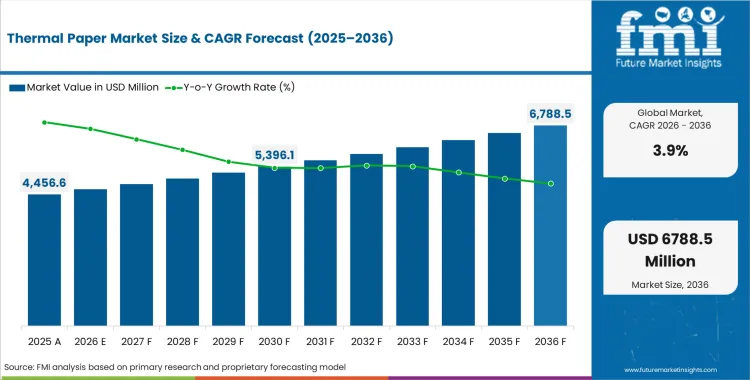
In 2025, the global thermal paper market was valued at USD 4,275.2 million. Based on Future Market Insights' analysis, demand for thermal paper is estimated to grow to USD 4,456.6 million in 2026 and USD 6,523.4 million by 2035. FMI projects a CAGR of 3.9% during the forecast period.
The market is expected to generate an absolute dollar growth of USD 2,066.8 million between 2026 and 2035. This reflects steady, application-driven expansion rather than rapid structural acceleration, as thermal paper demand remains closely linked to POS systems, ticketing, labeling, and logistics documentation. Growth is supported by retail digitization in emerging markets and rising demand for phenol-free and recyclable thermal grades. However, increasing digital payment adoption, e-receipts, and regulatory scrutiny on chemical coatings continue to moderate long-term volume growth in mature economies.
Summary of Global Thermal Paper Market
- Global Thermal Paper Market Definition
- The global thermal paper market includes chemically coated paper products designed for heat-sensitive printing applications such as receipts, labels, tickets, and tags.
- Demand Drivers in the Market
- Expansion of organized retail and POS terminal installations is driving steady demand for direct thermal receipt paper.
- Growth in logistics, e-commerce labeling, and barcode tracking systems is increasing consumption of self-adhesive and synthetic thermal papers.
- Regulatory restrictions on BPA and phenol-based coatings are accelerating adoption of phenol-free and safer thermal paper alternatives.
- Key Segments Analyzed in the FMI Report
- By Printing Technology: Direct thermal printing leads adoption due to widespread use in retail receipts and ticketing applications.
- By Product Type: Top coated and phenol-free thermal papers account for significant demand driven by durability and regulatory compliance requirements.
- By Geography: Asia Pacific represents a major growth region supported by retail expansion and transportation infrastructure development.
- Analyst Opinion at FMI
- Ismail Sutaria, Principal Consultant for Packaging Industry at Future Market Insights, opines, ‘CXOs will find in this report strategic clarity on how regulatory compliance, digital retail expansion, and specialty coating innovation are shaping competitive positioning in the thermal paper market.’
- Strategic Implications / Executive Takeaways
- Invest in phenol-free and recyclable thermal paper technologies to meet evolving environmental regulations.
- Expand capacity in label-grade and synthetic thermal substrates to serve logistics growth.
- Strengthen partnerships with POS system manufacturers and retail chains for recurring demand stability.
- Methodology
- Market estimates were validated through interviews with paper manufacturers and coating technology providers.
- Secondary research included retail infrastructure data and regulatory analysis.
- Forecasts were developed using POS deployment and logistics labeling demand modeling.
Mr. Andreas Endters, President & CEO, Voith Paper GmbH said “Paper has been quite important in the past; it is still a key product today and will be even more important in the future because ‘sustainability’ as a key characteristic of paper is a unique aspect.”
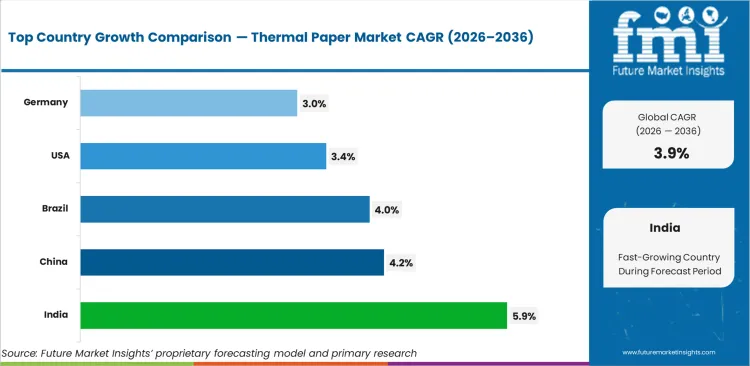
India (5.9%) is projected to register the fastest growth, driven by retail formalization and expanding POS infrastructure. China (4.2%) follows, supported by logistics and labeling demand. Brazil (4.0%) benefits from retail and banking expansion. The United States (3.4%) and Germany (3.0%) represent mature markets where demand is largely replacement-driven, constrained by digital transaction penetration and sustainability compliance requirements rather than new volume acceleration.
Global Thermal Paper Market Definition
The global thermal paper market refers to the production and supply of specially coated paper that changes color when exposed to heat, enabling ink-free printing. Thermal paper is commonly used in point-of-sale receipts, tickets, labels, tags, banking slips, and lottery applications. It is available in different thickness levels and product types such as top-coated, colored, self-adhesive, synthetic, phenol-free, and recycled grades. The primary function of thermal paper is to provide fast, reliable printing for transaction and identification purposes without the need for ribbons or ink cartridges. Key end users include retail stores, healthcare providers, transportation operators, financial institutions, government bodies, and industrial facilities.
Global Thermal Paper Market Inclusions
The report provides global and regional market size estimates for 2025 and 2026, with forecasts through 2035 and CAGR analysis. It includes segmentation by thickness, printing technology, product type, application, end use industry, and region. The study covers value-based sizing, demand trends across POS and labeling applications, regulatory shifts toward phenol-free formulations, and production capacity analysis.
Global Thermal Paper Market Exclusions
The scope excludes conventional printing paper, coated paper used for offset or inkjet printing, and packaging-grade paperboards. It does not include printing hardware such as thermal printers or barcode systems. Finished retail receipts or tickets are excluded, as the analysis focuses strictly on thermal paper manufacturing, coating technologies, and supply.
Global Thermal Paper Market Research Methodology
- Primary Research: Interviews were conducted with thermal paper manufacturers, coating chemical suppliers, POS system integrators, label converters, and retail procurement managers. Chemical suppliers clarified pricing trends for developer coatings, while converters validated demand shifts toward phenol-free and BPA-free grades.
- Desk Research: Trade statistics, pulp and paper industry reports, company annual disclosures, regulatory publications, and industry association data were reviewed to benchmark production volumes and regional demand.
- Market-Sizing and Forecasting: A hybrid top-down and bottom-up approach was applied. Demand was reconstructed from POS terminal installations and label consumption volumes and validated against mill production capacity.
- Data Validation and Update Cycle: Data was cross-verified across trade datasets, production statistics, and stakeholder inputs, followed by structured expert review prior to final release.
Segmental Analysis
Global Thermal Paper Market Analysis by Thickness
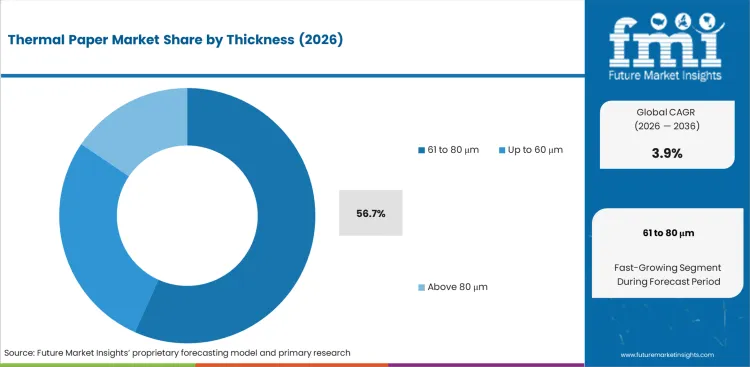
Based on FMI's Global Thermal Paper market report, consumption of 61 to 80 μm thickness is estimated to hold 56.7% share in 2026. This segment dominates due to its balanced durability, print clarity, and cost efficiency across high-volume transactional applications. It addresses buyer requirements for reliable image retention, smooth printer compatibility, and adequate resistance to tearing during handling. The thickness range is widely used in point-of-sale receipts, labels, and ticketing systems where performance consistency and affordability are critical.
- Print Performance Balance: The 61-80 μm range ensures optimal thermal coating responsiveness while maintaining mechanical strength for daily retail and banking operations.
- Cost Optimization: Compared to thicker grades, this range reduces raw material consumption while still delivering acceptable durability for short- to medium-term record retention.
- Retail Standardization: POS printer manufacturers commonly calibrate devices for mid-range thickness rolls, reinforcing widespread adoption across global retail networks.
Global Thermal Paper Market Analysis by Application
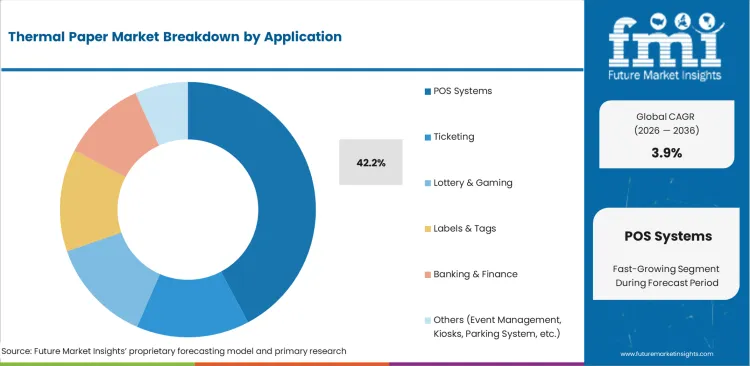
Based on FMI's Global Thermal Paper market report, consumption of POS Systems is estimated to hold 42.2% share in 2026. POS applications dominate due to extensive use in retail billing, hospitality transactions, and supermarket checkouts. Thermal paper addresses operational priorities including fast print speeds, low maintenance printing without ink cartridges, and consistent receipt output.
- Retail Transaction Volume: High daily transaction rates across supermarkets, restaurants, and convenience stores sustain strong demand for thermal receipt rolls.
- Operational Efficiency: Direct thermal printing reduces printer downtime and consumable complexity compared to ink-based systems.
- Digital Payment Expansion: Despite digital receipts growth, regulatory requirements for printed transaction records in many regions continue to support stable POS thermal paper consumption
Global Thermal Paper Market: Drivers, Restraints, and Opportunities
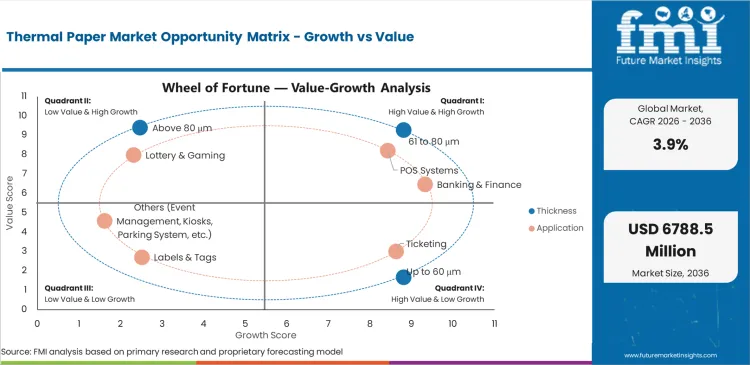
Future Market Insights analysis indicates that the global thermal paper market is structurally linked to retail billing systems, banking transactions, logistics labeling, and lottery and ticketing applications. The market exists at its current scale because thermal paper enables fast, ink-free printing for receipts, barcode labels, and point-of-sale (POS) documentation. Historical demand has closely followed expansion of organized retail, ATM networks, and parcel shipping volumes. While digital payments have moderated receipt growth in certain urban markets, thermal paper remains embedded in regulatory billing, tax documentation, and supply chain labeling requirements across both developed and emerging economies.
FMI analysts observe a transition from conventional Bisphenol-A (BPA)-based thermal coatings toward BPA-free and phenol-free alternatives. Regulatory scrutiny, particularly under the EU REACH Regulation restricting BPA in thermal paper, has accelerated reformulation across Europe and influenced global supply chains. Although alternative developers such as Bisphenol-S (BPS)-free and vitamin-based coatings carry higher formulation costs, compliance and retailer sustainability commitments support premium pricing. At the same time, long-term structural pressure from digital receipts and e-invoicing is gradually reducing growth in traditional POS segments, creating a balanced outlook where value growth stems from specialty and label-grade applications rather than volume expansion alone.
- Regulatory Reformulation Pressure: The EU REACH restriction on BPA in thermal paper has driven a shift toward BPA-free and phenol-free coatings. Compliance-driven reformulation supports higher value realization despite stable volumes.
- Logistics Label Expansion: Growth in e-commerce and parcel shipments is sustaining demand for thermal barcode and shipping labels, offsetting slower growth in retail receipt segments.
- Digital Substitution Risk: Increasing adoption of e-receipts and electronic invoicing is moderating POS receipt demand in mature markets, constraining long-term volume expansion while shifting focus to specialized printing grades.
Regional Analysis
The global thermal paper market is segmented across Asia Pacific, North America, and Europe, with demand concentrated in retail billing, banking, logistics labeling, and healthcare documentation. Regional growth varies based on point-of-sale penetration, e-commerce logistics, and regulatory shifts toward BPA-free paper grades. The full report provides comprehensive regional market attractiveness analysis.
.webp "Top Country Growth Comparison Thermal Paper Market Cagr (2026 2036)")
| Country | CAGR (26-36) |
|---|---|
| India | 5.9% |
| China | 4.2% |
| Brazil | 4.0% |
| United States | 3.4% |
| Germany | 3.0% |
Source: Future Market Insights (FMI) analysis, based on proprietary forecasting model and primary research
Asia Pacific - High-Volume Retail and Manufacturing Hub
Asia Pacific serves as the high-volume retail and manufacturing hub of the thermal paper market. Rapid expansion of organized retail, e-commerce logistics, and financial services drives demand for POS receipts and label rolls. Key regional players include Oji Holdings Corporation, Nippon Paper Industries Co., Ltd., Hansol Paper Co., Ltd., and Guangdong Guanhao High-Tech Co., Ltd., all maintaining large-scale thermal paper production capacity.
- China: Demand for thermal paper in China is projected to rise at a steady pace through 2036, supported by retail digitization and logistics expansion. In 2024, China continued enforcement of chemical safety and environmental compliance regulations impacting specialty paper coatings, encouraging transition toward BPA-free thermal grades. Growth in e-commerce parcel labeling and warehouse automation supports steady label roll consumption. Expansion of supermarket chains and convenience retail formats also increases POS receipt usage. While digital payments are expanding, high transaction volumes in offline retail sustain consistent demand.
- Japan: Demand for thermal paper in Japan is projected to grow steadily through 2036, supported by established retail infrastructure and banking services. In 2024, continued compliance with chemical substance regulations encouraged use of phenol-free thermal paper alternatives. Japan’s advanced retail network and public transportation ticketing systems sustain steady consumption of thermal receipt paper. Although digital receipts are increasing, printed receipts remain common in retail and vending machine transactions. The country’s focus on environmentally compliant coatings continues to shape product innovation.
- South Korea: Demand for thermal paper in South Korea is projected to rise gradually through 2036. Retail modernization, banking services, and logistics labeling support steady consumption. In 2024, regulatory oversight related to chemical safety standards reinforced the shift toward BPA-free coatings. Growth in food delivery platforms and parcel logistics also sustains demand for printed labels. Market maturity limits rapid expansion, but compliance-driven innovation supports stable output.
FMI's analysis of global thermal paper market in Asia Pacific consists of country-wise assessment that includes China, Japan, and South Korea. Readers can find insights on retail penetration, coating technology shifts, and logistics labeling trends.
North America - Compliance and Logistics-Driven Market
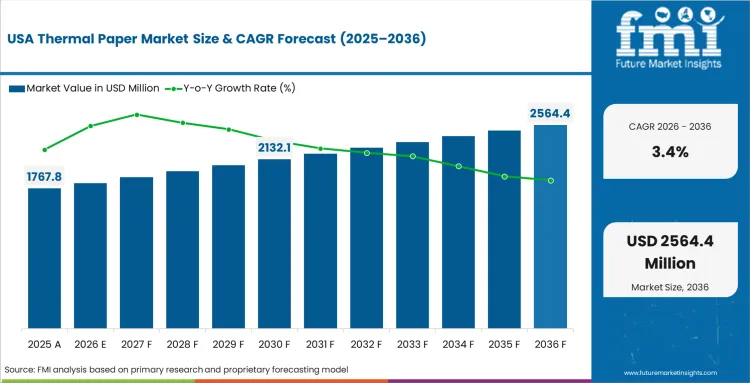
North America represents a compliance-driven and logistics-oriented thermal paper market. Demand is shaped by retail billing, shipping labels, and healthcare documentation. Companies such as Appvion Operations, Inc. and Domtar Corporation maintain established production and distribution networks across the region.
- United States: Demand for thermal paper in the United States is projected to remain stable through 2036. Growth is influenced by retail transactions and logistics labeling requirements. In 2024, continued regulatory attention toward chemical safety and phenol-free alternatives reinforced demand for BPA-free thermal paper products. Expansion in e-commerce and parcel shipping volumes sustains steady label consumption. Retail digitization trends are moderating receipt volume growth, but high transaction density continues to support demand. Healthcare and pharmacy billing systems also contribute to consistent thermal roll usage.
FMI's analysis of global thermal paper market in North America consists of country-wise assessment that includes the United States. Readers can find insights on chemical compliance trends, retail digitization impact, and logistics label demand.
Europe - Sustainability and Chemical Compliance Leader
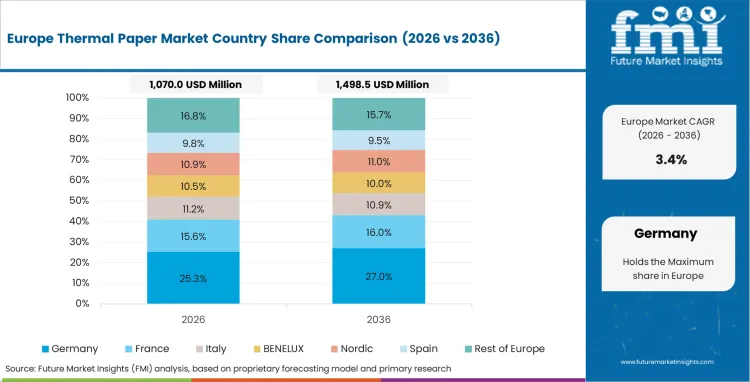
Europe functions as a sustainability-focused and regulation-driven thermal paper market. Chemical safety standards and environmental directives significantly influence product formulations. Key regional players include Koehler Paper Group, Mitsubishi Paper Mills Ltd., and Lecta Group.
- Germany: Demand for thermal paper in Germany is projected to grow moderately through 2036. Germany enforces strict compliance with European chemical regulations, encouraging use of BPA-free and phenol-free thermal coatings. Retail and logistics labeling remain primary demand drivers. The country’s strong recycling framework and environmental focus continue to influence development of eco-compliant thermal grades. While digital invoicing and electronic receipts are expanding, established retail infrastructure sustains baseline consumption.
- France: Demand for thermal paper in France is projected to expand steadily through 2036. Regulatory focus on reducing chemical exposure in consumer products continues to shape coating technology. Retail and hospitality transactions support receipt demand, although electronic billing adoption is increasing. Logistics and courier services provide steady label consumption. Environmental policy alignment with EU chemical standards reinforces transition toward safer thermal paper formulations.
FMI's analysis of global thermal paper market in Europe consists of country-wise assessment that includes Germany and France. Readers can find insights on chemical regulation impact, eco-friendly coating development, and retail transaction trends.
Competitive Aligners for Market Players
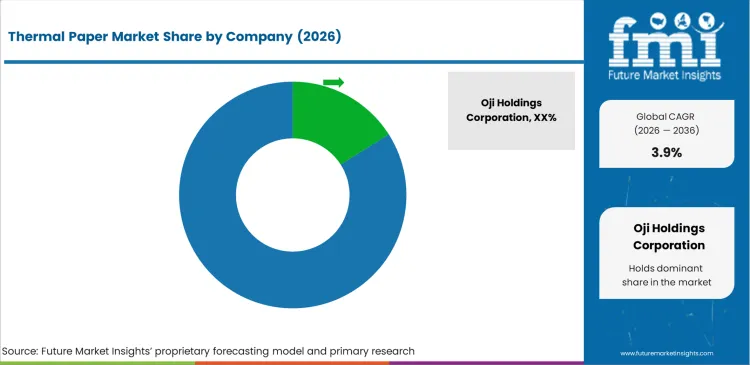
The global thermal paper market is moderately concentrated, with a group of large multinational paper producers and specialty coating companies accounting for a significant share of global capacity. Companies such as Oji Holdings Corporation, Ricoh Co., Ltd., Koehler Paper Group, Mitsubishi Paper Mills Ltd., Nippon Paper Industries, Hansol Paper, Lecta Group, Domtar Corporation, and Appvion Operations maintain strong positions due to their integrated pulp sourcing, coating expertise, and long-standing supply relationships with point-of-sale (POS), ATM, lottery, and labeling system manufacturers. Chinese producers including Chenming Group, Shandong Sun Paper, Henan JiangHE Paper, Gold Huasheng Paper, and Guangdong Guanhao High-Tech also hold meaningful regional and export market share. Competition in this market is primarily driven by coating technology, chemical formulation (BPA-free/BPS-free), regulatory compliance, and production scale efficiency.
Structural advantages are concentrated among companies with vertically integrated pulp production and advanced coating technology platforms. Firms such as Oji, Nippon Paper, Mitsubishi Paper Mills, and Koehler Paper benefit from captive fiber access and proprietary thermal coating formulations that meet evolving regulatory standards in Europe, North America, and Asia. Companies investing in phenol-free and recyclable thermal papers gain a competitive edge amid increasing environmental scrutiny and chemical regulation. Large producers with global converting networks and diversified product portfolios, including label stock and specialty papers, maintain stronger resilience against demand volatility in traditional POS receipt segments.
Buyer leverage in the thermal paper market is moderate. Large retailers, POS system integrators, and lottery operators negotiate bulk contracts and frequently dual-source to manage pricing volatility tied to pulp and chemical inputs. However, once a thermal paper grade is validated for printer compatibility, image durability, and regulatory compliance, supplier substitution can involve qualification costs and operational adjustments. The ongoing shift toward digital receipts and electronic invoicing exerts long-term demand pressure, while specialty applications such as logistics labels and medical monitoring continue to provide stability. As regulatory bans on BPA and similar chemicals expand, suppliers with compliant and certified thermal paper grades retain stronger pricing stability and customer retention.
Recent Developments
- On June 2025, Ricoh Co., Ltd. (Ricoh Industrie France) announced that it will showcase a tree-free top-coated thermal paper made from sugarcane agricultural residue, which is home-compostable and completely phenol-free, highlighting its innovation in sustainable thermal paper solutions.
- On September 2025 (Labelexpo Europe 2025), Koehler Paper Group highlighted its thermal paper-based linerless label solutions, including products based on its Blue4est® thermal paper technology, which eliminates chemical developers and improves recyclability and sustainability.
Key Players
- Oji Holdings Corporation
- Ricoh Co., Ltd.
- Appvion Operations, Inc.
- Koehler Paper Group
- Mitsubishi Paper Mills Ltd.
- Hansol Paper Co., Ltd.
- Jujo Thermal Ltd.
- Nippon Paper Industries Co., Ltd.
- Lecta Group
- Domtar Corporation
- Shandong Sun Paper Industry Co., Ltd.
- Chenming Group
Scope of Report
| Metric | Value |
|---|---|
| Quantitative Units | USD 4,275.2 million (2025); USD 4,456.6 million (2026) to USD 6,523.4 million (2035), at a CAGR of 3.9% |
| Market Definition | The global thermal paper market comprises the production and commercialization of heat-sensitive coated paper substrates that produce images without ink through thermal printing technology, widely used in point-of-sale systems, ticketing, labeling, financial transactions, and logistics applications. |
| Form Segmentation | Direct Thermal Paper; Thermal Transfer Paper |
| End Use Segmentation | Retail; Hospitality & Food Services; Healthcare; Transportation & Logistics; Banking & Financial Services; Entertainment & Gaming; Government & Public Sector; Industrial & Manufacturing |
| Application Coverage | POS Receipts; ATM & Banking Slips; Transport & Event Tickets; Lottery & Gaming Slips; Barcode Labels & Tags; Self-Adhesive Labels; Kiosk & Parking System Prints |
| Regions Covered | North America; Latin America; East Asia; South Asia & Pacific; Europe; Middle East & Africa |
| Countries Covered | United States; Germany; United Kingdom; France; China; Japan; South Korea; India; Brazil; Mexico; and 40+ countries |
| Key Companies Profiled | Oji Holdings Corporation; Ricoh Co., Ltd.; Koehler Paper Group; Mitsubishi Paper Mills Ltd.; Nippon Paper Industries Co., Ltd.; Others |
| Forecast Period | 2026 to 2035 |
| Approach | Hybrid top-down and bottom-up market modeling validated through primary interviews with thermal paper manufacturers, coating technology providers, POS system integrators, and distributors, supported by coating chemistry benchmarking (phenol-free transitions), thickness optimization analysis, regulatory compliance tracking, and trade flow assessment across global retail and logistics supply chains. |
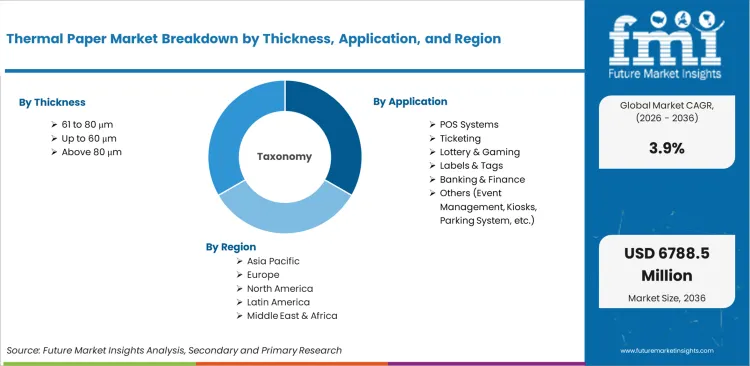
Global Thermal Paper Market by Segmentation
By Thickness:
- Up to 60 μm
- 61 to 80 μm
- Above 80 μm
By Printing Technology:
- Direct Thermal
- Thermal Transfer
By Product Type:
- Top Coated Paper
- Coloured Thermal Paper
- Self-adhesive Paper
- Synthetic Thermal Paper
- Phenol-Free Thermal Paper
- Recycled Thermal Paper
By Application:
- POS Systems
- Ticketing
- Lottery & Gaming
- Labels & Tags
- Banking & Finance
- Others (Event Management, Kiosks, Parking System, etc.)
By End Use:
- Retail
- Hospitality & Food Services
- Healthcare
- Transportation & Logistics
- Banking & Financial Services
- Entertainment & Gaming
- Government & Public Sector
- Industrial & Manufacturing
By Region:
- North America
- Latin America
- East Asia
- South Asia & Pacific
- Europe
- Middle East & Africa
Bibliography
- European Chemicals Agency (ECHA), Bisphenol A (BPA) Restriction under REACH - Updated Candidate List Information, January 2024.
- European Parliament and Council, Regulation (EU) 2024/1781 on Packaging and Packaging Waste (PPWR), April 2024.
- USA Environmental Protection Agency (EPA), Bisphenol A (BPA) Action Plan and Chemical Data Reporting Update, December 2023.
- Confederation of European Paper Industries (Cepi), Key Statistics 2023 - European Pulp and Paper Industry Data, July 2024.
- Food and Agriculture Organization of the United Nations (FAO), FAOSTAT Forestry Production and Trade Data (Updated 2024 Release), September 2024.
- International Organization for Standardization (ISO), ISO 9001:2015 Quality Management Systems (Confirmed 2023 Review), September 2023.
- European Environment Agency (EEA), Chemical Pollution in Europe - 2024 Update, November 2024.
- American Forest & Paper Association (AF&PA), 2024 Paperboard and Paper Market Statistics Report, June 2024.
This bibliography is provided for reader reference and is not exhaustive. The full report contains the complete reference list and detailed citations.
Frequently Asked Questions
How large is the Global Thermal Paper Market in 2026?
The Global Thermal Paper Market is valued at 4,456.6 Mn in 2026.
What was the market size of the Global Thermal Paper Market in 2025?
The market was valued at 4,275.2 Mn in 2025.
What will be the market size of the Global Thermal Paper Market by 2035?
The market is projected to reach 6,523.4 Mn by 2035.
What is the expected CAGR of the Global Thermal Paper Market during the forecast period?
The market is expected to grow at a CAGR of 3.9%.
Which thickness segment dominates the Global Thermal Paper Market?
The 61 to 80 μm thickness segment leads the market with a 56.7% share, followed by up to 60 μm at 27.0% and above 80 μm at 16.4%.
Which product type holds the largest share in the market?
Top Coated Paper dominates with a 52.6% share, followed by Phenol-Free Thermal Paper at 19.5% and Self-adhesive Paper at 9.9%.
How significant is the POS Systems application segment?
POS Systems account for 42.2% of total demand, making it the largest application segment.
Which country is projected to grow the fastest in the Global Thermal Paper Market?
India leads with a 5.9% CAGR, followed by China at 4.2%, Brazil at 4.0%, the United States at 3.4%, and Germany at 3.0% during 2026–2036.
Preview the report firsthand - request a free sample
Get SampleGet the brochure for pricing and purchase details.
Get PDFTable of Content
- Executive Summary
- Global Market Outlook
- Demand-side Trends
- Supply-side Trends
- Technology Roadmap Analysis
- Analysis and Recommendations
- Market Overview
- Market Coverage / Taxonomy
- Market Definition / Scope / Limitations
- Research Methodology
- Chapter Orientation
- Analytical Lens and Working Hypotheses
- Market Structure, Signals, and Trend Drivers
- Benchmarking and Cross-market Comparability
- Market Sizing, Forecasting, and Opportunity Mapping
- Research Design and Evidence Framework
- Desk Research Programme (Secondary Evidence)
- Company Annual and Sustainability Reports
- Peer-reviewed Journals and Academic Literature
- Corporate Websites, Product Literature, and Technical Notes
- Earnings Decks and Investor Briefings
- Statutory Filings and Regulatory Disclosures
- Technical White Papers and Standards Notes
- Trade Journals, Industry Magazines, and Analyst Briefs
- Conference Proceedings, Webinars, and Seminar Materials
- Government Statistics Portals and Public Data Releases
- Press Releases and Reputable Media Coverage
- Specialist Newsletters and Curated Briefings
- Sector Databases and Reference Repositories
- FMI Internal Proprietary Databases and Historical Market Datasets
- Subscription Datasets and Paid Sources
- Social Channels, Communities, and Digital Listening Inputs
- Additional Desk Sources
- Expert Input and Fieldwork (Primary Evidence)
- Primary Modes
- Qualitative Interviews and Expert Elicitation
- Quantitative Surveys and Structured Data Capture
- Blended Approach
- Why Primary Evidence is Used
- Field Techniques
- Interviews
- Surveys
- Focus Groups
- Observational and In-context Research
- Social and Community Interactions
- Stakeholder Universe Engaged
- C-suite Leaders
- Board Members
- Presidents and Vice Presidents
- R&D and Innovation Heads
- Technical Specialists
- Domain Subject-matter Experts
- Scientists
- Physicians and Other Healthcare Professionals
- Governance, Ethics, and Data Stewardship
- Research Ethics
- Data Integrity and Handling
- Primary Modes
- Tooling, Models, and Reference Databases
- Desk Research Programme (Secondary Evidence)
- Data Engineering and Model Build
- Data Acquisition and Ingestion
- Cleaning, Normalisation, and Verification
- Synthesis, Triangulation, and Analysis
- Quality Assurance and Audit Trail
- Market Background
- Market Dynamics
- Drivers
- Restraints
- Opportunity
- Trends
- Scenario Forecast
- Demand in Optimistic Scenario
- Demand in Likely Scenario
- Demand in Conservative Scenario
- Opportunity Map Analysis
- Product Life Cycle Analysis
- Supply Chain Analysis
- Investment Feasibility Matrix
- Value Chain Analysis
- PESTLE and Porter’s Analysis
- Regulatory Landscape
- Regional Parent Market Outlook
- Production and Consumption Statistics
- Import and Export Statistics
- Market Dynamics
- Global Market Analysis 2021 to 2025 and Forecast, 2026 to 2036
- Historical Market Size Value (USD Million) Analysis, 2021 to 2025
- Current and Future Market Size Value (USD Million) Projections, 2026 to 2036
- Y-o-Y Growth Trend Analysis
- Absolute $ Opportunity Analysis
- Global Market Pricing Analysis 2021 to 2025 and Forecast 2026 to 2036
- Global Market Analysis 2021 to 2025 and Forecast 2026 to 2036, By Thickness
- Introduction / Key Findings
- Historical Market Size Value (USD Million) Analysis By Thickness , 2021 to 2025
- Current and Future Market Size Value (USD Million) Analysis and Forecast By Thickness , 2026 to 2036
- 61 to 80 μm
- Up to 60 μm
- Above 80 μm
- 61 to 80 μm
- Y-o-Y Growth Trend Analysis By Thickness , 2021 to 2025
- Absolute $ Opportunity Analysis By Thickness , 2026 to 2036
- Global Market Analysis 2021 to 2025 and Forecast 2026 to 2036, By Application
- Introduction / Key Findings
- Historical Market Size Value (USD Million) Analysis By Application, 2021 to 2025
- Current and Future Market Size Value (USD Million) Analysis and Forecast By Application, 2026 to 2036
- POS Systems
- Ticketing
- Lottery & Gaming
- Labels & Tags
- Banking & Finance
- Others (Event Management, Kiosks, Parking System, etc.)
- POS Systems
- Y-o-Y Growth Trend Analysis By Application, 2021 to 2025
- Absolute $ Opportunity Analysis By Application, 2026 to 2036
- Global Market Analysis 2021 to 2025 and Forecast 2026 to 2036, By Region
- Introduction
- Historical Market Size Value (USD Million) Analysis By Region, 2021 to 2025
- Current Market Size Value (USD Million) Analysis and Forecast By Region, 2026 to 2036
- North America
- Latin America
- Western Europe
- Eastern Europe
- East Asia
- South Asia and Pacific
- Middle East & Africa
- Market Attractiveness Analysis By Region
- North America Market Analysis 2021 to 2025 and Forecast 2026 to 2036, By Country
- Historical Market Size Value (USD Million) Trend Analysis By Market Taxonomy, 2021 to 2025
- Market Size Value (USD Million) Forecast By Market Taxonomy, 2026 to 2036
- By Country
- USA
- Canada
- Mexico
- By Thickness
- By Application
- By Country
- Market Attractiveness Analysis
- By Country
- By Thickness
- By Application
- Key Takeaways
- Latin America Market Analysis 2021 to 2025 and Forecast 2026 to 2036, By Country
- Historical Market Size Value (USD Million) Trend Analysis By Market Taxonomy, 2021 to 2025
- Market Size Value (USD Million) Forecast By Market Taxonomy, 2026 to 2036
- By Country
- Brazil
- Chile
- Rest of Latin America
- By Thickness
- By Application
- By Country
- Market Attractiveness Analysis
- By Country
- By Thickness
- By Application
- Key Takeaways
- Western Europe Market Analysis 2021 to 2025 and Forecast 2026 to 2036, By Country
- Historical Market Size Value (USD Million) Trend Analysis By Market Taxonomy, 2021 to 2025
- Market Size Value (USD Million) Forecast By Market Taxonomy, 2026 to 2036
- By Country
- Germany
- UK
- Italy
- Spain
- France
- Nordic
- BENELUX
- Rest of Western Europe
- By Thickness
- By Application
- By Country
- Market Attractiveness Analysis
- By Country
- By Thickness
- By Application
- Key Takeaways
- Eastern Europe Market Analysis 2021 to 2025 and Forecast 2026 to 2036, By Country
- Historical Market Size Value (USD Million) Trend Analysis By Market Taxonomy, 2021 to 2025
- Market Size Value (USD Million) Forecast By Market Taxonomy, 2026 to 2036
- By Country
- Russia
- Poland
- Hungary
- Balkan & Baltic
- Rest of Eastern Europe
- By Thickness
- By Application
- By Country
- Market Attractiveness Analysis
- By Country
- By Thickness
- By Application
- Key Takeaways
- East Asia Market Analysis 2021 to 2025 and Forecast 2026 to 2036, By Country
- Historical Market Size Value (USD Million) Trend Analysis By Market Taxonomy, 2021 to 2025
- Market Size Value (USD Million) Forecast By Market Taxonomy, 2026 to 2036
- By Country
- China
- Japan
- South Korea
- By Thickness
- By Application
- By Country
- Market Attractiveness Analysis
- By Country
- By Thickness
- By Application
- Key Takeaways
- South Asia and Pacific Market Analysis 2021 to 2025 and Forecast 2026 to 2036, By Country
- Historical Market Size Value (USD Million) Trend Analysis By Market Taxonomy, 2021 to 2025
- Market Size Value (USD Million) Forecast By Market Taxonomy, 2026 to 2036
- By Country
- India
- ASEAN
- Australia & New Zealand
- Rest of South Asia and Pacific
- By Thickness
- By Application
- By Country
- Market Attractiveness Analysis
- By Country
- By Thickness
- By Application
- Key Takeaways
- Middle East & Africa Market Analysis 2021 to 2025 and Forecast 2026 to 2036, By Country
- Historical Market Size Value (USD Million) Trend Analysis By Market Taxonomy, 2021 to 2025
- Market Size Value (USD Million) Forecast By Market Taxonomy, 2026 to 2036
- By Country
- Kingdom of Saudi Arabia
- Other GCC Countries
- Turkiye
- South Africa
- Other African Union
- Rest of Middle East & Africa
- By Thickness
- By Application
- By Country
- Market Attractiveness Analysis
- By Country
- By Thickness
- By Application
- Key Takeaways
- Key Countries Market Analysis
- USA
- Pricing Analysis
- Market Share Analysis, 2025
- By Thickness
- By Application
- Canada
- Pricing Analysis
- Market Share Analysis, 2025
- By Thickness
- By Application
- Mexico
- Pricing Analysis
- Market Share Analysis, 2025
- By Thickness
- By Application
- Brazil
- Pricing Analysis
- Market Share Analysis, 2025
- By Thickness
- By Application
- Chile
- Pricing Analysis
- Market Share Analysis, 2025
- By Thickness
- By Application
- Germany
- Pricing Analysis
- Market Share Analysis, 2025
- By Thickness
- By Application
- UK
- Pricing Analysis
- Market Share Analysis, 2025
- By Thickness
- By Application
- Italy
- Pricing Analysis
- Market Share Analysis, 2025
- By Thickness
- By Application
- Spain
- Pricing Analysis
- Market Share Analysis, 2025
- By Thickness
- By Application
- France
- Pricing Analysis
- Market Share Analysis, 2025
- By Thickness
- By Application
- India
- Pricing Analysis
- Market Share Analysis, 2025
- By Thickness
- By Application
- ASEAN
- Pricing Analysis
- Market Share Analysis, 2025
- By Thickness
- By Application
- Australia & New Zealand
- Pricing Analysis
- Market Share Analysis, 2025
- By Thickness
- By Application
- China
- Pricing Analysis
- Market Share Analysis, 2025
- By Thickness
- By Application
- Japan
- Pricing Analysis
- Market Share Analysis, 2025
- By Thickness
- By Application
- South Korea
- Pricing Analysis
- Market Share Analysis, 2025
- By Thickness
- By Application
- Russia
- Pricing Analysis
- Market Share Analysis, 2025
- By Thickness
- By Application
- Poland
- Pricing Analysis
- Market Share Analysis, 2025
- By Thickness
- By Application
- Hungary
- Pricing Analysis
- Market Share Analysis, 2025
- By Thickness
- By Application
- Kingdom of Saudi Arabia
- Pricing Analysis
- Market Share Analysis, 2025
- By Thickness
- By Application
- Turkiye
- Pricing Analysis
- Market Share Analysis, 2025
- By Thickness
- By Application
- South Africa
- Pricing Analysis
- Market Share Analysis, 2025
- By Thickness
- By Application
- USA
- Market Structure Analysis
- Competition Dashboard
- Competition Benchmarking
- Market Share Analysis of Top Players
- By Regional
- By Thickness
- By Application
- Competition Analysis
- Competition Deep Dive
- Oji Holdings Corporation
- Overview
- Product Portfolio
- Profitability by Market Segments (Product/Age /Sales Channel/Region)
- Sales Footprint
- Strategy Overview
- Marketing Strategy
- Product Strategy
- Channel Strategy
- Ricoh Co., Ltd.
- Appvion Operations, Inc.
- Koehler Paper Group
- Mitsubishi Paper Mills Ltd.
- Hansol Paper Co., Ltd.
- Jujo Thermal Ltd.
- Nippon Paper Industries Co., Ltd.
- Lecta Group
- Domtar Corporation
- Shandong Sun Paper Industry Co., Ltd.
- Chenming Group
- Oji Holdings Corporation
- Competition Deep Dive
- Assumptions & Acronyms Used


