

- Industry Size (2026)
- USD 2.63 Bn
- Forecast (2036)
- USD 4.32 Bn
- CAGR (2026 to 2036)
- 5.10%
Emergency Venting System Market Size, Market Forecast and Outlook By FMI
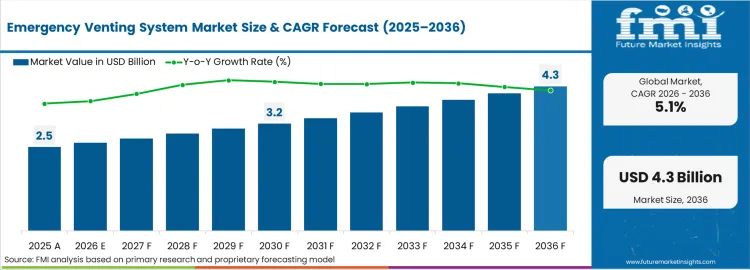
The emergency venting system market was valued at USD 2.50 billion in 2025, projected to reach USD 2.63 billion in 2026, and is forecast to expand to USD 4.32 billion by 2036 at a 5.10% CAGR. Expanding process safety management mandates across petrochemical, pharmaceutical, and food processing facilities are driving investment in engineered emergency venting systems that protect storage vessels and process equipment from overpressure events. ATEX, NFPA, and IEC standard compliance requirements are compelling facility operators to upgrade legacy venting installations with certified systems that provide documented relief capacity calculations and validated performance certifications.
The absolute dollar opportunity of approximately USD 1.69 billion over the forecast period reflects the parallel growth of new facility construction and existing installation upgrade demand. Combination venting systems integrating rupture disks with pressure relief valves are commanding premium per-installation values by providing both primary and secondary overpressure protection within a single integrated assembly. Smart venting systems with IoT-connected pressure monitoring and predictive maintenance alerting are creating a technology-differentiated product tier that generates recurring monitoring service revenues alongside initial equipment procurement.
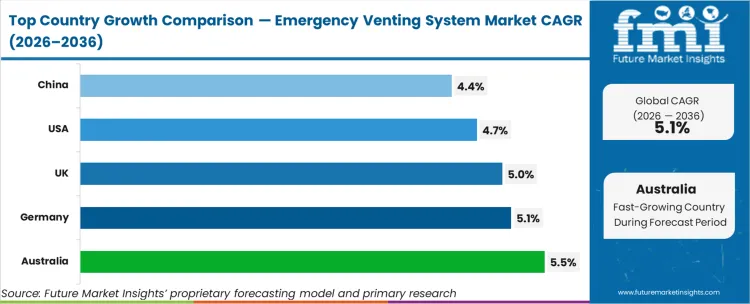
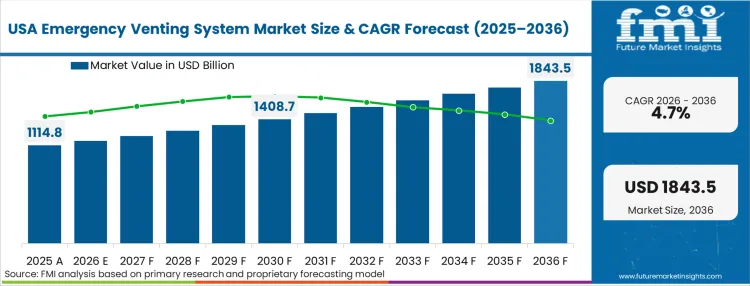
Australia sets the pace at a 5.5% CAGR, driven by LNG facility expansion and mining sector process safety equipment investment. Germany registers 5.1% growth under ATEX directive compliance and chemical industry safety management system upgrades. UK maintains 5.0% supported by COMAH regulation enforcement and North Sea facility safety equipment renewal. USA tracks at 4.7% driven by OSHA PSM compliance and refinery turnaround safety equipment replacement. China follows at 4.4% with petrochemical facility expansion and updated national process safety standards.
Summary of Emergency Venting System Market
- Emergency Venting System Market Definition
- Emergency venting systems are engineered overpressure protection installations using rupture disks, combination assemblies, and high-intensity vents to safely relieve abnormal pressure in industrial storage and process equipment across petrochemical, pharmaceutical, and food processing facilities.
- Demand Drivers in the Market
- ATEX, NFPA, and IEC process safety standard compliance requirements compel facility operators to upgrade legacy venting with certified systems providing documented relief capacity calculations and validated performance.
- Combination venting systems integrating rupture disks with relief valves command premium installation values by providing dual overpressure protection within single integrated assemblies.
- IoT-connected smart venting systems with pressure monitoring and predictive maintenance alerting create technology-differentiated tiers generating recurring monitoring service revenues.
- Key Segments Analyzed in the FMI Report
- Rupture Disk by Venting System Type: 38.0% share in 2026, as rupture disk assemblies provide the fastest response time for emergency overpressure relief with zero leakage during normal operation, making them the preferred primary protection device.
- Stainless Steel by Construction Material: 42.0% share in 2026, reflecting corrosion resistance requirements in chemical, pharmaceutical, and food processing applications where material compatibility with process media is mandatory.
- Australia: 5.5% compound growth driven by LNG facility expansion and mining sector process safety equipment investment across major resource extraction operations.
- Analyst Opinion at FMI
- Nandini Roy Choudhury, Principal Consultant for Food & Beverage analysts observe that, the emergency venting system market is driven by process safety compliance mandates where procurement timing aligns with facility audit cycles, turnaround maintenance windows, and new construction commissioning schedules. Manufacturers who can deliver combination venting system designs with pre-engineered relief capacity documentation accelerate the specification-to-procurement timeline for facility engineers working under compliance deadlines. The critical service revenue opportunity centers on IoT-connected monitoring, as predictive maintenance platforms that detect rupture disk degradation before failure create recurring service contract revenues that transform the business model from one-time equipment sales to continuous safety monitoring relationships.
- Strategic Implications / Executive Takeaways
- Emergency venting system manufacturers must develop pre-engineered combination assemblies with documented relief capacity calculations to accelerate specification timelines for facility engineers under compliance audit deadlines.
- Facility process safety managers must integrate venting system condition monitoring into plant-wide predictive maintenance programmes to detect rupture disk degradation before emergency relief events.
- Industrial safety equipment distributors must expand stainless steel venting system inventory depth to serve the growing pharmaceutical and food processing segment where material compatibility mandates exclude carbon steel alternatives.
Emergency Venting System Market Key Takeaways
| Metric | Details |
|---|---|
| Industry Size (2026) | USD 2.63 Billion |
| Industry Value (2036) | USD 4.32 Billion |
| CAGR (2026-2036) | 5.10% |
Source: Future Market Insights, 2026
Emergency Venting System Market Definition
Emergency venting systems are engineered overpressure protection installations designed to safely relieve abnormal pressure conditions in storage tanks, process vessels, and industrial equipment during fire exposure, process upsets, or equipment malfunction events. These systems encompass rupture disk assemblies, combination rupture disk and relief valve configurations, high-intensity tank venting systems, and integrated emergency relief installations manufactured from stainless steel, carbon steel, and aluminum for deployment across oil and gas, chemical, pharmaceutical, food processing, and power generation facilities.
Emergency Venting System Market Inclusions
Market scope includes rupture disk assemblies, combination venting systems, high-intensity emergency venting installations, pressure-vacuum relief systems, and IoT-connected smart venting platforms. Coverage spans oil and gas (upstream, midstream, downstream), chemical and petrochemical, pharmaceutical, food and beverage, power generation, and water treatment facility applications.
Emergency Venting System Market Exclusions
Standard pressure relief valves without emergency venting designation, tank blanketing nitrogen systems, and flare stack combustion equipment are excluded. Venting system engineering consulting without equipment supply falls outside analytical parameters.
Emergency Venting System Market Research Methodology
- Primary Research: Analysts engaged with process safety engineers at petrochemical facilities, pharmaceutical plant EHS directors, and emergency venting system manufacturer application engineers to map the regulatory compliance and risk assessment triggers for venting system specification.
- Desk Research: Data collection phases aggregated process safety management audit schedules, ATEX zone classification review timelines, and industrial facility construction permit data with safety equipment specifications.
- Market-Sizing and Forecasting: Baseline values derive from a bottom-up aggregation of emergency venting system installation values across system type and application categories, applying region-specific facility construction and compliance upgrade curves.
- Data Validation and Update Cycle: Projections are tested against publicly reported process safety equipment revenues from leading venting system manufacturers and industrial safety equipment distributors.
Key Factors Accelerating the Emergency Venting System Market
- The boom in stringent safety regulations across industries such as oil and gas, chemicals, and pharmaceuticals is accelerating the demand for emergency venting systems.
- Compliance with the regulations encourages companies to invest in robust safety measures, including installing emergency venting systems to mitigate potential hazards and ensure regulatory compliance.
- Boost awareness among industries about the importance of industrial safety is a significant factor urging the emergency venting system market.
Key Factors Hindering the Emergency Venting System Market
- Emergency venting systems require substantial investment in equipment, installation, and ongoing maintenance to ensure proper functioning and compliance with safety standards.
- The complexity of integrating emergency venting systems into existing industrial infrastructure can pose challenges for market growth.
- Retrofitting emergency venting systems into established facilities may require significant modifications to existing equipment and processes, leading to downtime and additional costs.
- System integration complexities can deter companies from adopting emergency venting solutions, particularly in industries with complex operational environments.
Category-wise Insights
The below section shows the leading segment. Based on the venting system type, the rupture disk segment is accounted to hold a market share of 14.0% in 2026. Based on application, the oil and gas industry is accounted to hold a market share of 20.0% in 2026.
Rupture disks offer reliable pressure relief by rupturing at predetermined pressures, thus preventing overpressure incidents and safeguarding personnel, equipment, and the environment.
Compliance with the regulations jaunts companies to invest in safety measures such as emergency venting systems to ensure operational integrity and regulatory adherence, fueling demand for these solutions within the oil and gas sector.
| Category | Market Share in 2026 |
|---|---|
| Rupture Disk | 14.0% |
| Oil and Gas Industry | 20.0% |
Rupture Disk Segment to Hold a Significant Share in the Market
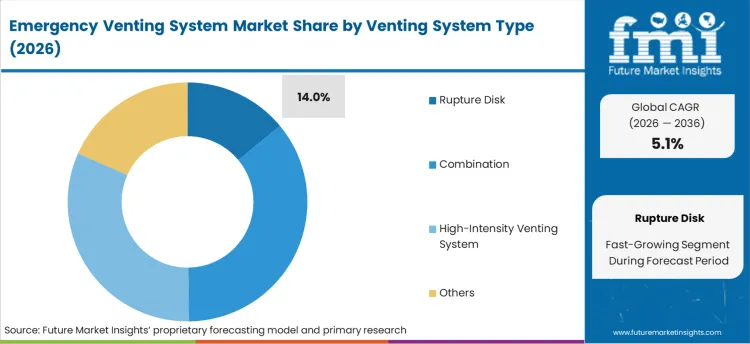
Based on material, the rupture disk sector is accounted to hold a market share of 14.0% in 2026. Rupture disks relieve pressure by rupturing at predetermined pressures, preventing overpressure incidents and potentially catastrophic failures in various industrial processes.
The disks' reliability, simplicity, and effectiveness make them preferred choices for emergency venting across industries such as oil and gas, chemical processing, pharmaceuticals, and manufacturing.
Oil and Gas Industry to Hold a Dominant Share in the Market and offer
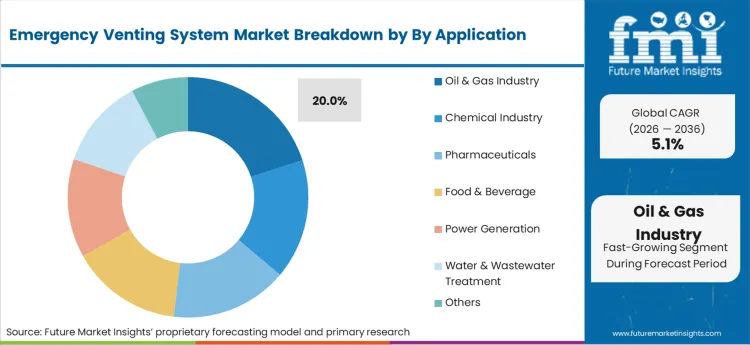
Based on application, the oil and gas industry is accounted to hold a market share of 20.0% in 2026. The oil and gas industry operates where high pressures and volatile substances pose significant risks.
Emergency venting systems, including rupture disks, are essential for safeguarding personnel, equipment, and the environment by releasing excess pressure and preventing equipment damage or catastrophic explosions.
The oil and gas industry continues to expand globally, mainly in offshore and onshore extraction operations. The demand for reliable emergency venting systems remains robust, propelling the market share of this application segment.
Country-wise Insights
The table mentions the top five countries ranked by revenue, with Australia holding the top position.
Rigorous safety standards and reliance on mining, oil, and gas industries help Australia dominate the emergency venting system market. With a focus on safety and regulatory compliance, the companies in Australia prioritize installing emergency venting systems to mitigate operational risks and ensure industrial safety.
.webp "Top Country Growth Comparison Emergency Venting System Market Cagr (2026 2036)")
| Countries | CAGR from 2026 to 2036 |
|---|---|
| United States | 4.7% |
| Germany | 5.1% |
| The United Kingdom | 5% |
| China | 4.4% |
| Australia | 5.5% |
Stringent Safety Regulations Help the United States Market to Improve
In the United States, the emergency venting system market is primarily used in various industries such as oil and gas, chemicals, pharmaceuticals, and manufacturing.
With stringent safety regulations and a focus on risk mitigation, emergency venting systems are important for preventing overpressure incidents and ensuring operational safety across these sectors.
Progressive Manufacturing and Industrial Sectors Initiate Prosperity in Germany
In Germany, known for its advanced manufacturing and industrial prowess, the emergency venting system market finds extensive usage in industries such as chemicals, automotive manufacturing, and pharmaceuticals.
The industries in Germany prioritize safety measures and compliance with strict regulatory standards, lifting the demand for emergency venting systems to protect personnel and assets.
Operational Efficiency and Safety Impresses the United States Market
In the United Kingdom, the emergency venting system Market is utilized across industries, including oil and gas, petrochemicals, and food processing.
With a focus on operational efficiency and safety, British industries rely on emergency venting systems to mitigate the risk of pressure buildup and potential hazards in their operations.
China, a Dominant Energy Consumer
In China, as the dominant energy consumer and a major player in industries such as manufacturing, chemicals, and refining, the emergency venting system market is broadly used to ensure safety and regulatory compliance.
The industrial growth and emphasis on safety standards augments the demand for emergency venting systems to safeguard industrial processes and personnel.
Australia Holds a Pivotal Position in the Market
In Australia, where industries such as mining, oil and gas, and renewable energy play significant economic roles, the market protects critical infrastructure and operations.
With a focus on safety and environmental stewardship, the industries in Australia employ emergency venting systems to prevent overpressure incidents and ensure the integrity of industrial processes.
Competitive Landscape
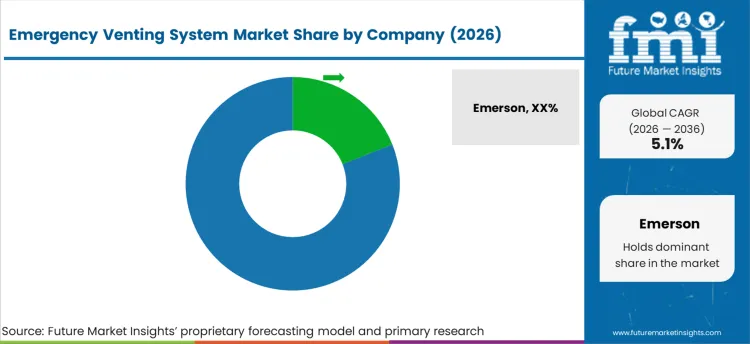
The competitive landscape of the emergency venting system market focuses on product differentiation, technological advancements, and strategic partnerships to maintain market share. Regulatory compliance, industry standards, and end-user requirements influence competition.
The market witnesses mergers, acquisitions, and collaborations to bolster product portfolios and geographical presence.
Some of the key developments are
- In June 2022, Warmafloor introduced the Ventiza range of mechanical heat recovery ventilation systems. This ultra-efficient solution offered comprehensive airflow control for residential spaces, ensuring optimal indoor air quality and comfort.
- In March 2021, EnviroVent unveiled the MEV 160 and MEV 300. These versatile, compact systems were designed to enhance indoor air quality in various residential and communal settings, offering high-performance ventilation with minimal energy consumption and moisture migration.
Key Coverage in the Emergency Venting System Industry Report
- Adjacent Study on Emergency Venting System Market, Emergency Relief Vent Market, Emergency and Transport Ventilator Market
- Australia Emergency Ventilator Market
- Emergency Venting System Market Size, Current Insights, and Demographic Trends
- Global Ventilation System Sales Market
- Key Opportunities in the Global Emergency Venting System Market
Scope of the Report
| Metric | Value |
|---|---|
| Quantitative Units | USD 2.63 Billion to USD 4.32 Billion, at a CAGR of 5.10% |
| Market Definition | Emergency venting systems are engineered overpressure protection installations using rupture disks, combination assemblies, and high-intensity vents to safely relieve abnormal pressure in industrial storage and process equipment across petrochemical, pharmaceutical, and food processing facilities. |
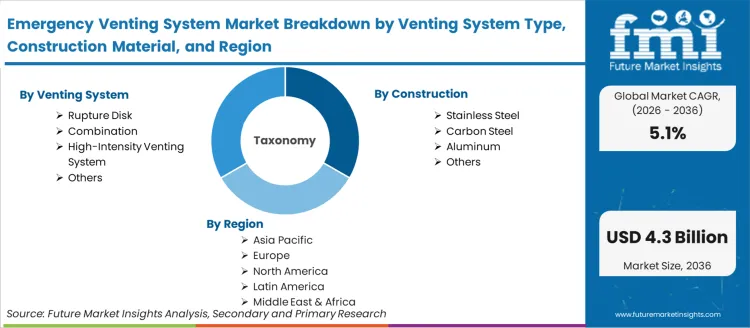
| Segmentation | Venting System Type: Rupture Disk, Combination, High-Intensity Venting System, and Others; Construction Material: Stainless Steel, Carbon Steel, Aluminum, and Others; Application: Oil & Gas Industry, Chemical Industry, Pharmaceuticals, Food & Beverage, Power Generation, Water & Wastewater Treatment, and Others |
| Regions Covered | North America, Latin America, Europe, East Asia, South Asia, Oceania, Middle East & Africa |
| Countries/Regions Covered | Australia, Germany, UK, USA, China, and 40 plus countries |
| Key Companies Profiled | Emerson, John M. Ellsworth Company Inc., Protectoseal, Oil Equipment, Kingsley Engineering Services, Ateco Tank Technology Engineering Service Co., Seneca Companies, FuelChief, Envirosafe, Nirmal Industrial Controls Pvt. Ltd. |
| Forecast Period | 2026 to 2036 |
| Approach | Forecasting models apply a bottom-up methodology starting with installed base metrics and projecting conversion rates to technology adoption. |
Key Segments
By Venting System Type:
- Rupture Disk
- Combination (Rupture Disk and Relief Valve)
- High-Intensity Venting System
- Others
By Construction Material:
- Stainless Steel
- Carbon Steel
- Aluminum
- Others
By Application:
- Oil & Gas Industry
- Upstream
- Midstream
- Downstream
- Chemical Industry
- Petrochemicals
- Specialty Chemicals
- Agrochemicals
- Pharmaceuticals
- Food & Beverage
- Power Generation
- Water & Wastewater Treatment
- Others
By Region:
- North America
- Latin America
- Western Europe
- Eastern Europe
- South Asia and Pacific
- East Asia
- The Middle East and Africa
Bibliography
- European Commission. (2024). ATEX Directive 2014/34/EU: Equipment for Explosive Atmospheres Compliance Update. European Commission.
- National Fire Protection Association. (2024). NFPA 68: Standard on Explosion Protection by Deflagration Venting. NFPA.
- Occupational Safety and Health Administration. (2024). Process Safety Management Standard 29 CFR 1910.119: Emergency Relief Systems Requirements. OSHA.
- Safe Work Australia. (2024). Managing Risks of Hazardous Chemicals: Emergency Relief System Standards. SWA.
- Health and Safety Executive UK. (2024). COMAH Guidance: Emergency Venting System Design and Maintenance Standards. HSE.
- International Electrotechnical Commission. (2024). IEC 61511: Functional Safety for Process Industry Emergency Systems. IEC.
This bibliography is provided for reader reference. The full FMI report contains the complete reference list with primary research documentation.
This Report Addresses
- Market sizing and quantitative forecast metrics detailing emergency venting system installation values across system type, material, and application categories through 2036.
- Segmentation analysis mapping combination venting system adoption and IoT-connected monitoring platform integration across process industry segments.
- Regional deployment intelligence comparing LNG and mining-driven demand in Australia against ATEX compliance upgrades in Europe and PSM-driven procurement in North America.
- Regulatory compliance assessment analyzing how ATEX, NFPA, and OSHA PSM standards drive venting system specification and certification requirements.
- Competitive posture evaluation tracking global process safety equipment manufacturers against regional venting system specialists.
- Capital project strategic guidance defining the engineering, certification, and IoT monitoring requirements for emergency venting system manufacturers.
- Supply chain vulnerability analysis identifying stainless steel alloy availability and rupture disk manufacturing lead time constraints.
- Custom data delivery formats encompassing interactive dashboards, raw Excel datasets, and comprehensive PDF narrative reports.
Frequently Asked Questions
How large is the demand for Emergency Venting Systems in the global market in 2026?
Demand is estimated to be valued at USD 2.63 billion in 2026.
What will be the market size by 2036?
Market size is projected to reach USD 4.32 billion by 2036.
What is the expected CAGR between 2026 and 2036?
Demand is expected to grow at a CAGR of 5.10% between 2026 and 2036.
Which Venting System Type is poised to lead by 2026?
Rupture Disk accounts for 38.0% share providing fastest response with zero leakage during normal operation.
How is Oil & Gas positioned as an Application in 2026?
Oil & Gas Industry represents 35.0% share generating the largest per-facility venting system procurement values across upstream, midstream, and downstream operations.
What is driving demand in Australia?
LNG facility expansion and mining process safety investment fuel the fastest growth at 5.5% CAGR through 2036.
What is included in the scope of this report?
The market covers rupture disks, combination systems, high-intensity vents, PV relief, and IoT monitoring for oil and gas, chemical, pharma, food, power, and water treatment.
What is excluded from the scope of this report?
Standard relief valves, tank blanketing, flare stacks, and engineering consulting without equipment supply are excluded.
Preview the report firsthand - request a free sample
Get SampleGet the brochure for pricing and purchase details.
Get PDFTable of Content
- Executive Summary
- Global Market Outlook
- Demand-side Trends
- Supply-side Trends
- Technology Roadmap Analysis
- Analysis and Recommendations
- Market Overview
- Market Coverage / Taxonomy
- Market Definition / Scope / Limitations
- Research Methodology
- Chapter Orientation
- Analytical Lens and Working Hypotheses
- Market Structure, Signals, and Trend Drivers
- Benchmarking and Cross-market Comparability
- Market Sizing, Forecasting, and Opportunity Mapping
- Research Design and Evidence Framework
- Desk Research Programme (Secondary Evidence)
- Company Annual and Sustainability Reports
- Peer-reviewed Journals and Academic Literature
- Corporate Websites, Product Literature, and Technical Notes
- Earnings Decks and Investor Briefings
- Statutory Filings and Regulatory Disclosures
- Technical White Papers and Standards Notes
- Trade Journals, Industry Magazines, and Analyst Briefs
- Conference Proceedings, Webinars, and Seminar Materials
- Government Statistics Portals and Public Data Releases
- Press Releases and Reputable Media Coverage
- Specialist Newsletters and Curated Briefings
- Sector Databases and Reference Repositories
- FMI Internal Proprietary Databases and Historical Market Datasets
- Subscription Datasets and Paid Sources
- Social Channels, Communities, and Digital Listening Inputs
- Additional Desk Sources
- Expert Input and Fieldwork (Primary Evidence)
- Primary Modes
- Qualitative Interviews and Expert Elicitation
- Quantitative Surveys and Structured Data Capture
- Blended Approach
- Why Primary Evidence is Used
- Field Techniques
- Interviews
- Surveys
- Focus Groups
- Observational and In-context Research
- Social and Community Interactions
- Stakeholder Universe Engaged
- C-suite Leaders
- Board Members
- Presidents and Vice Presidents
- R&D and Innovation Heads
- Technical Specialists
- Domain Subject-matter Experts
- Scientists
- Physicians and Other Healthcare Professionals
- Governance, Ethics, and Data Stewardship
- Research Ethics
- Data Integrity and Handling
- Primary Modes
- Tooling, Models, and Reference Databases
- Desk Research Programme (Secondary Evidence)
- Data Engineering and Model Build
- Data Acquisition and Ingestion
- Cleaning, Normalisation, and Verification
- Synthesis, Triangulation, and Analysis
- Quality Assurance and Audit Trail
- Market Background
- Market Dynamics
- Drivers
- Restraints
- Opportunity
- Trends
- Scenario Forecast
- Demand in Optimistic Scenario
- Demand in Likely Scenario
- Demand in Conservative Scenario
- Opportunity Map Analysis
- Product Life Cycle Analysis
- Supply Chain Analysis
- Investment Feasibility Matrix
- Value Chain Analysis
- PESTLE and Porter’s Analysis
- Regulatory Landscape
- Regional Parent Market Outlook
- Production and Consumption Statistics
- Import and Export Statistics
- Market Dynamics
- Global Market Analysis 2021 to 2025 and Forecast, 2026 to 2036
- Historical Market Size Value (USD Million) Analysis, 2021 to 2025
- Current and Future Market Size Value (USD Million) Projections, 2026 to 2036
- Y-o-Y Growth Trend Analysis
- Absolute $ Opportunity Analysis
- Global Market Pricing Analysis 2021 to 2025 and Forecast 2026 to 2036
- Global Market Analysis 2021 to 2025 and Forecast 2026 to 2036, By Venting System Type
- Introduction / Key Findings
- Historical Market Size Value (USD Million) Analysis By Venting System Type , 2021 to 2025
- Current and Future Market Size Value (USD Million) Analysis and Forecast By Venting System Type , 2026 to 2036
- Rupture Disk
- Combination
- High-Intensity Venting System
- Others
- Rupture Disk
- Y-o-Y Growth Trend Analysis By Venting System Type , 2021 to 2025
- Absolute $ Opportunity Analysis By Venting System Type , 2026 to 2036
- Global Market Analysis 2021 to 2025 and Forecast 2026 to 2036, By Construction Material
- Introduction / Key Findings
- Historical Market Size Value (USD Million) Analysis By Construction Material, 2021 to 2025
- Current and Future Market Size Value (USD Million) Analysis and Forecast By Construction Material, 2026 to 2036
- Stainless Steel
- Carbon Steel
- Aluminum
- Others
- Stainless Steel
- Y-o-Y Growth Trend Analysis By Construction Material, 2021 to 2025
- Absolute $ Opportunity Analysis By Construction Material, 2026 to 2036
- Global Market Analysis 2021 to 2025 and Forecast 2026 to 2036, By By Application
- Introduction / Key Findings
- Historical Market Size Value (USD Million) Analysis By By Application, 2021 to 2025
- Current and Future Market Size Value (USD Million) Analysis and Forecast By By Application, 2026 to 2036
- Oil & Gas Industry
- Upstream
- Midstream
- Downstream
- Chemical Industry
- Petrochemicals
- Specialty Chemicals
- Agrochemicals
- Pharmaceuticals
- Food & Beverage
- Power Generation
- Water & Wastewater Treatment
- Others
- Oil & Gas Industry
- Y-o-Y Growth Trend Analysis By By Application, 2021 to 2025
- Absolute $ Opportunity Analysis By By Application, 2026 to 2036
- Global Market Analysis 2021 to 2025 and Forecast 2026 to 2036, By Region
- Introduction
- Historical Market Size Value (USD Million) Analysis By Region, 2021 to 2025
- Current Market Size Value (USD Million) Analysis and Forecast By Region, 2026 to 2036
- North America
- Latin America
- Western Europe
- Eastern Europe
- East Asia
- South Asia and Pacific
- Middle East & Africa
- Market Attractiveness Analysis By Region
- North America Market Analysis 2021 to 2025 and Forecast 2026 to 2036, By Country
- Historical Market Size Value (USD Million) Trend Analysis By Market Taxonomy, 2021 to 2025
- Market Size Value (USD Million) Forecast By Market Taxonomy, 2026 to 2036
- By Country
- USA
- Canada
- Mexico
- By Venting System Type
- By Construction Material
- By By Application
- By Country
- Market Attractiveness Analysis
- By Country
- By Venting System Type
- By Construction Material
- By By Application
- Key Takeaways
- Latin America Market Analysis 2021 to 2025 and Forecast 2026 to 2036, By Country
- Historical Market Size Value (USD Million) Trend Analysis By Market Taxonomy, 2021 to 2025
- Market Size Value (USD Million) Forecast By Market Taxonomy, 2026 to 2036
- By Country
- Brazil
- Chile
- Rest of Latin America
- By Venting System Type
- By Construction Material
- By By Application
- By Country
- Market Attractiveness Analysis
- By Country
- By Venting System Type
- By Construction Material
- By By Application
- Key Takeaways
- Western Europe Market Analysis 2021 to 2025 and Forecast 2026 to 2036, By Country
- Historical Market Size Value (USD Million) Trend Analysis By Market Taxonomy, 2021 to 2025
- Market Size Value (USD Million) Forecast By Market Taxonomy, 2026 to 2036
- By Country
- Germany
- UK
- Italy
- Spain
- France
- Nordic
- BENELUX
- Rest of Western Europe
- By Venting System Type
- By Construction Material
- By By Application
- By Country
- Market Attractiveness Analysis
- By Country
- By Venting System Type
- By Construction Material
- By By Application
- Key Takeaways
- Eastern Europe Market Analysis 2021 to 2025 and Forecast 2026 to 2036, By Country
- Historical Market Size Value (USD Million) Trend Analysis By Market Taxonomy, 2021 to 2025
- Market Size Value (USD Million) Forecast By Market Taxonomy, 2026 to 2036
- By Country
- Russia
- Poland
- Hungary
- Balkan & Baltic
- Rest of Eastern Europe
- By Venting System Type
- By Construction Material
- By By Application
- By Country
- Market Attractiveness Analysis
- By Country
- By Venting System Type
- By Construction Material
- By By Application
- Key Takeaways
- East Asia Market Analysis 2021 to 2025 and Forecast 2026 to 2036, By Country
- Historical Market Size Value (USD Million) Trend Analysis By Market Taxonomy, 2021 to 2025
- Market Size Value (USD Million) Forecast By Market Taxonomy, 2026 to 2036
- By Country
- China
- Japan
- South Korea
- By Venting System Type
- By Construction Material
- By By Application
- By Country
- Market Attractiveness Analysis
- By Country
- By Venting System Type
- By Construction Material
- By By Application
- Key Takeaways
- South Asia and Pacific Market Analysis 2021 to 2025 and Forecast 2026 to 2036, By Country
- Historical Market Size Value (USD Million) Trend Analysis By Market Taxonomy, 2021 to 2025
- Market Size Value (USD Million) Forecast By Market Taxonomy, 2026 to 2036
- By Country
- India
- ASEAN
- Australia & New Zealand
- Rest of South Asia and Pacific
- By Venting System Type
- By Construction Material
- By By Application
- By Country
- Market Attractiveness Analysis
- By Country
- By Venting System Type
- By Construction Material
- By By Application
- Key Takeaways
- Middle East & Africa Market Analysis 2021 to 2025 and Forecast 2026 to 2036, By Country
- Historical Market Size Value (USD Million) Trend Analysis By Market Taxonomy, 2021 to 2025
- Market Size Value (USD Million) Forecast By Market Taxonomy, 2026 to 2036
- By Country
- Kingdom of Saudi Arabia
- Other GCC Countries
- Turkiye
- South Africa
- Other African Union
- Rest of Middle East & Africa
- By Venting System Type
- By Construction Material
- By By Application
- By Country
- Market Attractiveness Analysis
- By Country
- By Venting System Type
- By Construction Material
- By By Application
- Key Takeaways
- Key Countries Market Analysis
- USA
- Pricing Analysis
- Market Share Analysis, 2025
- By Venting System Type
- By Construction Material
- By By Application
- Canada
- Pricing Analysis
- Market Share Analysis, 2025
- By Venting System Type
- By Construction Material
- By By Application
- Mexico
- Pricing Analysis
- Market Share Analysis, 2025
- By Venting System Type
- By Construction Material
- By By Application
- Brazil
- Pricing Analysis
- Market Share Analysis, 2025
- By Venting System Type
- By Construction Material
- By By Application
- Chile
- Pricing Analysis
- Market Share Analysis, 2025
- By Venting System Type
- By Construction Material
- By By Application
- Germany
- Pricing Analysis
- Market Share Analysis, 2025
- By Venting System Type
- By Construction Material
- By By Application
- UK
- Pricing Analysis
- Market Share Analysis, 2025
- By Venting System Type
- By Construction Material
- By By Application
- Italy
- Pricing Analysis
- Market Share Analysis, 2025
- By Venting System Type
- By Construction Material
- By By Application
- Spain
- Pricing Analysis
- Market Share Analysis, 2025
- By Venting System Type
- By Construction Material
- By By Application
- France
- Pricing Analysis
- Market Share Analysis, 2025
- By Venting System Type
- By Construction Material
- By By Application
- India
- Pricing Analysis
- Market Share Analysis, 2025
- By Venting System Type
- By Construction Material
- By By Application
- ASEAN
- Pricing Analysis
- Market Share Analysis, 2025
- By Venting System Type
- By Construction Material
- By By Application
- Australia & New Zealand
- Pricing Analysis
- Market Share Analysis, 2025
- By Venting System Type
- By Construction Material
- By By Application
- China
- Pricing Analysis
- Market Share Analysis, 2025
- By Venting System Type
- By Construction Material
- By By Application
- Japan
- Pricing Analysis
- Market Share Analysis, 2025
- By Venting System Type
- By Construction Material
- By By Application
- South Korea
- Pricing Analysis
- Market Share Analysis, 2025
- By Venting System Type
- By Construction Material
- By By Application
- Russia
- Pricing Analysis
- Market Share Analysis, 2025
- By Venting System Type
- By Construction Material
- By By Application
- Poland
- Pricing Analysis
- Market Share Analysis, 2025
- By Venting System Type
- By Construction Material
- By By Application
- Hungary
- Pricing Analysis
- Market Share Analysis, 2025
- By Venting System Type
- By Construction Material
- By By Application
- Kingdom of Saudi Arabia
- Pricing Analysis
- Market Share Analysis, 2025
- By Venting System Type
- By Construction Material
- By By Application
- Turkiye
- Pricing Analysis
- Market Share Analysis, 2025
- By Venting System Type
- By Construction Material
- By By Application
- South Africa
- Pricing Analysis
- Market Share Analysis, 2025
- By Venting System Type
- By Construction Material
- By By Application
- USA
- Market Structure Analysis
- Competition Dashboard
- Competition Benchmarking
- Market Share Analysis of Top Players
- By Regional
- By Venting System Type
- By Construction Material
- By By Application
- Competition Analysis
- Competition Deep Dive
- Emerson
- Overview
- Product Portfolio
- Profitability by Market Segments (Product/Age /Sales Channel/Region)
- Sales Footprint
- Strategy Overview
- Marketing Strategy
- Product Strategy
- Channel Strategy
- John M. Ellsworth Company Inc.
- Protectoseal
- Oil Equipment
- Kingsley Engineering Services
- Ateco Tank Technology Engineering Service Co.
- Seneca Companies
- FuelChief
- Envirosafe
- Nirmal Industrial Controls Pvt. Ltd.
- Emerson
- Competition Deep Dive
- Assumptions & Acronyms Used


