

- Industry Size (2026)
- USD 1.7 Bn
- Forecast (2036)
- USD 4.31 Bn
- CAGR (2026 to 2036)
- 9.5%
Thermal Comfort Wearables Market Size, Market Forecast and Outlook By FMI
The thermal comfort wearables market was valued at USD 1.59 billion in 2025. Sector is expected to reach USD 1.7 billion in 2026, rising at a CAGR of 9.5% during the forecast period. The industry is set to reach USD 4.31 billion in 2036 as occupational heat-stress policies are transitioning into strict employer liabilities globally.
Heat exposure forces industrial procurement departments to evaluate wearable thermal regulation solutions. These garments act as primary productivity safeguards rather than simple worker perks. Site managers face severe commercial penalties during mandatory work-stoppage hours. These interruptions severely impact construction and logistics operations. Selecting an appropriate heated jacket or fan-cooled vest shifts these thermal limits. The gear extends allowable shift duration during extreme weather. Safety departments prioritize washability and durability over absolute thermal power. They refuse personal thermal management wearables failing standard industrial laundering cycles.
Summary of therapeutic food delivery for clinical nutrition market
- Market Snapshot
- The thermal comfort wearables market is valued at USD 1.59 billion in 2025 and is projected to reach USD 4.31 billion by 2036.
- The market is expected to grow at a 9.5% CAGR from 2026 to 2036. This creates an incremental opportunity of USD 2.57 billion between 2026 and 2036.
- This market covers wearable products that cool or warm the body. They use phase change materials, fans, thermoelectric modules, resistive heating, or thermal-reflective textile construction.
- The category remains specification-led rather than fashion-led. Cooling duration, comfort, battery life, washability, and weight determine adoption. Safe use under PPE or outdoor work conditions also drives adoption.
- Demand and Growth Drivers
- Demand is rising because heat exposure is widening across workplaces. Cooling wearables are seeing stronger uptake in industrial and PPE-heavy settings. They help in physically demanding work.
- Fan-cooled garments are gaining practical relevance. Broad-area forced convection cooling outperforms localized neck cooling. This is true especially for recovery and low-activity periods under hot conditions.
- Formal heat-risk recognition and policy response also support growth. The ILO documents rising global heat-stress risks.
- Among key countries, India leads at 11.8% CAGR. China follows at 10.9% CAGR and Japan at 10.4% CAGR. South Korea tracks at 9.9% CAGR and the United States at 8.9% CAGR. Germany advances at 8.2% CAGR and the United Kingdom at 7.8% CAGR.
- Battery cost and limited wear duration for some devices moderate growth. Laundering constraints also limit rapid adoption. Cooling garments work best integrated into a broader heat-management program. They are not standalone controls.
- Product and Segment View
- The market covers phase change cooling wearables and fan-cooled garments. Thermoelectric body-cooling devices and heated apparel are also included. Reflective thermal apparel is used across work, healthcare, sport, and outdoor settings.
- Phase change cooling leads the technology segment with 31.4% share. Its passive operation, repeatable performance, and strong fit for PPE support this.
- Vests lead the product type segment with 36.8% share. The vest format balances torso coverage, portability, and compatibility with uniforms.
- Battery-powered systems lead the power source segment with 42.6% share. This reflects the growing role of fan jackets and heated jackets. Neck or thermo devices with rechargeable control units also drive this.
- Industrial workwear leads the end use segment with 38.2% share. Construction, utilities, logistics, healthcare, and emergency response represent the strongest thermal-risk use cases.
- Direct-to-consumer leads the distribution channel segment with 44.1% share. Many leading brands now sell directly through their own sites and brand storefronts.
- The scope includes active and passive wearable thermal-regulation products worn on the body. It excludes HVAC systems, fixed cooling equipment, and general base-layer apparel lacking active functions. Non-wearable climate accessories are also excluded.
- Geography and Competitive Outlook
- India, China, and Japan are the fastest-growing national markets. The United States remains the most stable high-value demand base. Broader availability across industrial and consumer channels supports this.
- Competition is fragmented. A mix of outdoor-apparel brands and jobsite gear suppliers shapes it. Specialist cooling-device makers participate rather than a single dominant platform.
- Columbia Sportswear Company, Milwaukee Tool, and Sony Thermo Technology are key participants. Makita, TechNiche, Glacier Tek, and AlphaCool are also active.
- The market environment favors companies combining comfort engineering with battery ecosystem design. Reliable fulfillment into repeat purchases for workwear and outdoor-use cases is crucial.
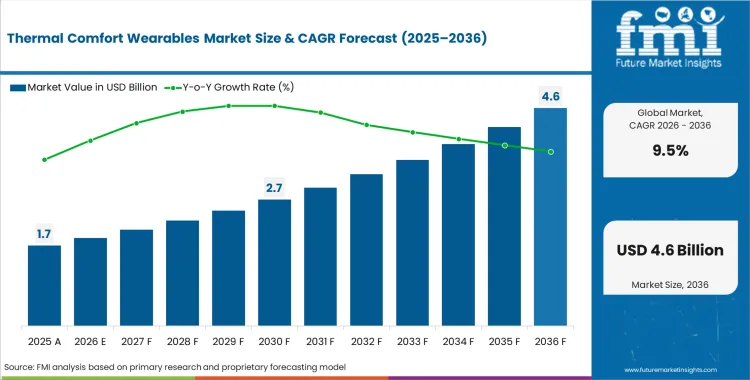
- 2025 market size: USD 1.59 billion
- 2026 market size: USD 1.7 billion
- 2036 forecast: USD 4.31 billion
- CAGR: 9.5%
- Top technology: Phase change cooling (31.4%)
- Top product type: Vests (36.8%)
- Top power source: Battery-powered systems (42.6%)
- Top end use: Industrial workwear (38.2%)
- Top distribution channel: Direct-to-consumer (44.1%)
| Metric | Details |
|---|---|
| Industry Size (2026) | USD 1.7 billion |
| Industry Value (2036) | USD 4.31 billion |
| CAGR (2026 to 2036) | 9.5% |
Source: Future Market Insights (FMI) analysis, based on proprietary forecasting model and primary research
Regulatory compliance drives the adoption of workplace heat mitigation technology, as mandatory rest periods are strictly triggered by regulatory temperature and humidity thresholds, forcing site operators to quickly implement active wearables to avoid penalties. Site management faces high financial penalties from mandatory work-stoppage periods due to excessive heat, which severely delays critical operations such as construction and logistics. The financial rationale favors hardware investment, as the cost of prolonged idle labor during heat-related work stoppages significantly exceeds the initial expense of body cooling and heating hardware like fan-cooled vests or heated jackets, making wearables a cost-effective method to extend permissible shift durations.
Demand for thermal comfort wearables in India is expected to rise at a CAGR of about 12.0% through 2036, driven by prolonged heat exposure across large construction and infrastructure workforces and tighter site‑level safety enforcement. China is projected to record roughly 11.1% CAGR as factories and logistics hubs deploy cooling gear to protect throughput during peak summer operations. Sales in Japan are likely to increase at around 10.6% CAGR, reflecting entrenched use of fan‑cooled workwear and stricter heat‑stress compliance from 2025. South Korea is set to post close to 10.1% CAGR, anchored in shipbuilding and heavy manufacturing requirements. The market in the United States is poised to expand at about 9.1% on steady industrial replacement demand and outdoor use, while Germany and the United Kingdom, growing at 8.4% and 8.0% by 2036, remain confined to clearly defined high‑risk occupations rather than broad workforce deployment.
Segmental Analysis
Thermal Comfort Wearables Market Analysis by Technology
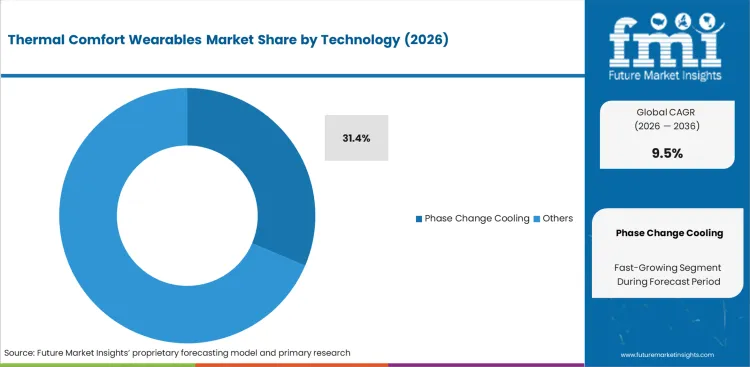
Battery constraints restrict active thermoelectric modules from capturing heavy industrial applications. The phase change cooling segment is likely to account for 31.4% share in 2026, driven by absolute reliability inside explosive environments. Workers refuse to carry heavy external battery packs up scaffolding. Integrating specific phase change microencapsulated thermoregulating fiber directly into uniform fabrics offers a lighter alternative. Bulkier inserts remain standard for extreme heat. Failing to specify chemically stable inserts results in ruptured packets. This ruins uniforms and forces immediate vendor replacement.
- Procurement savings: Passive insert architecture eliminates ongoing electricity costs. These costs are associated with charging massive battery fleets. Logistics departments avoid building expensive multi-port charging stations at temporary sites.
- Hidden weight penalties: Workers carrying heavy frozen inserts experience accelerated fatigue. This fatigue partially offsets thermal relief benefits. Industrial hygienists must calculate total ergonomic load before mandating continuous vest use.
- Lifecycle cost comparison: Total expenditure models reveal cheap evaporative vests fail faster than premium phase-change models. Category managers achieve lower multi-year costs by investing in durable sealed-packet systems initially.
Thermal Comfort Wearables Market Analysis by Product Type
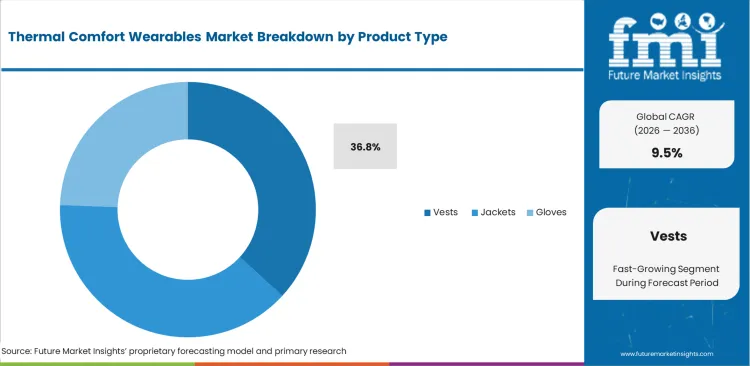
Core temperature regulation dictates format preference across the thermal comfort wearables market. This preference drives buyers away from extremities toward central body coverage. The vests segment is estimated to hold 36.8% revenue share in 2026, supported by excellent torso coverage without restricting necessary arm mobility. Manual labor demands full rotational freedom. Construction site supervisors issue vest formats over full jackets. This allows workers to swing hammers and operate controls freely. Procurement departments comparing products consistently underestimate sizing complexities. Utilizing advanced smart fabrics enables better contouring. High rigidity remains necessary for holding heavy ice packets or fan housings.
- Baseline specification: High-visibility standards dictate vest exterior colors and reflective striping placement. Safety compliance officers reject any cooling garment obstructing mandatory occupational visibility requirements.
- Mobility edge cases: Workers operating inside confined spaces discover bulky vest pockets snag on protrusions. Pipeline inspectors require ultra-thin cooling profiles to navigate narrow access hatches safely.
- Acceptability thresholds: Weight distribution determines a worker's willingness to wear cooling equipment continuously. Ergonomic designers must balance coolant mass symmetrically to prevent lower back strain.
Thermal Comfort Wearables Market Analysis by Power Source
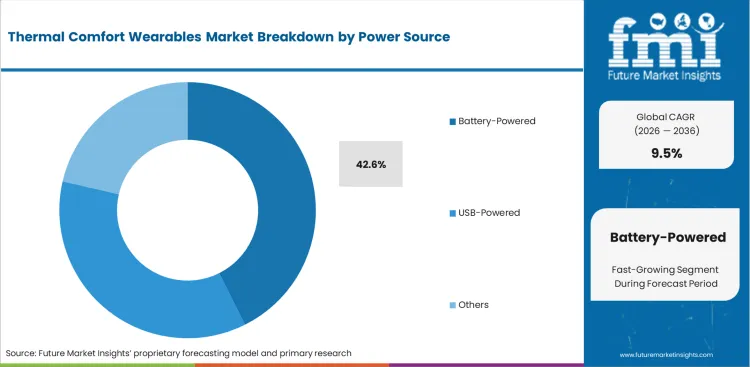
Continuous runtime requirements conflict violently with weight restrictions. Buyers must compromise between duration and comfort. The battery-powered segment is expected to account for 42.6% share in 2026, propelled by the specific energy demands of high-velocity fan jackets. These workers require emergency extraction after heated gear unexpectedly powers down mid-shift. Advanced thermoelectric fiber and yarn systems promise lighter profiles. Current rigid battery enclosures dominate heavy-duty applications due to sheer durability. Battery degradation in extreme cold creates a major friction point. Heated workwear performance plummets precisely during maximum output needs. Lithium-ion cells lose capacity at sub-zero temperatures. Procurement teams ignoring cold-weather voltage drops face stranded workers.
- Initial deployment: Early adopters test lightweight USB-powered units for light outdoor recreation. Consumer feedback quickly highlights insufficient heating power for extended stationary exposure.
- Subsequent upgrade: Serious tradesmen transition to proprietary power-tool battery ecosystems for heated apparel. Tool brand loyalty heavily influences secondary purchase decisions in the thermal comfort wearables market.
- Final conversion: Enterprise buyers eventually standardize on multi-voltage hybrid platforms. Asset managers consolidate inventory by stocking universally compatible power sources across all seasonal apparel.
Thermal Comfort Wearables Market Analysis by End Use
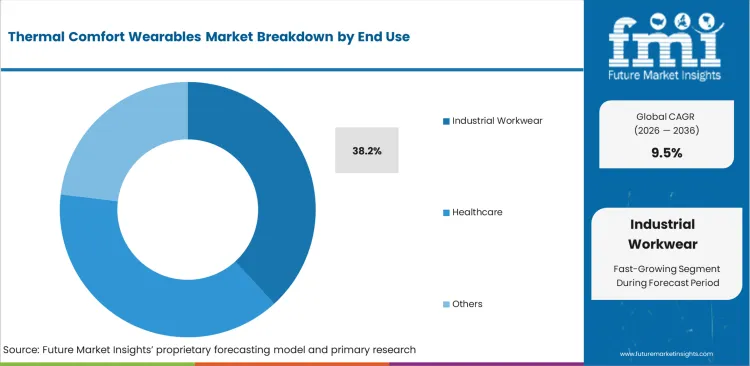
The industrial workwear segment is likely to secure 38.2% revenue share in 2026, due to implementation of safety mandates targeting outdoor construction and mining. Mitigating severe injury risk overrides basic comfort considerations. This reality shapes protective equipment investments in the thermal comfort wearables market. Health and safety departments working for global contractors mandate occupational heat stress wearables compliance. They enforce this to avoid catastrophic insurance premium hikes following heatstroke incidents. Many smart wearables fail industrial trials. Consumer-grade plastics shatter upon impact with concrete. This renders expensive systems useless within a week. Industrial buyers searching for the best cooling wearables require extremely rugged components.
- Triggering conditions: Record-breaking summer heatwaves force immediate emergency purchases. Site managers exhaust local distributor inventory attempting to equip exposed crews simultaneously.
- Validation hurdles: Union representatives inspect new cooling garments for weight and comfort. Devices creating excessive noise or vibration face immediate rejection from organized labor groups.
- Expansion mechanics: Successful pilot programs at specific facilities prompt corporate-wide thermal safety mandates. Global supply chain departments then negotiate massive volume contracts to standardize gear internationally.
Thermal Comfort Wearables Market Analysis by Distribution Channel
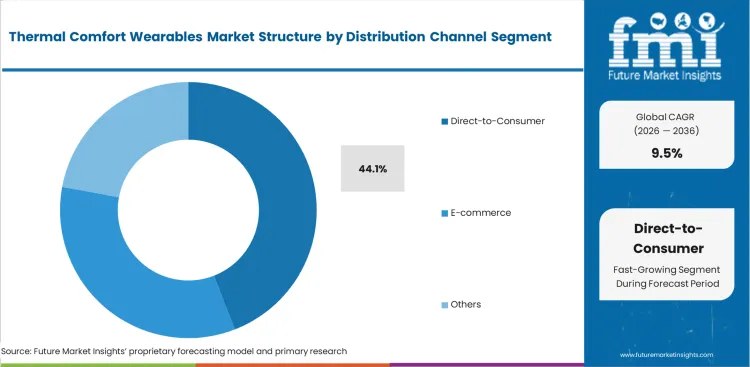
Margin protection drives manufacturers to bypass traditional retail intermediaries. They bypass these channels if logistics networks permit direct sales. Digital marketing managers leverage targeted social campaigns to reach specific occupational cohorts. Establishing a robust wearable fitness technology cross-selling strategy online allows direct marketing. The direct-to-consumer segment is anticipated to hold 44.1% share in 2026, as manufacturers are controlling pricing architecture and capturing valuable user sizing data. Brands market active cooling directly to endurance athletes alongside standard industrial buyers. Manufacturers failing to build competent e-commerce fulfillment engines surrender massive margins. Specialty distributors capture these profits and cripple future hardware research funding.
- Component sourcing: Niche manufacturers secure proprietary phase-change chemicals from specialized chemical producers. Maintaining stable chemical supply lines determines final product availability during summer demand spikes.
- Inventory constraints: Seasonal demand curves create massive inventory planning challenges. Supply chain managers face severe warehousing costs after overproducing heavy winter heated jackets.
- Long-term structure: Established tool brands leverage existing hardware distribution networks to push apparel. Independent apparel startups struggle to secure shelf space against entrenched industrial distribution monopolies.
Thermal Comfort Wearables Market Drivers, Restraints, and Opportunities
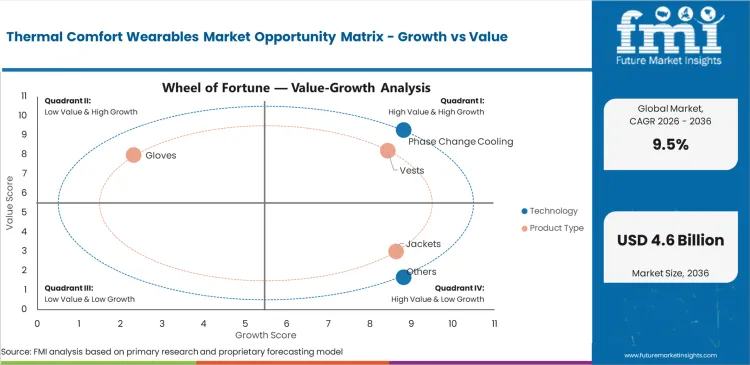
Increased regulatory scrutiny concerning occupational heat exposure necessitates immediate action from industrial procurement departments regarding active thermal management gear acquisition. Workplace safety administrations across multiple jurisdictions levy penalties upon employers failing to furnish sufficient thermal relief. Extreme weather events initiate stringent regulatory oversight, transforming industrial workwear thermal regulation from optional worker-retention elements into compulsory compliance instruments essential for maintaining site operations. Deferring acquisition subjects heavy construction and logistics organizations to substantial fines, obligatory work stoppages, and increased insurance premiums following heat-related medical evacuations. Integrating advanced body worn temperature sensors into site protocols further mandates compatible cooling apparel, collectively stimulating immediate hardware procurement across the thermal comfort wearables market.
Intense maintenance requirements and specialized laundering protocols generate severe operational friction. This friction slows adoption among enterprise buyers. Industrial workwear endures heavy soiling and requires aggressive chemical washing. This washing destroys delicate electrical components and fan motors rapidly. Facility managers struggle to implement complex daily cleaning procedures. These procedures demand workers remove batteries and detach fans before washing. This logistical burden prevents widespread adoption in fast-paced logistics hubs. Rapid shift turnovers leave zero time for equipment disassembly in these demanding environments.
Opportunities in the Thermal Comfort Wearables Market
- Intrinsic safety certification: Chemical refinery safety officers require cooling garments guaranteed not to generate sparks. Achieving strict explosion-proof ratings unlocks highly lucrative petrochemical contracts with very low competition. This expands the thermal comfort wearables market significantly.
- Arc-flash integration: Electrical utility managers need active cooling compatible with flame-resistant PPE. Developing vests maintaining high protective clothing ratings during electrical arc events captures massive utility budgets.
- Universal power adapters: Asset managers resent maintaining separate battery ecosystems for different apparel brands. Creating cross-compatible power adapters allows buyers to utilize existing tool batteries easily. This lowers initial adoption barriers substantially for the thermal comfort wearables market.
Regional Analysis
.webp "Top Country Growth Comparison Thermal Comfort Wearables Market Cagr (2026 2036)")
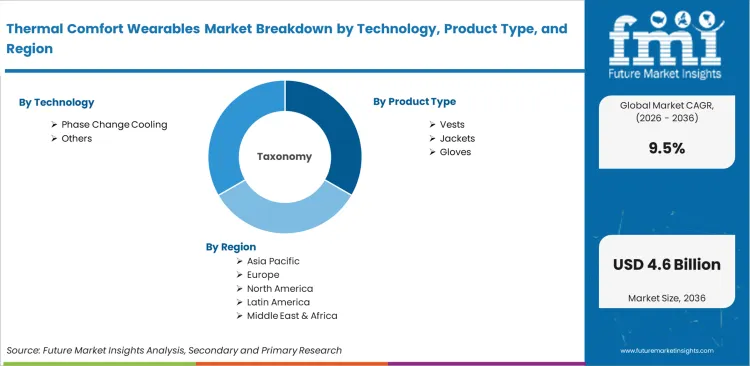
Based on regional analysis, the thermal comfort wearables market is segmented into North America, Europe, Asia Pacific, Latin America, and Middle East & Africa.
| Country | CAGR (2026 to 2036) |
|---|---|
| India | 12.0% |
| China | 11.1% |
| Japan | 10.6% |
| South Korea | 10.1% |
| United States | 9.1% |
| Germany | 8.4% |
| United Kingdom | 8.0% |
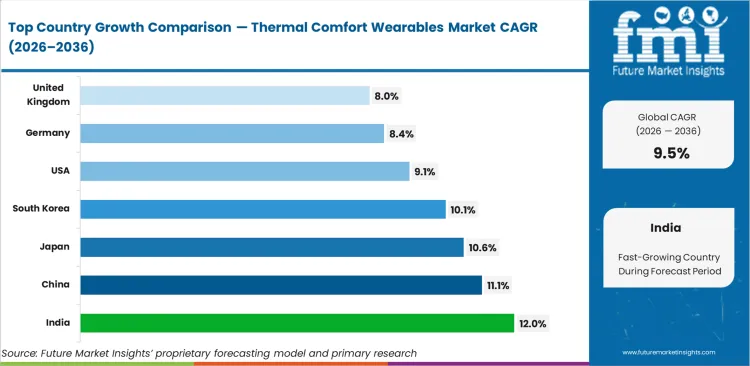
Source: Future Market Insights (FMI) analysis, based on proprietary forecasting model and primary research
North America Thermal Comfort Wearables Market Analysis
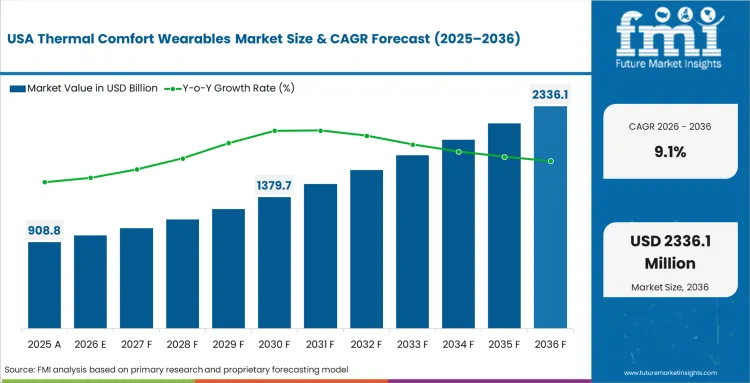
Robust infrastructure associated with jobsites and substantial outdoor recreational markets creates a highly stable environment for demand. Continuous industrial purchasing results from heavy construction, oil extraction, and utility maintenance. Concurrently, hunting and winter sports drive consistent consumer heated-apparel sales. Regional purchasers prioritize extreme durability and comprehensive warranty support above other attributes. They actively reject less expensive imported garments failing before a season's end. Developing ruggedized winter wear with integrated heating coils services both professional tradesmen and affluent consumers. The North America segment is anticipated to remain highly profitable.
- United States: Strict occupational safety frameworks and intense labor union oversight compel corporate buyers to prioritize mitigating thermal risk. Safety departments at massive logistics organizations procure evaporative and phase-change gear. This gear offers protection to thousands of warehouse employees operating without climate control. US is projected to register a 9.1% CAGR during the forecast period, driven by consistent replacement cycles, abrasive industrial environments destroying gear annually, and safety regulations demanding compliance. Securing major enterprise accounts allows brands to ensure highly predictable recurring revenue streams.
Europe Thermal Comfort Wearables Market Analysis
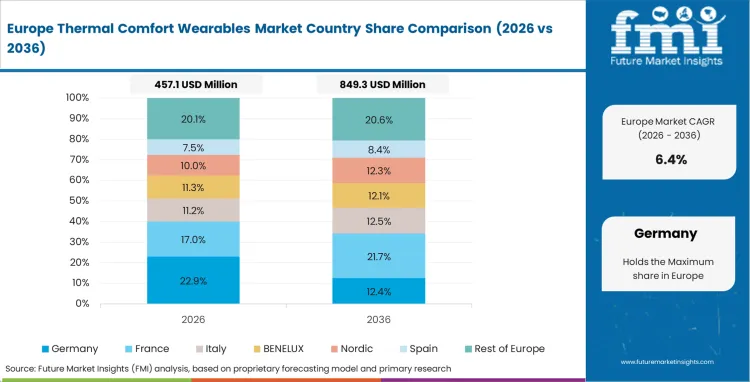
Targeted deployment within highly specialized occupational cohorts defines the regional behavior here. Stringent labor regulations mandate precise thermal comfort levels across the countries in Europe. Milder baseline climates restrict mass-market appeal to specific high-risk niches like foundries and specialized manufacturing. Buyers demand exhaustive clinical documentation proving physiological benefits before authorizing workplace PPE additions. Advanced thermochromic fabrics occasionally see deployment here as visual temperature indicators preceding active cooling activation. The Europe segment prioritizes worker health through preventative apparel investments.
- Germany: Deep industrial specialization in automotive and chemical manufacturing sectors drives demand for highly specific thermal gear, with procurement specialists requiring vests compatible with complex cleanroom or chemical-splash suits, rejecting generic open-market designs entirely, propelling market in Germany to expand at a rate of 8.4% during the forecast period. This growth is supported by deep industrial specialization, the need for cleanroom/chemical-splash suit compatibility, and extremely high unit values for customized solutions, despite a smaller target demographic constraining overall expansion.
- United Kingdom: Unpredictable seasonal shifts necessitate utility and transportation managers equipping field technicians with adaptable thermal gear. Fleet managers show preference for multi-season systems capable of swapping between cooling fans and heating elements. Such factors propels the industry to expand at a CAGR of 8.0% over the forecast period. This compound growth is underpinned by unpredictable seasonal shifts, a preference for multi-season systems, and strict corporate duty-of-care obligations compelling employers to mitigate all known environmental hazards.
Asia Pacific Thermal Comfort Wearables Market Analysis
Advanced cultural normalization of wearable technology accelerates industrial deployments across dense manufacturing hubs. Heavy industry operators in shipbuilding and automotive sectors face strict worker protection mandates. These mandates require localized climate control inside unventilated factory zones. High penetration of proprietary power-tool ecosystems facilitates rapid cross-selling of compatible fan jackets and heated vests. Incorporating sports wearables design principles into heavy-duty gear helps brands capture younger workers. These workers demand aesthetic appeal alongside functional performance. Asia Pacific exhibits massive scale potential for the thermal comfort wearables market.
- India: Massive infrastructure projects coinciding with severe summer temperatures necessitate the provision of active cooling gear by heavy construction firms. Safety departments across major conglomerates acknowledge that mitigating heatstroke directly prevents significant project delays. India is poised to register 12.0% CAGR over the forecast period, driven by mandatory issuance of active cooling gear to mitigate heatstroke, preventing catastrophic project delays in massive infrastructure projects, and securing a competitive advantage in labor recruitment through safer working conditions. Early adopters gain a significant competitive advantage in labor recruitment by offering safer working conditions.
- China: Expansion of massive logistics and e-commerce fulfillment centers exposes millions of warehouse workers to unregulated indoor temperatures. Operations managers issue fan-cooled garments to maintain pick-rate efficiency during peak summer sales events. China industry is projected to register a CAGR of 11.1% during the forecast period, propelled by the rapid scaling across entire enterprise workforces, the issuance of fan-cooled garments to maintain pick-rate efficiency in massive logistics centers, and vast domestic manufacturing capabilities pushing unit costs down to widely accessible levels. Vast domestic manufacturing capabilities, reducing unit costs to widely accessible levels, drive this rapid compound growth, allowing for rapid scaling across entire enterprise workforces simultaneously.
- Japan: Fan-cooled jackets already serve as standard summer workwear across construction and municipal maintenance roles. Procurement officers concentrate primarily on battery duration and motor noise reduction, with the baseline utility no longer a point of debate. Demand in Japan is likely to register 10.6% CAGR over the forecast period, fueled by tightening 2025 heatstroke prevention policies forcing laggard industries into compliance, the focus on battery duration and motor noise reduction in standard workwear, and universal adoption across all outdoor municipal roles becoming imminent. Tightening 2025 heatstroke prevention policies compel laggard industries into compliance, driving this growth rate. Universal adoption across all outdoor municipal roles is imminent.
- South Korea: Complex shipbuilding operations inside massive metal hulls subject workers to extreme radiant heat. Health and safety managers mandate sophisticated conductive cooling vests. These vests prevent severe medical emergencies in confined environments. South Korea is poised to expand at 10.1% CAGR over the forecast period, supported by strong union advocacy demanding superior thermal protection standards, mandatory use of sophisticated conductive cooling vests in complex shipbuilding operations, and the prevention of severe medical emergencies in confined, high-heat environments. Strong union advocacy demanding superior thermal protection standards supports this robust compound growth.
Competitive Aligners for Market Players
Specialist cooling-device makers clash directly with massive entrenched power-tool brands. This conflict creates a bifurcated competitive environment. Milwaukee Tool and Makita Corporation utilize massive existing install bases of proprietary batteries. They treat heated apparel and fan vests as accessories to primary hardware ecosystems. Columbia Sportswear Company attacks from the consumer angle. It utilizes massive retail footprints and proprietary reflective materials to capture outdoor enthusiasts and light industrial users. Procurement departments buying for massive construction crews strongly favor tool brands. Utilizing existing battery inventory slashes initial capital expenditure and simplifies jobsite charging logistics.
Incumbent tool manufacturers possess an almost insurmountable advantage regarding jobsite charging infrastructure and ruggedized component engineerin. They specialize intensely in passive phase-change technologies to avoid complex electrical engineering entirely. Specialists capture critical contracts inside explosive environments like refineries. A technologically superior cooling vest dissolving during standard chemical cleaning cycles holds zero commercial value to enterprise buyers.
Large industrial buyers aggressively resist being locked into proprietary battery ecosystems for apparel needs. Enterprise safety departments actively seek out agnostic power solutions. They demand heated workwear vendors provide cross-platform adapters to utilize available tool batteries. Sony Thermo Technology Inc. targets a different friction point entirely. It engineers highly discreet thermoelectric devices for white-collar or light-industrial workers refusing bulky vests. Ambient temperatures rise globally. Competition pivots toward developing functional garments indistinguishable from standard high-visibility uniforms. This innovation eliminates social and ergonomic friction associated with wearing secondary equipment. The thermal comfort wearables market rewards seamless integration.
Key Players in Thermal Comfort Wearables Market
- Columbia Sportswear Company
- Milwaukee Tool
- Sony Thermo Technology Inc.
- Makita Corporation
- TechNiche LLC
- Glacier Tek
- AlphaCool Products
Scope of the Report
| Metric | Value |
|---|---|
| Quantitative Units | USD 1.7 billion to USD 4.31 billion, at a CAGR of 9.5% |
| Market Definition | Thermal comfort wearables comprise apparel and accessories engineered to actively alter user body temperature through integrated mechanical, chemical, or electrical mechanisms. Operations rely on phase-change cooling, thermoelectric arrays, or convective fan systems. |
| Segmentation | Technology, Product Type, Power Source, End Use, Distribution Channel, Region |
| Regions Covered | North America, Europe, Asia Pacific, Latin America, Middle East & Africa |
| Countries Covered | United States, Canada, Germany, United Kingdom, France, Italy, Spain, China, Japan, South Korea, Taiwan, Singapore, India, Brazil, Mexico, Argentina, GCC Countries, South Africa, Israel, Rest of Middle East & Africa |
| Key Companies Profiled | Columbia Sportswear Company, Milwaukee Tool, Sony Thermo Technology Inc., Makita Corporation, TechNiche LLC, Glacier Tek, AlphaCool Products |
| Forecast Period | 2026 to 2036 |
| Approach | Baseline volume parameters anchored to active workforce headcount in high-exposure outdoor occupations, cross-validated by weather anomaly reports. |
Source: Future Market Insights (FMI) analysis, based on proprietary forecasting model and primary research
Thermal Comfort Wearables Market Analysis by Segments
By Technology
- Phase change cooling
- Fan-assisted cooling
- Thermoelectric cooling
- Resistive heating
- Reflective insulation
By Product Type
- Vests
- Jackets
- Neck devices
- Gloves
- Base layers
By Power Source
- Battery-powered
- Passive inserts
- Rechargeable packs
- USB-powered
- Hybrid systems
By End Use
- Industrial workwear
- Outdoor recreation
- Healthcare
- Sports fitness
- Defense response
By Distribution Channel
- Direct-to-consumer
- Industrial distributors
- Specialty retail
- E-commerce
- Institutional sales
By Region
- North America
- United States
- Canada
- Europe
- Germany
- United Kingdom
- France
- Italy
- Spain
- Asia Pacific
- India
- China
- Japan
- South Korea
- Taiwan
- Singapore
- Latin America
- Brazil
- Mexico
- Argentina
- Middle East & Africa
- GCC Countries
- South Africa
- Israel
- Rest of Middle East & Africa
Bibliography
- Raza, W., Berto, A., Tancon, M., Moro, L., & Azzolin, M. (2025, July). Enhancing thermal comfort: A comprehensive review of wearable cooling systems. Next Materials, 8, 100762.
- Ma, R., Li, D., Xu, C., Yang, J., Huang, J., & Guo, Z. (2024, October). Fabricated advanced textile for personal thermal management, intelligent health monitoring and energy harvesting. Advances in Colloid and Interface Science, 332, 103252.
- Ye, C., Zhao, L., Yang, S., & Li, X. (2024, May). Recent research on preparation and application of smart Joule heating fabrics. Small, 20(18), e2309027.
- Li, D., Liu, W., Peng, T., Liu, Y., Zhong, L., & Wang, X. (2025, April). Janus textile: Advancing wearable technology for autonomous sweat management and beyond. Small, 21(13), e2409730. DOI
- Liu, J., Xu, Z., Wang, H., Zhao, Y., & Lin, T. (2025, February). Directional liquid transport in thin fibrous matrices: Enhancement of advanced applications. ACS Nano, 19(6), 5913–5937. DOI
- Shou, D., & Li, Z. (2025, December). Personal moisture management by advanced textiles and intelligent wearables. Advanced Materials, 37(48), e08831.
This bibliography is provided for reader reference. The full FMI report contains the complete reference list with primary source documentation.
This Report Addresses
- Site managers mandating active thermoregulation gear to prevent mandatory work-stoppage hours during severe weather.
- Safety officers prioritizing standard industrial laundering survivability over absolute thermal power for high-turnover crews.
- Procurement departments failing to calculate hidden ergonomic weight penalties associated with frozen phase-change inserts.
- Fleet managers standardizing on multi-voltage platforms to consolidate power-tool and heated-apparel battery inventory.
- Operations departments selecting purely passive cooling vests to maintain compliance inside explosive petrochemical environments.
- Brand managers bypassing specialty retail to capture direct-to-consumer margins on premium recreational heating gear.
- Utility managers requiring cooling systems fully compatible with stringent flame-resistant and arc-flash safety ratings.
- Logistics coordinators deploying lightweight fan jackets to sustain order-picking efficiency inside unventilated fulfillment warehouses.
Frequently Asked Questions
What are thermal comfort wearables?
Thermal comfort wearables comprise apparel and accessories engineered to actively alter user body temperature. Functional architecture centers on extracting heat during hyperthermic conditions or delivering localized warmth during hypothermic exposure using integrated mechanical, chemical, or electrical mechanisms.
How big is the thermal comfort wearables market?
The sector was valued at USD 1.59 billion in 2025. This baseline captures accelerating adoption across heavy industrial and outdoor workforces facing intensifying seasonal heatwaves, driving initial hardware outlays for protective active-cooling apparel.
What is the CAGR of thermal comfort wearables market?
Sector demand expands at a 9.5% CAGR through the forecast period. Massive agricultural, construction, and logistics operations scaling procurement from small pilot trials to enterprise-wide standardization drives sustained compound expansion.
Who are the key players in thermal comfort wearables?
Leading active participants include Columbia Sportswear Company, Milwaukee Tool, Sony Thermo Technology Inc., Makita Corporation, TechNiche LLC, Glacier Tek, and AlphaCool Products. Competition spans massive power-tool ecosystems and specialized cooling-device engineers.
Why is thermal comfort wearables demand growing?
Escalating regulatory scrutiny regarding occupational heat exposure forces industrial procurement departments to purchase active thermal management gear. Workplace safety administrations across multiple jurisdictions now penalize employers who fail to provide adequate thermal relief during extreme weather events.
Compare cooling vests vs fan jackets vs neck coolers.
Vests target major circulatory pathways without restricting arm mobility, serving heavy manual labor well. Fan jackets provide convective cooling over larger surface areas but require compatible power ecosystems. Neck coolers offer highly discreet, localized relief favored by light-industrial or white-collar roles.
PCM vest vs fan jacket: which performs better industrially?
Phase change material (PCM) vests operate completely passively without electrical components, making them mandatory inside explosive environments where fan-motors risk ignition. Fan jackets excel in humid, open-air environments where battery weight is offset by extended forced-convection cooling duration.
What operational consequence drives preference for vest formats?
Vests secure 36.8% share by targeting major circulatory pathways without restricting arm mobility. Construction workers must maintain full rotational freedom to operate machinery; full jackets often introduce dangerous snag hazards or limit necessary physical extension.
Why do battery-powered systems dominate power source preferences?
Battery platforms hold 42.6% share, matching energy density requirements for heavy-duty fan and resistive heating operations. Tradesmen favor tool-compatible batteries because utilizing existing chargers slashes capital expenditure and simplifies jobsite energy logistics.
What element makes industrial workwear the leading end use?
Industrial operations account for 38.2% share because extreme heat translates directly into lost labor hours and catastrophic insurance liabilities. Heavy contractors purchase cooling gear to prevent forced site shutdowns and maintain project schedules during severe weather.
How does the direct-to-consumer channel maintain its 44.1% lead?
Manufacturers capture higher margins by bypassing traditional distributors online. Digital marketing enables brands to target highly specific occupational niches directly, while enterprise buyers frequently use these portals for stealth pilot testing before engaging official sales reps.
What explains the growth divergence between India and China?
India tracks at 11.8% while China registers 10.9%. India's faster rate reflects massive, highly exposed agricultural and construction workforces just beginning adoption, whereas China's manufacturing sector already possesses higher baseline penetration of entry-level fan garments.
Why do Japan buyers focus so heavily on fan jackets?
Japan advances at 10.4% driven by profound cultural normalization; fan-cooled workwear is already standard issue across municipal maintenance. Procurement officers there no longer debate utility, focusing entirely on motor noise reduction and extended battery lifespans.
What hidden friction prevents faster logistics sector adoption?
Laundering complexity acts as the primary barrier. Warehouse workers heavily soil gear, but removing batteries and fan motors before daily chemical washing creates unacceptable turnaround delays for operations managing thousands of transient shift workers.
How do incumbent tool brands maintain their competitive edge?
Major tool manufacturers leverage massive existing installations of proprietary 18-volt batteries. They treat heated jackets as accessories, effectively locking out apparel startups by making secondary power-system purchases financially unjustifiable for major contractors.
Why do cooling garments fail in some heavy industry trials?
Consumer-grade systems shatter upon concrete impact or dissolve during harsh chemical exposure. Industrial safety departments immediately reject any thermoregulation system incapable of surviving standard abrasive jobsite abuse, regardless of baseline cooling efficiency.
What role do safety compliance officers play in garment design?
Safety officers reject any thermal layer obstructing mandatory high-visibility colors or reflective striping. Manufacturers must integrate cooling channels underneath these critical safety layers to secure approval for highway and heavy construction deployment.
How does cold weather affect heated apparel performance?
Lithium-ion cell capacity plummets in sub-zero conditions. Procurement teams ignoring voltage drops face situations where heated winter gear powers down mid-shift, leaving remote workers exposed and necessitating emergency extraction from cold environments.
Why do some workers reject mandated active cooling vests?
Heavy frozen phase-change inserts introduce severe ergonomic penalties. Workers carrying excess weight experience accelerated muscular fatigue, prompting union representatives to demand lighter insert architectures before authorizing continuous full-shift usage.
What makes arc-flash compatibility a lucrative opportunity?
Electrical utility linemen face extreme heat burdens while wearing heavy flame-resistant suits. Developing active cooling systems that maintain strict arc-flash protection ratings unlocks massive utility budgets specifically reserved for these high-risk operations.
How do outdoor brands navigate industrial requirements?
Recreational apparel brands partner with specialized PPE manufacturers to upgrade durable shells with industrial-grade cooling inserts. This strategy avoids costly internal development cycles while instantly qualifying gear for lucrative corporate safety contracts.
Why is sizing complexity critical for conductive cooling?
Conductive vests require direct body contact to extract heat. Procurement departments specifying improperly sized, loose gear waste budgets entirely, as air gaps eliminate cooling efficiency and leave workers completely unmitigated against heatstroke risks.
What prompts emergency bulk orders for cooling equipment?
Unexpected, record-breaking summer heatwaves force site operators to instantly source mitigation gear. Contractors exhaust regional distributor inventory overnight attempting to equip vulnerable crews simultaneously to prevent immediate regulatory project shutdowns.
What transition characterizes the market moving toward 2036?
Market demand transitions from distinct, bulky add-on accessories toward deeply integrated textile solutions. Manufacturers focus on engineering functional cooling mechanics indistinguishable from standard high-visibility uniforms to eliminate social and physical wearer friction.
Preview the report firsthand - request a free sample
Get SampleGet the brochure for pricing and purchase details.
Get PDFTable of Content
- Executive Summary
- Global Market Outlook
- Demand-side Trends
- Supply-side Trends
- Technology Roadmap Analysis
- Analysis and Recommendations
- Market Overview
- Market Coverage / Taxonomy
- Market Definition / Scope / Limitations
- Research Methodology
- Chapter Orientation
- Analytical Lens and Working Hypotheses
- Market Structure, Signals, and Trend Drivers
- Benchmarking and Cross-market Comparability
- Market Sizing, Forecasting, and Opportunity Mapping
- Research Design and Evidence Framework
- Desk Research Programme (Secondary Evidence)
- Company Annual and Sustainability Reports
- Peer-reviewed Journals and Academic Literature
- Corporate Websites, Product Literature, and Technical Notes
- Earnings Decks and Investor Briefings
- Statutory Filings and Regulatory Disclosures
- Technical White Papers and Standards Notes
- Trade Journals, Industry Magazines, and Analyst Briefs
- Conference Proceedings, Webinars, and Seminar Materials
- Government Statistics Portals and Public Data Releases
- Press Releases and Reputable Media Coverage
- Specialist Newsletters and Curated Briefings
- Sector Databases and Reference Repositories
- FMI Internal Proprietary Databases and Historical Market Datasets
- Subscription Datasets and Paid Sources
- Social Channels, Communities, and Digital Listening Inputs
- Additional Desk Sources
- Expert Input and Fieldwork (Primary Evidence)
- Primary Modes
- Qualitative Interviews and Expert Elicitation
- Quantitative Surveys and Structured Data Capture
- Blended Approach
- Why Primary Evidence is Used
- Field Techniques
- Interviews
- Surveys
- Focus Groups
- Observational and In-context Research
- Social and Community Interactions
- Stakeholder Universe Engaged
- C-suite Leaders
- Board Members
- Presidents and Vice Presidents
- R&D and Innovation Heads
- Technical Specialists
- Domain Subject-matter Experts
- Scientists
- Physicians and Other Healthcare Professionals
- Governance, Ethics, and Data Stewardship
- Research Ethics
- Data Integrity and Handling
- Primary Modes
- Tooling, Models, and Reference Databases
- Desk Research Programme (Secondary Evidence)
- Data Engineering and Model Build
- Data Acquisition and Ingestion
- Cleaning, Normalisation, and Verification
- Synthesis, Triangulation, and Analysis
- Quality Assurance and Audit Trail
- Market Background
- Market Dynamics
- Drivers
- Restraints
- Opportunity
- Trends
- Scenario Forecast
- Demand in Optimistic Scenario
- Demand in Likely Scenario
- Demand in Conservative Scenario
- Opportunity Map Analysis
- Product Life Cycle Analysis
- Supply Chain Analysis
- Investment Feasibility Matrix
- Value Chain Analysis
- PESTLE and Porter’s Analysis
- Regulatory Landscape
- Regional Parent Market Outlook
- Production and Consumption Statistics
- Import and Export Statistics
- Market Dynamics
- Global Market Analysis 2021 to 2025 and Forecast, 2026 to 2036
- Historical Market Size Value (USD Million) Analysis, 2021 to 2025
- Current and Future Market Size Value (USD Million) Projections, 2026 to 2036
- Y-o-Y Growth Trend Analysis
- Absolute $ Opportunity Analysis
- Global Market Pricing Analysis 2021 to 2025 and Forecast 2026 to 2036
- Global Market Analysis 2021 to 2025 and Forecast 2026 to 2036, By Technology
- Introduction / Key Findings
- Historical Market Size Value (USD Million) Analysis By Technology , 2021 to 2025
- Current and Future Market Size Value (USD Million) Analysis and Forecast By Technology , 2026 to 2036
- Phase Change Cooling
- Others
- Phase Change Cooling
- Y-o-Y Growth Trend Analysis By Technology , 2021 to 2025
- Absolute $ Opportunity Analysis By Technology , 2026 to 2036
- Global Market Analysis 2021 to 2025 and Forecast 2026 to 2036, By Product Type
- Introduction / Key Findings
- Historical Market Size Value (USD Million) Analysis By Product Type, 2021 to 2025
- Current and Future Market Size Value (USD Million) Analysis and Forecast By Product Type, 2026 to 2036
- Vests
- Jackets
- Gloves
- Vests
- Y-o-Y Growth Trend Analysis By Product Type, 2021 to 2025
- Absolute $ Opportunity Analysis By Product Type, 2026 to 2036
- Global Market Analysis 2021 to 2025 and Forecast 2026 to 2036, By Power Source
- Introduction / Key Findings
- Historical Market Size Value (USD Million) Analysis By Power Source, 2021 to 2025
- Current and Future Market Size Value (USD Million) Analysis and Forecast By Power Source, 2026 to 2036
- Battery-Powered
- USB-Powered
- Others
- Battery-Powered
- Y-o-Y Growth Trend Analysis By Power Source, 2021 to 2025
- Absolute $ Opportunity Analysis By Power Source, 2026 to 2036
- Global Market Analysis 2021 to 2025 and Forecast 2026 to 2036, By End Use
- Introduction / Key Findings
- Historical Market Size Value (USD Million) Analysis By End Use, 2021 to 2025
- Current and Future Market Size Value (USD Million) Analysis and Forecast By End Use, 2026 to 2036
- Industrial Workwear
- Healthcare
- Others
- Industrial Workwear
- Y-o-Y Growth Trend Analysis By End Use, 2021 to 2025
- Absolute $ Opportunity Analysis By End Use, 2026 to 2036
- Global Market Analysis 2021 to 2025 and Forecast 2026 to 2036, By Distribution Channel
- Introduction / Key Findings
- Historical Market Size Value (USD Million) Analysis By Distribution Channel, 2021 to 2025
- Current and Future Market Size Value (USD Million) Analysis and Forecast By Distribution Channel, 2026 to 2036
- Direct-to-Consumer
- E-commerce
- Others
- Direct-to-Consumer
- Y-o-Y Growth Trend Analysis By Distribution Channel, 2021 to 2025
- Absolute $ Opportunity Analysis By Distribution Channel, 2026 to 2036
- Global Market Analysis 2021 to 2025 and Forecast 2026 to 2036, By Region
- Introduction
- Historical Market Size Value (USD Million) Analysis By Region, 2021 to 2025
- Current Market Size Value (USD Million) Analysis and Forecast By Region, 2026 to 2036
- North America
- Latin America
- Western Europe
- Eastern Europe
- East Asia
- South Asia and Pacific
- Middle East & Africa
- Market Attractiveness Analysis By Region
- North America Market Analysis 2021 to 2025 and Forecast 2026 to 2036, By Country
- Historical Market Size Value (USD Million) Trend Analysis By Market Taxonomy, 2021 to 2025
- Market Size Value (USD Million) Forecast By Market Taxonomy, 2026 to 2036
- By Country
- USA
- Canada
- Mexico
- By Technology
- By Product Type
- By Power Source
- By End Use
- By Distribution Channel
- By Country
- Market Attractiveness Analysis
- By Country
- By Technology
- By Product Type
- By Power Source
- By End Use
- By Distribution Channel
- Key Takeaways
- Latin America Market Analysis 2021 to 2025 and Forecast 2026 to 2036, By Country
- Historical Market Size Value (USD Million) Trend Analysis By Market Taxonomy, 2021 to 2025
- Market Size Value (USD Million) Forecast By Market Taxonomy, 2026 to 2036
- By Country
- Brazil
- Chile
- Rest of Latin America
- By Technology
- By Product Type
- By Power Source
- By End Use
- By Distribution Channel
- By Country
- Market Attractiveness Analysis
- By Country
- By Technology
- By Product Type
- By Power Source
- By End Use
- By Distribution Channel
- Key Takeaways
- Western Europe Market Analysis 2021 to 2025 and Forecast 2026 to 2036, By Country
- Historical Market Size Value (USD Million) Trend Analysis By Market Taxonomy, 2021 to 2025
- Market Size Value (USD Million) Forecast By Market Taxonomy, 2026 to 2036
- By Country
- Germany
- UK
- Italy
- Spain
- France
- Nordic
- BENELUX
- Rest of Western Europe
- By Technology
- By Product Type
- By Power Source
- By End Use
- By Distribution Channel
- By Country
- Market Attractiveness Analysis
- By Country
- By Technology
- By Product Type
- By Power Source
- By End Use
- By Distribution Channel
- Key Takeaways
- Eastern Europe Market Analysis 2021 to 2025 and Forecast 2026 to 2036, By Country
- Historical Market Size Value (USD Million) Trend Analysis By Market Taxonomy, 2021 to 2025
- Market Size Value (USD Million) Forecast By Market Taxonomy, 2026 to 2036
- By Country
- Russia
- Poland
- Hungary
- Balkan & Baltic
- Rest of Eastern Europe
- By Technology
- By Product Type
- By Power Source
- By End Use
- By Distribution Channel
- By Country
- Market Attractiveness Analysis
- By Country
- By Technology
- By Product Type
- By Power Source
- By End Use
- By Distribution Channel
- Key Takeaways
- East Asia Market Analysis 2021 to 2025 and Forecast 2026 to 2036, By Country
- Historical Market Size Value (USD Million) Trend Analysis By Market Taxonomy, 2021 to 2025
- Market Size Value (USD Million) Forecast By Market Taxonomy, 2026 to 2036
- By Country
- China
- Japan
- South Korea
- By Technology
- By Product Type
- By Power Source
- By End Use
- By Distribution Channel
- By Country
- Market Attractiveness Analysis
- By Country
- By Technology
- By Product Type
- By Power Source
- By End Use
- By Distribution Channel
- Key Takeaways
- South Asia and Pacific Market Analysis 2021 to 2025 and Forecast 2026 to 2036, By Country
- Historical Market Size Value (USD Million) Trend Analysis By Market Taxonomy, 2021 to 2025
- Market Size Value (USD Million) Forecast By Market Taxonomy, 2026 to 2036
- By Country
- India
- ASEAN
- Australia & New Zealand
- Rest of South Asia and Pacific
- By Technology
- By Product Type
- By Power Source
- By End Use
- By Distribution Channel
- By Country
- Market Attractiveness Analysis
- By Country
- By Technology
- By Product Type
- By Power Source
- By End Use
- By Distribution Channel
- Key Takeaways
- Middle East & Africa Market Analysis 2021 to 2025 and Forecast 2026 to 2036, By Country
- Historical Market Size Value (USD Million) Trend Analysis By Market Taxonomy, 2021 to 2025
- Market Size Value (USD Million) Forecast By Market Taxonomy, 2026 to 2036
- By Country
- Kingdom of Saudi Arabia
- Other GCC Countries
- Turkiye
- South Africa
- Other African Union
- Rest of Middle East & Africa
- By Technology
- By Product Type
- By Power Source
- By End Use
- By Distribution Channel
- By Country
- Market Attractiveness Analysis
- By Country
- By Technology
- By Product Type
- By Power Source
- By End Use
- By Distribution Channel
- Key Takeaways
- Key Countries Market Analysis
- USA
- Pricing Analysis
- Market Share Analysis, 2025
- By Technology
- By Product Type
- By Power Source
- By End Use
- By Distribution Channel
- Canada
- Pricing Analysis
- Market Share Analysis, 2025
- By Technology
- By Product Type
- By Power Source
- By End Use
- By Distribution Channel
- Mexico
- Pricing Analysis
- Market Share Analysis, 2025
- By Technology
- By Product Type
- By Power Source
- By End Use
- By Distribution Channel
- Brazil
- Pricing Analysis
- Market Share Analysis, 2025
- By Technology
- By Product Type
- By Power Source
- By End Use
- By Distribution Channel
- Chile
- Pricing Analysis
- Market Share Analysis, 2025
- By Technology
- By Product Type
- By Power Source
- By End Use
- By Distribution Channel
- Germany
- Pricing Analysis
- Market Share Analysis, 2025
- By Technology
- By Product Type
- By Power Source
- By End Use
- By Distribution Channel
- UK
- Pricing Analysis
- Market Share Analysis, 2025
- By Technology
- By Product Type
- By Power Source
- By End Use
- By Distribution Channel
- Italy
- Pricing Analysis
- Market Share Analysis, 2025
- By Technology
- By Product Type
- By Power Source
- By End Use
- By Distribution Channel
- Spain
- Pricing Analysis
- Market Share Analysis, 2025
- By Technology
- By Product Type
- By Power Source
- By End Use
- By Distribution Channel
- France
- Pricing Analysis
- Market Share Analysis, 2025
- By Technology
- By Product Type
- By Power Source
- By End Use
- By Distribution Channel
- India
- Pricing Analysis
- Market Share Analysis, 2025
- By Technology
- By Product Type
- By Power Source
- By End Use
- By Distribution Channel
- ASEAN
- Pricing Analysis
- Market Share Analysis, 2025
- By Technology
- By Product Type
- By Power Source
- By End Use
- By Distribution Channel
- Australia & New Zealand
- Pricing Analysis
- Market Share Analysis, 2025
- By Technology
- By Product Type
- By Power Source
- By End Use
- By Distribution Channel
- China
- Pricing Analysis
- Market Share Analysis, 2025
- By Technology
- By Product Type
- By Power Source
- By End Use
- By Distribution Channel
- Japan
- Pricing Analysis
- Market Share Analysis, 2025
- By Technology
- By Product Type
- By Power Source
- By End Use
- By Distribution Channel
- South Korea
- Pricing Analysis
- Market Share Analysis, 2025
- By Technology
- By Product Type
- By Power Source
- By End Use
- By Distribution Channel
- Russia
- Pricing Analysis
- Market Share Analysis, 2025
- By Technology
- By Product Type
- By Power Source
- By End Use
- By Distribution Channel
- Poland
- Pricing Analysis
- Market Share Analysis, 2025
- By Technology
- By Product Type
- By Power Source
- By End Use
- By Distribution Channel
- Hungary
- Pricing Analysis
- Market Share Analysis, 2025
- By Technology
- By Product Type
- By Power Source
- By End Use
- By Distribution Channel
- Kingdom of Saudi Arabia
- Pricing Analysis
- Market Share Analysis, 2025
- By Technology
- By Product Type
- By Power Source
- By End Use
- By Distribution Channel
- Turkiye
- Pricing Analysis
- Market Share Analysis, 2025
- By Technology
- By Product Type
- By Power Source
- By End Use
- By Distribution Channel
- South Africa
- Pricing Analysis
- Market Share Analysis, 2025
- By Technology
- By Product Type
- By Power Source
- By End Use
- By Distribution Channel
- USA
- Market Structure Analysis
- Competition Dashboard
- Competition Benchmarking
- Market Share Analysis of Top Players
- By Region
- By Technology
- By Product Type
- By Power Source
- By End Use
- By Distribution Channel
- Competition Analysis
- Competition Deep Dive
- Columbia Sportswear Company
- Overview
- Product Portfolio
- Profitability by Market Segments (Product/Age /Sales Channel/Region)
- Sales Footprint
- Strategy Overview
- Marketing Strategy
- Product Strategy
- Channel Strategy
- Milwaukee Tool
- Sony Thermo Technology Inc.
- Makita Corporation
- TechNiche LLC
- Glacier Tek
- AlphaCool Products
- Columbia Sportswear Company
- Competition Deep Dive
- Assumptions & Acronyms Used


