

- Industry Size (2026)
- USD 5.5 Bn
- Forecast (2036)
- USD 9.3 Bn
- CAGR (2026 to 2036)
- 5.4%
Electric Grills Market Size, Market Forecast and Outlook By FMI
The electric grills market is expected to expand from USD 5.5 billion in 2026 to USD 9.3 billion by 2036. The market is projected to register a 5.4% CAGR during the forecast period. Griddle is likely to lead type with a 62.0% share in 2026, while indoor usage is anticipated to account for 68.0% share of use location demand in 2026.
Summary of the Electric Grills Market
- Demand and Growth Drivers
- Compact cooking appliance adoption is expected to support electric grill purchases across urban households.
- Indoor cooking habits are likely to increase demand for easy-to-use griddle-led formats.
- Appliance replacement cycles are anticipated to sustain sales across residential retail channels.
- Product and Segment View
- Griddle is expected to lead type demand due to broad use in routine residential cooking.
- Indoor electric grills are likely to remain the main use location as compact kitchens shape product choice.
- Residential applications are anticipated to hold strong demand as households upgrade small cooking appliances.
- Geography and Competitive Outlook
- China is expected to lead country-level expansion as compact appliance adoption and online retail scale improve.
- USA is likely to record steady growth as replacement demand and retail promotions support category sales.
- Companies with stronger SKU control and retail availability are anticipated to improve their market position.
- Analyst Opinion
- Ronak Shah, Principal consultant for Consumer Product at FMI, suggests, “The electric grills market is likely to shift toward compact indoor appliances with clearer price tiers and dependable cooking performance. Brands with griddle-led platforms, stable heating assemblies, and reliable modern trade execution are expected to gain advantage as households prioritize convenient cooking formats.”
- Electric Grills Market Value Analysis
- The electric grills market is moving from occasional cooking equipment into mainstream compact kitchen appliances.
- Demand is likely to rise as consumers seek indoor grills that fit smaller homes and routine cooking needs.
- Adoption is expected to gain support from griddle formats that offer simple use and broad meal compatibility.
- Spending is anticipated to be backed by residential replacement cycles and stronger hypermarket shelf visibility.
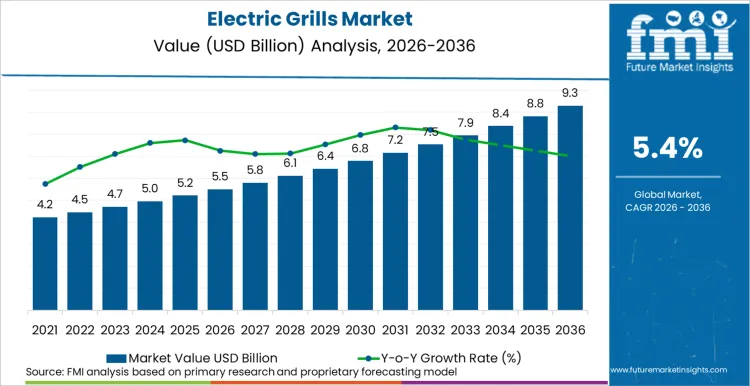
Key Takeaways, Market Size, and Forecast
| Metric | Value |
|---|---|
| Market Size (2026) | USD 5.5 Billion |
| Market Size (2036) | USD 9.3 Billion |
| CAGR (2026–2036) | 5.4% |
| Leading Product Type (2026) | Griddle |
| Griddle Share (2026) | 62.0% |
| Leading Use Location (2026) | Indoor Usage |
| Indoor Usage Share (2026) | 68.0% |
| Fastest-Growing Country | China |
| China CAGR | 6.6% |
Electric Grills Market Key Takeaways
| Metric | Value |
|---|---|
| Industry Size (2026) | USD 5.5 Billion |
| Industry Value (2036) | USD 9.3 Billion |
| CAGR (2026-2036) | 5.4% |
Source: Future Market Insights (FMI) analysis, based on proprietary forecasting model and primary research
What Drivers are Accelerating Market Penetration of Electric Grills?
Growth is supported by consistent demand for compact cooking formats, higher penetration of indoor cooking appliances in urban homes, and strong shelf visibility for griddle-led products across modern retail. Retailers are allocating space to electric grills where brands deliver stable price ladders, predictable stock availability, and strong promotional execution. This demand structure is aligned with the category expansion patterns in the electric grills landscape, where indoor usage and replacement demand are shaping volume consistency.
Griddle formats remain a dominant volume engine due to their compatibility with residential kitchen footprints and broad consumer adoption across routine cooking. Product pipelines continue to scale around this format, supported by platform reuse across multiple wattage and size configurations. This direction remains consistent with portfolio evolution across the electric griddle market, where category momentum continues to favour high-velocity griddle configurations.
A wider structural tailwind comes from steady growth in home cooking appliances, supported by replacement cycles and structured merchandising. This aligns with broader development in the household kitchen appliances landscape, where cooking appliance categories remain core to value capture across household budgets.
How is the Electric Grills Market Segmented across Key Categories?
The market is segmented by type, use location, application, and distribution channel, reflecting how appliance portfolios are planned across residential volume engines and commercial demand clusters. Segmentation is becoming more relevant as manufacturers rationalize catalogs while preserving tier differentiation across price points and channel requirements.
Why Does Griddle Lead Type Demand?
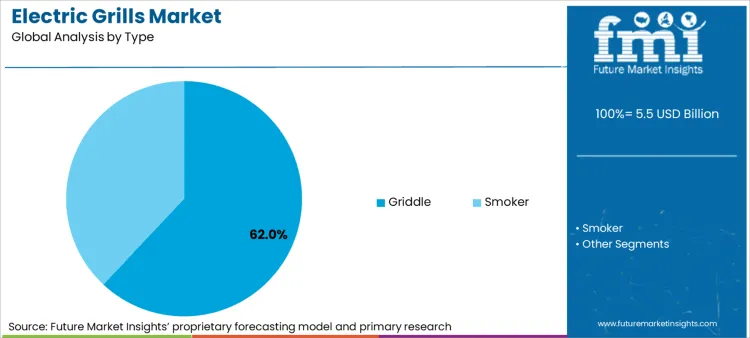
Griddle accounts for 62.0% share in 2026, supported by broad residential adoption and strong retail acceptance for standardized formats. This segment benefits from reliable throughput, high promotional traction, and efficient replenishment planning for retailers.
Why Does Indoor Usage Hold a Dominant Share?
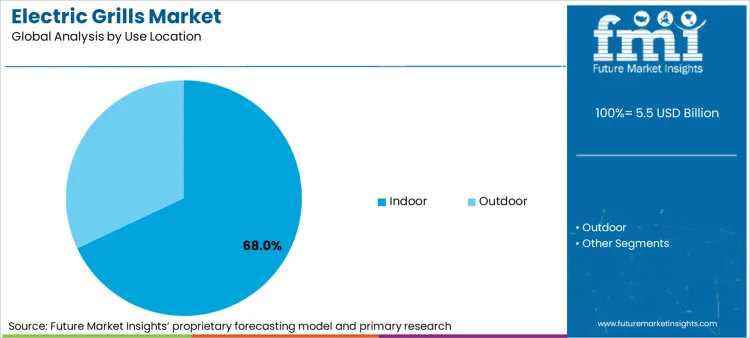
Indoor holds a 68.0% share in 2026, driven by urban household penetration and routine cooking usage patterns that support stable repeat purchase and replacement cycles. Indoor-first demand also aligns with retailer merchandising preferences for compact appliances with predictable sell-through.
Why Does Residential Remain the Primary Application?
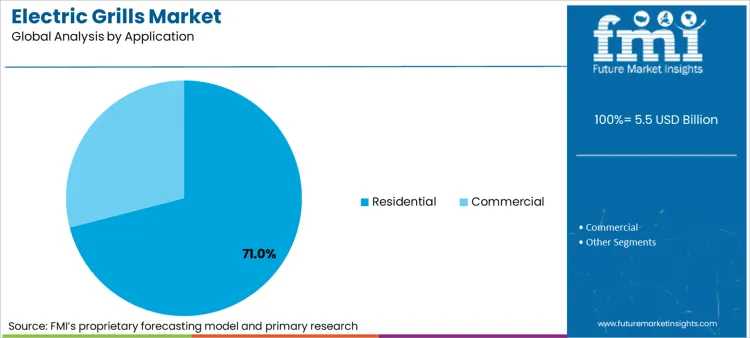
Residential accounts for a 71.0% share in 2026, reflecting the category’s dependence on household replacement cycles and broad channel accessibility. Suppliers benefit from higher turnover in residential lines compared to commercial programs that often require longer qualification and service support structures.
Why Do Hypermarkets/Supermarkets Lead the Distribution Mix?
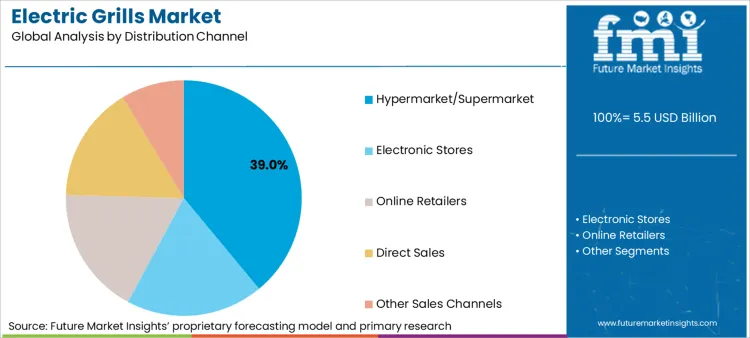
Hypermarkets/supermarkets hold a 39.0% share in 2026, supported by high footfall, promotion-driven appliance purchasing, and consistent shelf allocation for volume models. Retail partners favour brands that can sustain price stability, replenish quickly, and limit post-sale service friction.
What Strategic Shifts Will Shape the Market Through 2036?
How will portfolio discipline influence supplier performance?
Portfolio discipline is becoming a competitive advantage as brands reduce variant clutter and improve margin predictability. High-performing suppliers are standardizing heating platforms, limiting cosmetic-driven variants, and building clearer tiering across entry, mid, and premium models.
What is changing in distribution governance?
Channel governance is tightening due to pricing integrity risks across marketplaces and aggressive promotions. Manufacturers are expanding controlled distribution models, strengthening MAP-aligned enforcement where applicable, and prioritizing partners with consistent fulfilment execution.
Why is compliance documentation becoming more important?
Compliance readiness is becoming a procurement requirement across both household and commercial environments, especially where retailers and institutional buyers demand clearer documentation and risk reduction. Standards alignment for household cooking appliances that include grilling functions remains relevant for global suppliers targeting multi-market distribution.
How Will the Electric Grills Industry Evolve in Major Nations?
Growth outlook varies by household adoption of compact cooking appliances, channel maturity, and the scale of residential replacement demand. Higher-growth countries are seeing stronger volume expansion through modern trade and online retail, while developed markets remain anchored in replacement purchases and premium-tier migration.
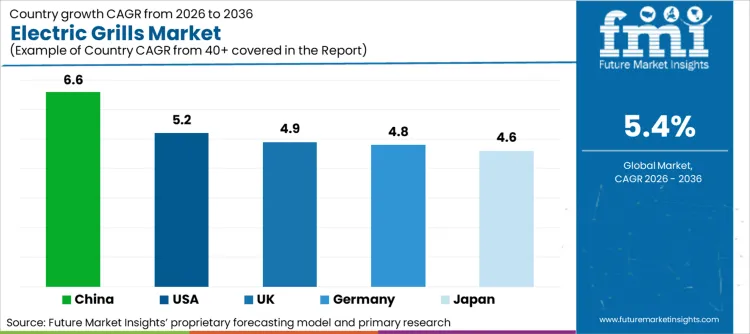
| Country | CAGR (2026 to 2036) |
|---|---|
| China | 6.6% |
| USA | 5.2% |
| UK | 4.9% |
| Germany | 4.8% |
| Japan | 4.6% |
Source: Future Market Insights (FMI) analysis, based on proprietary forecasting model and primary research
Why is the Electric Grills Industry in China Expanding Rapidly?
China is projected to expand at a 6.6% CAGR through 2036, supported by strong urban household adoption, expanding modern trade execution, and consistent growth in compact cooking appliance demand. Suppliers with scale manufacturing and strong online retail governance are expected to capture sustained growth.
Why is the Electric Grills Industry in the United States Sustaining Growth?
USA is expected to grow at a 5.2% CAGR, supported by stable replacement cycles, strong promotional activity in mainstream retail, and continued demand for indoor-friendly cooking formats. Brand performance is increasingly tied to pricing discipline and reliable distribution execution across major retailers.
Why is the Electric Grills Industry in the United Kingdom Maintaining Momentum?
The UK is projected to grow at a 4.9% CAGR, supported by consistent household demand for compact cooking appliances and high channel penetration across modern retail and digital platforms. Suppliers with standardized platforms and controlled discounting are positioned for better sell-through stability.
Why is the Electric Grills Industry in Germany Expanding Steadily?
Germany is forecast to grow at a 4.8% CAGR, supported by measured premiumisation, strong retailer quality expectations, and steady replacement demand across core appliance categories. Demand remains favourable for brands that deliver consistent build quality and predictable service performance.
Why is the Electric Grills Industry in Japan Showing Moderate Growth?
Japan is projected to grow at a 4.6% CAGR, supported by indoor appliance adoption patterns and stable replacement-led purchasing. Suppliers that maintain compact format discipline and strong quality consistency are likely to sustain category performance in a competitive retail environment.
What is the Competitive Outlook for the Electric Grills Market?
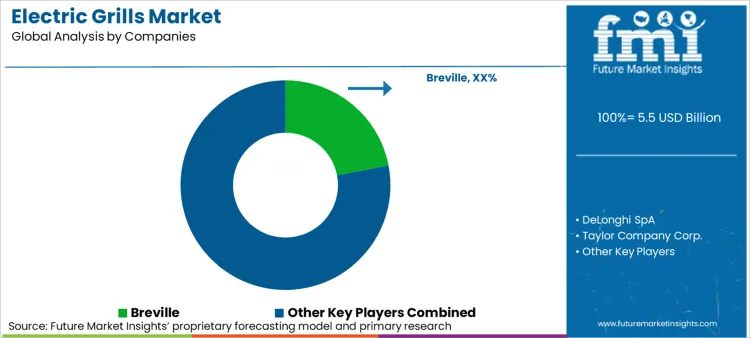
Competition is shaped by global appliance brands, outdoor cooking specialists, and diversified manufacturers with broad small kitchen appliance portfolios. Market leadership is increasingly tied to platform scalability, retail execution reliability, and disciplined tiering across volume griddle formats and differentiated smoker-led offerings.
Brands are investing in controlled assortment design, stronger availability across peak retail windows, and improved channel management to protect price integrity. Competitive intensity remains elevated, with market leaders maintaining relevance through broad distribution and strong product refresh cadence, consistent with trends in the electric grills landscape.
Key Players in Electric Grills Market
- Breville
- DeLonghi SpA
- Taylor Company Corp.
- The Coleman Company Ltd.
- Midea Group
- RH Peterson Co.
- Dimplex North America Ltd.
- The Middleby
- Roller Grill International S.A.
- Char Broil LLC
- Koninklijke Philips N.V.
- Weber-Stephen Products LLC
Scope of Report
| Items | Values |
|---|---|
| Quantitative Units | USD Billion |
| Type | Griddle, Smoker, Others |
| Use Location | Indoor, Outdoor |
| Application | Residential, Commercial |
| Distribution Channel | Hypermarket/Supermarket, Electronic Stores, Online Retailers, Direct Sales, Other Sales Channels |
| Regions | North America, Latin America, Western Europe, Eastern Europe, East Asia, South Asia & Pacific, Middle East and Africa |
Source: Future Market Insights (FMI) analysis, based on proprietary forecasting model and primary research
Electric Grills Market by Segments
Type
- Griddle
- Smoker
- Others
Use Location
- Indoor
- Outdoor
Application
- Residential
- Commercial
Distribution Channel
- Hypermarket/Supermarket
- Electronic Stores
- Online Retailers
- Direct Sales
- Other Sales Channels
By Region
- North America
- Latin America
- Western Europe
- Eastern Europe
- East Asia
- South Asia & Pacific
- Middle East and Africa
Bibliography
- International Electrotechnical Commission. (2019). IEC 60335-2-9:2019: Household and similar electrical appliances Safety Part 2-9: Particular requirements for grills, toasters and similar portable cooking appliances. IEC.
- Underwriters Laboratories. (2012). UL 1026: Standard for Safety for Electric Household Cooking and Food Serving Appliances (6th ed.). UL Standards & Engagement.
- Underwriters Laboratories. (2010). UL 197: Commercial Electric Cooking Appliances (10th ed.). UL Standards & Engagement.
- European Commission. (2023). Cooking appliances: Public consultation on ecodesign and energy labelling requirements. European Commission.
- European Commission. (2025). In focus: Energy efficient appliances. European Commission.
Frequently Asked Questions
What is the outlook for electric grills in the global market in 2026?
Demand for electric grills in the global market is estimated to be valued at USD 5.5 billion in 2026.
What will be the market size of electric grills in the global market by 2036?
Market size for electric grills is projected to reach USD 9.3 billion by 2036.
What is the expected demand growth for electric grills in the global market between 2026 and 2036?
Demand for electric grills in the global market is expected to grow at a CAGR of 5.4% between 2026 and 2036.
Which type is poised to lead global sales by 2026?
Griddle is expected to be the dominant type, capturing approximately 62.0% share of the global market in 2026.
Which use location is expected to account for the highest share by 2026?
Indoor electric grills are expected to lead usage, accounting for a 68.0% share of global demand in 2026.
Which application is expected to lead demand by 2026?
Residential electric grills are expected to be the dominant application, representing 71.0% of total demand in 2026.
Which distribution channel is expected to hold the highest share by 2026?
Hypermarkets/supermarkets are expected to remain the leading channel, accounting for approximately 39.0% share of global demand in 2026.
Preview the report firsthand - request a free sample
Get SampleGet the brochure for pricing and purchase details.
Get PDFTable of Content
- Executive Summary
- Global Market Outlook
- Demand-side Trends
- Supply-side Trends
- Technology Roadmap Analysis
- Analysis and Recommendations
- Market Overview
- Market Coverage / Taxonomy
- Market Definition / Scope / Limitations
- Research Methodology
- Chapter Orientation
- Analytical Lens and Working Hypotheses
- Market Structure, Signals, and Trend Drivers
- Benchmarking and Cross-market Comparability
- Market Sizing, Forecasting, and Opportunity Mapping
- Research Design and Evidence Framework
- Desk Research Programme (Secondary Evidence)
- Company Annual and Sustainability Reports
- Peer-reviewed Journals and Academic Literature
- Corporate Websites, Product Literature, and Technical Notes
- Earnings Decks and Investor Briefings
- Statutory Filings and Regulatory Disclosures
- Technical White Papers and Standards Notes
- Trade Journals, Industry Magazines, and Analyst Briefs
- Conference Proceedings, Webinars, and Seminar Materials
- Government Statistics Portals and Public Data Releases
- Press Releases and Reputable Media Coverage
- Specialist Newsletters and Curated Briefings
- Sector Databases and Reference Repositories
- Roots Internal Knowledge Base and Historical Datasets
- Subscription Datasets and Paid Sources
- Social Channels, Communities, and Digital Listening Inputs
- Additional Desk Sources
- Expert Input and Fieldwork (Primary Evidence)
- Primary Modes
- Qualitative Interviews and Expert Elicitation
- Quantitative Surveys and Structured Data Capture
- Blended A9oach
- Why Primary Evidence is Used
- Field Techniques
- Interviews
- Surveys
- Focus Groups
- Observational and In-context Research
- Social and Community Interactions
- Stakeholder Universe Engaged
- C-suite Leaders
- Board Members
- Presidents and Vice Presidents
- R&D and Innovation Heads
- Technical Specialists
- Domain Subject-matter Experts
- Scientists
- Physicians and Other Healthcare Professionals
- Governance, Ethics, and Data Stewardship
- Research Ethics
- Data Integrity and Handling
- Primary Modes
- Tooling, Models, and Reference Databases
- Desk Research Programme (Secondary Evidence)
- Data Engineering and Model Build
- Data Acquisition and Ingestion
- Cleaning, Normalisation, and Verification
- Synthesis, Triangulation, and Analysis
- Quality Assurance and Audit Trail
- Market Background
- Market Dynamics
- Drivers
- Restraints
- Opportunity
- Trends
- Scenario Forecast
- Demand in Optimistic Scenario
- Demand in Likely Scenario
- Demand in Conservative Scenario
- Opportunity Map Analysis
- Product Life Cycle Analysis
- Supply Chain Analysis
- Investment Feasibility Matrix
- Value Chain Analysis
- PESTLE and Porter’s Analysis
- Regulatory Landscape
- Regional Parent Market Outlook
- Production and Consumption Statistics
- Import and Export Statistics
- Market Dynamics
- Global Market Analysis 2021 to 2025 and Forecast, 2026 to 2036
- Historical Market Size Value (USD Million) Analysis, 2021 to 2025
- Current and Future Market Size Value (USD Million) Projections, 2026 to 2036
- Y-o-Y Growth Trend Analysis
- Absolute $ Opportunity Analysis
- Global Market Pricing Analysis 2021 to 2025 and Forecast 2026 to 2036
- Global Market Analysis 2021 to 2025 and Forecast 2026 to 2036, By Type
- Introduction / Key Findings
- Historical Market Size Value (USD Million) Analysis By Type , 2021 to 2025
- Current and Future Market Size Value (USD Million) Analysis and Forecast By Type , 2026 to 2036
- Griddle
- Smoker
- Griddle
- Y-o-Y Growth Trend Analysis By Type , 2021 to 2025
- Absolute $ Opportunity Analysis By Type , 2026 to 2036
- Global Market Analysis 2021 to 2025 and Forecast 2026 to 2036, By Use Location
- Introduction / Key Findings
- Historical Market Size Value (USD Million) Analysis By Use Location, 2021 to 2025
- Current and Future Market Size Value (USD Million) Analysis and Forecast By Use Location, 2026 to 2036
- Indoor
- Outdoor
- Indoor
- Y-o-Y Growth Trend Analysis By Use Location, 2021 to 2025
- Absolute $ Opportunity Analysis By Use Location, 2026 to 2036
- Global Market Analysis 2021 to 2025 and Forecast 2026 to 2036, By Application
- Introduction / Key Findings
- Historical Market Size Value (USD Million) Analysis By Application, 2021 to 2025
- Current and Future Market Size Value (USD Million) Analysis and Forecast By Application, 2026 to 2036
- Residential
- Commercial
- Residential
- Y-o-Y Growth Trend Analysis By Application, 2021 to 2025
- Absolute $ Opportunity Analysis By Application, 2026 to 2036
- Global Market Analysis 2021 to 2025 and Forecast 2026 to 2036, By Distribution Channel
- Introduction / Key Findings
- Historical Market Size Value (USD Million) Analysis By Distribution Channel, 2021 to 2025
- Current and Future Market Size Value (USD Million) Analysis and Forecast By Distribution Channel, 2026 to 2036
- Hypermarket/Supermarket
- Electronic Stores
- Online Retailers
- Direct Sales
- Other Sales Channels
- Hypermarket/Supermarket
- Y-o-Y Growth Trend Analysis By Distribution Channel, 2021 to 2025
- Absolute $ Opportunity Analysis By Distribution Channel, 2026 to 2036
- Global Market Analysis 2021 to 2025 and Forecast 2026 to 2036, By Region
- Introduction
- Historical Market Size Value (USD Million) Analysis By Region, 2021 to 2025
- Current Market Size Value (USD Million) Analysis and Forecast By Region, 2026 to 2036
- North America
- Latin America
- Western Europe
- Eastern Europe
- East Asia
- South Asia and Pacific
- Middle East & Africa
- Market Attractiveness Analysis By Region
- North America Market Analysis 2021 to 2025 and Forecast 2026 to 2036, By Country
- Historical Market Size Value (USD Million) Trend Analysis By Market Taxonomy, 2021 to 2025
- Market Size Value (USD Million) Forecast By Market Taxonomy, 2026 to 2036
- By Country
- USA
- Canada
- Mexico
- By Type
- By Use Location
- By Application
- By Distribution Channel
- By Country
- Market Attractiveness Analysis
- By Country
- By Type
- By Use Location
- By Application
- By Distribution Channel
- Key Takeaways
- Latin America Market Analysis 2021 to 2025 and Forecast 2026 to 2036, By Country
- Historical Market Size Value (USD Million) Trend Analysis By Market Taxonomy, 2021 to 2025
- Market Size Value (USD Million) Forecast By Market Taxonomy, 2026 to 2036
- By Country
- Brazil
- Chile
- Rest of Latin America
- By Type
- By Use Location
- By Application
- By Distribution Channel
- By Country
- Market Attractiveness Analysis
- By Country
- By Type
- By Use Location
- By Application
- By Distribution Channel
- Key Takeaways
- Western Europe Market Analysis 2021 to 2025 and Forecast 2026 to 2036, By Country
- Historical Market Size Value (USD Million) Trend Analysis By Market Taxonomy, 2021 to 2025
- Market Size Value (USD Million) Forecast By Market Taxonomy, 2026 to 2036
- By Country
- Germany
- UK
- Italy
- Spain
- France
- Nordic
- BENELUX
- Rest of Western Europe
- By Type
- By Use Location
- By Application
- By Distribution Channel
- By Country
- Market Attractiveness Analysis
- By Country
- By Type
- By Use Location
- By Application
- By Distribution Channel
- Key Takeaways
- Eastern Europe Market Analysis 2021 to 2025 and Forecast 2026 to 2036, By Country
- Historical Market Size Value (USD Million) Trend Analysis By Market Taxonomy, 2021 to 2025
- Market Size Value (USD Million) Forecast By Market Taxonomy, 2026 to 2036
- By Country
- Russia
- Poland
- Hungary
- Balkan & Baltic
- Rest of Eastern Europe
- By Type
- By Use Location
- By Application
- By Distribution Channel
- By Country
- Market Attractiveness Analysis
- By Country
- By Type
- By Use Location
- By Application
- By Distribution Channel
- Key Takeaways
- East Asia Market Analysis 2021 to 2025 and Forecast 2026 to 2036, By Country
- Historical Market Size Value (USD Million) Trend Analysis By Market Taxonomy, 2021 to 2025
- Market Size Value (USD Million) Forecast By Market Taxonomy, 2026 to 2036
- By Country
- China
- Japan
- South Korea
- By Type
- By Use Location
- By Application
- By Distribution Channel
- By Country
- Market Attractiveness Analysis
- By Country
- By Type
- By Use Location
- By Application
- By Distribution Channel
- Key Takeaways
- South Asia and Pacific Market Analysis 2021 to 2025 and Forecast 2026 to 2036, By Country
- Historical Market Size Value (USD Million) Trend Analysis By Market Taxonomy, 2021 to 2025
- Market Size Value (USD Million) Forecast By Market Taxonomy, 2026 to 2036
- By Country
- India
- ASEAN
- Australia & New Zealand
- Rest of South Asia and Pacific
- By Type
- By Use Location
- By Application
- By Distribution Channel
- By Country
- Market Attractiveness Analysis
- By Country
- By Type
- By Use Location
- By Application
- By Distribution Channel
- Key Takeaways
- Middle East & Africa Market Analysis 2021 to 2025 and Forecast 2026 to 2036, By Country
- Historical Market Size Value (USD Million) Trend Analysis By Market Taxonomy, 2021 to 2025
- Market Size Value (USD Million) Forecast By Market Taxonomy, 2026 to 2036
- By Country
- Kingdom of Saudi Arabia
- Other GCC Countries
- Turkiye
- South Africa
- Other African Union
- Rest of Middle East & Africa
- By Type
- By Use Location
- By Application
- By Distribution Channel
- By Country
- Market Attractiveness Analysis
- By Country
- By Type
- By Use Location
- By Application
- By Distribution Channel
- Key Takeaways
- Key Countries Market Analysis
- USA
- Pricing Analysis
- Market Share Analysis, 2025
- By Type
- By Use Location
- By Application
- By Distribution Channel
- Canada
- Pricing Analysis
- Market Share Analysis, 2025
- By Type
- By Use Location
- By Application
- By Distribution Channel
- Mexico
- Pricing Analysis
- Market Share Analysis, 2025
- By Type
- By Use Location
- By Application
- By Distribution Channel
- Brazil
- Pricing Analysis
- Market Share Analysis, 2025
- By Type
- By Use Location
- By Application
- By Distribution Channel
- Chile
- Pricing Analysis
- Market Share Analysis, 2025
- By Type
- By Use Location
- By Application
- By Distribution Channel
- Germany
- Pricing Analysis
- Market Share Analysis, 2025
- By Type
- By Use Location
- By Application
- By Distribution Channel
- UK
- Pricing Analysis
- Market Share Analysis, 2025
- By Type
- By Use Location
- By Application
- By Distribution Channel
- Italy
- Pricing Analysis
- Market Share Analysis, 2025
- By Type
- By Use Location
- By Application
- By Distribution Channel
- Spain
- Pricing Analysis
- Market Share Analysis, 2025
- By Type
- By Use Location
- By Application
- By Distribution Channel
- France
- Pricing Analysis
- Market Share Analysis, 2025
- By Type
- By Use Location
- By Application
- By Distribution Channel
- India
- Pricing Analysis
- Market Share Analysis, 2025
- By Type
- By Use Location
- By Application
- By Distribution Channel
- ASEAN
- Pricing Analysis
- Market Share Analysis, 2025
- By Type
- By Use Location
- By Application
- By Distribution Channel
- Australia & New Zealand
- Pricing Analysis
- Market Share Analysis, 2025
- By Type
- By Use Location
- By Application
- By Distribution Channel
- China
- Pricing Analysis
- Market Share Analysis, 2025
- By Type
- By Use Location
- By Application
- By Distribution Channel
- Japan
- Pricing Analysis
- Market Share Analysis, 2025
- By Type
- By Use Location
- By Application
- By Distribution Channel
- South Korea
- Pricing Analysis
- Market Share Analysis, 2025
- By Type
- By Use Location
- By Application
- By Distribution Channel
- Russia
- Pricing Analysis
- Market Share Analysis, 2025
- By Type
- By Use Location
- By Application
- By Distribution Channel
- Poland
- Pricing Analysis
- Market Share Analysis, 2025
- By Type
- By Use Location
- By Application
- By Distribution Channel
- Hungary
- Pricing Analysis
- Market Share Analysis, 2025
- By Type
- By Use Location
- By Application
- By Distribution Channel
- Kingdom of Saudi Arabia
- Pricing Analysis
- Market Share Analysis, 2025
- By Type
- By Use Location
- By Application
- By Distribution Channel
- Turkiye
- Pricing Analysis
- Market Share Analysis, 2025
- By Type
- By Use Location
- By Application
- By Distribution Channel
- South Africa
- Pricing Analysis
- Market Share Analysis, 2025
- By Type
- By Use Location
- By Application
- By Distribution Channel
- USA
- Market Structure Analysis
- Competition Dashboard
- Competition Benchmarking
- Market Share Analysis of Top Players
- By Regional
- By Type
- By Use Location
- By Application
- By Distribution Channel
- Competition Analysis
- Competition Deep Dive
- Breville
- Overview
- Product Portfolio
- Profitability by Market Segments (Product/Age /Sales Channel/Region)
- Sales Footprint
- Strategy Overview
- Marketing Strategy
- Product Strategy
- Channel Strategy
- DeLonghi SpA
- Taylor Company Corp.
- The Coleman Company Ltd.
- Midea Group
- RH Peterson Co.
- Dimplex North America Ltd.
- The Middleby
- Roller Grill International S.A.
- Char Broil LLC
- Koninklijke Philips N.V.
- Weber-Stephen Products LLC
- Others
- Breville
- Competition Deep Dive
- Assumptions & Acronyms Used


