

- Market Size (2026)
- USD 452.0 Mn
- Forecast (2036)
- USD 984.4 Mn
- CAGR (2026 to 2036)
- 8.1%
Electric Power Steering Cooling Hose Systems Market Size, Forecast, and Outlook By FMI
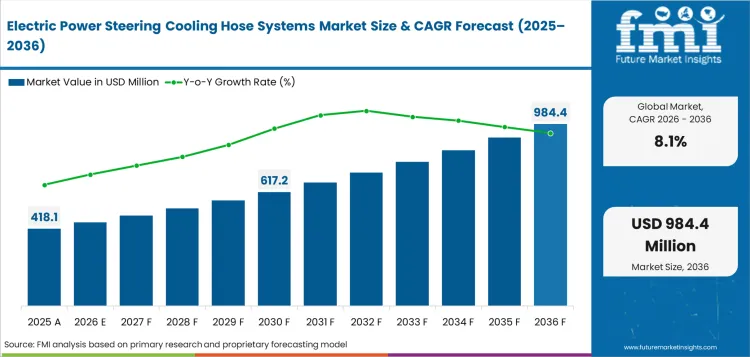
Electric power steering cooling hose systems market was valued at USD 418.1 million in 2025 and is expected to reach USD 452.0 million in 2026. Demand is forecast to reach USD 984.4 million by 2036 at 8.1% CAGR during the forecast period. OEM fitment is anticipated to represent 72.0% of sales channel in 2026. Passenger cars are forecast to account for 61.0% of vehicle type in 2026.
Summary of the Electric Power Steering Cooling Hose Systems Market
- Demand and Growth Drivers
- EPS torque loads are rising as larger EVs need stronger steering assistance and stable controller temperature.
- EV thermal loops are becoming denser, which raises demand for precise hose bends near steering motors.
- Steer-by-wire programs add safety redundancy and create need for cooler actuator electronics.
- Lightweight hose materials get attention as automakers reduce mass around front-end modules.
- Product and Segment View
- Molded coolant hoses hold a leading share as fixed bends suit rack-assist EPS layouts better than straight hose lengths.
- EPDM rubber keeps a leading position as glycol coolant compatibility and cost control support high-volume platforms.
- Thermoplastic hoses gain share as suppliers target weight reduction and automated assembly.
- Quick connectors and clamps support repeatable line assembly across modular steering systems.
- Geography and Competitive Outlook
- China and India are expected to advance faster as EV production raises local demand for thermal hose assemblies.
- Germany and Japan keep established engineering depth as steering and fluid routing suppliers support global platforms.
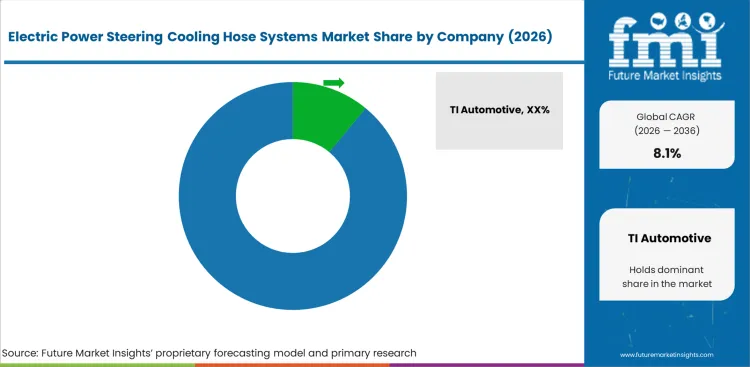
- TI Automotive and Cooper Standard compete through thermal line design and global program coverage.
- Suppliers with coolant compatibility data and packaging support will receive repeat awards from automakers.
- Analyst Opinion
- Nikhil Kaitwade of FMI says, “Electric power steering cooling hoses are becoming design-critical parts as EPS moves closer to heat-sensitive electronics. Automakers want hose assemblies with tight routing and stable coolant performance over long service life. Suppliers combining material proof with steering packaging support will be preferred in EV and steer-by-wire programs.”
- Electric Power Steering Cooling Hose Systems Market Value Analysis
- Electric power steering cooling hose systems market is moving from a small support component space into a more defined thermal routing category.
- Market value is rising as EVs and hybrid vehicles need better heat control around EPS motors and steering electronics.
- OEM fitment holds higher value because cooling hoses must match steering layout, coolant flow and vehicle packaging before platform approval.
- Material value is increasing as automakers look for hoses that reduce weight while keeping leakage risk low over long vehicle life.
Key Takeaways, Market Size, and Forecast
- Electric power steering cooling hose systems market was valued at USD 418.1 million in 2025.
- By 2036, demand is forecast to reach USD 984.4 million as EV steering electronics need safer coolant routing.
- Market value is expected to rise at 8.1% CAGR during the 2026 to 2036 forecast period.
- Market revenue is anticipated to add USD 532.4 million in incremental opportunity over 2026 to 2036.
- OEM fitment is expected to represent 72.0% of sales channel demand in 2026 as cooling hoses need early platform approval.
- Passenger cars are forecast to account for 61.0% of vehicle type demand in 2026 as EPS volume stays centered in car platforms.
- China at 9.7% CAGR and India at 9.4% CAGR are expected to lead country-level expansion during the forecast period.
- EPDM rubber is anticipated to hold 44.0% material share in 2026 as coolant resistance and cost control support vehicle programs.
EPS cooling hose design is becoming more important as steering modules carry more assist load in tight vehicle space. In April 2025, Nexteer said standard CEPS delivers 40-95 Nm of assist and its high-output CEPS increases capacity to 110 Nm. That pushes OEMs to look for hose assemblies that hold bend shape and avoid clamp movement near steering electronics. Material choice is shifting as EV thermal circuits need lighter routing. Cooper Standard said in its 2024 Annual Report that PlastiCool multilayer tubes can reduce weight by up to 60% versus traditional EPDM hoses. Such material proof gives hose suppliers a stronger case in programs that need lower weight and tighter packaging. Validation is becoming more important because coolant hoses face electrical and chemical stress. SAE International stated in November 2024 that electrochemical degradation is a major cause of EPDM coolant hose failures. Suppliers with ECD proof can support safer EPS cooling programs and reduce warranty exposure.
Electric Power Steering Cooling Hose Systems Market Definition
Electric power steering cooling hose systems cover molded hoses and thermoplastic coolant lines used to manage heat around EPS motors and steering control electronics.
Electric Power Steering Cooling Hose Systems Market Inclusions
Scope includes molded coolant hoses and straight hose lengths used in electric power steering cooling circuits. Scope covers thermoplastic coolant lines and quick connector assemblies used near EPS motors. Stakeholders include steering system makers and tier one fluid routing suppliers. Automakers and service networks complete the commercial scope.
Electric Power Steering Cooling Hose Systems Market Exclusions
Scope excludes hydraulic power steering pressure hoses unless coolant routing is part of an EPS conversion kit. General radiator hoses are excluded unless sold for EPS cooling. Brake hoses and fuel lines are excluded from the market boundary.
Electric Power Steering Cooling Hose Systems Market Research Methodology
- Primary Research: FMI analysts reviewed steering system suppliers and hose assembly makers across major automotive regions.
- Desk Research: Public data from IEA and ACEA supported market checks. OICA, CAAM and SIAM were used for vehicle production review.
- Market Sizing and Forecasting: Market size was estimated by EPS platform volume and average hose value per vehicle.
- Data Validation: Forecast checks compared EV sales and supplier thermal management developments from 2024 onward.
Why is the Electric Power Steering Cooling Hose Systems Market Growing?
- EPS cooling needs are rising as the automotive steering system shifts from hydraulic assist toward electric control across passenger vehicles.
- EV front-end packaging raises hose precision needs as coolant circuits share space with battery loops.
- Steer-by-wire programs create a higher-value route for cooled actuator modules and redundant steering electronics.
Vehicle electrification is increasing coolant routing adoption around steering electronics. IEA reported electric car sales of 21.0 million units in 2025, with one in four cars sold being electric. Higher EV volumes increase demand for EPS modules near thermal loops. Hose suppliers benefit from designs able to carry glycol coolant reliably near compact front-end electronics.
Steering system loads are moving higher as electric SUVs spread. Higher assist capacity puts more heat into EPS motors and controller areas. Cooling hose systems become part of the steering package as heat control affects response and durability. Material substitution opens another route for value creation. In November 2024, Cooper Standard introduced FlexiCore thermoplastic body seal as a lightweight alternative to traditional EPDM seals with metal-based carriers. The company stated that FlexiCore uses 100.0% TPE and polypropylene materials and can reduce weight by up to 44.0%. This gives automakers a newer material option where sealing performance and assembly ease are important. Suppliers with rubber and engineered plastic options can match material choice to each platform’s routing and assembly needs.
Market Segmentation Analysis
- Molded coolant hoses are expected to account for 38.0% share in 2026.
- EPDM rubber is forecast to hold 44.0% share in 2026.
- By vehicle type, passenger cars are anticipated to represent 61.0% share.
- In 2026, rack assist EPS is expected to hold 46.0% share.
- OEM fitment is forecast to hold 72.0% share in 2026.
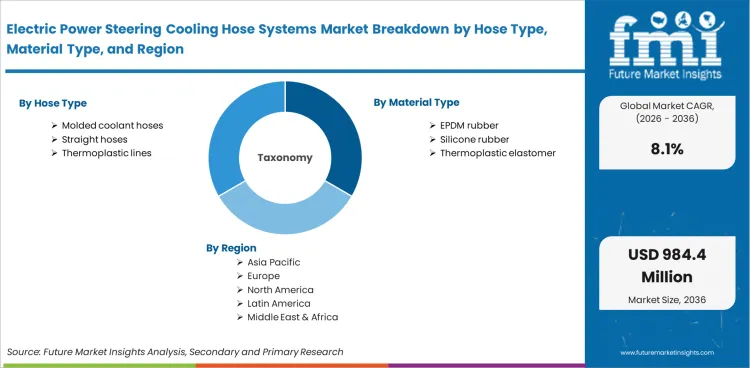
The market for electric power steering cooling hose systems is divided into groups based on hose type, material type, vehicle type, steering layout, sales channel, and region. Hose type includes molded coolant hoses and straight hoses. It also includes thermoplastic coolant lines and connector assemblies. Material type covers EPDM rubber and silicone rubber. Thermoplastic elastomer and reinforced nylon are included in the same scope. By vehicle type, the market covers passenger cars and light commercial vehicles. Electric SUVs and medium-duty vehicles are also included. Steering layout includes column assist EPS and rack assist EPS. Pinion assist EPS and steer-by-wire actuators complete the steering layout scope. By sales channel, the market covers OEM fitment and aftermarket replacement. Distributor sales and service kits complete the sales channel scope.
Insights into Electric Power Steering Cooling Hose Systems Market by Hose Type
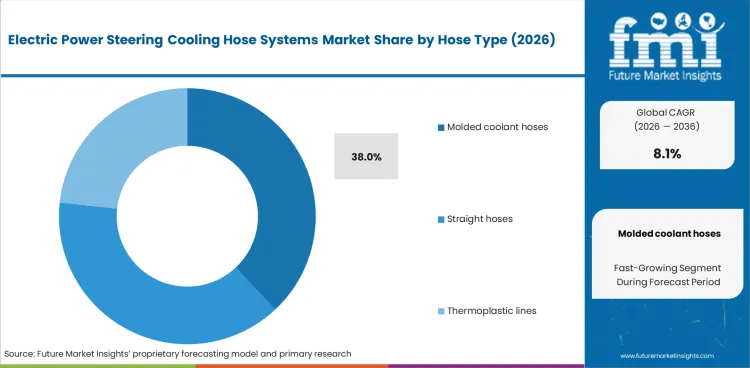
- Molded coolant hoses are forecast to represent 38.0% share in 2026 as EPS layouts need fixed bends near steering motors. automotive power steering hoses and assemblies stay in use because steering systems need shaped hose paths with reliable clamp points.
- Thermoplastic coolant lines are gaining use as automakers reduce weight around front-end steering modules. These lines support cleaner routing in compact EV spaces and lower assembly stress during vehicle build.
Insights into Electric Power Steering Cooling Hose Systems Market by Material Type
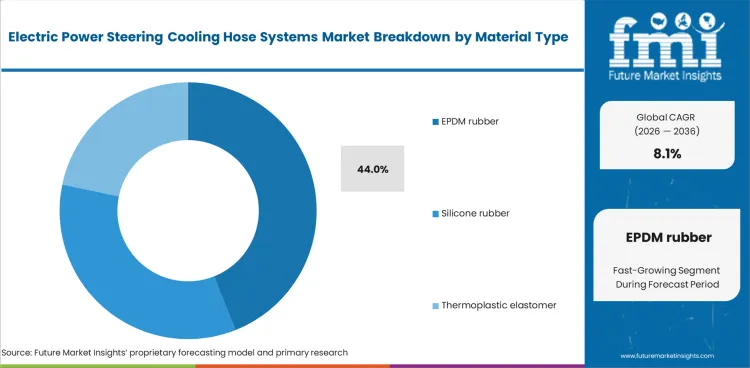
- EPDM rubber is expected to hold 44.0% share in the same period because it works well with glycol-based coolant. It is also familiar to hose suppliers, which keeps validation easier for high-volume programs.
- Thermoplastic elastomers are receiving attention as EV makers look for lighter hose materials. Material choice is becoming more important as EPS cooling hoses must balance flexibility with long service life.
Insights into Electric Power Steering Cooling Hose Systems Market by Vehicle Type
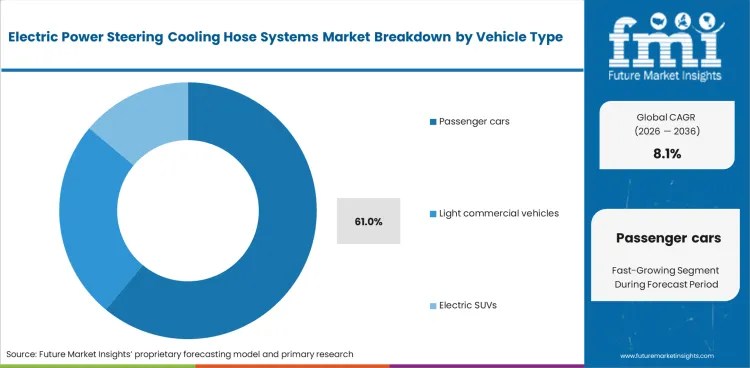
- Passenger cars are anticipated to account for 61.0% share in 2026 with EPS use being common across EV and hybrid car platforms. Automotive steering system demand supports this trend as more vehicles shift toward electric steering control.
- Electric SUVs create added demand because their higher weight needs stronger steering assist. Higher assist increases heat near EPS motors, so cooling hose routing becomes more important in these platforms.
Insights into Electric Power Steering Cooling Hose Systems Market by Steering Layout
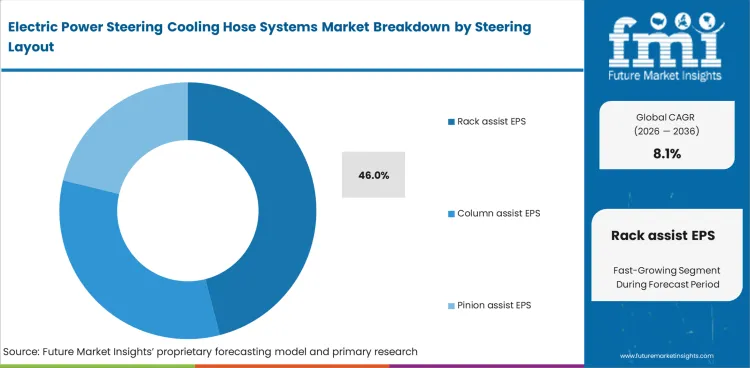
- In 2026, rack assist EPS is expected to hold 46.0% share. Heavier vehicles need assist closer to the steering rack. Electronic power steering (EPS) systems in these layouts need better heat control near motors and controllers.
- Steer-by-wire actuators are creating higher-value demand for cooling hose systems. More electronic control inside steering packages raises the need for stable coolant routing around actuator areas.
Insights into Electric Power Steering Cooling Hose Systems Market by Sales Channel
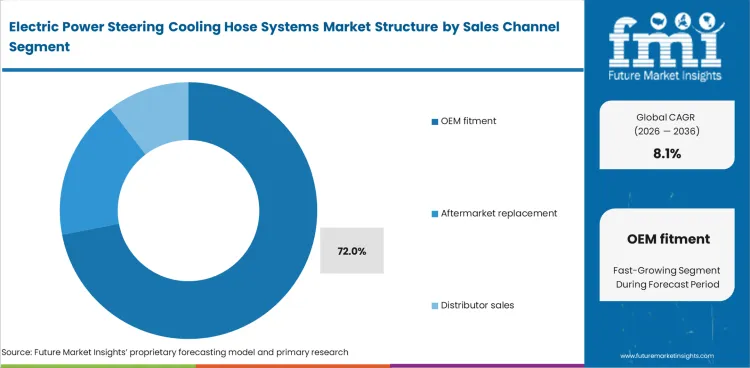
- OEM fitment is forecast to represent 72.0% share during 2026 as hoses must be approved with steering layout and thermal design. Automakers prefer early validation because hose routing can affect leakage risk and service access.
- Aftermarket replacement demand is expected to rise as older EPS cooling hoses face heat exposure and clamp wear. Automotive hoses and assemblies support repair demand as workshops replace aged hose lines near steering modules.
Electric Power Steering Cooling Hose Systems Market Drivers and Restraints
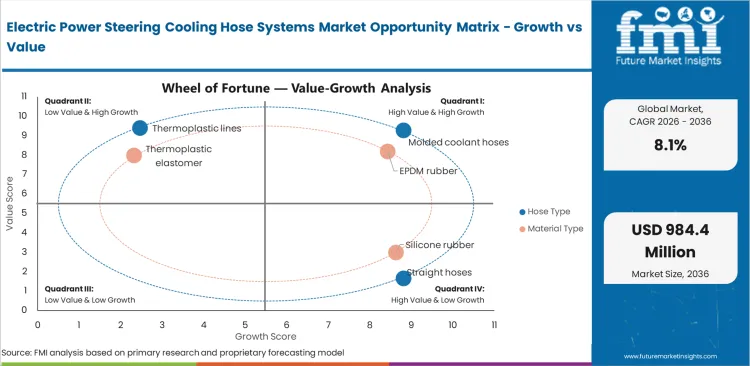
- Higher steering torque raises demand for routed coolant lines protecting EPS motors during repeated low-speed maneuvers.
- Validation cost can slow platform approval as hose assemblies must pass heat aging and pressure checks.
- Steer-by-wire programs create opportunities for compact cooling lines around actuator modules and redundant controllers.
Higher Steering Torque Raises Heat Load
Automakers use EPS systems in heavier EVs that need stronger steering support. Higher vehicle weight increases load on the steering motor during parking and slow turns. Extra load can raise heat around the motor and control electronics. Cooling hoses help move heat away from those parts so steering response stays stable over long vehicle life.
Compact Front-End Packaging Raises Hose Precision
EV platforms place steering parts close to power electronics and coolant circuits. Tight space makes hose shape and connector position more important. Poor routing can create rubbing risk or make service work harder. Molded hoses and thermoplastic lines help suppliers build cleaner paths around compact steering modules.
Validation Cost Slows Overbuilt Systems
Cooling hoses near steering electronics must pass heat aging and pressure tests before vehicle launch. New materials can reduce weight, but automakers need proof across coolant exposure and vibration cycles. Smaller suppliers may struggle with testing cost and documentation needs. Platform approval becomes harder when hose assemblies need full system-level validation.
Steer-by-Wire Opens Control Module Cooling
Steer-by-wire places more electronic control inside the steering system. Actuators and control modules need stable operating temperatures to support safe steering response. Cooling lines can protect these parts as steering systems become more electronic. Suppliers with compact routing and coolant-resistant materials can support future steering layouts.
Analysis of Electric Power Steering Cooling Hose Systems Market by Key Countries
.webp "Top Country Growth Comparison Electric Power Steering Cooling Hose Systems Market Cagr (2026 2036)")
| Country | CAGR |
|---|---|
| China | 9.7% |
| India | 9.4% |
| South Korea | 8.6% |
| Mexico | 8.5% |
| United States | 7.6% |
| Germany | 7.2% |
| Japan | 6.9% |
Source: Future Market Insights, 2026.
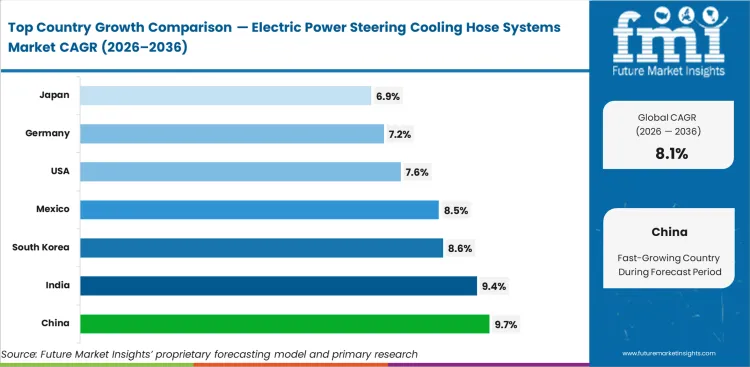
Electric Power Steering Cooling Hose Systems Market CAGR Analysis by Country
- China is forecast to expand at 9.7% CAGR through 2036 as NEV output supports local EPS coolant routing demand.
- India is expected to move ahead at 9.4% CAGR during the forecast period due to wider passenger vehicle production and local component scale.
- By 2036, South Korea is anticipated to advance at 8.6% CAGR with eco-friendly vehicle output strengthening thermal hose use.
- Mexico is forecast to register 8.5% CAGR in this market through 2036 as auto parts manufacturing supports North American platform supply.
- During the forecast period, the United States market is expected to hold 7.6% CAGR with EV and SUV programs needing validated steering cooling lines.
- Germany is forecast to move at 7.2% CAGR by 2036 as battery-electric vehicle programs support EPS thermal system adoption.
- Japan is expected to expand at 6.9% CAGR through 2036 as precision steering suppliers and hybrid platforms support steady demand.
- Global electric power steering cooling hose systems demand is forecast to advance at 8.1% CAGR during the forecast period.
Demand Outlook for Electric Power Steering Cooling Hose Systems Market in China
Through 2036, China is forecast to record 9.7% CAGR in electric power steering cooling hose systems. Local NEV production keeps steering and thermal parts close to vehicle programs. CAAM data carried by the State Council reported 16.626 million NEVs produced in 2025 and 16.49 million units sold. Large NEV output creates demand for coolant hoses that can be localized quickly for new platform designs.
- NEV-heavy platforms favor molded hose assemblies with compact power electronics routing.
- Local tier suppliers can get share with fast validation cycles and lower tooling lead times.
- Steer-by-wire launches increase attention on cooling near redundant controllers.
Sales Analysis of Electric Power Steering Cooling Hose Systems Market in India
The market in India is expected to expand at 9.4% CAGR through 2036 as local manufacturing improves hose assembly capacity and validation support. India demand is moving from basic EPS fitment toward stronger local component depth. SIAM reported passenger vehicle sales of 46.43 lakh units in FY2025-26 and electric passenger vehicle registration expansion above 80.0%. Such expansion raises demand for electronic power steering systems and routed coolant components across new platforms.
- High-volume passenger vehicles need EPDM hose assemblies with cost control and coolant resistance.
- EV launches increase demand for compact routing around steering modules and front-end cooling loops.
- Local service networks create replacement demand for hoses exposed to heat and clamp wear.
Opportunity Analysis of Electric Power Steering Cooling Hose Systems Market in South Korea
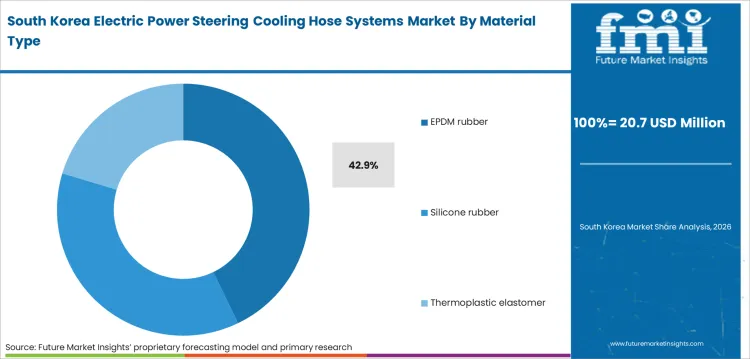
South Korea benefits from high electronics content across domestic vehicle platforms and export-oriented eco-friendly models. Adoption in South Korea is anticipated to grow at 8.6% CAGR by 2036. MOTIR reported January-February 2026 eco-friendly vehicle exports of USD 4.5 billion, up 20.4% from the prior year. Electric vehicle domestic sales rose 156.2% in February 2026, widening the addressable pool for EPS thermal routing. Steering suppliers will need safer cooling around power electronics.
- Eco-friendly vehicle output favors hose systems with clean assembly and stable coolant performance.
- High electronics content raises need for sealing proof around steering controllers.
- Export platforms reward suppliers able to meet global material rules and repeated quality checks.
Demand Outlook for Electric Power Steering Cooling Hose Systems Market in Mexico
Mexico has a significant role in North America vehicle and auto parts production. The International Trade Administration stated that Mexico vehicle exports reached about USD 104.8 billion in 2024. Auto parts production reached USD 121.3 billion in the same year. Mexico is forecast to hold 8.5% CAGR through 2036 as validated assemblies serve North American EV and hybrid platforms. Cross-border steering module production gives hose suppliers a route into OEM programs.
- Tier suppliers need coolant hose systems meeting automaker documentation and traceability rules.
- North American platform integration favors local hose forming and connector assembly capacity.
- EV and hybrid production shifts raise demand for lightweight routing near steering modules.
Future Outlook for Electric Power Steering Cooling Hose Systems Market in the United States
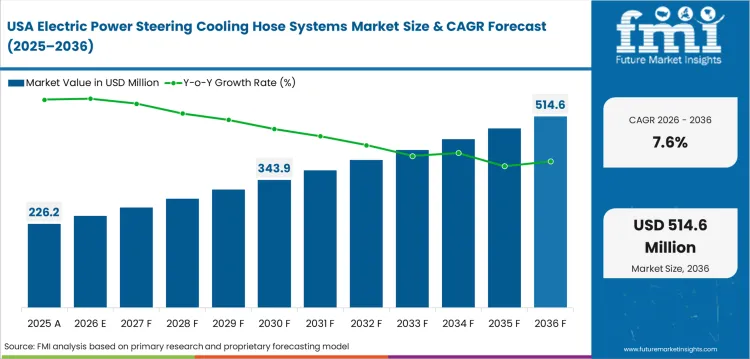
United States demand is tied to EV and light truck platforms that need stronger steering assist. IEA reported electric car sales in the United States declined 2.0% in 2025 after federal tax credit changes. A 7.6% CAGR is expected by 2036 as automakers keep validating EPS cooling for heavier vehicle programs. Softer EV sales keep cost pressure high, so durability proof becomes more important for hose suppliers.
- SUV and pickup platforms need stronger EPS assist with durable hose routing near steering racks.
- Automakers favor suppliers with local engineering support and proven coolant aging data.
- Aftermarket demand improves as service networks handle hose replacement near EPS modules.
Sales Analysis of Electric Power Steering Cooling Hose Systems Market in Germany
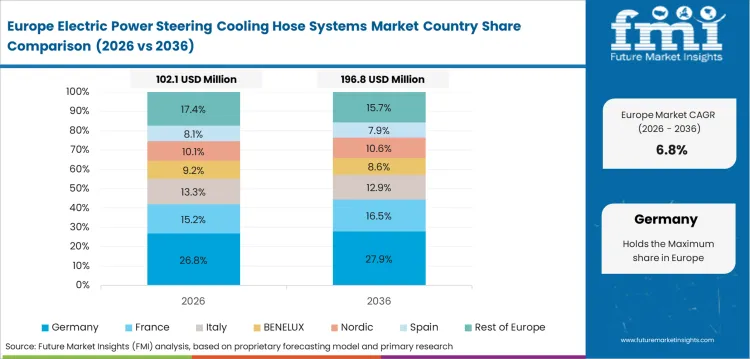
Germany demand is shaped by premium vehicle engineering and EU electric car adoption. ACEA reported 1.88 million battery-electric car registrations in the EU during 2025. Germany increased 43.2% year over year within EU battery-electric registrations. German programs need EPS packages able to pass strict thermal validation. Germany is forecast at 7.2% CAGR through 2036. Suppliers with strong material proof will have better access to platform work.
- Premium platforms need low-noise hose routing as steering feel and cabin refinement are closely judged.
- EV architecture depth increases demand for formed coolant lines near front-end electronics.
- Material suppliers get share by proving lower weight with durable coolant resistance.
Future Outlook for Electric Power Steering Cooling Hose Systems Market in Japan
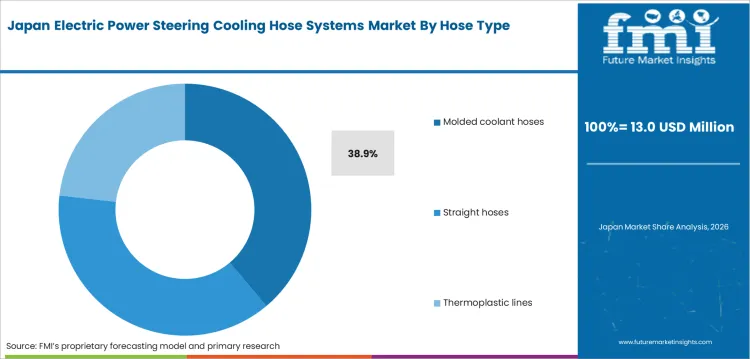
Japan demand is steady but technically demanding as steering and hose suppliers serve global vehicle programs. JAMA reported 8.23 million motor vehicles produced in Japan in 2024. Passenger cars made up 7.14 million units. Japan is expected to post 6.9% CAGR by 2036 as hybrid and EV platforms add thermal routing near steering electronics.
- Hybrid platforms need coolant routing for compact powertrain bays and high-quality assembly standards.
- Steering suppliers value hose assemblies with stable dimensions and low leak risk over long service life.
- Export programs reward suppliers with material documentation accepted across several vehicle regions.
Competitive Structure and Strategic Positioning
- Competition is centered on coolant resistance and routing accuracy because EPS cooling hoses sit close to steering electronics.
- Fluid routing suppliers need to prove burst strength and heat aging performance before they can win platform work.
- Hose specialists have an advantage when they offer both molded rubber hoses and lightweight thermoplastic lines.
- Entry barriers are rising as automakers ask for material traceability and vehicle-level validation before approval.
Competitive positioning in the industry is dependent on how well suppliers support steering-specific thermal needs. EPS cooling hoses are small parts, but failure can affect steering electronics and service safety. TI Automotive gains a wider fluid-routing position after ABC Technologies completed the acquisition of TI Fluid Systems in April 2025. The combined business gives automakers a larger supplier option for thermal line programs and steering-adjacent coolant routing.
Companies such as Cooper Standard focuses on coolant control and lightweight fluid-handling work. In April 2025, Cooper Standard said its eCoFlow Switch Pump technology received 2025 Automotive News PACE Pilot recognition. For EPS cooling hose suppliers, such work shows why automakers are asking for cleaner hose paths and stronger packaging support.
Key Companies in the Electric Power Steering Cooling Hose Systems Market
- Global Fluid Routing Suppliers: TI Automotive and Cooper Standard hold strong positions through thermal lines and molded hoses.
- Specialty Hose and Rubber Suppliers: Hutchinson and Sumitomo Riko compete through elastomer systems and steering-related fluid transfer expertise.
- Aftermarket and Component Participants: Gates Corporation supports replacement demand through hose products and distributor reach across major service networks.
Competitive Benchmarking: Electric Power Steering Cooling Hose Systems Market
| Company | Cooling Circuit Suitability | EPS Packaging Support | Material Qualification Depth | Geographic Footprint |
|---|---|---|---|---|
| TI Automotive | High | High | High | Global with North American strength |
| Cooper Standard | High | Medium | High | Global with North American and European depth |
| Continental ContiTech | High | Medium | High | Europe and global OE coverage |
| Hutchinson | Medium | Medium | High | Europe-centered with global support |
| Sumitomo Riko | Medium | Medium | High | Japan and Asia-centered global supply |
| Nichirin | Medium | Medium | Medium | Japan and Asia-centered supply |
| Gates Corporation | Medium | Low | High | Global aftermarket and selected OE reach |
Source: Future Market Insights competitive analysis, 2026.
Key Developments in Electric Power Steering Cooling Hose Systems Market
- In April 2025, Nexteer introduced high-output column-assist EPS with assist capacity up to 110.0 Nm. Higher assist capability increases attention on heat control around EPS electronics.
- In April 2026, Nexteer started series production of its first steer-by-wire system for a Chinese NEV maker. Electronic steering actuator programs create new coolant routing requirements.
Key Players in the Electric Power Steering Cooling Hose Systems Market
Major Global Players
- TI Automotive
- Cooper Standard
- Continental ContiTech
- Hutchinson
- Sumitomo Riko
Specialist and Regional Players
- Nichirin
- Gates Corporation
- Kongsberg Automotive
- Toyoda Gosei
- MAHLE
Electric Power Steering Cooling Hose Systems Market Report Scope
| Parameter | Details |
|---|---|
| Quantitative Units | USD 418.1 million to USD 984.4 million, at 8.1% CAGR |
| Market Definition | Cooling hoses and routed coolant line systems used around EPS motors and related steering electronics. |
| Regions Covered | North America and Latin America. Europe and East Asia. South Asia and Pacific. Middle East and Africa. |
| Countries Covered | United States and China. India and South Korea. Mexico and Germany. Japan and 30 plus countries. |
| Key Companies Profiled | TI Automotive and Cooper Standard. Continental ContiTech and Hutchinson. Sumitomo Riko and Nichirin. Gates Corporation. |
| Forecast Period | 2026 to 2036 |
| Approach | Hybrid bottom-up and top-down method using EPS vehicle fitment and hose system value per vehicle. |
Electric Power Steering Cooling Hose Systems Market Is Segmented By Hose Type, Material Type, Vehicle Type, Steering Layout, Sales Channel, and Region.
By Hose Type
- Molded coolant hoses
- Straight hoses
- Thermoplastic lines
- Connector assemblies
By Material Type
- EPDM rubber
- Silicone rubber
- Thermoplastic elastomer
- Reinforced nylon
By Vehicle Type
- Passenger cars
- Light commercial vehicles
- Electric SUVs
- Medium-duty vehicles
By Steering Layout
- Column assist EPS
- Pinion assist EPS
- Rack assist EPS
- Steer-by-wire actuators
By Sales Channel
- OEM fitment
- Aftermarket replacement
- Distributor sales
- Service kits
By Region
- North America
- Latin America
- Europe
- East Asia
- South Asia and Pacific
- Middle East and Africa
Bibliography
- International Energy Agency. (2026). Technology: Electric vehicles. IEA.
- Nexteer Automotive. (2025, April 8). Nexteer expands portfolio with high-output column-assist electric power steering. Nexteer.
- Nexteer Automotive. (2026, April 28). Nexteer puts steer-by-wire into series production. Nexteer.
- Cooper Standard. (2025). Corporate responsibility 2024: Transformation: Change is constant. Cooper Standard.
- Cooper Standard. (2025, April 25). Cooper Standard receives 2025 Automotive News PACE Pilot recognition. Cooper Standard.
- SAE International. (2024, November 6). Test method for evaluating the electrochemical resistance of coolant system hoses and materials (SAE Standard J1684_202411). SAE Mobilus.
- Ministry of Industry and Information Technology of the People’s Republic of China. (2026, January 15). 2025年12月汽车工业经济运行情况 [Economic operation of the automobile industry in December 2025]. Ministry of Industry and Information Technology of the People’s Republic of China.
- Society of Indian Automobile Manufacturers. (2026, April 14). Auto industry performance of Q4 (Jan-March 2026) & FY 2025-26. SIAM.
- Ministry of Trade, Industry and Resources. (2026, March 19). February 2026 automobile exports reach $4.8 billion. MOTIR.
- International Trade Administration. (2026, February 11). Mexico: Automotive industry. USA Department of Commerce.
- European Automobile Manufacturers’ Association. (2026, January 27). New car registrations: +1.8% in 2025; battery-electric 17.4% market share. ACEA.
- Japan Automobile Manufacturers Association. (2025, September). The motor industry of Japan 2025. JAMA.
- ABC Technologies. (2025, April 15). ABC Technologies completes acquisition of TI Fluid Systems; combined business will rebrand as TI Automotive. ABC Technologies.
This Report Answers
- What is the 2026 value of electric power steering cooling hose systems market?
- How large can demand for electric power steering cooling hose systems market become by 2036?
- What CAGR is expected during the 2026 to 2036 forecast period for electric power steering cooling hose systems market?
- Which hose type is expected to hold a leading share in 2026?
- Which material type is forecast to account for the leading share across EPS cooling hose applications?
- Why does OEM fitment represent the main sales channel for EPS cooling hose systems?
- How do EV thermal loops and steer-by-wire programs affect hose routing requirements?
- Which countries are expected to move faster in electric power steering cooling hose systems?
- Which companies compete in EPS cooling hose systems?
- How does FMI size the market using EPS fitment and hose value per platform?
Frequently Asked Questions
What is the global market demand for Electric Power Steering Cooling Hose Systems in 2026?
In 2026, global demand is expected to be worth USD 452.0 million as cooled EPS modules enter more EV and hybrid platforms.
What is the forecast value of Electric Power Steering Cooling Hose Systems by 2036?
By 2036, demand is forecast to reach USD 984.4 million as steering electronics need validated coolant routing.
What is the CAGR for Electric Power Steering Cooling Hose Systems between 2026 and 2036?
Demand is expected to rise at 8.1% CAGR during 2026 to 2036 as EV steering modules add more thermal routing needs.
Which hose type is expected to lead the market in 2026?
Molded coolant hoses are expected to hold 38.0% share in 2026 as fixed bends reduce stress near steering racks.
Which sales channel is expected to lead in 2026?
OEM fitment is forecast to represent 72.0% share in 2026 as cooling hoses need approval during vehicle design and validation.
Which country is expected to move fastest?
China is forecast to record 9.7% CAGR through 2036 as NEV production creates large demand for EPS cooling hose systems.
What does the market include?
Scope includes molded hoses and thermoplastic coolant lines used to cool EPS motors and steering electronics.
How does FMI forecast Electric Power Steering Cooling Hose Systems demand?
FMI uses EPS vehicle fitment, EV platform mix and average hose system value to build the forecast.
Why do EPS systems need cooling hoses?
EPS motors and controllers can heat during repeated steering inputs, so coolant hoses keep steering response stable.
How should suppliers qualify EPS cooling hoses?
Suppliers should provide coolant aging data and burst pressure proof before vehicle program approval.
Which materials are used in EPS cooling hoses?
EPDM rubber and engineered thermoplastics are used depending on coolant type and temperature zone.
How does steer-by-wire affect cooling hose demand?
Steer-by-wire adds actuator electronics and redundant controllers, creating new cooling needs near compact steering modules.
Preview the report firsthand - request a free sample
Get SampleGet the brochure for pricing and purchase details.
Get PDFTable of Content
- Executive Summary
- Global Market Outlook
- Demand-side Trends
- Supply-side Trends
- Technology Roadmap Analysis
- Analysis and Recommendations
- Market Overview
- Market Coverage / Taxonomy
- Market Definition / Scope / Limitations
- Research Methodology
- Chapter Orientation
- Analytical Lens and Working Hypotheses
- Market Structure, Signals, and Trend Drivers
- Benchmarking and Cross-market Comparability
- Market Sizing, Forecasting, and Opportunity Mapping
- Research Design and Evidence Framework
- Desk Research Programme (Secondary Evidence)
- Company Annual and Sustainability Reports
- Peer-reviewed Journals and Academic Literature
- Corporate Websites, Product Literature, and Technical Notes
- Earnings Decks and Investor Briefings
- Statutory Filings and Regulatory Disclosures
- Technical White Papers and Standards Notes
- Trade Journals, Industry Magazines, and Analyst Briefs
- Conference Proceedings, Webinars, and Seminar Materials
- Government Statistics Portals and Public Data Releases
- Press Releases and Reputable Media Coverage
- Specialist Newsletters and Curated Briefings
- Sector Databases and Reference Repositories
- FMI Internal Proprietary Databases and Historical Market Datasets
- Subscription Datasets and Paid Sources
- Social Channels, Communities, and Digital Listening Inputs
- Additional Desk Sources
- Expert Input and Fieldwork (Primary Evidence)
- Primary Modes
- Qualitative Interviews and Expert Elicitation
- Quantitative Surveys and Structured Data Capture
- Blended Approach
- Why Primary Evidence is Used
- Field Techniques
- Interviews
- Surveys
- Focus Groups
- Observational and In-context Research
- Social and Community Interactions
- Stakeholder Universe Engaged
- C-suite Leaders
- Board Members
- Presidents and Vice Presidents
- R&D and Innovation Heads
- Technical Specialists
- Domain Subject-matter Experts
- Scientists
- Physicians and Other Healthcare Professionals
- Governance, Ethics, and Data Stewardship
- Drivers
- Restraints
- Opportunity
- Trends
- Scenario Forecast
- Demand in Optimistic Scenario
- Demand in Likely Scenario
- Demand in Conservative Scenario
- Opportunity Map Analysis
- Product Life Cycle Analysis
- Supply Chain Analysis
- Investment Feasibility Matrix
- Value Chain Analysis
- PESTLE and Porter’s Analysis
- Regulatory Landscape
- Regional Parent Market Outlook
- Production and Consumption Statistics
- Import and Export Statistics
- Primary Modes
- Global Market Analysis 2021 to 2025 and Forecast, 2026 to 2036
- Historical Market Size Value (USD Million) Analysis, 2021 to 2025
- Current and Future Market Size Value (USD Million) Projections, 2026 to 2036
- Y-o-Y Growth Trend Analysis
- Absolute $ Opportunity Analysis
- Global Market Pricing Analysis 2021 to 2025 and Forecast 2026 to 2036
- Global Market Analysis 2021 to 2025 and Forecast 2026 to 2036, By Assembly Type
- Introduction / Key Findings
- Historical Market Size Value (USD Million) Analysis By Assembly Type , 2021 to 2025
- Current and Future Market Size Value (USD Million) Analysis and Forecast By Assembly Type , 2026 to 2036
- Hose Assemblies
- Vent Tubes
- Valve Kits
- Hose Assemblies
- Y-o-Y Growth Trend Analysis By Assembly Type , 2021 to 2025
- Absolute $ Opportunity Analysis By Assembly Type , 2026 to 2036
- Global Market Analysis 2021 to 2025 and Forecast 2026 to 2036, By Hose Material
- Introduction / Key Findings
- Historical Market Size Value (USD Million) Analysis By Hose Material, 2021 to 2025
- Current and Future Market Size Value (USD Million) Analysis and Forecast By Hose Material, 2026 to 2036
- EPDM Rubber
- PA Nylon
- Fluoroelastomer
- EPDM Rubber
- Y-o-Y Growth Trend Analysis By Hose Material, 2021 to 2025
- Absolute $ Opportunity Analysis By Hose Material, 2026 to 2036
- Global Market Analysis 2021 to 2025 and Forecast 2026 to 2036, By Vehicle Type
- Introduction / Key Findings
- Historical Market Size Value (USD Million) Analysis By Vehicle Type, 2021 to 2025
- Current and Future Market Size Value (USD Million) Analysis and Forecast By Vehicle Type, 2026 to 2036
- Light Trucks
- Commercial Vehicles
- Passenger Cars
- Light Trucks
- Y-o-Y Growth Trend Analysis By Vehicle Type, 2021 to 2025
- Absolute $ Opportunity Analysis By Vehicle Type, 2026 to 2036
- Global Market Analysis 2021 to 2025 and Forecast 2026 to 2036, By Sales Channel
- Introduction / Key Findings
- Historical Market Size Value (USD Million) Analysis By Sales Channel, 2021 to 2025
- Current and Future Market Size Value (USD Million) Analysis and Forecast By Sales Channel, 2026 to 2036
- OEM Fitment
- Aftermarket Replacement
- OEM Fitment
- Y-o-Y Growth Trend Analysis By Sales Channel, 2021 to 2025
- Absolute $ Opportunity Analysis By Sales Channel, 2026 to 2036
- Global Market Analysis 2021 to 2025 and Forecast 2026 to 2036, By Breather Location
- Introduction / Key Findings
- Historical Market Size Value (USD Million) Analysis By Breather Location, 2021 to 2025
- Current and Future Market Size Value (USD Million) Analysis and Forecast By Breather Location, 2026 to 2036
- Axle Mounted
- Housing Mounted
- Remote Vent
- Axle Mounted
- Y-o-Y Growth Trend Analysis By Breather Location, 2021 to 2025
- Absolute $ Opportunity Analysis By Breather Location, 2026 to 2036
- Global Market Analysis 2021 to 2025 and Forecast 2026 to 2036, By Region
- Introduction
- Historical Market Size Value (USD Million) Analysis By Region, 2021 to 2025
- Current Market Size Value (USD Million) Analysis and Forecast By Region, 2026 to 2036
- North America
- Latin America
- Western Europe
- Eastern Europe
- East Asia
- South Asia and Pacific
- Middle East & Africa
- Market Attractiveness Analysis By Region
- North America Market Analysis 2021 to 2025 and Forecast 2026 to 2036, By Country
- Historical Market Size Value (USD Million) Trend Analysis By Market Taxonomy, 2021 to 2025
- Market Size Value (USD Million) Forecast By Market Taxonomy, 2026 to 2036
- By Country
- USA
- Canada
- Mexico
- By Assembly Type
- By Hose Material
- By Vehicle Type
- By Sales Channel
- By Breather Location
- By Country
- Market Attractiveness Analysis
- By Country
- By Assembly Type
- By Hose Material
- By Vehicle Type
- By Sales Channel
- By Breather Location
- Key Takeaways
- Latin America Market Analysis 2021 to 2025 and Forecast 2026 to 2036, By Country
- Historical Market Size Value (USD Million) Trend Analysis By Market Taxonomy, 2021 to 2025
- Market Size Value (USD Million) Forecast By Market Taxonomy, 2026 to 2036
- By Country
- Brazil
- Chile
- Rest of Latin America
- By Assembly Type
- By Hose Material
- By Vehicle Type
- By Sales Channel
- By Breather Location
- By Country
- Market Attractiveness Analysis
- By Country
- By Assembly Type
- By Hose Material
- By Vehicle Type
- By Sales Channel
- By Breather Location
- Key Takeaways
- Western Europe Market Analysis 2021 to 2025 and Forecast 2026 to 2036, By Country
- Historical Market Size Value (USD Million) Trend Analysis By Market Taxonomy, 2021 to 2025
- Market Size Value (USD Million) Forecast By Market Taxonomy, 2026 to 2036
- By Country
- Germany
- UK
- Italy
- Spain
- France
- Nordic
- BENELUX
- Rest of Western Europe
- By Assembly Type
- By Hose Material
- By Vehicle Type
- By Sales Channel
- By Breather Location
- By Country
- Market Attractiveness Analysis
- By Country
- By Assembly Type
- By Hose Material
- By Vehicle Type
- By Sales Channel
- By Breather Location
- Key Takeaways
- Eastern Europe Market Analysis 2021 to 2025 and Forecast 2026 to 2036, By Country
- Historical Market Size Value (USD Million) Trend Analysis By Market Taxonomy, 2021 to 2025
- Market Size Value (USD Million) Forecast By Market Taxonomy, 2026 to 2036
- By Country
- Russia
- Poland
- Hungary
- Balkan & Baltic
- Rest of Eastern Europe
- By Assembly Type
- By Hose Material
- By Vehicle Type
- By Sales Channel
- By Breather Location
- By Country
- Market Attractiveness Analysis
- By Country
- By Assembly Type
- By Hose Material
- By Vehicle Type
- By Sales Channel
- By Breather Location
- Key Takeaways
- East Asia Market Analysis 2021 to 2025 and Forecast 2026 to 2036, By Country
- Historical Market Size Value (USD Million) Trend Analysis By Market Taxonomy, 2021 to 2025
- Market Size Value (USD Million) Forecast By Market Taxonomy, 2026 to 2036
- By Country
- China
- Japan
- South Korea
- By Assembly Type
- By Hose Material
- By Vehicle Type
- By Sales Channel
- By Breather Location
- By Country
- Market Attractiveness Analysis
- By Country
- By Assembly Type
- By Hose Material
- By Vehicle Type
- By Sales Channel
- By Breather Location
- Key Takeaways
- South Asia and Pacific Market Analysis 2021 to 2025 and Forecast 2026 to 2036, By Country
- Historical Market Size Value (USD Million) Trend Analysis By Market Taxonomy, 2021 to 2025
- Market Size Value (USD Million) Forecast By Market Taxonomy, 2026 to 2036
- By Country
- India
- ASEAN
- Australia & New Zealand
- Rest of South Asia and Pacific
- By Assembly Type
- By Hose Material
- By Vehicle Type
- By Sales Channel
- By Breather Location
- By Country
- Market Attractiveness Analysis
- By Country
- By Assembly Type
- By Hose Material
- By Vehicle Type
- By Sales Channel
- By Breather Location
- Key Takeaways
- Middle East & Africa Market Analysis 2021 to 2025 and Forecast 2026 to 2036, By Country
- Historical Market Size Value (USD Million) Trend Analysis By Market Taxonomy, 2021 to 2025
- Market Size Value (USD Million) Forecast By Market Taxonomy, 2026 to 2036
- By Country
- Kingdom of Saudi Arabia
- Other GCC Countries
- Turkiye
- South Africa
- Other African Union
- Rest of Middle East & Africa
- By Assembly Type
- By Hose Material
- By Vehicle Type
- By Sales Channel
- By Breather Location
- By Country
- Market Attractiveness Analysis
- By Country
- By Assembly Type
- By Hose Material
- By Vehicle Type
- By Sales Channel
- By Breather Location
- Key Takeaways
- Key Countries Market Analysis
- USA
- Pricing Analysis
- Market Share Analysis, 2025
- By Assembly Type
- By Hose Material
- By Vehicle Type
- By Sales Channel
- By Breather Location
- Canada
- Pricing Analysis
- Market Share Analysis, 2025
- By Assembly Type
- By Hose Material
- By Vehicle Type
- By Sales Channel
- By Breather Location
- Mexico
- Pricing Analysis
- Market Share Analysis, 2025
- By Assembly Type
- By Hose Material
- By Vehicle Type
- By Sales Channel
- By Breather Location
- Brazil
- Pricing Analysis
- Market Share Analysis, 2025
- By Assembly Type
- By Hose Material
- By Vehicle Type
- By Sales Channel
- By Breather Location
- Chile
- Pricing Analysis
- Market Share Analysis, 2025
- By Assembly Type
- By Hose Material
- By Vehicle Type
- By Sales Channel
- By Breather Location
- Germany
- Pricing Analysis
- Market Share Analysis, 2025
- By Assembly Type
- By Hose Material
- By Vehicle Type
- By Sales Channel
- By Breather Location
- UK
- Pricing Analysis
- Market Share Analysis, 2025
- By Assembly Type
- By Hose Material
- By Vehicle Type
- By Sales Channel
- By Breather Location
- Italy
- Pricing Analysis
- Market Share Analysis, 2025
- By Assembly Type
- By Hose Material
- By Vehicle Type
- By Sales Channel
- By Breather Location
- Spain
- Pricing Analysis
- Market Share Analysis, 2025
- By Assembly Type
- By Hose Material
- By Vehicle Type
- By Sales Channel
- By Breather Location
- France
- Pricing Analysis
- Market Share Analysis, 2025
- By Assembly Type
- By Hose Material
- By Vehicle Type
- By Sales Channel
- By Breather Location
- India
- Pricing Analysis
- Market Share Analysis, 2025
- By Assembly Type
- By Hose Material
- By Vehicle Type
- By Sales Channel
- By Breather Location
- ASEAN
- Pricing Analysis
- Market Share Analysis, 2025
- By Assembly Type
- By Hose Material
- By Vehicle Type
- By Sales Channel
- By Breather Location
- Australia & New Zealand
- Pricing Analysis
- Market Share Analysis, 2025
- By Assembly Type
- By Hose Material
- By Vehicle Type
- By Sales Channel
- By Breather Location
- China
- Pricing Analysis
- Market Share Analysis, 2025
- By Assembly Type
- By Hose Material
- By Vehicle Type
- By Sales Channel
- By Breather Location
- Japan
- Pricing Analysis
- Market Share Analysis, 2025
- By Assembly Type
- By Hose Material
- By Vehicle Type
- By Sales Channel
- By Breather Location
- South Korea
- Pricing Analysis
- Market Share Analysis, 2025
- By Assembly Type
- By Hose Material
- By Vehicle Type
- By Sales Channel
- By Breather Location
- Russia
- Pricing Analysis
- Market Share Analysis, 2025
- By Assembly Type
- By Hose Material
- By Vehicle Type
- By Sales Channel
- By Breather Location
- Poland
- Pricing Analysis
- Market Share Analysis, 2025
- By Assembly Type
- By Hose Material
- By Vehicle Type
- By Sales Channel
- By Breather Location
- Hungary
- Pricing Analysis
- Market Share Analysis, 2025
- By Assembly Type
- By Hose Material
- By Vehicle Type
- By Sales Channel
- By Breather Location
- Kingdom of Saudi Arabia
- Pricing Analysis
- Market Share Analysis, 2025
- By Assembly Type
- By Hose Material
- By Vehicle Type
- By Sales Channel
- By Breather Location
- Turkiye
- Pricing Analysis
- Market Share Analysis, 2025
- By Assembly Type
- By Hose Material
- By Vehicle Type
- By Sales Channel
- By Breather Location
- South Africa
- Pricing Analysis
- Market Share Analysis, 2025
- By Assembly Type
- By Hose Material
- By Vehicle Type
- By Sales Channel
- By Breather Location
- USA
- Market Structure Analysis
- Competition Dashboard
- Competition Benchmarking
- Market Share Analysis of Top Players
- By Regional
- By Assembly Type
- By Hose Material
- By Vehicle Type
- By Sales Channel
- By Breather Location
- Competition Analysis
- Competition Deep Dive
- Continental AG
- Overview
- Product Portfolio
- Profitability by Market Segments (Product/Age /Sales Channel/Region)
- Sales Footprint
- Strategy Overview
- Marketing Strategy
- Product Strategy
- Channel Strategy
- Gates Corporation
- Parker Hannifin Corporation
- TI Automotive
- Cooper Standard Holdings Inc.
- Continental AG
- Competition Deep Dive
- Desk Research Programme (Secondary Evidence)
- Assumptions & Acronyms Used


