

- Industry Size (2026)
- USD 271.2 Mn
- Forecast (2036)
- USD 915.3 Mn
- CAGR (2026 to 2036)
- 12.9%
Thermoelectric Fiber & Yarn Systems for Wearable Power Market Forecast and Outlook 2026 to 2036
The thermoelectric fiber and yarn systems for wearable power market is expected to reach USD 271.2 million in 2026 and expand to USD 915.3 million by 2036, growing at a 12.9% CAGR. FMI expects growth over the next decade to be shaped less by headline conversion efficiency and more by qualification readiness under textile realities.
Buyers are filtering suppliers on three proof thresholds: stable output under low skin to ambient temperature gradients, electrical continuity retention under repeated bending and stretch recovery, and durability backed by test artefacts that survive wash, abrasion, and long-wear friction.
Market behavior in 2026 is defined by the shift from novelty demos to specification-led purchasing. Product teams no longer accept a lab device photo as evidence of readiness. They request power curves tied to defined gradients, variability bands across lots, and failure mode documentation that links performance drift to material aging, coating microcracking, contact resistance growth, or knit structure fatigue. This procurement discipline is pulling demand toward yarn systems designed to be manufactured, verified, and re-verified across seasons, not one-off prototypes.
Policy and standards are also changing adoption economics. India’s extension of the National Technical Textiles Mission through March 31, 2026 provides a funding runway that moves thermoelectric textiles from academic prototypes into specialty fiber programs that can justify pilot lines, supplier qualification, and documentation routines.
Europe’s Ecodesign for Sustainable Products Regulation places durability and end-of-life accountability directly into brand strategy, which lifts the value of functional PPE textiles where thermal regulation and self-powered sensing extend in-field utility. China’s advanced materials self-reliance push is accelerating multifunctional protective metafabrics that bundle energy harvesting with protection features and industrial safety-grade performance targets.
“Through its R&D and Fashion Design Center, Hyosung TNC anticipates trends, develops breakthrough materials, and delivers future-ready solutions.” Simon Whitmarsh-Knight, Marketing Director, Hyosung TNC (January 21, 2026), Hyosung TNC News and Events
Within FMI’s forecast context, thermoelectric yarn systems are moving into product roadmaps where the business case is measurable uptime, fewer charging events, and reduced reliance on rigid power modules in garments that already carry sensing loads.
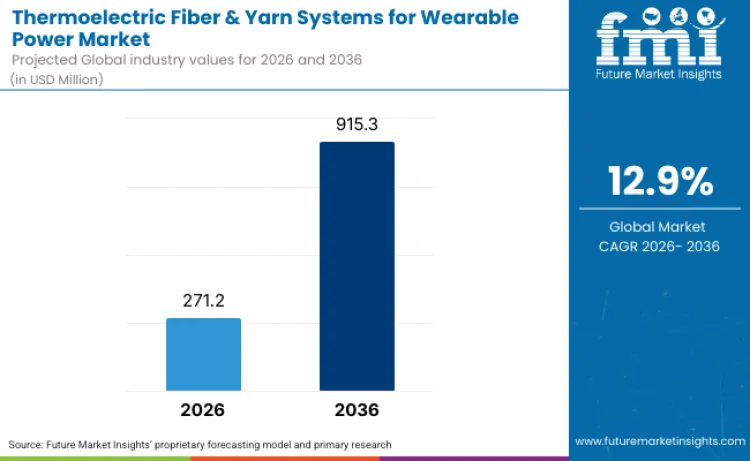
Summary of the Thermoelectric Fiber & Yarn Systems for Wearable Power Market
How will the Wearable Thermoelectric Fibers and Yarns Landscape advance until 2036?
Future Market Insights estimates the market will expand from USD 271.2 million in 2026 to USD 915.3 million by 2036, translating into a 12.9% CAGR. Growth is earned through textile-valid performance, not lab efficiency headlines, as buyers demand stable output under low skin-to-ambient temperature gradients and repeatable performance across real garment use.
FMI Research Approach: FMI sizes and forecasts this category using bottom-up revenue modelling, proof-threshold tracking (gradient stability, bend-cycle continuity, wash durability), and primary interviews with wearable OEMs and textile integrators.
What Is the Most Meaningful Commercial Pivot Happening Inside This Category?
The market is shifting from “demo-first” to specification-led purchasing. Product teams now ask for power curves tied to defined gradients, variability bands across lots, and documented failure-mode explanations for drift linked to aging, microcracking, contact resistance growth, or knit fatigue. Platforms that cannot be verified and re-verified across seasons are losing relevance even if peak performance looks impressive.
FMI Research Approach: FMI evaluates the pivot through procurement criteria analysis, documentation requirements observed in qualification cycles, and technical review of drift mechanisms emerging in textile-scale validation.
Which Geography Is Pulling Hardest on Adoption, and What Is Driving That Pull?
China is the strongest growth hub, tracking a 14.4% CAGR, as advanced-materials self-reliance initiatives accelerate multifunctional protective textiles that bundle energy harvesting with performance and safety features. Scale advantage shortens iteration loops and improves the odds of moving from lab concepts to safety-grade positioning.
FMI Research Approach: Country outlook is built from policy-direction mapping, materials supply scale indicators, and adoption signals in industrial and safety wearables where verification and documentation are non-negotiable.
What Does the 2036 Market Size Signal About Where Value Will Accumulate?
A USD 915.3 million market by 2036 points to value concentrating in applications where thermoelectrics reduce battery maintenance rather than replace batteries. Low-power sensing dominates the commercial centre of gravity because most textile electronics workloads are sensing-heavy and transmission-light, allowing thermoelectric trickle power to extend uptime without rigid modules.
FMI Research Approach: FMI links market sizing to power-class feasibility, application-level willingness-to-pay, and cross-validation against adoption pathways in industrial monitoring, safety garments, and specialty wearable electronics.
What Falls Inside FMI’s Definition of This Market, and what does not?
This market includes textile-compatible fiber and yarn architectures engineered to convert temperature gradients into electrical power in wearable and wearable-adjacent products. It covers inorganic, organic, and hybrid/composite yarn constructions designed for knitting, weaving, embroidery, or lamination while maintaining electrical function under textile stress. It excludes rigid thermoelectric modules without textile integration intent, non-thermoelectric harvesting textiles, and finished garments or retail devices.
FMI Research Approach: FMI uses a yarn- and fiber-level integration boundary to capture manufacturer revenues while excluding downstream assembly, electronics sold separately, and retail margin layers.
What Global Signals Are Uniquely Shaping Adoption Economics Right Now?
Three signals are reshaping adoption: durability is becoming the commercial filter, with buyers requesting drift curves across wash, bend, and humidity exposure. Measurement standardisation is improving comparability, tightening procurement language from narrative claims to enforceable specifications. Upstream access to repeatable CNT fibers, conductive networks, and stable encapsulation chemistries is influencing time-to-market by reducing program risk and iteration cycles.
FMI Research Approach: FMI identifies these signals through standards and instrumentation tracking, supplier capability benchmarking, and evaluation of qualification artefacts demanded by buyers in regulated and safety-critical wearables.
Thermoelectric Fiber & Yarn Systems for Wearable Power Market Key Takeaways
| Metric | Value |
|---|---|
| Market Value (2026) | USD 271.2 million |
| Forecast Value (2036) | USD 915.3 million |
| Growth Rate (2026 to 2036) | 12.9% CAGR |
Source: FMI’s proprietary forecasting model and primary research
Why is the Thermoelectric Fiber & Yarn Systems for Wearable Power Market Growing?
Qualification-led wearable power programs that prioritize reliability over peak claims are driving growth. Thermoelectric textiles earn budget when they reduce battery maintenance rather than replace batteries entirely. The strongest early use cases sit in garments that already justify premium pricing through performance, safety, or health outcomes. Industrial and safety wearables are pulling development toward harsh-use validation. These buyers treat a garment as a field asset. A sensor outage becomes a safety gap, not a consumer inconvenience.
That pushes thermoelectric yarn vendors to deliver stable output after sustained bending, repeated donning, abrasion at seams, and industrial wash routines. Measurement infrastructure is also maturing. Inconsistent reporting of ZT, power factor, and contact resistance contributions across flexible architectures has slowed thermoelectric procurement. The emergence of standardized measurement instruments in 2025 and 2026 is tightening supplier comparability and enabling procurement to write enforceable specifications rather than narrative requirements. Materials development is widening the feasible design space at yarn scale. CNT-based and hybrid conductor networks are raising power factor ceilings in flexible fabrics, supporting a plausible pathway toward meaningful low-power budgets when paired with duty-cycled electronics and energy buffering. Practical progress is also coming from device architecture, not only chemistry. Three-dimensional textile structures and segmented element layouts are being designed to protect brittle components, control contact resistance growth, and preserve output under stretch recovery.
How is the Thermoelectric Fiber & Yarn Systems for Wearable Power Market Segmented?
Material, application, and power class segment the thermoelectric fiber and yarn systems for wearable power market. By material, the market includes inorganic materials and fibers, organic systems, and hybrid and composite yarns. By application, the market includes body-heat harvesting for wearables, specialty and niche electronics, and industrial and safety wearables. By power class, the market includes low-power sensing, medium-power wearables, and high-power prototypes.
Why do Inorganic Materials and Fibers lead material adoption?
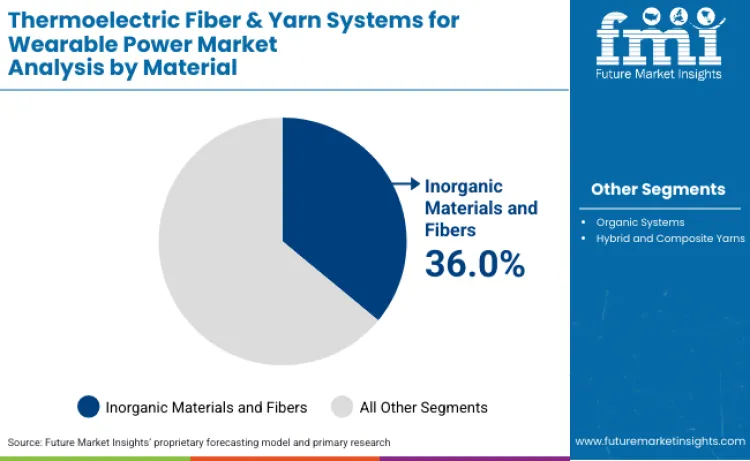
Inorganic thermoelectric systems lead at 36.0% because they remain the most direct route to repeatable Seebeck coefficient control and measurable power factor in production-relevant formats. Procurement teams prefer architectures with stable performance baselines that can be qualified across lots. Inorganic element systems also allow clearer mapping between process parameters and electrical outcomes, which strengthens supplier change-control credibility. Design teams manage brittleness risk through yarn-level packaging choices. Segmented element placement, strain-relief knit geometries, and encapsulation strategies are used to protect thermoelectric junction integrity under repeated bending. The commercial advantage is not theoretical ZT. The advantage is the ability to hold output within a defined drift window across wear and wash stress.
How does Body-Heat Harvesting for Wearables dominate the Application Share?
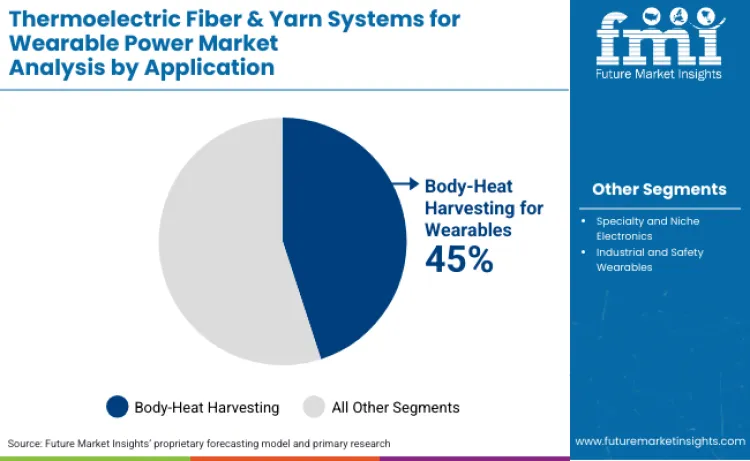
At 45.0%, body-heat harvesting leads because it aligns energy availability with the moments when wearables need to sense. A battery-free narrative is useful marketing, yet the purchasing driver is operating continuity. Wearables that track biometrics, posture, strain, or environmental conditions benefit from passive trickle power that stretches recharge intervals and supports always-on sensing modes. Successful programs concentrate thermoelectric structures in high skin-contact zones and stable pressure regions where thermal gradients are more consistent. Compression-based garments and contact-backed panels provide more repeatable coupling to the body, improving the predictability of harvested power.
Why does Low-Power Sensing lead the Power Class Segment?
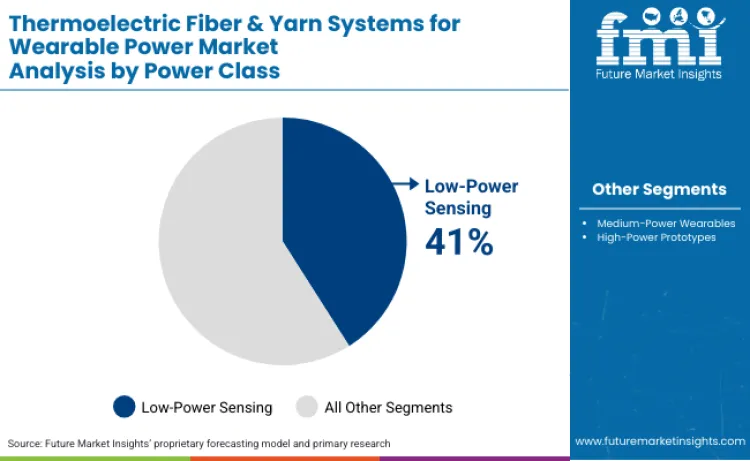
Low-power sensing leads at 41.0% because most textile electronics workloads are dominated by sensing, logging, and intermittent transmission. Thermoelectric yarn systems can support this power envelope when combined with duty cycling and buffering. The value proposition is strongest when the alternative is frequent battery replacement or rigid battery packs that compromise comfort, drape, or safety compliance. High-power prototypes exist in lab settings. Scaling remains constrained by wearable temperature gradients and thermal impedance through fabric layers. This keeps the near-term center of gravity in micro-watt to low milli-watt regimes tied to sensing and lightweight computation.
What are the Key Dynamics Influencing the Thermoelectric Fiber & Yarn Systems for Wearable Power Market?
Durability is becoming the primary commercial filter. European product rules and brand risk management are pushing suppliers to treat wash stability as a core specification. Buyers increasingly request drift curves across wash cycles, bend cycles, and humidity exposure rather than single-point performance. Standardization is tightening quality dispersion. When ZT and related parameters are measured through more consistent instrumentation, supplier claims become comparable and contractible. This reduces pilot ambiguity and increases the probability that qualified suppliers move into multi-season supply agreements. Upstream materials scale is also influencing time to market. Thermoelectric yarn output depends on repeatable conductive networks, controlled dopant behavior, and stable interfaces that do not degrade under mechanical stress. Suppliers with secure access to high-quality CNT fibers, conductive inks, and stable encapsulation chemistries reduce program risk and shorten iteration loops.
How will Thermoelectric Fiber & Yarn Systems for Wearable Power Demand Evolve in Key Countries?
Country-wise growth trajectories diverge based on technical textiles policy depth, standards enforcement, materials supply scale, and readiness of industrial safety wearables to pay for qualified functional textiles.
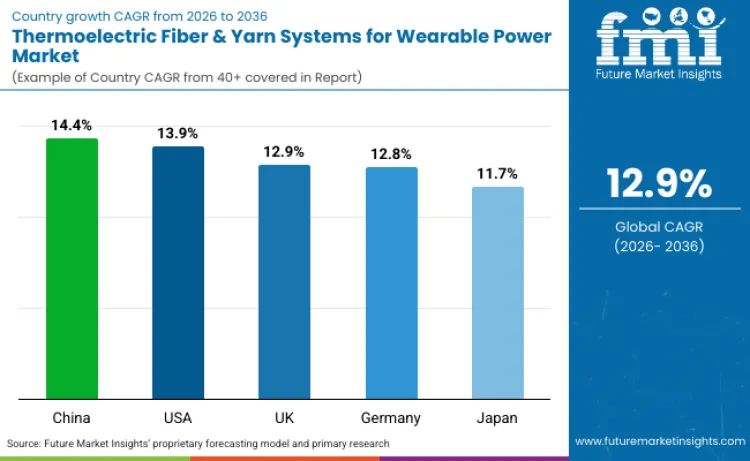
| Country | CAGR (2026 to 2036) |
|---|---|
| USA | 13.9% |
| UK | 12.9% |
| Germany | 12.8% |
| China | 14.4% |
| Japan | 11.7% |
Source: FMI’s proprietary forecasting model and primary research
How is the USA translating measurement discipline and CNT-based thermoelectric progress into procurement-grade wearable programs?
USA is advancing at a 13.9% CAGR, reflecting steady movement of thermoelectric textiles from experimental formats into qualification-led wearable programs. Momentum comes from defense-influenced test cultures and component-style procurement routines rather than fashion-driven adoption. Buyers in USA require defined test protocols, documented failure thresholds, and proof that electrical performance remains stable across repeated production lots. Supplier credibility depends on manufacturing discipline and traceable variance control, not lab-grade peak performance.
Programs slow when output cannot be reproduced outside controlled testing environments. CNT-based fiber progress matters because it pushes usable power output into ranges that remain stable under bending, encapsulation, and sweat exposure. Commercial viability hinges on whether CNT yarns behave consistently at scale and whether insulation strategies prevent conductivity drift during real wear cycles. Adoption concentrates in applications where uptime has direct financial impact, including industrial monitoring wearables and systems operating inside structured procurement frameworks. Measurement discipline further supports adoption by reducing disagreement between test data and supplier claims, shortening supplier down-selection cycles, and easing transition from pilot runs to contract manufacturing.
How is the UK building a wearables pipeline around flexible thermoelectric materials and specialty electronics integration?
UK is expanding at a 12.9% CAGR, supported by narrowly defined deployments where flexible energy harvesting enables differentiated functionality in specialty electronics and niche wearable programs. Progress favors contained use cases over mass consumer rollout.
Programs in UK show higher viability when suppliers deliver textile-ready yarn systems with predictable knitting behavior, stable contact resistance, and clearly defined electrical interfaces. Success depends less on material novelty and more on integration competence across textiles and electronics. Adoption pathways reward suppliers that arrive with integration kits, test protocols, and manufacturability guidance that reduce load on apparel engineering teams. Deployments often focus on garments and accessories where energy harvesting supports low-power sensing without adding bulk or disrupting wearability.
How is Germany using durability enforcement and PPE economics to accelerate qualification-led adoption?
Germany is moving forward at a 12.8% CAGR, shaped by durability-led regulation and PPE economics that favor functional textiles extending service life. Enforcement around wash stability, performance retention, and product longevity strengthens business cases for higher-value thermoelectric garments. EU ecodesign rules restricting destruction of unsold textiles further push brands toward lower overproduction risk and clearer end-of-life logic. Functional textiles that justify higher upfront cost through longer utility gain preference. Validation culture defines supplier access. Industrial buyers and regulators expect documented evidence tied to defined wash cycles and performance stability windows. Thermoelectric yarn suppliers able to quantify and bound performance drift gain entry into higher-value industrial and safety programs.
How is China converting advanced-materials self-reliance into high-growth multifunctional energy and protection textiles?
China is accelerating at a 14.4% CAGR, outpacing other profiled countries through policy-backed advanced materials industrialization and rapid movement of multifunctional textiles from laboratory demonstrations into safety-grade positioning. Integrated architectures such as X-Janus textile concepts signal development direction, combining energy harvesting with protection and performance functions suited for industrial wearables. Scale advantage enables faster iteration and broader pilot deployment across safety and industrial use cases. Commercial winners are likely to be suppliers aligning thermoelectric yarn output with industrial safety standards, documentation routines, and scalable manufacturing controls. Preference leans toward systems designed for regulated environments rather than consumer-fashion cycles.
How is Japan sustaining selective growth through precision textile engineering and materials system integration?
Japan is advancing at an 11.7% CAGR, driven by selective deployments where reliability, comfort, and integration quality justify higher material cost. Progress emphasizes precision rather than volume expansion. Materials and textile engineering strengths support hybrid and composite yarn architectures designed to preserve thermoelectric performance under bending while maintaining textile handle. Adoption concentrates in premium smart garments and specialty accessories where design teams can manage integration complexity. Preference favors suppliers demonstrating tight process control, repeatable lot behavior, and clear integration guidelines. Long product life expectations support investment in qualification-grade yarn systems and disciplined manufacturing practices.
What is the Competitive Intensity in the Thermoelectric Fiber & Yarn Systems for Wearable Power?
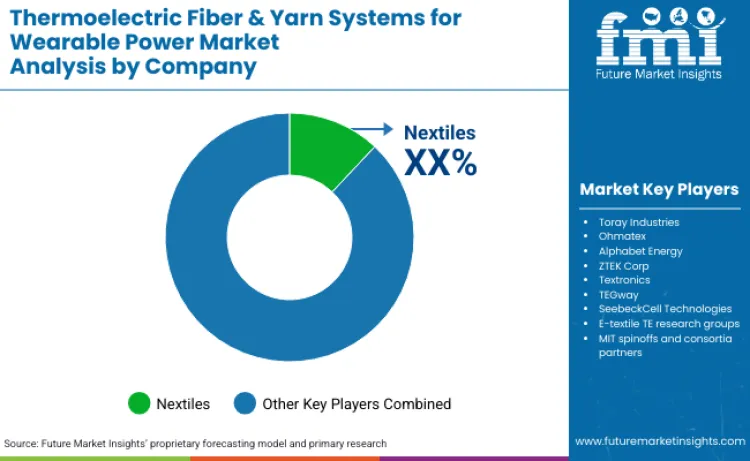
Competition in thermoelectric fiber and yarn systems for wearables is determined by material behavior under garment conditions rather than laboratory peak metrics. Repeated bending, laundering, stitch abrasion, connector fatigue, and electrical drift under body-level temperature gradients dictate whether solutions are commercially viable. Suppliers cluster into two operating models: qualification-led and manufacturability-led.
Qualification-led suppliers
Consumers in this segment apply procurement standards similar to medical, PPE, and defense programs. Supplier approval depends on documented wash durability, bend-cycle performance, and defensible explanations for output drift. Once qualified, suppliers are bound by strict change-control requirements. Toray Industries provides a clear reference through its hitoe conductive textile platform. Although not thermoelectric, hitoe demonstrates how qualification depth creates competitive separation. Toray has disclosed material structure, durability behavior, and regulated-adjacent deployment pathways linked to ECG-related components in Japan.
Competitive value stems from reproducibility and integration stability under sweat and motion. Ohmatex operates within a similar qualification-driven framework. Its positioning is anchored in ruggedized textile integration rather than demonstrations. Ohmatex has cited a collaboration with Viking Life-Saving Equipment beginning in 2007 involving firefighter garments with integrated heat-stress alerting. In such applications, wash survivability and sensor continuity are mandatory. Strength lies in supplying test evidence and explaining degradation mechanisms such as coating cracks, interconnect creep, contact resistance growth, and moisture-driven conductivity shifts.
Manufacturability-led suppliers
Manufacturability-led suppliers compete by lowering integration failure rates for knitting and weaving partners. Commercial success depends on predictable electrical behavior and compatibility with standard textile assembly routines. Nextiles illustrates this model. Its systems combine conductive threads with software and hardware designed for conventional sewing workflows.
While not thermoelectric, it shows that adoption favors suppliers delivering materials with integration guidance and data routines. Textronics provides another reference through commercial garments using knitted textile electrodes. Designs accounted for stretch, contact stability, transmitter placement, and consumer ecosystem compatibility. Thermoelectric yarn suppliers face similar expectations for junction stability, strain relief, and connector reliability.
Competitive pressure points
Benchmarks increasingly reflect textile-valid constructions rather than rigid-module performance. Peer-reviewed work has demonstrated scalable thermoelectric fibers and woven textiles, setting expectations for knit and weave compatibility. Measurement consistency has become a differentiator, given wide lab-to-lab variability. Adoption increasingly favors bundled offerings combining yarn, interconnect design, textile constraints, power management references, and test plans.
Key Companies Profiled
- Nextiles
- Toray Industries
- Ohmatex
- Alphabet Energy
- ZTEK Corp
- Textronics
- TEGway
- SeebeckCell Technologies
- E-textile TE research groups
- MIT spinoffs and consortia partners
Market Definition
The thermoelectric fiber and yarn systems for wearable power market represents revenues generated from textile-compatible fiber and yarn architectures engineered to convert temperature gradients into electrical power within wearable and wearable-adjacent products. These systems are produced in flexible fiber or yarn form so they can be knitted, woven, embroidered, or laminated into fabrics while preserving electrical function under textile strain and repeated handling. The market includes inorganic thermoelectric fibers, organic thermoelectric yarn systems, and hybrid or composite yarn constructions where thermoelectric elements, conductive pathways, and protective structures are integrated into a yarn-level platform intended for fabric assembly.
Application coverage includes body-heat powered wearables, specialty textile electronics where harvesting supports low-power operation, and industrial or safety wearables where energy harvesting reduces battery maintenance burden. The market excludes rigid thermoelectric modules sold without textile integration intent, conventional conductive yarns used only for signal transmission, non-thermoelectric energy harvesting textiles such as purely photovoltaic, piezoelectric, or triboelectric systems, and finished garments or wearable devices sold at retail. It also excludes standalone batteries, power management ICs sold separately, garment assembly services, and downstream retail margins.
Scope of Report
| Item | Value |
|---|---|
| Quantitative Units | USD million |
| Base Year | 2026 |
| Forecast Year | 2036 |
| CAGR | 2026 to 2036 |
| Segments Covered | Material, Application, Power Class |
| Regions Covered | North America, Latin America, Western Europe, Eastern Europe, East Asia, South Asia and Pacific, Middle East and Africa |
Source: Future Market Insights analysis, supported by a proprietary forecasting model and primary research
Thermoelectric Fiber & Yarn Systems for Wearable Power Market Segmentation
By Material:
- Inorganic Materials and Fibers
- Organic Systems
- Hybrid and Composite Yarns
By Application:
- Body-Heat Harvesting for Wearables
- Specialty and Niche Electronics
- Industrial and Safety Wearables
By Power Class:
- Low-Power Sensing
- Medium-Power Wearables
- High-Power Prototypes
By Region:
- North America
- Latin America
- Western Europe
- Eastern Europe
- East Asia
- South Asia and Pacific
- Middle East and Africa
Bibliography
- Press Information Bureau, Government of India. (2025, December 24). Year End Review 2025: Ministry of Textiles, National Technical Textiles Mission extension to 31 March 2026; outlay and approved R&D projects.
- Texpertise Network, Messe Frankfurt. (2024, September 18). EU 2024/1781 timeline and prohibition of destruction of unsold textiles from 19 July 2026 (interview with Dr. Anno Oexle).
- Hyosung TNC. (2026, January 21). Hyosung TNC presents new textile developments and trends at Winter 2026 industry events (verbatim quote).
- TEC Microsystems. (2025). DX4100 Z-Meter product documentation describing direct measurement of Z and related parameters for thermoelectric devices.
- TEGnology. (n.d.). FlexTEG product page and deployment positioning for flexible thermoelectric generators in harsh environments.
- Chai, J., et al. (2026). Multifaceted Janus textile achieving self-sustainable thermal management and self-powered functionality (X-Janus). Nano-Micro Letters.
Frequently Asked Questions
How big is the global thermoelectric fiber and yarn systems for wearable power market?
The global thermoelectric fiber and yarn systems for wearable power market is expected to be valued at USD 271.2 million in 2026.
What is the growth outlook over the next 10 years?
The market is projected to reach USD 915.3 million by 2036, expanding at a 12.9% CAGR.
Which segments drive demand most strongly?
Body-heat harvesting for wearables leads with a 45.0% share, supported by continuous energy availability during wear time and direct linkage to always-on sensing use cases.
Which material category leads adoption?
Inorganic materials and fibers lead with a 36.0% share due to stronger pathways to repeatable power factor performance and procurement-grade qualification.
Which power class dominates near-term commercialization?
Low-power sensing leads with a 41.0% share since wearable workloads are sensing-heavy and transmission-light, making thermoelectric harvesting more economically justified.
Who are the leading companies, and how is leadership defined?
Leadership is defined by the ability to deliver textile-manufacturable thermoelectric yarn systems with verified output stability, wash and fatigue durability data, and measurement credibility that supports procurement specifications. Key profiled players include Nextiles, Toray Industries, Ohmatex, Textronics, TEGway, and SeebeckCell Technologies.
Preview the report firsthand - request a free sample
Get SampleGet the brochure for pricing and purchase details.
Get PDFTable of Content
- Executive Summary
- Global Market Outlook
- Demand-side Adoption Signals
- Supply-side Capability Shifts
- Technology and Qualification Readiness Context
- Strategic Recommendations
- Market Overview
- Market Definition
- Market Scope and Coverage
- Inclusions and Exclusions
- Market Size Snapshot (2026) and Forecast (2036)
- Key Drivers, Constraints, and Trends
- Market Analysis and Forecast 2021 to 2036
- Historical Market Size Value (USD Million), 2021 to 2025
- Market Forecast Value (USD Million), 2026 to 2036
- Y-o-Y Growth Trend Analysis, 2021 to 2036
- Absolute Dollar Opportunity Analysis, 2026 to 2036
- Market Background and System Context
- Wearable Thermoelectric Textiles and System Boundary
- Performance Benchmarks Under Low Thermal Gradients
- Electrical Continuity Retention Under Bending and Recovery
- Durability Under Wash, Abrasion, and Long-wear Friction
- Failure-mode Drivers (Microcracking, Contact Resistance Growth, Knit Fatigue)
- Why is the Thermoelectric Fiber & Yarn Systems for Wearable Power Market Growing?
- Wearable Power as Uptime and Maintenance Reduction
- Industrial and Safety Wearables Pulling Harsh-use Validation
- Measurement Infrastructure Maturation and Supplier Comparability
- Materials and Architecture Progress at Yarn Scale
- Global Market Pricing Analysis 2021 to 2036
- Pricing Assumptions and Reference Points
- Historical Pricing Trend Analysis
- Pricing Sensitivity and Forward Outlook
- Global Market Analysis 2021 to 2025 and Forecast 2026 to 2036, By Material
- Introduction and Key Findings
- Historical Market Size Value Analysis, 2021 to 2025
- Market Forecast and Opportunity Analysis, 2026 to 2036
- Inorganic Materials and Fibers
- Organic Systems
- Hybrid and Composite Yarns
- Y-o-Y Growth Trend Analysis
- Absolute Dollar Opportunity Analysis
- Global Market Analysis 2021 to 2025 and Forecast 2026 to 2036, By Application
- Introduction and Key Findings
- Historical Market Size Value Analysis, 2021 to 2025
- Market Forecast and Opportunity Analysis, 2026 to 2036
- Body-Heat Harvesting for Wearables
- Specialty and Niche Electronics
- Industrial and Safety Wearables
- Y-o-Y Growth Trend Analysis
- Absolute Dollar Opportunity Analysis
- Global Market Analysis 2021 to 2025 and Forecast 2026 to 2036, By Power Class
- Introduction and Key Findings
- Historical Market Size Value Analysis, 2021 to 2025
- Market Forecast and Opportunity Analysis, 2026 to 2036
- Low-Power Sensing
- Medium-Power Wearables
- High-Power Prototypes
- Y-o-Y Growth Trend Analysis
- Absolute Dollar Opportunity Analysis
- Global Market Analysis 2021 to 2025 and Forecast 2026 to 2036, By Region
- Introduction
- Historical Market Size Value Analysis, 2021 to 2025
- Market Forecast by Region, 2026 to 2036
- North America
- Latin America
- Western Europe
- Eastern Europe
- East Asia
- South Asia and Pacific
- Middle East and Africa
- Market Attractiveness Analysis
- North America Market Analysis 2021 to 2025 and Forecast 2026 to 2036
- Historical Trend Analysis
- Market Forecast
- Key Takeaways
- Latin America Market Analysis 2021 to 2025 and Forecast 2026 to 2036
- Historical Trend Analysis
- Market Forecast
- Key Takeaways
- Western Europe Market Analysis 2021 to 2025 and Forecast 2026 to 2036
- Historical Trend Analysis
- Market Forecast
- Key Takeaways
- Eastern Europe Market Analysis 2021 to 2025 and Forecast 2026 to 2036
- Historical Trend Analysis
- Market Forecast
- Key Takeaways
- East Asia Market Analysis 2021 to 2025 and Forecast 2026 to 2036
- Historical Trend Analysis
- Market Forecast
- Key Takeaways
- South Asia and Pacific Market Analysis 2021 to 2025 and Forecast 2026 to 2036
- Historical Trend Analysis
- Market Forecast
- Key Takeaways
- Middle East and Africa Market Analysis 2021 to 2025 and Forecast 2026 to 2036
- Historical Trend Analysis
- Market Forecast
- Key Takeaways
- Country-wise Analysis
- USA
- UK
- Germany
- China
- Japan
- Competition Outlook
- Competitive Landscape and Positioning
- Qualification-led Platforms Versus Manufacturability-led Platforms
- Measurement Credibility and Documentation as a Supplier Filter
- Recent Developments
- Company Profiles
- Nextiles
- Toray Industries
- Ohmatex
- Alphabet Energy
- ZTEK Corp
- Textronics
- TEGway
- SeebeckCell Technologies
- E-textile Thermoelectric Research Groups
- MIT Spinoffs and Consortia Partners
- Assumptions and Acronyms
- Assumptions
- Acronyms
- Research Methodology
- Chapter Orientation
- Analytical Framework
- Market Sizing and Forecasting Approach
- Validation and Data Sources


