

- Industry Size (2026)
- USD 1.4 Bn
- Forecast (2036)
- USD 3.3 Bn
- CAGR (2026 to 2036)
- 9.0%
Non-Fluorinated DWR Fiber Systems Market Outlook and Forecast 2026-2036
The non-fluorinated DWR fiber systems market will likely total USD 1.4 billion in 2026, eventually increasing to USD 3.3 billion by 2036. FMI expects this expansion to sustain at a CAGR of 9.0% from 2026 to 2036. Non-fluorinated DWR fiber systems represent an execution-oriented transition. Regulatory enforcement is accelerating adoption, as tightening PFAS restrictions continue to erode the commercial viability of fluorinated chemistries and compel manufacturers to migrate from legacy material systems.
Non-fluorinated DWR solutions are no longer evaluated as experimental alternatives. Manufacturers are increasingly treating them as essential inputs that must deliver consistent performance within established production environments. Evaluation criteria have expanded beyond isolated performance metrics to include durability, processing stability, and compatibility with existing manufacturing lines. Collaborative development models have become central to commercialization, enabling suppliers to shorten qualification timelines while mitigating technical and operational risk.
Supplier strategies are evolving in parallel. Leading participants are positioning non-fluorinated systems as engineered performance platforms rather than transitional compromises. Collaborative initiatives, such as the partnership between AGC Chemicals and DRYFIBER, demonstrate this approach by applying surface engineering techniques to replicate the functional behavior of legacy fluorinated technologies. Broader partnership formation and targeted investment across the specialty chemicals landscape further indicate a structural shift toward compliant, higher-value material systems.
While performance constraints persist, particularly in oil repellency, competitive priorities have clearly shifted. Adoption is increasingly determined by ease of integration rather than peak functional benchmarks. Textile manufacturers favor solutions that can be deployed on existing equipment without requiring process modifications or capital expenditure. This emphasis on operational practicality reflects a more mature phase of market development, in which regulatory compliance is treated as a baseline requirement rather than a source of differentiation.
Industry leaders continue to stress that progress in non-fluorinated DWR performance depends on collaboration. This view is reflected in the following executive commentary from AGC Chemicals Americas:
"Our partnership with DRYFIBER marks a significant milestone for AGC Chemicals Americas as we continue to deliver sustainable innovations for the nonwovens and technical textiles market. This development represents a breakthrough in stain-resistant technology, delivering the performance our customers expect without relying on fluorinated chemistries. We are proud to meet the growing demand for non-fluorinated alternatives with this solution." Tim Johnson, Fibra LAST Business Manager, AGC Chemicals Americas
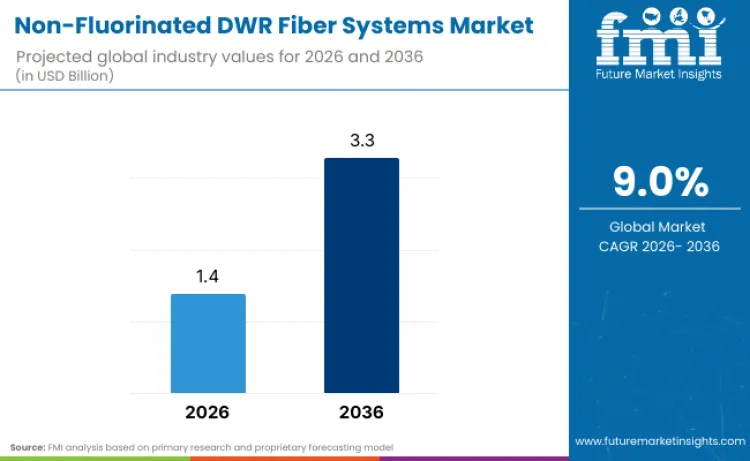
Summary of the Non-Fluorinated DWR Fiber Systems Market
What is the Growth Outlook for the Non-Fluorinated DWR Fiber Systems Market as per Future Market Insights?
Future Market Insights expects the non-fluorinated DWR fiber systems market to expand at a CAGR of 9.0% from 2026 to 2036, growing from USD 1.4 billion in 2026 to USD 3.3 billion by 2036. Growth is driven by regulatory enforcement, certification compliance requirements, and supplier qualification frameworks that are accelerating the phase-out of fluorinated DWR chemistries across apparel, technical textiles, and regulated end uses.
FMI Research Approach: FMI proprietary forecasting model integrating regulatory timelines, certification adoption rates, and fiber-level DWR system penetration.
How do FMI Analysts View the Evolution of the Non-Fluorinated DWR Fiber Systems Market?
FMI analysts view the market as having entered an execution-driven phase, where non-fluorinated DWR systems are no longer evaluated as transitional alternatives but treated as mandatory production inputs. Adoption is increasingly determined by durability, process stability, and compatibility with existing finishing infrastructure rather than peak performance claims, reflecting a maturing commercialization landscape.
FMI Research Approach: Primary interviews with textile chemical suppliers, certification bodies, and apparel sourcing teams, combined with supplier qualification benchmarking.
Which Countries are emerging as Key Adoption Centers for Non-Fluorinated DWR Fiber Systems?
China and the United States are emerging as primary adoption centers, supported by regulatory sequencing, export-oriented compliance strategies, and large-scale textile manufacturing bases. In Europe, markets such as the UK are advancing adoption through alignment with EU-level PFAS restrictions and retailer-led chemical governance frameworks rather than standalone national bans.
FMI Research Approach: Country-level regulatory tracking and apparel supply chain exposure modeling.
How large Is the Non-Fluorinated DWR Fiber Systems Market Expected to be by 2036?
By 2036, the global non-fluorinated DWR fiber systems market is expected to reach USD 3.3 billion, reflecting sustained conversion from fluorinated chemistries and expanding application beyond outdoor apparel into automotive interiors, medical textiles, and adjacent regulated segments.
FMI Research Approach: Long-term revenue projections linked to PFAS restriction rollouts, textile output growth, and DWR chemistry substitution rates.
What is the Definition of the Non-Fluorinated DWR Fiber Systems Market?
The non-fluorinated DWR fiber systems market comprises durable water-repellent technologies applied at the fiber or fabric level that deliver water repellency without the use of intentionally added fluorinated compounds. These systems are designed to integrate into existing textile manufacturing and finishing processes while meeting evolving regulatory and certification requirements.
FMI Research Approach: FMI market taxonomy and inclusion–exclusion framework.
What are some Distinct Trends Shaping the Non-Fluorinated DWR Fiber Systems Market Globally?
Key global trends include the tightening of certification protocols such as OEKO-TEX updates, the shift from chemistry-level substitution toward surface engineering and fiber compatibility, and growing cross-sector adoption in packaging and technical textiles. Competitive differentiation is increasingly anchored in compliance certainty, scalability, and operational reliability rather than sustainability signaling alone.
FMI Research Approach: Regulatory analysis, product launch tracking, and downstream buyer qualification criteria assessment.
Non-Fluorinated DWR Fiber Systems Market Key Takeaways
| Metric | Value |
|---|---|
| Expected Value (2026E) | USD 1.4 billion |
| Projected Value (2036F) | USD 3.3 billion |
| CAGR (2026-2036) | 9.0% |
Source: Future Market Insights analysis, supported by a proprietary forecasting model and primary research
Why is the Non-Fluorinated DWR Fiber Systems Market Growing?
Qualification requirements in performance apparel and technical textiles have tightened materially since 2024, reshaping the operating landscape for durable water repellent systems. Updates to OEKO-TEX Standard 100 and STeP protocols during 2024–2025 have increased scrutiny on PFAS presence at both formulation and residual levels, making long-term reliance on fluorinated DWR systems increasingly incompatible with certification renewal. For fiber producers and finishers supplying global apparel and industrial programs, this has shifted non-fluorinated DWR from an optional formulation choice to a prerequisite for maintaining approved supplier status.
Brand-level sourcing decisions have reinforced this shift. In 2024, Patagonia expanded its internal chemical governance framework to explicitly classify PFAS exposure as a material operational risk, linking DWR chemistry selection to supplier qualification and contract renewal criteria. This position has since translated into procurement mandates requiring non-fluorinated DWR compatibility at the yarn, fabric, and finished-garment levels. Similar supplier-facing requirements have emerged across multi-brand sourcing programs in Europe and North America, reducing tolerance for transitional fluorinated systems and compressing reformulation timelines for upstream suppliers.
Material developers have responded with commercially scaled non-fluorinated DWR platforms rather than pilot-stage alternatives. During 2024, Rudolf Group and Archroma expanded non-fluorinated water-repellent product lines specifically positioned for fiber and fabric system integration, emphasizing durability retention under industrial laundering and mechanical abrasion. These launches reflect a broader industry shift away from chemistry-heavy substitution toward surface-structure optimization and fiber-level compatibility, enabling performance parity without fluorinated inputs.
Performance concerns that historically constrained adoption have weakened as these systems matured. By late 2024, multiple non-fluorinated DWR fiber systems had cleared internal buyer benchmarks for spray rating retention, abrasion resistance, and multi-wash durability, allowing procurement discussions to pivot away from technical feasibility. Commercial evaluations are now concentrated on scalability, batch-to-batch consistency, and cost predictability, indicating that non-fluorinated systems have crossed from experimental qualification into repeat-order procurement.
Adoption has also expanded beyond apparel into regulated technical segments. Automotive interior suppliers and medical textile converters have begun applying the same chemical qualification standards used in apparel supply chains, driven by long-term exposure considerations and downstream compliance alignment. In 2025, several European automotive textile programs introduced non-fluorinated water-repellent specifications at the fabric system level, favoring suppliers with established experience in fluorine-free DWR integration. This cross-sector pull is broadening the addressable demand base for non-fluorinated DWR fiber systems beyond traditional outerwear applications.
The market has therefore moved into an execution-driven phase. Non-fluorinated DWR fiber systems are now advancing based on certification continuity, buyer acceptance, and demonstrated performance at scale. The transition is enforced through procurement discipline and qualification frameworks rather than aspirational positioning, making continued dependence on fluorinated systems incompatible with commercial participation in global technical textile supply chains.
How is the Non-Fluorinated DWR Fiber Systems Market Segmented?
Why are Paraffin and Wax Chemistry Platforms Holding Strong Adoption Momentum in DWR Finishing?
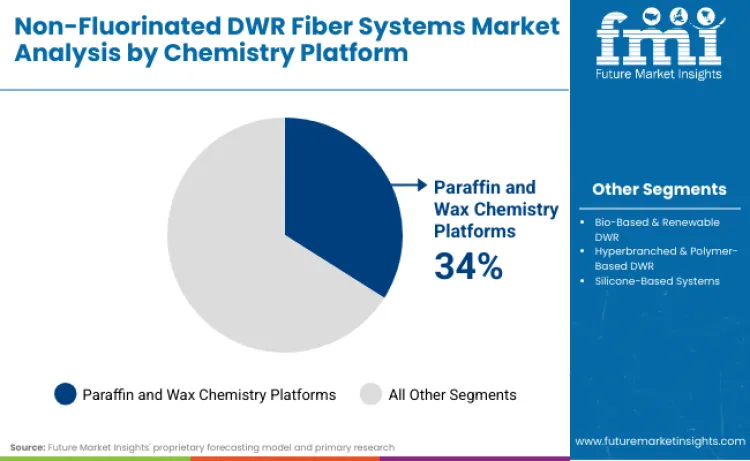
Paraffin and wax-based platforms account for 34% of the chemistry mix because they offer a practical route for mills and finishers to maintain water-repellent performance expectations without relying on fluorine chemistry. This platform tends to align with high-throughput finishing operations where consistent processing behaviour and predictable line outcomes matter more than peak performance claims. It also fits procurement realities in apparel supply chains where brands are prioritising certification-ready chemistries that can be deployed across multiple supplier tiers without lengthy chemical requalification cycles.
A concrete accelerant has been the tightening of certification testing rules around fluorine content. OEKO-TEX’s 2024 regulatory update moved to total fluorine-based limits and applied new limit values across multiple certification schemes effective January 1, 2024, pushing supply chains to reduce reliance on fluorinated inputs to remain eligible for widely used compliance labels. This kind of certification-driven compliance pressure disproportionately benefits non-fluorinated platforms that can be adopted quickly and verified more easily in routine chemical management workflows.
What keeps Polyester Fibers as the Primary Backbone for Non-Fluorinated DWR Uptake across Supply Chains?
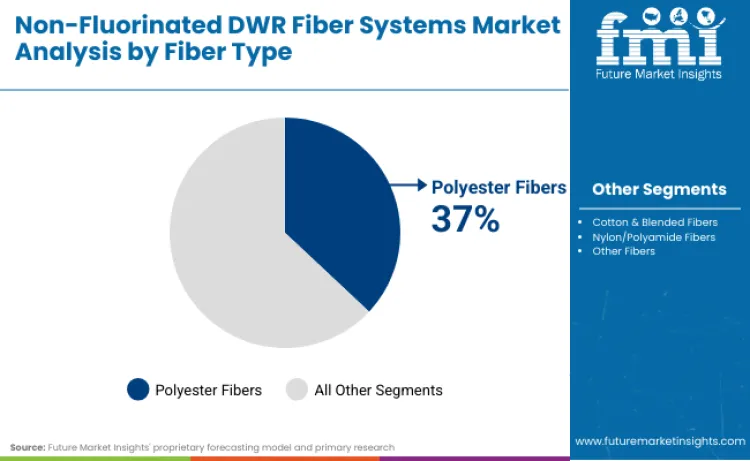
Polyester fibers represent 37% of the fiber base because they dominate the performance-textile substrate pool where DWR finishing is most frequently specified at scale. In practical sourcing terms, polyester is the default shell and face-fabric choice across large, repeat-order programs, so any broad DWR chemistry transition naturally concentrates on polyester lines first. That scale effect creates faster learning curves for mills, more stable finishing recipes over time, and clearer cost amortisation for switching to non-fluorinated systems.
Regulatory enforcement timelines are reinforcing this concentration. California’s AB 1817 restricts PFAS in new textile articles, with key provisions taking effect January 1, 2025, and it explicitly pushes manufacturers toward safer substitutions when removing regulated PFAS from textiles. Because polyester-based apparel and technical textiles account for a large share of what flows through large state-linked retail channels, these compliance deadlines accelerate conversion activity on polyester production lines first, strengthening polyester’s position as the main substrate where non-fluorinated DWR systems scale.
Why is Outdoor and Sportswear the Most Concentrated Demand Centre for Non-Fluorinated DWR Transitions?
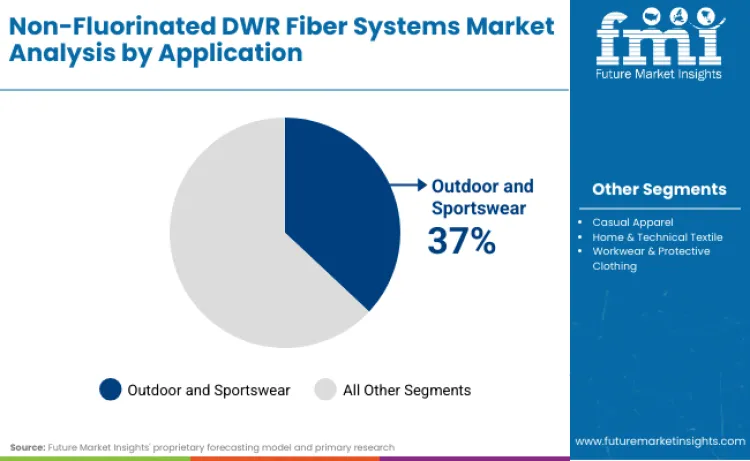
Outdoor and sportswear contributes 37% of application demand because it sits at the intersection of high consumer visibility, frequent third-party material compliance requirements, and retailer-led chemical policies. This category also has the shortest tolerance for regulatory uncertainty: brands selling technical outerwear are typically exposed to multi-market chemical restrictions and to reputational scrutiny that can force earlier material transitions than in lower-profile apparel categories.
One clear market signal is the shift from brand-level intent to execution-linked timelines. In February 2024, Liberated Brands announced that Spyder skiwear it produces would be PFAS-free beginning Fall 2024, framing the change as an industry-facing commitment rather than a pilot initiative. Moves like this create downstream urgency for mills, dyehouses, and finishing partners supplying outdoor and sportswear programs, which in turn amplifies demand for scalable non-fluorinated DWR fiber system pathways that can meet broad compliance expectations without relying on fluorinated chemistries.
What Drivers, Challenges, Opportunities and Threats Influence Non-Fluorinated DWR Fiber Systems Demand?
Non-fluorinated DWR fiber systems are no longer gaining traction just because regulations demand change or brands want to signal sustainability. Their uptake is now being driven by the fact that the technology actually works at scale. Since 2025, suppliers have moved away from trial-stage chemistries and focused on standardized formulations that behave predictably in industrial finishing lines.
Microban International’s launch of the H₂O Shield portfolio that year reflects this shift. Instead of positioning PFAS-free repellency as an alternative option, the company framed it as a production-ready finish designed to handle familiar mill challenges such as seam marking, inconsistent pickup, and wash durability. That change in framing shows how the discussion has narrowed.
Buyers are now less concerned about whether non-fluorinated systems can perform at all and more focused on costs, process yields, and compatibility with high-throughput operations. Archroma’s continued rollout and external validation of its PHOBOTEX® NTR systems in 2025 further supports this view, demonstrating that reliable water repellency and laundering resistance can be achieved across multiple fiber types at commercial volumes. Downstream, Patagonia’s Spring 2025 shift to PFAS-free membranes and finishes across core consumer apparel lines signals that performance confidence has moved beyond pilots and into mainstream production.
Non-fluorinated chemistries still struggle to match fluorinated systems in oil repellency and resistance to aggressive chemicals, which limits their use in industrial protective clothing and specialized PPE. This limitation is no longer debated at the chemistry level and is instead being reflected directly in policy design. France’s PFAS legislation adopted in 2025, which takes effect in January 2026, bans PFAS-based treatments in consumer clothing and waterproofing while allowing exemptions and longer transition periods for industrial technical textiles.
Denmark’s 2025 national restrictions follow the same logic, targeting consumer apparel and footwear but excluding professional protective gear. These exclusions are not temporary loopholes. They acknowledge that failure risks remain materially higher in environments involving oils, fuels, and chemicals. As a result, demand is separating into two clear tracks: consumer and lifestyle textiles, where non-fluorinated DWR is quickly becoming standard, and performance-critical industrial applications, where fluorinated treatments remain in place due to functional risk rather than regulatory delay.
Momentum is also coming from outside traditional apparel markets. In 2025, fiber-based and molded-fiber packaging saw rapid uptake of PFAS-free water- and grease-resistant barriers, creating a parallel demand stream for non-fluorinated repellency adapted to paper substrates. Impermea Materials’ strategic partnership with INX International to commercialize plastic-free, PFAS-free barrier coatings illustrates how the space is moving from experimentation to global rollout.
HEIDELBERG and Solenis showcased integrated coating processes for flexible paper packaging at FACHPACK 2025, pointing to barrier chemistries being built directly into converting workflows rather than added as downstream fixes. These developments show how non-fluorinated DWR technologies are extending into circular packaging systems, where regulatory exposure and brand risk are pushing adoption faster than in many apparel segments.
Pressures are starting to weigh on momentum. Trade actions and anti-dumping measures introduced in 2025 on chemical intermediates such as epoxy resins and polymer stabilizers added cost volatility to upstream inputs, squeezing margins for specialty finish suppliers. Broader PFAS disclosure requirements are raising compliance demands across textile and chemical value chains.
The late-2025 expansion of reporting obligations by the U.S. Environmental Protection Agency under TSCA increased documentation, traceability, and procurement scrutiny, forcing manufacturers to tighten supplier qualification standards. These forces are favoring suppliers with diversified sourcing, strong regulatory infrastructure, and financial resilience. The result is accelerating consolidation across the non-fluorinated DWR value chain and a higher barrier to entry for smaller or single-chemistry players.
How is Non-Fluorinated DWR Fiber Systems Market evolving in Key Countries?
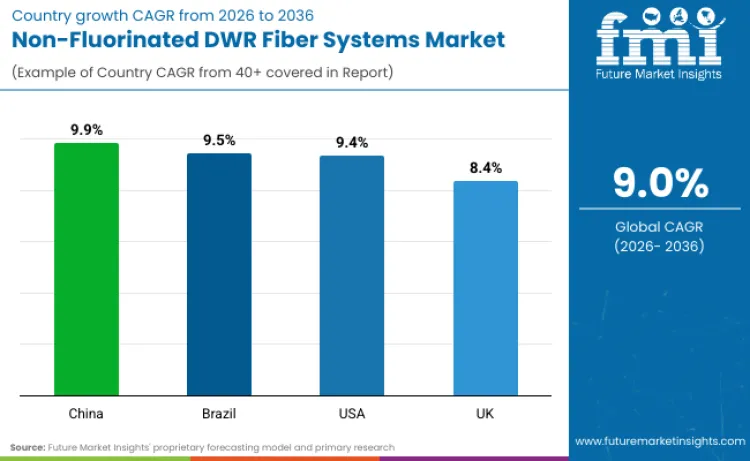
| Country | CAGR (2026-2036) |
|---|---|
| China | 9.9% |
| USA | 9.4% |
| UK | 8.4% |
| Brazil | 9.5% |
Source: FMI analysis based on primary research and proprietary forecasting model
How is China Converting Regulation into Domestic Technology Leadership?
Advancing at a 9.9% CAGR, China’s non fluorinated DWR trajectory is shaped by regulatory sequencing and industrial self reliance. The Ministry of Ecology and Environment has steadily expanded chemical control lists to include PFAS long chain PFCAs and related compounds signaling a clear policy direction for textiles and industrial materials. These draft and indicative lists provide manufacturers time to transition encouraging substitution instead of disruption. This has shifted fluorine free DWR from a compliance requirement to a strategic capability as provincial enforcement and export scrutiny tighten.
Industry response has been direct. Companies such as ANTA Sports have moved beyond alternative sourcing into proprietary development launching fully PFAS free membranes and surface treatments with domestic research institutions. These launches target scale and performance rather than niche sustainability positioning. The outcome is a stronger domestic supply chain where regulation drives innovation and positions China as both an adopter and exporter of non fluorinated DWR systems.
Why is USA Framing Non Fluorinated DWR as a Compliance Imperative?
The non-fluorinated DWR fiber systems industry in USA is forecasted to advance at a 9.4% CAGR until 2036. Regulatory pressure is split across state and federal levels but the combined effect is accelerating non fluorinated DWR adoption. California’s enforcement of PFAS bans on new textile articles has set a practical national benchmark forcing brands to redesign portfolios for the largest consumer market. At the federal level, expanded EPA TSCA reporting requirements increase legal and administrative exposure for companies retaining PFAS even when use remains legal.
This pressure is reshaping commercial strategy. Apparel and outdoor brands face higher material costs longer qualification cycles and cautious inventory planning as they exit fluorinated chemistries. Labeling rules in states such as Connecticut increase reputational risk making partial transitions less viable. Non fluorinated DWR is becoming the default development path because regulatory risk now outweighs performance trade offs.
Is UK Importing De Facto PFAS Policy Through Market Alignment?
An 8.4% CAGR is predicted for the non-fluorinated DWR fiber systems market in UK. UK is advancing non fluorinated DWR adoption through market alignment rather than standalone legislation. While UK REACH restrictions on PFAS remain under consultation retailers and manufacturers operating in the UK have aligned with France’s 2026 ban on PFAS containing textiles and waterproofing agents. Products developed for EU compliance increasingly shape UK assortments reducing tolerance for fluorinated DWR without a finalized domestic ban.
Corporate governance frameworks reinforce this shift. Multinational apparel groups have committed to ZDHC MRSL compliance across UK linked supply chains effectively prohibiting intentional PFAS use at the factory level. Consultations by the Health and Safety Executive on PFAS in textiles and firefighting foams add regulatory weight. Together these factors narrow the window for fluorinated DWR in the UK and push suppliers toward fluorine free systems as a risk management choice.
How is Brazil Linking Non Fluorinated DWR to Export Defense?
Progressing at a CAGR of 9.5%, Brazil’s move toward non fluorinated DWR is driven by trade positioning rather than consumer regulation. The rollout of Brazil REACH with a national chemical inventory and mandatory substance registration increases transparency across textile inputs including specialty finishes and additives. While not PFAS specific this framework raises compliance costs for opaque chemistries and favors suppliers with lower risk globally accepted formulations.
Industry bodies are responding through export protection strategies. Brazilian textile and apparel manufacturers are aligning with international standards set by organizations such as ITMF to maintain access to markets facing stricter PFAS controls in 2026. Proposed updates to RoHS related traceability rules increase scrutiny of chemical content in technical textiles. In this environment non-fluorinated DWR functions as a trade enabling technology that protects exporters from regulatory friction rather than serving only domestic environmental aims.
How is Competition evolving in the Non-Fluorinated DWR Fiber Systems Market?
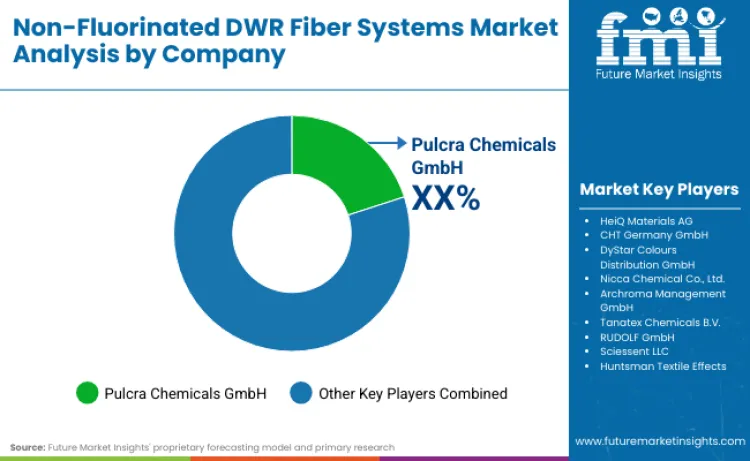
Non fluorinated DWR fiber systems landscape is entering a decisive structural shift during 2025 and 2026. Regulatory pressure is tightening across major textile consuming regions, cost structures are being recalibrated, and performance gaps with fluorinated chemistries are narrowing to commercially negligible levels.
The industry has moved beyond cautious substitution and is now operating within a fully PFAS free paradigm. This transition is no longer driven by sustainability positioning alone but by enforceable compliance requirements and rising liability exposure. Competitive advantage is being redefined, with limited tolerance for transitional chemistries or partial fluorine reduction strategies across the value chain.
Competitive dynamics are increasingly polarized between upstream specialty chemical suppliers and downstream integrated performance brands. Chemical producers remain focused on polymer architecture, surface engineering, and formulation stability under regulatory constraints. Integrated brands are internalizing membrane development, textile processing, and commercialization to gain cost control and supply certainty.
ANTA Group illustrates how this model is scaling in Asia. Its domestically developed bio based PFAS free membrane platform shows how Chinese players are combining material science capability with efficient manufacturing and fast commercialization. Fabrics that now meet global performance benchmarks at lower price points are compressing margins and accelerating the commoditization of PFAS free performance. This pricing pressure is reshaping sourcing strategies for global brands and eroding the historical pricing power of upstream suppliers.
These shifts are forcing chemical suppliers to redefine value creation. Non fluorinated DWR systems once carried a premium linked to sustainability claims and early regulatory alignment. That premium is fading as PFAS free chemistry becomes a baseline expectation rather than a differentiator. Companies such as Archroma are repositioning around compliance certainty, traceability, and risk mitigation, with greater emphasis on renewable carbon content and verified PFAS free status. Consumer behavior is changing accordingly. Legal exposure, disclosure obligations, and long term regulatory stability now outweigh incremental performance gains in procurement decisions. Regulation is reinforcing this trend.
In USA, expanded PFAS reporting under TSCA Section 8a7 introduces retrospective disclosure requirements that create long tail administrative and legal costs. Europe is advancing class based restrictions that effectively eliminate fluorinated fallback options. Together, these frameworks close the pathway for phased substitution and consolidate competition around zero intentional PFAS chemistries.
Within this narrowed competitive field, oil repellency remains the key technical constraint. Non fluorinated systems now deliver reliable water repellency, durability, and breathability across most apparel uses. Resistance to oils continues to limit adoption in industrial, medical, and protective textiles.
AGC Chemicals is addressing this gap through non fluorinated technologies designed to deliver combined oil and water repellency in nonwovens and technical fabrics. If scaled successfully, these solutions open access to higher margin segments such as industrial protective equipment, medical textiles, and specialty filtration. Supply chain strategies are shifting toward asset light models as regulatory uncertainty and capital discipline increase.
Capacity sharing arrangements such as those used by Chemours through partnerships with SRF Limited allow suppliers to remain flexible without committing to new fixed assets. The 2025 to 2026 period marks a shift toward scale driven competition and compliance centered value creation, where success depends on cost efficiency, performance completeness, and verifiable low risk compliance across global textile supply chains.
Key Players Profiled
- Pulcra Chemicals GmbH
- HeiQ Materials AG
- CHT Germany GmbH
- DyStar Colours Distribution GmbH
- Nicca Chemical Co., Ltd.
- Archroma Management GmbH
- Tanatex Chemicals B.V.
- RUDOLF GmbH
- Sciessent LLC
- Huntsman Textile Effects
Market Definition
The non-fluorinated DWR fiber systems market comprises fiber- and fabric-level water-repellent technologies engineered to deliver hydrophobic performance without the intentional use of fluorinated or PFAS-based chemistries. These systems are designed to provide water repellency, durability to laundering and abrasion, and process stability while aligning with tightening chemical regulations and certification frameworks. Adoption is compliance-driven, with non-fluorinated DWR increasingly treated as a mandatory input across apparel, technical textiles, and regulated end uses.
This report includes non-fluorinated DWR systems applied to or integrated with textile fibers and fabrics, covering paraffin and wax-based platforms, silicone-based systems, bio-based and renewable chemistries, and polymer or hyperbranched DWR architectures. Coverage spans key fiber types such as polyester, cotton and blends, nylon or polyamide, and other commonly finished textile substrates. The scope also incorporates applications across outdoor and sportswear, casual apparel, home and technical textiles, and selected workwear programs where water repellency is specified alongside certification, durability, and manufacturing compatibility requirements.
The report excludes fluorinated and PFAS-containing DWR chemistries, partial or transitional fluorine-reduction systems, and surface treatments that do not meet zero-intentional-PFAS criteria. Finished garments and textile products sold as end goods are excluded when assessed beyond the fiber or fabric system level. The scope also excludes protective applications where oil repellency, chemical resistance, or extreme hazard performance remains dependent on fluorinated technologies, as well as non-textile water-repellent coatings and hardware-based waterproofing solutions.
Scope of Report
| Items | Values |
|---|---|
| Quantitative Units (2026) | USD 1.4 billion |
| Chemistry Platform |
Paraffin/Wax-Based Systems, Bio-Based & Renewable DWR, Hyperbranched & Polymer-Based DWR,Silicone-Based Systems |
| Fiber Type | Polyester Fibers, Cotton & Blended Fibers, Nylon/Polyamide Fibers, Other Fibers |
| Application | Outdoor & Sportswear, Casual Apparel, Home & Technical Textiles, Workwear & Protective Clothing |
| Regions Covered | North America, Western Europe, Eastern Europe, East Asia, South Asia & Pacific, Latin America, Middle East & Africa |
| Countries Covered | USA, China, UK, Brazil and 40+ Countries |
| Key Companies Profiled | Pulcra Chemicals GmbH, HeiQ Materials AG, CHT Germany GmbH, DyStar Colours Distribution GmbH, Nicca Chemical Co., Ltd., Archroma Management GmbH, Tanatex Chemicals B.V., RUDOLF GmbH, Sciessent LLC, Huntsman Textile Effects |
Key Segments
Chemistry Platform
- Paraffin/Wax-Based Systems
- Bio-Based & Renewable DWR
- Hyperbranched & Polymer-Based DWR
- Silicone-Based Systems
Fiber Type
- Polyester Fibers
- Cotton & Blended Fibers
- Nylon/Polyamide Fibers
- Other Fibers
Application
- Outdoor & Sportswear
- Casual Apparel
- Home & Technical Textiles
- Workwear & Protective Clothing
Region
- North America
- Western Europe
- Eastern Europe
- East Asia
- South Asia & Pacific
- Latin America
- Middle East & Africa
Bibliography
- OEKO-TEX Association. (2024). STANDARD 100 and STeP by OEKO-TEX®: Limit values, testing criteria, and implementation guidance. OEKO-TEX®.
- ZDHC Foundation. (2024). Manufacturing Restricted Substances List (MRSL) Version 3.1 and conformance guidance. ZDHC Foundation.
- Health and Safety Executive (HSE), United Kingdom. (2024). PFAS risk management options and regulatory considerations for consumer products and textiles. HSE.
- International Textile Manufacturers Federation (ITMF). (2024). Chemical compliance and material substitution trends in global textile supply chains. ITMF.
- Archroma Management GmbH. (2024). PFAS-free durable water repellent technologies: Performance validation and industrial scalability. Archroma.
Frequently Asked Questions
What is the Growth Outlook for the Enzyme-Ready Reactive Finishing Fiber Market as per Future Market Insights?
Future Market Insights expects the enzyme-ready reactive finishing fiber market to expand at a CAGR of 7.8% from 2026 to 2036, growing from USD 0.8 billion in 2026 to USD 1.7 billion by 2036.
How do FMI Analysts View the Evolution of the Enzyme-Ready Reactive Finishing Fiber Market?
FMI analysts view the market as transitioning from a process-level optimization niche into a structurally embedded input category. Enzyme-ready fibers are no longer evaluated as optional efficiency enhancers but as necessary materials for achieving repeatable finishing outcomes, reduced variability, and compliance alignment across global textile manufacturing networks.
Which Countries are emerging as Key Adoption Centers for Enzyme-Ready Reactive Finishing Fibers?
USA, Brazil, and UK are emerging as key adoption centers, supported by compliance-driven sourcing models, export exposure to regulated markets, and increasing scrutiny of finishing chemistry efficiency. Adoption is strongest in regions where enzymatic finishing is being institutionalized through regulatory oversight, financial disclosure frameworks, and buyer qualification standards.
How Large is the Enzyme-Ready Reactive Finishing Fiber Market Expected to be by 2036?
By 2036, the global enzyme-ready reactive finishing fiber market is expected to reach USD 1.7 billion.
Preview the report firsthand - request a free sample
Get SampleGet the brochure for pricing and purchase details.
Get PDFTable of Content
- Executive Summary
- Non-Fluorinated DWR Fiber Systems Market Introduction
- Market Definition
- Market Scope
- Market Taxonomy
- Research Methodology
- Study Framework
- Assumptions and Limitations
- Data Sources
- Market Estimation and Forecasting Approach
- Non-Fluorinated DWR Fiber Systems Market Key Takeaways
- Why is the Non-Fluorinated DWR Fiber Systems Market Growing?
- Non-Fluorinated DWR Fiber Systems Market Segmentation
- Analysis by Chemistry Platform
- Analysis by Fiber Type
- Analysis by Application
- Analysis by Region
- Non-Fluorinated DWR Fiber Systems Market Analysis by Region
- North America
- Western Europe
- Eastern Europe
- East Asia
- South Asia & Pacific
- Latin America
- Middle East & Africa
- Non-Fluorinated DWR Fiber Systems Market Analysis by Key Countries
- China
- United States
- United Kingdom
- Brazil
- Competitive Landscape Analysis
- Key Players Profiled
- Market Definition and Scope
- Market Segmentation and Key Segment Coverage
- Bibliography
- Frequently Asked Questions


