

- Industry Size (2026)
- USD 1.5 Bn
- Forecast (2036)
- USD 3.6 Bn
- CAGR (2026 to 2036)
- 9.0%
Circular Design Certified Textile Fiber Systems Market Forecast and Outlook 2026 to 2036
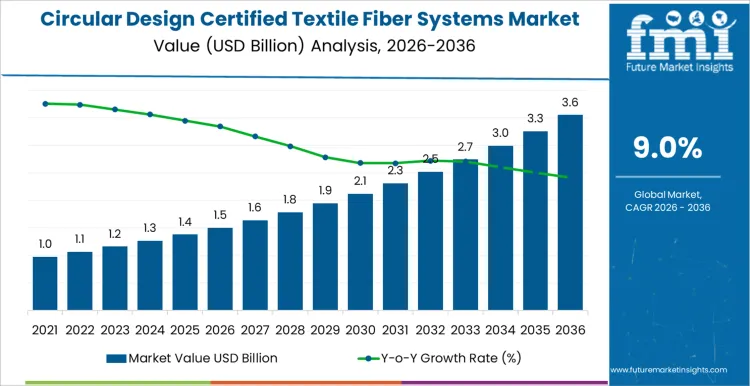
USD 1.5 billion in 2026 defines the opening scale of the circular design certified textile fiber systems market, with the value projected to reach USD 3.6 billion by 2036 at a 9.0% CAGR. Demand is established by design rules that require defined material recovery routes, documented disassembly logic, and controlled substance profiles. Brands and material owners embed these requirements at concept stage rather than at sourcing stage. Fiber systems are selected through architecture frameworks that link product geometry, component count, and end-of-life handling. Once a product family enters certification scope, later changes affect recovery pathways, labeling permissions, and compliance files. Volume growth follows adoption across apparel, workwear, and home textiles governed by portfolio-level design standards.
Control over system definitions determines participation in the circular design certified textile fiber systems market through approved architectures, audit schedules, and recovery protocols maintained by brand groups and program owners. Entry depends on evidence covering material traceability, recyclability outcomes, and compatibility with declared processing routes. Product families remain fixed across extended cycles because certification statements attach to complete constructions rather than to individual inputs. Replacement occurs during concept resets rather than during routine sourcing rounds. Revenue development reflects the number of product platforms built under certified circular frameworks. Competitive standing depends on early involvement in product system design and continued inclusion within governed material architectures.
Circular Design Certified Textile Fiber Systems Market Quick Stats
- Circular Design Certified Textile Fiber Systems Market Value (2026): USD 1.5 billion
- Circular Design Certified Textile Fiber Systems Market Forecast Value (2036): USD 3.6 billion
- Circular Design Certified Textile Fiber Systems Market CAGR: 9.0%
- Circular Design Design Certified Textile Fiber Systems Market: Recycled and regenerated fiber systems
- Key Growth Regions in Circular Design Certified Textile Fiber Systems Market: China, USA, Germany, South Korea, Japan
- Top Players in Circular Design Certified Textile Fiber Systems Market: Lenzing AG, Birla Cellulose, Indorama Ventures, Aquafil, Eastman Chemical Company, Toray Industries, Teijin, Kelheim Fibres, Sateri Holdings
What is the Growth Forecast for the Circular Design Certified Textile Fiber Systems Market through 2036?
Product development in this segment starts with disassembly rules, material passports, and recovery pathways rather than with yarn cost alone. Designers specify these fiber systems to keep trims, dyes, and constructions within defined return loops. In 2026, spending in the circular design certified textile fiber systems market stands near USD 1.5 billion, supported by apparel, workwear, and home textile programs that operate under closed loop criteria. Material approval depends on documentation depth, recyclability testing, and behavior across repeated processing cycles. Integration takes place at the platform level, not at the style level. The rise to USD 3.6 billion by 2036 reflects a 9.0% growth path tied to broader program coverage and higher system content per finished product.
Operating structure sets, the commercial rhythm of the circular design certified textile fiber systems market. Volumes move under framework agreements linked to take back schemes and certified processing routes. Stock policy favors continuity of approved system components rather than opportunistic substitution. Manufacturing cost tracks segregation, record keeping, testing, and additional process controls inside spinning and finishing plants. Mills measure audit pass rates, rework exposure, and documentation accuracy. Annual values pass through the low and mid two billion during the early 2030s as more product families shift into closed loop specifications. The move to USD 3.6 billion in 2036 comes from wider mandate coverage, higher material intensity in compliant designs, and longer contracts that lock these systems into fixed bills of material.
Circular Design Certified Textile Fiber Systems Market Key Takeaways
| Metric | Value |
|---|---|
| Market Value (2026) | USD 1.5 billion |
| Forecast Value (2036) | USD 3.6 billion |
| Forecast CAGR (2026 to 2036) | 9.0% |
How Is the Circular Design Certified Textile Fiber Systems Market Being Used to Control Material Approval and End of Life Routing in Regulated Supply Chains?
Design programs built around certified circularity treat fiber systems as governed assets rather than as interchangeable raw materials. Material selection begins with dismantling rules, separation pathways, and documentation scope instead of with tensile or hand feel targets. Spinners and fabric producers adapt construction choices to keep later disassembly feasible and to avoid mixed structures that fail recovery audits. Finishing plants evaluate chemical compatibility because some auxiliaries block downstream sorting or reuse. Quality teams link shipment release to documentation completeness and declared recovery routes as much as to physical inspection. Storage and handling rules tighten because cross contamination breaks certification logic. Qualification centers on system level behavior, not on individual component properties, since approval depends on the whole loop remaining auditable from production through collection and reprocessing.
Operations using certified circular systems plan around return flows and recovery yield rather than only forward shipments. Inventory tracking extends beyond customers to include take back and sorting stages. Production managers measure success through recovery rates, contamination incidents, and reentry acceptance, not only through first sale volume. A fabric that performs well in use but fails separation rules creates disposal cost and certification risk. Suppliers align polymer choice, construction methods, and finishing steps to keep material pathways open. Contracts define take back obligations, sorting tolerances, and audit rights. Demand concentrates in programs where regulatory exposure, brand commitments, and procurement rules require proof that material choices remain compatible with defined reuse or recycling routes over multiple product life cycles.
How do compliance architecture and product lifecycle plan shape demand in the Circular Design Certified Textile Fiber Systems Market by certification framework and fiber type in 2026?
In the circular design certified textile fiber systems market, adoption decisions begin with documentation workload, audit cadence, and product lifecycle mapping rather than fiber conversion cost. Brands operating product stewardship programs, textile compliance management systems, and material approval platforms require certification routes that integrate into design, sourcing, and end-of-life reporting without fragmenting records. By certification framework, use spans cradle-to-cradle and similar schemes, circular and preferred fiber programs, industry and brand-led labels, and other systems. By fiber type, demand centers on recycled and regenerated fibers, biobased and renewable fibers, blended circular systems, and other platforms. Portfolio structure reflects governance simplicity, evidence continuity, and update burden across multi-year collections.
Why do formal certification frameworks dominate long-cycle programs?
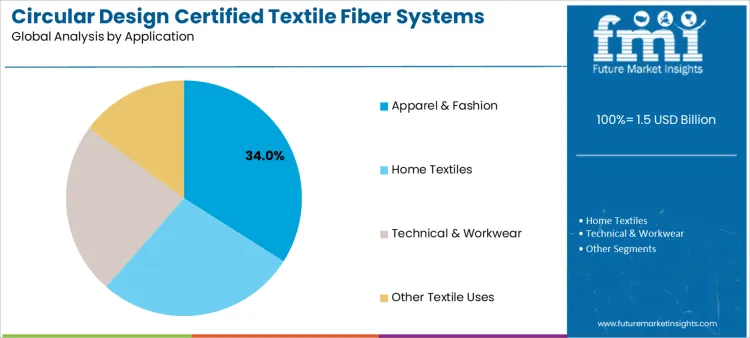
Cradle-to-cradle and similar frameworks represent about 34% share, driven by structured criteria, version control, and defined reassessment intervals. These features simplify planning across seasonal assortments and supplier changes. Circular and preferred fiber programs provide narrower scope with faster onboarding, which suits categories with short development cycles. Industry and brand-led labels offer internal alignment, yet they carry higher maintenance cost for rule updates and auditor training. Other systems remain confined to niche channels. Program owners evaluate frameworks through document reuse, audit frequency, and cross-category coverage. Legal teams review claim defensibility. Sourcing teams review supplier readiness. Framework choice follows governance workload rather than logo value.
Once a framework is selected, design briefs, supplier contracts, and audit calendars assume that rulebook. Changing frameworks alters criteria mapping and training plans. IT systems require new templates and workflows. Planning then aligns collections to the chosen cadence. Warehousing and labeling follow the same declaration structure. Procurement locks preferred mills that already operate under the same scheme. Capacity growth arrives through more certified styles and partners rather than frequent framework switching. The operating result favors systems that minimize administrative friction and preserve continuity across multiple seasons, regions, and product categories with stable interpretation rules and predictable reassessment cycles.
How do fiber platform choices follow verification mechanics and recovery routes?
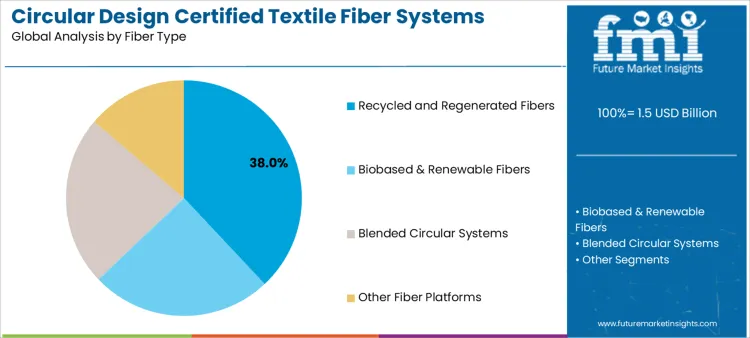
Recycled and regenerated fibers account for about 38% share, reflecting their compatibility with material balance accounting and established verification methods. These platforms fit recovery narratives that rely on measured input and output streams. Biobased and renewable fibers serve categories where agricultural origin and feedstock renewal require different evidence sets. Blended circular systems address durability or performance targets, though they complicate end-of-life routing and reporting. Other fiber platforms remain tied to specific use cases. Engineering teams assess fibers through durability and reprocessing potential. Compliance teams assess through traceability and audit burden. Product teams assess through performance retention and appearance stability.
After a fiber platform is fixed, bills of material, supplier declarations, and test matrices assume that pathway. Switching platforms resets recovery assumptions and documentation. Planning then stabilizes sourcing to protect continuity. Storage and labeling follow the same classification logic. Service teams define take-back or recycling instructions aligned to the chosen platform. Sales commits collections using predictable approval timing. Orders expand by adding categories and volumes rather than changing platforms. Demand concentrates in fibers that fit existing verification mechanics and recovery routes while preserving performance expectations across multiple seasons and markets.
Why Are Material Verification and Lifecycle Criteria Supporting the Circular Design Certified Textile Fiber Systems Market?
circular design certified textile fiber systems market demand is increasing because brands and textile converters are setting material use criteria that require fibers with documented end-of-life pathways and certified circular characteristics. Certified systems allow procurement teams to trace how fibers are sourced, processed, and returned into material streams that meet internal material criteria. Buyers evaluate certified systems based on clarity of certification evidence, alignment with internal audit requirements, and performance in manufacturing processes. Value is realized when certification supports product claims, reduces supplier risk, and aligns with external reporting frameworks. Converters prefer fiber systems that reduce margin risk and clarify how material attributes affect product programs.
What Constraints Are Affecting Adoption in the Circular Design Certified Textile Fiber Systems Market?
circular design certified textile fiber systems market growth is limited by certification complexity, supply network alignment, and cost thresholds in fiber procurement programs. Achieving certification requires comprehensive documentation of feedstock sources, processing steps, and material handling, which adds procedural work at fiber mills and converters. Variability in certification standards and acceptance criteria across markets can slow qualification, causing production planning delays for brands. Cost differences relative to conventional fiber systems influence adoption in cost sensitive categories where performance and price are primary drivers. Integration of certified systems often involves additional inspection and verification steps, which increase operational workload for mills and buying teams.
How Are Product Specifications and Commercial Practices Shaping the Circular Design Certified Textile Fiber Systems Market?
circular design certified textile fiber systems market offerings are being organized around defined certification levels, trace criteria, and system compatibility guidelines to help buyers make informed choices quickly. Suppliers provide detailed compliance documentation, system boundaries, and audit data linked to fiber production and handling. Portfolio segmentation by application category such as apparel, technical textiles, and home textiles helps converters match certified fiber systems to product requirements with fewer qualification cycles. Commercial engagements increasingly include planned delivery schedules and consistency guarantees that align with fabric and finished goods production calendars. Technical support focuses on certification onboarding, supply network mapping, and verification workflows to help converters and brands maintain production continuity while integrating certified fiber systems.
What is the Demand for Circular Design Certified Textile Fiber Systems by Country?
| Country | CAGR (%) |
|---|---|
| USA | 8.7% |
| Japan | 7.5% |
| South Korea | 8.2% |
| Germany | 8.6% |
| China | 10.2% |
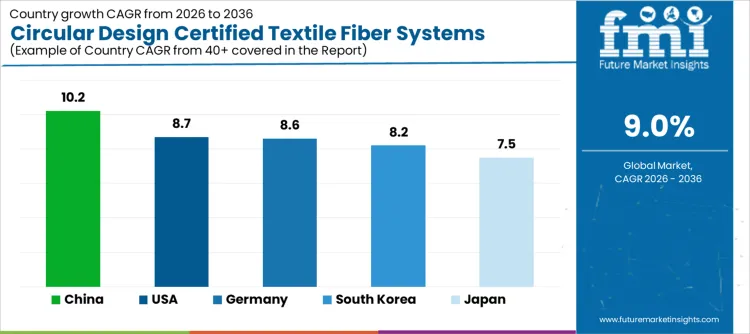
The demand for circular design certified textile fiber systems is increasing across apparel, home textiles, and technical fabrics where verified recycling and closed loop production are essential for brand compliance and material efficiency. China leads at 10.2% CAGR, supported by large scale textile manufacturing and growing adoption of certified circular fibers in export oriented production. The USA grows at 8.7%, driven by brand initiatives to integrate circular and recycled content into collections. Germany records 8.6%, shaped by technical textile and high value apparel production with strict traceability and certification requirements. South Korea advances at 8.2%, reflecting steady use in functional and performance textiles. Japan posts 7.5%, within a mature but specification driven market focused on certified circular material integration.
How Do Verification Protocols Influence Procurement in the Circular Design Certified Textile Fiber Systems Market in the USA?
Verification protocols and certification standards are directing the circular design certified textile fiber systems market in the United States at a growth rate consistent with an 8.7% CAGR. Material approval requires demonstration of fiber traceability, recycled content integrity, and performance retention after processing. Technical teams evaluate tensile strength, dimensional stability, fiber uniformity, and compatibility with dyeing or finishing operations. Once a fiber grade is validated, the same approval package governs sourcing across programs and substitution becomes rare. Volume expands when apparel, home textile, and technical fabric programs adopt certified construction methods or extend product lines. Oversight committees retain authority over any specification change. Supplier access depends on audit compliance and documentation rigor. Production planning follows program schedules rather than spot orders. Commercial success relies on certified inclusion and consistent lot performance across multiple mills.
How Do Compliance and Documentation Standards Guide Adoption in the Circular Design Certified Textile Fiber Systems Market in Japan?
Compliance and documentation rigor are shaping the circular design certified textile fiber systems market in Japan along a trajectory consistent with a 7.5% CAGR. Fiber selection is treated as a controlled process variable because certification gaps can invalidate downstream sustainability claims. Any proposed change enters a formal evaluation sequence that includes recycled content verification, fiber property retention, and process reproducibility checks. Engineers examine uniformity, tensile retention, color stability, and tolerance to finishing. Approval requires production-scale evidence supported by auditable records. Once validated, the same fiber remains in repeated constructions for extended periods. Requalification is mandatory for any deviation. Supplier participation depends on record completeness and inspection outcomes. Volume growth follows measured program expansions rather than rapid substitution. Commercial positioning relies on predictable certified performance and procedural discipline.
How Do Platform Certification Frameworks Drive Scale in the Circular Design Certified Textile Fiber Systems Market in South Korea?
Platform certification frameworks are explaining why the circular design certified textile fiber systems market in South Korea is advancing in line with an 8.2% CAGR. Standardized fiber sets are defined to serve multiple product families across apparel, technical textiles, and nonwovens. A single fiber approval can influence multiple programs without separate factory validation. Technical assessment focuses on recycled content retention, process stability, tensile and dimensional performance, and compatibility with finishing workflows. When a grade enters the platform baseline, scale follows through synchronized production adoption. Plant-level changes remain limited because the framework governs material use. Suppliers secure positions through joint trials and documentation alignment. Volume growth mirrors platform rollout schedules. Commercial success depends on early inclusion in platform definitions and reliable execution during multi-line production.
How Do Central Audit Systems Control Material Access in the Circular Design Certified Textile Fiber Systems Market in Germany?
Centralized audit systems are guiding the circular design certified textile fiber systems market in Germany in line with an 8.6% CAGR. Material access is managed through approved lists that span multiple production sites. Individual mills cannot introduce new fibers independently. Reviews focus on traceability, recycled content verification, and process reproducibility across operations. After approval, the same fiber grade is used in multiple factories under consistent specification rules. Volume growth follows program adoption rather than local sourcing initiatives. Supplier standing depends on audit performance and documentation discipline. Change control remains formal and monitored. Production planning aligns with coordinated capacity allocation. Commercial success depends on maintaining identical certified performance and record integrity across distributed manufacturing environments.
How Do Replication and Rollout Programs Accelerate Uptake in the Circular Design Certified Textile Fiber Systems Market in China?
Replication of approved configurations across production networks explains why the circular design certified textile fiber systems market in China is advancing in line with a 10.2% CAGR. Once a fiber meets defined recycled content, performance, and traceability standards in one facility, it is deployed into parallel operations with minimal redesign. Approval emphasizes consistency, process reproducibility, and audit readiness. Expansion teams rely on standardized qualification files and commissioning protocols. Domestic suppliers hold an advantage because they can follow rapid capacity additions and network expansions. Imported materials remain concentrated in higher specification applications. Volume increases through repetition of approved constructions across multiple sites. Commercial advantage depends on being included when a configuration becomes a reference template rather than competing for each production line.
How Do Suppliers Compete in the Circular Design Certified Textile Fiber Systems Market?
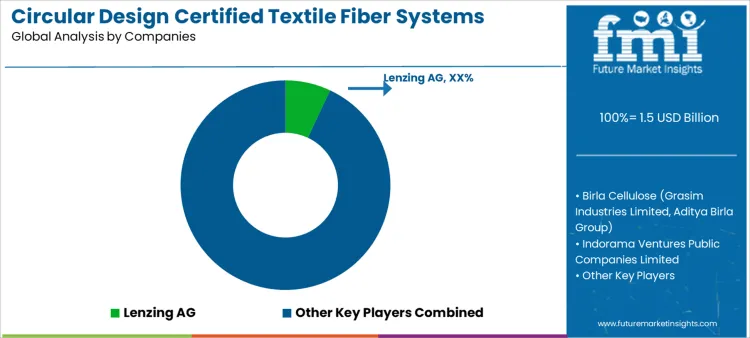
Verified circular content, fiber durability, and processing reliability guide adoption in the Circular Design Certified Textile Fiber Systems Market. Lenzing AG, Birla Cellulose, Indorama Ventures, Aquafil, Eastman Chemical Company, Toray Industries, Teijin, Kelheim Fibres, and Sateri compete during fiber qualification, pilot production, and textile integration trials. Once fibers are used in apparel, industrial fabrics, or nonwovens, traceable origin, mechanical stability, and compatibility with finishing processes anchor supplier selection. Lenzing AG emphasizes fully traceable cellulose fibers certified for circular design. Birla Cellulose supplies viscose fibers optimized for durable apparel applications. Indorama Ventures focuses on recycled polyester with verified content. Aquafil provides nylon fibers derived from post-consumer waste. Eastman Chemical supports polymer fibers compatible with circular manufacturing. Toray Industries and Teijin offer high-performance fibers aligned with certification standards. Kelheim Fibres delivers specialty cellulose fibers, and Sateri ensures traceable sustainable sourcing.
Integration into production lines, lot-to-lot reproducibility, and regulatory documentation shape supplier positioning in the Circular Design Certified Textile Fiber Systems Market. Fiber developers assess tensile strength, fiber uniformity, thermal and chemical stability, and certification compliance during evaluation. Manufacturing teams prioritize suppliers able to deliver scalable production and technical guidance. Lenzing AG secures adoption through pilot support and verified circular supply chains. Birla Cellulose captures placements in industrial and apparel programs requiring certified fibers. Indorama Ventures maintains share in large-scale recycled polyester production. Aquafil competes where nylon fiber regeneration is critical. Eastman Chemical supports polymer fiber applications for certified circular textiles. Toray Industries and Teijin gain adoption in high-performance fiber programs. Kelheim Fibres attracts niche applications requiring specialty fibers. Sateri focuses on traceable, sustainable fibers for large-volume apparel production. Market positions vary by fiber type, production scale, end-use application, and regional circular economy regulations.
Key Players in the Circular Design Certified Textile Fiber Systems Market
- Lenzing AG
- Birla Cellulose (Grasim Industries Limited, Aditya Birla Group)
- Indorama Ventures Public Company Limited
- Aquafil S.p.A.
- Eastman Chemical Company
- Toray Industries, Inc.
- Teijin Limited
- Kelheim Fibres GmbH
- Sateri Holdings Limited
Scope of the Report
| Items | Values |
|---|---|
| Quantitative Units (2026) | USD billion |
| Certification and Framework | Cradle-to-cradle and similar, circular and preferred fiber programs, industry and brand-led circular labels, other certification systems |
| Fiber Type | Recycled and regenerated fibers, biobased and renewable fibers, blended circular systems, other fiber platforms |
| Application | Apparel and fashion, home textiles, technical and workwear, other textile uses |
| Customer Segment | Global apparel brands, retailers and private labels, technical and workwear brands, other brand and institutional buyers |
| Regions Covered | Asia Pacific, Europe, North America, Latin America, Middle East & Africa |
| Countries Covered | United States, Canada, Mexico, Germany, United Kingdom, France, Italy, Spain, Nordics, BENELUX, China, Japan, South Korea, India, Australia & New Zealand, ASEAN, Brazil, Chile, Saudi Arabia, Turkey, South Africa, and other regional markets |
| Key Companies Profiled | Lenzing AG, Birla Cellulose, Indorama Ventures, Aquafil, Eastman Chemical Company, Toray Industries, Teijin, Kelheim Fibres, Sateri |
| Additional Attributes | Dollar sales by certification framework, fiber type, application, and customer segment, material traceability and audit governance, defined disassembly and recovery pathways, recyclability testing and recovery yield tracking, documentation workload and compliance file management, segregation and handling rules across production and take-back stages, qualification and reapproval cycles tied to certification programs, integration into closed-loop product architectures, and regional demand patterns driven by apparel, workwear, and home textile circular design programs |
Circular Design Certified Textile Fiber Systems Market Segmentation
Certification and Framework:
- Cradle-to-Cradle and Similar
- Circular and Preferred Fiber Programs
- Industry and Brand-Led Circular Labels
- Other Certification Systems
Fiber Type:
- Recycled and Regenerated Fibers
- Biobased & Renewable Fibers
- Blended Circular Systems
- Other Fiber Platforms
Application:
- Apparel & Fashion
- Home Textiles
- Technical & Workwear
- Other Textile Uses
Customer Segment:
- Global Apparel Brands
- Retailers & Private Labels
- Technical and Workwear Brands
- Other Brand/Institutional Buyers
Region
- Asia Pacific
- China
- Japan
- South Korea
- India
- Australia & New Zealand
- ASEAN
- Rest of Asia Pacific
- Europe
- Germany
- United Kingdom
- France
- Italy
- Spain
- Nordic
- BENELUX
- Rest of Europe
- North America
- United States
- Canada
- Mexico
- Latin America
- Brazil
- Chile
- Rest of Latin America
- Middle East & Africa
- Kingdom of Saudi Arabia
- Other GCC Countries
- Turkey
- South Africa
- Other African Union
- Rest of Middle East & Africa
Bibliography
- United Nations Environment Programme. (2023). Sustainability and circularity in the textile value chain: Global roadmap. United Nations Environment Programme.
- Shamsuzzaman, M., Islam, M., Al Mamun, M. A., Rayyaan, R., Sowrov, K., Islam, S., & Sayem, A. S. M. (2025). Fashion and textile waste management in the circular economy: A systematic review. Cleaner Waste Systems, 11, Article 100268.
- Parnell, K., Rolston, A., Hilton, B., & Luccitti, A. (2025). Circular economy in the textile industry: A review of technology, practice, and opportunity. Recycling, 10(6), 225.
Frequently Asked Questions
How big is the global circular design certified textile fiber systems market in 2026?
The global circular design certified textile fiber systems market is projected to be valued at USD 1.5 billion in 2026.
What will be the size of the circular design certified textile fiber systems market in 2036?
The market size for circular design certified textile fiber systems is projected to reach USD 3.6 billion by 2036.
How much will the demand for circular design certified textile fiber systems grow between 2026 and 2036?
Demand for circular design certified textile fiber systems is projected to grow at a 9.0% CAGR between 2026 and 2036.
Which fiber type holds a significant share in the circular design certified textile fiber systems market in 2026?
In terms of fiber type, recycled and regenerated fibers are expected to account for a 38.0% share in 2026.
Preview the report firsthand - request a free sample
Get SampleGet the brochure for pricing and purchase details.
Get PDFTable of Content
- Executive Summary
- Global Market Outlook
- Demand-side Trends
- Supply-side Trends
- Technology Roadmap Analysis
- Analysis and Recommendations
- Market Overview
- Market Coverage / Taxonomy
- Market Definition / Scope / Limitations
- Market Background
- Market Dynamics
- Drivers
- Restraints
- Opportunity
- Trends
- Scenario Forecast
- Demand in Optimistic Scenario
- Demand in Likely Scenario
- Demand in Conservative Scenario
- Opportunity Map Analysis
- Product Life Cycle Analysis
- Supply Chain Analysis
- Investment Feasibility Matrix
- Value Chain Analysis
- PESTLE and Porter’s Analysis
- Regulatory Landscape
- Regional Parent Market Outlook
- Production and Consumption Statistics
- Import and Export Statistics
- Market Dynamics
- Global Market Analysis 2021 to 2025 and Forecast, 2026 to 2036
- Historical Market Size Value (USD Million) Analysis, 2021 to 2025
- Current and Future Market Size Value (USD Million) Projections, 2026 to 2036
- Y-o-Y Growth Trend Analysis
- Absolute $ Opportunity Analysis
- Global Market Pricing Analysis 2021 to 2025 and Forecast 2026 to 2036
- Global Market Analysis 2021 to 2025 and Forecast 2026 to 2036, By Certification and Framework
- Introduction / Key Findings
- Historical Market Size Value (USD Million) Analysis By Certification and Framework , 2021 to 2025
- Current and Future Market Size Value (USD Million) Analysis and Forecast By Certification and Framework , 2026 to 2036
- Cradle-to-Cradle and Similar
- Circular and Preferred Fiber Programs
- Industry and Brand-Led Circular Labels
- Other Certification Systems
- Cradle-to-Cradle and Similar
- Y-o-Y Growth Trend Analysis By Certification and Framework , 2021 to 2025
- Absolute $ Opportunity Analysis By Certification and Framework , 2026 to 2036
- Global Market Analysis 2021 to 2025 and Forecast 2026 to 2036, By Fiber Type
- Introduction / Key Findings
- Historical Market Size Value (USD Million) Analysis By Fiber Type, 2021 to 2025
- Current and Future Market Size Value (USD Million) Analysis and Forecast By Fiber Type, 2026 to 2036
- Recycled and Regenerated Fibers
- Biobased & Renewable Fibers
- Blended Circular Systems
- Other Fiber Platforms
- Recycled and Regenerated Fibers
- Y-o-Y Growth Trend Analysis By Fiber Type, 2021 to 2025
- Absolute $ Opportunity Analysis By Fiber Type, 2026 to 2036
- Global Market Analysis 2021 to 2025 and Forecast 2026 to 2036, By Application
- Introduction / Key Findings
- Historical Market Size Value (USD Million) Analysis By Application, 2021 to 2025
- Current and Future Market Size Value (USD Million) Analysis and Forecast By Application, 2026 to 2036
- Apparel & Fashion
- Home Textiles
- Technical & Workwear
- Other Textile Uses
- Apparel & Fashion
- Y-o-Y Growth Trend Analysis By Application, 2021 to 2025
- Absolute $ Opportunity Analysis By Application, 2026 to 2036
- Global Market Analysis 2021 to 2025 and Forecast 2026 to 2036, By Customer Segment
- Introduction / Key Findings
- Historical Market Size Value (USD Million) Analysis By Customer Segment, 2021 to 2025
- Current and Future Market Size Value (USD Million) Analysis and Forecast By Customer Segment, 2026 to 2036
- Global Apparel Brands
- Retailers & Private Labels
- Technical/Workwear Brands
- Other Brand/Institutional Buyers
- Global Apparel Brands
- Y-o-Y Growth Trend Analysis By Customer Segment, 2021 to 2025
- Absolute $ Opportunity Analysis By Customer Segment, 2026 to 2036
- Global Market Analysis 2021 to 2025 and Forecast 2026 to 2036, By Region
- Introduction
- Historical Market Size Value (USD Million) Analysis By Region, 2021 to 2025
- Current Market Size Value (USD Million) Analysis and Forecast By Region, 2026 to 2036
- North America
- Latin America
- Western Europe
- Eastern Europe
- East Asia
- South Asia and Pacific
- Middle East & Africa
- Market Attractiveness Analysis By Region
- North America Market Analysis 2021 to 2025 and Forecast 2026 to 2036, By Country
- Historical Market Size Value (USD Million) Trend Analysis By Market Taxonomy, 2021 to 2025
- Market Size Value (USD Million) Forecast By Market Taxonomy, 2026 to 2036
- By Country
- USA
- Canada
- Mexico
- By Certification and Framework
- By Fiber Type
- By Application
- By Customer Segment
- By Country
- Market Attractiveness Analysis
- By Country
- By Certification and Framework
- By Fiber Type
- By Application
- By Customer Segment
- Key Takeaways
- Latin America Market Analysis 2021 to 2025 and Forecast 2026 to 2036, By Country
- Historical Market Size Value (USD Million) Trend Analysis By Market Taxonomy, 2021 to 2025
- Market Size Value (USD Million) Forecast By Market Taxonomy, 2026 to 2036
- By Country
- Brazil
- Chile
- Rest of Latin America
- By Certification and Framework
- By Fiber Type
- By Application
- By Customer Segment
- By Country
- Market Attractiveness Analysis
- By Country
- By Certification and Framework
- By Fiber Type
- By Application
- By Customer Segment
- Key Takeaways
- Western Europe Market Analysis 2021 to 2025 and Forecast 2026 to 2036, By Country
- Historical Market Size Value (USD Million) Trend Analysis By Market Taxonomy, 2021 to 2025
- Market Size Value (USD Million) Forecast By Market Taxonomy, 2026 to 2036
- By Country
- Germany
- UK
- Italy
- Spain
- France
- Nordic
- BENELUX
- Rest of Western Europe
- By Certification and Framework
- By Fiber Type
- By Application
- By Customer Segment
- By Country
- Market Attractiveness Analysis
- By Country
- By Certification and Framework
- By Fiber Type
- By Application
- By Customer Segment
- Key Takeaways
- Eastern Europe Market Analysis 2021 to 2025 and Forecast 2026 to 2036, By Country
- Historical Market Size Value (USD Million) Trend Analysis By Market Taxonomy, 2021 to 2025
- Market Size Value (USD Million) Forecast By Market Taxonomy, 2026 to 2036
- By Country
- Russia
- Poland
- Hungary
- Balkan & Baltic
- Rest of Eastern Europe
- By Certification and Framework
- By Fiber Type
- By Application
- By Customer Segment
- By Country
- Market Attractiveness Analysis
- By Country
- By Certification and Framework
- By Fiber Type
- By Application
- By Customer Segment
- Key Takeaways
- East Asia Market Analysis 2021 to 2025 and Forecast 2026 to 2036, By Country
- Historical Market Size Value (USD Million) Trend Analysis By Market Taxonomy, 2021 to 2025
- Market Size Value (USD Million) Forecast By Market Taxonomy, 2026 to 2036
- By Country
- China
- Japan
- South Korea
- By Certification and Framework
- By Fiber Type
- By Application
- By Customer Segment
- By Country
- Market Attractiveness Analysis
- By Country
- By Certification and Framework
- By Fiber Type
- By Application
- By Customer Segment
- Key Takeaways
- South Asia and Pacific Market Analysis 2021 to 2025 and Forecast 2026 to 2036, By Country
- Historical Market Size Value (USD Million) Trend Analysis By Market Taxonomy, 2021 to 2025
- Market Size Value (USD Million) Forecast By Market Taxonomy, 2026 to 2036
- By Country
- India
- ASEAN
- Australia & New Zealand
- Rest of South Asia and Pacific
- By Certification and Framework
- By Fiber Type
- By Application
- By Customer Segment
- By Country
- Market Attractiveness Analysis
- By Country
- By Certification and Framework
- By Fiber Type
- By Application
- By Customer Segment
- Key Takeaways
- Middle East & Africa Market Analysis 2021 to 2025 and Forecast 2026 to 2036, By Country
- Historical Market Size Value (USD Million) Trend Analysis By Market Taxonomy, 2021 to 2025
- Market Size Value (USD Million) Forecast By Market Taxonomy, 2026 to 2036
- By Country
- Kingdom of Saudi Arabia
- Other GCC Countries
- Turkiye
- South Africa
- Other African Union
- Rest of Middle East & Africa
- By Certification and Framework
- By Fiber Type
- By Application
- By Customer Segment
- By Country
- Market Attractiveness Analysis
- By Country
- By Certification and Framework
- By Fiber Type
- By Application
- By Customer Segment
- Key Takeaways
- Key Countries Market Analysis
- USA
- Pricing Analysis
- Market Share Analysis, 2025
- By Certification and Framework
- By Fiber Type
- By Application
- By Customer Segment
- Canada
- Pricing Analysis
- Market Share Analysis, 2025
- By Certification and Framework
- By Fiber Type
- By Application
- By Customer Segment
- Mexico
- Pricing Analysis
- Market Share Analysis, 2025
- By Certification and Framework
- By Fiber Type
- By Application
- By Customer Segment
- Brazil
- Pricing Analysis
- Market Share Analysis, 2025
- By Certification and Framework
- By Fiber Type
- By Application
- By Customer Segment
- Chile
- Pricing Analysis
- Market Share Analysis, 2025
- By Certification and Framework
- By Fiber Type
- By Application
- By Customer Segment
- Germany
- Pricing Analysis
- Market Share Analysis, 2025
- By Certification and Framework
- By Fiber Type
- By Application
- By Customer Segment
- UK
- Pricing Analysis
- Market Share Analysis, 2025
- By Certification and Framework
- By Fiber Type
- By Application
- By Customer Segment
- Italy
- Pricing Analysis
- Market Share Analysis, 2025
- By Certification and Framework
- By Fiber Type
- By Application
- By Customer Segment
- Spain
- Pricing Analysis
- Market Share Analysis, 2025
- By Certification and Framework
- By Fiber Type
- By Application
- By Customer Segment
- France
- Pricing Analysis
- Market Share Analysis, 2025
- By Certification and Framework
- By Fiber Type
- By Application
- By Customer Segment
- India
- Pricing Analysis
- Market Share Analysis, 2025
- By Certification and Framework
- By Fiber Type
- By Application
- By Customer Segment
- ASEAN
- Pricing Analysis
- Market Share Analysis, 2025
- By Certification and Framework
- By Fiber Type
- By Application
- By Customer Segment
- Australia & New Zealand
- Pricing Analysis
- Market Share Analysis, 2025
- By Certification and Framework
- By Fiber Type
- By Application
- By Customer Segment
- China
- Pricing Analysis
- Market Share Analysis, 2025
- By Certification and Framework
- By Fiber Type
- By Application
- By Customer Segment
- Japan
- Pricing Analysis
- Market Share Analysis, 2025
- By Certification and Framework
- By Fiber Type
- By Application
- By Customer Segment
- South Korea
- Pricing Analysis
- Market Share Analysis, 2025
- By Certification and Framework
- By Fiber Type
- By Application
- By Customer Segment
- Russia
- Pricing Analysis
- Market Share Analysis, 2025
- By Certification and Framework
- By Fiber Type
- By Application
- By Customer Segment
- Poland
- Pricing Analysis
- Market Share Analysis, 2025
- By Certification and Framework
- By Fiber Type
- By Application
- By Customer Segment
- Hungary
- Pricing Analysis
- Market Share Analysis, 2025
- By Certification and Framework
- By Fiber Type
- By Application
- By Customer Segment
- Kingdom of Saudi Arabia
- Pricing Analysis
- Market Share Analysis, 2025
- By Certification and Framework
- By Fiber Type
- By Application
- By Customer Segment
- Turkiye
- Pricing Analysis
- Market Share Analysis, 2025
- By Certification and Framework
- By Fiber Type
- By Application
- By Customer Segment
- South Africa
- Pricing Analysis
- Market Share Analysis, 2025
- By Certification and Framework
- By Fiber Type
- By Application
- By Customer Segment
- USA
- Market Structure Analysis
- Competition Dashboard
- Competition Benchmarking
- Market Share Analysis of Top Players
- By Regional
- By Certification and Framework
- By Fiber Type
- By Application
- By Customer Segment
- Competition Analysis
- Competition Deep Dive
- Lenzing AG
- Overview
- Product Portfolio
- Profitability by Market Segments (Product/Age /Sales Channel/Region)
- Sales Footprint
- Strategy Overview
- Marketing Strategy
- Product Strategy
- Channel Strategy
- Birla Cellulose (Grasim Industries Limited, Aditya Birla Group)
- Indorama Ventures Public Companies Limited
- Aquafil S.p.A.
- Eastman Chemical Company
- Toray Industries, Inc.
- Teijin Limited
- Kelheim Fibres GmbH
- Sateri Holdings Limited
- Lenzing AG
- Competition Deep Dive
- Assumptions & Acronyms Used
- Research Methodology


