

- Industry Size (2026)
- USD 0.4 Bn
- Forecast (2036)
- USD 1.2 Bn
- CAGR (2026 to 2036)
- 10.9%
Polyethylene Furanoate (PEF) Technical Textile Fiber Market Forecast and Outlook 2026 to 2036
The polyethylene furanoate (PEF) technical textile fiber market is projected to be valued at USD 0.4 billion in 2026 and is expected to reach USD 1.2 billion by 2036, expanding at a 10.9% CAGR. Growth is shaped by buyers that prioritize performance retention and barrier-linked functionality in fiber form, while keeping conversion risk manageable for mills operating at scale.
The PEF technical textile fiber market develops through qualification-led procurement where product selection is anchored in consistent spinning behavior, predictable downstream finishing outcomes, and repeatable performance metrics across large production campaigns. PEF fiber adoption is progressing through a narrow set of textile programs where measurable value is visible in oxygen and moisture barrier behavior, dimensional stability, and durability under repeated stress.
These properties matter most in technical and industrial textiles, performance-led apparel constructions, and interior applications that demand long service life. Over the forecast period, commercial traction strengthens when PEF inputs are supplied with disciplined quality control and documentation packages that allow rapid buyer approvals and stable reordering.
Quick Stats for Polyethylene Furanoate (PEF) Technical Textile Fiber Market
- Polyethylene Furanoate (PEF) Technical Textile Fiber Market Value (2026): USD 0.4 billion
- Polyethylene Furanoate (PEF) Technical Textile Fiber Market Forecast Value (2036): USD 1.2 billion
- Polyethylene Furanoate (PEF) Technical Textile Fiber Market Forecast CAGR: 10.9%
- Leading Product: Filament yarns (44.0%)
- Leading Application: Technical and industrial textiles (42.0%)
- Leading End User: Early-adopter brands (33.3%)
- Key Growth Countries: USA, China, UK, Germany, South Korea, Japan
- Key Players: ALPLA, Resilux, Mitsubishi Chemical Group, Toray Industries, Avantium, Indorama Ventures, Teijin, Far Eastern New Century, Yibin Grace New Materials, Synvina
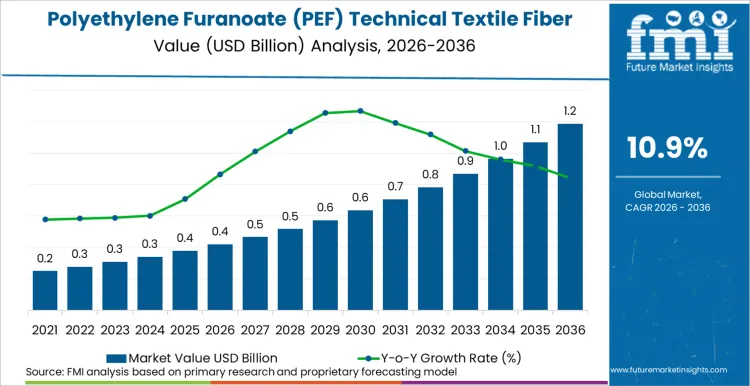
Key Macro Trends expected to influence the PEF Technical Textile Fiber Market
Across chemicals and materials, a recurring theme is the shift from novelty-led bio-based inputs toward procurement frameworks that demand performance parity plus measurable functional gains. As buyers tighten approval gates, polymer selection increasingly depends on how well a new material behaves in production rather than its positioning alone.
This favors PEF fiber programs where barrier-linked performance translates into clear product outcomes and where mills can scale without extensive process variability. A second macro trend is stronger demand for supply-chain governance, with documentation speed and consistency becoming a competitive advantage in advanced materials procurement.
Another force shaping adoption is the convergence of packaging-driven barrier innovation with textile use-cases that value moisture and oxygen management, durability, and long service intervals. In parallel, brand owners are escalating lifecycle scrutiny, stable quality systems, traceable sourcing, and repeatable results influence so material choices across multi-factory sourcing networks. This elevates the importance of scale-up discipline in PEF intermediates and highlights the value of suppliers that can support both technical qualification and reliable long-run delivery.
Polyethylene Furanoate (PEF) Technical Textile Fiber Market Key Takeaways
| Metric | Value |
|---|---|
| Market Value (2026) | USD 0.4 billion |
| Market Forecast Value (2036) | USD 1.2 billion |
| Forecast CAGR 2026 to 2036 | 10.9% |
Source: FMI analysis based on primary research and proprietary forecasting model
Why are Technical Textile Buyers evaluating PEF Fiber Formats for Performance-Critical Applications?
Demand is rising because technical textile purchasing is becoming more specification-led, with performance stability taking priority over short-term cost savings. Fibers are evaluated on how they behave across spinning, weaving or knitting, coating or lamination where relevant, and real-world exposure cycles. This approach aligns with the broader scale-up logic present in the technical textiles market where procurement emphasizes documented performance windows and repeat runability across long production campaigns.
A second catalyst is that PEF is being assessed as a route to deliver barrier-linked functionality through textile structures without relying entirely on multilayer constructions or heavy surface treatments. In selected industrial fabric programs, even incremental improvements in permeability control, dimensional stability, and durability can reduce failures in end use. This reinforces demand from technical textile producers that want repeatable performance but cannot afford unstable conversion behavior.
A third factor is that materials innovation is increasingly integrated into platform decisions rather than isolated pilots. When mills and converters approve a new fiber specification, they tend to reuse it across multiple programs to reduce qualification burden. This is similar to how engineered yarn upgrades are scaled in adjacent high-performance categories such as low-creep high-modulus yarns, where stability and predictable outcomes matter as much as headline properties.
Segmental Analysis
Which Product Formats are Scaling Fastest as PEF Fiber Demand Commercializes?
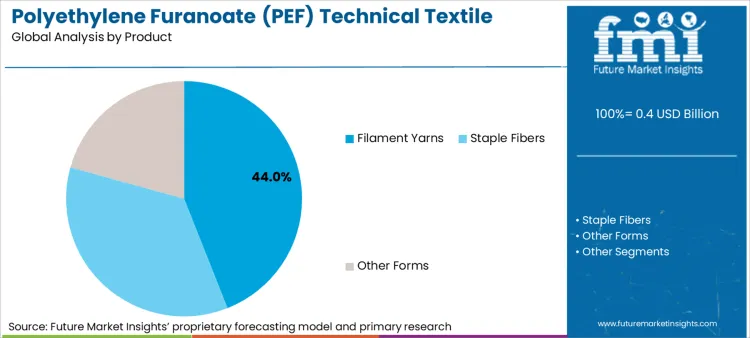
Filament yarns lead demand and account for a 44.0% share because they provide consistent tensile behavior, dimensional control, and processing stability across high-speed textile manufacturing. Filament formats are preferred in technical textile programs where uniformity and repeatability are essential to protect downstream performance specifications. As per FMI’s projection, mills also favor filament pathways because they reduce variability in fabric construction and enable tighter control over permeability-linked behavior in performance structures.
Staple fibers are gaining traction in applications where handfeel, bulk, and blend flexibility matter, particularly in home and interior uses that still require durability and stability. Other forms remain relevant in niche routes and early development programs, but their scaling depends on whether they can demonstrate consistent conversion outcomes across multiple manufacturing partners.
Why do Technical and Industrial Textiles anchor PEF Fiber Adoption?
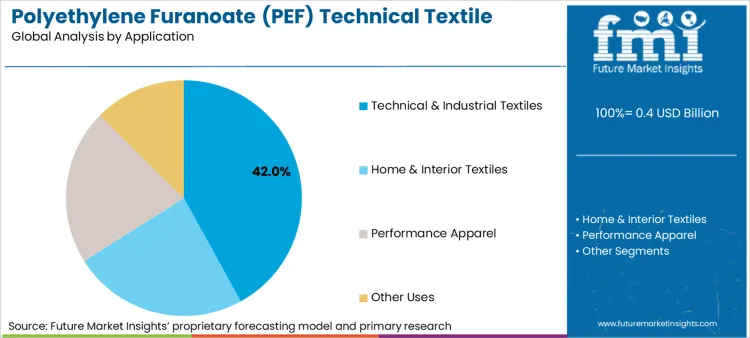
Technical and industrial textiles represent a 42.0% share because they monetize performance stability over longer service intervals and under harsher conditions. These applications reward materials that reduce functional loss over time, making PEF fiber evaluation more commercially direct than in fashion-led categories. This growth logic is reinforced by parallel investment in process capability and output consistency across technical textile manufacturing equipment ecosystems, visible in markets such as technical textiles production equipment.
Home and interior textiles are expanding as buyers explore durable upgrades that preserve product aesthetics while improving service life. Performance apparel adoption is rising where comfort and durability expectations are high, but scaling depends on ensuring dyeing and finishing consistency so that functional benefits do not introduce shade drift or feel variability.
Which End Users are driving the Earliest Scale-Up Decisions?
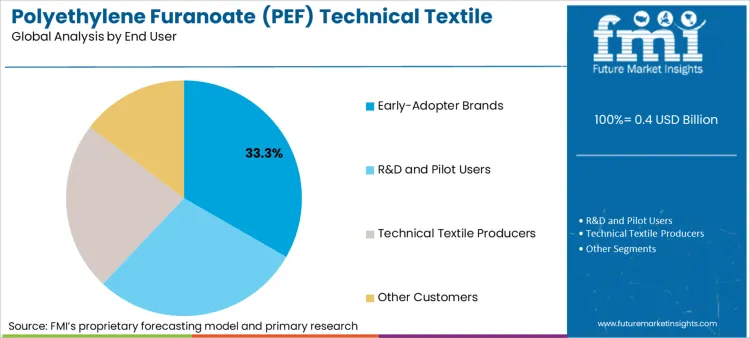
Early-adopter brands account for a 33.3% share because they are willing to validate new materials for differentiated performance positioning and portfolio upgrades. These buyers typically allocate initial volumes to controlled programs, then expand when results remain stable across repeat runs and multiple suppliers.
R&D and pilot users remain important for qualification pipelines, but their purchases are smaller and more experimental by nature. Technical textile producers scale volumes when PEF fiber inputs consistently meet processing and performance acceptance windows, since production disruption risk is a primary constraint in high-throughput environments.
Why is performance repeatability becoming the deciding factor in fiber selection?
As per FMI’s estimates, technical textile buyers are optimizing around total operating cost rather than only input price. Fibers that minimize production troubleshooting, reduce defect rates, and protect downstream performance claims are more likely to be approved for long-run programs. PEF fiber evaluation benefits from this shift when it can show stable conversion performance and measurable functional retention.
What slows PEF fiber commercialization even when the performance case is attractive?
The primary constraint is the difficulty of scaling consistent supply while maintaining narrow quality windows. Many technical textile supply chains demand repeatable polymer behavior across time and across factories. If PEF inputs fluctuate across lots, it increases the need for re-tuning and revalidation, which raises operating costs and slows reorder decisions.
Where will the most reliable growth pockets emerge through 2036?
The strongest opportunities will emerge where PEF’s barrier-linked and stability benefits map directly to product performance targets, including industrial textiles and durable interiors. This pathway also benefits from the broader rise of furan chemistry investment in materials markets, supported by the expanding ecosystem around furan-based polymers and their downstream applications.
How does upstream furan chemistry scaling support long-term demand stability?
FMI is of the opinion that improved supply confidence in upstream furan intermediates will be a key enabler for PEF fiber scale-up. As precursor availability becomes more predictable, fiber producers can commit to longer contracts and multi-site allocations, which strengthens adoption in structured procurement programs. This is consistent with expansion momentum in upstream building blocks such as furandicarboxylic acid, which supports broader furan polymer adoption pathways.
Country-wise Analysis
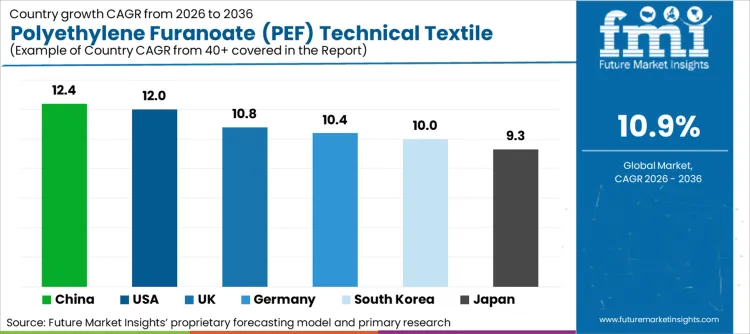
| Country | CAGR (2026-2036) |
|---|---|
| USA | 12.0% |
| China | 12.4% |
| UK | 10.8% |
| Germany | 10.4% |
| South Korea | 10.0% |
| Japan | 9.3% |
Source: FMI analysis based on primary research and proprietary forecasting model
Why does the USA show strong momentum in PEF technical textile fiber adoption?
The USA expands at a 12.0% CAGR because technical textiles are increasingly procured through specification-led frameworks that prioritize stable performance and reliable vendor support. Demand strengthens where industrial and performance-oriented textile programs value durability and functional retention, and where multi-site buyers want consistent quality documentation and stable delivery cadence.
How is China becoming the fastest-growing focus country for this market?
China grows at a 12.4% CAGR driven by its scale in textile manufacturing and its capacity to industrialize new polymer pathways once conversion stability is proven. As per FMI’s projection, growth accelerates when PEF fiber formats can be produced and converted at high throughput without increasing defect risk, enabling broader adoption across technical textile producers and early brand programs.
What supports steady adoption in the UK despite tighter procurement thresholds?
The UK advances at a 10.8% CAGR as buyers evaluate durable performance upgrades that fit governance-led sourcing requirements. Technical textile programs in interiors and industrial uses scale when supplier documentation, consistency, and change control are strong enough to support repeat ordering across multi-season production cycles.
Why does Germany remain a structured, quality-driven growth market?
Germany expands at a 10.4% CAGR due to quality-centric procurement that favors repeatability and proven performance retention. Buyers in this market typically require disciplined compliance support and stable manufacturing behavior, which rewards suppliers that can deliver narrow performance variability and rapid technical responsiveness during ramp-ups.
How do South Korea and Japan contribute to market scaling in Asia?
South Korea grows at a 10.0% CAGR supported by high-throughput manufacturing and export-linked programs that prioritize consistent process behavior. Japan expands at a 9.3% CAGR with a reliability-first approach where adoption is deliberate and qualification cycles are longer, but contract stability can be strong once specifications are approved.
Competitive Landscape
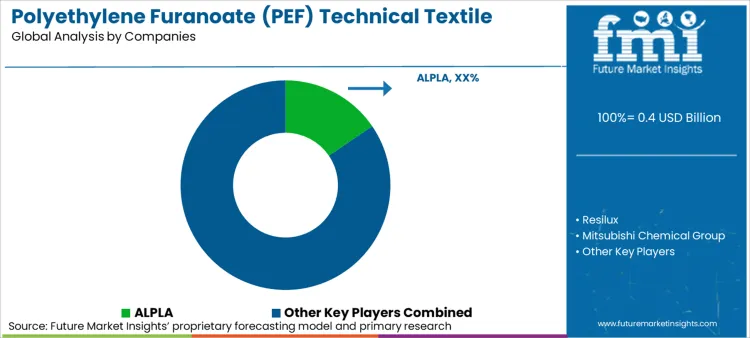
Competition in the PEF technical textile fiber market is defined by scale-up discipline, supply reliability, and technical support capability rather than by portfolio breadth alone. Suppliers compete on how consistently they can deliver fiber properties within defined acceptance windows while maintaining predictable conversion performance for mills and converters.
As per FMI’s analysis, buyers increasingly prefer vendors that can support qualification with structured documentation, stable batch performance, and responsive troubleshooting during early scaling. Competitive advantage also depends on the ability to align PEF fiber performance to application-specific requirements without increasing process instability across dyeing, finishing, and downstream fabric engineering.
As per FMI’s estimates, long-term share capture will concentrate among participants that can secure dependable upstream inputs, scale fiber manufacturing with low variability, and support multi-factory adoption for technical textile producers and early adopter brands.
Key Players
- ALPLA
- Resilux
- Mitsubishi Chemical Group
- Toray Industries
- Avantium
- Indorama Ventures
- Teijin
- Far Eastern New Century
- Yibin Grace New Materials
- Synvina
Scope of Report
| Items | Values |
|---|---|
| Quantitative Units | USD Billion |
| Product Segments | Filament Yarns; Staple Fibers; Other Forms |
| Application Segments | Technical & Industrial Textiles; Home & Interior Textiles; Performance Apparel; Other Uses |
| End User Segments | Early-Adopter Brands; R&D and Pilot Users; Technical Textile Producers; Other Customers |
| Region Segmentation | North America; Latin America; Western Europe; Eastern Europe; East Asia; South Asia & Pacific; Middle East & Africa |
| Key Countries | USA, China, UK, Germany, South Korea, Japan |
Polyethylene Furanoate (PEF) Technical Textile Fiber Market by Segment
By Product
- Filament Yarns
- Staple Fibers
- Other Forms
By Application
- Technical & Industrial Textiles
- Home & Interior Textiles
- Performance Apparel
- Other Uses
By End User
- Early-Adopter Brands
- R&D and Pilot Users
- Technical Textile Producers
- Other Customers
By Region
- North America
- Latin America
- Western Europe
- Eastern Europe
- East Asia
- South Asia & Pacific
- Middle East & Africa
Bibliography
- International Organization for Standardization. (2023). ISO 139: Textiles - Standard atmospheres for conditioning and testing. ISO.
- International Organization for Standardization. (2024). ISO 6330: Textiles - Domestic washing and drying procedures for textile testing. ISO.
- International Organization for Standardization. (2023). ISO 105-B02: Textiles - Tests for colour fastness - Part B02: Colour fastness to artificial light. ISO.
- Organisation for Economic Co-operation and Development. (2023). Test No. 301: Ready biodegradability. OECD Publishing.
- European Commission. (2024). EU strategy for sustainable and circular textiles: Policy framework and implementation priorities. Publications Office of the European Union.
- USA Environmental Protection Agency. (2024). Sustainable materials management: Durable goods and polymers lifecycle considerations. USA EPA.
- United Nations Environment Programme. (2024). Turning off the tap: How the world can end plastic pollution and create a circular economy. UNEP.
- Siracusa, V., & Blanco, I. (2023). Bio-based polymers for durable and functional applications: Processing stability and performance retention. Polymer Testing, 121, 107991.
Frequently Asked Questions
How big is the polyethylene furanoate (PEF) technical textile fiber market in 2026?
The polyethylene furanoate (PEF) technical textile fiber market is valued at USD 0.4 billion in 2026.
What will be the size of the polyethylene furanoate (PEF) technical textile fiber market in 2036?
As per FMI’s projection, the market size for polyethylene furanoate (PEF) technical textile fiber is projected to reach USD 1.2 billion by 2036.
How fast will the polyethylene furanoate (PEF) technical textile fiber market grow?
Demand for polyethylene furanoate (PEF) technical textile fiber is projected to grow at a 10.9% CAGR between 2026 and 2036.
Which product segment holds the largest market share?
Filament yarns lead the market, accounting for a 44.0% share in 2026.
Which end-user group drives the earliest demand concentration?
Early-adopter brands are expected to represent a 33.3% share of demand in 2026.
Preview the report firsthand - request a free sample
Get SampleGet the brochure for pricing and purchase details.
Get PDFTable of Content
- Executive Summary
- Global Market Outlook
- Demand-side Trends
- Supply-side Trends
- Technology Roadmap Analysis
- Analysis and Recommendations
- Market Overview
- Market Coverage / Taxonomy
- Market Definition / Scope / Limitations
- Research Methodology
- Chapter Orientation
- Analytical Lens and Working Hypotheses
- Market Structure, Signals, and Trend Drivers
- Benchmarking and Cross-market Comparability
- Market Sizing, Forecasting, and Opportunity Mapping
- Research Design and Evidence Framework
- Desk Research Programme (Secondary Evidence)
- Company Annual and Sustainability Reports
- Peer-reviewed Journals and Academic Literature
- Corporate Websites, Product Literature, and Technical Notes
- Earnings Decks and Investor Briefings
- Statutory Filings and Regulatory Disclosures
- Technical White Papers and Standards Notes
- Trade Journals, Industry Magazines, and Analyst Briefs
- Conference Proceedings, Webinars, and Seminar Materials
- Government Statistics Portals and Public Data Releases
- Press Releases and Reputable Media Coverage
- Social Channels, Communities, and Digital Listening Inputs
- Additional Desk Sources
- Expert Input and Fieldwork (Primary Evidence)
- Primary Modes
- Qualitative Interviews and Expert Elicitation
- Quantitative Surveys and Structured Data Capture
- Blended A8oach
- Why Primary Evidence is Used
- Field Techniques
- Interviews
- Surveys
- Focus Groups
- Observational and In-context Research
- Social and Community Interactions
- Stakeholder Universe Engaged
- C-suite Leaders
- Board Members
- Presidents and Vice Presidents
- R&D and Innovation Heads
- Technical Specialists
- Domain Subject-matter Experts
- Scientists
- Physicians and Other Healthcare Professionals
- Governance, Ethics, and Data Stewardship
- Research Ethics
- Data Integrity and Handling
- Primary Modes
- Tooling, Models, and Reference Databases
- Desk Research Programme (Secondary Evidence)
- Data Engineering and Model Build
- Data Acquisition and Ingestion
- Cleaning, Normalisation, and Verification
- Synthesis, Triangulation, and Analysis
- Quality Assurance and Audit Trail
- Market Background
- Market Dynamics
- Drivers
- Restraints
- Opportunity
- Trends
- Scenario Forecast
- Demand in Optimistic Scenario
- Demand in Likely Scenario
- Demand in Conservative Scenario
- Opportunity Map Analysis
- Product Life Cycle Analysis
- Supply Chain Analysis
- Investment Feasibility Matrix
- Value Chain Analysis
- PESTLE and Porter’s Analysis
- Regulatory Landscape
- Regional Parent Market Outlook
- Production and Consumption Statistics
- Import and Export Statistics
- Market Dynamics
- Global Market Analysis 2021 to 2025 and Forecast, 2026 to 2036
- Historical Market Size Value (USD Million) Analysis, 2021 to 2025
- Current and Future Market Size Value (USD Million) Projections, 2026 to 2036
- Y-o-Y Growth Trend Analysis
- Absolute $ Opportunity Analysis
- Global Market Pricing Analysis 2021 to 2025 and Forecast 2026 to 2036
- Global Market Analysis 2021 to 2025 and Forecast 2026 to 2036, By Product
- Introduction / Key Findings
- Historical Market Size Value (USD Million) Analysis By Product , 2021 to 2025
- Current and Future Market Size Value (USD Million) Analysis and Forecast By Product , 2026 to 2036
- Filament Yarns
- Staple Fibers
- Other Forms
- Filament Yarns
- Y-o-Y Growth Trend Analysis By Product , 2021 to 2025
- Absolute $ Opportunity Analysis By Product , 2026 to 2036
- Global Market Analysis 2021 to 2025 and Forecast 2026 to 2036, By Application
- Introduction / Key Findings
- Historical Market Size Value (USD Million) Analysis By Application, 2021 to 2025
- Current and Future Market Size Value (USD Million) Analysis and Forecast By Application, 2026 to 2036
- Technical & Industrial Textiles
- Home & Interior Textiles
- Performance Apparel
- Other Uses
- Technical & Industrial Textiles
- Y-o-Y Growth Trend Analysis By Application, 2021 to 2025
- Absolute $ Opportunity Analysis By Application, 2026 to 2036
- Global Market Analysis 2021 to 2025 and Forecast 2026 to 2036, By End User
- Introduction / Key Findings
- Historical Market Size Value (USD Million) Analysis By End User, 2021 to 2025
- Current and Future Market Size Value (USD Million) Analysis and Forecast By End User, 2026 to 2036
- Early-Adopter Brands
- R&D and Pilot Users
- Technical Textile Producers
- Other Customers
- Early-Adopter Brands
- Y-o-Y Growth Trend Analysis By End User, 2021 to 2025
- Absolute $ Opportunity Analysis By End User, 2026 to 2036
- Global Market Analysis 2021 to 2025 and Forecast 2026 to 2036, By Region
- Introduction
- Historical Market Size Value (USD Million) Analysis By Region, 2021 to 2025
- Current Market Size Value (USD Million) Analysis and Forecast By Region, 2026 to 2036
- North America
- Latin America
- Western Europe
- Eastern Europe
- East Asia
- South Asia and Pacific
- Middle East & Africa
- Market Attractiveness Analysis By Region
- North America Market Analysis 2021 to 2025 and Forecast 2026 to 2036, By Country
- Historical Market Size Value (USD Million) Trend Analysis By Market Taxonomy, 2021 to 2025
- Market Size Value (USD Million) Forecast By Market Taxonomy, 2026 to 2036
- By Country
- USA
- Canada
- Mexico
- By Product
- By Application
- By End User
- By Country
- Market Attractiveness Analysis
- By Country
- By Product
- By Application
- By End User
- Key Takeaways
- Latin America Market Analysis 2021 to 2025 and Forecast 2026 to 2036, By Country
- Historical Market Size Value (USD Million) Trend Analysis By Market Taxonomy, 2021 to 2025
- Market Size Value (USD Million) Forecast By Market Taxonomy, 2026 to 2036
- By Country
- Brazil
- Chile
- Rest of Latin America
- By Product
- By Application
- By End User
- By Country
- Market Attractiveness Analysis
- By Country
- By Product
- By Application
- By End User
- Key Takeaways
- Western Europe Market Analysis 2021 to 2025 and Forecast 2026 to 2036, By Country
- Historical Market Size Value (USD Million) Trend Analysis By Market Taxonomy, 2021 to 2025
- Market Size Value (USD Million) Forecast By Market Taxonomy, 2026 to 2036
- By Country
- Germany
- UK
- Italy
- Spain
- France
- Nordic
- BENELUX
- Rest of Western Europe
- By Product
- By Application
- By End User
- By Country
- Market Attractiveness Analysis
- By Country
- By Product
- By Application
- By End User
- Key Takeaways
- Eastern Europe Market Analysis 2021 to 2025 and Forecast 2026 to 2036, By Country
- Historical Market Size Value (USD Million) Trend Analysis By Market Taxonomy, 2021 to 2025
- Market Size Value (USD Million) Forecast By Market Taxonomy, 2026 to 2036
- By Country
- Russia
- Poland
- Hungary
- Balkan & Baltic
- Rest of Eastern Europe
- By Product
- By Application
- By End User
- By Country
- Market Attractiveness Analysis
- By Country
- By Product
- By Application
- By End User
- Key Takeaways
- East Asia Market Analysis 2021 to 2025 and Forecast 2026 to 2036, By Country
- Historical Market Size Value (USD Million) Trend Analysis By Market Taxonomy, 2021 to 2025
- Market Size Value (USD Million) Forecast By Market Taxonomy, 2026 to 2036
- By Country
- China
- Japan
- South Korea
- By Product
- By Application
- By End User
- By Country
- Market Attractiveness Analysis
- By Country
- By Product
- By Application
- By End User
- Key Takeaways
- South Asia and Pacific Market Analysis 2021 to 2025 and Forecast 2026 to 2036, By Country
- Historical Market Size Value (USD Million) Trend Analysis By Market Taxonomy, 2021 to 2025
- Market Size Value (USD Million) Forecast By Market Taxonomy, 2026 to 2036
- By Country
- India
- ASEAN
- Australia & New Zealand
- Rest of South Asia and Pacific
- By Product
- By Application
- By End User
- By Country
- Market Attractiveness Analysis
- By Country
- By Product
- By Application
- By End User
- Key Takeaways
- Middle East & Africa Market Analysis 2021 to 2025 and Forecast 2026 to 2036, By Country
- Historical Market Size Value (USD Million) Trend Analysis By Market Taxonomy, 2021 to 2025
- Market Size Value (USD Million) Forecast By Market Taxonomy, 2026 to 2036
- By Country
- Kingdom of Saudi Arabia
- Other GCC Countries
- Turkiye
- South Africa
- Other African Union
- Rest of Middle East & Africa
- By Product
- By Application
- By End User
- By Country
- Market Attractiveness Analysis
- By Country
- By Product
- By Application
- By End User
- Key Takeaways
- Key Countries Market Analysis
- USA
- Pricing Analysis
- Market Share Analysis, 2025
- By Product
- By Application
- By End User
- Canada
- Pricing Analysis
- Market Share Analysis, 2025
- By Product
- By Application
- By End User
- Mexico
- Pricing Analysis
- Market Share Analysis, 2025
- By Product
- By Application
- By End User
- Brazil
- Pricing Analysis
- Market Share Analysis, 2025
- By Product
- By Application
- By End User
- Chile
- Pricing Analysis
- Market Share Analysis, 2025
- By Product
- By Application
- By End User
- Germany
- Pricing Analysis
- Market Share Analysis, 2025
- By Product
- By Application
- By End User
- UK
- Pricing Analysis
- Market Share Analysis, 2025
- By Product
- By Application
- By End User
- Italy
- Pricing Analysis
- Market Share Analysis, 2025
- By Product
- By Application
- By End User
- Spain
- Pricing Analysis
- Market Share Analysis, 2025
- By Product
- By Application
- By End User
- France
- Pricing Analysis
- Market Share Analysis, 2025
- By Product
- By Application
- By End User
- India
- Pricing Analysis
- Market Share Analysis, 2025
- By Product
- By Application
- By End User
- ASEAN
- Pricing Analysis
- Market Share Analysis, 2025
- By Product
- By Application
- By End User
- Australia & New Zealand
- Pricing Analysis
- Market Share Analysis, 2025
- By Product
- By Application
- By End User
- China
- Pricing Analysis
- Market Share Analysis, 2025
- By Product
- By Application
- By End User
- Japan
- Pricing Analysis
- Market Share Analysis, 2025
- By Product
- By Application
- By End User
- South Korea
- Pricing Analysis
- Market Share Analysis, 2025
- By Product
- By Application
- By End User
- Russia
- Pricing Analysis
- Market Share Analysis, 2025
- By Product
- By Application
- By End User
- Poland
- Pricing Analysis
- Market Share Analysis, 2025
- By Product
- By Application
- By End User
- Hungary
- Pricing Analysis
- Market Share Analysis, 2025
- By Product
- By Application
- By End User
- Kingdom of Saudi Arabia
- Pricing Analysis
- Market Share Analysis, 2025
- By Product
- By Application
- By End User
- Turkiye
- Pricing Analysis
- Market Share Analysis, 2025
- By Product
- By Application
- By End User
- South Africa
- Pricing Analysis
- Market Share Analysis, 2025
- By Product
- By Application
- By End User
- USA
- Market Structure Analysis
- Competition Dashboard
- Competition Benchmarking
- Market Share Analysis of Top Players
- By Regional
- By Product
- By Application
- By End User
- Competition Analysis
- Competition Deep Dive
- ALPLA
- Overview
- Product Portfolio
- Profitability by Market Segments (Product/Age /Sales Channel/Region)
- Sales Footprint
- Strategy Overview
- Marketing Strategy
- Product Strategy
- Channel Strategy
- Resilux
- Mitsubishi Chemical Group
- Toray Industries
- Avantium
- Indorama Ventures
- Teijin
- Far Eastern New Century
- Yibin Grace New Materials
- Synvina
- ALPLA
- Competition Deep Dive
- Assumptions & Acronyms Used


