

- Industry Size (2026)
- USD 460.0 Mn
- Forecast (2036)
- USD 1129.6 Mn
- CAGR (2026 to 2036)
- 9.4%
High-Transparency LSR Compounds for Technical Textile and Film Coatings Market Forecast and Outlook 2026 to 2036
The high-transparency liquid silicone rubber compounds for technical textile and film coatings are valued at USD 460.0 million in 2026 and are projected to reach USD 1,129.6 million by 2036, reflecting a CAGR of 9.4%. Expansion is anchored in applications where optical clarity is a functional requirement rather than a visual preference. Coated textiles and films used in protective membranes, medical barriers, architectural fabrics, and optically active layers require materials that transmit light without haze while retaining elasticity, thermal resistance, and chemical stability. Liquid silicone rubber meets these requirements through inherently low light scattering, stable polymer backbones, and resistance to yellowing under heat and ultraviolet exposure. Adoption intensifies where coatings must remain transparent after repeated flexing, washing, or environmental exposure, conditions that limit suitability of polyurethane or PVC systems.
Quick Stats for High-Transparency LSR Compounds for Technical Textile and Film Coatings Market
- High-Transparency LSR Compounds for Technical Textile and Film Coatings Market Value (2026): USD 460.0 million
- High-Transparency LSR Compounds for Technical Textile and Film Coatings Market Forecast Value (2036): USD 1,129.6 million
- High-Transparency LSR Compounds for Technical Textile and Film Coatings Market Forecast CAGR (2026 to 2036): 9.4%
- Leading LSR Compound Type: Optical-Grade Transparent LSR
- Fastest-Growing Countries: China, India, Germany, USA, Japan
- Key Players: Wacker Chemie AG, Dow, Elkem, Momentive, Shin-Etsu Chemical
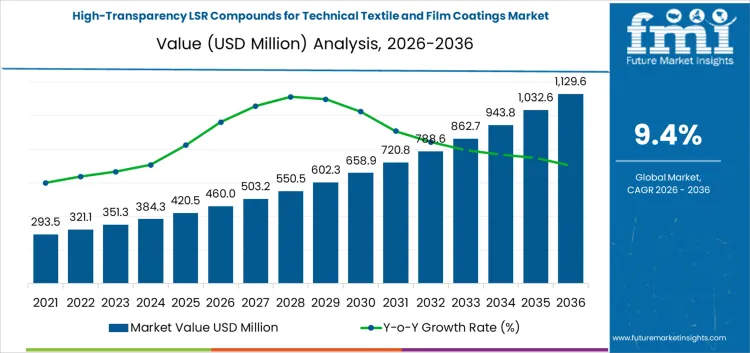
Growth trajectory is shaped by material qualification depth and processing discipline instead of rapid substitution cycles. Transparent LSR coatings are integrated into production lines only after extended validation of cure behavior, adhesion consistency, and optical stability across substrate variations. Technical textiles and films increasingly function as active interfaces in medical devices, wearable electronics, and controlled-environment structures, elevating tolerance thresholds for defects, inclusions, and optical distortion. Manufacturing scale-up favors LSR formulations that maintain clarity under continuous coating, calendaring, or lamination without post-processing correction. Demand strengthens where transparency performance remains stable across global plants, enabling standardized product specifications and long service life. Material selection is therefore driven by repeatable optical performance and process reliability rather than short-term cost optimization or design refresh cycles.
High-Transparency LSR Compounds for Technical Textile and Film Coatings Market Key Takeaways
| Metric | Value |
|---|---|
| Market Value (2026) | USD 460.0 million |
| Market Forecast Value (2036) | USD 1,129.6 million |
| Forecast CAGR (2026-2036) | 9.4% |
Why is the Demand for High-Transparency LSR Compounds for Technical Textile and Film Coatings Market Growing Globally?
Demand for high-transparency liquid silicone rubber (LSR) compounds for technical textile and film coatings is growing globally due to expanding applications that require optical clarity, flexibility, and durable performance. Technical textiles used in protective apparel, medical barriers, architectural membranes, and flexible electronics benefit from LSR coatings that maintain high light transmission while providing moisture resistance, elasticity, and thermal stability. Films used in displays, sensors, and optically sensitive surfaces also require transparent silicone compounds that do not compromise visual quality or functional performance.
Growth in wearable technology, smart fabrics, and advanced medical textiles reinforces adoption of LSR compounds that combine clarity with mechanical robustness under repeated flexing and environmental stress. Regulatory frameworks in multiple regions emphasize material safety, biocompatibility, and low extractable, which reinforces specification of high-purity silicone systems for sensitive end uses. Advances in silicone formulation improve processing consistency, surface adhesion, and cure kinetics, enabling integration with diverse substrates without loss of transparency or coating uniformity. Expansion of manufacturing capabilities and automated coating systems increases throughput for high-value textile and film products. Continued innovation in flexible, optically transparent materials support adoption of high-transparency LSR compounds across global technical textile and film markets.
How Is the Global High-Transparency LSR Compounds for Technical Textile and Film Coatings Market Structured?
Global demand for high-transparency liquid silicone rubber compounds is driven by optical clarity requirements, durability expectations, and coating performance stability in advanced textile and film applications. Technical textiles and coated films increasingly require materials that maintain transparency under thermal exposure, UV radiation, and repeated mechanical stress. LSR compounds are selected for their inherent clarity, elasticity, and resistance to environmental degradation. Adoption reflects expansion of functional textiles, protective films, and specialty coating layers where visual clarity and long-term performance must coexist with scalable processing.
Which LSR Compound Type Holds the Largest Share of Global Demand?
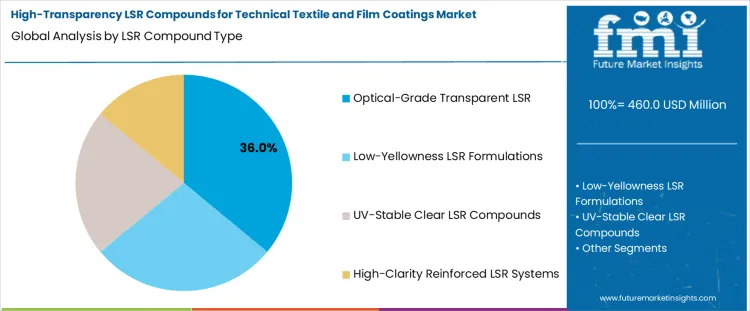
Optical-grade transparent LSR compounds account for the largest share at 36.0%, reflecting widespread use in applications requiring maximum light transmission and minimal haze. These compounds support coated textiles and films used in protective, industrial, and specialty fabric systems. Low-yellowness LSR formulations represent 28.0%, driven by requirements for color neutrality and appearance retention during prolonged heat or UV exposure. UV-stable clear LSR compounds hold 22.0%, supporting outdoor and high-exposure applications where transparency must be preserved over extended service life. High-clarity reinforced LSR systems account for 14.0%, applied where additional mechanical strength is required without significant loss of optical performance.
Key Points
- Optical-grade LSR leads due to maximum transparency needs
- Low-yellowness formulations preserve visual neutrality
- Reinforced systems balance clarity with mechanical strength
Which Transparency Optimization Method Is Most Widely Applied Globally?
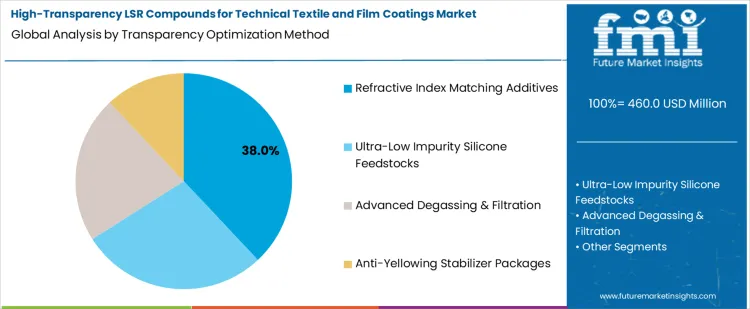
Refractive index matching additives represent the leading optimization method at 38.0%, reflecting their effectiveness in reducing light scattering at polymer interfaces within coated layers. These additives enhance transparency without altering base polymer properties. Ultra-low impurity silicone feedstocks account for 28.0%, supporting baseline clarity and consistency by minimizing contaminants that cause haze or discoloration. Advanced degassing and filtration processes hold 22.0%, used to remove entrapped gases and particulates during compound preparation. Anti-yellowing stabilizer packages represent 12.0%, applied selectively to delay discoloration under thermal or ultraviolet stress.
Key Points
- Refractive index control directly improves optical clarity
- High-purity feedstocks ensure consistent transparency
- Degassing processes reduce haze and defects
Which Application Segment Generates the Highest Global Demand?
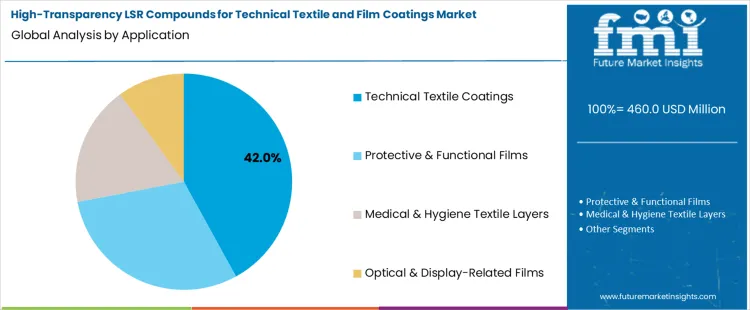
Technical textile coatings account for 42.0% of global demand, driven by use in industrial fabrics, protective textiles, and performance materials requiring flexible, transparent coatings. These applications rely on LSR compounds for durability and clarity across varied operating conditions. Protective and functional films represent 30.0%, including barrier films and specialty overlays where transparency and elasticity are critical. Medical and hygiene textile layers hold 18.0%, reflecting demand for clear, skin-safe coatings in healthcare-related fabrics. Optical and display-related films account for 10.0%, constrained by stringent optical tolerances and specialized performance requirements.
Key Points
- Technical textiles lead due to broad industrial use
- Films demand clarity combined with functional protection
- Medical layers prioritize transparency and material safety
What are the Key Dynamics in the High-Transparency LSR Compounds for Technical Textile and Film Coatings Market?
Global demand rises as manufacturers of technical textiles and specialty films adopt high-transparency liquid silicone rubber (LSR) compounds to deliver clarity, flexibility, and functional coating performance. High-transparency LSR compounds support optical neutrality, moisture barrier properties, and soft-touch surfaces in applications such as medical textiles, protective films, wearable electronics interfaces, and premium industrial fabrics. Adoption aligns with growth in advanced material integration, performance-driven coatings, and demand for visual quality and durability across North America, Europe, Asia-Pacific, and Latin America. Usage spans industrial, healthcare, and consumer markets where clarity and functional performance are key product differentiators.
How do application performance requirements and end-user expectations shape adoption?
Technical textile and film producers require high-transparency LSR compounds that maintain optical clarity while providing stretch, abrasion resistance, and environmental stability. Clarity supports aesthetics and display integration in wearable and flexible electronic interfaces where pigments and haze must be minimized. Protective and functional films leverage moisture and chemical resistance of LSR coatings alongside transparency, enhancing protective qualities without obscuring substrate characteristics. Medical textile applications emphasize both clarity and biocompatibility for use in diagnostic wraps, cleanroom materials, and visual inspection zones. Brand owners emphasize reliable performance metrics and consistent coating quality that uphold end-product standards in demanding use environments.
How do cost considerations, processing complexity, and regulatory frameworks influence market scalability?
High-transparency LSR compounds often command premium pricing due to specialized polymer formulations, purification requirements, and quality control measures that ensure minimal inclusions and optical defects. Processing complexity arises from the need to control cure kinetics, filler content, and coating uniformity to achieve both transparency and functional attributes, requiring precise molding or coating equipment and expertise. Cost pressures affect adoption in price-sensitive segments where alternative materials may suffice without transparency requirements. Regulatory frameworks governing silicone use, material safety, and labeling vary across regions, influencing compliance strategies for global distribution. Long-term growth depends on continued innovation in cost-effective, high-performance LSR formulations and harmonized standards that support scalable adoption in technical textile and film coating applications worldwide.
How Is Demand for High-Transparency LSR Compounds for Technical Textile and Film Coatings Evolving Globally?
Demand for high-transparency LSR compounds for technical textile and film coatings is increasing globally due to requirements for optical clarity, durability, and process stability in advanced applications. China leads with a 9.8% CAGR, supported by scale manufacturing of coated textiles and functional films. India follows at 9.5%, driven by expansion of technical textiles and value-added coatings. Germany records 9.3%, reflecting engineering precision and qualification standards. USA posts a 9.0% CAGR, shaped by performance specifications and diversified end uses. Japan records 8.8%, supported by controlled adoption in high-spec applications. Growth reflects transition toward LSR formulations delivering clarity, thermal stability, and consistent coating performance.
| Country | CAGR (%) |
|---|---|
| China | 9.8% |
| India | 9.5% |
| Germany | 9.3% |
| USA | 9.0% |
| Japan | 8.8% |
What is driving strong adoption of high-transparency LSR compounds in China?
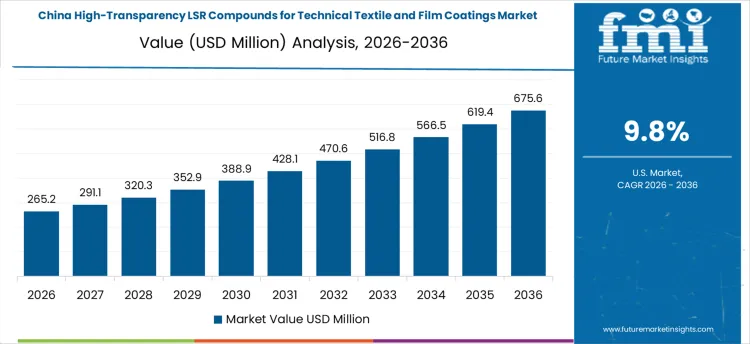
China demand is driven by large-scale production of technical textiles and coated films used in industrial, medical, and consumer applications. CAGR of 9.8% reflects adoption of high-transparency LSR compounds that provide optical clarity, flexibility, and resistance to heat and chemicals. Manufacturers require consistent flow behavior and adhesion across continuous coating lines. Functional films for electronics protection and industrial covers increase volume demand. Domestic compounders scale transparent LSR formulations optimized for high-throughput processing. Regulatory alignment and export requirements reinforce material upgrades. Growth remains scale-driven and manufacturing-aligned, supported by infrastructure investment and expanding coated textile capacity.
- Expansion of technical textile and film coating production
- Demand for optical clarity and thermal resistance
- Compatibility with continuous coating processes
- Scaling of domestic transparent LSR compounding
How is India sustaining growth in high-transparency LSR compound usage?
India demand reflects expansion of technical textile manufacturing and gradual shift toward higher-performance coating materials. CAGR of 9.5% is supported by adoption of transparent LSR compounds in protective fabrics, architectural membranes, and specialty films. Manufacturers prioritize durability, clarity, and cost efficiency. Government initiatives supporting technical textiles influence material adoption. Domestic processors integrate LSR coatings to improve product differentiation. Equipment compatibility and simplified processing support uptake. Growth remains manufacturing-led and cost-aligned, supported by increasing domestic demand and export-oriented textile development.
- Growth of technical textile and coated fabric sectors
- Need for clarity and durability in coatings
- Influence of technical textile promotion programs
- Adoption of LSR for value-added differentiation
What factors support Germany’s steady expansion in transparent LSR compounds?
Germany demand reflects strong engineering standards, quality assurance requirements, and use of technical textiles in regulated applications. CAGR of 9.3% is supported by adoption of high-transparency LSR compounds in medical textiles, industrial films, and precision coatings. Manufacturers require predictable rheology, optical consistency, and long-term stability. Regulatory compliance and documentation guide material selection. Compounders invest in purity control and formulation precision. Collaboration between material suppliers and end users accelerates qualification. Growth remains technology-led and quality-focused, supported by advanced processing standards and performance-driven markets.
- Use in regulated and precision technical applications
- Emphasis on optical consistency and stability
- Strong regulatory and documentation requirements
- Collaboration across material and application development
What is shaping demand growth in the USA for high-transparency LSR coatings?
USA demand is shaped by diversified applications across industrial textiles, protective films, and specialty coatings. CAGR of 9.0% reflects adoption of transparent LSR compounds that deliver clarity, flexibility, and resistance to environmental stress. Manufacturers emphasize performance consistency and scalability. Innovation in coated fabrics for medical, aerospace, and industrial uses supports demand. Domestic compounders offer application-specific transparent grades. Growth remains application-driven and performance-focused, aligned with product innovation and quality assurance needs.
- Diversified end-use applications for coated textiles
- Demand for clarity and environmental resistance
- Availability of application-specific LSR grades
- Focus on scalable and reliable coating performance
Why is Japan showing measured growth in high-transparency LSR compound adoption?
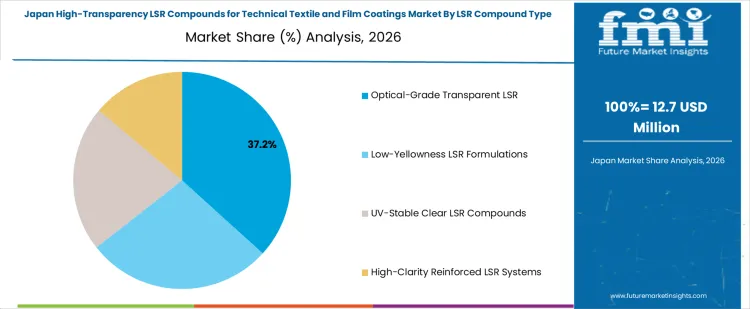
Japan demand reflects cautious material qualification, emphasis on precision, and high standards for optical performance. CAGR of 8.8% is supported by selective adoption of transparent LSR compounds in electronics-related films and specialty technical textiles. Manufacturers prioritize surface finish, purity, and long-term stability. Qualification cycles remain stringent. Domestic suppliers focus on consistency and process control. Growth remains quality-driven and technology-aligned, supported by disciplined engineering practices and targeted application expansion.
- High standards for optical purity and surface quality
- Selective adoption in specialty applications
- Rigorous material qualification processes
- Emphasis on consistency and long-term performance
What is the competitive landscape of demand for high-transparency LSR compounds for technical textile and film coatings globally?
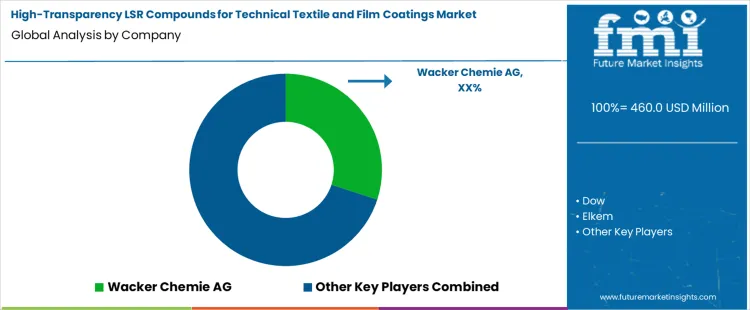
Demand for high-transparency LSR compounds for technical textile and film coatings is driven by optical clarity requirements, durability expectations, and expansion of coated fabrics and functional films. Applications include protective textiles, medical fabrics, architectural membranes, and specialty films requiring flexibility, UV stability, and visual transparency. Buyers evaluate optical transmission, haze control, adhesion to textile substrates, mechanical resilience, and processing consistency under coating and calendaring conditions. Procurement teams prioritize suppliers with formulation purity, stable rheology, and documented compliance with industrial, medical, and safety standards. Trend in the global market reflects increased use of silicone-based coatings to replace PVC and PU systems in transparency-critical applications.
Wacker Chemie AG holds leading positioning through high-purity LSR compounds engineered for transparent coating and impregnation applications. Dow supports demand with silicone elastomer platforms optimized for optical clarity and processing stability in textile and film coatings. Elkem contributes transparent LSR solutions with strong UV resistance and long-term performance characteristics. Momentive supplies specialty silicone elastomers tailored for coated fabric durability and visual consistency. Shin-Etsu Chemical participates through advanced LSR materials supporting high-transparency and precision coating requirements. Competitive differentiation depends on optical performance consistency, adhesion reliability, processing window control, and ability to support high-volume technical coating operations.
Key Players in the High-Transparency LSR Compounds for Technical Textile and Film Coatings Market
- Wacker Chemie AG
- Dow
- Elkem
- Momentive
- Shin-Etsu Chemical
Scope of the Report
| Items | Values |
|---|---|
| Quantitative Units | USD million |
| LSR Compound Type | Optical-Grade Transparent LSR; Low-Yellowness LSR Formulations; UV-Stable Clear LSR Compounds; High-Clarity Reinforced LSR Systems |
| Transparency Optimization Method | Refractive Index Matching Additives; Ultra-Low Impurity Silicone Feedstocks; Advanced Degassing & Filtration; Anti-Yellowing Stabilizer Packages |
| Application | Technical Textile Coatings; Protective & Functional Films; Medical & Hygiene Textile Layers; Optical & Display-Related Films |
| Regions Covered | Asia Pacific, Europe, North America, Latin America, Middle East & Africa |
| Countries Covered | China, India, Germany, USA, Japan, and 40+ countries |
| Key Companies Profiled | Wacker Chemie AG; Dow; Elkem; Momentive; Shin-Etsu Chemical |
| Additional Attributes | Dollar sales by LSR compound type and application; adoption trends for high-transparency LSR coatings in textiles and films; optical clarity, haze, and yellowness index performance metrics; compatibility with coating, calendaring, and film-lamination processes; long-term UV stability, thermal aging, and cleanliness considerations; compliance with medical, hygiene, and optical material standards influencing transparent LSR compound selection. |
High-Transparency LSR Compounds for Technical Textile and Film Coatings Market by Segment
LSR Compound Type:
- Optical-Grade Transparent LSR
- Low-Yellowness LSR Formulations
- UV-Stable Clear LSR Compounds
- High-Clarity Reinforced LSR Systems
Transparency Optimization Method:
- Refractive Index Matching Additives
- Ultra-Low Impurity Silicone Feedstocks
- Advanced Degassing & Filtration
- Anti-Yellowing Stabilizer Packages
Application:
- Technical Textile Coatings
- Protective & Functional Films
- Medical & Hygiene Textile Layers
- Optical & Display-Related Films
Region:
- Asia Pacific
- China
- Japan
- South Korea
- India
- Australia & New Zealand
- ASEAN
- Rest of Asia Pacific
- Europe
- Germany
- United Kingdom
- France
- Italy
- Spain
- Nordic
- BENELUX
- Rest of Europe
- North America
- United States
- Canada
- Mexico
- Latin America
- Brazil
- Chile
- Rest of Latin America
- Middle East & Africa
- Kingdom of Saudi Arabia
- Other GCC Countries
- Turkey
- South Africa
- Other African Union
- Rest of Middle East & Africa
Frequently Asked Questions
How big is the high-transparency LSR compounds for technical textile and film coatings market in 2026?
The global high-transparency LSR compounds for technical textile and film coatings market is estimated to be valued at USD 460.0 million in 2026.
What will be the size of high-transparency LSR compounds for technical textile and film coatings market in 2036?
The market size for the high-transparency LSR compounds for technical textile and film coatings market is projected to reach USD 1,129.6 million by 2036.
How much will be the high-transparency LSR compounds for technical textile and film coatings market growth between 2026 and 2036?
The high-transparency LSR compounds for technical textile and film coatings market is expected to grow at a 9.4% CAGR between 2026 and 2036.
What are the key LSR compound types in the high-transparency lsr compounds for technical textile and film coatings market?
The key LSR compound types in high-transparency LSR compounds for technical textile and film coatings market are optical-grade transparent LSR, low-yellowness LSR formulations, UV-stable clear LSR compounds, and high-clarity reinforced LSR systems.
Which transparency optimization method segment to contribute significant share in the high-transparency LSR compounds for technical textile and film coatings market in 2026?
In terms of transparency optimization method, refractive index matching additives segment to command 38.0% share in the high-transparency LSR compounds for technical textile and film coatings market in 2026.
Preview the report firsthand - request a free sample
Get SampleGet the brochure for pricing and purchase details.
Get PDFTable of Content
- Executive Summary
- Global Market Outlook
- Demand-side Trends
- Supply-side Trends
- Technology Roadmap Analysis
- Analysis and Recommendations
- Market Overview
- Market Coverage / Taxonomy
- Market Definition / Scope / Limitations
- Market Background
- Market Dynamics
- Drivers
- Restraints
- Opportunity
- Trends
- Scenario Forecast
- Demand in Optimistic Scenario
- Demand in Likely Scenario
- Demand in Conservative Scenario
- Opportunity Map Analysis
- Product Life Cycle Analysis
- Supply Chain Analysis
- Investment Feasibility Matrix
- Value Chain Analysis
- PESTLE and Porter’s Analysis
- Regulatory Landscape
- Regional Parent Market Outlook
- Production and Consumption Statistics
- Import and Export Statistics
- Market Dynamics
- Global Market Analysis 2021 to 2025 and Forecast, 2026 to 2036
- Historical Market Size Value (USD Million) Analysis, 2021 to 2025
- Current and Future Market Size Value (USD Million) Projections, 2026 to 2036
- Y-o-Y Growth Trend Analysis
- Absolute $ Opportunity Analysis
- Global Market Pricing Analysis 2021 to 2025 and Forecast 2026 to 2036
- Global Market Analysis 2021 to 2025 and Forecast 2026 to 2036, By LSR Compound Type
- Introduction / Key Findings
- Historical Market Size Value (USD Million) Analysis By LSR Compound Type , 2021 to 2025
- Current and Future Market Size Value (USD Million) Analysis and Forecast By LSR Compound Type , 2026 to 2036
- Optical-Grade Transparent LSR
- Low-Yellowness LSR Formulations
- UV-Stable Clear LSR Compounds
- High-Clarity Reinforced LSR Systems
- Optical-Grade Transparent LSR
- Y-o-Y Growth Trend Analysis By LSR Compound Type , 2021 to 2025
- Absolute $ Opportunity Analysis By LSR Compound Type , 2026 to 2036
- Global Market Analysis 2021 to 2025 and Forecast 2026 to 2036, By Transparency Optimization Method
- Introduction / Key Findings
- Historical Market Size Value (USD Million) Analysis By Transparency Optimization Method, 2021 to 2025
- Current and Future Market Size Value (USD Million) Analysis and Forecast By Transparency Optimization Method, 2026 to 2036
- Refractive Index Matching Additives
- Ultra-Low Impurity Silicone Feedstocks
- Advanced Degassing & Filtration
- Anti-Yellowing Stabilizer Packages
- Refractive Index Matching Additives
- Y-o-Y Growth Trend Analysis By Transparency Optimization Method, 2021 to 2025
- Absolute $ Opportunity Analysis By Transparency Optimization Method, 2026 to 2036
- Global Market Analysis 2021 to 2025 and Forecast 2026 to 2036, By Application
- Introduction / Key Findings
- Historical Market Size Value (USD Million) Analysis By Application, 2021 to 2025
- Current and Future Market Size Value (USD Million) Analysis and Forecast By Application, 2026 to 2036
- Technical Textile Coatings
- Protective & Functional Films
- Medical & Hygiene Textile Layers
- Optical & Display-Related Films
- Technical Textile Coatings
- Y-o-Y Growth Trend Analysis By Application, 2021 to 2025
- Absolute $ Opportunity Analysis By Application, 2026 to 2036
- Global Market Analysis 2021 to 2025 and Forecast 2026 to 2036, By Region
- Introduction
- Historical Market Size Value (USD Million) Analysis By Region, 2021 to 2025
- Current Market Size Value (USD Million) Analysis and Forecast By Region, 2026 to 2036
- North America
- Latin America
- Western Europe
- Eastern Europe
- East Asia
- South Asia and Pacific
- Middle East & Africa
- Market Attractiveness Analysis By Region
- North America Market Analysis 2021 to 2025 and Forecast 2026 to 2036, By Country
- Historical Market Size Value (USD Million) Trend Analysis By Market Taxonomy, 2021 to 2025
- Market Size Value (USD Million) Forecast By Market Taxonomy, 2026 to 2036
- By Country
- USA
- Canada
- Mexico
- By LSR Compound Type
- By Transparency Optimization Method
- By Application
- By Country
- Market Attractiveness Analysis
- By Country
- By LSR Compound Type
- By Transparency Optimization Method
- By Application
- Key Takeaways
- Latin America Market Analysis 2021 to 2025 and Forecast 2026 to 2036, By Country
- Historical Market Size Value (USD Million) Trend Analysis By Market Taxonomy, 2021 to 2025
- Market Size Value (USD Million) Forecast By Market Taxonomy, 2026 to 2036
- By Country
- Brazil
- Chile
- Rest of Latin America
- By LSR Compound Type
- By Transparency Optimization Method
- By Application
- By Country
- Market Attractiveness Analysis
- By Country
- By LSR Compound Type
- By Transparency Optimization Method
- By Application
- Key Takeaways
- Western Europe Market Analysis 2021 to 2025 and Forecast 2026 to 2036, By Country
- Historical Market Size Value (USD Million) Trend Analysis By Market Taxonomy, 2021 to 2025
- Market Size Value (USD Million) Forecast By Market Taxonomy, 2026 to 2036
- By Country
- Germany
- UK
- Italy
- Spain
- France
- Nordic
- BENELUX
- Rest of Western Europe
- By LSR Compound Type
- By Transparency Optimization Method
- By Application
- By Country
- Market Attractiveness Analysis
- By Country
- By LSR Compound Type
- By Transparency Optimization Method
- By Application
- Key Takeaways
- Eastern Europe Market Analysis 2021 to 2025 and Forecast 2026 to 2036, By Country
- Historical Market Size Value (USD Million) Trend Analysis By Market Taxonomy, 2021 to 2025
- Market Size Value (USD Million) Forecast By Market Taxonomy, 2026 to 2036
- By Country
- Russia
- Poland
- Hungary
- Balkan & Baltic
- Rest of Eastern Europe
- By LSR Compound Type
- By Transparency Optimization Method
- By Application
- By Country
- Market Attractiveness Analysis
- By Country
- By LSR Compound Type
- By Transparency Optimization Method
- By Application
- Key Takeaways
- East Asia Market Analysis 2021 to 2025 and Forecast 2026 to 2036, By Country
- Historical Market Size Value (USD Million) Trend Analysis By Market Taxonomy, 2021 to 2025
- Market Size Value (USD Million) Forecast By Market Taxonomy, 2026 to 2036
- By Country
- China
- Japan
- South Korea
- By LSR Compound Type
- By Transparency Optimization Method
- By Application
- By Country
- Market Attractiveness Analysis
- By Country
- By LSR Compound Type
- By Transparency Optimization Method
- By Application
- Key Takeaways
- South Asia and Pacific Market Analysis 2021 to 2025 and Forecast 2026 to 2036, By Country
- Historical Market Size Value (USD Million) Trend Analysis By Market Taxonomy, 2021 to 2025
- Market Size Value (USD Million) Forecast By Market Taxonomy, 2026 to 2036
- By Country
- India
- ASEAN
- Australia & New Zealand
- Rest of South Asia and Pacific
- By LSR Compound Type
- By Transparency Optimization Method
- By Application
- By Country
- Market Attractiveness Analysis
- By Country
- By LSR Compound Type
- By Transparency Optimization Method
- By Application
- Key Takeaways
- Middle East & Africa Market Analysis 2021 to 2025 and Forecast 2026 to 2036, By Country
- Historical Market Size Value (USD Million) Trend Analysis By Market Taxonomy, 2021 to 2025
- Market Size Value (USD Million) Forecast By Market Taxonomy, 2026 to 2036
- By Country
- Kingdom of Saudi Arabia
- Other GCC Countries
- Turkiye
- South Africa
- Other African Union
- Rest of Middle East & Africa
- By LSR Compound Type
- By Transparency Optimization Method
- By Application
- By Country
- Market Attractiveness Analysis
- By Country
- By LSR Compound Type
- By Transparency Optimization Method
- By Application
- Key Takeaways
- Key Countries Market Analysis
- USA
- Pricing Analysis
- Market Share Analysis, 2025
- By LSR Compound Type
- By Transparency Optimization Method
- By Application
- Canada
- Pricing Analysis
- Market Share Analysis, 2025
- By LSR Compound Type
- By Transparency Optimization Method
- By Application
- Mexico
- Pricing Analysis
- Market Share Analysis, 2025
- By LSR Compound Type
- By Transparency Optimization Method
- By Application
- Brazil
- Pricing Analysis
- Market Share Analysis, 2025
- By LSR Compound Type
- By Transparency Optimization Method
- By Application
- Chile
- Pricing Analysis
- Market Share Analysis, 2025
- By LSR Compound Type
- By Transparency Optimization Method
- By Application
- Germany
- Pricing Analysis
- Market Share Analysis, 2025
- By LSR Compound Type
- By Transparency Optimization Method
- By Application
- UK
- Pricing Analysis
- Market Share Analysis, 2025
- By LSR Compound Type
- By Transparency Optimization Method
- By Application
- Italy
- Pricing Analysis
- Market Share Analysis, 2025
- By LSR Compound Type
- By Transparency Optimization Method
- By Application
- Spain
- Pricing Analysis
- Market Share Analysis, 2025
- By LSR Compound Type
- By Transparency Optimization Method
- By Application
- France
- Pricing Analysis
- Market Share Analysis, 2025
- By LSR Compound Type
- By Transparency Optimization Method
- By Application
- India
- Pricing Analysis
- Market Share Analysis, 2025
- By LSR Compound Type
- By Transparency Optimization Method
- By Application
- ASEAN
- Pricing Analysis
- Market Share Analysis, 2025
- By LSR Compound Type
- By Transparency Optimization Method
- By Application
- Australia & New Zealand
- Pricing Analysis
- Market Share Analysis, 2025
- By LSR Compound Type
- By Transparency Optimization Method
- By Application
- China
- Pricing Analysis
- Market Share Analysis, 2025
- By LSR Compound Type
- By Transparency Optimization Method
- By Application
- Japan
- Pricing Analysis
- Market Share Analysis, 2025
- By LSR Compound Type
- By Transparency Optimization Method
- By Application
- South Korea
- Pricing Analysis
- Market Share Analysis, 2025
- By LSR Compound Type
- By Transparency Optimization Method
- By Application
- Russia
- Pricing Analysis
- Market Share Analysis, 2025
- By LSR Compound Type
- By Transparency Optimization Method
- By Application
- Poland
- Pricing Analysis
- Market Share Analysis, 2025
- By LSR Compound Type
- By Transparency Optimization Method
- By Application
- Hungary
- Pricing Analysis
- Market Share Analysis, 2025
- By LSR Compound Type
- By Transparency Optimization Method
- By Application
- Kingdom of Saudi Arabia
- Pricing Analysis
- Market Share Analysis, 2025
- By LSR Compound Type
- By Transparency Optimization Method
- By Application
- Turkiye
- Pricing Analysis
- Market Share Analysis, 2025
- By LSR Compound Type
- By Transparency Optimization Method
- By Application
- South Africa
- Pricing Analysis
- Market Share Analysis, 2025
- By LSR Compound Type
- By Transparency Optimization Method
- By Application
- USA
- Market Structure Analysis
- Competition Dashboard
- Competition Benchmarking
- Market Share Analysis of Top Players
- By Regional
- By LSR Compound Type
- By Transparency Optimization Method
- By Application
- Competition Analysis
- Competition Deep Dive
- Wacker Chemie AG
- Overview
- Product Portfolio
- Profitability by Market Segments (Product/Age /Sales Channel/Region)
- Sales Footprint
- Strategy Overview
- Marketing Strategy
- Product Strategy
- Channel Strategy
- Dow
- Elkem
- Momentive
- Shin-Etsu Chemical
- Wacker Chemie AG
- Competition Deep Dive
- Assumptions & Acronyms Used
- Research Methodology


