

- Industry Size (2026)
- USD 3.9 Bn
- Forecast (2036)
- USD 8.8 Bn
- CAGR (2026 to 2036)
- 8.5%
LSR Grades for Functional Textile Coating and Sealing Applications Market Forecast and Outlook 2026 to 2036
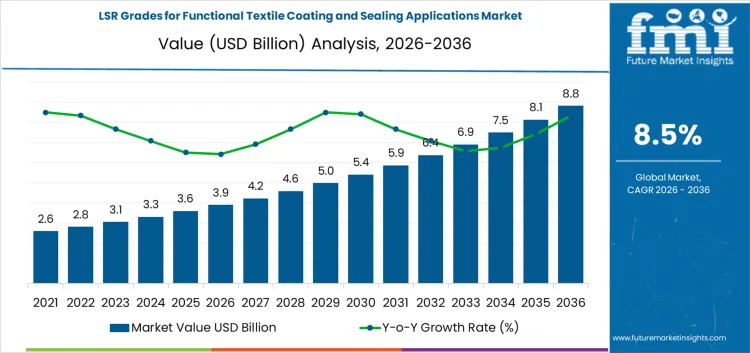
The global LSR grades for functional textile coating and sealing applications market is projected to grow from USD 3.9 billion in 2026 to USD 8.8 billion by 2036, at a CAGR of 8.5%. This growth is largely driven by the increasing demand for durable, high-performance, and versatile materials in textiles, particularly in automotive, healthcare, and industrial sectors. Regional market dynamics reflect uneven adoption patterns, with China leading the market due to its strong textile manufacturing base and the rising demand for functional textiles.
The USA follows closely, driven by increasing adoption of advanced textile technologies, particularly in the EV and medical sectors. Germany's market is bolstered by innovations in industrial textiles, and Japan is growing due to its automotive and wearable technology industries. South Korea’s market is expanding due to its focus on sustainable manufacturing practices. These geographic cost advantages and regional growth rates highlight varying market readiness, with some regions benefiting from established infrastructure and others driven by emerging demand for high-performance textiles in functional applications.
Quick Stats for LSR Grades for Functional Textile Coating and Sealing Applications Market
- LSR Grades for Functional Textile Coating and Sealing Applications Market Value (2026): USD 3.9 Billion
- LSR Grades for Functional Textile Coating and Sealing Applications Market Forecast Value (2036): USD 8.8 Billion
- LSR Grades for Functional Textile Coating and Sealing Applications Market Forecast CAGR (2026 to 2036): 8.5%
- Leading Polymer Type in LSR Grades for Functional Textile Coating and Sealing Applications Market: Standard Industrial LSR
- Key Growth Regions in LSR Grades for Functional Textile Coating and Sealing Applications Market: Asia Pacific, North America
- Top Key Players in LSR Grades for Functional Textile Coating and Sealing Applications Market: Dow Inc., Wacker Chemie AG, Shin-Etsu Chemical Co., Ltd.
LSR Grades for Functional Textile Coating and Sealing Applications Market Key Takeaways
| Metric | Value |
|---|---|
| Industry Value (2026) | USD 3.9 Billion |
| Forecast Value (2036) | USD 8.8 Billion |
| Forecast CAGR (2026 to 2036) | 8.5% |
How is the Global LSR Grades for Functional Textile Coating and Sealing Applications Market Advancing?
The global LSR (liquid silicone rubber) grades for functional textile coating and sealing applications market is experiencing significant growth, driven by the increasing demand for high-performance, durable, and versatile materials in the textile and garment industries. LSR grades are widely used for coating and sealing applications due to their superior properties, such as heat resistance, flexibility, and excellent adhesion to various substrates. These characteristics make them an ideal choice for functional textile coatings, particularly in products that require water resistance, durability, and long-term performance, such as outdoor wear, medical textiles, and automotive fabrics.
The market growth is driven by the increasing adoption of LSR grades in various textile applications, including waterproof coatings, flame-retardant textiles, and protective clothing. The growing demand for functional textiles in industries such as healthcare, automotive, and sports is also contributing to the expansion of the LSR grades market. LSR offers advantages such as ease of processing, excellent mechanical properties, and resistance to extreme environmental conditions, making it an attractive choice for manufacturers looking to improve the performance and longevity of their textile products.
Technological advancements in LSR formulations, such as the development of more sustainable and cost-effective options, are further propelling the market. As the demand for functional, high-performance textiles continues to rise, especially in safety and medical applications, the LSR grades for functional textile coating and sealing applications market is expected to experience steady growth over the coming years.
What Is the Segment-Wise Analysis for the LSR Grades for Functional Textile Coating and Sealing Applications Market?
The LSR grades for functional textile coating and sealing applications market is segmented by grade type and application. Standard Industrial LSR leads the market with a 40% share, followed by high-temperature or specialty LSR, medical or high-purity LSR (textile hygiene), and customized textile-specific LSR. These LSR grades are essential for enhancing the functionality and durability of textile products. In terms of application, functional outdoor apparel dominates with 30% share, followed by technical & industrial textiles, protective & safety fabrics, medical & healthcare textiles, and other textile applications.
Why Does Standard Industrial LSR Lead the Market?
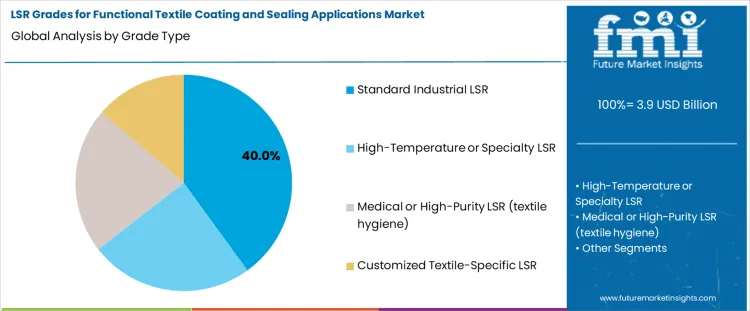
Standard Industrial LSR accounts for 40% of the market share in LSR grades for functional textile coating and sealing applications due to its widespread use in various industrial textile applications. This LSR grade offers an optimal balance of flexibility, durability, and ease of processing, making it ideal for functional coatings and seals in textiles. It is particularly valued for its resistance to heat, moisture, and chemicals, ensuring long-lasting performance in demanding environments. As industries continue to seek reliable, high-performance solutions for textiles, the adoption of standard industrial LSR remains strong, reinforcing its leadership in the market.
How Does Functional Outdoor Apparel Contribute to the LSR Grades Market?
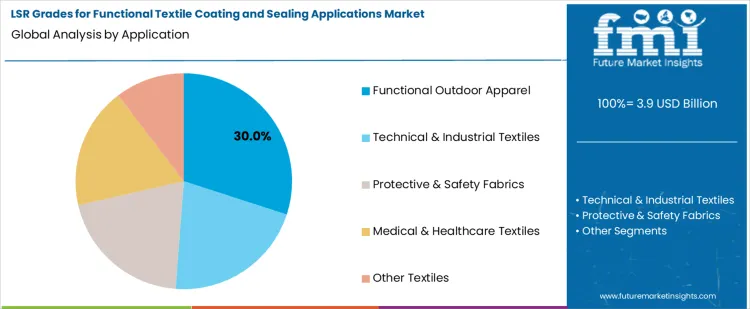
Functional outdoor apparel represents 30% of the application segment in the LSR grades for functional textile coating and sealing applications market. This sector benefits significantly from LSR coatings and seals, which improve the performance, durability, and comfort of outdoor garments. LSR materials provide waterproofing, thermal resistance, and flexibility, making them ideal for use in apparel designed for extreme weather conditions. As the demand for high-performance outdoor clothing rises, particularly in the sports, adventure, and military sectors, functional outdoor apparel continues to be a major contributor to the market for LSR grades, driving growth in textile coating and sealing applications.
What Are the Key Dynamics for the LSR Grades for Functional Textile Coating and Sealing Applications Market?
The LSR grades for functional textile coating and sealing applications market is shaped by growing demand for advanced liquid silicone rubber (LSR) formulations that deliver superior flexibility, durability, weather resistance, and chemical stability on textile substrates. These functional coatings and seals enhance performance in automotive interiors, industrial wear, medical textiles, sports apparel, and protective fabrics. As manufacturers seek materials that combine performance with process efficiency, LSR grades tailored for textile applications become critical.
How Are the Key Drivers Shaping the LSR Grades for Functional Textile Coating and Sealing Applications Market?
Growth in the LSR grades for functional textile coating and sealing applications market is driven by rising end‑use requirements for textiles that offer water repellency, breathability, UV resistance, and enhanced mechanical properties. LSR grades provide excellent adhesion and elasticity, enabling functional finishes like seam sealing, anti‑abrasion layers, and protective barriers without adding significant weight. Advances in silicone compounding technologies allow customization for specific performance needs, including flame retardance and chemical resistance. Cross‑industry adoption spanning automotive, healthcare, outdoor gear, and industrial textiles is expanding.
Why Are There Restraints Impacting the LSR Grades for Functional Textile Coating and Sealing Applications Market?
The LSR Grades for Functional Textile Coating and Sealing Applications Market faces restraint from the high cost and formulation complexity of advanced LSR compounds compared with conventional polymer coatings. Achieving tailored performance characteristics often requires precise compounding and specialized additives, which raise production expenses. This can constrain adoption among price‑sensitive textile manufacturers or apparel brands focused on cost reduction. Integrating LSR coating processes into existing textile production lines may require capital investments in equipment and training.
What is the Growth Outlook for the LSR Grades for Functional Textile Coating and Sealing Applications Market by Country?
| Country | CAGR (%) |
|---|---|
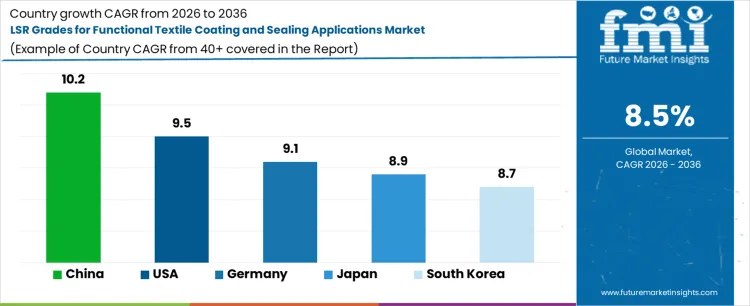
| China | 10.2% |
| USA | 9.5% |
| Germany | 9.1% |
| Japan | 8.9% |
| South Korea | 8.7% |
The LSR grades for functional textile coating and sealing applications market is experiencing steady growth globally, with China leading at 10.2%, driven by its dominant position in the textile manufacturing industry and rising demand for functional textiles in sectors like automotive, healthcare, and consumer goods. The USA follows with a growth rate of 9.5%, fueled by advancements in LSR technology and increasing adoption of functional textiles for medical and industrial applications. Germany’s market grows at 9.1%, supported by innovation in functional coatings for high-performance textiles. Japan grows at 8.9%, driven by demand for durable, high-quality textiles in various industries. South Korea’s market grows at 8.7%, with increasing applications in wearable technologies and smart textiles.
What is Driving the Growth of the LSR Grades for Functional Textile Coating and Sealing Applications Market in China?
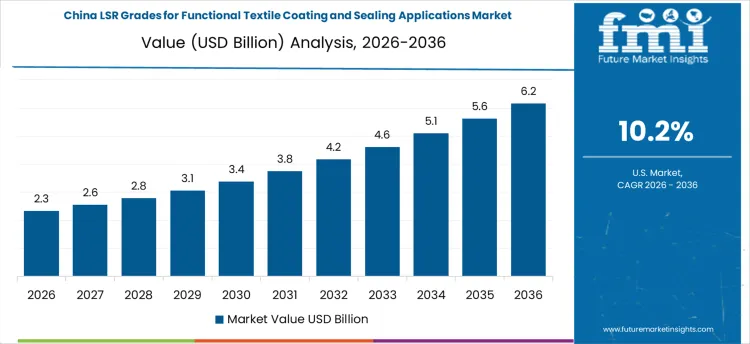
China’s LSR grades for functional textile coating and sealing applications market is growing at 10.2%, driven by the country’s dominance in the textile industry and the increasing demand for functional textiles in automotive, healthcare, and consumer goods. As one of the largest textile manufacturers globally, China’s shift toward high-performance textiles is driving the need for advanced coating and sealing materials. The rising demand for durable, high-quality fabrics used in industrial and consumer products is accelerating the adoption of LSR materials. The Chinese government’s focus on innovation and green technologies further supports the market, with a growing emphasis on sustainability in manufacturing. As industries seek improved functionality and performance in textiles, China’s market for LSR grades is expected to continue its upward trajectory, driven by technological advancements and the expanding demand for specialized textiles.
What is Contributing to the Growth of the LSR Grades for Functional Textile Coating and Sealing Applications Market in the USA?
The LSR grades for functional textile coating and sealing applications market in the USA is growing at 9.5%, fueled by increasing demand for functional textiles in various industries, such as healthcare, automotive, and industrial applications. Liquid silicone rubber (LSR) is gaining popularity for its durability, flexibility, and superior sealing and coating properties, making it ideal for high-performance textiles. The USA’s focus on advanced manufacturing techniques, including the use of sustainable and high-quality materials, is driving the market. The rising trend of wearable technologies and smart fabrics is contributing to the demand for LSR coatings. The automotive industry’s growing focus on lightweight, functional materials and stricter regulations on material performance are also pushing the adoption of LSR grades. As demand for innovative textile solutions continues to rise, the USA’s market for LSR grades is set to grow further.
How is the LSR Grades for Functional Textile Coating and Sealing Applications Market Expanding in Germany?
Germany’s LSR grades for functional textile coating and sealing applications market is growing at 9.1%, driven by the country’s leadership in automotive manufacturing and high-performance textile applications. The increasing demand for functional textiles in automotive interiors, medical devices, and industrial sectors is propelling the growth of LSR coatings. Germany’s automotive industry, with its focus on lightweight and durable materials, relies heavily on LSR grades for textile applications that ensure high performance and safety. The growing emphasis on sustainability in manufacturing, combined with innovations in textile technologies, is further supporting the demand for LSR materials. The rising adoption of functional coatings and sealing solutions in specialized textiles, particularly in applications requiring high precision and quality, contributes to the expansion of the market. Germany’s strong focus on technological advancements in manufacturing ensures the continued growth of this market.
What is Driving the Growth of the LSR Grades for Functional Textile Coating and Sealing Applications Market in Japan?
Japan’s LSR grades for functional textile coating and sealing applications market is growing at 8.9%, supported by the country’s technological expertise in high-performance materials and the expanding demand for functional textiles in the automotive, healthcare, and electronics sectors. The need for durable, high-quality textile coatings that meet stringent industry standards is increasing, particularly in automotive applications where lightweight and robust materials are essential. Japan’s innovation in textile technologies, particularly in smart textiles and wearable devices, is driving the need for advanced materials like LSR for coating and sealing applications. Japan’s automotive industry, with its growing emphasis on electric vehicles (EVs), is increasingly relying on LSR grades to ensure the quality of vehicle interiors and components. As Japan continues to prioritize sustainability and innovation, its market for LSR grades in textile coatings and sealing is expected to grow steadily.
What is Contributing to the Growth of the LSR Grades for Functional Textile Coating and Sealing Applications Market in South Korea?
South Korea’s LSR grades for functional textile coating and sealing applications market is growing at 8.7%, driven by the country’s strong automotive and electronics industries, which require high-performance materials for textiles. As South Korea continues to innovate in electric vehicles (EVs) and consumer electronics, the demand for durable, functional textiles is increasing, particularly for automotive interiors and wearable technologies. LSR grades are gaining popularity due to their ability to provide excellent sealing and coating properties, ensuring long-lasting performance in automotive and industrial applications. South Korea’s push towards sustainable manufacturing practices and the rise of smart fabrics are also contributing to the growing demand for LSR-coated textiles. With increasing investments in advanced manufacturing and automotive sectors, South Korea’s market for LSR grades for textile applications is expected to continue expanding, driven by innovation and the need for high-quality materials.
What Are the Competitive Strategies in the LSR Grades for Functional Textile Coating and Sealing Applications Market?
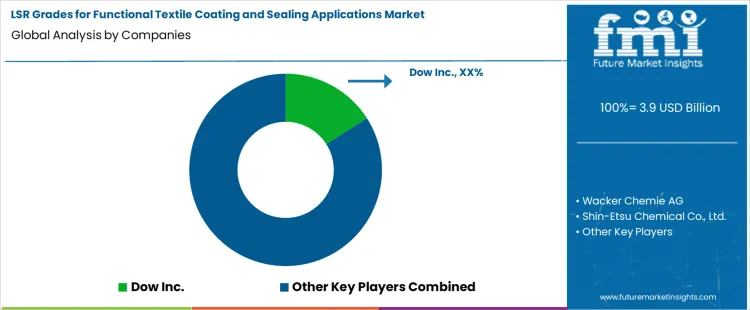
Competition in the LSR (liquid silicone rubber) grades for functional textile coating and sealing applications market is driven by material performance, formulation versatility, curing characteristics, and application specificity. Dow Inc. positions its LSR offerings with tailored formulations that combine excellent flexibility, adhesion, and thermal stability, and its product literature highlights broad compatibility with diverse textile substrates used in industrial, automotive, and consumer applications. Wacker Chemie AG competes with a wide portfolio of high-performance silicone solutions designed for coating, sealing, and encapsulation, emphasizing consistent quality, reliable cure profiles, and robust mechanical properties.
Shin-Etsu Chemical Co., Ltd. differentiates through specialty LSR grades that deliver enhanced adhesion and durability for performance textiles, with collateral underscoring controlled viscosity ranges and customizable cure kinetics that support high-speed processing. Elkem ASA brings innovative silicone elastomer technologies that are marketed for excellent weathering resistance and tensile strength, helping textile manufacturers deliver products that perform reliably under stress.
Momentive Performance Materials competes with advanced LSR systems engineered for precise application control and rapid cure, and its brochures focus on formulation flexibility for functional finishes and sealing layers. Avantor Inc. offers LSR chemistries tailored for niche coating and sealing requirements, with documentation emphasizing tight specification control and consistent batch-to-batch performance. KCC Corporation rounds out the competitive landscape with cost-effective LSR solutions that balance performance and processing efficiency, often positioned for mid-range industrial and consumer textile applications. Across all vendors, product materials underscore mechanical performance, process adaptability, cure behavior, and compatibility with textile finishing systems as key differentiators in this evolving market.
Key Players in LSR Grades for Functional Textile Coating and Sealing Applications Market
- Dow Inc.
- Wacker Chemie AG
- Shin‑Etsu Chemical Co., Ltd.
- Elkem ASA
- Momentive Performance Materials
- Avantor Inc.
- KCC Corporation
Scope of Report
| Items | Values |
|---|---|
| Quantitative Unit (2026) | USD Billion |
| Grade Type | Standard Industrial LSR, High-Temperature or Specialty LSR, Medical or High-Purity LSR (textile hygiene), Customized Textile-Specific LSR |
| Application | Functional Outdoor Apparel, Technical & Industrial Textiles, Protective & Safety Fabrics, Medical & Healthcare Textiles, Other Textiles |
| Regions Covered | Asia Pacific, Europe, North America, Latin America, Middle East & Africa |
| Countries Covered | USA, China, Japan, South Korea, India, Australia & New Zealand, ASEAN, Germany, UK, France, Italy, Spain, Nordic, BENELUX, Brazil, Chile, Mexico, Saudi Arabia, Other GCC Countries, Turkey, South Africa, Other African Union |
| Key Companies Profiled | Dow Inc., Wacker Chemie AG, Shin-Etsu Chemical Co., Ltd., Elkem ASA, Momentive Performance Materials, Avantor Inc., KCC Corporation |
| Additional Attributes | Dollar sales segmented by grade type, application, and region. Regional CAGR and growth outlook, with a focus on the role of LSR in enhancing textile durability and functionality for outdoor, industrial, and medical textiles. |
LSR Grades for Functional Textile Coating and Sealing Applications Market by Key Segments
By Grade Type:
- Standard Industrial LSR
- High‑Temperature or Specialty LSR
- Medical or High‑Purity LSR (textile hygiene)
- Customized Textile‑Specific LSR
By Application:
- Functional Outdoor Apparel
- Technical & Industrial Textiles
- Protective & Safety Fabrics
- Medical & Healthcare Textiles
- Other Textiles
By Region:
- Asia Pacific
- China
- Japan
- South Korea
- India
- Australia & New Zealand
- ASEAN
- Rest of Asia Pacific
- Europe
- Germany
- United Kingdom
- France
- Italy
- Spain
- Nordic
- BENELUX
- Rest of Europe
- North America
- United States
- Canada
- Mexico
- Latin America
- Brazil
- Chile
- Rest of Latin America
- Middle East & Africa
- Kingdom of Saudi Arabia
- Other GCC Countries
- Turkey
- South Africa
- Other African Union
- Rest of Middle East & Africa
Frequently Asked Questions
How big is the LSR Grades for functional textile coating and sealing applications market in 2026?
The global LSR Grades for functional textile coating and sealing applications market is estimated to be valued at USD 3.9 billion in 2026.
What will be the size of LSR Grades for functional textile coating and sealing applications market in 2036?
The market size for the LSR Grades for functional textile coating and sealing applications market is projected to reach USD 8.8 billion by 2036.
How much will be the LSR Grades for functional textile coating and sealing applications market growth between 2026 and 2036?
The LSR Grades for functional textile coating and sealing applications market is expected to grow at a 8.5% CAGR between 2026 and 2036.
What are the key grade types in the LSR Grades for functional textile coating and sealing applications market?
The key grade types in LSR Grades for functional textile coating and sealing applications market are standard industrial LSR, high‑temperature or specialty LSR, medical or high‑purity LSR (textile hygiene), and customized textile‑specific LSR.
Which application segment to contribute significant share in the LSR Grades for functional textile coating and sealing applications market in 2026?
In terms of application, functional outdoor apparel segment to command 30.0% share in the LSR Grades for functional textile coating and sealing applications market in 2026.
Preview the report firsthand - request a free sample
Get SampleGet the brochure for pricing and purchase details.
Get PDFTable of Content
- Executive Summary
- Global Market Outlook
- Demand-side Trends
- Supply-side Trends
- Technology Roadmap Analysis
- Analysis and Recommendations
- Market Overview
- Market Coverage / Taxonomy
- Market Definition / Scope / Limitations
- Market Background
- Market Dynamics
- Drivers
- Restraints
- Opportunity
- Trends
- Scenario Forecast
- Demand in Optimistic Scenario
- Demand in Likely Scenario
- Demand in Conservative Scenario
- Opportunity Map Analysis
- Product Life Cycle Analysis
- Supply Chain Analysis
- Investment Feasibility Matrix
- Value Chain Analysis
- PESTLE and Porter’s Analysis
- Regulatory Landscape
- Regional Parent Market Outlook
- Production and Consumption Statistics
- Import and Export Statistics
- Market Dynamics
- Global Market Analysis 2021 to 2025 and Forecast, 2026 to 2036
- Historical Market Size Value (USD Million) Analysis, 2021 to 2025
- Current and Future Market Size Value (USD Million) Projections, 2026 to 2036
- Y-o-Y Growth Trend Analysis
- Absolute $ Opportunity Analysis
- Global Market Pricing Analysis 2021 to 2025 and Forecast 2026 to 2036
- Global Market Analysis 2021 to 2025 and Forecast 2026 to 2036, By Grade Type
- Introduction / Key Findings
- Historical Market Size Value (USD Million) Analysis By Grade Type , 2021 to 2025
- Current and Future Market Size Value (USD Million) Analysis and Forecast By Grade Type , 2026 to 2036
- Standard Industrial LSR
- High‑Temperature or Specialty LSR
- Medical or High‑Purity LSR (textile hygiene)
- Customized Textile‑Specific LSR
- Standard Industrial LSR
- Y-o-Y Growth Trend Analysis By Grade Type , 2021 to 2025
- Absolute $ Opportunity Analysis By Grade Type , 2026 to 2036
- Global Market Analysis 2021 to 2025 and Forecast 2026 to 2036, By Application
- Introduction / Key Findings
- Historical Market Size Value (USD Million) Analysis By Application, 2021 to 2025
- Current and Future Market Size Value (USD Million) Analysis and Forecast By Application, 2026 to 2036
- Functional Outdoor Apparel
- Technical & Industrial Textiles
- Protective & Safety Fabrics
- Medical & Healthcare Textiles
- Other Textiles
- Functional Outdoor Apparel
- Y-o-Y Growth Trend Analysis By Application, 2021 to 2025
- Absolute $ Opportunity Analysis By Application, 2026 to 2036
- Global Market Analysis 2021 to 2025 and Forecast 2026 to 2036, By Region
- Introduction
- Historical Market Size Value (USD Million) Analysis By Region, 2021 to 2025
- Current Market Size Value (USD Million) Analysis and Forecast By Region, 2026 to 2036
- North America
- Latin America
- Western Europe
- Eastern Europe
- East Asia
- South Asia and Pacific
- Middle East & Africa
- Market Attractiveness Analysis By Region
- North America Market Analysis 2021 to 2025 and Forecast 2026 to 2036, By Country
- Historical Market Size Value (USD Million) Trend Analysis By Market Taxonomy, 2021 to 2025
- Market Size Value (USD Million) Forecast By Market Taxonomy, 2026 to 2036
- By Country
- USA
- Canada
- Mexico
- By Grade Type
- By Application
- By Country
- Market Attractiveness Analysis
- By Country
- By Grade Type
- By Application
- Key Takeaways
- Latin America Market Analysis 2021 to 2025 and Forecast 2026 to 2036, By Country
- Historical Market Size Value (USD Million) Trend Analysis By Market Taxonomy, 2021 to 2025
- Market Size Value (USD Million) Forecast By Market Taxonomy, 2026 to 2036
- By Country
- Brazil
- Chile
- Rest of Latin America
- By Grade Type
- By Application
- By Country
- Market Attractiveness Analysis
- By Country
- By Grade Type
- By Application
- Key Takeaways
- Western Europe Market Analysis 2021 to 2025 and Forecast 2026 to 2036, By Country
- Historical Market Size Value (USD Million) Trend Analysis By Market Taxonomy, 2021 to 2025
- Market Size Value (USD Million) Forecast By Market Taxonomy, 2026 to 2036
- By Country
- Germany
- UK
- Italy
- Spain
- France
- Nordic
- BENELUX
- Rest of Western Europe
- By Grade Type
- By Application
- By Country
- Market Attractiveness Analysis
- By Country
- By Grade Type
- By Application
- Key Takeaways
- Eastern Europe Market Analysis 2021 to 2025 and Forecast 2026 to 2036, By Country
- Historical Market Size Value (USD Million) Trend Analysis By Market Taxonomy, 2021 to 2025
- Market Size Value (USD Million) Forecast By Market Taxonomy, 2026 to 2036
- By Country
- Russia
- Poland
- Hungary
- Balkan & Baltic
- Rest of Eastern Europe
- By Grade Type
- By Application
- By Country
- Market Attractiveness Analysis
- By Country
- By Grade Type
- By Application
- Key Takeaways
- East Asia Market Analysis 2021 to 2025 and Forecast 2026 to 2036, By Country
- Historical Market Size Value (USD Million) Trend Analysis By Market Taxonomy, 2021 to 2025
- Market Size Value (USD Million) Forecast By Market Taxonomy, 2026 to 2036
- By Country
- China
- Japan
- South Korea
- By Grade Type
- By Application
- By Country
- Market Attractiveness Analysis
- By Country
- By Grade Type
- By Application
- Key Takeaways
- South Asia and Pacific Market Analysis 2021 to 2025 and Forecast 2026 to 2036, By Country
- Historical Market Size Value (USD Million) Trend Analysis By Market Taxonomy, 2021 to 2025
- Market Size Value (USD Million) Forecast By Market Taxonomy, 2026 to 2036
- By Country
- India
- ASEAN
- Australia & New Zealand
- Rest of South Asia and Pacific
- By Grade Type
- By Application
- By Country
- Market Attractiveness Analysis
- By Country
- By Grade Type
- By Application
- Key Takeaways
- Middle East & Africa Market Analysis 2021 to 2025 and Forecast 2026 to 2036, By Country
- Historical Market Size Value (USD Million) Trend Analysis By Market Taxonomy, 2021 to 2025
- Market Size Value (USD Million) Forecast By Market Taxonomy, 2026 to 2036
- By Country
- Kingdom of Saudi Arabia
- Other GCC Countries
- Turkiye
- South Africa
- Other African Union
- Rest of Middle East & Africa
- By Grade Type
- By Application
- By Country
- Market Attractiveness Analysis
- By Country
- By Grade Type
- By Application
- Key Takeaways
- Key Countries Market Analysis
- USA
- Pricing Analysis
- Market Share Analysis, 2025
- By Grade Type
- By Application
- Canada
- Pricing Analysis
- Market Share Analysis, 2025
- By Grade Type
- By Application
- Mexico
- Pricing Analysis
- Market Share Analysis, 2025
- By Grade Type
- By Application
- Brazil
- Pricing Analysis
- Market Share Analysis, 2025
- By Grade Type
- By Application
- Chile
- Pricing Analysis
- Market Share Analysis, 2025
- By Grade Type
- By Application
- Germany
- Pricing Analysis
- Market Share Analysis, 2025
- By Grade Type
- By Application
- UK
- Pricing Analysis
- Market Share Analysis, 2025
- By Grade Type
- By Application
- Italy
- Pricing Analysis
- Market Share Analysis, 2025
- By Grade Type
- By Application
- Spain
- Pricing Analysis
- Market Share Analysis, 2025
- By Grade Type
- By Application
- France
- Pricing Analysis
- Market Share Analysis, 2025
- By Grade Type
- By Application
- India
- Pricing Analysis
- Market Share Analysis, 2025
- By Grade Type
- By Application
- ASEAN
- Pricing Analysis
- Market Share Analysis, 2025
- By Grade Type
- By Application
- Australia & New Zealand
- Pricing Analysis
- Market Share Analysis, 2025
- By Grade Type
- By Application
- China
- Pricing Analysis
- Market Share Analysis, 2025
- By Grade Type
- By Application
- Japan
- Pricing Analysis
- Market Share Analysis, 2025
- By Grade Type
- By Application
- South Korea
- Pricing Analysis
- Market Share Analysis, 2025
- By Grade Type
- By Application
- Russia
- Pricing Analysis
- Market Share Analysis, 2025
- By Grade Type
- By Application
- Poland
- Pricing Analysis
- Market Share Analysis, 2025
- By Grade Type
- By Application
- Hungary
- Pricing Analysis
- Market Share Analysis, 2025
- By Grade Type
- By Application
- Kingdom of Saudi Arabia
- Pricing Analysis
- Market Share Analysis, 2025
- By Grade Type
- By Application
- Turkiye
- Pricing Analysis
- Market Share Analysis, 2025
- By Grade Type
- By Application
- South Africa
- Pricing Analysis
- Market Share Analysis, 2025
- By Grade Type
- By Application
- USA
- Market Structure Analysis
- Competition Dashboard
- Competition Benchmarking
- Market Share Analysis of Top Players
- By Regional
- By Grade Type
- By Application
- Competition Analysis
- Competition Deep Dive
- Dow Inc.
- Overview
- Product Portfolio
- Profitability by Market Segments (Product/Age /Sales Channel/Region)
- Sales Footprint
- Strategy Overview
- Marketing Strategy
- Product Strategy
- Channel Strategy
- Wacker Chemie AG
- Shin‑Etsu Chemical Co., Ltd.
- Elkem ASA
- Momentive Performance Materials
- Avantor Inc.
- KCC Corporation
- Dow Inc.
- Competition Deep Dive
- Assumptions & Acronyms Used
- Research Methodology


