

- Market Size (2026)
- USD 366.4 Mn
- Forecast (2036)
- USD 668.7 Mn
- CAGR (2026 to 2036)
- 6.2%
How big is the enzymatic textile processing chemicals market in 2026?
USD 366.4 million in 2026 and USD 668.7 million by 2036 at a 6.2% CAGR.
The enzymatic textile processing chemicals industry value is forecast to grow from USD 345.0 million in 2025 to USD 668.7 million by 2036 at 6.2% CAGR as textile mills use enzyme systems to improve desizing, biopolishing, bleach clean-up, denim abrasion, and fabric surface control. Textiles are forecast to represent 63.0% share in 2026 because industrial fabric preparation and finishing remain the most direct use case. Process aid functions are expected to secure 52.0% share in 2026, led by mill demand for chemistry that delivers controlled bath outcomes with lower fiber damage.
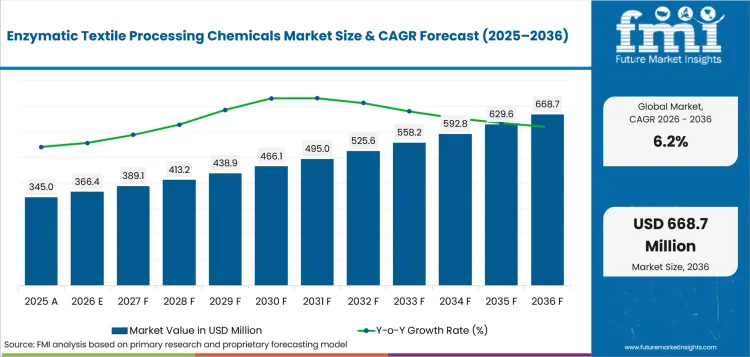
Enzymatic Textile Processing Chemicals Market Overview: Size and Forecast
- 2026 Market Size: USD 366.4 million
- 2036 Market Size: USD 668.7 million
- Forecast CAGR: 6.2% from 2026 to 2036
- Leading Application: Textiles
- Textiles Share in 2026: 63.0%
- Leading Function: Process Aid
- Process Aid Share in 2026: 52.0%
- Fastest-growing Country: India
- India CAGR: 7.4% by 2036
Summary of the Enzymatic Textile Processing Chemicals Market
- Demand and Growth Drivers
- Textile mills are replacing harsher preparation and finishing steps with enzyme systems that support cleaner chemical files.
- Denim laundries are using biological abrasion and peroxide clean-up to improve shade repeatability across wash batches.
- Export suppliers are choosing documented process aids to satisfy brand screening before larger production orders are approved.
- Product and Segment View
- Textiles are forecast to represent 63.0% share in 2026, led by desizing, biopolishing, peroxide removal, and denim finishing demand.
- Process aid is projected to hold 52.0% share in 2026, influenced by mills buying enzymes for defined bath outcomes.
- Bio-based chemistry is expected to secure 46.0% share in 2026, supported by safer-input claims and enzyme-origin positioning.
- Geography and Competitive Outlook
- India is projected to record 7.4% CAGR by 2036, backed by export clusters, denim washing, knitwear processing, and buyer documentation needs.
- China is expected to expand at 7.1% CAGR by 2036 through large textile processing clusters and faster recipe replication after mill trials.
- Novonesis, IFF, AB Enzymes, BASF, Advanced Enzyme Technologies, Fineotex Chemical, and Zschimmer & Schwarz define the main supplier field.
- Competition centers on enzyme stability, bath compatibility, application service, and compliance support instead of catalogue breadth alone.
- Analyst Opinion
- Nandini Roy, Senior Chemicals Analyst at FMI, observes, “Enzymatic textile processing chemicals are moving from optional mill aids into practical tools for safer preparation and finish control. Mills want enzymes that work in real bath conditions and reduce fabric damage without creating shade variation. Suppliers with strong technical service and verified compliance files should win repeat orders from export-facing dyehouses, denim laundries, and technical textile converters.”
Textile processing demand is being shaped by fiber volume, chemical verification, and circular product rules. Textile Exchange reported in September 2025 that global fiber production reached 132 million tonnes in 2024, rising from about 125 million tonnes in 2023. OEKO-TEX reported in September 2024 that more than 40,000 chemical products were certified under ECO PASSPORT. The European Commission stated in February 2026 that the ban on destruction of unsold apparel, clothing accessories, and footwear will apply to large companies from 19 July 2026. These signals make enzyme-assisted textile processing more valuable for mills needing safer input files, finish consistency, and better waste control.
The enzymatic textile processing chemicals market is expected to witness steady growth through 2036, driven by demand from textile mills seeking safer wet processing, lower fabric damage, and repeatable finishing results. Market expansion is further supported by chemical compliance programs and export buyer audits.
Which factors support expansion in the enzymatic textile processing chemicals market?
Finished enzyme systems and documented process aids support market value across textile wet processing channels.
- Market value is supported by enzyme sales into desizing, biopolishing, bleach clean-up, denim finishing, and surface modification.
- Supplier pricing reflects enzyme concentration, formulation stability, dosage support, and technical service before distributor margins apply.
- Revenue improves as mills shift from single-enzyme trials into wider bath programs across cotton, denim, and blended fabrics.
- Buyer confidence rises when suppliers document restricted-substance fit, application conditions, and repeatable fabric performance.
Why is the enzymatic textile processing chemicals market growing?
Textile mills are moving toward enzyme-assisted wet processing with clearer quality control and safer input documentation.
Growth outlook has become more structured as textile exporters respond to buyer rules and chemical screening. India’s Ministry of Commerce and Industry reported in April 2026 that textile exports including handicrafts increased from ₹3,09,859.3 crore in FY 2024-25 to ₹3,16,334.9 crore in FY 2025-26. This supports demand for documented enzyme systems because export mills need repeatable fabric quality before buyer approvals move into larger orders. Enzyme suppliers gain when they prove lower fabric damage, stable shade outcomes, and compatible bath performance across common cotton, denim, and blend recipes.
How is the enzymatic textile processing chemicals market segmented?
Textiles are projected to secure 63.0% share in 2026, led by enzyme use in desizing, biopolishing, peroxide removal, and denim washing applications that directly affect mill quality outcomes.
- Process aid is anticipated to hold 52.0% share in 2026 since mills approve enzymes when they solve defined bath problems such as residual starch, lint, peroxide carryover, and back-staining.
- Bio-based chemistry is expected to capture 46.0% share in 2026 due to stronger alignment with safer-input claims, certification-sensitive purchasing, and export buyer audits.
- Industrial manufacturing is forecast to represent 42.0% share in 2026, guided by dyehouses, laundries, finishers, and converters that make most production-scale chemical decisions.
- East Asia is projected to account for 35.0% share in 2026, reflected by large textile conversion clusters across China, Japan, and South Korea.
Why do textiles dominate the enzymatic textile processing chemicals market?
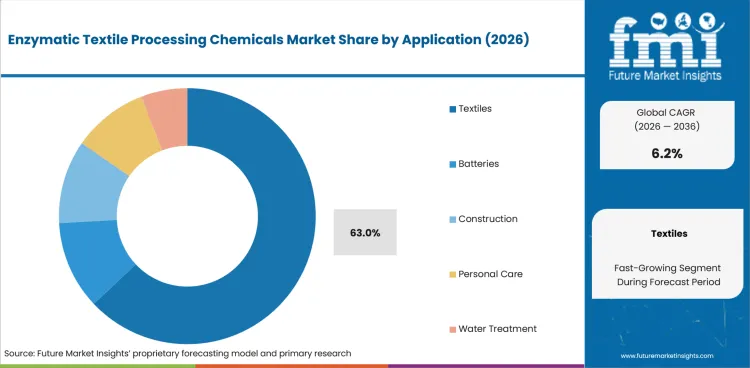
- Textiles are projected to account for 63.0% share in 2026, influenced by direct enzyme use in fabric preparation, scouring, denim abrasion, biopolishing, and bleach clean-up across industrial wet lines.
- Technical textiles gain added demand as fabric smoothness, lint control, print readiness, and coating preparation influence quality-sensitive applications in automotive fabrics, workwear, and performance materials.
Which function leads the enzymatic textile processing chemicals market?
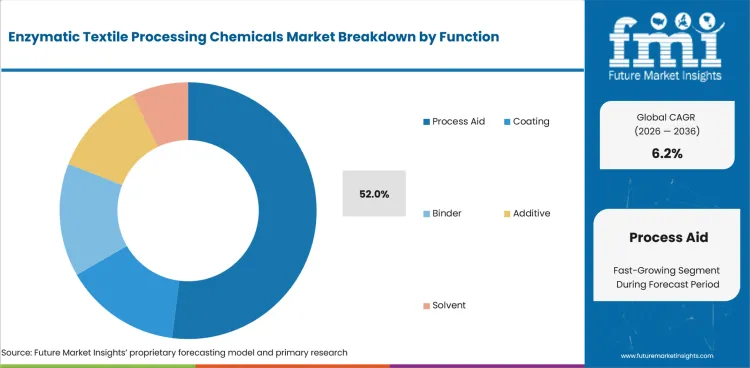
- Process aid is anticipated to hold 52.0% share in 2026 through enzyme use in defined bath steps where mills measure performance through shade repeatability, fiber protection, and lower rework.
- Coating-linked preparation gains attention as mills use enzyme-assisted surface control before functional finishes, especially where technical textiles require cleaner substrate behavior.
Which chemistry type leads the enzymatic textile processing chemicals market?
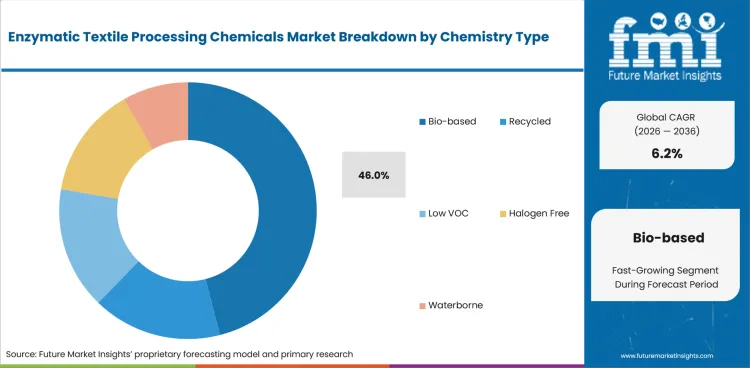
- Bio-based chemistry is forecast to secure 46.0% share in 2026, reflected by enzyme-origin positioning and buyer preference for safer wet processing inputs in export supply chains.
- Low VOC and waterborne systems gain importance as mills combine enzymes with auxiliary chemistry that must satisfy chemical review and worker-safety expectations.
Which end-use industry leads the enzymatic textile processing chemicals market?
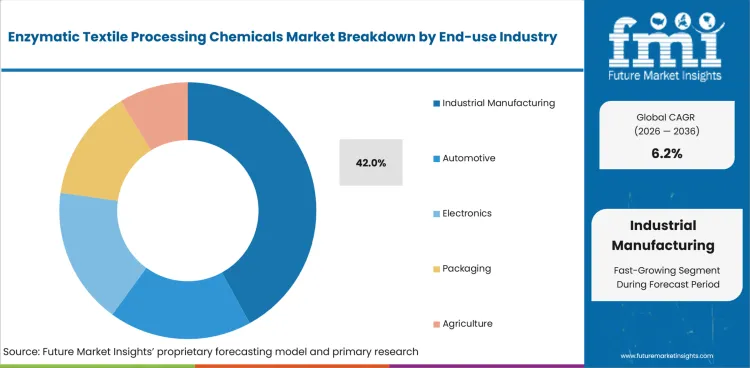
- Industrial manufacturing is expected to represent 42.0% share in 2026, shaped by dyehouses, laundries, textile finishers, and converters that purchase enzymes for process control.
- Automotive and electronics-linked textile buyers create smaller but higher-value demand where surface quality, coating readiness, and defect reduction influence supplier qualification.
Which region leads the enzymatic textile processing chemicals market?
- East Asia is projected to account for 35.0% share in 2026, led by China, Japan, and South Korea supporting textile processing, technical textile conversion, and fabric finishing activity.
- South Asia follows through India’s export mills, denim laundries, knitwear clusters, and domestic enzyme suppliers that support faster local trial conversion.
What are the driver, restraints, and opportunities in the enzymatic textile processing chemicals market?
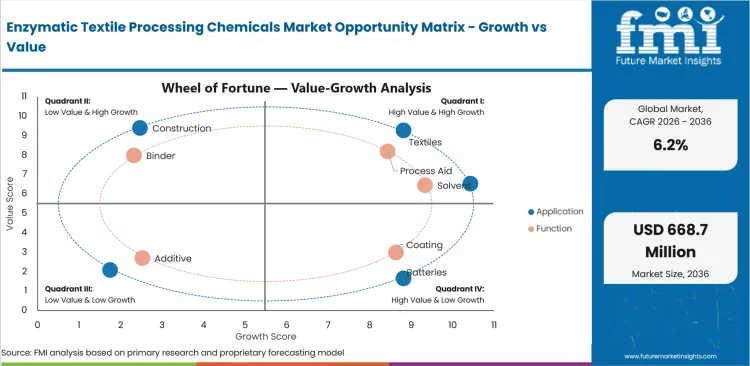
Mill conversion and buyer compliance support demand while bath sensitivity limits faster adoption.
- Driver: Denim laundries and export mills are replacing harsher finishing steps with enzyme systems that support shade control and cleaner chemical records.
- Restraint: Enzyme performance can weaken when bath pH, heat, salts, surfactants, or peroxide residues move outside supplier guidance.
- Opportunity: Mills can combine enzymes with low-impact finishing chemistry to improve surface control, fabric hand feel, and documentation for buyers.
Enzymatic Textile Processing Chemicals Market Demand Outlook
Demand outlook is moving toward enzyme-assisted textile wet processing that can prove safer input use before wider mill adoption. ZDHC released MRSL Version 3.1 in 2025, covering substances banned from intentional use in textile, leather, rubber, foam, adhesives, and trim processing. This matters for enzyme suppliers because mills compare process aids not only on bath performance but also on restricted-substance fit. Suppliers with formulation transparency and clear application files can shorten buyer approval cycles for export production.
Consumer Segmentation and Purchase Behavior Analysis
Purchase behavior is shaped by mills, denim laundries, finishers, brand compliance teams, and specialty chemical distributors. The European Commission stated in 2024 that the Ecodesign for Sustainable Products Regulation will make sustainable products the norm by strengthening durability, resource efficiency, repairability, and product information requirements. This creates stronger demand for processing chemistry that protects fabric quality instead of creating avoidable rework or waste. Mills are likely to approve enzyme systems when trial results show stable shade, lower fabric damage, and fewer production disruptions.
Voice of Customer and Decision-driver Analysis
Decision drivers are defined by trial reliability, technical support, dosage clarity, and certification compatibility. OEKO-TEX reported in September 2025 that its product control testing covered more than 7,700 test reports in the 2024/2025 cycle. This reinforces the direction of textile supply chains toward measurable input verification. For enzymatic textile processing chemicals, the buying decision depends on whether suppliers can prove safe chemistry documentation and stable results in actual mill baths.
Which countries are growing fastest in the enzymatic textile processing chemicals market?
India 7.4% CAGR, China 7.1% CAGR, South Korea 6.0% CAGR, Germany 5.8% CAGR, Japan 5.7% CAGR, France 5.6% CAGR, United States 5.5% CAGR, and United Kingdom 5.2% CAGR through 2036.
.webp "Top Country Growth Comparison Enzymatic Textile Processing Chemicals Market Cagr (2026 2036)")
| Country | CAGR |
|---|---|
| India | 7.4% |
| China | 7.1% |
| South Korea | 6.0% |
| Germany | 5.8% |
| Japan | 5.7% |
| France | 5.6% |
| United States | 5.5% |
| United Kingdom | 5.2% |
Source: Future Market Insights, 2026.
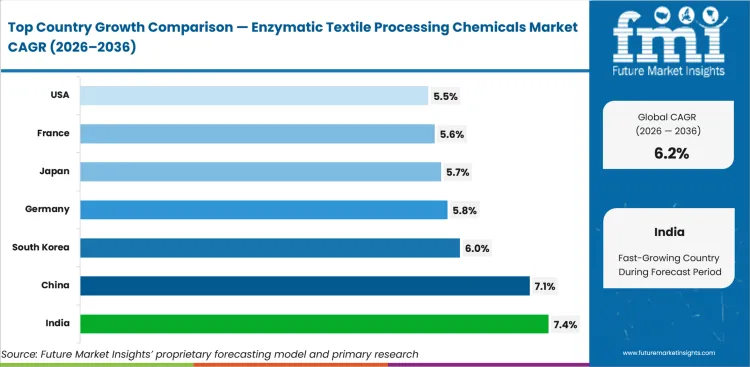
How do country-level CAGRs compare in the enzymatic textile processing chemicals market?
India leads country growth while the United Kingdom records the most cautious expansion outlook among profiled markets.
- India is forecast to record 7.4% CAGR by 2036 as export mills adopt better chemical documentation.
- China is expected to expand at 7.1% CAGR from 2026 to 2036 due to large denim, knitwear, and home textile processing clusters.
- South Korea is projected to grow at 6.0% CAGR through 2036 as performance textiles require controlled surface finishing.
- Germany is estimated to rise at 5.8% CAGR by 2036 with enzyme supplier depth and technical textile purchasing discipline.
- Japan is expected to advance at 5.7% CAGR over the forecast period as precision processing and resource circulation programs influence textile chemistry.
- France is forecast to grow at 5.6% CAGR through 2036 as luxury textile finishing and circularity rules shape supplier selection.
- The United States is projected to post 5.5% CAGR by 2036 as technical textile mills prioritize service-led enzyme trials.
- The United Kingdom is anticipated to record 5.2% CAGR through 2036 as premium batch processing supports selective adoption.
How fast is the enzymatic textile processing chemicals market growing in India?
A 7.4% CAGR through 2036 reflects export mill compliance, denim washing demand, and clustered wet processing capacity.
Country Market Snapshot Table
| Parameter | Value |
|---|---|
| Market Size in 2025 (Value) | USD 48.4 million |
| Market Size in 2026 (Value) | USD 52.0 million |
| Market Forecast in 2036 (Value) | USD 106.3 million |
| CAGR (2026 to 2036) | 7.4% |
| Years Considered | 2021 to 2036 |
| Base Year | 2025 |
| Forecast Period | 2026 to 2036 |
| Units Considered | Value (USD million) |
| Leading Sub-Region | Tirupur, Surat, Ludhiana, Ahmedabad, and Mumbai-linked textile corridors |
India Enzymatic Textile Processing Chemicals Market Outlook
- India enzymatic textile processing chemical demand is shaped by export clusters, denim washing, knitwear processing, and fragmented dyehouse capacity. Mills need enzyme systems that support buyer documentation without increasing batch failure risk.
- Domestic suppliers and regional distributors improve access to technical service. Export-facing mills are expected to favor process aids that reduce harsh inputs while supporting fabric quality.
Key Growth Drivers
- Export mill clusters need approved process chemistry because textile exports including handicrafts increased 2.1% to ₹3,16,334.9 crore in FY 2025-26.
- National textile capacity supports long-term processing demand as the industry produces about 22,000 million garments per year and targets USD 350.0 billion by 2030.
- Denim and knitwear washing creates frequent use cases for cellulase and catalase enzymes across clustered wet processing operations.
- Domestic suppliers provide local service and smaller pack flexibility for fragmented processors that need faster troubleshooting.
Key Restraints
- Cotton input-cost sensitivity affects wet processing margins because the government extended an 11% import duty exemption on cotton until 31 December 2025.
- Price-sensitive dyehouses can delay conversion when enzyme savings are not measured across water, rework, and fabric loss.
- Effluent and water constraints vary by state, which creates uneven urgency across textile clusters and slows uniform recipe adoption.
What makes India unique
India is unique because export pressure, local suppliers, and clustered wet processing reinforce each other across denim, knitwear, cotton, and apparel supply chains.
Key Companies
- Advanced Enzyme Technologies Ltd.
- Fineotex Chemical Ltd.
- Rossari Biotech Ltd.
- Novonesis
- IFF
- BASF
- AB Enzymes
Sales & Marketing Channels
- Direct sales to export mills
- Regional textile chemical distributors
- Denim laundry trial programs
- Cluster-based technical seminars
- Brand-approved vendor routes
- Agent networks for small dyehouses
Country Segment Breakdown Table
| Segment | Sub-Segments |
|---|---|
| By Application | Textiles · Batteries · Construction · Personal Care · Water Treatment |
| By Function | Process Aid · Coating · Binder · Additive · Solvent |
| By Chemistry Type | Bio-based · Recycled · Low VOC · Halogen Free · Waterborne |
| By End-use Industry | Industrial Manufacturing · Automotive · Electronics · Packaging · Agriculture |
| By Region | North America · Europe · East Asia · South Asia · Latin America |
| Key Sub-Regions Covered, Textile Processing Areas | Tirupur · Surat · Ludhiana · Ahmedabad · Mumbai · Coimbatore |
Frequently Asked Questions
How fast is India enzymatic textile processing chemicals market growing?
Sales in India are ready to scale at 7.4% CAGR from 2026 to 2036, guided by export mill compliance and denim washing demand.
Who leads India enzymatic textile processing chemicals market?
Advanced Enzyme Technologies, Fineotex Chemical, Rossari Biotech, Novonesis, IFF, BASF, and AB Enzymes compete through enzyme systems and technical service.
What is driving adoption in India enzymatic textile processing chemicals market?
Export buyer audits, denim finishing, cotton processing, and regional supplier support are moving mills toward documented enzyme systems.
What is the enzymatic textile processing chemicals market outlook in China?
A 7.1% CAGR through 2036 is supported by large textile processing clusters and repeat demand after successful mill trials.
Country Market Snapshot Table
| Parameter | Value |
|---|---|
| Market Size in 2025 (Value) | USD 93.4 million |
| Market Size in 2026 (Value) | USD 100.0 million |
| Market Forecast in 2036 (Value) | USD 198.7 million |
| CAGR (2026 to 2036) | 7.1% |
| Years Considered | 2021 to 2036 |
| Base Year | 2025 |
| Forecast Period | 2026 to 2036 |
| Units Considered | Value (USD million) |
| Leading Sub-Region | Zhejiang, Jiangsu, Guangdong, and Shandong processing clusters |
China Enzymatic Textile Processing Chemicals Market Outlook
- China enzymatic textile processing chemical demand is influenced by large-scale textile conversion, export production, and regional mill density. Enzyme suppliers can convert one validated bath recipe into repeat programs across multiple plants.
- The market remains price competitive. Suppliers need local application teams that can solve process instability quickly while proving yield gains and lower rework.
Key Growth Drivers
- Textile-specific momentum supports process chemistry demand because China’s textile industry value-added output increased 4.6% in December 2024.
- Export scale supports repeat mill programs because China exported USD 268.0 billion in textiles during 2024.
- Export buyer audits push mills toward documented chemical input systems that reduce restricted-substance risk during supplier qualification.
- Local processing depth supports bundled sales of enzymes and compatible auxiliaries across denim, knitwear, and home textile mills.
Key Restraints
- Industrial profit pressure can delay chemistry approvals because industrial enterprises recorded 85.37 yuan in costs per 100 yuan of business revenue during January to March 2025.
- Low-cost chemical competition can slow enzyme conversion where buyers focus only on immediate input price.
- Regional enforcement differences can create uneven demand for certified chemical systems across textile provinces.
What makes China unique
China is unique because large processing clusters allow suppliers to convert validated enzyme programs into multi-site textile demand.
Key Companies
- Novonesis
- IFF
- AB Enzymes
- BASF
- Zschimmer & Schwarz
- Regional enzyme formulators
- Textile auxiliary distributors
Sales & Marketing Channels
- Direct mill enterprise accounts
- Regional chemical distributors
- Industrial park supplier programs
- Denim laundry trial routes
- Export brand compliance channels
- Textile auxiliary reseller networks
Country Segment Breakdown Table
| Segment | Sub-Segments |
|---|---|
| By Application | Textiles · Batteries · Construction · Personal Care · Water Treatment |
| By Function | Process Aid · Coating · Binder · Additive · Solvent |
| By Chemistry Type | Bio-based · Recycled · Low VOC · Halogen Free · Waterborne |
| By End-use Industry | Industrial Manufacturing · Automotive · Electronics · Packaging · Agriculture |
| By Region | North America · Europe · East Asia · South Asia · Latin America |
| Key Sub-Regions Covered, Textile Processing Areas | Zhejiang · Jiangsu · Guangdong · Shandong · Fujian · Shanghai |
Frequently Asked Questions
How fast is China enzymatic textile processing chemicals market growing?
Demand in China is expected to rise at 7.1% CAGR from 2026 to 2036, supported by large textile conversion clusters.
Who leads China enzymatic textile processing chemicals market?
Novonesis, IFF, AB Enzymes, BASF, Zschimmer & Schwarz, and regional formulators compete through enzyme support and wet processing service.
What is driving adoption in China enzymatic textile processing chemicals market?
Large textile clusters, export audit needs, and repeat mill trials are moving enzyme chemistry into scale production.
How is the enzymatic textile processing chemicals market performing in South Korea?
A 6.0% CAGR through 2036 reflects synthetic blend finishing, performance textiles, and export-oriented processing.
Country Market Snapshot Table
| Parameter | Value |
|---|---|
| Market Size in 2025 (Value) | USD 20.8 million |
| Market Size in 2026 (Value) | USD 22.0 million |
| Market Forecast in 2036 (Value) | USD 39.4 million |
| CAGR (2026 to 2036) | 6.0% |
| Years Considered | 2021 to 2036 |
| Base Year | 2025 |
| Forecast Period | 2026 to 2036 |
| Units Considered | Value (USD million) |
| Leading Sub-Region | Daegu, Gyeonggi, Seoul, and Busan textile corridors |
South Korea Enzymatic Textile Processing Chemicals Market Outlook
- South Korea demand is connected to synthetic fibers, functional textiles, and export-linked processing. Enzyme use is more selective than cotton-heavy Asian markets because buyers require compatibility with performance fabrics.
- Mills and converters are expected to test enzymes where surface quality, pilling control, and finish repeatability affect product value. Supplier success depends on proof that enzyme systems do not weaken technical fabric claims.
Key Growth Drivers
- Export-facing processors support specialty finishing because South Korea accounted for 1.23% of global textile exports and ranked 16th among textile exporters in 2024.
- KOTRA’s overseas support network of 131 offices across 86 countries strengthens market access for Korean fashion and textile exporters.
- Synthetic blend finishing creates demand for precise and low-damage chemistry across sportswear, workwear, and technical fabrics.
- Converter networks around Daegu and Gyeonggi help suppliers test enzyme systems in performance-oriented textile lines.
Key Restraints
- Domestic-use textile import volatility can pressure planning because Korea Customs data showed textile imports falling from USD 226.0 million in January 2024 to USD 187.0 million in February 2024.
- Synthetic-heavy processing can limit the addressable share for traditional cellulase systems when thermal or coating steps dominate.
- Buyers may require extended validation before using enzymes in performance fabrics with strict durability claims.
What makes South unique
South Korea is unique because enzyme value depends on compatibility with synthetic blends, technical finishes, and export-quality performance fabrics.
Key Companies
- Hyosung TNC-linked textile value chains
- Kolon Industries-linked textile value chains
- Novonesis
- IFF
- AB Enzymes
- BASF
- Local specialty chemical distributors
Sales & Marketing Channels
- Specialty distributor networks
- Direct converter trials
- Performance apparel supply chains
- Export buyer approval routes
- Technical textile industry networks
- Regional formulation partners
Country Segment Breakdown Table
| Segment | Sub-Segments |
|---|---|
| By Application | Textiles · Batteries · Construction · Personal Care · Water Treatment |
| By Function | Process Aid · Coating · Binder · Additive · Solvent |
| By Chemistry Type | Bio-based · Recycled · Low VOC · Halogen Free · Waterborne |
| By End-use Industry | Industrial Manufacturing · Automotive · Electronics · Packaging · Agriculture |
| By Region | North America · Europe · East Asia · South Asia · Latin America |
| Key Sub-Regions Covered, Textile Processing Areas | Daegu · Gyeonggi · Seoul · Busan · Ulsan · Incheon |
Frequently Asked Questions
How fast is South Korea enzymatic textile processing chemicals market growing?
South Korea demand is projected to expand at 6.0% CAGR from 2026 to 2036 through performance textile finishing.
Who leads South Korea enzymatic textile processing chemicals market?
Global enzyme suppliers and local specialty distributors compete through performance fabric trials and converter relationships.
What is driving adoption in South Korea enzymatic textile processing chemicals market?
Functional apparel, synthetic blend processing, and export buyer documentation are supporting enzyme-assisted finishing demand.
What is the enzymatic textile processing chemicals market forecast for Germany?
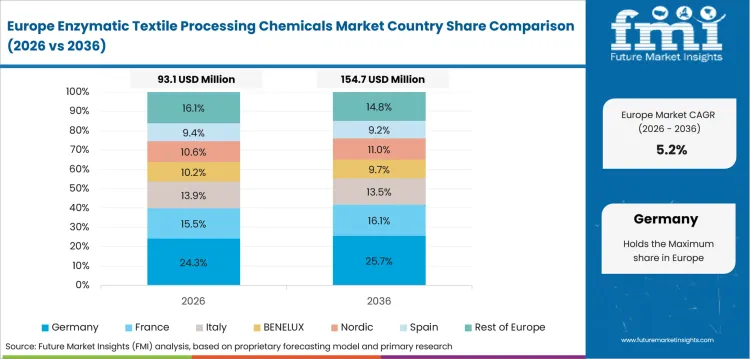
A 5.8% CAGR through 2036 reflects enzyme supplier depth and technical textile purchasing discipline.
Country Market Snapshot Table
| Parameter | Value |
|---|---|
| Market Size in 2025 (Value) | USD 32.1 million |
| Market Size in 2026 (Value) | USD 34.0 million |
| Market Forecast in 2036 (Value) | USD 59.7 million |
| CAGR (2026 to 2036) | 5.8% |
| Years Considered | 2021 to 2036 |
| Base Year | 2025 |
| Forecast Period | 2026 to 2036 |
| Units Considered | Value (USD million) |
| Leading Sub-Region | North Rhine-Westphalia, Bavaria, Baden-Württemberg, and Saxony |
Germany Enzymatic Textile Processing Chemicals Market Outlook
- Germany demand is shaped by specialty chemistry suppliers, technical textiles, and industrial fabric users. Buyers evaluate enzymes against repeatability, documentation, and downstream surface performance.
- The country also acts as a capability center for enzyme and specialty chemistry development. Suppliers with strong laboratory support and local technical service can gain stronger acceptance in high-spec processing lines.
Key Growth Drivers
- Industrial buyers support technical textile chemistry because German industrial production increased 0.4% month on month in April 2026.
- Technical textile relevance is strong because EURATEX’s 2024 profile placed industrial and technical textiles at 19% of European textile and clothing applications.
- EU product rules encourage safer and better-documented textile processing inputs across mills serving regulated buyers.
- Industrial fabric buyers need controlled surface quality before coating, lamination, or functional finishing applications.
Key Restraints
- Producer-price pressure can limit trial budgets because German industrial producer prices were 1.7% higher in April 2026 than in April 2025.
- Qualification cycles are longer when customers serve automotive, industrial fabric, and protective textile buyers.
- Strict documentation needs can slow entry for smaller enzyme formulators without local regulatory and application support.
What makes Germany unique
Germany is unique because enzyme supplier depth and technical textile purchasing discipline are present in the same market.
Key Companies
- BASF
- AB Enzymes
- Novonesis
- IFF
- Zschimmer & Schwarz
- Specialty textile auxiliary distributors
- Technical textile converters
Sales & Marketing Channels
- Direct enterprise sales to textile processors
- Technical service projects with mills
- Specialty chemical distributor routes
- OEM and machinery-adjacent partnerships
- Certification-driven supplier qualification
- Industrial fabric converter networks
Country Segment Breakdown Table
| Segment | Sub-Segments |
|---|---|
| By Application | Textiles · Batteries · Construction · Personal Care · Water Treatment |
| By Function | Process Aid · Coating · Binder · Additive · Solvent |
| By Chemistry Type | Bio-based · Recycled · Low VOC · Halogen Free · Waterborne |
| By End-use Industry | Industrial Manufacturing · Automotive · Electronics · Packaging · Agriculture |
| By Region | North America · Europe · East Asia · South Asia · Latin America |
| Key Sub-Regions Covered, Textile Processing Areas | North Rhine-Westphalia · Bavaria · Baden-Württemberg · Saxony · Hesse · Lower Saxony |
Frequently Asked Questions
How fast is Germany enzymatic textile processing chemicals market growing?
Germany demand is expected to expand at 5.8% CAGR from 2026 to 2036, supported by technical textile processing.
Who leads Germany enzymatic textile processing chemicals market?
BASF, AB Enzymes, Novonesis, IFF, and Zschimmer & Schwarz compete through enzyme knowledge and chemical support.
What is driving adoption in Germany enzymatic textile processing chemicals market?
Technical textiles, supplier proximity, and EU chemical documentation requirements are supporting enzyme-assisted processing.
What is driving enzymatic textile processing chemicals growth in Japan?
A 5.7% CAGR through 2036 is supported by precision textile processing, technical fabrics, and resource circulation priorities.
Country Market Snapshot Table
| Parameter | Value |
|---|---|
| Market Size in 2025 (Value) | USD 25.5 million |
| Market Size in 2026 (Value) | USD 27.0 million |
| Market Forecast in 2036 (Value) | USD 47.0 million |
| CAGR (2026 to 2036) | 5.7% |
| Years Considered | 2021 to 2036 |
| Base Year | 2025 |
| Forecast Period | 2026 to 2036 |
| Units Considered | Value (USD million) |
| Leading Sub-Region | Tokyo, Osaka, Aichi, and technical textile corridors |
Japan Enzymatic Textile Processing Chemicals Market Outlook
- Japan demand is expected to build from high-value textile processing, technical fabrics, and strict quality expectations. Enzymes are relevant when they protect fiber surfaces or prepare fabrics for functional finishing.
- Purchasing remains validation-led. Suppliers must show that enzyme systems perform under strict process windows and do not create visible fabric variation.
Key Growth Drivers
- Resource-circulation pressure supports lower-impact processing because Japan’s apparel item supply increased to more than 1.8 times its 1990 level by 2022.
- Import-linked quality demand remains large because Japan’s total textile and apparel imports from the world reached USD 30,873 million in 2024.
- Trading company networks help global enzyme suppliers reach specialized processors and technical textile converters.
- Precision textile processors use enzyme trials when surface control supports printing, lamination, and functional finishing.
Key Restraints
- Imported apparel dependence narrows local processing volume because Japan’s import penetration rate reached 98.5% by volume in 2022.
- Long validation timelines can delay enzyme substitution in quality-sensitive mills and technical fabric lines.
- Smaller domestic apparel manufacturing limits broad volume demand compared with larger Asian processing markets.
What makes Japan unique
Japan is unique because enzyme value comes from precision finish control, fabric consistency, and technical textile performance.
Key Companies
- Novonesis
- IFF
- AB Enzymes
- BASF
- Japanese specialty chemical distributors
- Technical textile converters
- Trading company supply networks
Sales & Marketing Channels
- Specialty chemical distributors
- Trading company supply routes
- Direct trials with technical textile converters
- OEM-adjacent fabric supply chains
- Brand and quality certification channels
- Textile technology networks
Country Segment Breakdown Table
| Segment | Sub-Segments |
|---|---|
| By Application | Textiles · Batteries · Construction · Personal Care · Water Treatment |
| By Function | Process Aid · Coating · Binder · Additive · Solvent |
| By Chemistry Type | Bio-based · Recycled · Low VOC · Halogen Free · Waterborne |
| By End-use Industry | Industrial Manufacturing · Automotive · Electronics · Packaging · Agriculture |
| By Region | North America · Europe · East Asia · South Asia · Latin America |
| Key Sub-Regions Covered, Textile Processing Areas | Tokyo · Osaka · Aichi · Kyoto · Hyogo · Shizuoko |
Frequently Asked Questions
How fast is Japan enzymatic textile processing chemicals market growing?
Japan demand is projected to advance at 5.7% CAGR from 2026 to 2036, guided by technical textile processing.
Who leads Japan enzymatic textile processing chemicals market?
Global enzyme suppliers, specialty chemical distributors, and trading company networks compete through technical service.
What is driving adoption in Japan enzymatic textile processing chemicals market?
Quality control, resource circulation work, and technical textile finish requirements are moving processors toward enzyme systems.
How is the enzymatic textile processing chemicals market performing in France?
A 5.6% CAGR through 2036 reflects luxury textile finishing, circularity policy, and technical fabric demand.
Country Market Snapshot Table
| Parameter | Value |
|---|---|
| Market Size in 2025 (Value) | USD 22.7 million |
| Market Size in 2026 (Value) | USD 24.0 million |
| Market Forecast in 2036 (Value) | USD 41.3 million |
| CAGR (2026 to 2036) | 5.6% |
| Years Considered | 2021 to 2036 |
| Base Year | 2025 |
| Forecast Period | 2026 to 2036 |
| Units Considered | Value (USD million) |
| Leading Sub-Region | Auvergne-Rhône-Alpes, Hauts-de-France, Paris, and Grand Est |
France Enzymatic Textile Processing Chemicals Market Outlook
- France demand links enzyme use with apparel circularity, luxury fabric finishing, and technical textiles. Buyers adopt enzyme systems when hand feel, surface quality, and compliance evidence match brand expectations.
- Supplier access often runs through finishers and converters rather than large commodity mills. Enzyme systems gain value where premium fabric prices can absorb technical service costs.
Key Growth Drivers
- Premium textile buyers need finish control because the EU textile and clothing industry employed about 1.3 million workers across nearly 200,000 companies in 2024.
- French suppliers are exposed to a large European base because the EU textile and clothing sector recorded about EUR 170.0 billion turnover across 197,000 companies in 2023.
- Technical textile producers need compatible surface preparation before coatings, laminates, and functional finishes.
- Luxury supply chains require strong control over fabric hand feel, appearance, and restricted-substance documentation.
Key Restraints
- Fragmented company structure can slow large enzyme rollouts because SMEs represent 99.5% of companies active in the European textiles ecosystem.
- Premium buyers require proof that enzyme changes will not alter fabric identity, shade behavior, or finishing signature.
- Compliance work can raise supplier effort as product information and disclosure expectations increase under EU sustainability rules.
What makes France unique
France is unique because luxury textile value, circularity policy, and finish quality meet in supplier selection.
Key Companies
- Novonesis
- IFF
- BASF
- AB Enzymes
- Zschimmer & Schwarz
- Specialty textile auxiliary distributors
- Premium fabric finishers
Sales & Marketing Channels
- Direct sales to specialty finishers
- Brand-approved supplier lists
- Distributor routes for textile auxiliaries
- Technical fabric converter partnerships
- Certification and compliance consultant channels
- Luxury supply-chain qualification routes
Country Segment Breakdown Table
| Segment | Sub-Segments |
|---|---|
| By Application | Textiles · Batteries · Construction · Personal Care · Water Treatment |
| By Function | Process Aid · Coating · Binder · Additive · Solvent |
| By Chemistry Type | Bio-based · Recycled · Low VOC · Halogen Free · Waterborne |
| By End-use Industry | Industrial Manufacturing · Automotive · Electronics · Packaging · Agriculture |
| By Region | North America · Europe · East Asia · South Asia · Latin America |
| Key Sub-Regions Covered, Textile Processing Areas | Paris · Lyon · Lille · Mulhouse · Troyes · Saint-Étienne |
Frequently Asked Questions
How fast is France enzymatic textile processing chemicals market growing?
France demand is forecast to grow at 5.6% CAGR from 2026 to 2036 through premium finishing and circularity-led processing.
Who leads France enzymatic textile processing chemicals market?
Global enzyme suppliers and specialty auxiliary distributors compete through finish quality, documentation, and technical support.
What is driving adoption in France enzymatic textile processing chemicals market?
Luxury finishing, circular product rules, and technical textile requirements are supporting demand for enzyme-assisted wet processing.
What is the enzymatic textile processing chemicals market outlook in the United States?
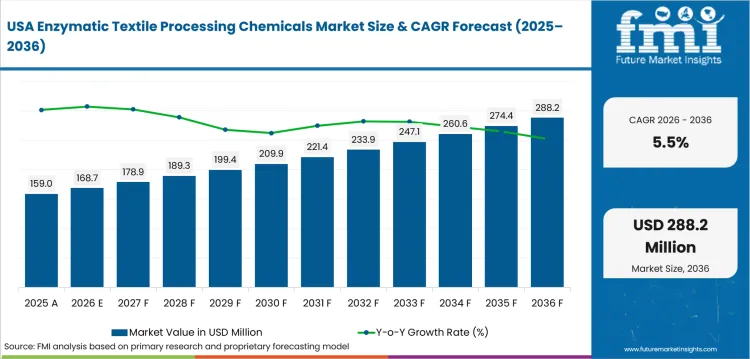
A 5.5% CAGR through 2036 reflects service-led textile processing, technical fabrics, and brand assurance needs.
Country Market Snapshot Table
| Parameter | Value |
|---|---|
| Market Size in 2025 (Value) | USD 40.8 million |
| Market Size in 2026 (Value) | USD 43.0 million |
| Market Forecast in 2036 (Value) | USD 73.5 million |
| CAGR (2026 to 2036) | 5.5% |
| Years Considered | 2021 to 2036 |
| Base Year | 2025 |
| Forecast Period | 2026 to 2036 |
| Units Considered | Value (USD million) |
| Leading Sub-Region | Carolinas, Georgia, California, and technical textile corridors |
United States Enzymatic Textile Processing Chemicals Market Outlook
- United States demand is shaped by technical textile mills, denim laundries, and industrial fabric processing. Buyers are less volume-driven than Asian clusters, so suppliers must show savings in rework, fabric damage, and batch stability.
- The market behaves like a service-heavy specialty chemical purchase. Mills expect trial support, safety documentation, and enough local inventory to avoid production delays.
Key Growth Drivers
- Domestic mill activity supports enzyme demand because BLS data placed textile mill and textile product mill output at USD 21.3 billion in 2024.
- Brand chemical rules influence sourcing because USA textile and apparel general imports reached USD 125.8 billion in 2024.
- Denim and garment wash houses use enzyme abrasion when brands require cleaner chemical records and more repeatable visual effects.
- Technical fabric producers need surface preparation that supports coatings, laminates, and performance finishes.
Key Restraints
- Output pressure can limit trial budgets because real sectoral output for textile mills and textile product mills declined from 76.743 in 2023 to 73.599 in 2024.
- High labor and utility costs make mills cautious about long trial programs with uncertain batch economics.
- Fragmented garment washing capacity can slow national scale for new enzyme recipes.
What makes United unique
The United States is unique because technical service and brand assurance matter more than broad mill count.
Key Companies
- IFF
- Novonesis
- BASF
- AB Enzymes
- Specialty chemical distributors
- Denim laundry service providers
- Technical textile converters
Sales & Marketing Channels
- Direct technical sales to textile mills
- Specialty chemical distribution
- Denim laundry trial programs
- Brand-approved chemical list channels
- Technical textile converter partnerships
- Compliance consultant networks
Country Segment Breakdown Table
| Segment | Sub-Segments |
|---|---|
| By Application | Textiles · Batteries · Construction · Personal Care · Water Treatment |
| By Function | Process Aid · Coating · Binder · Additive · Solvent |
| By Chemistry Type | Bio-based · Recycled · Low VOC · Halogen Free · Waterborne |
| By End-use Industry | Industrial Manufacturing · Automotive · Electronics · Packaging · Agriculture |
| By Region | North America · Europe · East Asia · South Asia · Latin America |
| Key Sub-Regions Covered, Textile Processing Areas | Carolinas · Georgia · California · Texas · Northeast · Midwest |
Frequently Asked Questions
How fast is United States enzymatic textile processing chemicals market growing?
United States demand is anticipated to grow at 5.5% CAGR from 2026 to 2036, reflecting technical textile service needs.
Who leads United States enzymatic textile processing chemicals market?
IFF, Novonesis, BASF, AB Enzymes, and specialty distributors compete through technical enzyme support.
What is driving adoption in United States enzymatic textile processing chemicals market?
Technical textile processing, denim wash trials, and brand-approved chemical lists are moving mills toward enzyme systems.
What is driving enzymatic textile processing chemicals growth in the United Kingdom?
A 5.2% CAGR through 2036 is supported by premium textile finishing and selective reshoring interest.
Country Market Snapshot Table
| Parameter | Value |
|---|---|
| Market Size in 2025 (Value) | USD 19.0 million |
| Market Size in 2026 (Value) | USD 20.0 million |
| Market Forecast in 2036 (Value) | USD 33.2 million |
| CAGR (2026 to 2036) | 5.2% |
| Years Considered | 2021 to 2036 |
| Base Year | 2025 |
| Forecast Period | 2026 to 2036 |
| Units Considered | Value (USD million) |
| Leading Sub-Region | Leicester, Manchester, London, Yorkshire, and Midlands textile corridors |
United Kingdom Enzymatic Textile Processing Chemicals Market Outlook
- United Kingdom demand centers on specialty mills, apparel reshoring pilots, wool processing, and premium textile finishing. Buyers evaluate process risk before they accept new chemistry.
- Supplier selling is often advisory rather than transaction-led. Mills ask suppliers to support trials and document chemical choices for brand customers.
Key Growth Drivers
- Premium textile finishing has a clear base because Great Britain textile manufacturing employed 49,000 people in 2024.
- Specialist production remains valuable because UK textile manufacturing GVA reached GBP 3,734 million in 2024.
- Apparel reshoring trials support interest in shorter certified supply chains with better chemical visibility.
- Brand chemical audits make documented enzyme inputs useful during mill qualification and buyer approval.
Key Restraints
- Scale limits enzyme rollouts because garment manufacturing accounts for less than 2% of the UK textiles sector’s GBP 25.6 billion value.
- Smaller production lots can make enzyme conversion slower and more costly to validate.
- Post-Brexit documentation differences can add checks for mills serving European buyers.
What makes United unique
The United Kingdom is unique because supplier service and certification files can outweigh volume price in premium-batch textile processing.
Key Companies
- Novonesis
- IFF
- AB Enzymes
- BASF
- Specialty chemical distributors
- Premium textile finishers
- Technical textile innovation centers
Sales & Marketing Channels
- Direct mill technical service
- Distributor sales into specialty chemicals
- Brand sourcing and compliance routes
- Trial programs with finishers
- Textile innovation center partnerships
- Premium apparel supply-chain channels
Country Segment Breakdown Table
| Segment | Sub-Segments |
|---|---|
| By Application | Textiles · Batteries · Construction · Personal Care · Water Treatment |
| By Function | Process Aid · Coating · Binder · Additive · Solvent |
| By Chemistry Type | Bio-based · Recycled · Low VOC · Halogen Free · Waterborne |
| By End-use Industry | Industrial Manufacturing · Automotive · Electronics · Packaging · Agriculture |
| By Region | North America · Europe · East Asia · South Asia · Latin America |
| Key Sub-Regions Covered, Textile Processing Areas | Leicester · Manchester · London · Yorkshire · Midlands · Scotland |
Frequently Asked Questions
How fast is United Kingdom enzymatic textile processing chemicals market growing?
United Kingdom demand is expected to rise at 5.2% CAGR from 2026 to 2036 through premium textile finishing.
Who leads United Kingdom enzymatic textile processing chemicals market?
Global enzyme suppliers and specialty chemical distributors compete through mill trials and documentation support.
What is driving adoption in United Kingdom enzymatic textile processing chemicals market?
Premium textile processing, reshoring interest, and buyer chemical audits are supporting selective enzyme adoption.
Who are the leading companies in the enzymatic textile processing chemicals market?
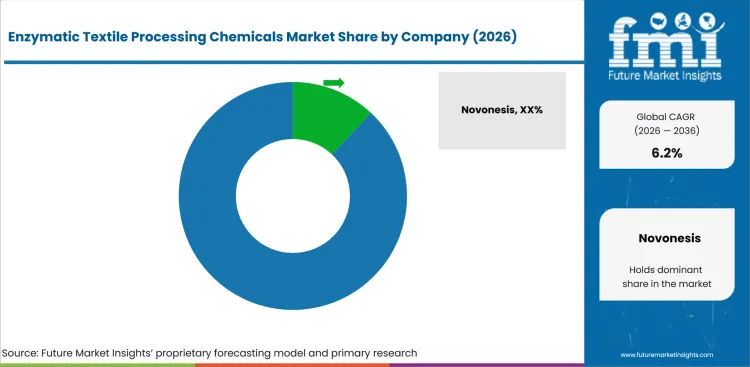
Novonesis, IFF, AB Enzymes, BASF, Advanced Enzyme Technologies, Fineotex Chemical, and Zschimmer & Schwarz.
- Established biosolution suppliers hold an advantage through enzyme libraries, fermentation scale, and application know-how.
- Textile auxiliary specialists gain mill access by combining enzyme systems with wet processing formulation support.
- Regional formulators can win in clustered markets by offering smaller packs and faster process troubleshooting.
- Documentation-ready suppliers support trial conversion through restricted-substance files, dosage guidance, and bath-condition support.
Large enzyme suppliers compete by combining bioscience capability with textile application teams. Novonesis, IFF, and AB Enzymes are positioned around enzyme libraries, process knowledge, and support for desizing, biopolishing, denim abrasion, and bleach clean-up. Mills assess these suppliers based on bath reliability, documentation, and ability to support trials beyond laboratory conditions.
Textile chemical integrators compete by adapting enzyme systems to real mill recipes. BASF, Fineotex Chemical, and Zschimmer & Schwarz are relevant because mills often buy enzyme-compatible auxiliaries alongside wet processing chemicals. These companies can support customers where enzyme performance must be aligned with softeners, coatings, surfactants, and finishing systems.
Smaller and regional suppliers can win through proximity and practical service. Advanced Enzyme Technologies, Noor Enzymes, and regional distributors can support dyehouses that need fast troubleshooting and flexible order sizes. Suppliers best positioned to win are those that combine enzyme stability, compliance evidence, and field support across export-facing textile clusters.
How do top enzymatic textile processing chemicals companies compare?
Novonesis and IFF score strongest on enzyme portfolio depth while BASF and Zschimmer & Schwarz lead in textile chemistry support.
| Company | Relevance to Market Title | Textile Enzyme Portfolio | Wet Processing Support | Compliance Chemistry Fit | Channel Reach | Geographic Footprint |
|---|---|---|---|---|---|---|
| Novonesis | Very High | Very Strong | Very Strong | Very Strong | Very Strong | Global |
| IFF | Very High | Very Strong | Strong | Strong | Very Strong | Global |
| AB Enzymes | High | Very Strong | Strong | Strong | Strong | Europe, Asia, Americas |
| BASF | High | Moderate | Very Strong | Very Strong | Very Strong | Global |
| Advanced Enzyme Technologies | High | Strong | Moderate | Moderate | Strong | India, Asia, Americas, Europe |
| Fineotex Chemical | Moderate to High | Moderate | Strong | Moderate | Strong | India, selected export markets |
| Zschimmer & Schwarz | High | Moderate | Very Strong | Strong | Strong | Europe, Asia, Americas |
| Noor Enzymes | Moderate | Moderate | Moderate | Moderate | Moderate | India, selected export markets |
Source: Future Market Insights competitive analysis, 2026.
Who are the key players in the enzymatic textile processing chemicals market?
Novonesis, IFF, AB Enzymes, BASF, Advanced Enzyme Technologies, Fineotex Chemical, and Zschimmer & Schwarz are listed among other suppliers.
Key global companies leading the enzymatic textile processing chemicals market include:
- Novonesis
- IFF
- AB Enzymes
- BASF
- Advanced Enzyme Technologies
- Fineotex Chemical
- Zschimmer & Schwarz
- Noor Enzymes
- Rossari Biotech
- Regional textile auxiliary distributors
Key Developments in Enzymatic Textile Processing Chemicals Market
- In May 2026, Novonesis became a bluesign System Partner and highlighted DeniBrite as a biological denim bleaching solution for textile and leather processing.
- In October 2025, BASF and IFF announced a strategic collaboration for next-generation enzyme systems and biobased polymers across fabric care and cleaning applications.
- In March 2026, IFF expanded its Latin American bioscience footprint by developing its Arroyito site into a fermentation-based enzyme production hub.
Key Players in the Enzymatic Textile Processing Chemicals Market
Biosolution Platform Suppliers
- Novonesis
- IFF
- AB Enzymes
Application Chemical Integrators
- BASF
- Fineotex Chemical
- Zschimmer & Schwarz
Regional Enzyme Formulators
- Advanced Enzyme Technologies
- Noor Enzymes
- Rossari Biotech
Enzymatic Textile Processing Chemicals Market - Scope & Definition
| Attribute | Detail |
|---|---|
| Market Definition | Enzyme-based and enzyme-compatible chemicals used during textile preparation, finishing, denim washing, bleach clean-up, and surface modification in industrial textile processing. |
| Functions Covered | Desizing, scouring support, biopolishing, denim abrasion, peroxide clean-up, coating preparation, surface modification, and process control. |
| Applications Covered | Textiles, batteries, construction, personal care, and water treatment where enzyme-compatible processing chemicals are used within the defined scope. |
| End-Use Industries | Industrial manufacturing, automotive, electronics, packaging, agriculture, and textile conversion channels. |
| Grades Covered | Bio-based, recycled, low VOC, halogen free, and waterborne enzyme-compatible chemistry formats. |
| Inclusions | Commercially sold enzyme-based and enzyme-compatible textile processing chemicals used in preparation, finishing, denim washing, bleach clean-up, and surface treatment. |
| Exclusions | Commodity dyes, bulk caustic soda, standalone peroxide, optical brighteners, textile machinery, finished apparel, consumer detergents, and food-grade enzyme ingredients outside textile processing. |
Enzymatic Textile Processing Chemicals Market - Research Methodology
| Method | Description |
|---|---|
| Primary Research | FMI analyst interviews with textile mills, denim laundries, specialty chemical distributors, brand compliance teams, wet processing consultants, and enzyme application specialists. |
| Desk Research | Review of textile output indicators, chemical safety programs, official trade sources, supplier portfolios, standards documents, company releases, and textile processing references. |
| Market Sizing & Forecasting | Bottom-up process-boundary approach using enzyme use rates, textile wet processing depth, supplier pricing bands, regional penetration, and segment-level adoption estimates. |
| Data Validation | Cross-verification using textile output signals, export demand, restricted-substance programs, supplier activity, enzyme portfolio evidence, and country-level manufacturing indicators. |
Enzymatic Textile Processing Chemicals Market - Report Scope
| Value | Item |
|---|---|
| Market size by 2036 | USD 668.7 million |
| Growth rate | 6.2% CAGR from 2026 to 2036 |
| Forecast period | 2026 to 2036 |
| Base year value (2025) | USD 345.0 million |
| By application | Textiles, batteries, construction, personal care, water treatment |
| By function | Process aid, coating, binder, additive, solvent |
| By chemistry type | Bio-based, recycled, low VOC, halogen free, waterborne |
| By end-use industry | Industrial manufacturing, automotive, electronics, packaging, agriculture |
| Regions covered | North America, Europe, East Asia, South Asia, Latin America |
| Countries covered | India, China, South Korea, Germany, Japan, France, United States, United Kingdom |
| Key companies profiled | Novonesis, IFF, AB Enzymes, BASF, Advanced Enzyme Technologies, Fineotex Chemical, Zschimmer & Schwarz |
| Approach | Bottom-up process-boundary approach using textile wet processing activity, enzyme use rates, supplier portfolios, pricing bands, and country-level adoption patterns |
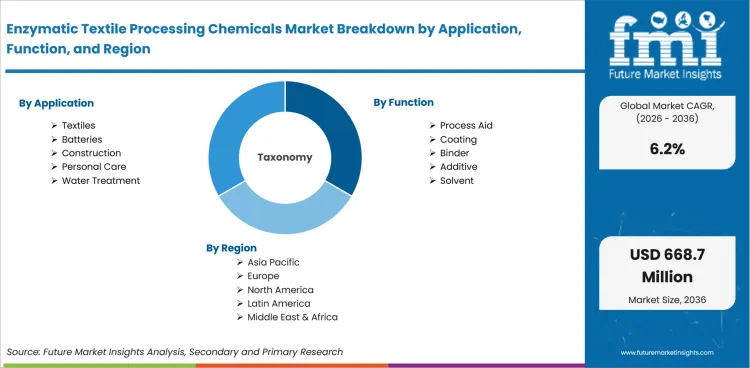
Enzymatic Textile Processing Chemicals Market Breakdown by Application, Function, Chemistry Type, End-use Industry, and Region
Enzymatic Textile Processing Chemicals Market Segmented by Application
- Textiles
- Batteries
- Construction
- Personal Care
- Water Treatment
Enzymatic Textile Processing Chemicals Market Segmented by Function
- Process Aid
- Coating
- Binder
- Additive
- Solvent
Enzymatic Textile Processing Chemicals Market Segmented by Chemistry Type
- Bio-based
- Recycled
- Low VOC
- Halogen Free
- Waterborne
Enzymatic Textile Processing Chemicals Market Segmented by End-use Industry
- Industrial Manufacturing
- Automotive
- Electronics
- Packaging
- Agriculture
Enzymatic Textile Processing Chemicals Market by Region
- North America
- Europe
- East Asia
- South Asia
- Latin America
Research Sources and Bibliography
- AB Enzymes. (2024, July 15). AB Enzymes signs rental contract for future global headquarters.
- BASF. (2025, October 21). BASF and IFF announce strategic collaboration to drive next-generation enzyme and polymer innovation.
- China National Bureau of Statistics. (2025, January 24). Industrial production operation in December 2024.
- China National Bureau of Statistics. (2025, April 28). The profit of industrial enterprises above designated size from January to March 2025.
- European Commission. (2024, July 19). New law to make products on the EU market more sustainable.
- European Commission. (2026, February 9). New EU rules to stop destruction of unsold clothes and shoes.
- EURATEX. (2024). Facts and key figures 2024.
- European Environment Agency. (2025, March 26). Circularity of the EU textiles value chain in numbers.
- Federal Statistical Office of Germany. (2026, June 9). Production in April 2026: +0.4% on the previous month.
- Federal Statistical Office of Germany. (2026, May 20). Producer prices in April 2026.
- IFF. (2026, March 10). IFF expands Latin American bioscience footprint with new enzyme hub and Brazil application lab.
- Invest Korea. (2025). Fashion industry profile.
- Japan Ministry of Economy, Trade and Industry. (2024, February 29). Establishing resource circulation systems for textile products in Japan.
- Korea Trade-Investment Promotion Agency. (2026). Introduction.
- Novonesis. (2026, May 13). Novonesis becomes a bluesign System Partner, reinforcing sustainable innovation in textiles and leather.
- OEKO-TEX. (2024, September 3). OEKO-TEX Annual Report 2023/2024.
- OEKO-TEX. (2025, September 2). OEKO-TEX Annual Report 2024/2025.
- Press Information Bureau. (2025, April 1). Threads of progress: Advancing India’s textile sector.
- Press Information Bureau. (2025, August 5). India-Japan textile trade and investment collaboration.
- Press Information Bureau. (2025, August 28). Import duty exemption on cotton extended till 31st December 2025.
- Press Information Bureau. (2026, April 22). India’s textile exports register growth of 2.1% in FY 2025-26.
- Textile Exchange. (2025, September 18). Materials Market Report 2025.
- UK Parliament House of Commons Library. (2026, February 9). Onshoring in the fashion and textiles industry.
- United States Bureau of Labor Statistics. (2025, August 28). Employment and output by industry.
- United States International Trade Commission. (2025). Textiles and apparel: USA trade shifts 2024.
- ZDHC Foundation. (2025). ZDHC Manufacturing Restricted Substances List Version 3.1.
This bibliography is provided for reader reference and is not exhaustive. The full report contains the complete reference list and detailed citations.
This Report Answers
-
Market size estimates for 2026 and forecasts through 2036 for the enzymatic textile processing chemicals market.
- Insights across selected country-level markets including India, China, South Korea, Germany, Japan, France, the United States, and the United Kingdom.
- Analysis of demand drivers, textile mill adoption patterns, wet processing trends, and purchase behavior.
- Evaluation of leading applications and functions including textiles and process aid chemistry.
- Assessment of chemical documentation, restricted-substance programs, and circular textile policy impacts on market development.
- Identification of opportunities across enzyme desizing, denim abrasion, biopolishing, peroxide clean-up, and surface modification.
- Evaluation of supplier positioning across biosolution platforms, textile auxiliary integration, and regional formulation.
- Country-level growth analysis covering industrial textile processing clusters and technical textile demand.
- Assessment of the competitive landscape, including leading enzyme and textile chemical suppliers.
- Analysis of market definition, inclusions, exclusions, and research methodology used to size the market.
- Regional outlooks across North America, Europe, East Asia, South Asia, and Latin America.
- Delivery of market data, forecasts, and supporting analysis in report-ready format.
Frequently Asked Questions
What is the enzymatic textile processing chemicals market size in 2026?
The enzymatic textile processing chemicals market size is anticipated to reach USD 366.4 million in 2026.
What is the enzymatic textile processing chemicals market forecast for 2036?
The enzymatic textile processing chemicals industry revenue is predicted to reach USD 668.7 million by 2036 as enzyme-assisted processing gains wider mill-level use.
What is the enzymatic textile processing chemicals market CAGR?
The enzymatic textile processing chemicals sector is projected to expand at 6.2% CAGR from 2026 to 2036.
What segment leads the enzymatic textile processing chemicals market?
Textiles are likely to capture 63.0% share in 2026 due to direct use in desizing, biopolishing, bleach clean-up, and denim finishing.
What country grows fastest in the enzymatic textile processing chemicals market?
India is set to record 7.4% CAGR by 2036, driven by export mill compliance, denim washing, and clustered wet processing demand.
Preview the report firsthand - request a free sample
Get SampleGet the brochure for pricing and purchase details.
Get PDFTable of Content
- Executive Summary
- Global Market Outlook
- Demand to side Trends
- Supply to side Trends
- Technology Roadmap Analysis
- Analysis and Recommendations
- Market Overview
- Market Coverage / Taxonomy
- Market Definition / Scope / Limitations
- Research Methodology
- Chapter Orientation
- Analytical Lens and Working Hypotheses
- Market Structure, Signals, and Trend Drivers
- Benchmarking and Cross-market Comparability
- Market Sizing, Forecasting, and Opportunity Mapping
- Research Design and Evidence Framework
- Desk Research Programme (Secondary Evidence)
- Company Annual and Sustainability Reports
- Peer-reviewed Journals and Academic Literature
- Corporate Websites, Product Literature, and Technical Notes
- Earnings Decks and Investor Briefings
- Statutory Filings and Regulatory Disclosures
- Technical White Papers and Standards Notes
- Trade Journals, Industry Magazines, and Analyst Briefs
- Conference Proceedings, Webinars, and Seminar Materials
- Government Statistics Portals and Public Data Releases
- Press Releases and Reputable Media Coverage
- Specialist Newsletters and Curated Briefings
- Sector Databases and Reference Repositories
- FMI Internal Proprietary Databases and Historical Market Datasets
- Subscription Datasets and Paid Sources
- Social Channels, Communities, and Digital Listening Inputs
- Additional Desk Sources
- Expert Input and Fieldwork (Primary Evidence)
- Primary Modes
- Qualitative Interviews and Expert Elicitation
- Quantitative Surveys and Structured Data Capture
- Blended Approach
- Why Primary Evidence is Used
- Field Techniques
- Interviews
- Surveys
- Focus Groups
- Observational and In-context Research
- Social and Community Interactions
- Stakeholder Universe Engaged
- C-suite Leaders
- Board Members
- Presidents and Vice Presidents
- R&D and Innovation Heads
- Technical Specialists
- Domain Subject-matter Experts
- Scientists
- Physicians and Other Healthcare Professionals
- Governance, Ethics, and Data Stewardship
- Research Ethics
- Data Integrity and Handling
- Primary Modes
- Tooling, Models, and Reference Databases
- Desk Research Programme (Secondary Evidence)
- Data Engineering and Model Build
- Data Acquisition and Ingestion
- Cleaning, Normalisation, and Verification
- Synthesis, Triangulation, and Analysis
- Quality Assurance and Audit Trail
- Market Background
- Market Dynamics
- Drivers
- Restraints
- Opportunity
- Trends
- Scenario Forecast
- Demand in Optimistic Scenario
- Demand in Likely Scenario
- Demand in Conservative Scenario
- Opportunity Map Analysis
- Product Life Cycle Analysis
- Supply Chain Analysis
- Investment Feasibility Matrix
- Value Chain Analysis
- PESTLE and Porter’s Analysis
- Regulatory Landscape
- Regional Parent Market Outlook
- Production and Consumption Statistics
- Import and Export Statistics
- Market Dynamics
- Global Market Analysis 2021 to 2025 and Forecast, 2026 to 2036
- Historical Market Size Value (USD Million) Analysis, 2021 to 2025
- Current and Future Market Size Value (USD Million) Projections, 2026 to 2036
- Y to o to Y Growth Trend Analysis
- Absolute $ Opportunity Analysis
- Global Market Pricing Analysis 2021 to 2025 and Forecast 2026 to 2036
- Global Market Analysis 2021 to 2025 and Forecast 2026 to 2036, By Application
- Introduction / Key Findings
- Historical Market Size Value (USD Million) Analysis By Application , 2021 to 2025
- Current and Future Market Size Value (USD Million) Analysis and Forecast By Application , 2026 to 2036
- Textiles
- Batteries
- Construction
- Personal Care
- Water Treatment
- Textiles
- Y to o to Y Growth Trend Analysis By Application , 2021 to 2025
- Absolute $ Opportunity Analysis By Application , 2026 to 2036
- Global Market Analysis 2021 to 2025 and Forecast 2026 to 2036, By Function
- Introduction / Key Findings
- Historical Market Size Value (USD Million) Analysis By Function, 2021 to 2025
- Current and Future Market Size Value (USD Million) Analysis and Forecast By Function, 2026 to 2036
- Process Aid
- Coating
- Binder
- Additive
- Solvent
- Process Aid
- Y to o to Y Growth Trend Analysis By Function, 2021 to 2025
- Absolute $ Opportunity Analysis By Function, 2026 to 2036
- Global Market Analysis 2021 to 2025 and Forecast 2026 to 2036, By Chemistry Type
- Introduction / Key Findings
- Historical Market Size Value (USD Million) Analysis By Chemistry Type, 2021 to 2025
- Current and Future Market Size Value (USD Million) Analysis and Forecast By Chemistry Type, 2026 to 2036
- Bio-based
- Recycled
- Low VOC
- Halogen Free
- Waterborne
- Bio-based
- Y to o to Y Growth Trend Analysis By Chemistry Type, 2021 to 2025
- Absolute $ Opportunity Analysis By Chemistry Type, 2026 to 2036
- Global Market Analysis 2021 to 2025 and Forecast 2026 to 2036, By End-use Industry
- Introduction / Key Findings
- Historical Market Size Value (USD Million) Analysis By End-use Industry, 2021 to 2025
- Current and Future Market Size Value (USD Million) Analysis and Forecast By End-use Industry, 2026 to 2036
- Industrial Manufacturing
- Automotive
- Electronics
- Packaging
- Agriculture
- Industrial Manufacturing
- Y to o to Y Growth Trend Analysis By End-use Industry, 2021 to 2025
- Absolute $ Opportunity Analysis By End-use Industry, 2026 to 2036
- Global Market Analysis 2021 to 2025 and Forecast 2026 to 2036, By Region
- Introduction
- Historical Market Size Value (USD Million) Analysis By Region, 2021 to 2025
- Current Market Size Value (USD Million) Analysis and Forecast By Region, 2026 to 2036
- North America
- Latin America
- Western Europe
- Eastern Europe
- East Asia
- South Asia and Pacific
- Middle East & Africa
- Market Attractiveness Analysis By Region
- North America Market Analysis 2021 to 2025 and Forecast 2026 to 2036, By Country
- Historical Market Size Value (USD Million) Trend Analysis By Market Taxonomy, 2021 to 2025
- Market Size Value (USD Million) Forecast By Market Taxonomy, 2026 to 2036
- By Country
- USA
- Canada
- Mexico
- By Application
- By Function
- By Chemistry Type
- By End-use Industry
- By Country
- Market Attractiveness Analysis
- By Country
- By Application
- By Function
- By Chemistry Type
- By End-use Industry
- Key Takeaways
- Latin America Market Analysis 2021 to 2025 and Forecast 2026 to 2036, By Country
- Historical Market Size Value (USD Million) Trend Analysis By Market Taxonomy, 2021 to 2025
- Market Size Value (USD Million) Forecast By Market Taxonomy, 2026 to 2036
- By Country
- Brazil
- Chile
- Rest of Latin America
- By Application
- By Function
- By Chemistry Type
- By End-use Industry
- By Country
- Market Attractiveness Analysis
- By Country
- By Application
- By Function
- By Chemistry Type
- By End-use Industry
- Key Takeaways
- Western Europe Market Analysis 2021 to 2025 and Forecast 2026 to 2036, By Country
- Historical Market Size Value (USD Million) Trend Analysis By Market Taxonomy, 2021 to 2025
- Market Size Value (USD Million) Forecast By Market Taxonomy, 2026 to 2036
- By Country
- Germany
- UK
- Italy
- Spain
- France
- Nordic
- BENELUX
- Rest of Western Europe
- By Application
- By Function
- By Chemistry Type
- By End-use Industry
- By Country
- Market Attractiveness Analysis
- By Country
- By Application
- By Function
- By Chemistry Type
- By End-use Industry
- Key Takeaways
- Eastern Europe Market Analysis 2021 to 2025 and Forecast 2026 to 2036, By Country
- Historical Market Size Value (USD Million) Trend Analysis By Market Taxonomy, 2021 to 2025
- Market Size Value (USD Million) Forecast By Market Taxonomy, 2026 to 2036
- By Country
- Russia
- Poland
- Hungary
- Balkan & Baltic
- Rest of Eastern Europe
- By Application
- By Function
- By Chemistry Type
- By End-use Industry
- By Country
- Market Attractiveness Analysis
- By Country
- By Application
- By Function
- By Chemistry Type
- By End-use Industry
- Key Takeaways
- East Asia Market Analysis 2021 to 2025 and Forecast 2026 to 2036, By Country
- Historical Market Size Value (USD Million) Trend Analysis By Market Taxonomy, 2021 to 2025
- Market Size Value (USD Million) Forecast By Market Taxonomy, 2026 to 2036
- By Country
- China
- Japan
- South Korea
- By Application
- By Function
- By Chemistry Type
- By End-use Industry
- By Country
- Market Attractiveness Analysis
- By Country
- By Application
- By Function
- By Chemistry Type
- By End-use Industry
- Key Takeaways
- South Asia and Pacific Market Analysis 2021 to 2025 and Forecast 2026 to 2036, By Country
- Historical Market Size Value (USD Million) Trend Analysis By Market Taxonomy, 2021 to 2025
- Market Size Value (USD Million) Forecast By Market Taxonomy, 2026 to 2036
- By Country
- India
- ASEAN
- Australia & New Zealand
- Rest of South Asia and Pacific
- By Application
- By Function
- By Chemistry Type
- By End-use Industry
- By Country
- Market Attractiveness Analysis
- By Country
- By Application
- By Function
- By Chemistry Type
- By End-use Industry
- Key Takeaways
- Middle East & Africa Market Analysis 2021 to 2025 and Forecast 2026 to 2036, By Country
- Historical Market Size Value (USD Million) Trend Analysis By Market Taxonomy, 2021 to 2025
- Market Size Value (USD Million) Forecast By Market Taxonomy, 2026 to 2036
- By Country
- Kingdom of Saudi Arabia
- Other GCC Countries
- Turkiye
- South Africa
- Other African Union
- Rest of Middle East & Africa
- By Application
- By Function
- By Chemistry Type
- By End-use Industry
- By Country
- Market Attractiveness Analysis
- By Country
- By Application
- By Function
- By Chemistry Type
- By End-use Industry
- Key Takeaways
- Key Countries Market Analysis
- USA
- Pricing Analysis
- Market Share Analysis, 2025
- By Application
- By Function
- By Chemistry Type
- By End-use Industry
- Canada
- Pricing Analysis
- Market Share Analysis, 2025
- By Application
- By Function
- By Chemistry Type
- By End-use Industry
- Mexico
- Pricing Analysis
- Market Share Analysis, 2025
- By Application
- By Function
- By Chemistry Type
- By End-use Industry
- Brazil
- Pricing Analysis
- Market Share Analysis, 2025
- By Application
- By Function
- By Chemistry Type
- By End-use Industry
- Chile
- Pricing Analysis
- Market Share Analysis, 2025
- By Application
- By Function
- By Chemistry Type
- By End-use Industry
- Germany
- Pricing Analysis
- Market Share Analysis, 2025
- By Application
- By Function
- By Chemistry Type
- By End-use Industry
- UK
- Pricing Analysis
- Market Share Analysis, 2025
- By Application
- By Function
- By Chemistry Type
- By End-use Industry
- Italy
- Pricing Analysis
- Market Share Analysis, 2025
- By Application
- By Function
- By Chemistry Type
- By End-use Industry
- Spain
- Pricing Analysis
- Market Share Analysis, 2025
- By Application
- By Function
- By Chemistry Type
- By End-use Industry
- France
- Pricing Analysis
- Market Share Analysis, 2025
- By Application
- By Function
- By Chemistry Type
- By End-use Industry
- India
- Pricing Analysis
- Market Share Analysis, 2025
- By Application
- By Function
- By Chemistry Type
- By End-use Industry
- ASEAN
- Pricing Analysis
- Market Share Analysis, 2025
- By Application
- By Function
- By Chemistry Type
- By End-use Industry
- Australia & New Zealand
- Pricing Analysis
- Market Share Analysis, 2025
- By Application
- By Function
- By Chemistry Type
- By End-use Industry
- China
- Pricing Analysis
- Market Share Analysis, 2025
- By Application
- By Function
- By Chemistry Type
- By End-use Industry
- Japan
- Pricing Analysis
- Market Share Analysis, 2025
- By Application
- By Function
- By Chemistry Type
- By End-use Industry
- South Korea
- Pricing Analysis
- Market Share Analysis, 2025
- By Application
- By Function
- By Chemistry Type
- By End-use Industry
- Russia
- Pricing Analysis
- Market Share Analysis, 2025
- By Application
- By Function
- By Chemistry Type
- By End-use Industry
- Poland
- Pricing Analysis
- Market Share Analysis, 2025
- By Application
- By Function
- By Chemistry Type
- By End-use Industry
- Hungary
- Pricing Analysis
- Market Share Analysis, 2025
- By Application
- By Function
- By Chemistry Type
- By End-use Industry
- Kingdom of Saudi Arabia
- Pricing Analysis
- Market Share Analysis, 2025
- By Application
- By Function
- By Chemistry Type
- By End-use Industry
- Turkiye
- Pricing Analysis
- Market Share Analysis, 2025
- By Application
- By Function
- By Chemistry Type
- By End-use Industry
- South Africa
- Pricing Analysis
- Market Share Analysis, 2025
- By Application
- By Function
- By Chemistry Type
- By End-use Industry
- USA
- Market Structure Analysis
- Competition Dashboard
- Competition Benchmarking
- Market Share Analysis of Top Players
- By Regional
- By Application
- By Function
- By Chemistry Type
- By End-use Industry
- Competition Analysis
- Competition Deep Dive
- Novonesis
- Overview
- Product Portfolio
- Profitability by Market Segments (Product/Age /Sales Channel/Region)
- Sales Footprint
- Strategy Overview
- Marketing Strategy
- Product Strategy
- Channel Strategy
- IFF
- AB Enzymes
- BASF
- Advanced Enzyme Technologies
- Fineotex Chemical
- Zschimmer & Schwarz
- Noor Enzymes
- Novonesis
- Competition Deep Dive
- Assumptions & Acronyms Used


