

- Market Size (2026)
- USD 64.0 Mn
- Forecast (2036)
- USD 389.7 Mn
- CAGR (2026 to 2036)
- 19.8%
Enzymatic Polyester Depolymerization Catalysts Market Size, Market Forecast and Outlook By FMI
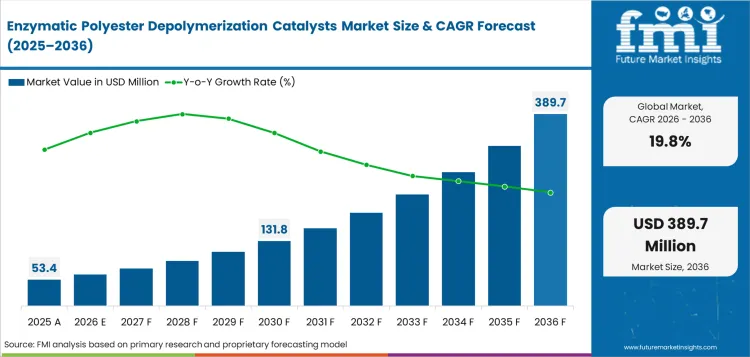
The enzymatic polyester depolymerization catalysts market was valued at USD 53.4 million in 2025. FMI estimates the market to reach USD 64.0 million in 2026 and expand at a CAGR of 19.8% between 2026 and 2036 to reach USD 389.7 million by 2036. PET packaging is expected to dominate with a 48.0% feedstock share, and technology licensing is estimated to lead the sales model segment with a 46.0% share.
Recycling operators face a practical qualification problem before enzyme-based polyester recycling moves into steady commercial supply. European recycled-content rules create the first pressure point since PET beverage bottles need 25% recycled plastic from 2025 and all plastic beverage bottles need 30% from 2030. Catalyst suppliers who can help create traceable monomer-grade rPET gain stronger access to packaging buyers. Plant validation is the second filter as Carbios has outlined 50 kt/year of prepared waste capacity for its Longlaville PET biorecycling plant.
The capacity signal moves supplier assessment away from lab activity claims and toward verified feedstock performance. Feedstock preparation adds the third operating test since patent WO2024076959A1 reported depolymerization completeness rising from 80.6% to 90.5% after sink-float treatment over 48 hours. Enzyme developers and recycling operators need to treat sorting quality and reactor proof as part of the same buying decision.
Summary of the Enzymatic Polyester Depolymerization Catalysts Market
- Demand and Growth Drivers
- Recycled-content rules create demand for enzymatic recycling catalysts as packaging firms need monomer-grade recycled PET.
- Polyester textile waste expands catalyst use as blends and dyed fibers need selective depolymerization.
- Enzyme qualification work matters more as recyclers compare catalyst dose with monomer recovery.
- Product and Segment View
- Engineered PET hydrolases are projected to capture 44.0% of catalyst type share in 2026, as higher enzyme activity helps plants improve reaction speed and reactor economics.
- Sorted bottle and tray streams place PET packaging at 48.0% of feedstock use in 2026, giving early commercial plants a more predictable input base.
- Technology licensing stays the preferred sales model as plant developers need process rights and operating know-how before regular enzyme supply contracts expand.
- Geography and Competitive Outlook
- China is expected to record a CAGR of 23.5% through 2036 as PET resin scale and recycling investment expand.
- The USA is projected to expand at 21.0% CAGR as recycling infrastructure investment improves feedstock handling.
- Companies combining enzyme design depth with plant licensing skill are gaining stronger positions during the forecast period.
- Analyst Opinion
- Nikhil Kaitwade, Principal Consultant for Chemicals and Materials domain at FMI, says, “Enzymatic polyester depolymerization catalysts are becoming a qualification step for food-grade and textile-grade recycled outputs. Recycling plants need enzymes to handle colored PET without unstable monomer quality. Enzyme dose and residence time raise cost while pilot data reduces project risk.”
- Enzymatic Polyester Depolymerization Catalysts Market Value Analysis
- The enzymatic polyester depolymerization catalysts market is moving from pilot enzyme testing into structured plant licensing and recurring enzyme supply.
- Recycled-content requirements are encouraging catalyst use across packaging recovery and polyester textile recycling chains.
- The market is benefiting from deeper use of industrial enzymes across regulated manufacturing and waste processing applications.
- Catalyst validation records strengthen market confidence by confirming monomer yield and reaction stability. These records help recycling operators limit batch failures and reduce licensing risk.
Key Takeaways
- The enzymatic polyester depolymerization catalysts market was valued at USD 53.4 million in 2025.
- By 2036, the enzymatic polyester depolymerization catalysts market is expected to be worth USD 389.7 million.
- From 2026 to 2036, the market is projected to expand at a CAGR of 19.8%.
- The market is projected to create an incremental opportunity of USD 325.7 million between 2026 and 2036.
- In 2026, PET packaging is expected to account for 48.0% of feedstock demand.
- China at 23.5% CAGR and the USA at 21.0% CAGR are two of the fastest-expanding country markets.
Enzymatic Polyester Depolymerization Catalysts Market Definition
The enzymatic polyester depolymerization catalysts market includes enzyme catalysts used to break polyester polymers into reusable monomers before repolymerization. Scope includes engineered PET hydrolases, cutinases, PETase variants, MHETase systems, and immobilized enzyme formats. These catalysts serve PET packaging recovery and polyester textile recycling. Conventional glycolysis catalysts and mechanical recycling machines are outside the scope.
Enzymatic Polyester Depolymerization Catalysts Market Inclusions
Market scope covers all commercially traded enzymatic polyester depolymerization catalysts categorized by catalyst type, including engineered PET hydrolases, cutinases, PETase variants, MHETase systems, and other enzymes; feedstock, including PET packaging, polyester textiles, PET films, and polyester blends; reactor form, including slurry reactors, immobilized beds, membrane reactors, and batch reactors; and sales model, including technology licensing, enzyme supply, joint ventures, and research contracts. Revenue scope covers 2026 to 2036. Stakeholders include enzyme developers, catalyst manufacturers, PET recycling operators, polyester producers, packaging converters, textile recyclers, bioprocess technology providers, reactor system suppliers, brand owners, waste management firms, licensing partners, research institutes, investors, and regulatory bodies.
Enzymatic Polyester Depolymerization Catalysts Market Exclusions
Scope does not include mechanical recycling equipment, chemical glycolysis catalysts, methanolysis catalysts, hydrolysis chemicals, composting enzymes, virgin polyester additives, or finished recycled PET resin sales.
Enzymatic Polyester Depolymerization Catalysts Market Research Methodology
- Primary Research: FMI analysts reviewed recycler interviews, enzyme developer inputs, polyester producer feedback, and plant licensing discussions across important markets.
- Desk Research: FMI analysts combined data from recycling rules, PET hydrolase studies, company technology disclosures, and polyester waste processing requirements.
- Market Sizing and Forecasting: Added catalyst use across pilot plants, commercial plants, licensing value, and enzyme replacement cycles from the bottom up.
- Data Validation: Cross-checked every three months against recycled-content regulation, commercial plant progress, and enzyme supplier portfolios.
Why is the Enzymatic Polyester Depolymerization Catalysts Market Growing?
- Packaging firms are testing enzyme-based recycling earlier to secure monomer-grade recycled PET for regulated packaging use.
- Polyester textile recyclers need selective depolymerization as dyes and blends reduce mechanical recycling output quality.
- Technology licensors matter more as commercial plants need enzyme data and reactor operating guidance.
Packaging rules are creating a direct market signal for enzyme-based PET recycling. Regulatory pressure is pushing packaging firms to secure recycled inputs with stronger quality records. The shift raises the value of catalyst systems that can convert PET waste into purified monomers. Recyclers with dependable enzyme records can strengthen offtake discussions with packaging firms.
PET hydrolase testing is moving toward better industrial comparability. A May 2025 Nature Communications paper identified the need for uniform PET samples and reaction settings aligned with industrial conditions. Standardization matters as enzymes move from lab screening into plant design. Catalyst suppliers with consistent testing records can reduce uncertainty during plant scale-up.
Market Segmentation Analysis
- Engineered PET hydrolases are estimated to represent 44.0% of catalyst type use in 2026, as recyclers prioritize faster PET breakdown across bottle and tray waste.
- PET packaging is projected to capture 48.0% of feedstock volume in 2026, supported by sorted bottle streams with more predictable input quality.
- Slurry reactors are expected to contribute 36.0% of reactor form adoption in 2026, with shredded PET requiring stronger enzyme contact during processing.
- Recycling operators are forecast to account for 40.0% of application share in 2026, since plant yield and output quality depend on catalyst performance.
- Technology licensing is estimated to hold 46.0% of sales model value in 2026, as plant developers secure process rights before recurring enzyme supply expands.
The market for enzymatic polyester depolymerization catalysts is divided into five primary segment groups based on catalyst type, feedstock, reactor form, application, and sales model. Catalyst type includes engineered PET hydrolases, cutinases, PETase variants, MHETase systems, and other enzymes. Feedstock includes PET packaging, polyester textiles, PET films, and polyester blends. Reactor form includes slurry reactors, immobilized beds, membrane reactors, and batch reactors. Application includes recycling operators, polyester producers, packaging converters, and textile recyclers. Sales model includes technology licensing, enzyme supply, joint ventures, and research contracts.
Insights into Enzymatic Polyester Depolymerization Catalysts Market by Catalyst Type
- In 2026, engineered PET hydrolases are expected to make up 44.0% of the catalyst type segment. Higher activity profiles help recycling plants shorten reaction time and improve monomer recovery.
- Cutinases and PETase variants address selected process development needs. Their value improves in programs requiring enzyme benchmarking before larger reactor trials.
Insights into Enzymatic Polyester Depolymerization Catalysts Market by Feedstock
- PET packaging is projected to account for 48.0% of the feedstock segment in 2026. Bottle and tray streams offer better sorting visibility for early commercial enzymatic recycling plants.
- Polyester textiles and PET films serve more selective recycling needs. Their value improves as pretreatment systems become better suited to dyed and mixed material waste.
Insights into Enzymatic Polyester Depolymerization Catalysts Market by Reactor Form
- Slurry reactors are estimated to represent 36.0% of the reactor form segment in 2026. Shredded polyester waste needs close enzyme contact during early plant operation.
- Immobilized beds and membrane reactors address projects focused on enzyme recovery. Their use improves in plants requiring tighter catalyst control across repeat processing cycles.
Insights into Enzymatic Polyester Depolymerization Catalysts Market by Application
- In 2026, recycling operators are forecast to hold 40.0% of the application segment. Operators use enzymatic catalysts to raise monomer yield before selling recycled outputs.
- Polyester producers and packaging converters serve later-stage demand. Their participation improves after recycling plants prove stable quality and dependable offtake volumes.
Insights into Enzymatic Polyester Depolymerization Catalysts Market by Sales Model
- Technology licensing is projected to account for 46.0% of the sales model segment in 2026. Plant developers often need process access before recurring enzyme orders begin.
- Enzyme supply and joint ventures address later commercial needs. Their value improves after licensed plants move from validation work into regular production campaigns.
Enzymatic Polyester Depolymerization Catalysts Market Drivers, Restraints, and Opportunities
- Recycled-content rules are creating structured demand for enzyme systems across packaging-grade PET recovery.
- The need for advanced protein design and pilot validation increases pricing pressure for smaller enzyme developers.
- Polyester textiles improve service opportunity through selective depolymerization and fiber-to-fiber recycling needs.
Enzymatic polyester depolymerization catalyst systems keep growing because recyclers need cleaner monomer recovery from PET packaging and polyester textile waste. Cost pressure and enzyme dose limits can slow commercial use. Growth continues through licensed recycling plants and improved hydrolase systems.
Virgin PET Discount Keeps Catalyst Pricing Under Pressure
Price competitiveness between virgin and recycled PET plays a critical role in shaping catalyst adoption and economics. In October 2025, BIR reported virgin PET at US$ 800 per tonne in developed markets. Recycled PET was about twice this price. For the Enzymatic Polyester Depolymerization Catalysts Market this price gap limits how much recyclers can pay for enzyme systems unless catalysts improve monomer yield and reduce purification losses. Low virgin PET prices weaken the payback case for enzymatic depolymerization. Catalyst developers face pressure to offer performance based pricing and pilot validation. They need to reduce enzyme dose per tonne of polyester waste to improve cost competitiveness.
Recycled-Content Tax Raises the Value of Catalyst-Enabled PET Circularity
Regulatory cost pressures are strengthening the business case for enzymatic recycling solutions. In February 2026, HM Revenue & Customs confirmed the UK Plastic Packaging Tax applies to packaging with less than 30% recycled plastic and rises to 228.82 per tonne from 1 April 2026. The tax increase directly affects enzymatic polyester depolymerization catalysts because PET packaging converters need reliable recycled-content routes to meet food safety and quality requirements. As the tax burden increases from £223.69 per tonne in April 2025 to £228.82 per tonne in April 2026, catalyst vendors gain stronger pricing support where enzyme-based depolymerization improves access to high-purity recycled monomers. Catalyst pricing can move closer to compliance value instead of simple processing-cost comparison.
Analysis of Enzymatic Polyester Depolymerization Catalysts Market By Key Countries
| Country | CAGR |
|---|---|
| China | 23.5% |
| USA | 21.0% |
| France | 20.4% |
| India | 18.9% |
| UK | 16.1% |
Source: Future Market Insights, 2026.
Enzymatic Polyester Depolymerization Catalysts Market CAGR Analysis By Country
- China is predicted to record expansion at 23.5% CAGR through 2036, supported by large PET production capacity and early enzyme licensing activity.
- USA demand is projected to expand at 21.0% CAGR as recycling infrastructure upgrades lead to stronger interest in advanced PET recovery systems.
- France is forecast at 20.4% CAGR through 2036, with commercial plant development giving enzymatic PET recycling a stronger operating base.
- India is expected to advance at 18.9% CAGR as packaging EPR rules and registered plastic waste processors enhance a broader recycling platform.
- UK demand is projected to rise at 16.1% CAGR, backed by recycled-content tax pressure and policy review around chemical recycling recognition.
Demand for enzymatic polyester depolymerization catalysts is forecast to rise at 19.8% CAGR from 2026 to 2036. Country-level analysis covers the major markets contributing to this forecast, with country markets listed below.
Demand Outlook for Enzymatic Polyester Depolymerization Catalysts Market in China
China’s enzymatic polyester depolymerization catalysts industry is projected to record a CAGR of 23.5% through 2036. Carbios and Wankai New Materials signed a definitive agreement in December 2025 covering exclusive PET depolymerization technology licensing in Asia for three years. The agreement requires at least 100 kt per year of added capacity for the initial license term. The agreement creates a defined platform for China enzymatic polyester depolymerization catalysts demand.
- China’s PET producer base raises demand for enzyme systems connected to monomer recovery.
- Wankai’s Asia license path gives catalyst adoption a defined industrial channel.
- Local plant scale can reduce enzyme cost through repeat operating cycles.
Sales Analysis of Enzymatic Polyester Depolymerization Catalysts Market in the United States
The USA enzymatic polyester depolymerization catalysts sector is expected to expand at a CAGR of 21.0% during the assessment period. EPA’s August 2025 report states that USD 36.5 billion to USD 43.4 billion is needed to improve USA recycling infrastructure by 2030. The investment gap favors advanced recycling technologies able to lift recovery value from PET packaging. USA recyclers need catalyst systems with dependable yield evidence for consistent performance validation.
- Recycling infrastructure gaps boost demand for process upgrades across PET recovery facilities.
- EPA estimates improved systems could recover another 82 million to 89 million tons of packaging and organic waste.
- Catalyst suppliers with pilot plant evidence can gain from chemical recycling service project planning.
Demand Outlook for Enzymatic Polyester Depolymerization Catalysts Market in France
France’s enzymatic polyester depolymerization catalysts industry is forecast to grow at a CAGR of 20.4% by 2036. Carbios celebrated the groundbreaking of its Longlaville PET biorecycling plant in April 2024. The plant will have a processing capacity of 50 kt per year of prepared waste at full capacity. The plant base raises France enzymatic polyester depolymerization catalysts demand through enzyme validation and license activity.
- Commercial plant activity gives France a stronger enzyme recycling reference base.
- Public funding and industrial partnerships improve confidence in plant-scale PET depolymerization.
- French projects can strengthen demand for molecular recycling feedstock and polyester renewal resins.
Opportunity Analysis of Enzymatic Polyester Depolymerization Catalysts Market in India
India’s enzymatic polyester depolymerization catalysts segment is projected to advance at 18.9% CAGR over the forecast years. India’s EPR portal listed 60,128 registered producers, importers, and brand owners in March 2026. PIB reported 3,012 registered plastic waste processors and around 207 lakh tonnes of recycled plastic packaging waste. The compliance base raises demand for India enzymatic polyester depolymerization catalysts as recycled-content needs deepen.
- Plastic packaging EPR increases a larger demand base for verified recycled output.
- Registered processors can become early partners for enzymatic PET trials.
- Catalyst systems can help converters address hard-to-recycle PET packaging streams.
Future Outlook for Enzymatic Polyester Depolymerization Catalysts Market in the United Kingdom
The UK enzymatic polyester depolymerization catalysts industry is expected to post 16.1% CAGR through 2036. HMRC guidance updated in February 2026 listed the Plastic Packaging Tax rate at GBP 228.82 per tonne from April 2026. UK guidance recognizes the 30% recycled-content threshold in Plastic Packaging Tax guidance. The policy setting supports UK enzymatic polyester depolymerization catalysts as chemical recyclate accounting develops.
- Plastic Packaging Tax enhances a direct cost signal for recycled-content compliance.
- Chemical recyclate recognition can improve demand for enzyme-based monomer recovery.
- Policy clarity can increase demand for packaging waste recycling systems with stronger traceability.
Competitive Landscape and Strategic Positioning
Enzymatic Polyester Depolymerization Catalysts Market Analysis By Company
Enzyme performance now shapes competitive positioning in this market as technology owners prove monomer yield and catalyst reuse. Plant execution has become the second test as recycling operators compare reactor readiness and license terms.
- Carbios is positioned strongly through PET biorecycling technology and license-based commercialization connected to industrial plant execution programs.
- Novonesis and Samsara Eco compete through enzyme production capacity and AI-designed platforms for polyester recycling programs.
- Specialist firms focus on polyester textile waste and pilot-scale enzyme design for targeted process development work.
Carbios holds a strong position through its engineered enzyme platform and Longlaville commercial plant pathway. Novonesis brings fermentation depth and enzyme manufacturing skill for scale-up programs. Samsara Eco competes through EosEco enzymatic recycling technology across mixed plastic and textile inputs. Protein Evolution and Epoch Biodesign focus on AI-designed enzyme systems for polyester-rich waste.
Competitive barriers include enzyme cost and reactor scale-up challenges across commercial recycling projects due to feedstock pretreatment requirements. Companies with proven plant data and repeatable enzyme performance are best placed to win long-term recycling partnerships.
Key Companies in the Enzymatic Polyester Depolymerization Catalysts Market
Global companies active in the enzymatic polyester depolymerization catalysts market include:
- Carbios and Novonesis have strong infrastructure for PET enzyme design and industrial enzyme production.
- Samsara Eco and Protein Evolution serve recycling partners through AI-designed enzyme platforms and polymer breakdown systems.
- Epoch Biodesign, Basecamp Research, and Wankai New Materials hold specialist positions across enzyme discovery and PET biorecycling scale-up.
Competitive Benchmarking: Enzymatic Polyester Depolymerization Catalysts Market
| Company | PET Enzyme Depth | Fermentation Scale | Plant License Readiness | Geographic Footprint |
|---|---|---|---|---|
| Carbios | High | Medium | Strong | France base with PET biorecycling commercialization in Europe and Asia licensing through Wankai New Materials. |
| Novonesis | High | High | Moderate | Global biosolutions footprint with subsidiaries across Europe, North America, Latin America, and Asia. |
| Samsara Eco | High | Medium | Moderate | Australia base with Jerrabomberra plant and commercialization relevance across apparel, packaging, and automotive materials. |
| Protein Evolution | Medium | Medium | Moderate | United States base with enzyme design activity centered in New Haven, Connecticut. |
| Epoch Biodesign | Medium | Low | Early | United Kingdom base with enzymatic recycling focus for mixed plastics and textile waste. |
| Basecamp Research | Medium | Medium | Early | United Kingdom headquarters with United States presence through Cambridge, Massachusetts. |
| Wankai New Materials | Low | Low | Strong | China PET producer with Asia-focused PET biorecycling license partnership and first plant planned in China. |
Source: Future Market Insights, 2026.
Key Developments in Enzymatic Polyester Depolymerization Catalysts Market
- In April 2024, Carbios held the groundbreaking ceremony for its Longlaville PET biorecycling plant in France. The plant is designed for 50 kt per year of prepared waste at full capacity.
- In December 2025, Carbios and Wankai New Materials signed a definitive agreement for large-scale PET biorecycling deployment in Asia. The agreement covers exclusive licensing in Asia subject to added capacity commitments.
Key Players in the Enzymatic Polyester Depolymerization Catalysts Market
Major Global Players:
- Carbios
- Novonesis
- Samsara Eco
- Protein Evolution
- Wankai New Materials
Specialist Players:
- Epoch Biodesign
- Basecamp Research
Report Scope and Coverage
Enzymatic Polyester Depolymerization Catalysts Market Breakdown By Catalyst Type, Feedstock, And Region
| Parameter | Details |
|---|---|
| Quantitative Units | USD 64.0 million to USD 389.7 million, at a CAGR of 19.8% |
| Market Definition | The enzymatic polyester depolymerization catalysts market encompasses enzyme systems used to break PET and polyester waste into reusable monomers. |
| Regions Covered | North America, Latin America, Europe, East Asia, South Asia and Pacific, Middle East and Africa |
| Countries Covered | USA, UK, Germany, China, India, France, Japan, and 30 plus countries |
| Key Companies Profiled | Carbios, Novonesis, Samsara Eco, Protein Evolution, Epoch Biodesign, Basecamp Research, Wankai New Materials |
| Forecast Period | 2026 to 2036 |
| Approach | Hybrid bottom-up and top-down methodology starting with catalyst use, licensing demand, and verified recycling policy signals. |
Enzymatic Polyester Depolymerization Catalysts Market by Segments
Enzymatic Polyester Depolymerization Catalysts Market Segmented by Catalyst Type:
- Engineered PET Hydrolases
- Cutinases
- PETase Variants
- MHETase Systems
- Other Enzymes
Enzymatic Polyester Depolymerization Catalysts Market Segmented by Feedstock:
- PET Packaging
- Polyester Textiles
- PET Films
- Polyester Blends
Enzymatic Polyester Depolymerization Catalysts Market Segmented by Reactor Form:
- Slurry Reactors
- Immobilized Beds
- Membrane Reactors
- Batch Reactors
Enzymatic Polyester Depolymerization Catalysts Market Segmented by Application:
- Recycling Operators
- Polyester Producers
- Packaging Converters
- Textile Recyclers
Enzymatic Polyester Depolymerization Catalysts Market Segmented by Sales Model:
- Technology Licensing
- Enzyme Supply
- Joint Ventures
- Research Contracts
Enzymatic Polyester Depolymerization Catalysts Market by Region:
- North America
- USA
- Canada
- Mexico
- Latin America
- Brazil
- Chile
- Rest of Latin America
- Europe
- Germany
- UK
- Italy
- Spain
- France
- Rest of Europe
- East Asia
- China
- Japan
- South Korea
- South Asia and Pacific
- India
- ASEAN
- Australia & New Zealand
- Rest of South Asia and Pacific
- Middle East and Africa
- Saudi Arabia
- Other GCC Countries
- South Africa
- Rest of Middle East and Africa
Research Sources and Bibliography
- Bureau of International Recycling. (2025, October 28). BIR Bangkok 2025 – Plastics Division: ‘Glimmer of hope’ for plastics recyclers in continued tough market. BIR. Source link
- HM Revenue & Customs. (2026, February 12). Plastic Packaging Tax: steps to take. GOV.UK.
- Carbios. (2024, April 25). Carbios celebrates the groundbreaking of its PET biorecycling plant, a world first, with its partners.
- Carbios. (2025, December 2). Carbios and Wankai New Materials sign the definitive agreement establishing a strategic partnership.
- HM Revenue & Customs. (2026, February 12). Plastic Packaging Tax: steps to take.
- His Majesty’s Treasury. (2024, October 30). Plastic Packaging Tax: Chemical recycling and adoption of a mass balance approach.
- Plastics Recyclers Europe. (2025, November). Plastics recycling industry figures.
- Press Information Bureau. (2026, March 23). Plastic Waste Management. Government of India.
- USA Environmental Protection Agency. (2025, August 6). USA Recycling Infrastructure Assessment and State Data Collection Reports.
- Wei, R., et al. (2025, May). Standardization guidelines and future trends for PET hydrolase research. Nature Communications.
- Groseclose, T. M., et al. (2025, August). Recent advances in enzyme engineering for improved deconstruction of PET plastics. Communications Materials.
This Report Answers
• What is the current and future size of the enzymatic polyester depolymerization catalysts market during the forecast period?
• How fast is the enzymatic polyester depolymerization catalysts market expected to expand between 2026 and 2036?
• Which catalyst type is expected to lead the market by 2026 across commercial recycling applications?
• Which feedstock segment is expected to account for the highest catalyst demand by 2026?
• What factors are driving demand for enzymatic polyester depolymerization catalysts across recycling plants globally?
• How are recycled-content rules influencing adoption of enzyme-based polyester recycling systems across packaging value chains?
• Why are recycling operators the main application base for enzymatic polyester depolymerization catalysts?
• How are polyester textiles creating demand for specialized enzyme depolymerization systems through 2036?
• Which countries are projected to record faster expansion in enzymatic polyester depolymerization catalysts through 2036?
• What is driving market expansion in China and the United States during the assessment period?
• Which companies are active in the enzymatic polyester depolymerization catalysts market globally?
• How does FMI estimate and validate the enzymatic polyester depolymerization catalysts market forecast?
Frequently Asked Questions
What is the global market demand for Enzymatic Polyester Depolymerization Catalysts in 2026?
In 2026, the global market for enzymatic polyester depolymerization catalysts is expected to be worth USD 64.0 million.
How big will the market for Enzymatic Polyester Depolymerization Catalysts be in 2036?
In 2026, the global market for enzymatic polyester depolymerization catalysts is expected to be worth USD 64.0 million.
How much is demand for Enzymatic Polyester Depolymerization Catalysts expected to expand between 2026 and 2036?
Between 2026 and 2036, demand for enzymatic polyester depolymerization catalysts is expected to expand at a CAGR of 19.8%.
Which catalyst type segment is likely to be the leading segment globally by 2026?
Engineered PET Hydrolases will make up 44.0% of the catalyst type segment in 2026.
What is causing demand to rise in China during the forecast assessment period?
The China enzymatic polyester depolymerization catalysts market is projected to record 23.5% CAGR through 2036, backed by PET production scale and license activity.
What is causing demand to rise in the United States during the forecast assessment period?
The USA enzymatic polyester depolymerization catalysts market is projected to expand at 21.0% CAGR through 2036, backed by recycling infrastructure investment.
What does this report mean by Enzymatic Polyester Depolymerization Catalysts Market definition?
The enzymatic polyester depolymerization catalysts market includes enzyme systems used to convert PET and polyester waste into reusable monomers.
How does FMI make the Enzymatic Polyester Depolymerization Catalysts forecast and check it?
Forecasting models use a hybrid bottom-up and top-down approach, starting with catalyst use and checking it against recycling policy signals.
Preview the report firsthand - request a free sample
Get SampleGet the brochure for pricing and purchase details.
Get PDFTable of Content
- Key Takeaways
- Market Size and CAGR
- Top Growth Driver
- Fastest Growing Segment
- Leading Region
- Key Companies
- Emerging Opportunities
- Executive Summary
- Global Market Outlook
- Demand-side Trends
- Supply-side Trends
- Technology Roadmap Analysis
- Analysis and Recommendations
- Analyst Perspective (What is happening? Why now? What should investors know?)
- Key Questions Answered
- How large is the market?
- What is the CAGR?
- What are key trends?
- Which region dominates?
- Who are the leaders?
- Market Overview
- Market Coverage / Taxonomy
- Market Definition / Scope / Limitations
- Research Methodology
- Chapter Orientation
- Analytical Lens and Working Hypotheses
- Market Structure, Signals, and Trend Drivers
- Benchmarking and Cross-market Comparability
- Market Sizing, Forecasting, and Opportunity Mapping
- Research Design and Evidence Framework
- Desk Research Programme (Secondary Evidence)
- Expert Input and Fieldwork (Primary Evidence)
- Tooling, Models, and Reference Databases
- Data Engineering and Model Build
- Quality Assurance and Audit Trail
- Market Background
- Market Dynamics (Drivers, Restraints, Opportunity, Trends)
- Scenario Forecast (Optimistic, Likely, Conservative)
- Impact Analysis
- AI Impact
- Sustainability Impact
- Regulatory Impact
- Technology Impact
- Consumer / Buyer Analysis
- Purchase Drivers
- Adoption Barriers
- Buyer Journey
- Opportunity Map Analysis
- Product Life Cycle Analysis
- Supply Chain Analysis
- Investment Feasibility Matrix
- Value Chain Analysis
- PESTLE and Porter's Analysis
- Regulatory Landscape
- Regional Parent Market Outlook
- Production and Consumption Statistics
- Import and Export Statistics
- Global Market Analysis and Forecast, 2021 to 2036
- Historical Market Size Value (USD Million) & Volume (Unit) Analysis, 2021 to 2025
- Current and Future Market Size Value (USD Million) & Volume (Unit) Projections, 2026 to 2036
- Y-o-Y Growth Trend Analysis
- Absolute $ Opportunity Analysis
- Global Market Pricing Analysis, 2021 to 2036
- Global Market Analysis and Forecast, By Catalyst Type, 2021 to 2036
- Introduction / Key Findings
- Historical Market Size Value (USD Million) & Volume (Unit) Analysis By Catalyst Type, 2021 to 2025
- Current and Future Market Size Value (USD Million) & Volume (Unit) Analysis and Forecast By Catalyst Type, 2026 to 2036
- Engineered PET Hydrolases
- Cutinases
- PETase Variants
- MHETase Systems
- Other Enzymes
- Engineered PET Hydrolases
- Y-o-Y Growth Trend Analysis By Catalyst Type, 2021 to 2025
- Absolute $ Opportunity Analysis By Catalyst Type, 2026 to 2036
- Global Market Analysis and Forecast, By Feedstock, 2021 to 2036
- Introduction / Key Findings
- Historical Market Size Value (USD Million) & Volume (Unit) Analysis By Feedstock, 2021 to 2025
- Current and Future Market Size Value (USD Million) & Volume (Unit) Analysis and Forecast By Feedstock, 2026 to 2036
- PET Packaging
- Polyester Textiles
- PET Films
- Polyester Blends
- PET Packaging
- Y-o-Y Growth Trend Analysis By Feedstock, 2021 to 2025
- Absolute $ Opportunity Analysis By Feedstock, 2026 to 2036
- Global Market Analysis and Forecast, By Reactor Form, 2021 to 2036
- Introduction / Key Findings
- Historical Market Size Value (USD Million) & Volume (Unit) Analysis By Reactor Form, 2021 to 2025
- Current and Future Market Size Value (USD Million) & Volume (Unit) Analysis and Forecast By Reactor Form, 2026 to 2036
- Slurry Reactors
- Immobilized Beds
- Membrane Reactors
- Batch Reactors
- Slurry Reactors
- Y-o-Y Growth Trend Analysis By Reactor Form, 2021 to 2025
- Absolute $ Opportunity Analysis By Reactor Form, 2026 to 2036
- Global Market Analysis and Forecast, By Application, 2021 to 2036
- Introduction / Key Findings
- Historical Market Size Value (USD Million) & Volume (Unit) Analysis By Application, 2021 to 2025
- Current and Future Market Size Value (USD Million) & Volume (Unit) Analysis and Forecast By Application, 2026 to 2036
- Recycling Operators
- Polyester Producers
- Packaging Converters
- Textile Recyclers
- Recycling Operators
- Y-o-Y Growth Trend Analysis By Application, 2021 to 2025
- Absolute $ Opportunity Analysis By Application, 2026 to 2036
- Global Market Analysis and Forecast, By Sales Model, 2021 to 2036
- Introduction / Key Findings
- Historical Market Size Value (USD Million) & Volume (Unit) Analysis By Sales Model, 2021 to 2025
- Current and Future Market Size Value (USD Million) & Volume (Unit) Analysis and Forecast By Sales Model, 2026 to 2036
- Technology Licensing
- Enzyme Supply
- Joint Ventures
- Research Contracts
- Technology Licensing
- Y-o-Y Growth Trend Analysis By Sales Model, 2021 to 2025
- Absolute $ Opportunity Analysis By Sales Model, 2026 to 2036
- Global Market Analysis and Forecast, By Region, 2021 to 2036
- Introduction
- Historical Market Size Value (USD Million) & Volume (Unit) Analysis By Region, 2021 to 2025
- Current Market Size Value (USD Million) & Volume (Unit) Analysis and Forecast By Region, 2026 to 2036
- North America
- Latin America
- Western Europe
- Eastern Europe
- East Asia
- South Asia and Pacific
- Middle East & Africa
- Market Attractiveness Analysis By Region
- North America Market Analysis and Forecast, By Country, 2021 to 2036
- Historical Market Size Value (USD Million) & Volume (Unit) Trend Analysis By Market Taxonomy, 2021 to 2025
- Market Size Value (USD Million) & Volume (Unit) Forecast By Market Taxonomy, 2026 to 2036
- By Country
- USA
- Canada
- Mexico
- By Catalyst Type
- By Feedstock
- By Reactor Form
- By Application
- By Sales Model
- By Country
- Market Attractiveness Analysis
- By Country
- By Catalyst Type
- By Feedstock
- By Reactor Form
- By Application
- By Sales Model
- Key Takeaways
- Latin America Market Analysis and Forecast, By Country
- Historical Market Size Value (USD Million) & Volume (Unit) Trend Analysis By Market Taxonomy, 2021 to 2025
- Market Size Value (USD Million) & Volume (Unit) Forecast By Market Taxonomy, 2026 to 2036
- By Country
- Brazil
- Chile
- Rest of Latin America
- By Catalyst Type
- By Feedstock
- By Reactor Form
- By Application
- By Sales Model
- By Country
- Market Attractiveness Analysis
- By Country
- By Catalyst Type
- By Feedstock
- By Reactor Form
- By Application
- By Sales Model
- Key Takeaways
- Western Europe Market Analysis and Forecast, By Country
- Historical Market Size Value (USD Million) & Volume (Unit) Trend Analysis By Market Taxonomy, 2021 to 2025
- Market Size Value (USD Million) & Volume (Unit) Forecast By Market Taxonomy, 2026 to 2036
- By Country
- Germany
- UK
- Italy
- Spain
- France
- Nordic
- BENELUX
- Rest of Western Europe
- By Catalyst Type
- By Feedstock
- By Reactor Form
- By Application
- By Sales Model
- By Country
- Market Attractiveness Analysis
- By Country
- By Catalyst Type
- By Feedstock
- By Reactor Form
- By Application
- By Sales Model
- Key Takeaways
- Eastern Europe Market Analysis and Forecast, By Country
- Historical Market Size Value (USD Million) & Volume (Unit) Trend Analysis By Market Taxonomy, 2021 to 2025
- Market Size Value (USD Million) & Volume (Unit) Forecast By Market Taxonomy, 2026 to 2036
- By Country
- Russia
- Poland
- Hungary
- Balkan & Baltic
- Rest of Eastern Europe
- By Catalyst Type
- By Feedstock
- By Reactor Form
- By Application
- By Sales Model
- By Country
- Market Attractiveness Analysis
- By Country
- By Catalyst Type
- By Feedstock
- By Reactor Form
- By Application
- By Sales Model
- Key Takeaways
- East Asia Market Analysis and Forecast, By Country
- Historical Market Size Value (USD Million) & Volume (Unit) Trend Analysis By Market Taxonomy, 2021 to 2025
- Market Size Value (USD Million) & Volume (Unit) Forecast By Market Taxonomy, 2026 to 2036
- By Country
- China
- Japan
- South Korea
- By Catalyst Type
- By Feedstock
- By Reactor Form
- By Application
- By Sales Model
- By Country
- Market Attractiveness Analysis
- By Country
- By Catalyst Type
- By Feedstock
- By Reactor Form
- By Application
- By Sales Model
- Key Takeaways
- South Asia and Pacific Market Analysis and Forecast, By Country
- Historical Market Size Value (USD Million) & Volume (Unit) Trend Analysis By Market Taxonomy, 2021 to 2025
- Market Size Value (USD Million) & Volume (Unit) Forecast By Market Taxonomy, 2026 to 2036
- By Country
- India
- ASEAN
- Australia & New Zealand
- Rest of South Asia and Pacific
- By Catalyst Type
- By Feedstock
- By Reactor Form
- By Application
- By Sales Model
- By Country
- Market Attractiveness Analysis
- By Country
- By Catalyst Type
- By Feedstock
- By Reactor Form
- By Application
- By Sales Model
- Key Takeaways
- Middle East & Africa Market Analysis and Forecast, By Country
- Historical Market Size Value (USD Million) & Volume (Unit) Trend Analysis By Market Taxonomy, 2021 to 2025
- Market Size Value (USD Million) & Volume (Unit) Forecast By Market Taxonomy, 2026 to 2036
- By Country
- Kingdom of Saudi Arabia
- Other GCC Countries
- Türkiye
- South Africa
- Other African Union
- Rest of Middle East & Africa
- By Catalyst Type
- By Feedstock
- By Reactor Form
- By Application
- By Sales Model
- By Country
- Market Attractiveness Analysis
- By Country
- By Catalyst Type
- By Feedstock
- By Reactor Form
- By Application
- By Sales Model
- Key Takeaways
- Key Countries Market Analysis
- USA
- Pricing Analysis
- Market Share Analysis, 2025
- By Catalyst Type
- By Feedstock
- By Reactor Form
- By Application
- By Sales Model
- Canada
- Pricing Analysis
- Market Share Analysis, 2025
- By Catalyst Type
- By Feedstock
- By Reactor Form
- By Application
- By Sales Model
- Mexico
- Pricing Analysis
- Market Share Analysis, 2025
- By Catalyst Type
- By Feedstock
- By Reactor Form
- By Application
- By Sales Model
- Brazil
- Pricing Analysis
- Market Share Analysis, 2025
- By Catalyst Type
- By Feedstock
- By Reactor Form
- By Application
- By Sales Model
- Chile
- Pricing Analysis
- Market Share Analysis, 2025
- By Catalyst Type
- By Feedstock
- By Reactor Form
- By Application
- By Sales Model
- Germany
- Pricing Analysis
- Market Share Analysis, 2025
- By Catalyst Type
- By Feedstock
- By Reactor Form
- By Application
- By Sales Model
- UK
- Pricing Analysis
- Market Share Analysis, 2025
- By Catalyst Type
- By Feedstock
- By Reactor Form
- By Application
- By Sales Model
- Italy
- Pricing Analysis
- Market Share Analysis, 2025
- By Catalyst Type
- By Feedstock
- By Reactor Form
- By Application
- By Sales Model
- Spain
- Pricing Analysis
- Market Share Analysis, 2025
- By Catalyst Type
- By Feedstock
- By Reactor Form
- By Application
- By Sales Model
- France
- Pricing Analysis
- Market Share Analysis, 2025
- By Catalyst Type
- By Feedstock
- By Reactor Form
- By Application
- By Sales Model
- India
- Pricing Analysis
- Market Share Analysis, 2025
- By Catalyst Type
- By Feedstock
- By Reactor Form
- By Application
- By Sales Model
- ASEAN
- Pricing Analysis
- Market Share Analysis, 2025
- By Catalyst Type
- By Feedstock
- By Reactor Form
- By Application
- By Sales Model
- Australia & New Zealand
- Pricing Analysis
- Market Share Analysis, 2025
- By Catalyst Type
- By Feedstock
- By Reactor Form
- By Application
- By Sales Model
- China
- Pricing Analysis
- Market Share Analysis, 2025
- By Catalyst Type
- By Feedstock
- By Reactor Form
- By Application
- By Sales Model
- Japan
- Pricing Analysis
- Market Share Analysis, 2025
- By Catalyst Type
- By Feedstock
- By Reactor Form
- By Application
- By Sales Model
- South Korea
- Pricing Analysis
- Market Share Analysis, 2025
- By Catalyst Type
- By Feedstock
- By Reactor Form
- By Application
- By Sales Model
- Russia
- Pricing Analysis
- Market Share Analysis, 2025
- By Catalyst Type
- By Feedstock
- By Reactor Form
- By Application
- By Sales Model
- Poland
- Pricing Analysis
- Market Share Analysis, 2025
- By Catalyst Type
- By Feedstock
- By Reactor Form
- By Application
- By Sales Model
- Hungary
- Pricing Analysis
- Market Share Analysis, 2025
- By Catalyst Type
- By Feedstock
- By Reactor Form
- By Application
- By Sales Model
- Kingdom of Saudi Arabia
- Pricing Analysis
- Market Share Analysis, 2025
- By Catalyst Type
- By Feedstock
- By Reactor Form
- By Application
- By Sales Model
- Türkiye
- Pricing Analysis
- Market Share Analysis, 2025
- By Catalyst Type
- By Feedstock
- By Reactor Form
- By Application
- By Sales Model
- South Africa
- Pricing Analysis
- Market Share Analysis, 2025
- By Catalyst Type
- By Feedstock
- By Reactor Form
- By Application
- By Sales Model
- USA
- Market Structure Analysis
- Competition Dashboard
- Competition Benchmarking
- Market Share Analysis of Top Players
- By Regional
- By Catalyst Type
- By Feedstock
- By Reactor Form
- By Application
- By Sales Model
- Emerging Startups
- Innovation Benchmarking
- Competition Analysis
- Competition Deep Dive
- Carbios
- Overview
- Product Portfolio
- Profitability by Market Segments (Product/Region/Sales Channel)
- Sales Footprint
- Strategy Overview
- Marketing Strategy
- Product Strategy
- Channel Strategy
- Novonesis
- Samsara Eco
- Protein Evolution
- Wankai New Materials
- Epoch Biodesign
- Basecamp Research
- Carbios
- Case Studies
- Success Stories
- Recent Developments
- Competition Deep Dive
- Assumptions & Acronyms Used


