

- Industry Size (2026)
- USD 2.4 Bn
- Forecast (2036)
- USD 6.4 Bn
- CAGR (2026 to 2036)
- 10.3%
Molecular Recycling Feedstock and Polyester Renewal Resins Market Forecast and Outlook 2026 to 2036
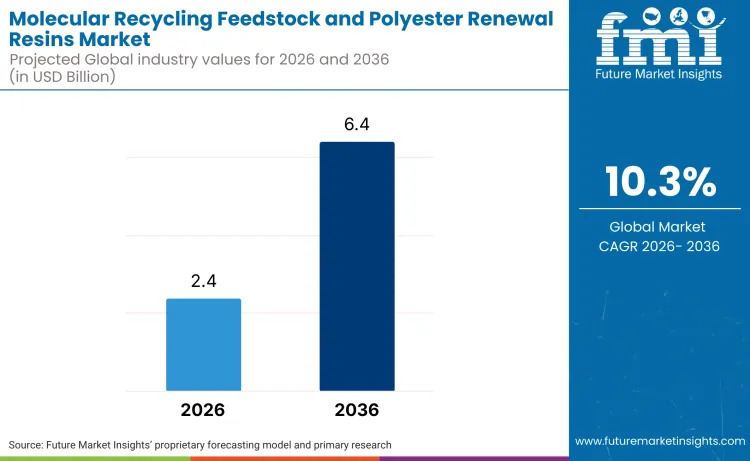
The molecular recycling feedstock and polyester renewal resins market is forecasted to total USD 2.4 billion in 2026, anticipated to rise further to USD 6.4 billion by 2036 at a CAGR of 10.3%. Analysis by future market insights reveals that this industry is moving out of its experimental phase and into a period defined by commercial execution. This shift reflects a broader change in how the chemical industry views recycling.
Momentum is fueled by limitations of mechanical recycling, which struggles with mixed, contaminated, and textile-based waste. Molecular recycling technologies address these gaps by breaking polymers back into their chemical building blocks, enabling reuse across applications that require high and consistent material performance. For brand owners and converters, this capability matters less as a sustainability claim and more as a way to secure reliable, specification-grade material in a tightening regulatory environment.
Asia-Pacific is consolidating its role as a center for advanced recycling investment. South Korea stands out as a focal point, supported by coordinated industrial policy and the emergence of integrated recycling clusters designed to operate at global scale. These developments are reinforcing regional leadership not through experimentation, but through capacity, integration, and execution discipline.
North America demonstrates that molecular recycling can function as a commercially viable industrial model, not just an ESG-led initiative. Operating assets in the region have helped normalize the economics of advanced recycling and reduce investor skepticism around scale and returns.
Across regions, partnerships are becoming the dominant operating model. Waste handlers, chemical producers, and technology providers are aligning to secure feedstock access, stabilize quality, and reduce scale-up risk. Digital tools are increasingly embedded into these partnerships, not as optional enhancements but as prerequisites for consistency and compliance.
Summary of the Molecular Recycling Feedstock and Polyester Renewal Resins Market
What is Growth Outlook for Molecular Recycling Feedstock and Polyester Renewal Resins Market as per Future Market Insights Projection?
Future Market Insights projects the molecular recycling feedstock and polyester renewal resins market to expand at a CAGR of 10.3% from 2026 to 2036, increasing from USD 2.4 billion in 2026 to USD 6.4 billion by 2036.
FMI Research Approach: FMI proprietary forecasting model integrating enforceable recycled-content mandates, chemical depolymerisation capacity deployment, and resin-grade recycled polyester demand across packaging and textile value chains.
How do FMI Analysts Perceive Molecular Recycling Feedstock and Polyester Renewal Resins Market to Evolve?
FMI analysts perceive the market evolving from pilot-scale validation into a phase defined by industrial execution and regulatory anchoring. Molecular recycling is increasingly positioned as a compliance-critical supply route rather than a discretionary sustainability option, particularly as mechanical recycling limitations constrain access to specification-grade recycled polyester. Market momentum is driven by capacity integration, feedstock control, and downstream polymer performance consistency.
FMI Research Approach: Assessment of regulatory enforcement trajectories, capital deployment by chemical majors, and commercial performance of operating molecular recycling assets.
Which Country Holds Largest Share in Global Molecular Recycling Feedstock and Polyester Renewal Resins Market?
China holds the largest share of the global molecular recycling feedstock and polyester renewal resins market, supported by standardized recycled resin quality frameworks, coordinated industrial policy, and accelerating deployment of export-aligned advanced recycling facilities.
FMI Research Approach: Country-level modeling based on advanced recycling capacity, regulatory standardization, and integration with downstream polyester production ecosystems.
What is the Definition of Molecular Recycling Feedstock and Polyester Renewal Resins Market?
The molecular recycling feedstock and polyester renewal resins market comprises chemically recycled polymer intermediates and regenerated polyester resins produced through depolymerisation processes, enabling conversion of mixed, contaminated, and textile-based waste into specification-grade materials suitable for regulated packaging and textile applications.
FMI Research Approach: FMI market taxonomy and inclusion-exclusion framework covering molecular recycling routes, feedstock classes, and downstream resin applications.
What are some Globally Unique Trends Shaping Molecular Recycling Feedstock and Polyester Renewal Resins Market?
Key trends include the dominance of glycolysis as the leading depolymerisation route, rising reliance on rigid packaging as the primary demand anchor, growing integration of digital traceability systems, and increasing treatment of chemically recycled polyester as a margin-protection tool under plastic tax and recycled-content regulations.
FMI Research Approach: Synthesis of regulatory developments, project commissioning data, and downstream procurement strategies across major recycling and polymer-producing regions.
Molecular Recycling Feedstock and Polyester Renewal Resins Market Key Takeaways
| Metric | Values |
|---|---|
| Expected Value (2026E) | USD 2.4 billion |
| Projected Valued (2036F) | USD 6.4 billion |
| CAGR (2026-2036) | 10.3% |
Source: Future Market Insights analysis, supported by a proprietary forecasting model and primary research
Why is the Molecular Recycling and Recycled Polyester Resins Market Growing?
Growth is driven by enforceable regulation, industrial scale capital deployment, and measurable improvements in process economics rather than voluntary sustainability commitments. What operated as a niche, premium priced segment is shifting into a compliance mandated materials market across the European Union and high growth Asian economies such as India. Demand is anchored to regulation than price sensitivity.
Government enforced minimum thresholds for recycled plastics in packaging are compelling FMCG, pharmaceutical, and e commerce companies to secure compliant recycled resin supply regardless of near term market cycles. India’s enforcement of revised Plastic Waste Management rules in 2025 marks a clear inflection point, converting recycled polymer usage into a non-negotiable compliance obligation. Similar regulatory enforcement trajectories are emerging across Southeast Asia and Latin America.
The entry of global energy and chemical majors is accelerating the transition of molecular recycling from pilot validation to industrial operation. Large capital commitments and multi unit commissioning within integrated petrochemical complexes signal rising confidence in feedstock aggregation, process stability, and downstream polymer integration. This shift lowers perceived technology risk while raising competitive barriers.
Advances in chemical depolymerization and polymer engineering are expanding both feedstock availability and application quality. Mixed fiber and functionalized polyester textiles are increasingly processed without sacrificing polymer performance. Recycled polyester now retains durability, soil release, and consistency suitable for higher value textile and packaging applications.
How is the Molecular Recycling Feedstock & Polyester Renewal Resins Market Segmented?
The molecular recycling and polyester renewal ecosystem is being defined by process maturity and downstream compatibility rather than experimental innovation. Glycolysis has emerged as the most widely deployed recycling route due to its scalability and resin-grade output consistency.
Rigid packaging and bottle applications dominate resin consumption by demand, reflecting regulatory pressure and brand-led circularity commitments that favour rapid, high-volume adoption.
Is Glycolysis the Leading Molecular Recycling Route for Polyester Renewal?
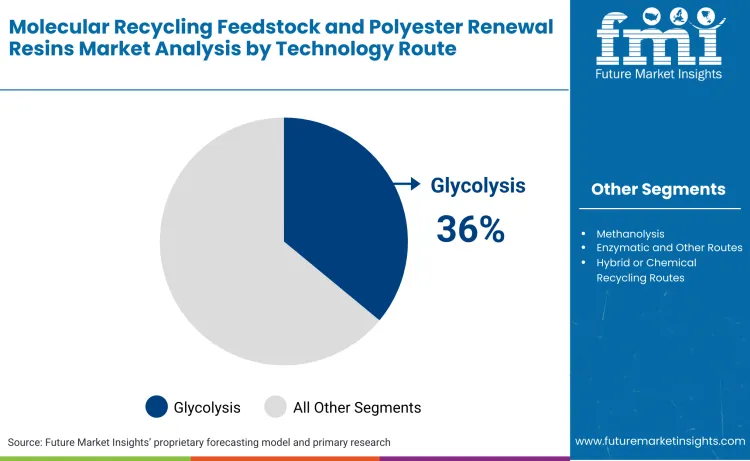
Glycolysis accounts for 36% of total technology route adoption, positioning it as the most established molecular recycling pathway for polyester feedstock renewal. Its dominance is rooted in process simplicity and industrial readiness. Unlike methanolysis or enzymatic systems, glycolysis operates under comparatively moderate temperature and pressure conditions, allowing recyclers to retrofit existing depolymerisation infrastructure rather than build entirely new plants. This has significantly lowered capital barriers and accelerated commercial deployment.
Another key advantage lies in output flexibility and quality control. Glycolysis produces BHET-rich intermediates that can be purified and repolymerised into near-virgin polyester resins suitable for food-contact and high-clarity applications. This reliability has made glycolysis the preferred route for converters and brand owners seeking predictable resin performance at scale. As a result, most early commercial polyester renewal projects have anchored their technology stack around glycolysis before selectively layering in hybrid or enzymatic processes.
Why are Rigid Packaging and Bottles the Primary End-Use Anchor?
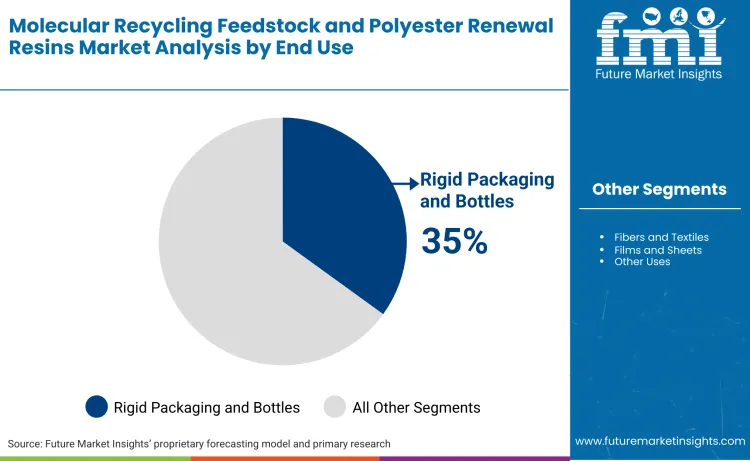
Representing 35% of total demand, rigid packaging and bottles constitute the leading end-use of molecularly recycled polyester renewal resins, making this the single largest application segment. This leadership is driven by regulatory mandates and brand commitments that prioritise recycled content in beverage bottles and food packaging. Closed-loop bottle-to-bottle recycling has become the most economically and politically supported use case for molecular recycling, providing a clear outlet for high-purity renewal resins.
Rigid packaging offers rapid qualification cycles and high-volume offtake, allowing molecular recycling projects to secure long-term supply agreements early in their lifecycle. Compared with textiles or films, bottle applications impose more standardised material specifications, reducing adoption friction for recycled resins produced via glycolysis. This has positioned rigid packaging as the demand backbone of the market, anchoring baseline volumes while other applications scale more gradually.
What Drivers, Challenges, Opportunities, and Trends influence Molecular Recycling Feedstock & Polyester Renewal Resins Market?
In 2026, the global molecular recycling and polyester renewal resins market is being reshaped by regulation that now carries direct financial consequences. Sustainability policy has moved beyond aspirational targets into enforceable cost exposure, most visibly across European jurisdictions. Plastic taxes linked to non-recycled waste volumes are influencing procurement decisions at board level.
Chemically recycled resins that qualify for recycled content credits are increasingly viewed as a mechanism to protect margins rather than as a branding initiative. For multinational FMCG companies managing exposure across multiple regulatory regimes, molecular recycling has become embedded in cost-control and compliance strategies rather than discretionary sustainability planning.
Momentum remains constrained by structural limitations rooted in legacy packaging design. Multi-layer and composite formats, long optimised for durability and shelf stability, remain difficult to process across both mechanical and chemical recycling pathways. Packaging redesign efforts in 2026 are therefore prioritising mono-material solutions, particularly HDPE and BOPE structures. This shift supports long-term circularity targets but limits the immediate availability of suitable feedstock for molecular recycling assets. The imbalance highlights a systemic dependency on upstream material redesign rather than downstream recovery capacity alone.
Molecular recycling is opening access to waste streams that have remained economically inaccessible. Flexible films, coloured plastics, contaminated fractions, and mixed polymer waste continue to sit outside the effective reach of mechanical recycling.
Advanced depolymerisation technologies capable of handling this complexity are expanding the usable feedstock pool for recycled polyester production. Regions with established waste collection systems but low material recovery rates stand to benefit most, as molecular recycling converts structural inefficiency into addressable supply.
Capital deployment remains sensitive to regulatory interpretation. The risk that pyrolysis and similar thermochemical processes could be classified as incineration continues to weigh on project economics and permitting timelines. In response, operators are embedding AI-driven feedstock preparation into plant design.
What is the Country profile of the Molecular Recycling Feedstock & Polyester Renewal Resins Market?
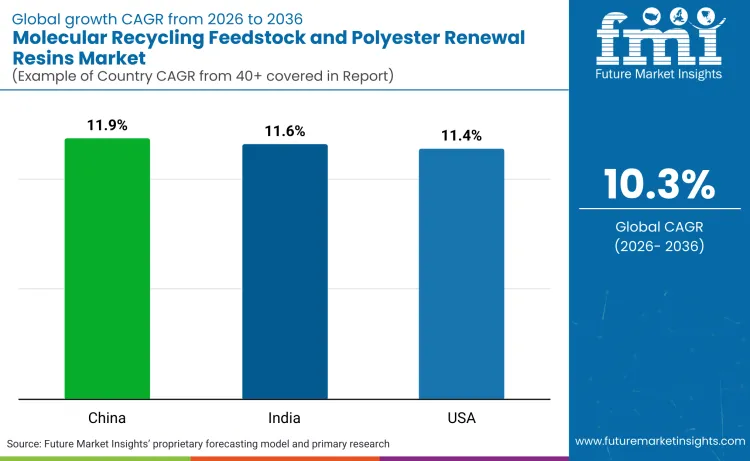
| Country | CAGR (2026-2036) |
|---|---|
| USA | 11.4% |
| China | 11.9% |
| India | 11.6% |
Source: Future Market Insights analysis, supported by a proprietary forecasting model and primary research
How is USA turning Advanced Recycling Scale into Durable Earnings Power?
USA’s advanced recycling market is now judged less by technical novelty and more by earnings contribution. Disclosures from large incumbents show that molecular recycling assets are beginning to behave like industrial profit centers rather than experimental infrastructure. Eastman Chemical Company’s Kingsport operations illustrate this shift clearly. The facility demonstrates that depolymerization economics improve meaningfully once feedstock consistency and process yield stabilize. Output expansion has translated directly into margin uplift, confirming that learning curves in advanced recycling are compressing faster than earlier investment cases assumed.
Structural risk has not disappeared. Industry capacity assessments indicate that processing assets are no longer the limiting factor. Feedstock availability and quality now define the ceiling for utilization. Municipal collection systems remain fragmented, creating volatility for recyclers without captive logistics. Integrated operators such as ExxonMobil are positioned to absorb this risk through internal sourcing and balance sheet flexibility. Standalone recyclers face greater exposure to supply swings.
Is China Creating the Conditions for Industrial Confidence in Recycled Polymers?
China’s regulatory posture has shifted from throughput expansion toward material integrity and traceability. National standards introduced over the past cycle impose uniform design and labeling requirements that reduce ambiguity across the value chain. These frameworks address long standing inconsistencies in recycled resin quality that previously limited downstream adoption. Manufacturers and exporters now operate within a clearer compliance architecture aligned with global trade expectations.
This standardization lowers execution risk for advanced recycling assets. BASF’s Loopamid start up in Shanghai reflects this improved investment climate. The facility’s certification signals that China can host export aligned circular materials production rather than serving solely as a processing hub. Remaining uncertainty centers on enforcement consistency across provinces.
Will India’s Escalating Mandates Reorder Capital Priorities across the Plastics Chain?
India’s regulatory tightening has moved recycled content from aspirational to compulsory. Time bound mandates force packaging producers and brand owners to adjust sourcing strategies rapidly. This compression of compliance timelines favors companies with integrated polymer capabilities and supply chain reach. Reliance Industries Limited is aligning materials expansion with circular feedstock readiness, signaling a strategic pivot away from volume driven virgin growth.
Waste segregation reform strengthens the long term outlook for advanced recycling by improving feedstock quality at the source. Execution risk remains concentrated at the municipal level. Infrastructure build out and coordination between public authorities and private operators determine capital efficiency more than technology choice.
Competitive Landscape
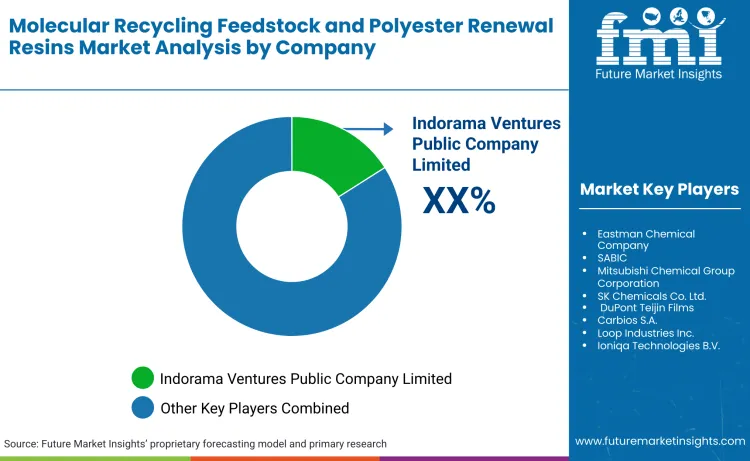
The molecular recycling feedstocks and polyester renewal resins industry entered a structurally distinct phase in the mid decade period, marked by a shift from early-stage validation toward operational scale, capital discipline, and regulatory alignment. Prior to the mid decade transition, competitive activity centered on proving technological feasibility and de-risking investment through partnerships across the value chain.
Differentiation is driven by asset utilization efficiency rather than greenfield construction. Leading producers are prioritizing debottlenecking, yield optimization, and throughput expansion at proven sites to improve return on invested capital amid volatile macroeconomic conditions.
Eastman disclosed that its Kingsport facility could be expanded meaningfully beyond original nameplate capacity through targeted upgrades, offering superior capital efficiency compared with delayed secondary projects.
A similar pattern is visible at ExxonMobil, which commissioned an additional advanced recycling unit at Baytown and is targeting substantial global capacity expansion. This focus on incremental expansion reflects a sector-wide preference for faster cash-flow generation and reduced execution risk, signaling the maturation of investment strategies.
Regulatory frameworks have emerged as the dominant demand catalyst for packaging-grade renewal resins. The EU Packaging and Packaging Waste Regulation, effective in the latter half of the decade, is expected to enforce structurally higher demand for certified recycled content, converting regulatory compliance into a commercial requirement.
Eastman has indicated expectations of a strong packaging revenue ramp as customers such as PepsiCo prepare to meet recycled content mandates. Chemically recycled resins are moving from niche sustainability inputs to baseline materials for regulated end-use applications.
A regional hub-and-spoke model is taking shape, defined by large integrated recycling clusters serving localized industrial ecosystems. In Northeast Asia, SK Geo Centric is nearing completion of its Ulsan Advanced Recycling Cluster designed to process large volumes of plastic waste annually across multiple technologies.
In India, Reliance Industries is expanding mechanical PET recycling capacity at multi-billion bottle scale while advancing chemical recycling aligned with net-zero objectives. Traceability has become a critical competitive requirement.
Companies with established mass-balance certifications and digital transparency systems are positioned to access regulated markets and sustain pricing premiums, as demonstrated by BASF achieving REDcert² certification across multiple European sites. Market leadership is increasingly determined by asset productivity, regulatory readiness, and traceability infrastructure rather than standalone process innovation.
Section 8
Key Players Profiled
- Indorama Ventures Public Company Limited
- Eastman Chemical Company
- SABIC
- Mitsubishi Chemical Group Corporation
- SK Chemicals Co. Ltd.
- DuPont Teijin Films
- Carbios S.A.
- Loop Industries Inc.
- Ioniqa Technologies B.V.
- IBM Research
Market Definition
The molecular recycling feedstock and polyester renewal resins market comprises chemically recycled polymer intermediates and regenerated polyester resins produced through depolymerisation technologies that break plastic waste back into its molecular building blocks. These processes enable the conversion of mixed, contaminated, and textile-based polyester waste into specification-grade materials with performance comparable to virgin resin. The market reflects the shift of molecular recycling from experimental sustainability initiatives into a compliance- and supply-driven industrial pathway for regulated packaging and textile applications.
The report includes molecular recycling feedstocks such as depolymerised PET intermediates and polyester renewal resins produced via glycolysis, methanolysis, enzymatic, and hybrid chemical recycling routes. It covers regenerated polyester resins used in rigid packaging and bottles, fibers and textiles, films and sheets, and other applications requiring consistent material quality and traceability. The scope also includes commercially deployed recycling assets integrated with downstream polyester polymerisation and certified under mass-balance or equivalent regulatory frameworks across major regions.
The scope excludes conventional mechanically recycled polyester limited to downcycled or non-specification applications, virgin polyester resins, and non-polyester plastics outside molecular depolymerisation pathways. It also excludes waste collection, sorting, and pre-processing activities that do not result in resin-grade molecular feedstock, pilot-scale or laboratory-only recycling technologies, and finished packaging or textile products manufactured from recycled polyester resins.
Scope of Report
| Items | Values |
|---|---|
| Quantitative Units (2026) | USD 2.4 billion |
| Technology | Glycolysis, Methanolysis, Enzymatic and Other Routes, Hybrid or Chemical Recycling Routes |
| End Use | Rigid Packaging and Bottles, Fibers and Textiles, Films and Sheets, Other Uses |
| Regions Covered | North America, Western Europe, Eastern Europe, East Asia, South Asia & Pacific, Latin America, Middle East & Africa |
| Countries Covered | USA, China, India and 40+ Countries |
| Key Companies Profiled | Indorama Ventures Public Company Limited, Eastman Chemical Company, SABIC, Mitsubishi Chemical Group Corporation, SK Chemicals Co., Ltd., DuPont Teijin Films, Carbios S.A., Loop Industries, Inc., Ioniqa Technologies B.V., IBM Research |
Source: FMI analysis based on primary research and proprietary forecasting model
Key Segments Profiled in the Molecular Recycling Feedstocks and Polyester Renewal Resins Market
Technology Route:
- Glycolysis
- Methanolysis
- Enzymatic and Other Routes
- Hybrid or Chemical Recycling Routes
End Use:
- Rigid Packaging and Bottles
- Fibers and Textiles
- Films and Sheets
- Other Uses
Region:
- North America
- Western Europe
- Eastern Europe
- East Asia
- South Asia & Pacific
- Latin America
- Middle East & Africa
Bibliography
- Al-Sabagh, A. M., Yehia, F. Z., Eshaq, G., Rabie, A. M., & ElMetwally, A. E. (2016). Greener routes for recycling of polyethylene terephthalate. Egyptian Journal of Petroleum, 25(1), 53-64. (Referenced for foundational glycolysis chemistry and industrial feasibility context)
- George, N., Kurian, T., & Thomas, S. (2023). Chemical recycling of poly(ethylene terephthalate): A review on depolymerization methods and product applications. Polymer Degradation and Stability, 210, 110290.
- Rorrer, N. A., Nicholson, S., Carpenter, A., Biddy, M. J., Grundl, N. J., & Beckham, G. T. (2023). Combining reclaimed PET with chemical recycling to enable circular polyester. Nature Communications, 14, 1231.
- Eastman Chemical Company. (2025). Polyester renewal technology: Depolymerization, feedstock flexibility, and resin performance. Technical Sustainability Report.
- Carbios S.A. (2025). Enzymatic depolymerisation of PET: Industrial scale performance and resin quality outcomes. Technology White Paper.
Frequently Asked Questions
How large is the molecular recycling feedstock and polyester renewal resins market?
The market is valued at around USD 2.4 billion in 2026, reflecting its transition from pilot-scale recycling concepts to industrially deployed chemical recycling and resin renewal systems.
What role do molecular recycling feedstocks play from a materials perspective?
Molecular recycling feedstocks enable the depolymerisation of polyester waste into chemical intermediates that can be repolymerised into specification-grade resins with performance comparable to virgin polyester.
Why is molecular recycling gaining preference over mechanical recycling routes?
Molecular recycling overcomes the limitations of mechanical recycling by processing mixed, contaminated, and textile-based waste while delivering consistent molecular weight, purity, and application-ready resin quality.
Which technology routes dominate polyester renewal resin production?
Glycolysis leads adoption due to its industrial maturity, moderate operating conditions, and ability to produce BHET-rich intermediates suitable for food-contact and high-clarity polyester applications.
What factors constrain faster scale-up of molecular recycling and renewal resins?
Key constraints include feedstock availability and consistency, capital intensity of depolymerisation assets, and regulatory uncertainty around classification of certain chemical recycling processes.
Preview the report firsthand - request a free sample
Get SampleGet the brochure for pricing and purchase details.
Get PDFTable of Content
- Executive Summary
- Molecular Recycling Feedstock and Polyester Renewal Resins Market Introduction
- Market Definition
- Market Scope
- Market Taxonomy
- Research Methodology
- Study Framework
- Assumptions and Limitations
- Data Sources
- Market Estimation and Forecasting Approach
- Molecular Recycling Feedstock and Polyester Renewal Resins Market Forecast and Outlook (2026-2036)
- Molecular Recycling Feedstock and Polyester Renewal Resins Market Key Takeaways
- Molecular Recycling Feedstock and Polyester Renewal Resins Market Dynamics
- Drivers
- Challenges
- Opportunities
- Trends
- Molecular Recycling Feedstock and Polyester Renewal Resins Market Segmentation Analysis
- By Technology Route
- By End Use
- By Region
- Molecular Recycling Feedstock and Polyester Renewal Resins Market Analysis by Region
- North America
- Western Europe
- Eastern Europe
- East Asia
- South Asia & Pacific
- Latin America
- Middle East & Africa
- Molecular Recycling Feedstock and Polyester Renewal Resins Market Analysis by Key Countries
- United States
- China
- India
- Competitive Landscape
- Key Players Profiled
- Market Definition
- Scope of Report
- Key Segments Profiled
- Bibliography
- Frequently Asked Questions


