

- Industry Size (2026)
- USD 18.5 Bn
- Forecast (2036)
- USD 41.5 Bn
- CAGR (2026 to 2036)
- 8.4%
Molecular Diagnostic Market Size, Market Forecast and Outlook By FMI
The molecular diagnostics market demonstrated a valuation of USD 17.1 billion in 2025, supported primarily by sustained demand in oncology and essential infectious disease testing. Market expansion is projected to continue, rising to USD 18.5 billion in 2026 and reaching USD 41.5 billion by 2036, reflecting a robust CAGR of 8.4%. As per FMI's projection, growth is no longer solely a function of installed base expansion but is increasingly driven by "compliance gates" and retrofit cycles.
Laboratories are retiring legacy closed systems in favor of high-throughput platforms capable of meeting new regulatory standards, such as the FDA's finalized rule on Laboratory Developed Tests (LDTs) [10]. This regulatory reset forces capital expenditure toward approved, automated platforms to mitigate legal risk, effectively stripping share from manual, in-house assay protocols.
President and CEO of Roche Diagnostics North America, contextualized this technological velocity during a system update: Brad Moore, "This update is significant because it not only allows for new innovation in PCR-testing technology and more choices in omni-channel testing, but it also addresses some key improvements that customers have told us are high priorities for them. All of these updates and improvements can be made to existing 6800/8800 systems through the software upgrade, providing higher throughput to laboratories with the same footprint and delivering more flexibility to physicians and patients.[2]" Rapid sequencing capabilities are compressing the time-to-diagnosis for complex conditions, fundamentally altering how procurement teams evaluate total cost of ownership for genomic hardware.
Summary of Molecular Diagnostic Market
- Molecular Diagnostic Market Definition
- Covers technologies analyzing genomic markers for disease detection, including PCR and NGS platforms.
- Demand Drivers in the Market
- Urgent need to close the screening gap for cancers lacking recommended tests.
- Decentralization of testing infrastructure to point-of-care settings.
- Sovereign investment in localized genomic databases in Asia Pacific.
- Key Segments Analyzed in the FMI Report
- Product: Reagents & Kits dominance (64.4%) driven by recurring volume.
- Technology: PCR (38.7%) leads, with NGS (24.0%) gaining rapid share.
- Geography: Fast-growing Asian markets versus value-driven North America.
- Analyst Opinion at FMI
- Sabyasachi Ghosh, Principal Consultant for Healthcare, opines, "Market consolidation is accelerating as legacy players like Abbott move aggressively into oncology. My findings indicate that future value lies not just in hardware, but in bioinformatics pipelines that can interpret localized genomic data for diverse populations."
- Strategic Implications/Executive Takeaways
- Prioritize clinical diagnostics menu expansion into multi-cancer early detection.
- Invest in automated workflows to counter labor shortages in labs.
- Target public health tenders in Southeast Asia for tuberculosis and AMR.
- Methodology
- Validated through first-hand corporate production and capacity data.
- Zero reliance on speculative third-party market research reports.
- Based on verifiable industrial benchmarks and verified sources.
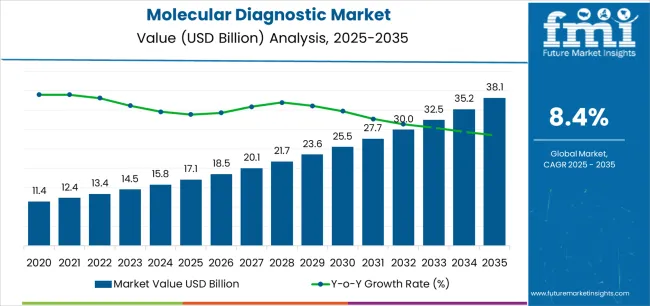
Geographic dispersion of growth highlights a clear divide between mature replacement markets and emerging adopters. High-growth territories include India (5.9% CAGR), Thailand (4.7% CAGR), Malaysia (4.3% CAGR), France (4.3% CAGR), and Indonesia (3.9% CAGR), while established markets like Canada (3.8% CAGR) and the United States (2.2% CAGR) focus on high-value oncology integration.
Molecular Diagnostic Market Definition
The molecular diagnostic industry encompasses the development and commercialization of technologies that analyze biological markers in the genome and proteome to detect disease. It primarily involves the detection of specific sequences in DNA or RNA that may be associated with disease, including single nucleotide polymorphisms (SNPs), deletions, rearrangements, insertions, and others.
Molecular Diagnostic Market Inclusions
This market includes all instruments, reagents, kits, and software used for nucleic acid testing (NAT). It covers major technologies such as Polymerase Chain Reaction (PCR), Next-Generation Sequencing (NGS), In Situ Hybridization (ISH), and microarrays used in clinical settings. Applications range from infectious disease screening (COVID-19, HIV, TB) to oncology (liquid biopsy, solid tumor profiling) and genetic testing.
Molecular Diagnostic Market Exclusions
Excluded from this report are traditional immunoassay-based diagnostics, clinical chemistry analyzers, and microbiological culture methods that do not utilize nucleic acid amplification or sequencing. Research-only (RUO) products not intended for clinical diagnostic use, unless they are operating under specific LDT exemptions, are also outside the primary market sizing scope.
Molecular Diagnostic Market Research Methodology
- Primary Research: Interviews were conducted with laboratory directors, oncologists, procurement officers in hospital networks, and regulatory consultants across key regions.
- Desk Research: Production data from annual reports, FDA/EMA clearance databases, and national health ministry budget allocations supported volume benchmarking.
- Market-Sizing and Forecasting: A hybrid top-down and bottom-up model was developed.
- Data Validation and Update Cycle: Outputs undergo anomaly screening, variance checks across production and trade datasets, and structured peer review prior to release.
Segmental Analysis
Molecular Diagnostic Market Analysis by Product
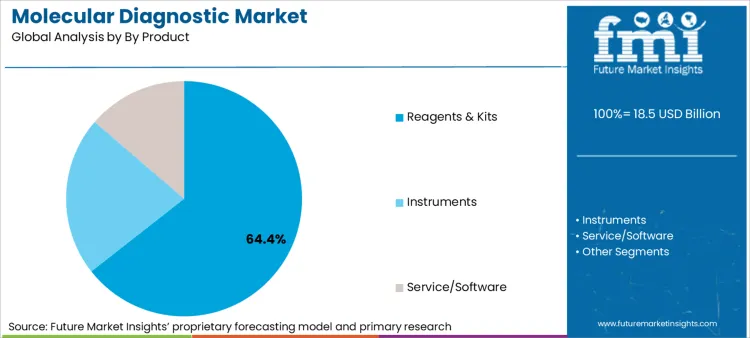
Reagents and kits serve as the recurrent revenue engine for the industry, securing 64.4% of the market share in 2026. This dominance is sustained by the high-frequency consumption of assay-specific chemistries required for both routine infectious disease screening and complex genomic profiling.
- Procurement lock-in: Demand for proprietary nucleic acid extraction kit consumables is reinforced by closed-system architectures, ensuring that hardware placements translate into long-term annuity streams for manufacturers like Roche and Abbott. [1, 2]
- Menu expansion: According to FMI's estimates, uptake accelerates as vendors release multiplex panels that detect up to 22 pathogens simultaneously, justifying the higher unit cost of specialized reagent cartridges. [7]
- Supply chain resilience: Growth is anchored in localized manufacturing strategies that mitigate logistics risks, allowing laboratories to maintain 15-minute to 1-hour turnaround times for critical point of care molecular diagnostics. [4]
Molecular Diagnostic Market Analysis by Technology
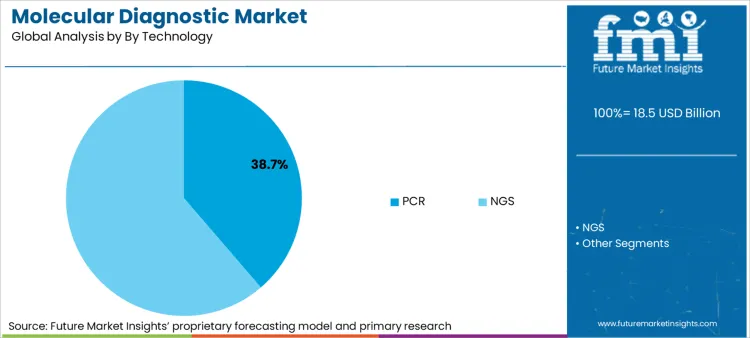
PCR technology remains the workhorse of the sector, holding 38.7% share, while Next-Generation Sequencing (NGS) captures 24.0% by value. The shift is defined by PCR's entrenched role in rapid screening and NGS's indispensability in precision oncology.
- Throughput breakthrough: Adoption of real-time PCR systems accelerates where new technologies like TAGS allow multiple targets to be detected in a single well, tripling throughput without additional hardware.
- Genomic velocity: FMI analysts opine that NGS integration increases as sequencing times drop below four hours for a whole genome, enabling clinicians to make same-day therapeutic decisions for critical oncology cases.
- Cost physics: Procurement shifts because multiplex capabilities in 1-step RT-PCR kits reduce the cost-per-result, making molecular testing viable for routine surveillance beyond tertiary care centers. [7]
Molecular Diagnostic Market Analysis by Application
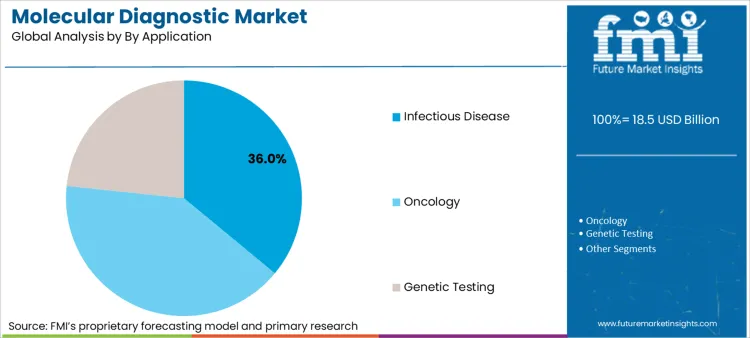
Infectious disease testing accounts for 36% of market volume, but oncology applications are the primary value driver. The disparity arises because infectious disease tests are high-volume/low-margin, whereas oncology based molecular diagnostics command premium pricing due to clinical complexity.
- Screening imperative: Growth tracks the urgent need to address the 50% of cancers diagnosed annually that currently lack recommended screening tests, driving massive investment into multi-cancer detection (MCD). [9]
- Surveillance shift: Demand for infectious diseases molecular diagnostics persists as public health bodies mandate rapid molecular testing for tuberculosis, aiming to reverse the decline in positive detection rates. [3]
- M&A consolidation: Adoption accelerates where major players acquire specialized firms, such as Abbott's move for Exact Sciences, to integrate screening and diagnostic workflows under one vendor contract. [1]
Molecular Diagnostic Market Analysis by End User
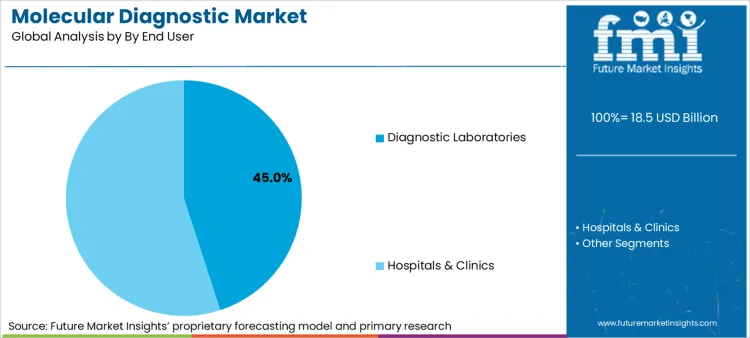
Diagnostic laboratories constitute 45% of the user base, serving as centralized hubs for high-complexity testing. However, the fastest functional growth is occurring in decentralized hospital settings and public health networks.
- Infrastructure legacy: Demand is reinforced by the repurposing of pandemic-era infrastructure, exemplified by Indonesia retaining 1,000 active PCR laboratories to combat endemic diseases like TB. [4]
- Workforce efficiency: Procurement shifts because automated systems reduce the dependency on specialized technicians, allowing labs to handle higher volumes despite chronic staffing shortages. [1, 2]
- Decentralized access: Growth is anchored in the deployment of compact automated nucleic acid extraction systems in district hospitals, enabling 20-minute results for respiratory viruses at the patient's bedside. [4]
Molecular Diagnostic Market Drivers, Restraints, and Opportunities
The primary catalyst for market value expansion is the urgent clinical requirement to close the "screening gap" in oncology. With nearly half of all cancers diagnosed annually having no recommended screening tests, healthcare systems are aggressively pivoting toward liquid biopsy and multi-cancer early detection (MCD) platforms to catch malignancies at treatable stages. This demand is converted into revenue through high-value reimbursement codes and large-scale procurement of NGS platforms. Abbott's strategic acquisition of Exact Sciences in late 2025 underscores this shift, as major players consolidate to capture the nascent but lucrative MCD segment. [1, 9]
A significant restraint involves the tightening regulatory environment for Laboratory Developed Tests (LDTs), specifically in the United States. The FDA's final rule ending enforcement discretion for LDTs imposes Class III medical device requirements on high-complexity in-house tests, creating a massive compliance and cost burden for independent laboratories. This mechanism slows the rollout of novel assays as labs must now invest time and capital into premarket review processes or switch to approved IVD kits. The uncertainty surrounding these regulations forces smaller players to pause innovation or seek acquisition by larger entities capable of navigating the new compliance landscape. [10]
- Wastewater Surveillance: Municipalities and governments are increasingly funding environmental monitoring to track pathogen spread before clinical cases spike. Innovation in this space is evidenced by bioMérieux’s launch of the WATCHFIRE panel, which detects 22 pathogens in wastewater in under 45 minutes. [7]
- Antimicrobial Resistance (AMR): National health agendas in emerging markets are prioritizing gene-based identification to combat drug-resistant bacteria. Thailand’s Department of Livestock Development has explicitly allocated budget through 2030 for PCR machines and molecular equipment to strengthen AMR diagnostics. [5]
- Localized Genomics: There is a growing opportunity for "genomic sovereignty" where nations build their own genetic databases to improve diagnostic accuracy for local populations. Tata Memorial Centre in India is leading this trend by curating over 10,000 germline genotypes to support indigenous cancer care. [6]
Regional Analysis
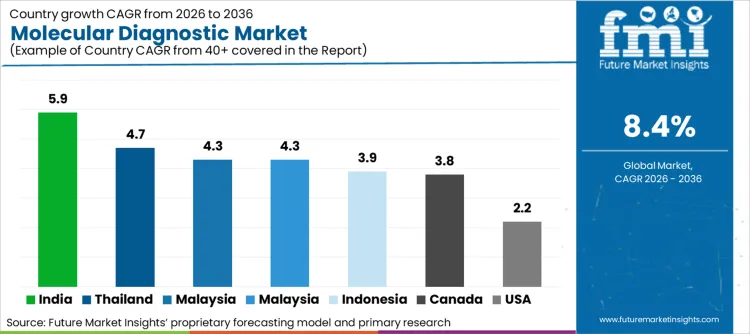
Based on the regional analysis, the molecular diagnostic market is segmented into North America, Latin America, Europe, East Asia, South Asia, Oceania and Middle East & Africa across 40+ countries. The full report also offers market attractiveness analysis based on regional trends.
| Country | CAGR (2026 to 2036) |
|---|---|
| India | 5.9% |
| Thailand | 4.7% |
| France | 4.3% |
| Malaysia | 4.3% |
| Indonesia | 3.9% |
| Canada | 3.8% |
| United States | 2.2% |
Source: Future Market Insights (FMI) analysis, based on proprietary forecasting model and primary research
North America Molecular Diagnostic Market Analysis
North America remains the value capital of the industry, characterized by a transition from infectious disease volume to high-margin oncology diagnostics. The region is seeing a "green recovery" in terms of sustainable lab practices and a heavy emphasis on automation to combat labor shortages.
- United States: Growth tracks a CAGR of 2.2% as healthcare providers replace legacy COVID-19 infrastructure with advanced multi-cancer detection (MCD) platforms. This trajectory is supported by major consolidation events, such as Abbott’s acquisition of Exact Sciences, which positions the market for broad adoption of non-invasive screening tools.
- Canada: The outlook for molecular diagnostics in Canada indicates a 3.8% CAGR from 2026 to 2036 as provincial health systems prioritize rapid respiratory panels. This demand is reflected in public health mandates for 15-minute to 1-hour turnaround times for viral molecular diagnostics in remote and community settings. [4]
FMI’s report includes a detailed growth analysis for North America. Including the US and Canada, Mexico offers opportunistic growth in cross-border medical tourism for specialized genetic testing. Buyers in the region should monitor the integration of AI-driven bioinformatics into reimbursement schedules, which will define the profitability of future NGS installations. [10]
Europe Molecular Diagnostic Market Analysis
Europe is operating as a regulatory pioneer, where stringent IVDR compliance is reshaping the competitive field. The market is driven by localized environmental health initiatives and a strong focus on syndromic testing panels that offer higher diagnostic yields per patient visit.
- France: Demand for molecular diagnostic solutions in France is set to grow at 4.3% CAGR through 2036, supported by government investment in environmental surveillance. This expansion is underpinned by the deployment of multiplex PCR systems like the WATCHFIRE panel for wastewater monitoring of 22 distinct pathogens. [7]
FMI’s report includes comprehensive coverage of the European landscape. Germany and the UK remain critical markets for automated molecular diagnostics testing system market adoption, driven by centralized lab consolidation. Suppliers should watch for opportunities in the Nordics, where digitized health records are facilitating large-scale population genomics programs similar to France's environmental initiatives. [7]
Asia Pacific Molecular Diagnostic Market Analysis
Asia Pacific is rapidly evolving from a technology importer to a hub of localized innovation and genomic data generation. As per FMI's projection, the region is leveraging pandemic-era investments to build sovereign diagnostic capabilities that address region-specific disease burdens like tuberculosis and dengue.
- India: Growth tracks a CAGR of 5.9% as the country invests heavily in indigenous genomic curation. This trajectory is supported by institutions like Tata Memorial Centre curating over 10,000 germline genotypes, reducing reliance on Western reference databases for cancer care. [6]
- Thailand: The molecular diagnostic sector in Thailand is poised to expand at 4.7% CAGR during 2026 to 2036 because of specific budget allocations for antimicrobial resistance (AMR) control. This demand is evidenced by the Department of Livestock Development's 2025-2030 plan to equip labs with PCR machines for gene-based identification. [5]
- Malaysia: Malaysia is likely to see molecular diagnostic revenues increase at 4.3% CAGR during 2026 to 2036, given the expansion of public hospital testing menus. This growth is anchored in the availability of 107 specialized molecular tests, including retinoblastoma panels, within the state health apparatus. [3]
- Indonesia: Indonesia is expected to record 3.9% CAGR in molecular diagnostic demand over 2026 to 2036 as the Ministry of Health maintains a network of 1,000 active PCR laboratories. This infrastructure is now being pivoted to combat tuberculosis, supported by the development of five localized PCR-based detection tools. [4]
FMI’s report includes a deep dive into the Asia Pacific opportunity. Vietnam and the Philippines are emerging as key markets for multiplex molecular diagnostics to manage tropical infectious diseases. Strategic players should focus on public-private partnerships for technology transfer, as seen with Indonesia's collaboration with Japanese medical groups to build advanced cardiovascular and diagnostic centers. [4]
Competitive Aligners for Market Players
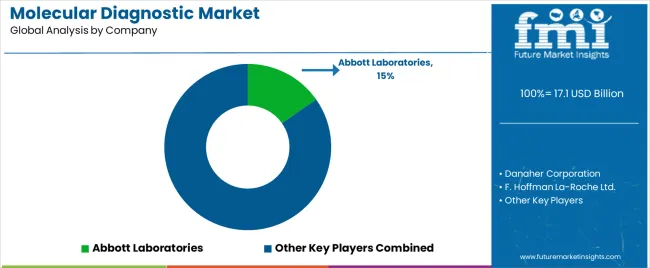
Competition is bifurcated between scale players driving automation and niche innovators focusing on proprietary content. Leading diagnostic giants are leveraging their installed base of instruments to enforce "menu lock-in," ensuring that customers purchasing hardware for one indication (e.g., COVID-19) eventually adopt the same platform for oncology or sexual health testing. This strategy increases switching costs for laboratories and secures long-term reagent revenue streams.
Regulatory agility has become a primary competitive advantage. With the FDA's shift on LDTs and Europe's IVDR rollout, companies that can rapidly secure premarket approval for their assays are displacing smaller competitors who relied on enforcement discretion. Roche’s ability to secure CE marks for updated systems and Abbott’s strategic acquisitions demonstrate how regulatory capital is being used to clear the field of non-compliant rivals. [8, 10]
Innovation in workflow efficiency is differentiating the winners from the commoditized bulk suppliers. Companies introducing technologies that multiply throughput without expanding footprint, such as Roche’s TAGS technology which allows 15 targets in a single well, are winning contracts in space-constrained hospital labs. These technical leaps directly address the "cost-per-reportable-result" metric that dominates tender evaluations in value-conscious markets. [8]
Recent Developments
The report includes full coverage of key trends from competitive benchmarking. Some of the recent developments covered in the reports:
- In January 2025, Synthego announced its formal entry into the molecular biology and clinical diagnostic reagents market, including a portfolio expansion supported through collaboration with biotechrabbit GmbH and manufacturing under ISO 13485/ISO 9001 quality systems [11].
- In August 2025, Seegene unveiled CURECA (a fully unattended PCR automation system) and STAgora (a real-time data analytics platform) at ADLM 2025, noting both were demonstrated as pre-commercial technologies not cleared for clinical diagnostic use [12].
- In May 2025, SAGA Diagnostics announced the U.S. commercial launch of Pathlight (a tumor-informed, multi-cancer MRD platform using structural variants as biomarkers), timed with ASCO 2025 [13].
- In February 2026, New England Biolabs (NEB) announced it would present NGS sample-prep updates at the 2026 AGBT meeting and stated it would launch NEBNext UltraShear Long Read (enzymatic DNA fragmentation for 2–30 kb) at the event [14].
Key Players in Molecular Diagnostic
- Abbott Laboratories
- Danaher (Cepheid)
- Roche Diagnostics
- Siemens Healthineers
- BD
- Agilent Technologies
- bioMérieux
Scope of the Report
| Metric | Value |
|---|---|
| Quantitative Units | USD 18.5 billion (2026) to USD 41.5 billion (2036), at a CAGR of 8.4% |
| Market Definition | The molecular diagnostic industry encompasses the development and commercialization of technologies that analyze biological markers in the genome and proteome to detect disease. |
| Product Segmentation | Reagents & Kits, Instruments, Service & Software |
| Technology Segmentation | PCR, NGS, Others |
| Application Coverage | Infectious Disease, Oncology, Genetic Testing, Others |
| Regions Covered | North America, Latin America, Europe, East Asia, South Asia, Oceania, Middle East and Africa |
| Countries Covered | United States, Canada, France, India, Thailand, Malaysia, Indonesia and 40 plus countries |
| Key Companies Profiled | Abbott Laboratories, Danaher (Cepheid), Roche Diagnostics, Siemens Healthineers, BD, Agilent Technologies, bioMérieux |
| Forecast Period | 2026 to 2036 |
| Approach | Hybrid top down and bottom up market modeling validated through primary interviews with resin producers and panel manufacturers, supported by trade data benchmarking and plant level capacity verification |
Key Segments
Product
- Reagents & Kits
- Instruments
- Service & Software
Technology
- PCR
- NGS
- Others
Application
- Infectious Disease
- Oncology
- Genetic Testing
- Others
End User
- Diagnostic Laboratories
- Hospitals & Clinics
- Others
Region
- Asia Pacific
- India
- China
- Japan
- South Korea
- Indonesia
- Australia & New Zealand
- ASEAN
- Rest of Asia Pacific
- Europe
- Germany
- Italy
- France
- United Kingdom
- Spain
- Benelux
- Nordics
- Central & Eastern Europe
- Rest of Europe
- North America
- United States
- Canada
- Mexico
- Latin America
- Brazil
- Argentina
- Chile
- Rest of Latin America
- Middle East & Africa
- Kingdom of Saudi Arabia
- United Arab Emirates
- South Africa
- Turkey
- Rest of Middle East & Africa
Bibliography
- [1] Abbott. (2026). Abbott Reports Fourth Quarter and Full Year 2025 Results. Corporate Investor Relations.
- [2] Roche. (2025, December 16). Roche announces U.S. launch of next generation cobas 6800/8800 systems and software, enhancing laboratory efficiency and testing capabilities.
- [3] Jabatan Kesihatan Negeri Perak. (2025). Molecular Diagnostic Test Menu. Official Government Document.
- [4] Ministry of Health Indonesia. (2024). Health Transformation and Laboratory Infrastructure. Official Government Website.
- [5] Department of Livestock Development. (2025). Sustain Plan 2025-2030. Thailand Government.
- [6] Tata Memorial Centre. (2025). ICGCW 2025 Flyer & Scientific Programme. Official Conference Document.
- [7] bioMérieux. (2025). WATCHFIRE™ Respiratory Panel Launch. French Government Open Data.
- [8] Roche. (2024). CE Mark for cobas 6800/8800 systems 2.0. Corporate Press Release.
- [9] American Cancer Society. (2025). Multi-Cancer Early Detection Tests. Association Website.
- [10] FDA. (2025). Laboratory Developed Tests Final Rule. US Government Regulatory Update.
- [11] Synthego. (2025, January 13). Synthego announces entry into molecular biology and clinical diagnostic reagents market.
- [12] Seegene Inc. (2025, August 5). Seegene unveils CURECA and STAgora at ADLM 2025, advancing the next stage of diagnostics.
- [13] SAGA Diagnostics. (2025, May 27). SAGA Diagnostics announces U.S. commercial launch of Pathlight at ASCO 2025, setting a new standard for ultra-sensitive and early MRD detection.
- [14] New England Biolabs, Inc. (2026, February 20). New England Biolabs to present latest updates in next generation sequencing sample preparation at 2026 AGBT meeting.
This Report Addresses
- Market intelligence to enable structured strategic decision making across mature and emerging resin economies
- Market size estimation and 10 year revenue forecasts from 2026 to 2036, supported by validated capacity and trade benchmarks
- Growth opportunity mapping across powder, liquid, and solid forms with emphasis on ULEF and NAF grade transitions
- Segment and regional revenue forecasts covering building and construction, furniture and joinery, agriculture, automotive, and electrical applications
- Competition strategy assessment including integration models, cost survivability positioning, and compliance capability benchmarking
- Product reformulation and emission compliance tracking including E0, E1, CARB Phase 2, and EPA TSCA Title VI aligned grades
- Regulatory impact analysis covering formaldehyde emission mandates, indoor air quality thresholds, and export driven specification upgrades
- Market report delivery in PDF, Excel, PPT, and interactive dashboard formats for executive and operational use
Frequently Asked Questions
How large is the demand for Molecular Diagnostic in the global market in 2026?
Demand for Molecular Diagnostic in the global market is estimated to be valued at USD 18.5 billion in 2026.
What will be the market size of Molecular Diagnostic in the global market by 2036?
Market size for Molecular Diagnostic is projected to reach USD 41.5 billion by 2036.
What is the expected demand growth for Molecular Diagnostic in the global market between 2026 and 2036?
Demand for Molecular Diagnostic in the global market is expected to grow at a CAGR of 8.4% between 2026 and 2036.
Which Product is poised to lead global sales by 2026?
Reagents & Kits are expected to be the dominant form, capturing approximately 64.4% of global market share in 2026 due to recurring consumption.
How significant is the role of Infectious Disease in driving Molecular Diagnostic adoption in 2026?
Infectious Disease represents a critical segment, projected to hold a substantial 36.0% share of the total market in 2026.
What is driving demand in India?
Demand is driven by the curation of indigenous genomic databases and a shift toward localized cancer care protocols.
What compliance standards or regulations are referenced for the United States?
The FDA's final rule regarding the oversight of Laboratory Developed Tests (LDTs) is a key regulatory benchmark.
What is the India growth outlook in this report?
India is projected to grow at a CAGR of 5.9% during 2026 to 2036.
Why is Europe described as a priority region in this report?
Europe is prioritizing environmental surveillance and strict IVDR compliance, driving replacement demand for approved systems.
What type of demand dominates in Europe?
Demand is dominated by high-throughput syndromic testing and wastewater surveillance programs.
What is Thailand growth outlook in this report?
Thailand is projected to expand at a CAGR of 4.7% during 2026 to 2036.
Does the report cover Malaysia in its regional analysis?
Yes, Malaysia is included within Asia Pacific under the regional scope of analysis.
What are the sources referred to for analyzing Malaysia?
Official molecular diagnostic test menus from state health departments and hospital procurement lists are cited.
What is the main demand theme linked to Malaysia in its region coverage?
Growth is linked to the expansion of specialized public hospital testing menus for genetic and oncology conditions.
Does the report cover Indonesia in its regional analysis?
Yes, Indonesia is included within Asia Pacific under the regional coverage framework.
What is the main Indonesia related demand theme in its region coverage?
Demand is driven by the maintenance and repurposing of 1,000 PCR laboratories for tuberculosis and endemic disease management.
Which product formats or configurations are strategically important for Asia Pacific supply chains?
Compact, automated PCR systems and localized reagent manufacturing are prioritized to ensure supply security.
What is Molecular Diagnostic and what is it mainly used for?
Molecular diagnostic refers to technologies that analyze biological markers in the genome to detect disease, used for infectious disease, oncology, and genetic testing.
What does Molecular Diagnostic Market mean in this report?
It refers to the global trade of instruments, reagents, and software for nucleic acid testing in clinical settings.
What is included in the scope of this Molecular Diagnostic report?
Scope covers PCR, NGS, and other nucleic acid technologies used in labs, hospitals, and clinics.
What is excluded from the scope of this report?
Traditional immunoassays, clinical chemistry, and research-only (RUO) products without clinical application are excluded.
What does market forecast mean on this page?
Market forecast represents a model based projection built on defined assumptions for strategic planning purposes.
How does FMI build and validate the Molecular Diagnostic forecast?
Forecast is developed using hybrid top down and bottom up modeling validated through trade data, capacity checks, and industry review.
What does zero reliance on speculative third party market research mean here?
Primary interviews and verifiable public datasets are used instead of unverified syndicated market estimates.
Preview the report firsthand - request a free sample
Get SampleGet the brochure for pricing and purchase details.
Get PDFTable of Content
- Executive Summary
- Global Market Outlook
- Demand-side Trends
- Supply-side Trends
- Technology Roadmap Analysis
- Analysis and Recommendations
- Market Overview
- Market Coverage / Taxonomy
- Market Definition / Scope / Limitations
- Market Background
- Market Dynamics
- Drivers
- Restraints
- Opportunity
- Trends
- Scenario Forecast
- Demand in Optimistic Scenario
- Demand in Likely Scenario
- Demand in Conservative Scenario
- Opportunity Map Analysis
- Product Life Cycle Analysis
- Supply Chain Analysis
- Investment Feasibility Matrix
- Value Chain Analysis
- PESTLE and Porter’s Analysis
- Regulatory Landscape
- Regional Parent Market Outlook
- Production and Consumption Statistics
- Import and Export Statistics
- Market Dynamics
- Global Market Analysis 2020-2024 and Forecast, 2025-2035
- Historical Market Size Value (USD Billion) Analysis, 2020-2024
- Current and Future Market Size Value (USD Billion) Projections, 2025-2035
- Y-o-Y Growth Trend Analysis
- Absolute $ Opportunity Analysis
- Global Market Pricing Analysis 2020-2024 and Forecast 2025-2035
- Global Market Analysis 2020-2024 and Forecast 2025-2035, By Product
- Introduction / Key Findings
- Historical Market Size Value (USD Billion) Analysis By Product , 2020-2024
- Current and Future Market Size Value (USD Billion) Analysis and Forecast By Product , 2025-2035
- Reagents And Kits
- Instruments
- Service And Software
- Y-o-Y Growth Trend Analysis By Product , 2020-2024
- Absolute $ Opportunity Analysis By Product , 2025-2035
- Global Market Analysis 2020-2024 and Forecast 2025-2035, By Technology
- Introduction / Key Findings
- Historical Market Size Value (USD Billion) Analysis By Technology, 2020-2024
- Current and Future Market Size Value (USD Billion) Analysis and Forecast By Technology, 2025-2035
- Polymerase Chain Reaction (PCR)
- Isothermal Nucleic Acid Amplification Technology (INNAT)
- DNA Sequencing And Next-Generation Sequencing (NGS)
- In Situ Hybridization (ISH)
- DNA Microarrays
- Others
- Y-o-Y Growth Trend Analysis By Technology, 2020-2024
- Absolute $ Opportunity Analysis By Technology, 2025-2035
- Global Market Analysis 2020-2024 and Forecast 2025-2035, By Application
- Introduction / Key Findings
- Historical Market Size Value (USD Billion) Analysis By Application, 2020-2024
- Current and Future Market Size Value (USD Billion) Analysis and Forecast By Application, 2025-2035
- Infectious Disease Diagnostics
- Oncology Testing
- Genetic Testing
- Others
- Y-o-Y Growth Trend Analysis By Application, 2020-2024
- Absolute $ Opportunity Analysis By Application, 2025-2035
- Global Market Analysis 2020-2024 and Forecast 2025-2035, By End User
- Introduction / Key Findings
- Historical Market Size Value (USD Billion) Analysis By End User, 2020-2024
- Current and Future Market Size Value (USD Billion) Analysis and Forecast By End User, 2025-2035
- Diagnostic Laboratories
- Hospitals And Clinics
- Others
- Y-o-Y Growth Trend Analysis By End User, 2020-2024
- Absolute $ Opportunity Analysis By End User, 2025-2035
- Global Market Analysis 2020-2024 and Forecast 2025-2035, By Region
- Introduction
- Historical Market Size Value (USD Billion) Analysis By Region, 2020-2024
- Current Market Size Value (USD Billion) Analysis and Forecast By Region, 2025-2035
- North America
- Latin America
- Western Europe
- Eastern Europe
- East Asia
- South Asia and Pacific
- Middle East & Africa
- Market Attractiveness Analysis By Region
- North America Market Analysis 2020-2024 and Forecast 2025-2035, By Country
- Historical Market Size Value (USD Billion) Trend Analysis By Market Taxonomy, 2020-2024
- Market Size Value (USD Billion) Forecast By Market Taxonomy, 2025-2035
- By Country
- USA
- Canada
- Mexico
- By Product
- By Technology
- By Application
- By End User
- By Country
- Market Attractiveness Analysis
- By Country
- By Product
- By Technology
- By Application
- By End User
- Key Takeaways
- Latin America Market Analysis 2020-2024 and Forecast 2025-2035, By Country
- Historical Market Size Value (USD Billion) Trend Analysis By Market Taxonomy, 2020-2024
- Market Size Value (USD Billion) Forecast By Market Taxonomy, 2025-2035
- By Country
- Brazil
- Chile
- Rest of Latin America
- By Product
- By Technology
- By Application
- By End User
- By Country
- Market Attractiveness Analysis
- By Country
- By Product
- By Technology
- By Application
- By End User
- Key Takeaways
- Western Europe Market Analysis 2020-2024 and Forecast 2025-2035, By Country
- Historical Market Size Value (USD Billion) Trend Analysis By Market Taxonomy, 2020-2024
- Market Size Value (USD Billion) Forecast By Market Taxonomy, 2025-2035
- By Country
- Germany
- UK
- Italy
- Spain
- France
- Nordic
- BENELUX
- Rest of Western Europe
- By Product
- By Technology
- By Application
- By End User
- By Country
- Market Attractiveness Analysis
- By Country
- By Product
- By Technology
- By Application
- By End User
- Key Takeaways
- Eastern Europe Market Analysis 2020-2024 and Forecast 2025-2035, By Country
- Historical Market Size Value (USD Billion) Trend Analysis By Market Taxonomy, 2020-2024
- Market Size Value (USD Billion) Forecast By Market Taxonomy, 2025-2035
- By Country
- Russia
- Poland
- Hungary
- Balkan & Baltic
- Rest of Eastern Europe
- By Product
- By Technology
- By Application
- By End User
- By Country
- Market Attractiveness Analysis
- By Country
- By Product
- By Technology
- By Application
- By End User
- Key Takeaways
- East Asia Market Analysis 2020-2024 and Forecast 2025-2035, By Country
- Historical Market Size Value (USD Billion) Trend Analysis By Market Taxonomy, 2020-2024
- Market Size Value (USD Billion) Forecast By Market Taxonomy, 2025-2035
- By Country
- China
- Japan
- South Korea
- By Product
- By Technology
- By Application
- By End User
- By Country
- Market Attractiveness Analysis
- By Country
- By Product
- By Technology
- By Application
- By End User
- Key Takeaways
- South Asia and Pacific Market Analysis 2020-2024 and Forecast 2025-2035, By Country
- Historical Market Size Value (USD Billion) Trend Analysis By Market Taxonomy, 2020-2024
- Market Size Value (USD Billion) Forecast By Market Taxonomy, 2025-2035
- By Country
- India
- ASEAN
- Australia & New Zealand
- Rest of South Asia and Pacific
- By Product
- By Technology
- By Application
- By End User
- By Country
- Market Attractiveness Analysis
- By Country
- By Product
- By Technology
- By Application
- By End User
- Key Takeaways
- Middle East & Africa Market Analysis 2020-2024 and Forecast 2025-2035, By Country
- Historical Market Size Value (USD Billion) Trend Analysis By Market Taxonomy, 2020-2024
- Market Size Value (USD Billion) Forecast By Market Taxonomy, 2025-2035
- By Country
- Kingdom of Saudi Arabia
- Other GCC Countries
- Turkiye
- South Africa
- Other African Union
- Rest of Middle East & Africa
- By Product
- By Technology
- By Application
- By End User
- By Country
- Market Attractiveness Analysis
- By Country
- By Product
- By Technology
- By Application
- By End User
- Key Takeaways
- Key Countries Market Analysis
- USA
- Pricing Analysis
- Market Share Analysis, 2024
- By Product
- By Technology
- By Application
- By End User
- Canada
- Pricing Analysis
- Market Share Analysis, 2024
- By Product
- By Technology
- By Application
- By End User
- Mexico
- Pricing Analysis
- Market Share Analysis, 2024
- By Product
- By Technology
- By Application
- By End User
- Brazil
- Pricing Analysis
- Market Share Analysis, 2024
- By Product
- By Technology
- By Application
- By End User
- Chile
- Pricing Analysis
- Market Share Analysis, 2024
- By Product
- By Technology
- By Application
- By End User
- Germany
- Pricing Analysis
- Market Share Analysis, 2024
- By Product
- By Technology
- By Application
- By End User
- UK
- Pricing Analysis
- Market Share Analysis, 2024
- By Product
- By Technology
- By Application
- By End User
- Italy
- Pricing Analysis
- Market Share Analysis, 2024
- By Product
- By Technology
- By Application
- By End User
- Spain
- Pricing Analysis
- Market Share Analysis, 2024
- By Product
- By Technology
- By Application
- By End User
- France
- Pricing Analysis
- Market Share Analysis, 2024
- By Product
- By Technology
- By Application
- By End User
- India
- Pricing Analysis
- Market Share Analysis, 2024
- By Product
- By Technology
- By Application
- By End User
- ASEAN
- Pricing Analysis
- Market Share Analysis, 2024
- By Product
- By Technology
- By Application
- By End User
- Australia & New Zealand
- Pricing Analysis
- Market Share Analysis, 2024
- By Product
- By Technology
- By Application
- By End User
- China
- Pricing Analysis
- Market Share Analysis, 2024
- By Product
- By Technology
- By Application
- By End User
- Japan
- Pricing Analysis
- Market Share Analysis, 2024
- By Product
- By Technology
- By Application
- By End User
- South Korea
- Pricing Analysis
- Market Share Analysis, 2024
- By Product
- By Technology
- By Application
- By End User
- Russia
- Pricing Analysis
- Market Share Analysis, 2024
- By Product
- By Technology
- By Application
- By End User
- Poland
- Pricing Analysis
- Market Share Analysis, 2024
- By Product
- By Technology
- By Application
- By End User
- Hungary
- Pricing Analysis
- Market Share Analysis, 2024
- By Product
- By Technology
- By Application
- By End User
- Kingdom of Saudi Arabia
- Pricing Analysis
- Market Share Analysis, 2024
- By Product
- By Technology
- By Application
- By End User
- Turkiye
- Pricing Analysis
- Market Share Analysis, 2024
- By Product
- By Technology
- By Application
- By End User
- South Africa
- Pricing Analysis
- Market Share Analysis, 2024
- By Product
- By Technology
- By Application
- By End User
- USA
- Market Structure Analysis
- Competition Dashboard
- Competition Benchmarking
- Market Share Analysis of Top Players
- By Regional
- By Product
- By Technology
- By Application
- By End User
- Competition Analysis
- Competition Deep Dive
- Abbott Laboratories
- Overview
- Product Portfolio
- Profitability by Market Segments (Product/Age /Sales Channel/Region)
- Sales Footprint
- Strategy Overview
- Marketing Strategy
- Product Strategy
- Channel Strategy
- Danaher Corporation
- F. Hoffman La-Roche Ltd.
- Siemens Ag (Siemens Healthineers)
- Becton Dickinson And Company
- Agilent Technologies Inc.
- Biomerieux SA
- Hologic Inc.
- Qiagen Inc.
- Grifols SA
- Abbott Laboratories
- Competition Deep Dive
- Assumptions & Acronyms Used
- Research Methodology


