

- Market Size (2026)
- USD 80.0 Mn
- Forecast (2036)
- USD 200.0 Mn
- CAGR (2026 to 2036)
- 8.3%
Recycling of Automotive Glass and Laminated Windscreens in EU Industry Size, Market Forecast and Outlook by FMI
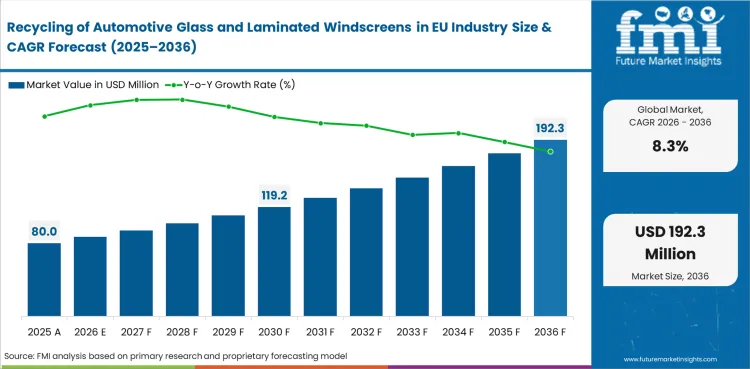
The recycling of automotive glass and laminated windscreens in EU industry was estimated at USD 80.0 million in 2025. The market is projected to reach USD 90.0 million in 2026 and USD 200.0 million by 2036. Sales are expected to advance at an 8.3% CAGR from 2026 to 2036.
Summary of the Recycling of Automotive Glass and Laminated Windscreens in EU Industry
- Demand and Growth Drivers
- End-of-life vehicle regulation is expected to support dedicated automotive glass removal before shredding across EU treatment facilities.
- Replacement windscreen collections are likely to improve access to cleaner laminated scrap for specialist recycling plants.
- Recovered PVB is anticipated to improve processor value by creating a secondary material stream beyond glass cullet.
- Product and Segment View
- Laminated glass is expected to lead the glass type segment due to higher windscreen recovery value and interlayer separation needs.
- ELV glass is likely to remain the main source stream as pre-shred dismantling rules strengthen automotive glass recovery.
- Mechanical separation is anticipated to remain the preferred process because crushing and sorting form the base of recovery operations.
- Geography and Competitive Outlook
- Spain is expected to lead country-level expansion as recovery formalization and laminated glass sorting capacity improve.
- Poland is likely to record strong growth as organized waste channels support more specialized laminated fraction recovery.
- Processors with stronger delamination capability and cleaner outlet access are anticipated to strengthen their position in EU recycling networks.
- Recycling of Automotive Glass and Laminated Windscreens in EU Industry Value Analysis
- The recycling of automotive glass and laminated windscreens in EU industry is moving from low-value vehicle residue handling toward controlled circular material recovery.
- Demand is likely to rise as dismantlers and replacement networks improve access to cleaner automotive glass fractions.
- Processor value is expected to increase where laminated glass separation supports both cullet recovery and recycled PVB output.
- Spending is anticipated to be supported by ELV regulation, cleaner glass outlet demand, and investment in laminated recovery capacity.
Key Takeaways, Market Size, and Forecast
- Recycling of Automotive Glass and Laminated Windscreens in EU Industry is projected to grow from USD 90.0 million in 2026 to USD 200.0 million by 2036, at a CAGR of 8.3%.
- The recycling of automotive glass and laminated windscreens in EU industry was valued at USD 80.0 million in 2025.
- By 2036, the Recycling of Automotive Glass and Laminated Windscreens in EU Industry is expected to be worth USD 200.0 million.
- From 2026 to 2036, the industry is anticipated to expand at a CAGR of 8.3%.
- The industry is predicted to create an incremental opportunity of USD 110.0 million between 2026 and 2036.
- In 2026, Laminated Glass is expected to account for 52.0% of the glass type segment.
- Spain (9.1%) and Poland (8.8%) are projected to be two of the fastest growing markets.
Recycling of Automotive Glass and Laminated Windscreens in EU Industry Key Takeaways
| Parameter | Details |
|---|---|
| Market Value (2025) | USD 80.0 million |
| Forecast Value (2036) | USD 200.0 million |
| CAGR (2026 to 2036) | 8.3% |
| Estimated Market Value (2026) | USD 90.0 million |
| Incremental Opportunity | USD 110.0 million |
| Leading Glass Type | Laminated glass (52.0% of glass type demand) |
| Leading Recycling Process | Mechanical Separation (61.0% of process demand) |
| Leading Vehicle Type | Passenger Cars (72.0% of vehicle type demand) |
| Leading Collection Channel | Dismantlers (46.0% of collection channel demand) |
Source: Future Market Insights, 2026
Incremental opportunity during the forecast period is estimated at USD 110.0 million for EU recyclers and processors. End-of-life vehicle regulation and dedicated laminated glass separation remain the main forces shaping the forecast.
Policy direction across Europe raises the commercial value of dedicated automotive glass recovery because higher dismantling targets favor processors to supply clean recycled glass and polyvinyl butyral PVB outputs. Compliance costs at treatment facilities rise once windshields enter mixed vehicle residue without prior removal. Dedicated recovery lines improve access to flat glass furnaces and secondary polymer outlets and pay premiums for cleaner fractions. Profitability is determined more by the share of material reaching controlled separation than by the gross volume entering vehicle treatment yards.
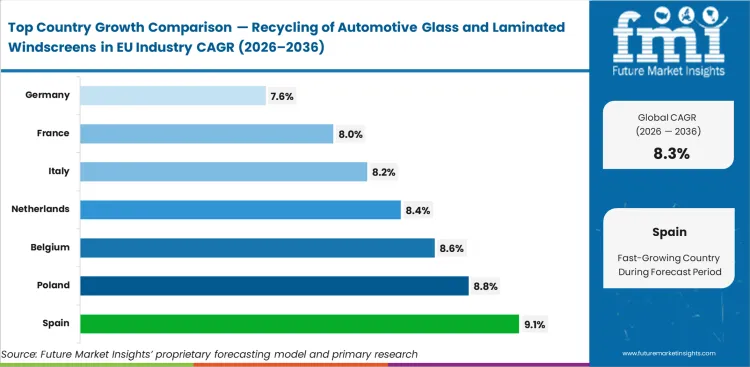
Material recovery economics in this industry depends on collection quality along with nominal glass volume. Windshield removal before shredding improves cullet purity and preserves access to higher-value recycling streams for both glass and interlayer fractions. Spain is projected to post the highest CAGR at 9.1% through the forecast period. Poland follows at 8.8% CAGR and Belgium at 8.6% CAGR. The Netherlands is likely to register 8.4% CAGR, followed by Italy at 8.2%, France at 8.0%, and Germany at 7.6% from a larger installed base. Processors that sort laminated scrap cleanly can sell into higher-grade glass and polymer outlets with better margin protection.
Recycling of Automotive Glass and Laminated Windscreens in EU Industry Definition
FMI defines recycling of automotive glass and laminated windscreens in EU industry as the collection and resale of vehicle glass fractions recovered across EU treatment and replacement channels.
Scope covers side windows and rear windows along with laminated windscreens routed into cullet recovery and recycled PVB processing.
Recycling of Automotive Glass and Laminated Windscreens in EU Industry Inclusions
Coverage includes side windows and rear windows plus laminated windscreens recovered from end-of-life vehicles and replacement activity across the European Union. Segment coverage spans source stream and glass type plus recycling process and recovered output along with end application and vehicle type and end user and collection channel through 2036.
Recycling of Automotive Glass and Laminated Windscreens in EU Industry Exclusions
Scope excludes container glass recycling and building demolition glass along with non-automotive laminated waste and untreated mixed shredder residue sold without dedicated glass recovery.
Recycling of Automotive Glass and Laminated Windscreens in EU Industry Research Methodology
- Primary Research: FMI analysts interviewed dismantlers, replacement glass operators, laminated glass processors, and downstream material buyers across major EU automotive markets.
- Desk Research: Data from ACEA, Eurostat, EU policy texts, and industry disclosures established the vehicle and recovery baseline. Public material from recyclers and trade bodies added inputs on glass collection flows, delamination capability, and downstream outlet direction.
- Market Sizing and Forecasting: Baseline values were developed through a bottom-up assessment of recoverable vehicle glass volumes and replacement glazing flows across the EU. Recovery rates for cullet and recycled PVB plus processor economics were applied to project market demand through 2036.
- Data Validation and Update Cycle: Forecast models are reviewed against recycler disclosures, policy revisions, and downstream outlet signals on a quarterly basis.
Why Is the Recycling of Automotive Glass and Laminated Windscreens in EU Industry Growing?
- End-of-life vehicle policy revision is pushing more treatment sites toward dedicated glass removal before shredding.
- Replacement windscreen collections deliver cleaner laminated scrap and support better material recovery economics across EU processing networks.
- Secondary value from recycled PVB improves processor revenue per ton and broadens downstream sales options for specialized recyclers.
End-of-life vehicles create a large supply base for recovered automotive glass across Europe, yet real value comes from disciplined handling before processing begins. Mixed shredding lowers glass quality very quickly, as fragments pick up rubber and sealant residue during rough treatment. Earlier separation by dismantlers and replacement glass operators preserves cleaner material, supports better resale potential, and reduces cleaning effort later.
Across Europe, policy direction is moving automotive glass out of a neglected waste stream and into a more closely watched circularity segment. Planned dismantling obligations place more attention on treatment practices at authorized facilities and place less trust in mixed shredder output. Laminated windscreens need extra care, as broken glass and attached PVB lower recovery quality and reduce access to higher-grade outlets.
Processors with delamination capability can serve both recycled glass buyers and recycled polymer users with stronger consistency. Qualification standards will tighten for operators aiming to sell furnace-grade cullet and cleaner polymer fractions into higher-value uses. Clean cullet moves into flat glass and insulation applications more easily. Recovered PVB adds another revenue stream. Scale alone will not secure pricing strength, as clean output and repeat supply will support stronger returns.
Segmental Analysis
Key Facts About Segments
- Windscreens lead the glass source segment with an estimated 52.0% share in 2026, supported by replacement volumes and dismantling focus.
- Laminated glass holds an estimated 61.0% share in 2026 within glass construction, reflecting interlayer separation needs and higher recovery attention.
- Glass cullet reaches an estimated 58.0% share in 2026 across recovery output, as most operators monetize usable glass first.
- ELV dismantlers account for an estimated 46.0% share in 2026 under collection channel, supported by pre-shred removal discipline.
- Mechanical separation contributes an estimated 49.0% share in 2026 in recycling process, since crushing and sorting remain baseline industrial steps.
- Flat glass manufacturing captures an estimated 34.0% share in 2026 across end use, reflecting stronger resale value for recovered cullet.
Segment structure in this market follows material complexity, separation effort, contamination control, and outlet value rather than scrap tonnage alone. Laminated windscreens carry added weight across Europe since interlayer removal, cullet purity, and resale quality shape realized returns inside recycling operations. Processing discipline has greater influence on margin realization than simple intake volume across most automotive glazing streams.
Recycling of Automotive Glass and Laminated Windscreens in EU Market Analysis by Glass Source
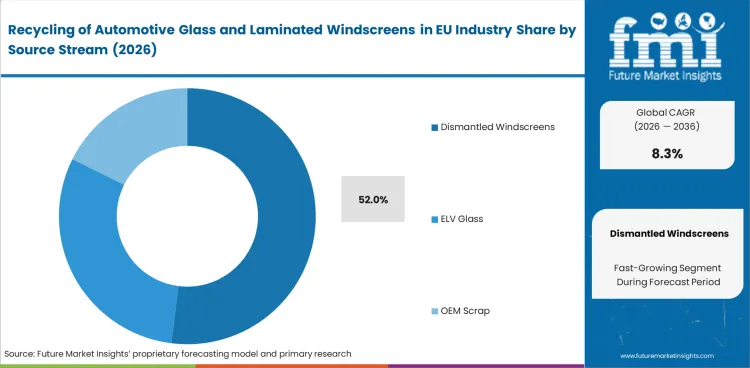
Glass source analysis starts with removal practicality, since input value changes sharply once glazing enters mixed shredder residue. Windscreens are estimated to account for 52.0% share in 2026, reflecting heavier focus on laminated front-glass recovery across Europe. Side glass and rear glass remain relevant supply pools, yet tempered formats usually move through less specialized handling steps. Sunroof glass and quarter glass add useful volume in selected vehicle lines, though supply remains less predictable across dismantling networks. Replacement activity keeps windscreen flow more visible than many other glazing streams in post-use recovery channels. Adjacent automotive front windshield context supports the replacement-led laminated glass flow entering post-use collection channels.
- Early windscreen removal preserves larger recoverable pieces and reduces contamination carried from sealants, films, and mixed residues.
- Replacement networks supply steadier laminated volumes than random scrap flows, supporting more predictable utilization across specialist recycling plants.
- Higher value concentration in windscreens keeps operator attention focused on removal discipline before breakage reduces resale potential.
Recycling of Automotive Glass and Laminated Windscreens in EU Market Analysis by Glass Construction
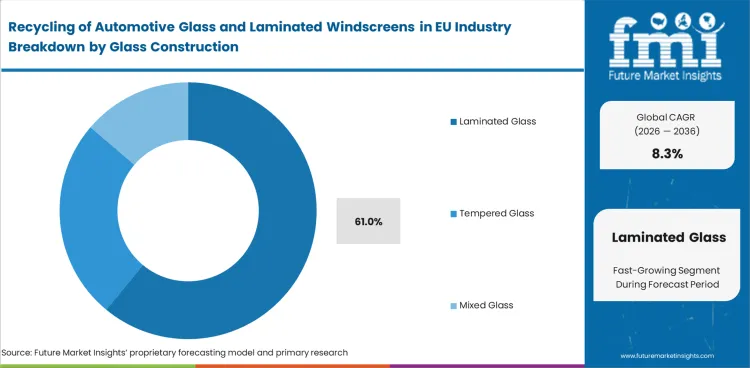
Glass construction shapes processing intensity, since laminated units require separation work beyond ordinary crushing and grading activity. Tempered glass enters recovery in meaningful volumes through side and rear glazing, especially in broad passenger vehicle fleets. Laminated glass is expected to hold 61.0% share in 2026 within this segment, reflecting direct windscreen concentration and interlayer recovery value. Coated glass, acoustic glass, and heated glass add complexity across selected premium vehicles, yet overall volumes remain comparatively narrower. Material build also influences labor content, equipment choice, and acceptable downstream outlet mix across specialist operators. polyvinyl butyral PVB provides adjacent context for the interlayer material carrying much of the separation burden in laminated recovery.
- Laminated formats require more handling discipline, since glass and interlayer value are realized only after successful separation.
- Tempered glass flows usually move faster through plants, yet resale upside often remains lower across simpler recovery lines.
- Specialty glazing features raise processing effort and quality control needs, especially in mixed inflows from newer vehicle platforms.
Recycling of Automotive Glass and Laminated Windscreens in EU Market Analysis by Recovery Output
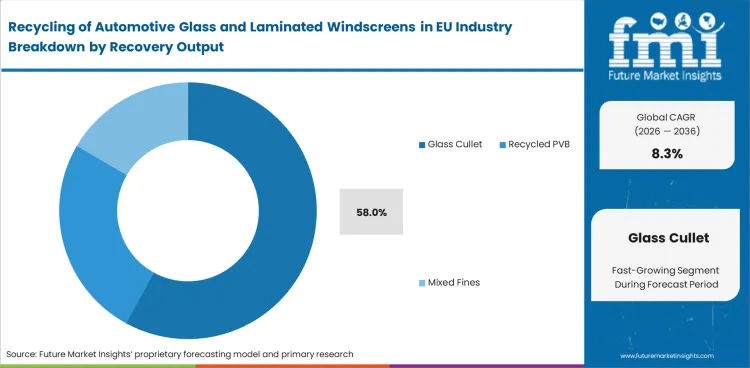
Recovery output analysis centers on saleable fractions, since plant economics improve only after recovered material reaches usable quality bands. Glass cullet remains the main commercial output across Europe, supported by broader demand visibility and easier handling than secondary fractions. PVB flakes and PVB powder carry rising relevance in selected recovery chains, especially in facilities investing in interlayer-focused separation systems. Glass cullet is projected to represent 58.0% share in 2026 within recovery output, reflecting its role as the main monetized fraction. Mixed glass fines and secondary residues appear across lower-quality inflows, limiting realized yield in less disciplined operations.
- Clean cullet attracts better resale interest than mixed fines, especially in applications requiring tighter impurity control.
- Polymer recovery adds value only after separation quality improves enough to support stable material grading.
- Output mix changes margin potential across plants, especially under differing contamination levels and equipment capabilities.
Recycling of Automotive Glass and Laminated Windscreens in EU Market Analysis by Collection Channel
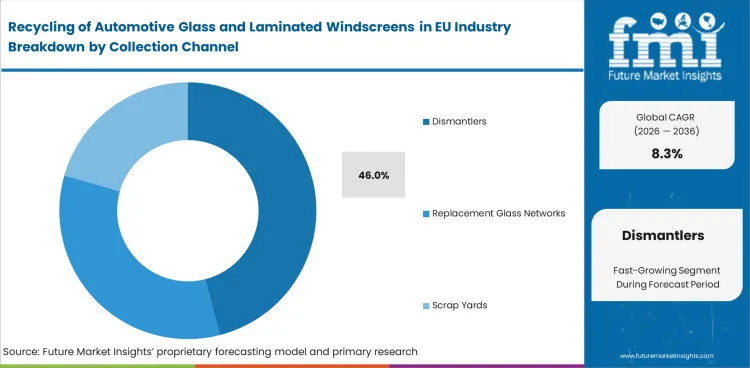
ELV dismantlers are estimated to account for 46.0% share in 2026 within collection channel, reflecting stronger attention on pre-shred glass removal across Europe. Glass replacement networks follow closely, supported by regular windscreen change cycles and easier access to intact laminated units. OEM scrap streams, body shops, and insurance salvage yards contribute useful volumes, though supply is less evenly distributed across countries and operators. Collection economics favor channels delivering intact pieces with lower contamination, stronger traceability, and less mixed residual handling. Authorized dismantling sites remain central for recovery planning since early extraction preserves usable material before breakage spreads through shredded flows.
- Authorized treatment facilities improve feed discipline by separating glazing before shredding mixes sealants, trims, and glass fragments.
- Replacement networks contribute especially valuable laminated units, since removed windscreens often arrive with lower breakage and better sortability.
- Scrap originating from uncontrolled breakage usually lowers realized value across both cullet recovery and interlayer separation lines.
Recycling of Automotive Glass and Laminated Windscreens in EU Market Analysis by Recycling Process
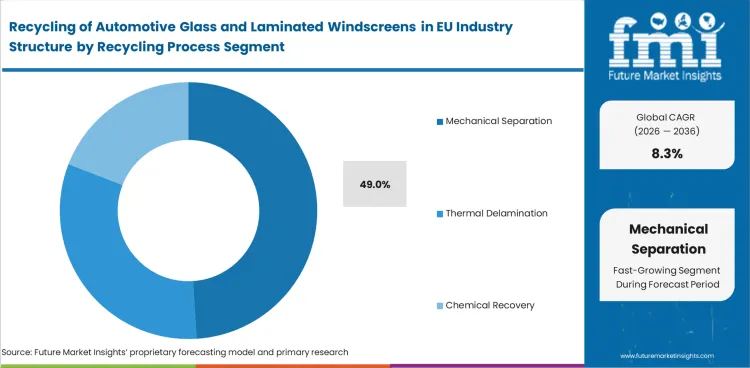
Recycling process analysis focuses on industrial steps moving glass from mixed vehicle components into usable fractions with saleable quality. Mechanical separation remains the operating base for most plants, built around crushing, liberation, sorting, and staged impurity removal. Delamination, cleaning, and PVB purification add higher-value capability, yet these steps require more disciplined intake and better process control. Thermal treatment appears in selected systems, though cost sensitivity and material quality risks limit wider deployment across automotive glazing recovery. Mechanical separation is estimated to hold 49.0% share in 2026 within recycling process, reflecting its position as the standard starting method.
- Baseline separation equipment allows plants to process varied inflows without relying on highly specialized polymer recovery assets.
- Delamination capacity improves value capture in laminated streams, yet utilization stays connected to steady intake quality and consistent volumes.
- Process selection shapes labor needs, reject rates, and resale outcomes across each stage of the recovery chain.
Recycling of Automotive Glass and Laminated Windscreens in EU Market Analysis by End Use
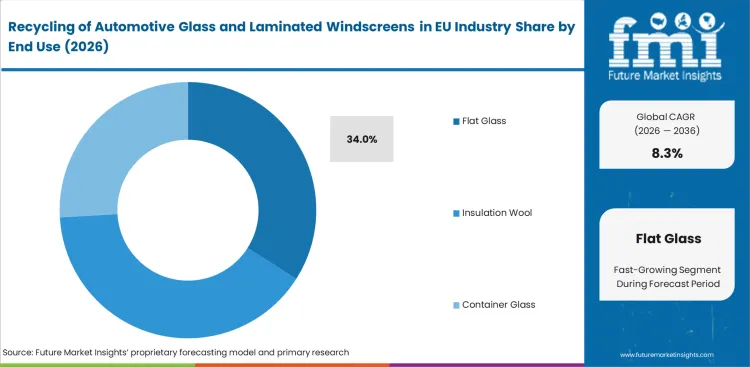
End-use analysis turns on outlet quality, since value realization improves only after recovered fractions match practical downstream specifications. Insulation materials, fiberglass, PVB compounds, construction fillers, and industrial abrasives all absorb portions of recovered automotive glazing output. Flat glass manufacturing carries the strongest strategic pull, especially for operators targeting higher-grade cullet with tighter contamination control. Outlet selection also influences plant sorting discipline, since stronger applications require more selective handling from the first removal step. Broader industrial outlets remain useful for lower-grade material, helping operators reduce disposal pressure and maintain steady material movement. Flat glass manufacturing is expected to capture 34.0% share in 2026 within end use, reflecting better value retention for suitable cullet.
- Higher-grade outlets reward tighter sorting standards and place stronger value on intact cullet with lower impurity levels.
- Lower-grade outlets absorb meaningful volumes, though price realization usually remains below premium downstream uses.
- End-use diversity helps plants balance resale risk across mixed output streams produced from varied vehicle-glazing inflows.
Segment performance in this market follows a simple operating pattern, with value rising alongside better removal discipline, stronger material separation, and tighter outlet qualification. Windscreens, laminated formats, cullet recovery, dismantler-led collection, baseline mechanical separation, and flat glass outlets form the current commercial center of gravity. Future gains in margin and resale quality will come from improved interlayer handling and steadier access to intact laminated units.
Drivers, Restraints, and Opportunities for Recycling of Automotive Glass and Laminated Windscreens in EU Industry
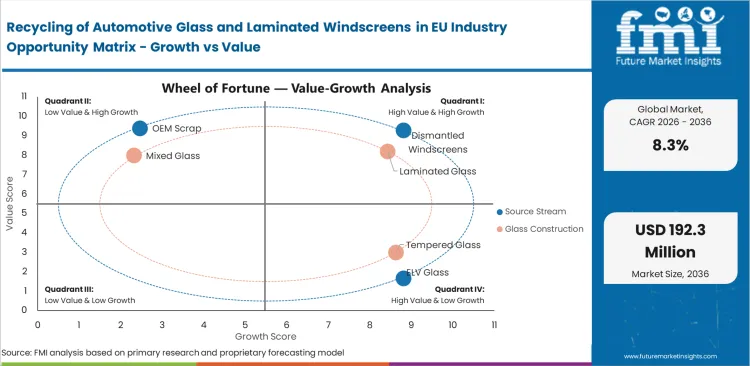
- Mandatory pre-shred glass removal can lift the supply of cleaner automotive cullet across EU treatment facilities.
- Contamination from mixed vehicle residue compresses recovery value and raises cleaning costs at recycling plants.
- Closed-loop use of recycled PVB creates a higher-value outlet for windscreen interlayer material across specialized recovery programs.
Processed Flat Glass Prices Strengthened the Recycling Benchmark
In August 2025, Germany’s Federal Statistical Office reported that shaped and processed flat glass prices were 4.3% higher than in August 2024 and 2.3% above July 2025. For the recycling automotive glass and laminated windscreens EU industry, this is a direct pricing signal because recovered windscreen glass is negotiated against current processed-glass replacement values, not against distant raw-material proxies. Year‑on‑year and month‑on‑month increases in processed flat glass prices expand pricing room for cleaner cullet and better‑separated laminated glass streams. Recovery quality affects the pricing discussions, because higher-purity output is better positioned to capture any uplift in downstream glass values.
Austria’s July Jump Signaled Firmer Glass Trade Pricing
In July 2025, Statistics Austria reported that wholesale prices rose 0.2% from June 2025, while flat glass increased 4.3% month on month. This is directly relevant to the EU automotive glass and laminated windscreen recycling industry because flat-glass trade pricing is one of the clearest public benchmarks for valuing recovered glass fractions after separation and cleaning. A move of this size within one month tightens the pricing environment for buyers sourcing usable recycled glass, especially when recyclers can show low contamination and stable output quality. Firmer negotiations for processed windscreen glass streams are supported in this way, while mixed laminated waste with poorer recovery yield is more exposed to discounts
Analysis by Key Countries
Country performance differs across Europe because dismantling practices and vehicle parc size plus recycling infrastructure do not develop at the same pace. Growth forecasts reflect regulatory exposure and the local ability to turn recovered glazing into saleable cullet or recycled polymer.
.webp "Top Country Growth Comparison Recycling Of Automotive Glass And Laminated Windscreens In Eu Industry Cagr (2026 2036)")
| Country | Forecast CAGR Through 2036 |
|---|---|
| Germany | 7.6% |
| France | 8.0% |
| Italy | 8.2% |
| Spain | 9.1% |
| Poland | 8.8% |
| Belgium | 8.6% |
| Netherlands | 8.4% |
Source: FMI analysis based on primary research and proprietary forecasting model
Recycling of Automotive Glass and Laminated Windscreens in EU Industry Demand Outlook for Germany
Germany carries the largest installed base for vehicle dismantling and flat glass processing in this industry. Demand for recycled automotive glass in Germany is anticipated to rise at a CAGR of 7.6% by 2036 because recovery systems are more established than in newer expansion markets. North Rhine-Westphalia and Lower Saxony provide a dense industrial base for dismantling and secondary material handling. Price realization is affected by whether recovered cullet reaches consistent quality bands for furnace use. Growth runs below Spain and Poland because Germany starts from a broader base and a more mature recycling setup. Margin conditions favor processors to combine clean collections with stable outlet agreements across nearby industrial demand centers.
Recycling of Automotive Glass and Laminated Windscreens in EU Industry Demand Outlook for France
France is expected to post 8.0% CAGR in this sector through 2036 as dismantling discipline and circular material policy strengthen local recovery economics. Hauts-de-France and Grand Est support both automotive activity and downstream glass demand, which helps processors place cleaner cullet into repeat industrial channels. Windscreen recovery receives close attention because laminated scrap carries more value once separation holds contamination at workable levels. Processing plants which grade outputs carefully will benefit from steadier resale conditions across domestic and nearby markets. Growth stands above Germany because recovery formalization has more room to improve collection efficiency and material grading.
Recycling of Automotive Glass and Laminated Windscreens in EU Industry Demand Outlook for Italy
Italy combines strong replacement glass activity with a broad passenger vehicle base to support recurring recovery volumes. Northern industrial areas around Lombardy and Emilia-Romagna create favorable conditions for collection and downstream material placement. Cullet demand from mineral applications helps balance the slower rollout of advanced polymer recovery capacity. Recycling programs focused on windscreens should benefit as dismantling practices become more organized across treatment facilities. Sales of recycled automotive glass in Italy are expected to increase at a CAGR of 8.2% during the forecast period. Forecast pace reflects a market moving from fragmented handling toward more controlled recovery across regional treatment networks.
Recycling of Automotive Glass and Laminated Windscreens in EU Industry Demand Outlook for Spain
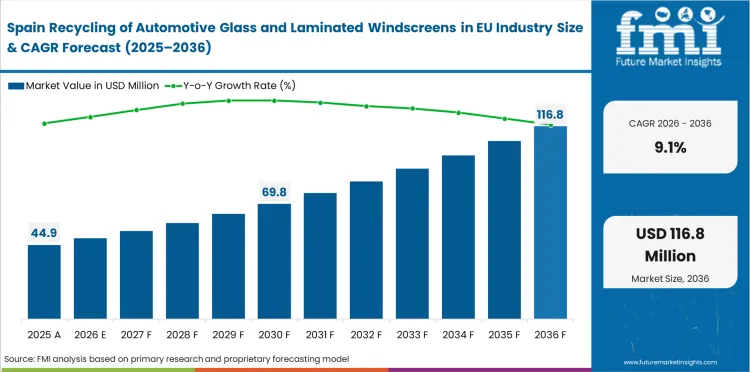
Spain posts the fastest country forecast because recycling formalization and laminated glass sorting capacity have more room to expand from current levels. Catalonia and Valencia support recovery demand through vehicle activity and logistics access into wider Iberian material networks. Demand for recycled automotive glass in Spain is anticipated to rise at a CAGR of 9.1% through 2036 because policy pressure and plant investment can improve separation economics quickly. Windscreen removal before shredding has a strong effect on plant margins as outlet access is affected by clean cullet quality. Growth runs above the EU average because Spain combines catch-up volume with visible circularity pressure.
Recycling of Automotive Glass and Laminated Windscreens in EU Industry Demand Outlook for Poland
Automotive glass removal in Poland is routed into organized waste channels through formal collection systems. Silesia and Greater Poland show industrial density associated with dismantling activity and secondary material movement. Value expansion at a CAGR of 8.8% signals a faster transition from basic handling into more specialized recovery for laminated fractions. Downstream opportunities improve once processors can separate cleaner glass and interlayer residues into industrial applications. Poland ranks near the top of the forecast range because capacity formalization can lift both yield and resale quality over the assessment period.
Recycling of Automotive Glass and Laminated Windscreens in EU Industry Demand Outlook for Belgium
Belgium serves as a compact processing and logistics hub for cross-border recycled glass movement in Northwestern Europe. Antwerp and surrounding industrial zones give processors access to transport infrastructure, and it suits heavy secondary material flows. Recycled automotive glass demand across Belgium is set to rise at 8.6% CAGR over the forecast years because recovery firms can pair local treatment with regional outlet access. Market scale is smaller than Germany or France, though network efficiency helps protect realized value. Belgian operators with laminated glass capability should benefit from regional material access and shorter delivery distances into downstream plants.
Recycling of Automotive Glass and Laminated Windscreens in EU Industry Demand Outlook for Netherlands
Netherlands combines strong logistics access with active circular material policy, which supports organized recovery routes for automotive glazing. Rotterdam and nearby industrial clusters help recyclers move recovered glass efficiently into regional processing and resale channels. Domestic vehicle retirement volumes are smaller than in Germany or France, so growth is determined by collection quality and transit efficiency as much as on local scrap generation. Demand for the recycling automotive glass and laminated windscreens in the Netherlands is expected to advance at a CAGR of 8.4% from 2026 to 2036. Stable outlet access should keep the Dutch sector commercially attractive for specialized processors serving nearby industrial clusters.
Competitive Landscape of Recycling of Automotive Glass and Laminated Windscreens in EU Industry
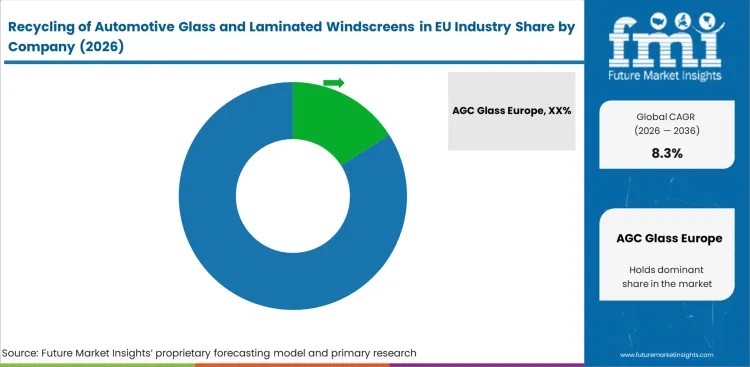
- Top processors are differentiated by glass separation quality and access to cleaner laminated windscreen feedstock.
- European recyclers add value through stronger delamination capability and reliable outlet access for cullet and recovered PVB.
- Competitive pressure is highest in higher-grade recovery streams, as output purity and repeatable quality control decide commercial acceptance.
Competitive Aligners
Reiling Glas Recycling and Maltha hold strong positions because both companies operate at the intersection of high collection quality and industrial resale discipline. Their advantage comes from established sorting capability and from relationships with downstream glass users who require dependable cullet specification. Automotive glazing forms only a portion of their broader glass flow, and this portion is more valuable as Europe tightens dismantling expectations.
Shark Solutions, Sibelco, Interzero, and Auto Glass Recycling s.r.o. support the specialized end of the category through PVB recovery, circular material handling, and niche processing capability. Competitive positions are determined by feedstock quality control and outlet development for recycled polymer fractions. Scale helps, though outlet access and separation quality decide commercial ranking more than volume headlines.
Competitive Benchmarking for Recycling of Automotive Glass and Laminated Windscreens in EU Industry
| Company | Laminated Recovery | Outlet Access | Polymer Alignment | Geographic Footprint |
|---|---|---|---|---|
| Reiling Glas Recycling | High | High | Medium | Europe |
| Maltha | High | High | Medium | Europe |
| Belron | Medium | Medium | Low | Europe |
| AGC Glass Europe | Medium | High | Low | Europe |
| Saint-Gobain Glass | Medium | High | Low | Europe |
| Sibelco | Medium | Medium | Medium | Europe |
| Shark Solutions | Low | Medium | High | Europe |
Source: Future Market Insights competitive analysis, 2026.
Recent Developments
- January 2025: Maltha Glass Recycling invested in laminated glass recycling capacity at Lommel, Belgium. The added PVB-processing capability strengthens recovery of automotive windscreen glass and supports higher-value recycling output.
- December 2025 / February 2026: The EU’s provisional ELV agreement retained key automotive glass provisions, including mandatory dismantling targets and recycling of removed glass into new glass applications, improving long-term visibility for laminated windscreen recycling investment.
Key Companies
Major Global Companies
- AGC Glass Europe
- Saint-Gobain Glass
- Belron
- Sibelco
Other Active Companies
- Reiling Glas Recycling
- Maltha Glass Recycling
- Shark Solutions
Scope of the Report
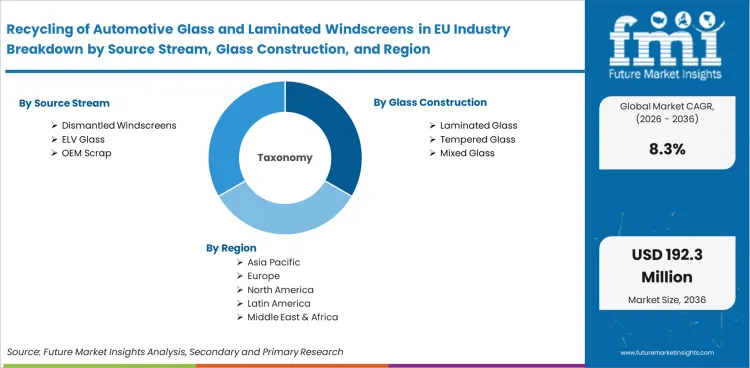
| Attribute | Details |
|---|---|
| Metric | Value |
| Quantitative Units | USD 80.0 million (2025) to USD 200.0 million (2036), at a CAGR of 8.3% |
| Market Definition | The Recycling of Automotive Glass and Laminated Windscreens in EU Market covers collection, separation, processing, and reuse activities for end-of-life vehicle glass and replacement glazing waste across the European Union. Scope includes laminated windscreens, tempered side and rear glass, glass cullet recovery, PVB interlayer recovery, and related recycling processes used to convert withdrawn automotive glazing into reusable material streams for glass, insulation, polymer, and industrial applications. |
| Segmentation |
|
| Regions Covered | Western Europe, Northern Europe, Southern Europe, Eastern Europe |
| Countries Covered | Germany, France, Italy, Spain, Poland, Belgium, Netherlands, and other EU countries |
| Key Companies Profiled | AGC Glass Europe, Saint-Gobain Glass, Belron, Reiling Glas Recycling, Maltha Glass Recycling, Shark Solutions, Sibelco, and other regional recyclers |
| Forecast Period | 2026 to 2036 |
| Approach | Hybrid bottom-up and top-down methodology using verified end-of-life vehicle volumes, replacement glass recovery flows, laminated glass processing economics, and adoption estimates for cullet and recycled PVB across downstream applications. Forecasting is supported by primary interviews, secondary industry sources, and country-level assessment of recovery infrastructure, regulatory direction, and outlet quality requirements. |
Recycling of Automotive Glass and Laminated Windscreens in EU Market by Segments
Recycling of Automotive Glass and Laminated Windscreens in EU Market Segmented by Source Stream
- ELV Glass
- Replacement Glass
- OEM Scrap
- Dismantled Windscreens
- Side and Rear Glass
Recycling of Automotive Glass and Laminated Windscreens in EU Market Classified by Glass Type
- Laminated Glass
- Tempered Glass
- Mixed Glass
- Windscreen Glass
- Side and Rear Glass
Recycling of Automotive Glass and Laminated Windscreens in EU Market Analyzed by Recycling Process
- Mechanical Separation
- Thermal Delamination
- Chemical Recovery
- Crushing and Cleaning
- PVB Separation
Recycling of Automotive Glass and Laminated Windscreens in EU Market Classified by Recovered Output
- Glass Cullet
- Recycled PVB
- Mixed Fines
- Glass Powder
- Composite Residue
Recycling of Automotive Glass and Laminated Windscreens in EU Market Classified by End Application
- Flat Glass
- Insulation Wool
- Container Glass
- Polymer Compounds
- Construction Fill
Recycling of Automotive Glass and Laminated Windscreens in EU Market Classified by Vehicle Type
- Passenger Cars
- SUVs
- Light Commercial Vehicles
- Heavy Commercial Vehicles
- Buses
Recycling of Automotive Glass and Laminated Windscreens in EU Market Classified by End User
- Flat Glass Manufacturers
- Insulation Producers
- Polymer Processors
- Aggregates Processors
- Specialty Recyclers
Recycling of Automotive Glass and Laminated Windscreens in EU Market Classified by Collection Channel
- Dismantlers
- Replacement Glass Networks
- Authorized Treatment Facilities
- Scrap Yards
- OEM Plants
Recycling of Automotive Glass and Laminated Windscreens in EU Market by Region and Country
- Western Europe
- Germany
- France
- Netherlands
- Belgium
- Austria
- Luxembourg
- Northern Europe
- Denmark
- Sweden
- Norway
- Finland
- Ireland
- Iceland
- Southern Europe
- Italy
- Spain
- Portugal
- Greece
- Malta
- Cyprus
- Eastern Europe
- Poland
- Czech Republic
- Slovakia
- Hungary
- Romania
- Bulgaria
- Croatia
- Slovenia
- Estonia
- Latvia
- Lithuania
Bibliography
- Renewi. (2025, January 16). Maltha Glass Recycling invests in laminated glass recycling.
- Council of the European Union. (2025, June 11). Proposal for a regulation of the European Parliament and of the Council on circularity requirements for vehicle design and on management of end-of-life vehicles, amending Regulations (EU) 2018/858 and 2019/1020 and repealing Directives 2000/53/EC and 2005/64/EC-General approach (10092/25).
- Glass for Europe. (2026, February 26). The End-of-Life Vehicles Regulation moves forward with key provisions for automotive glass.
- German Federal Statistical Office (Destatis). (2025, September 19). Producer prices in August 2025: -2.2% on August 2024.
- Statistics Austria. (2025, August 6). Wholesale prices slightly below previous year in July 2025.
- Council of the European Union. (2025, June 17). Circular economy: Council adopts position on the recycling of vehicles at the end of their life. Consilium.
- Council of the European Union. (2025, December 12). Circular economy: Council and Parliament strike deal on rules for vehicle circularity and management of end-of-life vehicles. Consilium.
- Glass for Europe. (2024, June). Dismantling automotive glass is a mandatory step to increase recycling of end-of-life vehicles. Glass for Europe.
This bibliography is provided for reader reference and is not exhaustive. The full report contains the complete reference list and detailed citations.
This Report Addresses
- Market sizing and revenue forecasting for recycled automotive glass and laminated windscreen recovery from 2025 to 2036.
- Segmentation analysis across source stream and glass type plus recycling process and recovered output along with end application and vehicle type.
- Country-level growth assessment for seven European industries with comparative CAGR evaluation across the forecast period.
- Regulatory analysis covering ELV treatment requirements and circular material standards that influence recovery economics across the region.
- Competitive assessment covering market concentration and company positioning plus downstream outlet alignment across the recycling chain.
- Supply chain review from glass removal and source segregation through processor upgrading and industrial resale.
- Delivery of a structured preview assessment in document format for editorial and commercial planning use.
Frequently Asked Questions
How much is the market worth across Europe in 2026 according to FMI analysis?
FMI estimates the market at USD 90.0 million in 2026 based on EU vehicle glass recovery and recycling activity.
Where is market value expected to reach by 2036 under the base forecast used in this report?
Forecast value reaches USD 200.0 million by 2036 under the base case used for this assessment.
At what rate is demand expected to grow through 2036 across this European recycling category?
Demand is expected to rise at an 8.3% CAGR between 2026 and 2036 across the assessed European market.
Which glass type carries the largest share in 2026 within the segmentation used for this study?
Laminated glass leads glass type demand with an estimated 52.0% share in 2026 because windscreen recovery carries stronger value per processed unit.
Which collection route contributes to the largest portion of recyclable input under the 2026 segment outlook?
Dismantlers contribute the largest collection share at 46.0% in 2026 because pre-shred removal preserves cleaner glass and stronger resale quality.
Which country posts the fastest forecast pace through 2036 in this report?
Spain posts the fastest country forecast at 9.1% CAGR through 2036 because recovery formalization has more room to lift usable material yield.
What falls within the scope used to define this market in the report?
Scope covers collection and recycling of side glass and rear glass plus laminated windscreens within EU treatment and replacement channels using commercial recovery routes.
How was the market forecast constructed for this preview assessment and validation process?
Forecasting used a bottom-up model linking recoverable glass volumes with realizable cullet and recycled polymer value, then checked those results against policy and industry evidence.
Preview the report firsthand - request a free sample
Get SampleGet the brochure for pricing and purchase details.
Get PDFTable of Content
- Executive Summary
- Global Market Outlook
- Demand-side Trends
- Supply-side Trends
- Technology Roadmap Analysis
- Analysis and Recommendations
- Market Overview
- Market Coverage / Taxonomy
- Market Definition / Scope / Limitations
- Research Methodology
- Chapter Orientation
- Analytical Lens and Working Hypotheses
- Market Structure, Signals, and Trend Drivers
- Benchmarking and Cross-market Comparability
- Market Sizing, Forecasting, and Opportunity Mapping
- Research Design and Evidence Framework
- Desk Research Programme (Secondary Evidence)
- Company Annual and Sustainability Reports
- Peer-reviewed Journals and Academic Literature
- Corporate Websites, Product Literature, and Technical Notes
- Earnings Decks and Investor Briefings
- Statutory Filings and Regulatory Disclosures
- Technical White Papers and Standards Notes
- Trade Journals, Industry Magazines, and Analyst Briefs
- Conference Proceedings, Webinars, and Seminar Materials
- Government Statistics Portals and Public Data Releases
- Press Releases and Reputable Media Coverage
- Specialist Newsletters and Curated Briefings
- Sector Databases and Reference Repositories
- FMI Internal Proprietary Databases and Historical Market Datasets
- Subscription Datasets and Paid Sources
- Social Channels, Communities, and Digital Listening Inputs
- Additional Desk Sources
- Expert Input and Fieldwork (Primary Evidence)
- Primary Modes
- Qualitative Interviews and Expert Elicitation
- Quantitative Surveys and Structured Data Capture
- Blended Approach
- Why Primary Evidence is Used
- Field Techniques
- Interviews
- Surveys
- Focus Groups
- Observational and In-context Research
- Social and Community Interactions
- Stakeholder Universe Engaged
- C-suite Leaders
- Board Members
- Presidents and Vice Presidents
- R&D and Innovation Heads
- Technical Specialists
- Domain Subject-matter Experts
- Scientists
- Physicians and Other Healthcare Professionals
- Governance, Ethics, and Data Stewardship
- Research Ethics
- Data Integrity and Handling
- Primary Modes
- Tooling, Models, and Reference Databases
- Desk Research Programme (Secondary Evidence)
- Data Engineering and Model Build
- Data Acquisition and Ingestion
- Cleaning, Normalisation, and Verification
- Synthesis, Triangulation, and Analysis
- Quality Assurance and Audit Trail
- Market Background
- Market Dynamics
- Drivers
- Restraints
- Opportunity
- Trends
- Scenario Forecast
- Demand in Optimistic Scenario
- Demand in Likely Scenario
- Demand in Conservative Scenario
- Opportunity Map Analysis
- Product Life Cycle Analysis
- Supply Chain Analysis
- Investment Feasibility Matrix
- Value Chain Analysis
- PESTLE and Porter’s Analysis
- Regulatory Landscape
- Regional Parent Market Outlook
- Production and Consumption Statistics
- Import and Export Statistics
- Market Dynamics
- Global Market Analysis 2021 to 2025 and Forecast, 2026 to 2036
- Historical Market Size Value (USD Million) Analysis, 2021 to 2025
- Current and Future Market Size Value (USD Million) Projections, 2026 to 2036
- Y-o-Y Growth Trend Analysis
- Absolute $ Opportunity Analysis
- Global Market Pricing Analysis 2021 to 2025 and Forecast 2026 to 2036
- Global Market Analysis 2021 to 2025 and Forecast 2026 to 2036, By Source Stream
- Introduction / Key Findings
- Historical Market Size Value (USD Million) Analysis By Source Stream , 2021 to 2025
- Current and Future Market Size Value (USD Million) Analysis and Forecast By Source Stream , 2026 to 2036
- Dismantled Windscreens
- ELV Glass
- OEM Scrap
- Dismantled Windscreens
- Y-o-Y Growth Trend Analysis By Source Stream , 2021 to 2025
- Absolute $ Opportunity Analysis By Source Stream , 2026 to 2036
- Global Market Analysis 2021 to 2025 and Forecast 2026 to 2036, By Glass Construction
- Introduction / Key Findings
- Historical Market Size Value (USD Million) Analysis By Glass Construction, 2021 to 2025
- Current and Future Market Size Value (USD Million) Analysis and Forecast By Glass Construction, 2026 to 2036
- Laminated Glass
- Tempered Glass
- Mixed Glass
- Laminated Glass
- Y-o-Y Growth Trend Analysis By Glass Construction, 2021 to 2025
- Absolute $ Opportunity Analysis By Glass Construction, 2026 to 2036
- Global Market Analysis 2021 to 2025 and Forecast 2026 to 2036, By Recovery Output
- Introduction / Key Findings
- Historical Market Size Value (USD Million) Analysis By Recovery Output, 2021 to 2025
- Current and Future Market Size Value (USD Million) Analysis and Forecast By Recovery Output, 2026 to 2036
- Glass Cullet
- Recycled PVB
- Mixed Fines
- Glass Cullet
- Y-o-Y Growth Trend Analysis By Recovery Output, 2021 to 2025
- Absolute $ Opportunity Analysis By Recovery Output, 2026 to 2036
- Global Market Analysis 2021 to 2025 and Forecast 2026 to 2036, By Collection Channel
- Introduction / Key Findings
- Historical Market Size Value (USD Million) Analysis By Collection Channel, 2021 to 2025
- Current and Future Market Size Value (USD Million) Analysis and Forecast By Collection Channel, 2026 to 2036
- Dismantlers
- Replacement Glass Networks
- Scrap Yards
- Dismantlers
- Y-o-Y Growth Trend Analysis By Collection Channel, 2021 to 2025
- Absolute $ Opportunity Analysis By Collection Channel, 2026 to 2036
- Global Market Analysis 2021 to 2025 and Forecast 2026 to 2036, By Recycling Process
- Introduction / Key Findings
- Historical Market Size Value (USD Million) Analysis By Recycling Process, 2021 to 2025
- Current and Future Market Size Value (USD Million) Analysis and Forecast By Recycling Process, 2026 to 2036
- Mechanical Separation
- Thermal Delamination
- Chemical Recovery
- Mechanical Separation
- Y-o-Y Growth Trend Analysis By Recycling Process, 2021 to 2025
- Absolute $ Opportunity Analysis By Recycling Process, 2026 to 2036
- Global Market Analysis 2021 to 2025 and Forecast 2026 to 2036, By End Use
- Introduction / Key Findings
- Historical Market Size Value (USD Million) Analysis By End Use, 2021 to 2025
- Current and Future Market Size Value (USD Million) Analysis and Forecast By End Use, 2026 to 2036
- Flat Glass
- Insulation Wool
- Container Glass
- Flat Glass
- Y-o-Y Growth Trend Analysis By End Use, 2021 to 2025
- Absolute $ Opportunity Analysis By End Use, 2026 to 2036
- Global Market Analysis 2021 to 2025 and Forecast 2026 to 2036, By Region
- Introduction
- Historical Market Size Value (USD Million) Analysis By Region, 2021 to 2025
- Current Market Size Value (USD Million) Analysis and Forecast By Region, 2026 to 2036
- North America
- Latin America
- Western Europe
- Eastern Europe
- East Asia
- South Asia and Pacific
- Middle East & Africa
- Market Attractiveness Analysis By Region
- North America Market Analysis 2021 to 2025 and Forecast 2026 to 2036, By Country
- Historical Market Size Value (USD Million) Trend Analysis By Market Taxonomy, 2021 to 2025
- Market Size Value (USD Million) Forecast By Market Taxonomy, 2026 to 2036
- By Country
- USA
- Canada
- Mexico
- By Source Stream
- By Glass Construction
- By Recovery Output
- By Collection Channel
- By Recycling Process
- By End Use
- By Country
- Market Attractiveness Analysis
- By Country
- By Source Stream
- By Glass Construction
- By Recovery Output
- By Collection Channel
- By Recycling Process
- By End Use
- Key Takeaways
- Latin America Market Analysis 2021 to 2025 and Forecast 2026 to 2036, By Country
- Historical Market Size Value (USD Million) Trend Analysis By Market Taxonomy, 2021 to 2025
- Market Size Value (USD Million) Forecast By Market Taxonomy, 2026 to 2036
- By Country
- Brazil
- Chile
- Rest of Latin America
- By Source Stream
- By Glass Construction
- By Recovery Output
- By Collection Channel
- By Recycling Process
- By End Use
- By Country
- Market Attractiveness Analysis
- By Country
- By Source Stream
- By Glass Construction
- By Recovery Output
- By Collection Channel
- By Recycling Process
- By End Use
- Key Takeaways
- Western Europe Market Analysis 2021 to 2025 and Forecast 2026 to 2036, By Country
- Historical Market Size Value (USD Million) Trend Analysis By Market Taxonomy, 2021 to 2025
- Market Size Value (USD Million) Forecast By Market Taxonomy, 2026 to 2036
- By Country
- Germany
- UK
- Italy
- Spain
- France
- Nordic
- BENELUX
- Rest of Western Europe
- By Source Stream
- By Glass Construction
- By Recovery Output
- By Collection Channel
- By Recycling Process
- By End Use
- By Country
- Market Attractiveness Analysis
- By Country
- By Source Stream
- By Glass Construction
- By Recovery Output
- By Collection Channel
- By Recycling Process
- By End Use
- Key Takeaways
- Eastern Europe Market Analysis 2021 to 2025 and Forecast 2026 to 2036, By Country
- Historical Market Size Value (USD Million) Trend Analysis By Market Taxonomy, 2021 to 2025
- Market Size Value (USD Million) Forecast By Market Taxonomy, 2026 to 2036
- By Country
- Russia
- Poland
- Hungary
- Balkan & Baltic
- Rest of Eastern Europe
- By Source Stream
- By Glass Construction
- By Recovery Output
- By Collection Channel
- By Recycling Process
- By End Use
- By Country
- Market Attractiveness Analysis
- By Country
- By Source Stream
- By Glass Construction
- By Recovery Output
- By Collection Channel
- By Recycling Process
- By End Use
- Key Takeaways
- East Asia Market Analysis 2021 to 2025 and Forecast 2026 to 2036, By Country
- Historical Market Size Value (USD Million) Trend Analysis By Market Taxonomy, 2021 to 2025
- Market Size Value (USD Million) Forecast By Market Taxonomy, 2026 to 2036
- By Country
- China
- Japan
- South Korea
- By Source Stream
- By Glass Construction
- By Recovery Output
- By Collection Channel
- By Recycling Process
- By End Use
- By Country
- Market Attractiveness Analysis
- By Country
- By Source Stream
- By Glass Construction
- By Recovery Output
- By Collection Channel
- By Recycling Process
- By End Use
- Key Takeaways
- South Asia and Pacific Market Analysis 2021 to 2025 and Forecast 2026 to 2036, By Country
- Historical Market Size Value (USD Million) Trend Analysis By Market Taxonomy, 2021 to 2025
- Market Size Value (USD Million) Forecast By Market Taxonomy, 2026 to 2036
- By Country
- India
- ASEAN
- Australia & New Zealand
- Rest of South Asia and Pacific
- By Source Stream
- By Glass Construction
- By Recovery Output
- By Collection Channel
- By Recycling Process
- By End Use
- By Country
- Market Attractiveness Analysis
- By Country
- By Source Stream
- By Glass Construction
- By Recovery Output
- By Collection Channel
- By Recycling Process
- By End Use
- Key Takeaways
- Middle East & Africa Market Analysis 2021 to 2025 and Forecast 2026 to 2036, By Country
- Historical Market Size Value (USD Million) Trend Analysis By Market Taxonomy, 2021 to 2025
- Market Size Value (USD Million) Forecast By Market Taxonomy, 2026 to 2036
- By Country
- Kingdom of Saudi Arabia
- Other GCC Countries
- Turkiye
- South Africa
- Other African Union
- Rest of Middle East & Africa
- By Source Stream
- By Glass Construction
- By Recovery Output
- By Collection Channel
- By Recycling Process
- By End Use
- By Country
- Market Attractiveness Analysis
- By Country
- By Source Stream
- By Glass Construction
- By Recovery Output
- By Collection Channel
- By Recycling Process
- By End Use
- Key Takeaways
- Key Countries Market Analysis
- USA
- Pricing Analysis
- Market Share Analysis, 2025
- By Source Stream
- By Glass Construction
- By Recovery Output
- By Collection Channel
- By Recycling Process
- By End Use
- Canada
- Pricing Analysis
- Market Share Analysis, 2025
- By Source Stream
- By Glass Construction
- By Recovery Output
- By Collection Channel
- By Recycling Process
- By End Use
- Mexico
- Pricing Analysis
- Market Share Analysis, 2025
- By Source Stream
- By Glass Construction
- By Recovery Output
- By Collection Channel
- By Recycling Process
- By End Use
- Brazil
- Pricing Analysis
- Market Share Analysis, 2025
- By Source Stream
- By Glass Construction
- By Recovery Output
- By Collection Channel
- By Recycling Process
- By End Use
- Chile
- Pricing Analysis
- Market Share Analysis, 2025
- By Source Stream
- By Glass Construction
- By Recovery Output
- By Collection Channel
- By Recycling Process
- By End Use
- Germany
- Pricing Analysis
- Market Share Analysis, 2025
- By Source Stream
- By Glass Construction
- By Recovery Output
- By Collection Channel
- By Recycling Process
- By End Use
- UK
- Pricing Analysis
- Market Share Analysis, 2025
- By Source Stream
- By Glass Construction
- By Recovery Output
- By Collection Channel
- By Recycling Process
- By End Use
- Italy
- Pricing Analysis
- Market Share Analysis, 2025
- By Source Stream
- By Glass Construction
- By Recovery Output
- By Collection Channel
- By Recycling Process
- By End Use
- Spain
- Pricing Analysis
- Market Share Analysis, 2025
- By Source Stream
- By Glass Construction
- By Recovery Output
- By Collection Channel
- By Recycling Process
- By End Use
- France
- Pricing Analysis
- Market Share Analysis, 2025
- By Source Stream
- By Glass Construction
- By Recovery Output
- By Collection Channel
- By Recycling Process
- By End Use
- India
- Pricing Analysis
- Market Share Analysis, 2025
- By Source Stream
- By Glass Construction
- By Recovery Output
- By Collection Channel
- By Recycling Process
- By End Use
- ASEAN
- Pricing Analysis
- Market Share Analysis, 2025
- By Source Stream
- By Glass Construction
- By Recovery Output
- By Collection Channel
- By Recycling Process
- By End Use
- Australia & New Zealand
- Pricing Analysis
- Market Share Analysis, 2025
- By Source Stream
- By Glass Construction
- By Recovery Output
- By Collection Channel
- By Recycling Process
- By End Use
- China
- Pricing Analysis
- Market Share Analysis, 2025
- By Source Stream
- By Glass Construction
- By Recovery Output
- By Collection Channel
- By Recycling Process
- By End Use
- Japan
- Pricing Analysis
- Market Share Analysis, 2025
- By Source Stream
- By Glass Construction
- By Recovery Output
- By Collection Channel
- By Recycling Process
- By End Use
- South Korea
- Pricing Analysis
- Market Share Analysis, 2025
- By Source Stream
- By Glass Construction
- By Recovery Output
- By Collection Channel
- By Recycling Process
- By End Use
- Russia
- Pricing Analysis
- Market Share Analysis, 2025
- By Source Stream
- By Glass Construction
- By Recovery Output
- By Collection Channel
- By Recycling Process
- By End Use
- Poland
- Pricing Analysis
- Market Share Analysis, 2025
- By Source Stream
- By Glass Construction
- By Recovery Output
- By Collection Channel
- By Recycling Process
- By End Use
- Hungary
- Pricing Analysis
- Market Share Analysis, 2025
- By Source Stream
- By Glass Construction
- By Recovery Output
- By Collection Channel
- By Recycling Process
- By End Use
- Kingdom of Saudi Arabia
- Pricing Analysis
- Market Share Analysis, 2025
- By Source Stream
- By Glass Construction
- By Recovery Output
- By Collection Channel
- By Recycling Process
- By End Use
- Turkiye
- Pricing Analysis
- Market Share Analysis, 2025
- By Source Stream
- By Glass Construction
- By Recovery Output
- By Collection Channel
- By Recycling Process
- By End Use
- South Africa
- Pricing Analysis
- Market Share Analysis, 2025
- By Source Stream
- By Glass Construction
- By Recovery Output
- By Collection Channel
- By Recycling Process
- By End Use
- USA
- Market Structure Analysis
- Competition Dashboard
- Competition Benchmarking
- Market Share Analysis of Top Players
- By Regional
- By Source Stream
- By Glass Construction
- By Recovery Output
- By Collection Channel
- By Recycling Process
- By End Use
- Competition Analysis
- Competition Deep Dive
- AGC Glass Europe
- Overview
- Product Portfolio
- Profitability by Market Segments (Product/Age /Sales Channel/Region)
- Sales Footprint
- Strategy Overview
- Marketing Strategy
- Product Strategy
- Channel Strategy
- Saint-Gobain Glass
- Belron
- Sibelco
- Reiling Glas Recycling
- AGC Glass Europe
- Competition Deep Dive
- Assumptions & Acronyms Used


