

- Industry Size (2026)
- USD 230.0 Mn
- Forecast (2036)
- USD 444.1 Mn
- CAGR (2026 to 2036)
- 6.8%
Gypsum Plasterboard Loop and Closed-Loop Recycling in EU Construction Industry Size, Market Forecast and Outlook By FMI
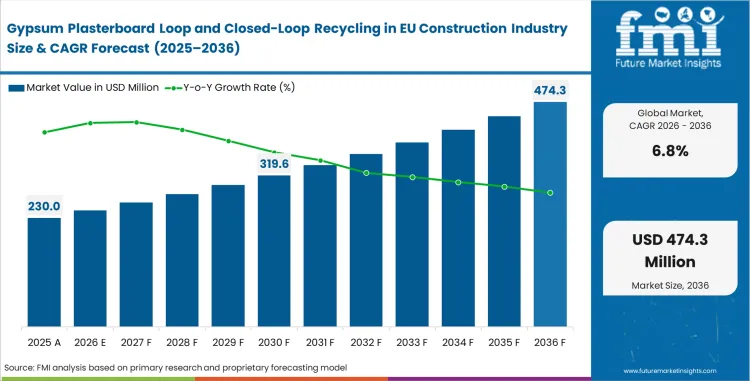
The gypsum plasterboard loop and closed-loop recycling in EU construction industry was valued at USD 215.4 million in 2025. Market demand is projected to reach USD 230.0 million in 2026 and is expected to rise to USD 444.1 million by 2036, reflecting a CAGR of 6.8% over the forecast period. Growth is being supported by rising recovery volumes as landfill costs increase and contractors place greater value on cleaner diversion routes.
Summary of Gypsum Plasterboard Loop and Closed-Loop Recycling in EU Construction Industry
- The market is forecast to reach USD 444.1 million by 2036.
- The market is expected to grow at a CAGR of 6.8% from 2026 to 2036.
- The market was estimated at USD 215.4 million in 2025.
- The forecast period represents an incremental opportunity of USD 214.1 million.
- The market is a circular construction materials recovery segment focused on collecting plasterboard waste and reprocessing it into board-grade gypsum for reuse.
- Growth is being driven by producer initiatives, with companies such as Saint-Gobain and Etex launching 100% recycled plasterboard products in 2025.
- Recycled gypsum demand remains specification-led, requiring strict purity and moisture compliance to replace virgin materials.
- Renovation waste leads the waste source segment with a 41% share, while closed-loop recycling accounts for 64% of recycling routes.
- New plasterboard dominates end use with a 72% share, and direct take-back leads collection channels with 46%.
- Standard board holds 58% share in board type due to its volume advantage and ease of reincorporation.
- The Netherlands, Germany, and France are the fastest-growing markets, while the United Kingdom remains a key installed base.
- Key companies include Saint-Gobain, Etex, Knauf, New West Gypsum Recycling, Gypsum Recycling International, Encore Environment, and REMONDIS, with competition remaining fragmented and regionally driven.
Key Takeaways, Market Size, and Forecast
- Gypsum Plasterboard Loop and Closed-Loop Recycling in EU Construction Industry is projected to grow from USD 230.0 million in 2026 to USD 444.1 million by 2036, at a CAGR of 6.8%.
- The gypsum plasterboard loop and closed-loop recycling in EU construction industry was valued at USD 215.4 million in 2025.
- By 2036, the Gypsum Plasterboard Loop and Closed-Loop Recycling in EU Construction Industry is expected to be worth USD 444.1 million.
- From 2026 to 2036, the industry is projected to expand at a CAGR of 6.8%.
- The industry is projected to create an incremental opportunity of USD 214.1 million between 2026 and 2036.
- In 2026, Renovation waste is expected to account for 41.0% of the waste source segment.
- Netherlands (7.6%) and Germany (7.4%) are two of the fastest growing markets.
Large contractors are treating plasterboard disposal charges as a direct pressure on margin rather than a cost that can be passed through without consequence. Supply agreements are increasingly favoring manufacturers with verifiable take-back systems because collection certainty matters once municipal sorting fees begin to rise. Delayed segregation of plasterboard waste can quickly result in added gate-fee exposure and weaker recovery value. Paper contamination often creates a bigger recycling barrier than calcium sulfate quality in the gypsum core itself, which makes on-site waste handling more important than many operators assume. Use of green building materials also depends on reliable tracking of diverted plasterboard streams so recovered content can move through the chain with clearer documentation.
Feedstock economics begin to shift once drywall producers complete plant upgrades that allow higher recycled input. Additional capacity for lower-carbon plasterboard changes the value of secondary gypsum and improves the case for more structured collection systems. Local processing hubs become more effective once throughput reaches a viable level, because transport, sorting, and recovery costs can then compete more credibly with virgin extraction routes.
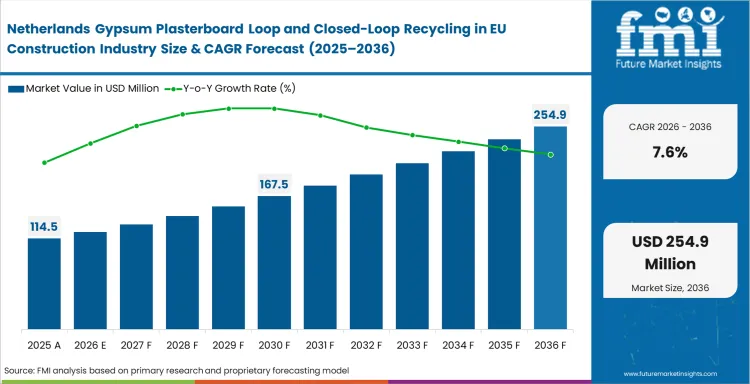
Netherlands is projected to register a CAGR of 7.6% through 2036, supported by stricter circular construction targets that favor verified secondary material use. Germany is expected to expand at a CAGR of 7.4%, helped by mature sorting systems and strong domestic wallboard production capacity. France is likely to record 7.2% CAGR during the forecast period, where producer-responsibility structures are giving wallboard recovery stronger support. Spain is estimated to grow at 7.1%, backed by solid construction waste volumes. United Kingdom is projected to post 6.9%, as landfill tax pressure continues to redirect material toward recovery routes. Belgium is expected to witness 6.7% CAGR through 2036, while Denmark is likely to grow at 6.3%, reflecting a market where recovery networks are already more developed. Country-level variation continues to depend on segregation quality, processing scale, and how effectively local systems connect collection with recycled board production.
Segmental Analysis
Gypsum Plasterboard Loop and Closed-Loop Recycling in EU Construction Industry Analysis by Waste Source
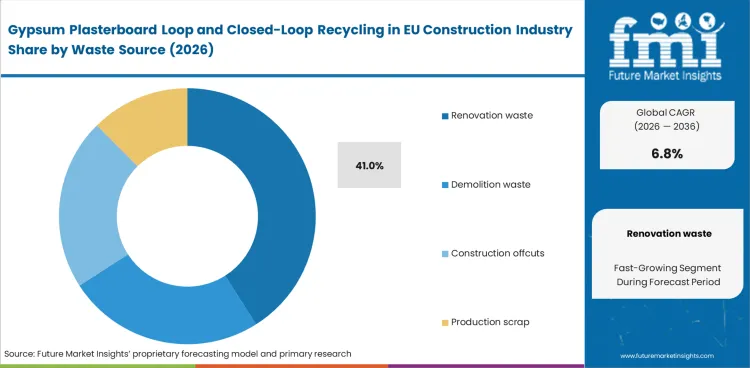
Recovery quality in plasterboard recycling often depends on how well material is protected during strip-out rather than on processing capacity alone. FMI’s analysis indicates renovation waste is expected to account for 41.0% share in 2026. Site teams regularly struggle to keep removed boards dry, and even limited moisture exposure can downgrade material before it reaches the recycler. Selective demolition for plasterboard recycling also requires extra labor, which can narrow the cost advantage of avoiding landfill disposal. Adhesive residue remains another common problem because it often pushes otherwise recoverable boards into lower-grade outlets. Modern waste management market can only run efficiently when incoming material meets tighter cleanliness standards. Weak on-site separation therefore reduces both recovery value and diversion performance.
- Moisture contamination risk: Covered storage needs to be in place as soon as boards are removed because wet material raises drying cost and disrupts crushing efficiency.
- Fastener extraction limits: Magnetic systems remove standard screws, but non-ferrous anchors can still raise wear and maintenance pressure in processing lines.
- Adhesive rejection thresholds: Backing paper with excessive glue often leads to direct downgrading at the recycling gate.
Gypsum Plasterboard Loop and Closed-Loop Recycling in EU Construction Industry Analysis by Recycling Route
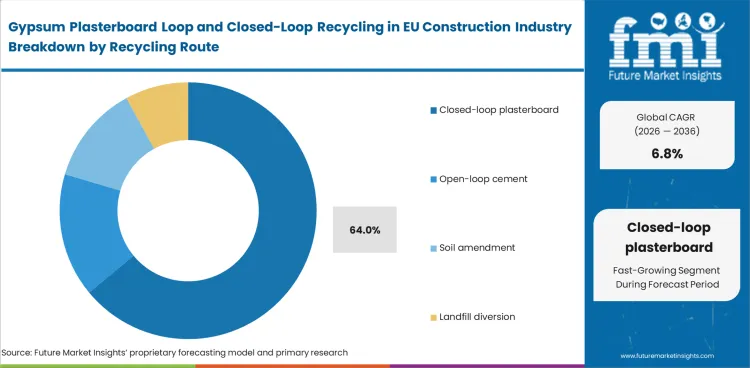
High-value recovery remains the preferred direction where technical substitution is achievable and policy pressure discourages lower-grade pathways. Closed-loop gypsum recycling is favored because board manufacturers need reprocessed powder that can match virgin calcination behavior with more consistency. Closed-loop plasterboard is anticipated to capture 64.0% share in 2026. This lead comes less from collection volume alone and more from stronger end-use fit in board manufacturing compared with lower-tier outlets. Open-loop channels still absorb material that falls outside strict quality thresholds, but they work more as a balancing route than a primary target. In markets where alternatives such as recycled concrete aggregates offer stronger outlet stability, lower-grade gypsum can move more easily. Closed-loop participation therefore depends heavily on certified processing links and dependable board-grade demand.
- Scale-dependent viability: Early landfill avoidance improves the economics, but equipment wear and contamination control can raise downstream costs quickly.
- Drying energy penalties: Moisture-heavy waste increases thermal load and can weaken the cost case for secondary gypsum use.
- Substitution premium extraction: Board-grade output usually offers better lifecycle value when quality can be maintained consistently.
Gypsum Plasterboard Loop and Closed-Loop Recycling in EU Construction Industry Analysis by End Use
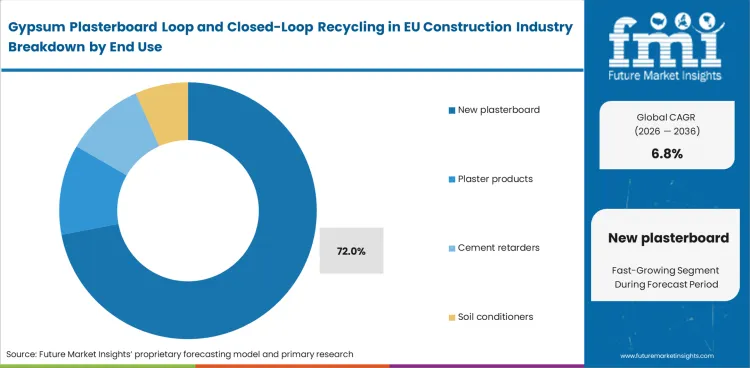
Using recovered gypsum in new board manufacturing requires tighter process control than many external uses. Recycled input changes water behavior during hydration, so formulation settings need more frequent adjustment on active production lines. Board manufacturers also face density management issues because higher recycled content can increase finished board weight and affect transport efficiency. New plasterboard is forecast to command 72.0% share in 2026. Kiln performance becomes more important as recycled content rises, especially where moisture variation remains high. Secondary gypsum can also move into joint compound & joint compound demand related applications, but those channels require different grinding profiles and binder systems. That makes end-use selection a technical decision rather than a simple volume shift.
- Drying zone calibration: Kiln settings must be adjusted carefully because poor control can lead to blistering or paper separation.
- Retarder chemical dosing: Additive levels often need revision when recycled gypsum changes hydration speed during board formation.
- Core density management: Continuous monitoring is necessary because heavier board can reduce square-meter output per truckload.
Gypsum Plasterboard Loop and Closed-Loop Recycling in EU Construction Industry Analysis by Collection Channel
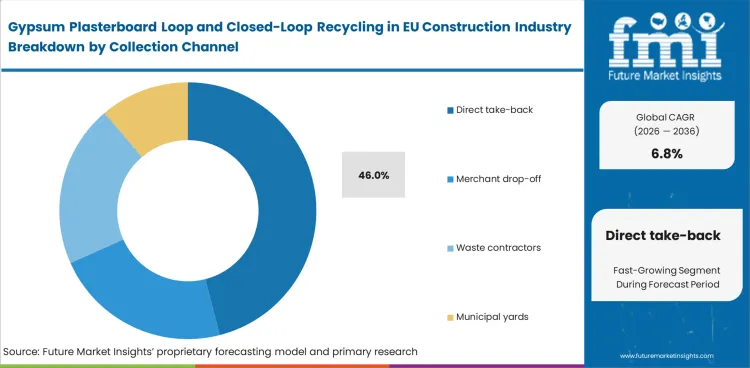
Collection purity often breaks down when plasterboard moves through general skip-hire systems before sorting. Direct take-back channels reduce that risk by linking waste collection more closely with the original board producer. Major drywall manufacturers use branded bags and return logistics to collect cleaner waste directly from larger contractor sites. This route works well because backhaul collection can use trucks already serving fresh board deliveries, which improves transport efficiency. FMI analysts note that direct take-back is poised to garner 46.0% share in 2026. Site contamination risk also falls when material avoids municipal transfer points. More localized integrated recycling hubs can strengthen this model further by shortening routes and improving consolidation control.
- Proprietary logistics networks: Manufacturer-led container systems support cleaner feedstock flow and better fit with in-house milling operations.
- Municipal routing limits: Direct pickups reduce weather exposure and avoid delay points that often damage stripped board quality.
- Consolidation landscapes: Regional contractor consolidation is likely to favor approved recycling networks over smaller unaffiliated waste handlers.
Gypsum Plasterboard Loop and Closed-Loop Recycling in EU Construction Industry Analysis by Board Type
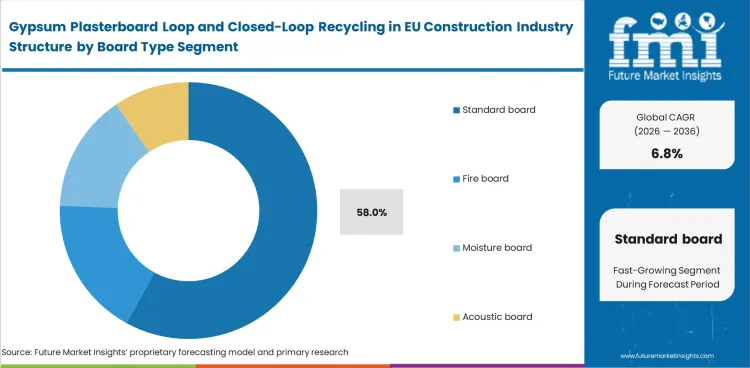
Processing strategy changes materially when recyclers move from standard plasterboard into more specialized board categories. Standard board remains easier to mill because it contains fewer additives and creates less disruption in downstream powder recovery. Fire-resistant, moisture-resistant, and acoustic products often need separate handling because glass fiber, silicone, and polymer content can interfere with ordinary recycling runs. Throughput also falls when mixed board types require repeated cleaning and process changeovers. Milling insulation boards introduces added contamination risk, while validating some insulation products can require separate chemical separation steps. FMI’s estimates indicate standard board is set to represent 58.0% share in 2026. That keeps standard board as the most operationally straightforward input stream for current recycling systems.
- Baseline volume aggregators: Standard board is usually sorted first because its simpler composition supports faster and more stable crusher throughput.
- Specialty board isolation: Segregating colored and additive-rich boards on site helps reduce rejection risk and protects recovered powder quality.
- Complex composite handlers: More advanced recyclers handle acoustic and foil-backed products later because those materials need specialized separation capability.
Gypsum Plasterboard Loop and Closed-Loop Recycling in EU Construction Industry Drivers, Restraints, and Opportunities
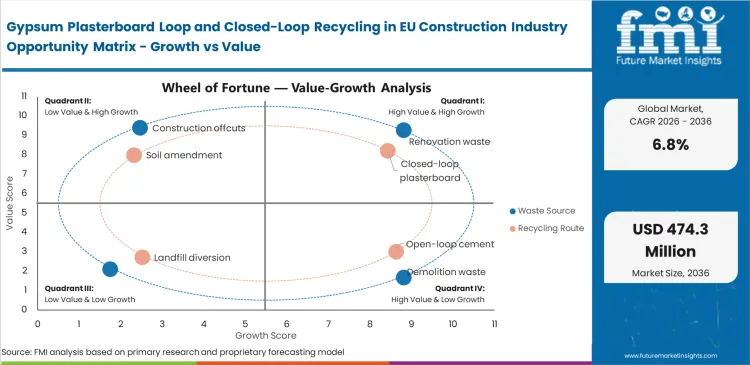
Landfill costs are pushing demolition contractors to divert plasterboard waste away from mixed disposal routes. As sorting fees and gate charges rise, on-site segregation becomes more important to protect project economics and maintain compliance with local diversion targets. This is increasing interest in dedicated collection routes that can preserve board quality and improve recovery value.
Geographic spread remains a clear restraint. Transporting low-density plasterboard waste over long distances can quickly undermine the economics of recovery, especially where local processing capacity is limited. Mobile units can reduce part of this burden, but they do not fully replace fixed plants where higher-purity closed-loop output is required.
Opportunities in the Gypsum Plasterboard Loop and Closed-Loop Recycling in EU Construction Industry
- Mobile separation: Compact screening units can improve transport efficiency by removing part of the paper fraction before haulage.
- Paper off-take: Securing local outlets for separated paper liner waste can improve plant economics and reduce disposal pressure.
- Automated quality control: Near-infrared scanning can help identify heavily contaminated loads before they enter the main processing line.
Regional Analysis
Based on regional analysis, gypsum plasterboard loop and closed-loop recycling in the EU construction industry is assessed within Europe, with country-level analysis focused on the key markets covered in this report.
.webp "Top Country Growth Comparison Gypsum Plasterboard Loop And Closed Loop Recycling In Eu Construction Industry Cagr (2026 2036)")
| Country | CAGR (2026 to 2036) |
|---|---|
| Netherlands | 7.6% |
| Germany | 7.4% |
| France | 7.2% |
| Spain | 7.1% |
| United Kingdom | 6.9% |
| Belgium | 6.7% |
| Denmark | 6.3% |
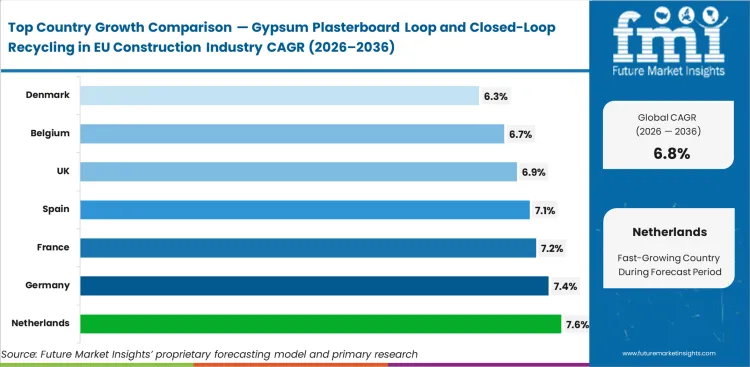
Source: Future Market Insights (FMI) analysis, based on proprietary forecasting model and primary research
Europe Gypsum Plasterboard Loop and Closed-Loop Recycling in EU Construction Industry Analysis
Europe is being shaped by extended producer responsibility, landfill restrictions, and wider circular construction targets that support plasterboard recovery. Local processing hubs remain central to market development because regions without nearby board production often struggle to secure viable off-take for recovered gypsum. As a result, the market tends to develop through local or national loops rather than broad cross-border trade in low-value waste streams.
- Netherlands: High disposal taxes and circular construction targets continue to support stricter source segregation of plasterboard waste. Demand in the Netherlands is anticipated to rise at a CAGR of 7.6% through 2036. Established links between recyclers and manufacturers improve off-take visibility and support continued investment in separation capacity.
- Germany: Strong domestic plasterboard production capacity creates a stable outlet for recycled gypsum. Demand in Germany is poised to expand at a CAGR of 7.4% during the forecast period. Integration between demolition firms, recyclers, and local board producers supports higher throughput and improves the practicality of closed-loop recovery.
- France: Policy support for circular construction and stronger recovery structures continue to improve the outlook for plasterboard recycling. Demand in France is expected to register a CAGR of 7.2% through 2036. The market benefits from closer alignment between recovery programs, green-building requirements, and board manufacturers seeking cleaner secondary inputs.
- Spain: Domestic board production and construction waste volumes support the case for stronger local recovery systems. Adoption in Spain is likely to advance at a CAGR of 7.1% by 2036. Better separation techniques and wider use of domestic secondary supply are likely to remain important to the market outlook.
- United Kingdom: Landfill tax pressure continues to support diversion away from traditional disposal routes. Volume across the UK plasterboard recycling segment is projected to witness 6.9% CAGR through 2036. The market remains supported by take-back programs, established waste contractor networks, and the need to secure cleaner feedstock for local recovery.
- Belgium: Dense urban construction activity and tighter disposal constraints continue to support circular recovery routes. Belgium is set to record a CAGR of 6.7% during the assessment period. The market benefits from relatively short haul distances, structured reporting requirements, and growing interest in closed-loop logistics.
- Denmark: Denmark is anticipated to see recovery volumes grow at a CAGR of 6.3% over the forecast period. Growth is likely to remain steadier than in less-developed markets because collection and processing networks are already relatively mature. The focus is shifting more toward efficiency improvement than basic capacity build-out.
FMI's report also considers additional European markets beyond these primary hubs. Across the region, commercial viability depends on how well local recycling capacity aligns with nearby demand from plasterboard manufacturing and related gypsum uses.
Competitive Aligners for Market Players
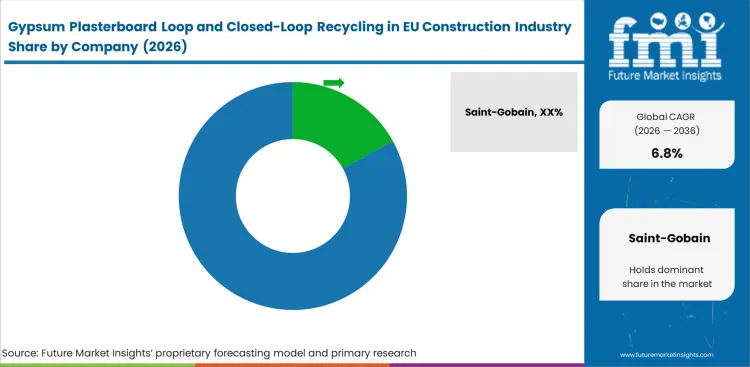
Competition in this market is shaped mainly by feedstock access, off-take reliability, and local transport economics. Long-term supply agreements with contractors and waste handlers remain important because clean and predictable volume often matters as much as processing capability. The sector also stays regional, since hauling costs place a natural limit on collection radius and plant profitability.
Established players benefit from existing off-take relationships with plasterboard manufacturers, which gives them an advantage in a market where quality validation takes time. New entrants need to prove that recycled gypsum can meet required purity and process standards without disrupting board production. Qualification periods therefore remain a real barrier to entry, especially where manufacturers can still choose between recycled, virgin, and synthetic gypsum sources.
Large manufacturers retain significant leverage because they can reject secondary material that falls outside specification. This keeps contamination control and consistency central to recycler economics. In response, some recyclers are moving closer to waste collection and demolition networks to secure cleaner input streams from the start.
Key Players in Gypsum Plasterboard Loop and Closed-Loop Recycling in EU Construction Industry
- Saint-Gobain
- Etex
- Knauf
- New West Gypsum Recycling
- Gypsum Recycling International
- Encore Environment
- REMONDIS
Scope of the Report
| Metric | Value |
|---|---|
| Quantitative Units | USD 230.0 million to USD 444.1 million, at a CAGR of 6.8% |
| Market Definition | This market covers the recovery, processing, and reintegration of discarded plasterboard into gypsum-specific recycling and manufacturing loops. |
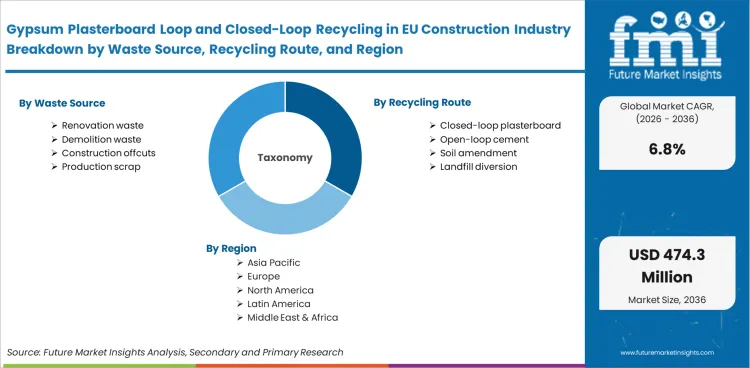
| Segmentation | Waste Source, Recycling Route, End Use, Collection Channel, Board Type, and Region |
| Regions Covered | Europe |
| Countries Covered | Netherlands, Germany, France, Spain, United Kingdom, Belgium, Denmark |
| Key Companies Profiled | Saint-Gobain, Etex, Knauf, New West Gypsum Recycling, Gypsum Recycling International, Encore Environment, REMONDIS |
| Forecast Period | 2026 to 2036 |
| Approach | The market estimate is based on recovery volumes, gate-fee dynamics, recycling yields, local transport economics, and demand from board manufacturers. |
Source: Future Market Insights (FMI) analysis, based on proprietary forecasting model and primary research
Gypsum Plasterboard Loop and Closed-Loop Recycling in EU Construction Industry Analysis by Segments
Waste Source
- Renovation waste
- Demolition waste
- Construction offcuts
- Production scrap
Recycling Route
- Closed-loop plasterboard
- Open-loop cement
- Soil amendment
- Landfill diversion
End Use
- New plasterboard
- Plaster products
- Cement retarders
- Soil conditioners
Collection Channel
- Direct take-back
- Merchant drop-off
- Waste contractors
- Municipal yards
Board Type
- Standard board
- Fire board
- Moisture board
- Acoustic board
Region
- Netherlands
- Germany
- France
- Spain
- United Kingdom
- Belgium
- Denmark
Bibliography
- Building Performance Institute Europe. (2024, June 20). Extended Producer Responsibility in the construction sector.
- Eurogypsum. (2024, March). Recycled Gypsum Quality Criteria (2024).
- Mhlanga, J., Osmani, M., & Shen, L. (2025, October 1). Circular economy business model opportunities, challenges and enablers for plasterboard. Sustainable Futures, 10, 100546.
- Morsali, S., Rakhshan, K., Osmani, M., & Massey, A. (2024, April 24). Life cycle assessment of plasterboard production: A UK case study. Sustainability, 16(9), 3564.
- Pérez-Gálvez, F., Solís-Guzmán, J., Marrero, M., & Llatas, C. (2025, September). Gypsum plasterboard waste as a raw material for the production of new eco-friendly plaster composites: the case of the Spanish industry. Results in Engineering, 26, 104672.
- Publications Office of the European Union. (2024, October 15). The EU Construction & Demolition Waste Management Protocol (2024 updated edition).
- Rodrigo-Bravo, A., Pavía, S., Calderón Carpintero, V., Cuenca-Romero, L. A., & Gutiérrez-González, S. (2025, April). Valorisation of gypsum boards with polyurethane waste to promote their circular economy. Resources, Conservation & Recycling Advances, 200240.
This bibliography is provided for reader reference. The full FMI report contains the complete reference list with primary source documentation.
This Report Addresses
- Margin risks demolition contractors face regarding mixed construction waste disposal penalties.
- Capacity thresholds dictating local profitability for regional plasterboard recycling hubs.
- Logistical advantages drywall manufacturers secure utilizing proprietary direct take-back channels.
- Contamination limits processing facilities enforce preventing silicone transfer from moisture boards.
- Calcination consistency required substituting recycled powder into virgin continuous production lines.
- Transport radius limitations capping geographic viability of centralized milling operations.
- Retarder chemical dosing adjustments necessary balancing accelerated hydration curves.
- Backhaul route optimization strategies improving fleet utilization during waste collection.
Frequently Asked Questions
What is closed-loop plasterboard recycling in Europe?
This practice involves recovering calcium sulfate from discarded wallboard and directly reintegrating it into new plasterboard manufacturing. This maintains material value entirely, unlike open-loop methods that downcycle the mineral into cement retarders or agricultural soil amendments.
How large is the EU gypsum plasterboard recycling market?
Valuation metrics place the sector at USD 230.0 million in 2026, advancing to USD 444.1 million by 2036. Reaching this threshold requires massive expansion of localized milling capacity near urban demolition centers across key member states.
Why is recycled gypsum becoming more important in EU construction?
Landfill taxes on high-sulfate waste force contractors to divert material, while green building certifications award points for secondary raw materials. Shrinking availability of synthetic desulfurization gypsum from coal plants accelerates this transition.
How much recycled gypsum can new plasterboard contain?
Facilities currently process formulations containing up to 30% recycled content safely. Higher recycled ratios alter board weight and hydration predictability, forcing formulation chemists to deploy expensive chemical retarder additives to maintain stable setting times.
Which companies lead gypsum recycling in Europe?
Key operators shaping processing capacity include New West Gypsum Recycling, Gypsum Recycling International, and Encore Environment. Massive wallboard producers like Saint-Gobain, Etex, and Knauf dictate the off-take standards these recyclers must meet.
What is the difference between open-loop and closed-loop gypsum recycling?
Open-loop routes divert processed powder into secondary industries like cement manufacturing or agriculture at lower price points. Closed-loop processing returns the material exclusively to drywall manufacturing, capturing premium pricing but demanding near-perfect paper separation.
How do take-back schemes support plasterboard recycling?
Manufacturer-branded bags bypass municipal transfer stations entirely. Maintaining direct chain of custody prevents cross-contamination from other demolition rubble, yielding pristine feedstock perfectly calibrated for the manufacturer's own milling facilities.
Which EU countries are advancing fastest in plasterboard recycling?
Netherlands leads expansion at 7.6% CAGR due to aggressive circularity quotas and tight landfill constraints. Germany, France, and Spain follow closely, supported by massive domestic board production capacity requiring localized raw material inputs.
What regulations support gypsum recycling in construction?
Extended producer responsibility mandates force manufacturers to fund recovery logistics directly. Landfill bans on sulfate-bearing waste prevent cheap disposal, while national circular economy targets mandate specific percentages of recycled material in new public buildings.
Why is selective demolition important for plasterboard recovery?
Strip-out projects isolating clean boards immediately prevent moisture absorption and rubble cross-contamination. Saturated or heavily mixed loads clog recycling crushers instantly, forcing operators to reject shipments and pass severe disposal penalties back to the contractor.
Why is plasterboard waste hard to recycle?
Paper liners bound to the gypsum core resist mechanical separation. If extraction equipment leaves more than 1% paper fluff in the final powder, the organic residue disrupts the curing phase during new plasterboard production.
How is plasterboard recycled in Europe?
Facilities crush incoming boards using specialized rotary screens that separate the brittle gypsum core from the flexible paper backing. The core undergoes fine milling into pure powder, while the extracted paper requires separate diversion to biomass energy plants.
Is recycled gypsum replacing virgin gypsum in EU plasterboard?
Manufacturers utilize secondary powder aggressively to offset volatile virgin import costs and declining synthetic gypsum supplies. The replacement ratio depends entirely on local recycler capacity and strict adherence to calcination purity profiles.
What limits open-loop cement applications?
Cement producers pay significantly less per ton than board manufacturers. Recyclers utilizing open-loop routes struggle covering high collection and haulage costs without securing premium board-grade pricing agreements.
Why are acoustic boards difficult to process?
Viscoelastic damping polymers sandwiched between specialized acoustic boards melt under mechanical friction. Melted polymers coat crushing hammers, forcing operators into expensive, time-consuming manual cleaning protocols.
How does geographic distance cap profitability?
Hauling low-density wallboard beyond 200 kilometers erodes margins completely. Transport costs exceed recovered powder value rapidly, mandating localized processing hubs over centralized mega-facilities for sustainable operations.
What prevents new entrants establishing recycling hubs?
Manufacturers require months of continuous validation testing before accepting powder from unproven facilities. Challengers struggle surviving financially during extensive qualification periods without guaranteed off-take revenue streams.
Why do magnetic separators fail ensuring total purity?
Magnets capture standard steel drywall screws reliably but miss specialized non-ferrous anchors or plastic toggle bolts. Trace plastic contaminants melt inside calcination kilns, ruining entire production batches instantly.
How do joint ventures protect recycling margins?
Recyclers partnering directly with major demolition firms like REMONDIS secure exclusive access to concentrated volume. Vertical integration guarantees steady feedstock while locking competitors out of prime urban demolition contracts.
What role do near-infrared sensors play?
Automated scanning identifies backing paper contamination instantly on active conveyor belts. Quality controllers reject heavily glued or contaminated boards before they enter primary crushers, protecting downstream purity.
Why does Germany generate massive secondary demand?
Deep domestic plasterboard production infrastructure creates continuous appetite for raw materials. Massive factory footprints require thousands of tons daily, absorbing local recycled output effortlessly into continuous manufacturing lines.
What happens to separated backing paper?
Recyclers must secure off-take agreements supplying local biomass energy plants or secondary fiber markets. Failing to monetize paper waste creates massive storage bottlenecks, crippling overall facility throughput and profitability.
Why do silicone contaminants ruin production lines?
Trace silicone from moisture-resistant green boards alters water absorption profiles unpredictably. Subsequent standard boards manufactured using contaminated powder fail basic quality assurance adhesion tests during finishing phases.
How do transport managers optimize fleet emissions?
Logistics coordinators use trucks delivering fresh boards returning with waste bags. Maximizing vehicle backhaul utilization reduces empty miles, lowering overall transport carbon footprint while securing continuous feedstock supply.
Preview the report firsthand - request a free sample
Get SampleGet the brochure for pricing and purchase details.
Get PDFTable of Content
- Executive Summary
- Global Market Outlook
- Demand-side Trends
- Supply-side Trends
- Technology Roadmap Analysis
- Analysis and Recommendations
- Market Overview
- Market Coverage / Taxonomy
- Market Definition / Scope / Limitations
- Research Methodology
- Chapter Orientation
- Analytical Lens and Working Hypotheses
- Market Structure, Signals, and Trend Drivers
- Benchmarking and Cross-market Comparability
- Market Sizing, Forecasting, and Opportunity Mapping
- Research Design and Evidence Framework
- Desk Research Programme (Secondary Evidence)
- Company Annual and Sustainability Reports
- Peer-reviewed Journals and Academic Literature
- Corporate Websites, Product Literature, and Technical Notes
- Earnings Decks and Investor Briefings
- Statutory Filings and Regulatory Disclosures
- Technical White Papers and Standards Notes
- Trade Journals, Industry Magazines, and Analyst Briefs
- Conference Proceedings, Webinars, and Seminar Materials
- Government Statistics Portals and Public Data Releases
- Press Releases and Reputable Media Coverage
- Specialist Newsletters and Curated Briefings
- Sector Databases and Reference Repositories
- FMI Internal Proprietary Databases and Historical Market Datasets
- Subscription Datasets and Paid Sources
- Social Channels, Communities, and Digital Listening Inputs
- Additional Desk Sources
- Expert Input and Fieldwork (Primary Evidence)
- Primary Modes
- Qualitative Interviews and Expert Elicitation
- Quantitative Surveys and Structured Data Capture
- Blended Approach
- Why Primary Evidence is Used
- Field Techniques
- Interviews
- Surveys
- Focus Groups
- Observational and In-context Research
- Social and Community Interactions
- Stakeholder Universe Engaged
- C-suite Leaders
- Board Members
- Presidents and Vice Presidents
- R&D and Innovation Heads
- Technical Specialists
- Domain Subject-matter Experts
- Scientists
- Physicians and Other Healthcare Professionals
- Governance, Ethics, and Data Stewardship
- Research Ethics
- Data Integrity and Handling
- Primary Modes
- Tooling, Models, and Reference Databases
- Desk Research Programme (Secondary Evidence)
- Data Engineering and Model Build
- Data Acquisition and Ingestion
- Cleaning, Normalisation, and Verification
- Synthesis, Triangulation, and Analysis
- Quality Assurance and Audit Trail
- Market Background
- Market Dynamics
- Drivers
- Restraints
- Opportunity
- Trends
- Scenario Forecast
- Demand in Optimistic Scenario
- Demand in Likely Scenario
- Demand in Conservative Scenario
- Opportunity Map Analysis
- Product Life Cycle Analysis
- Supply Chain Analysis
- Investment Feasibility Matrix
- Value Chain Analysis
- PESTLE and Porter’s Analysis
- Regulatory Landscape
- Regional Parent Market Outlook
- Production and Consumption Statistics
- Import and Export Statistics
- Market Dynamics
- Global Market Analysis 2021 to 2025 and Forecast, 2026 to 2036
- Historical Market Size Value (USD Million) Analysis, 2021 to 2025
- Current and Future Market Size Value (USD Million) Projections, 2026 to 2036
- Y-o-Y Growth Trend Analysis
- Absolute $ Opportunity Analysis
- Global Market Pricing Analysis 2021 to 2025 and Forecast 2026 to 2036
- Global Market Analysis 2021 to 2025 and Forecast 2026 to 2036, By Waste Source
- Introduction / Key Findings
- Historical Market Size Value (USD Million) Analysis By Waste Source , 2021 to 2025
- Current and Future Market Size Value (USD Million) Analysis and Forecast By Waste Source , 2026 to 2036
- Renovation waste
- Demolition waste
- Construction offcuts
- Production scrap
- Renovation waste
- Y-o-Y Growth Trend Analysis By Waste Source , 2021 to 2025
- Absolute $ Opportunity Analysis By Waste Source , 2026 to 2036
- Global Market Analysis 2021 to 2025 and Forecast 2026 to 2036, By Recycling Route
- Introduction / Key Findings
- Historical Market Size Value (USD Million) Analysis By Recycling Route, 2021 to 2025
- Current and Future Market Size Value (USD Million) Analysis and Forecast By Recycling Route, 2026 to 2036
- Closed-loop plasterboard
- Open-loop cement
- Soil amendment
- Landfill diversion
- Closed-loop plasterboard
- Y-o-Y Growth Trend Analysis By Recycling Route, 2021 to 2025
- Absolute $ Opportunity Analysis By Recycling Route, 2026 to 2036
- Global Market Analysis 2021 to 2025 and Forecast 2026 to 2036, By End Use
- Introduction / Key Findings
- Historical Market Size Value (USD Million) Analysis By End Use, 2021 to 2025
- Current and Future Market Size Value (USD Million) Analysis and Forecast By End Use, 2026 to 2036
- New plasterboard
- Plaster products
- Cement retarders
- Soil conditioners
- New plasterboard
- Y-o-Y Growth Trend Analysis By End Use, 2021 to 2025
- Absolute $ Opportunity Analysis By End Use, 2026 to 2036
- Global Market Analysis 2021 to 2025 and Forecast 2026 to 2036, By Collection Channel
- Introduction / Key Findings
- Historical Market Size Value (USD Million) Analysis By Collection Channel, 2021 to 2025
- Current and Future Market Size Value (USD Million) Analysis and Forecast By Collection Channel, 2026 to 2036
- Direct take-back
- Merchant drop-off
- Waste contractors
- Municipal yards
- Direct take-back
- Y-o-Y Growth Trend Analysis By Collection Channel, 2021 to 2025
- Absolute $ Opportunity Analysis By Collection Channel, 2026 to 2036
- Global Market Analysis 2021 to 2025 and Forecast 2026 to 2036, By Board Type
- Introduction / Key Findings
- Historical Market Size Value (USD Million) Analysis By Board Type, 2021 to 2025
- Current and Future Market Size Value (USD Million) Analysis and Forecast By Board Type, 2026 to 2036
- Standard board
- Fire board
- Moisture board
- Acoustic board
- Standard board
- Y-o-Y Growth Trend Analysis By Board Type, 2021 to 2025
- Absolute $ Opportunity Analysis By Board Type, 2026 to 2036
- Global Market Analysis 2021 to 2025 and Forecast 2026 to 2036, By Region
- Introduction
- Historical Market Size Value (USD Million) Analysis By Region, 2021 to 2025
- Current Market Size Value (USD Million) Analysis and Forecast By Region, 2026 to 2036
- North America
- Latin America
- Western Europe
- Eastern Europe
- East Asia
- South Asia and Pacific
- Middle East & Africa
- Market Attractiveness Analysis By Region
- North America Market Analysis 2021 to 2025 and Forecast 2026 to 2036, By Country
- Historical Market Size Value (USD Million) Trend Analysis By Market Taxonomy, 2021 to 2025
- Market Size Value (USD Million) Forecast By Market Taxonomy, 2026 to 2036
- By Country
- USA
- Canada
- Mexico
- By Waste Source
- By Recycling Route
- By End Use
- By Collection Channel
- By Board Type
- By Country
- Market Attractiveness Analysis
- By Country
- By Waste Source
- By Recycling Route
- By End Use
- By Collection Channel
- By Board Type
- Key Takeaways
- Latin America Market Analysis 2021 to 2025 and Forecast 2026 to 2036, By Country
- Historical Market Size Value (USD Million) Trend Analysis By Market Taxonomy, 2021 to 2025
- Market Size Value (USD Million) Forecast By Market Taxonomy, 2026 to 2036
- By Country
- Brazil
- Chile
- Rest of Latin America
- By Waste Source
- By Recycling Route
- By End Use
- By Collection Channel
- By Board Type
- By Country
- Market Attractiveness Analysis
- By Country
- By Waste Source
- By Recycling Route
- By End Use
- By Collection Channel
- By Board Type
- Key Takeaways
- Western Europe Market Analysis 2021 to 2025 and Forecast 2026 to 2036, By Country
- Historical Market Size Value (USD Million) Trend Analysis By Market Taxonomy, 2021 to 2025
- Market Size Value (USD Million) Forecast By Market Taxonomy, 2026 to 2036
- By Country
- Germany
- UK
- Italy
- Spain
- France
- Nordic
- BENELUX
- Rest of Western Europe
- By Waste Source
- By Recycling Route
- By End Use
- By Collection Channel
- By Board Type
- By Country
- Market Attractiveness Analysis
- By Country
- By Waste Source
- By Recycling Route
- By End Use
- By Collection Channel
- By Board Type
- Key Takeaways
- Eastern Europe Market Analysis 2021 to 2025 and Forecast 2026 to 2036, By Country
- Historical Market Size Value (USD Million) Trend Analysis By Market Taxonomy, 2021 to 2025
- Market Size Value (USD Million) Forecast By Market Taxonomy, 2026 to 2036
- By Country
- Russia
- Poland
- Hungary
- Balkan & Baltic
- Rest of Eastern Europe
- By Waste Source
- By Recycling Route
- By End Use
- By Collection Channel
- By Board Type
- By Country
- Market Attractiveness Analysis
- By Country
- By Waste Source
- By Recycling Route
- By End Use
- By Collection Channel
- By Board Type
- Key Takeaways
- East Asia Market Analysis 2021 to 2025 and Forecast 2026 to 2036, By Country
- Historical Market Size Value (USD Million) Trend Analysis By Market Taxonomy, 2021 to 2025
- Market Size Value (USD Million) Forecast By Market Taxonomy, 2026 to 2036
- By Country
- China
- Japan
- South Korea
- By Waste Source
- By Recycling Route
- By End Use
- By Collection Channel
- By Board Type
- By Country
- Market Attractiveness Analysis
- By Country
- By Waste Source
- By Recycling Route
- By End Use
- By Collection Channel
- By Board Type
- Key Takeaways
- South Asia and Pacific Market Analysis 2021 to 2025 and Forecast 2026 to 2036, By Country
- Historical Market Size Value (USD Million) Trend Analysis By Market Taxonomy, 2021 to 2025
- Market Size Value (USD Million) Forecast By Market Taxonomy, 2026 to 2036
- By Country
- India
- ASEAN
- Australia & New Zealand
- Rest of South Asia and Pacific
- By Waste Source
- By Recycling Route
- By End Use
- By Collection Channel
- By Board Type
- By Country
- Market Attractiveness Analysis
- By Country
- By Waste Source
- By Recycling Route
- By End Use
- By Collection Channel
- By Board Type
- Key Takeaways
- Middle East & Africa Market Analysis 2021 to 2025 and Forecast 2026 to 2036, By Country
- Historical Market Size Value (USD Million) Trend Analysis By Market Taxonomy, 2021 to 2025
- Market Size Value (USD Million) Forecast By Market Taxonomy, 2026 to 2036
- By Country
- Kingdom of Saudi Arabia
- Other GCC Countries
- Turkiye
- South Africa
- Other African Union
- Rest of Middle East & Africa
- By Waste Source
- By Recycling Route
- By End Use
- By Collection Channel
- By Board Type
- By Country
- Market Attractiveness Analysis
- By Country
- By Waste Source
- By Recycling Route
- By End Use
- By Collection Channel
- By Board Type
- Key Takeaways
- Key Countries Market Analysis
- USA
- Pricing Analysis
- Market Share Analysis, 2025
- By Waste Source
- By Recycling Route
- By End Use
- By Collection Channel
- By Board Type
- Canada
- Pricing Analysis
- Market Share Analysis, 2025
- By Waste Source
- By Recycling Route
- By End Use
- By Collection Channel
- By Board Type
- Mexico
- Pricing Analysis
- Market Share Analysis, 2025
- By Waste Source
- By Recycling Route
- By End Use
- By Collection Channel
- By Board Type
- Brazil
- Pricing Analysis
- Market Share Analysis, 2025
- By Waste Source
- By Recycling Route
- By End Use
- By Collection Channel
- By Board Type
- Chile
- Pricing Analysis
- Market Share Analysis, 2025
- By Waste Source
- By Recycling Route
- By End Use
- By Collection Channel
- By Board Type
- Germany
- Pricing Analysis
- Market Share Analysis, 2025
- By Waste Source
- By Recycling Route
- By End Use
- By Collection Channel
- By Board Type
- UK
- Pricing Analysis
- Market Share Analysis, 2025
- By Waste Source
- By Recycling Route
- By End Use
- By Collection Channel
- By Board Type
- Italy
- Pricing Analysis
- Market Share Analysis, 2025
- By Waste Source
- By Recycling Route
- By End Use
- By Collection Channel
- By Board Type
- Spain
- Pricing Analysis
- Market Share Analysis, 2025
- By Waste Source
- By Recycling Route
- By End Use
- By Collection Channel
- By Board Type
- France
- Pricing Analysis
- Market Share Analysis, 2025
- By Waste Source
- By Recycling Route
- By End Use
- By Collection Channel
- By Board Type
- India
- Pricing Analysis
- Market Share Analysis, 2025
- By Waste Source
- By Recycling Route
- By End Use
- By Collection Channel
- By Board Type
- ASEAN
- Pricing Analysis
- Market Share Analysis, 2025
- By Waste Source
- By Recycling Route
- By End Use
- By Collection Channel
- By Board Type
- Australia & New Zealand
- Pricing Analysis
- Market Share Analysis, 2025
- By Waste Source
- By Recycling Route
- By End Use
- By Collection Channel
- By Board Type
- China
- Pricing Analysis
- Market Share Analysis, 2025
- By Waste Source
- By Recycling Route
- By End Use
- By Collection Channel
- By Board Type
- Japan
- Pricing Analysis
- Market Share Analysis, 2025
- By Waste Source
- By Recycling Route
- By End Use
- By Collection Channel
- By Board Type
- South Korea
- Pricing Analysis
- Market Share Analysis, 2025
- By Waste Source
- By Recycling Route
- By End Use
- By Collection Channel
- By Board Type
- Russia
- Pricing Analysis
- Market Share Analysis, 2025
- By Waste Source
- By Recycling Route
- By End Use
- By Collection Channel
- By Board Type
- Poland
- Pricing Analysis
- Market Share Analysis, 2025
- By Waste Source
- By Recycling Route
- By End Use
- By Collection Channel
- By Board Type
- Hungary
- Pricing Analysis
- Market Share Analysis, 2025
- By Waste Source
- By Recycling Route
- By End Use
- By Collection Channel
- By Board Type
- Kingdom of Saudi Arabia
- Pricing Analysis
- Market Share Analysis, 2025
- By Waste Source
- By Recycling Route
- By End Use
- By Collection Channel
- By Board Type
- Turkiye
- Pricing Analysis
- Market Share Analysis, 2025
- By Waste Source
- By Recycling Route
- By End Use
- By Collection Channel
- By Board Type
- South Africa
- Pricing Analysis
- Market Share Analysis, 2025
- By Waste Source
- By Recycling Route
- By End Use
- By Collection Channel
- By Board Type
- USA
- Market Structure Analysis
- Competition Dashboard
- Competition Benchmarking
- Market Share Analysis of Top Players
- By Regional
- By Waste Source
- By Recycling Route
- By End Use
- By Collection Channel
- By Board Type
- Competition Analysis
- Competition Deep Dive
- Saint-Gobain
- Overview
- Product Portfolio
- Profitability by Market Segments (Product/Age /Sales Channel/Region)
- Sales Footprint
- Strategy Overview
- Marketing Strategy
- Product Strategy
- Channel Strategy
- Etex
- Knauf
- New West Gypsum Recycling
- Gypsum Recycling International
- Encore Environment
- REMONDIS
- Saint-Gobain
- Competition Deep Dive
- Assumptions & Acronyms Used


