

- Market Size (2026)
- USD 1.2 Bn
- Forecast (2036)
- USD 3.8 Bn
- CAGR (2026 to 2036)
- 12.2%
Prefabricated Building Element Deconstruction and Component Reuse Industry in Europe Size, Forecast and Outlook By FMI
Prefabricated building element deconstruction and component reuse industry in Europe was valued at USD 1.0 billion in 2025. Sector is predicted to reach a value of USD 1.2 billion in 2026 and is likely to grow at a CAGR of 12.2% from 2026 to 2036. Industry value is set to surpass the valuation of USD 3.8 billion by 2036 as building owners and redevelopment contractors move recoverable elements out of mixed demolition streams. Planned reuse channels are taking a larger role than conventional salvage work.
Summary of Prefabricated Building Element Deconstruction and Component Reuse Industry in Europe
- Prefabricated building element deconstruction and component reuse industry in Europe is expected to reach USD 3.8 billion by 2036.
- Market growth is pegged at a 12.2% CAGR from 2026 to 2036.
- Industry value was around USD 1.0 billion in 2025.
- Market size is estimated to cross USD 1.2 billion in 2026.
- Wall panels are expected to account for 24.0% share in 2026.
- In 2026, concrete is projected to contribute 31.0% of total market share.
- Renovation projects are anticipated to represent 37.0% of the market in 2026 because reused prefabricated components fit upgrade work more readily.
- The Netherlands records the fastest growth through 2036 in this market.
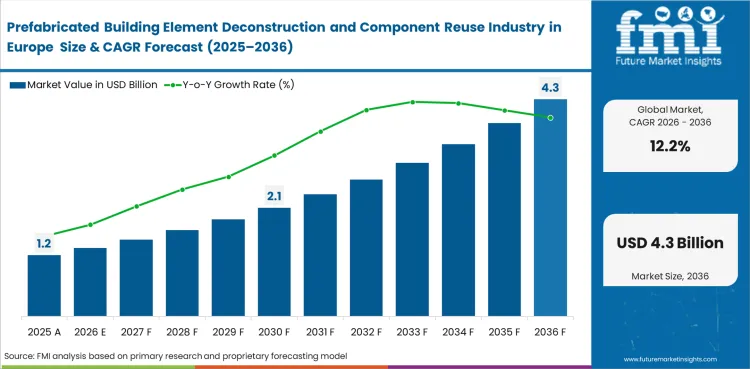
Key Takeaways, Market Size, and Forecast
- The market was valued at USD 1.0 billion in 2025.
- It is projected to reach USD 3.8 billion by 2036.
- The industry is expected to grow at a CAGR of 12.2% from 2026 to 2036.
- Market size is estimated at USD 1.2 billion in 2026.
- The Netherlands is the fastest-growing country in this market.
Prefabricated Building Element Deconstruction and Component Reuse Industry in Europe Key Takeaways
| Parameter | Details |
|---|---|
| Market value (2026) | USD 1.2 billion |
| Forecast value (2036) | USD 3.8 billion |
| CAGR (2026 to 2036) | 12.20% |
| Estimated market value (2025) | USD 1.0 billion |
| Incremental opportunity | USD 2.62 billion |
| Leading component type | Wall panels |
| Leading material type | Concrete |
| Leading building type | Residential |
| Leading reuse pathway | Refurbished reuse |
| Key companies profiled | Algeco, Adapteo, Portakabin, Neptunus, Rotor Deconstruction, Concular |
Source: Future Market Insights (FMI) analysis, based on proprietary forecasting model and primary research
Project planning in this market is more deliberate. Disposal once served as the default outcome after a structure entered stripping stage. Current project reviews focus on whether wall panels and façade units can be removed with enough condition value intact for a second use cycle. Reuse economics are often decided early in that process. Value erosion starts quickly once components are costed and handled as waste. Closer alignment with modular construction workflows supports more organized component recirculation.
Commercial appeal alone does not create a viable reuse market. Pre-deconstruction audits and condition records must align with removal planning and a clear buyer route for reclaimed stock. Project teams can evaluate removed elements as reusable inputs once that threshold is met. Timing and placement then matter more than residual waste logic.
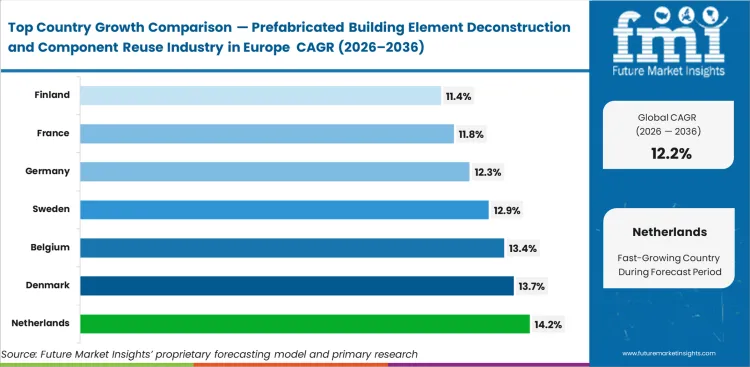
The Netherlands is projected to witness a CAGR of 14.2% in the market through 2036, supported by mature circular-building programs and stronger commercial routes for reclaimed elements. Denmark is expected to expand at 13.7% CAGR, backed by disciplined deconstruction practice and wider project acceptance of reusable modules. Belgium is likely to record 13.4% CAGR, while Sweden is set to post 12.9% CAGR. Germany is anticipated to grow at 12.3% CAGR, compared with 11.8% CAGR for France and 11.4% CAGR for Finland, where reuse competes directly with broad construction waste handling routes.
Polymer Relief Is Not Flowing Through Paper Packaging Plastic Protection
Packaging cost matters most in the European prefabricated building element deconstruction and component reuse industry. The strongest current cost signal is not dependent on raw-material price volatility alone. It has become the added compliance burden on packaging formats that rely heavily on plastic. PackUK’s 2025 base-fee schedule puts plastic at £423 per tonne, far above paper and card at £196, glass at £192, aluminium at £266, and steel at £259. HMRC then shows the Plastic Packaging Tax rising from £217.85 per tonne from 1 April 2024 to £223.69 per tonne from 1 April 2025 for packaging that falls below the recycled-content threshold. For reuse operators, the commercial answer is straightforward: keep plastic where moisture, abrasion, or breakage risk is real, but strip it out of lower-risk outer protection wherever paper-based or reusable alternatives can do the job.
Segmental Analysis
Key Facts About Segments
- Wall panels account for 24.0% of component type demand in 2026. Recovery economics often begin with components that can be removed intact and placed again with less redesign burden on the receiving project.
- Concrete is likely to secure 31.0% share in 2026 by material type. A deep base of precast structures across Europe keeps concrete central to recovery pilots and secondary supply channels.
- Residential buildings are set to make up 29.0% of the market in 2026. Repeated layouts and housing renewal cycles make reclaimed prefabricated elements easier to remap into active work packages.
- Refurbished reuse is forecast to account for 34.0% share in 2026. Cleaning and dimensional checks often decide whether a recovered component becomes a usable product or difficult stock.
- Market estimates place selective dismantling at 46.0% share in 2026. Reuse retains value only when connectors and surfaces are preserved during removal.
- Share contribution from renovation projects is expected to reach 37.0% in 2026. Reused elements gain traction here because they can support lower-carbon upgrades and shorter project timelines.
Prefabricated Building Element Deconstruction and Component Reuse Industry in Europe Analysis by Component Type
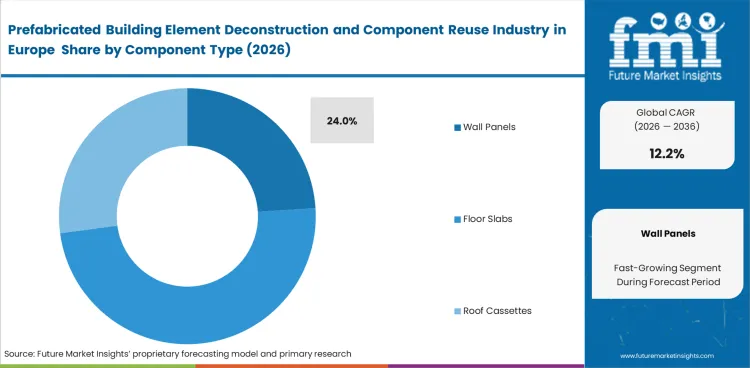
Wall panels are projected to emerge with 24.0% market share in 2026 because recovery economics begins with components that can be removed intact and placed again with limited disruption. Panels appear in large numbers across prefabricated stock and offer a workable balance between lifting effort and storage practicality. Contractors favor components that can be measured and matched to a receiving project without major redesign. Traceability loss or strip-out breakage can push reuse value down quickly.
- Rigging ease: Panels that can be removed with predictable rigging time are easier to schedule, price, and move into resale channels.
- Geometry fit: Repeated dimensions help designers and contractors match reclaimed stock to new openings without long redesign cycles.
- Damage exposure: Cracked edges and missing documentation can push an otherwise usable panel into a lower-value outlet.
Prefabricated Building Element Deconstruction and Component Reuse Industry in Europe Analysis by Material Type
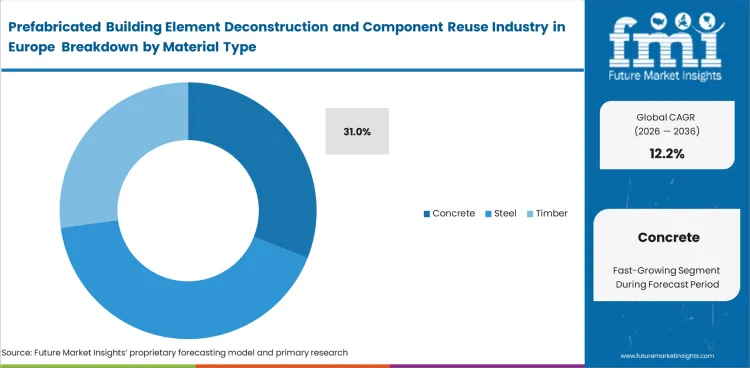
Installed stock matters more than theory in this segment. Strong reuse pathways usually follow the material that exists in meaningful recoverable volume. Concrete represents 31.0% of the market in 2026 because Europe has a deep base of precast structures that can feed reuse pilots and refurbishment work. Transport cost and testing burden shape material choice at the same time. Concrete leads because installed base gives it the clearest commercial route into repeat recovery activity.
- Installed base: Large volumes of existing precast stock create a steadier pipeline for recovery and reuse work.
- Testing burden: Material condition must be clear enough for buyers to accept reused elements without lengthy dispute.
- Fallback value: When direct reuse is not workable, concrete-linked recovery routes preserve part of the site value chain.
Prefabricated Building Element Deconstruction and Component Reuse Industry in Europe Analysis by Building Type
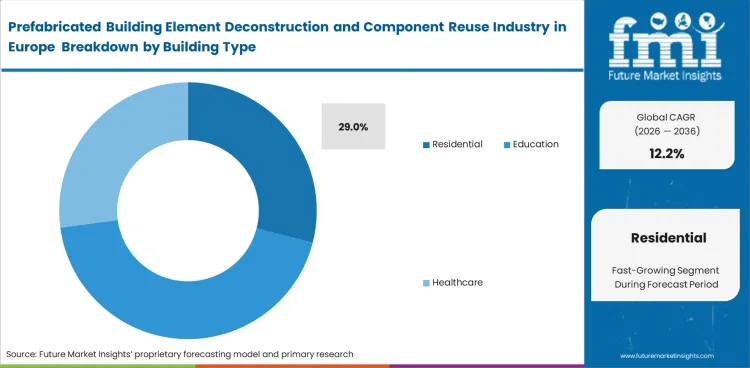
Housing-led refurbishment keeps this segment in front because repeated layouts and phased upgrade cycles create a workable fit for reclaimed prefabricated elements. Apartment renewal and social housing upgrades can absorb reused wall and façade elements at practical volumes when condition records are clear. Residential buildings secure 29.0% share in 2026 for that reason. Commercial assets move more slowly because fit-out demands and approval routes vary more widely.
- Repeat layouts: Similar room and envelope patterns make reused elements easier to remap into new work packages.
- Refit speed: Housing programs often reward products that shorten enclosure or upgrade time on occupied assets.
- Approval timing: Narrow site windows can delay projects even when reclaimed supply is technically suitable.
Prefabricated Building Element Deconstruction and Component Reuse Industry in Europe Analysis by Reuse Pathway
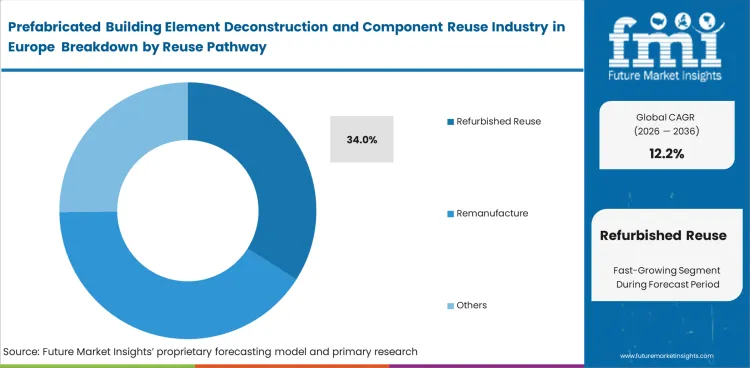
Project teams rarely want a raw removed component dropped straight onto a new site because condition and installation readiness are often uncertain. Direct reuse can work when recovery conditions are unusually clean and buyer matching is quick. Refurbished reuse stays ahead because it gives suppliers a broader buyer pool and a clearer answer to performance questions. Refurbished reuse makes up 34.0% of the market in 2026 because cleaning and repair often determine whether a salvage item becomes usable stock.
- Condition recovery: Small repairs often decide whether a component returns to construction use or drops into disposal.
- Buyer confidence: Cleaned and checked stock is easier to specify than elements sold with open condition questions.
- Placement readiness: Refurbishment reduces on-site correction work after delivery and improves acceptance at receipt.
Prefabricated Building Element Deconstruction and Component Reuse Industry in Europe Analysis by Deconstruction Method
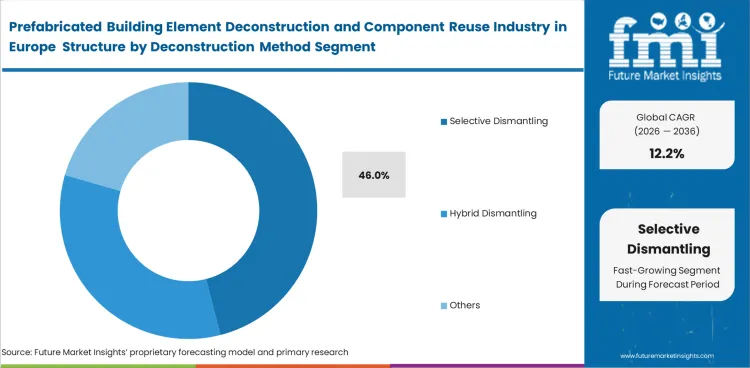
Method choice decides value retention before a component even leaves the building because connectors and surfaces can be lost quickly under rough removal. Manual and hybrid approaches appear on many projects, but the leading method is the one that protects resale value. Selective dismantling accounts for 46.0% share in 2026 because it preserves the physical condition needed for second-life placement more consistently than break-out methods. Fast removal can save labor hours on paper and destroy the resale case at the same time.
- Value protection: Controlled removal keeps connectors, edges, and surfaces in a more usable condition.
- Sequence planning: Dismantling order affects whether modules leave site intact or require repair before resale.
- Margin leakage: Fast break-out methods can save labor time while erasing the resale case.
Prefabricated Building Element Deconstruction and Component Reuse Industry in Europe Analysis by End Use
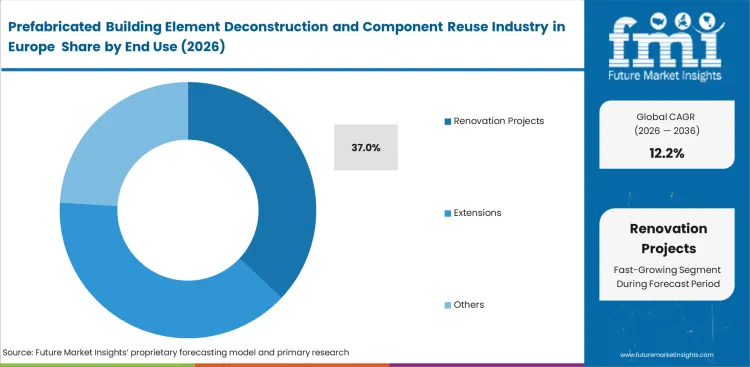
Renovation projects sit at the center of demand because practical carbon savings and shorter delivery windows matter at the same time. Envelope upgrades and classroom expansion can draw from recovered stock when fit and condition remain clear. Reused elements compete against new systems on timing as much as on material logic. Renovation projects contribute 37.0% of total market share in 2026 because upgrade work can use reclaimed components without full replacement.
- Programme pressure: Refurbishment-led projects often reward components that cut purchase and enclosure time.
- Carbon case: Reused stock helps owners show material savings in projects facing emissions scrutiny.
- Specification risk: Ambiguous fit or approval language can push buyers back toward fully new supply.
Drivers, Restraints, and Opportunities for Prefabricated Building Element Deconstruction and Component Reuse Industry in Europe
European redevelopment work increasingly treats recoverability as a project input instead of an afterthought. Procurement teams want lower embodied carbon and faster site turnaround. Reclaimed prefabricated elements answer that need when condition and placement can be managed with discipline. Retrofit work around façade and enclosure systems adds further overlap with reuse decisions.
Missing documentation is the main restraint. A removed panel may look sound but fail to resale if drawings and connection details are unclear. Approval and pricing are both slow under those conditions. Transport adds another burden because bulky elements lose margin quickly when donor and receiving sites are poorly matched. Reuse works best when audit and storage are planned as one sequence.
Opportunities
- Municipal renovation pipelines create repeat demand for reclaimed stock where public housing and civic assets favor lower-carbon upgrades with tighter budget control.
- Connection-ready systems improve the recovery route. Dry joints and accessible fixings make dismantling more predictable and reduce damage during removal.
- Digital matching tools can reduce idle stock time when donor assets and project demand are connected through usable condition data.
Regional Analysis
Key Facts About Country
- Demand for prefabricated building element deconstruction and component reuse in the Netherlands is expected to rise at a CAGR of 14.2% through 2036.
- Denmark is projected to record a CAGR of 13.7% in prefabricated building element deconstruction and component reuse during the forecast period as offsite building familiarity improves acceptance of reusable modules.
- Sales of prefabricated building element deconstruction and component reuse in Belgium are likely to increase at a CAGR of 13.4% through 2036.
- Prefabricated building element deconstruction and component reuse adoption across Sweden is anticipated to grow at 12.9% CAGR during the study period.
- Germany is forecast to post 12.3% CAGR in the prefabricated building element deconstruction and component reuse market through 2036.
- The market for prefabricated building element deconstruction and component reuse in France is set to expand at a CAGR of 11.8% over the assessment period as timing between recovery and placement shapes project economics.
- Prefabricated building element deconstruction and component reuse demand across Finland is projected to increase at 11.4% CAGR by 2036.
Based on the regional analysis, the Prefabricated Building Element Deconstruction and Component Reuse Industry in Europe is segmented into Western Europe, Northern Europe, and Central Europe across 40 plus countries.
.webp "Top Country Growth Comparison Prefabricated Building Element Deconstruction And Component Reuse Industry In Europe Cagr (2026 2036)")
| Country | CAGR (2026 to 2036) |
|---|---|
| Netherlands | 14.2% |
| Denmark | 13.7% |
| Belgium | 13.4% |
| Sweden | 12.9% |
| Germany | 12.3% |
| France | 11.8% |
| Finland | 11.4% |
Source: Future Market Insights (FMI) analysis, based on proprietary forecasting model and primary research
Western Europe Prefabricated Building Element Deconstruction and Component Reuse Industry in Europe Analysis
Western Europe provides a clear near-term projection for this industry because reuse decisions enter refurbishment and redevelopment work earlier in the project cycle. Project teams in this region compare recovered stock against standard replacement routes more readily than many other regions. Commercial progress depends on condition checks and resale timing being aligned before dismantling starts. Reuse gains traction when those steps are managed as one coordinated plan.
- Netherlands: Market growth for prefabricated building element deconstruction and component reuse in the Netherlands is expected to run at a CAGR of 14.2% during the forecast period. Early-stage building review gives the country a practical lead because reusable elements are identified before demolition plans to narrow the available options. Better matching between donor stock and receiving projects reduces handling loss and storage time.
- Belgium: Urban redevelopment propels industry in Belgium as recovered components can move into nearby projects without long transport loops. Belgium is expected to register 13.4% CAGR in prefabricated building element deconstruction and component reuse through 2036. Clear condition records help reclaimed stock reach the next site with less friction. Weak technical documentation can delay acceptance.
- France: France benefits from a broad renovation base even though the path from dismantled element to approved reuse often takes longer than expected. Timing matters because delays between recovery and placement weaken the commercial case. Demand in France posts an expected CAGR of 11.8% during the assessment period when fit and handling sequence are settled before material leaves the donor asset.
FMI’s report covers Spain and Italy along with Austria and Switzerland. Wider regional progress depends on resale channels that can absorb reclaimed stock without long project gaps.
Northern Europe Prefabricated Building Element Deconstruction and Component Reuse Industry in Europe Analysis
Northern Europe industry has a practical advantage because industrialized building methods are already familiar across housing and public buildings. Project teams judge reused elements on fit and project timing more readily than many other regions do. Reclaimed supply has a clearer route into the next committed job under those conditions.
- Denmark: Denmark is set to post 13.7% CAGR in the market for prefabricated building element deconstruction and component reuse during the assessment period. Familiarity with offsite building methods gives reused components a workable setting when dismantling plans and replacement needs are aligned from the start. Clear condition records keep confidence higher.
- Sweden: Industrialized housing methods support second-life elements in Sweden where project formats stay predictable. Through 2036, prefabricated building element deconstruction and component reuse sales in Sweden are expected to grow at a CAGR of 12.9%. Storage periods and site handling must stay controlled because long idle time weakens the commercial case quickly.
- Finland: Prefabricated building element deconstruction and component reuse demand in Finland is likely to expand at 11.4% CAGR during the forecast period. Technical familiarity with precast systems supports the market even with a smaller construction base. Clean dimensional records matter because mismatch can interrupt project sequencing.
FMI’s report includes Norway and Ireland beyond the named group. Reuse moves better across that wider set when industrialized building habits are backed by cleaner documentation and practical sales channels.
Central Europe Prefabricated Building Element Deconstruction and Component Reuse Industry in Europe Analysis
Central Europe brings scale and donor-building depth along with a broad construction base. Recovery becomes harder when resale access and project timing do not keep pace with available material. Scale alone does not convert into organized reuse.
- Germany: By 2036, Germany is expected to post 12.3% CAGR in the prefabricated building element deconstruction and component reuse market. Germany offers donor-building scale and technical familiarity with precast systems. Approval discipline stays high, so fit and documentation need to be held under review.
Competitive Aligners for Market Players
Reuse and modular recovery are fragmented. No single participant controls donor identification and technical recovery in one integrated chain. Project teams apply straightforward evaluation criteria around inspection protocol and end-use suitability. Operators with modular inventories and refurbishment processes start from a practical advantage.
Incumbent suppliers hold their position when they can combine condition assessment and relocation planning within one commercial offer. Smaller specialists can compete when donor-asset understanding, or inspection speed is better. Portakabin is relevant where modular inventory and reconfiguration speed matter. Rotor Deconstruction is more influential where early identification of reusable material determines recovery success.
Buyer power is high because reclaimed components can lack verification and installation certainty. Purchasing decisions therefore prioritize reliability and documentation of quality over broad sustainability claims. Reuse activity is moving away from opportunistic recovery and toward a managed supply category. Participants that coordinate sequencing and quality validation across multiple sites are in a stronger position.
Key Players
- Algeco
- Adapteo
- Portakabin
- Neptunus
- Rotor Deconstruction
- Concular
Scope of the Report
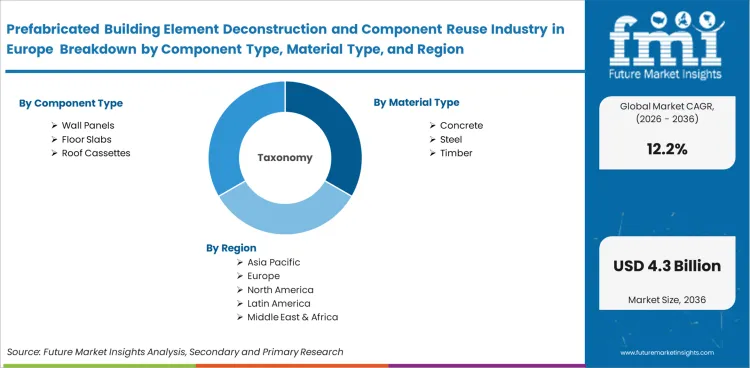
| Metric | Value |
|---|---|
| Quantitative Units | USD 1.2 billion to USD 3.8 billion, at a CAGR of 12.20% |
| Market Definition | Selective deconstruction, qualification, refurbishment, resale, and reuse of prefabricated building elements and modular components across Europe. |
| Component Type Segmentation | Wall panels, Floor slabs, Roof cassettes, Facade units, Stair modules, Bathroom pods, Steel frames, Service modules |
| Material Type Segmentation | Concrete, Steel, Timber, Aluminium, Glass, Gypsum, Hybrid composites |
| Building Type Segmentation | Residential, Education, Healthcare, Offices, Industrial, Hospitality, Public buildings |
| Reuse Pathway Segmentation | Refurbished reuse, Direct reuse, Remanufacture, Parts harvesting, Material recycling |
| Deconstruction Method Segmentation | Selective dismantling, Hybrid dismantling, Manual strip-out, Mechanical lift-out, Robotic cutting |
| End Use Segmentation | Renovation projects, New build, Extensions, Temporary buildings, Social housing, Public facilities |
| Regions Covered | Western Europe, Northern Europe, Central Europe |
| Countries Covered | Netherlands, Denmark, Belgium, Sweden, Germany, France, Finland, and 40 plus countries |
| Key Companies Profiled | Algeco, Adapteo, Portakabin, Neptunus, Rotor Deconstruction, Concular |
Source: Future Market Insights (FMI) analysis, based on proprietary forecasting model and primary research
Prefabricated Building Element Deconstruction and Component Reuse Industry in Europe Analysis by Segments
Component Type
- Wall panels
- Floor slabs
- Roof cassettes
- Facade units
- Stair modules
- Bathroom pods
- Steel frames
- Service modules
Material Type
- Concrete
- Steel
- Timber
- Aluminium
- Glass
- Gypsum
- Hybrid composites
Building Type
- Residential
- Education
- Healthcare
- Offices
- Industrial
- Hospitality
- Public buildings
Reuse Pathway
- Refurbished reuse
- Direct reuse
- Remanufacture
- Parts harvesting
- Material recycling
Deconstruction Method
- Selective dismantling
- Hybrid dismantling
- Manual strip-out
- Mechanical lift-out
- Robotic cutting
End Use
- Renovation projects
- New build
- Extensions
- Temporary buildings
- Social housing
- Public facilities
Region
- Western Europe
- Germany
- France
- Netherlands
- Belgium
- Austria
- Switzerland
- Luxembourg
- Northern Europe
- Denmark
- Sweden
- Norway
- Finland
- Ireland
- Iceland
- Southern Europe
- Italy
- Spain
- Portugal
- Greece
- Malta
- Cyprus
- Eastern Europe
- Poland
- Czech Republic
- Hungary
- Romania
- Slovakia
- Bulgaria
- Croatia
- Slovenia
- Estonia
- Latvia
- Lithuania
Bibliography
- PackUK. (2025, June 30). Extended Producer Responsibility for Packaging: 2025 base fees.
- HM Revenue & Customs. (2026, February 12). Plastic Packaging Tax: steps to take.
- Svatikova, K., Brown, A., & Börkey, P. (2025, February). Economic instruments for a resource-efficient circular economy.
- Ostapska, K., Rüther, P., Loli, A., & Gradeci, K. (2024, July). Design for Disassembly: A systematic scoping review and analysis of built structures Designed for Disassembly. Sustainable Production and Consumption, 48, 407-430.
- Riuttala, M., Harala, L., Aarikka-Stenroos, L., & Huuhka, S. (2024, March 1). How building component reuse creates economic value: Identifying value capture determinants from a case study. Journal of Cleaner Production, 443, 141112.
- Walsh, S. J., & Shotton, E. (2024, September 6). Integrating Design for Adaptability, Disassembly, and Reuse into Architectural Design Practice. Sustainability, 16(17), 7771.
- Haakonsen, S. M., Tomczak, A., Izumi, B., & Luczkowski, M. (2024, February 27). Automation of circular design: A timber building case study. International Journal of Architectural Computing, 22(3).
- Harsunen, P., Uotila, U., Joensuu, T., & Saari, A. (2025, April 24). Deconstruction of a prefabricated concrete building designed for disassembly-cost comparison of deconstruction and demolition. Environmental Research: Infrastructure and Sustainability, 5, 025005.
- Al-Najjar, A., Malmqvist, T., Stenberg, E., & Höjer, M. (2025). Stock, flow and reuse potential of precast concrete in Swedish residential buildings: Embodied carbon assessment. Resources, Conservation and Recycling, 218, 108229.
- Westerlind, H., Hernández Vargas, J., & Stenberg, E. (2025, May 12). Sourcing and designing with reused precast concrete elements: The ReCreate H22 pilot. In Structures and Architecture (pp. 961-969). CRC Press.
- Sivers, M., & Fivet, C. (2025). Reuse Market Dynamics: Unlocking Building-Component Reuse in European Construction. IOP Conference Series: Earth and Environmental Science, 1554(1), 012019.
- Küpfer, C. M., & Fivet, C. (2024, June 27). Structural component reuse of precast and cast-in-place reinforced concrete in architecture since the late 1960s in Europe. In Proceedings of the 8th International Congress on Construction History (Construction Matters). EPFL Infoscience.
- Construct Innovate. (2024, February). Design for Manufacture and Assembly with Design for Reuse.
This bibliography is provided for reader reference. The full FMI report contains the complete reference list with primary source documentation.
This Report Addresses
- Market intelligence to support strategic decision making across wall panels, floor slabs, façade units, stair modules, bathroom pods, and service modules.
- Market size estimation and 10-year forecasts from 2026 to 2036, supported by donor-building recovery logic, reuse pathway analysis, and Europe-specific circular construction assumptions.
- Growth opportunity mapping across Component Type, Material Type, Building Type, Reuse Pathway, Deconstruction Method, End Use, and Region with emphasis on audit-ready secondary supply.
- Segment and regional forecasts covering wall panels, concrete elements, residential buildings, refurbished reuse, selective dismantling, and renovation projects across key European countries.
- Competition assessment including condition verification, refurbishment readiness, logistics control, digital matching, and project-level delivery reliability.
- Reuse pathway tracking across direct reuse, refurbishment, remanufacture, parts harvesting, and material recycling where value retention depends on timing and component condition.
- Market access analysis covering public renovation programs, social housing upgrades, donor-building recovery, reuse platforms, and contractor-led recirculation models.
- Market report delivery in PDF, Excel, PPT, and interactive dashboard formats for executive planning, circular construction strategy, and operational benchmarking use.
Frequently Asked Questions
How large is the prefabricated building element deconstruction and component reuse industry in Europe in 2026?
FMI estimates the industry at USD 1.2 billion in 2026.
What value is projected for 2036?
Market valuation is expected to reach USD 3.8 billion by 2036.
What CAGR is projected for the forecast period?
Demand is forecast to expand at a 12.20% CAGR from 2026 to 2036.
Which component type leads the segment structure?
Wall panels are expected to make up 24.0% of segment demand in 2026 because they are easier to recover and place back into modular and panelized projects.
Which material type remains the most prominent?
Concrete should represent 31.0% of total market share in 2026 due to the large installed base of precast elements across Europe.
Which building type contributes the largest share?
Residential applications are expected to account for 29.0% of the market in 2026, driven by sustained housing retrofit activity and circular renovation initiatives across Europe.
Which reuse pathway leads the market?
Refurbished reuse is poised to represent 34.0% share in 2026 because many recovered elements need cleaning, testing, and repair before redeployment.
Which deconstruction method is expected to dominate?
In 2026, market share for selective dismantling is expected to reach 46.0% since reusable components lose value quickly under conventional demolition.
Which connection type is most relevant for reuse economics?
Bolted systems are forecast to represent 28.0% of market demand in 2026 because reversible joints simplify disassembly and second-life installation.
Which end use leads demand?
By 2026, renovation projects are likely to contribute 37.0% of total demand as low-carbon upgrades keep drawing attention in the European building stock.
Which sales channel holds the largest portion of activity?
Direct contractor channels are forecast to represent 33.0% of market demand in 2026 because reuse decisions are handled mainly at project level.
What is driving growth in reused prefab components across Europe?
Growth is being supported by selective deconstruction, embodied-carbon pressure, and wider interest in circular building systems that keep usable elements in service.
What is the main restraint affecting reuse of prefabricated elements?
Incomplete donor-building records, uneven product standards, and logistics cost slow wider commercial use.
Which country is expected to grow the fastest?
The Netherlands is likely to see prefabricated building element deconstruction and component reuse advance at a CAGR of 14.2% through 2036.
How does Denmark compare in the country outlook?
Country growth in Denmark is projected to record a CAGR of 13.7% in this market during the forecast period as circular construction thinking moves into more organized project execution.
What supports growth in Belgium?
Belgium should record 13.4% CAGR in prefabricated building element deconstruction and component reuse through the study period as reclaimed-component activity becomes more organized.
How is Sweden positioned in this report?
Prefabricated building element deconstruction and component reuse adoption in Sweden is poised to grow at a CAGR of 12.9% through 2036.
What outlook is estimated for Germany?
A CAGR of 12.3% is expected for prefabricated building element deconstruction and component reuse in Germany through 2036, supported by its large construction base though standardization takes time.
How is France expected to perform?
Market growth for prefabricated building element deconstruction and component reuse in France is expected to run at a CAGR of 11.8% during the forecast period as circular renovation gains ground.
What does the report project for Finland?
Finland is expected to register 11.4% CAGR in prefabricated building element deconstruction and component reuse through 2036.
What does this study include within scope?
Scope covers reusable prefabricated elements, deconstruction services, qualification work, refurbishment activity, and organized resale or redeployment.
What is excluded from the scope?
Mixed rubble processing, bulk aggregate recycling, and generic waste hauling are outside scope because they do not preserve building elements for second-life use.
Which companies are identified as key participants?
Algeco, Adapteo, Portakabin, Neptunus, Rotor Deconstruction, and Concular are among the companies covered in the report.
What is the main commercial insight behind this market?
Real momentum builds when recovered elements can move through testing, handling, and redeployment without losing too much time or value inside the project cycle.
Preview the report firsthand - request a free sample
Get SampleGet the brochure for pricing and purchase details.
Get PDFTable of Content
- Executive Summary
- Global Market Outlook
- Demand-side Trends
- Supply-side Trends
- Analysis and Recommendations
- Market Overview
- Market Coverage / Taxonomy
- Market Definition / Scope / Limitations
- Research Methodology
- Chapter Orientation
- Analytical Lens and Working Hypotheses
- Market Structure, Signals, and Trend Drivers
- Benchmarking and Cross-market Comparability
- Market Sizing, Forecasting, and Opportunity Mapping
- Desk Research Programme (Secondary Evidence)
- Company Annual and Sustainability Reports
- Peer-reviewed Journals and Academic Literature
- Corporate Websites, Product Literature, and Technical Notes
- Earnings Decks and Investor Briefings
- Statutory Filings and Regulatory Disclosures
- Technical White Papers and Standards Notes
- Trade Journals, Industry Magazines, and Analyst Briefs
- Conference Proceedings, Webinars, and Seminar Materials
- Government Statistics Portals and Public Data Releases
- Press Releases and Reputable Media Coverage
- Specialist Newsletters and Curated Briefings
- Sector Databases and Reference Repositories
- FMI Internal Proprietary Databases and Historical Market Datasets
- Subscription Datasets and Paid Sources
- Social Channels, Communities, and Digital Listening Inputs
- Additional Desk Sources
- Expert Input and Fieldwork (Primary Evidence)
- Primary Modes
- Qualitative Interviews and Expert Elicitation
- Quantitative Surveys and Structured Data Capture
- Why Primary Evidence is Used
- Field Techniques
- Interviews
- Surveys
- Focus Groups
- Observational and In-context Research
- Social and Community Interactions
- Stakeholder Universe Engaged
- C-suite Leaders
- Board Members
- Presidents and Vice Presidents
- R&D and Innovation Heads
- Technical Specialists
- Domain Subject-matter Experts
- Scientists
- Physicians and Other Healthcare Professionals
- Governance, Ethics, and Data Stewardship
- Research Ethics
- Data Integrity and Handling
- Tooling, Models, and Reference Databases
- Primary Modes
- Data Engineering and Model Build
- Data Acquisition and Ingestion
- Cleaning, Normalisation, and Verification
- Synthesis, Triangulation, and Analysis
- Quality Assurance and Audit Trail
- Market Background
- Market Dynamics
- Drivers
- Restraints
- Opportunity
- Trends
- Scenario Forecast
- Demand in Optimistic Scenario
- Demand in Likely Scenario
- Demand in Conservative Scenario
- Opportunity Map Analysis
- Product Life Cycle Analysis
- Supply Chain Analysis
- Investment Feasibility Matrix
- Value Chain Analysis
- PESTLE and Porter’s Analysis
- Regulatory Landscape
- Regional Parent Market Outlook
- Market Dynamics
- Global Market Analysis 2021 to 2025 and Forecast, 2026 to 2036
- Historical Market Size Value (USD Million) Analysis, 2021 to 2025
- Current and Future Market Size Value (USD Million) Projections, 2026 to 2036
- Y-o-Y Growth Trend Analysis
- Absolute $ Opportunity Analysis
- Global Market Pricing Analysis 2021 to 2025 and Forecast 2026 to 2036
- Global Market Analysis 2021 to 2025 and Forecast 2026 to 2036, By Component Type
- Introduction / Key Findings
- Historical Market Size Value (USD Million) Analysis By Component Type , 2021 to 2025
- Current and Future Market Size Value (USD Million) Analysis and Forecast By Component Type , 2026 to 2036
- Wall Panels
- Floor Slabs
- Roof Cassettes
- Wall Panels
- Y-o-Y Growth Trend Analysis By Component Type , 2021 to 2025
- Absolute $ Opportunity Analysis By Component Type , 2026 to 2036
- Global Market Analysis 2021 to 2025 and Forecast 2026 to 2036, By Material Type
- Introduction / Key Findings
- Historical Market Size Value (USD Million) Analysis By Material Type, 2021 to 2025
- Current and Future Market Size Value (USD Million) Analysis and Forecast By Material Type, 2026 to 2036
- Concrete
- Steel
- Timber
- Concrete
- Y-o-Y Growth Trend Analysis By Material Type, 2021 to 2025
- Absolute $ Opportunity Analysis By Material Type, 2026 to 2036
- Global Market Analysis 2021 to 2025 and Forecast 2026 to 2036, By Building Type
- Introduction / Key Findings
- Historical Market Size Value (USD Million) Analysis By Building Type, 2021 to 2025
- Current and Future Market Size Value (USD Million) Analysis and Forecast By Building Type, 2026 to 2036
- Residential
- Education
- Healthcare
- Residential
- Y-o-Y Growth Trend Analysis By Building Type, 2021 to 2025
- Absolute $ Opportunity Analysis By Building Type, 2026 to 2036
- Global Market Analysis 2021 to 2025 and Forecast 2026 to 2036, By Reuse Pathway
- Introduction / Key Findings
- Historical Market Size Value (USD Million) Analysis By Reuse Pathway, 2021 to 2025
- Current and Future Market Size Value (USD Million) Analysis and Forecast By Reuse Pathway, 2026 to 2036
- Refurbished Reuse
- Remanufacture
- Others
- Refurbished Reuse
- Y-o-Y Growth Trend Analysis By Reuse Pathway, 2021 to 2025
- Absolute $ Opportunity Analysis By Reuse Pathway, 2026 to 2036
- Global Market Analysis 2021 to 2025 and Forecast 2026 to 2036, By Deconstruction Method
- Introduction / Key Findings
- Historical Market Size Value (USD Million) Analysis By Deconstruction Method, 2021 to 2025
- Current and Future Market Size Value (USD Million) Analysis and Forecast By Deconstruction Method, 2026 to 2036
- Selective Dismantling
- Hybrid Dismantling
- Others
- Y-o-Y Growth Trend Analysis By Deconstruction Method, 2021 to 2025
- Absolute $ Opportunity Analysis By Deconstruction Method, 2026 to 2036
- Selective Dismantling
- Global Market Analysis 2021 to 2025 and Forecast 2026 to 2036, By End Use
- Introduction / Key Findings
- Historical Market Size Value (USD Million) Analysis By End Use, 2021 to 2025
- Current and Future Market Size Value (USD Million) Analysis and Forecast By End Use, 2026 to 2036
- Renovation Projects
- Extensions
- Others
- Renovation Projects
- Y-o-Y Growth Trend Analysis By End Use, 2021 to 2025
- Absolute $ Opportunity Analysis By End Use, 2026 to 2036
- Global Market Analysis 2021 to 2025 and Forecast 2026 to 2036, By Region
- Introduction
- Historical Market Size Value (USD Million) Analysis By Region, 2021 to 2025
- Current Market Size Value (USD Million) Analysis and Forecast By Region, 2026 to 2036
- North America
- Latin America
- Western Europe
- Eastern Europe
- East Asia
- South Asia and Pacific
- Middle East & Africa
- Market Attractiveness Analysis By Region
- North America Market Analysis 2021 to 2025 and Forecast 2026 to 2036, By Country
- Historical Market Size Value (USD Million) Trend Analysis By Market Taxonomy, 2021 to 2025
- Market Size Value (USD Million) Forecast By Market Taxonomy, 2026 to 2036
- By Country
- USA
- Canada
- Mexico
- By Component Type
- By Material Type
- By Building Type
- By Reuse Pathway
- By Deconstruction Method
- By End Use
- By Country
- Market Attractiveness Analysis
- By Country
- By Component Type
- By Material Type
- By Building Type
- By Reuse Pathway
- By Deconstruction Method
- By End Use
- Key Takeaways
- Latin America Market Analysis 2021 to 2025 and Forecast 2026 to 2036, By Country
- Historical Market Size Value (USD Million) Trend Analysis By Market Taxonomy, 2021 to 2025
- Market Size Value (USD Million) Forecast By Market Taxonomy, 2026 to 2036
- By Country
- Brazil
- Chile
- Rest of Latin America
- By Component Type
- By Material Type
- By Building Type
- By Reuse Pathway
- By Deconstruction Method
- By End Use
- By Country
- Market Attractiveness Analysis
- By Country
- By Component Type
- By Material Type
- By Building Type
- By Reuse Pathway
- By Deconstruction Method
- By End Use
- Key Takeaways
- Western Europe Market Analysis 2021 to 2025 and Forecast 2026 to 2036, By Country
- Historical Market Size Value (USD Million) Trend Analysis By Market Taxonomy, 2021 to 2025
- Market Size Value (USD Million) Forecast By Market Taxonomy, 2026 to 2036
- By Country
- Germany
- UK
- Italy
- Spain
- France
- Nordic
- BENELUX
- Rest of Western Europe
- By Component Type
- By Material Type
- By Building Type
- By Reuse Pathway
- By Deconstruction Method
- By End Use
- By Country
- Market Attractiveness Analysis
- By Country
- By Component Type
- By Material Type
- By Building Type
- By Reuse Pathway
- By Deconstruction Method
- By End Use
- Key Takeaways
- Eastern Europe Market Analysis 2021 to 2025 and Forecast 2026 to 2036, By Country
- Historical Market Size Value (USD Million) Trend Analysis By Market Taxonomy, 2021 to 2025
- Market Size Value (USD Million) Forecast By Market Taxonomy, 2026 to 2036
- By Country
- Russia
- Poland
- Hungary
- Balkan & Baltic
- Rest of Eastern Europe
- By Component Type
- By Material Type
- By Building Type
- By Reuse Pathway
- By Deconstruction Method
- By End Use
- By Country
- Market Attractiveness Analysis
- By Country
- By Component Type
- By Material Type
- By Building Type
- By Reuse Pathway
- By Deconstruction Method
- By End Use
- Key Takeaways
- East Asia Market Analysis 2021 to 2025 and Forecast 2026 to 2036, By Country
- Historical Market Size Value (USD Million) Trend Analysis By Market Taxonomy, 2021 to 2025
- Market Size Value (USD Million) Forecast By Market Taxonomy, 2026 to 2036
- By Country
- China
- Japan
- South Korea
- By Component Type
- By Material Type
- By Building Type
- By Reuse Pathway
- By Deconstruction Method
- By End Use
- By Country
- Market Attractiveness Analysis
- By Country
- By Component Type
- By Material Type
- By Building Type
- By Reuse Pathway
- By Deconstruction Method
- By End Use
- Key Takeaways
- South Asia and Pacific Market Analysis 2021 to 2025 and Forecast 2026 to 2036, By Country
- Historical Market Size Value (USD Million) Trend Analysis By Market Taxonomy, 2021 to 2025
- Market Size Value (USD Million) Forecast By Market Taxonomy, 2026 to 2036
- By Country
- India
- ASEAN
- Australia & New Zealand
- Rest of South Asia and Pacific
- By Component Type
- By Material Type
- By Building Type
- By Reuse Pathway
- By Deconstruction Method
- By End Use
- By Country
- Market Attractiveness Analysis
- By Country
- By Component Type
- By Material Type
- By Building Type
- By Reuse Pathway
- By Deconstruction Method
- By End Use
- Key Takeaways
- Middle East & Africa Market Analysis 2021 to 2025 and Forecast 2026 to 2036, By Country
- Historical Market Size Value (USD Million) Trend Analysis By Market Taxonomy, 2021 to 2025
- Market Size Value (USD Million) Forecast By Market Taxonomy, 2026 to 2036
- By Country
- Kingdom of Saudi Arabia
- Other GCC Countries
- Turkiye
- South Africa
- Other African Union
- Rest of Middle East & Africa
- By Component Type
- By Material Type
- By Building Type
- By Reuse Pathway
- By Deconstruction Method
- By End Use
- By Country
- Market Attractiveness Analysis
- By Country
- By Component Type
- By Material Type
- By Building Type
- By Reuse Pathway
- By Deconstruction Method
- By End Use
- Key Takeaways
- Key Countries Market Analysis
- USA
- Pricing Analysis
- Market Share Analysis, 2025
- By Component Type
- By Material Type
- By Building Type
- By Reuse Pathway
- By Deconstruction Method
- By End Use
- Canada
- Pricing Analysis
- Market Share Analysis, 2025
- By Component Type
- By Material Type
- By Building Type
- By Reuse Pathway
- By Deconstruction Method
- By End Use
- Mexico
- Pricing Analysis
- Market Share Analysis, 2025
- By Component Type
- By Material Type
- By Building Type
- By Reuse Pathway
- By Deconstruction Method
- By End Use
- Brazil
- Pricing Analysis
- Market Share Analysis, 2025
- By Component Type
- By Material Type
- By Building Type
- By Reuse Pathway
- By Deconstruction Method
- By End Use
- Chile
- Pricing Analysis
- Market Share Analysis, 2025
- By Component Type
- By Material Type
- By Building Type
- By Reuse Pathway
- By Deconstruction Method
- By End Use
- Germany
- Pricing Analysis
- Market Share Analysis, 2025
- By Component Type
- By Material Type
- By Building Type
- By Reuse Pathway
- By Deconstruction Method
- By End Use
- UK
- Pricing Analysis
- Market Share Analysis, 2025
- By Component Type
- By Material Type
- By Building Type
- By Reuse Pathway
- By Deconstruction Method
- By End Use
- Italy
- Pricing Analysis
- Market Share Analysis, 2025
- By Component Type
- By Material Type
- By Building Type
- By Reuse Pathway
- By Deconstruction Method
- By End Use
- Spain
- Pricing Analysis
- Market Share Analysis, 2025
- By Component Type
- By Material Type
- By Building Type
- By Reuse Pathway
- By Deconstruction Method
- By End Use
- France
- Pricing Analysis
- Market Share Analysis, 2025
- By Component Type
- By Material Type
- By Building Type
- By Reuse Pathway
- By Deconstruction Method
- By End Use
- India
- Pricing Analysis
- Market Share Analysis, 2025
- By Component Type
- By Material Type
- By Building Type
- By Reuse Pathway
- By Deconstruction Method
- By End Use
- ASEAN
- Pricing Analysis
- Market Share Analysis, 2025
- By Component Type
- By Material Type
- By Building Type
- By Reuse Pathway
- By Deconstruction Method
- By End Use
- Australia & New Zealand
- Pricing Analysis
- Market Share Analysis, 2025
- By Component Type
- By Material Type
- By Building Type
- By Reuse Pathway
- By Deconstruction Method
- By End Use
- China
- Pricing Analysis
- Market Share Analysis, 2025
- By Component Type
- By Material Type
- By Building Type
- By Reuse Pathway
- By Deconstruction Method
- By End Use
- Japan
- Pricing Analysis
- Market Share Analysis, 2025
- By Component Type
- By Material Type
- By Building Type
- By Reuse Pathway
- By Deconstruction Method
- By End Use
- South Korea
- Pricing Analysis
- Market Share Analysis, 2025
- By Component Type
- By Material Type
- By Building Type
- By Reuse Pathway
- By Deconstruction Method
- By End Use
- Russia
- Pricing Analysis
- Market Share Analysis, 2025
- By Component Type
- By Material Type
- By Building Type
- By Reuse Pathway
- By Deconstruction Method
- By End Use
- Poland
- Pricing Analysis
- Market Share Analysis, 2025
- By Component Type
- By Material Type
- By Building Type
- By Reuse Pathway
- By Deconstruction Method
- By End Use
- Hungary
- Pricing Analysis
- Market Share Analysis, 2025
- By Component Type
- By Material Type
- By Building Type
- By Reuse Pathway
- By Deconstruction Method
- By End Use
- Kingdom of Saudi Arabia
- Pricing Analysis
- Market Share Analysis, 2025
- By Component Type
- By Material Type
- By Building Type
- By Reuse Pathway
- By Deconstruction Method
- By End Use
- Turkiye
- Pricing Analysis
- Market Share Analysis, 2025
- By Component Type
- By Material Type
- By Building Type
- By Reuse Pathway
- By Deconstruction Method
- By End Use
- South Africa
- Pricing Analysis
- Market Share Analysis, 2025
- By Component Type
- By Material Type
- By Building Type
- By Reuse Pathway
- By Deconstruction Method
- By End Use
- USA
- Market Structure Analysis
- Competition Dashboard
- Competition Benchmarking
- Market Share Analysis of Top Players
- By Regional
- By Component Type
- By Material Type
- By Building Type
- By Reuse Pathway
- By Deconstruction Method
- By End Use
- Competition Analysis
- Competition Deep Dive
- Competition Deep Dive
- Assumptions & Acronyms Used


