

- Industry Size (2025)
- USD 619.1 Mn
- Forecast (2035)
- USD 982.3 Mn
- CAGR (2025 to 2035)
- 4.7%
Demand for Prefabricated Building System in Japan Forecast and Outlook 2025 to 2035
Demand for prefabricated building systems in Japan is witnessing a steady upward trajectory, growing from USD 96.9 million in 2025 to USD 982.3 million by 2035, with a CAGR of 4.7%. Year-on-year growth for the sector shows consistent increases, particularly after 2026. From 2025 to 2026, the demand sees a substantial rise, reaching USD 491.5 million, nearly five times the previous year's value. This sharp increase reflects the rapid adoption of prefabricated systems as a cost-effective, efficient solution for construction. Following this peak, the growth rate moderates but remains steady, with demand rising year after year, reaching USD 619.1 million by 2027.
Quick Stats of the Demand for Prefabricated Building System in Japan
- Demand for Prefabricated Building System in Japan Value (2025): USD 619.1 million
- Demand for Prefabricated Building System in Japan Forecast Value (2035): USD 982.3 million
- Demand for Prefabricated Building System in Japan Forecast CAGR (2025-2035): 4.7%
- Demand for Prefabricated Building System in Japan Leading Dimension: Skeleton System
- Demand for Prefabricated Building System in Japan Key Growth Regions: Kyushu & Okinawa, Kanto, Kansai, Chubu, Tohoku, Rest of Japan
- Demand for Prefabricated Building System in Japan Top Players: Karmod Prefabricated Building Technologies, Volumetric Building Companies, Red Sea Housing, Bajaj Steel Industries Ltd., TSSC Harwal Group
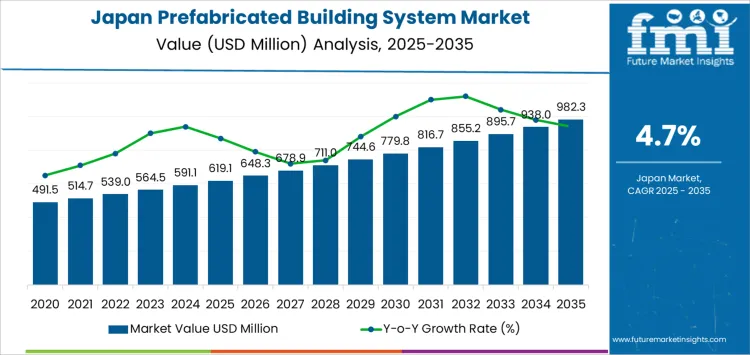
The YoY growth continues at a strong pace, peaking at USD 855.2 million by 2034, indicating sustained expansion as prefabricated buildings gain traction due to factors such as sustainability, quicker construction timelines, and reduced labor costs. By 2035, the industry will have grown to USD 982.3 million, marking an overall increase across the years. This steady, sustained growth underscores the increasing acceptance of prefabricated solutions in both residential and commercial sectors, driven by Japan's growing demand for rapid, scalable, and environmentally friendly construction methods. Despite this consistent growth, there are some fluctuations in individual years, reflecting changes in industry dynamics, such as shifts in policy, economic factors, and technological advancements that impact the construction industry.
Demand for Prefabricated Building System in Japan Key Takeaways
| Metric | Value |
|---|---|
| Demand for Prefabricated Building System in Japan Value (2025) | USD 619.1 million |
| Demand for Prefabricated Building System in Japan Forecast Value (2035) | USD 982.3 million |
| Demand for Prefabricated Building System in Japan Forecast CAGR (2025-2035) | 4.7% |
Why is the Demand for Prefabricated Building System in Japan Growing?
The demand for prefabricated building systems in Japan is growing as the construction industry seeks more efficient and cost-effective solutions to meet the country's increasing housing and infrastructure needs. Prefabricated buildings, where components are manufactured off-site and assembled on location, offer several advantages, including faster construction times, reduced labor costs, and better quality control. As Japan continues to experience urbanization and the demand for both residential and commercial buildings rises, prefabricated systems are becoming an attractive option for developers, government projects, and private investors looking to streamline construction processes and meet tight deadlines.
The growth is also driven by Japan’s focus on sustainability and environmental impact. Prefabricated building systems are considered more environmentally friendly than traditional construction methods due to their ability to minimize waste, reduce energy consumption, and lower carbon footprints. With Japan’s strong commitment to sustainability and disaster resilience, prefabricated systems are gaining popularity for their ability to be quickly constructed in earthquake-prone regions. These systems can be designed to withstand natural disasters, offering both safety and durability, which aligns with Japan’s rigorous building standards.
Technological advancements in materials and design are making prefabricated buildings more customizable and versatile, allowing them to cater to a wide range of architectural styles and functionalities. As the demand for affordable, efficient, and environmentally conscious buildings continues to rise, the use of prefabricated building systems in Japan is expected to expand steadily through 2035.
What is the Segment-Wise Analysis of Demand for Prefabricated Building System in Japan?
Demand for prefabricated building systems in Japan is segmented by application, weight, dimension, and region. By application, residential use leads at 50%, followed by commercial and industrial applications. In terms of weight, lightweight systems (less than 2 tons) dominate, accounting for 65%, with heavy weight systems (more than 2 tons) contributing to the remaining demand. The most common dimensions for prefabricated building systems include skeleton systems, panel systems, cellular systems, and combined systems. Regionally, demand spans across Kyushu & Okinawa, Kanto, Kansai, Chubu, Tohoku, and the rest of Japan, with varying levels of adoption based on regional construction trends and infrastructure needs.
How Does Lightweight Prefabricated Building Systems Lead the Demand in Japan?
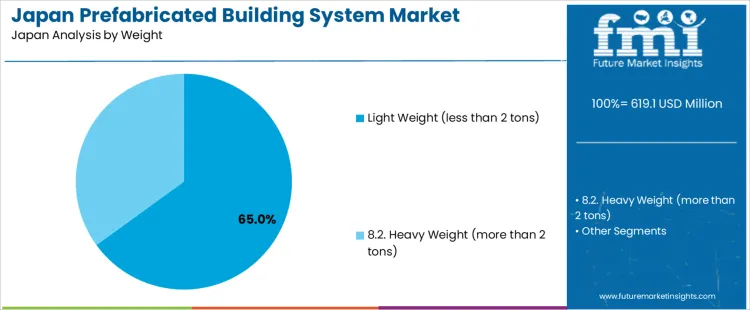
Lightweight prefabricated building systems account for 65% of the demand in Japan, driven by their advantages in speed of construction and cost-effectiveness. These systems are highly favored in both residential and commercial applications, where faster construction times and reduced costs are essential. The lightweight nature of these systems makes them ideal for projects that require quick assembly and minimal structural load, such as in urban areas with space constraints.
The demand for lightweight systems is particularly high in regions like Kanto and Kansai, where urban development is fast-paced, and efficiency is a priority. The growing trend for modular construction and sustainability also boosts the demand for lightweight prefabricated systems, as they offer flexibility and eco-friendly construction solutions, making them a preferred choice in the industry for building systems in Japan.
Why Does Residential Application Lead the Demand for Prefabricated Building Systems in Japan?
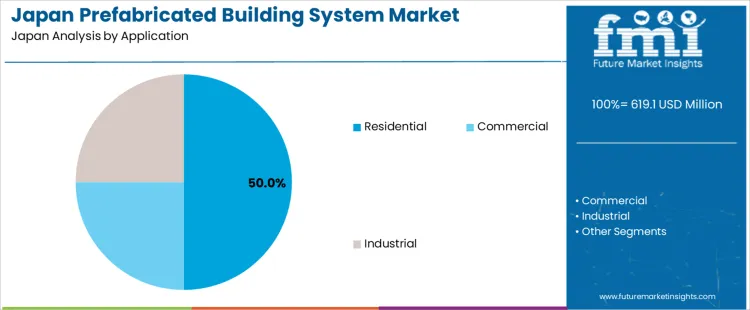
Residential applications account for 50% of the demand for prefabricated building systems in Japan, reflecting the growing trend of modular and efficient housing solutions. As Japan’s population faces increasing urbanization and space constraints, prefabricated systems offer a practical solution for rapid and cost-effective residential construction. The ability to quickly assemble homes using prefabricated elements, such as panel systems or skeleton structures, appeals to both homebuilders and consumers looking for affordable housing options.
The preference for residential applications is particularly strong in regions like Kanto and Kansai, where housing demand is high and construction efficiency is critical. With the growing focus on eco-friendly building practices and reducing construction timelines, prefabricated building systems continue to gain popularity in Japan’s residential sector, making it the leading application for these systems.
What are the Key Trends, Drivers, and Restraints in Demand for Prefabricated Building System in Japan?
Demand for prefabricated building systems in Japan is growing due to the need for more efficient, cost-effective, and time-saving construction methods. Prefabricated buildings allow major components such as walls and floors to be produced off-site, reducing labor costs and construction time while improving quality control. These benefits are particularly valuable in urban areas with limited space and labor shortages.
Prefabricated systems help reduce material waste and offer a more sustainable construction solution. Challenges include the complexity of meeting strict building codes, particularly seismic and environmental requirements, and overcoming the public perception that prefabricated buildings are less customizable or aesthetically appealing than traditional constructions. These factors may hinder broader adoption, especially for more customized or large-scale projects.
Why is Demand for Prefabricated Building System Growing in Japan?
The demand for prefabricated building systems in Japan is driven by urbanization, labor shortages, and rising construction costs. Prefabrication allows for faster and more cost-efficient building processes, which is crucial in densely populated areas where housing demand is high. The labor shortage in the construction industry has increased interest in prefabricated systems, as they require less on-site labor.
Furthermore, the growing emphasis on sustainability and environmental concerns has made prefabricated systems attractive, as they reduce material waste and can offer better energy efficiency. Modular construction provides flexibility, allowing for customizable designs suitable for a wide range of applications, from residential homes to commercial buildings. These advantages make prefabricated systems a practical solution for Japan's evolving construction needs.
How are Technological & Industry Innovations Driving Prefabricated Building System Demand in Japan?
Technological advancements are driving the demand for prefabricated building systems in Japan. Innovations such as Building Information Modeling (BIM) and automated production lines have improved precision and efficiency in manufacturing prefabricated components. These technologies enable better design integration, more accurate customization, and faster production times, making prefab construction more appealing.
The use of advanced materials, such as engineered timber and hybrid systems, has improved the durability, sustainability, and energy efficiency of prefabricated buildings. These innovations help overcome previous limitations, such as the perception that prefab designs are too generic or structurally weak. As a result, prefab systems are becoming more suitable for Japan’s specific needs, such as earthquake-resistant housing, and are gaining wider acceptance among consumers and developers.
What are the Key Challenges and Risks That Could Limit Prefabricated Building System Demand in Japan?
Despite the advantages of prefabricated building systems, there are several challenges that could limit their adoption in Japan. Regulatory hurdles, including the need to comply with stringent seismic and fire safety standards, can make approval and integration into building codes more complex. These challenges may increase costs and limit the scalability of prefab systems. Cultural preferences for customized, site-specific designs may make some consumers hesitant to adopt prefab solutions, as they are often perceived as less personalized. The logistics of adapting prefab systems to irregular sites, such as sloped or difficult terrains, may also limit their applicability. Fluctuations in material costs and supply chain disruptions could impact the price competitiveness of prefabricated buildings, potentially hindering their growth in the industry.
What is the Regional Demand Outlook for Prefabricated Building System in Japan?
Demand for prefabricated building systems in Japan is growing steadily across all regions, with Kyushu & Okinawa leading at a 5.9% CAGR, driven by the region's focus on efficient construction methods and sustainability. Kanto follows with a 5.4% CAGR, supported by its large urban population and ongoing infrastructure development projects. Kansai shows a 4.8% CAGR, as demand for prefabricated buildings rises in both commercial and residential sectors. Chubu experiences a 4.2% CAGR, with steady adoption driven by the region’s industrial and commercial construction needs. Tohoku and the Rest of Japan see more moderate growth at 3.7% and 3.5%, respectively, as smaller regions continue to integrate prefabricated solutions into their construction projects.
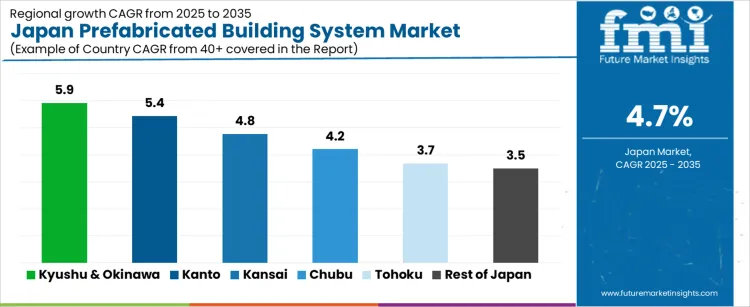
| Region | CAGR (%) |
|---|---|
| Kyushu & Okinawa | 5.9% |
| Kanto | 5.4% |
| Kansai | 4.8% |
| Chubu | 4.2% |
| Tohoku | 3.7% |
| Rest of Japan | 3.5% |
How is Demand for Prefabricated Building Systems Growing in Kyushu & Okinawa?
Kyushu & Okinawa leads the demand for prefabricated building systems, growing at a 5.9% CAGR. The region's growing focus on construction efficiency, sustainability, and disaster resilience has contributed to the rise in demand for prefabricated buildings. Okinawa, with its unique climate and geographical challenges, benefits from the ability of prefabricated buildings to offer faster construction times and improved durability. Prefabricated systems are increasingly being used in both residential and commercial construction, providing a solution to the region’s demand for energy-efficient and cost-effective buildings.
Kyushu & Okinawa’s push toward sustainable building practices, coupled with government incentives for eco-friendly construction, has helped drive the adoption of prefabricated building systems. As the region continues to modernize its infrastructure and urbanize further, prefabricated systems are expected to play a key role in meeting the growing demand for new buildings while maintaining a focus on sustainability and efficiency.
Why is Demand for Prefabricated Building Systems Rising in Kanto?
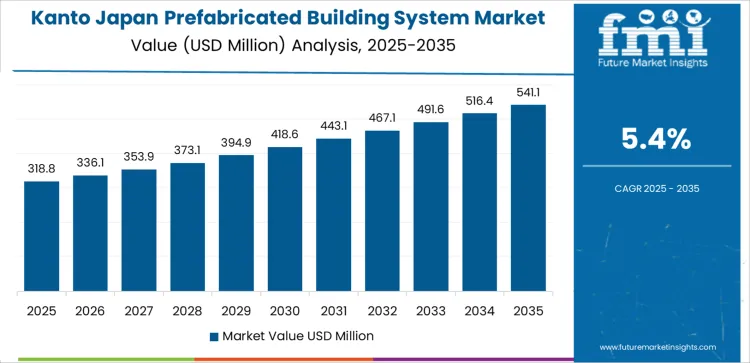
In Kanto, demand for prefabricated building systems is rising at a 5.4% CAGR. The region’s large population, especially in Tokyo, continues to drive the need for efficient, cost-effective construction methods. The growing demand for residential and commercial buildings in urban areas has made prefabricated systems an ideal solution, as they offer faster construction times, lower costs, and reduced labor requirements. With Japan’s increasing emphasis on sustainable construction, prefabricated buildings have gained popularity due to their energy efficiency and reduced environmental impact.
Kanto’s rapid infrastructure development, along with an increasing focus on green building technologies, is supporting the adoption of prefabricated systems. The flexibility of prefabricated solutions in terms of design and functionality makes them an attractive option for both private developers and public sector projects. As Kanto continues to modernize and urbanize, demand for prefabricated building systems is expected to grow steadily, meeting both residential and commercial construction needs.
How is Demand for Prefabricated Building Systems Expanding in Kansai?
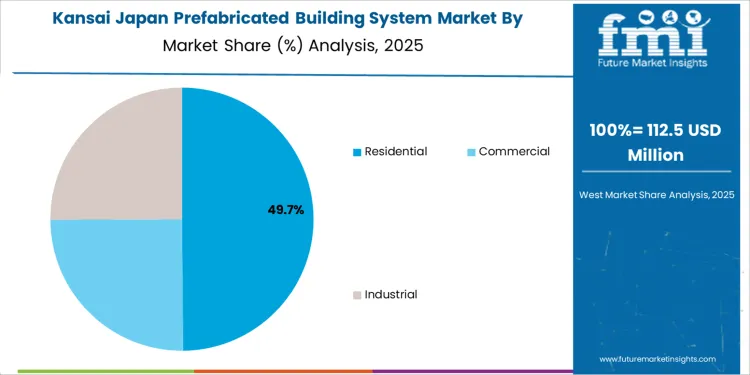
Kansai shows steady demand for prefabricated building systems, growing at a 4.8% CAGR. The region’s strong industrial and commercial sectors, particularly in Osaka and Kobe, are major drivers of this demand, as businesses seek efficient and cost-effective construction solutions. Prefabricated systems offer several advantages, including faster construction timelines, lower costs, and improved energy efficiency, making them a popular choice for commercial and residential projects. Kansai’s commitment to sustainable building practices and environmentally friendly solutions has fueled the adoption of prefabricated building systems.
As the region continues to experience urban growth and infrastructure development, prefabricated solutions are increasingly being used to meet rising demand for residential, commercial, and public buildings. With government incentives supporting green building initiatives and energy-efficient construction, Kansai’s demand for prefabricated systems is expected to remain strong and continue expanding over the coming years.
Why is Demand for Prefabricated Building Systems Growing in Chubu?
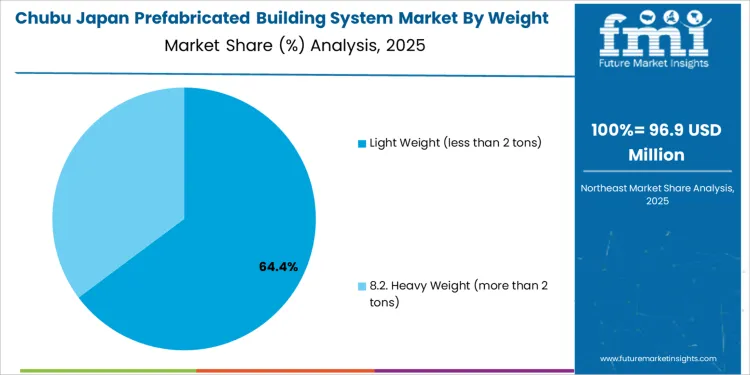
Chubu is experiencing steady demand for prefabricated building systems, growing at a 4.2% CAGR. The region’s focus on improving industrial and commercial infrastructure has led to an increased adoption of prefabricated systems, as they offer significant advantages in terms of cost and construction speed. In urban areas like Nagoya, prefabricated buildings are being used to meet growing demand for residential and commercial spaces. The ability of prefabricated systems to be customized for different building types and functions further contributes to their popularity.
Chubu’s emphasis on sustainable construction and reducing energy consumption has made prefabricated building systems an appealing choice for developers seeking environmentally friendly options. As Chubu continues to modernize its infrastructure, prefabricated solutions will likely play an even larger role in meeting both residential and commercial building needs. The growing recognition of the benefits of prefabricated systems in terms of efficiency, cost, and sustainability will continue to drive demand in the region.
How is Demand for Prefabricated Building Systems Expanding in Tohoku?
Tohoku is seeing moderate growth in prefabricated building demand, with a 3.7% CAGR. While adoption is slower compared to urban centers, there is growing interest in prefabricated systems as Tohoku’s construction sector embraces more efficient and sustainable building practices. The region’s focus on rebuilding and infrastructure development, particularly in areas affected by natural disasters, has led to an increased demand for fast, reliable, and cost-effective building solutions.
Prefabricated systems, which allow for quicker construction and better disaster resilience, are increasingly being utilized in both residential and public infrastructure projects. As Tohoku’s economy recovers and its population grows, there will be a continued demand for affordable and energy-efficient housing, which prefabricated systems can provide. The region’s increasing commitment to sustainability and environmental considerations will also support steady growth in the adoption of prefabricated building systems, as they offer a practical solution to construction challenges.
Why is Demand for Prefabricated Building Systems Steady in the Rest of Japan?
The Rest of Japan is experiencing steady demand for prefabricated building systems, with a 3.5% CAGR. While the adoption rate is slower in rural and smaller cities compared to major urban regions, there is growing interest in prefabricated solutions due to their cost-effectiveness, faster construction timelines, and ability to meet local housing and infrastructure needs. As rural areas continue to modernize and urbanize, the demand for prefabricated systems is rising, particularly in residential and small-scale commercial projects.
The affordability and ease of installation of prefabricated buildings make them an attractive option for local governments and developers. The increasing focus on energy efficiency and sustainability in construction practices is driving the adoption of prefabricated systems. While growth is more gradual in these areas, the demand for prefabricated buildings will continue to grow steadily as the Rest of Japan embraces more efficient and sustainable construction methods.
What is Driving the Demand for Prefabricated Building Systems in Japan and Who Are the Key Providers?
The demand for prefabricated building systems in Japan is growing as urbanization and a need for more efficient construction methods drive the adoption of off-site manufacturing techniques. Prefabricated buildings allow for faster construction with reduced on-site labor costs, as most components are manufactured in controlled environments and then assembled at the project site. This results in a shorter construction timeline, greater precision in building, and cost savings. With Japan's highly urbanized areas facing space constraints, prefabricated systems offer an ideal solution for efficiently utilizing available land, especially for residential, commercial, and temporary structures.
Key players in the prefabricated building systems industry in Japan include Karmod Prefabricated Building Technologies, Volumetric Building Companies, Red Sea Housing, Bajaj Steel Industries Ltd., and TSSC Harwal Group. Karmod Prefabricated Building Technologies leads the industry with a share of 42.0%, providing modular and volumetric solutions for various applications. These companies offer a range of modular units and customizable prefabricated components, catering to the diverse needs of Japan’s residential, commercial, and temporary construction sectors. As the demand for quick, scalable, and sustainable building solutions continues to rise, prefabricated systems are becoming a key component of Japan's construction industry.
In addition to speed and efficiency, prefabricated buildings are also increasingly popular due to their ability to meet Japan's high safety standards, particularly in earthquake-resistant design. Japan's vulnerability to natural disasters has spurred interest in modular construction methods that can be engineered to withstand seismic activity. Prefabrication's controlled production process leads to less waste and higher sustainability, which aligns with Japan's growing focus on environmentally conscious and resource-efficient construction practices. This shift in priorities toward sustainability and disaster resilience has made prefabricated systems an attractive alternative to traditional building methods.
Key Players in Japan Small Satellites Demand
- Karmod Prefabricated Building Technologies
- Volumetric Building Companies
- Red Sea Housing
- Bajaj Steel Industries Ltd.
- TSSC Harwal Group
Scope of Report
| Items | Values |
|---|---|
| Quantitative Units (2025) | USD million |
| Application | Residential, Commercial, Industrial |
| Weight | Light Weight (less than 2 tons), Heavy Weight (more than 2 tons) |
| Dimension | Skeleton System, Panel System, Cellular System, Combined System |
| Region | Kyushu & Okinawa, Kanto, Kansai, Chubu, Tohoku, Rest of Japan |
| Countries Covered | Japan |
| Key Companies Profiled | Karmod Prefabricated Building Technologies, Volumetric Building Companies, Red Sea Housing, Bajaj Steel Industries Ltd., TSSC Harwal Group |
| Additional Attributes | Dollar sales by application and dimension; regional CAGR and growth trends; increasing adoption of prefabricated systems in residential, commercial, and industrial applications; cost-efficiency trends in construction |
Japan Small Satellites Demand by Key Segments
Application
- Residential
- Commercial
- Industrial
Weight
- Light Weight (less than 2 tons)
- 8.2. Heavy Weight (more than 2 tons)
Dimension
- Skeleton System
- Panel System
- Cellular System
- Combined System
Region
- Kyushu & Okinawa
- Kanto
- Kansai
- Chubu
- Tohoku
- Rest of Japan
Frequently Asked Questions
How big is the demand for prefabricated building system in Japan in 2025?
The demand for prefabricated building system in Japan is estimated to be valued at USD 619.1 million in 2025.
What will be the size of prefabricated building system in Japan in 2035?
The market size for the prefabricated building system in Japan is projected to reach USD 982.3 million by 2035.
How much will be the demand for prefabricated building system in Japan growth between 2025 and 2035?
The demand for prefabricated building system in Japan is expected to grow at a 4.7% CAGR between 2025 and 2035.
What are the key product types in the prefabricated building system in Japan?
The key product types in prefabricated building system in Japan are residential, commercial and industrial.
Which weight segment is expected to contribute significant share in the prefabricated building system in Japan in 2025?
In terms of weight, light weight (less than 2 tons) segment is expected to command 65.0% share in the prefabricated building system in Japan in 2025.
Preview the report firsthand - request a free sample
Get SampleGet the brochure for pricing and purchase details.
Get PDFTable of Content
- Executive Summary
- Japan Market Outlook
- Demand-side Trends
- Supply-side Trends
- Technology Roadmap Analysis
- Analysis and Recommendations
- Market Overview
- Market Coverage / Taxonomy
- Market Definition / Scope / Limitations
- Market Background
- Market Dynamics
- Drivers
- Restraints
- Opportunity
- Trends
- Scenario Forecast
- Demand in Optimistic Scenario
- Demand in Likely Scenario
- Demand in Conservative Scenario
- Opportunity Map Analysis
- Product Life Cycle Analysis
- Supply Chain Analysis
- Investment Feasibility Matrix
- Value Chain Analysis
- PESTLE and Porter’s Analysis
- Regulatory Landscape
- Regional Parent Market Outlook
- Production and Consumption Statistics
- Import and Export Statistics
- Market Dynamics
- Japan Market Analysis 2020 to 2024 and Forecast, 2025 to 2035
- Historical Market Size Value (USD Million) Analysis, 2020 to 2024
- Current and Future Market Size Value (USD Million) Projections, 2025 to 2035
- Y-o-Y Growth Trend Analysis
- Absolute $ Opportunity Analysis
- Japan Market Pricing Analysis 2020 to 2024 and Forecast 2025 to 2035
- Japan Market Analysis 2020 to 2024 and Forecast 2025 to 2035, By Application
- Introduction / Key Findings
- Historical Market Size Value (USD Million) Analysis By Application , 2020 to 2024
- Current and Future Market Size Value (USD Million) Analysis and Forecast By Application , 2025 to 2035
- Residential
- Commercial
- Industrial
- Y-o-Y Growth Trend Analysis By Application , 2020 to 2024
- Absolute $ Opportunity Analysis By Application , 2025 to 2035
- Japan Market Analysis 2020 to 2024 and Forecast 2025 to 2035, By Weight
- Introduction / Key Findings
- Historical Market Size Value (USD Million) Analysis By Weight, 2020 to 2024
- Current and Future Market Size Value (USD Million) Analysis and Forecast By Weight, 2025 to 2035
- Light Weight (less than 2 tons)
- 8.2. Heavy Weight (more than 2 tons)
- Y-o-Y Growth Trend Analysis By Weight, 2020 to 2024
- Absolute $ Opportunity Analysis By Weight, 2025 to 2035
- Japan Market Analysis 2020 to 2024 and Forecast 2025 to 2035, By Dimension
- Introduction / Key Findings
- Historical Market Size Value (USD Million) Analysis By Dimension, 2020 to 2024
- Current and Future Market Size Value (USD Million) Analysis and Forecast By Dimension, 2025 to 2035
- Skeleton System
- Panel System
- Cellular System
- Combined System
- Y-o-Y Growth Trend Analysis By Dimension, 2020 to 2024
- Absolute $ Opportunity Analysis By Dimension, 2025 to 2035
- Market Structure Analysis
- Competition Dashboard
- Competition Benchmarking
- Market Share Analysis of Top Players
- By Regional
- By Application
- By Weight
- By Dimension
- Competition Analysis
- Competition Deep Dive
- Volumetric Building Companies
- Overview
- Product Portfolio
- Profitability by Market Segments (Product/Age /Sales Channel/Region)
- Sales Footprint
- Strategy Overview
- Marketing Strategy
- Product Strategy
- Channel Strategy
- Red Sea Housing
- Bajaj Steel Industries Ltd.
- TSSC Harwal Group
- Volumetric Building Companies
- Competition Deep Dive
- Assumptions & Acronyms Used
- Research Methodology


