

- Industry Size (2026)
- USD 122 Mn
- Forecast (2036):
- USD 343.3 Mn
- CAGR (2026 to 2036)
- 10.9%
Closed-Loop Recycling Systems for Hospital Polymer Waste Market Forecast and Outlook 2026 to 2036
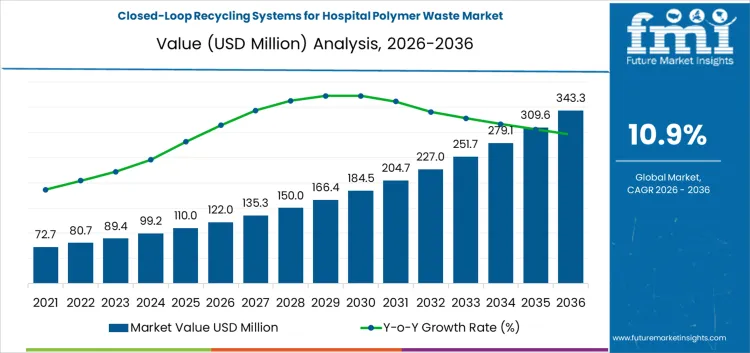
The closed-loop recycling systems for hospital polymer waste market is valued at USD 122 million in 2026 and is projected to reach USD 343.3 million by 2036, reflecting a CAGR of 10.9%. Growth is supported by rising volumes of hospital polymer waste, regulatory pressure for circular solutions, and increasing adoption of on-site and centralized recycling systems. Cost structures are shaped by sterilization protocols, equipment capital intensity, and operational compliance requirements. Margin concentration favors operators able to integrate collection, decontamination, and processing within validated systems. Pricing control rests with providers delivering certified recycled polymers for reuse in medical devices, packaging, and ancillary applications rather than those handling general volume.
Between 2026 and 2036, regional uptake varies according to hospital density, waste management infrastructure, and local regulatory mandates. Early-adopter regions capture disproportionate value due to established logistics and workforce expertise. Operators investing in process standardization, documentation, and audit readiness maintain higher utilization and consistent margins. Competitive positioning reflects integration capability, traceability, and capacity to supply multiple hospital polymer streams. Firms lacking regulatory alignment or operational scale face narrower returns, while those delivering end-to-end, compliant solutions secure long-term value concentration and stable revenue growth across the forecast period.
Quick Stats of the Closed-Loop Recycling Systems for Hospital Polymer Waste Market
- Closed-Loop Recycling Systems for Hospital Polymer Waste Market Value (2026): USD 122 million
- Closed-Loop Recycling Systems for Hospital Polymer Waste Market Forecast Value (2036): USD 343.3 million
- Closed-Loop Recycling Systems for Hospital Polymer Waste Market Forecast CAGR (2026–2036): 10.9%
- Closed-Loop Recycling Systems for Hospital Polymer Waste Market Leading Waste Source: Post-consumer hospital plastic waste
- Closed-Loop Recycling Systems for Hospital Polymer Waste Market Key Growth Regions: India, China, USA, Brazil, UK
- Closed-Loop Recycling Systems for Hospital Polymer Waste Market Top Players: Veolia, Suez, Stericycle, Revolution Recovery Systems, MBA Polymers, Clean Harbor, ALBA Group
What is the Growth Forecast for Closed-Loop Recycling Systems for Hospital Polymer Waste Market through 2036?
Between 2026 and 2031, the closed-loop recycling systems for hospital polymer waste market is projected to expand from USD 122 million to USD 200 million, generating an absolute increase of USD 78 million and representing approximately 32% of total decade growth. This phase is shaped by the initial adoption of hospital waste segregation, sterilization, and polymer recovery processes, driven by regulatory pressure on medical waste management and hospital sustainability programs. Cost structures are influenced by collection logistics, decontamination technologies, and process validation. Value capture favors operators offering certified, high-purity recycled polymers suitable for medical applications rather than focusing solely on throughput.
From 2031 to 2036, the market is expected to grow from USD 200 million to USD 343.3 million, adding USD 144 million and representing roughly 68% of total decade expansion. Growth accelerates as closed-loop systems scale across hospital networks and recycled polymers integrate into medical device supply chains. Margins increasingly favor operators controlling feedstock quality, sterilization efficiency, and compliance documentation. Competitive advantage shifts toward firms delivering traceable, validated output, while late entrants optimize operational efficiency and standardization to capture incremental market share.
Closed Loop Recycling Systems for Hospital Polymer Waste Market Key Takeaways
| Metric | Value |
|---|---|
| Market Value (2026) | USD 122 million |
| Forecast Value (2036) | USD 343.3 million |
| Forecast CAGR (2026–2036) | 10.9% |
How Are Closed-Loop Recycling Systems Transforming Hospital Polymer Waste Management?
Closed-loop recycling systems for hospital polymer waste are increasingly adopted to reduce clinical disposal volumes, enhance material recovery, and maintain regulatory compliance. Historically, hospital plastics from syringes, tubing, and packaging were incinerated or landfilled due to contamination risk and mixed polymer streams. Emerging systems integrate segregation, sterilization, shredding, and controlled extrusion to produce regranulates suitable for non-critical hospital applications. Hospitals, medical device suppliers, and specialized recyclers collaborate to ensure traceable handling, validated decontamination, and compliance with healthcare waste regulations. Value capture is concentrated on operational efficiency, material reuse assurance, and reduction of disposal liability rather than throughput alone. Pilot programs demonstrate process reliability, energy efficiency, and feedstock consistency to guide broader adoption.
Future growth is influenced by healthcare sustainability mandates, regulatory oversight, and institutional procurement policies rather than voluntary environmental initiatives. Compared with early experimental programs, modern closed-loop systems emphasize reproducible polymer quality, segregation fidelity, and documented chain of custody for recovered materials. Cost structures are shaped by sterilization energy, contamination screening, and shredding efficiency, concentrating margins among operators capable of integrating quality control with hospital operations. Hospitals prioritize systems that provide traceable compliance, reduce waste management expenses, and maintain polymer performance for non-critical applications. By 2036, closed-loop recycling systems are expected to form a standard component of hospital waste management strategies, enabling both operational cost reduction and regulatory alignment.
What Factors Are Shaping the Demand for Closed Loop Recycling Systems for Hospital Polymer Waste in Terms of Waste Source and Recycling Technology?
The demand for closed loop recycling systems for hospital polymer waste is segmented by waste source and recycling technology. Waste sources include post-consumer hospital plastics, sterilized medical device scrap, surgical tray and packaging remnants, and laboratory polymer waste. Recycling technologies include mechanical recycling, chemical depolymerization, solvent based purification, and thermal or pyrolysis recovery. Segment adoption is influenced by regulatory compliance, sterility requirements, and polymer property retention. Hospitals and waste management operators prioritize systems that ensure traceable, safe, and high quality output suitable for reuse in non-critical or controlled applications. Demand is shaped by operational integration rather than cost efficiency alone.
What Is Driving the Leading Use of Post-Consumer Hospital Plastic Waste in Closed Loop Systems?
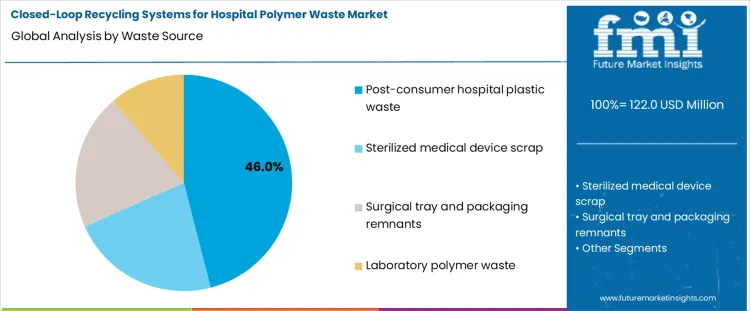
Post-consumer hospital plastic waste accounts for approximately 46% of total feedstock demand, making it the largest waste source segment. This reflects the volume of single use items such as trays, containers, and disposable instruments generated daily in hospital operations. Collection and segregation protocols ensure material quality and sterility before recycling. Operators favor this feedstock for its predictable composition, which simplifies downstream mechanical or chemical processing. The high concentration of polymer types in post-consumer waste allows for standardized recovery procedures, reducing variability and facilitating consistent output for reuse.
Demand for post-consumer hospital plastics is driven by regulatory and operational priorities. Waste management programs and hospital sustainability initiatives incentivize the collection of high purity streams. The feedstock supports closed loop recycling, minimizing landfill disposal while maintaining material integrity. Predictable polymer content enables reliable reprocessing and compliance with medical waste guidelines. The segment remains dominant because it provides sufficient volume, consistency, and traceability to justify investment in closed loop recycling infrastructure.
Why Is Mechanical Recycling the Leading Technology for Hospital Polymer Waste Recovery?
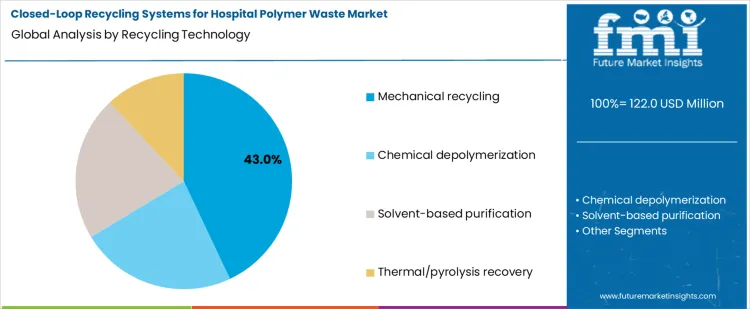
Mechanical recycling represents approximately 43% of total technology adoption, making it the dominant route. This reflects its ability to process segregated hospital plastics efficiently while maintaining polymer properties suitable for non-critical applications. Shredding, washing, and regranulation allow reuse in secondary products or controlled hospital supply items. Mechanical recycling is favored where feedstock homogeneity and sterility verification enable safe processing without chemical alteration.
Demand for mechanical recycling is shaped by operational feasibility and regulatory alignment. Hospitals and recyclers prioritize processes that are fast, cost effective, and maintain traceable material quality. Mechanical methods allow integration with existing hospital waste streams and facilitate batch control. The segment leads because it balances throughput, compliance, and material retention, providing a practical approach to recovering hospital polymer waste within closed loop systems.
How Are Closed-Loop Recycling Systems Transforming Hospital Polymer Waste Management in Practice?
Closed-loop recycling systems for hospital polymer waste focus on secure recovery of disposable medical plastics such as syringes, IV components, and diagnostic devices. Adoption is driven by hospitals’ need to comply with local biohazard disposal regulations while minimizing landfill use. Systems prioritize process reliability, polymer integrity, and infection control. Growth is concentrated in regions with strict enforcement of medical waste segregation and recycling mandates. Operators that demonstrate traceable, audit-ready processes gain preference from healthcare networks. Expansion reflects regulatory alignment and operational assurance rather than overall hospital waste volume, emphasizing safety and compliance over cost efficiency.
What Local Regulatory and Institutional Drivers Are Shaping Closed-Loop Recycling Adoption in Hospitals?
Adoption is strongly influenced by country-specific healthcare waste policies and hospital accreditation requirements. Authorities often mandate traceable handling and validated sterilization for polymer recycling, particularly for high-risk devices. Hospitals with sustainability initiatives adopt closed-loop systems to reduce incineration and landfill reliance while meeting internal audit criteria. Funding and incentives for waste reduction programs in certain regions accelerate investment. The driver is regulatory and institutional compliance rather than operational cost savings. Facilities capable of maintaining certified, reproducible recycling loops secure stronger partnerships with hospitals and device manufacturers, ensuring continued material recovery and alignment with regional standards.
What Operational and Technical Barriers Limit Widespread Implementation of Closed-Loop Hospital Polymer Recycling?
Key barriers include complex segregation and collection of diverse polymer types, stringent sterilization requirements, and variability in feedstock contamination levels. High capital investment for decontamination and processing lines restricts participation to larger or consortium-backed operators. Skilled personnel are required to maintain process integrity and manage regulatory documentation. Some hospitals face logistical challenges integrating collection protocols into daily operations without disrupting clinical workflows. Inconsistent local regulations or unclear enforcement further slow adoption. These factors concentrate early deployment among well-funded, technically capable operators in high-volume healthcare networks, delaying broader penetration in smaller or resource-constrained facilities.
How Are Process Innovation and Collaboration Trends Influencing Closed-Loop Recycling in Hospital Settings?
Trends show a move toward modular, scalable recycling units integrated with sterilization and quality monitoring systems. Partnerships between hospitals, medical device suppliers, and recyclers secure feedstock while ensuring compliance with local regulations. Digital traceability platforms provide audit-ready records at batch level, supporting both regulatory and institutional reporting. Some operators adopt pilot-scale demonstration plants to validate process reproducibility before full-scale deployment. Focus is shifting from maximizing throughput to ensuring polymer integrity, safety, and compliance. Successful adoption depends on stakeholder collaboration, regulatory alignment, and the ability to maintain reproducible, certified recycling loops across multiple healthcare facilities.
What is the Demand for Closed-Loop Recycling Systems for Hospital Polymer Waste by Country?
| Country | CAGR (%) |
|---|---|
| USA | 8.2% |
| UK | 7.6% |
| China | 9.7% |
| India | 11.2% |
| Brazil | 9.0% |
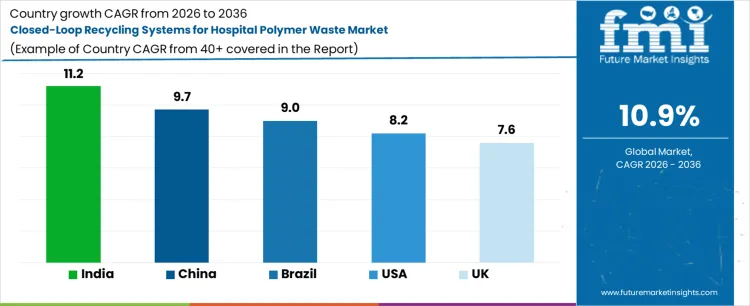
Demand for closed-loop recycling systems for hospital polymer waste is rising as healthcare facilities implement sustainable waste management and regulatory-compliant recovery processes. India leads at 11.2% CAGR, supported by rapid hospital infrastructure growth, high volumes of single-use polymeric devices, and government incentives for recycling technologies. China follows at 9.7%, driven by large medical institutions adopting in-house and third-party closed-loop systems to ensure material recovery and maintain compliance. Brazil records 9.0% growth, shaped by expanding private hospital networks and rising adoption of polymer segregation and sterilization-compliant recycling. The USA grows at 8.2%, reflecting investments in hospital-grade closed-loop systems for polypropylene, polycarbonate, and other polymers. The UK shows moderate growth at 7.6%, driven by steady implementation of waste segregation protocols and incremental adoption of closed-loop polymer recovery solutions.
How Are Hospital Sustainability Programs Driving Closed-Loop Polymer Recycling in the United States?
The United States closed-loop recycling systems for hospital polymer waste market is growing at a CAGR of 8.2%, supported by hospital initiatives aimed at reducing medical waste and integrating recovered polymers into secondary applications. Hospitals and contract recyclers are investing in collection, segregation, cleaning, and sterilization systems to ensure high-quality feedstock suitable for non-critical reuse. Demand is concentrated among large healthcare networks and certified recycling operators seeking compliance documentation and process reliability. Investments prioritize operational validation, contamination control, and traceability rather than rapid expansion. Growth reflects strategic integration of closed-loop systems into existing waste management practices.
- Hospital sustainability programs drive adoption of closed-loop recycling systems.
- Segregation, cleaning, and sterilization ensure polymer quality and safety.
- Large healthcare networks dominate early adoption.
- Traceability and documentation support regulatory and institutional compliance.
Why Is Regulatory Alignment Supporting Closed-Loop Systems in the United Kingdom?
In the United Kingdom, the closed-loop recycling systems for hospital polymer waste market is expanding at a CAGR of 7.6%, driven by healthcare and environmental regulations promoting material recovery. Recycling operators focus on controlled cleaning, sterilization, and quality verification to produce compliant polymer feedstock. Demand is concentrated among hospitals and certified recyclers servicing the healthcare sector. Investments emphasize process standardization, operational consistency, and traceable material flows rather than capacity expansion. Growth reflects cautious integration of closed-loop systems into hospital waste management strategies.
- Regulatory frameworks encourage adoption of closed-loop recycling processes.
- Controlled cleaning and sterilization ensure material compliance.
- Standardized processes support consistent output quality.
- Certified recyclers lead early-stage implementation.
How Is Export-Oriented Healthcare Manufacturing Influencing Closed-Loop Adoption in China?
China is experiencing strong growth in the closed-loop recycling systems for hospital polymer waste market, with a CAGR of 9.7%, fueled by hospitals and recycling firms meeting domestic and international sustainability expectations. Recyclers are implementing cleaning, sterilization, and material verification protocols to produce high-quality polymer feedstock for reuse or downcycling. Demand is concentrated in urban healthcare clusters and large hospital networks. Investments emphasize process reliability, standardization, and traceable outputs. Growth is driven by environmental regulations and international compliance requirements, alongside increasing awareness of circular healthcare practices.
- Urban hospital clusters drive feedstock availability for closed-loop systems.
- Cleaning and sterilization protocols ensure safety and compliance.
- Standardized processes improve output reliability and traceability.
- Export-oriented compliance requirements influence adoption.
Why Is Hospital Waste Volume Expansion Driving Closed-Loop Systems in India?
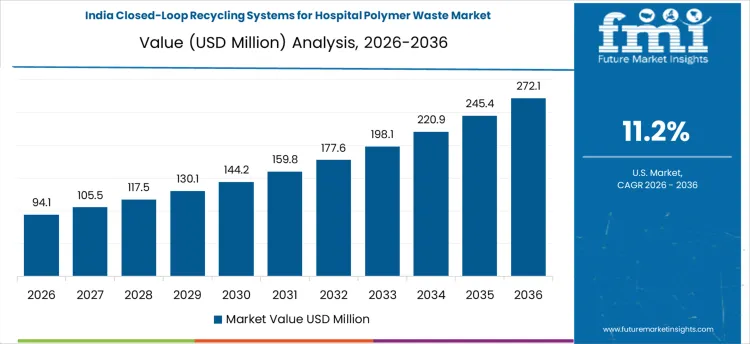
India shows the fastest growth in closed-loop recycling systems for hospital polymer waste, expanding at a CAGR of 11.2%, driven by rising hospital capacity and increased consumption of single-use medical devices. Recycling operators are deploying integrated segregation, cleaning, and sterilization systems to reclaim polymers suitable for secondary applications. Demand is concentrated among organized recyclers partnered with large hospital networks. Investments prioritize operational reliability, contamination control, and regulatory alignment. Growth reflects both higher hospital waste volumes and the need to provide certified recycled feedstock for healthcare and industrial use.
- Rising hospital and single-use device volumes increase feedstock supply.
- Integrated cleaning and sterilization systems support polymer recovery.
- Compliance and quality assurance shape investment focus.
- Organized recyclers partner with hospital networks to scale adoption.
How Is Healthcare Infrastructure Development Supporting Closed-Loop Adoption in Brazil?
Brazil is experiencing steady growth in closed-loop recycling systems for hospital polymer waste at a CAGR of 9.0%, supported by expanding hospital infrastructure and improved waste management practices. Recyclers are implementing controlled cleaning, sterilization, and verification processes to reclaim high-quality polymer for secondary applications. Demand is concentrated in urban hospitals with established recycling programs. Investments emphasize process standardization, contamination reduction, and traceability rather than large-scale capacity expansion. Growth reflects gradual integration of closed-loop systems into existing hospital waste management and compliance frameworks.
- Hospital infrastructure improvements increase polymer feedstock availability.
- Cleaning and sterilization processes ensure recovered polymer quality.
- Urban hospitals concentrate demand and adoption.
- Standardization and traceability support compliance and process reliability.
Who Competes in Closed Loop Recycling Systems for Hospital Polymer Waste and How Do They Differ?
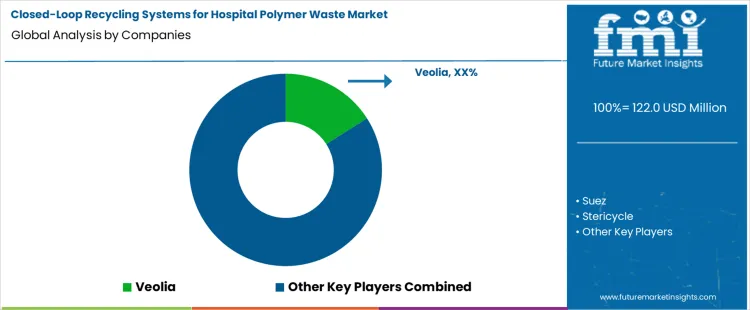
Competition in closed loop recycling systems for hospital polymer waste reflects differences in service models, technology focus, and integration with healthcare operations. Veolia competes through broad environmental services networks that combine regulated medical waste handling with downstream recycling capabilities, enabling clinic and hospital customers to streamline waste segregation, cleaning, and material recovery under unified contracts. Suez offers integrated waste to recycling pathways with emphasis on logistic optimization and centralized processing hubs that serve multi facility healthcare groups. Stericycle focuses on regulated waste collection and segregation protocols, partnering with recyclers or deploying localized systems that ensure infection control while feeding polymer streams into reprocessing workflows.
Other competitors differentiate through specialized recycling technology or service delivery models. Revolution Recovery Systems emphasizes tailored on site systems and modular recycling units that allow hospitals to manage polymer processing internally or through local partnerships. MBA Polymers contributes deep expertise in sorting, decontamination, and reprocessing of mixed polymer streams, enhancing output quality for recycled material markets. CleanHarbor integrates decontamination logistics with recycling workflows, supporting safe handling from generation to material recovery. ALBA Group participates in European markets with end to end recycling solutions linked to regional hospital networks. Competitive positioning is shaped by infection control integration, scale of operations, technology maturity, and ability to provide traceable recycled polymers suitable for secondary applications while maintaining compliance with regulated waste handling standards.
Key Players in the Closed-Loop Recycling Systems for Hospital Polymer Waste Market
- Veolia
- Suez
- Stericycle
- Revolution Recovery Systems
- MBA Polymers
- Clean Harbor
- ALBA Group
Scope of the Report
| Items | Values |
|---|---|
| Quantitative Units (2026) | USD million |
| Waste Source | Post-consumer hospital plastic waste, Sterilized medical device scrap, Surgical tray and packaging remnants, Laboratory polymer waste |
| Recycling Technology | Mechanical recycling, Chemical depolymerization, Solvent based purification, Thermal/pyrolysis recovery |
| Region | Asia Pacific, Europe, North America, Latin America, Middle East & Africa |
| Key Countries Covered | China, Japan, South Korea, India, Australia & New Zealand, Germany, United Kingdom, France, Italy, Spain, Nordic, BENELUX, United States, Canada, Mexico, Brazil, Chile, Kingdom of Saudi Arabia, Other GCC Countries, Turkey, South Africa, Other African Union |
| Key Companies Profiled | Veolia, Suez, Stericycle, Revolution Recovery Systems, MBA Polymers, Clean Harbor, ALBA Group |
| Additional Attributes | Dollar sales by waste source and recycling technology, medical-grade compliance and sterilization protocols, feedstock traceability, operational integration with hospital workflows, process reliability and contamination control, regulatory alignment with ISO/FDA standards, modular and scalable system adoption, hospital network coverage, audit-ready documentation for recycled polymers |
Closed-Loop Recycling Systems for Hospital Polymer Waste Market Segmentation
Waste Source:
- Post consumer hospital plastic waste
- Sterilized medical device scrap
- Surgical tray and packaging remnants
- Laboratory polymer waste
Recycling Technology:
- Mechanical recycling
- Chemical depolymerization
- Solvent based purification
- Thermal/pyrolysis recovery
Region
Asia Pacific
- China
- Japan
- South Korea
- India
- Australia & New Zealand
- ASEAN
- Rest of Asia Pacific
Europe
- Germany
- United Kingdom
- France
- Italy
- Spain
- Nordic
- BENELUX
- Rest of Europe
North America
- United States
- Canada
- Mexico
Latin America
- Brazil
- Chile
- Rest of Latin America
Middle East & Africa
- Kingdom of Saudi Arabia
- Other GCC Countries
- Turkey
- South Africa
- Other African Union
- Rest of Middle East & Africa
Frequently Asked Questions
How big is the closed-loop recycling systems for hospital polymer waste market in 2026?
The global closed-loop recycling systems for hospital polymer waste market is estimated to be valued at USD 122.0 million in 2026.
What will be the size of closed-loop recycling systems for hospital polymer waste market in 2036?
The market size for the closed-loop recycling systems for hospital polymer waste market is projected to reach USD 343.3 million by 2036.
How much will be the closed-loop recycling systems for hospital polymer waste market growth between 2026 and 2036?
The closed-loop recycling systems for hospital polymer waste market is expected to grow at a 10.9% CAGR between 2026 and 2036.
What are the key waste source types in the closed-loop recycling systems for hospital polymer waste market?
The key waste source types in closed-loop recycling systems for hospital polymer waste market are post‑consumer hospital plastic waste, sterilized medical device scrap, surgical tray and packaging remnants, and laboratory polymer waste.
Which recycling technology segment to contribute significant share in the closed-loop recycling systems for hospital polymer waste market in 2026?
In terms of recycling technology, mechanical recycling segment to command 43.0% share in the closed-loop recycling systems for hospital polymer waste market in 2026.
Preview the report firsthand - request a free sample
Get SampleGet the brochure for pricing and purchase details.
Get PDFTable of Content
- Executive Summary
- Global Market Outlook
- Demand-side Trends
- Supply-side Trends
- Technology Roadmap Analysis
- Analysis and Recommendations
- Market Overview
- Market Coverage / Taxonomy
- Market Definition / Scope / Limitations
- Market Background
- Market Dynamics
- Drivers
- Restraints
- Opportunity
- Trends
- Scenario Forecast
- Demand in Optimistic Scenario
- Demand in Likely Scenario
- Demand in Conservative Scenario
- Opportunity Map Analysis
- Product Life Cycle Analysis
- Supply Chain Analysis
- Investment Feasibility Matrix
- Value Chain Analysis
- PESTLE and Porter’s Analysis
- Regulatory Landscape
- Regional Parent Market Outlook
- Production and Consumption Statistics
- Import and Export Statistics
- Market Dynamics
- Global Market Analysis 2021 to 2025 and Forecast, 2026 to 2036
- Historical Market Size Value (USD Million) Analysis, 2021 to 2025
- Current and Future Market Size Value (USD Million) Projections, 2026 to 2036
- Y-o-Y Growth Trend Analysis
- Absolute $ Opportunity Analysis
- Global Market Pricing Analysis 2021 to 2025 and Forecast 2026 to 2036
- Global Market Analysis 2021 to 2025 and Forecast 2026 to 2036, By Waste Source
- Introduction / Key Findings
- Historical Market Size Value (USD Million) Analysis By Waste Source , 2021 to 2025
- Current and Future Market Size Value (USD Million) Analysis and Forecast By Waste Source , 2026 to 2036
- Post‑consumer hospital plastic waste
- Sterilized medical device scrap
- Surgical tray and packaging remnants
- Laboratory polymer waste
- Post‑consumer hospital plastic waste
- Y-o-Y Growth Trend Analysis By Waste Source , 2021 to 2025
- Absolute $ Opportunity Analysis By Waste Source , 2026 to 2036
- Global Market Analysis 2021 to 2025 and Forecast 2026 to 2036, By Recycling Technology
- Introduction / Key Findings
- Historical Market Size Value (USD Million) Analysis By Recycling Technology, 2021 to 2025
- Current and Future Market Size Value (USD Million) Analysis and Forecast By Recycling Technology, 2026 to 2036
- Mechanical recycling
- Chemical depolymerization
- Solvent‑based purification
- Thermal/pyrolysis recovery
- Mechanical recycling
- Y-o-Y Growth Trend Analysis By Recycling Technology, 2021 to 2025
- Absolute $ Opportunity Analysis By Recycling Technology, 2026 to 2036
- Global Market Analysis 2021 to 2025 and Forecast 2026 to 2036, By Region
- Introduction
- Historical Market Size Value (USD Million) Analysis By Region, 2021 to 2025
- Current Market Size Value (USD Million) Analysis and Forecast By Region, 2026 to 2036
- North America
- Latin America
- Western Europe
- Eastern Europe
- East Asia
- South Asia and Pacific
- Middle East & Africa
- Market Attractiveness Analysis By Region
- North America Market Analysis 2021 to 2025 and Forecast 2026 to 2036, By Country
- Historical Market Size Value (USD Million) Trend Analysis By Market Taxonomy, 2021 to 2025
- Market Size Value (USD Million) Forecast By Market Taxonomy, 2026 to 2036
- By Country
- USA
- Canada
- Mexico
- By Waste Source
- By Recycling Technology
- By Country
- Market Attractiveness Analysis
- By Country
- By Waste Source
- By Recycling Technology
- Key Takeaways
- Latin America Market Analysis 2021 to 2025 and Forecast 2026 to 2036, By Country
- Historical Market Size Value (USD Million) Trend Analysis By Market Taxonomy, 2021 to 2025
- Market Size Value (USD Million) Forecast By Market Taxonomy, 2026 to 2036
- By Country
- Brazil
- Chile
- Rest of Latin America
- By Waste Source
- By Recycling Technology
- By Country
- Market Attractiveness Analysis
- By Country
- By Waste Source
- By Recycling Technology
- Key Takeaways
- Western Europe Market Analysis 2021 to 2025 and Forecast 2026 to 2036, By Country
- Historical Market Size Value (USD Million) Trend Analysis By Market Taxonomy, 2021 to 2025
- Market Size Value (USD Million) Forecast By Market Taxonomy, 2026 to 2036
- By Country
- Germany
- UK
- Italy
- Spain
- France
- Nordic
- BENELUX
- Rest of Western Europe
- By Waste Source
- By Recycling Technology
- By Country
- Market Attractiveness Analysis
- By Country
- By Waste Source
- By Recycling Technology
- Key Takeaways
- Eastern Europe Market Analysis 2021 to 2025 and Forecast 2026 to 2036, By Country
- Historical Market Size Value (USD Million) Trend Analysis By Market Taxonomy, 2021 to 2025
- Market Size Value (USD Million) Forecast By Market Taxonomy, 2026 to 2036
- By Country
- Russia
- Poland
- Hungary
- Balkan & Baltic
- Rest of Eastern Europe
- By Waste Source
- By Recycling Technology
- By Country
- Market Attractiveness Analysis
- By Country
- By Waste Source
- By Recycling Technology
- Key Takeaways
- East Asia Market Analysis 2021 to 2025 and Forecast 2026 to 2036, By Country
- Historical Market Size Value (USD Million) Trend Analysis By Market Taxonomy, 2021 to 2025
- Market Size Value (USD Million) Forecast By Market Taxonomy, 2026 to 2036
- By Country
- China
- Japan
- South Korea
- By Waste Source
- By Recycling Technology
- By Country
- Market Attractiveness Analysis
- By Country
- By Waste Source
- By Recycling Technology
- Key Takeaways
- South Asia and Pacific Market Analysis 2021 to 2025 and Forecast 2026 to 2036, By Country
- Historical Market Size Value (USD Million) Trend Analysis By Market Taxonomy, 2021 to 2025
- Market Size Value (USD Million) Forecast By Market Taxonomy, 2026 to 2036
- By Country
- India
- ASEAN
- Australia & New Zealand
- Rest of South Asia and Pacific
- By Waste Source
- By Recycling Technology
- By Country
- Market Attractiveness Analysis
- By Country
- By Waste Source
- By Recycling Technology
- Key Takeaways
- Middle East & Africa Market Analysis 2021 to 2025 and Forecast 2026 to 2036, By Country
- Historical Market Size Value (USD Million) Trend Analysis By Market Taxonomy, 2021 to 2025
- Market Size Value (USD Million) Forecast By Market Taxonomy, 2026 to 2036
- By Country
- Kingdom of Saudi Arabia
- Other GCC Countries
- Turkiye
- South Africa
- Other African Union
- Rest of Middle East & Africa
- By Waste Source
- By Recycling Technology
- By Country
- Market Attractiveness Analysis
- By Country
- By Waste Source
- By Recycling Technology
- Key Takeaways
- Key Countries Market Analysis
- USA
- Pricing Analysis
- Market Share Analysis, 2025
- By Waste Source
- By Recycling Technology
- Canada
- Pricing Analysis
- Market Share Analysis, 2025
- By Waste Source
- By Recycling Technology
- Mexico
- Pricing Analysis
- Market Share Analysis, 2025
- By Waste Source
- By Recycling Technology
- Brazil
- Pricing Analysis
- Market Share Analysis, 2025
- By Waste Source
- By Recycling Technology
- Chile
- Pricing Analysis
- Market Share Analysis, 2025
- By Waste Source
- By Recycling Technology
- Germany
- Pricing Analysis
- Market Share Analysis, 2025
- By Waste Source
- By Recycling Technology
- UK
- Pricing Analysis
- Market Share Analysis, 2025
- By Waste Source
- By Recycling Technology
- Italy
- Pricing Analysis
- Market Share Analysis, 2025
- By Waste Source
- By Recycling Technology
- Spain
- Pricing Analysis
- Market Share Analysis, 2025
- By Waste Source
- By Recycling Technology
- France
- Pricing Analysis
- Market Share Analysis, 2025
- By Waste Source
- By Recycling Technology
- India
- Pricing Analysis
- Market Share Analysis, 2025
- By Waste Source
- By Recycling Technology
- ASEAN
- Pricing Analysis
- Market Share Analysis, 2025
- By Waste Source
- By Recycling Technology
- Australia & New Zealand
- Pricing Analysis
- Market Share Analysis, 2025
- By Waste Source
- By Recycling Technology
- China
- Pricing Analysis
- Market Share Analysis, 2025
- By Waste Source
- By Recycling Technology
- Japan
- Pricing Analysis
- Market Share Analysis, 2025
- By Waste Source
- By Recycling Technology
- South Korea
- Pricing Analysis
- Market Share Analysis, 2025
- By Waste Source
- By Recycling Technology
- Russia
- Pricing Analysis
- Market Share Analysis, 2025
- By Waste Source
- By Recycling Technology
- Poland
- Pricing Analysis
- Market Share Analysis, 2025
- By Waste Source
- By Recycling Technology
- Hungary
- Pricing Analysis
- Market Share Analysis, 2025
- By Waste Source
- By Recycling Technology
- Kingdom of Saudi Arabia
- Pricing Analysis
- Market Share Analysis, 2025
- By Waste Source
- By Recycling Technology
- Turkiye
- Pricing Analysis
- Market Share Analysis, 2025
- By Waste Source
- By Recycling Technology
- South Africa
- Pricing Analysis
- Market Share Analysis, 2025
- By Waste Source
- By Recycling Technology
- USA
- Market Structure Analysis
- Competition Dashboard
- Competition Benchmarking
- Market Share Analysis of Top Players
- By Regional
- By Waste Source
- By Recycling Technology
- Competition Analysis
- Competition Deep Dive
- Veolia
- Overview
- Product Portfolio
- Profitability by Market Segments (Product/Age /Sales Channel/Region)
- Sales Footprint
- Strategy Overview
- Marketing Strategy
- Product Strategy
- Channel Strategy
- Suez
- Stericycle
- Revolution Recovery‑Systems
- MBA Polymers
- Clean‑Harbor
- ALBA Group
- Veolia
- Competition Deep Dive
- Assumptions & Acronyms Used
- Research Methodology


