

- Industry Size (2026)
- USD 200.0 Mn
- Forecast (2036)
- USD 560.0 Mn
- CAGR (2026 to 2036)
- 10.8%
Demand for Hotel and Hospitality Linen Textile Recycling Plants in Europe Size, Forecast and Outlook By FMI
The hotel and hospitality linen textile recycling plants in Europe totaled USD 180.0 million in 2025. It is expected to exceed USD 200.0 million in 2026 and attain USD 560.0 million by 2036, expanding at a CAGR of 10.8% from 2026 to 2036.
Summary of Demand for Hotel and Hospitality Linen Textile Recycling Plants in Europe
- Market Snapshot
- The hotel and hospitality linen textile recycling plants in Europe totaled USD 180.0 million in 2025 and is projected to reach USD 560.0 million by 2036 for the forecast period 2026 to 2036.
- The industry will grow at an 10.8% CAGR for 2026 to 2036, creating an incremental revenue opportunity of USD 360.0 million for 2026 to 2036.
- The industry is a recycling infrastructure and processing sector. Recurring linen flows, integration with commercial laundries, sorting quality, and output utilization determine competitiveness.
- Europe’s textile separate‑collection obligations and municipal enforcement drive the scale‑up of domestic sorting and recycling capacity.
- Demand and Growth Drivers
- European textile waste rules are raising demand for stronger collection, sorting, and treatment systems in this market during 2026 to 2036.
- Hospitality linen draws more recycling interest because hotel textiles are uniform, high-volume, and easier to aggregate than mixed apparel waste.
- Textile service companies and industry bodies are expanding recycling partnerships across Europe, supporting network scale-up in this market through 2036.
- Spain leads at 12.4% CAGR from 2026 to 2036, followed by Italy at 12.0%, the Netherlands at 11.8%, Germany at 11.2%, France at 10.9%, the United Kingdom at 10.7%, and Poland at 10.1%.
- Growth from 2026 to 2036 remains constrained by limited textile-to-textile capacity, contamination issues, and reliance on repurposing routes.
- Product and Segment View
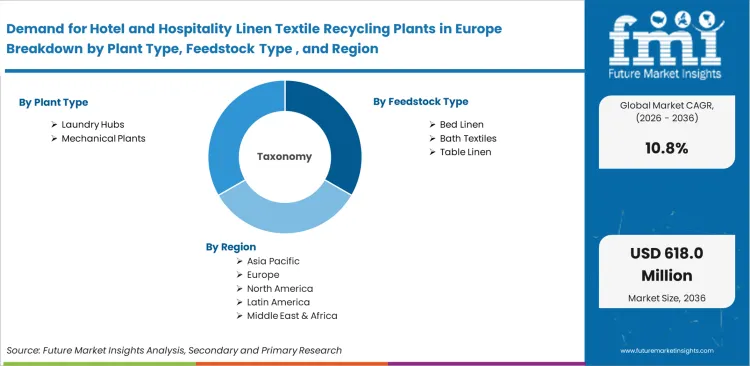
- The industry covers plants recycling hotel bed linen, towels, table linen, and mixed hospitality textiles through sorting, shredding, fiber recovery, and reuse.
- These facilities serve hotel chains, resorts, linen rental programs, and commercial laundry networks that manage textile flows for hospitality clients.
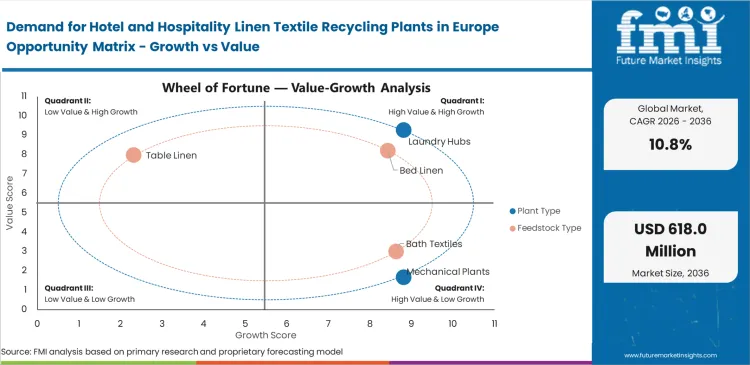
- Laundry-linked recycling hubs hold 36.0% of the Plant Type segment because linen-service operators already manage collection, washing, and takeback.
- Cotton-rich bed linen accounts for 41.0% of the Feedstock Type segment due to its wide use and simpler fiber handling.
- Mechanical recycling holds 48.0% of the Recycling Route segment because most active European projects still focus on physical processing.
- Industrial wiping and cleaning textiles represent 31.0% of the Output Product segment as recovered linen often enters secondary applications first.
- Hotel laundry networks account for 44.0% of the Source Channel segment because organized commercial laundries handle most linen turnover.
- The scope includes hospitality linen recycling plants and hotel-textile recovery hubs, excluding municipal clothing recycling, healthcare-only linen systems, and home programs.
- The industry covers plants and processing hubs handling hotel bed linen, towels, table linen, and mixed hospitality textiles through sorting, shredding, fiber recovery, and downstream reuse or recycling routes.
- Geography and Competitive Outlook
- Spain, Italy, and the Netherlands are the fastest-growing markets, while Germany and France remain steadier bases for processing capacity.
- Competition centers on recycling partnerships, linen takeback programs, and service coordination among Elis, Lindström Group, Blycolin, Johnsons Hotel Linen, TexCycle, and Polarier.
- The landscape remains fragmented, with Elis holding an estimated 16.0% share, because no operator controls Europe’s full hospitality-linen recycling chain.
- Commercial strength depends on recurring linen volumes, efficient plant logistics, hotel contracts, and reliable conversion of worn textiles into usable outputs.
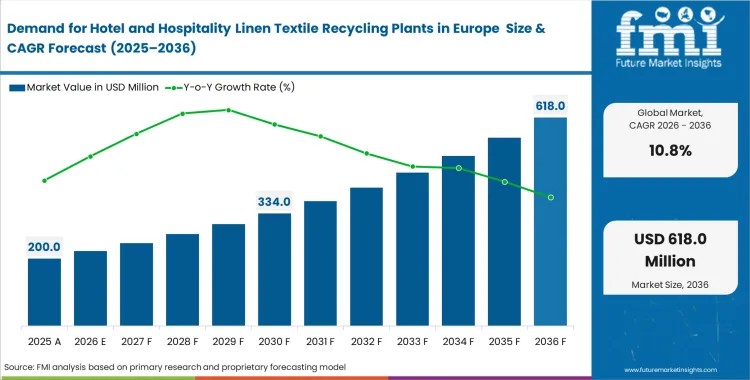
Hotel groups across Europe are facing higher costs for textile disposal. Used bed sheets, towels, and other linen waste now carry stricter handling requirements under EU waste rules. This is pushing buyers to secure agreements with textile recycling plants. Waste processing is becoming a core operating requirement for large hospitality chains. Limited access to recycling capacity can raise compliance costs and disrupt disposal planning.
Sorting efficiency improves when commercial laundry partners install automated scanners at collection and processing sites. Larger volumes of similar linen types reduce the cost of manual separation. Mechanical recycling becomes more practical when feedstock arrives in steady volumes from centralized laundry networks.
Spain is projected to record a 12.4% CAGR in the hotel and hospitality linen textile recycling plants market from 2026 to 2036. Italy follows at 12.0% CAGR over the same period. The Netherlands is expected to expand at 11.8% CAGR. Germany is forecast to grow at 11.2%, while France posts 10.9% CAGR from 2026 to 2036. The United Kingdom is set to register 10.7%, and Poland 10.1%, in this market over the forecast period. Differences across countries reflect local enforcement levels for commercial textile disposal and recycling investment.
Segmental Analysis
Demand for Hotel and Hospitality Linen Textile Recycling Plants in Europe Analysis by Plant Type
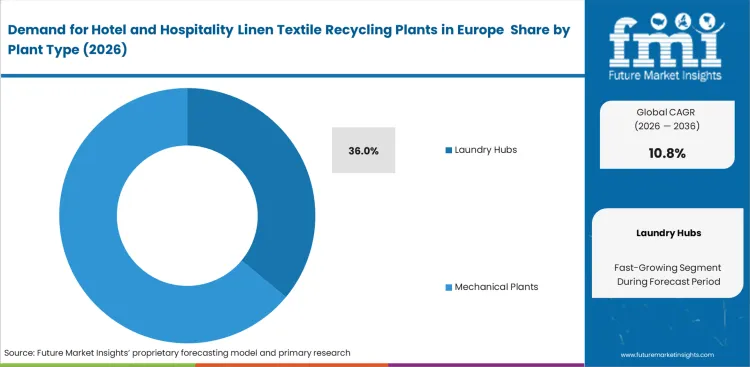
Decentralized processing breaks down when transport costs absorb already tight margins. Laundry-linked recycling hubs remove this pressure by placing tearing and baling equipment inside washing facilities. Laundry-linked recycling hubs lead with 36.0% share in 2026, driven by direct capture of discarded linens at the point they exit service. FMI’s analysis indicates that this setup locks in material before it enters external waste streams, avoiding both transport costs and classification requirements. Operators that continue using third-party disposal face steadily rising fees that cut into rental income.
- Shredders placed next to washing lines turn discarded linen into immediate input, removing the need for any inbound logistics step.
- When sorting is not handled at the laundry stage, facilities rely on optical systems that add cost without fixing upstream errors.
- Savings build from avoided disposal and transport charges, not from price premiums, which shortens recovery timelines once throughput stabilizes.
Demand for Hotel and Hospitality Linen Textile Recycling Plants in Europe Analysis by Feedstock Type
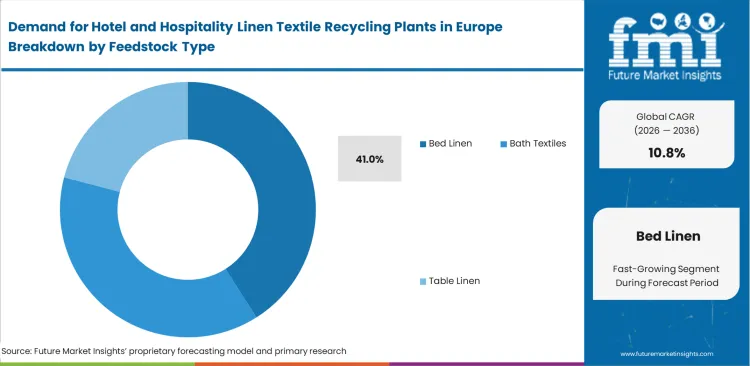
Processing stability depends on how uniform the input stream remains. Cotton-rich bed linen leads with 41.0% share in 2026 as consistent fiber structure allows machines to run without repeated adjustment. Procurement teams remove these items based on visible wear, which keeps supply predictable. FMI’s assessment points to this repeatability as the main reason recycling lines maintain steady utilization. Chemical residues from earlier treatment stages still interfere with processing, forcing periodic recalibration. Mixed or blended fabrics increase stoppages and reduce line efficiency.
- Identical bedding batches allow operators to run tearing lines continuously without resetting blade configurations.
- Small contaminants, including embedded synthetics or tracking tags, can damage batch quality, pushing inspection earlier in the workflow.
- Input mix is changing as hospitality buyers shift toward synthetics, reducing the share of clean cotton available for processing.
Demand for Hotel and Hospitality Linen Textile Recycling Plants in Europe Analysis by Recycling Route
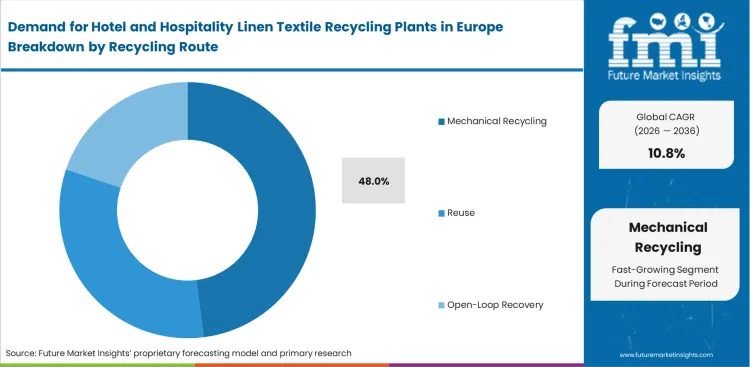
Mechanical recycling hotel linen leads with 48.0% share in 2026. Much of this comes from tearing systems, which pull used linen back into fiber without using chemical recycling methods. Plant managers prefer them because they are easier to install and run. These systems are commonly used for table and kitchen linen. The downside is that fiber gets shorter after each cycle, which reduces reuse quality over time.
- Early processing cycles still produce usable fiber, but later passes reduce material into dust that cannot enter spinning applications.
- Heavily used textiles break apart more easily, increasing airborne waste and lowering recovery rates during tearing.
- End users require minimum strength levels, so recycled output is often mixed with virgin fiber to meet specifications.
Demand for Hotel and Hospitality Linen Textile Recycling Plants in Europe Analysis by Output Product
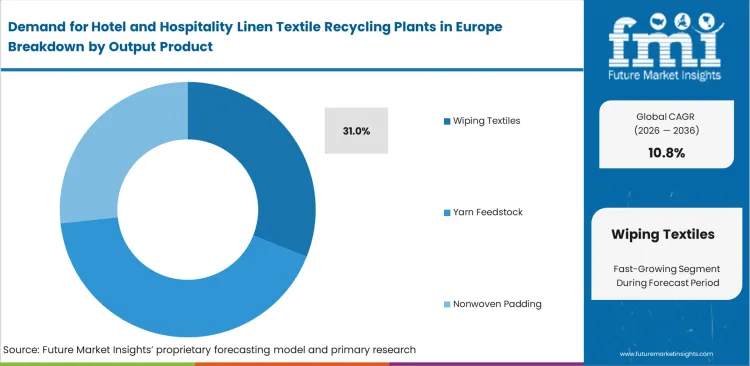
Industrial wiping cloths made from hotel linen are expected to hold 31.0% share in 2026. This segment grows because mechanically recycled fabric can be turned into wiping rags quickly and sold without complex processing. Manufacturing plants use these cloths in large volumes, where absorbency matters more than appearance. FMI analysis suggests that converting discarded bedding and linen into industrial wipers needs much lower investment than spinning recycled yarn. Demand in this segment still depends heavily on the health of regional automotive and industrial activity. When factory output slows, demand for wiping cloths can weaken quickly and leave recyclers with unsold inventory. Plants that rely too much on this one output may face unstable revenue, especially if they do not expand into higher-value products such as recycled yarn.
- Production setups tend to prioritize cutting efficiency and standardized sizing rather than maximizing fiber recovery or quality enhancement.
- Residual fibers that fall outside wiping specifications are redirected into insulation use, where performance requirements allow broader variation.
- Facilities heavily dependent on this route experience uneven throughput when manufacturing demand contracts, with limited fallback options.
Demand for Hotel and Hospitality Linen Textile Recycling Plants in Europe Analysis by Source Channel
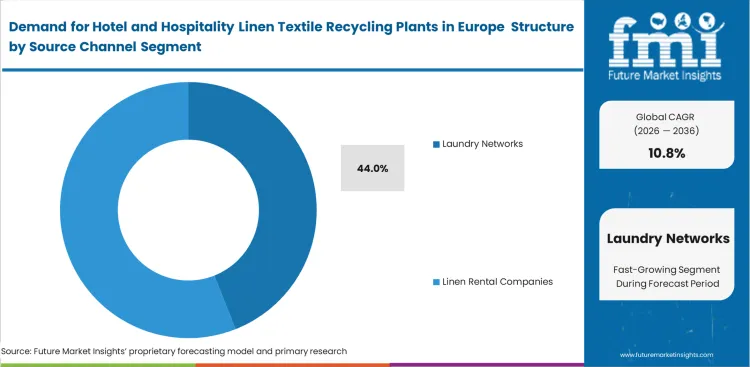
Hotel laundry networks play a leading role in this market because they centralize large textile volumes and held 44.0% share in 2026. This makes them a reliable source of feedstock for recycling operators. FMI analysts note that working with these networks is often the most practical way to maintain stable plant utilization. The challenge is that hotels often lease linen rather than own it, so recycling depends heavily on rental and laundry partners. Operators that bypass these networks and collect from individual hotels usually face higher transport costs and weaker margins.
- Collection systems built around independent hotels introduce irregular pickup volumes, disrupting processing schedules and increasing cost per unit.
- Variability in handling practices across smaller sites raises contamination risk, often forcing rejection of entire loads upon arrival.
- Facilities that lack direct alignment with large laundry operators struggle to maintain steady input, which affects utilization rates and planning accuracy.
Hotel and Hospitality Linen Textile Recycling Plants in Europe Market Drivers, Restraints, and Opportunities
Regulatory mandates on commercial textile waste are forcing hospitality operators to change disposal practices. European rules on separate textile collection and landfill diversion are increasing pressure on hotel groups and commercial laundries. Disposal fees for used linen are rising, which is tightening operating margins. Access to regional textile waste recycling machine is becoming a procurement requirement rather than a sustainability preference. Delayed off-take agreements can leave operators exposed to higher disposal costs. This is driving faster investment in hospitality linen recycling infrastructure across Europe.
Blended textile compositions are creating processing difficulties inside recycling plants. Poly-cotton linen is harder to separate than pure cotton material. Cotton fibers process more predictably during mechanical tearing. Synthetic content can stretch, wrap around equipment, and reduce line efficiency. Plant teams often need to stop machinery to remove tangled fibers. Chemical separation methods remain costly and energy intensive, which limits wider commercial use. Optical sorting helps at the pre-processing stage, though heavily blended hospitality textiles still reduce throughput. Closed-loop hotel linen recycling in Europe remains limited until blended-fiber processing becomes more efficient and more economical.
Opportunities in the Hotel and Hospitality Linen Textile Recycling Plants in Europe
- Chemical depolymerization expansion: Advancements in solvent-based recovery permit total separation of poly-cotton blends. R&D directors capture premium pricing by supplying pure cellulose pulp to advanced fiber spinners.
- Data-driven tracking platforms: Mandated traceability requires precise chain-of-custody documentation. Software engineers build integrated RFID tracking systems proving circularity metrics for hospitality corporate reporting.
- Localized micro-processing: Urban hotel density supports smaller automated tearing units. Facility managers deploy modular textile staples recovery systems inside city limits, drastically reducing regional transport requirements for hotel linen reuse and repurposing.
Regional Analysis
.webp "Top Country Growth Comparison Demand For Hotel And Hospitality Linen Textile Recycling Plants In Europe Cagr (2026 2036)")
Based on regional analysis, Hotel and Hospitality Linen Textile Recycling Plants in Europe is segmented into Southern Europe, Western Europe, and Central and Eastern Europe across 40 plus countries.
| Country | CAGR (2026 to 2036) |
|---|---|
| Spain | 12.4% |
| Italy | 12.0% |
| Netherlands | 11.8% |
| Germany | 11.2% |
| France | 10.9% |
| United Kingdom | 10.7% |
| Poland | 10.1% |
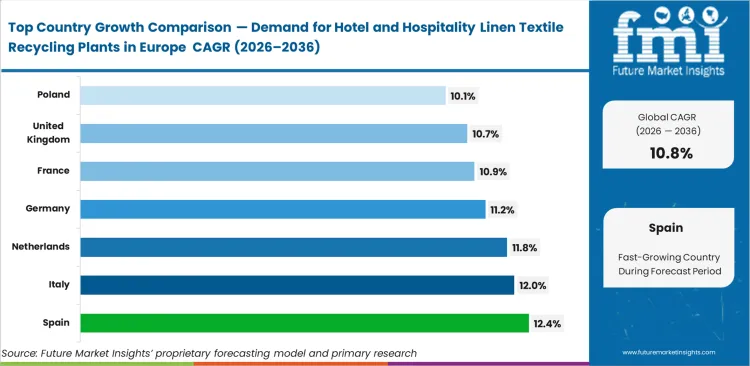
Source: Future Market Insights (FMI) analysis, based on proprietary forecasting model and primary research
Southern Europe Hotel and Hospitality Linen Textile Recycling Plants in Europe Market Analysis
Seasonal tourism cycles across Mediterranean economies impose uneven input flows, requiring plants to manage peak summer surges followed by underutilized winter capacity. Engineering decisions prioritize modular mechanical systems, flexible labor deployment, and short-cycle storage. Cross-border textile movement remains limited due to transport costs, so facilities cluster near coastal hospitality zones. Regulatory pressure focuses on diverting commercial laundry waste from landfill, pushing localized preprocessing infrastructure rather than centralized export-oriented systems.
- Spain: Demand for hotel and hospitality linen textile recycling plants in Spain is anticipated to rise at a 12.4% CAGR through 2036. Coastal tourism belts are tightening waste diversion practices, which is increasing the need for near-site textile sorting before disposal or reuse. This is pushing operators to set up decentralized hubs close to dense hotel clusters, where collection volumes remain more stable. Port infrastructure supports managed outbound movement, though a large share of recovered fibers is expected to remain within the domestic market due to cost considerations. Municipal contract compliance continues to shape plant location, throughput planning, and seasonal operating structures across key hospitality regions.
- Italy: Sales of hotel and hospitality linen textile recycling plants in Italy are set to record 12.0% CAGR during the assessment period. Northern industrial corridors are strengthening this outlook by linking recycled textile output with established spinning and fashion supply chains, which helps reduce dependence on imported fibers. Plant operators are focusing on high-grade recovery aligned with luxury hospitality requirements, while strict traceability standards are guiding material handling practices. Domestic premium manufacturers are expected to absorb much of the recovered supply, keeping export volumes selective. Waste classification norms and fiber quality oversight remain central to processing configurations, especially in hospitality-intensive regions.
Western Europe Hotel and Hospitality Linen Textile Recycling Plants in Europe Market Analysis
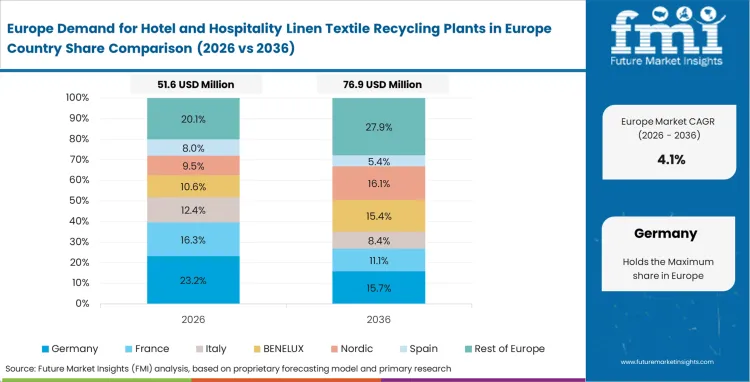
Regulatory enforcement across Western Europe centers on circular textile flows, traceability, and reduced reliance on imported raw fibers. Public funding supports advanced processing infrastructure, including chemical regeneration, while audit systems govern material movement. Dense transport networks enable cross-border textile flows, though national policies increasingly favor domestic retention. Procurement standards from hospitality operators require verified recycling pathways, influencing long-term supply agreements and technology adoption across facilities.
- Netherlands: Sales of hotel and hospitality linen textile recycling plants in the Netherlands are set to rise at an 11.8% CAGR through 2036. Policy support remains a major growth lever, as financial incentives are increasingly linked with traceable recycling performance. This is encouraging stronger alignment between commercial laundries and processing units across the country. Operators are also benefiting from port connectivity, which helps manage controlled textile imports and supports selected re-export activity. Subsidy-backed expansion in chemical processing is adding further capacity, while dense infrastructure keeps short-haul logistics efficient. These factors continue to support a distributed recycling model in the Dutch market.
- Germany: The hotel and hospitality linen textile recycling plants industry in Germany is anticipated to record 11.2% CAGR during the forecast period. Growth is being shaped by industrial automation and the country’s engineering-led operating structure. Processing facilities are using optical sorting technologies to handle mixed textile streams with lower manual dependence. Domestic machinery availability is also helping stabilize equipment investment and reduce procurement risk. At the same time, strict federal waste rules are raising recovery expectations and limiting landfill reliance. Well-developed rail and road networks keep inbound textile movement steady, strengthening Germany’s processing role across Europe.
- France: Demand for hotel and hospitality linen textile recycling plants in France is poised to expand at 10.9% CAGR by 2036. Regulatory compliance remains central to market development, with investment increasingly directed toward traceable and regionally managed recovery systems. Extended producer responsibility requirements are compelling operators to track recovered fibers more closely, which narrows export flexibility. Public support is favoring regional processing build-out over centralized capacity concentration. Hospitality buyers are also aligning procurement with national sustainability goals, helping maintain reliable feedstock availability. This continues to shape France as a tightly regulated but stable growth market.
- United Kingdom: The hotel and hospitality linen textile recycling plants market in the United Kingdom is expected to register a 10.7% CAGR during the assessment period. Shifts in landfill taxation and post-Brexit waste shipment controls are making domestic recycling more commercially attractive. Operators are responding by retaining more textile waste within national processing systems to reduce exposure to export barriers and pricing uncertainty. Port infrastructure still supports movement, although outbound channels remain subject to tighter compliance procedures. Investment is largely moving into scalable mechanical recycling systems, with selective chemical capacity added where resource efficiency targets support it. This is gradually strengthening the country’s domestic processing base.
Central and Eastern Europe Hotel and Hospitality Linen Textile Recycling Plants in Europe Market Analysis
Maturing logistics networks slowly integrate regional linen streams into broader continental processing hubs. Transport coordinators build consolidation routes capturing inventory from emerging hotel chains. FMI analysts observe that initial capital deployment prioritizes heavy mechanical tearing over experimental chemical processes. Focus remains strictly on generating reliable, low-cost industrial wiping materials.
- Poland: Demand for hotel and hospitality linen textile recycling plants in Poland is anticipated to rise at a 10.1% CAGR through 2036. The country’s position as a regional processing hub continues to support this outlook, especially as proximity to Germany and nearby economies helps maintain stable inbound textile volumes through road freight corridors. Processing facilities are largely geared toward high-throughput mechanical tearing, with stronger emphasis on industrial-grade output than premium fiber recovery. Lower labor costs and relatively flexible operating conditions are also supporting competitive processing economics. Export activity remains active across the market, linking Polish output with Western European demand and secondary manufacturing destinations. This keeps Poland well placed in the region’s volume-driven recycling network.
FMI's report includes extensive analysis covering remaining Nordic and Baltic territories. Regional dynamics confirm that policy enforcement speed ultimately determines where major capital equipment gets deployed.
Competitive Aligners for Market Players
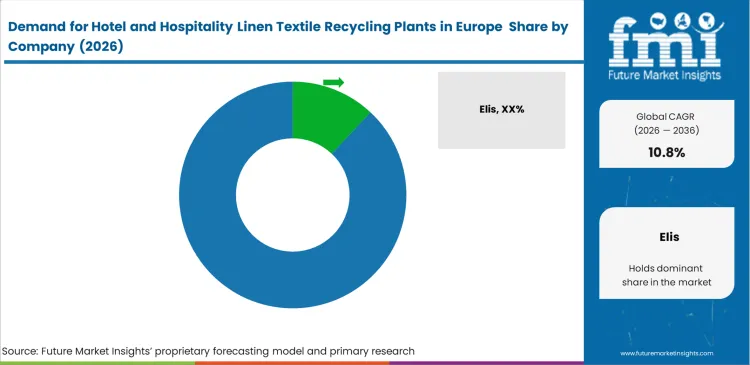
Exclusive control over textile feedstock shapes market viability well before recycling equipment is commissioned. Elis gains a clear advantage here because it manages large rental textile volumes across Europe, rather than depending only on stronger tearing capability. Its facilities receive steady streams of hotel linens and antimicrobial hospital textiles through internal collection networks. That consistency allows plant teams to configure systems around known material compositions and more predictable contamination profiles.
By contrast, recycling operators without long-term supply control work with textile waste collected from multiple outside sources. This creates constant variation in fabric mix, quality, and impurity levels, which forces frequent adjustment across processing lines. Equipment decisions in such cases depend less on uniform throughput and more on the ability to handle mixed and lower-grade inputs. Operators with captive supply networks face fewer of these operational limitations and can plan capacity with greater confidence.
Established companies also benefit from existing industrial footprints and approved logistics systems. Lindström Group and Johnsons Hotel Linen operate sites that are already aligned with zoning and environmental conditions needed for heavy textile processing. New participants often require years to secure permits for dust-generating shredding operations, which slows market entry. Existing providers can install recycling units faster within current facilities, while integration with collection and distribution systems lowers execution risk.
Traceability is becoming equally important across hospitality linen recycling programs in Europe. Large hotel groups increasingly require clear tracking of discarded textile volumes across their supply chains. In response, Blycolin are investing in software platforms that monitor material movement from collection to final output. Facilities are expected to document how each textile batch is processed and where recovered material is directed. Those lacking this level of visibility are likely to lose access to major hospitality contracts.
Key Players in Hotel and Hospitality Linen Textile Recycling Plants in Europe Market
- Elis
- Lindström Group
- Blycolin
- Johnsons Hotel Linen
- TexCycle
- Polarier
Scope of the Report
| Metric | Value |
|---|---|
| Quantitative Units | USD 200.0 million to USD 560.0 million, at a CAGR of 11.1% |
| Market Definition | Industrial operations converting discarded commercial lodging fabrics into secondary raw materials or repurposed textiles through mechanical and chemical processing. |
| Segmentation | Plant Type, Feedstock Type, Recycling Route, Output Product, Source Channel, Region |
| Regions Covered | North America, Latin America, Europe, Asia Pacific, Middle East and Africa |
| Countries Covered | Spain, Italy, Netherlands, Germany, France, United Kingdom, Poland |
| Key Companies Profiled | Elis, Lindström Group, Blycolin, Johnsons Hotel Linen, TexCycle, Polarier |
| Forecast Period | 2026 to 2036 |
| Approach | Installed capacity volumes measured against regional hotel bed-night statistics. |
Source: Future Market Insights (FMI) analysis, based on proprietary forecasting model and primary research
Hotel and Hospitality Linen Textile Recycling Plants in Europe Market Analysis by Segments
Plant Type
- Laundry Hubs
- Mechanical Plants
- Sorting Centers
- Finishing Plants
Feedstock Type
- Bed Linen
- Bath Textiles
- Table Linen
- Mixed Textile Waste
Recycling Route
- Mechanical Recycling
- Reuse
- Open-Loop Recovery
- Closed-Loop Recycling
Output Product
- Wiping Textiles
- Yarn Feedstock
- Nonwoven Padding
- Replacement Textiles
Source Channel
- Laundry Networks
- Linen Rental Companies
- Independent Hotels
- Hospitality GroupsTop of Form
- Bottom of Form
Region
- North America
- Latin America
- Europe
- Asia Pacific
- Middle East and Africa
Bibliography
- European Commission. (2025, October). Revised Waste Framework Directive enters into force to boost circularity of textile sector and slash food waste.
- European Environment Agency. (2024, May). Management of used and waste textiles in Europe’s circular economy. European Environment Agency.
- Lindström Group. (2026, March 10). Textile service companies unite to advance textile recycling in Europe.
- Deckers, J., Duhoux, T., & European Topic Centre on Circular Economy and Resource Use. (2024, May). Textile waste management in Europe’s circular economy. European Topic Centre on Circular Economy and Resource Use.
- Pavlopoulou, K. E., Hrůzová, K., Kahoush, M., Kadi, N., Patel, A., Rova, U., Matsakas, L., & Christakopoulos, P. (2024). Textile recycling: Efficient polyester recovery from polycotton blends using the heated high-ethanol alkaline aqueous process. Polymers, 16(21), 3008.
This bibliography is provided for reader reference. The full FMI report contains the complete reference list with primary source documentation.
This Report Addresses
- Processing economics concerning mechanical tearing versus chemical depolymerization.
- Logistics integration advantages held by dominant linen rental companies.
- Impacts of extended producer responsibility mandates on facility deployment speed.
- Fiber length degradation limits restricting closed-loop circularity efforts.
- Optical sorting automation requirements for handling complex poly-cotton blends.
- Feedstock consolidation strategies utilized by major hospitality laundry networks.
- Capital expenditure barriers blocking standalone independent recycling plants.
- Off-take qualification standards demanded by downstream yarn spinners.
Frequently Asked Questions
How large is the hospitality linen recycling sector in Europe?
Facilities handling commercial fabric recovery generated USD 200.0 million in 2026. This metric reflects accelerating capital deployment driven directly by imminent landfill bans targeting hospitality operators.
What valuation will these facilities reach by 2036?
Total revenue touches USD 560.0 million by 2036. Sustained expansion stems from chemical depolymerization technology achieving commercial scale capable of processing complex poly-cotton blends efficiently.
What dictates the growth rate here?
A compound growth rate of 11.1% persists due to regulatory fines. Hospitality chains cannot absorb escalating disposal fees, forcing rapid investment into dedicated secondary material processing infrastructure.
Which facility type processes the most volume?
Laundry-linked recycling hubs process 36.0% of all feedstock. Collocating tearing machinery directly beside washing operations eliminates redundant transportation legs, allowing operators to secure pure inputs at zero acquisition cost.
Why does this specific plant design dominate?
Internalizing waste processing bypasses municipal transport restrictions. Logistics directors transform standard waste disposal expenses into profitable secondary raw material streams by avoiding third-party collection fees completely.
Which fabric provides the primary intake material?
Cotton-rich bed linen represents 41.0% of all processed inputs. High uniformity allows plant managers to run mechanical shredders continuously without recalibrating blade settings for different fabric densities.
How does processing this specific fabric shape plant operations?
Predictable composition lowers optical sorting requirements. Facility engineers depend on pure cotton streams to maintain high-throughput margins before machinery requires maintenance for blade sharpening.
What processing method is utilized most frequently?
Mechanical recycling accounts for 48.0% of operational capacity. Lower initial capital requirements allow regional commercial laundries to install tearing lines without waiting for complex chemical handling permits.
What limits mechanical processing efficiency?
Fiber staple length degrades violently during rotary tearing. Quality control supervisors struggle to qualify mechanically shredded outputs for anything beyond basic industrial padding or acoustic insulation applications.
Which output product generates the highest early volume?
Industrial wiping textiles capture 31.0% share initially. Minimal technical specifications allow facility directors to commercialize these basic rags immediately, bypassing complex qualification standards demanded by yarn spinners.
How does legislation alter facility deployment?
Extended producer responsibility rules shift disposal costs onto fabric owners. Sustainability directors must underwrite regional recycling capacity simply to maintain basic legal compliance across their property portfolios.
What operational advantage do incumbents possess?
Legacy commercial laundries hold pre-approved industrial zoning. Challengers face multi-year municipal battles securing permits for dust-generating mechanical operations, allowing incumbents to launch colocated modules years earlier.
How do large hotel groups exert pressure on these plants?
Corporate sustainability officers demand verifiable chain-of-custody documentation. Regional operators lacking sophisticated digital tracking frameworks lose access to premium hospitality contracts entirely.
What technology expands future processing capabilities?
Solvent-based depolymerization permits total separation of synthetic blends. R&D directors capture premium pricing by supplying pure cellulose pulp extracted chemically from otherwise unprocessable poly-cotton waste.
Where does localized processing show promise?
Urban hotel density supports modular tearing units. Facility managers deploy automated recovery systems directly inside city limits, drastically reducing regional transport requirements for basic fabric downcycling.
What determines ultimate processing survival?
Intake logistics dictate facility economics. Plants relying on contaminated municipal collection face margin collapse, while those integrated into closed-loop hotel networks capture pure streams ensuring continuous shredder utilization.
Preview the report firsthand - request a free sample
Get SampleGet the brochure for pricing and purchase details.
Get PDFTable of Content
- Executive Summary
- Global Market Outlook
- Demand-side Trends
- Supply-side Trends
- Technology Roadmap Analysis
- Analysis and Recommendations
- Market Overview
- Market Coverage / Taxonomy
- Market Definition / Scope / Limitations
- Research Methodology
- Chapter Orientation
- Analytical Lens and Working Hypotheses
- Market Structure, Signals, and Trend Drivers
- Benchmarking and Cross-market Comparability
- Market Sizing, Forecasting, and Opportunity Mapping
- Research Design and Evidence Framework
- Desk Research Programme (Secondary Evidence)
- Company Annual and Sustainability Reports
- Peer-reviewed Journals and Academic Literature
- Corporate Websites, Product Literature, and Technical Notes
- Earnings Decks and Investor Briefings
- Statutory Filings and Regulatory Disclosures
- Technical White Papers and Standards Notes
- Trade Journals, Industry Magazines, and Analyst Briefs
- Conference Proceedings, Webinars, and Seminar Materials
- Government Statistics Portals and Public Data Releases
- Press Releases and Reputable Media Coverage
- Specialist Newsletters and Curated Briefings
- Sector Databases and Reference Repositories
- FMI Internal Proprietary Databases and Historical Market Datasets
- Subscription Datasets and Paid Sources
- Social Channels, Communities, and Digital Listening Inputs
- Additional Desk Sources
- Expert Input and Fieldwork (Primary Evidence)
- Primary Modes
- Qualitative Interviews and Expert Elicitation
- Quantitative Surveys and Structured Data Capture
- Blended Approach
- Why Primary Evidence is Used
- Field Techniques
- Interviews
- Surveys
- Focus Groups
- Observational and In-context Research
- Social and Community Interactions
- Stakeholder Universe Engaged
- C-suite Leaders
- Board Members
- Presidents and Vice Presidents
- R&D and Innovation Heads
- Technical Specialists
- Domain Subject-matter Experts
- Scientists
- Physicians and Other Healthcare Professionals
- Governance, Ethics, and Data Stewardship
- Research Ethics
- Data Integrity and Handling
- Primary Modes
- Tooling, Models, and Reference Databases
- Desk Research Programme (Secondary Evidence)
- Data Engineering and Model Build
- Data Acquisition and Ingestion
- Cleaning, Normalisation, and Verification
- Synthesis, Triangulation, and Analysis
- Quality Assurance and Audit Trail
- Market Background
- Market Dynamics
- Drivers
- Restraints
- Opportunity
- Trends
- Scenario Forecast
- Demand in Optimistic Scenario
- Demand in Likely Scenario
- Demand in Conservative Scenario
- Opportunity Map Analysis
- Product Life Cycle Analysis
- Supply Chain Analysis
- Investment Feasibility Matrix
- Value Chain Analysis
- PESTLE and Porter’s Analysis
- Regulatory Landscape
- Regional Parent Market Outlook
- Production and Consumption Statistics
- Import and Export Statistics
- Market Dynamics
- Global Market Analysis 2021 to 2025 and Forecast, 2026 to 2036
- Historical Market Size Value (USD Million) Analysis, 2021 to 2025
- Current and Future Market Size Value (USD Million) Projections, 2026 to 2036
- Y-o-Y Growth Trend Analysis
- Absolute $ Opportunity Analysis
- Global Market Pricing Analysis 2021 to 2025 and Forecast 2026 to 2036
- Global Market Analysis 2021 to 2025 and Forecast 2026 to 2036, By Service Model
- Introduction / Key Findings
- Historical Market Size Value (USD Million) Analysis By Service Model , 2021 to 2025
- Current and Future Market Size Value (USD Million) Analysis and Forecast By Service Model , 2026 to 2036
- Rental-Linked
- Rental-Linked
- Y-o-Y Growth Trend Analysis By Service Model , 2021 to 2025
- Absolute $ Opportunity Analysis By Service Model , 2026 to 2036
- Global Market Analysis 2021 to 2025 and Forecast 2026 to 2036, By System Type
- Introduction / Key Findings
- Historical Market Size Value (USD Million) Analysis By System Type, 2021 to 2025
- Current and Future Market Size Value (USD Million) Analysis and Forecast By System Type, 2026 to 2036
- Take-Back Logistics
- Take-Back Logistics
- Y-o-Y Growth Trend Analysis By System Type, 2021 to 2025
- Absolute $ Opportunity Analysis By System Type, 2026 to 2036
- Global Market Analysis 2021 to 2025 and Forecast 2026 to 2036, By Material Focus
- Introduction / Key Findings
- Historical Market Size Value (USD Million) Analysis By Material Focus, 2021 to 2025
- Current and Future Market Size Value (USD Million) Analysis and Forecast By Material Focus, 2026 to 2036
- Polycotton
- Polycotton
- Y-o-Y Growth Trend Analysis By Material Focus, 2021 to 2025
- Absolute $ Opportunity Analysis By Material Focus, 2026 to 2036
- Global Market Analysis 2021 to 2025 and Forecast 2026 to 2036, By Region
- Introduction
- Historical Market Size Value (USD Million) Analysis By Region, 2021 to 2025
- Current Market Size Value (USD Million) Analysis and Forecast By Region, 2026 to 2036
- North America
- Latin America
- Western Europe
- Eastern Europe
- East Asia
- South Asia and Pacific
- Middle East & Africa
- Market Attractiveness Analysis By Region
- North America Market Analysis 2021 to 2025 and Forecast 2026 to 2036, By Country
- Historical Market Size Value (USD Million) Trend Analysis By Market Taxonomy, 2021 to 2025
- Market Size Value (USD Million) Forecast By Market Taxonomy, 2026 to 2036
- By Country
- USA
- Canada
- Mexico
- By Service Model
- By System Type
- By Material Focus
- By Country
- Market Attractiveness Analysis
- By Country
- By Service Model
- By System Type
- By Material Focus
- Key Takeaways
- Latin America Market Analysis 2021 to 2025 and Forecast 2026 to 2036, By Country
- Historical Market Size Value (USD Million) Trend Analysis By Market Taxonomy, 2021 to 2025
- Market Size Value (USD Million) Forecast By Market Taxonomy, 2026 to 2036
- By Country
- Brazil
- Chile
- Rest of Latin America
- By Service Model
- By System Type
- By Material Focus
- By Country
- Market Attractiveness Analysis
- By Country
- By Service Model
- By System Type
- By Material Focus
- Key Takeaways
- Western Europe Market Analysis 2021 to 2025 and Forecast 2026 to 2036, By Country
- Historical Market Size Value (USD Million) Trend Analysis By Market Taxonomy, 2021 to 2025
- Market Size Value (USD Million) Forecast By Market Taxonomy, 2026 to 2036
- By Country
- Germany
- UK
- Italy
- Spain
- France
- Nordic
- BENELUX
- Rest of Western Europe
- By Service Model
- By System Type
- By Material Focus
- By Country
- Market Attractiveness Analysis
- By Country
- By Service Model
- By System Type
- By Material Focus
- Key Takeaways
- Eastern Europe Market Analysis 2021 to 2025 and Forecast 2026 to 2036, By Country
- Historical Market Size Value (USD Million) Trend Analysis By Market Taxonomy, 2021 to 2025
- Market Size Value (USD Million) Forecast By Market Taxonomy, 2026 to 2036
- By Country
- Russia
- Poland
- Hungary
- Balkan & Baltic
- Rest of Eastern Europe
- By Service Model
- By System Type
- By Material Focus
- By Country
- Market Attractiveness Analysis
- By Country
- By Service Model
- By System Type
- By Material Focus
- Key Takeaways
- East Asia Market Analysis 2021 to 2025 and Forecast 2026 to 2036, By Country
- Historical Market Size Value (USD Million) Trend Analysis By Market Taxonomy, 2021 to 2025
- Market Size Value (USD Million) Forecast By Market Taxonomy, 2026 to 2036
- By Country
- China
- Japan
- South Korea
- By Service Model
- By System Type
- By Material Focus
- By Country
- Market Attractiveness Analysis
- By Country
- By Service Model
- By System Type
- By Material Focus
- Key Takeaways
- South Asia and Pacific Market Analysis 2021 to 2025 and Forecast 2026 to 2036, By Country
- Historical Market Size Value (USD Million) Trend Analysis By Market Taxonomy, 2021 to 2025
- Market Size Value (USD Million) Forecast By Market Taxonomy, 2026 to 2036
- By Country
- India
- ASEAN
- Australia & New Zealand
- Rest of South Asia and Pacific
- By Service Model
- By System Type
- By Material Focus
- By Country
- Market Attractiveness Analysis
- By Country
- By Service Model
- By System Type
- By Material Focus
- Key Takeaways
- Middle East & Africa Market Analysis 2021 to 2025 and Forecast 2026 to 2036, By Country
- Historical Market Size Value (USD Million) Trend Analysis By Market Taxonomy, 2021 to 2025
- Market Size Value (USD Million) Forecast By Market Taxonomy, 2026 to 2036
- By Country
- Kingdom of Saudi Arabia
- Other GCC Countries
- Turkiye
- South Africa
- Other African Union
- Rest of Middle East & Africa
- By Service Model
- By System Type
- By Material Focus
- By Country
- Market Attractiveness Analysis
- By Country
- By Service Model
- By System Type
- By Material Focus
- Key Takeaways
- Key Countries Market Analysis
- USA
- Pricing Analysis
- Market Share Analysis, 2025
- By Service Model
- By System Type
- By Material Focus
- Canada
- Pricing Analysis
- Market Share Analysis, 2025
- By Service Model
- By System Type
- By Material Focus
- Mexico
- Pricing Analysis
- Market Share Analysis, 2025
- By Service Model
- By System Type
- By Material Focus
- Brazil
- Pricing Analysis
- Market Share Analysis, 2025
- By Service Model
- By System Type
- By Material Focus
- Chile
- Pricing Analysis
- Market Share Analysis, 2025
- By Service Model
- By System Type
- By Material Focus
- Germany
- Pricing Analysis
- Market Share Analysis, 2025
- By Service Model
- By System Type
- By Material Focus
- UK
- Pricing Analysis
- Market Share Analysis, 2025
- By Service Model
- By System Type
- By Material Focus
- Italy
- Pricing Analysis
- Market Share Analysis, 2025
- By Service Model
- By System Type
- By Material Focus
- Spain
- Pricing Analysis
- Market Share Analysis, 2025
- By Service Model
- By System Type
- By Material Focus
- France
- Pricing Analysis
- Market Share Analysis, 2025
- By Service Model
- By System Type
- By Material Focus
- India
- Pricing Analysis
- Market Share Analysis, 2025
- By Service Model
- By System Type
- By Material Focus
- ASEAN
- Pricing Analysis
- Market Share Analysis, 2025
- By Service Model
- By System Type
- By Material Focus
- Australia & New Zealand
- Pricing Analysis
- Market Share Analysis, 2025
- By Service Model
- By System Type
- By Material Focus
- China
- Pricing Analysis
- Market Share Analysis, 2025
- By Service Model
- By System Type
- By Material Focus
- Japan
- Pricing Analysis
- Market Share Analysis, 2025
- By Service Model
- By System Type
- By Material Focus
- South Korea
- Pricing Analysis
- Market Share Analysis, 2025
- By Service Model
- By System Type
- By Material Focus
- Russia
- Pricing Analysis
- Market Share Analysis, 2025
- By Service Model
- By System Type
- By Material Focus
- Poland
- Pricing Analysis
- Market Share Analysis, 2025
- By Service Model
- By System Type
- By Material Focus
- Hungary
- Pricing Analysis
- Market Share Analysis, 2025
- By Service Model
- By System Type
- By Material Focus
- Kingdom of Saudi Arabia
- Pricing Analysis
- Market Share Analysis, 2025
- By Service Model
- By System Type
- By Material Focus
- Turkiye
- Pricing Analysis
- Market Share Analysis, 2025
- By Service Model
- By System Type
- By Material Focus
- South Africa
- Pricing Analysis
- Market Share Analysis, 2025
- By Service Model
- By System Type
- By Material Focus
- USA
- Market Structure Analysis
- Competition Dashboard
- Competition Benchmarking
- Market Share Analysis of Top Players
- By Regional
- By Service Model
- By System Type
- By Material Focus
- Competition Analysis
- Competition Deep Dive
- Elis
- Overview
- Product Portfolio
- Profitability by Market Segments (Product/Age /Sales Channel/Region)
- Sales Footprint
- Strategy Overview
- Marketing Strategy
- Product Strategy
- Channel Strategy
- Lindström
- CWS Workwear
- MEWA
- Fristads
- alsico
- Elis
- Competition Deep Dive
- Assumptions & Acronyms Used


