

- Industry Size (2026)
- USD 160.0 Mn
- Forecast (2036)
- USD 358.4 Mn
- CAGR (2026 to 2036)
- 8.40%
Automotive Seat Cover and Interior Textile Recycling in Europe Market Size, Market Forecast, and Outlook By FMI
The automotive seat cover and interior textile recycling in Europe market was valued at USD 147.6 million in 2025. Demand is poised to cross USD 160.0 million in 2026 at a CAGR of 8.40% during this forecast period. Market expansion is projected to reach USD 358.4 million through 2036 as European regulators mandate closed-loop material recovery targets for vehicle assembly networks.
Summary of Automotive Seat Cover and Interior Textile Recycling in Europe Market
- The market is forecast to reach USD 358.4 million by 2036.
- The market is expected to grow at a CAGR of 8.4% from 2026 to 2036.
- The market was estimated at USD 147.6 million in 2025.
- The forecast period represents an incremental opportunity of USD 198.4 million.
- The market remains niche, supported by ELV dismantling and production scrap recovery across Europe.
- Europe recorded around 4.3 million ELVs and 5.0 million tonnes of ELV weight in 2023, with a parc of 256 million passenger cars and annual production of about 14.8 million units.
- Demand is being driven by evolving vehicle recovery regulations, extended producer responsibility, and mandatory textile collection policies from 2025.
- OEM adoption is improving, with recycled PET textiles meeting seat-cover specifications and mono-material designs aiding recyclability.
- Polyester is expected to dominate the material segment with a 46% share, while ELV textiles account for 61% of source streams and mechanical recycling holds 64% of processing.
- Seat covers lead applications with a 34% share, and OEM interiors dominate end use with 57%.
- Germany, Spain, and France are the fastest-growing markets, while Italy and the United Kingdom show comparatively moderate growth.
- Key companies include Autoneum, Trèves Group, Grupo Antolin, Adler Pelzer Group, Lear, FORVIA, and Sage Automotive Interiors, with competition remaining fragmented across the value chain.
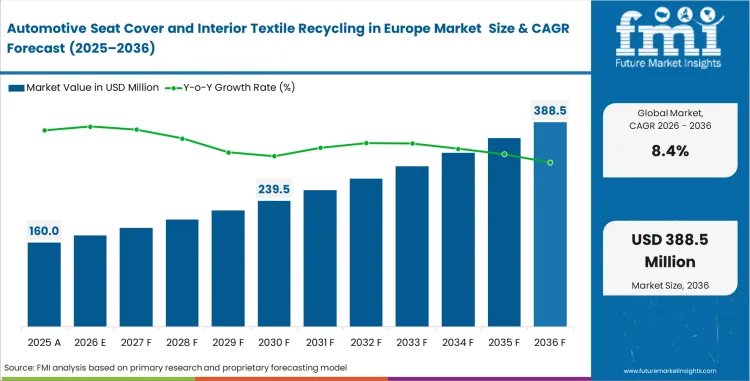
European supply chains face rising pressure to replace conventional virgin textile inputs with traceable recycled materials. End-of-life vehicle rules are accelerating the shift from virgin polymers toward recycled feedstocks in seating and interior trim programs. Moving away from linear material use increasingly requires redesigning entire cabin architectures around automotive fabric components capable of repeated recovery cycles. Delaying this supply chain overhaul exposes manufacturers to severe compliance penalties. Early access to dedicated automotive seat cover recycling capacity is likely to improve supply security and pricing discipline for manufacturersduring the forecast period. .
The market will be shaped by processing discipline. Recycled interior textiles gain traction only when converters can supply consistent material that meets OEM qualification standards on volume and cost. Recycling is likely to provide growth momentum in the near future. Further, companies are likely to adopt depolymerization in use cases where the onus is on high value output. Established European automotive clusters are likely to see faster adoption first, as they already have better ELV availability and more developed recovery systems.
Germany is likely to remain the leading market, with a CAGR of 9.0% during 2026 to 2036, supported by its strong vehicle production base and better integration with interior-component manufacturing. Spain and France are also expected to post strong growth at 8.9% and 8.7%, respectively. Spain benefits from stronger Tier-1 processing capacity, while France is likely to gain from tighter regulatory alignment around waste recovery. Poland and Czechia are projected to grow at 8.5% and 8.3%, respectively, and are likely to remain important cost-competitive processing locations. Italy is expected to expand at 8.1%, while the United Kingdom is projected to grow at 7.8%, with lower vehicle output limiting the available scrap base to some extent.
Segmental Analysis
Automotive Seat Cover and Interior Textile Recycling in Europe Market Analysis by Material Type
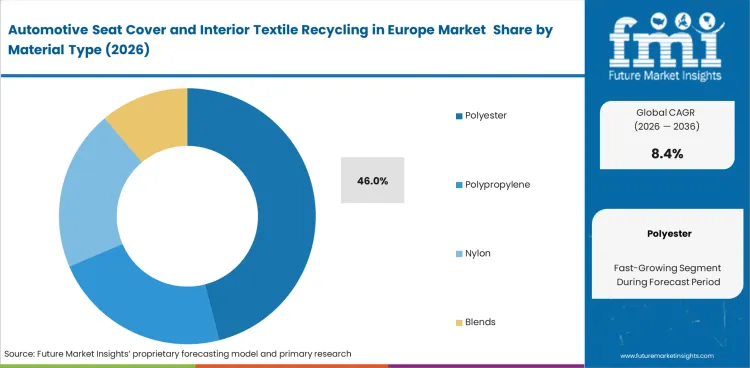
Polyester leads this market due to its wide use across cabin textiles and its stronger fit with current recycling systems than blended interior materials. Established thermomechanical routes andnonwoven conversion systems are better aligned with polyester microfiber fabric, giving recyclers a clearer path to stable output quality. Mono-material polyester structures also reduce dismantling complexity and sorting losses.Polyester is expected to hold 46.0% share of the material type segment in 2026, reflecting its position in vehicle interiors and its compatibility with existing recycling infrastructure across Europe. Contamination identification: Spectroscopy sensors help detect legacy flame-retardant treatments on incoming polyester scrap. Early separation improves batch quality and reduces disruption across polyester microfiber fabric recycling lines.
- Resin degradation: Repeated thermomechanical processing can lower intrinsic viscosity across polyester chains. Performance control remains critical where recycled polyester car seat covers Europe supply chains require stable tensile strength andand processing consistency.
- Specification conformity: OEM interior programs require close control over color consistency and visible-surface quality. Recycled polyester streams need disciplined sorting and formulation adjustment to remain suitable for polyester microfiber fabric applications in exposed cabin textiles.
Automotive Seat Cover and Interior Textile Recycling in Europe Market Analysis by Source Stream
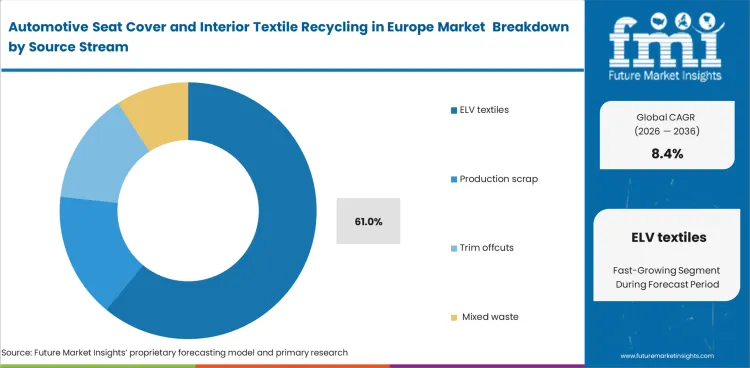
End-of-life vehicle textiles remain the largest segment in this market because scrapped vehicles provide broader material availability than post-industrial interior waste streams. ELV textiles are anticipated to capture 61.0% share.Recovery economics also favor this stream where seat covers, carpets, and other cabin fabrics offer concentrated synthetic material yield across dismantling networks, making ELV interior textile recycling Europe scaling more commercially viable as collection and sorting systems expand. Dependence on production scrap offers less room for volume growth.Feedstock leadership is likely to remain with ELV textiles as long as dismantling efficiencyand downstream processing consistency continue to improve across Europe.
- Dismantling labor rates: Manual removal of cabin fabrics adds meaningful labor cost at dismantling yards. Cost recovery depends on securing enough usable textile volume and maintaining resale value for recovered material streams.
- Yield variability: Embedded foam, adhesives, and layered construction reduce usable fiber output during processing. Lower recovery yield directly affects processing efficiency and limits suitability for higher-value interior applications.
- Lifecycle parity: Recycled fiber pricing often moves in relation to virgin polymer markets. Margin stability depends on disciplined purchasing terms and careful control over input qualityand conversion efficiency.
Automotive Seat Cover and Interior Textile Recycling in Europe Market Analysis by Recycling Process
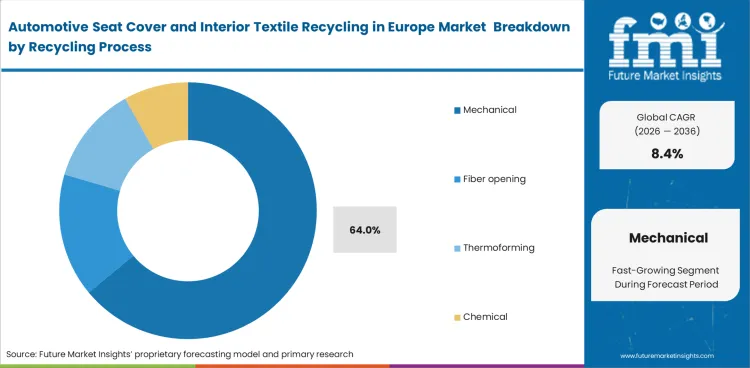
Mechanical recycling remains the leading route in this market as existing infrastructure already supports commercial-scale processing of automotive interior trim parts without the cost burden tied to more advanced conversion systems. Current recovery economics also favor this route for uniform production scrap and post-industrial textile streams that can move into non-visible acoustic and insulation applications with limited upgrading. In the debate around mechanical vs chemical recycling of automotive textiles, mechanical systems retain the stronger position in near-term volume terms.Mechanical processing is estimated to hold 64.0% share of the recycling process segment in 2026, reflecting its established infrastructure base and faster path to usable output across Europe’s interior textile recovery chain. Chemical pathways remain relevant for selected visible-surface applications.
- Capital deployment: Mechanical shredding and carding lines require lower upfront investment than chemical depolymerization systems. Lower entry cost matters because it supports faster capacity additions in insulation, automotive headliner, and non-visible interior applications.
- Feedstock bottlenecks: Chemical conversion economics depend on consistent, high-volume feedstock with tighter material uniformity. Supply instability matters because underutilized reactor capacity can quickly weaken cost competitiveness and delay scale-up.
- Technological convergence: Hybrid processing models combining mechanical sorting with selective chemical purification are gaining practical relevance. This structure matters because it allows recyclers to serve both high-volume non-visible applications and smaller premium programs requiring better surface quality.
Automotive Seat Cover and Interior Textile Recycling in Europe Market Analysis by Application
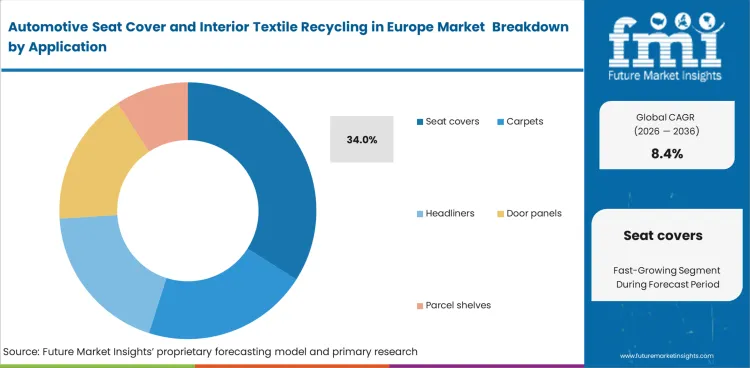
Seat covers lead this market as they offer one of the largest uniform textile areas inside a vehicle, making recovery and sorting easier than in more complex interior components. Material simplification strengthens this position.Visible-surface use also keeps performance requirements high, as durabilitydirectly influences material acceptance. Cleaner textile streams improve downstream processing consistency and reduce avoidable loss during dismantling. Seat covers are anticipated to capture 34.0% share of the application segment in 2026, supported by their scale per vehicle and stronger fit with closed-loop textile recovery pathways. More complex interior textile applications remain harder to recycle, where adhesive layers, mixed construction, and uneven material composition limit recovery efficiency and extend qualification timelines.
- Tear strength validation: Secondary yarns often show lower tensile tolerance under repeated load conditions. Reduced strength matters in seating applications because visible-surface durability and long-use performance remain central to OEM approval.
- Delamination failures: Recycled backing layers can face bond-stability limitations during extreme temperature cycling. Bond failure risk remains commercially important in interior systems where long service life and warranty performance influence material acceptance.
- Testing protocols: Automakers apply extended aging and durability validation before approving recycled textile assemblies for serial use. Long qualification cycles slow adoption even in segments with clearer recovery advantages.
Automotive Seat Cover and Interior Textile Recycling in Europe Market Analysis by End Use
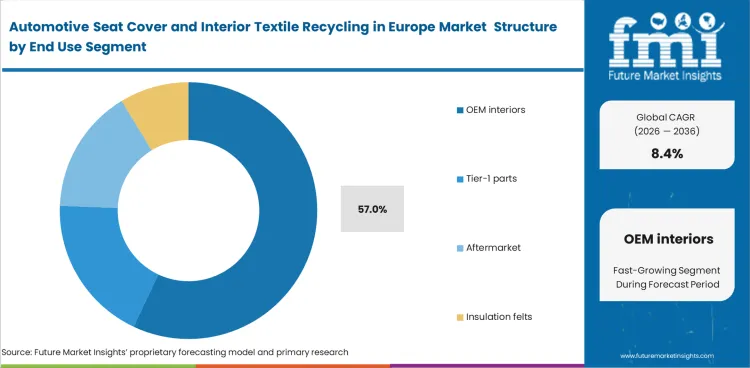
OEM interiors remain the dominant end-use segment because regulatory compliance, traceability requirements, and recycled-content targets are enforced most directly within original vehicle production programs. Material decisions at this level shape sourcing standards for adjacent categories such as plastic interior trims and broader automotive OEM circular materials, keeping OEM-led platforms at the center of recycled-content adoption. OEM interiors are expected to hold 57.0% share of the end-use segment in 2026, reflecting stronger control over material selection and a clearer pathway for integrating recycled textile content into approved interior systems. Certified secondary inputs carry greater weight in this segment, as supplier approval depends on documented material origin, repeatable quality, and alignment with circular-design expectations across vehicle platforms. Aftermarket adoption remains relevant, although looser specification discipline and lower traceability pressure continue to limit its share relative to OEM-directed demand.
- Quota enforcement: Recycled-content targets raise the importance of securing dependable secondary material supply for approved interior programs. Limited access to certified inputs can disrupt production planning and delay platform execution.
- Audit transparency: Chain-of-custody visibility remains essential where recycled textile content is used in OEM-qualified components. Strong documentation discipline carries commercial value, as weak traceability can restrict acceptance in regulated automotive supply programs.
- Supplier consolidation: Integrated recycling capability increasingly strengthens supplier positioning in OEM interior sourcing. Greater control over recovery, sorting, and conversion improves the ability to meet contract requirements consistently.
Automotive Seat Cover and Interior Textile Recycling in Europe Market Drivers, Restraints, and Opportunities
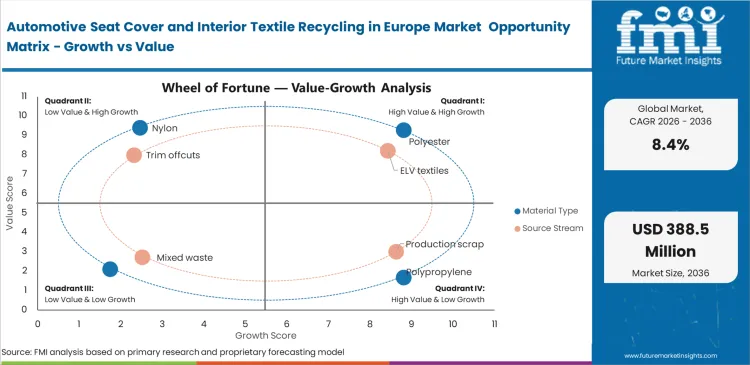
European Commission mandates establishing mandatory recycled content thresholds force Tier-1 purchasers to abandon legacy virgin polymer contracts. Transitioning supply chains requires locking high-volume secondary material streams before regional competitors exhaust available processing capacity. Procurement officers delaying agreements with specialized chemical recyclers face devastating spot-market pricing premiums once compliance grade pcr requirements take effect. Identifying what is driving recycled automotive upholstery demand in Europe reveals that regulatory pressure transforms recycled automotive textiles from a niche sustainability initiative into a fundamental license to operate within European vehicle assembly networks.
Cross-contamination during vehicle dismantling fundamentally limits secondary material purity and yield. Operations managers at recovery facilities struggle to separate advanced multi-layer composites utilizing incompatible adhesives and legacy flame retardants. This contamination requires expensive spectroscopic sorting and intensive pre-washing protocols that destroy mechanical recycling profit margins. Automated robotic dismantling systems show promise, yet current capital costs prevent widespread deployment across fragmented independent scrapyard networks.
Opportunities in the Automotive Seat Cover and Interior Textile Recycling in Europe Market
- Optical sorting algorithms: Machine learning integration improves material separation accuracy. Facility managers capture higher margins by supplying pure closed loop polymers streams.
- Depolymerization licensing: Specialized chemical startups franchise reactor designs to regional waste handlers. Process engineers accelerate capacity expansion without assuming massive central capital expenditure.
- Mono-material redesign: Seating architects eliminate mixed-polymer assemblies. Engineering teams guarantee future material recoverability while standardizing the best recycled materials for automotive interiors.
Regional Analysis
Based on regional analysis, Automotive Seat Cover and Interior Textile Recycling in Europe is segmented into Germany, Spain, France, Poland, Czechia, Italy, and United Kingdom.
.webp "Top Country Growth Comparison Automotive Seat Cover And Interior Textile Recycling In Europe Market Cagr (2026 2036)")
| Country | CAGR (2026 to 2036) |
|---|---|
| Germany | 9.0% |
| Spain | 8.9% |
| France | 8.7% |
| Poland | 8.5% |
| Czechia | 8.3% |
| Italy | 8.1% |
| United Kingdom | 7.8% |
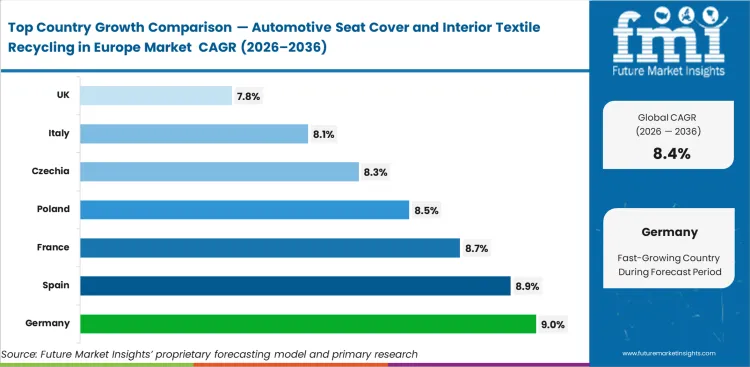
Source: Future Market Insights (FMI) analysis, based on a proprietary forecasting model and primary research
Demand for Automotive Seat Cover and Interior Textile Recycling in the Western Europe Market Analysis
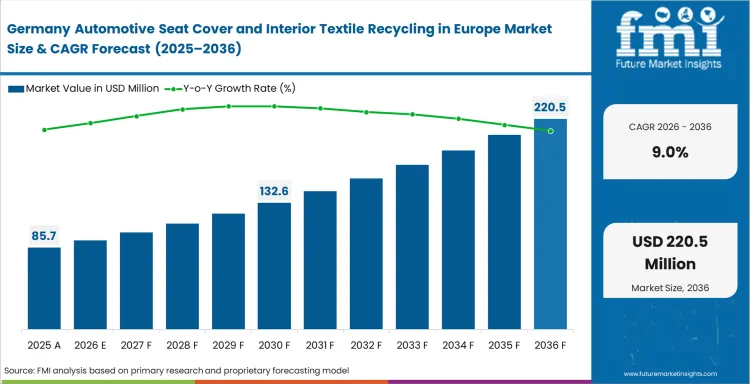
Western Europe remains the structural center of this market because vehicle manufacturing density, dismantling capability, recycling regulation, and interior-component conversion capacity are concentrated within the same regional system. Growth across the region is being supported by tighter circularity requirements, stronger traceability expectations, and a more developed base for sorting, fiber recovery, and secondary material qualification than in most adjacent markets. Recovery economics are also more favorable where ELV volumes, processing infrastructure, and OEM-linked interior supply chains operate in proximity, allowing recycled textile streams to move more efficiently into seat covers, felts, and other soft-trim applications. Processing depth still varies by country, especially between mechanically oriented recovery routes and higher-value conversion pathways, but the Europe automotive interior textile recycling market remains the most commercially important region through 2036.
- Germany: Strong vehicle production density, industrial chemistry depth, and mature interior supply networks keep Germany at the center of Western Europe’s automotive interior textile recycling chain. Better-developed recovery infrastructure and tighter integration between processing and manufacturing support wider use of recycled textile inputs in approved interior applications. Demand for automotive seat covers and interior textile recycling in Germany is projected to increase at a CAGR of 9.0% from 2026 to 2036. Scale and systems integration keep the country ahead, where closed-loop qualification and consistent secondary material output matter most.
- Spain: Cost-efficient conversion capacity and improving sorting efficiency give Spain a strong position in handling mixed ELV textile streams. Sales of automotive seat covers and interior textile recycling solutions in Spain are anticipated to rise at a 8.9% CAGR from 2026 to 2036. Recovery operations in the country are better placed to manage variable feedstock quality while maintaining commercially usable output for downstream interior applications. Processing flexibility continues to support Spain in recycled interior programs where material utilization and cost discipline need to work together.
- France: Stricter waste and circularity requirements give France a clearer route for recycled textile integration across automotive interior programs. Material recovery carries added importance in this market because compliance expectations are increasingly tied to product design, recyclability, and controlled sourcing practices. Automotive seat cover and interior textile recycling demand in France is forecast to advance at a CAGR of 8.7%. Regulatory alignment and local processing readiness keep the country commercially important in compliant interior material supply.
- Italy: Demand for automotive upholstery and related interior textile recycling in Italy is likely to grow at a CAGR of 8.1% through 2036. Textile conversion expertise and premium interior requirements keep Italy relevant in higher-value automotive applications. Recycled textile adoption moves at a more selective pace than in larger recovery-led markets, though specialized interior programs still support steady demand expansion. This leaves Italy better placed in design-sensitive and technically demanding interior uses than in large-volume recovery segments.
- United Kingdom: Lower vehicle output and a less concentrated scrap base make market expansion in the United Kingdom more dependent on collection efficiency and downstream processing discipline. Feedstock availability remains narrower than in the main continental hubs, which places greater weight on logistics performance and material sorting quality. Adoption of automotive seat fabric and interior textile recycling in the United Kingdom is estimated to expand at a 7.8% CAGR. Further progress is expected to depend on tighter scrap aggregation and more efficient routing of sorted textile waste into scalable recycling channels.
FMI's report includes an extensive analysis of emerging regional recovery networks across Belgium, the Netherlands, and Sweden. Denmark also adds strategic relevance as stricter circular-material alignment and efficient waste-handling systems improve the outlook for higher-quality textile recovery.
Demand for Automotive Seat Cover and Interior Textile Recycling in the Eastern Europe Market Analysis
Eastern Europe remains important to this market because processing economics, manufacturing depth, and cross-border supply access are better aligned here than in many higher-cost parts of the region. Secondary textile recovery benefits from a cost base that supports sorting, shredding, fiber opening, and conversion at scale, while the presence of seating, trim, and interior-component manufacturing creates a more immediate outlet for recycled materials. Proximity to Western European assembly networks also improves the commercial case for localized recovery, especially where transport costs, feedstock consistency, and turnaround time influence recycled material adoption. Regional growth is being shaped less by headline circularity targets alone and more by the ability to convert variable textile waste into usable automotive interior inputs with dependable processing economics.
- Poland: Cross-border positioning gives Poland an advantage in this market because recoverable textile streams can move efficiently between dismantling centers, processing sites, and major automotive production hubs. Stronger scale in secondary processing also supports higher throughput, making the country one of the more practical locations for handling large ELV textile volumes within Europe’s interior recycling chain. Demand for automotive seat covers and interior textile recycling in Poland is projected to rise at a CAGR of 8.5% from 2026 to 2036. Continued investment in sorting efficiency and higher-volume conversion capacity is expected to keep Poland central to regional supply balancing as recycled interior material demand expands.
- Czechia: Established component manufacturing depth gives Czechia a more direct route for integrating recycled textiles into interior assemblies without relying on long intermediate supply chains. Sales of automotive seat covers and interior textile recycling solutions in Czechia are anticipated to increase at a 8.3% CAGR. Existing Tier-1 production infrastructure supports faster validation of recycled material performance under real manufacturing conditions, improving the practicality of local adoption in seat, trim, and soft-interior applications. Closer alignment between waste recovery and component production is likely to keep Czechia efficient in closed-loop interior textile applications where logistics discipline and material consistency matter most.
FMI's report includes an analysis of developing recycling capacity across Slovakia, Hungary, and Romania. Serbia also adds relevance as automotive component manufacturing expands and lower-cost processing economics improve the case for localized textile recovery.
Competitive Aligners for Market Players
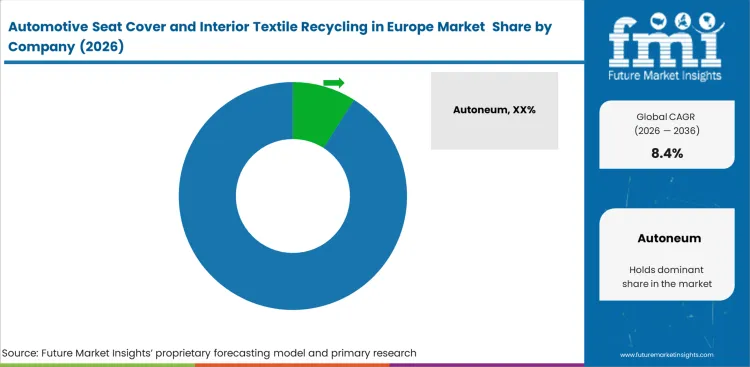
Established automotive interior plastic components suppliers continue to face pressure from specialized recycling-focused entrants trying to capture more of the material value chain. Competitive strength in this market rests less on conversion technology alone and more on the ability to secure dependable feedstock, process it at consistent quality, and align recycled output with OEM interior requirements. Autoneum, Trèves Group, Grupo Antolin, Adler Pelzer Group, Lear Corporation, FORVIA, and Sage Automotive Interiors remain relevant because long-standing relationships in automotive interiors give them stronger access to qualification pathways, manufacturing discipline, and integration across broader cabin systems. Evaluation of automotive textile recycling suppliers in Europe tends to favor participants with tighter control over feedstock access, conversion readiness, and downstream interior-material compatibility.
Incumbent suppliers benefit from deeper knowledge of legacy vehicle material composition, giving them an advantage in identifying textile streams with better recovery potential and more predictable recycling outcomes. Existing manufacturing scale also improves the commercial case for automated sorting, fiber recovery, mono-material processing, and the selective use of recycled polyester apparel fiber technology in automotive interior applications where material consistency remains critical. Lear Corporation, Grupo Antolin, and Adler Pelzer Group remain well-positioned in this respect because scale, installed manufacturing depth, and interior-component experience reduce the risk attached to qualification costs and material inconsistency. Competitive pressure remains higher for smaller entrants where recovery capability exists, but access to validated offtake, traceable feedstock, and repeatable processing quality is still limited.
Key Players in Automotive Seat Cover and Interior Textile Recycling in Europe Market
- Autoneum
- Trèves Group
- Grupo Antolin
- Adler Pelzer Group
- Lear Corporation
- FORVIA
- Sage Automotive Interiors
Scope of the Report
| Metric | Value |
|---|---|
| Quantitative Units | USD 160.0 million to USD 358.4 million, at a CAGR of 8.40% |
| Market Definition | Industrial recovery and conversion of vehicle cabin fabrics into automotive-grade secondary materials. Operations span collection, separation, and fiber regeneration specifically targeting closed-loop automotive supply chains. |
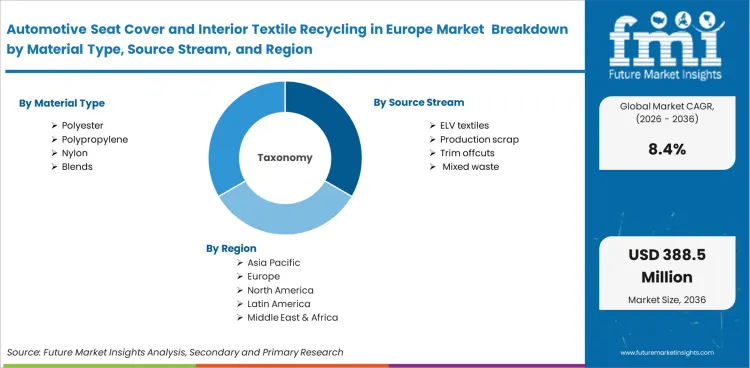
| Segmentation | Material Type, Source Stream, Recycling Process, Application, End Use, and Region |
| Countries Covered | Germany, Spain, France, Poland, Czechia, Italy, United Kingdom |
| Key Companies Profiled | Autoneum, Trèves Group, Grupo Antolin, Adler Pelzer Group, Lear Corporation, FORVIA, Sage Automotive Interiors |
| Forecast Period | 2026 to 2036 |
| Approach | Annual end-of-life vehicle volumes cross-referenced with average cabin textile weight metrics |
Source: Future Market Insights (FMI) analysis, based on proprietary forecasting model and primary research
Automotive Seat Cover and Interior Textile Recycling in Europe Market Analysis by Segments
Material Type
- Polyester
- Polypropylene
- Nylon
- Blends
Source Stream
- ELV textiles
- Production scrap
- Trim offcuts
- Mixed waste
Recycling Process
- Mechanical
- Fiber opening
- Thermoforming
- Chemical
Application
- Seat covers
- Carpets
- Headliners
- Door panels
- Parcel shelves
End Use
- OEM interiors
- Tier-1 parts
- Aftermarket
- Insulation felts
Region
- North America
- Latin America
- Western Europe
- Eastern Europe
- Asia Pacific
- Middle East and Africa
Bibliography
- European Automobile Manufacturers’ Association. (2025, August). The automobile industry pocket guide 2025/2026. ACEA.
- European Automobile Manufacturers’ Association. (2026, January). Report – Vehicles on European roads 2026. ACEA.
- European Commission, Directorate-General for Environment. (2025). End-of-life vehicle statistics. Eurostat.
- European Environment Agency. (2024, May). Management of used and waste textiles in Europe’s circular economy. EEA.
- European Environment Agency. (2025, March). Circularity of the EU textiles value chain in numbers. EEA.
- Lanz, I. E., Dimou, A., Shen, L., & Drewniok, M. P. (2024). A mapping of textile waste recycling technologies in Europe. Recycling.
- European Parliament. (2025, September). New EU rules on design, reuse and recycling in the automotive sector. European Parliament.
- Recycling Europe. (2026, January). Closing the loop: Mandatory recycled content in textile products placed in the EU. Recycling Europe.
This bibliography is provided for reader reference. The full FMI report contains the complete reference list with primary source documentation.
This Report Addresses
- Regulatory timelines forcing Tier-1 substitution of virgin polymers with secondary alternatives.
- Feedstock purity requirements separating mechanical shredding from premium chemical depolymerization.
- Regional capacity bottlenecks limiting immediate continental compliance with circularity mandates.
- OEM contract structures prioritizing vertically integrated recycling capabilities.
- Technological gaps preventing profitable recovery of multi-material acoustic carpets.
- Supply chain vulnerabilities exposing interior manufacturers to non-compliance penalties.
- Cross-border logistics economics governing ELV textile transportation networks.
- Qualification protocols extending secondary fiber approval timelines.
Frequently Asked Questions
What is automotive interior textile recycling in Europe?
Industrial recovery and conversion of vehicle cabin fabrics into automotive-grade secondary materials. Operations span collection, separation, and fiber regeneration specifically targeting closed-loop automotive supply chains, reducing reliance on virgin synthetics.
How big is the automotive seat cover recycling market in Europe?
Demand is poised to cross USD 160.0 million in 2026 at a CAGR of 8.40%. Sustained investment propels cumulative revenue to USD 358.4 million through 2036 as European regulators mandate closed-loop material recovery targets.
Which interior textiles are recycled from end-of-life vehicles?
Disassembly yards extract seat covers, carpets, headliners, door panels, and parcel shelves. Procurement officers prioritize secondary polyester because established recycling pathways yield reliable automotive-grade physical properties.
How are car seat fabrics recycled in Europe?
Mechanical shredding dominates volume, utilizing established carding infrastructure requiring minimal advanced capital expenditure. Facility directors prefer mechanical routes for rapidly processing uniform industrial offcuts into non-visible acoustic insulation components.
Can automotive seat covers be recycled into new interiors?
Eliminating complex multi-polymer composites bypasses expensive mechanical separation stages. Seating architects specifying pure polyester assemblies ensure immediate downstream recoverability and reduce extended producer responsibility financial liabilities.
Which materials dominate recycled automotive interiors?
Tier-1 seating engineers specify continuous-filament polymers exclusively to satisfy incoming directives. Polyester commands 46.0% share as legacy cabin architectures rely heavily on this durable synthetic compound.
What limits mechanical recycling profitability?
Contamination from legacy flame retardants and complex adhesives destroys secondary fiber integrity. Operations managers face severe margin compression when incoming ELV bales require intensive manual pre-sorting or cause extruder fouling during thermomechanical conversion.
How do automakers enforce circularity?
Sustainability directors insert rigid recycled-content minimums directly into multi-year platform sourcing agreements. Tier-1 suppliers lacking certified secondary material streams face immediate disqualification from bidding on upcoming European vehicle programs.
What advantage do chemical recyclers hold?
Depolymerization removes embedded dyes and organic contaminants entirely. Process engineers deliver virgin-equivalent secondary resins necessary for visible surface applications where OEMs tolerate zero cosmetic defects or structural weaknesses.
Why does Germany lead regional adoption?
Dense concentrations of Tier-1 manufacturing and legacy chemical engineering expertise create unparalleled closed-loop testing environments. R&D directors validate novel secondary polymers rapidly using localized prototyping facilities supported by aggressive national mandates.
What risk do independent dismantlers face?
Generalist scrapyards lacking advanced optical sorting technology produce low-purity scrap bales rejected by premium automotive recyclers. Facility directors must invest in automated material identification or accept commodity-level pricing from construction-grade insulation buyers.
What limits chemical recycling expansion?
Massive capital requirements and complex environmental permitting slow reactor deployment. Plant managers must guarantee enormous steady-state feedstock volumes to offset high fixed operational costs associated with glycolysis processes.
Why are acoustic carpets difficult to recycle?
Heavy adhesive layers and mixed-fiber compositions resist standard shredding and dissolution techniques. Textile engineers struggle to break strong thermochemical bonds without simultaneously destroying underlying fiber tensile strength.
How do procurement officers mitigate price risk?
Secondary polymer spot prices fluctuate violently alongside virgin petrochemical indices. Sourcing managers execute long-term floating-rate contracts with localized mechanical recyclers to stabilize interior component margins across entire vehicle production lifecycles.
What role do blockchain systems play?
European auditors demand unbroken chain-of-custody documentation tracing secondary fibers back to specific ELV origins. Compliance managers utilize distributed ledgers to prove material provenance and avoid severe regulatory non-compliance fines.
Why is tear strength critical for secondary fibers?
Recycling processes inherently reduce polymer chain length and intrinsic viscosity. Seating engineers must over-engineer component thickness to compensate for degraded tensile limits under dynamic passenger loads.
What drives investment in France?
Aggressive national anti-waste legislation preempts broader EU directives. Supply chain managers secure local processing capacity immediately to avoid imminent financial penalties targeting non-circular vehicle interior assemblies.
How do Tier-1 suppliers protect market share?
Incumbents integrate specialized recycling startups through joint ventures or direct acquisitions. Operations directors internalize feedstock purification to guarantee reliable material supply regardless of external commodity market volatility.
What complicates ELV textile logistics?
Low bulk density makes transporting uncompressed automotive textiles economically unviable over long distances. Logistics managers deploy specialized high-compression baling equipment at dismantling yards to maximize payload efficiency during cross-border transit.
Why do OEMs reject mechanically recycled surfaces?
Shredded fibers retain microscopic color variations and structural inconsistencies. Quality assurance heads refuse mechanically processed materials for high-visibility cabin areas due to unpredictable aesthetic degradation under prolonged UV exposure.
What accelerates Spanish recycling growth?
Extensive established textile manufacturing infrastructure pivots rapidly to automotive recovery. Plant managers adapt legacy spinning and carding equipment to process highly contaminated mixed-waste bales generated by domestic assembly hubs.
How do flame retardants affect recycling?
Legacy chemical treatments applied to older vehicle interiors poison modern catalytic depolymerization reactors. Dismantlers must isolate treated fabrics using advanced spectroscopy before dispatching bales to chemical processing partners.
What value does pre-washing provide?
Removing embedded organic contaminants and road grime stabilizes downstream extrusion processes. Facility directors eliminate unpredictable reactor pressure spikes by implementing intensive multi-stage washing protocols before shredding.
Why are aftermarket adoption rates lower?
Independent replacement part manufacturers lack the massive capital required to qualify novel secondary materials. Engineering teams rely on virgin synthetics until OEM-driven economies of scale reduce premium pricing on certified recycled polymers.
Preview the report firsthand - request a free sample
Get SampleGet the brochure for pricing and purchase details.
Get PDFTable of Content
- Executive Summary
- Global Market Outlook
- Demand-side Trends
- Supply-side Trends
- Technology Roadmap Analysis
- Analysis and Recommendations
- Market Overview
- Market Coverage / Taxonomy
- Market Definition / Scope / Limitations
- Research Methodology
- Chapter Orientation
- Analytical Lens and Working Hypotheses
- Market Structure, Signals, and Trend Drivers
- Benchmarking and Cross-market Comparability
- Market Sizing, Forecasting, and Opportunity Mapping
- Research Design and Evidence Framework
- Desk Research Programme (Secondary Evidence)
- Company Annual and Sustainability Reports
- Peer-reviewed Journals and Academic Literature
- Corporate Websites, Product Literature, and Technical Notes
- Earnings Decks and Investor Briefings
- Statutory Filings and Regulatory Disclosures
- Technical White Papers and Standards Notes
- Trade Journals, Industry Magazines, and Analyst Briefs
- Conference Proceedings, Webinars, and Seminar Materials
- Government Statistics Portals and Public Data Releases
- Press Releases and Reputable Media Coverage
- Specialist Newsletters and Curated Briefings
- Sector Databases and Reference Repositories
- FMI Internal Proprietary Databases and Historical Market Datasets
- Subscription Datasets and Paid Sources
- Social Channels, Communities, and Digital Listening Inputs
- Additional Desk Sources
- Expert Input and Fieldwork (Primary Evidence)
- Primary Modes
- Qualitative Interviews and Expert Elicitation
- Quantitative Surveys and Structured Data Capture
- Blended Approach
- Why Primary Evidence is Used
- Field Techniques
- Interviews
- Surveys
- Focus Groups
- Observational and In-context Research
- Social and Community Interactions
- Stakeholder Universe Engaged
- C-suite Leaders
- Board Members
- Presidents and Vice Presidents
- R&D and Innovation Heads
- Technical Specialists
- Domain Subject-matter Experts
- Scientists
- Physicians and Other Healthcare Professionals
- Governance, Ethics, and Data Stewardship
- Research Ethics
- Data Integrity and Handling
- Primary Modes
- Tooling, Models, and Reference Databases
- Desk Research Programme (Secondary Evidence)
- Data Engineering and Model Build
- Data Acquisition and Ingestion
- Cleaning, Normalisation, and Verification
- Synthesis, Triangulation, and Analysis
- Quality Assurance and Audit Trail
- Market Background
- Market Dynamics
- Drivers
- Restraints
- Opportunity
- Trends
- Scenario Forecast
- Demand in Optimistic Scenario
- Demand in Likely Scenario
- Demand in Conservative Scenario
- Opportunity Map Analysis
- Product Life Cycle Analysis
- Supply Chain Analysis
- Investment Feasibility Matrix
- Value Chain Analysis
- PESTLE and Porter’s Analysis
- Regulatory Landscape
- Regional Parent Market Outlook
- Production and Consumption Statistics
- Import and Export Statistics
- Market Dynamics
- Global Market Analysis 2021 to 2025 and Forecast, 2026 to 2036
- Historical Market Size Value (USD Million) Analysis, 2021 to 2025
- Current and Future Market Size Value (USD Million) Projections, 2026 to 2036
- Y-o-Y Growth Trend Analysis
- Absolute $ Opportunity Analysis
- Global Market Pricing Analysis 2021 to 2025 and Forecast 2026 to 2036
- Global Market Analysis 2021 to 2025 and Forecast 2026 to 2036, By Material Type
- Introduction / Key Findings
- Historical Market Size Value (USD Million) Analysis By Material Type , 2021 to 2025
- Current and Future Market Size Value (USD Million) Analysis and Forecast By Material Type , 2026 to 2036
- Polyester
- Polypropylene
- Nylon
- Blends
- Polyester
- Y-o-Y Growth Trend Analysis By Material Type , 2021 to 2025
- Absolute $ Opportunity Analysis By Material Type , 2026 to 2036
- Global Market Analysis 2021 to 2025 and Forecast 2026 to 2036, By Source Stream
- Introduction / Key Findings
- Historical Market Size Value (USD Million) Analysis By Source Stream, 2021 to 2025
- Current and Future Market Size Value (USD Million) Analysis and Forecast By Source Stream, 2026 to 2036
- ELV textiles
- Production scrap
- Trim offcuts
- Mixed waste
- ELV textiles
- Y-o-Y Growth Trend Analysis By Source Stream, 2021 to 2025
- Absolute $ Opportunity Analysis By Source Stream, 2026 to 2036
- Global Market Analysis 2021 to 2025 and Forecast 2026 to 2036, By Recycling Process
- Introduction / Key Findings
- Historical Market Size Value (USD Million) Analysis By Recycling Process, 2021 to 2025
- Current and Future Market Size Value (USD Million) Analysis and Forecast By Recycling Process, 2026 to 2036
- Mechanical
- Fiber opening
- Thermoforming
- Chemical
- Mechanical
- Y-o-Y Growth Trend Analysis By Recycling Process, 2021 to 2025
- Absolute $ Opportunity Analysis By Recycling Process, 2026 to 2036
- Global Market Analysis 2021 to 2025 and Forecast 2026 to 2036, By Application
- Introduction / Key Findings
- Historical Market Size Value (USD Million) Analysis By Application, 2021 to 2025
- Current and Future Market Size Value (USD Million) Analysis and Forecast By Application, 2026 to 2036
- Seat covers
- Carpets
- Headliners
- Door panels
- Parcel shelves
- Seat covers
- Y-o-Y Growth Trend Analysis By Application, 2021 to 2025
- Absolute $ Opportunity Analysis By Application, 2026 to 2036
- Global Market Analysis 2021 to 2025 and Forecast 2026 to 2036, By End Use
- Introduction / Key Findings
- Historical Market Size Value (USD Million) Analysis By End Use, 2021 to 2025
- Current and Future Market Size Value (USD Million) Analysis and Forecast By End Use, 2026 to 2036
- OEM interiors
- Tier-1 parts
- Aftermarket
- Insulation felts
- OEM interiors
- Y-o-Y Growth Trend Analysis By End Use, 2021 to 2025
- Absolute $ Opportunity Analysis By End Use, 2026 to 2036
- Global Market Analysis 2021 to 2025 and Forecast 2026 to 2036, By Region
- Introduction
- Historical Market Size Value (USD Million) Analysis By Region, 2021 to 2025
- Current Market Size Value (USD Million) Analysis and Forecast By Region, 2026 to 2036
- North America
- Latin America
- Western Europe
- Eastern Europe
- East Asia
- South Asia and Pacific
- Middle East & Africa
- Market Attractiveness Analysis By Region
- North America Market Analysis 2021 to 2025 and Forecast 2026 to 2036, By Country
- Historical Market Size Value (USD Million) Trend Analysis By Market Taxonomy, 2021 to 2025
- Market Size Value (USD Million) Forecast By Market Taxonomy, 2026 to 2036
- By Country
- USA
- Canada
- Mexico
- By Material Type
- By Source Stream
- By Recycling Process
- By Application
- By End Use
- By Country
- Market Attractiveness Analysis
- By Country
- By Material Type
- By Source Stream
- By Recycling Process
- By Application
- By End Use
- Key Takeaways
- Latin America Market Analysis 2021 to 2025 and Forecast 2026 to 2036, By Country
- Historical Market Size Value (USD Million) Trend Analysis By Market Taxonomy, 2021 to 2025
- Market Size Value (USD Million) Forecast By Market Taxonomy, 2026 to 2036
- By Country
- Brazil
- Chile
- Rest of Latin America
- By Material Type
- By Source Stream
- By Recycling Process
- By Application
- By End Use
- By Country
- Market Attractiveness Analysis
- By Country
- By Material Type
- By Source Stream
- By Recycling Process
- By Application
- By End Use
- Key Takeaways
- Western Europe Market Analysis 2021 to 2025 and Forecast 2026 to 2036, By Country
- Historical Market Size Value (USD Million) Trend Analysis By Market Taxonomy, 2021 to 2025
- Market Size Value (USD Million) Forecast By Market Taxonomy, 2026 to 2036
- By Country
- Germany
- UK
- Italy
- Spain
- France
- Nordic
- BENELUX
- Rest of Western Europe
- By Material Type
- By Source Stream
- By Recycling Process
- By Application
- By End Use
- By Country
- Market Attractiveness Analysis
- By Country
- By Material Type
- By Source Stream
- By Recycling Process
- By Application
- By End Use
- Key Takeaways
- Eastern Europe Market Analysis 2021 to 2025 and Forecast 2026 to 2036, By Country
- Historical Market Size Value (USD Million) Trend Analysis By Market Taxonomy, 2021 to 2025
- Market Size Value (USD Million) Forecast By Market Taxonomy, 2026 to 2036
- By Country
- Russia
- Poland
- Hungary
- Balkan & Baltic
- Rest of Eastern Europe
- By Material Type
- By Source Stream
- By Recycling Process
- By Application
- By End Use
- By Country
- Market Attractiveness Analysis
- By Country
- By Material Type
- By Source Stream
- By Recycling Process
- By Application
- By End Use
- Key Takeaways
- East Asia Market Analysis 2021 to 2025 and Forecast 2026 to 2036, By Country
- Historical Market Size Value (USD Million) Trend Analysis By Market Taxonomy, 2021 to 2025
- Market Size Value (USD Million) Forecast By Market Taxonomy, 2026 to 2036
- By Country
- China
- Japan
- South Korea
- By Material Type
- By Source Stream
- By Recycling Process
- By Application
- By End Use
- By Country
- Market Attractiveness Analysis
- By Country
- By Material Type
- By Source Stream
- By Recycling Process
- By Application
- By End Use
- Key Takeaways
- South Asia and Pacific Market Analysis 2021 to 2025 and Forecast 2026 to 2036, By Country
- Historical Market Size Value (USD Million) Trend Analysis By Market Taxonomy, 2021 to 2025
- Market Size Value (USD Million) Forecast By Market Taxonomy, 2026 to 2036
- By Country
- India
- ASEAN
- Australia & New Zealand
- Rest of South Asia and Pacific
- By Material Type
- By Source Stream
- By Recycling Process
- By Application
- By End Use
- By Country
- Market Attractiveness Analysis
- By Country
- By Material Type
- By Source Stream
- By Recycling Process
- By Application
- By End Use
- Key Takeaways
- Middle East & Africa Market Analysis 2021 to 2025 and Forecast 2026 to 2036, By Country
- Historical Market Size Value (USD Million) Trend Analysis By Market Taxonomy, 2021 to 2025
- Market Size Value (USD Million) Forecast By Market Taxonomy, 2026 to 2036
- By Country
- Kingdom of Saudi Arabia
- Other GCC Countries
- Turkiye
- South Africa
- Other African Union
- Rest of Middle East & Africa
- By Material Type
- By Source Stream
- By Recycling Process
- By Application
- By End Use
- By Country
- Market Attractiveness Analysis
- By Country
- By Material Type
- By Source Stream
- By Recycling Process
- By Application
- By End Use
- Key Takeaways
- Key Countries Market Analysis
- USA
- Pricing Analysis
- Market Share Analysis, 2025
- By Material Type
- By Source Stream
- By Recycling Process
- By Application
- By End Use
- Canada
- Pricing Analysis
- Market Share Analysis, 2025
- By Material Type
- By Source Stream
- By Recycling Process
- By Application
- By End Use
- Mexico
- Pricing Analysis
- Market Share Analysis, 2025
- By Material Type
- By Source Stream
- By Recycling Process
- By Application
- By End Use
- Brazil
- Pricing Analysis
- Market Share Analysis, 2025
- By Material Type
- By Source Stream
- By Recycling Process
- By Application
- By End Use
- Chile
- Pricing Analysis
- Market Share Analysis, 2025
- By Material Type
- By Source Stream
- By Recycling Process
- By Application
- By End Use
- Germany
- Pricing Analysis
- Market Share Analysis, 2025
- By Material Type
- By Source Stream
- By Recycling Process
- By Application
- By End Use
- UK
- Pricing Analysis
- Market Share Analysis, 2025
- By Material Type
- By Source Stream
- By Recycling Process
- By Application
- By End Use
- Italy
- Pricing Analysis
- Market Share Analysis, 2025
- By Material Type
- By Source Stream
- By Recycling Process
- By Application
- By End Use
- Spain
- Pricing Analysis
- Market Share Analysis, 2025
- By Material Type
- By Source Stream
- By Recycling Process
- By Application
- By End Use
- France
- Pricing Analysis
- Market Share Analysis, 2025
- By Material Type
- By Source Stream
- By Recycling Process
- By Application
- By End Use
- India
- Pricing Analysis
- Market Share Analysis, 2025
- By Material Type
- By Source Stream
- By Recycling Process
- By Application
- By End Use
- ASEAN
- Pricing Analysis
- Market Share Analysis, 2025
- By Material Type
- By Source Stream
- By Recycling Process
- By Application
- By End Use
- Australia & New Zealand
- Pricing Analysis
- Market Share Analysis, 2025
- By Material Type
- By Source Stream
- By Recycling Process
- By Application
- By End Use
- China
- Pricing Analysis
- Market Share Analysis, 2025
- By Material Type
- By Source Stream
- By Recycling Process
- By Application
- By End Use
- Japan
- Pricing Analysis
- Market Share Analysis, 2025
- By Material Type
- By Source Stream
- By Recycling Process
- By Application
- By End Use
- South Korea
- Pricing Analysis
- Market Share Analysis, 2025
- By Material Type
- By Source Stream
- By Recycling Process
- By Application
- By End Use
- Russia
- Pricing Analysis
- Market Share Analysis, 2025
- By Material Type
- By Source Stream
- By Recycling Process
- By Application
- By End Use
- Poland
- Pricing Analysis
- Market Share Analysis, 2025
- By Material Type
- By Source Stream
- By Recycling Process
- By Application
- By End Use
- Hungary
- Pricing Analysis
- Market Share Analysis, 2025
- By Material Type
- By Source Stream
- By Recycling Process
- By Application
- By End Use
- Kingdom of Saudi Arabia
- Pricing Analysis
- Market Share Analysis, 2025
- By Material Type
- By Source Stream
- By Recycling Process
- By Application
- By End Use
- Turkiye
- Pricing Analysis
- Market Share Analysis, 2025
- By Material Type
- By Source Stream
- By Recycling Process
- By Application
- By End Use
- South Africa
- Pricing Analysis
- Market Share Analysis, 2025
- By Material Type
- By Source Stream
- By Recycling Process
- By Application
- By End Use
- USA
- Market Structure Analysis
- Competition Dashboard
- Competition Benchmarking
- Market Share Analysis of Top Players
- By Regional
- By Material Type
- By Source Stream
- By Recycling Process
- By Application
- By End Use
- Competition Analysis
- Competition Deep Dive
- Autoneum
- Overview
- Product Portfolio
- Profitability by Market Segments (Product/Age /Sales Channel/Region)
- Sales Footprint
- Strategy Overview
- Marketing Strategy
- Product Strategy
- Channel Strategy
- Trèves Group
- Grupo Antolin
- Adler Pelzer Group
- Lear Corporation
- FORVIA
- Sage Automotive Interiors
- Autoneum
- Competition Deep Dive
- Assumptions & Acronyms Used


