

- Industry Size (2026)
- USD 2.4 Bn
- Forecast (2036)
- USD 5.1 Bn
- CAGR (2026 to 2036)
- 7.8%
Telecom Rack and Network Equipment Refurbishment and Recycling in Europe Industry Size, Market Forecast and Outlook By FMI
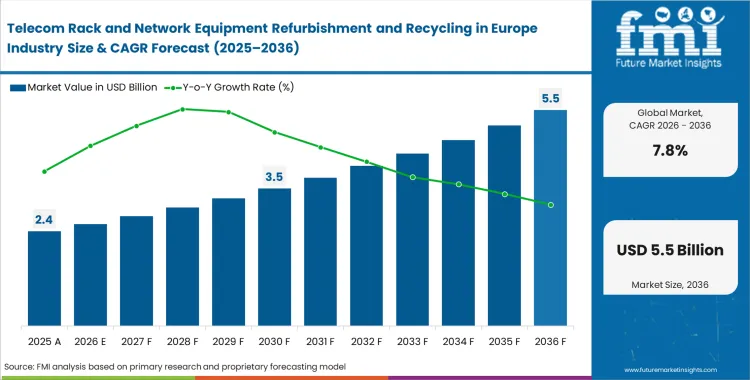
The telecom rack and network equipment refurbishment and recycling industry in Europe surpassed a valuation of USD 2.2 billion in 2025 and is estimated to reach USD 2.4 billion in 2026. FMI estimates the industry will expand at a CAGR of 7.8% from 2026 to 2036, taking total valuation to USD 5.1 billion by 2036. Market expansion is being supported by network modernization programs that now incorporate secondary-asset recovery more directly into equipment replacement cycles, rather than treating it as a disposal step after core infrastructure upgrades are completed.
Summary of Telecom Rack and Network Equipment Refurbishment and Recycling in Europe Industry
- The market is forecast to reach USD 5.1 billion by 2036.
- The market is expected to grow at a CAGR of 7.8% from 2026 to 2036.
- The market was estimated at USD 2.2 billion in 2025.
- The forecast period represents an incremental opportunity of USD 2.69 billion.
- The industry is a compliance-linked circular services market covering refurbishment, certified resale, repair, parts harvesting, and recycling of telecom network equipment.
- Demand is being driven by ongoing 5G SA, FTTH, edge, and cloud infrastructure upgrades, which are increasing volumes of decommissioned and surplus assets entering secondary channels.
- Regulatory push from Europe’s repair policies and WEEE directives is strengthening structured recovery, reuse, and recycling practices.
- Radio Access equipment leads with 34% share, while refurbishment services dominate with 38% share due to strong reuse economics.
- Telecom operators account for 46% of end users, reflecting their control over network upgrades and asset recovery programs.
- The United Kingdom, Sweden, and Germany are among the fastest-growing markets, with the UK leading at 8.4% CAGR.
- TXO, Nokia, Ericsson, and PICS Telecom are among the key companies active in this market, with TXO serving as an indicative leader.
Telecom operators are under growing pressure to manage decommissioned network hardware more systematically as upgrade cycles accelerate across fixed and mobile infrastructure. Rack systems, switching gear, power units, and network modules still carry usable resale, refurbishment, or component recovery value, yet that value can erode quickly when recovery decisions are delayed. Hardware replacement has historically favored straight-line equipment turnover, but tighter capital control and recurring supply constraints have made secondary equipment channels more commercially relevant. In that context, e-waste management is becoming more closely tied to telecom asset planning, especially where operators need to reduce stranded hardware costs while keeping recovery, resale, and recycling routes auditable.
Market structure improves once large carriers require decommissioned equipment to move through verified refurbishment or recycling channels instead of fragmented liquidation routes. That change brings more predictable feedstock into the secondary market and improves inventory visibility for resale platforms, refurbishers, and material recovery specialists. Liquidity matters here because isolated refurbishment activity rarely supports scale on its own. A more organized return flow allows operators to recover value from legacy network assets and use that recovery to offset part of the capital burden associated with infrastructure renewal.
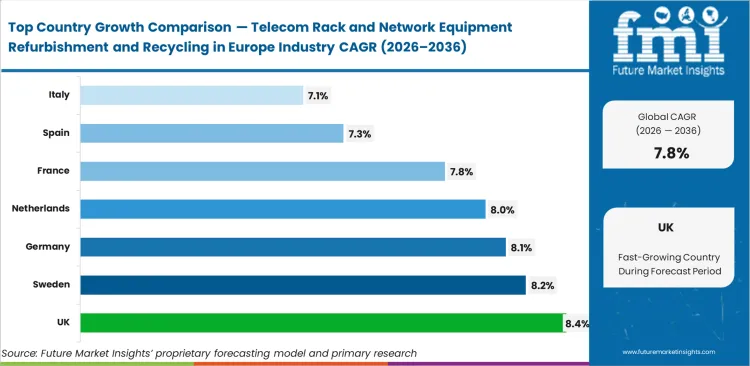
The United Kingdom is projected to witness 8.4% CAGR through 2036, supported by active secondary-market participation and stronger asset recovery discipline across telecom infrastructure portfolios. Sweden is expected to grow at 8.2%, helped by more established equipment redeployment practices and wider acceptance of reused ICT hardware. Germany is likely to register 8.1% CAGR during the forecast period as regulatory pressure and industrial discipline strengthen domestic secondary channels. The Netherlands is estimated at 8.0%, with concentrated data center and network activity contributing to faster hardware turnover and recovery volumes. France is anticipated to post 7.8% as lifecycle extension practices gain more institutional support. Spain is projected to expand at 7.3%, while Italy is expected to record 7.1% as refurbishment and recycling activity improves from a relatively less mature operating base. A clear regional split is emerging: Northern European markets are moving faster in organized resale and refurbishment, while parts of Southern Europe are still building out more basic recovery and recycling pathways.
Segmental Analysis
Telecom Rack and Network Equipment Refurbishment and Recycling in Europe Market Analysis by Equipment Type
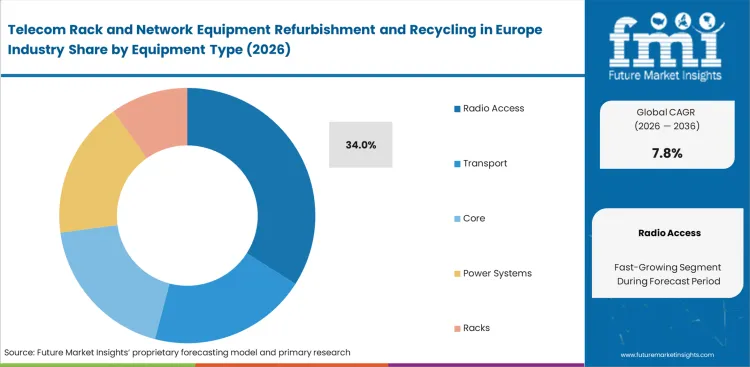
Network modernization across European telecom sites continues to release large volumes of retired radio hardware into recovery channels. Radio access equipment remains central to these return flows because antenna swaps and site reconfiguration generate concentrated batches that are easier to process than mixed network scrap. FMI’s analysis indicates that Radio Access is estimated to account for 34.0% share in 2026. Recovery economics depend heavily on separating complex assemblies without damaging reusable boards or alloy housings, especially where metal recovery from e-waste is tied to higher-value equipment output. Operators also face a practical limitation: certified testing systems for reused radio units remain scarce, which pushes a meaningful share of still-functional assets into scrap treatment. Liquid cooling loops and other assemblies found in high density racks add another handling requirement, since drainage and material segregation must happen before shredding begins.
- Site sunset displacement: Legacy spectrum closures force operators to remove large volumes of still-working radio units at the same time. Processing sites must absorb these spikes without breaching storage and safety limits.
- Diagnostic testing premium: Functional verification depends on proprietary software and approved test environments. Facilities with those tools are better placed to route suitable units into resale rather than scrap.
- Thermal management reclamation: Cooling assemblies inside dense telecom infrastructure contain recoverable copper and aluminum. Proper fluid removal and controlled dismantling are necessary before material separation begins.
Telecom Rack and Network Equipment Refurbishment and Recycling in Europe Market Analysis by Service Type
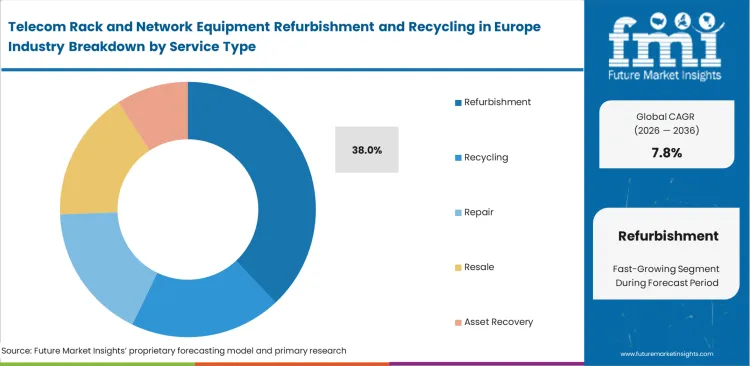
Processing choice in this market is guided by value retention rather than simple material removal. Working routers, switches, and transport gear generally justify repair and remarketing when technical condition and software access still allow commercial reuse. Refurbishment is likely to account for 38.0% share in 2026 because operators can preserve more value through controlled testing, repair, and resale than through immediate destruction. FMI’s assessment suggests that this path remains attractive only when facilities can combine technical capability with quality assurance that meets buyer expectations. Software dependency has become a key constraint, since some functional equipment loses secondary market utility when license transfer is restricted. Facilities without strong downstream channels or credible waste recycling services partnerships often struggle to place refurbished stock with cautious telecom buyers.
- Component triage economics: Intake teams separate reusable networking hardware from damaged units at the start of processing. This helps direct skilled labor toward equipment with the highest recovery potential.
- Software licensing friction: Cloud-tied operating rights can limit resale even when the hardware itself remains functional. That weakens refurbishment viability for part of the incoming asset base.
- Elemental extraction baseline: Units that fail diagnostic assessment move into dismantling and shredding flows. Material recovery then focuses on ferrous metals and board-level precious content.
Telecom Rack and Network Equipment Refurbishment and Recycling in Europe Market Analysis by End User
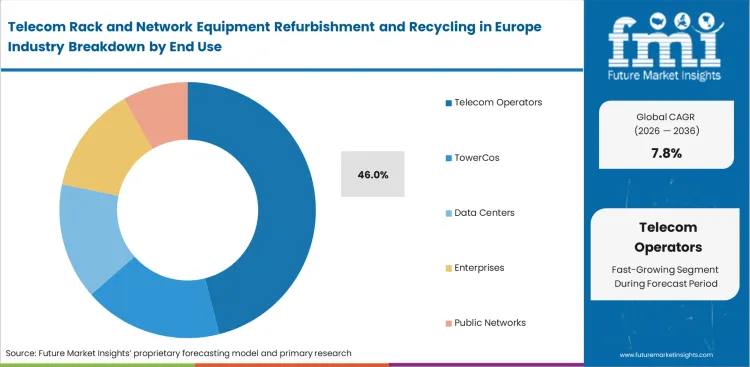
Telecom operators remain the largest organized source of retired rack and network equipment because they manage large installed bases under formal replacement cycles. Their disposal behavior is shaped by compliance exposure, asset tracking requirements, and public scrutiny tied to network infrastructure turnover. Telecom Operators are poised to garner 46.0% share in 2026, reflecting the scale of carrier-led retirements and their preference for certified downstream handling. FMI analysts note that many operators use structured ITAD channels to reduce data, dumping, and reporting risk while maintaining visibility over removed assets. Some carriers also reintroduce selected used hardware into lower-priority sites when replacing everything with newly specified data center construction equipment is not commercially sensible. Operators that delay formal disposition plans often end up carrying avoidable warehousing burden on obsolete stock.
- Liability mitigation focus: Carrier groups require documented chain-of-custody and verified data destruction for retired equipment. That documentation is often central to maintaining long-term ITAD relationships.
- Rural maintenance sourcing: Mid-sized and regional operators still rely on secondary markets for legacy parts that remain useful in remote networks. Access to specialized broker supply can extend the life of older installed systems.
- Enterprise redeployment cycles: Corporate network refresh programs also feed smaller but steady hardware volumes into the market. Aggregating those batches supports regional processing continuity.
Telecom Rack and Network Equipment Refurbishment and Recycling in Europe Market Analysis by Asset State
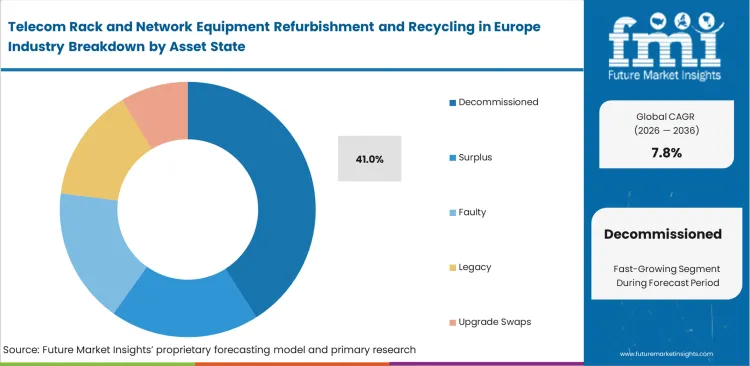
Hardware condition on arrival is largely shaped by planned network replacement cycles rather than sudden equipment failure alone. Scheduled removals release large quantities of intact but outdated gear, giving processors a better chance to assess reuse potential before dismantling begins. In FMI’s view, decommissioned equipment is anticipated to account for 41.0% share in 2026 because orderly removal usually preserves physical integrity and improves downstream handling options. That makes these assets more suitable for refurbishment pathways than units removed after active failure. Processing firms still face a practical risk when removed hardware sits outdoors too long before collection, since moisture exposure can erode resale value quickly, even for equipment comparable to refurbished computer and laptops secondary channels. Fast protected pickup therefore matters as much as the original removal schedule.
- Scheduled removal volume: Planned shutdowns of older network layers create large and predictable return waves of similar equipment types. Transport capacity has to be aligned closely with those decommissioning schedules.
- Staging degradation risk: Equipment stored temporarily in exposed tower yards can lose functional value before testing begins. Faster protected retrieval helps preserve reuse potential.
- Faulty unit triage: Hardware removed for technical faults needs early inspection to identify salvageable components. Quick segregation improves the chance of recovering useful boards and assemblies.
Telecom Rack and Network Equipment Refurbishment and Recycling in Europe Market Analysis by Channel
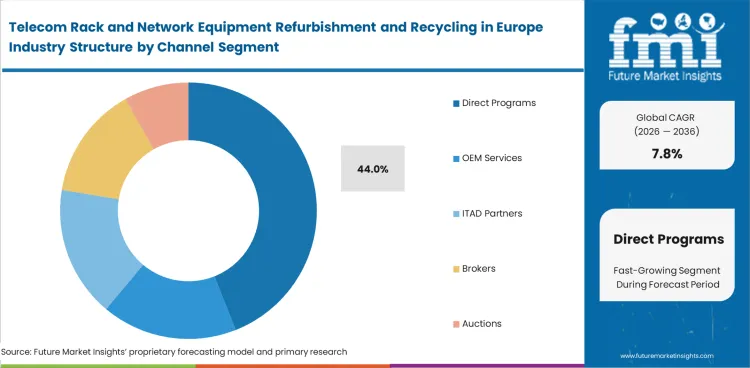
Channel structure in this market is strongly influenced by the purchasing power and aftersales control of major equipment vendors. Direct programs remain attractive to carriers because they simplify end-of-life handling and align removal with existing supplier relationships. Direct Programs are projected to secure 44.0% share in 2026. FMI’s projection suggests that vendor-managed return routes continue to gain preference where take-back terms are embedded in equipment contracts and tied to structured reverse logistics execution. This approach reduces administrative burden for operators and shifts more responsibility for environmental handling back to manufacturers. It also narrows the room available to open-market brokers, particularly when vendors restrict resale of working trade-ins to protect new equipment demand. Independent channels therefore survive more often in narrow legacy niches than in mainstream telecom hardware flow.
- Contractual take-back integration: End-of-life removal is increasingly written into broader rollout and replacement agreements. This helps synchronize outgoing and incoming hardware movement.
- Cannibalization prevention: Some vendors require functional trade-ins to be destroyed rather than resold into the open market. That limits secondary circulation even when equipment remains technically usable.
- Broker niche specialization: Independent brokers persist by focusing on highly specific legacy product categories outside dominant vendor programs. Specialized sourcing remains their main route to relevance.
Telecom Rack and Network Equipment Refurbishment and Recycling in Europe Market Drivers, Restraints, and Opportunities
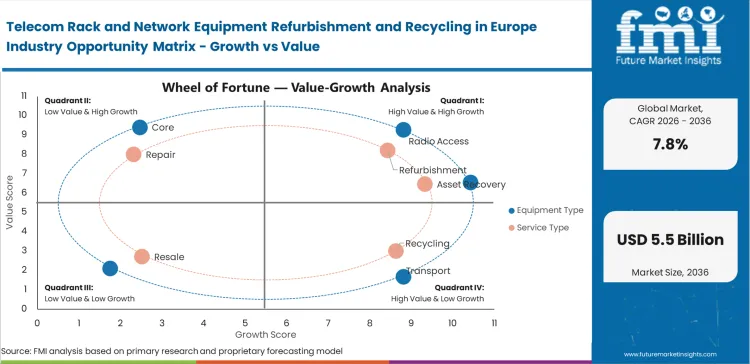
Non-compliance penalties force companies to act immediately to buy refurbished telecom network equipment in Europe. European WEEE directive amendments compel operators to track every single baseband unit from tower removal to final material extraction. Failing to provide certified disposal documentation results in severe regulatory fines and blocks future spectrum bidding eligibility. Integrating electronics take back and closed loop PCR protocols shifts asset recovery from a public relations exercise into a strict operational requirement.
Proprietary software lock-ins create severe friction, slowing hardware redeployment, complicating the telecom equipment refurbishment vs new equipment cost equation. Equipment vendors increasingly tie physical hardware functionality to non-transferable cloud licenses. Network engineers evaluating secondary market transport gear often find that affordable physical units cannot be activated without paying exorbitant relicensing fees to the original manufacturer. Emerging third-party firmware solutions offer partial workarounds, but strict carrier security standards currently prevent deployment in core networks.
Opportunities in the Telecom Rack and Network Equipment Refurbishment and Recycling in Europe Market
- Diagnostic automation: Implementing AI-driven testing protocols allows technicians at any certified telecom hardware reseller in Europe to certify high volumes of complex radio units rapidly.
- Closed-loop material integration: Extracting pure aluminum from heatsinks allows stakeholders to sell premium feedstocks back to green electronics manufacturing facilities.
- Localized processing nodes: Deploying small-scale dismantling operations near major tower clusters helps to drastically cut secure transport costs.
Regional Analysis
Based on regional analysis, telecom rack and network equipment refurbishment and recycling in Europe is segmented into United Kingdom, Germany, Sweden, France, Netherlands, Spain, and Italy across 40 plus countries.
.webp "Top Country Growth Comparison Telecom Rack And Network Equipment Refurbishment And Recycling In Europe Industry Cagr (2026 2036)")
| Country | CAGR (2026 to 2036) |
|---|---|
| United Kingdom | 8.4% |
| Sweden | 8.2% |
| Germany | 8.1% |
| Netherlands | 8.0% |
| France | 7.8% |
| Spain | 7.3% |
| Italy | 7.1% |
United Kingdom Telecom Rack and Network Equipment Refurbishment and Recycling in Europe Market Analysis
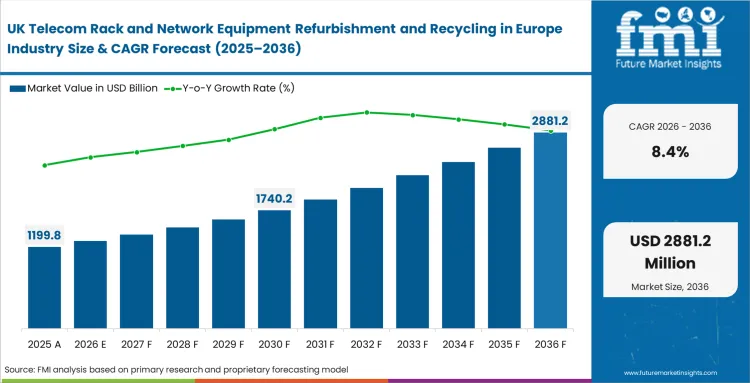
- United Kingdom: Independent broker networks dominate regional equipment flow by leveraging established refurbished smartphone ecosystems to process heavy infrastructure gear. Local operators favor these partners, fostering a highly liquid UK telecom equipment recycling industry. Equipment demand in the United Kingdom is anticipated to rise at a CAGR of 8.4% through 2036. Agile firms with robust diagnostic capabilities consistently secure lucrative carrier contracts.
Germany Telecom Rack and Network Equipment Refurbishment and Recycling in Europe Market Analysis
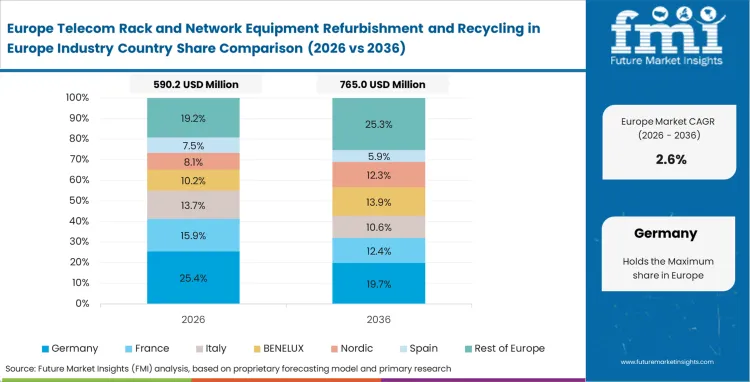
- Germany: Strict environmental compliance mandates dictate facility operations across the Germany telecom equipment refurbishment segment. Germany is projected to witness an 8.1% CAGR in the secondary hardware sector through 2036. Advanced metal recycling equipment is utilized to meet high national targets for hazardous substance containment. Absolute legal protection takes precedence over maximizing resale values, establishing massive barriers that protect incumbent recycling giants.
Sweden Telecom Rack and Network Equipment Refurbishment and Recycling in Europe Market Analysis
- Sweden: Secondary asset adoption in Sweden is likely to post a CAGR of 8.2% by 2036. Deep cultural commitment to circular economies runearly adoption of closed-loop hardware strategies. Network planners actively mandate recycled copper foil and refurbished components within new buildout specifications. Enterprise buyers integrate tested IT infrastructure into active production environments, rewarding operators who successfully verify component origin.
FMI's report includes France, Netherlands, Spain, and Italy. Southern European markets demonstrate lower initial resale liquidity but show rapid growth in foundational mechanical dismantling capacity.
Competitive Aligners for Market Players
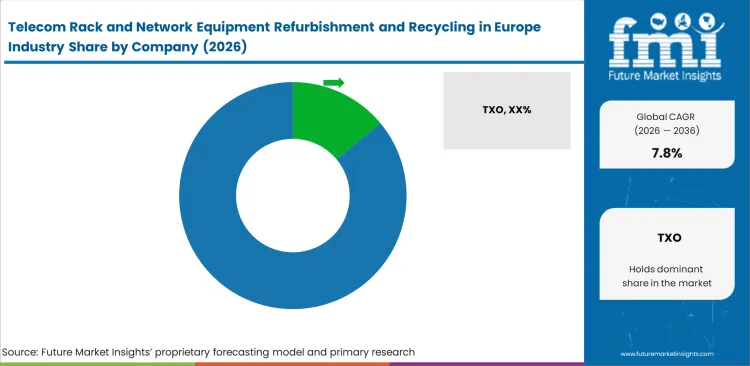
Independent ITAD facilities compete with original equipment manufacturers for control of high-value decommissioned hardware in the European telecom refurbishment market. One side of the market is centered on stronger short-term resale recovery through independent channels, while the other is shaped by closed-loop take-back structures linked to primary equipment supply. Commercial choice is therefore influenced by the tradeoff between cash recovery, technical validation access, and compliance control.
OEM channels retain an advantage where proprietary diagnostic software and firmware rights determine whether advanced radio equipment can be fully tested, certified, and relicensed for secondary deployment. Independent facilities often face tighter operating limits because testing protocols are less accessible and technical validation can require outside engineering support. Market position in this segment depends on proving hardware viability with enough consistency to satisfy secondary-use requirements. This keeps software access, certification pathways, and test credibility central to competitive positioning.
Large telecom operators still seek to avoid full dependence on OEM-controlled disposition routes by dividing recovery programs across multiple independent vendors. Specialized dismantling methods and purpose-built teardown lines can support stronger extraction performance where equipment complexity is higher. By 2036, chain-of-custody visibility and data integration are expected to become more important differentiators across the market. This is likely to widen the gap between full-service ITAD platforms and lower-value regional scrap processing models.
Key Players in Telecom Rack and Network Equipment Refurbishment and Recycling in Europe Market
- TXO
- Nokia
- Ericsson
- PICS Telecom
Scope of the Report
| Metric | Value |
|---|---|
| Quantitative Units | USD 2.4 billion to USD 5.1 billion, at a CAGR of 7.80% |
| Market Definition | Certified recovery, restoration, and material reclamation of operator-grade communications hardware. |
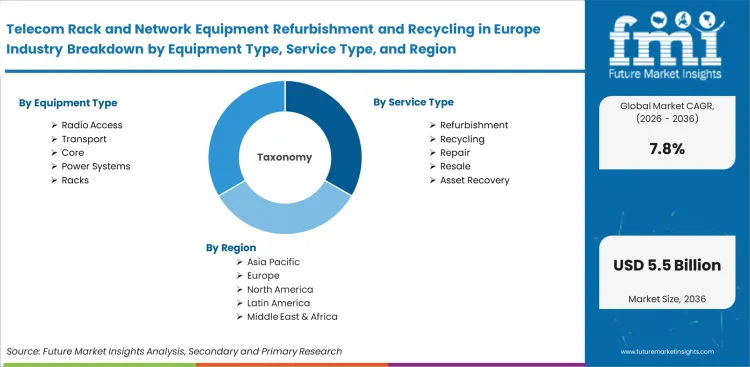
| Segmentation | Equipment Type, Service Type, End User, Asset State, Channel, and Region |
| Regions Covered | North America, Latin America, Europe, Asia Pacific, Middle East and Africa |
| Countries Covered | United Kingdom, Germany, Sweden, France, Netherlands, Spain, Italy |
| Key Companies Profiled | TXO, Nokia, Ericsson, PICS Telecom |
| Forecast Period | 2026 to 2036 |
| Approach | Hardware lifecycle models linked to 3G/4G network sunset timelines. |
Telecom Rack and Network Equipment Refurbishment and Recycling in Europe Industry Analysis by Segments
Equipment Type
- Radio Access
- Transport
- Core
- Power Systems
- Racks
Service Type
- Refurbishment
- Recycling
- Repair
- Resale
- Asset Recovery
End User
- Telecom Operators
- TowerCos
- Data Centers
- Enterprises
- Public Networks
Asset State
- Decommissioned
- Surplus
- Faulty
- Legacy
- Upgrade Swaps
Channel
- Direct Programs
- OEM Services
- ITAD Partners
- Brokers
- Auctions
Region
- Northern & Western Europe
- United Kingdom
- Germany
- Sweden
- France
- Netherlands
- Southern Europe
- Spain
- Italy
Bibliography
- Baldini, G., Cerutti, I., & Chountala, C. (2024). Identifying common indicators for measuring the environmental footprint of electronic communications networks (ECNs) for the provision of electronic communications services (ECSs). Publications Office of the European Union.
- European Telecommunications Standards Institute. (2024). ETSI ES 204 082 V1.1.0: Environmental Engineering (EE); An information model for digital product information on sustainability and circularity.
- GSMA Intelligence. (2024). Global mobile trends 2024.
- Nagase, Y., & Uehara, T. (2024). The potential impact of the new ‘Right to Repair’ rules on electrical and electronic equipment waste: A case study of the UK. Waste Management, 182, 175–185.
- Organisation for Economic Co-operation and Development. (2025). The environmental sustainability of communication networks. OECD Digital Economy Papers.
This bibliography is provided for reader reference. The full FMI report contains the complete reference list with primary source documentation.
This Report Addresses
- Equipment Type integration trends driving telecom infrastructure recycling services in Europe.
- Radio Access baseband extraction mechanics supporting specific metal recovery metrics.
- Service Type dynamics shifting margin focus to telecom equipment remarketing services in Europe.
- Refurbishment diagnostic protocols necessary to bypass proprietary software lock-ins.
- End User sustainability constraints forcing a telecom equipment refurbishment services Europe RFQ process.
- Asset State triage realities determining which legacy systems survive outdoor staging degradation.
- Channel tension between independent ITAD partners and OEM managed take-back contracts.
- Geographic infrastructure differences separating Northern European resale channels from Southern European dismantling hubs.
Frequently Asked Questions
What is telecom equipment refurbishment?
It encompasses systematic recovery, testing, repair, and material reclamation of communications infrastructure hardware, restoring components for functional resale rather than scrap extraction.
How big is the telecom equipment refurbishment market in Europe?
Total valuation is forecast to reach USD 5.1 billion by 2036, rising from a USD 2.4 billion baseline in 2026. This scale signals a permanent shift where secondary processing transitions from a minor compliance afterthought into a critical supply chain function.
Explain the Europe telecom refurbishment market in simple terms?
Facilities sanitize, test, and remarket decommissioned infrastructure components or dismantle them for elemental extraction under strict European environmental guidelines, extending the life of heavy carrier hardware.
How does telecom equipment recycling work?
Units failing diagnostic checks proceed to mechanical shredding. Recycling plants optimize blade configurations to separate ferrous metals from printed circuit boards containing gold and palladium.
Who buys decommissioned telecom equipment in Europe?
Companies actively scout secondary markets for specific legacy line cards, while large corporate IT departments acquire refurbished routing hardware to manage surplus telecom network hardware in Europe.
Is refurbished network equipment reliable for telecom operators?
Yes, provided it undergoes certified diagnostic testing. Firms actively specify secondary basebands not to save pennies, but to meet launch deadlines when virgin hardware lead times exceed construction schedules.
What regulations affect telecom equipment recycling in Europe?
European WEEE directive amendments compel operators to track every single baseband unit from tower removal to final material extraction, attaching severe regulatory fines to non-compliance.
Which companies lead telecom network equipment refurbishment in Europe?
Major players include TXO, Nokia, Ericsson, and PICS Telecom. The landscape splits between independent broker networks and direct OEM take-back programs.
Compare telecom equipment refurbishment and recycling in Europe?
Refurbishment yields fundamentally superior margin economics through functional hardware resale, while recycling focuses purely on bulk elemental extraction of copper, aluminum, and precious metals.
Why is telecom network equipment reuse growing in Europe?
Major operators face regulatory scrutiny regarding carbon footprint reduction. Strict end-of-life tracking, funneling massive volume directly to certified ITAD facilities are mandated.
Estimate the Europe telecom rack recycling market?
Advanced liquid cooling loops inside modern racks contain highly valuable copper and aluminum, pushing firms to implement specialized fluid drainage protocols before mechanical shredding captures elemental value.
Give me country growth rates for telecom equipment recycling in Europe?
The United Kingdom leads at an 8.4% CAGR, followed closely by Sweden at 8.2% and Germany at 8.1%. Southern European nations like Spain and Italy advance slightly slower at 7.3% and 7.1% respectively.
Telecom equipment refurbishment vs new equipment cost?
Secondary market hardware offers significant capital expenditure relief for mid-tier broadband providers, though proprietary software licensing fees often erode the initial hardware cost advantage.
Refurbished vs recycled telecom equipment?
Refurbished units maintain physical functionality and deploy immediately into active networks. Recycled equipment undergoes complete mechanical destruction to reclaim underlying commodity metals.
OEM refurbished telecom gear vs third party refurbished?
OEMs possess exclusive ability to fully test, certify, and re-license advanced radio equipment. Third-party facilities often must reverse-engineer testing protocols to prove hardware viability to buyers.
Best telecom equipment recycling companies Europe?
Elite partners maintain proprietary diagnostic software and provide operators with cryptographic proof of data destruction, separating global ITAD leaders from basic regional scrap processors.
Telecom rack refurbishment vs rack replacement?
Refurbishing existing high-density enclosures avoids massive steel and aluminum sourcing delays, allowing data center operators to deploy upgraded thermal management systems significantly faster.
Network equipment asset recovery vs disposal?
Asset recovery captures high-margin resale value through complex diagnostic certification, whereas basic disposal guarantees environmental compliance but sacrifices all functional hardware equity.
What defines the optical transport equipment refurbishment sector?
Transport hardware requires active cloud subscriptions to function, forcing secondary market brokers to overcome significant hurdles convincing buyers to purchase used optical gear without guaranteed license transfers.
How do telecom OEM circular services operate in Europe?
Companies negotiate end-of-life removal services directly into massive 5G rollout contracts, shifting all environmental liability back to the original manufacturer while locking out independent brokers.
Preview the report firsthand - request a free sample
Get SampleGet the brochure for pricing and purchase details.
Get PDFTable of Content
- Executive Summary
- Global Market Outlook
- Demand-side Trends
- Supply-side Trends
- Technology Roadmap Analysis
- Analysis and Recommendations
- Market Overview
- Market Coverage / Taxonomy
- Market Definition / Scope / Limitations
- Research Methodology
- Chapter Orientation
- Analytical Lens and Working Hypotheses
- Market Structure, Signals, and Trend Drivers
- Benchmarking and Cross-market Comparability
- Market Sizing, Forecasting, and Opportunity Mapping
- Research Design and Evidence Framework
- Desk Research Programme (Secondary Evidence)
- Company Annual and Sustainability Reports
- Peer-reviewed Journals and Academic Literature
- Corporate Websites, Product Literature, and Technical Notes
- Earnings Decks and Investor Briefings
- Statutory Filings and Regulatory Disclosures
- Technical White Papers and Standards Notes
- Trade Journals, Industry Magazines, and Analyst Briefs
- Conference Proceedings, Webinars, and Seminar Materials
- Government Statistics Portals and Public Data Releases
- Press Releases and Reputable Media Coverage
- Specialist Newsletters and Curated Briefings
- Sector Databases and Reference Repositories
- FMI Internal Proprietary Databases and Historical Market Datasets
- Subscription Datasets and Paid Sources
- Social Channels, Communities, and Digital Listening Inputs
- Additional Desk Sources
- Expert Input and Fieldwork (Primary Evidence)
- Primary Modes
- Qualitative Interviews and Expert Elicitation
- Quantitative Surveys and Structured Data Capture
- Blended Approach
- Why Primary Evidence is Used
- Field Techniques
- Interviews
- Surveys
- Focus Groups
- Observational and In-context Research
- Social and Community Interactions
- Stakeholder Universe Engaged
- C-suite Leaders
- Board Members
- Presidents and Vice Presidents
- R&D and Innovation Heads
- Technical Specialists
- Domain Subject-matter Experts
- Scientists
- Physicians and Other Healthcare Professionals
- Governance, Ethics, and Data Stewardship
- Research Ethics
- Data Integrity and Handling
- Primary Modes
- Tooling, Models, and Reference Databases
- Desk Research Programme (Secondary Evidence)
- Data Engineering and Model Build
- Data Acquisition and Ingestion
- Cleaning, Normalisation, and Verification
- Synthesis, Triangulation, and Analysis
- Quality Assurance and Audit Trail
- Market Background
- Market Dynamics
- Drivers
- Restraints
- Opportunity
- Trends
- Scenario Forecast
- Demand in Optimistic Scenario
- Demand in Likely Scenario
- Demand in Conservative Scenario
- Opportunity Map Analysis
- Product Life Cycle Analysis
- Supply Chain Analysis
- Investment Feasibility Matrix
- Value Chain Analysis
- PESTLE and Porter’s Analysis
- Regulatory Landscape
- Regional Parent Market Outlook
- Production and Consumption Statistics
- Import and Export Statistics
- Market Dynamics
- Global Market Analysis 2021 to 2025 and Forecast, 2026 to 2036
- Historical Market Size Value (USD Million) Analysis, 2021 to 2025
- Current and Future Market Size Value (USD Million) Projections, 2026 to 2036
- Y-o-Y Growth Trend Analysis
- Absolute $ Opportunity Analysis
- Global Market Pricing Analysis 2021 to 2025 and Forecast 2026 to 2036
- Global Market Analysis 2021 to 2025 and Forecast 2026 to 2036, By Equipment Type
- Introduction / Key Findings
- Historical Market Size Value (USD Million) Analysis By Equipment Type , 2021 to 2025
- Current and Future Market Size Value (USD Million) Analysis and Forecast By Equipment Type , 2026 to 2036
- Radio Access
- Transport
- Core
- Power Systems
- Racks
- Radio Access
- Y-o-Y Growth Trend Analysis By Equipment Type , 2021 to 2025
- Absolute $ Opportunity Analysis By Equipment Type , 2026 to 2036
- Global Market Analysis 2021 to 2025 and Forecast 2026 to 2036, By Service Type
- Introduction / Key Findings
- Historical Market Size Value (USD Million) Analysis By Service Type, 2021 to 2025
- Current and Future Market Size Value (USD Million) Analysis and Forecast By Service Type, 2026 to 2036
- Refurbishment
- Recycling
- Repair
- Resale
- Asset Recovery
- Refurbishment
- Y-o-Y Growth Trend Analysis By Service Type, 2021 to 2025
- Absolute $ Opportunity Analysis By Service Type, 2026 to 2036
- Global Market Analysis 2021 to 2025 and Forecast 2026 to 2036, By End Use
- Introduction / Key Findings
- Historical Market Size Value (USD Million) Analysis By End Use, 2021 to 2025
- Current and Future Market Size Value (USD Million) Analysis and Forecast By End Use, 2026 to 2036
- Telecom Operators
- TowerCos
- Data Centers
- Enterprises
- Public Networks
- Telecom Operators
- Y-o-Y Growth Trend Analysis By End Use, 2021 to 2025
- Absolute $ Opportunity Analysis By End Use, 2026 to 2036
- Global Market Analysis 2021 to 2025 and Forecast 2026 to 2036, By Asset State
- Introduction / Key Findings
- Historical Market Size Value (USD Million) Analysis By Asset State, 2021 to 2025
- Current and Future Market Size Value (USD Million) Analysis and Forecast By Asset State, 2026 to 2036
- Decommissioned
- Surplus
- Faulty
- Legacy
- Upgrade Swaps
- Decommissioned
- Y-o-Y Growth Trend Analysis By Asset State, 2021 to 2025
- Absolute $ Opportunity Analysis By Asset State, 2026 to 2036
- Global Market Analysis 2021 to 2025 and Forecast 2026 to 2036, By Channel
- Introduction / Key Findings
- Historical Market Size Value (USD Million) Analysis By Channel, 2021 to 2025
- Current and Future Market Size Value (USD Million) Analysis and Forecast By Channel, 2026 to 2036
- Direct Programs
- OEM Services
- ITAD Partners
- Brokers
- Auctions
- Direct Programs
- Y-o-Y Growth Trend Analysis By Channel, 2021 to 2025
- Absolute $ Opportunity Analysis By Channel, 2026 to 2036
- Global Market Analysis 2021 to 2025 and Forecast 2026 to 2036, By Region
- Introduction
- Historical Market Size Value (USD Million) Analysis By Region, 2021 to 2025
- Current Market Size Value (USD Million) Analysis and Forecast By Region, 2026 to 2036
- North America
- Latin America
- Western Europe
- Eastern Europe
- East Asia
- South Asia and Pacific
- Middle East & Africa
- Market Attractiveness Analysis By Region
- North America Market Analysis 2021 to 2025 and Forecast 2026 to 2036, By Country
- Historical Market Size Value (USD Million) Trend Analysis By Market Taxonomy, 2021 to 2025
- Market Size Value (USD Million) Forecast By Market Taxonomy, 2026 to 2036
- By Country
- USA
- Canada
- Mexico
- By Equipment Type
- By Service Type
- By End Use
- By Asset State
- By Channel
- By Country
- Market Attractiveness Analysis
- By Country
- By Equipment Type
- By Service Type
- By End Use
- By Asset State
- By Channel
- Key Takeaways
- Latin America Market Analysis 2021 to 2025 and Forecast 2026 to 2036, By Country
- Historical Market Size Value (USD Million) Trend Analysis By Market Taxonomy, 2021 to 2025
- Market Size Value (USD Million) Forecast By Market Taxonomy, 2026 to 2036
- By Country
- Brazil
- Chile
- Rest of Latin America
- By Equipment Type
- By Service Type
- By End Use
- By Asset State
- By Channel
- By Country
- Market Attractiveness Analysis
- By Country
- By Equipment Type
- By Service Type
- By End Use
- By Asset State
- By Channel
- Key Takeaways
- Western Europe Market Analysis 2021 to 2025 and Forecast 2026 to 2036, By Country
- Historical Market Size Value (USD Million) Trend Analysis By Market Taxonomy, 2021 to 2025
- Market Size Value (USD Million) Forecast By Market Taxonomy, 2026 to 2036
- By Country
- Germany
- UK
- Italy
- Spain
- France
- Nordic
- BENELUX
- Rest of Western Europe
- By Equipment Type
- By Service Type
- By End Use
- By Asset State
- By Channel
- By Country
- Market Attractiveness Analysis
- By Country
- By Equipment Type
- By Service Type
- By End Use
- By Asset State
- By Channel
- Key Takeaways
- Eastern Europe Market Analysis 2021 to 2025 and Forecast 2026 to 2036, By Country
- Historical Market Size Value (USD Million) Trend Analysis By Market Taxonomy, 2021 to 2025
- Market Size Value (USD Million) Forecast By Market Taxonomy, 2026 to 2036
- By Country
- Russia
- Poland
- Hungary
- Balkan & Baltic
- Rest of Eastern Europe
- By Equipment Type
- By Service Type
- By End Use
- By Asset State
- By Channel
- By Country
- Market Attractiveness Analysis
- By Country
- By Equipment Type
- By Service Type
- By End Use
- By Asset State
- By Channel
- Key Takeaways
- East Asia Market Analysis 2021 to 2025 and Forecast 2026 to 2036, By Country
- Historical Market Size Value (USD Million) Trend Analysis By Market Taxonomy, 2021 to 2025
- Market Size Value (USD Million) Forecast By Market Taxonomy, 2026 to 2036
- By Country
- China
- Japan
- South Korea
- By Equipment Type
- By Service Type
- By End Use
- By Asset State
- By Channel
- By Country
- Market Attractiveness Analysis
- By Country
- By Equipment Type
- By Service Type
- By End Use
- By Asset State
- By Channel
- Key Takeaways
- South Asia and Pacific Market Analysis 2021 to 2025 and Forecast 2026 to 2036, By Country
- Historical Market Size Value (USD Million) Trend Analysis By Market Taxonomy, 2021 to 2025
- Market Size Value (USD Million) Forecast By Market Taxonomy, 2026 to 2036
- By Country
- India
- ASEAN
- Australia & New Zealand
- Rest of South Asia and Pacific
- By Equipment Type
- By Service Type
- By End Use
- By Asset State
- By Channel
- By Country
- Market Attractiveness Analysis
- By Country
- By Equipment Type
- By Service Type
- By End Use
- By Asset State
- By Channel
- Key Takeaways
- Middle East & Africa Market Analysis 2021 to 2025 and Forecast 2026 to 2036, By Country
- Historical Market Size Value (USD Million) Trend Analysis By Market Taxonomy, 2021 to 2025
- Market Size Value (USD Million) Forecast By Market Taxonomy, 2026 to 2036
- By Country
- Kingdom of Saudi Arabia
- Other GCC Countries
- Turkiye
- South Africa
- Other African Union
- Rest of Middle East & Africa
- By Equipment Type
- By Service Type
- By End Use
- By Asset State
- By Channel
- By Country
- Market Attractiveness Analysis
- By Country
- By Equipment Type
- By Service Type
- By End Use
- By Asset State
- By Channel
- Key Takeaways
- Key Countries Market Analysis
- USA
- Pricing Analysis
- Market Share Analysis, 2025
- By Equipment Type
- By Service Type
- By End Use
- By Asset State
- By Channel
- Canada
- Pricing Analysis
- Market Share Analysis, 2025
- By Equipment Type
- By Service Type
- By End Use
- By Asset State
- By Channel
- Mexico
- Pricing Analysis
- Market Share Analysis, 2025
- By Equipment Type
- By Service Type
- By End Use
- By Asset State
- By Channel
- Brazil
- Pricing Analysis
- Market Share Analysis, 2025
- By Equipment Type
- By Service Type
- By End Use
- By Asset State
- By Channel
- Chile
- Pricing Analysis
- Market Share Analysis, 2025
- By Equipment Type
- By Service Type
- By End Use
- By Asset State
- By Channel
- Germany
- Pricing Analysis
- Market Share Analysis, 2025
- By Equipment Type
- By Service Type
- By End Use
- By Asset State
- By Channel
- UK
- Pricing Analysis
- Market Share Analysis, 2025
- By Equipment Type
- By Service Type
- By End Use
- By Asset State
- By Channel
- Italy
- Pricing Analysis
- Market Share Analysis, 2025
- By Equipment Type
- By Service Type
- By End Use
- By Asset State
- By Channel
- Spain
- Pricing Analysis
- Market Share Analysis, 2025
- By Equipment Type
- By Service Type
- By End Use
- By Asset State
- By Channel
- France
- Pricing Analysis
- Market Share Analysis, 2025
- By Equipment Type
- By Service Type
- By End Use
- By Asset State
- By Channel
- India
- Pricing Analysis
- Market Share Analysis, 2025
- By Equipment Type
- By Service Type
- By End Use
- By Asset State
- By Channel
- ASEAN
- Pricing Analysis
- Market Share Analysis, 2025
- By Equipment Type
- By Service Type
- By End Use
- By Asset State
- By Channel
- Australia & New Zealand
- Pricing Analysis
- Market Share Analysis, 2025
- By Equipment Type
- By Service Type
- By End Use
- By Asset State
- By Channel
- China
- Pricing Analysis
- Market Share Analysis, 2025
- By Equipment Type
- By Service Type
- By End Use
- By Asset State
- By Channel
- Japan
- Pricing Analysis
- Market Share Analysis, 2025
- By Equipment Type
- By Service Type
- By End Use
- By Asset State
- By Channel
- South Korea
- Pricing Analysis
- Market Share Analysis, 2025
- By Equipment Type
- By Service Type
- By End Use
- By Asset State
- By Channel
- Russia
- Pricing Analysis
- Market Share Analysis, 2025
- By Equipment Type
- By Service Type
- By End Use
- By Asset State
- By Channel
- Poland
- Pricing Analysis
- Market Share Analysis, 2025
- By Equipment Type
- By Service Type
- By End Use
- By Asset State
- By Channel
- Hungary
- Pricing Analysis
- Market Share Analysis, 2025
- By Equipment Type
- By Service Type
- By End Use
- By Asset State
- By Channel
- Kingdom of Saudi Arabia
- Pricing Analysis
- Market Share Analysis, 2025
- By Equipment Type
- By Service Type
- By End Use
- By Asset State
- By Channel
- Turkiye
- Pricing Analysis
- Market Share Analysis, 2025
- By Equipment Type
- By Service Type
- By End Use
- By Asset State
- By Channel
- South Africa
- Pricing Analysis
- Market Share Analysis, 2025
- By Equipment Type
- By Service Type
- By End Use
- By Asset State
- By Channel
- USA
- Market Structure Analysis
- Competition Dashboard
- Competition Benchmarking
- Market Share Analysis of Top Players
- By Regional
- By Equipment Type
- By Service Type
- By End Use
- By Asset State
- By Channel
- Competition Analysis
- Competition Deep Dive
- TXO
- Overview
- Product Portfolio
- Profitability by Market Segments (Product/Age /Sales Channel/Region)
- Sales Footprint
- Strategy Overview
- Marketing Strategy
- Product Strategy
- Channel Strategy
- Nokia
- Ericsson
- PICS Telecom
- TXO
- Competition Deep Dive
- Assumptions & Acronyms Used


