

- Industry Size (2026)
- USD 980.0 Mn
- Forecast (2036)
- USD 3520.0 Mn
- CAGR (2026 to 2036)
- 13.6%
Industry-Integrated Data Networks for PCR Verification Market Forecast and Outlook 2026 to 2036
The industry-integrated data networks for PCR verification market is likely to be valued at USD 980.0 million in 2026, is projected to reach USD 3,520.0 million by 2036, and is expected to expand at a 13.6% CAGR. Between 2026 and 2036, value capture concentrates less in transaction volume and more in control of trust infrastructure identity, permissions, audit trails, and interoperability standards that allow claims to survive scrutiny.
The highest cost layers sit in onboarding and integration: mapping supplier data, building API connectors, maintaining secure environments, and keeping reporting logic aligned with evolving rules. Platforms that become “default rails” for cross-enterprise exchanges gain pricing control through network effects and recurring fees tied to verified events, participants, or audits, rather than one-time deployments. Margins pool with providers that own governance and certification interfaces, because switching is costly once multiple tiers are connected and historical verification logs matter. Service-heavy implementations remain competitive but thinner in margin, especially where integrators must customize for fragmented data maturity.
Quick Stats for Industry-Integrated Data Networks for PCR Verification Market
- Industry-Integrated Data Networks for PCR Verification Market Value (2026): USD 980.0 Million
- Industry-Integrated Data Networks for PCR Verification Market Forecast Value (2036): USD 3,520.0 Million
- Industry-Integrated Data Networks for PCR Verification Market Forecast CAGR 2026 to 2036: 13.6%
- Leading End Use in Industry-Integrated Data Networks for PCR Verification Market: Multi-Industry PCR Verification (Packaging, Electronics, Automotive)
- Leading Network Type in Industry-Integrated Data Networks for PCR Verification Market: Cross-Enterprise Data Networks
- Key Growth Regions in Industry-Integrated Data Networks for PCR Verification Market: Asia Pacific, Europe, North America
- Top Key Players in Industry-Integrated Data Networks for PCR Verification Market: Catena-X Automotive Network e.V., Circularise B.V., SAP SE, IBM Corporation, Ant Group Co., Ltd., Huawei Technologies Co., Ltd., NEC Corporation
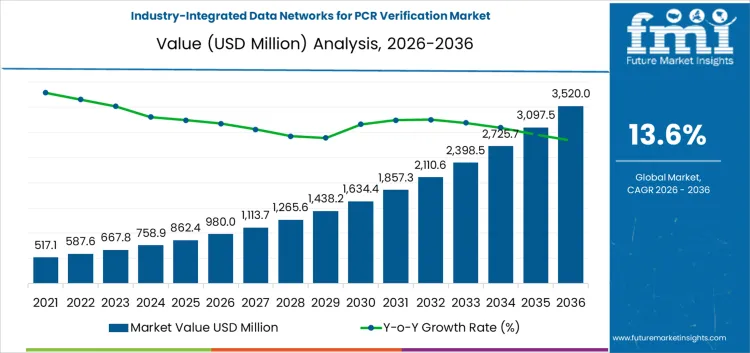
Industry-Integrated Data Networks for PCR Verification Market Key Takeaways
| Metric | Value |
|---|---|
| Industry Value (2026) | USD 980.0 Million |
| Forecast Value (2036) | USD 3,520.0 Million |
| Forecast CAGR 2026 to 2036 | 13.6% |
How Is the Global Industry-Integrated Data Networks for PCR Verification Market Advancing?
The global industry-integrated data networks for PCR verification market is advancing rapidly, driven by increasing demand for traceability, verification, and data integrity across post-consumer recycled (PCR) material value chains. These data networks enable secure tracking, validation, and reporting of PCR content as materials move from collection and recycling through conversion and end-use manufacturing.
A key driver supporting market growth is the rising requirement for verifiable PCR claims from brand owners, converters, and packaging manufacturers. Regulatory scrutiny, customer audits, and internal compliance programs are pushing companies to adopt digital systems that can authenticate PCR content using auditable data trails rather than manual documentation. Industry-integrated platforms connect recyclers, compounders, converters, and brand owners into shared verification ecosystems, improving transparency and reducing fraud risk.
Expansion of circular material supply chains is further contributing to market demand. As PCR sourcing becomes more complex and geographically distributed, centralized data networks help standardize reporting formats, reconcile material balances, and support chain-of-custody validation across multiple stakeholders.
Technological advancements are strengthening market adoption. Integration of cloud-based data platforms, secure APIs, automated reporting tools, and third-party certification interfaces is improving scalability and reliability. As PCR usage targets increase and verification expectations tighten, industry-integrated data networks are expected to become a core infrastructure layer for PCR compliance and reporting, supporting sustained market growth over the forecast period.
What Is the Segment-Wise Overview of the Industry-Integrated Data Networks for PCR Verification Market?
The industry-integrated data networks for PCR verification market is driven by the need for traceable, auditable recycled-content validation across complex supply chains. Multi-industry PCR verification spanning packaging, electronics, and automotive leads with a 45% share, as these sectors face the highest regulatory and brand-driven pressure to substantiate recycled content claims. Verification must span multiple tiers, suppliers, and geographies, increasing reliance on integrated data networks. By network type, cross-enterprise data networks account for 50% of demand, reflecting the need to securely exchange PCR data between brands, suppliers, recyclers, and auditors.
Why Does Multi-Industry PCR Verification Lead the Industry-Integrated Data Networks Market?
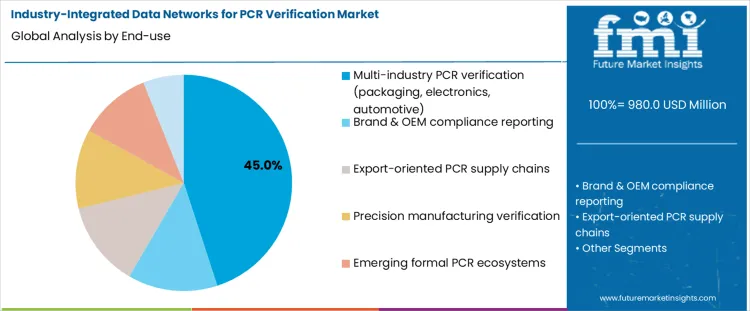
Multi-industry PCR verification represents 45% of end-use demand because packaging, electronics, and automotive sectors simultaneously face regulatory scrutiny, customer expectations, and internal ESG reporting requirements. These industries manage complex, multi-tier supply chains where PCR content must be validated across material sourcing, processing, and manufacturing stages. Industry-integrated data networks enable standardized data capture, chain-of-custody tracking, and third-party verification across diverse product categories. Brands and OEMs rely on shared verification frameworks to reduce audit duplication and ensure consistent reporting. As PCR mandates expand across multiple industries rather than isolated sectors, demand concentrates around platforms capable of supporting cross-industry data harmonization and scalable compliance workflows.
How Do Cross-Enterprise Data Networks Drive the PCR Verification Market?
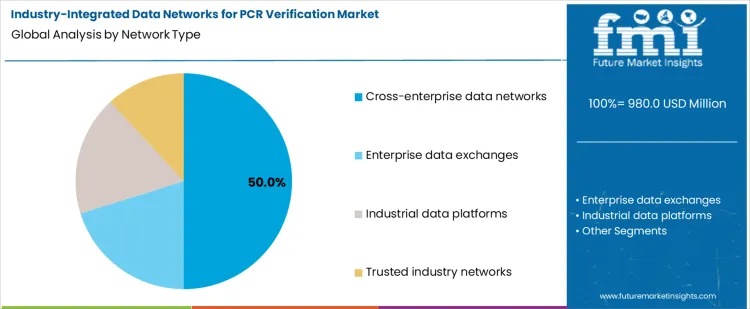
Cross-enterprise data networks account for 50% of network type demand, making them the dominant architecture in the PCR verification market. PCR verification requires secure data exchange between recyclers, compounders, converters, brands, and auditors, which cannot be achieved through isolated enterprise systems. Cross-enterprise networks enable interoperability, real-time data validation, and controlled access across organizational boundaries. These networks support digital product passports, mass-balance accounting, and audit-ready documentation without manual reconciliation. As PCR supply chains become more global and regulated, stakeholders increasingly favor shared data environments over siloed platforms. This need for transparency, scalability, and trust positions cross-enterprise data networks as the backbone of PCR verification infrastructure.
What Are the Key Dynamics for the Industry-Integrated Data Networks for PCR Verification Market?
Industry-integrated data networks integrate information from collection, sorting, recycling, and manufacturing stages to validate PCR origin, volume, and material flow. Key market dynamics include rising regulatory scrutiny on recycled content claims, increasing brand commitments to PCR usage, and demand for auditable verification systems. Industry-integrated platforms connect recyclers, converters, brand owners, and certification bodies, enabling real-time data exchange and documentation. As PCR value chains become more global and fragmented, reliance on integrated digital networks for verification and reporting is increasing to reduce fraud risk and support compliant PCR sourcing.
Why Is the Industry-Integrated Data Networks for PCR Verification Market Growing?
The industry-integrated data networks for PCR verification market is growing as recycled content mandates and disclosure requirements expand across packaging, consumer goods, and industrial plastics sectors. Brands and manufacturers are under pressure to substantiate PCR claims with verifiable data rather than self-reported declarations. Growth in mechanical and chemical recycling capacity is increasing transaction volumes and complexity, reinforcing the need for centralized digital verification frameworks. Supply chain participants are adopting integrated data networks to streamline audits, reduce manual recordkeeping, and improve confidence in PCR attribution. Cross-border movement of recycled materials further amplifies demand for standardized, interoperable data systems that enable consistent verification across regions and stakeholders, supporting market expansion.
How Are the Key Drivers Shaping the Industry-Integrated Data Networks for PCR Verification Market?
Key drivers shaping the industry-integrated data networks for PCR verification market include tightening regulations on recycled content labeling, extended producer responsibility schemes, and third-party certification requirements. Digitalization of recycling operations and material tracking enables automated data capture at each processing stage, improving verification accuracy. Integration of blockchain, secure databases, and interoperability standards supports tamper-resistant PCR data management. Brand owners are influencing adoption by requiring verified PCR documentation from suppliers as part of procurement processes. Collaboration between recyclers, data platform providers, certification bodies, and industry associations is accelerating deployment of shared verification networks.
What is the Growth Outlook for the Industry-Integrated Data Networks for PCR Verification Market by Country?
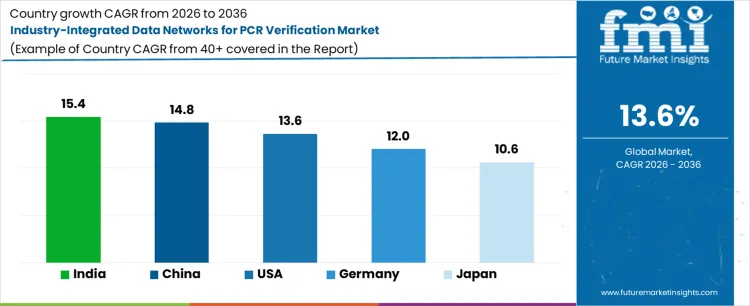
| Country | CAGR (%) |
|---|---|
| India | 15.4% |
| China | 14.8% |
| USA | 13.6% |
| Germany | 12.0% |
| Japan | 10.6% |
The industry-integrated data networks for PCR verification market is expanding as recycled content verification becomes essential across packaging and manufacturing value chains. India leads with a 15.4% CAGR, driven by regulatory enforcement and organized recycling growth. China follows at 14.8%, supported by large-scale PCR processing and digital supply chains. The USA grows at 13.6%, reflecting strong compliance and audit requirements. Germany records 12.0% growth, driven by structured regulatory frameworks. Japan expands at 10.6%, supported by quality-focused verification needs. As PCR adoption increases globally, demand for integrated verification data networks is expected to strengthen across regions.
Why Is the Industry-Integrated Data Networks for PCR Verification Market Expanding Rapidly in India?
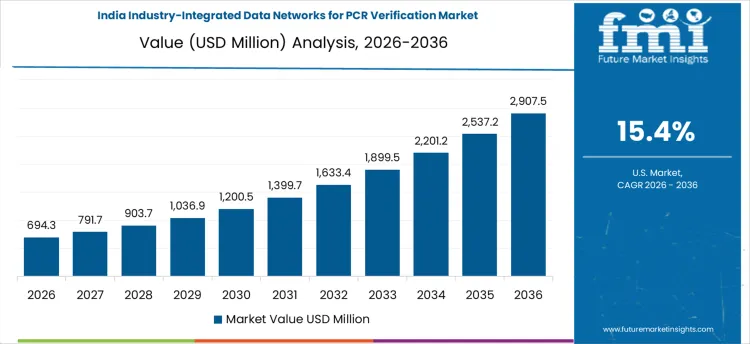
Demand for industry-integrated data networks for PCR verification in India is expanding at a CAGR of 15.4%. Demand for industry-integrated data networks for PCR verification in India is driven by tightening regulatory oversight, rising export scrutiny, and rapid growth of organized recycling and packaging sectors. PCR verification networks enable traceability of recycled content across collection, processing, and conversion stages, which is becoming essential for brand owners and converters. Sales of industry-integrated data networks for PCR verification in India are supported by growing adoption among packaging producers, FMCG companies, and recycling operators seeking audit-ready compliance systems. Digital infrastructure growth and increasing use of cloud-based compliance platforms are strengthening adoption. PCR verification industry in India benefits from extended producer responsibility enforcement and rising corporate accountability requirements. Integration with ERP, supplier databases, and certification bodies improves transparency across value chains. As PCR usage expands across packaging formats, demand for industry-integrated data networks for PCR verification in India is expected to rise strongly.
What Is Driving Growth of the Industry-Integrated Data Networks for PCR Verification Market in China?
Sales of industry-integrated data networks for PCR verification in China is growing at a CAGR of 14.8%. Demand for industry-integrated data networks for PCR verification in China is supported by large-scale recycling operations and increasing regulatory focus on recycled content verification. Sales of industry-integrated data networks for PCR verification in China are driven by packaging, consumer goods, and export-oriented manufacturers that require transparent PCR validation. PCR verification industry in China benefits from digitization of industrial supply chains and strong adoption of industrial data platforms. High-volume recycling and centralized processing increase the need for real-time data integration across stakeholders. Brand owners are prioritizing verifiable PCR claims to meet global customer and compliance expectations. Integration of blockchain-enabled traceability and AI-based audit tools is strengthening system adoption. As China continues to scale PCR utilization across manufacturing sectors, demand for industry-integrated data networks for PCR verification is expected to grow steadily.
Why Is the Industry-Integrated Data Networks for PCR Verification Market Advancing in the USA?
Demand for industry-integrated data networks for PCR verification in the USA is expanding at a CAGR of 13.6%. Demand for industry-integrated data networks for PCR verification in the USA is driven by strict corporate disclosure requirements and increasing scrutiny of recycled content claims. Sales of industry-integrated data networks for PCR verification in the USA are supported by adoption among packaging converters, consumer brands, and recyclers seeking end-to-end traceability. PCR verification industry in the USA benefits from mature digital compliance ecosystems and strong integration with certification bodies. Companies are investing in data platforms that support audit trails, supplier validation, and lifecycle reporting. Growth of circular packaging initiatives and retailer compliance mandates is increasing reliance on verified PCR data. Integration with sustainability reporting and ESG systems enhances platform value. As regulatory and brand-driven verification requirements intensify, demand for industry-integrated data networks for PCR verification in the USA is expected to rise consistently.
What Is Supporting Growth of the Industry-Integrated Data Networks for PCR Verification Market in Germany?
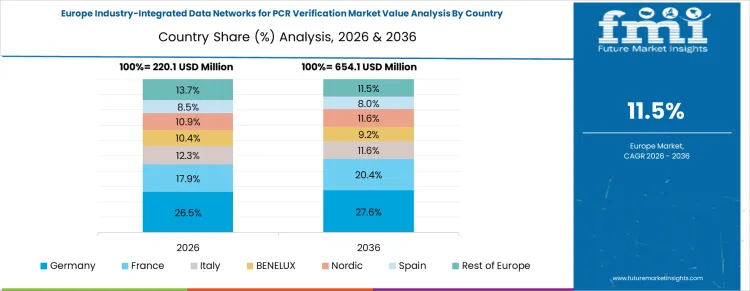
Sales for industry-integrated data networks for PCR verification in Germany is growing at a CAGR of 12.0%. Demand for industry-integrated data networks for PCR verification in Germany is driven by stringent regulatory frameworks and strong emphasis on traceability across industrial supply chains. Sales of industry-integrated data networks for PCR verification in Germany are supported by adoption in packaging, automotive, and industrial manufacturing sectors. PCR verification industry in Germany aligns closely with structured compliance processes and digital manufacturing systems. Companies value platforms that integrate seamlessly with existing quality management and production data systems. Strong focus on verified material sourcing and compliance documentation supports sustained adoption. Integration with European certification standards enhances reliability and acceptance. As Germany continues to enforce high standards for recycled content verification, demand for industry-integrated data networks for PCR verification is expected to grow at a steady pace.
Why Is the Industry-Integrated Data Networks for PCR Verification Market Growing at a Measured Pace in Japan?
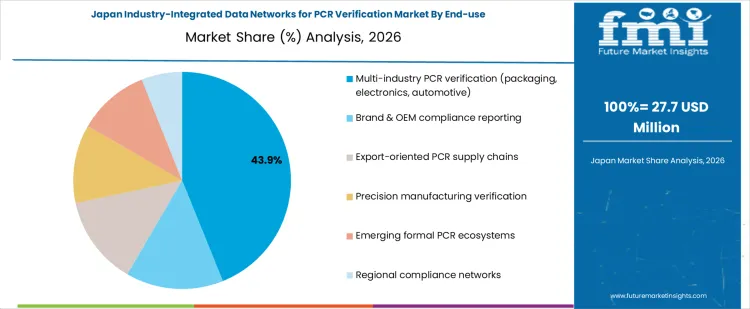
Industry-integrated data networks for PCR verification market in Japan is expanding at a CAGR of 10.6%. Demand for industry-integrated data networks for PCR verification in Japan is supported by high manufacturing quality standards and growing use of recycled materials in packaging and consumer goods. Sales of industry-integrated data networks for PCR verification in Japan are driven by manufacturers seeking precise documentation and traceability. PCR verification industry in Japan emphasizes data accuracy, system reliability, and long-term compliance. Companies are adopting integrated platforms that reduce manual verification effort and improve supplier transparency. Integration with production control and quality assurance systems supports adoption. While growth is moderate due to mature industrial structures, replacement of manual verification processes continues to drive demand. As recycled material usage increases gradually, demand for industry-integrated data networks for PCR verification in Japan is expected to remain stable.
How Are Companies Competing in the Industry-Integrated Data Networks for PCR Verification Market?
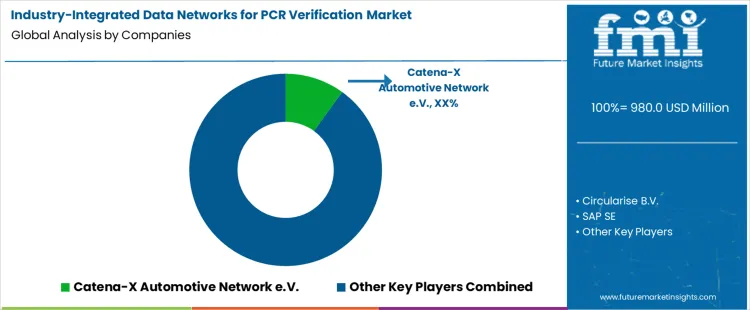
Competition in the industry-integrated data networks for PCR verification market is driven by traceability credibility, interoperability across multi-tier supply chains, data privacy controls, and the ability to support audit-ready proof of recycled content at scale. PCR verification requires trusted chain-of-custody records that link material origin, mass-balance or segregation logic, processing steps, and ownership transfers. Companies compete on data models, secure identity and credentialing, integration with ERP and manufacturing systems, and governance frameworks that ensure participants can share verified attributes without exposing sensitive commercial data. Differentiation increasingly centers on standardized data exchange, automated verification workflows, and acceptance by regulators, OEMs, and certification bodies.
Catena-X Automotive Network e.V., SAP SE, IBM Corporation, NEC Corporation, Huawei Technologies, and Ant Group compete through platform scale, enterprise integration depth, and security-first architectures. Catena-X differentiates through ecosystem governance and shared standards that enable interoperable data exchange across automotive value chains, extending naturally into recycled-content traceability for parts and materials. SAP competes by embedding PCR verification data flows into core enterprise processes like procurement, production, and compliance reporting. IBM and NEC emphasize enterprise-grade trust layers such as identity, encryption, and verifiable data sharing suited for complex, global supplier networks. Huawei and Ant Group compete through high-throughput infrastructure, strong security capabilities, and digital network deployment expertise that supports real-time, multi-party verification.
Circularise B.V. competes through purpose-built circularity traceability, focusing on granular material provenance, selective disclosure, and workflows designed for recycled content claims across packaging, polymers, and components. Its differentiation is typically stronger in attribute-level sharing and supplier onboarding simplicity, especially where participants want to prove PCR content while limiting exposure of formulations, volumes, or commercial terms. Across the market, competitive advantage is defined by network adoption, cross-industry interoperability, assurance mechanisms that stand up to audits, and the ability to convert PCR verification from manual document chasing into continuous, system-to-system validation.
Key Players in Industry-Integrated Data Networks for PCR Verification Market
- Catena-X Automotive Network e.V.
- Circularise B.V.
- SAP SE
- IBM Corporation
- Ant Group Co., Ltd.
- Huawei Technologies Co., Ltd.
- NEC Corporation
Scope of Report
| Attributes | Description |
|---|---|
| Quantitative Unit (2026) | USD Million |
| End-use | Multi-Industry PCR Verification (Packaging, Electronics, Automotive), Brand & OEM Compliance Reporting, Export-Oriented PCR Supply Chains, Precision Manufacturing Verification, Emerging Formal PCR Ecosystems, Regional Compliance Networks |
| Network Type | Cross-Enterprise Data Networks, Enterprise Data Exchanges, Industrial Data Platforms, Trusted Industry Networks |
| Regions Covered | Asia Pacific, Europe, North America, Latin America, Middle East & Africa |
| Countries Covered | China, Japan, South Korea, India, Australia & New Zealand, ASEAN, Rest of Asia Pacific, Germany, United Kingdom, France, Italy, Spain, Nordic, BENELUX, Rest of Europe, United States, Canada, Mexico, Brazil, Chile, Rest of Latin America, Kingdom of Saudi Arabia, Other GCC Countries, Turkey, South Africa, Other African Union, Rest of Middle East & Africa |
| Key Companies Profiled | Catena-X Automotive Network e.V., Circularise B.V., SAP SE, IBM Corporation, Ant Group Co., Ltd., Huawei Technologies Co., Ltd., NEC Corporation |
| Additional Attributes | Dollar sales by end-use and network type; regional market size and forecast analysis; growth outlook across major regions; adoption trends for interoperable PCR data networks; assessment of data integrity, traceability assurance, cross-enterprise interoperability, and demand patterns across regulated and export-oriented PCR value chains. |
Industry-Integrated Data Networks for PCR Verification Market by Key Segments
End-use:
- Multi-industry PCR verification (packaging, electronics, automotive)
- Brand & OEM compliance reporting
- Export-oriented PCR supply chains
- Precision manufacturing verification
- Emerging formal PCR ecosystems
- Regional compliance networks
Network Type:
- Cross-enterprise data networks
- Enterprise data exchanges
- Industrial data platforms
- Trusted industry networks
Region:
- Asia Pacific
- China
- Japan
- South Korea
- India
- Australia & New Zealand
- ASEAN
- Rest of Asia Pacific
- Europe
- Germany
- United Kingdom
- France
- Italy
- Spain
- Nordic
- BENELUX
- Rest of Europe
- North America
- United States
- Canada
- Mexico
- Latin America
- Brazil
- Chile
- Rest of Latin America
- Middle East & Africa
- Kingdom of Saudi Arabia
- Other GCC Countries
- Turkey
- South Africa
- Other African Union
- Rest of Middle East & Africa
Bibliography
- European Commission. (2023). Proposal for a regulation of the European Parliament and of the Council on circularity requirements for vehicle design and on management of end-of-life vehicles (COM/2023/451 final). European Commission.
- Catena-X Automotive Network e.V. (2024, July). Data requirements for recycling of ELVs [White paper]. Catena-X Automotive Network e.V.
- National Institute of Standards and Technology. (2025). Supply chain traceability: Manufacturing meta-framework (NIST IR 8536 2pd). National Institute of Standards and Technology.
Frequently Asked Questions
How big is the industry-integrated data networks for PCR verification market in 2026?
The global industry-integrated data networks for PCR verification market is estimated to be valued at USD 980.0 million in 2026.
What will be the size of industry-integrated data networks for PCR verification market in 2036?
The market size for the industry-integrated data networks for PCR verification market is projected to reach USD 3,520.0 million by 2036.
How much will be the industry-integrated data networks for PCR verification market growth between 2026 and 2036?
The industry-integrated data networks for PCR verification market is expected to grow at a 13.6% CAGR between 2026 and 2036.
What are the key product types in the industry-integrated data networks for PCR verification market?
The key product types in industry-integrated data networks for PCR verification market are multi-industry PCR verification (packaging, electronics, automotive), brand & OEM compliance reporting, export-oriented PCR supply chains, precision manufacturing verification, emerging formal PCR ecosystems, and regional compliance networks.
Which network type segment to contribute significant share in the industry-integrated data networks for PCR verification market in 2026?
In terms of network type, cross-enterprise data networks segment to command 50.0% share in the industry-integrated data networks for PCR verification market in 2026.
Preview the report firsthand - request a free sample
Get SampleGet the brochure for pricing and purchase details.
Get PDFTable of Content
- Executive Summary
- Global Market Outlook
- Demand-side Trends
- Supply-side Trends
- Technology Roadmap Analysis
- Analysis and Recommendations
- Market Overview
- Market Coverage / Taxonomy
- Market Definition / Scope / Limitations
- Market Background
- Market Dynamics
- Drivers
- Restraints
- Opportunity
- Trends
- Scenario Forecast
- Demand in Optimistic Scenario
- Demand in Likely Scenario
- Demand in Conservative Scenario
- Opportunity Map Analysis
- Product Life Cycle Analysis
- Supply Chain Analysis
- Investment Feasibility Matrix
- Value Chain Analysis
- PESTLE and Porter’s Analysis
- Regulatory Landscape
- Regional Parent Market Outlook
- Production and Consumption Statistics
- Import and Export Statistics
- Market Dynamics
- Global Market Analysis 2021 to 2025 and Forecast, 2026 to 2036
- Historical Market Size Value (USD Million) Analysis, 2021 to 2025
- Current and Future Market Size Value (USD Million) Projections, 2026 to 2036
- Y-o-Y Growth Trend Analysis
- Absolute $ Opportunity Analysis
- Global Market Pricing Analysis 2021 to 2025 and Forecast 2026 to 2036
- Global Market Analysis 2021 to 2025 and Forecast 2026 to 2036, By End-use
- Introduction / Key Findings
- Historical Market Size Value (USD Million) Analysis By End-use, 2021 to 2025
- Current and Future Market Size Value (USD Million) Analysis and Forecast By End-use, 2026 to 2036
- Multi-industry PCR verification (packaging, electronics, automotive)
- Brand & OEM compliance reporting
- Export-oriented PCR supply chains
- Precision manufacturing verification
- Emerging formal PCR ecosystems
- Regional compliance networks
- Multi-industry PCR verification (packaging, electronics, automotive)
- Y-o-Y Growth Trend Analysis By End-use, 2021 to 2025
- Absolute $ Opportunity Analysis By End-use, 2026 to 2036
- Global Market Analysis 2021 to 2025 and Forecast 2026 to 2036, By Network Type
- Introduction / Key Findings
- Historical Market Size Value (USD Million) Analysis By Network Type, 2021 to 2025
- Current and Future Market Size Value (USD Million) Analysis and Forecast By Network Type, 2026 to 2036
- Cross-enterprise data networks
- Enterprise data exchanges
- Industrial data platforms
- Trusted industry networks
- Cross-enterprise data networks
- Y-o-Y Growth Trend Analysis By Network Type, 2021 to 2025
- Absolute $ Opportunity Analysis By Network Type, 2026 to 2036
- Global Market Analysis 2021 to 2025 and Forecast 2026 to 2036, By Region
- Introduction
- Historical Market Size Value (USD Million) Analysis By Region, 2021 to 2025
- Current Market Size Value (USD Million) Analysis and Forecast By Region, 2026 to 2036
- North America
- Latin America
- Western Europe
- Eastern Europe
- East Asia
- South Asia and Pacific
- Middle East & Africa
- Market Attractiveness Analysis By Region
- North America Market Analysis 2021 to 2025 and Forecast 2026 to 2036, By Country
- Historical Market Size Value (USD Million) Trend Analysis By Market Taxonomy, 2021 to 2025
- Market Size Value (USD Million) Forecast By Market Taxonomy, 2026 to 2036
- By Country
- USA
- Canada
- Mexico
- By End-use
- By Network Type
- By Country
- Market Attractiveness Analysis
- By Country
- By End-use
- By Network Type
- Key Takeaways
- Latin America Market Analysis 2021 to 2025 and Forecast 2026 to 2036, By Country
- Historical Market Size Value (USD Million) Trend Analysis By Market Taxonomy, 2021 to 2025
- Market Size Value (USD Million) Forecast By Market Taxonomy, 2026 to 2036
- By Country
- Brazil
- Chile
- Rest of Latin America
- By End-use
- By Network Type
- By Country
- Market Attractiveness Analysis
- By Country
- By End-use
- By Network Type
- Key Takeaways
- Western Europe Market Analysis 2021 to 2025 and Forecast 2026 to 2036, By Country
- Historical Market Size Value (USD Million) Trend Analysis By Market Taxonomy, 2021 to 2025
- Market Size Value (USD Million) Forecast By Market Taxonomy, 2026 to 2036
- By Country
- Germany
- UK
- Italy
- Spain
- France
- Nordic
- BENELUX
- Rest of Western Europe
- By End-use
- By Network Type
- By Country
- Market Attractiveness Analysis
- By Country
- By End-use
- By Network Type
- Key Takeaways
- Eastern Europe Market Analysis 2021 to 2025 and Forecast 2026 to 2036, By Country
- Historical Market Size Value (USD Million) Trend Analysis By Market Taxonomy, 2021 to 2025
- Market Size Value (USD Million) Forecast By Market Taxonomy, 2026 to 2036
- By Country
- Russia
- Poland
- Hungary
- Balkan & Baltic
- Rest of Eastern Europe
- By End-use
- By Network Type
- By Country
- Market Attractiveness Analysis
- By Country
- By End-use
- By Network Type
- Key Takeaways
- East Asia Market Analysis 2021 to 2025 and Forecast 2026 to 2036, By Country
- Historical Market Size Value (USD Million) Trend Analysis By Market Taxonomy, 2021 to 2025
- Market Size Value (USD Million) Forecast By Market Taxonomy, 2026 to 2036
- By Country
- China
- Japan
- South Korea
- By End-use
- By Network Type
- By Country
- Market Attractiveness Analysis
- By Country
- By End-use
- By Network Type
- Key Takeaways
- South Asia and Pacific Market Analysis 2021 to 2025 and Forecast 2026 to 2036, By Country
- Historical Market Size Value (USD Million) Trend Analysis By Market Taxonomy, 2021 to 2025
- Market Size Value (USD Million) Forecast By Market Taxonomy, 2026 to 2036
- By Country
- India
- ASEAN
- Australia & New Zealand
- Rest of South Asia and Pacific
- By End-use
- By Network Type
- By Country
- Market Attractiveness Analysis
- By Country
- By End-use
- By Network Type
- Key Takeaways
- Middle East & Africa Market Analysis 2021 to 2025 and Forecast 2026 to 2036, By Country
- Historical Market Size Value (USD Million) Trend Analysis By Market Taxonomy, 2021 to 2025
- Market Size Value (USD Million) Forecast By Market Taxonomy, 2026 to 2036
- By Country
- Kingdom of Saudi Arabia
- Other GCC Countries
- Turkiye
- South Africa
- Other African Union
- Rest of Middle East & Africa
- By End-use
- By Network Type
- By Country
- Market Attractiveness Analysis
- By Country
- By End-use
- By Network Type
- Key Takeaways
- Key Countries Market Analysis
- USA
- Pricing Analysis
- Market Share Analysis, 2025
- By End-use
- By Network Type
- Canada
- Pricing Analysis
- Market Share Analysis, 2025
- By End-use
- By Network Type
- Mexico
- Pricing Analysis
- Market Share Analysis, 2025
- By End-use
- By Network Type
- Brazil
- Pricing Analysis
- Market Share Analysis, 2025
- By End-use
- By Network Type
- Chile
- Pricing Analysis
- Market Share Analysis, 2025
- By End-use
- By Network Type
- Germany
- Pricing Analysis
- Market Share Analysis, 2025
- By End-use
- By Network Type
- UK
- Pricing Analysis
- Market Share Analysis, 2025
- By End-use
- By Network Type
- Italy
- Pricing Analysis
- Market Share Analysis, 2025
- By End-use
- By Network Type
- Spain
- Pricing Analysis
- Market Share Analysis, 2025
- By End-use
- By Network Type
- France
- Pricing Analysis
- Market Share Analysis, 2025
- By End-use
- By Network Type
- India
- Pricing Analysis
- Market Share Analysis, 2025
- By End-use
- By Network Type
- ASEAN
- Pricing Analysis
- Market Share Analysis, 2025
- By End-use
- By Network Type
- Australia & New Zealand
- Pricing Analysis
- Market Share Analysis, 2025
- By End-use
- By Network Type
- China
- Pricing Analysis
- Market Share Analysis, 2025
- By End-use
- By Network Type
- Japan
- Pricing Analysis
- Market Share Analysis, 2025
- By End-use
- By Network Type
- South Korea
- Pricing Analysis
- Market Share Analysis, 2025
- By End-use
- By Network Type
- Russia
- Pricing Analysis
- Market Share Analysis, 2025
- By End-use
- By Network Type
- Poland
- Pricing Analysis
- Market Share Analysis, 2025
- By End-use
- By Network Type
- Hungary
- Pricing Analysis
- Market Share Analysis, 2025
- By End-use
- By Network Type
- Kingdom of Saudi Arabia
- Pricing Analysis
- Market Share Analysis, 2025
- By End-use
- By Network Type
- Turkiye
- Pricing Analysis
- Market Share Analysis, 2025
- By End-use
- By Network Type
- South Africa
- Pricing Analysis
- Market Share Analysis, 2025
- By End-use
- By Network Type
- USA
- Market Structure Analysis
- Competition Dashboard
- Competition Benchmarking
- Market Share Analysis of Top Players
- By Regional
- By End-use
- By Network Type
- Competition Analysis
- Competition Deep Dive
- Catena-X Automotive Network e.V.
- Overview
- Product Portfolio
- Profitability by Market Segments (Product/Age /Sales Channel/Region)
- Sales Footprint
- Strategy Overview
- Marketing Strategy
- Product Strategy
- Channel Strategy
- Circularise B.V.
- SAP SE
- IBM Corporation
- Ant Group Co., Ltd.
- Huawei Technologies Co., Ltd.
- NEC Corporation
- Catena-X Automotive Network e.V.
- Competition Deep Dive
- Assumptions & Acronyms Used
- Research Methodology


