

- Market Size (2026)
- USD 1.8 Bn
- Forecast (2036)
- USD 7.1 Bn
- CAGR (2026 to 2036)
- 14.7%
Data Center Direct-to-Chip Coolant Fluids Market Size, Market Forecast and Outlook By FMI
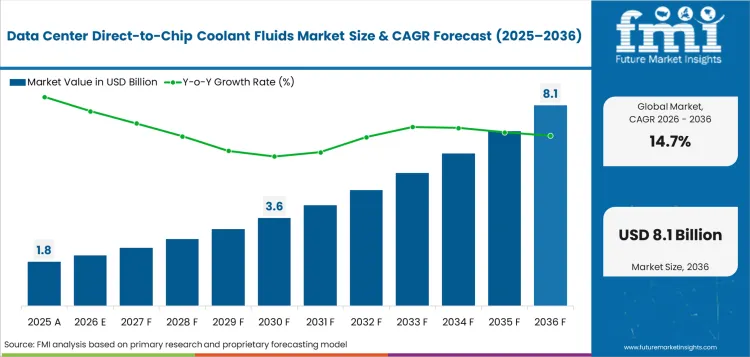
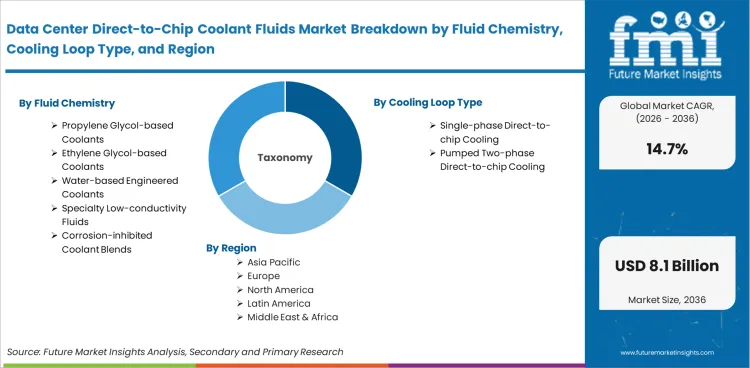
The data center direct-to-chip coolant fluids market is projected to grow from USD 1.8 billion in 2026 to USD 7.1 billion by 2036, at a CAGR of 14.7%. Propylene glycol-based coolants are expected to account for 42.0% of market revenue in 2026, while single-phase direct-to-chip cooling remains the leading cooling-loop type with a 71.0% share. Source: FMI analysis, 2026.
Summary of the Data Center Direct-to-Chip Coolant Fluids Market
- Demand and Growth Drivers
- AI rack density is pushing data centers toward liquid cooling systems that need more specialized coolant fluids.
- Coolant selection is becoming a performance and reliability decision, not only a maintenance item.
- Fluid suppliers are competing on heat transfer stability and service life, with materials compatibility still central.
- Product and Segment View
- Propylene glycol-based coolants hold the largest share as they already align with many direct-to-chip specifications and operating practices.
- Ready-to-use fluids are gaining more traction where operators want faster commissioning and lower fluid-mixing risk.
- Pumped two-phase systems remain smaller today, though they are drawing more interest in high-density AI deployments.
- Geography and Competitive Outlook
- North America leads through hyperscale AI investment and early fluid qualification activity.
- Asia Pacific is scaling through new AI infrastructure and OEM partnerships, alongside broader data center build-outs.
- Europe remains important through energy-efficiency pressure and demand for reliable fluid management.
- Analyst Opinion
- "Direct-to-chip coolant fluids are moving from a background consumable to a specification-critical part of AI infrastructure. Buyers now care more about compatibility and field reliability, since coolant failure becomes far more expensive in high-density compute environments," says Nandini Roy Choudhury, Principal Consultant.
- The strongest suppliers are pairing coolant chemistry with validation support and lifecycle monitoring.
- Buyers are placing more weight on serviceability and materials performance than on broad efficiency claims.
- The market remains early, though fluid qualification cycles are becoming more structured.
Key Takeaways
- The data center direct-to-chip coolant fluids market is expected to be valued at USD 1.8 billion in 2026.
- By 2036, the data center direct-to-chip coolant fluids market is forecast to reach USD 7.1 billion.
- From 2026 to 2036, the market is projected to expand at a CAGR of 14.7%.
- The market is expected to create an incremental opportunity of USD 5.3 billion over the forecast period.
- Propylene glycol-based coolants remain the leading fluid chemistry as they align with current direct-to-chip system requirements and established specifications.
- Single-phase direct-to-chip cooling leads demand in 2026 as it fits the current deployment pattern for many AI and high-density rack environments.
- The United States remains the largest value market, while China, Japan, Germany, and Singapore continue to influence fluid qualification practices.
The real opportunity sits in qualification-backed coolant chemistry, not in generic heat-transfer fluid supply. First-hand product signals from Castrol ON Direct Liquid Cooling PG 25, Shell DLC Fluid S3, Dow's DOWFROST LC positioning, and Arteco's ZITREC EC range show that buyers are now selecting fluids around loop compatibility, purity control, and long-cycle reliability. That raises the bar for coolant suppliers from commodity blending to specification support and service readiness. Suppliers that can align with OEM approvals and field validation should capture the highest-value share as direct-to-chip cooling scales across dense compute environments.
Data Center Direct-to-Chip Coolant Fluids Market Definition
The data center direct-to-chip coolant fluids market includes formulated heat-transfer fluids used in direct-to-chip liquid cooling systems that circulate coolant through cold plates attached to CPUs, GPUs, and other high-heat server components. It covers fluid products supplied for single-phase and pumped two-phase direct-to-chip environments across hyperscale, enterprise, edge, and high-performance computing facilities.
Data Center Direct-to-Chip Coolant Fluids Market Inclusions
Market scope covers glycol-based coolants, water-based engineered fluids, specialty low-conductivity liquids, and corrosion-inhibited blends sold for direct-to-chip data center cooling. The study includes segmentation by fluid chemistry, cooling loop type, formulation type, application, end use, distribution channel, and region for the period 2026 to 2036.
Key stakeholder scope includes chemical manufacturers, coolant formulators, additive and corrosion-inhibitor suppliers, OEMs, cold-plate and CDU providers, system integrators, hyperscale and colocation data center operators, maintenance-service providers, industrial distributors, and procurement teams. Chemical manufacturers benefit from higher-value engineered-fluid demand, distributors benefit from refill and service-linked supply, OEMs benefit from qualified fluid compatibility, and operators benefit through safer heat removal, longer loop life, and lower downtime risk in high-density AI environments.
Data Center Direct-to-Chip Coolant Fluids Market Exclusions
The scope does not include immersion cooling fluids used for full-submersion systems, standalone coolant distribution units, cold plates, chillers, heat exchangers, or generic industrial heat-transfer fluids with no direct-to-chip positioning.
Market Research Methodology
- Primary Research: Review of demand behavior across data center operators, cooling-system integrators, coolant formulators, plus OEMs in major markets.
- Desk Research: Assessment of public company launches, cooling-fluid product announcements, plus liquid-cooling qualification trends.
- Market sizing and forecasting: Revenue modeling based on liquid-cooling deployment, rack-density growth, coolant replacement cycles, plus regional AI infrastructure expansion.
- Data validation: Cross-checking against visible product launches, system deployment trends, plus supplier ecosystem activity.
Why is the Data Center Direct-to-Chip Coolant Fluids Market Growing?
- AI servers are generating more heat per rack than air cooling can handle efficiently in many deployments.
- Direct-to-chip systems need coolant fluids that protect components while maintaining stable thermal performance.
- Operators want fluids that can fit current specifications without adding unnecessary service complexity.
The market is growing as AI compute pushes more facilities toward direct-to-chip liquid cooling. Once cold plates and coolant loops are adopted, the fluid itself becomes a critical operating material. It must transfer heat efficiently, protect mixed metals, control biological growth, and remain stable across longer service periods.
Recent launches show that coolant chemistry is becoming its own product category inside data center infrastructure. Castrol launched Castrol ON Direct Liquid Cooling PG 25 in December 2024 as a propylene glycol-based fluid designed for direct-to-chip cooling applications in high-performance data centers. Shell launched Shell DLC Fluid S3 in June 2025 as a direct liquid cooling fluid that meets Open Compute Project PG25 coolant specifications. Dow has also positioned DOWFROST LC Heat Transfer Fluid specifically for liquid-cooled, direct-to-chip applications, while Arteco expanded its ZITREC EC range for electronics and data center cooling.
The category also benefits from practical deployment logic. Many operators can adopt direct-to-chip cooling without fully redesigning the facility, but they still need approved fluids that fit the loop design, material set, and maintenance strategy. That gives coolant suppliers a clearer role in qualification and lifecycle support.
The market still faces constraints. Qualification cycles can be slow, fluid compatibility testing takes time, and buyers remain cautious about long-term maintenance burden. Even so, demand is rising fast enough that formulated coolant fluids are becoming a more visible procurement category in AI-led data center build-outs.
Market Segmentation Analysis
- Propylene glycol-based coolants account for 42.0% of market revenue in 2026 as they remain the clearest fit with current direct-to-chip system specifications. Source: FMI analysis, 2026.
- Single-phase direct-to-chip cooling holds a 71.0% share in 2026, keeping it the leading cooling-loop type for coolant fluid demand. Source: FMI analysis, 2026.
- Direct OEM supply and cooling-system integrator channels remain the main commercial routes as buyers still rely on approved fluid lists and system-level validation.
The data center direct-to-chip coolant fluids market is segmented by fluid chemistry, cooling loop type, formulation type, application, end use, distribution channel, and region. That structure reflects where value is forming: in qualified chemistry, reliable system compatibility, and support for dense compute environments.
Insights into the Propylene Glycol-based Coolants Segment
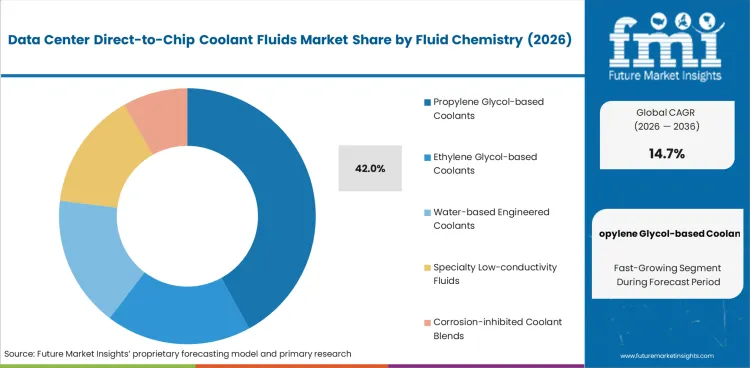
Propylene glycol-based coolants remain the leading fluid chemistry segment in 2026. They are widely recognized in direct-to-chip cooling discussions and already align with important specification frameworks such as PG25-type requirements. That gives them a practical advantage in early market scaling.
The segment also benefits from supplier activity. New launches from Castrol and Shell have reinforced the commercial visibility of PG-based fluids for direct liquid cooling environments.
Insights into the Single-phase Direct-to-chip Cooling Segment
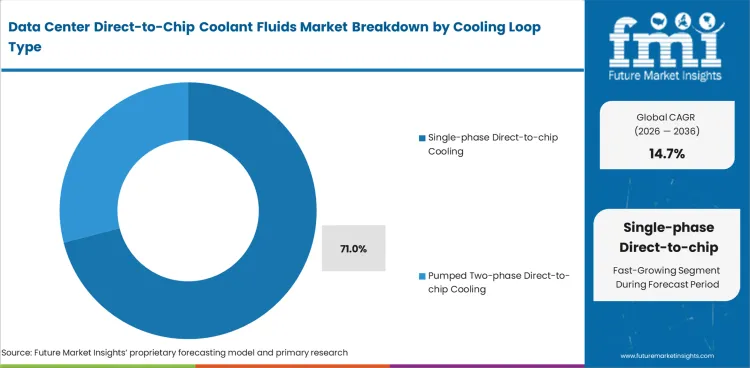
Single-phase direct-to-chip cooling remains the largest cooling-loop segment in 2026. It is the most commercially established path for many AI racks and high-density server deployments, which makes it the largest source of current coolant-fluid demand.
This segment matters as fluid qualification is more active where deployments are already scaling. Suppliers that can match current cold-plate systems and loop materials have a clearer route to repeat orders.
Insights into the GPU Cooling Segment
GPU cooling is expected to account for the largest end-use share in 2026. AI training and inference clusters are increasing the thermal intensity of GPU-heavy racks, which pushes operators toward more robust liquid-cooling strategies.
This segment is likely to stay central through the forecast period as newer accelerators keep raising heat loads and forcing more fluid-sensitive operating conditions.
Data Center Direct-to-Chip Coolant Fluids Market Drivers, Restraints, and Opportunities
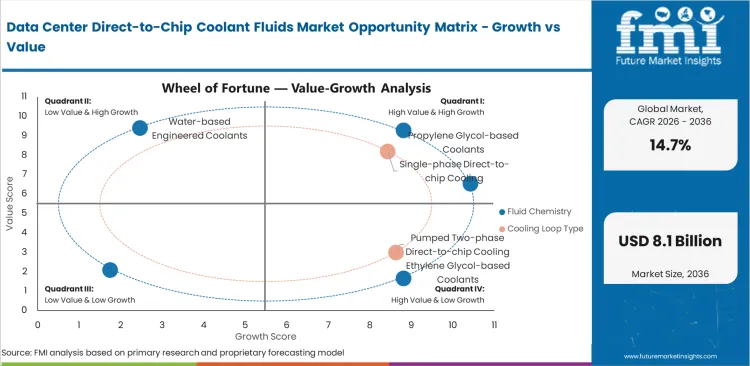
- AI rack density remains the main market driver.
- Qualification friction and lifecycle uncertainty continue to restrain faster fluid adoption.
- The strongest opportunities are opening in approved PG-based fluids and ready-to-use formulations, especially where advanced high-density loops need qualified chemistries.
The market is expanding quickly, though it is not yet a commodity fluids story. Buyers are not only comparing price. They are evaluating whether a coolant can stay stable in a live AI environment where failure risk is expensive.
Higher Rack Density Is Pulling Fluids into the Center of Cooling Design
As CPU and GPU thermal loads increase, coolant fluids are no longer a secondary detail. They affect pump behavior, corrosion control, maintenance intervals, and long-term system uptime.
Qualification Cycles and Compatibility Concerns Slow Procurement
The main restraint is qualification. Operators and OEMs need proof on material compatibility, biostability, and long service life before standardizing a fluid across new or retrofitted deployments.
Upside Is Strongest in Ready-to-use and Qualification-backed Fluids
The clearest opportunity sits in products that shorten deployment friction. Ready-to-use fluids, PG25-aligned formulations, and chemistry packages with stronger service support should see the best demand.
Regional Market Analysis
.webp "Top Country Growth Comparison Data Center Direct To Chip Coolant Fluids Market Cagr (2026 2036)")
- The United States is projected to grow at 15.3% CAGR from 2026 to 2036 and remain the largest market in value terms.
- China and Singapore are expected to expand at 16.1% and 15.7%, supported by AI data center investment and regional hyperscale infrastructure growth.
- Japan and Germany are forecast to post 13.4% and 12.8% growth as high-reliability cooling design and industrial-quality standards keep shaping fluid qualification. Country growth rates are FMI estimates, 2026.
The data center direct-to-chip coolant fluids market is likely to scale first in countries where AI infrastructure, hyperscale expansion, and liquid-cooling adoption are moving together. North America leads the first commercial wave, while Asia Pacific is building the next concentration of qualified fluid demand.
How Is the United States Shaping the Data Center Direct-to-Chip Coolant Fluids Market?
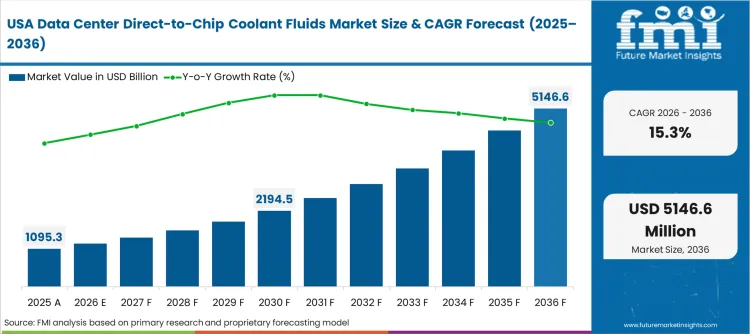
The United States remains the anchor market for direct-to-chip coolant fluids. It combines hyperscale AI spending, early liquid-cooling deployment, and a strong supplier ecosystem for thermal-management products.
- AI data center expansion is pushing fluid demand into larger purchasing decisions.
- USA-linked suppliers are launching more direct-to-chip coolant products.
- Operators are more active in fluid qualification and retrofit planning.
Why Does China Matter in This Data Center Direct-to-Chip Coolant Fluids Market?
China matters through large AI infrastructure ambitions, broad server deployment, and strong industrial cooling capability. The market is likely to reward suppliers that can scale fluid support while meeting local system and materials requirements.
- AI and cloud build-outs are increasing the need for higher-density cooling.
- Domestic and regional ecosystem development can accelerate localized fluid supply.
- Cost-performance balance remains important in fluid selection.
What Is Driving Demand in Singapore?
Singapore remains important through its role as a regional data center hub with strong interest in energy-efficient cooling. The market is likely to favor fluids that support compact, high-performance liquid-cooling systems with disciplined service management.
- High-value data center deployments create a strong qualification environment.
- Operators are more sensitive to efficiency and uptime tradeoffs.
- Regional visibility can turn successful fluid deployments into broader Asia Pacific references.
How Are Japan and Germany Supporting the Market?
Japan and Germany support the market through reliability-focused deployment logic. Both markets tend to place more weight on validated operating performance and materials discipline than on aggressive early adoption.
- Japan rewards high-stability cooling systems for advanced compute environments.
- Germany places more emphasis on engineering reliability and process control.
- Both markets can influence qualification standards beyond their direct volume share.
Competitive Landscape and Strategic Positioning
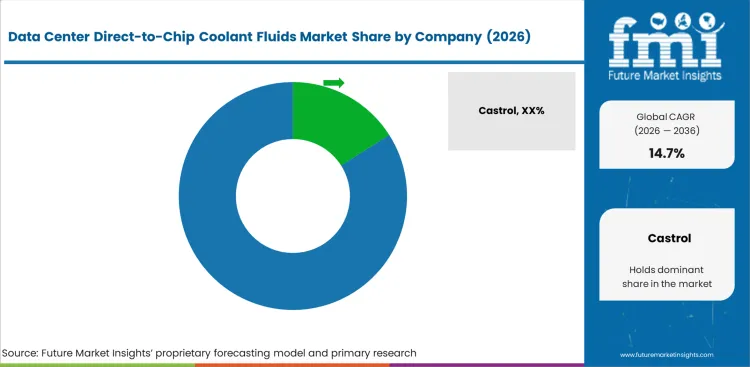
- Competition spans coolant formulators, lubricant majors, specialty chemical suppliers, plus adjacent cooling-system players.
- Competitive strength depends on thermal stability and corrosion protection, along with specification alignment.
- The strongest suppliers are linking chemistry with validation support instead of selling fluid as a simple consumable.
Competition is forming around qualification, not only distribution. Buyers want fluids that fit approved specifications, work across mixed material loops, and remain serviceable over longer operating cycles.
That matters in an early market. Hardware vendors can help shape demand, but the fluid suppliers that win will be the ones that stay close to OEM approvals, system integrators, and field data from live deployments.
Service support is becoming a meaningful differentiator. Fluid monitoring, contamination guidance, and refill planning are likely to matter more as liquid cooling moves from pilot deployments into scaled AI infrastructure.
Key and Adjacent Companies in the Data Center Direct-to-Chip Coolant Fluids Market
Key companies active in the market include Castrol, Shell, Dow, Arteco, LiquidStack, and Vertiv.
Competitive Benchmarking: Data Center Direct-to-Chip Coolant Fluids Market
| Company | Core Strength | Primary Direct-to-chip Coolant Fluids Exposure | Strategic Positioning | Geographic Footprint |
|---|---|---|---|---|
| Castrol | Thermal-management fluids and industrial lubricant scale | Castrol ON Direct Liquid Cooling PG 25 for direct-to-chip applications | PG-based coolant supply with fluid performance positioning | Global |
| Shell | Heat-transfer fluids and data center cooling portfolio | Shell DLC Fluid S3 for direct liquid cooling, aligned with OCP PG25 specifications | Global fluids brand expanding into AI data center cooling | Global |
| Dow | Heat-transfer chemistry and engineered fluids | DOWFROST LC Heat Transfer Fluid for direct-to-chip cooling | Industrial chemistry supplier with data center cooling portfolio | Global |
| Arteco | Engineered coolant formulation and lifecycle support | ZITREC EC direct-to-chip coolant range for data centers | Specialty coolant supplier with performance and sustainability focus | Europe, Asia, Americas |
| LiquidStack | Liquid cooling systems and deployment ecosystem | Adjacent exposure through direct-to-chip cooling systems that shape approved fluid demand | Cooling-system ecosystem influence | Global |
| Vertiv | AI cooling infrastructure and fluid-management support | Adjacent exposure through direct-to-chip cooling deployment and fluid management services | Infrastructure and lifecycle service influence | Global |
Key Developments in Data Center Direct-to-Chip Coolant Fluids Market
- Castrol launched Castrol ON Direct Liquid Cooling PG 25 in December 2024 as a propylene glycol-based fluid engineered for direct-to-chip cooling applications in high-performance data centers.
- Shell launched Shell DLC Fluid S3 in June 2025 as a propylene glycol-based direct liquid cooling fluid that meets Open Compute Project PG25 coolant specifications.
- Dow positioned DOWFROST LC Heat Transfer Fluid for liquid-cooled, direct-to-chip applications and highlighted the product in its 2024 annual-report discussion of advanced data center cooling uses.
- Arteco launched its ZITREC EC range for electronics and data center cooling, including direct-to-chip coolant positioning for server and AI-era cooling environments.
- Vertiv said in November 2024 that its new high-capacity CoolChip CDUs support direct-to-chip AI applications and include lifecycle and fluid-management support, reinforcing the need for qualified coolant fluids.
Key Players in the Data Center Direct-to-Chip Coolant Fluids Market
Major Global Players
- Castrol
- Shell
- Dow
- Arteco
- LiquidStack
- Vertiv
Emerging and Specialist Growth Suppliers
- Specialty heat-transfer formulators, regional coolant blenders, and OEM-linked thermal-management suppliers are likely to widen the field over the next few years. Their role will be strongest where localized qualification, refill support, or custom chemistry packages improve adoption.
Research Scope and Coverage
| Attribute | Details |
|---|---|
| Estimated market size (2026) | USD 1.8 billion |
| Projected market size (2036) | USD 7.1 billion |
| CAGR (2026 to 2036) | 14.7% |
| Quantitative units | USD billion |
| Key segment coverage | Fluid Chemistry , Cooling Loop Type , Formulation Type , Application , End Use , Distribution Channel , and Region |
| Regions covered | North America, Europe, Asia Pacific, Latin America, Middle East and Africa |
Segment Analysis by Fluid Chemistry, Cooling Loop Type, Formulation Type, Application, End Use, Distribution Channel, and Region
By Fluid Chemistry:
- Propylene Glycol-based Coolants
- Ethylene Glycol-based Coolants
- Water-based Engineered Coolants
- Specialty Low-conductivity Fluids
- Corrosion-inhibited Coolant Blends
By Cooling Loop Type:
- Single-phase Direct-to-chip Cooling
- Pumped Two-phase Direct-to-chip Cooling
By Formulation Type:
- Ready-to-use Fluids
- Concentrates
By Application:
- AI Training Clusters
- High-performance Computing
- Hyperscale Cloud Data Centers
- Enterprise Data Centers
- Edge and Colocation Data Centers
By End Use:
- CPU Cooling
- GPU Cooling
- Mixed CPU-GPU Racks
- Networking and Accelerator Systems
By Distribution Channel:
- Direct OEM Supply
- Cooling-system Integrators
- Industrial Distributors
- Aftermarket Service and Refill Contracts
By Region:
- North America
- Latin America
- Europe
- Asia Pacific
- Middle East and Africa
Research Sources and Bibliography
- 1. FMI analysis, 2026.
- 2. Official company announcements and product launch disclosures referenced in the competitive landscape and key developments sections.
- 3. Company product pages, investor communications, and technology or portfolio documentation referenced for market context.
- 4. Public industry documentation, platform updates, and regulatory or standards-related materials used for category framing where relevant.
This Report Answers
- What is the projected value of the Data Center Direct-to-Chip Coolant Fluids Market in 2026 and 2036?
- What is the expected CAGR from 2026 to 2036?
- Which segment currently contributes the largest share in the market structure?
- Which countries are expected to expand faster than the global average through 2036?
- Which companies hold the strongest visible positions in the current competitive landscape?
- What commercial factors are supporting current market adoption?
- Which product, application, or end-use areas are expected to create the strongest opportunity?
Frequently Asked Questions
What is the global market demand for Data Center Direct-to-Chip Coolant Fluids Market in 2026?
In 2026, the global market for Data Center Direct-to-Chip Coolant Fluids Market is estimated at USD 1.8 billion.
What is the forecast market value by 2036?
By 2036, the market is projected to reach USD 7.1 billion under the base-case forecast model.
What is the forecast CAGR from 2026 to 2036?
The market is expected to expand at a 14.7% CAGR during the forecast period.
Which segment leads the market?
The leading segment is identified in the market segmentation analysis based on FMI estimates for 2026.
Which countries are expected to expand faster than the global average?
The regional market analysis highlights the faster-growing country markets under the FMI forecast model.
Why is Data Center Direct-to-Chip Coolant Fluids Market gaining market traction?
Adoption is rising as suppliers and buyers respond to measurable operational, commercial, and performance needs in the category.
Preview the report firsthand - request a free sample
Get SampleGet the brochure for pricing and purchase details.
Get PDFTable of Content
- Executive Summary
- Global Market Outlook
- Demand-side Trends
- Supply-side Trends
- Technology Roadmap Analysis
- Analysis and Recommendations
- Market Overview
- Market Coverage / Taxonomy
- Market Definition / Scope / Limitations
- Research Methodology
- Chapter Orientation
- Analytical Lens and Working Hypotheses
- Market Structure, Signals, and Trend Drivers
- Benchmarking and Cross-market Comparability
- Market Sizing, Forecasting, and Opportunity Mapping
- Research Design and Evidence Framework
- Desk Research Programme (Secondary Evidence)
- Company Annual and Sustainability Reports
- Peer-reviewed Journals and Academic Literature
- Corporate Websites, Product Literature, and Technical Notes
- Earnings Decks and Investor Briefings
- Statutory Filings and Regulatory Disclosures
- Technical White Papers and Standards Notes
- Trade Journals, Industry Magazines, and Analyst Briefs
- Conference Proceedings, Webinars, and Seminar Materials
- Government Statistics Portals and Public Data Releases
- Press Releases and Reputable Media Coverage
- Specialist Newsletters and Curated Briefings
- Sector Databases and Reference Repositories
- FMI Internal Proprietary Databases and Historical Market Datasets
- Subscription Datasets and Paid Sources
- Social Channels, Communities, and Digital Listening Inputs
- Additional Desk Sources
- Expert Input and Fieldwork (Primary Evidence)
- Primary Modes
- Qualitative Interviews and Expert Elicitation
- Quantitative Surveys and Structured Data Capture
- Blended Approach
- Why Primary Evidence is Used
- Field Techniques
- Interviews
- Surveys
- Focus Groups
- Observational and In-context Research
- Social and Community Interactions
- Stakeholder Universe Engaged
- C-suite Leaders
- Board Members
- Presidents and Vice Presidents
- R&D and Innovation Heads
- Technical Specialists
- Domain Subject-matter Experts
- Scientists
- Physicians and Other Healthcare Professionals
- Governance, Ethics, and Data Stewardship
- Research Ethics
- Data Integrity and Handling
- Primary Modes
- Tooling, Models, and Reference Databases
- Desk Research Programme (Secondary Evidence)
- Data Engineering and Model Build
- Data Acquisition and Ingestion
- Cleaning, Normalisation, and Verification
- Synthesis, Triangulation, and Analysis
- Quality Assurance and Audit Trail
- Market Background
- Market Dynamics
- Drivers
- Restraints
- Opportunity
- Trends
- Scenario Forecast
- Demand in Optimistic Scenario
- Demand in Likely Scenario
- Demand in Conservative Scenario
- Opportunity Map Analysis
- Product Life Cycle Analysis
- Supply Chain Analysis
- Investment Feasibility Matrix
- Value Chain Analysis
- PESTLE and Porter’s Analysis
- Regulatory Landscape
- Regional Parent Market Outlook
- Production and Consumption Statistics
- Import and Export Statistics
- Market Dynamics
- Global Market Analysis 2021 to 2025 and Forecast, 2026 to 2036
- Historical Market Size Value (USD Million) Analysis, 2021 to 2025
- Current and Future Market Size Value (USD Million) Projections, 2026 to 2036
- Y-o-Y Growth Trend Analysis
- Absolute $ Opportunity Analysis
- Global Market Pricing Analysis 2021 to 2025 and Forecast 2026 to 2036
- Global Market Analysis 2021 to 2025 and Forecast 2026 to 2036, By Fluid Chemistry
- Introduction / Key Findings
- Historical Market Size Value (USD Million) Analysis By Fluid Chemistry , 2021 to 2025
- Current and Future Market Size Value (USD Million) Analysis and Forecast By Fluid Chemistry , 2026 to 2036
- Propylene Glycol-based Coolants
- Ethylene Glycol-based Coolants
- Water-based Engineered Coolants
- Specialty Low-conductivity Fluids
- Corrosion-inhibited Coolant Blends
- Propylene Glycol-based Coolants
- Y-o-Y Growth Trend Analysis By Fluid Chemistry , 2021 to 2025
- Absolute $ Opportunity Analysis By Fluid Chemistry , 2026 to 2036
- Global Market Analysis 2021 to 2025 and Forecast 2026 to 2036, By Cooling Loop Type
- Introduction / Key Findings
- Historical Market Size Value (USD Million) Analysis By Cooling Loop Type, 2021 to 2025
- Current and Future Market Size Value (USD Million) Analysis and Forecast By Cooling Loop Type, 2026 to 2036
- Single-phase Direct-to-chip Cooling
- Pumped Two-phase Direct-to-chip Cooling
- Single-phase Direct-to-chip Cooling
- Y-o-Y Growth Trend Analysis By Cooling Loop Type, 2021 to 2025
- Absolute $ Opportunity Analysis By Cooling Loop Type, 2026 to 2036
- Global Market Analysis 2021 to 2025 and Forecast 2026 to 2036, By Region
- Introduction
- Historical Market Size Value (USD Million) Analysis By Region, 2021 to 2025
- Current Market Size Value (USD Million) Analysis and Forecast By Region, 2026 to 2036
- North America
- Latin America
- Western Europe
- Eastern Europe
- East Asia
- South Asia and Pacific
- Middle East & Africa
- Market Attractiveness Analysis By Region
- North America Market Analysis 2021 to 2025 and Forecast 2026 to 2036, By Country
- Historical Market Size Value (USD Million) Trend Analysis By Market Taxonomy, 2021 to 2025
- Market Size Value (USD Million) Forecast By Market Taxonomy, 2026 to 2036
- By Country
- USA
- Canada
- Mexico
- By Fluid Chemistry
- By Cooling Loop Type
- By Country
- Market Attractiveness Analysis
- By Country
- By Fluid Chemistry
- By Cooling Loop Type
- Key Takeaways
- Latin America Market Analysis 2021 to 2025 and Forecast 2026 to 2036, By Country
- Historical Market Size Value (USD Million) Trend Analysis By Market Taxonomy, 2021 to 2025
- Market Size Value (USD Million) Forecast By Market Taxonomy, 2026 to 2036
- By Country
- Brazil
- Chile
- Rest of Latin America
- By Fluid Chemistry
- By Cooling Loop Type
- By Country
- Market Attractiveness Analysis
- By Country
- By Fluid Chemistry
- By Cooling Loop Type
- Key Takeaways
- Western Europe Market Analysis 2021 to 2025 and Forecast 2026 to 2036, By Country
- Historical Market Size Value (USD Million) Trend Analysis By Market Taxonomy, 2021 to 2025
- Market Size Value (USD Million) Forecast By Market Taxonomy, 2026 to 2036
- By Country
- Germany
- UK
- Italy
- Spain
- France
- Nordic
- BENELUX
- Rest of Western Europe
- By Fluid Chemistry
- By Cooling Loop Type
- By Country
- Market Attractiveness Analysis
- By Country
- By Fluid Chemistry
- By Cooling Loop Type
- Key Takeaways
- Eastern Europe Market Analysis 2021 to 2025 and Forecast 2026 to 2036, By Country
- Historical Market Size Value (USD Million) Trend Analysis By Market Taxonomy, 2021 to 2025
- Market Size Value (USD Million) Forecast By Market Taxonomy, 2026 to 2036
- By Country
- Russia
- Poland
- Hungary
- Balkan & Baltic
- Rest of Eastern Europe
- By Fluid Chemistry
- By Cooling Loop Type
- By Country
- Market Attractiveness Analysis
- By Country
- By Fluid Chemistry
- By Cooling Loop Type
- Key Takeaways
- East Asia Market Analysis 2021 to 2025 and Forecast 2026 to 2036, By Country
- Historical Market Size Value (USD Million) Trend Analysis By Market Taxonomy, 2021 to 2025
- Market Size Value (USD Million) Forecast By Market Taxonomy, 2026 to 2036
- By Country
- China
- Japan
- South Korea
- By Fluid Chemistry
- By Cooling Loop Type
- By Country
- Market Attractiveness Analysis
- By Country
- By Fluid Chemistry
- By Cooling Loop Type
- Key Takeaways
- South Asia and Pacific Market Analysis 2021 to 2025 and Forecast 2026 to 2036, By Country
- Historical Market Size Value (USD Million) Trend Analysis By Market Taxonomy, 2021 to 2025
- Market Size Value (USD Million) Forecast By Market Taxonomy, 2026 to 2036
- By Country
- India
- ASEAN
- Australia & New Zealand
- Rest of South Asia and Pacific
- By Fluid Chemistry
- By Cooling Loop Type
- By Country
- Market Attractiveness Analysis
- By Country
- By Fluid Chemistry
- By Cooling Loop Type
- Key Takeaways
- Middle East & Africa Market Analysis 2021 to 2025 and Forecast 2026 to 2036, By Country
- Historical Market Size Value (USD Million) Trend Analysis By Market Taxonomy, 2021 to 2025
- Market Size Value (USD Million) Forecast By Market Taxonomy, 2026 to 2036
- By Country
- Kingdom of Saudi Arabia
- Other GCC Countries
- Turkiye
- South Africa
- Other African Union
- Rest of Middle East & Africa
- By Fluid Chemistry
- By Cooling Loop Type
- By Country
- Market Attractiveness Analysis
- By Country
- By Fluid Chemistry
- By Cooling Loop Type
- Key Takeaways
- Key Countries Market Analysis
- USA
- Pricing Analysis
- Market Share Analysis, 2025
- By Fluid Chemistry
- By Cooling Loop Type
- Canada
- Pricing Analysis
- Market Share Analysis, 2025
- By Fluid Chemistry
- By Cooling Loop Type
- Mexico
- Pricing Analysis
- Market Share Analysis, 2025
- By Fluid Chemistry
- By Cooling Loop Type
- Brazil
- Pricing Analysis
- Market Share Analysis, 2025
- By Fluid Chemistry
- By Cooling Loop Type
- Chile
- Pricing Analysis
- Market Share Analysis, 2025
- By Fluid Chemistry
- By Cooling Loop Type
- Germany
- Pricing Analysis
- Market Share Analysis, 2025
- By Fluid Chemistry
- By Cooling Loop Type
- UK
- Pricing Analysis
- Market Share Analysis, 2025
- By Fluid Chemistry
- By Cooling Loop Type
- Italy
- Pricing Analysis
- Market Share Analysis, 2025
- By Fluid Chemistry
- By Cooling Loop Type
- Spain
- Pricing Analysis
- Market Share Analysis, 2025
- By Fluid Chemistry
- By Cooling Loop Type
- France
- Pricing Analysis
- Market Share Analysis, 2025
- By Fluid Chemistry
- By Cooling Loop Type
- India
- Pricing Analysis
- Market Share Analysis, 2025
- By Fluid Chemistry
- By Cooling Loop Type
- ASEAN
- Pricing Analysis
- Market Share Analysis, 2025
- By Fluid Chemistry
- By Cooling Loop Type
- Australia & New Zealand
- Pricing Analysis
- Market Share Analysis, 2025
- By Fluid Chemistry
- By Cooling Loop Type
- China
- Pricing Analysis
- Market Share Analysis, 2025
- By Fluid Chemistry
- By Cooling Loop Type
- Japan
- Pricing Analysis
- Market Share Analysis, 2025
- By Fluid Chemistry
- By Cooling Loop Type
- South Korea
- Pricing Analysis
- Market Share Analysis, 2025
- By Fluid Chemistry
- By Cooling Loop Type
- Russia
- Pricing Analysis
- Market Share Analysis, 2025
- By Fluid Chemistry
- By Cooling Loop Type
- Poland
- Pricing Analysis
- Market Share Analysis, 2025
- By Fluid Chemistry
- By Cooling Loop Type
- Hungary
- Pricing Analysis
- Market Share Analysis, 2025
- By Fluid Chemistry
- By Cooling Loop Type
- Kingdom of Saudi Arabia
- Pricing Analysis
- Market Share Analysis, 2025
- By Fluid Chemistry
- By Cooling Loop Type
- Turkiye
- Pricing Analysis
- Market Share Analysis, 2025
- By Fluid Chemistry
- By Cooling Loop Type
- South Africa
- Pricing Analysis
- Market Share Analysis, 2025
- By Fluid Chemistry
- By Cooling Loop Type
- USA
- Market Structure Analysis
- Competition Dashboard
- Competition Benchmarking
- Market Share Analysis of Top Players
- By Regional
- By Fluid Chemistry
- By Cooling Loop Type
- Competition Analysis
- Competition Deep Dive
- Castrol
- Overview
- Product Portfolio
- Profitability by Market Segments (Product/Age /Sales Channel/Region)
- Sales Footprint
- Strategy Overview
- Marketing Strategy
- Product Strategy
- Channel Strategy
- Shell
- Dow
- Arteco
- LiquidStack
- Vertiv
- Castrol
- Competition Deep Dive
- Assumptions & Acronyms Used


