

- Industry Size (2026)
- USD 4120.0 Mn
- Forecast (2036)
- USD 12910.8 Mn
- CAGR (2026 to 2036)
- 12.1%
AI-Enabled Recycling Infrastructure Market Forecast and Outlook 2026 to 2036
The AI-enabled recycling infrastructure market is likely to be valued at USD 4,120.0 million in 2026 and is projected to reach USD 12,910.8 million by 2036, expanding at a CAGR of 12.1% during the forecast period. Growth is driven by rising complexity of waste streams, labor constraints, and increasing pressure to improve material recovery rates and output purity. Recycling operators deploy AI-based vision systems, robotics, and sensor fusion technologies to identify polymers, composites, and contaminants with higher accuracy than conventional sorting methods. These capabilities support consistent production of high-quality recycled feedstock required by packaging, consumer goods, and industrial end users.
Expansion of this market is shaped by regulatory recovery targets, recycled content verification requirements, and operational efficiency goals rather than capacity growth alone. AI-enabled infrastructure enables real-time monitoring of throughput, contamination levels, and equipment performance, improving decision-making and compliance reporting. Modular deployment models allow facilities to retrofit existing lines, lowering adoption barriers while scaling automation incrementally. As recycled material quality becomes a competitive differentiator, AI-driven sorting and analytics are increasingly positioned as core infrastructure supporting long-term recycling economics, traceability, and alignment with circular economy objectives.
Quick Stats for AI-Enabled Recycling Infrastructure Market
- AI-Enabled Recycling Infrastructure Market Value (2026): USD 4,120.0 million
- AI-Enabled Recycling Infrastructure Market Forecast Value (2036): USD 12,910.8 million
- AI-Enabled Recycling Infrastructure Market Forecast CAGR (2026 to 2036): 12.1%
- Leading Infrastructure Type by Demand Share: AI-optimised sorting plants
- Fastest-Growing Countries: India, China, USA, Germany, Brazil
- Top Players in Global Demand: TOMRA, ZenRobotics, AMP Robotics, WM, Everbright Environment
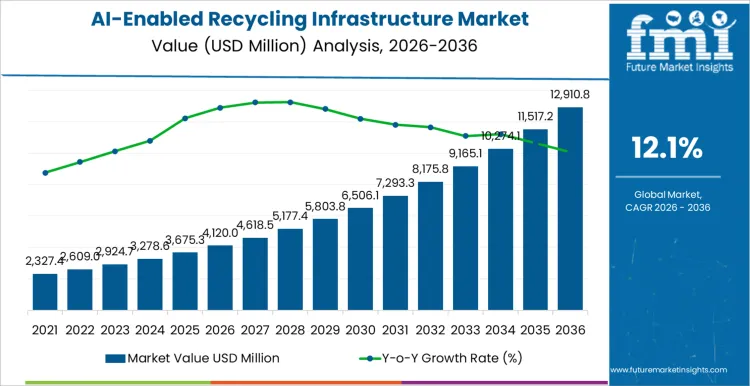
AI-Enabled Recycling Infrastructure Market Key Takeaways
| Metric | Value |
|---|---|
| Market Value (2026) | USD 4,120.0 million |
| Market Forecast Value (2036) | USD 12,910.8 million |
| Forecast CAGR (2026 to 2036) | 12.1% |
Why is the Demand for AI-Enabled Recycling Infrastructure Growing?
Recycling facilities and waste management operators are adopting AI-enabled infrastructure as complexity in material streams increases beyond manual sorting capabilities. Traditional optical and mechanical sortation systems struggle to identify and separate mixed plastics, flexible films, and multi-polymer composites at the speed required for high throughput facilities. AI systems using machine vision, neural networks, and real-time sensor fusion can classify materials with greater precision, boosting recovery rates and reducing contamination in output streams destined for mechanical or advanced recycling. Brand owners that commit to recycled content targets require traceable, high quality feedstocks; facilities equipped with AI-driven robotics and predictive analytics help ensure consistent polymer purity and reduce rejects. Sorting centers working with municipal, commercial, and industrial waste adopt these solutions to accommodate variable input loads without sacrificing yield, supporting higher operational efficiency and lower downstream processing costs.
Investment in AI-enabled recycling infrastructure is also shaped by regulatory and corporate sustainability frameworks that tie performance metrics to recycled content compliance. Governments and extended producer responsibility schemes increasingly set benchmarks for material recovery and documentation of recycling outcomes. Data platforms integrated with AI sortation systems provide analytics that support reporting on throughput, material composition trends, and equipment performance. Equipment OEMs offer modular AI upgrades that integrate with existing conveyor lines, allowing facilities to scale capabilities incrementally. Collaboration between software developers and recycling operators advances machine learning models that adapt to evolving packaging formats and contaminants, reinforcing the case for continued deployment across global recycling networks.
How Is the AI-Enabled Recycling Infrastructure Market Structured by Infrastructure Type, Waste Stream, and End Use?
AI-enabled recycling infrastructure is evolving as a response to rising material complexity, labor constraints, and quality requirements for recycled outputs. Deployment patterns vary based on plant scale, waste composition, and downstream recovery objectives. Segmentation across infrastructure type, waste stream focus, and end-use deployment illustrates where artificial intelligence delivers the highest operational and economic value for recyclers and municipal operators.
Which Infrastructure Type Leads Adoption in AI-Enabled Recycling Facilities?
AI-optimised sorting plants account for the largest share at 38.0%, reflecting strong adoption of machine vision, hyperspectral imaging, and AI-driven classification to improve material recovery rates. These systems are typically integrated into existing or new high-throughput facilities. Other infrastructure formats, including robotics-assisted facilities, smart recycling zones, compact AI-enabled facilities, and alternative configurations, are implemented based on space constraints, investment capacity, and regional waste volumes rather than disclosed percentage splits.
Key Points
- AI-optimised sorting plants dominate due to measurable recovery and purity gains.
- Robotics and compact systems address labor shortages and space limitations.
- Infrastructure choice depends on throughput requirements and retrofit feasibility.
Which Waste Stream Drives the Majority of AI Recycling Deployments?
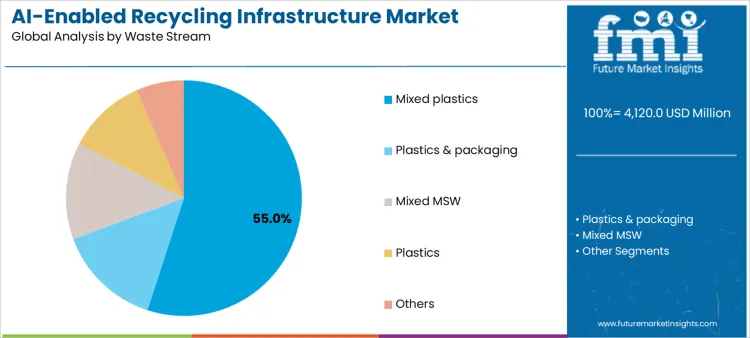
Mixed plastics represent 55.0% of the waste stream focus, driven by their high contamination levels and economic importance for circular packaging. AI systems are particularly effective in identifying polymers, colors, and formats within mixed plastic streams. Other waste streams include plastics and packaging combinations, mixed municipal solid waste, single-material plastics, and niche streams, where AI adoption varies with feedstock complexity and target output quality.
Key Points
- Mixed plastics benefit most from AI-based identification and separation.
- Higher feedstock complexity increases ROI for AI systems.
- Waste stream composition shapes sensor and algorithm selection.
Which End-Use Segment Accounts for the Highest Deployment of AI-Enabled Recycling Infrastructure?
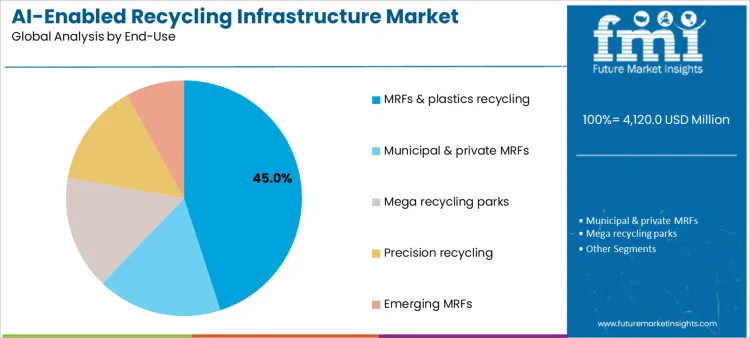
MRFs and plastics recycling facilities lead with a 45.0% share, as these operators prioritize throughput efficiency, purity improvement, and cost control. Municipal and private MRFs, mega recycling parks, precision recycling facilities, and emerging MRFs also adopt AI systems, though implementation pace depends on funding models, regulatory drivers, and scale of operations rather than specific share data.
Key Points
- Established MRFs are primary adopters due to scale and economic pressure.
- AI supports both centralized mega-facilities and decentralized emerging MRFs.
- End-use adoption aligns with quality requirements of downstream recyclers and brand owners.
What are the Key Dynamics in the AI-enabled recycling infrastructure market?
Demand in the AI-enabled recycling infrastructure market is driven by the need to increase material recovery rates, improve sorting accuracy, and reduce operational costs across recycling facilities. Artificial intelligence systems paired with computer vision, robotics, and sensor arrays enable automated identification and separation of polymers, metals, and complex waste streams. Adoption is most pronounced in materials recovery facilities (MRFs), plastics reclamation centers, and advanced recycling operations where feedstock quality directly impacts downstream processing yields and economic returns. Purchasers prioritize AI solutions that deliver measurable improvements in throughput, contamination reduction, and real-time process visibility.
How do operational needs in modern recycling facilities shape technology uptake?
Recycling facilities face specific challenges in handling heterogeneous waste streams that include mixed plastics, multilayer packaging, and composite materials. Manual sorting limits capacity and yields inconsistent feedstock purity, which suppresses revenue opportunities for downstream mechanical and chemical recycling. AI-enabled systems using machine learning models trained on extensive material libraries can classify items by polymer type, color, and shape at high speeds, enabling robotic sorters to divert material into targeted streams with higher accuracy. Facilities processing post-consumer and post-industrial streams implement AI inspection points to flag contamination, optimize conveyor flows, and reduce residual waste sent to landfill or energy recovery. Incremental improvements in detection accuracy translate directly into higher quality PCR feedstock, improving competitiveness against virgin polymers in packaging, automotive, and durable goods applications.
How do deployment costs and data integration challenges influence market growth?
Growth of the AI-enabled recycling infrastructure market is influenced by capital intensity and the complexity of integrating new technologies into legacy systems. High-resolution cameras, edge computing modules, and robotic actuators represent significant upfront equipment costs, which can deter smaller MRFs and regional recyclers with limited capital budgets. Ongoing investment in model training, sensor calibration, and maintenance is required to sustain performance as waste composition evolves, introducing operational cost considerations beyond initial purchase. Integration challenges emerge when AI platforms must interface with existing plant information systems, requiring customized software development and data standardization across sorting lines. Variability in waste streams from region to region demands continuous model refinement, which adds time and technical expertise requirements. Regulatory frameworks and reporting obligations for material traceability mean that data captured by AI systems must align with compliance needs without creating undue administrative burden, shaping where and how facilities prioritize AI deployments within broader recycling modernization efforts.
How Is Demand for AI-Enabled Recycling Infrastructure Evolving Globally?
Global demand for AI-enabled recycling infrastructure is rising as material recovery systems require higher efficiency, accuracy, and throughput. Growth reflects increasing complexity of waste streams, stricter recycled content verification, and pressure to improve recovery economics. AI-based vision systems, robotic sorting, and data-driven process optimization support higher purity output across plastics, metals, and paper. India records 15.8% CAGR, China records 14.4% CAGR, USA records 11.6% CAGR, Germany records 11.2% CAGR, and Brazil records 11.1% CAGR. Expansion is driven by operational performance requirements, regulatory compliance, and feedstock quality demands rather than capacity addition alone.
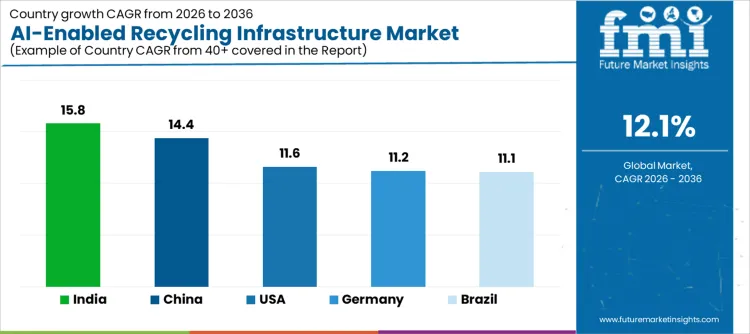
| Country | CAGR (%) |
|---|---|
| India | 15.8 |
| China | 14.4 |
| USA | 11.6 |
| Germany | 11.2 |
| Brazil | 11.1 |
What is driving growth of AI-enabled recycling infrastructure demand in India?
Demand for AI-enabled recycling infrastructure in India is expanding as waste volumes rise across urban and industrial centers. Growth at 15.8% CAGR reflects the need to improve sorting accuracy for mixed municipal and packaging waste. Informal collection systems create feedstock variability, increasing reliance on AI-driven identification and automation. Government initiatives targeting higher recycling rates push operators toward technology upgrades. Cost efficiency and labor optimization remain central adoption drivers. Deployment focuses on optical sorting, AI-enabled quality control, and robotic segregation within large-scale material recovery facilities serving metropolitan regions.
- Rising urban waste generation
- High feedstock variability challenges
- Government recycling efficiency targets
- Need for labor and cost optimization
Why is China seeing expansion in AI-enabled recycling infrastructure adoption?
AI-enabled recycling infrastructure demand in China is rising as large centralized facilities scale material recovery operations. Growth at 14.4% CAGR reflects high waste volumes from packaging, electronics, and consumer goods manufacturing. Regulatory pressure on recycling performance accelerates automation investment. AI systems support real-time sorting, contamination reduction, and yield optimization. Export-oriented recycled material supply chains require consistent purity levels. State-supported infrastructure programs and industrial-scale deployment favor rapid technology integration across major recycling hubs.
- Large-scale centralized recycling facilities
- Regulatory pressure on recovery efficiency
- High demand for consistent output quality
- State-supported automation investment
What factors are shaping AI-enabled recycling infrastructure sales in the USA?
Sales of AI-enabled recycling infrastructure in the USA are increasing as operators address labor constraints and contamination issues. Growth at 11.6% CAGR reflects adoption of AI vision systems, robotic sorters, and predictive maintenance tools. Single-stream recycling increases sorting complexity, elevating technology reliance. Brand and municipal contracts require higher material purity. Investment decisions prioritize return visibility and operational resilience. Adoption centers on retrofitting existing facilities rather than greenfield construction.
- Labor availability constraints
- Complexity of single-stream recycling
- Demand for higher material purity
- Focus on retrofit-based technology upgrades
How is Germany supporting growth of AI-enabled recycling infrastructure demand?
AI-enabled recycling infrastructure demand in Germany is advancing as circular economy regulations tighten recovery performance requirements. Growth at 11.2% CAGR reflects emphasis on precision sorting, traceability, and material quality assurance. Facilities integrate AI for polymer identification, defect detection, and data reporting. High compliance standards drive adoption of certified automation technologies. Investment focuses on upgrading advanced recycling plants serving packaging, automotive, and industrial waste streams.
- Strict circular economy compliance requirements
- Focus on precision and traceability
- Advanced polymer identification needs
- High investment in certified automation
What is driving expansion of AI-enabled recycling infrastructure demand in Brazil?
Demand for AI-enabled recycling infrastructure in Brazil is rising as recycling systems modernize across major urban regions. Growth at 11.1% CAGR reflects the need to improve recovery rates from mixed waste streams. Regional disparities in collection quality increase reliance on automated sorting. Public-private partnerships support infrastructure modernization. Adoption emphasizes scalable AI solutions balancing cost and performance within evolving regulatory frameworks.
- Modernization of urban recycling systems
- Mixed waste stream complexity
- Public-private infrastructure investment
- Focus on scalable automation solutions
What is the competitive landscape of demand for the AI-enabled recycling infrastructure market globally?
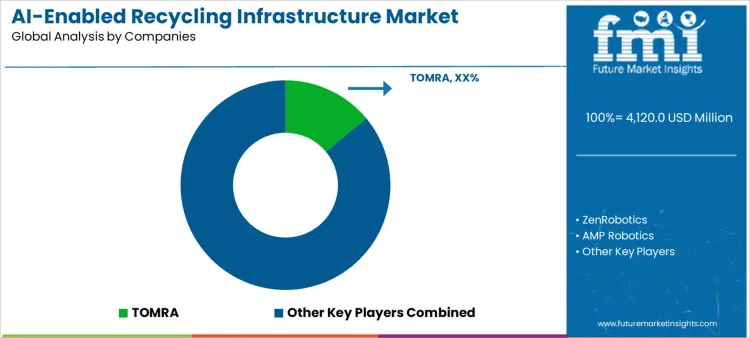
Rising contamination penalties, labor shortages, and higher material recovery targets are driving Demand for AI-enabled recycling infrastructure across municipal and industrial waste streams. Operators evaluate sorting accuracy, recognition speed, adaptability to mixed waste, uptime reliability, and performance across flexible, rigid, and composite materials. Buyer assessment includes integration with existing MRF layouts, data analytics for yield optimization, maintenance intensity, and return on capital deployment. Procurement behavior favors proven deployments, modular scalability, and suppliers capable of supporting large multi-facility rollouts. Trend in the AI-enabled recycling infrastructure market reflects rapid shift from manual and optical sorting toward robotic systems delivering consistent recovery under variable feedstock conditions.
TOMRA leads competitive positioning through AI-enhanced sensor sorting platforms combined with deep installed base across global material recovery facilities. ZenRobotics competes by focusing on heavy-duty robotic sorting for construction, demolition, and bulky waste streams where manual sorting remains inefficient. AMP Robotics supports demand with AI vision and robotic arms optimized for high-throughput packaging and fiber recovery. WM maintains relevance by deploying AI systems internally to upgrade proprietary recycling infrastructure at scale. Hitachi Zosen participates through integrated waste processing plants combining robotics, automation, and mechanical sorting. Competitive differentiation centers on sorting precision, system scalability, operational uptime, and demonstrated performance under real-world waste variability.
Key Players in the AI-Enabled Recycling Infrastructure Market
- TOMRA
- ZenRobotics
- AMP Robotics
- WM
- Everbright Environment
- Bozhon
- Hitachi Zosen
- JFE Engineering
- Others
Scope of the Report
| Items | Values |
|---|---|
| Quantitative Units | USD million |
| Infrastructure Type | AI-optimised sorting plants; Robotics-assisted facilities; Smart recycling zones; Compact AI facilities; Others |
| Waste Stream | Mixed plastics; Plastics & packaging; Mixed MSW; Plastics; Others |
| End-Use | MRFs & plastics recycling; Municipal & private MRFs; Mega recycling parks; Precision recycling; Emerging MRFs |
| Regions Covered | Asia Pacific, Europe, North America, Latin America, Middle East & Africa |
| Countries Covered | India, China, USA, Germany, Brazil, and 40+ countries |
| Key Companies Profiled | TOMRA; ZenRobotics; AMP Robotics; WM; Everbright Environment; Bozhon; Hitachi Zosen; JFE Engineering; Others |
| Additional Attributes | Dollar sales by infrastructure type, waste stream, and end-use deployment; AI vision accuracy and robotics throughput influencing sorting efficiency; capex allocation toward smart recycling zones and mega parks; integration of machine learning with legacy MRF systems; procurement trends across municipal and private operators prioritising yield improvement and contamination reduction. |
AI-Enabled Recycling Infrastructure Market by Segment
Infrastructure Type:
- AI-optimised sorting plants
- Robotics-assisted facilities
- Smart recycling zones
- Compact AI facilities
- Others
Waste Stream:
- Mixed plastics
- Plastics & packaging
- Mixed MSW
- Plastics
- Others
End-Use:
- MRFs & plastics recycling
- Municipal & private MRFs
- Mega recycling parks
- Precision recycling
- Emerging MRFs
Region:
- Asia Pacific
- China
- Japan
- South Korea
- India
- Australia & New Zealand
- ASEAN
- Rest of Asia Pacific
- Europe
- Germany
- United Kingdom
- France
- Italy
- Spain
- Nordic
- BENELUX
- Rest of Europe
- North America
- United States
- Canada
- Mexico
- Latin America
- Brazil
- Chile
- Rest of Latin America
- Middle East & Africa
- Kingdom of Saudi Arabia
- Other GCC Countries
- Turkey
- South Africa
- Other African Union
- Rest of Middle East & Africa
Bibliography
- European Commission. (2023). Artificial intelligence applications in waste management and recycling systems. Publications Office of the European Union.
- European Commission, Directorate‑General for Environment. (2024). Digitalisation and automation in recycling infrastructure under the EU circular economy framework. European Commission.
- International Solid Waste Association. (2023). Artificial intelligence and robotics in material recovery facilities. ISWA Scientific and Technical Committee.
- International Organization for Standardization. (2023). Automation systems and integration—Data exchange frameworks for industrial artificial intelligence applications (ISO/IEC 20547‑4:2023). International Organization for Standardization.
Frequently Asked Questions
How big is the ai-enabled recycling infrastructure market in 2026?
The global ai-enabled recycling infrastructure market is estimated to be valued at USD 4,120.0 million in 2026.
What will be the size of ai-enabled recycling infrastructure market in 2036?
The market size for the ai-enabled recycling infrastructure market is projected to reach USD 12,910.8 million by 2036.
How much will be the ai-enabled recycling infrastructure market growth between 2026 and 2036?
The ai-enabled recycling infrastructure market is expected to grow at a 12.1% CAGR between 2026 and 2036.
What are the key product types in the ai-enabled recycling infrastructure market?
The key product types in ai-enabled recycling infrastructure market are ai-optimised sorting plants, robotics-assisted facilities, smart recycling zones, compact ai facilities and others.
Which waste stream segment to contribute significant share in the ai-enabled recycling infrastructure market in 2026?
In terms of waste stream, mixed plastics segment to command 55.0% share in the ai-enabled recycling infrastructure market in 2026.
Preview the report firsthand - request a free sample
Get SampleGet the brochure for pricing and purchase details.
Get PDFTable of Content
- Executive Summary
- Global Market Outlook
- Demand-side Trends
- Supply-side Trends
- Technology Roadmap Analysis
- Analysis and Recommendations
- Market Overview
- Market Coverage / Taxonomy
- Market Definition / Scope / Limitations
- Market Background
- Market Dynamics
- Drivers
- Restraints
- Opportunity
- Trends
- Scenario Forecast
- Demand in Optimistic Scenario
- Demand in Likely Scenario
- Demand in Conservative Scenario
- Opportunity Map Analysis
- Product Life Cycle Analysis
- Supply Chain Analysis
- Investment Feasibility Matrix
- Value Chain Analysis
- PESTLE and Porter’s Analysis
- Regulatory Landscape
- Regional Parent Market Outlook
- Production and Consumption Statistics
- Import and Export Statistics
- Market Dynamics
- Global Market Analysis 2021 to 2025 and Forecast, 2026 to 2036
- Historical Market Size Value (USD Million) Analysis, 2021 to 2025
- Current and Future Market Size Value (USD Million) Projections, 2026 to 2036
- Y-o-Y Growth Trend Analysis
- Absolute $ Opportunity Analysis
- Global Market Pricing Analysis 2021 to 2025 and Forecast 2026 to 2036
- Global Market Analysis 2021 to 2025 and Forecast 2026 to 2036, By Infrastructure Type
- Introduction / Key Findings
- Historical Market Size Value (USD Million) Analysis By Infrastructure Type , 2021 to 2025
- Current and Future Market Size Value (USD Million) Analysis and Forecast By Infrastructure Type , 2026 to 2036
- AI-optimised sorting plants
- Robotics-assisted facilities
- Smart recycling zones
- Compact AI facilities
- Others
- AI-optimised sorting plants
- Y-o-Y Growth Trend Analysis By Infrastructure Type , 2021 to 2025
- Absolute $ Opportunity Analysis By Infrastructure Type , 2026 to 2036
- Global Market Analysis 2021 to 2025 and Forecast 2026 to 2036, By Waste Stream
- Introduction / Key Findings
- Historical Market Size Value (USD Million) Analysis By Waste Stream, 2021 to 2025
- Current and Future Market Size Value (USD Million) Analysis and Forecast By Waste Stream, 2026 to 2036
- Mixed plastics
- Plastics & packaging
- Mixed MSW
- Plastics
- Others
- Mixed plastics
- Y-o-Y Growth Trend Analysis By Waste Stream, 2021 to 2025
- Absolute $ Opportunity Analysis By Waste Stream, 2026 to 2036
- Global Market Analysis 2021 to 2025 and Forecast 2026 to 2036, By End-Use
- Introduction / Key Findings
- Historical Market Size Value (USD Million) Analysis By End-Use, 2021 to 2025
- Current and Future Market Size Value (USD Million) Analysis and Forecast By End-Use, 2026 to 2036
- MRFs & plastics recycling
- Municipal & private MRFs
- Mega recycling parks
- Precision recycling
- Emerging MRFs
- MRFs & plastics recycling
- Y-o-Y Growth Trend Analysis By End-Use, 2021 to 2025
- Absolute $ Opportunity Analysis By End-Use, 2026 to 2036
- Global Market Analysis 2021 to 2025 and Forecast 2026 to 2036, By Region
- Introduction
- Historical Market Size Value (USD Million) Analysis By Region, 2021 to 2025
- Current Market Size Value (USD Million) Analysis and Forecast By Region, 2026 to 2036
- North America
- Latin America
- Western Europe
- Eastern Europe
- East Asia
- South Asia and Pacific
- Middle East & Africa
- Market Attractiveness Analysis By Region
- North America Market Analysis 2021 to 2025 and Forecast 2026 to 2036, By Country
- Historical Market Size Value (USD Million) Trend Analysis By Market Taxonomy, 2021 to 2025
- Market Size Value (USD Million) Forecast By Market Taxonomy, 2026 to 2036
- By Country
- USA
- Canada
- Mexico
- By Infrastructure Type
- By Waste Stream
- By End-Use
- By Country
- Market Attractiveness Analysis
- By Country
- By Infrastructure Type
- By Waste Stream
- By End-Use
- Key Takeaways
- Latin America Market Analysis 2021 to 2025 and Forecast 2026 to 2036, By Country
- Historical Market Size Value (USD Million) Trend Analysis By Market Taxonomy, 2021 to 2025
- Market Size Value (USD Million) Forecast By Market Taxonomy, 2026 to 2036
- By Country
- Brazil
- Chile
- Rest of Latin America
- By Infrastructure Type
- By Waste Stream
- By End-Use
- By Country
- Market Attractiveness Analysis
- By Country
- By Infrastructure Type
- By Waste Stream
- By End-Use
- Key Takeaways
- Western Europe Market Analysis 2021 to 2025 and Forecast 2026 to 2036, By Country
- Historical Market Size Value (USD Million) Trend Analysis By Market Taxonomy, 2021 to 2025
- Market Size Value (USD Million) Forecast By Market Taxonomy, 2026 to 2036
- By Country
- Germany
- UK
- Italy
- Spain
- France
- Nordic
- BENELUX
- Rest of Western Europe
- By Infrastructure Type
- By Waste Stream
- By End-Use
- By Country
- Market Attractiveness Analysis
- By Country
- By Infrastructure Type
- By Waste Stream
- By End-Use
- Key Takeaways
- Eastern Europe Market Analysis 2021 to 2025 and Forecast 2026 to 2036, By Country
- Historical Market Size Value (USD Million) Trend Analysis By Market Taxonomy, 2021 to 2025
- Market Size Value (USD Million) Forecast By Market Taxonomy, 2026 to 2036
- By Country
- Russia
- Poland
- Hungary
- Balkan & Baltic
- Rest of Eastern Europe
- By Infrastructure Type
- By Waste Stream
- By End-Use
- By Country
- Market Attractiveness Analysis
- By Country
- By Infrastructure Type
- By Waste Stream
- By End-Use
- Key Takeaways
- East Asia Market Analysis 2021 to 2025 and Forecast 2026 to 2036, By Country
- Historical Market Size Value (USD Million) Trend Analysis By Market Taxonomy, 2021 to 2025
- Market Size Value (USD Million) Forecast By Market Taxonomy, 2026 to 2036
- By Country
- China
- Japan
- South Korea
- By Infrastructure Type
- By Waste Stream
- By End-Use
- By Country
- Market Attractiveness Analysis
- By Country
- By Infrastructure Type
- By Waste Stream
- By End-Use
- Key Takeaways
- South Asia and Pacific Market Analysis 2021 to 2025 and Forecast 2026 to 2036, By Country
- Historical Market Size Value (USD Million) Trend Analysis By Market Taxonomy, 2021 to 2025
- Market Size Value (USD Million) Forecast By Market Taxonomy, 2026 to 2036
- By Country
- India
- ASEAN
- Australia & New Zealand
- Rest of South Asia and Pacific
- By Infrastructure Type
- By Waste Stream
- By End-Use
- By Country
- Market Attractiveness Analysis
- By Country
- By Infrastructure Type
- By Waste Stream
- By End-Use
- Key Takeaways
- Middle East & Africa Market Analysis 2021 to 2025 and Forecast 2026 to 2036, By Country
- Historical Market Size Value (USD Million) Trend Analysis By Market Taxonomy, 2021 to 2025
- Market Size Value (USD Million) Forecast By Market Taxonomy, 2026 to 2036
- By Country
- Kingdom of Saudi Arabia
- Other GCC Countries
- Turkiye
- South Africa
- Other African Union
- Rest of Middle East & Africa
- By Infrastructure Type
- By Waste Stream
- By End-Use
- By Country
- Market Attractiveness Analysis
- By Country
- By Infrastructure Type
- By Waste Stream
- By End-Use
- Key Takeaways
- Key Countries Market Analysis
- USA
- Pricing Analysis
- Market Share Analysis, 2025
- By Infrastructure Type
- By Waste Stream
- By End-Use
- Canada
- Pricing Analysis
- Market Share Analysis, 2025
- By Infrastructure Type
- By Waste Stream
- By End-Use
- Mexico
- Pricing Analysis
- Market Share Analysis, 2025
- By Infrastructure Type
- By Waste Stream
- By End-Use
- Brazil
- Pricing Analysis
- Market Share Analysis, 2025
- By Infrastructure Type
- By Waste Stream
- By End-Use
- Chile
- Pricing Analysis
- Market Share Analysis, 2025
- By Infrastructure Type
- By Waste Stream
- By End-Use
- Germany
- Pricing Analysis
- Market Share Analysis, 2025
- By Infrastructure Type
- By Waste Stream
- By End-Use
- UK
- Pricing Analysis
- Market Share Analysis, 2025
- By Infrastructure Type
- By Waste Stream
- By End-Use
- Italy
- Pricing Analysis
- Market Share Analysis, 2025
- By Infrastructure Type
- By Waste Stream
- By End-Use
- Spain
- Pricing Analysis
- Market Share Analysis, 2025
- By Infrastructure Type
- By Waste Stream
- By End-Use
- France
- Pricing Analysis
- Market Share Analysis, 2025
- By Infrastructure Type
- By Waste Stream
- By End-Use
- India
- Pricing Analysis
- Market Share Analysis, 2025
- By Infrastructure Type
- By Waste Stream
- By End-Use
- ASEAN
- Pricing Analysis
- Market Share Analysis, 2025
- By Infrastructure Type
- By Waste Stream
- By End-Use
- Australia & New Zealand
- Pricing Analysis
- Market Share Analysis, 2025
- By Infrastructure Type
- By Waste Stream
- By End-Use
- China
- Pricing Analysis
- Market Share Analysis, 2025
- By Infrastructure Type
- By Waste Stream
- By End-Use
- Japan
- Pricing Analysis
- Market Share Analysis, 2025
- By Infrastructure Type
- By Waste Stream
- By End-Use
- South Korea
- Pricing Analysis
- Market Share Analysis, 2025
- By Infrastructure Type
- By Waste Stream
- By End-Use
- Russia
- Pricing Analysis
- Market Share Analysis, 2025
- By Infrastructure Type
- By Waste Stream
- By End-Use
- Poland
- Pricing Analysis
- Market Share Analysis, 2025
- By Infrastructure Type
- By Waste Stream
- By End-Use
- Hungary
- Pricing Analysis
- Market Share Analysis, 2025
- By Infrastructure Type
- By Waste Stream
- By End-Use
- Kingdom of Saudi Arabia
- Pricing Analysis
- Market Share Analysis, 2025
- By Infrastructure Type
- By Waste Stream
- By End-Use
- Turkiye
- Pricing Analysis
- Market Share Analysis, 2025
- By Infrastructure Type
- By Waste Stream
- By End-Use
- South Africa
- Pricing Analysis
- Market Share Analysis, 2025
- By Infrastructure Type
- By Waste Stream
- By End-Use
- USA
- Market Structure Analysis
- Competition Dashboard
- Competition Benchmarking
- Market Share Analysis of Top Players
- By Regional
- By Infrastructure Type
- By Waste Stream
- By End-Use
- Competition Analysis
- Competition Deep Dive
- TOMRA
- Overview
- Product Portfolio
- Profitability by Market Segments (Product/Age /Sales Channel/Region)
- Sales Footprint
- Strategy Overview
- Marketing Strategy
- Product Strategy
- Channel Strategy
- ZenRobotics
- AMP Robotics
- WM
- Everbright Environment
- Bozhon
- Hitachi Zosen
- JFE Engineering
- Others
- TOMRA
- Competition Deep Dive
- Assumptions & Acronyms Used
- Research Methodology


