

- Market Size (2026)
- USD 23.9 Bn
- Forecast (2036)
- USD 63.1 Bn
- CAGR (2026 to 2036)
- 10.2%
Refurbished Computers and Laptops Market Size, Market Forecast and Outlook By FMI
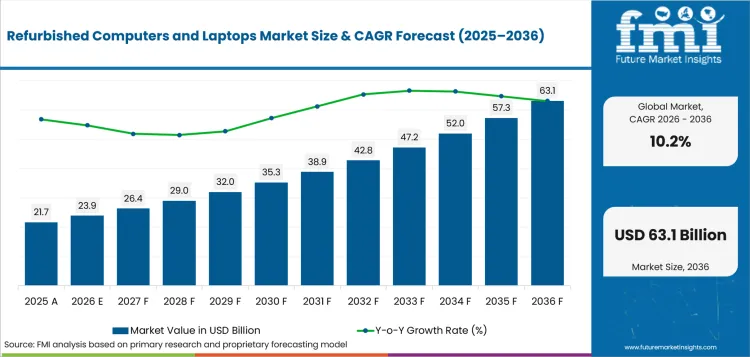
The refurbished computers and laptops market is anticipated to rise from USD 21.7 billion in 2025 to USD 63.1 billion by 2036, at a 10.2% CAGR, driven by certified resale, device affordability, and secure data wiping, with refurbished laptops accounting for 74.0% share and Windows OS contributing 66.1% share as buyers compare price with warranty proof.
Key Takeaways, Market Size, and Forecast
| Metric | Value |
|---|---|
| Market Size (2026) | USD 23.9 Billion |
| Market Size (2036) | USD 63.1 Billion |
| Forecast CAGR | 10.2% from 2026 to 2036 |
| Leading Product | Refurbished Laptops |
| Refurbished Laptops Share In 2026 | 74.0% |
| Leading Operating System | Windows OS |
| Windows OS Share In 2026 | 66.1% |
| Fastest-Growing Country | China |
| China CAGR | 11.2% by 2036 |
Summary of Refurbished Computers and Laptops Market
- Demand and Growth Drivers
- Enterprise refresh cycles create steady used laptops for refurbishment after fleet owners replace business systems.
- Education and small business buyers favor tested laptops sold with clear grades and warranty terms.
- Data wiping and parts grading are becoming trust checks before used computers re-enter managed work areas.
- Product and Segment View
- Refurbished laptops are estimated to hold 74.0% share in 2026 due to portable systems serving students and remote workers.
- Windows OS is projected to secure 66.1% share in 2026, led by offices using Microsoft software and legacy applications.
- Online e-commerce is expected to represent 55.0% share in 2026 since buyers compare grade and warranty before ordering.
- Geography and Competitive Outlook
- China is likely to record 11.2% CAGR by 2036, backed by trade-in funding and fast online resale flow.
- India is expected to expand at 10.7% CAGR by 2036, influenced by affordable access and formal electronics recovery.
- Back Market and Dell compete on certified grades and online trust signals for refurbished computers.
- HP and Apple compete through brand-backed refurbished offers and tighter control over device quality.
- Analyst Opinion
- Rahul Pandita, Principal Consultant for Technology at FMI, opines, “Refurbished computing is shifting from price-led resale toward governed device life extension. Buyers are asking for battery health and warranty clarity before comparing used laptops with new devices. Sellers able to prove grading discipline should protect repeat business.”
- Refurbished Computers and Laptops Market Value Analysis
- Market value is tied to device intake quality before processor grade and warranty affect resale price.
- Supplier pricing reflects battery health and memory configuration before channel margin affects delivered cost.
- Revenue improves as sellers shift from loose used listings toward certified refurbished computers.
- Buyer trust rises as wipe certificates and after-sales support reduce perceived risk in online channels.
Refurbished computer buyers are now checking software support and service coverage before price comparison starts. Microsoft said Windows 10 support ended on October 14 2025, so sellers need to screen older laptops for Windows 11 readiness before listing. National Institute of Standards and Technology released SP 800-88 Rev. 2 in September 2025 for media sanitization programs, giving enterprise sellers a clearer way to prove safe data removal. eBay stated that refurbished items are 100% functional and backed by a one-year or two-year warranty, making warranty proof a direct trust factor in online resale. HP said in January 2025, its certified refurbished PCs include a standard one-year limited warranty and optional two-year or three-year offsite support. Refurbishers with upgrade checks and service-backed listings are likely to acquire repeat business from schools and small firms.
Refurbished Computers and Laptops Market Definition
Refurbished computers and laptops cover used desktops, laptops, mini PCs, workstations, and Chromebooks restored for resale after testing, repair, data removal, and grading. Scope includes certified and seller-refurbished systems sold with warranty or return terms. New computers, tablets, phones, printers, loose parts, and standalone accessories are outside scope.
Refurbished Computers and Laptops Market Inclusions
Scope includes refurbished laptops, desktops, workstations, mini PCs, and Chromebooks sold through online, brand, institutional, and reseller channels. Trade-in, lease return, enterprise refresh, and consumer resale flows are included. Warranty-backed resale and parts-supported refurbishment are counted if systems are usable computers.
Refurbished Computers and Laptops Market Exclusions
Scope excludes new computers, loose parts, tablets, phones, printers, and standalone accessories. Scrap electronic waste is excluded unless a tested device returns to resale. Software-only upgrades are excluded unless bundled with a refurbished computer sold for use.
Refurbished Computers and Laptops Market Research Methodology
- Primary Research: FMI analysts reviewed refurbisher channel checks and institutional buying needs across education and small business accounts.
- Desk Research: Official digital access data and e-waste management guidance supported scope mapping and demand checks.
- Market Sizing and Forecasting: Forecast values used device refresh flow and country channel review.
- Data Validation: Checks compared 2026 value with 2036 value and tested compound annual growth rate consistency across seven country rates.
Why is the Refurbished Computers and Laptops Market Growing?
- Businesses are moving toward certified resale as verified data wiping lowers risk for used computing devices.
- Education and small business users need affordable laptops with clear grade labels and warranty support.
- Online resale platforms are improving trust as product grades and return terms become easier to compare.
Growth is clearer as connected work and device waste pressure create fresh demand for tested used computers. International Telecommunication Union reported in November 2025 that about 6.0 billion people used the internet in 2025. United Nations Institute for Training and Research stated in March 2024, e-waste reached 62.0 million metric tons in 2022. Organized refurbishers gain from both signals as device access and reuse expectations increase together.
Market Segmentation Analysis
- Refurbished laptops are forecast to capture 74.0% share in 2026, driven by portable devices that suit school and work needs.
- Windows OS is expected to represent 66.1% share in 2026, influenced by enterprise software and familiar support paths.
- Online e-commerce is projected at 55.0% share in 2026, reflecting grade comparison and doorstep fulfillment.
- Grade A devices are anticipated to hold 46.8% share in 2026 as low cosmetic wear supports premium resale pricing.
- Small businesses are estimated to secure 36.4% share in 2026, guided by cost control and basic computing needs.
Market segmentation covers product, operating system, sales channel, device grade, end user, and region. Product scope connects with refurbished computers and laptops sold through certified online listings. Adjacent technology choices relate to electronic equipment repair as device intake determines resale yield. Security expectations connect with consumer electronics reuse as wiped laptops move back into business networks. E-waste management affects unusable device handling before resale sorting.
Insights into Refurbished Computers and Laptops Market by Product
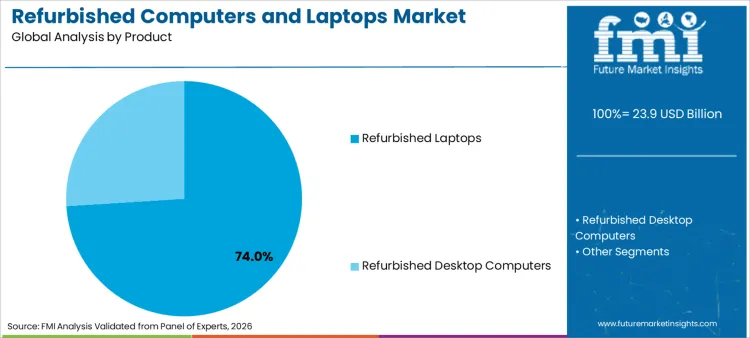
- Refurbished laptops are projected to account for 74.0% share in 2026, driven by battery checks and screen grading making portable resale easier for buyers to judge.
- Desktop computers retain institutional value as labs and shared offices use fixed systems with lower damage risk.
Insights into Refurbished Computers and Laptops Market by Operating System
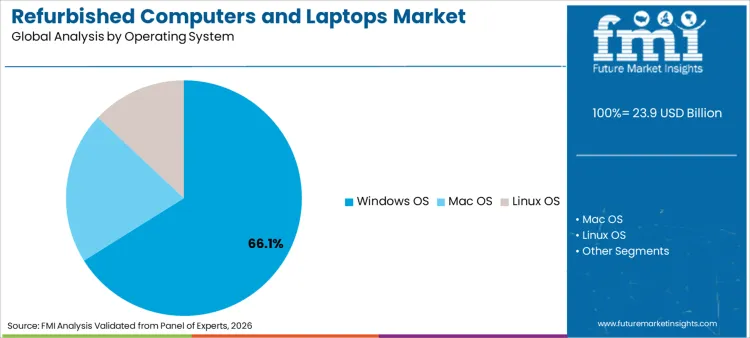
- Windows OS is forecast to hold 66.1% share in 2026, as business software keeps resale demand centered on familiar systems.
- Chrome OS gains value in schools using managed accounts led by older hardware being able to work with lighter system images.
Insights into Refurbished Computers and Laptops Market by Sales Channel
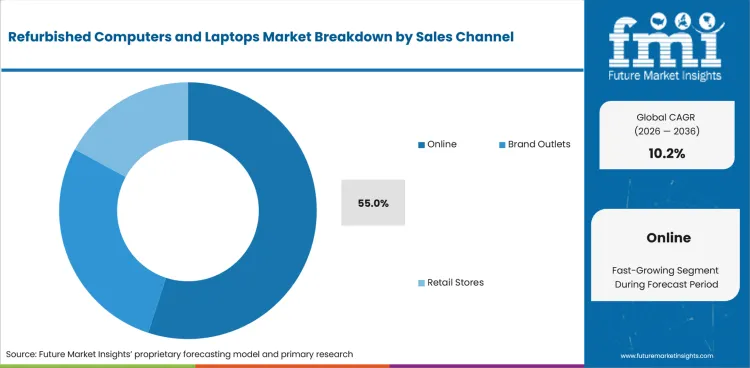
- Online e-commerce is anticipated to capture 55.0% share in 2026 due to buyers comparing processor and warranty before payment.
- Retail stores keep a role for buyers wanting physical inspection and local service before selecting refurbished laptops for home use.
Insights into Refurbished Computers and Laptops Market by Device Grade
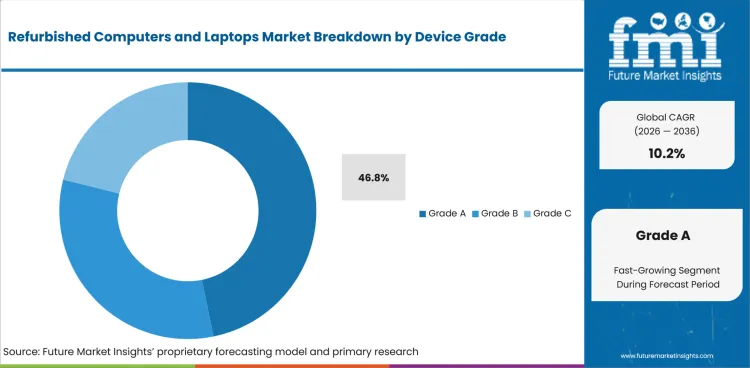
- Grade A devices are estimated to secure 46.8% share in 2026 since clean cosmetic condition allows sellers to charge more with fewer disputes.
- Grade B devices expand among students and small offices due to lower pricing offsetting visible wear after basic checks are completed.
Insights into Refurbished Computers and Laptops Market by End User
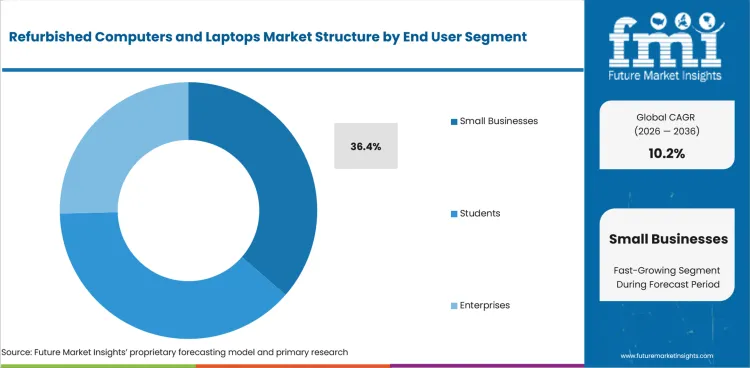
- Small businesses are projected to represent 36.4% share in 2026 as firms seek functional computers without paying full new-device prices.
- Students form a steady user group since education budgets favor warranty-backed laptops and accessible e-commerce logistics.
Refurbished Computers and Laptops Market Drivers, Restraints and Opportunities
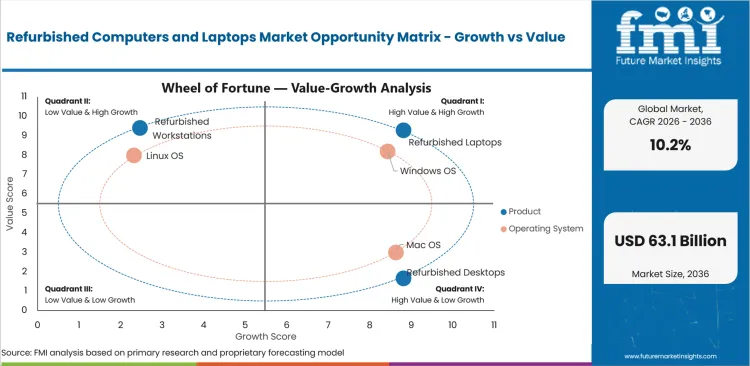
- Driver: Warranty-backed grading is making refurbished computers easier to approve for school and small business use.
- Restraint: Battery condition and support limits keep some institutional buyers cautious during device selection.
- Opportunity: Circular IT verification can improve resale routing for laptops before unusable systems move into recycling.
The refurbished computers and laptops sector is moving toward proof-led resale as institutional buyers compare warranty terms and verified electronics criteria before placing orders. Global Electronics Council stated in December 2025 that EPEAT 2.0 products became available from December 2, 2025 and that all products listed on the EPEAT Registry will meet EPEAT 2.0 criteria by July 1, 2027. HP stated in January 2025 that its Certified Refurbished PC portfolio includes a standard 1-year limited warranty with optional 2-year or 3-year offsite support packages. Refurbishers with grade discipline and service-backed listings can gain buyer confidence without relying on loose used-device claims.
Competitive Benchmarking and Certified Resale Positioning Analysis
Competitive benchmarking for refurbished computers should compare sellers by certified data erasure, tested device quality and warranty-backed channel reach. Arvato Systems stated in January 2025, its AfB partnership refurbished and remarketed 14,778 used IT devices and AfB sells refurbished devices with a minimum 12-month warranty. Competitive strength is expected to shift toward refurbishers with corporate intake partnerships and verified resale controls because business buyers need safe data handling before accepting used computers.
Trade-in and Circular Device Flow Analysis
Repair and trade-in analysis is more useful for refurbished computers than industrial automation tracking since resale supply depends on device recovery and repair capacity. Currys reported in July 2025 stating 5.5 million e-waste products were collected for reuse and recycling across the group in 2024/25. Currys separately stated that 1.6 million repair activities were completed across the group in 2024/25, showing how repair depth can expand resale supply and parts recovery for refurbished laptops.
Competitive Landscape and Strategic Positioning
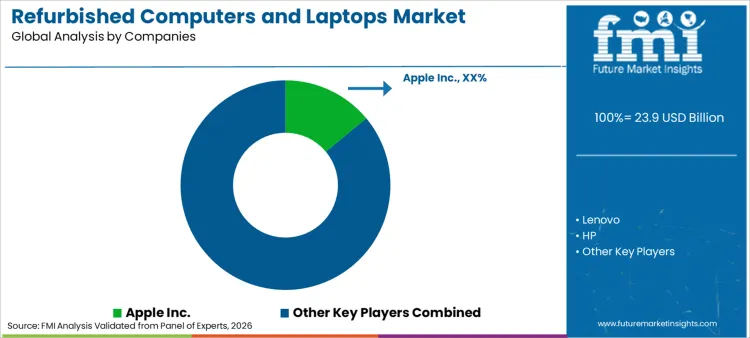
- Large certified platforms hold an advantage through grade standards and warranty execution for online resale.
- Brand-backed sellers gain orders by linking refurbished computers with service support and software legitimacy.
- IT asset disposition firms strengthen supply as enterprise refresh cycles return usable laptops for testing.
- Specialist refurbishers support education and small business accounts through bundles and clear return terms.
Competitive structure is led by certified platforms, brand outlets, and IT asset recovery specialists. Back Market holds platform recognition through refurbished technology focus and grade clarity. Dell Technologies and HP support brand-backed resale through asset recovery and outlet routes. Apple and Lenovo add trust through controlled programs. ERI and ITOCHU Belong strengthen local intake.
Supplier selection starts with grade proof before price review. AI PC replacement cycles may lift used device supply from enterprise refresh programs. Business buyers ask for battery health and operating system legitimacy. Students and small offices compare warranty coverage with delivered price. Sellers with consistent testing and clear returns should gain repeat orders.
Key Companies in the Refurbished Computers and Laptops Market
Competitive structure is divided across resale platforms, brand outlets, and IT asset disposition firms. Grade proof shapes premium positioning.
- Global Resale Platforms: Back Market, Amazon Renewed, and eBay Refurbished compete based on certified listings and buyer protection.
- Brand-Backed Programs: Dell Technologies, HP Inc., Apple, and Lenovo compete depending on outlet control and device support strength.
- Specialist and Regional Participants: Best Buy, ITOCHU Belong, ERI, CeX, and AfB compete on intake access and local service trust.
Competitive Benchmarking: Refurbished Computers and Laptops Market
| Company | Certified Grade Depth | Wipe Proof Depth | Warranty Execution | Channel Reach | Geographic Footprint |
|---|---|---|---|---|---|
| Back Market | Very Strong | Strong | Very Strong | Very Strong | Global |
| Dell Technologies | Strong | Very Strong | Strong | Strong | Global |
| HP Inc. | Strong | Strong | Strong | Strong | Global |
| Apple Inc. | Strong | Strong | Very Strong | Strong | Global |
| Lenovo Group | Strong | Strong | Moderate | Strong | Global |
| Amazon Renewed | Strong | Moderate | Strong | Very Strong | Global |
| eBay Refurbished | Strong | Moderate | Strong | Very Strong | Global |
| ERI | Moderate | Very Strong | Moderate | Strong | North America and Japan |
Source: Future Market Insights competitive analysis, 2026.
Key Developments in Refurbished Computers and Laptops Market
- In September 2024, Back Market introduced the Back Market Promise with a 1-year warranty, 30-day money-back guarantee and 100-point inspection checks, strengthening buyer trust in online refurbished technology.
- In January 2025, HP expanded its Certified Refurbished PC portfolio with EliteBook and EliteDesk devices, each carrying a standard 1-year limited warranty and optional 2-year or 3-year offsite support packages.
- In March 2026, ITOCHU announced that Belong and ERI would establish ERI Japan for IT equipment reuse and recycling, with ERI bringing experience from over 2.5 billion pounds of recycled e-waste.
Key Players in the Refurbished Computers and Laptops Market
- Back Market
- Dell Technologies
- HP Inc.
- Apple Inc.
- Lenovo Group
- Amazon Renewed
- eBay Refurbished
- Best Buy
- ITOCHU Belong
- ERI
Analysis of Refurbished Computers and Laptops Market by Key Countries
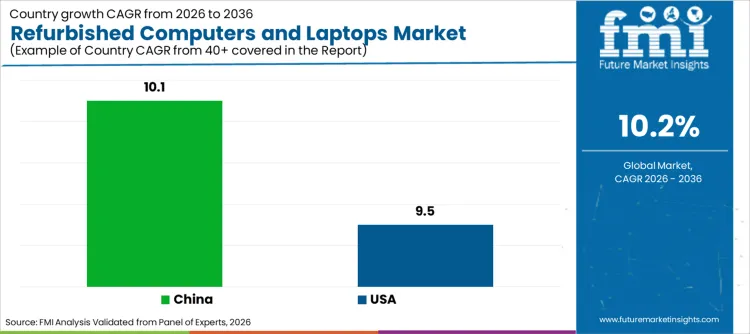
.webp "Top Country Growth Comparison Refurbished Computers And Laptops Market Cagr (2026 2036)")
| Country | CAGR |
|---|---|
| China | 11.2% |
| India | 10.7% |
| United States | 9.9% |
| United Kingdom | 9.4% |
| Germany | 9.1% |
| France | 8.8% |
| Japan | 8.5% |
Source: Future Market Insights, 2026.
Demand Outlook for Refurbished Computers and Laptops Market in China
Fastest-growing refurbished computing market · 2026 to 2036
Country Market Snapshot Table
| Parameter | Value |
|---|---|
| Market Size in 2025 (Value) | USD 4.6 billion |
| Market Size in 2026 (Value) | USD 5.1 billion |
| Market Forecast in 2036 (Value) | USD 14.7 billion |
| CAGR (2026-2036) | 11.2% |
| Years Considered | 2016-2036 |
| Base Year | 2025 |
| Forecast Period | 2026-2036 |
| Units Considered | Value (USD billion) |
| Leading Sub-Region | Guangdong and Yangtze River Delta digital resale corridor |
China Refurbished Computers and Laptops Market Outlook
China refurbished computing demand is driven by trade-in funding and large online electronics channels. Used laptops and desktops enter resale networks as households and offices replace older devices through formal exchange routes.
Digital product support gives refurbished computers and laptops a wider intake path. Refurbishers with fast inspection and grade control can gain as more replaced devices move through structured channels.
Key Growth Drivers
- Trade-in programs widen organized intake for used digital devices, as the State Council Information Office placed 2025 trade-in sales at RMB 2.6 trillion. Refurbishers can screen more returned laptops before routing unusable units into parts recovery.
- Public funding keeps replacement channels active, as advance 2026 support reached RMB 62.5 billion for consumer goods trade-in activity. Recovery partners can use subsidy-linked device flow to improve laptop inspection and resale sorting.
- Digital product subsidies improve trade-in response, as the program capped support at RMB 500 per eligible digital product. Laptop sellers can capture more used systems through inspection channels tied to new device replacement.
Key Restraints
- New-device subsidies can limit used laptop interest during active funding windows, as the Ministry of Commerce recorded 66.95 billion yuan in subsidized digital product sales by March 2025. Refurbished sellers may need sharper warranty terms to defend price appeal.
- Subsidy participation creates short-term pressure on refurbished computer sellers, as digital product applications crossed 42.0 million by March 2025. Buyers may delay used device purchases while subsidized new systems remain available.
- Subsidized device campaigns can shift attention toward new computers during replacement cycles. Refurbished platforms need stronger grade proof and service clarity to hold user trust during discount-heavy periods.
What makes China unique
China is unique since state-backed replacement funding works alongside large online resale channels. Refurbishers gain by controlling intake speed and grade consistency before devices reach buyers.
Key Companies
- Lenovo
- Dell China
- HP China
- Apple China
- JD.com
- Alibaba Tmall
- ATRenew
- Zhuanzhuan
Sales & Marketing Channels
- National e-commerce platforms
- Brand outlet programs
- Electronics recyclers
- School device resellers
- Small business distributors
- Repair shop networks
Country Segment Breakdown Table
| Segment | Sub-Segments |
|---|---|
| By Product | Laptops · Desktops · Workstations · Mini PCs · Chromebooks |
| By Operating System | Windows · Mac · Linux · Chrome |
| By Sales Channel | Online · Brand Outlets · Retail Stores · Distributors · Institutions |
| By Device Grade | Grade A · Grade B · Grade C · Open Box · Parts |
| By End User | Small Firms · Students · Enterprises · Public Buyers · Home Users |
| Key Sub-Regions Covered, Provinces / Municipalities | Guangdong · Jiangsu · Zhejiang · Shandong · Beijing · Shanghai · Sichuan · Hubei |
Frequently Asked Questions
How fast is China’s refurbished computers and laptops market growing?
China’s refurbished computers and laptops market is projected to grow at 11.2% CAGR from 2026 to 2036.
Who leads China’s refurbished computers and laptops market?
Lenovo, Dell China, HP China, Apple China and certified online sellers compete across resale and brand outlet channels.
What is driving adoption of refurbished computers and laptops in China?
Trade-in funding and online resale scale support adoption as replaced devices move into structured inspection and resale routes.
Demand Analysis for Refurbished Computers and Laptops Market in India
High-access refurbished computing market · 2026 to 2036
Country Market Snapshot Table
| Parameter | Value |
|---|---|
| Market Size in 2025 (Value) | USD 2.0 billion |
| Market Size in 2026 (Value) | USD 2.2 billion |
| Market Forecast in 2036 (Value) | USD 6.1 billion |
| CAGR (2026-2036) | 10.7% |
| Years Considered | 2016-2036 |
| Base Year | 2025 |
| Forecast Period | 2026-2036 |
| Units Considered | Value (USD billion) |
| Leading Sub-Region | Maharashtra and Karnataka affordable computing corridor |
India Refurbished Computers and Laptops Market Outlook
India refurbished computing demand is supported by affordable device needs and formal electronics recovery systems. Students and small firms use refurbished laptops as lower-cost computing options when new-device budgets are limited.
Formal e-waste processing gives the sector a stronger supply route. Sellers with inspection discipline and service access can improve trust across online and dealer-led channels.
Key Growth Drivers
- Formal recovery systems are improving device routing, as Press Information Bureau placed fiscal 2024 to 2025 e-waste generation at 1,397,955.6 metric tons. Refurbishers can identify usable laptops before remaining devices move into recycling.
- Organized processing supports resale screening, as e-waste collection and processing reached 70.7% in fiscal 2024 to 2025. Certified channels can separate working systems from scrap more consistently.
- Wider recycler presence improves fallback routes for unusable systems, as registered recyclers operated in 19 states in 2024 to 2025. Refurbished computer sellers can manage failed devices without relying only on informal outlets.
Key Restraints
- Traceable intake remains limited for some refurbishers, as government data indicate 29.3% of generated e-waste stayed outside formal collection in fiscal 2024 to 2025. Smaller sellers may face supply gaps for verified resale stock.
- Inspection capacity can come under strain, as generated e-waste increased by 143.7 thousand metric tons in fiscal 2024 to 2025. Refurbishers need better sorting and repair workflows before scaling certified resale.
- Informal device recovery can weaken warranty-backed resale channels. Buyers may hesitate if laptop history and data removal records are unclear.
What makes India unique
India is unique because affordability needs meet a fast-formalizing recovery system. Refurbishers that combine low pricing with testing proof can serve students and small firms at scale.
Key Companies
- Electronics Bazaar
- Cashify
- Budli
- Xfurbish
- Amazon Renewed India
- Flipkart Renewed
- Dell India
- Lenovo India
Sales & Marketing Channels
- Online marketplaces
- Education supply firms
- Repair networks
- Small business dealers
- Certified refurbishers
- Electronics recyclers
Country Segment Breakdown Table
| Segment | Sub-Segments |
|---|---|
| By Product | Laptops · Desktops · Workstations · Mini PCs · Chromebooks |
| By Operating System | Windows · Mac · Linux · Chrome |
| By Sales Channel | Online · Brand Outlets · Retail Stores · Distributors · Institutions |
| By Device Grade | Grade A · Grade B · Grade C · Open Box · Parts |
| By End User | Small Firms · Students · Enterprises · Public Buyers · Home Users |
| Key Sub-Regions Covered, States / Union Territories | Maharashtra · Karnataka · Tamil Nadu · Delhi NCR · Telangana · Gujarat · Uttar Pradesh · West Bengal |
Frequently Asked Questions
How fast is India’s refurbished computers and laptops market growing?
India’s refurbished computers and laptops market is projected to grow at 10.7% CAGR from 2026 to 2036.
Who leads India’s refurbished computers and laptops market?
Electronics Bazaar, Cashify, Budli, Xfurbish and brand-backed channels compete across resale and recovery routes.
What is driving adoption of refurbished computers and laptops in India?
Affordable device access and formal e-waste processing support adoption as working laptops return to resale channels.
Sales Analysis for Refurbished Computers and Laptops Market in the United States
High-value certified resale market · 2026 to 2036
Country Market Snapshot Table
| Parameter | Value |
|---|---|
| Market Size in 2025 (Value) | USD 4.4 billion |
| Market Size in 2026 (Value) | USD 4.8 billion |
| Market Forecast in 2036 (Value) | USD 12.3 billion |
| CAGR (2026-2036) | 9.9% |
| Years Considered | 2016-2036 |
| Base Year | 2025 |
| Forecast Period | 2026-2036 |
| Units Considered | Value (USD billion) |
| Leading Sub-Region | California and Texas certified resale corridor |
United States Refurbished Computers and Laptops Market Outlook
United States demand is shaped by enterprise refresh cycles and certified online resale. Buyers compare condition grade and data wiping proof before accepting refurbished laptops for office or education use.
The market has mature resale channels and strong compliance expectations. Sellers with recognized standards and secure retirement workflows can command greater trust from institutional buyers.
Key Growth Drivers
- Affordable access needs support refurbished device buying, as National Telecommunications and Information Administration reported 13.0 million more internet users in 2023 than 2021. Lower-cost laptops can help households and small firms maintain digital access.
- Nonprofit reuse programs are widening access to refurbished computers, as Digitunity stated in October 2025 that its AT&T rural initiative will distribute 2,500 donated and refurbished computers through technology reuse partners. Refurbished sellers can use such programs to build trust with schools and low-income households.
- Brand-backed recovery routes strengthen enterprise resale, as Dell Asset Recovery Services described resale and recycling routes in May 2025 after device collection. Fleet owners can move retired systems into traceable resale before recycling.
Key Restraints
- Resale price comparison can remain difficult, as Bureau of Labor Statistics placed computer hardware CPI weight at 0.293% in December 2025. Limited price visibility can make refurbished laptop benchmarking harder for buyers.
- Compliance work can raise seller burden, as the United States Environmental Protection Agency listed only 2 accredited electronics recycling standards in August 2025. Refurbishers handling retired laptops need clearer partner screening and audit discipline.
- Enterprise buyers can slow approval if wipe proof is weak. Refurbished sellers need documented data removal and warranty support before used devices re-enter managed networks.
What makes the United States unique
The United States is unique due to enterprise refresh flow meeting mature online resale and strict data-risk expectations. Sellers gain when warranty clarity and certified retirement proof reduce institutional concern.
Key Companies
- Back Market
- Dell Technologies
- HP Inc.
- Apple
- Amazon Renewed
- eBay Refurbished
- Best Buy
- PCs for People
Sales & Marketing Channels
- Certified online platforms
- Brand outlets
- IT asset disposition firms
- Nonprofit refurbishers
- Retail stores
- Enterprise resellers
Country Segment Breakdown Table
| Segment | Sub-Segments |
|---|---|
| By Product | Laptops · Desktops · Workstations · Mini PCs · Chromebooks |
| By Operating System | Windows · Mac · Linux · Chrome |
| By Sales Channel | Online · Brand Outlets · Retail Stores · Distributors · Institutions |
| By Device Grade | Grade A · Grade B · Grade C · Open Box · Parts |
| By End User | Small Firms · Students · Enterprises · Public Buyers · Home Users |
| Key Sub-Regions Covered, States / Regions | California · Texas · New York · Florida · Illinois · Washington · Massachusetts · Georgia |
Frequently Asked Questions
How fast is the United States refurbished computers and laptops market growing?
The United States refurbished computers and laptops market is anticipated to rise at 9.9% CAGR from 2026 to 2036.
Who leads the United States refurbished computers and laptops market?
Back Market, Dell, HP, Apple, Amazon Renewed, eBay and Best Buy compete across certified resale channels.
What is driving adoption of refurbished computers and laptops in the United States?
Enterprise refresh flow and certified resale support adoption as buyers compare grade proof, wipe records and warranty terms.
Growth Outlook for Refurbished Computers and Laptops Market in the United Kingdom
Online-first refurbished computing market · 2026 to 2036
Country Market Snapshot Table
| Parameter | Value |
|---|---|
| Market Size in 2025 (Value) | USD 0.9 billion |
| Market Size in 2026 (Value) | USD 1.0 billion |
| Market Forecast in 2036 (Value) | USD 2.5 billion |
| CAGR (2026-2036) | 9.4% |
| Years Considered | 2016-2036 |
| Base Year | 2025 |
| Forecast Period | 2026-2036 |
| Units Considered | Value (USD billion) |
| Leading Sub-Region | England online resale corridor |
United Kingdom Refurbished Computers and Laptops Market Outlook
United Kingdom demand is shaped by online comparison and household device affordability. Refurbished sellers use grade labels and warranty cover to reduce buyer hesitation during online purchases.
Digital behavior supports online-first resale. The main growth challenge is reaching users with weaker internet access or lower confidence in online refurbished device buying.
Key Growth Drivers
- Online access supports refurbished device discovery, as Ofcom reported in December 2025 that 95.0% of people aged 16 and over had home internet access. Certified sellers can reach a wide buyer pool through online channels.
- Digital work and study needs remain active, as adults spent an average of 4.5 hours online daily in May 2025. Refurbished laptops can serve users seeking lower-cost systems for everyday access.
- Clearer waste duties support resale routing, as government WEEE guidance was updated in March 2026. Sellers can connect returned consumer electronics with repair and recycling routes more clearly.
Key Restraints
- Purely online refurbished sellers face access limits, as Ofcom reported 5.0% of United Kingdom adults had no home internet access in 2025. Retail and local reseller channels still matter for offline buyers.
- Older users remain harder to reach through online resale, as Ofcom found 32.0% of adults aged 75 and over lacked home internet access in 2024. Refurbished sellers may need phone support and store-based advice.
- Online hesitation can persist when grading terms are unclear. Refurbishers need simple condition labels and returns support to reduce uncertainty before payment.
What makes the United Kingdom unique
The United Kingdom is unique because online buying habits are well established, but trust still depends on clear grade labels. Refurbishers gain by making returns and warranty terms simple.
Key Companies
- Back Market UK
- MusicMagpie
- CeX
- Laptops Direct
- eBay UK
- Amazon Renewed UK
- Dell UK
- Apple UK
Sales & Marketing Channels
- Online marketplaces
- Specialty electronics stores
- Brand outlets
- Education suppliers
- IT resellers
- Repair chains
Country Segment Breakdown Table
| Segment | Sub-Segments |
|---|---|
| By Product | Laptops · Desktops · Workstations · Mini PCs · Chromebooks |
| By Operating System | Windows · Mac · Linux · Chrome |
| By Sales Channel | Online · Brand Outlets · Retail Stores · Distributors · Institutions |
| By Device Grade | Grade A · Grade B · Grade C · Open Box · Parts |
| By End User | Small Firms · Students · Enterprises · Public Buyers · Home Users |
| Key Sub-Regions Covered, Countries / Cities | England · Scotland · Wales · Northern Ireland · London · Manchester · Birmingham · Leeds |
Frequently Asked Questions
How fast is the United Kingdom refurbished computers and laptops market growing?
The United Kingdom refurbished computers and laptops market is expected to expand at 9.4% CAGR from 2026 to 2036.
Who leads the United Kingdom refurbished computers and laptops market?
Back Market UK, CeX, MusicMagpie, eBay UK and brand stores compete across online and store-based resale routes.
What is driving adoption of refurbished computers and laptops in the United Kingdom?
Online comparison and lower-cost device needs support adoption as buyers assess grade, warranty and return terms.
Industry Analysis for Refurbished Computers and Laptops Market in Germany
Compliance-focused refurbished computing market · 2026 to 2036
Country Market Snapshot Table
| Parameter | Value |
|---|---|
| Market Size in 2025 (Value) | USD 1.2 billion |
| Market Size in 2026 (Value) | USD 1.3 billion |
| Market Forecast in 2036 (Value) | USD 3.1 billion |
| CAGR (2026-2036) | 9.1% |
| Years Considered | 2016-2036 |
| Base Year | 2025 |
| Forecast Period | 2026-2036 |
| Units Considered | Value (USD billion) |
| Leading Sub-Region | North Rhine-Westphalia and Bavaria business resale corridor |
Germany Refurbished Computers and Laptops Market Outlook
Germany demand is supported by repair policy, compliance expectations and business device replacement. Refurbished computers must meet data security and grade checks before institutional orders expand.
Enterprise connectivity and cautious buyer standards shape purchase decisions. Sellers with audit records, wipe proof and service documentation can protect repeat business demand.
Key Growth Drivers
- Online comparison supports certified reseller discovery, as Eurostat reported in 2025 that 78.0% of European Union internet users bought online. German buyers can compare grade, price and warranty across refurbished device platforms.
- Business connectivity supports workplace device replacement, as Destatis reported in 2025 that 63.0% of German enterprises had high-speed web access. Small firms need affordable laptops for daily digital work.
- Business refurbishment capacity supports Germany’s circular IT route, as Arvato stated in 2026 that its Deutsche Telekom refurbishment program processes over 1.5 million devices annually. Refurbished computer sellers can use similar service depth to meet business expectations for tested reuse and reliable device routing.
Key Restraints
- Business connectivity gaps can slow online refresh programs, as Destatis reported a European Union high-speed web average of 69.0% in 2025. Germany’s lower rate can hold back smaller firms that depend on cloud-based buying and setup.
- Germany trails the European Union high-speed web average by 6.0 percentage points. Refurbished sellers may need dealer support and local service routes for less-connected business users.
- Strict buyer checks can lengthen order cycles for institutional buyers. Sellers need clear testing records and wipe proof before refurbished laptops are approved.
What makes Germany unique
Germany is unique because compliance expectations and cautious buyer standards shape refurbished computing purchases. Sellers with audit records can protect repeat institutional demand.
Key Companies
- AfB social and green IT
- Refurbed Germany
- Back Market Germany
- Cyberport
- Notebooksbilliger
- Dell Germany
- HP Germany
- Apple Germany
Sales & Marketing Channels
- Certified refurbishers
- Online platforms
- Business IT resellers
- Brand stores
- Education suppliers
- Repair specialists
Country Segment Breakdown Table
| Segment | Sub-Segments |
|---|---|
| By Product | Laptops · Desktops · Workstations · Mini PCs · Chromebooks |
| By Operating System | Windows · Mac · Linux · Chrome |
| By Sales Channel | Online · Brand Outlets · Retail Stores · Distributors · Institutions |
| By Device Grade | Grade A · Grade B · Grade C · Open Box · Parts |
| By End User | Small Firms · Students · Enterprises · Public Buyers · Home Users |
| Key Sub-Regions Covered, Federal States / Cities | North Rhine-Westphalia · Bavaria · Baden-Württemberg · Hesse · Berlin · Hamburg · Saxony · Lower Saxony |
Frequently Asked Questions
How fast is Germany’s refurbished computers and laptops market growing?
Germany’s refurbished computers and laptops market is forecast to grow at 9.1% CAGR from 2026 to 2036.
Who leads Germany’s refurbished computers and laptops market?
AfB, Refurbed, Back Market Germany, Cyberport, Dell, HP and Apple compete across certified resale routes.
What is driving adoption of refurbished computers and laptops in Germany?
Compliance expectations and business device refresh cycles support adoption as buyers ask for testing and data removal proof.
Demand Analysis for Refurbished Computers and Laptops Market in France
Repair-policy supported refurbished computing market · 2026 to 2036
Country Market Snapshot Table
| Parameter | Value |
|---|---|
| Market Size in 2025 (Value) | USD 1.0 billion |
| Market Size in 2026 (Value) | USD 1.1 billion |
| Market Forecast in 2036 (Value) | USD 2.6 billion |
| CAGR (2026-2036) | 8.8% |
| Years Considered | 2016-2036 |
| Base Year | 2025 |
| Forecast Period | 2026-2036 |
| Units Considered | Value (USD billion) |
| Leading Sub-Region | Île-de-France and Auvergne-Rhône-Alpes online resale corridor |
France Refurbished Computers and Laptops Market Outlook
France demand is supported by repair awareness and active online retail channels. Buyers pay attention to condition grade and return terms before selecting refurbished laptops.
Digital access and repair-policy visibility help formal resale. Rural and less-connected areas remain harder to serve through online-only channels.
Key Growth Drivers
- Digital equipment tracking keeps device access visible, as Arcom reported in March 2025 that the Digital Barometer tracks equipment adoption in France. Refurbishers can use access trends to align laptop offers with user needs.
- Repair-policy awareness supports refurbished electronics acceptance, as European Union repair rules were adopted in June 2024. The policy direction encourages longer use of computers before final recycling.
- Computer ownership creates a large replacement pool in France, as Labo Société Numérique reported in March 2025 that 89.0% of the population owned a computer in 2024. Refurbished laptop sellers can use this installed device stock to support resale intake and upgrade-driven replacement.
Key Restraints
- Online resale has a narrow access ceiling, as Arcep reported 86.0% of France’s population had a fixed internet subscription in June 2025. Sellers need offline routes for households outside fixed connectivity.
- Rural reach can weaken remote refurbished computer buying, as least populated municipalities reached 76.0% fibre coverage in June 2025. Local service and retail access remain important outside dense areas.
- Warranty confidence can delay buying if condition grades differ across platforms. Refurbishers need consistent labels to make device comparison easier.
What makes France unique
France is unique led by repair-policy awareness connecting with online comparison behavior. Refurbishers can gain by combining simple grade labels with warranty and returns clarity.
Key Companies
- Back Market France
- Refurbed France
- Recommerce
- Fnac Darty
- Certideal
- Dell France
- HP France
- Apple France
Sales & Marketing Channels
- Online platforms
- Electronics retailers
- Brand outlets
- Repair networks
- Education suppliers
- Business resellers
Country Segment Breakdown Table
| Segment | Sub-Segments |
|---|---|
| By Product | Laptops · Desktops · Workstations · Mini PCs · Chromebooks |
| By Operating System | Windows · Mac · Linux · Chrome |
| By Sales Channel | Online · Brand Outlets · Retail Stores · Distributors · Institutions |
| By Device Grade | Grade A · Grade B · Grade C · Open Box · Parts |
| By End User | Small Firms · Students · Enterprises · Public Buyers · Home Users |
| Key Sub-Regions Covered, Regions | Île-de-France · Auvergne-Rhône-Alpes · Occitanie · Nouvelle-Aquitaine · Hauts-de-France · Grand Est · Provence-Alpes-Côte d’Azur · Brittany |
Frequently Asked Questions
How fast is France’s refurbished computers and laptops market growing?
France’s refurbished computers and laptops market is anticipated to expand at 8.8% CAGR from 2026 to 2036.
Who leads France’s refurbished computers and laptops market?
Back Market France, Recommerce, Fnac Darty, Certideal, Dell, HP and Apple compete in resale channels.
What is driving adoption of refurbished computers and laptops in France?
Repair awareness and online refurbished device comparison support adoption as buyers review grade, warranty and return terms.
Industry Outlook for Refurbished Computers and Laptops Market in Japan
Quality-driven refurbished computing market · 2026 to 2036
Country Market Snapshot Table
| Parameter | Value |
|---|---|
| Market Size in 2025 (Value) | USD 1.1 billion |
| Market Size in 2026 (Value) | USD 1.2 billion |
| Market Forecast in 2036 (Value) | USD 2.7 billion |
| CAGR (2026-2036) | 8.5% |
| Years Considered | 2016-2036 |
| Base Year | 2025 |
| Forecast Period | 2026-2036 |
| Units Considered | Value (USD billion) |
| Leading Sub-Region | Tokyo and Osaka quality-controlled resale corridor |
Japan Refurbished Computers and Laptops Market Outlook
Japan demand is shaped by quality expectations and secure reuse programs. Refurbished laptops serve price-conscious households and firms seeking tested systems with reliable condition grading.
Formal IT reuse partnerships support the country’s resale path. Refurbishers with certified testing and clear support can serve users that need more guidance before accepting reused devices.
Key Growth Drivers
- Formal IT reuse is gaining business support, as ITOCHU announced in March 2026 that Belong and ERI would establish ERI Japan for IT reuse. The move can improve secure recovery and refurbishment infrastructure.
- Large-scale processing experience supports reuse confidence, as ERI stated in March 2026 that its United States operations can process over 1.0 billion pounds annually. Japanese partners can apply similar recovery discipline to local IT equipment flows.
- Public digital access planning keeps device needs active, as Japan Digital Agency published its June 2025 digital society plan. Refurbished computers can serve users seeking lower-cost access to public and online services.
Key Restraints
- User support needs remain high, as Digital Agency found 29.8% of people could adapt to digitalization in July 2024. Refurbished sellers may need simpler setup support and after-sales guidance.
- Trust in reused systems can face adoption limits, as Digital Agency found 11.1% of people were unfavorable toward social digitalization in July 2024. Sellers need warranty clarity and testing proof to reduce first-time hesitation.
- Quality expectations can slow low-grade device sales. Refurbishers need strict cosmetic grading and function checks before listing laptops for Japanese buyers.
What makes Japan unique
Japan is unique backed by quality control and secure resale being closely tied to buyer acceptance. Certified testing and clear support can help refurbishers serve business and household buyers.
Key Companies
- ITOCHU Belong
- ERI Japan
- GEO Holdings
- Sofmap
- Janpara
- Apple Japan
- Dell Japan
- Lenovo Japan
Sales & Marketing Channels
- Specialty electronics shops
- Business IT resellers
- Online platforms
- Brand outlets
- Recycling partners
- Education suppliers
Country Segment Breakdown Table
| Segment | Sub-Segments |
|---|---|
| By Product | Laptops · Desktops · Workstations · Mini PCs · Chromebooks |
| By Operating System | Windows · Mac · Linux · Chrome |
| By Sales Channel | Online · Brand Outlets · Retail Stores · Distributors · Institutions |
| By Device Grade | Grade A · Grade B · Grade C · Open Box · Parts |
| By End User | Small Firms · Students · Enterprises · Public Buyers · Home Users |
| Key Sub-Regions Covered, Prefectures / Cities | Tokyo · Osaka · Kanagawa · Aichi · Saitama · Fukuoka · Hokkaido · Hyogo |
Frequently Asked Questions
How fast is Japan’s refurbished computers and laptops market growing?
Japan’s refurbished computers and laptops market is forecast to expand at 8.5% CAGR from 2026 to 2036.
Who leads Japan’s refurbished computers and laptops market?
ITOCHU Belong, ERI Japan, GEO Holdings, Sofmap and Janpara compete across local resale channels.
What is driving adoption of refurbished computers and laptops in Japan?
Quality-controlled reuse and formal electronics recovery support adoption as users seek tested devices with reliable after-sales support.
Market Report Scope
| Item | Value |
|---|---|
| Market size by 2036 | USD 63.1 billion |
| Growth rate | 10.2% CAGR from 2026 to 2036 |
| Forecast period | 2026 to 2036 |
| Base year value 2026 | USD 23.9 billion |
| By product | Refurbished Laptops, Refurbished Desktops, Refurbished Workstations, Mini PCs, Chromebooks |
| By operating system | Windows OS, Mac OS, Linux OS, Chrome OS |
| By sales channel | Online, Brand Outlets, Retail Stores, Distributors, Institutions |
| By device grade | Grade A, Grade B, Grade C, Open Box, Parts Harvest |
| By end user | Small Firms, Students, Enterprises, Public Buyers, Home Users |
| Regions covered | North America, Latin America, Western Europe, Eastern Europe, East Asia, South Asia and Pacific, Middle East & Africa |
| Countries covered | China, India, United States, United Kingdom, Germany, France, Japan, 30 plus countries |
| Key companies profiled | Back Market, Dell Technologies, HP Inc., Apple Inc., Lenovo Group, Amazon Renewed, eBay Refurbished, Best Buy, ITOCHU Belong, ERI |
| Approach | Hybrid bottom-up and top-down methodology using device refresh flow, resale pricing, channel checks and country validation. |
Source: Future Market Insights competitive analysis, 2026.
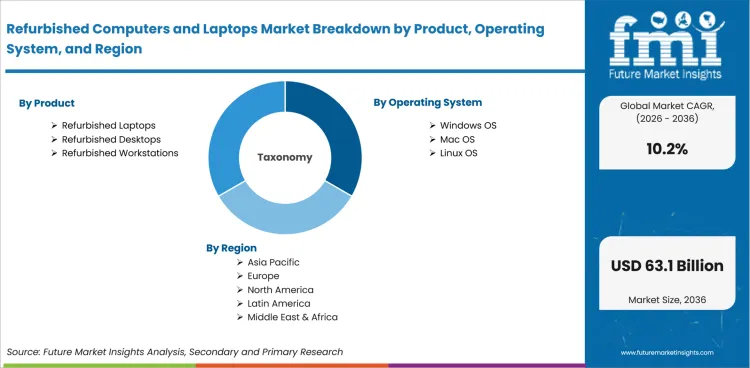
Refurbished Computers and Laptops Market Breakdown by Product, Operating System, Sales Channel, Device Grade, End User, and Region
By Product
- Refurbished Laptops
- Refurbished Desktops
- Refurbished Workstations
- Mini PCs
- Chromebooks
By Operating System
- Windows OS
- Mac OS
- Linux OS
- Chrome OS
By Sales Channel
- Online
- Brand Outlets
- Retail Stores
- Distributors
- Institutions
By Device Grade
- Grade A
- Grade B
- Grade C
- Open Box
- Parts Harvest
By End User
- Small Firms
- Students
- Enterprises
- Public Buyers
- Home Users
By Region
- North America
- Latin America
- Western Europe
- Eastern Europe
- East Asia
- South Asia and Pacific
- Middle East & Africa
Research Sources and Bibliography
- HP Inc. (2025, January 2). HP expands AI-powered services and certified refurbished hardware offerings to enhance reliability and reduce impact. HP Newsroom.
- Microsoft. (2025, October 14). Windows 10 support has ended on October 14, 2025. Microsoft Support.
- Chandramouli, R., & Hibbard, E. (2025, September). Guidelines for media sanitization (NIST Special Publication 800-88 Rev. 2). National Institute of Standards and Technology.
- Back Market. (2024, September 19). Back Market celebrates 10-year anniversary and announces profitability in Europe.
- Back Market. (2026, March 11). Back Market and Google launch ChromeOS Flex USB pilot.
- Google. (2026, April 21). Certified models list. ChromeOS Flex Help.
- Global Electronics Council. (2025, December 10). GEC launches EPEAT 2.0 to accelerate responsible electronics.
- International Telecommunication Union. (2025, November 17). ITU’s Facts and Figures 2025 shows steady progress but deepening divides in digital connectivity.
- United Nations Institute for Training and Research. (2024, March 20). Global E-waste Monitor 2024: Electronic waste rising five times faster than documented e-waste recycling.
- European Commission. (2024, June 13). Directive on common rules promoting the repair of goods.
- Basel Convention. (2025, January 1). E-waste amendments entering into force.
- United States Environmental Protection Agency. (2025, August 15). Certified electronics recyclers.
- Press Information Bureau of India. (2025, July 24). Parliament question: E-waste processing management. Government of India.
- State Council Information Office of the People’s Republic of China. (2026, January 4). China’s trade-in program drives consumer goods sales by over 2.6 trillion yuan in 2025.
- The State Council of the People’s Republic of China. (2025, March 20). China’s subsidy program spurs digital product consumption.
- Ofcom. (2025, December 10). Online Nation report 2025.
- ITOCHU Corporation. (2026, March 24). ITOCHU announces establishment of circular IT equipment business utilizing circular technologies.
- USA Bureau of Labor Statistics. (2026, February 13). Measuring price change in the CPI: Computers, peripherals, and smart home assistant devices.
- German Federal Statistical Office. (2025, December 22). Businesses with high-speed broadband: Germany below EU average. Destatis.
- Eurostat. (2026). E-commerce statistics for individuals. European Commission.
- Autorité de régulation des communications électroniques, des postes et de la distribution de la presse. (2026, February 9). Digital device ownership and usage.
- Digital Agency of Japan. (2025, July 28). Priority Plan for the Advancement of a Digital Society.
- Arvato Systems. (2025, January 13). Arvato Systems celebrates ten years of sustainable IT partnership with AfB social & green IT.
- Currys plc. (2025, July 3). Currys full year results 2024/25.
- Lenovo. (2025, November 27). Lenovo leads the circular IT shift with a new chapter in certified refurbishment services.
- Digitunity. (2025, October 21). AT&T and Digitunity launch national digital navigator initiative to support rural community organizations.
- Labo Société Numérique. (2025, March 28). Digital Barometer 2024: Key results.
- Arvato. (2026). Deutsche Telekom: Refurbishment of more than 1.5 million devices per year.
Bibliography uses public body, regulatory, company, and sector sources dated 2024 onward.
This Report Answers
- What is the projected value of the Refurbished Computers and Laptops Market in 2026 and 2036?
- How fast is the Refurbished Computers and Laptops Market forecast to expand from 2026 to 2036?
- Which product segment is projected to account for the leading share in refurbished computing?
- Why do Windows OS devices account for a major share of refurbished computer demand?
- How do online channels shape resale pricing and grade comparison for refurbished laptops?
- Which countries record the faster outlook for refurbished computers and laptops by 2036?
- How do repair policy and e-waste rules affect certified refurbished computing supply?
- Which companies compete across certified refurbished computers and laptops channels?
Frequently Asked Questions
What is the global market demand for refurbished computers and laptops market in 2026?
In 2026, the refurbished computers and laptops market value is expected to cross USD 23.9 billion as certified resale expands.
What is the forecast for refurbished computers and laptops market by 2036?
By 2036, the refurbished computers and laptops industry revenue is projected to reach USD 63.1 billion as device reuse gains business acceptance.
What is the compound annual growth rate for refurbished computers and laptops market?
The refurbished computers and laptops market is forecast to expand at 10.2% CAGR from 2026 to 2036.
Which product leads refurbished computers and laptops market in 2026?
Refurbished laptops are projected to account for 74.0% share in 2026 as portable systems suit education and small business users.
Which operating system leads refurbished computers and laptops market in 2026?
Windows OS is forecast to account for 66.1% share in 2026 as business software support favors familiar systems.
Which sales channel leads refurbished computers and laptops market in 2026?
Online e-commerce is anticipated to hold 55.0% share in 2026 as buyers compare grade and specifications.
Preview the report firsthand - request a free sample
Get SampleGet the brochure for pricing and purchase details.
Get PDFTable of Content
- Executive Summary
- Global Market Outlook
- Demand-side Trends
- Supply-side Trends
- Technology Roadmap Analysis
- Analysis and Recommendations
- Market Overview
- Market Coverage / Taxonomy
- Market Definition / Scope / Limitations
- Research Methodology
- Chapter Orientation
- Analytical Lens and Working Hypotheses
- Market Structure, Signals, and Trend Drivers
- Benchmarking and Cross-market Comparability
- Market Sizing, Forecasting, and Opportunity Mapping
- Research Design and Evidence Framework
- Desk Research Programme (Secondary Evidence)
- Company Annual and Sustainability Reports
- Peer-reviewed Journals and Academic Literature
- Corporate Websites, Product Literature, and Technical Notes
- Earnings Decks and Investor Briefings
- Statutory Filings and Regulatory Disclosures
- Technical White Papers and Standards Notes
- Trade Journals, Industry Magazines, and Analyst Briefs
- Conference Proceedings, Webinars, and Seminar Materials
- Government Statistics Portals and Public Data Releases
- Press Releases and Reputable Media Coverage
- Specialist Newsletters and Curated Briefings
- Sector Databases and Reference Repositories
- FMI Internal Proprietary Databases and Historical Market Datasets
- Subscription Datasets and Paid Sources
- Social Channels, Communities, and Digital Listening Inputs
- Additional Desk Sources
- Expert Input and Fieldwork (Primary Evidence)
- Primary Modes
- Qualitative Interviews and Expert Elicitation
- Quantitative Surveys and Structured Data Capture
- Blended Approach
- Why Primary Evidence is Used
- Field Techniques
- Interviews
- Surveys
- Focus Groups
- Observational and In-context Research
- Social and Community Interactions
- Stakeholder Universe Engaged
- C-suite Leaders
- Board Members
- Presidents and Vice Presidents
- R&D and Innovation Heads
- Technical Specialists
- Domain Subject-matter Experts
- Scientists
- Physicians and Other Healthcare Professionals
- Governance, Ethics, and Data Stewardship
- Research Ethics
- Data Integrity and Handling
- Primary Modes
- Tooling, Models, and Reference Databases
- Desk Research Programme (Secondary Evidence)
- Data Engineering and Model Build
- Data Acquisition and Ingestion
- Cleaning, Normalisation, and Verification
- Synthesis, Triangulation, and Analysis
- Quality Assurance and Audit Trail
- Market Background
- Market Dynamics
- Drivers
- Restraints
- Opportunity
- Trends
- Scenario Forecast
- Demand in Optimistic Scenario
- Demand in Likely Scenario
- Demand in Conservative Scenario
- Opportunity Map Analysis
- Product Life Cycle Analysis
- Supply Chain Analysis
- Investment Feasibility Matrix
- Value Chain Analysis
- PESTLE and Porter’s Analysis
- Regulatory Landscape
- Regional Parent Market Outlook
- Production and Consumption Statistics
- Import and Export Statistics
- Market Dynamics
- Global Market Analysis 2016 to 2025 and Forecast, 2026 to 2036
- Historical Market Size Value (USD Million) Analysis, 2016 to 2025
- Current and Future Market Size Value (USD Million) Projections, 2026 to 2036
- Y-o-Y Growth Trend Analysis
- Absolute $ Opportunity Analysis
- Global Market Pricing Analysis 2016 to 2025 and Forecast 2026 to 2036
- Global Market Analysis 2016 to 2025 and Forecast 2026 to 2036, By Product
- Introduction / Key Findings
- Historical Market Size Value (USD Million) Analysis By Product, 2016 to 2025
- Current and Future Market Size Value (USD Million) Analysis and Forecast By Product, 2026 to 2036
- Refurbished Laptops
- Refurbished Desktops
- Refurbished Workstations
- Refurbished Laptops
- Y-o-Y Growth Trend Analysis By Product, 2016 to 2025
- Absolute $ Opportunity Analysis By Product, 2026 to 2036
- Global Market Analysis 2016 to 2025 and Forecast 2026 to 2036, By Operating System
- Introduction / Key Findings
- Historical Market Size Value (USD Million) Analysis By Operating System, 2016 to 2025
- Current and Future Market Size Value (USD Million) Analysis and Forecast By Operating System, 2026 to 2036
- Windows OS
- Mac OS
- Linux OS
- Windows OS
- Y-o-Y Growth Trend Analysis By Operating System, 2016 to 2025
- Absolute $ Opportunity Analysis By Operating System, 2026 to 2036
- Global Market Analysis 2016 to 2025 and Forecast 2026 to 2036, By Sales Channel
- Introduction / Key Findings
- Historical Market Size Value (USD Million) Analysis By Sales Channel, 2016 to 2025
- Current and Future Market Size Value (USD Million) Analysis and Forecast By Sales Channel, 2026 to 2036
- Online
- Brand Outlets
- Retail Stores
- Online
- Y-o-Y Growth Trend Analysis By Sales Channel, 2016 to 2025
- Absolute $ Opportunity Analysis By Sales Channel, 2026 to 2036
- Global Market Analysis 2016 to 2025 and Forecast 2026 to 2036, By Device Grade
- Introduction / Key Findings
- Historical Market Size Value (USD Million) Analysis By Device Grade, 2016 to 2025
- Current and Future Market Size Value (USD Million) Analysis and Forecast By Device Grade, 2026 to 2036
- Grade A
- Grade B
- Grade C
- Grade A
- Y-o-Y Growth Trend Analysis By Device Grade, 2016 to 2025
- Absolute $ Opportunity Analysis By Device Grade, 2026 to 2036
- Global Market Analysis 2016 to 2025 and Forecast 2026 to 2036, By End User
- Introduction / Key Findings
- Historical Market Size Value (USD Million) Analysis By End User, 2016 to 2025
- Current and Future Market Size Value (USD Million) Analysis and Forecast By End User, 2026 to 2036
- Small Businesses
- Students
- Enterprises
- Small Businesses
- Y-o-Y Growth Trend Analysis By End User, 2016 to 2025
- Absolute $ Opportunity Analysis By End User, 2026 to 2036
- Global Market Analysis 2016 to 2025 and Forecast 2026 to 2036, By Region
- Introduction
- Historical Market Size Value (USD Million) Analysis By Region, 2016 to 2025
- Current Market Size Value (USD Million) Analysis and Forecast By Region, 2026 to 2036
- North America
- Latin America
- Western Europe
- Eastern Europe
- East Asia
- South Asia and Pacific
- Middle East & Africa
- Market Attractiveness Analysis By Region
- North America Market Analysis 2016 to 2025 and Forecast 2026 to 2036, By Country
- Historical Market Size Value (USD Million) Trend Analysis By Market Taxonomy, 2016 to 2025
- Market Size Value (USD Million) Forecast By Market Taxonomy, 2026 to 2036
- By Country
- USA
- Canada
- Mexico
- By Product
- By Operating System
- By Sales Channel
- By Device Grade
- By End User
- By Country
- Market Attractiveness Analysis
- By Country
- By Product
- By Operating System
- By Sales Channel
- By Device Grade
- By End User
- Key Takeaways
- Latin America Market Analysis 2016 to 2025 and Forecast 2026 to 2036, By Country
- Historical Market Size Value (USD Million) Trend Analysis By Market Taxonomy, 2016 to 2025
- Market Size Value (USD Million) Forecast By Market Taxonomy, 2026 to 2036
- By Country
- Brazil
- Chile
- Rest of Latin America
- By Product
- By Operating System
- By Sales Channel
- By Device Grade
- By End User
- By Country
- Market Attractiveness Analysis
- By Country
- By Product
- By Operating System
- By Sales Channel
- By Device Grade
- By End User
- Key Takeaways
- Western Europe Market Analysis 2016 to 2025 and Forecast 2026 to 2036, By Country
- Historical Market Size Value (USD Million) Trend Analysis By Market Taxonomy, 2016 to 2025
- Market Size Value (USD Million) Forecast By Market Taxonomy, 2026 to 2036
- By Country
- Germany
- UK
- Italy
- Spain
- France
- Nordic
- BENELUX
- Rest of Western Europe
- By Product
- By Operating System
- By Sales Channel
- By Device Grade
- By End User
- By Country
- Market Attractiveness Analysis
- By Country
- By Product
- By Operating System
- By Sales Channel
- By Device Grade
- By End User
- Key Takeaways
- Eastern Europe Market Analysis 2016 to 2025 and Forecast 2026 to 2036, By Country
- Historical Market Size Value (USD Million) Trend Analysis By Market Taxonomy, 2016 to 2025
- Market Size Value (USD Million) Forecast By Market Taxonomy, 2026 to 2036
- By Country
- Russia
- Poland
- Hungary
- Balkan & Baltic
- Rest of Eastern Europe
- By Product
- By Operating System
- By Sales Channel
- By Device Grade
- By End User
- By Country
- Market Attractiveness Analysis
- By Country
- By Product
- By Operating System
- By Sales Channel
- By Device Grade
- By End User
- Key Takeaways
- East Asia Market Analysis 2016 to 2025 and Forecast 2026 to 2036, By Country
- Historical Market Size Value (USD Million) Trend Analysis By Market Taxonomy, 2016 to 2025
- Market Size Value (USD Million) Forecast By Market Taxonomy, 2026 to 2036
- By Country
- China
- Japan
- South Korea
- By Product
- By Operating System
- By Sales Channel
- By Device Grade
- By End User
- By Country
- Market Attractiveness Analysis
- By Country
- By Product
- By Operating System
- By Sales Channel
- By Device Grade
- By End User
- Key Takeaways
- South Asia and Pacific Market Analysis 2016 to 2025 and Forecast 2026 to 2036, By Country
- Historical Market Size Value (USD Million) Trend Analysis By Market Taxonomy, 2016 to 2025
- Market Size Value (USD Million) Forecast By Market Taxonomy, 2026 to 2036
- By Country
- India
- ASEAN
- Australia & New Zealand
- Rest of South Asia and Pacific
- By Product
- By Operating System
- By Sales Channel
- By Device Grade
- By End User
- By Country
- Market Attractiveness Analysis
- By Country
- By Product
- By Operating System
- By Sales Channel
- By Device Grade
- By End User
- Key Takeaways
- Middle East & Africa Market Analysis 2016 to 2025 and Forecast 2026 to 2036, By Country
- Historical Market Size Value (USD Million) Trend Analysis By Market Taxonomy, 2016 to 2025
- Market Size Value (USD Million) Forecast By Market Taxonomy, 2026 to 2036
- By Country
- Kingdom of Saudi Arabia
- Other GCC Countries
- Turkiye
- South Africa
- Other African Union
- Rest of Middle East & Africa
- By Product
- By Operating System
- By Sales Channel
- By Device Grade
- By End User
- By Country
- Market Attractiveness Analysis
- By Country
- By Product
- By Operating System
- By Sales Channel
- By Device Grade
- By End User
- Key Takeaways
- Key Countries Market Analysis
- USA
- Pricing Analysis
- Market Share Analysis, 2025
- By Product
- By Operating System
- By Sales Channel
- By Device Grade
- By End User
- Canada
- Pricing Analysis
- Market Share Analysis, 2025
- By Product
- By Operating System
- By Sales Channel
- By Device Grade
- By End User
- Mexico
- Pricing Analysis
- Market Share Analysis, 2025
- By Product
- By Operating System
- By Sales Channel
- By Device Grade
- By End User
- Brazil
- Pricing Analysis
- Market Share Analysis, 2025
- By Product
- By Operating System
- By Sales Channel
- By Device Grade
- By End User
- Chile
- Pricing Analysis
- Market Share Analysis, 2025
- By Product
- By Operating System
- By Sales Channel
- By Device Grade
- By End User
- Germany
- Pricing Analysis
- Market Share Analysis, 2025
- By Product
- By Operating System
- By Sales Channel
- By Device Grade
- By End User
- UK
- Pricing Analysis
- Market Share Analysis, 2025
- By Product
- By Operating System
- By Sales Channel
- By Device Grade
- By End User
- Italy
- Pricing Analysis
- Market Share Analysis, 2025
- By Product
- By Operating System
- By Sales Channel
- By Device Grade
- By End User
- Spain
- Pricing Analysis
- Market Share Analysis, 2025
- By Product
- By Operating System
- By Sales Channel
- By Device Grade
- By End User
- France
- Pricing Analysis
- Market Share Analysis, 2025
- By Product
- By Operating System
- By Sales Channel
- By Device Grade
- By End User
- India
- Pricing Analysis
- Market Share Analysis, 2025
- By Product
- By Operating System
- By Sales Channel
- By Device Grade
- By End User
- ASEAN
- Pricing Analysis
- Market Share Analysis, 2025
- By Product
- By Operating System
- By Sales Channel
- By Device Grade
- By End User
- Australia & New Zealand
- Pricing Analysis
- Market Share Analysis, 2025
- By Product
- By Operating System
- By Sales Channel
- By Device Grade
- By End User
- China
- Pricing Analysis
- Market Share Analysis, 2025
- By Product
- By Operating System
- By Sales Channel
- By Device Grade
- By End User
- Japan
- Pricing Analysis
- Market Share Analysis, 2025
- By Product
- By Operating System
- By Sales Channel
- By Device Grade
- By End User
- South Korea
- Pricing Analysis
- Market Share Analysis, 2025
- By Product
- By Operating System
- By Sales Channel
- By Device Grade
- By End User
- Russia
- Pricing Analysis
- Market Share Analysis, 2025
- By Product
- By Operating System
- By Sales Channel
- By Device Grade
- By End User
- Poland
- Pricing Analysis
- Market Share Analysis, 2025
- By Product
- By Operating System
- By Sales Channel
- By Device Grade
- By End User
- Hungary
- Pricing Analysis
- Market Share Analysis, 2025
- By Product
- By Operating System
- By Sales Channel
- By Device Grade
- By End User
- Kingdom of Saudi Arabia
- Pricing Analysis
- Market Share Analysis, 2025
- By Product
- By Operating System
- By Sales Channel
- By Device Grade
- By End User
- Turkiye
- Pricing Analysis
- Market Share Analysis, 2025
- By Product
- By Operating System
- By Sales Channel
- By Device Grade
- By End User
- South Africa
- Pricing Analysis
- Market Share Analysis, 2025
- By Product
- By Operating System
- By Sales Channel
- By Device Grade
- By End User
- USA
- Market Structure Analysis
- Competition Dashboard
- Competition Benchmarking
- Market Share Analysis of Top Players
- By Region
- By Product
- By Operating System
- By Sales Channel
- By Device Grade
- By End User
- Competition Analysis
- Competition Deep Dive
- Back Market
- Overview
- Product Portfolio
- Profitability by Market Segments (Product/Operating System/Sales Channel/Device Grade/End User/Region)
- Sales Footprint
- Strategy Overview
- Marketing Strategy
- Product Strategy
- Channel Strategy
- Dell Technologies
- HP Inc.
- Apple Inc.
- Lenovo Group
- Amazon Renewed
- Back Market
- Competition Deep Dive
- Assumptions & Acronyms Used


