

- Industry Size (2025)
- USD 252.5 Bn
- Forecast (2035)
- USD 638 Bn
- CAGR (2025 to 2035)
- 9.7%
Andro Supplements Market Snapshot (2022 to 2032)
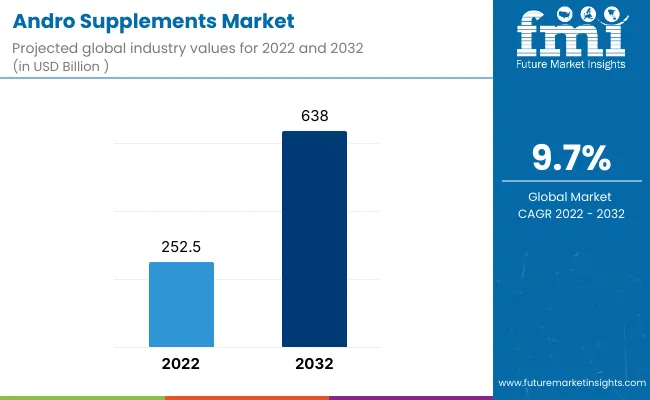
Global Andro Supplements Market demand is anticipated to be valued at USD 252.5 Million in 2022, forecast to grow at a CAGR of 9.7% to be valued at USD 638 Million from 2022 to 2032. Growth is attributed to the rising prevalence of lifestyle diseases such as obesity, diabetes, high blood pressure, and other cardiovascular diseases.
|
Report Attribute |
Details |
|
Estimated Base Year Value (2021) |
USD 249 Million |
|
Expected Market Value (2022) |
USD 252.5 Million |
|
Anticipated Forecast Value (2032) |
USD 638 Million |
|
Projected Growth Rate (2022 to 2032) |
9.7% CAGR |
Traditionally, andro supplements are widely used in the bodybuilding supplement industry. The andro supplements increased muscle mass, improved muscle recovery, increased strength, increased energy, increased protein synthesis, reduced body fat, and decreased muscle fatigue.
North America is considered to be a highly lucrative market for the andro supplements market and its different products, driven primarily by its utilization across the pharmaceutical, sports nutrition, and food industry.
Simultaneously, some side effects concerning the use of the andro supplements market are acting as significant growth barriers. If Andro supplements are not consumed at appropriate levels have reported effects such as increased aggression, hair loss, high blood pressure, and gynecomastia among others. Certain stringent regulation by the government is the hindering factor for the market. Hence, manufacturers are striving to develop more user-friendly alternatives. This is expected to restrain market growth to a significant extent.
Which are Some Prominent Drivers Spearheading Andro Supplements Market Growth?
The pharmaceutical industry is expected to accrue significant benefits to the global andro supplements market. The andro supplements market is expected to witness significant growth in the near future. This is attributed to the increasing availability of these products across the online market, supermarkets, and departmental stores.
Rising awareness regarding weight management and the health benefits of dietary supplements increased the demand for the andro supplement market. Increasing focus on curbing lifestyle diseases is anticipated to increase the andro supplement market.
What are the Challenges Faced by the Andro Supplements Industry?
Although the andro supplements market has numerous end-uses, there are numerous obstacles that likely pose a challenge to market growth. An increasing prevalence of chronic diseases, a trend of active living, an increased aged population, and growth in disposable income are some of the factors driving the demand for the dietary supplements market.
Andro supplements are generally administered orally in the form of tablets or capsules but with extensive research, andro supplements are available in the form of a spray, which can be administered orally just beneath the tongue enabling rapid absorption of the drug.
The availability of other alternatives which are natural in origin such as fenugreek seed extracts which are becoming a popular trend throughout the world may hinder the growth of the andro supplement market. Stringent government rules and regulations gradually abandoned the use of the andro supplements market and other side effects such as a decrease in the level of HDL cholesterol, consequently increased levels of LDL cholesterol. Hence, this is anticipated to act as a significant growth barrier to the andro supplements market in forthcoming years. With increasingly complex rules and regulations, andro supplements manufacturing companies are focusing on producing creative and innovative products to ensure they stay ahead of the regulatory authorities.
Why is North America Emerging as an Opportunistic Andro Supplements Market?
North America was the largest market for andro supplements market and the trend is expected to continue into the forecast period owing to rapid increment in the health and fitness industry in this region. Growing demand for andro supplements is indirectly expected to augment the andro supplements market. The region is forecast to surge at over 9% CAGR from 2022 to 2032.
An increasing aging population, rising cases of obesity, and increasing sedentary lifestyle in the USA are amongst some of the most prominent growth drivers for the North American region.
How is Europe Contributing to the Growth of the Andro Supplements Market?
According to Future Market Insights, Europe is expected to provide immense growth opportunities for Andro Supplements Market, with the United Kingdom expected to steer the bulk of all regional growth. Extensive applications in the dietary supplement industry are keeping sales of the andro supplements market afloat across the United Kingdom.
The manufacturers and producers of Andro supplements were reliant on online retail pharmacies and retail health & beauty stores to restore the supply chain of the market. Additionally, for increasing immunity issues especially among the aging population there has been a significant rise in the demand for andro supplements across the United Kingdom
Market Competition
Some of the key participants present in the global andro supplements market include Finetech Industry Limited, Biosynth A. G., Dongyao Pharmaceutical, Indo Phyto Chemicals, Dahua Pharmaceutical, Hi-Tech Pharmaceuticals, BioQuest, Hangzhou Yuhao Chemical Technology Co. Ltd., and Biovet among others.
Attributed to the presence of such a high number of participants, the market is highly competitive. While global players such as Finetech Industry Limited and Biosynth A. G. account for considerable market size, several regional-level players are also operating across key growth regions, particularly in North America.
Report Scope
|
Report Attribute |
Details |
|
Growth Rate |
CAGR of 9.7% from 2022 to 2032 |
|
Market Value in 2022 |
USD 252.5 Million |
|
Market Value in 2032 |
USD 638 Million |
|
Base Year for Estimation |
2021 |
|
Historical Data |
2017 to 2021 |
|
Forecast Period |
2022 to 2032 |
|
Quantitative Units |
Revenue in USD Million, Volume in Kilotons, and CAGR from 2022 to 2032 |
|
Report Coverage |
Revenue Forecast, Volume Forecast, Company Ranking, Competitive Landscape, Growth Factors, Trends, and Pricing Analysis |
|
Segments Covered |
|
|
Regions Covered |
|
|
Key Countries Profiled |
|
|
Key Companies Profiled |
|
|
Customization |
Available Upon Request |
Key Segments Profiled in the Andro Supplements Industry Survey
Market by product type:
- 4-AD
- AAD
Market by End-use:
- in Food & Beverages
- in Sports Nutrition
- in Dietary Supplements
- in Pharmaceutical Products
Market by Form:
- Dry
- Liquid
Market by Distribution Channel:
- Online Sales of
- Sales via Specialty Stores
- Sales via Supermarkets/Hypermarkets
- Sales via Wholesalers
Market Region:
- North America
- Latin America
- Europe
- East Asia
- South Asia & Pacific
- Middle East and Africa
Frequently Asked Questions
What is the anticipated growth of the andro supplements market until 2032?
FMI projects the global andro supplements market to expand at a 9.7% value CAGR by 2032
Which region is forecast to be the most lucrative for Andro supplements market growth?
North America is expected to be the most opportunistic andro supplements market, expanding at a 9% CAGR
Which are some prominent andro supplements, market manufacturers?
Finetech Industry Limited, Biosynth A. G., and Dongyao Pharmaceutical are some prominent andro supplements market manufacturers
Preview the report firsthand - request a free sample
Get SampleGet the brochure for pricing and purchase details.
Get PDFTable of Content
- 1. Executive Summary | Andro Supplements Market
- 1.1. Global Market Outlook
- 1.2. Demand-side Trends
- 1.3. Supply-side Trends
- 1.4. Technology Roadmap Analysis
- 1.5. Analysis and Recommendations
- 2. Market Overview
- 2.1. Market Coverage / Taxonomy
- 2.2. Market Definition / Scope / Limitations
- 3. Market Background
- 3.1. Market Dynamics
- 3.1.1. Drivers
- 3.1.2. Restraints
- 3.1.3. Opportunity
- 3.1.4. Trends
- 3.2. Scenario Forecast
- 3.2.1. Demand in Optimistic Scenario
- 3.2.2. Demand in Likely Scenario
- 3.2.3. Demand in Conservative Scenario
- 3.3. Opportunity Map Analysis
- 3.4. Product Life Cycle Analysis
- 3.5. Supply Chain Analysis
- 3.5.1. Supply Side Participants and Their Roles
- 3.5.1.1. Producers
- 3.5.1.2. Mid-Level Participants (Traders/ Agents/ Brokers)
- 3.5.1.3. Wholesalers and Distributors
- 3.5.2. Value Added and Value Created at Node in the Supply Chain
- 3.5.3. List of Raw Material Suppliers
- 3.5.4. List of Existing and Potential Buyers
- 3.5.1. Supply Side Participants and Their Roles
- 3.6. Investment Feasibility Matrix
- 3.7. Value Chain Analysis
- 3.7.1. Profit Margin Analysis
- 3.7.2. Wholesalers and Distributors
- 3.7.3. Retailers
- 3.8. PESTLE and Porter’s Analysis
- 3.9. Regulatory Landscape
- 3.9.1. By Key Regions
- 3.9.2. By Key Countries
- 3.10. Regional Parent Market Outlook
- 3.11. Production and Consumption Statistics
- 3.12. Import and Export Statistics
- 3.1. Market Dynamics
- 4. Global Market Analysis 2017 to 2021 and Forecast, 2022 to 2032
- 4.1. Historical Market Size Value (US$ Million) & Volume (Tons) Analysis, 2017 to 2021
- 4.2. Current and Future Market Size Value (US$ Million) & Volume (Tons) Projections, 2022 to 2032
- 4.2.1. Y-o-Y Growth Trend Analysis
- 4.2.2. Absolute $ Opportunity Analysis
- 5. Global Market Analysis 2017 to 2021 and Forecast 2022 to 2032, By Product Type
- 5.1. Introduction / Key Findings
- 5.2. Historical Market Size Value (US$ Million) & Volume (Tons) Analysis By Product Type, 2017 to 2021
- 5.3. Current and Future Market Size Value (US$ Million) & Volume (Tons) Analysis and Forecast By Product Type, 2022 to 2032
- 5.3.1. 4-AD
- 5.3.2. ADD
- 5.4. Y-o-Y Growth Trend Analysis By Product Type, 2017 to 2021
- 5.5. Absolute $ Opportunity Analysis By Product Type, 2022 to 2032
- 6. Global Market Analysis 2017 to 2021 and Forecast 2022 to 2032, By End Use
- 6.1. Introduction / Key Findings
- 6.2. Historical Market Size Value (US$ Million) & Volume (Tons) Analysis By End Use, 2017 to 2021
- 6.3. Current and Future Market Size Value (US$ Million) & Volume (Tons) Analysis and Forecast By End Use, 2022 to 2032
- 6.3.1. Food & beverages
- 6.3.2. Sports Nutrition
- 6.3.3. Dietary Supplement
- 6.3.4. Pharmaceutical
- 6.4. Y-o-Y Growth Trend Analysis By End Use, 2017 to 2021
- 6.5. Absolute $ Opportunity Analysis By End Use, 2022 to 2032
- 7. Global Market Analysis 2017 to 2021 and Forecast 2022 to 2032, By Form
- 7.1. Introduction / Key Findings
- 7.2. Historical Market Size Value (US$ Million) & Volume (Tons) Analysis By Form, 2017 to 2021
- 7.3. Current and Future Market Size Value (US$ Million) & Volume (Tons) Analysis and Forecast By Form, 2022 to 2032
- 7.3.1. Dry
- 7.3.2. Liquid
- 7.4. Y-o-Y Growth Trend Analysis By Form, 2017 to 2021
- 7.5. Absolute $ Opportunity Analysis By Form, 2022 to 2032
- 8. Global Market Analysis 2017 to 2021 and Forecast 2022 to 2032, By Distribution Channel
- 8.1. Introduction / Key Findings
- 8.2. Historical Market Size Value (US$ Million) & Volume (Tons) Analysis By Distribution Channel, 2017 to 2021
- 8.3. Current and Future Market Size Value (US$ Million) & Volume (Tons) Analysis and Forecast By Distribution Channel, 2022 to 2032
- 8.3.1. Online Retailers
- 8.3.2. Specialty Stores
- 8.3.3. Supermarkets/Hypermarkets
- 8.3.4. Wholesalers
- 8.4. Y-o-Y Growth Trend Analysis By Distribution Channel, 2017 to 2021
- 8.5. Absolute $ Opportunity Analysis By Distribution Channel, 2022 to 2032
- 9. Global Market Analysis 2017 to 2021 and Forecast 2022 to 2032, By Region
- 9.1. Introduction
- 9.2. Historical Market Size Value (US$ Million) & Volume (Tons) Analysis By Region, 2017 to 2021
- 9.3. Current Market Size Value (US$ Million) & Volume (Tons) Analysis and Forecast By Region, 2022 to 2032
- 9.3.1. North America
- 9.3.2. Latin America
- 9.3.3. Europe
- 9.3.4. East Asia
- 9.3.5. South Asia & Pacific
- 9.3.6. Middle East and Africa
- 9.4. Market Attractiveness Analysis By Region
- 10. North America Market Analysis 2017 to 2021 and Forecast 2022 to 2032, By Country
- 10.1. Historical Market Size Value (US$ Million) & Volume (Tons) Trend Analysis By Market Taxonomy, 2017 to 2021
- 10.2. Market Size Value (US$ Million) & Volume (Tons) Forecast By Market Taxonomy, 2022 to 2032
- 10.2.1. By Country
- 10.2.1.1. USA
- 10.2.1.2. Canada
- 10.2.2. By Product Type
- 10.2.3. By End Use
- 10.2.4. By Form
- 10.2.5. By Distribution Channel
- 10.2.1. By Country
- 10.3. Market Attractiveness Analysis
- 10.3.1. By Country
- 10.3.2. By Product Type
- 10.3.3. By End Use
- 10.3.4. By Form
- 10.3.5. By Distribution Channel
- 10.4. Key Takeaways
- 11. Latin America Market Analysis 2017 to 2021 and Forecast 2022 to 2032, By Country
- 11.1. Historical Market Size Value (US$ Million) & Volume (Tons) Trend Analysis By Market Taxonomy, 2017 to 2021
- 11.2. Market Size Value (US$ Million) & Volume (Tons) Forecast By Market Taxonomy, 2022 to 2032
- 11.2.1. By Country
- 11.2.1.1. Mexico
- 11.2.1.2. Brazil
- 11.2.1.3. Rest of Latin America
- 11.2.2. By Product Type
- 11.2.3. By End Use
- 11.2.4. By Form
- 11.2.5. By Distribution Channel
- 11.2.1. By Country
- 11.3. Market Attractiveness Analysis
- 11.3.1. By Country
- 11.3.2. By Product Type
- 11.3.3. By End Use
- 11.3.4. By Form
- 11.3.5. By Distribution Channel
- 11.4. Key Takeaways
- 12. Europe Market Analysis 2017 to 2021 and Forecast 2022 to 2032, By Country
- 12.1. Historical Market Size Value (US$ Million) & Volume (Tons) Trend Analysis By Market Taxonomy, 2017 to 2021
- 12.2. Market Size Value (US$ Million) & Volume (Tons) Forecast By Market Taxonomy, 2022 to 2032
- 12.2.1. By Country
- 12.2.1.1. Germany
- 12.2.1.2. Italy
- 12.2.1.3. France
- 12.2.1.4. United Kingdom
- 12.2.1.5. Spain
- 12.2.1.6. BENELUX
- 12.2.1.7. Russia
- 12.2.1.8. Rest of Europe
- 12.2.2. By Product Type
- 12.2.3. By End Use
- 12.2.4. By Form
- 12.2.5. By Distribution Channel
- 12.2.1. By Country
- 12.3. Market Attractiveness Analysis
- 12.3.1. By Country
- 12.3.2. By Product Type
- 12.3.3. By End Use
- 12.3.4. By Form
- 12.3.5. By Distribution Channel
- 12.4. Key Takeaways
- 13. East Asia Market Analysis 2017 to 2021 and Forecast 2022 to 2032, By Country
- 13.1. Historical Market Size Value (US$ Million) & Volume (Tons) Trend Analysis By Market Taxonomy, 2017 to 2021
- 13.2. Market Size Value (US$ Million) & Volume (Tons) Forecast By Market Taxonomy, 2022 to 2032
- 13.2.1. By Country
- 13.2.1.1. China
- 13.2.1.2. Japan
- 13.2.1.3. South Korea
- 13.2.2. By Product Type
- 13.2.3. By End Use
- 13.2.4. By Form
- 13.2.5. By Distribution Channel
- 13.2.1. By Country
- 13.3. Market Attractiveness Analysis
- 13.3.1. By Country
- 13.3.2. By Product Type
- 13.3.3. By End Use
- 13.3.4. By Form
- 13.3.5. By Distribution Channel
- 13.4. Key Takeaways
- 14. South Asia & Pacific Market Analysis 2017 to 2021 and Forecast 2022 to 2032, By Country
- 14.1. Historical Market Size Value (US$ Million) & Volume (Tons) Trend Analysis By Market Taxonomy, 2017 to 2021
- 14.2. Market Size Value (US$ Million) & Volume (Tons) Forecast By Market Taxonomy, 2022 to 2032
- 14.2.1. By Country
- 14.2.1.1. India
- 14.2.1.2. ASEAN
- 14.2.1.3. Australia and New Zealand
- 14.2.1.4. Rest of South Asia & Pacific
- 14.2.2. By Product Type
- 14.2.3. By End Use
- 14.2.4. By Form
- 14.2.5. By Distribution Channel
- 14.2.1. By Country
- 14.3. Market Attractiveness Analysis
- 14.3.1. By Country
- 14.3.2. By Product Type
- 14.3.3. By End Use
- 14.3.4. By Form
- 14.3.5. By Distribution Channel
- 14.4. Key Takeaways
- 15. Middle East and Africa Market Analysis 2017 to 2021 and Forecast 2022 to 2032, By Country
- 15.1. Historical Market Size Value (US$ Million) & Volume (Tons) Trend Analysis By Market Taxonomy, 2017 to 2021
- 15.2. Market Size Value (US$ Million) & Volume (Tons) Forecast By Market Taxonomy, 2022 to 2032
- 15.2.1. By Country
- 15.2.1.1. GCC Countries
- 15.2.1.2. Turkey
- 15.2.1.3. South Africa
- 15.2.1.4. Rest of Middle East and Africa
- 15.2.2. By Product Type
- 15.2.3. By End Use
- 15.2.4. By Form
- 15.2.5. By Distribution Channel
- 15.2.1. By Country
- 15.3. Market Attractiveness Analysis
- 15.3.1. By Country
- 15.3.2. By Product Type
- 15.3.3. By End Use
- 15.3.4. By Form
- 15.3.5. By Distribution Channel
- 15.4. Key Takeaways
- 16. Key Countries Market Analysis
- 16.1. USA
- 16.1.1. Pricing Analysis
- 16.1.2. Market Share Analysis, 2021
- 16.1.2.1. By Product Type
- 16.1.2.2. By End Use
- 16.1.2.3. By Form
- 16.1.2.4. By Distribution Channel
- 16.2. Canada
- 16.2.1. Pricing Analysis
- 16.2.2. Market Share Analysis, 2021
- 16.2.2.1. By Product Type
- 16.2.2.2. By End Use
- 16.2.2.3. By Form
- 16.2.2.4. By Distribution Channel
- 16.3. Mexico
- 16.3.1. Pricing Analysis
- 16.3.2. Market Share Analysis, 2021
- 16.3.2.1. By Product Type
- 16.3.2.2. By End Use
- 16.3.2.3. By Form
- 16.3.2.4. By Distribution Channel
- 16.4. Brazil
- 16.4.1. Pricing Analysis
- 16.4.2. Market Share Analysis, 2021
- 16.4.2.1. By Product Type
- 16.4.2.2. By End Use
- 16.4.2.3. By Form
- 16.4.2.4. By Distribution Channel
- 16.5. Germany
- 16.5.1. Pricing Analysis
- 16.5.2. Market Share Analysis, 2021
- 16.5.2.1. By Product Type
- 16.5.2.2. By End Use
- 16.5.2.3. By Form
- 16.5.2.4. By Distribution Channel
- 16.6. Italy
- 16.6.1. Pricing Analysis
- 16.6.2. Market Share Analysis, 2021
- 16.6.2.1. By Product Type
- 16.6.2.2. By End Use
- 16.6.2.3. By Form
- 16.6.2.4. By Distribution Channel
- 16.7. France
- 16.7.1. Pricing Analysis
- 16.7.2. Market Share Analysis, 2021
- 16.7.2.1. By Product Type
- 16.7.2.2. By End Use
- 16.7.2.3. By Form
- 16.7.2.4. By Distribution Channel
- 16.8. United Kingdom
- 16.8.1. Pricing Analysis
- 16.8.2. Market Share Analysis, 2021
- 16.8.2.1. By Product Type
- 16.8.2.2. By End Use
- 16.8.2.3. By Form
- 16.8.2.4. By Distribution Channel
- 16.9. Spain
- 16.9.1. Pricing Analysis
- 16.9.2. Market Share Analysis, 2021
- 16.9.2.1. By Product Type
- 16.9.2.2. By End Use
- 16.9.2.3. By Form
- 16.9.2.4. By Distribution Channel
- 16.10. BENELUX
- 16.10.1. Pricing Analysis
- 16.10.2. Market Share Analysis, 2021
- 16.10.2.1. By Product Type
- 16.10.2.2. By End Use
- 16.10.2.3. By Form
- 16.10.2.4. By Distribution Channel
- 16.11. Russia
- 16.11.1. Pricing Analysis
- 16.11.2. Market Share Analysis, 2021
- 16.11.2.1. By Product Type
- 16.11.2.2. By End Use
- 16.11.2.3. By Form
- 16.11.2.4. By Distribution Channel
- 16.12. China
- 16.12.1. Pricing Analysis
- 16.12.2. Market Share Analysis, 2021
- 16.12.2.1. By Product Type
- 16.12.2.2. By End Use
- 16.12.2.3. By Form
- 16.12.2.4. By Distribution Channel
- 16.13. Japan
- 16.13.1. Pricing Analysis
- 16.13.2. Market Share Analysis, 2021
- 16.13.2.1. By Product Type
- 16.13.2.2. By End Use
- 16.13.2.3. By Form
- 16.13.2.4. By Distribution Channel
- 16.14. South Korea
- 16.14.1. Pricing Analysis
- 16.14.2. Market Share Analysis, 2021
- 16.14.2.1. By Product Type
- 16.14.2.2. By End Use
- 16.14.2.3. By Form
- 16.14.2.4. By Distribution Channel
- 16.15. India
- 16.15.1. Pricing Analysis
- 16.15.2. Market Share Analysis, 2021
- 16.15.2.1. By Product Type
- 16.15.2.2. By End Use
- 16.15.2.3. By Form
- 16.15.2.4. By Distribution Channel
- 16.16. ASIAN
- 16.16.1. Pricing Analysis
- 16.16.2. Market Share Analysis, 2021
- 16.16.2.1. By Product Type
- 16.16.2.2. By End Use
- 16.16.2.3. By Form
- 16.16.2.4. By Distribution Channel
- 16.17. Australia and New Zealand
- 16.17.1. Pricing Analysis
- 16.17.2. Market Share Analysis, 2021
- 16.17.2.1. By Product Type
- 16.17.2.2. By End Use
- 16.17.2.3. By Form
- 16.17.2.4. By Distribution Channel
- 16.18. GCC Countries
- 16.18.1. Pricing Analysis
- 16.18.2. Market Share Analysis, 2021
- 16.18.2.1. By Product Type
- 16.18.2.2. By End Use
- 16.18.2.3. By Form
- 16.18.2.4. By Distribution Channel
- 16.19. Turkey
- 16.19.1. Pricing Analysis
- 16.19.2. Market Share Analysis, 2021
- 16.19.2.1. By Product Type
- 16.19.2.2. By End Use
- 16.19.2.3. By Form
- 16.19.2.4. By Distribution Channel
- 16.20. South Africa
- 16.20.1. Pricing Analysis
- 16.20.2. Market Share Analysis, 2021
- 16.20.2.1. By Product Type
- 16.20.2.2. By End Use
- 16.20.2.3. By Form
- 16.20.2.4. By Distribution Channel
- 16.1. USA
- 17. Market Structure Analysis
- 17.1. Competition Dashboard
- 17.2. Competition Benchmarking
- 17.3. Market Share Analysis of Top Players
- 17.3.1. By Regional
- 17.3.2. By Product Type
- 17.3.3. By End Use
- 17.3.4. By Form
- 17.3.5. By Distribution Channel
- 18. Competition Analysis
- 18.1. Competition Deep Dive
- 18.1.1. Finetech Industry Limited
- 18.1.1.1. Overview
- 18.1.1.2. Product Portfolio
- 18.1.1.3. Profitability by Market Segments
- 18.1.1.4. Sales Footprint
- 18.1.1.5. Strategy Overview
- 18.1.1.5.1. Marketing Strategy
- 18.1.1.5.2. Product Strategy
- 18.1.1.5.3. Channel Strategy
- 18.1.2. Biosynth A. G
- 18.1.3. Dongyao Pharmaceutical
- 18.1.4. Indo Phyto Chemicals
- 18.1.5. Dahua Pharmaceutical
- 18.1.6. Hi-Tech Pharmaceuticals
- 18.1.7. BioQuest
- 18.1.8. Hangzhou Yuhao Chemical Technology Co. Ltd.
- 18.1.9. Biovet
- 18.1.1. Finetech Industry Limited
- 18.1. Competition Deep Dive
- 19. Assumptions & Acronyms Used
- 20. Research Methodology


