

- Industry Size (2026)
- USD 2620.0 Mn
- Forecast (2036)
- USD 8740.0 Mn
- CAGR (2026 to 2036)
- 12.80%
Electronics Take-Back and Closed-Loop PCR Market Forecast and Outlook 2026 to 2036
The electronics take-back and closed-loop PCR market is likely to be valued at USD 2,620.0 million in 2026, is set to reach USD 8,740.0 million by 2036, and is expected to expand at a 12.8% CAGR. Market momentum is being driven by OEM efforts to convert end-of-life electronics into controlled, repeatable sources of electronics-grade recycled plastics rather than relying on open-market PCR streams. Value creation is being concentrated in closed-loop systems where collection, dismantling, polymer separation, and compounding are coordinated under OEM or brand oversight, because this structure reduces material variability and qualification risk.
Take-back programs are being designed to prioritize high-recovery device categories such as smartphones, IT hardware, and appliances, where polymer composition is well understood. Cost advantages are emerging through predictable feedstock access, reduced exposure to virgin resin volatility, and lower requalification cycles. Competitive positioning is being strengthened when recovered materials are reintroduced into the same product families, enabling stable aesthetics and mechanical performance.
Quick Stats for Electronics Take-Back and Closed-Loop PCR Market
- Electronics Take-Back and Closed-Loop PCR Market Value (2026): USD 2,620.0 Million
- Electronics Take-Back and Closed-Loop PCR Market Forecast Value (2036): USD 8,740.0 Million
- Electronics Take-Back and Closed-Loop PCR Market Forecast CAGR 2026 to 2036: 12.80%
- Leading End Use in Electronics Take-Back and Closed-Loop PCR Market: OEM Electronics Recovery
- Leading Program Type in Electronics Take-Back and Closed-Loop PCR Market: Brand-Led Take-Back Programs
- Key Growth Regions in Electronics Take-Back and Closed-Loop PCR Market: Asia Pacific, Europe, North America
- Top Key Players in Electronics Take-Back and Closed-Loop PCR Market: Apple, HP, Dell, Interzero, BASF, Lenovo, GEM Co., Panasonic, Sharp

Electronics Take-Back and Closed-Loop PCR Market Key Takeaways
| Metric | Value |
|---|---|
| Industry Value (2026) | USD 2,620.0 Million |
| Forecast Value (2036) | USD 8,740.0 Million |
| Forecast CAGR 2026 to 2036 | 12.80% |
How is the Global Electronics Take-Back and Closed-Loop PCR Market Advancing?
The global electronics take-back and closed-loop PCR market is advancing rapidly, driven by increasing recovery of end-of-life electronic products and growing reuse of recycled plastics within electronics manufacturing. Take-back programs enable collection of discarded devices such as smartphones, laptops, televisions, and peripherals, creating a controlled feedstock stream for producing electronics-grade post-consumer recycled materials.
A key driver supporting market growth is the rising focus by electronics manufacturers on securing reliable sources of high-quality recycled plastics. Closed-loop systems allow recovered plastics to be processed, compounded, and reused in new electronic products, reducing material variability and improving supply consistency. This approach is particularly important for components such as housings, frames, and internal structural parts that require stable mechanical and aesthetic properties.
Expansion of formal electronics recycling infrastructure is further contributing to market adoption. OEM-led and retailer-supported take-back programs are improving collection rates and material traceability, enabling better separation of polymer types and higher recycling yields. These programs also support compliance with extended producer responsibility requirements and internal material recovery targets.
Technological advancements are strengthening closed-loop system performance. Improved sorting technologies, advanced polymer purification processes, and integration with digital traceability platforms are enhancing material recovery efficiency. As electronics manufacturers continue to prioritize controlled recycling loops and material reuse, the electronics take-back and closed-loop PCR market is expected to experience strong growth over the forecast period.
What Is the Segment-Wise Overview of the Electronics Take-Back and Closed-Loop PCR Market?
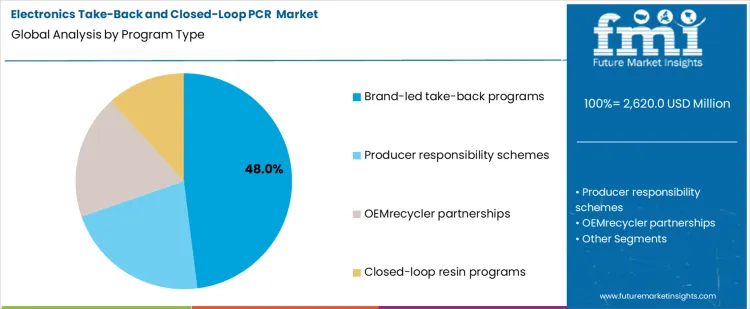
The electronics take-back and closed-loop PCR market is driven by OEM accountability for end-of-life products and structured recovery programs that enable material circularity. OEM electronics recovery leads the end-use segment with a 45% share, as device manufacturers increasingly take responsibility for collecting and reclaiming plastics from used electronics to secure recycled feedstock. These programs support compliance, material security, and closed-loop production goals. By program type, brand-led take-back programs dominate with a 48% share, reflecting OEM preference for directly managed collection initiatives that offer better control over volumes, quality, and traceability. Together, these segments highlight a market centered on OEM-driven recovery models and take-back structures designed to enable reliable closed-loop PCR supply.
Why Does OEM Electronics Recovery Lead the Electronics Take-Back and Closed-Loop PCR Market?
OEM electronics recovery accounts for 45% of market demand because electronics manufacturers face increasing regulatory and brand pressure to manage product end-of-life responsibly. Recovering plastics from devices such as smartphones, IT equipment, and appliances allows OEMs to reclaim high-quality polymer streams suitable for closed-loop reuse. Direct recovery programs improve material traceability, reduce dependency on open recycling markets, and support internal PCR targets. OEM-led recovery also aligns with extended producer responsibility frameworks and corporate circularity commitments. As device volumes grow and product lifecycles shorten, OEM-controlled recovery becomes essential for securing consistent PCR supply, reinforcing its position as the leading end-use segment.
How Do Brand-Led Take-Back Programs Drive the Closed-Loop PCR Market?
Brand-led take-back programs represent 48% of program type demand, making them the dominant model in the electronics take-back and closed-loop PCR market. These programs enable manufacturers to collect used electronics directly from consumers, businesses, or retail partners, ensuring controlled material flows. Brand-led initiatives improve collection efficiency, enhance consumer participation, and enable better sorting of plastic fractions for recycling. They also simplify compliance reporting and strengthen brand credibility by demonstrating active circular practices. By maintaining ownership of the recovery process, brands can align take-back volumes with recycling and compounding capacity. As closed-loop PCR strategies mature, brand-led take-back programs remain the preferred mechanism for electronics material recovery and reuse.
What Are the Key Dynamics for the Electronics Take-Back and Closed-Loop PCR Market?
The electronics take-back and closed-loop PCR market is driven by the need to recover end-of-life electronic products and reintroduce recovered materials back into electronics manufacturing supply chains. Take-back systems enable structured collection of discarded devices such as smartphones, laptops, televisions, and small appliances, while closed-loop recycling converts recovered plastics into post-consumer recycled materials suitable for reuse. Key market dynamics include tightening e-waste regulations, rising recovery targets, and OEM pressure to demonstrate material circularity. Integration of collection logistics, dismantling operations, polymer separation, and material reprocessing supports traceable closed-loop flows. As electronics manufacturers seek greater control over recycled feedstock quality and availability, structured take-back programs combined with closed-loop PCR systems are becoming strategically important within electronics material sourcing models.
Why Is the Electronics Take-Back and Closed-Loop PCR Market Growing?
The electronics take-back and closed-loop PCR market is growing as electronic waste volumes rise globally and regulators enforce stricter collection and recycling mandates. Extended producer responsibility frameworks require OEMs to finance or manage take-back systems, accelerating program adoption. Consumer-facing trade-in and buyback schemes are improving return rates, expanding the availability of recoverable materials. OEMs increasingly prefer closed-loop PCR sourcing to reduce dependence on virgin resins and manage supply volatility. Growth in recycled plastic usage for electronics housings and internal components further supports demand. As sustainability commitments become more closely scrutinized, closed-loop systems provide manufacturers with measurable, auditable pathways to demonstrate recycled content usage, reinforcing long-term market expansion.
How Are the Key Drivers Shaping the Electronics Take-Back and Closed-Loop PCR Market?
Key drivers shaping the electronics take-back and closed-loop PCR market include regulatory enforcement of e-waste recovery targets and growing demand for verified recycled content in electronic products. OEMs are redesigning devices to improve dismantling efficiency and polymer recoverability, enabling higher-quality PCR output. Advances in automated sorting, polymer identification, and purification technologies are improving the consistency of recovered materials. Collaboration between electronics manufacturers, recyclers, logistics providers, and compounders is strengthening closed-loop ecosystems. Digital tracking systems are increasingly used to monitor device returns and material flows. These drivers are shifting take-back programs from compliance obligations toward value-generating supply channels for electronics-grade PCR materials.
What is the Growth Outlook for the Electronics Take-Back and Closed-Loop PCR Market by Country?
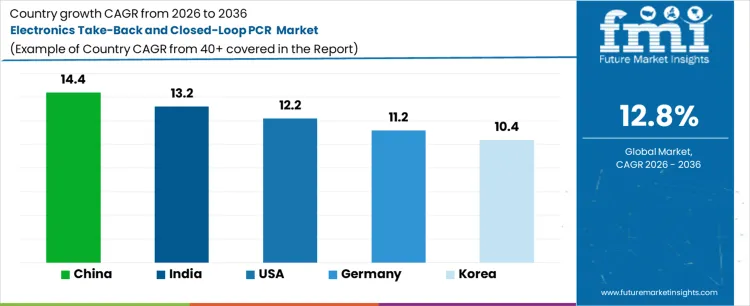
| Country | CAGR (%) |
|---|---|
| China | 14.4% |
| India | 13.2% |
| USA | 12.2% |
| Germany | 11.2% |
| South Korea | 10.4% |
The electronics take-back and closed-loop PCR market is expanding as OEMs seek secure, compliant recycled material sourcing. China leads with a 14.4% CAGR, driven by scale and integrated recycling infrastructure. India follows at 13.2%, supported by e-waste regulation and rising electronics consumption. The USA grows at 12.2%, reflecting strong corporate circularity commitments. Germany records 11.2% growth, driven by regulatory rigor and consumer participation. South Korea expands at 10.4%, supported by cautious, quality-led adoption. As circular electronics models strengthen, closed-loop PCR systems are becoming increasingly central to electronics supply chains.
Why Is the Electronics Take-Back and Closed-Loop PCR Market Expanding Rapidly in China?
Demand for electronics take-back and closed-loop PCR systems in China is expanding at a CAGR of 14.4%. Large-scale electronics manufacturing and short product replacement cycles generate high volumes of end-of-life devices, creating strong feedstock availability for closed-loop recycling. OEMs are increasingly implementing structured take-back programs to secure consistent PCR supply for device housings and components. Closed-loop models help manufacturers control material quality while reducing dependence on virgin plastics. Integration of take-back programs with recycling and reprocessing facilities improves yield predictability and material traceability. Export-oriented brands use closed-loop PCR to meet global recycled-content commitments. Digital tracking and compliance documentation strengthen operational efficiency. Government emphasis on circular electronics and resource efficiency further supports adoption. As China continues to scale electronics production and recycling integration, demand for take-back and closed-loop PCR systems is expected to grow strongly.
Why Is the Electronics Take-Back and Closed-Loop PCR Market Gaining Momentum in India?
Demand for electronics take-back and closed-loop PCR systems in India is expanding at a CAGR of 13.2%. Enforcement of e-waste management rules and producer responsibility obligations is pushing OEMs to formalize take-back programs. Rapid growth in consumer electronics usage is increasing end-of-life device volumes, improving feedstock availability for closed-loop recycling. Electronics brands are adopting closed-loop PCR to secure compliant material for housings and accessories. Integration with authorized recyclers improves material quality control and documentation. Closed-loop models help OEMs manage supply risk and reduce exposure to volatile PCR spot markets. Participation of multinational electronics brands is accelerating adoption of standardized take-back frameworks. As compliance pressure and electronics consumption rise, demand for structured take-back and closed-loop PCR systems in India is expected to increase steadily.
Why Is the Electronics Take-Back and Closed-Loop PCR Market Advancing in the USA?
Demand for electronics take-back and closed-loop PCR systems in the USA is expanding at a CAGR of 12.2%. Corporate sustainability commitments and retailer expectations are encouraging OEMs to recover and reuse plastics from end-of-life electronics. Take-back programs support reliable PCR sourcing while strengthening brand accountability. Closed-loop recycling improves material consistency for electronics-grade applications. OEMs integrate take-back systems with compliance reporting and ESG disclosures to demonstrate circularity outcomes. High consumer participation in recycling programs improves collection efficiency. Partnerships with specialized recyclers support material qualification and quality assurance. Adoption is strongest among large electronics brands with mature sustainability strategies. As circular electronics models gain traction, demand for take-back and closed-loop PCR systems in the USA is expected to remain strong.
What Is Supporting Growth of the Electronics Take-Back and Closed-Loop PCR Market in Germany?
Sales for electronics take-back and closed-loop PCR systems in Germany is growing at a CAGR of 11.2%. Strong regulatory frameworks and high consumer participation in recycling programs support closed-loop electronics models. OEMs rely on take-back systems to secure verified PCR that meets strict quality and documentation requirements. Closed-loop recycling aligns with Germany’s structured compliance and reporting environment. Electronics manufacturers integrate take-back data with quality management and procurement systems. Recyclers benefit from predictable material streams and clear specifications. Adoption focuses on upgrading existing take-back and recycling programs rather than new system creation. As circularity expectations remain high, demand for electronics take-back and closed-loop PCR systems in Germany is expected to grow steadily.
Why Is the Electronics Take-Back and Closed-Loop PCR Market Developing at a Measured Pace in South Korea?
Demand for electronics take-back and closed-loop PCR systems in South Korea is expanding at a CAGR of 10.4%. Electronics OEMs are gradually integrating closed-loop PCR into production while maintaining strict quality benchmarks. Take-back programs help secure controlled feedstock for high-performance components and housings. Export-oriented manufacturers value closed-loop models for compliance with international customer requirements. Integration with material testing and qualification workflows supports reliable adoption. Growth remains measured due to cautious scaling of PCR usage in precision electronics. Recyclers aligned with OEM specifications benefit from long-term partnerships. As circular electronics strategies mature, adoption of take-back and closed-loop PCR systems in South Korea is expected to continue steadily.
How Are Electronics Take-Back and Closed-Loop PCR Models Being Used to Compete?

Competition in the electronics take-back and closed-loop PCR market is being shaped by how effectively end-of-life devices are converted into repeatable, electronics-grade recycled materials. Apple, HP, Dell, Lenovo, Panasonic, and Sharp are positioning take-back programs as structured supply inputs rather than brand-facing recycling initiatives. Collection schemes are being designed to capture high-quality plastic fractions with known provenance. Returned devices are being routed through approved dismantling and sorting channels, allowing recovered polymers to be reintroduced into new product lines. Closed-loop usage is being highlighted in product brochures as evidence of material control, consistency, and reduced dependency on virgin resins.
Interzero and GEM Co. are competing as infrastructure and processing anchors within these closed-loop systems. Interzero’s offerings are positioned around certified take-back, sorting, and high-purity recycling streams that meet OEM specifications. Brochures emphasize loop closure metrics, traceability, and stable secondary raw material supply. GEM Co. is differentiated through large-scale recovery capacity and advanced materials processing, supporting continuous PCR feedstock availability for electronics manufacturing. BASF is positioned as a materials enabler rather than a collector. Its closed-loop relevance is framed through recycled and mass-balance polymer solutions designed to meet electronics performance standards, bridging the gap between recovered waste and application-ready resin grades.
Across the market, take-back programs are being used to secure long-term access to compliant PCR materials while reinforcing regulatory and customer confidence. Closed-loop systems are being embedded into procurement, design validation, and compliance reporting workflows. Material loops are being measured, audited, and disclosed to demonstrate repeatability rather than one-off recovery success. Competitive advantage is being defined by the ability to stabilize PCR quality, reduce supply volatility, and align recycling outputs with product engineering needs. As regulatory scrutiny and material disclosure requirements increase, electronics take-back and closed-loop PCR models are being positioned as strategic control mechanisms rather than auxiliary environmental initiatives.
Key Players in Electronics Take-Back and Closed-Loop PCR Market
- Apple
- HP
- Dell
- Interzero
- BASF
- Lenovo
- GEM Co.
- Panasonic
- Sharp
Scope of Report
| Attributes | Description |
|---|---|
| Quantitative Unit (2026) | USD Million |
| End-use | OEM Electronics Recovery, EU Circular Electronics, High-Volume OEM Recovery, Appliance & IT Take-Back, E-Waste Formalisation, Corporate Take-Back Initiatives |
| Program Type | Brand-Led Take-Back Programs, Producer Responsibility Schemes, OEM-Recycler Partnerships, Closed-Loop Resin Programs |
| Regions Covered | Asia Pacific, Europe, North America, Latin America, Middle East & Africa |
| Countries Covered | China, Japan, South Korea, India, Australia & New Zealand, ASEAN, Rest of Asia Pacific, Germany, United Kingdom, France, Italy, Spain, Nordic, BENELUX, Rest of Europe, United States, Canada, Mexico, Brazil, Chile, Rest of Latin America, Kingdom of Saudi Arabia, Other GCC Countries, Turkey, South Africa, Other African Union, Rest of Middle East & Africa |
| Key Companies Profiled | Apple, HP, Dell, Interzero, BASF, Lenovo, GEM Co., Panasonic, Sharp |
| Additional Attributes | Dollar sales by end-use and program type; regional market size and forecast analysis; growth outlook across major regions; adoption trends for electronics take-back and closed-loop PCR systems; assessment of collection efficiency, material recovery rates, OEM-recycler integration, and demand patterns across consumer electronics, appliances, and IT hardware value chains. |
Electronics Take-Back and Closed-Loop PCR Market by Key Segments
End-use
- OEM electronics recovery
- EU circular electronics
- High-volume OEM recovery
- Appliance & IT take-back
- E-waste formalisation
- Corporate take-back initiatives
Program Type
- Brand-led take-back programs
- Producer responsibility schemes
- OEMrecycler partnerships
- Closed-loop resin programs
Region
- Asia Pacific
- China
- Japan
- South Korea
- India
- Australia & New Zealand
- ASEAN
- Rest of Asia Pacific
- Europe
- Germany
- United Kingdom
- France
- Italy
- Spain
- Nordic
- BENELUX
- Rest of Europe
- North America
- United States
- Canada
- Mexico
- Latin America
- Brazil
- Chile
- Rest of Latin America
- Middle East & Africa
- Kingdom of Saudi Arabia
- Other GCC Countries
- Turkey
- South Africa
- Other African Union
- Rest of Middle East & Africa
Bibliography
- Central Pollution Control Board (CPCB), India (2024) - E-Waste (Management) Rules - Third Amendment Rules, 2024 (legal text). Available at CPCB.nic.in.
- Central Pollution Control Board (CPCB), India (2024) - Centralized EPR Portal for Plastic Packaging (producer/recycler registration).
- OECD (2024, May) - Plastics Recycled Content Requirements (Policy Paper) (PDF). Provides chain-of-custody definitions and recycled content guidance.
- Data.gov.in (2024, Sept) - Year-wise Details of Volume of E-Waste Generation and Recycling Under E-Waste Management Rules (dataset).
- Global Electronics Council (2025) - Sustainable Use of Resources Criteria (EPEAT SUR 2025) - includes post-consumer recycled content reporting and chain-of-custody requirements for electronics product
Frequently Asked Questions
How big is the electronics take-back and closed-loop pcr market in 2026?
The global electronics take-back and closed-loop pcr market is estimated to be valued at USD 2,620.0 million in 2026.
What will be the size of electronics take-back and closed-loop pcr market in 2036?
The market size for the electronics take-back and closed-loop pcr market is projected to reach USD 8,740.0 million by 2036.
How much will be the electronics take-back and closed-loop pcr market growth between 2026 and 2036?
The electronics take-back and closed-loop pcr market is expected to grow at a 12.8% CAGR between 2026 and 2036.
What are the key product types in the electronics take-back and closed-loop pcr market?
The key product types in electronics take-back and closed-loop pcr market are oem electronics recovery, eu circular electronics, high-volume oem recovery, appliance & it take-back, e-waste formalisation and corporate take-back initiatives.
Which program type segment to contribute significant share in the electronics take-back and closed-loop pcr market in 2026?
In terms of program type, brand-led take-back programs segment to command 48.0% share in the electronics take-back and closed-loop pcr market in 2026.
Preview the report firsthand - request a free sample
Get SampleGet the brochure for pricing and purchase details.
Get PDFTable of Content
- Executive Summary
- Global Market Outlook
- Demand-side Trends
- Supply-side Trends
- Technology Roadmap Analysis
- Analysis and Recommendations
- Market Overview
- Market Coverage / Taxonomy
- Market Definition / Scope / Limitations
- Market Background
- Market Dynamics
- Drivers
- Restraints
- Opportunity
- Trends
- Scenario Forecast
- Demand in Optimistic Scenario
- Demand in Likely Scenario
- Demand in Conservative Scenario
- Opportunity Map Analysis
- Product Life Cycle Analysis
- Supply Chain Analysis
- Investment Feasibility Matrix
- Value Chain Analysis
- PESTLE and Porter’s Analysis
- Regulatory Landscape
- Regional Parent Market Outlook
- Production and Consumption Statistics
- Import and Export Statistics
- Market Dynamics
- Global Market Analysis 2021 to 2025 and Forecast, 2026 to 2036
- Historical Market Size Value (USD Million) Analysis, 2021 to 2025
- Current and Future Market Size Value (USD Million) Projections, 2026 to 2036
- Y-o-Y Growth Trend Analysis
- Absolute $ Opportunity Analysis
- Global Market Pricing Analysis 2021 to 2025 and Forecast 2026 to 2036
- Global Market Analysis 2021 to 2025 and Forecast 2026 to 2036, By End-use
- Introduction / Key Findings
- Historical Market Size Value (USD Million) Analysis By End-use, 2021 to 2025
- Current and Future Market Size Value (USD Million) Analysis and Forecast By End-use, 2026 to 2036
- OEM electronics recovery
- EU circular electronics
- High-volume OEM recovery
- Appliance & IT take-back
- E-waste formalisation
- Corporate take-back initiatives
- OEM electronics recovery
- Y-o-Y Growth Trend Analysis By End-use, 2021 to 2025
- Absolute $ Opportunity Analysis By End-use, 2026 to 2036
- Global Market Analysis 2021 to 2025 and Forecast 2026 to 2036, By Program Type
- Introduction / Key Findings
- Historical Market Size Value (USD Million) Analysis By Program Type, 2021 to 2025
- Current and Future Market Size Value (USD Million) Analysis and Forecast By Program Type, 2026 to 2036
- Brand-led take-back programs
- Producer responsibility schemes
- OEMrecycler partnerships
- Closed-loop resin programs
- Brand-led take-back programs
- Y-o-Y Growth Trend Analysis By Program Type, 2021 to 2025
- Absolute $ Opportunity Analysis By Program Type, 2026 to 2036
- Global Market Analysis 2021 to 2025 and Forecast 2026 to 2036, By Region
- Introduction
- Historical Market Size Value (USD Million) Analysis By Region, 2021 to 2025
- Current Market Size Value (USD Million) Analysis and Forecast By Region, 2026 to 2036
- North America
- Latin America
- Western Europe
- Eastern Europe
- East Asia
- South Asia and Pacific
- Middle East & Africa
- Market Attractiveness Analysis By Region
- North America Market Analysis 2021 to 2025 and Forecast 2026 to 2036, By Country
- Historical Market Size Value (USD Million) Trend Analysis By Market Taxonomy, 2021 to 2025
- Market Size Value (USD Million) Forecast By Market Taxonomy, 2026 to 2036
- By Country
- USA
- Canada
- Mexico
- By End-use
- By Program Type
- By Country
- Market Attractiveness Analysis
- By Country
- By End-use
- By Program Type
- Key Takeaways
- Latin America Market Analysis 2021 to 2025 and Forecast 2026 to 2036, By Country
- Historical Market Size Value (USD Million) Trend Analysis By Market Taxonomy, 2021 to 2025
- Market Size Value (USD Million) Forecast By Market Taxonomy, 2026 to 2036
- By Country
- Brazil
- Chile
- Rest of Latin America
- By End-use
- By Program Type
- By Country
- Market Attractiveness Analysis
- By Country
- By End-use
- By Program Type
- Key Takeaways
- Western Europe Market Analysis 2021 to 2025 and Forecast 2026 to 2036, By Country
- Historical Market Size Value (USD Million) Trend Analysis By Market Taxonomy, 2021 to 2025
- Market Size Value (USD Million) Forecast By Market Taxonomy, 2026 to 2036
- By Country
- Germany
- UK
- Italy
- Spain
- France
- Nordic
- BENELUX
- Rest of Western Europe
- By End-use
- By Program Type
- By Country
- Market Attractiveness Analysis
- By Country
- By End-use
- By Program Type
- Key Takeaways
- Eastern Europe Market Analysis 2021 to 2025 and Forecast 2026 to 2036, By Country
- Historical Market Size Value (USD Million) Trend Analysis By Market Taxonomy, 2021 to 2025
- Market Size Value (USD Million) Forecast By Market Taxonomy, 2026 to 2036
- By Country
- Russia
- Poland
- Hungary
- Balkan & Baltic
- Rest of Eastern Europe
- By End-use
- By Program Type
- By Country
- Market Attractiveness Analysis
- By Country
- By End-use
- By Program Type
- Key Takeaways
- East Asia Market Analysis 2021 to 2025 and Forecast 2026 to 2036, By Country
- Historical Market Size Value (USD Million) Trend Analysis By Market Taxonomy, 2021 to 2025
- Market Size Value (USD Million) Forecast By Market Taxonomy, 2026 to 2036
- By Country
- China
- Japan
- South Korea
- By End-use
- By Program Type
- By Country
- Market Attractiveness Analysis
- By Country
- By End-use
- By Program Type
- Key Takeaways
- South Asia and Pacific Market Analysis 2021 to 2025 and Forecast 2026 to 2036, By Country
- Historical Market Size Value (USD Million) Trend Analysis By Market Taxonomy, 2021 to 2025
- Market Size Value (USD Million) Forecast By Market Taxonomy, 2026 to 2036
- By Country
- India
- ASEAN
- Australia & New Zealand
- Rest of South Asia and Pacific
- By End-use
- By Program Type
- By Country
- Market Attractiveness Analysis
- By Country
- By End-use
- By Program Type
- Key Takeaways
- Middle East & Africa Market Analysis 2021 to 2025 and Forecast 2026 to 2036, By Country
- Historical Market Size Value (USD Million) Trend Analysis By Market Taxonomy, 2021 to 2025
- Market Size Value (USD Million) Forecast By Market Taxonomy, 2026 to 2036
- By Country
- Kingdom of Saudi Arabia
- Other GCC Countries
- Turkiye
- South Africa
- Other African Union
- Rest of Middle East & Africa
- By End-use
- By Program Type
- By Country
- Market Attractiveness Analysis
- By Country
- By End-use
- By Program Type
- Key Takeaways
- Key Countries Market Analysis
- USA
- Pricing Analysis
- Market Share Analysis, 2025
- By End-use
- By Program Type
- Canada
- Pricing Analysis
- Market Share Analysis, 2025
- By End-use
- By Program Type
- Mexico
- Pricing Analysis
- Market Share Analysis, 2025
- By End-use
- By Program Type
- Brazil
- Pricing Analysis
- Market Share Analysis, 2025
- By End-use
- By Program Type
- Chile
- Pricing Analysis
- Market Share Analysis, 2025
- By End-use
- By Program Type
- Germany
- Pricing Analysis
- Market Share Analysis, 2025
- By End-use
- By Program Type
- UK
- Pricing Analysis
- Market Share Analysis, 2025
- By End-use
- By Program Type
- Italy
- Pricing Analysis
- Market Share Analysis, 2025
- By End-use
- By Program Type
- Spain
- Pricing Analysis
- Market Share Analysis, 2025
- By End-use
- By Program Type
- France
- Pricing Analysis
- Market Share Analysis, 2025
- By End-use
- By Program Type
- India
- Pricing Analysis
- Market Share Analysis, 2025
- By End-use
- By Program Type
- ASEAN
- Pricing Analysis
- Market Share Analysis, 2025
- By End-use
- By Program Type
- Australia & New Zealand
- Pricing Analysis
- Market Share Analysis, 2025
- By End-use
- By Program Type
- China
- Pricing Analysis
- Market Share Analysis, 2025
- By End-use
- By Program Type
- Japan
- Pricing Analysis
- Market Share Analysis, 2025
- By End-use
- By Program Type
- South Korea
- Pricing Analysis
- Market Share Analysis, 2025
- By End-use
- By Program Type
- Russia
- Pricing Analysis
- Market Share Analysis, 2025
- By End-use
- By Program Type
- Poland
- Pricing Analysis
- Market Share Analysis, 2025
- By End-use
- By Program Type
- Hungary
- Pricing Analysis
- Market Share Analysis, 2025
- By End-use
- By Program Type
- Kingdom of Saudi Arabia
- Pricing Analysis
- Market Share Analysis, 2025
- By End-use
- By Program Type
- Turkiye
- Pricing Analysis
- Market Share Analysis, 2025
- By End-use
- By Program Type
- South Africa
- Pricing Analysis
- Market Share Analysis, 2025
- By End-use
- By Program Type
- USA
- Market Structure Analysis
- Competition Dashboard
- Competition Benchmarking
- Market Share Analysis of Top Players
- By Regional
- By End-use
- By Program Type
- Competition Analysis
- Competition Deep Dive
- Apple
- Overview
- Product Portfolio
- Profitability by Market Segments (Product/Age /Sales Channel/Region)
- Sales Footprint
- Strategy Overview
- Marketing Strategy
- Product Strategy
- Channel Strategy
- HP
- Dell
- Interzero
- BASF
- Lenovo
- GEM Co.
- Panasonic
- Sharp
- Apple
- Competition Deep Dive
- Assumptions & Acronyms Used
- Research Methodology


