

- Industry Size (2026)
- USD 1157.20 Bn
- Forecast (2036)
- USD 1921.17 Bn
- CAGR (2026 to 2036)
- 5.20%
Electronics Retailing Market Size, Market Forecast and Outlook By FMI
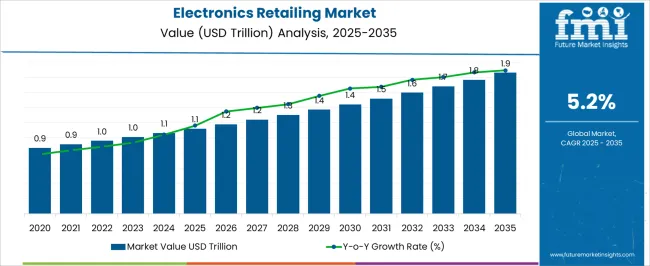
The electronics retailing market was valued at USD 1,100.00 billion in 2025, projected to reach USD 1,157.20 billion in 2026, and is forecast to expand to USD 1,921.17 billion by 2036 at a 5.20% CAGR. Consumer electronics upgrade cycles driven by AI-capable device launches, smartphone replacement demand, and expanding smart home technology adoption are sustaining retail channel throughput across both online and physical store formats. Mass merchant retailers are capturing an increasing share of electronics procurement by integrating electronics departments with services ecosystems that include device setup, financing, trade-in programmes, and extended warranty offerings that generate per-transaction attachment revenues.
The absolute dollar opportunity of approximately USD 763.97 billion over the forecast period reflects the sustained consumer appetite for connected devices, computing equipment, and home entertainment systems across both replacement and first-time purchase segments. Online electronics retailing continues to gain share through marketplace platforms offering price comparison, customer review aggregation, and same-day delivery capabilities that compress the traditional research-to-purchase timeline. Physical retail electronics stores are evolving into experiential showroom formats where product demonstration, consultation, and service attachment generate per-visit conversion rates that justify higher operating costs compared to pure online fulfilment.
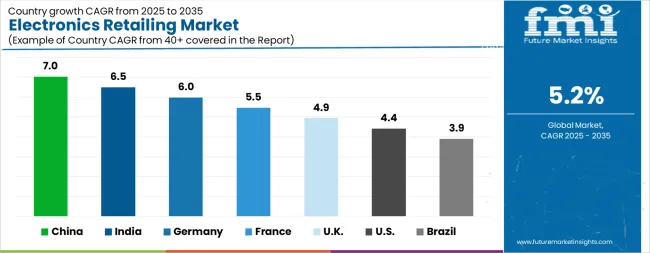
China sets the pace at a 7.0% CAGR, driven by consumer electronics upgrade cycles and e-commerce platform dominance in electronics distribution. India follows at 6.5% as smartphone penetration growth, organized retail expansion, and rising consumer electronics spending generate electronics retail volume. Germany registers 6.0% growth supported by established electronics retail chain density and consumer preference for in-store purchase with professional setup services. France maintains 5.5% driven by electronics retail chain modernization and online channel growth. UK expands at 4.9% anchored by omnichannel electronics retail evolution and consumer device upgrade demand. USA tracks at 4.4% supported by the largest consumer electronics retail base and manufacturer direct-to-consumer channel expansion. Brazil registers 3.9% with growing electronics retail penetration and instalment payment plan-driven consumer electronics access.
Summary of Electronics Retailing Market
- Electronics Retailing Market Definition
- Electronics retailing is the distribution and sale of consumer electronics through physical, online, and omnichannel retail formats, covering mass merchants and niche merchants selling smartphones, computing, entertainment, wearable, and smart home products.
- Demand Drivers in the Market
- AI-capable device launch cycles across smartphones, laptops, and smart home products are generating consumer upgrade demand that sustains retail throughput independent of base-level market saturation in developed economies.
- Mass merchant retailers integrating device setup, financing, trade-in, and warranty ecosystems capture per-transaction attachment revenues that differentiate their electronics proposition from pure-price online competition.
- Online marketplace platforms compressing the research-to-purchase timeline through price comparison, review aggregation, and same-day delivery are accelerating consumer electronics procurement cycle velocity.
- Key Segments Analyzed in the FMI Report
- Mass Merchants by Category Specific Merchants: 62.4% share in 2026, as large-format retailers with integrated services ecosystems capture the majority of consumer electronics procurement through one-stop shopping convenience and financing availability.
- China: 7.0% compound growth driven by consumer electronics upgrade cycles and e-commerce platform dominance in electronics distribution across tier-1 through tier-4 city consumer segments.
- Analyst Opinion at FMI
- The electronics retailing market is bifurcating between mass merchant platforms competing on service ecosystem breadth and price-focused online marketplaces competing on transaction efficiency, with specialty electronics retailers compressed between both models. Retailers who cannot deliver post-purchase service differentiation through setup, repair, and trade-in programmes face margin erosion as commodity product pricing converges across channels. The critical competitive risk centers on manufacturer direct-to-consumer channel expansion, as major electronics brands invest in owned retail and online storefronts that bypass traditional retail distribution and capture full margin.
- Strategic Implications / Executive Takeaways
- Electronics retailers must invest in post-purchase service ecosystems spanning device setup, repair, and trade-in to maintain differentiation against manufacturer direct channels and pure-price online marketplaces.
- Online marketplace platforms must develop same-day electronics delivery capabilities and expanded return processing infrastructure to capture impulse purchase conversion from consumers accustomed to physical retail immediacy.
- Consumer electronics manufacturers must balance direct-to-consumer channel investment against retail partner relationship maintenance to avoid distribution conflicts that reduce total market coverage.
Electronics Retailing Market Key Takeaways
| Metric | Details |
|---|---|
| Industry Size (2026) | USD 1,157.20 Billion |
| Industry Value (2036) | USD 1,921.17 Billion |
| CAGR (2026-2036) | 5.20% |
Source: Future Market Insights, 2026
Electronics Retailing Market Definition
Electronics retailing encompasses the distribution and sale of consumer electronics products through physical store, online marketplace, and omnichannel retail formats serving individual and household buyers. This market covers mass merchant electronics retailers, specialty electronics store chains, manufacturer direct-to-consumer channels, and online marketplace platforms selling smartphones, computing devices, home entertainment systems, wearable technology, smart home products, and consumer accessories.
Electronics Retailing Market Inclusions
Market scope includes mass merchant electronics department revenues, specialty electronics retailer sales, online marketplace electronics category transactions, manufacturer direct store and website sales, and refurbished electronics retail channels. Coverage spans smartphones, laptops, tablets, televisions, audio equipment, wearables, smart home devices, and consumer electronics accessories.
Electronics Retailing Market Exclusions
Business-to-business electronics procurement, enterprise IT hardware distribution, component-level electronics sales, and wholesale electronics distribution without consumer retail presence are excluded. Telecommunications service revenues bundled with device sales fall outside analytical parameters.
Electronics Retailing Market Research Methodology
- Primary Research: Analysts engaged with electronics retail chain merchandising directors, online marketplace electronics category managers, and consumer electronics manufacturer channel strategy leads to map the retail format and purchasing triggers across consumer segments.
- Desk Research: Data collection phases aggregated retail point-of-sale electronics category data, online marketplace transaction volumes, and consumer electronics shipment statistics from industry tracking services.
- Market-Sizing and Forecasting: Baseline values derive from a bottom-up aggregation of electronics retail transaction values across mass merchant, specialty, online, and direct channels, applying region-specific consumer electronics spending growth curves.
- Data Validation and Update Cycle: Projections are tested against publicly reported consumer electronics retail segment revenues from leading retail chains and marketplace platforms.
Why is the Electronics Retailing Market Growing?
The Electronics Retailing market is experiencing steady growth, driven by increasing consumer demand for electronic products, including smartphones, home appliances, computers, and entertainment devices. Growth is being supported by rising disposable incomes, urbanization, and greater penetration of organized retail chains across emerging and developed markets. The shift toward omnichannel retailing, combining physical stores with e-commerce platforms, is enhancing customer reach and improving convenience, which is further fueling market expansion.
Investments in supply chain optimization, digital marketing, and customer experience innovations are enabling retailers to maintain competitiveness. The market is also being influenced by rapid technological advancements in electronics, which increase product variety and encourage frequent upgrades by consumers.
Regulatory measures, warranty standards, and quality certifications are supporting consumer confidence in organized retail As digital transformation continues and consumer preferences evolve, electronics retailing is expected to witness sustained growth, with merchants leveraging data-driven strategies and efficient operations to drive sales and enhance profitability.
Segmental Analysis
The electronics retailing market is segmented by category specific merchants, and geographic regions. By category specific merchants, electronics retailing market is divided into Mass Merchants and Niche Merchants. Regionally, the electronics retailing industry is classified into North America, Latin America, Western Europe, Eastern Europe, Balkan & Baltic Countries, Russia & Belarus, Central Asia, East Asia, South Asia & Pacific, and the Middle East & Africa.
Insights into the Mass Merchants Category Specific Merchants Segment
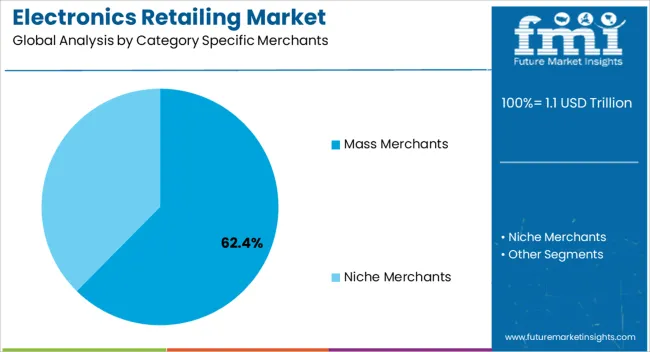
The mass merchants segment is projected to hold 62.4% of the market revenue in 2026, establishing it as the leading category within electronics retailing. Its growth is being driven by the ability to offer a wide range of electronic products at competitive prices, appealing to price-sensitive and value-conscious consumers. Large-scale distribution networks and economies of scale enable mass merchants to maintain cost efficiency while providing convenience and extensive product selection under one roof.
Integration of digital platforms, loyalty programs, and in-store promotions enhances customer engagement and drives repeat purchases. The flexibility to adapt to seasonal demand fluctuations and promotional campaigns further strengthens their market position.
Mass merchants are also investing in advanced inventory management, point-of-sale technologies, and omnichannel strategies, allowing seamless shopping experiences As consumer preference shifts toward convenient, reliable, and competitively priced electronics purchasing, the mass merchants segment is expected to maintain its leading position, driven by scale, operational efficiency, and evolving customer expectations.
Market Overview
Electronics Retailing Market Overview
The use of advanced technical products such as laptop, mobile phones have given a new platform for shopping. By using internet, a person can buy any product through virtual stores like websites, mobile apps/portals which are becoming totally new perspective of shopping & proving beneficial for both the seller as well as the buyers.
The term electronic retailing also be called as E-tailing where ‘E’ stands for the electronics medium since the retailing starts through the internet (electronic media). With the use of these shopping websites/portals customer can visit the virtual store and choose their preferred product in the shopping cart by seeing its pictures, features, and price.
After that payment can be made by different methods mentioned by shopping site and then product would be delivered to customer’s doorstep by an associated courier company of shopping site.
The success of electronic retailing depends on various factors/components such as online portal attractiveness, appropriate revenue model and last but not least penetration over internet.
Electronic retailing is a rapidly growing segment of e-commerce with the attractive services provided by the vendors and is expected to grow in future as well.
Analysis of Electronics Retailing Market By Key Countries
.webp "Top Country Growth Comparison Electronics Retailing Market Cagr (2026 2036)")
| Country | CAGR |
|---|---|
| China | 7.0% |
| India | 6.5% |
| Germany | 6.0% |
| France | 5.5% |
| UK | 4.9% |
| USA | 4.4% |
| Brazil | 3.9% |
Source: FMI analysis based on primary research and proprietary forecasting model
Country-wise Analysis
The Electronics Retailing Market is expected to register a CAGR of 5.2% during the forecast period, exhibiting varied country level momentum. China leads with the highest CAGR of 7.0%, followed by India at 6.5%. Developed markets such as Germany, France, and the UK continue to expand steadily, while the USA is likely to grow at consistent rates. Brazil posts the lowest CAGR at 3.9%, yet still underscores a broadly positive trajectory for the global Electronics Retailing Market. In 2024, Germany held a dominant revenue in the Western Europe market and is expected to grow with a CAGR of 6.0%. The USA Electronics Retailing Market is estimated to be valued at USD 385.5 trillion in 2026 and is anticipated to reach a valuation of USD 594.1 trillion by 2036. Sales are projected to rise at a CAGR of 4.4% over the forecast period between 2026 and 2036. While Japan and South Korea markets are estimated to be valued at USD 51.9 trillion and USD 37.9 trillion respectively in 2026.
Key Players in the Electronics Retailing Market
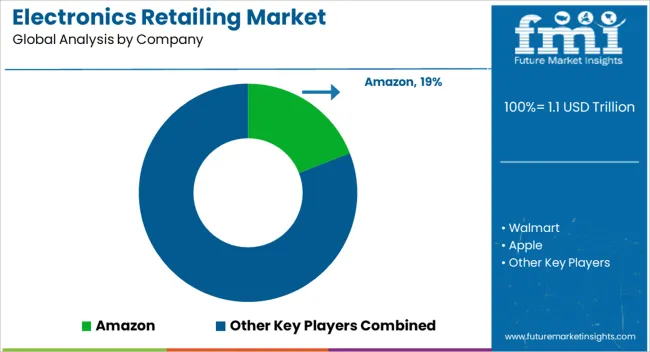
- Amazon
- Walmart
- Apple
- BestBuy
- Dell
- Samsung
- LG Electronics
- Staples
- Panasonic
- Haier Group
Scope of the Report
| Metric | Value |
|---|---|
| Quantitative Units | USD 1,157.20 Billion to USD 1,921.17 Billion, at a CAGR of 5.20% |
| Market Definition | Electronics retailing is the distribution and sale of consumer electronics through physical, online, and omnichannel retail formats, covering mass merchants and niche merchants selling smartphones, computing, entertainment, wearable, and smart home products. |
| Segmentation | Category Specific Merchants: Mass Merchants and Niche Merchants |
| Regions Covered | North America, Latin America, Europe, East Asia, South Asia, Oceania, Middle East & Africa |
| Countries Covered | China, India, Germany, France, UK, USA, Brazil, and 40 plus countries |
| Key Companies Profiled | Amazon, Walmart, Apple, BestBuy, Dell, Samsung, LG Electronics |
| Forecast Period | 2026 to 2036 |
| Approach | Forecasting models apply a bottom-up methodology starting with installed base metrics and projecting conversion rates to technology adoption. |
Electronics Retailing Market by Segments
Category Specific Merchants:
- Mass Merchants
- Niche Merchants
Region:
- North America
- USA
- Canada
- Mexico
- Latin America
- Brazil
- Chile
- Rest of Latin America
- Western Europe
- Germany
- UK
- Italy
- Spain
- France
- Nordic
- BENELUX
- Rest of Western Europe
- Eastern Europe
- Russia
- Poland
- Hungary
- Balkan & Baltic
- Rest of Eastern Europe
- East Asia
- China
- Japan
- South Korea
- South Asia and Pacific
- India
- ASEAN
- Australia & New Zealand
- Rest of South Asia and Pacific
- Middle East & Africa
- Kingdom of Saudi Arabia
- Other GCC Countries
- Turkiye
- South Africa
- Other African Union
- Rest of Middle East & Africa
Bibliography
- 1. Consumer Technology Association. (2024). USA Consumer Technology Sales and Forecasts: Annual Industry Report. CTA.
- 2. China Electronic Commerce Association. (2024). Online Electronics Retail: Annual Transaction Volume and Growth Report. CECA.
- 3. GfK Consumer Intelligence. (2024). Global Consumer Electronics Retail: Channel Performance and Format Evolution. GfK.
- 4. Euromonitor International. (2024). Consumer Electronics Retailing: Global Market Assessment. Euromonitor.
- 5. Ministry of Commerce, India. (2024). Consumer Electronics Retail: Organized Retail Penetration and E-commerce Growth Report. MoC.
- 6. Japan Electronics and Information Technology Industries Association. (2024). Consumer Electronics Shipment Statistics. JEITA.
- This bibliography is provided for reader reference. The full FMI report contains the complete reference list with primary research documentation.
Source: FMI analysis based on primary research and proprietary forecasting model
Frequently Asked Questions
How large is the demand for Electronics Retailing in the global market in 2026?
Demand is estimated to be valued at USD 1,157.20 billion in 2026.
What will be the market size by 2036?
Market size is projected to reach USD 1,921.17 billion by 2036.
What is the expected CAGR between 2026 and 2036?
Demand is expected to grow at a CAGR of 5.20% between 2026 and 2036.
Which merchant category is poised to lead global sales by 2026?
Mass Merchants accounts for 62.4% share in 2026 capturing the majority through one-stop convenience and integrated service ecosystems.
What is driving demand in China?
Consumer electronics upgrade cycles and e-commerce platform dominance fuel the fastest growth at 7.0% CAGR through 2036.
What is included in the scope of this report?
The market covers mass merchant, specialty, online, and direct-channel electronics sales across smartphones, computing, entertainment, wearables, and smart home categories.
What is excluded from the scope of this report?
B2B electronics procurement, enterprise IT distribution, component sales, wholesale without retail presence, and telecom service revenues are excluded.
How is the retail format evolving?
Physical stores are shifting to experiential showrooms with consultation and service attachment while online platforms compete on transaction efficiency and delivery speed.
Preview the report firsthand - request a free sample
Get SampleGet the brochure for pricing and purchase details.
Get PDFTable of Content
- Executive Summary
- Global Market Outlook
- Demand-side Trends
- Supply-side Trends
- Technology Roadmap Analysis
- Analysis and Recommendations
- Market Overview
- Market Coverage / Taxonomy
- Market Definition / Scope / Limitations
- Research Methodology
- Chapter Orientation
- Analytical Lens and Working Hypotheses
- Market Structure, Signals, and Trend Drivers
- Benchmarking and Cross-market Comparability
- Market Sizing, Forecasting, and Opportunity Mapping
- Research Design and Evidence Framework
- Desk Research Programme (Secondary Evidence)
- Company Annual and Sustainability Reports
- Peer-reviewed Journals and Academic Literature
- Corporate Websites, Product Literature, and Technical Notes
- Earnings Decks and Investor Briefings
- Statutory Filings and Regulatory Disclosures
- Technical White Papers and Standards Notes
- Trade Journals, Industry Magazines, and Analyst Briefs
- Conference Proceedings, Webinars, and Seminar Materials
- Government Statistics Portals and Public Data Releases
- Press Releases and Reputable Media Coverage
- Specialist Newsletters and Curated Briefings
- Sector Databases and Reference Repositories
- FMI Internal Proprietary Databases and Historical Market Datasets
- Subscription Datasets and Paid Sources
- Social Channels, Communities, and Digital Listening Inputs
- Additional Desk Sources
- Expert Input and Fieldwork (Primary Evidence)
- Primary Modes
- Qualitative Interviews and Expert Elicitation
- Quantitative Surveys and Structured Data Capture
- Blended Approach
- Why Primary Evidence is Used
- Field Techniques
- Interviews
- Surveys
- Focus Groups
- Observational and In-context Research
- Social and Community Interactions
- Stakeholder Universe Engaged
- C-suite Leaders
- Board Members
- Presidents and Vice Presidents
- R&D and Innovation Heads
- Technical Specialists
- Domain Subject-matter Experts
- Scientists
- Physicians and Other Healthcare Professionals
- Governance, Ethics, and Data Stewardship
- Research Ethics
- Data Integrity and Handling
- Primary Modes
- Tooling, Models, and Reference Databases
- Desk Research Programme (Secondary Evidence)
- Data Engineering and Model Build
- Data Acquisition and Ingestion
- Cleaning, Normalisation, and Verification
- Synthesis, Triangulation, and Analysis
- Quality Assurance and Audit Trail
- Market Background
- Market Dynamics
- Drivers
- Restraints
- Opportunity
- Trends
- Scenario Forecast
- Demand in Optimistic Scenario
- Demand in Likely Scenario
- Demand in Conservative Scenario
- Opportunity Map Analysis
- Product Life Cycle Analysis
- Supply Chain Analysis
- Investment Feasibility Matrix
- Value Chain Analysis
- PESTLE and Porter’s Analysis
- Regulatory Landscape
- Regional Parent Market Outlook
- Production and Consumption Statistics
- Import and Export Statistics
- Market Dynamics
- Global Market Analysis 2021 to 2025 and Forecast, 2026 to 2036
- Historical Market Size Value (USD Million) Analysis, 2021 to 2025
- Current and Future Market Size Value (USD Million) Projections, 2026 to 2036
- Y-o-Y Growth Trend Analysis
- Absolute $ Opportunity Analysis
- Global Market Pricing Analysis 2021 to 2025 and Forecast 2026 to 2036
- Global Market Analysis 2021 to 2025 and Forecast 2026 to 2036, By Category Specific Merchants
- Introduction / Key Findings
- Historical Market Size Value (USD Million) Analysis By Category Specific Merchants , 2021 to 2025
- Current and Future Market Size Value (USD Million) Analysis and Forecast By Category Specific Merchants , 2026 to 2036
- Mass Merchants
- Niche Merchants
- Mass Merchants
- Y-o-Y Growth Trend Analysis By Category Specific Merchants , 2021 to 2025
- Absolute $ Opportunity Analysis By Category Specific Merchants , 2026 to 2036
- Global Market Analysis 2021 to 2025 and Forecast 2026 to 2036, By Region
- Introduction
- Historical Market Size Value (USD Million) Analysis By Region, 2021 to 2025
- Current Market Size Value (USD Million) Analysis and Forecast By Region, 2026 to 2036
- North America
- Latin America
- Western Europe
- Eastern Europe
- East Asia
- South Asia and Pacific
- Middle East & Africa
- Market Attractiveness Analysis By Region
- North America Market Analysis 2021 to 2025 and Forecast 2026 to 2036, By Country
- Historical Market Size Value (USD Million) Trend Analysis By Market Taxonomy, 2021 to 2025
- Market Size Value (USD Million) Forecast By Market Taxonomy, 2026 to 2036
- By Country
- USA
- Canada
- Mexico
- By Category Specific Merchants
- By Country
- Market Attractiveness Analysis
- By Country
- By Category Specific Merchants
- Key Takeaways
- Latin America Market Analysis 2021 to 2025 and Forecast 2026 to 2036, By Country
- Historical Market Size Value (USD Million) Trend Analysis By Market Taxonomy, 2021 to 2025
- Market Size Value (USD Million) Forecast By Market Taxonomy, 2026 to 2036
- By Country
- Brazil
- Chile
- Rest of Latin America
- By Category Specific Merchants
- By Country
- Market Attractiveness Analysis
- By Country
- By Category Specific Merchants
- Key Takeaways
- Western Europe Market Analysis 2021 to 2025 and Forecast 2026 to 2036, By Country
- Historical Market Size Value (USD Million) Trend Analysis By Market Taxonomy, 2021 to 2025
- Market Size Value (USD Million) Forecast By Market Taxonomy, 2026 to 2036
- By Country
- Germany
- UK
- Italy
- Spain
- France
- Nordic
- BENELUX
- Rest of Western Europe
- By Category Specific Merchants
- By Country
- Market Attractiveness Analysis
- By Country
- By Category Specific Merchants
- Key Takeaways
- Eastern Europe Market Analysis 2021 to 2025 and Forecast 2026 to 2036, By Country
- Historical Market Size Value (USD Million) Trend Analysis By Market Taxonomy, 2021 to 2025
- Market Size Value (USD Million) Forecast By Market Taxonomy, 2026 to 2036
- By Country
- Russia
- Poland
- Hungary
- Balkan & Baltic
- Rest of Eastern Europe
- By Category Specific Merchants
- By Country
- Market Attractiveness Analysis
- By Country
- By Category Specific Merchants
- Key Takeaways
- East Asia Market Analysis 2021 to 2025 and Forecast 2026 to 2036, By Country
- Historical Market Size Value (USD Million) Trend Analysis By Market Taxonomy, 2021 to 2025
- Market Size Value (USD Million) Forecast By Market Taxonomy, 2026 to 2036
- By Country
- China
- Japan
- South Korea
- By Category Specific Merchants
- By Country
- Market Attractiveness Analysis
- By Country
- By Category Specific Merchants
- Key Takeaways
- South Asia and Pacific Market Analysis 2021 to 2025 and Forecast 2026 to 2036, By Country
- Historical Market Size Value (USD Million) Trend Analysis By Market Taxonomy, 2021 to 2025
- Market Size Value (USD Million) Forecast By Market Taxonomy, 2026 to 2036
- By Country
- India
- ASEAN
- Australia & New Zealand
- Rest of South Asia and Pacific
- By Category Specific Merchants
- By Country
- Market Attractiveness Analysis
- By Country
- By Category Specific Merchants
- Key Takeaways
- Middle East & Africa Market Analysis 2021 to 2025 and Forecast 2026 to 2036, By Country
- Historical Market Size Value (USD Million) Trend Analysis By Market Taxonomy, 2021 to 2025
- Market Size Value (USD Million) Forecast By Market Taxonomy, 2026 to 2036
- By Country
- Kingdom of Saudi Arabia
- Other GCC Countries
- Turkiye
- South Africa
- Other African Union
- Rest of Middle East & Africa
- By Category Specific Merchants
- By Country
- Market Attractiveness Analysis
- By Country
- By Category Specific Merchants
- Key Takeaways
- Key Countries Market Analysis
- USA
- Pricing Analysis
- Market Share Analysis, 2025
- By Category Specific Merchants
- Canada
- Pricing Analysis
- Market Share Analysis, 2025
- By Category Specific Merchants
- Mexico
- Pricing Analysis
- Market Share Analysis, 2025
- By Category Specific Merchants
- Brazil
- Pricing Analysis
- Market Share Analysis, 2025
- By Category Specific Merchants
- Chile
- Pricing Analysis
- Market Share Analysis, 2025
- By Category Specific Merchants
- Germany
- Pricing Analysis
- Market Share Analysis, 2025
- By Category Specific Merchants
- UK
- Pricing Analysis
- Market Share Analysis, 2025
- By Category Specific Merchants
- Italy
- Pricing Analysis
- Market Share Analysis, 2025
- By Category Specific Merchants
- Spain
- Pricing Analysis
- Market Share Analysis, 2025
- By Category Specific Merchants
- France
- Pricing Analysis
- Market Share Analysis, 2025
- By Category Specific Merchants
- India
- Pricing Analysis
- Market Share Analysis, 2025
- By Category Specific Merchants
- ASEAN
- Pricing Analysis
- Market Share Analysis, 2025
- By Category Specific Merchants
- Australia & New Zealand
- Pricing Analysis
- Market Share Analysis, 2025
- By Category Specific Merchants
- China
- Pricing Analysis
- Market Share Analysis, 2025
- By Category Specific Merchants
- Japan
- Pricing Analysis
- Market Share Analysis, 2025
- By Category Specific Merchants
- South Korea
- Pricing Analysis
- Market Share Analysis, 2025
- By Category Specific Merchants
- Russia
- Pricing Analysis
- Market Share Analysis, 2025
- By Category Specific Merchants
- Poland
- Pricing Analysis
- Market Share Analysis, 2025
- By Category Specific Merchants
- Hungary
- Pricing Analysis
- Market Share Analysis, 2025
- By Category Specific Merchants
- Kingdom of Saudi Arabia
- Pricing Analysis
- Market Share Analysis, 2025
- By Category Specific Merchants
- Turkiye
- Pricing Analysis
- Market Share Analysis, 2025
- By Category Specific Merchants
- South Africa
- Pricing Analysis
- Market Share Analysis, 2025
- By Category Specific Merchants
- USA
- Market Structure Analysis
- Competition Dashboard
- Competition Benchmarking
- Market Share Analysis of Top Players
- By Regional
- By Category Specific Merchants
- Competition Analysis
- Competition Deep Dive
- Amazon
- Overview
- Product Portfolio
- Profitability by Market Segments (Product/Age /Sales Channel/Region)
- Sales Footprint
- Strategy Overview
- Marketing Strategy
- Product Strategy
- Channel Strategy
- Walmart
- Apple
- BestBuy
- Dell
- Samsung
- LG Electronics
- Amazon
- Competition Deep Dive
- Assumptions & Acronyms Used


