

- Industry Size (2026)
- USD 18.62 Bn
- Forecast (2036)
- USD 40.21 Bn
- CAGR (2026 to 2036)
- 8.00%
HIFI Electronics Market Size, Market Forecast and Outlook By FMI
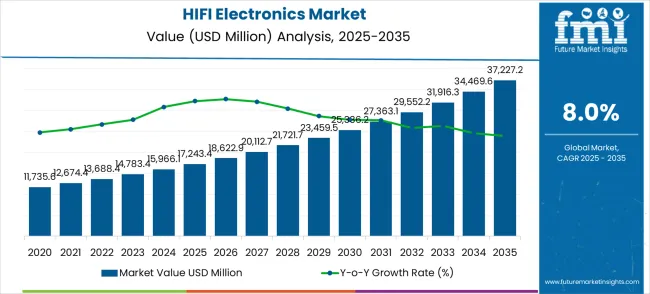
In 2025, the hifi electronics market was valued at USD 17.24 billion. Based on Future Market Insights' analysis, demand is estimated to grow to USD 18.62 billion in 2026 and USD 40.21 billion by 2036. FMI projects a CAGR of 8.00% during the forecast period.
The market is set to add approximately USD 21.58 billion in absolute terms between 2026 and 2036. Vinyl turntable sales recovery and network media streamer adoption are the two growth vectors expanding hi-fi electronics beyond the traditional CD player base. Streaming-connected hi-fi devices integrating Tidal, Qobuz, and Apple Music lossless audio playback are converting digital-native consumers into hi-fi equipment buyers by eliminating the physical media requirement that previously constrained the addressable market.
Summary of HIFI Electronics Market
- HIFI Electronics Market Definition
- The hi-fi electronics market encompasses high-fidelity audio playback and streaming devices including turntables, CD players, digital audio players, and network media streamers designed for audiophile-grade music reproduction in personal home listening and commercial sound system environments.
- Demand Drivers in the Market
- Vinyl turntable sales growth driven by Gen Z and Millennial collector culture is expanding the hi-fi electronics buyer base beyond traditional audiophile demographics, with entry-level turntables (Audio-Technica AT-LP60X, Pro-Ject Debut) serving as gateway products for broader hi-fi system investment.
- Lossless audio streaming service adoption (Apple Music Lossless, Tidal HiFi, Qobuz) is converting digital-native consumers into hi-fi equipment buyers by providing a content library that justifies the audio quality improvement audible through dedicated hi-fi source components.
- Commercial hi-fi system installations in hospitality (hotels, restaurants, cocktail bars) and retail environments are growing as venue operators recognize that ambient audio quality contributes to brand experience and customer dwell time.
- Key Segments Analyzed in the FMI Report
- Turntables device type: 30.0% share in 2026, reflecting its structural position as the primary category across established procurement channels.
- Personal Use application: 60.0% share in 2026, reflecting its structural position as the primary category across established procurement channels.
- China: 10.80% compound growth through 2036, indicating concentrated demand acceleration.
- Analyst Opinion at FMI
- The hi-fi electronics market is experiencing a generational broadening where vinyl culture and lossless streaming are attracting buyers who would never have entered the category through traditional CD-based hi-fi purchasing pathways. FMI analysts observe that turntables command 30.0% device type share because vinyl revival positions them as both audio equipment and lifestyle accessories, generating unit volumes that exceed CD players despite lower per-unit pricing. Personal use at 60.0% application share confirms that home listening remains the primary hi-fi consumption context, though commercial installations represent a faster-growing segment. China leads at 10.8% CAGR because domestic consumer electronics brands (Shanling, FiiO, SMSL) are developing competitively priced hi-fi components that make audiophile-grade equipment accessible to the country's expanding middle-class consumer base.
- Strategic Implications / Executive Takeaways
- Hi-fi electronics manufacturers should develop streaming-integrated turntable and all-in-one systems that eliminate the multi-component complexity barrier preventing digital-native consumers from entering the hi-fi category.
- Hospitality operators should specify commercial-grade hi-fi systems with centralized streaming management to create differentiated ambient audio experiences that commodity background music services cannot deliver.
- Audio brands should partner with lossless streaming platforms to create co-branded hi-fi equipment bundles with complimentary subscription periods, reducing the trial barrier for consumers unfamiliar with audible quality differences between compressed and lossless audio.
HIFI Electronics Market Key Takeaways
| Metric | Details |
|---|---|
| Industry Size (2026) | USD 18.62 Billion |
| Industry Value (2036) | USD 40.21 Billion |
| CAGR (2026 to 2036) | 8.00% |
Source: Future Market Insights, 2026
As per FMI, country-level growth rates through 2036 are projected as follows: China at 10.80%, India at 10.00%, Germany at 9.20%, Brazil at 8.40%, USA at 7.60%, UK at 6.80%, Japan at 6.00%. China records the fastest expansion driven by concentrated industry investment.
HIFI Electronics Market Definition
The hi-fi electronics market represents high-fidelity audio source components engineered for music reproduction quality exceeding mass-market consumer electronics specifications. The market spans analog turntables, optical disc players, portable and desktop digital audio players, and network-connected media streamers capable of decoding high-resolution and lossless audio formats. FMI is of the opinion that the market is transitioning from a niche audiophile category to a broader consumer electronics segment, driven by vinyl revival culture attracting younger demographics and lossless streaming services providing a content delivery mechanism that justifies hi-fi equipment investment.
HIFI Electronics Market Inclusions
Market scope covers turntables, CD players, portable and desktop digital audio players, network media streamers, and integrated hi-fi systems sold for personal home entertainment and commercial audio applications.
HIFI Electronics Market Exclusions
Headphones and earphones, standalone amplifiers and receivers, loudspeakers, professional studio recording equipment, and mass-market Bluetooth portable speakers not classified as hi-fi grade are excluded.
HIFI Electronics Market Research Methodology
- Primary Research: Analysts conducted structured interviews with procurement managers, product engineers, and distribution channel operators to map purchase decision triggers and specification requirements across key verticals.
- Desk Research: Data collection aggregated regulatory filings, industry standards documentation, patent registries, trade body publications, and company annual reports across all target geographies.
- Market-Sizing and Forecasting: Baseline values derive from a bottom-up aggregation of product shipment volumes and average selling prices, validated against publicly disclosed revenue figures from leading suppliers.
- Data Validation and Update Cycle: Projections are cross-referenced against quarterly earnings data, import-export trade statistics, and industry association production reports to maintain forecast integrity.
Why is the HIFI Electronics Market Growing?
Market expansion is being supported by the increasing global appreciation for high-quality audio experiences and the corresponding need for premium audio equipment that can deliver exceptional sound reproduction, support diverse audio formats, and provide authentic listening experiences across various consumer and professional audio applications. Modern audio enthusiasts and professional users are increasingly focused on implementing audio solutions that can reproduce music with precision, support high-resolution audio formats, and provide immersive listening experiences that capture the original recording quality. HIFI electronics' proven ability to deliver superior audio fidelity, support premium audio standards, and enhance listening experiences makes them essential components for contemporary audio systems and music appreciation.
The growing focus on audio quality and authentic music reproduction is driving demand for HIFI electronics that can support high-resolution audio, preserve musical detail, and enable premium listening experiences. Audio consumers' preference for equipment that combines exceptional sound quality with build quality and aesthetic appeal is creating opportunities for innovative HIFI electronics implementations. The rising influence of streaming services and digital music platforms is also contributing to increased adoption of HIFI electronics that can enhance digital audio reproduction without compromising sound quality or musical authenticity.
Segmental Analysis
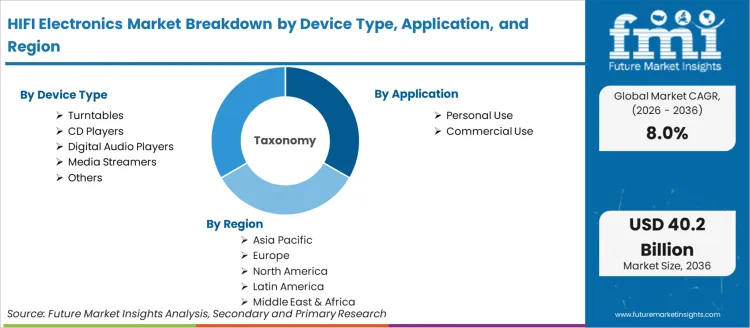
The market is segmented by device type, application, and region. By device type, the market is divided into turntables, CD players, digital audio players (DAPs), media streamers, and others. Based on application, the market is categorized into personal use and commercial use. Regionally, the market is divided into Asia Pacific, North America, Europe, Latin America, and the Middle East & Africa.
By Device Type, the Turntables Segment Leads the Market with 30% Share
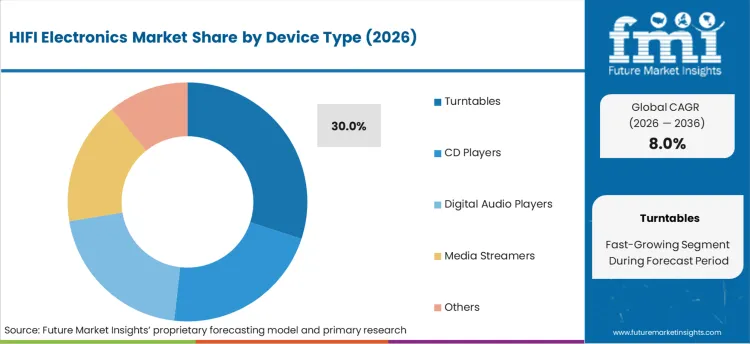
The turntables segment is projected to maintain its leading position in the HIFI electronics market in 2026, capturing 30% of the market share. Audio enthusiasts and professionals increasingly rely on turntables for their authentic analog sound reproduction, superior audio fidelity, and versatile capabilities across various music genres and listening environments. Turntable technology delivers proven audio performance and analog authenticity, meeting the audiophile demands for genuine music reproduction and premium listening experiences. As the cornerstone of modern HIFI audio systems, turntables offer unmatched sound quality and have become central to high-performance audio setups. Investments in turntable systems by audio enthusiasts and music professionals continue to drive adoption, making them an essential component of comprehensive Hi-Fi audio strategies.
- Delivers authentic analog sound reproduction with high audio fidelity.
- Essential for audiophiles seeking premium listening experiences.
- Continues to be a cornerstone of high-performance HIFI audio systems.
By Application, the Personal Use Segment Dominates Market Demand with 60% Share
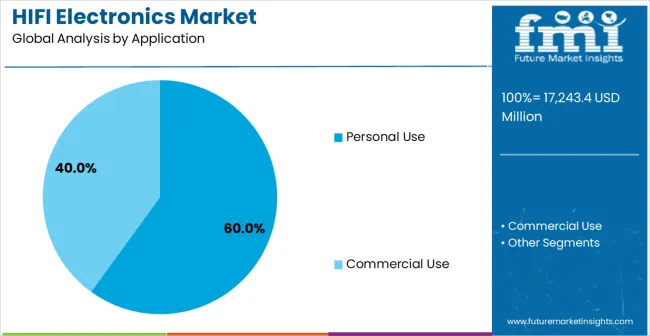
The personal use application segment is projected to represent the largest share of HIFI electronics demand in 2026, with 60% of the market. Audio consumers prefer HIFI electronics for personal use due to their superior sound quality, comprehensive audio format support, and ability to enhance music enjoyment across various listening preferences and musical styles. This segment is crucial in driving the adoption of premium audio equipment for home audio systems, personal listening setups, and individual music appreciation. With continuous innovation in personal audio technologies and the growing availability of high-resolution audio content, consumers are investing in sophisticated personal audio systems to support diverse music collections. As expectations for audio quality continue to rise, the personal use application will remain dominant in the market, ensuring advanced audio utilization and a premium listening experience.
- Provides superior sound quality, enhancing personal music enjoyment.
- Supports diverse listening preferences and musical styles with high-resolution audio support.
- Continues to dominate as consumers invest in advanced personal audio systems.
What are the Drivers, Restraints, and Key Trends of the HIFI Electronics Market?
The HIFI electronics market is advancing rapidly due to increasing consumer demand for premium audio experiences and growing adoption of high-resolution audio technologies that provide enhanced sound reproduction and authentic music listening across diverse audio applications. The market faces challenges, including high equipment costs and premium pricing, competition from mainstream audio devices, and the need for specialized knowledge in audio system setup and optimization. Innovation in wireless audio technologies and smart connectivity continues to influence product development and market expansion patterns.
Expansion of Wireless and Streaming Audio Technologies
The growing adoption of wireless connectivity and streaming audio technologies is enabling audio users to achieve superior convenience, enhanced flexibility, and comprehensive audio format support for improved listening experiences. Wireless audio systems provide improved user convenience while allowing more flexible system configurations and consistent audio quality across various streaming sources and digital platforms. Manufacturers are increasingly recognizing the competitive advantages of wireless audio capabilities for user experience differentiation and system integration optimization.
Integration of AI and Smart Audio Features
Modern HIFI electronics manufacturers are incorporating artificial intelligence technologies and smart audio features to enhance sound optimization, enable personalized listening experiences, and provide intelligent audio processing for superior sound reproduction. These technologies improve audio performance while enabling new applications, including room acoustic optimization and personalized sound profiles. Advanced AI integration also allows users to support comprehensive audio customization and listening optimization beyond traditional manual audio adjustment approaches.
Analysis of the HIFI Electronics Market by Key Countries
.webp "Top Country Growth Comparison Hifi Electronics Market Cagr (2026 2036)")
| Country | CAGR |
|---|---|
| China | 10.8% |
| India | 10.0% |
| Germany | 9.2% |
| Brazil | 8.4% |
| USA | 7.6% |
| UK | 6.8% |
| Japan | 6.0% |
Source: FMI analysis based on primary research and proprietary forecasting model
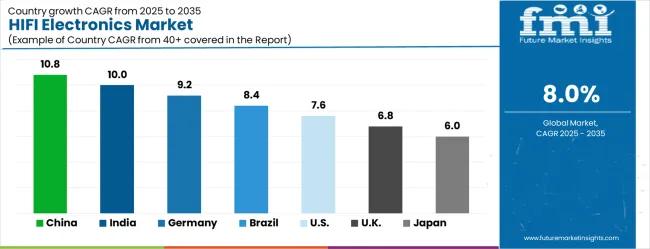
The HIFI electronics market is experiencing exceptional growth globally, with China leading at a 10.8% CAGR through 2036, driven by the expanding consumer electronics market, growing middle-class purchasing power, and significant investment in premium audio technology adoption and music appreciation culture development. India follows at 10.0%, supported by rapid economic growth, increasing disposable income, and growing appreciation for high-quality audio experiences among urban consumers. Germany shows growth at 9.2%, emphasizing precision engineering and audiophile culture traditions. Brazil records 8.4%, focusing on consumer electronics market expansion and premium audio adoption. The USA demonstrates 7.6% growth, supported by an established audiophile community and an focus on premium audio experiences. The UK exhibits 6.8% growth, emphasizing music culture and high-quality audio appreciation. Japan shows 6.0% growth, supported by advanced audio technologies and precision manufacturing expertise.
The report provides an in-depth analysis of 40+ countries, with top-performing countries highlighted below.
Analysis of the HIFI Electronics Market in China
The HIFI electronics market is projected to grow at a CAGR of 10.8% from 2026 to 2036. As the demand for high-quality audio systems soars, China continues to lead as the largest producer and consumer of HIFI electronics. With advancements in technology, there has been an increasing shift toward smart home audio systems, combining high fidelity with IoT integration. China’s strong presence in the manufacturing of components like amplifiers, speakers, and subwoofers provides an edge in meeting domestic and global demand. The rise in live-streaming platforms, entertainment, and content creation has increased the consumption of high-fidelity audio devices. International brands continue to invest in China due to its enormous consumer base and technological advancements. The country’s robust retail infrastructure, coupled with a growing e-commerce trend, is amplifying product availability, making premium audio systems more accessible to the middle-class population.
- Integration of smart audio systems with IoT for enhanced user experience
- Growing presence of local and international brands driving competition
- Increased consumption of HIFI electronics due to live-streaming and content creation
Sales Analysis of HIFI Electronics Market in India
Demand for HIFI electronics is growing at a CAGR of 10.0% during the forecast period. The increasing disposable income and shift toward premium products in India are key contributors to this growth. As the middle class expands, there is a growing demand for quality audio equipment in both urban and suburban areas. Consumers are gravitating towards wireless audio solutions, particularly Bluetooth speakers and headphones, which are becoming an integral part of the tech-savvy lifestyle. With the proliferation of streaming services, people are prioritizing sound quality, propelling the market further. The rise of local audio brands offering cost-effective and high-quality solutions has intensified competition, driving innovation in the sector. There is also a growing adoption of high-end audio solutions in the entertainment and retail sectors, leading to increased penetration in the commercial space.
- Increased focus on wireless audio solutions for convenience and portability
- Rise in local brands offering competitive, high-quality audio systems
- Adoption of premium HIFI electronics in commercial and retail sectors
Growth Prospects of HIFI Electronics Market in Germany
Germany, with a projected CAGR of 9.2%, is emerging as a key player in Europe’s HIFI electronics market. Known for its high-quality engineering, Germany has a strong demand for precision-crafted audio products, particularly in the audiophile segment. The country’s affinity for superior sound quality, coupled with a rich culture of music and entertainment, drives the steady adoption of HIFI systems. As consumers seek more personalized and immersive listening experiences, the demand for premium audio equipment such as speakers, amplifiers, and noise-canceling headphones continues to rise. Germany also serves as a critical manufacturing hub for high-performance audio equipment, with many global brands sourcing components from the region. With increased investment in R&D, German companies are pushing the boundaries of audio technology, leading to innovations like 3D sound and integration with smart home systems.
- Strong demand for audiophile-grade products and high-performance equipment
- Increased focus on R&D for technological advancements in audio systems
- Germany’s position as a manufacturing hub for premium audio components
Opportunity Analysis of HIFI Electronics Market in Brazil
The HIFI electronics market in Brazil, with a CAGR of 8.4%, is driven by the rise in consumer spending and the growing appeal of high-quality entertainment systems. With a large, diverse population and increasing access to global products, there is a heightened interest in premium audio solutions, especially in the middle and upper-income segments. Brazil’s vibrant music culture and social events, including live performances and festivals, have heightened the demand for high-fidelity audio equipment. Cost remains a critical factor, with consumers seeking a balance between price and performance. Local manufacturers are responding by producing affordable yet reliable options, while international brands continue to expand their presence in the region. The ongoing growth of streaming services, including music and video content, further fuels demand for premium home audio and mobile devices.
- Rising demand for high-performance audio systems among middle and upper-income consumers
- Music culture influencing demand for HIFI electronics in live and home settings
- Local manufacturers competing with global brands to offer affordable, high-quality products
Sales Performance of HIFI Electronics Market in the United States
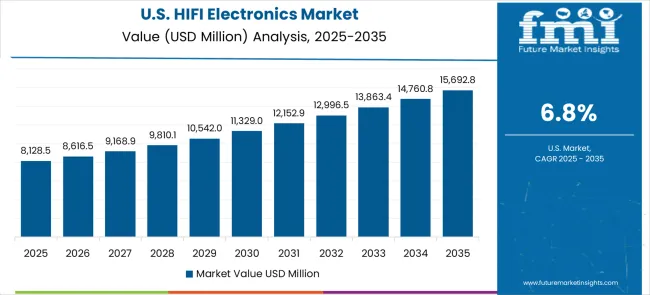
The United States holds a significant share of the global HIFI electronics market, with a CAGR of 7.6%. The USA remains a leader in the adoption of premium audio systems, particularly in the home entertainment and consumer electronics sectors. Increasing investment in home automation and entertainment systems is pushing the demand for HIFI audio solutions, including high-end speakers, amplifiers, and wireless systems. The rapid growth of music streaming services like Spotify, Apple Music, and others contributes to the rising demand for high-fidelity audio, as consumers seek superior sound quality. Consumer interest in high-definition video content and gaming has prompted innovation in gaming headphones and soundbars. The USA is also witnessing the rise of smart audio devices that integrate seamlessly with voice assistants, making it easier for users to enjoy high-quality audio experiences in smart homes.
- Growth in home automation driving demand for advanced audio systems
- Rising demand for gaming headphones and soundbars for immersive experiences
- Integration of smart audio devices with voice assistants for enhanced functionality
Market Insights of HIFI Electronics Market in the United Kingdom
The UK market for HIFI electronics is expected to grow at a CAGR of 6.8%, supported by a strong culture of music and audio appreciation. The demand for premium audio systems is particularly high in urban areas, where consumers seek high-quality audio for home entertainment, personal use, and gaming. The UK is witnessing a shift toward wireless and Bluetooth-enabled device, offering greater flexibility and portability. Streaming services have accelerated the adoption of high-fidelity audio systems, with consumers upgrading their sound systems to match the quality of the content they consume. The UK is also a significant market for high-end audiophile equipment, with a growing number of enthusiasts investing in specialized systems for optimal sound quality.
- Increasing preference for wireless, Bluetooth-enabled audio systems
- High-end audiophile segment growing in line with streaming service adoption
- Demand for premium home entertainment systems rising in urban areas
Japan Shows Advanced Audio Technologies and Precision Manufacturing Excellence
The HIFI electronics market in Japan is expanding at a CAGR of 6.0%. As one of the most technologically advanced nations, Japan has a deep-rooted culture of music and entertainment, where high-quality audio is integral to the experience. The demand for premium audio equipment, especially headphones and portable speakers, is strong, driven by Japan's love for personal music consumption and high-quality home entertainment. With a high level of technology integration, many Japanese consumers are investing in smart audio systems that seamlessly integrate with their daily lives. The Japanese market is witnessing a growing interest in noise-canceling technology, particularly in high-end headphones and personal audio devices.
- High demand for headphones and portable speakers due to personal music consumption habits
- Smart audio systems becoming a staple in homes and businesses
- Growing popularity of noise-canceling technology in personal audio devices
Europe Market Split by Countries
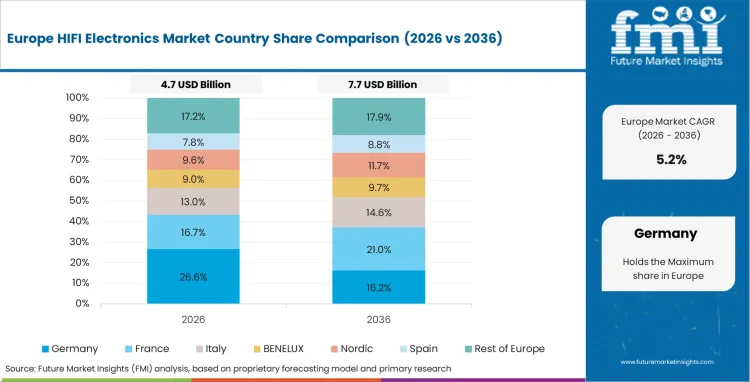
The HIFI electronics market in Europe is projected to grow from USD 6,136.9 million in 2026 to USD 12,589.4 million by 2036, registering a CAGR of 7.5% over the forecast period. Germany is expected to maintain its leadership position with a 28.0% market share in 2026, moderating slightly to 27.8% by 2036, supported by its strong audiophile culture, advanced audio engineering sector, and comprehensive premium audio retail infrastructure serving major European markets.
The United Kingdom follows with 22.0% in 2026, projected to reach 21.8% by 2036, driven by established music culture, comprehensive audio heritage, and advanced premium audio appreciation programs. France holds 18.0% in 2026, rising to 18.2% by 2036, supported by the development of the luxury consumer goods market and the growing adoption of premium audio technologies. Italy commands 13.0% in 2026, projected to reach 13.1% by 2036, while Spain accounts for 8.5% in 2026, expected to reach 8.6% by 2036. The Netherlands maintains a 4.0% share in 2026, growing to 4.1% by 2036. The Rest of Europe region, including Nordic countries, Eastern Europe, and other markets, is anticipated to maintain its position, holding its collective share at 6.5% by 2036, attributed to increasing consumer electronics modernization and growing premium audio adoption across emerging consumer markets implementing advanced audio standards.
Competitive Landscape of the HIFI Electronics Market
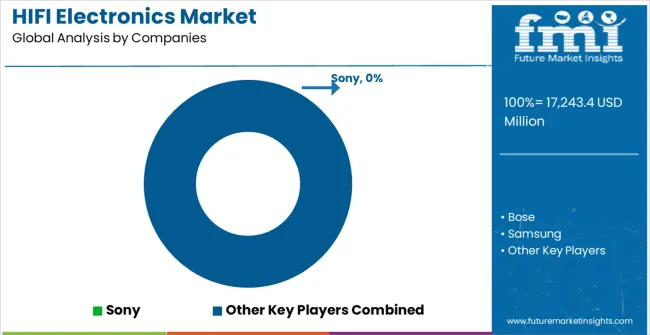
The HIFI electronics market is characterized by competition among established consumer electronics companies, specialized audio equipment manufacturers, and integrated premium audio solution providers. Companies are investing in advanced audio technology research, product innovation, brand development, and comprehensive product portfolios to deliver superior, innovative, and premium Hi-Fi electronics solutions. Innovation in wireless audio technologies, smart connectivity, and precision audio engineering is central to strengthening market position and competitive advantage.
Sony leads the market with comprehensive consumer electronics solutions, offering advanced Hi-Fi products with a focus on audio innovation and premium sound reproduction across diverse consumer applications. Bose provides specialized audio equipment with an focus on acoustic engineering and premium audio experiences. Samsung delivers innovative consumer electronics with a focus on digital integration and smart audio features. LG Electronics specializes in consumer electronics and audio technology with an focus on connectivity and user experience. Yamaha focuses on audio equipment and musical instruments with focus on audio authenticity and performance. Panasonic offers comprehensive consumer electronics with an focus on audio quality and technological innovation.
Key Players in the HIFI Electronics Market
- Sony
- Bose
- Samsung
- LG Electronics
- Yamaha
- Panasonic
- DALI
- Apple
- Linn
- Pro-Ject
- Victrola
- Pioneer DJ
Scope of the Report
| Metric | Value |
|---|---|
| Quantitative Units | USD 18.62 Bn to USD 40.21 Bn, at a CAGR of 8.00% |
| Market Definition | The hi-fi electronics market encompasses high-fidelity audio playback and streaming devices including turntables, CD players, digital audio players, and network media streamers designed for audiophile-grade music reproduction in personal home listening and commercial sound system environments. |
| Device Type Segmentation | Turntables, CD Players, Digital Audio Players, Media Streamers, Others |
| Application Segmentation | Personal Use, Commercial Use |
| Regions Covered | North America, Latin America, Europe, East Asia, South Asia, Oceania, Middle East & Africa |
| Countries Covered | China, India, Germany, Brazil, USA, UK, Japan, and 40 plus countries |
| Key Companies Profiled | Sony, Bose, Samsung, LG Electronics, Yamaha, Panasonic, DALI, Apple, Linn, Pro-Ject, Victrola, Pioneer DJ |
| Forecast Period | 2026 to 2036 |
| Approach | Hybrid bottom-up and top-down modeling validated against primary research inputs and publicly available industry data. |
HIFI Electronics Market by Segments
Device Type:
- Turntables
- CD Players
- Digital Audio Players (DAPs)
- Media Streamers
- Others
Application:
- Personal Use
- Commercial Use
Region:
Asia Pacific
- China
- India
- Japan
- South Korea
- ASEAN
- Australia & New Zealand
- Rest of Asia Pacific
North America
- United States
- Canada
- Mexico
Europe
- Germany
- United Kingdom
- France
- Italy
- Spain
- Nordic
- BENELUX
- Rest of Europe
Latin America
- Brazil
- Chile
- Argentina
- Rest of Latin America
Middle East & Africa
- Kingdom of Saudi Arabia
- Other GCC Countries
- Turkey
- South Africa
- Other African Union
- Rest of Middle East & Africa
Bibliography
- [1] International Federation of the Phonographic Industry. (2024). Global Music Report: Music Revenue and Format Distribution. IFPI.
- [2] Consumer Technology Association. (2024). US Consumer Electronics Sales Forecast: Audio Equipment Category. CTA.
- [3] Sony Corporation. (2024). Annual Report 2024: Entertainment, Technology & Services Division. Sony.
- [4] Yamaha Corporation. (2024). Annual Report 2024: Audio Products Division. Yamaha.
- [5] Apple Inc. (2024). Apple Music Lossless Audio: Technical Specifications and Subscriber Data. Apple.
This bibliography is provided for reader reference. The full FMI report contains the complete reference list with primary research documentation.
Frequently Asked Questions
How large is the demand for HIFI Electronics in the global market in 2026?
Demand for HIFI Electronics in the global market is estimated to be valued at USD 18.62 billion in 2026.
What will be the market size of HIFI Electronics by 2036?
Market size for HIFI Electronics is projected to reach USD 40.21 billion by 2036.
What is the expected demand growth between 2026 and 2036?
Demand is expected to grow at a CAGR of 8.00% between 2026 and 2036.
Which Device Type is poised to lead by 2026?
Turntables accounts for 30.0% in 2026.
How significant is Personal Use in driving adoption?
Personal Use represents 60.0% of segment share in 2026.
What country records the fastest growth?
China is projected to grow at a CAGR of 10.80% during 2026 to 2036.
What is the projected growth for India?
India is projected to expand at a CAGR of 10.00% during 2026 to 2036.
What is included in the scope of this report?
Market scope covers turntables, CD players, portable and desktop digital audio players, network media streamers, and integrated hi-fi systems sold for personal home entertainment and commercial audio applications.
Preview the report firsthand - request a free sample
Get SampleGet the brochure for pricing and purchase details.
Get PDFTable of Content
- Executive Summary
- Global Market Outlook
- Demand-side Trends
- Supply-side Trends
- Technology Roadmap Analysis
- Analysis and Recommendations
- Market Overview
- Market Coverage / Taxonomy
- Market Definition / Scope / Limitations
- Research Methodology
- Chapter Orientation
- Analytical Lens and Working Hypotheses
- Market Structure, Signals, and Trend Drivers
- Benchmarking and Cross-market Comparability
- Market Sizing, Forecasting, and Opportunity Mapping
- Research Design and Evidence Framework
- Desk Research Programme (Secondary Evidence)
- Company Annual and Sustainability Reports
- Peer-reviewed Journals and Academic Literature
- Corporate Websites, Product Literature, and Technical Notes
- Earnings Decks and Investor Briefings
- Statutory Filings and Regulatory Disclosures
- Technical White Papers and Standards Notes
- Trade Journals, Industry Magazines, and Analyst Briefs
- Quantitative Surveys and Structured Data Capture
- Blended Approach
- Why Primary Evidence is Used
- Field Techniques
- Interviews
- Surveys
- Focus Groups
- Observational and In-context Research
- Social and Community Interactions
- Stakeholder Universe Engaged
- C-suite Leaders
- Board Members
- Presidents and Vice Presidents
- R&D and Innovation Heads
- Technical Specialists
- Domain Subject-matter Experts
- Scientists
- Physicians and Other Healthcare Professionals
- Governance, Ethics, and Data Stewardship
- Research Ethics
- Data Integrity and Handling
- Desk Research Programme (Secondary Evidence)
- Tooling, Models, and Reference Databases
- Data Engineering and Model Build
- Data Acquisition and Ingestion
- Cleaning, Normalisation, and Verification
- Synthesis, Triangulation, and Analysis
- Quality Assurance and Audit Trail
- Market Background
- Market Dynamics
- Drivers
- Restraints
- Opportunity
- Trends
- Scenario Forecast
- Demand in Optimistic Scenario
- Demand in Likely Scenario
- Demand in Conservative Scenario
- Opportunity Map Analysis
- Product Life Cycle Analysis
- Supply Chain Analysis
- Investment Feasibility Matrix
- Value Chain Analysis
- PESTLE and Porter’s Analysis
- Regulatory Landscape
- Regional Parent Market Outlook
- Production and Consumption Statistics
- Import and Export Statistics
- Market Dynamics
- Global Market Analysis 2021 to 2025 and Forecast, 2026 to 2036
- Historical Market Size Value (USD Million) Analysis, 2021 to 2025
- Current and Future Market Size Value (USD Million) Projections, 2026 to 2036
- Y-o-Y Growth Trend Analysis
- Absolute $ Opportunity Analysis
- Global Market Pricing Analysis 2021 to 2025 and Forecast 2026 to 2036
- Global Market Analysis 2021 to 2025 and Forecast 2026 to 2036, By Device Type
- Introduction / Key Findings
- Historical Market Size Value (USD Million) Analysis By Device Type , 2021 to 2025
- Current and Future Market Size Value (USD Million) Analysis and Forecast By Device Type , 2026 to 2036
- Turntables
- CD Players
- Digital Audio Players
- Media Streamers
- Others
- Turntables
- Y-o-Y Growth Trend Analysis By Device Type , 2021 to 2025
- Absolute $ Opportunity Analysis By Device Type , 2026 to 2036
- Global Market Analysis 2021 to 2025 and Forecast 2026 to 2036, By Application
- Introduction / Key Findings
- Historical Market Size Value (USD Million) Analysis By Application, 2021 to 2025
- Current and Future Market Size Value (USD Million) Analysis and Forecast By Application, 2026 to 2036
- Personal Use
- Commercial Use
- Personal Use
- Y-o-Y Growth Trend Analysis By Application, 2021 to 2025
- Absolute $ Opportunity Analysis By Application, 2026 to 2036
- Global Market Analysis 2021 to 2025 and Forecast 2026 to 2036, By Region
- Introduction
- Historical Market Size Value (USD Million) Analysis By Region, 2021 to 2025
- Current Market Size Value (USD Million) Analysis and Forecast By Region, 2026 to 2036
- North America
- Latin America
- Western Europe
- Eastern Europe
- East Asia
- South Asia and Pacific
- Middle East & Africa
- Market Attractiveness Analysis By Region
- North America Market Analysis 2021 to 2025 and Forecast 2026 to 2036, By Country
- Historical Market Size Value (USD Million) Trend Analysis By Market Taxonomy, 2021 to 2025
- Market Size Value (USD Million) Forecast By Market Taxonomy, 2026 to 2036
- By Country
- USA
- Canada
- Mexico
- By Device Type
- By Application
- By Country
- Market Attractiveness Analysis
- By Country
- By Device Type
- By Application
- Key Takeaways
- Latin America Market Analysis 2021 to 2025 and Forecast 2026 to 2036, By Country
- Historical Market Size Value (USD Million) Trend Analysis By Market Taxonomy, 2021 to 2025
- Market Size Value (USD Million) Forecast By Market Taxonomy, 2026 to 2036
- By Country
- Brazil
- Chile
- Rest of Latin America
- By Device Type
- By Application
- By Country
- Market Attractiveness Analysis
- By Country
- By Device Type
- By Application
- Key Takeaways
- Western Europe Market Analysis 2021 to 2025 and Forecast 2026 to 2036, By Country
- Historical Market Size Value (USD Million) Trend Analysis By Market Taxonomy, 2021 to 2025
- Market Size Value (USD Million) Forecast By Market Taxonomy, 2026 to 2036
- By Country
- Germany
- UK
- Italy
- Spain
- France
- Nordic
- BENELUX
- Rest of Western Europe
- By Device Type
- By Application
- By Country
- Market Attractiveness Analysis
- By Country
- By Device Type
- By Application
- Key Takeaways
- Eastern Europe Market Analysis 2021 to 2025 and Forecast 2026 to 2036, By Country
- Historical Market Size Value (USD Million) Trend Analysis By Market Taxonomy, 2021 to 2025
- Market Size Value (USD Million) Forecast By Market Taxonomy, 2026 to 2036
- By Country
- Russia
- Poland
- Hungary
- Balkan & Baltic
- Rest of Eastern Europe
- By Device Type
- By Application
- By Country
- Market Attractiveness Analysis
- By Country
- By Device Type
- By Application
- Key Takeaways
- East Asia Market Analysis 2021 to 2025 and Forecast 2026 to 2036, By Country
- Historical Market Size Value (USD Million) Trend Analysis By Market Taxonomy, 2021 to 2025
- Market Size Value (USD Million) Forecast By Market Taxonomy, 2026 to 2036
- By Country
- China
- Japan
- South Korea
- By Device Type
- By Application
- By Country
- Market Attractiveness Analysis
- By Country
- By Device Type
- By Application
- Key Takeaways
- South Asia and Pacific Market Analysis 2021 to 2025 and Forecast 2026 to 2036, By Country
- Historical Market Size Value (USD Million) Trend Analysis By Market Taxonomy, 2021 to 2025
- Market Size Value (USD Million) Forecast By Market Taxonomy, 2026 to 2036
- By Country
- India
- ASEAN
- Australia & New Zealand
- Rest of South Asia and Pacific
- By Device Type
- By Application
- By Country
- Market Attractiveness Analysis
- By Country
- By Device Type
- By Application
- Key Takeaways
- Middle East & Africa Market Analysis 2021 to 2025 and Forecast 2026 to 2036, By Country
- Historical Market Size Value (USD Million) Trend Analysis By Market Taxonomy, 2021 to 2025
- Market Size Value (USD Million) Forecast By Market Taxonomy, 2026 to 2036
- By Country
- Kingdom of Saudi Arabia
- Other GCC Countries
- Turkiye
- South Africa
- Other African Union
- Rest of Middle East & Africa
- By Device Type
- By Application
- By Country
- Market Attractiveness Analysis
- By Country
- By Device Type
- By Application
- Key Takeaways
- Key Countries Market Analysis
- USA
- Pricing Analysis
- Market Share Analysis, 2025
- By Device Type
- By Application
- Canada
- Pricing Analysis
- Market Share Analysis, 2025
- By Device Type
- By Application
- Mexico
- Pricing Analysis
- Market Share Analysis, 2025
- By Device Type
- By Application
- Brazil
- Pricing Analysis
- Market Share Analysis, 2025
- By Device Type
- By Application
- Chile
- Pricing Analysis
- Market Share Analysis, 2025
- By Device Type
- By Application
- Germany
- Pricing Analysis
- Market Share Analysis, 2025
- By Device Type
- By Application
- UK
- Pricing Analysis
- Market Share Analysis, 2025
- By Device Type
- By Application
- Italy
- Pricing Analysis
- Market Share Analysis, 2025
- By Device Type
- By Application
- Spain
- Pricing Analysis
- Market Share Analysis, 2025
- By Device Type
- By Application
- France
- Pricing Analysis
- Market Share Analysis, 2025
- By Device Type
- By Application
- India
- Pricing Analysis
- Market Share Analysis, 2025
- By Device Type
- By Application
- ASEAN
- Pricing Analysis
- Market Share Analysis, 2025
- By Device Type
- By Application
- Australia & New Zealand
- Pricing Analysis
- Market Share Analysis, 2025
- By Device Type
- By Application
- China
- Pricing Analysis
- Market Share Analysis, 2025
- By Device Type
- By Application
- Japan
- Pricing Analysis
- Market Share Analysis, 2025
- By Device Type
- By Application
- South Korea
- Pricing Analysis
- Market Share Analysis, 2025
- By Device Type
- By Application
- Russia
- Pricing Analysis
- Market Share Analysis, 2025
- By Device Type
- By Application
- Poland
- Pricing Analysis
- Market Share Analysis, 2025
- By Device Type
- By Application
- Hungary
- Pricing Analysis
- Market Share Analysis, 2025
- By Device Type
- By Application
- Kingdom of Saudi Arabia
- Pricing Analysis
- Market Share Analysis, 2025
- By Device Type
- By Application
- Turkiye
- Pricing Analysis
- Market Share Analysis, 2025
- By Device Type
- By Application
- South Africa
- Pricing Analysis
- Market Share Analysis, 2025
- By Device Type
- By Application
- USA
- Market Structure Analysis
- Competition Dashboard
- Competition Benchmarking
- Market Share Analysis of Top Players
- By Regional
- By Device Type
- By Application
- Competition Analysis
- Competition Deep Dive
- Sony
- Overview
- Product Portfolio
- Profitability by Market Segments (Product/Age /Sales Channel/Region)
- Sales Footprint
- Strategy Overview
- Marketing Strategy
- Product Strategy
- Channel Strategy
- Bose
- Samsung
- LG Electronics
- Yamaha
- Panasonic
- DALI
- Apple
- Linn
- Pro-Ject
- Victrola
- Pioneer DJ
- Sony
- Competition Deep Dive
- Assumptions & Acronyms Used


