

- Industry Size (2026)
- USD 1260 Mn
- Forecast (2036)
- USD 3984 Mn
- CAGR (2026 to 2036)
- 12.2%
Fire-Retardant Additives for PCR Electronics Market Forecast and Outlook 2026 to 2036
The fire-retardant additives for PCR electronics market is forecast to rise from USD 1,260 million in 2026 to USD 3,984 million in 2036, implying a CAGR of 12.2%. Market expansion is driven less by broad resin substitution and more by deep penetration into a narrow set of critical applications, particularly consumer electronics housings and select IT and appliance components where flammability compliance is mandatory. This concentrated demand base underpins baseline volume stability but also makes growth highly sensitive to device refresh cycles and OEM qualification decisions.
In this environment, fire-retardant systems must be tightly engineered to specific polymers, molding windows, and certification thresholds, which restricts easy transfer of formulations across different applications. Volume visibility improves in programs built around long-running platforms and standardized enclosure designs, while smaller or niche electronics lines add only limited upside due to the cost and time of repeated requalification. As a result, growth disproportionately benefits suppliers that are already embedded in high-volume electronics platforms with established, recurring certification pathways, rather than those pursuing opportunistic, one-off PCR trials across fragmented electronic component categories.
Quick Stats for Fire-Retardant Additives for PCR Electronics Market
- Fire-Retardant Additives for PCR Electronics Market Value (2026): USD 1,260 Million
- Fire-Retardant Additives for PCR Electronics Market Forecast Value (2036): USD 3,984 Million
- Fire-Retardant Additives for PCR Electronics Market Forecast CAGR 2026 to 2036: 12.2%
- Leading Additive Type: Halogen-Free Fire-Retardant Systems (39% share)
- Key Growth Regions: Asia Pacific, North America, Europe
- Top Key Players: Clariant AG, LANXESS AG, ICL Group Ltd., Avient Corporation, Kingfa Sci. & Tech. Co., Ltd., ADEKA Corporation, Nippon Kayaku Co., Ltd.
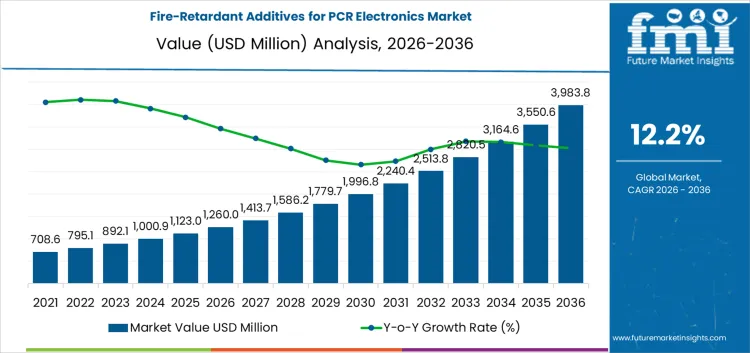
Fire-Retardant Additives for PCR Electronics Market Key Takeaways
| Metric | Value |
|---|---|
| Fire-Retardant Additives for PCR Electronics Market Value (2026) | USD 1,260 Million |
| Fire-Retardant Additives for PCR Electronics Market Forecast Value (2036) | USD 3,984 Million |
| Fire-Retardant Additives for PCR Electronics Market Forecast CAGR 2026 to 2036 | 12.2% |
How are Safety Certification and PCR Adoption Pressures Reshaping Demand for Fire-Retardant Additives in Electronics?
Demand for fire-retardant additives in PCR-based electronics materials is accelerating as OEMs balance recycled-content targets with strict fire safety and performance requirements. Electronic housings, connectors, and internal components must comply with flammability standards such as UL 94 while maintaining mechanical strength, thermal stability, and dimensional accuracy. For additive suppliers, this is shifting demand toward high-efficiency flame retardants that can deliver compliance at lower loadings, minimizing negative impacts on processing and part performance in PCR-rich formulations.
Qualification complexity is becoming a central purchasing driver. Electronics manufacturers are increasingly cautious about introducing PCR materials due to variability in base resin properties, which can affect flame-retardant performance and consistency. This is elevating demand for additive systems that are tolerant of feedstock variation and supported by robust technical validation. Suppliers offering pre-tested additive packages, compounding guidance, and certification-ready data sets are gaining preference as OEMs seek to reduce requalification cycles and time-to-market risk.
Regulatory pressure and global electronics manufacturing expansion are further reinforcing market momentum. Restrictions on hazardous substances, combined with sustainability mandates from major electronics brands, are accelerating adoption of halogen-free and low-smoke fire-retardant solutions compatible with PCR resins. Growth in electronics production across Asia Pacific and nearshoring trends in North America and Europe are increasing the need for regionally available, compliant additive solutions. For suppliers, competitive advantage increasingly depends on certification credibility, formulation expertise, and the ability to scale fire-retardant performance reliably within PCR electronics materials.
How is The Fire-Retardant Additives for PCR Electronics Market Structured?
The fire-retardant additives for PCR electronics market is segmented by end use and additive type, reflecting how fire safety requirements, processing conditions, and component design influence formulation choices. By end use, consumer electronics housings lead demand, driven by high production volumes and strict flammability standards for external device enclosures. Other end uses include IT and appliance electronics, mass electronics, precision electronics, displays and devices, and local electronics manufacturing. By additive type, halogen-free fire-retardant systems represent the leading solution, while phosphorus-based fire retardants, synergistic blends, and high-purity fire-retardant additives address performance, processing, and regulatory needs across electronics applications.
Why Do Consumer Electronics Housings Lead Demand In The Fire-Retardant Additives For PCR Electronics Market?
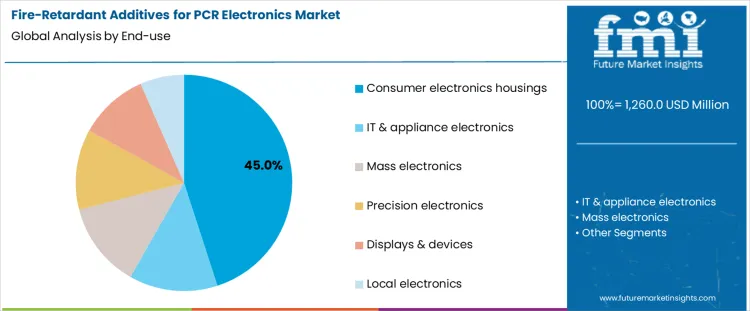
Consumer electronics housings account for 45% share of the fire-retardant additives for PCR electronics market because enclosures form the primary structural and protective interface of electronic devices. Smartphones, laptops, televisions, and small appliances require materials that meet flammability ratings while maintaining impact resistance and surface finish. High unit volumes amplify additive consumption across injection-molded housings and frames. Manufacturers specify fire-retardant formulations to comply with safety standards without compromising moldability or aesthetics. Rapid product refresh cycles create recurring demand for qualified additive systems. For additive suppliers, this segment offers scale, repeat orders, and long-term supply relationships, explaining why consumer electronics housings remain the largest end-use category.
Why Do Halogen-Free Fire-Retardant Systems Dominate Additive Selection?
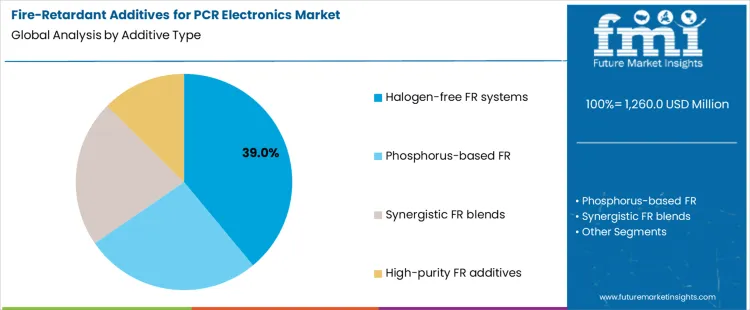
Halogen-free fire-retardant systems hold 39% share of the fire-retardant additives for PCR electronics market because they deliver effective flame resistance while supporting processing stability and material compatibility. These systems are widely used in electronics housings to achieve required fire performance without corrosive by-products that can affect components. Compounders favor halogen-free solutions due to predictable dispersion and consistent mechanical properties in recycled resin blends. Compatibility with common engineering plastics enables broad application across device categories. For additive manufacturers, halogen-free systems allow standardized formulations and scalable production. These technical and commercial advantages explain their leading adoption across electronics applications.
What Are The Key Dynamics Of The Fire-Retardant Additives For PCR Electronics Market?
The fire-retardant additives for PCR electronics market is driven by the increasing use of post-consumer recycled (PCR) plastics in electronic housings, connectors, and internal components where flame resistance is essential for safety and compliance. Electronics manufacturers are integrating PCR resins into products to meet material sourcing guidelines while still satisfying UL, IEC, and other industry-specific flammability requirements (e.g., V-0, 5VA). For additive producers, compounders, and resin suppliers, ensuring that fire-retardant solutions maintain mechanical integrity, dielectric performance, and processability (melt flow, easy molding) is central to market acceptance. Supply continuity, cost-effective formulations, and robust technical support influence long-term procurement decisions.
How Are Regulatory And Performance Requirements Shaping This Market?
Regulatory and performance requirements heavily shape the fire-retardant additives for PCR electronics market because consumer, industrial, and medical devices must meet strict flame-resistance standards without compromising electrical performance. Certification protocols such as UL 94 classifications and IEC 60695 test methods dictate acceptable levels of flame spread, drip behavior, and heat release. Additives must be compatible with PCR feedstocks across a range of base polymers (e.g., PCR ABS, PCR PC/ABS, and PCR PET) and retain their efficacy after recycling processing. For suppliers, comprehensive documentation of test results and long-term reliability data is often required by OEMs and compliance engineers before materials are qualified for production use.
Why Do Material Compatibility And Quality Consistency Challenges Restrain Market Adoption?
Material compatibility and quality consistency challenges restrain broader adoption of fire-retardant additives in the PCR electronics market. PCR resins exhibit variability in composition, residual contaminant levels, and thermal history factors that can affect how fire-retardant additives distribute and activate during molding. Inconsistent additive dispersion can lead to uneven flame resistance, reduced mechanical strength, or processing instability, which are critical concerns for electronics applications. Long qualification cycles are required to demonstrate consistent performance across PCR batches and to satisfy both safety and functional specifications. These technical barriers increase development time, testing complexity, and cost for additive producers and compounders.
What Is the Country-Wise Outlook for Fire-Retardant Additives Used in PCR Electronics Materials?
The fire-retardant additives market for PCR-based electronics materials is shaped by tightening fire-safety standards, increasing use of recycled polymers in electronic housings, and rising complexity of electronic devices. Country-level adoption depends on regulatory fire classifications, electronics manufacturing density, and tolerance for additive interactions affecting mechanical, thermal, and electrical performance. Mature markets prioritize validation, flame-retardant efficiency, and long-term material stability, while high-growth manufacturing hubs focus on scaling compliant formulations for mass production. Additive suppliers that deliver consistent flame-retardant performance, compatibility with PCR polymers, and predictable processing behavior are best positioned across regional electronics value chains.
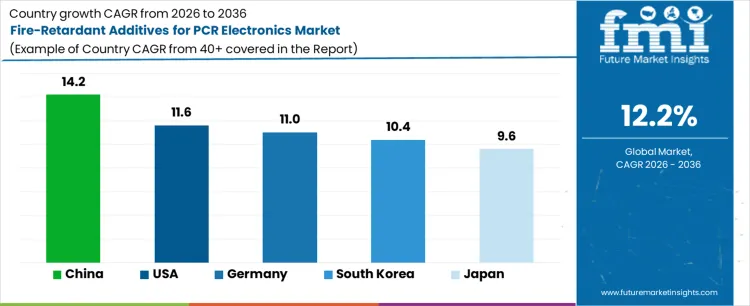
| Country | CAGR (%) |
|---|---|
| China | 14.2 |
| United States | 11.6 |
| Germany | 11.0 |
| South Korea | 10.4 |
| Japan | 9.6 |
How is Germany Driving Specification-Led Demand for Fire-Retardant PCR Electronics Materials?
The fire-retardant additives market for PCR electronics materials in Germany, growing at a CAGR of 11.0% during 2026-2036, is shaped by strict electrical safety standards and a strong base of industrial electronics manufacturing. OEMs require flame-retardant systems that meet UL 94 ratings while maintaining dimensional stability, heat resistance, and surface quality in enclosures and internal components. Buyers emphasize halogen-free formulations, controlled additive dispersion, and minimal impact on mechanical strength. Qualification cycles are long and documentation-heavy, involving thermal aging, glow-wire testing, and electrical performance verification. Adoption is largely replacement-led, as manufacturers reformulate existing housings and connectors using PCR polymers with embedded fire-retardant functionality. Procurement favors suppliers with strong formulation expertise, consistent batch quality, and technical support for molding and extrusion processes. Volumes are moderate, but margins are supported by high specification depth.
What is Driving Strong Uptake of Fire-Retardant Additives in the United States Electronics Market?
The fire-retardant additives market for PCR electronics materials in the United States, expanding at a CAGR of 11.6% during 2026-2036, is driven by large-scale production of consumer electronics, data-center hardware, and electrical equipment. Manufacturers require flame-retardant systems that perform reliably across wide temperature ranges and high-volume molding operations. Buyers prioritize UL compliance, processing stability, and availability at scale. Adoption is supported by continuous product refresh cycles and increasing use of recycled polymers in housings, frames, and power components. Procurement decisions emphasize supply security, formulation robustness, and application engineering support. Qualification timelines are structured but faster than in Europe, enabling quicker commercial rollout. The US represents a value-driven market where suppliers that combine proven fire-retardant efficiency with consistent processing behavior gain preferred status.
Why is China the Fastest-Growing Market for Fire-Retardant Additives in PCR Electronics?
The fire-retardant additives market for PCR electronics materials in China, growing at a CAGR of 14.2% during 2026-2036, is driven by the country’s unmatched scale in electronics manufacturing and rapid incorporation of recycled polymers into device casings and structural components. Consumer electronics, appliances, networking equipment, and power devices are produced in very high volumes, creating strong demand for flame-retardant systems that can perform reliably in mass-production environments. OEMs prioritize formulations that meet export fire-safety standards while remaining cost-effective and compatible with high-speed injection molding. Domestic additive suppliers compete aggressively on price and availability, particularly for phosphorus-based and mineral flame-retardant systems. International suppliers focus on higher-performance additives for premium electronics requiring tighter thermal and mechanical control. Qualification cycles are shorter than in Europe or Japan, enabling faster commercialization and rapid capacity ramp-up.
How Does Japan Maintain High Reliability Standards for Fire-Retardant PCR Electronics Materials?
The fire-retardant additives market for PCR electronics materials in Japan, expanding at a CAGR of 9.6% during the forecast period, reflects a reliability-first and precision-driven approach. Japanese electronics manufacturers require flame-retardant systems that deliver stable performance over long product lifecycles, with minimal volatility and no adverse impact on precision molding or electrical insulation. Additives must perform consistently under thermal cycling, mechanical stress, and prolonged operating conditions. Adoption is incremental, often beginning with non-critical housings before expansion into more demanding applications. Qualification processes are extensive and methodical, involving repeated testing, aging studies, and strict documentation. Buyers favor suppliers with deep materials science expertise, strong formulation control, and long-term supply reliability. Japan rewards suppliers that prioritize predictability, low variability, and close technical collaboration rather than rapid scaling or aggressive cost competition.
How is South Korea Supporting Specialized Demand for Fire-Retardant Additives in Electronics?
The fire-retardant additives market for PCR electronics materials in South Korea, growing at a CAGR of 10.4% during 2026-2036, is closely linked to advanced semiconductor, display, and battery electronics manufacturing. These sectors require flame-retardant systems that maintain dimensional stability, thermal resistance, and electrical safety while supporting automated, high-precision assembly processes. Buyers emphasize consistent additive dispersion, predictable processing behavior, and compatibility with thin-wall molding used in compact electronic components. Adoption is driven by ongoing upgrades to device platforms rather than broad material substitution. Procurement decisions favor suppliers offering semiconductor-grade consistency, fast technical iteration, and strong local engineering support. Qualification timelines are structured but faster than in Japan, allowing quicker deployment once performance benchmarks are met. Volumes are moderate, but technical requirements are demanding.
How are Companies Competing in the Fire-Retardant Additives for PCR Electronics Market?
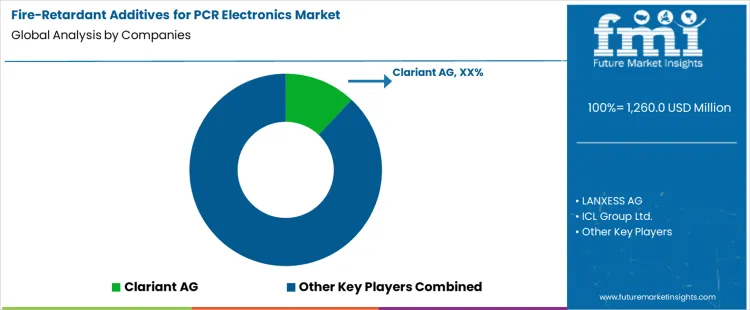
Competition in the fire-retardant additives for PCR electronics market is centered on verified flame performance, polymer compatibility, and regulatory compliance documented in official technical brochures. Clariant AG positions its fire-retardant additive portfolios with datasheets that highlight optimized formulations for PCR (post-consumer recycled) thermoplastics used in electronic enclosures and components. Product materials emphasize low smoke and halogen-free performance aligned with UL 94 and IEC fire safety standards, appealing to OEMs targeting sustainable electronics designs. LANXESS AG competes through engineered flame-retardant solutions backed by official literature detailing synergistic additive systems that enhance LOI (limiting oxygen index) values while maintaining mechanical integrity in high-PCR content compounds.
Material science leaders differentiate through multi-functional performance. ICL Group Ltd. promotes its flame-retardant additives with brochures showing performance in both rigid and engineering PCR plastics, with documented reductions in peak heat release rates and compliance with EN 60695 series test protocols. Avient Corporation positions its compounded solutions with technical materials that underscore tailored fire-retardant packages compatible with extrusion and injection molding processes, ensuring consistent dispersion and PCR blend stability.
Specialty and regional suppliers add competitive breadth. JLS Flame Retardants, Inc. focuses on cost-optimized additive grades with product guides that emphasize ease of processing and tailored fire performance. Kingfa Sci. & Tech. Co., Ltd. and ADEKA Corporation differentiate through flame-retardant chemistries documented for low migration and compatibility with high recycled content, appealing to global electronics manufacturers. Nippon Kayaku Co., Ltd. brings flame-retardant solutions with official materials highlighting thermal stability and reduced char formation in PCR compounds. Across suppliers, competitive advantage is based on brochure-verified flame retardancy metrics, regulatory alignment, and integration support rather than price alone.
Key Players in Fire-Retardant Additives for PCR Electronics Market
- Clariant AG
- LANXESS AG
- ICL Group Ltd.
- Avient Corporation
- JLS Flame Retardants, Inc.
- Kingfa Sci. & Tech. Co., Ltd.
- ADEKA Corporation
- Nippon Kayaku Co., Ltd.
Scope of Report
| Attribute | Description |
|---|---|
| Quantitative Unit | USD Million |
| End-use | Consumer Electronics Housings, IT & Appliance Electronics, Mass Electronics, Precision Electronics, Displays & Devices, Local Electronics |
| Additive Type | Halogen-Free FR Systems, Phosphorus-Based FR, Synergistic FR Blends, High-Purity FR Additives |
| Countries Covered | China, Japan, South Korea, India, Australia & New Zealand, ASEAN, Rest of Asia Pacific, Germany, United Kingdom, France, Italy, Spain, Nordic, BENELUX, Rest of Europe, United States, Canada, Mexico, Brazil, Chile, Rest of Latin America, Kingdom of Saudi Arabia, Other GCC Countries, Turkey, South Africa, Other African Union, Rest of Middle East & Africa |
| Regions Covered | Asia Pacific, Europe, North America, Latin America, Middle East & Africa |
| Key Companies Profiled | Clariant AG, LANXESS AG, ICL Group Ltd., Avient Corporation, JLS Flame Retardants, Inc., Kingfa Sci. & Tech. Co., Ltd., ADEKA Corporation, Nippon Kayaku Co., Ltd. |
| Additional Attributes | Dollar sales by end-use and additive type are assessed across PCR-based electronics housing and component manufacturing. The report includes country-level demand assessment, growth projections for 2026-2036, analysis of flame-retardancy performance and regulatory compliance, evaluation of halogen-free formulation adoption, competitive benchmarking of additive suppliers, and assessment of sustainability-driven material substitution trends in electronics manufacturing. |
Fire-Retardant Additives for PCR Electronics Market by Key Segments
End-use:
- Consumer electronics housings
- IT & appliance electronics
- Mass electronics
- Precision electronics
- Displays & devices
- Local electronics
Additive Type:
- Halogen-free FR systems
- Phosphorus-based FR
- Synergistic FR blends
- High-purity FR additives
Region:
- Asia Pacific
- China
- Japan
- South Korea
- India
- Australia & New Zealand
- ASEAN
- Rest of Asia Pacific
- Europe
- Germany
- United Kingdom
- France
- Italy
- Spain
- Nordic
- BENELUX
- Rest of Europe
- North America
- United States
- Canada
- Mexico
- Latin America
- Brazil
- Chile
- Rest of Latin America
- Middle East & Africa
- Kingdom of Saudi Arabia
- Other GCC Countries
- Turkey
- South Africa
- Other African Union
- Rest of Middle East & Africa
Bibliography
- European Commission. (2023). Review of Directive 2011/65/EU on the restriction of the use of certain hazardous substances in electrical and electronic equipment (RoHS). European Union.
- International Electrotechnical Commission. (2024). IEC TS 60695-2-20: Fire hazard testing—Part 2-20: Abnormal heat—Glass fiber ignition temperature test method. IEC.
- International Electrotechnical Commission. (2023). IEC 60695 series: Fire hazard testing for electrotechnical products. IEC.
- European Chemicals Agency. (2024). Flame retardants in electrical and electronic equipment under REACH and RoHS. ECHA.
- Organisation for Economic Co-operation and Development. (2023). Electronics value chains and chemical safety regulation. OECD.
Frequently Asked Questions
How big is the fire-retardant additives for PCR electronics market in 2026?
The global fire-retardant additives for PCR electronics market is estimated to be valued at USD 1,260.0 million in 2026.
What will be the size of fire-retardant additives for PCR electronics market in 2036?
The market size for the fire-retardant additives for PCR electronics market is projected to reach USD 3,983.8 million by 2036.
How much will be the fire-retardant additives for PCR electronics market growth between 2026 and 2036?
The fire-retardant additives for PCR electronics market is expected to grow at a 12.2% CAGR between 2026 and 2036.
What are the key product types in the fire-retardant additives for PCR electronics market?
The key product types in fire-retardant additives for PCR electronics market are consumer electronics housings, it & appliance electronics, mass electronics, precision electronics, displays & devices and local electronics.
Which additive type segment to contribute significant share in the fire-retardant additives for PCR electronics market in 2026?
In terms of additive type, halogen-free fr systems segment to command 39.0% share in the fire-retardant additives for PCR electronics market in 2026.
Preview the report firsthand - request a free sample
Get SampleGet the brochure for pricing and purchase details.
Get PDFTable of Content
- Executive Summary
- Global Market Outlook
- Demand-side Trends
- Supply-side Trends
- Technology Roadmap Analysis
- Analysis and Recommendations
- Market Overview
- Market Coverage / Taxonomy
- Market Definition / Scope / Limitations
- Market Background
- Market Dynamics
- Drivers
- Restraints
- Opportunity
- Trends
- Scenario Forecast
- Demand in Optimistic Scenario
- Demand in Likely Scenario
- Demand in Conservative Scenario
- Opportunity Map Analysis
- Product Life Cycle Analysis
- Supply Chain Analysis
- Investment Feasibility Matrix
- Value Chain Analysis
- PESTLE and Porter’s Analysis
- Regulatory Landscape
- Regional Parent Market Outlook
- Production and Consumption Statistics
- Import and Export Statistics
- Market Dynamics
- Global Market Analysis 2021 to 2025 and Forecast, 2026 to 2036
- Historical Market Size Value (USD Million) Analysis, 2021 to 2025
- Current and Future Market Size Value (USD Million) Projections, 2026 to 2036
- Y-o-Y Growth Trend Analysis
- Absolute $ Opportunity Analysis
- Global Market Pricing Analysis 2021 to 2025 and Forecast 2026 to 2036
- Global Market Analysis 2021 to 2025 and Forecast 2026 to 2036, By End-use
- Introduction / Key Findings
- Historical Market Size Value (USD Million) Analysis By End-use , 2021 to 2025
- Current and Future Market Size Value (USD Million) Analysis and Forecast By End-use , 2026 to 2036
- Consumer electronics housings
- IT & appliance electronics
- Mass electronics
- Precision electronics
- Displays & devices
- Local electronics
- Consumer electronics housings
- Y-o-Y Growth Trend Analysis By End-use , 2021 to 2025
- Absolute $ Opportunity Analysis By End-use , 2026 to 2036
- Global Market Analysis 2021 to 2025 and Forecast 2026 to 2036, By Additive Type
- Introduction / Key Findings
- Historical Market Size Value (USD Million) Analysis By Additive Type, 2021 to 2025
- Current and Future Market Size Value (USD Million) Analysis and Forecast By Additive Type, 2026 to 2036
- Halogen-free FR systems
- Phosphorus-based FR
- Synergistic FR blends
- High-purity FR additives
- Halogen-free FR systems
- Y-o-Y Growth Trend Analysis By Additive Type, 2021 to 2025
- Absolute $ Opportunity Analysis By Additive Type, 2026 to 2036
- Global Market Analysis 2021 to 2025 and Forecast 2026 to 2036, By Region
- Introduction
- Historical Market Size Value (USD Million) Analysis By Region, 2021 to 2025
- Current Market Size Value (USD Million) Analysis and Forecast By Region, 2026 to 2036
- North America
- Latin America
- Western Europe
- Eastern Europe
- East Asia
- South Asia and Pacific
- Middle East & Africa
- Market Attractiveness Analysis By Region
- North America Market Analysis 2021 to 2025 and Forecast 2026 to 2036, By Country
- Historical Market Size Value (USD Million) Trend Analysis By Market Taxonomy, 2021 to 2025
- Market Size Value (USD Million) Forecast By Market Taxonomy, 2026 to 2036
- By Country
- USA
- Canada
- Mexico
- By End-use
- By Additive Type
- By Country
- Market Attractiveness Analysis
- By Country
- By End-use
- By Additive Type
- Key Takeaways
- Latin America Market Analysis 2021 to 2025 and Forecast 2026 to 2036, By Country
- Historical Market Size Value (USD Million) Trend Analysis By Market Taxonomy, 2021 to 2025
- Market Size Value (USD Million) Forecast By Market Taxonomy, 2026 to 2036
- By Country
- Brazil
- Chile
- Rest of Latin America
- By End-use
- By Additive Type
- By Country
- Market Attractiveness Analysis
- By Country
- By End-use
- By Additive Type
- Key Takeaways
- Western Europe Market Analysis 2021 to 2025 and Forecast 2026 to 2036, By Country
- Historical Market Size Value (USD Million) Trend Analysis By Market Taxonomy, 2021 to 2025
- Market Size Value (USD Million) Forecast By Market Taxonomy, 2026 to 2036
- By Country
- Germany
- UK
- Italy
- Spain
- France
- Nordic
- BENELUX
- Rest of Western Europe
- By End-use
- By Additive Type
- By Country
- Market Attractiveness Analysis
- By Country
- By End-use
- By Additive Type
- Key Takeaways
- Eastern Europe Market Analysis 2021 to 2025 and Forecast 2026 to 2036, By Country
- Historical Market Size Value (USD Million) Trend Analysis By Market Taxonomy, 2021 to 2025
- Market Size Value (USD Million) Forecast By Market Taxonomy, 2026 to 2036
- By Country
- Russia
- Poland
- Hungary
- Balkan & Baltic
- Rest of Eastern Europe
- By End-use
- By Additive Type
- By Country
- Market Attractiveness Analysis
- By Country
- By End-use
- By Additive Type
- Key Takeaways
- East Asia Market Analysis 2021 to 2025 and Forecast 2026 to 2036, By Country
- Historical Market Size Value (USD Million) Trend Analysis By Market Taxonomy, 2021 to 2025
- Market Size Value (USD Million) Forecast By Market Taxonomy, 2026 to 2036
- By Country
- China
- Japan
- South Korea
- By End-use
- By Additive Type
- By Country
- Market Attractiveness Analysis
- By Country
- By End-use
- By Additive Type
- Key Takeaways
- South Asia and Pacific Market Analysis 2021 to 2025 and Forecast 2026 to 2036, By Country
- Historical Market Size Value (USD Million) Trend Analysis By Market Taxonomy, 2021 to 2025
- Market Size Value (USD Million) Forecast By Market Taxonomy, 2026 to 2036
- By Country
- India
- ASEAN
- Australia & New Zealand
- Rest of South Asia and Pacific
- By End-use
- By Additive Type
- By Country
- Market Attractiveness Analysis
- By Country
- By End-use
- By Additive Type
- Key Takeaways
- Middle East & Africa Market Analysis 2021 to 2025 and Forecast 2026 to 2036, By Country
- Historical Market Size Value (USD Million) Trend Analysis By Market Taxonomy, 2021 to 2025
- Market Size Value (USD Million) Forecast By Market Taxonomy, 2026 to 2036
- By Country
- Kingdom of Saudi Arabia
- Other GCC Countries
- Turkiye
- South Africa
- Other African Union
- Rest of Middle East & Africa
- By End-use
- By Additive Type
- By Country
- Market Attractiveness Analysis
- By Country
- By End-use
- By Additive Type
- Key Takeaways
- Key Countries Market Analysis
- USA
- Pricing Analysis
- Market Share Analysis, 2025
- By End-use
- By Additive Type
- Canada
- Pricing Analysis
- Market Share Analysis, 2025
- By End-use
- By Additive Type
- Mexico
- Pricing Analysis
- Market Share Analysis, 2025
- By End-use
- By Additive Type
- Brazil
- Pricing Analysis
- Market Share Analysis, 2025
- By End-use
- By Additive Type
- Chile
- Pricing Analysis
- Market Share Analysis, 2025
- By End-use
- By Additive Type
- Germany
- Pricing Analysis
- Market Share Analysis, 2025
- By End-use
- By Additive Type
- UK
- Pricing Analysis
- Market Share Analysis, 2025
- By End-use
- By Additive Type
- Italy
- Pricing Analysis
- Market Share Analysis, 2025
- By End-use
- By Additive Type
- Spain
- Pricing Analysis
- Market Share Analysis, 2025
- By End-use
- By Additive Type
- France
- Pricing Analysis
- Market Share Analysis, 2025
- By End-use
- By Additive Type
- India
- Pricing Analysis
- Market Share Analysis, 2025
- By End-use
- By Additive Type
- ASEAN
- Pricing Analysis
- Market Share Analysis, 2025
- By End-use
- By Additive Type
- Australia & New Zealand
- Pricing Analysis
- Market Share Analysis, 2025
- By End-use
- By Additive Type
- China
- Pricing Analysis
- Market Share Analysis, 2025
- By End-use
- By Additive Type
- Japan
- Pricing Analysis
- Market Share Analysis, 2025
- By End-use
- By Additive Type
- South Korea
- Pricing Analysis
- Market Share Analysis, 2025
- By End-use
- By Additive Type
- Russia
- Pricing Analysis
- Market Share Analysis, 2025
- By End-use
- By Additive Type
- Poland
- Pricing Analysis
- Market Share Analysis, 2025
- By End-use
- By Additive Type
- Hungary
- Pricing Analysis
- Market Share Analysis, 2025
- By End-use
- By Additive Type
- Kingdom of Saudi Arabia
- Pricing Analysis
- Market Share Analysis, 2025
- By End-use
- By Additive Type
- Turkiye
- Pricing Analysis
- Market Share Analysis, 2025
- By End-use
- By Additive Type
- South Africa
- Pricing Analysis
- Market Share Analysis, 2025
- By End-use
- By Additive Type
- USA
- Market Structure Analysis
- Competition Dashboard
- Competition Benchmarking
- Market Share Analysis of Top Players
- By Regional
- By End-use
- By Additive Type
- Competition Analysis
- Competition Deep Dive
- Clariant AG
- Overview
- Product Portfolio
- Profitability by Market Segments (Product/Age /Sales Channel/Region)
- Sales Footprint
- Strategy Overview
- Marketing Strategy
- Product Strategy
- Channel Strategy
- LANXESS AG
- ICL Group Ltd.
- Avient Corporation
- JLS Flame Retardants, Inc.
- Kingfa Sci. & Tech. Co., Ltd.
- ADEKA Corporation
- Nippon Kayaku Co., Ltd.
- Clariant AG
- Competition Deep Dive
- Assumptions & Acronyms Used
- Research Methodology


