

- Industry Size (2026)
- USD 0.9 Bn
- Forecast (2036)
- USD 2.0 Bn
- CAGR (2026 to 2036)
- 8.3%
IT Asset Disposition and Closed-Loop Recycling for EU Data Centres Industry Size, Market Forecast and Outlook By FMI
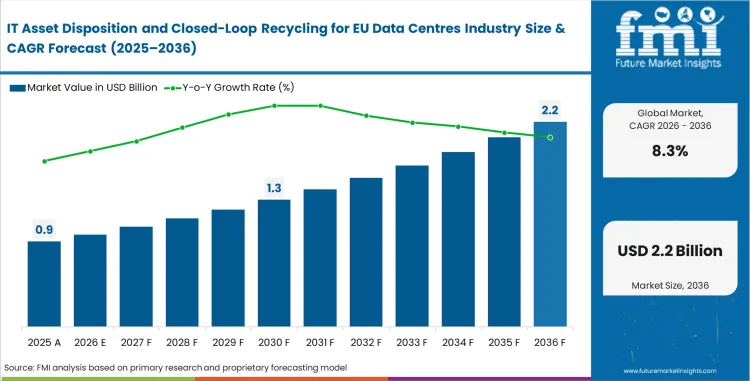
The EU data centre IT asset disposition industry was valued at USD 0.8 billion in 2025. Market value is projected to reach USD 0.9 billion in 2026 and USD 2.0 billion by 2036, expanding at a CAGR of 8.3% over the forecast period. Growth is being supported by tighter expectations around traceability, recovery, and downstream material control, as operators move decommissioned hardware into more formal and auditable recovery channels.
Summary of IT Asset Disposition and Closed-Loop Recycling for EU Data Centres Market
- The market is forecast to reach USD 2.0 billion by 2036.
- The market is expected to grow at a CAGR of 8.3% from 2026 to 2036.
- The market was estimated at USD 0.8 billion in 2025.
- The forecast period represents an incremental opportunity of USD 1.1 billion.
- The market is a compliance-led lifecycle services segment focused on secure data destruction, asset recovery, remarketing, and materials traceability.
- Growth is supported by tightening EU regulations around data-centre reporting, circular economy practices, and WEEE enforcement.
- Closed-loop processing is gaining importance due to regulatory emphasis on reuse, recycling, and recovery of secondary raw materials.
- Remarketing leads the service segment with a 33.0% share, while servers dominate asset type with 44.0%, and reuse leads processing routes with 39.0%.
- Colocation accounts for 41.0% of end users, reflecting its role as the largest installed IT infrastructure base in Europe.
- Spain, Sweden, Italy, and Ireland are the fastest-growing markets, while Germany, the Netherlands, and France remain stable high-value regions.
- Key companies include Iron Mountain, Sims Lifecycle Services, SK tes, Evernex, CHG-MERIDIAN, Inrego, and TXO, with competition remaining fragmented and capability-driven.
Key Takeaways, Market Size, and Forecast
- IT Asset Disposition and Closed-Loop Recycling for EU Data Centres Industry is projected to grow from USD 0.9 billion in 2026 to USD 2.0 billion by 2036, at a CAGR of 8.3%.
- The IT asset disposition and closed-loop recycling for EU data centres industry was valued at USD 0.8 billion in 2025.
- By 2036, the IT Asset Disposition and Closed-Loop Recycling for EU Data Centres Industry is expected to be worth USD 2.0 billion.
- From 2026 to 2036, the industry is projected to expand at a CAGR of 8.3%.
- The industry is projected to create an incremental opportunity of USD 1.1 billion between 2026 and 2036.
- In 2026, Remarketing is expected to account for 33.0% of the service type segment.
- Spain (9.4%) and Sweden (9.1%) are two of the fastest growing markets.
Operators managing large-scale hardware retirement are under pressure to move decommissioned equipment into auditable recovery streams instead of treating it as mixed electronic waste. Evolving compliance rules are increasing scrutiny around IT asset disposition volumes, especially where hardware passes through multiple handlers before final recovery or destruction. Weak control over those flows can create both reporting gaps and regulatory risk. Delayed investment in formal asset recovery frameworks can also affect future expansion plans, as municipalities increasingly expect clearer evidence of lifecycle management. Data security adds another layer of complexity because secure destruction can reduce reuse potential for higher-value components, particularly where storage media is involved.
Vendor structures also begin to change once hardware refresh cycles accelerate and equipment turnover rises. Secure transport, chain-of-custody control, and verified wiping requirements all become more important when decommissioning volumes increase across hyperscale and colocation environments. On-site erasure requirements, especially before rack removal, are encouraging operators to work with fewer recovery partners that can manage both security and downstream processing within a controlled framework. Closed-loop recovery becomes more commercially attractive in that setting because material accountability, compliance documentation, and operational simplicity start to carry more weight than basic removal cost alone.
Spain is projected to register a CAGR of 9.4% through 2036 as data centre capacity continues to scale across Southern Europe. Sweden is expected to expand at a CAGR of 9.1%, supported by stronger circularity requirements and mature recovery discipline. Italy is likely to record 8.9% CAGR during the forecast period, backed by continuing infrastructure buildout. Ireland is estimated to grow at 8.7%, reflecting the scale and maturity of its Dublin data centre base. France is projected to post 8.1%, where public-sector oversight continues to support formal recovery practices. Netherlands is expected to witness 7.9% CAGR through 2036, while Germany is likely to grow at 7.8%, with permitting constraints influencing where future retirement volumes emerge. Across the region, location economics and grid access are starting to shape decommissioning flows as much as underlying server demand.
Segmental Analysis
IT Asset Disposition and Closed-Loop Recycling for EU Data Centres Industry Analysis by Service Type
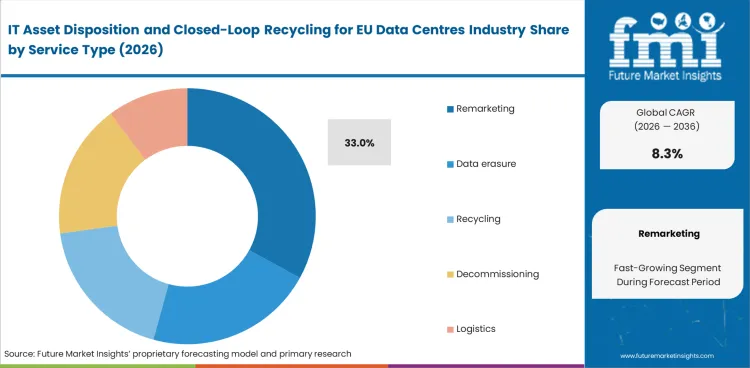
This segment is no longer limited to scrap recovery. Asset owners increasingly want value recovery before material destruction, especially where processors, memory modules, and other components still retain resale potential. Remarketing is estimated to account for 33.0% share in 2026 because it helps offset refresh costs while also supporting circularity targets. The service remains credible only when vendors can show clearly which assets were remarketed, dismantled, or recycled. In practice, traceability and reporting discipline matter almost as much as resale capability.
- Sourcing event: Documented recovery programs help clients avoid idle hardware buildup and improve control over retired assets.
- Qualification requirement: Secure chain-of-custody certification remains essential for vendors handling sensitive enterprise hardware.
- Contract renewal: Fast financial settlement and consistent recovery outcomes support longer vendor relationships.
IT Asset Disposition and Closed-Loop Recycling for EU Data Centres Industry Analysis by Asset Type
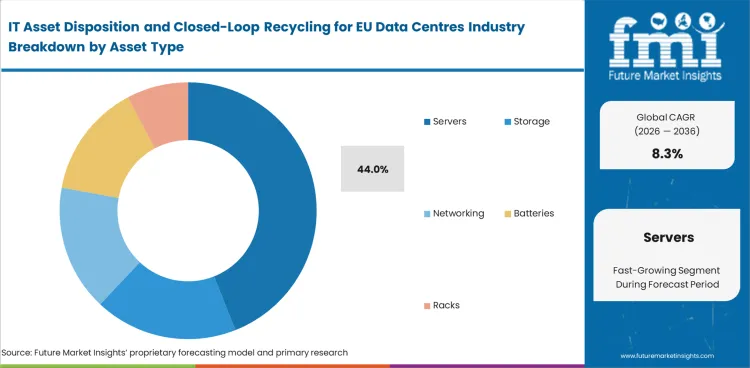
Hardware refresh cycles in data centres are driven largely by performance density and energy efficiency targets. Servers continue to dominate decommissioning streams because they are replaced more often than many other asset classes. Hyperscale operators also rotate high availability servers & storage systems on relatively short cycles to reduce power draw per compute unit. According to FMI’s estimates, servers are poised to garner 44.0% share in 2026. That turnover creates large volumes of similar hardware, which improves secondary market visibility for selected components. Customized server architecture can still limit intact resale where proprietary board design narrows reuse potential. In those cases, value shifts away from full-unit remarketing and toward selective part harvesting. Asset recovery economics, therefore, depend heavily on how standardized the retired fleet remains.
- Residual margin source: Memory modules often preserve better secondary value and are commonly prioritized during harvesting.
- Processing friction: Soldered or glued components raise labor intensity and slow non-destructive dismantling.
- Lifecycle assessment: Secondary market demand increasingly shapes hardware selection at the original purchase stage.
IT Asset Disposition and Closed-Loop Recycling for EU Data Centres Industry Analysis by Processing Route
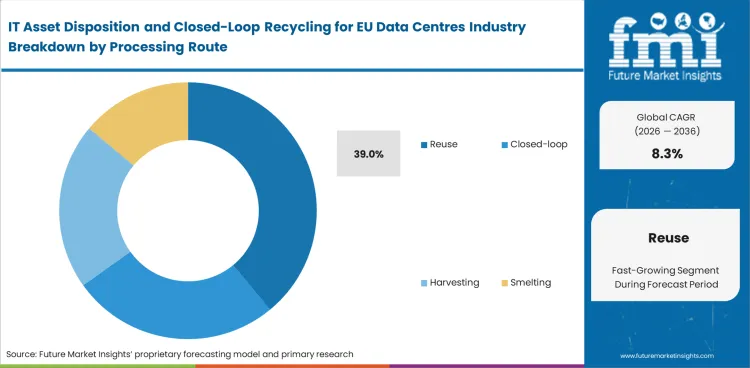
Asset owners usually prefer routes that preserve functional value before moving to raw-material recovery. Reuse is set to represent 39.0% share in 2026 because refurbished enterprise hardware still finds demand across secondary channels. The route works best when testing, data wiping, and requalification are handled efficiently before assets re-enter the market. Physical recycling remains necessary where sanitization cannot be verified, but reuse continues to offer the stronger value case when equipment remains serviceable. Processing capability in this segment therefore depends on diagnostics, data security, and turnaround speed.
- Primary failure prevention: Certified data wiping reduces breach risk before equipment moves into secondary channels.
- Residual liability: Perceived data exposure can still push some clients toward destruction even after sanitization is completed.
- Capture optimization: Rapid diagnostics help identify reusable power-related components before labor costs rise too far.
IT Asset Disposition and Closed-Loop Recycling for EU Data Centres Industry Analysis by End User
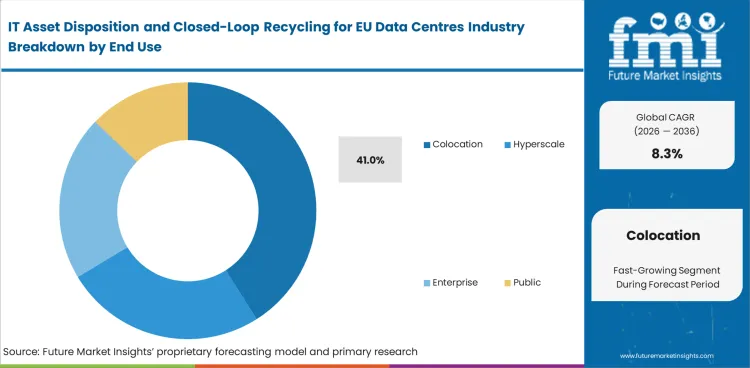
Colocation operators remain a key end-user group because they manage decommissioning risk across large numbers of tenant-owned assets. Tenant churn, lease exits, and undocumented legacy hardware all increase the need for controlled retirement programs. Colocation is likely to account for 41.0% share in 2026. These operators also decide which ITAD and recovery vendors are allowed on site, which gives them a central role in qualification and disposal control. Problems often arise when tenants leave equipment behind without a clear disposition plan, forcing the facility to absorb cost and storage burden. Formal end-of-lease clauses help reduce that risk and improve floor-space recovery.
- First-mover adoption: Hyperscale facilities usually set the early benchmark for structured closed-loop disposition programs.
- Secondary conversion: Enterprise users often follow these operating models when internal audit pressure increases.
- Late-stage transition: Public sector facilities tend to move later because disposal rules are usually more rigid.
IT Asset Disposition and Closed-Loop Recycling for EU Data Centres Industry Analysis by Output Quality
Output quality in IT asset recovery depends on whether downstream buyers can rely on consistent material and component specifications. Refurbishment channels need clean testing records, while material buyers require purity and classification discipline. Diagnostic infrastructure becomes more important when mixed hardware streams include power systems and other specialized components. Reuse potential also varies by calibration status, condition, and application history, which makes routing discipline important. Standardized grading and traceable handling therefore remain central to both reuse and recycling pathways.
- Specification control: Buyers expect clear grading standards before accepting refurbished units or separated material streams.
- Routing discipline: Mixed hardware requires tighter sorting logic when reuse potential differs sharply across device categories.
- Buyer confidence: Traceable handling and stable quality reporting improve acceptance in higher-value secondary channels.
IT Asset Disposition and Closed-Loop Recycling for EU Data Centres Industry Drivers, Restraints, and Opportunities
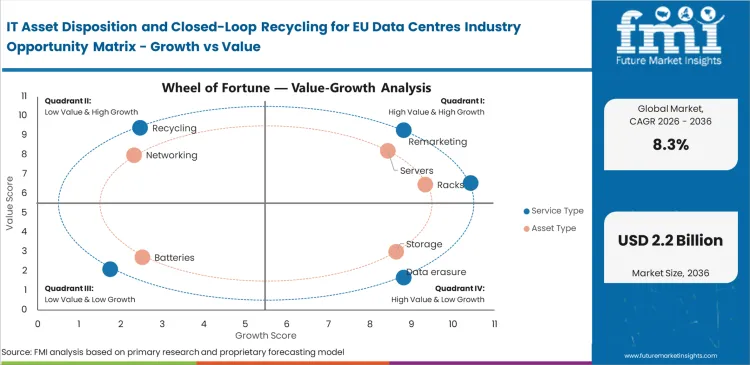
Tighter EU waste and circularity requirements are pushing operators to document how decommissioned hardware is handled after removal. This is making ITAD less of a basic logistics task and more of a compliance-led service. Operators increasingly need clearer audit trails, stronger chain-of-custody records, and better evidence of downstream recovery or destruction. That shift is encouraging colocation and hyperscale operators to formalize vendor relationships and move more volume into certified recovery channels.
A key operational restraint is the fragmentation of battery formats, storage media, and proprietary hardware designs. Some systems have limited secondary-market value, while others take longer to dismantle because of non-standard fasteners, glued components, or tightly integrated assemblies. These factors raise labor intensity and reduce recovery margins. Although some OEMs are moving toward more modular designs, the installed base of customized hardware is still large enough to keep this friction in place for much of the forecast period.
Opportunities in the IT Asset Disposition and Closed-Loop Recycling for EU Data Centres Industry
- On-site sanitization deployment: Colocation compliance officers require data wiping before hardware leaves the security perimeter. ITAD vendors deploying mobile wiping teams secure exclusive contracts by eliminating transit risk.
- Proprietary component harvesting: Firms face mounting pressure to execute closed-loop metals recovery from servers EU. Firms investing in advanced integrated recycling hubs capture high-margin material streams that basic shredding operations lose.
- Firmware unlocking services: Hardware brokers struggle to remarket enterprise servers locked to specific cloud environments. Engineering teams capable of factory-resetting proprietary BIOS systems unlock massive residual value from otherwise unusable assets.
Regional Analysis
Based on regional analysis, the market is discussed across Spain, Sweden, Italy, Ireland, France, the Netherlands, and Germany, which are the key countries covered in this report.
.webp "Top Country Growth Comparison It Asset Disposition And Closed Loop Recycling For Eu Data Centres Industry Cagr (2026 2036)")
| Country | CAGR (2026 to 2036) |
|---|---|
| Spain | 9.4% |
| Sweden | 9.1% |
| Italy | 8.9% |
| Ireland | 8.7% |
| Netherlands | 7.9% |
| Germany | 7.8% |
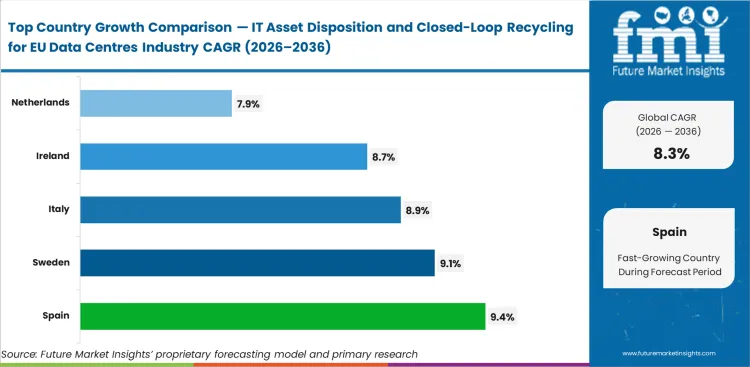
Source: Future Market Insights (FMI) analysis, based on proprietary forecasting model and primary research
Southern Europe IT Asset Disposition and Closed-Loop Recycling for EU Data Centres Industry Analysis
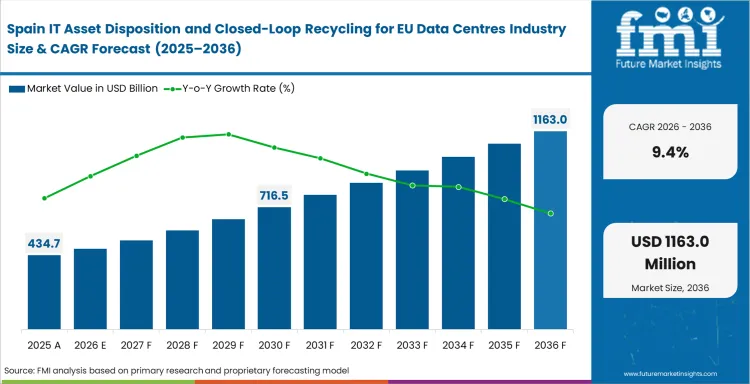
Southern Europe is emerging as a more visible ITAD growth zone as data centre capacity expands across Spain and Italy. Power constraints in traditional hubs are redirecting part of new infrastructure investment toward these markets, which will gradually lift future decommissioning volumes as installed bases mature. At the same time, stronger compliance expectations are pushing operators away from informal disposal routes and toward certified ITAD providers.
- Spain: Massive investments in new data campuses create a proportional future demand for specialized local asset recovery. Demand across the Spanish sector is set to rise at a 9.4% CAGR over the forecast period. Localized volume spikes are expected as these new facilities reach their first refresh cycles. Securing early vendor contracts allows local ITAD firms to lock in lucrative remarketing channels before multinational recyclers dominate.
- Italy: Cloud migration initiatives across the Italian public sector generate significant legacy hardware turnover. Public entities actively seek certified wiping services to handle sensitive government data storage arrays. Shifting from scattered on-premise server rooms to centralized colocation facilities permanently upgrades regional asset recovery standards. Italy is projected to witness an 8.9% CAGR in the ITAD segment through 2036, anchored by these modernization efforts.
Nordics IT Asset Disposition and Closed-Loop Recycling for EU Data Centres Industry Analysis
Nordic markets remain important because environmental compliance is strong and circularity expectations are relatively mature. Operators in these countries face higher scrutiny around reuse, recycling, and downstream traceability, which gives structured ITAD providers a clearer role. Sweden stands out because formal recovery discipline is stronger and closed-loop processing is already more established than in many other European markets.
- Sweden: Aggressive national circularity policies force operators to document the exact downstream paths of decommissioned high density racks. Compliance teams face reputational damage if hardware is traced to undocumented scrap markets. The circular hardware demand in Sweden is likely to advance at a CAGR of 9.1% by 2036. This advanced regulatory environment provides a competitive advantage for ITAD firms capable of generating OEM-grade recycled output.
Western Europe IT Asset Disposition and Closed-Loop Recycling for EU Data Centres Industry Analysis
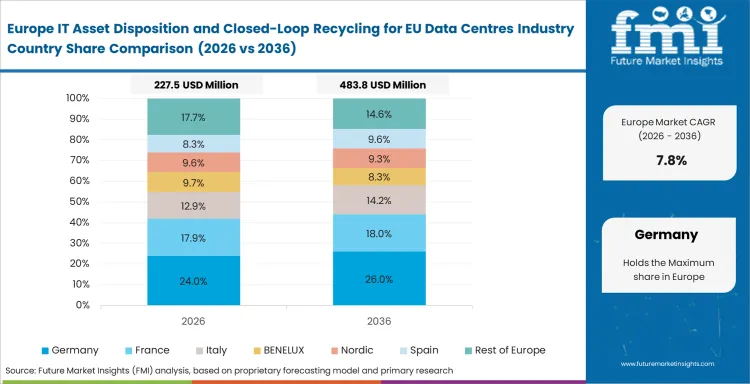
Western Europe remains a high-value installed base for ITAD because existing data-centre footprints are large and hardware refresh cycles are active. Grid congestion and permitting delays are constraining some new builds, but they also increase the importance of extracting more value from existing infrastructure through structured refresh and decommissioning programs. That keeps retirement volumes meaningful even where headline capacity growth is moderating.
- Ireland: The concentration of hyperscale facilities around Dublin ensures a steady supply of high-value secondary hardware. Operations teams depend on this dense operational footprint to optimize logistics routing. Ireland is set to record a CAGR of 8.7% in specialized disposition services during the assessment period. The expansion of dedicated processing facilities cements the country's role as a critical node in global remarketing networks.
- France: Public sector regulations mandating the acquisition of refurbished hardware stimulate domestic demand for remarketed components. Government entities actively source secondary servers to meet strict environmental compliance quotas. The French asset recovery sector is expected to register an 8.1% CAGR from 2026 to 2036. This legislative support effectively creates a self-sustaining domestic market for high-quality used enterprise equipment, ensuring consistent disposition volumes.
- Netherlands: Severe power availability limits force operators to maximize the efficiency of every active server. Demand within the Dutch recycling sector is anticipated to rise at a 7.9% CAGR during the assessment period. Operators rapidly swap ageing cabling systems and storage arrays for newer models to maintain performance. The inability to secure power for new builds permanently shifts operational focus toward maximizing existing infrastructure lifecycles.
- Germany: Stringent data sovereignty laws complicate the cross-border transport of decommissioned storage media. Federal regulations mandate local, in-country destruction to mitigate legal risks. These strict regulatory stances force multinational ITAD vendors to establish localized processing hubs to service their enterprise clients. The German industry is forecast to record steady growth at a 7.8% CAGR through 2036, anchored entirely by these rigid domestic compliance requirements.
FMI's analysis also considers emerging data-centre nodes in other parts of Europe where colocation expansion is beginning to support demand for more formal ITAD infrastructure. These markets remain smaller, but they show how hardware recovery requirements tend to follow new investment in professionally managed capacity.
Competitive Aligners for Market Players
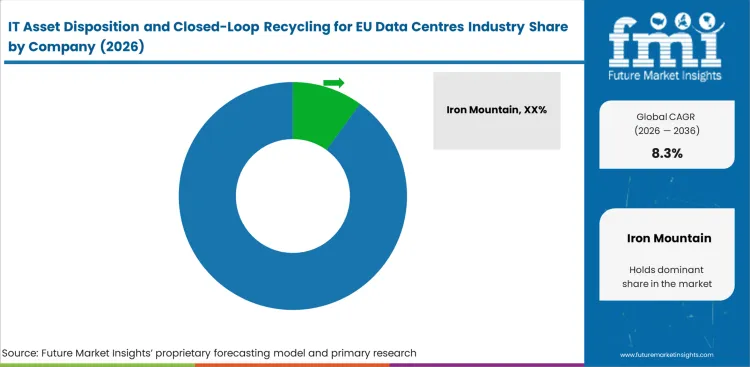
Audited chain of custody remains one of the main factors in vendor selection. Operators handling sensitive hardware want clear security certifications, serialized tracking, and documented control from rack removal through final processing. On-site wiping or physical destruction capabilities can strengthen a vendor's position, especially in hyperscale and colocation environments where data risk is high. In practice, buyers often place security architecture and reporting quality ahead of price alone.
Large ITAD providers also benefit from broader resale networks that smaller regional challengers often cannot match. Stronger downstream channels help them recover more value from servers, storage, and memory modules that still have secondary-market demand. When those channels are weak, more material tends to move into lower-margin recycling instead of reuse. This gives scale players an advantage in financial recovery as well as logistics.
At the same time, large operators often avoid relying on a single vendor. Many split decommissioning volumes across multiple providers to maintain pricing discipline, preserve operational redundancy, and compare recovery outcomes. As circularity requirements tighten, the gap is likely to widen between vendors that can provide audited reuse and closed-loop recovery pathways, and those that remain focused mainly on basic removal or resale.
Key Players in IT Asset Disposition and Closed-Loop Recycling for EU Data Centres Market
- Iron Mountain
- Sims Lifecycle Services
- SK tes
- Evernex
- CHG-MERIDIAN
- Inrego
- TXO
Scope of the Report
| Metric | Value |
|---|---|
| Quantitative Units | USD 0.9 billion to USD 2.0 billion, at a CAGR of 8.3% |
| Market Definition | The secure decommissioning, processing, and value recovery of retired data-centre hardware within a framework shaped by EU circularity, waste, and chain-of-custody requirements. |
| Segmentation | Service type, Asset type, Processing route, End user, Region |
| Regions Covered | Europe |
| Countries Covered | Spain, Sweden, Italy, Ireland, France, Netherlands, Germany |
| Key Companies Profiled | Iron Mountain, Sims Lifecycle Services, SK tes, Evernex, CHG-MERIDIAN, Inrego, TXO |
| Forecast Period | 2026 to 2036 |
| Approach | Audited rack decommissioning volumes mapped against secondary market resale values and raw material recovery yields. |
Source: Future Market Insights (FMI) analysis, based on proprietary forecasting model and primary research
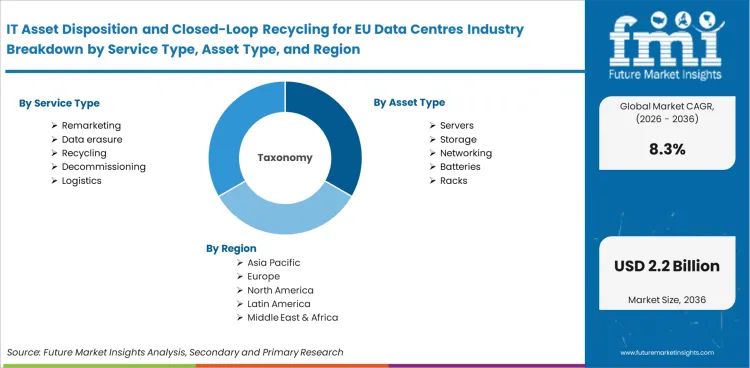
IT Asset Disposition and Closed-Loop Recycling for EU Data Centres Market Analysis by Segments
Service type
- Remarketing
- Data erasure
- Recycling
- Decommissioning
- Logistics
Asset type
- Servers
- Storage
- Networking
- Batteries
- Racks
Processing route
- Reuse
- Closed-loop
- Harvesting
- Smelting
End user
- Colocation
- Hyperscale
- Enterprise
- Public
Region
- Southern Europe
- Spain
- Italy
- Nordics
- Sweden
- Western Europe
- Ireland
- France
- Netherlands
- Germany
Bibliography
- Andrews, D., & Kerwin, K. (2026, January 15). Design for circularity - a data centre equipment case study. Mineral Economics, 39, 53-70.
- European Data Centre Association. (2026). State of European Data Centres 2026.
- European Environment Agency / European Commission. (2026). Waste from Electrical and Electronic Equipment (WEEE). Environment.
- International Energy Agency. (2025, April 10). Energy and AI.
- Sims Limited. (2024, August). Annual report 2024.
- UNITAR, ITU, & ISWA. (2024). The Global E-waste Monitor 2024.
- Wierda, L., & Zanuttini, R. (2024). Ecodesign requirements for circularity of servers and data centres. Nordic Council of Ministers.
This bibliography is provided for reader reference. The full FMI report contains the complete reference list with primary source documentation.
This Report Addresses
- The exact rate at which colocation facility managers execute enterprise infrastructure refresh recycling EU programs.
- How EU WEEE data center compliance directives dictate downstream material recovery protocols for hyperscalers.
- The commercial impact of data center hardware reuse ROI on initial sourcing decisions.
- Which localized grid congestion issues divert decommissioning volumes toward Southern Europe.
- The specific NIST 800-88 data center erasure Europe standards required to execute on-site cryptographic drive wiping.
- How proprietary motherboard designs reduce the remarketing viability of decommissioned servers.
- The shift from informal scrap recovery toward audited closed-loop material extraction.
- Which operational bottlenecks prevent rapid non-destructive dismantling of enterprise racks.
Frequently Asked Questions
What is IT asset disposition for EU data centres?How to choose an EU data center ITAD vendor?
ITAD encompasses the formalized extraction, secure processing, and value recovery of decommissioned enterprise computing infrastructure. It ensures data security and environmental compliance while maximizing residual value.
Explain the EU data centre ITAD market size and forecast?
Revenues cross USD 0.9 billion in 2026, reflecting the massive volume of computing hardware reaching end-of-life. The data center asset disposition forecast for Europe 2036 projects growth to USD 2.0 billion at an 8.3% CAGR.
Why do data centres use ITAD providers?
Operators must mitigate data breach risks and comply with stringent WEEE regulations. They rely on certified providers to ensure exact chain-of-custody tracking and secure logistics during hardware retirement.
How does closed-loop recycling work for servers?
Closed-loop operations dismantle retired servers to recover specific trace metals and components, which are then processed into OEM-grade secondary materials intended directly for manufacturing new server hardware.
Which EU countries lead data center hardware recycling growth?
Spain expands at 9.4% due to Southern European capacity investments, while Sweden grows at 9.1% driven by strict Nordic circularity mandates, outpacing legacy FLAPD markets constrained by grid limits.
Spain expands at 9.4% due to Southern European capacity investments, while Sweden grows at 9.1% driven by strict Nordic circularity mandates, outpacing legacy FLAPD markets constrained by grid limits.
Servers undergo secure data wiping and testing. Functional units are remarketed via secondary channels, while obsolete or proprietary chassis are shredded to recover precious metals like gold and copper.
Compare reuse and closed-loop recycling for retired servers?
Reuse extends component lifespans, capturing high financial returns by remarketing intact drives and RAM. Closed-loop recycling destroys the asset to extract raw materials, optimizing resource circularity but yielding lower immediate margins.
Which certifications matter for data center ITAD vendors?
Vendors holding R2v3, e-Stewards, and ADISA certifications are prioritised, ensuring the provider adheres to the highest global standards for data destruction and environmental stewardship.
What regulations shape EU data center asset disposition?
The WEEE Directive and updated Corporate Sustainability Reporting Directives force operators to maintain exact audit trails for electronic waste, penalizing informal disposal and mandating specific recovery rates.
How to choose an EU data center ITAD vendor?
Decision-makers should evaluate a provider’s ability to execute on-site sanitization, their global resale network for value recovery, and their capacity to provide immutable, serialized audit trails for every decommissioned asset.
How does data center migration hardware disposal impact volumes?
Enterprise cloud migrations initiate massive, sudden influxes of legacy on-premise hardware into the ITAD pipeline, requiring vendors capable of scaling rapid decommissioning and secure transit operations.
Why do colocation providers bear disproportionate disposal risks?
Multi-tenant facilities often inherit abandoned legacy hardware when client leases expire. Facility managers enforce strict end-of-life disposition clauses to clear unpowered servers and maintain available floor space.
What is the impact of AI-driven data center growth and ITAD demand?
The rapid deployment of high-density AI clusters accelerates the retirement of traditional CPU servers. This creates a massive secondary market supply while simultaneously challenging recyclers with complex new cooling and power architectures.
How does the lack of firmware unlocking services impact the sector?
Software-locked components artificially depress secondary market inventory. When brokers cannot reset proprietary BIOS systems, perfectly functional hardware is destroyed, directly undermining broader EU circularity objectives.
What geographic advantage does Ireland offer for asset recovery?
The concentration of existing data centers around Dublin simplifies logistics routing. ITAD firms establish large processing hubs nearby, relying on the constant volume generated by this dense geographic cluster to optimize operations.
How will circular data center purchasing in Europe evolve by 2036?
Elite ITAD providers will bypass secondary hardware markets entirely. They will process old servers directly into raw materials specifically graded for immediate re-integration into new OEM manufacturing lines.
Why is component testing a critical bottleneck in the reuse route?
Validating the functionality of thousands of extracted processors requires extensive specialized infrastructure. ITAD facility managers must balance the high labor costs of rigorous testing against the premium prices verified working components command.
What determines the success of regional ITAD challengers?
Local firms win by securing exclusive contracts with newly built campuses in emerging markets like Spain before those facilities reach their first refresh cycle. Securing these early relationships locks out multinational competitors from local volume spikes.
Preview the report firsthand - request a free sample
Get SampleGet the brochure for pricing and purchase details.
Get PDFTable of Content
- Executive Summary
- Global Market Outlook
- Demand-side Trends
- Supply-side Trends
- Technology Roadmap Analysis
- Analysis and Recommendations
- Market Overview
- Market Coverage / Taxonomy
- Market Definition / Scope / Limitations
- Research Methodology
- Chapter Orientation
- Analytical Lens and Working Hypotheses
- Market Structure, Signals, and Trend Drivers
- Benchmarking and Cross-market Comparability
- Research Design and Evidence Framework
- Desk Research Programme (Secondary Evidence)
- Company Annual and Sustainability Reports
- Peer-reviewed Journals and Academic Literature
- Corporate Websites, Product Literature, and Technical Notes
- Earnings Decks and Investor Briefings
- Statutory Filings and Regulatory Disclosures
- Technical White Papers and Standards Notes
- Trade Journals, Industry Magazines, and Analyst Briefs
- Conference Proceedings, Webinars, and Seminar Materials
- Government Statistics Portals and Public Data Releases
- Press Releases and Reputable Media Coverage
- Specialist Newsletters and Curated Briefings
- Sector Databases and Reference Repositories
- FMI Internal Proprietary Databases and Historical Market Datasets
- Subscription Datasets and Paid Sources
- Social Channels, Communities, and Digital Listening Inputs
- Additional Desk Sources
- Expert Input and Fieldwork (Primary Evidence)
- Primary Modes
- Qualitative Interviews and Expert Elicitation
- Quantitative Surveys and Structured Data Capture
- Blended Approach
- Why Primary Evidence is Used
- Social and Community Interactions
- Primary Modes
- Stakeholder Universe Engaged
- C-suite Leaders
- Board Members
- Presidents and Vice Presidents
- R&D and Innovation Heads
- Technical Specialists
- Domain Subject-matter Experts
- Scientists
- Physicians and Other Healthcare Professionals
- Governance, Ethics, and Data Stewardship
- Research Ethics
- Data Integrity and Handling
- Desk Research Programme (Secondary Evidence)
- Tooling, Models, and Reference Databases
- Data Engineering and Model Build
- Data Acquisition and Ingestion
- Cleaning, Normalisation, and Verification
- Synthesis, Triangulation, and Analysis
- Quality Assurance and Audit Trail
- Market Background
- Market Dynamics
- Drivers
- Restraints
- Opportunity
- Trends
- Scenario Forecast
- Demand in Optimistic Scenario
- Demand in Likely Scenario
- Demand in Conservative Scenario
- Opportunity Map Analysis
- Product Life Cycle Analysis
- Supply Chain Analysis
- Investment Feasibility Matrix
- Value Chain Analysis
- PESTLE and Porter’s Analysis
- Regulatory Landscape
- Regional Parent Market Outlook
- Production and Consumption Statistics
- Import and Export Statistics
- Market Dynamics
- Global Market Analysis 2021 to 2025 and Forecast, 2026 to 2036
- Historical Market Size Value (USD Million) Analysis, 2021 to 2025
- Current and Future Market Size Value (USD Million) Projections, 2026 to 2036
- Y-o-Y Growth Trend Analysis
- Absolute $ Opportunity Analysis
- Global Market Pricing Analysis 2021 to 2025 and Forecast 2026 to 2036
- Global Market Analysis 2021 to 2025 and Forecast 2026 to 2036, By Service Type
- Introduction / Key Findings
- Historical Market Size Value (USD Million) Analysis By Service Type , 2021 to 2025
- Current and Future Market Size Value (USD Million) Analysis and Forecast By Service Type , 2026 to 2036
- Remarketing
- Data erasure
- Recycling
- Decommissioning
- Logistics
- Remarketing
- Y-o-Y Growth Trend Analysis By Service Type , 2021 to 2025
- Absolute $ Opportunity Analysis By Service Type , 2026 to 2036
- Global Market Analysis 2021 to 2025 and Forecast 2026 to 2036, By Asset Type
- Introduction / Key Findings
- Historical Market Size Value (USD Million) Analysis By Asset Type, 2021 to 2025
- Current and Future Market Size Value (USD Million) Analysis and Forecast By Asset Type, 2026 to 2036
- Servers
- Storage
- Networking
- Batteries
- Racks
- Servers
- Y-o-Y Growth Trend Analysis By Asset Type, 2021 to 2025
- Absolute $ Opportunity Analysis By Asset Type, 2026 to 2036
- Global Market Analysis 2021 to 2025 and Forecast 2026 to 2036, By Processing Route
- Introduction / Key Findings
- Historical Market Size Value (USD Million) Analysis By Processing Route, 2021 to 2025
- Current and Future Market Size Value (USD Million) Analysis and Forecast By Processing Route, 2026 to 2036
- Reuse
- Closed-loop
- Harvesting
- Smelting
- Reuse
- Y-o-Y Growth Trend Analysis By Processing Route, 2021 to 2025
- Absolute $ Opportunity Analysis By Processing Route, 2026 to 2036
- Global Market Analysis 2021 to 2025 and Forecast 2026 to 2036, By End Use
- Introduction / Key Findings
- Historical Market Size Value (USD Million) Analysis By End Use, 2021 to 2025
- Current and Future Market Size Value (USD Million) Analysis and Forecast By End Use, 2026 to 2036
- Colocation
- Hyperscale
- Enterprise
- Public
- Colocation
- Y-o-Y Growth Trend Analysis By End Use, 2021 to 2025
- Absolute $ Opportunity Analysis By End Use, 2026 to 2036
- Global Market Analysis 2021 to 2025 and Forecast 2026 to 2036, By Region
- Introduction
- Historical Market Size Value (USD Million) Analysis By Region, 2021 to 2025
- Current Market Size Value (USD Million) Analysis and Forecast By Region, 2026 to 2036
- North America
- Latin America
- Western Europe
- Eastern Europe
- East Asia
- South Asia and Pacific
- Middle East & Africa
- Market Attractiveness Analysis By Region
- North America Market Analysis 2021 to 2025 and Forecast 2026 to 2036, By Country
- Historical Market Size Value (USD Million) Trend Analysis By Market Taxonomy, 2021 to 2025
- Market Size Value (USD Million) Forecast By Market Taxonomy, 2026 to 2036
- By Country
- USA
- Canada
- Mexico
- By Service Type
- By Asset Type
- By Processing Route
- By End Use
- By Country
- Market Attractiveness Analysis
- By Country
- By Service Type
- By Asset Type
- By Processing Route
- By End Use
- Key Takeaways
- Latin America Market Analysis 2021 to 2025 and Forecast 2026 to 2036, By Country
- Historical Market Size Value (USD Million) Trend Analysis By Market Taxonomy, 2021 to 2025
- Market Size Value (USD Million) Forecast By Market Taxonomy, 2026 to 2036
- By Country
- Brazil
- Chile
- Rest of Latin America
- By Service Type
- By Asset Type
- By Processing Route
- By End Use
- By Country
- Market Attractiveness Analysis
- By Country
- By Service Type
- By Asset Type
- By Processing Route
- By End Use
- Key Takeaways
- Western Europe Market Analysis 2021 to 2025 and Forecast 2026 to 2036, By Country
- Historical Market Size Value (USD Million) Trend Analysis By Market Taxonomy, 2021 to 2025
- Market Size Value (USD Million) Forecast By Market Taxonomy, 2026 to 2036
- By Country
- Germany
- UK
- Italy
- Spain
- France
- Nordic
- BENELUX
- Rest of Western Europe
- By Service Type
- By Asset Type
- By Processing Route
- By End Use
- By Country
- Market Attractiveness Analysis
- By Country
- By Service Type
- By Asset Type
- By Processing Route
- By End Use
- Key Takeaways
- Eastern Europe Market Analysis 2021 to 2025 and Forecast 2026 to 2036, By Country
- Historical Market Size Value (USD Million) Trend Analysis By Market Taxonomy, 2021 to 2025
- Market Size Value (USD Million) Forecast By Market Taxonomy, 2026 to 2036
- By Country
- Russia
- Poland
- Hungary
- Balkan & Baltic
- Rest of Eastern Europe
- By Service Type
- By Asset Type
- By Processing Route
- By End Use
- By Country
- Market Attractiveness Analysis
- By Country
- By Service Type
- By Asset Type
- By Processing Route
- By End Use
- Key Takeaways
- East Asia Market Analysis 2021 to 2025 and Forecast 2026 to 2036, By Country
- Historical Market Size Value (USD Million) Trend Analysis By Market Taxonomy, 2021 to 2025
- Market Size Value (USD Million) Forecast By Market Taxonomy, 2026 to 2036
- By Country
- China
- Japan
- South Korea
- By Service Type
- By Asset Type
- By Processing Route
- By End Use
- By Country
- Market Attractiveness Analysis
- By Country
- By Service Type
- By Asset Type
- By Processing Route
- By End Use
- Key Takeaways
- South Asia and Pacific Market Analysis 2021 to 2025 and Forecast 2026 to 2036, By Country
- Historical Market Size Value (USD Million) Trend Analysis By Market Taxonomy, 2021 to 2025
- Market Size Value (USD Million) Forecast By Market Taxonomy, 2026 to 2036
- By Country
- India
- ASEAN
- Australia & New Zealand
- Rest of South Asia and Pacific
- By Service Type
- By Asset Type
- By Processing Route
- By End Use
- By Country
- Market Attractiveness Analysis
- By Country
- By Service Type
- By Asset Type
- By Processing Route
- By End Use
- Key Takeaways
- Middle East & Africa Market Analysis 2021 to 2025 and Forecast 2026 to 2036, By Country
- Historical Market Size Value (USD Million) Trend Analysis By Market Taxonomy, 2021 to 2025
- Market Size Value (USD Million) Forecast By Market Taxonomy, 2026 to 2036
- By Country
- Kingdom of Saudi Arabia
- Other GCC Countries
- Turkiye
- South Africa
- Other African Union
- Rest of Middle East & Africa
- By Service Type
- By Asset Type
- By Processing Route
- By End Use
- By Country
- Market Attractiveness Analysis
- By Country
- By Service Type
- By Asset Type
- By Processing Route
- By End Use
- Key Takeaways
- Key Countries Market Analysis
- USA
- Pricing Analysis
- Market Share Analysis, 2025
- By Service Type
- By Asset Type
- By Processing Route
- By End Use
- Canada
- Pricing Analysis
- Market Share Analysis, 2025
- By Service Type
- By Asset Type
- By Processing Route
- By End Use
- Mexico
- Pricing Analysis
- Market Share Analysis, 2025
- By Service Type
- By Asset Type
- By Processing Route
- By End Use
- Brazil
- Pricing Analysis
- Market Share Analysis, 2025
- By Service Type
- By Asset Type
- By Processing Route
- By End Use
- Chile
- Pricing Analysis
- Market Share Analysis, 2025
- By Service Type
- By Asset Type
- By Processing Route
- By End Use
- Germany
- Pricing Analysis
- Market Share Analysis, 2025
- By Service Type
- By Asset Type
- By Processing Route
- By End Use
- UK
- Pricing Analysis
- Market Share Analysis, 2025
- By Service Type
- By Asset Type
- By Processing Route
- By End Use
- Italy
- Pricing Analysis
- Market Share Analysis, 2025
- By Service Type
- By Asset Type
- By Processing Route
- By End Use
- Spain
- Pricing Analysis
- Market Share Analysis, 2025
- By Service Type
- By Asset Type
- By Processing Route
- By End Use
- France
- Pricing Analysis
- Market Share Analysis, 2025
- By Service Type
- By Asset Type
- By Processing Route
- By End Use
- India
- Pricing Analysis
- Market Share Analysis, 2025
- By Service Type
- By Asset Type
- By Processing Route
- By End Use
- ASEAN
- Pricing Analysis
- Market Share Analysis, 2025
- By Service Type
- By Asset Type
- By Processing Route
- By End Use
- Australia & New Zealand
- Pricing Analysis
- Market Share Analysis, 2025
- By Service Type
- By Asset Type
- By Processing Route
- By End Use
- China
- Pricing Analysis
- Market Share Analysis, 2025
- By Service Type
- By Asset Type
- By Processing Route
- By End Use
- Japan
- Pricing Analysis
- Market Share Analysis, 2025
- By Service Type
- By Asset Type
- By Processing Route
- By End Use
- South Korea
- Pricing Analysis
- Market Share Analysis, 2025
- By Service Type
- By Asset Type
- By Processing Route
- By End Use
- Russia
- Pricing Analysis
- Market Share Analysis, 2025
- By Service Type
- By Asset Type
- By Processing Route
- By End Use
- Poland
- Pricing Analysis
- Market Share Analysis, 2025
- By Service Type
- By Asset Type
- By Processing Route
- By End Use
- Hungary
- Pricing Analysis
- Market Share Analysis, 2025
- By Service Type
- By Asset Type
- By Processing Route
- By End Use
- Kingdom of Saudi Arabia
- Pricing Analysis
- Market Share Analysis, 2025
- By Service Type
- By Asset Type
- By Processing Route
- By End Use
- Turkiye
- Pricing Analysis
- Market Share Analysis, 2025
- By Service Type
- By Asset Type
- By Processing Route
- By End Use
- South Africa
- Pricing Analysis
- Market Share Analysis, 2025
- By Service Type
- By Asset Type
- By Processing Route
- By End Use
- USA
- Market Structure Analysis
- Competition Dashboard
- Competition Benchmarking
- Market Share Analysis of Top Players
- By Regional
- By Service Type
- By Asset Type
- By Processing Route
- By End Use
- Competition Analysis
- Competition Deep Dive
- Iron Mountain
- Overview
- Product Portfolio
- Profitability by Market Segments (Product/Age /Sales Channel/Region)
- Sales Footprint
- Strategy Overview
- Marketing Strategy
- Product Strategy
- Channel Strategy
- Sims Lifecycle Services
- SK tes
- Evernex
- CHG-MERIDIAN
- Inrego
- TXO
- Iron Mountain
- Competition Deep Dive
- Assumptions & Acronyms Used


