

- Market Size (2026)
- USD 0.9 Bn
- Forecast (2036)
- USD 3.1 Bn
- CAGR (2026 to 2036)
- 13.1%
ELV Lithium-Ion Battery and Electronics Recovery Industry in Europe Size, Market Forecast and Outlook By FMI
The ELV lithium-ion battery and electronics recovery industry in Europe was valued at USD 0.8 billion in 2025. Industry is expected to reach USD 0.9 billion in 2026, and projected to surpass a value of USD 3.1 billion by 2036 at a CAGR of 13.1%. More end-of-life battery packs and high-value electronic assemblies are moving out of mixed scrap channels and into specialist recovery flows. Handling routines that protect safety and downstream material value are strengthening market economics.
Summary of ELV Lithium-Ion Battery and Electronics Recovery Industry in Europe
- The ELV lithium-ion battery and electronics recovery industry in Europe is expected to reach USD 3.1 billion by 2036.
- The market is projected to expand at a CAGR of 13.1% from 2026 to 2036.
- Industry value stood at USD 0.8 billion in 2025.
- Market size is estimated at USD 0.9 billion in 2026.
- NMC is expected to account for 41.6% share in 2026 under battery chemistry.
- Black mass refining is forecast to represent 34.2% share in 2026 under recovery stage.
- BEVs are projected to contribute 38.7% share in 2026 under vehicle source.
- Germany is projected to post the fastest country CAGR through 2036 in this market.
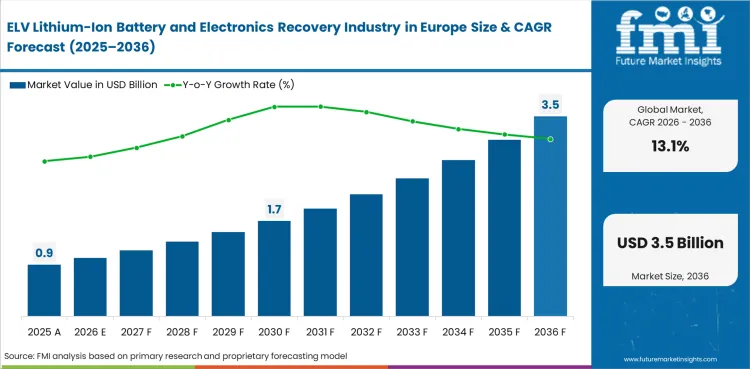
Key Takeaways, Market Size, and Forecast - ELV Lithium-Ion Battery and Electronics Recovery Industry in Europe
- The ELV lithium-ion battery and electronics recovery industry in Europe was valued at USD 0.8 billion in 2025.
- The market is set to reach USD 0.9 billion by 2026-end and grow at a CAGR of 13.1% between 2026-2036 to reach USD 3.1 billion by 2036.
- NMC will dominate with a 41.6% share, while black mass refining will lead with a 34.2% share.
- The ELV lithium-ion battery and electronics recovery industry in Europe was valued at USD 0.8 billion in 2025.
- By 2036, the industry is expected to be worth USD 3.1 billion.
- From 2026 to 2036, the market is projected to expand at a CAGR of 13.1%.
- The market is projected to create an incremental opportunity of USD 2.2 billion between 2026 and 2036.
- In 2026, NMC is expected to account for 41.6% of the battery chemistry segment, driven by higher recoverable metal value and clearer downstream refining economics.
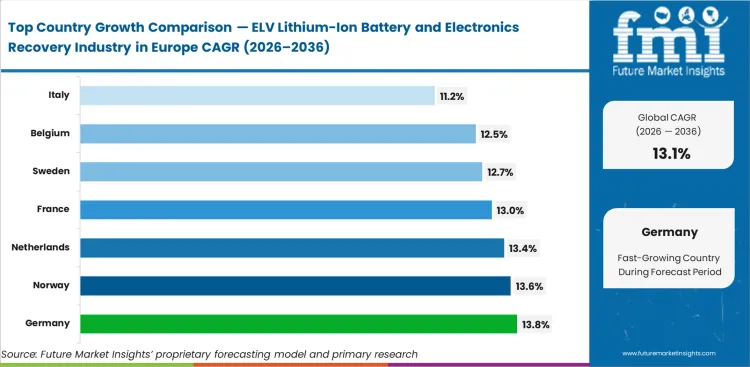
- Germany (13.8%) and Norway (13.6%) are two of the fastest growing markets in Europe.
ELV Lithium-Ion Battery and Electronics Recovery Industry in Europe Key Takeaways
| Parameter | Details |
|---|---|
| Market value (2026) | USD 0.9 billion |
| Forecast value (2036) | USD 3.1 billion |
| CAGR (2026 to 2036) | 13.10% |
| Estimated market value (2025) | USD 0.8 billion |
| Incremental opportunity | USD 2.2 billion |
| Leading battery chemistry | NMC |
| Leading recovery stage | Black mass refining |
| Leading recovered output | Black mass |
| Leading process technology | Hydrometallurgy |
| Brands referenced in market landscape | Umicore, Fortum Battery Recycling, Stena Recycling, Ecobat, ACCUREC Recycling, REDUX Recycling |
Source: Future Market Insights (FMI) analysis, based on proprietary forecasting model and primary research
Vehicle dismantlers and recovery operators are deciding whether battery packs and electronic assemblies should stay inside legacy scrap practice or move into dedicated handling chains. Pack condition and electronics sorting affect pricing much earlier in the chain. Higher battery volume does not by itself make the economics work. Recovery value depends on how well the first handling stage preserves material quality, safety, and traceability.
Intake discipline is becoming the threshold that moves this market from narrower recovery activity into more scalable industrial flow. Stronger battery identification data helps dismantlers price downstream routing more effectively. Better intake quality improves recovery decisions across batteries and electronics because uncertainty around chemistry and processing fit is reduced.
Germany is projected to witness a CAGR of 13.8% in the market through 2036, supported by strong EV penetration, established recovery capacity, and deeper alignment between dismantling and downstream processing. Norway is expected to expand at 13.6% CAGR, backed by its high electric-vehicle base and mature recovery focus. The Netherlands is likely to record 13.4% CAGR, while France is set to post 13.0% CAGR. Sweden is anticipated to grow at 12.7% CAGR, compared with a CAGR of 12.5% for Belgium and 11.2% CAGR for Italy, where feedstock quality and industrial readiness are advancing at a more measured pace.
Nickel Weakness Is Capping Battery Recovery Upside
In April 2025, the World Bank highlighted a mixed pricing environment for Europe’s ELV lithium‑ion battery and electronics recovery market. Cobalt prices rose 13% in 2025Q1, supporting recovered value, while lithium prices remained largely stable after late‑2024 gains. In contrast, nickel prices fell 35% over the past two years and were projected to decline a further 6% in 2025, with Indonesia supplying around 60% of global output. This imbalance affects black‑mass economics, as weak nickel pricing weighs on NMC‑linked returns and increases reliance on yield control, refining efficiency, and secured offtake.
Copper and Aluminum Scrap Are Supporting Electronics Recovery
Electronics recovery economics in Europe are being strengthened by higher nonferrous scrap prices. U.S. Bureau of Labor Statistics data released in February 2026 showed nonferrous scrap rising 42.3% year on year and 8.5% month on month in January 2026. Copper scrap prices increased 26.7% year on year, while aluminum scrap rose 30.6%. These trends are directly relevant to ELV electronics recovery, as wiring, motors, connectors, casings, and mixed assemblies are sold through internationally benchmarked scrap markets. Stronger copper and aluminum realizations help offset weaker battery‑metal pricing when dismantling and sorting maximize clean metal recovery.
Segmental Analysis
Key Facts About Segments
- NMC is expected to account for 41.6% share in 2026 within battery chemistry. Nickel-rich chemistries hold stronger commercial appeal because recoverable metal value and downstream refining logic are clearer at intake.
- Black mass refining is likely to secure 34.2% share in 2026 under recovery stage. Value becomes easier to price once mixed battery content turns into an intermediate product.
- Black mass is anticipated to represent 29.4% of the market in 2026 under recovered output. It is the clearest commercial bridge between dismantling-stage recovery and deeper metals refining demand.
- Market estimates place control units at 26.8% share in 2026 under electronics stream. Broad installed-base presence across old and new vehicles keeps removal volume meaningful.
- By 2026, BEVs are likely to contribute 38.7% of total demand under vehicle source. Traction packs and denser power electronics create a richer recoverable pool per vehicle.
- Hydrometallurgy is forecast to account for 37.1% share in 2026 under process technology. Europe favors routes that can capture lithium alongside nickel, cobalt, and copper.
ELV Lithium-Ion Battery and Electronics Recovery Industry in Europe Analysis by Battery Chemistry
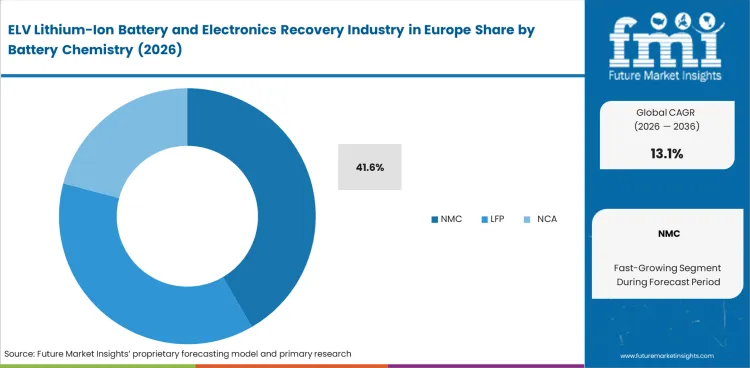
Recoverable metal value determines where commercial attention goes in this market, and nickel-rich chemistries keep the clearest pricing logic once packs enter a clean treatment route. Dismantlers and refining-side buyers prefer streams with more predictable nickel, cobalt, and lithium value. LFP and mixed chemistries will expand as retirement profiles change, though the current European ELV mix leans toward earlier NMC-heavy vehicles. NMC is expected to account for 41.6% share in 2026 within battery chemistry. A weak chemistry read at intake can lower pricing confidence immediately and push otherwise valuable packs into less attractive routes.
- Chemistry fit: NMC gives recyclers a clearer value case because the recovered metal mix is easier to place into refining routes.
- Feed quality: Better identification at pack intake reduces sorting mistakes and preserves the economics of nickel-rich material.
- Route clarity: Refiners pay closer attention to streams that arrive with a cleaner chemistry profile and lower handling uncertainty.
ELV Lithium-Ion Battery and Electronics Recovery Industry in Europe Analysis by Recovery Stage
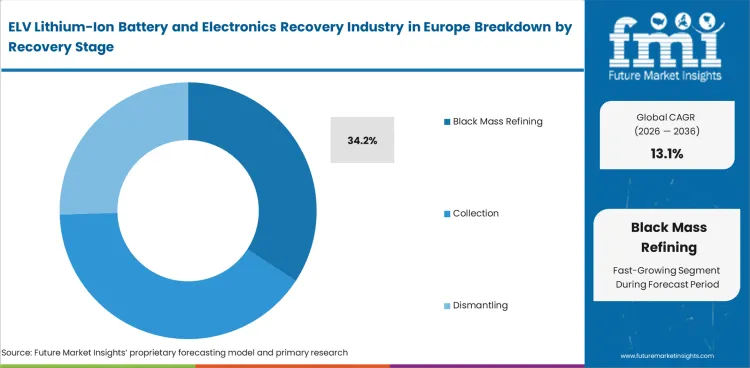
Collection alone does not secure value because stronger returns appear only after battery content becomes an intermediate product that downstream buyers can price with confidence. Collection and dismantling matter, but they do not offer the same pricing leverage or margin visibility as refining-ready treatment. Black mass refining is projected to emerge with 34.2% market share in 2026. Timing between disassembly and refining-ready treatment matters because long delays raise handling cost and increase the chance of quality loss. Operators gain the strongest advantage when material moves quickly from safe removal into refining-oriented treatment.
- Refining pull: Black mass refining leads because it connects pack treatment directly with the point where material becomes more clearly priceable.
- Timing control: Shorter movement from dismantling to refining helps reduce safety risk and preserve intermediate quality.
- Output discipline: Tighter control at this stage lowers losses from mixed fractions and avoidable contamination.
ELV Lithium-Ion Battery and Electronics Recovery Industry in Europe Analysis by Recovered Output
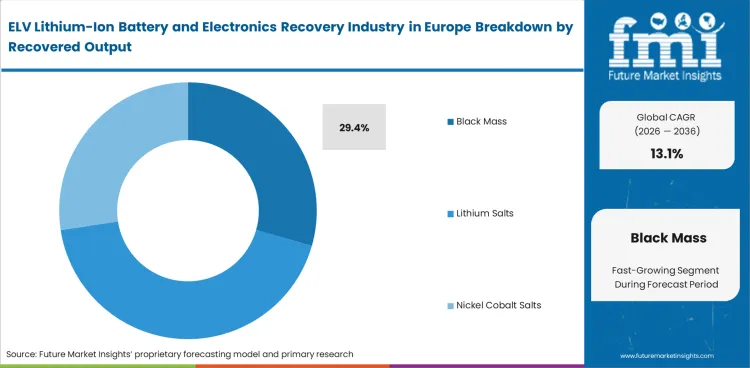
Intermediate products determine how easily value passes from dismantlers and pretreatment operators into more advanced refining demand. Recovered salts and separated metal fractions remain important, but many operators first reach visible monetization through a product that is easier to trade and compare across buyers. Black mass is the clearest bridge between early processing and downstream demand linked to metals recovery. A 29.4% market share is anticipated for black mass in 2026. Poor separation before this stage weakens yield and reduces buyer confidence in grade stability.
- Bridge product: Black mass gives recovery operators a saleable handoff point before deeper refining begins.
- Metal carryover: Better pre-treatment keeps lithium, nickel, cobalt, and copper value inside the outgoing stream.
- Buyer confidence: Stable output quality helps downstream buyers accept material without wide pricing discounts.
ELV Lithium-Ion Battery and Electronics Recovery Industry in Europe Analysis by Electronics Stream
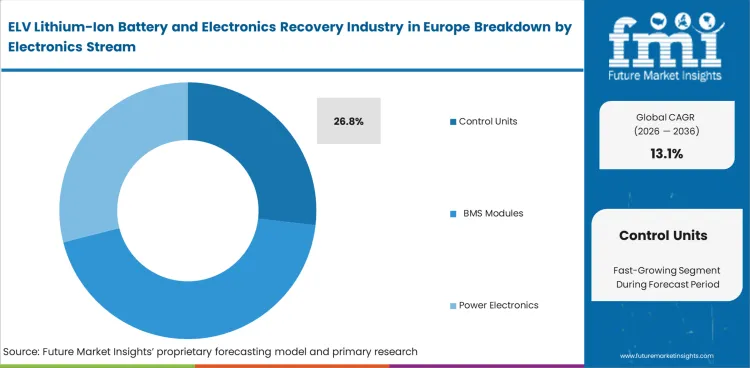
Vehicle electronics recovery depends on how widely a component appears across the ELV base and how much value it retains once removed. Control units remain commercially important because they appear across a wide range of functions and reach dismantlers as discrete assemblies. Battery management units and power electronics matter too, especially in electrified vehicles, but control units hold the broader installed-base advantage. Control units are forecast to represent 26.8% of market demand in 2026. Recovery businesses perform better when they prioritize electronics that offer removal practicality and repeatable downstream value.
- Installed base: Control units lead because they are found across a broad range of legacy and newer vehicles.
- Removal ease: Discrete assemblies are easier to identify and separate than small, embedded electronics.
- Sorting upside: Early separation improves the chance of better board recovery and cleaner downstream metals output.
ELV Lithium-Ion Battery and Electronics Recovery Industry in Europe Analysis by Vehicle Source
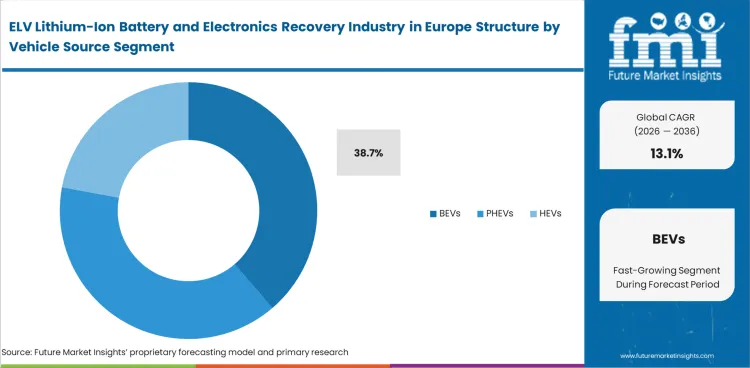
Feedstock richness changes sharply by vehicle type, so recovery planning now depends more on source profile than on simple ELV volume. BEVs stand out because full traction packs and denser power electronics create a much larger recoverable pool per vehicle than hybrid or conventional models. PHEVs and HEVs add useful material, but their smaller systems usually carry lower value concentration at retirement. FMI estimates suggest BEVs will represent 38.7% of the market in 2026. Businesses that adapt to richer BEV-derived feed earlier are better placed to preserve yield before those materials are diluted in broader ELV processing.
- Pack density: BEVs bring more battery mass and more valuable electronic hardware into each end-of-life event.
- Voltage burden: High-voltage handling raises the need for better removal discipline and safer transport routines.
- Yield quality: Specialized BEV treatment helps keep battery and electronics value from being lost in mixed ELV processing.
ELV Lithium-Ion Battery and Electronics Recovery Industry in Europe Analysis by Process Technology
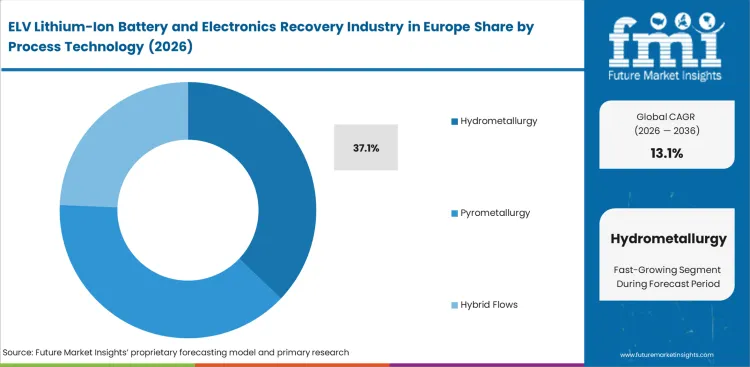
Process technology determines whether the chain captures high-value metals in a form that supports stronger refining economics. Europe favors routes that recover lithium as well as nickel, cobalt, and copper, so hydrometallurgy remains commercially central. Pyrometallurgy has a place for selected inputs, but it does not satisfy every buyer's requirement once lithium recovery becomes more important and downstream specifications tighten. Hydrometallurgy is set to make up 37.1% of the market in 2026. Operators strengthen margins when process choice follows recoverable value rather than legacy treatment habits.
- Lithium recovery: Hydrometallurgy leads because it better fits the push to recover lithium alongside base and critical metals.
- Process match: Mixed ELV battery streams need routes that can handle chemistry variation without excessive value loss.
- Refining fit: Downstream buyers prefer intermediate output that arrives in a form suited to more precise metals recovery.
ELV Lithium-Ion Battery and Electronics Recovery Industry in Europe Drivers, Restraints, and Opportunities
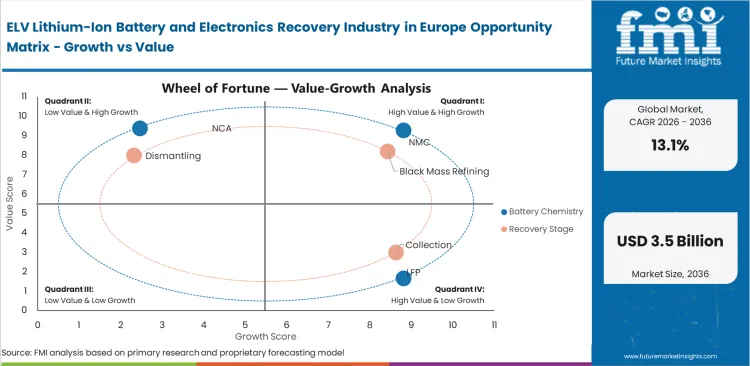
Battery-rich ELV flows are harder to treat as ordinary scrap because more value depends on safe pack removal, electronics separation, and early routing into dedicated refining paths. Authorized treatment facilities, transport coordinators, and refining-side buyers benefit when recovery starts before bulk shredding. Stronger handling discipline supports cleaner outputs and steadier buyer interest. A chain built around mixed scrap economics leaves too much value trapped in the first handling step.
Battery identification and safe triage are the main brake on scale. Pack condition may be unclear when vehicles arrive damaged, battery data may be incomplete, and dismantlers do not all work with the same process maturity. Transport planning, storage rules, and downstream pricing become harder to align under those conditions. Newer compliance systems reduce part of the uncertainty, though clean intake remains difficult when early handling quality varies.
Opportunities in the ELV Lithium-Ion Battery and Electronics Recovery Industry in Europe
- Pack data handoff: Better transfer of battery information creates room for faster routing decisions and earlier risk assessment.
- Refining adjacency: Facilities closer to dismantling and pre-treatment sites can shorten handling loops and improve output quality.
- Electronics extraction: More disciplined removal of control units, boards, and power modules supports higher-value recovery routes.
Regional Analysis
Key Facts About Country
- Germany is expected to register 13.8% CAGR through 2036, which places it at the top of the country group.
- Norway is forecast to post 13.6% CAGR through 2036 because its electric-vehicle base is deeper and battery-rich ELV flows arrive earlier.
- The Netherlands is likely to see ELV lithium-ion battery and electronics recovery advance at a CAGR of 13.4% through 2036.
- France is projected to record 13.0% CAGR in ELV lithium-ion battery and electronics recovery during the forecast period.
- Sweden is set to post 12.7% CAGR in the market for ELV lithium-ion battery and electronics recovery during the assessment period.
- Belgium should record 12.5% CAGR in ELV lithium-ion battery and electronics recovery through the study period.
- Italy is expected to register 11.2% CAGR in ELV lithium-ion battery and electronics recovery through 2036.
Based on the regional analysis, the ELV Lithium-Ion Battery and Electronics Recovery Industry in Europe is segmented into Western Europe, Northern Europe, and Southern Europe across 40 plus countries.
.webp "Top Country Growth Comparison Elv Lithium Ion Battery And Electronics Recovery Industry In Europe Cagr (2026 2036)")
| Country | CAGR (2026 to 2036) |
|---|---|
| Germany | 13.8% |
| Norway | 13.6% |
| Netherlands | 13.4% |
| France | 13.0% |
| Sweden | 12.7% |
| Belgium | 12.5% |
| Italy | 11.2% |
Source: Future Market Insights (FMI) analysis, based on proprietary forecasting model and primary research
Western Europe ELV Lithium-Ion Battery and Electronics Recovery Industry in Europe Analysis
Western Europe has a larger role in this study because vehicle scale, dismantling density, and shorter distance to refining assets improve commercial fit. Countries in this group combine legacy ELV volume with rising electrified vehicle retirement. Recovery businesses focus on intake quality and cross-border material movement. Organized collection and routing discipline matter because operators with cleaner removal routines place intermediate material into downstream contracts more easily.
- Germany: Germany benefits from vehicle scale and an industrial base that is already familiar with battery handling and metals recovery. A wider installed base helps recovery companies justify dedicated lines for packs and electronics. Demand for ELV lithium-ion battery and electronics recovery in Germany is expected to rise at a CAGR of 13.8% from 2026 to 2036. Battery-rich retirements are likely to deepen first where dismantling, testing, and refining work closely together. Stable intake quality matters more than sporadic volume.
- Netherlands: Cross-border material movement shapes the Dutch position more than domestic size. Logistics efficiency and port access make it easier to move battery material and electronic fractions into downstream treatment. Recovery activity in the Netherlands is projected to expand at a CAGR of 13.4% during the forecast period. Shorter handling loops help recyclers preserve value when pack condition is uncertain or electronics need faster sorting. The Netherlands earns its role as a routing point inside the European chain.
- France: France sits in a balanced position where electrified vehicle growth, industrial capability, and a broad vehicle base support steady expansion. Recovery businesses benefit from the country’s automotive footprint, though performance depends on how well pack removal and electronics sorting are handled before material moves deeper into the chain. Market growth for ELV lithium-ion battery and electronics recovery in France is expected to run at a CAGR of 13.0% during the forecast period. Cleaner early-stage process creates cleaner output and reduces pricing uncertainty.
- Belgium: Refining proximity keeps Belgium relevant even though its vehicle base is smaller than Germany or France. ELV lithium-ion battery and electronics recovery in Belgium is poised to grow at a CAGR of 12.5% through 2036 because the country sits close to industrial routes that matter for battery-material processing. Location advantage helps keep value inside Europe when intermediate output needs a reliable downstream home. Recovery businesses benefit most when incoming material quality is cleaner.
FMI’s report reviews other Western European countries where feedstock quality and logistics discipline vary with local ELV structure. Sub-regional growth depends on whether dismantlers and downstream processors can reduce uncertainty around pack condition and electronics sorting before material changes hands.
Northern Europe ELV Lithium-Ion Battery and Electronics Recovery Industry in Europe Analysis
Northern Europe has a different shape because electrification depth is higher and battery-rich feedstock arrives earlier. Recovery readiness is therefore a practical issue rather than a distant planning topic. Operators in this group face reuse checks, safe transport, and routing into BEV-linked flows sooner than many other European markets.
- Norway: High EV penetration gives Norway one of the clearest early signals for how this industry behaves as electrified vehicles age out of the fleet. Recovery businesses spend less time proving that the feedstock shift is real and more time building safe handling methods. Norway is projected to record a CAGR of 13.6% in ELV lithium-ion battery and electronics recovery during the forecast period. That timing advantage keeps the country near the top of the regional growth band.
- Sweden: Industrial competence and a mature circularity mindset keep Sweden important in this study. ELV lithium-ion battery and electronics recovery demand in Sweden is projected to increase at 12.7% CAGR by 2036 as more electrified vehicles leave service and enter channels that separate batteries and electronics with greater care. Sweden does not depend on volume alone. Its advantage comes from connecting vehicle retirement with organized recovery and downstream treatment.
FMI’s report includes other Northern European markets where electrification is advanced but industrial scale differs. Timing binds the sub-region together because battery-heavy ELV flows arrive sooner and force recovery systems to mature earlier.
Southern Europe ELV Lithium-Ion Battery and Electronics Recovery Industry in Europe Analysis
Southern Europe is less advanced in battery-rich ELV feedstock, though it remains relevant because later adoption creates rising need for dedicated treatment. Recovery systems in this part of Europe are shaped more by gradual industrial adaptation than by early saturation. A slower start changes the sequence of investment rather than removing the opportunity.
- Italy: Italy enters the forecast from a lower electrification base than the northern leaders, so battery-rich ELV volumes are lighter in the early years. Progress depends on how quickly dismantling and sorting move beyond conventional scrap habits. A CAGR of 11.2% is expected for ELV lithium-ion battery and electronics recovery in Italy from 2026 to 2036. A slower starting point leaves room for improvement, but material value will only be captured when handling discipline improves with feedstock change.
FMI’s report covers additional Southern European countries where the same pattern appears at different degrees. Growth is present, but the commercial payoff arrives faster where recovery operators update handling routines before battery-rich ELV flows become harder to manage.
Competitive Aligners for Market Players
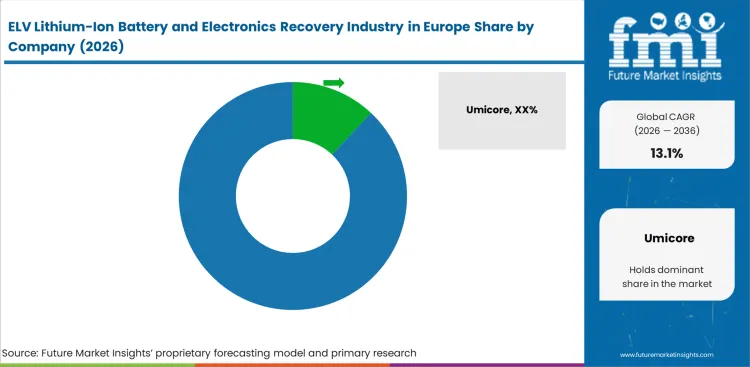
Competition remains moderately fragmented because integration is uneven across the value chain in the ELV lithium-ion battery and electronics recovery industry in Europe. It is not accurate to say that no operator spans collection through refining, since some players present integrated recycling models in Europe. The better reading is that integration exists, but it is not consistent across the market. Umicore and Fortum should therefore be read as different operating models rather than firms active at fully separate stages. For buyers, vendor choice depends on secure intake and reliable traceability. It also depends on how well each operator handles damaged packs and mixed chemistries, because output quality and downstream acceptance are shaped early in the process.
Early advantage comes from stronger control of the first processing stages. Stena Recycling remains relevant because it combines intake with testing and dismantling, even when final refining is done through partners. Ecobat also remains important as a pre treatment specialist with strength in collection and shredding. That means first stage conditioning carries more weight than many buyers assume. A recycler that stabilizes incoming material and routes it safely can build confidence even without owning every downstream step. New entrants can still win share, but only when they show tighter control over feed quality and safer operating discipline.
Feedstock owners should continue to hold influence because the contract structure affects routing flexibility when battery mix changes. The stronger recovery partners are the ones that explain their handling process clearly from receipt to downstream transfer. That clarity matters because buyers are judging operational risk as much as price. Competitive pressure will rise as more operators pursue battery-rich ELV volumes. Even so, this market is unlikely to become a simple price contest because compliance and safety remain central to partner selection.
Key Players in ELV Lithium-Ion Battery and Electronics Recovery Industry in Europe
- Umicore
- Fortum Battery Recycling
- Stena Recycling
- Ecobat
- ACCUREC Recycling
- REDUX Recycling
Scope of the Report
| Metric | Value |
|---|---|
| Quantitative Units | USD 0.9 billion to USD 3.1 billion, at a CAGR of 13.10% |
| Market Definition | Recovery value tied to end-of-life vehicle lithium-ion batteries and automotive electronic assemblies in Europe, covering collection, safe removal, sorting, intermediate treatment, and refining-linked outputs. Scope excludes generic ELV shredding value, lead-acid recycling, and manufacturing scrap not linked to ELVs. |
| Battery Chemistry Segmentation | NMC, LFP, NCA, Mixed Li-ion, Li-ion polymer |
| Recovery Stage Segmentation | Collection, Dismantling, Mechanical shredding, Black mass refining, Material purification |
| Recovered Output Segmentation | Black mass, Lithium salts, Nickel cobalt salts, Copper aluminium fractions, Plastics fractions |
| Electronics Stream Segmentation | Control units, BMS modules, Power electronics, Infotainment units, Sensors, Wiring assemblies |
| Vehicle Source Segmentation | BEVs, PHEVs, HEVs, ICE vehicles, Commercial EVs |
| Process Technology Segmentation | Mechanical separation, Hydrometallurgy, Pyrometallurgy, Direct recycling, Hybrid flows |
| Regions Covered | Western Europe, Northern Europe, Southern Europe |
| Countries Covered | Germany, Norway, Netherlands, France, Sweden, Belgium, Italy, and 40 plus countries |
| Key Companies Profiled | Umicore, Fortum Battery Recycling, Stena Recycling, Ecobat, ACCUREC Recycling, REDUX Recycling |
| Forecast Period | 2026 to 2036 |
| Approach | FMI combined interviews across the ELV recovery chain with desk review of battery recovery rules, recycler positioning, electrified vehicle retirement direction, and intermediate material flow economics. Forecasts were anchored to ELV feedstock change, battery chemistry mix, electronics intensity, and the value capture available across dismantling, pre-treatment, and refining-linked outputs. |
Source: Future Market Insights (FMI) analysis, based on proprietary forecasting model and primary research
ELV Lithium-Ion Battery and Electronics Recovery Industry in Europe Analysis by Segments
Battery Chemistry:
- NMC
- LFP
- NCA
- Mixed Li-ion
- Li-ion polymer
Recovery Stage:
- Collection
- Dismantling
- Mechanical shredding
- Black mass refining
- Material purification
Recovered Output:
- Black mass
- Lithium salts
- Nickel cobalt salts
- Copper aluminium fractions
- Plastics fractions
Electronics Stream:
- Control units
- BMS modules
- Power electronics
- Infotainment units
- Sensors
- Wiring assemblies
Vehicle Source:
- BEVs
- PHEVs
- HEVs
- ICE vehicles
- Commercial EVs
Process Technology:
- Mechanical separation
- Hydrometallurgy
- Pyrometallurgy
- Direct recycling
- Hybrid flows
Region:
- Western Europe
- Germany
- France
- Netherlands
- Belgium
- Austria
- Switzerland
- Luxembourg
- Northern Europe
- Denmark
- Sweden
- Norway
- Finland
- Ireland
- Iceland
- Southern Europe
- Italy
- Spain
- Portugal
- Greece
- Malta
- Cyprus
- Eastern Europe
- Poland
- Czech Republic
- Hungary
- Romania
- Slovakia
- Bulgaria
- Croatia
- Slovenia
- Estonia
- Latvia
- Lithuania
Bibliography
- USA Bureau of Labor Statistics. (2026, February 27). Producer Price Index News Release - 2026 M01 Results. U.S. Department of Labor.
- World Bank. (2025, April 3). Commodity Markets Outlook -- April 2025. World Bank.
- OECD. (2025). Improving evidence-based assessments of environmental policies. OECD Publishing.
- USA Bureau of Labor Statistics. (2026, February). Table 9. Producer price indexes for commodity and service groupings and individual items [PDF]. U.S. Department of Labor.
- OECD. (2025). The evolution of cleantech manufacturing. OECD Publishing.
- European Automobile Manufacturers’ Association. (2026, January 27). New car registrations: +1.8% in 2025; battery-electric 17.4% market share. ACEA.
- RECHARGE. (2025). RECHARGE Black Mass Whitepaper. RECHARGE.
- Fortum. (2026, March 25). Fortum Battery Recycling signs Grant Agreement with CINEA. Fortum.
- Ecobat. (2025, April 3). Ecobat Accelerates Battery Recycling with Three Fully Operational Lithium Recycling Plants in 12 Months. Ecobat.
- Stena Recycling. (2026, February 4). Stena Recycling expands major investment in electric vehicle batteries. Stena Recycling.
- Umicore. (2026, February 20). Full Year Results 2025. Umicore.
- Alcoceba-Pascual, S., Ortego, A., Villanueva-Martínez, N. I., van Schaik, A., Reuter, M. A., Iglesias-Émbil, M., & Valero, A. (2025, July 1). Evaluating the recyclability of electronic car parts through disassemblability, thermodynamic and metallurgical analyses. Journal of Cleaner Production, 513, 145725.
This bibliography is provided for reader reference. The full FMI report contains the complete reference list with primary source documentation.
This Report Addresses
- Market intelligence to support strategic decisions across traction battery packs, battery modules, black mass refining, automotive control units, and power electronics
- Market size estimation and 10-year revenue forecasts from 2026 to 2036 supported by ELV feedstock transition analysis, battery chemistry interpretation, and recovery-stage economics
- Growth opportunity mapping across battery chemistry, recovery stage, recovered output, electronics stream, vehicle source, and process technology with emphasis on safe intake and output quality
- Segment and regional revenue forecasts covering NMC, black mass refining, black mass, control units, BEVs, and hydrometallurgy across European recovery systems
- Competition strategy assessment including safe intake discipline, output quality, downstream placement confidence, and cross-border routing efficiency
- Battery and electronics recovery development tracking across hydrometallurgy, mechanical separation, black mass conversion, control-unit extraction, and pack handling
- Market access analysis covering authorized treatment facilities, reverse-logistics routing, refining-linked outputs, and recovery chains built around battery and electronics value
- Market report delivery in PDF, Excel, PPT, and interactive dashboard formats for executive strategy, circularity planning, and operational benchmarking use
Frequently Asked Questions
How large is the ELV lithium-ion battery and electronics recovery industry in Europe in 2026?
Industry value is estimated at USD 0.9 billion in 2026.
What valuation is expected by 2036?
FMI estimates the industry will reach USD 3.1 billion by 2036.
What CAGR is projected for the forecast period?
Growth is projected at a 13.1% CAGR from 2026 to 2036.
What was the estimated market size in 2025?
Baseline valuation stands at USD 0.8 billion for 2025.
Which battery chemistry leads the revenue mix?
NMC batteries are expected to account for 41.6% share in 2026 because they remain widely present in legacy EV and hybrid retirement flows.
Which recovery stage contributes the largest share?
Black mass refining is projected to represent 34.2% share in 2026 because value realization improves after dismantling and pre-treatment.
Which recovered output stays most commercially important?
Black mass is anticipated to hold 29.4% share in 2026 since it remains the main intermediate output connecting recovery with refining.
Which electronics stream leads within dismantled vehicle systems?
Control units are likely to secure 26.8% share in 2026 because they appear across conventional and electrified vehicle systems.
Which vehicle source generates the strongest recovery value?
BEVs are set to make up 38.7% share in 2026 as larger battery packs and denser electronics create richer recovery value per vehicle.
Which process route leads across recycling operations?
Hydrometallurgy is forecast to account for 37.1% share in 2026 because it aligns with lithium as well as nickel, cobalt, and copper recovery.
Which buyer group leads demand for recovered material?
Battery refiners and downstream processors lead demand where black mass and purified outputs enter refining-linked contracts.
Which collection channel remains most important in Europe?
Authorized treatment facilities remain central because ELV depollution and battery-safe handling usually start there.
What is driving faster expansion in this industry?
Growth is supported by rising EV retirements, stricter recovery expectations, and better sorting at early handling stages.
What is the main restraint for wider scale-up?
Safe battery handling, transport complexity, chemistry variation, and uneven feedstock quality continue to slow recovery scale-up.
Which country records the fastest forecast growth?
Germany leads the country outlook with a projected 13.8% CAGR through 2036.
Why does Germany stay ahead in the regional outlook?
Germany benefits from a larger EV base, stronger dismantling infrastructure, and closer access to battery and metals recovery capacity.
How does Norway remain a strong growth market?
Norway is expected to grow at 13.6% CAGR because deep EV penetration supports a stronger future stream of battery-rich ELVs.
Why is the Netherlands important for this report?
The Netherlands is projected to expand at 13.4% CAGR as logistics strength and port access support battery and electronics movement.
What keeps France in the upper range of the country outlook?
France is forecast to post 13.0% CAGR through 2036 as electrification depth and industrial recovery capability improve.
How do Sweden and Belgium compare in forecast terms?
Sweden is expected to register 12.7% CAGR and Belgium 12.5% because both markets link recovery with downstream processing discipline.
Why does Italy grow below the top tier?
Italy is projected to expand at 11.2% CAGR because battery-rich ELV volume and dedicated handling capacity are building more gradually.
What makes competition different from ordinary scrap handling?
Competitive strength depends on safe battery removal, material traceability, and quality control across downstream transfer.
What is the non-obvious point in this recovery chain?
Battery and electronics value is not unlocked by volume alone because dismantling quality shapes pricing and route choice early.
What does the report include within scope?
Coverage includes ELV-derived lithium-ion batteries, battery packs, modules, BMS units, power electronics, control units, and refining-linked outputs.
What falls outside the report scope?
Lead-acid battery recycling, manufacturing scrap unrelated to ELVs, tire-only streams, and undifferentiated whole-vehicle shredding fall outside scope.
Preview the report firsthand - request a free sample
Get SampleGet the brochure for pricing and purchase details.
Get PDFTable of Content
- Executive Summary
- Global Market Outlook
- Demand-side Trends
- Supply-side Trends
- Technology Roadmap Analysis
- Analysis and Recommendations
- Market Overview
- Market Coverage / Taxonomy
- Market Definition / Scope / Limitations
- Research Methodology
- Chapter Orientation
- Analytical Lens and Working Hypotheses
- Market Structure, Signals, and Trend Drivers
- Benchmarking and Cross-market Comparability
- Market Sizing, Forecasting, and Opportunity Mapping
- Research Design and Evidence Framework
- Desk Research Programme (Secondary Evidence)
- Company Annual and Sustainability Reports
- Peer-reviewed Journals and Academic Literature
- Corporate Websites, Product Literature, and Technical Notes
- Earnings Decks and Investor Briefings
- Statutory Filings and Regulatory Disclosures
- Technical White Papers and Standards Notes
- Trade Journals, Industry Magazines, and Analyst Briefs
- Conference Proceedings, Webinars, and Seminar Materials
- Government Statistics Portals and Public Data Releases
- Press Releases and Reputable Media Coverage
- Specialist Newsletters and Curated Briefings
- Sector Databases and Reference Repositories
- FMI Internal Proprietary Databases and Historical Market Datasets
- Subscription Datasets and Paid Sources
- Social Channels, Communities, and Digital Listening Inputs
- Additional Desk Sources
- Expert Input and Fieldwork (Primary Evidence)
- Primary Modes
- Qualitative Interviews and Expert Elicitation
- Quantitative Surveys and Structured Data Capture
- Blended Approach
- Why Primary Evidence is Used
- Field Techniques
- Interviews
- Surveys
- Focus Groups
- Observational and In-context Research
- Social and Community Interactions
- Stakeholder Universe Engaged
- C-suite Leaders
- Board Members
- Presidents and Vice Presidents
- R&D and Innovation Heads
- Technical Specialists
- Domain Subject-matter Experts
- Scientists
- Physicians and Other Healthcare Professionals
- Governance, Ethics, and Data Stewardship
- Research Ethics
- Data Integrity and Handling
- Primary Modes
- Tooling, Models, and Reference Databases
- Desk Research Programme (Secondary Evidence)
- Data Engineering and Model Build
- Data Acquisition and Ingestion
- Cleaning, Normalisation, and Verification
- Synthesis, Triangulation, and Analysis
- Quality Assurance and Audit Trail
- Market Background
- Market Dynamics
- Drivers
- Restraints
- Opportunity
- Trends
- Scenario Forecast
- Demand in Optimistic Scenario
- Demand in Likely Scenario
- Demand in Conservative Scenario
- Opportunity Map Analysis
- Product Life Cycle Analysis
- Supply Chain Analysis
- Investment Feasibility Matrix
- Value Chain Analysis
- PESTLE and Porter’s Analysis
- Regulatory Landscape
- Regional Parent Market Outlook
- Production and Consumption Statistics
- Import and Export Statistics
- Market Dynamics
- Global Market Analysis 2021 to 2025 and Forecast, 2026 to 2036
- Historical Market Size Value (USD Million) Analysis, 2021 to 2025
- Current and Future Market Size Value (USD Million) Projections, 2026 to 2036
- Y-o-Y Growth Trend Analysis
- Absolute $ Opportunity Analysis
- Global Market Pricing Analysis 2021 to 2025 and Forecast 2026 to 2036
- Global Market Analysis 2021 to 2025 and Forecast 2026 to 2036, By Battery Chemistry
- Introduction / Key Findings
- Historical Market Size Value (USD Million) Analysis By Battery Chemistry , 2021 to 2025
- Current and Future Market Size Value (USD Million) Analysis and Forecast By Battery Chemistry , 2026 to 2036
- NMC
- LFP
- NCA
- NMC
- Y-o-Y Growth Trend Analysis By Battery Chemistry , 2021 to 2025
- Absolute $ Opportunity Analysis By Battery Chemistry , 2026 to 2036
- Global Market Analysis 2021 to 2025 and Forecast 2026 to 2036, By Recovery Stage
- Introduction / Key Findings
- Historical Market Size Value (USD Million) Analysis By Recovery Stage, 2021 to 2025
- Current and Future Market Size Value (USD Million) Analysis and Forecast By Recovery Stage, 2026 to 2036
- Black Mass Refining
- Collection
- Dismantling
- Black Mass Refining
- Y-o-Y Growth Trend Analysis By Recovery Stage, 2021 to 2025
- Absolute $ Opportunity Analysis By Recovery Stage, 2026 to 2036
- Global Market Analysis 2021 to 2025 and Forecast 2026 to 2036, By Recovered Output
- Introduction / Key Findings
- Historical Market Size Value (USD Million) Analysis By Recovered Output, 2021 to 2025
- Current and Future Market Size Value (USD Million) Analysis and Forecast By Recovered Output, 2026 to 2036
- Black Mass
- Lithium Salts
- Nickel Cobalt Salts
- Black Mass
- Y-o-Y Growth Trend Analysis By Recovered Output, 2021 to 2025
- Absolute $ Opportunity Analysis By Recovered Output, 2026 to 2036
- Global Market Analysis 2021 to 2025 and Forecast 2026 to 2036, By Electronics Stream
- Introduction / Key Findings
- Historical Market Size Value (USD Million) Analysis By Electronics Stream, 2021 to 2025
- Current and Future Market Size Value (USD Million) Analysis and Forecast By Electronics Stream, 2026 to 2036
- Control Value (USD Million)s
- BMS Modules
- Power Electronics
- Control Value (USD Million)s
- Y-o-Y Growth Trend Analysis By Electronics Stream, 2021 to 2025
- Absolute $ Opportunity Analysis By Electronics Stream, 2026 to 2036
- Global Market Analysis 2021 to 2025 and Forecast 2026 to 2036, By Vehicle Source
- Introduction / Key Findings
- Historical Market Size Value (USD Million) Analysis By Vehicle Source, 2021 to 2025
- Current and Future Market Size Value (USD Million) Analysis and Forecast By Vehicle Source, 2026 to 2036
- BEVs
- PHEVs
- HEVs
- BEVs
- Y-o-Y Growth Trend Analysis By Vehicle Source, 2021 to 2025
- Absolute $ Opportunity Analysis By Vehicle Source, 2026 to 2036
- Global Market Analysis 2021 to 2025 and Forecast 2026 to 2036, By Process Technology
- Introduction / Key Findings
- Historical Market Size Value (USD Million) Analysis By Process Technology, 2021 to 2025
- Current and Future Market Size Value (USD Million) Analysis and Forecast By Process Technology, 2026 to 2036
- Hydrometallurgy
- Pyrometallurgy
- Hybrid Flows
- Hydrometallurgy
- Y-o-Y Growth Trend Analysis By Process Technology, 2021 to 2025
- Absolute $ Opportunity Analysis By Process Technology, 2026 to 2036
- Global Market Analysis 2021 to 2025 and Forecast 2026 to 2036, By Region
- Introduction
- Historical Market Size Value (USD Million) Analysis By Region, 2021 to 2025
- Current Market Size Value (USD Million) Analysis and Forecast By Region, 2026 to 2036
- North America
- Latin America
- Western Europe
- Eastern Europe
- East Asia
- South Asia and Pacific
- Middle East & Africa
- Market Attractiveness Analysis By Region
- North America Market Analysis 2021 to 2025 and Forecast 2026 to 2036, By Country
- Historical Market Size Value (USD Million) Trend Analysis By Market Taxonomy, 2021 to 2025
- Market Size Value (USD Million) Forecast By Market Taxonomy, 2026 to 2036
- By Country
- USA
- Canada
- Mexico
- By Battery Chemistry
- By Recovery Stage
- By Recovered Output
- By Electronics Stream
- By Vehicle Source
- By Process Technology
- By Country
- Market Attractiveness Analysis
- By Country
- By Battery Chemistry
- By Recovery Stage
- By Recovered Output
- By Electronics Stream
- By Vehicle Source
- By Process Technology
- Key Takeaways
- Latin America Market Analysis 2021 to 2025 and Forecast 2026 to 2036, By Country
- Historical Market Size Value (USD Million) Trend Analysis By Market Taxonomy, 2021 to 2025
- Market Size Value (USD Million) Forecast By Market Taxonomy, 2026 to 2036
- By Country
- Brazil
- Chile
- Rest of Latin America
- By Battery Chemistry
- By Recovery Stage
- By Recovered Output
- By Electronics Stream
- By Vehicle Source
- By Process Technology
- By Country
- Market Attractiveness Analysis
- By Country
- By Battery Chemistry
- By Recovery Stage
- By Recovered Output
- By Electronics Stream
- By Vehicle Source
- By Process Technology
- Key Takeaways
- Western Europe Market Analysis 2021 to 2025 and Forecast 2026 to 2036, By Country
- Historical Market Size Value (USD Million) Trend Analysis By Market Taxonomy, 2021 to 2025
- Market Size Value (USD Million) Forecast By Market Taxonomy, 2026 to 2036
- By Country
- Germany
- UK
- Italy
- Spain
- France
- Nordic
- BENELUX
- Rest of Western Europe
- By Battery Chemistry
- By Recovery Stage
- By Recovered Output
- By Electronics Stream
- By Vehicle Source
- By Process Technology
- By Country
- Market Attractiveness Analysis
- By Country
- By Battery Chemistry
- By Recovery Stage
- By Recovered Output
- By Electronics Stream
- By Vehicle Source
- By Process Technology
- Key Takeaways
- Eastern Europe Market Analysis 2021 to 2025 and Forecast 2026 to 2036, By Country
- Historical Market Size Value (USD Million) Trend Analysis By Market Taxonomy, 2021 to 2025
- Market Size Value (USD Million) Forecast By Market Taxonomy, 2026 to 2036
- By Country
- Russia
- Poland
- Hungary
- Balkan & Baltic
- Rest of Eastern Europe
- By Battery Chemistry
- By Recovery Stage
- By Recovered Output
- By Electronics Stream
- By Vehicle Source
- By Process Technology
- By Country
- Market Attractiveness Analysis
- By Country
- By Battery Chemistry
- By Recovery Stage
- By Recovered Output
- By Electronics Stream
- By Vehicle Source
- By Process Technology
- Key Takeaways
- East Asia Market Analysis 2021 to 2025 and Forecast 2026 to 2036, By Country
- Historical Market Size Value (USD Million) Trend Analysis By Market Taxonomy, 2021 to 2025
- Market Size Value (USD Million) Forecast By Market Taxonomy, 2026 to 2036
- By Country
- China
- Japan
- South Korea
- By Battery Chemistry
- By Recovery Stage
- By Recovered Output
- By Electronics Stream
- By Vehicle Source
- By Process Technology
- By Country
- Market Attractiveness Analysis
- By Country
- By Battery Chemistry
- By Recovery Stage
- By Recovered Output
- By Electronics Stream
- By Vehicle Source
- By Process Technology
- Key Takeaways
- South Asia and Pacific Market Analysis 2021 to 2025 and Forecast 2026 to 2036, By Country
- Historical Market Size Value (USD Million) Trend Analysis By Market Taxonomy, 2021 to 2025
- Market Size Value (USD Million) Forecast By Market Taxonomy, 2026 to 2036
- By Country
- India
- ASEAN
- Australia & New Zealand
- Rest of South Asia and Pacific
- By Battery Chemistry
- By Recovery Stage
- By Recovered Output
- By Electronics Stream
- By Vehicle Source
- By Process Technology
- By Country
- Market Attractiveness Analysis
- By Country
- By Battery Chemistry
- By Recovery Stage
- By Recovered Output
- By Electronics Stream
- By Vehicle Source
- By Process Technology
- Key Takeaways
- Middle East & Africa Market Analysis 2021 to 2025 and Forecast 2026 to 2036, By Country
- Historical Market Size Value (USD Million) Trend Analysis By Market Taxonomy, 2021 to 2025
- Market Size Value (USD Million) Forecast By Market Taxonomy, 2026 to 2036
- By Country
- Kingdom of Saudi Arabia
- Other GCC Countries
- Turkiye
- South Africa
- Other African Union
- Rest of Middle East & Africa
- By Battery Chemistry
- By Recovery Stage
- By Recovered Output
- By Electronics Stream
- By Vehicle Source
- By Process Technology
- By Country
- Market Attractiveness Analysis
- By Country
- By Battery Chemistry
- By Recovery Stage
- By Recovered Output
- By Electronics Stream
- By Vehicle Source
- By Process Technology
- Key Takeaways
- Key Countries Market Analysis
- USA
- Pricing Analysis
- Market Share Analysis, 2025
- By Battery Chemistry
- By Recovery Stage
- By Recovered Output
- By Electronics Stream
- By Vehicle Source
- By Process Technology
- Canada
- Pricing Analysis
- Market Share Analysis, 2025
- By Battery Chemistry
- By Recovery Stage
- By Recovered Output
- By Electronics Stream
- By Vehicle Source
- By Process Technology
- Mexico
- Pricing Analysis
- Market Share Analysis, 2025
- By Battery Chemistry
- By Recovery Stage
- By Recovered Output
- By Electronics Stream
- By Vehicle Source
- By Process Technology
- Brazil
- Pricing Analysis
- Market Share Analysis, 2025
- By Battery Chemistry
- By Recovery Stage
- By Recovered Output
- By Electronics Stream
- By Vehicle Source
- By Process Technology
- Chile
- Pricing Analysis
- Market Share Analysis, 2025
- By Battery Chemistry
- By Recovery Stage
- By Recovered Output
- By Electronics Stream
- By Vehicle Source
- By Process Technology
- Germany
- Pricing Analysis
- Market Share Analysis, 2025
- By Battery Chemistry
- By Recovery Stage
- By Recovered Output
- By Electronics Stream
- By Vehicle Source
- By Process Technology
- UK
- Pricing Analysis
- Market Share Analysis, 2025
- By Battery Chemistry
- By Recovery Stage
- By Recovered Output
- By Electronics Stream
- By Vehicle Source
- By Process Technology
- Italy
- Pricing Analysis
- Market Share Analysis, 2025
- By Battery Chemistry
- By Recovery Stage
- By Recovered Output
- By Electronics Stream
- By Vehicle Source
- By Process Technology
- Spain
- Pricing Analysis
- Market Share Analysis, 2025
- By Battery Chemistry
- By Recovery Stage
- By Recovered Output
- By Electronics Stream
- By Vehicle Source
- By Process Technology
- France
- Pricing Analysis
- Market Share Analysis, 2025
- By Battery Chemistry
- By Recovery Stage
- By Recovered Output
- By Electronics Stream
- By Vehicle Source
- By Process Technology
- India
- Pricing Analysis
- Market Share Analysis, 2025
- By Battery Chemistry
- By Recovery Stage
- By Recovered Output
- By Electronics Stream
- By Vehicle Source
- By Process Technology
- ASEAN
- Pricing Analysis
- Market Share Analysis, 2025
- By Battery Chemistry
- By Recovery Stage
- By Recovered Output
- By Electronics Stream
- By Vehicle Source
- By Process Technology
- Australia & New Zealand
- Pricing Analysis
- Market Share Analysis, 2025
- By Battery Chemistry
- By Recovery Stage
- By Recovered Output
- By Electronics Stream
- By Vehicle Source
- By Process Technology
- China
- Pricing Analysis
- Market Share Analysis, 2025
- By Battery Chemistry
- By Recovery Stage
- By Recovered Output
- By Electronics Stream
- By Vehicle Source
- By Process Technology
- Japan
- Pricing Analysis
- Market Share Analysis, 2025
- By Battery Chemistry
- By Recovery Stage
- By Recovered Output
- By Electronics Stream
- By Vehicle Source
- By Process Technology
- South Korea
- Pricing Analysis
- Market Share Analysis, 2025
- By Battery Chemistry
- By Recovery Stage
- By Recovered Output
- By Electronics Stream
- By Vehicle Source
- By Process Technology
- Russia
- Pricing Analysis
- Market Share Analysis, 2025
- By Battery Chemistry
- By Recovery Stage
- By Recovered Output
- By Electronics Stream
- By Vehicle Source
- By Process Technology
- Poland
- Pricing Analysis
- Market Share Analysis, 2025
- By Battery Chemistry
- By Recovery Stage
- By Recovered Output
- By Electronics Stream
- By Vehicle Source
- By Process Technology
- Hungary
- Pricing Analysis
- Market Share Analysis, 2025
- By Battery Chemistry
- By Recovery Stage
- By Recovered Output
- By Electronics Stream
- By Vehicle Source
- By Process Technology
- Kingdom of Saudi Arabia
- Pricing Analysis
- Market Share Analysis, 2025
- By Battery Chemistry
- By Recovery Stage
- By Recovered Output
- By Electronics Stream
- By Vehicle Source
- By Process Technology
- Turkiye
- Pricing Analysis
- Market Share Analysis, 2025
- By Battery Chemistry
- By Recovery Stage
- By Recovered Output
- By Electronics Stream
- By Vehicle Source
- By Process Technology
- South Africa
- Pricing Analysis
- Market Share Analysis, 2025
- By Battery Chemistry
- By Recovery Stage
- By Recovered Output
- By Electronics Stream
- By Vehicle Source
- By Process Technology
- USA
- Market Structure Analysis
- Competition Dashboard
- Competition Benchmarking
- Market Share Analysis of Top Players
- By Regional
- By Battery Chemistry
- By Recovery Stage
- By Recovered Output
- By Electronics Stream
- By Vehicle Source
- By Process Technology
- Competition Analysis
- Competition Deep Dive
- Umicore
- Overview
- Product Portfolio
- Profitability by Market Segments (Product/Age /Sales Channel/Region)
- Sales Footprint
- Strategy Overview
- Marketing Strategy
- Product Strategy
- Channel Strategy
- Fortum Battery Recycling
- Stena Recycling
- Ecobat
- ACCUREC Recycling
- REDUX Recycling
- Umicore
- Competition Deep Dive
- Assumptions & Acronyms Used


