

- Industry Size (2026)
- USD 98.0 Mn
- Forecast (2036)
- USD 228.8 Mn
- CAGR (2026 to 2036)
- 8.8%
Smartphone Printed Circuit Board Precious Metal Recovery Facilities in Europe Industry Size, Market Forecast and Outlook By FMI
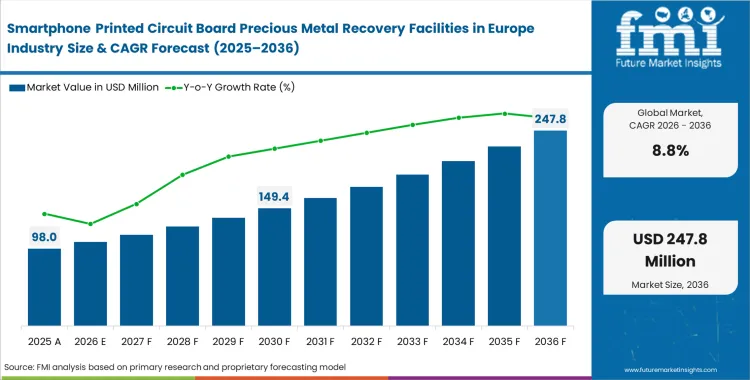
The smartphone printed circuit board precious metal recovery facilities industry in Europe was valued at USD 90.0 million in 2025 and is estimated to reach USD 98.0 million in 2026. FMI estimates the industry will expand at a CAGR of 8.8% from 2026 to 2036, taking total valuation to USD 228.8 million by 2036. Capacity additions at European recycling and refining sites are increasingly tied to raw material security goals, especially as governments and manufacturers place greater weight on domestic recovery of high-value metals from discarded electronics.
Summary of Smartphone Printed Circuit Board Precious Metal Recovery Facilities in Europe Industry
- The market is forecast to reach USD 228.8 million by 2036.
- The market is expected to grow at a CAGR of 8.8% from 2026 to 2036.
- The market was estimated at USD 90.0 million in 2025.
- The forecast period represents an incremental opportunity of USD 130.8 million.
- This market focuses on certified recovery facilities extracting gold, silver, palladium, platinum, and copper from discarded smartphone PCBs within Europe.
- Growth is driven by EU critical raw material security initiatives and the need to strengthen domestic sourcing of valuable metals.
- Demand is supported by the high metal content in smartphone PCBs, making them economically attractive for advanced recovery processes.
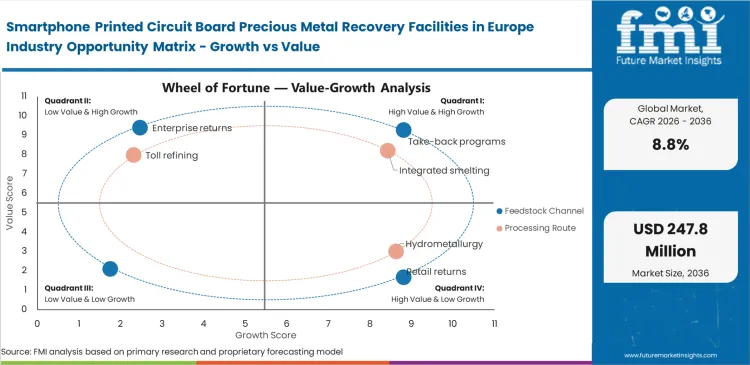
- Take-back programs lead the feedstock channel with a 41% share, highlighting the importance of organized collection systems.
- Integrated smelting dominates the processing route with a 56% share due to strong European refining infrastructure.
- Gold accounts for 48% of recovered value, making it the most economically significant metal in PCB recycling.
- Multimetal refiners hold a 61% share, reflecting the region’s capability to process complex mixed-metal streams.
- Bullion intermediates lead the output segment with a 44% share, ahead of other refined forms.
- Germany, Belgium, and the Netherlands are the fastest-growing markets, with Germany leading at a 9.5% CAGR.
- Umicore, Aurubis, Boliden, Sims Limited, and Metalor Technologies are key participants in the competitive landscape.
Access to end-of-life smartphone printed circuit boards is becoming more selective, which is raising the importance of timely compliance upgrades. Facilities that delay those investments are more likely to lose access to higher-value corporate and telecom take-back volumes.
Precious metal recovery from e-waste follows a far more demanding operating model than basic dismantling or shredding. Gold, silver, palladium, and copper recovery depends on specialized thermal and metallurgical systems, supported by process control that can separate valuable fractions without avoidable loss. Sites limited to shredding often divert value into mixed output streams, where metal content is absorbed into broader copper and copper alloy scrap flows. Yield realization tends to weaken under that model, reducing the commercial value captured from each intake batch.
Feedstock control is now shaping market structure as strongly as plant configuration. Once telecom programs, enterprise take-back channels, and large collection networks allocate volumes to approved recovery partners, independent operators face tighter access to richer board streams. Steady contract volumes help keep furnaces and downstream recovery systems running at more workable utilization levels. Technically capable sites can still face commercial pressure when intake remains irregular, since unstable feedstock lowers recovery efficiency and puts margin consistency under strain.
Germany is projected to witness 9.5% CAGR through 2036, supported by stricter placed-on-market obligations and a stronger compliance-driven collection structure for end-of-life electronics. Belgium is expected to expand at 9.1%, helped by its established non-ferrous and precious-metals processing base. The Netherlands is likely to grow at 8.9% as collection discipline and regulatory enforcement continue to support localized PCB recovery activity. France is estimated at 8.7%, where organized return logistics improve access to recoverable board volumes. Italy is projected to record 8.4% CAGR during the forecast period, reflecting gradual improvement in domestic recovery depth. Spain is expected to post 8.2% as electronic return flows strengthen through local collection channels. Sweden is anticipated to register 7.9%, where broader materials expertise supports recovery activity even as PCB volumes remain comparatively smaller. Across Europe, higher-value circuit board refining is concentrating in countries with deeper metallurgical capability, while lower-value dismantling and initial sorting remain more dispersed across the region.
Segmental Analysis
Smartphone Printed Circuit Board Precious Metal Recovery Facilities in Europe Industry Analysis by Feedstock Channel
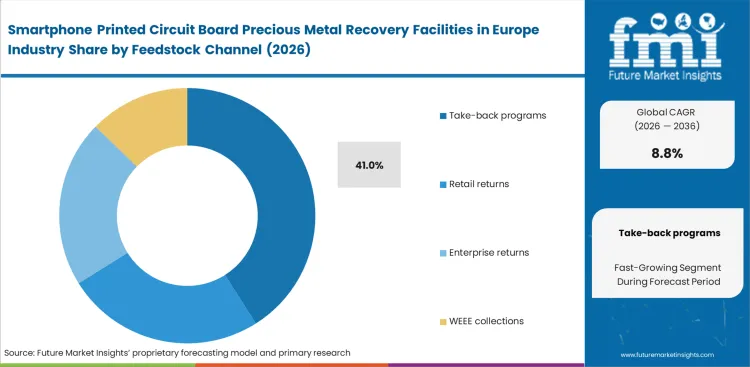
Formal return systems remain central to feedstock security because smelters require steady volumes and tighter material consistency than open-market scrap usually provides. Certified take-back flows reduce sorting uncertainty and help operators manage safety risks linked to mixed consumer electronics returns. Take-back programs are estimated to account for 41.0% share in 2026 because they supply cleaner and more predictable printed circuit boards than municipal channels. Smelter operators rely on that consistency to maintain furnace balance and limit disruption from hidden batteries, plastics, and low-grade mixed assemblies. Municipal sorting streams rarely generate enough concentrated mobile board volume to support efficient transfer into specialized refining networks. Facilities receiving poorly separated loads are more likely to face downgrades or rejection once plastic-heavy batches reach refinery gates.
- Volume predictability: Corporate take-back channels provide more regular monthly inflow. This supports steadier furnace utilization and reduces the risk of feedstock gaps.
- Contamination control: Formal return channels usually remove embedded batteries before shipment. Cleaner loads lower safety risk during shredding and thermal treatment.
- Yield optimization: Purified smartphone board batches allow tighter process control in downstream recovery. Stable input chemistry improves precious metal extraction efficiency.
Smartphone Printed Circuit Board Precious Metal Recovery Facilities in Europe Industry Analysis by Processing Route
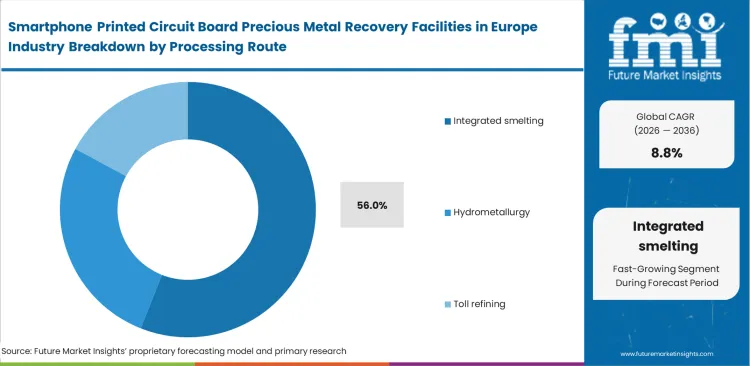
Integrated smelting remains difficult to challenge because the route depends on permit access, large-scale infrastructure, and the ability to process mixed board material without extensive pre-separation. Existing operators benefit from legacy industrial positions that smaller entrants in electronic materials and chemicals cannot easily replicate. Based on FMI’s assessment, integrated smelting is poised to represent 56.0% share in 2026 as established facilities combine scale, thermal efficiency, and compliance readiness in one operating model. Direct furnace treatment also handles brominated plastics more effectively than smaller standalone systems attempting chemical leaching on whole boards. Hydrometallurgical challengers often struggle once pretreatment requirements and gold plating chemicals consumption are factored into operating reality. That leaves established smelters with a clear advantage in high-complexity board recovery.
- Thermodynamic integration: Board plastics contribute energy value and support furnace chemistry during copper-based processing. This lowers dependence on additional external energy input.
- Halogen management: Specialized gas treatment systems manage emissions from flame-retardant-rich board fractions. This is critical for maintaining regulatory compliance in thermal recovery.
- Scale economics: Large furnaces process mixed assemblies with less manual intervention. That reduces dismantling burden and improves throughput efficiency.
Smartphone Printed Circuit Board Precious Metal Recovery Facilities in Europe Industry Analysis by Recovered Metal
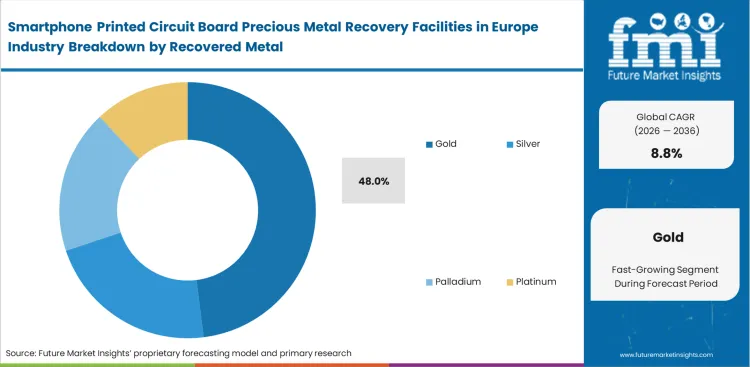
Gold remains the core target because smartphone motherboards still contain materially richer gold content than many other electronics waste categories. FMI observes that refiners tune intake testing, separation steps, and payout logic around this reality, with gold anticipated to account for 48.0% share in 2026. Silver and palladium contribute additional value, but they do not run the economics of plant utilization in the same way. Processing recycled scrap metal for bulk copper alone rarely justifies the complexity of these refining routes. Selective recovery supported by precious metal plating chemicals therefore stays central to commercial viability, especially when newer device batches contain lower average gold loading.
- Assay calibration: Intake labs test incoming board material with a strong focus on gold concentration. Purchase terms are then aligned to expected recovery value.
- Chemical targeting: Separation circuits prioritize gold isolation early in processing where feasible. This supports stronger recovery of the highest-value metal stream.
- Margin protection: Gold output supports the wider cost structure of board refining operations. Lower bullion yield can quickly weaken plant economics.
Smartphone Printed Circuit Board Precious Metal Recovery Facilities in Europe Industry Analysis by Facility Model
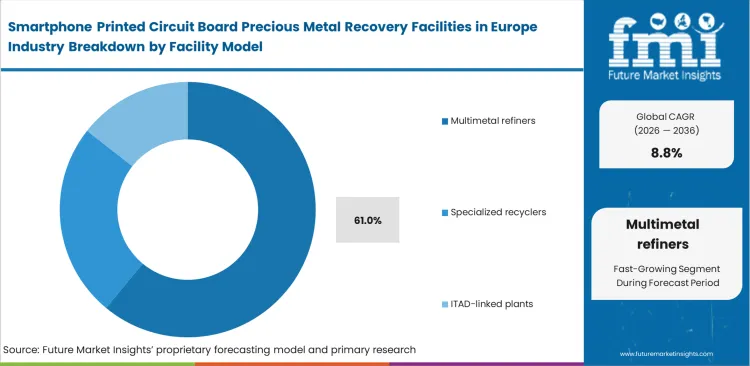
Large multimetal complexes are expected to retain a leading position because they can absorb contamination, manage byproducts, and route electronics scrap through broader metallurgical systems. Their edge is linked less to scale alone and more to the ability to process recycled metal with primary concentrates inside established refining circuits. Multimetal refiners are estimated to account for 61.0% of the market in 2026. Such integration gives operators more room to handle impurities and residues that smaller specialist recyclers often cannot treat within their own facilities. It is also expected to reduce reliance on external slag treatment while improving recovery from trace elements beyond the main precious metal stream. Facilities lacking this level of integration are likely to face tighter disposal limits and more restricted operating margins.
- Impurity blending: Primary concentrate volumes help dilute contaminants present in electronic scrap feed. This makes overall process control easier at large integrated sites.
- Byproduct valorization: Complex refining circuits recover smaller metals that would otherwise be lost. This broadens the usable output base from smartphone board treatment.
- Slag management: Integrated metallurgical systems process hazardous residues within the same industrial footprint. That reduces external disposal dependence and simplifies waste handling.
Smartphone Printed Circuit Board Precious Metal Recovery Facilities in Europe Industry Analysis by Output Form
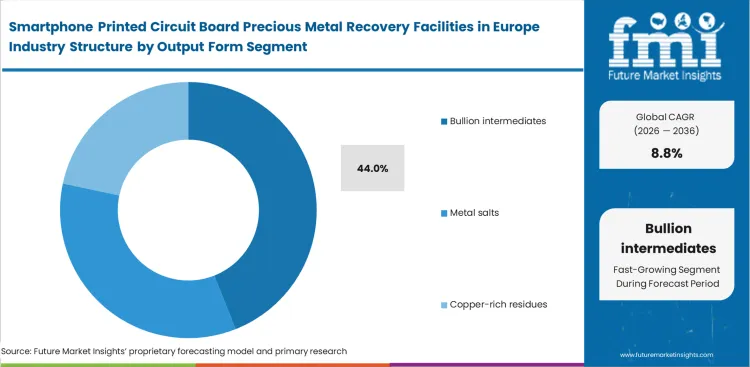
Buyer preference in this industry is shaped by transport practicality, assay clarity, and storage stability rather than metallurgical form alone. Semi-refined bullion is easier to move, test, and value across borders than liquid intermediates, especially where several refining stages are involved. Bullion intermediates are estimated to account for 44.0% share in 2026 because they provide a clearer commercial handoff point for industrial buyers and trading counterparts. Solid form reduces disputes over concentration, simplifies logistics, and gives operators in metal recycling more flexibility over shipment timing. Liquid salts are harder to transport and are more likely to create valuation disputes when sampling lacks consistency. Bullion is therefore expected to remain the more workable intermediate for cross-border precious metal transactions.
- Valuation standardization: Solid bullion allows easier core sampling and independent assay verification. This makes final settlement more transparent for buyers and sellers.
- Logistical simplification: Solid intermediates face fewer transport complications than liquid metal-bearing solutions. This helps reduce shipping complexity and insurance burden.
- Storage stability: Bullion remains easier to store over longer periods without chemical degradation. Operators can therefore manage inventory timing with less material risk.
Smartphone Printed Circuit Board Precious Metal Recovery Facilities in Europe Industry Drivers, Restraints, and Opportunities
Raw material security rules are pushing major European telecom operators to keep hardware recycling channels within the region. Risk of end-of-life devices entering informal overseas processing routes is increasing the need for certified European multi-metal refineries in the smartphone e-waste precious metals industry in Europe. Delays in local qualification can leave corporate ITAD providers excluded from government and enterprise disposal contracts where compliance controls are stricter.
Cross-border movement remains difficult because hazardous waste transfer rules slow the flow of populated circuit boards between collection sites and centralized refineries. Basel-related permit requirements often extend administrative timelines and keep valuable feedstock in temporary storage for long periods. Localized shredding can reduce transport volume, though it often damages board structure needed for efficient smelting and recovery. This keeps compliant regional refining capacity important not only for legal control, but for preserving material quality through the recycling chain.
Opportunities in the Smartphone Printed Circuit Board Precious Metal Recovery Facilities in Europe Industry
- Artificial intelligence integration: Machine vision systems sort mobile motherboards by expected gold yield. Margins are increased by sending only highest-grade boards to premium toll refiners using AI-enabled recycling infrastructure.
- Automated robotic dismantling: Precision robots extract batteries without damaging mainboards. Thermal events are eliminated in shredders while maintaining optimal feedstock for smelting operations.
- Direct corporate partnerships: Refineries establish exclusive processing contracts with major smartphone brands. Companies secure guaranteed high-yield volumes bypassing independent scrap brokers entirely using electronics take-back and closed-loop PCR networks.
Regional Analysis
Based on regional analysis, smartphone printed circuit board precious metal recovery facilities in Europe industry is segmented into Germany, Belgium, Netherlands, France, Italy, Spain, and Sweden across 40 plus countries.
.webp "Top Country Growth Comparison Smartphone Printed Circuit Board Precious Metal Recovery Facilities In Europe Industry Cagr (2026 2036)")
| Country | CAGR (2026 to 2036) |
|---|---|
| Germany | 9.5% |
| Belgium | 9.1% |
| Netherlands | 8.9% |
| France | 8.7% |
| Italy | 8.4% |
| Spain | 8.2% |
| Sweden | 7.9% |
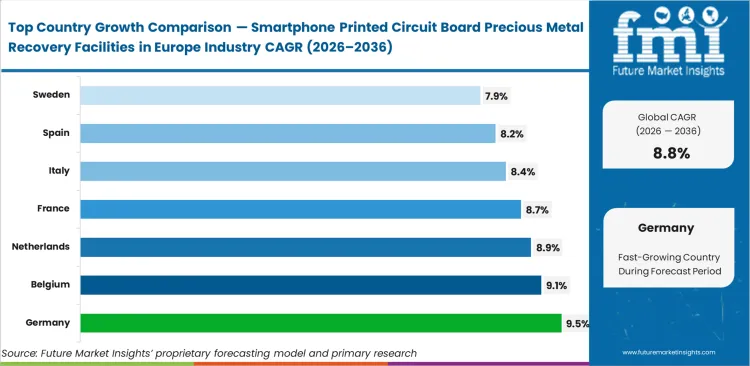
Source: Future Market Insights (FMI) analysis, based on proprietary forecasting model and primary research
Western Europe Smartphone Printed Circuit Board Precious Metal Recovery Facilities in Europe Industry Analysis
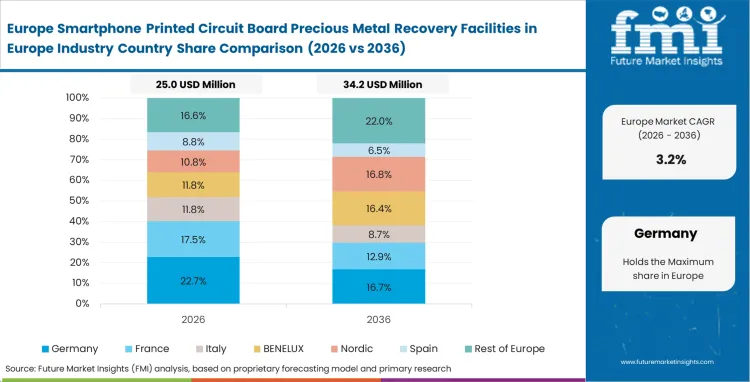
Integrated authorization networks dictate material flow across regional industrial hubs. Centralized collection facilities funnel high-grade smartphone motherboards directly to domestic multi-metal smelters. Stringent national extended producer responsibility laws compel manufacturers to trace exact recovery yields. Centralized European smelting operations consolidate high-yield circuit boards, while peripheral nations manage baseline mechanical dismantling using metal recycling equipment.
- Germany: Strict auditing requirements force enterprise channels to abandon overseas export routes to participate in the Germany smartphone PCB recycling industry. Demand for smartphone PCB recovery in Germany is expected to grow at a CAGR of 9.5% during the projection period. Corporate mandates demand transparent domestic metallurgical processing for mobile devices. Specialized domestic processors subsequently capture significant market share from independent brokers.
- Belgium: Deep-water port access enables facilities to receive consolidated electronic scrap from international sources. Belgium is anticipated to see recovery volumes grow at a CAGR of 9.1% over the forecast period. Intake scheduling aligns closely with massive rotary furnace availability for Belgium precious metal recovery from phone PCBs. Concentrated capability forces adjacent nations to export their highest-value circuit boards directly to Belgian refiners.
- Netherlands: Dense population centers enable highly efficient localized reverse logistics networks. Reduced collection overhead costs give recycling facilities a distinct advantage compared to sparse rural geographies. Smartphone PCB recovery demand across the Netherlands is set to rise at an 8.9% CAGR from 2026 to 2036. Processors achieve steady operational outcomes by minimizing transit times between initial consumer drop-off points and final metallurgical smelting destinations.
- France: Consumer awareness campaigns actively channel older handsets into formal national recycling structures. France is projected to witness an 8.7% CAGR in the smartphone PCB recovery segment through 2036. Formal collection points secure vast volumes of mixed electronics to feed domestic smelters. High consumer participation guarantees these centralized processing facilities a consistent baseline of necessary feedstock availability for continuous recovery operations.
- Italy: Sales of recovery services in Italy are expected to increase at a CAGR of 8.4% through 2036. Fragmented municipal collection protocols force industrial recyclers to build private regional consolidation centers. Heavy investment in localized logistics remains necessary to secure adequate circuit board supply. Facilities mastering this regional aggregation consistently secure higher feedstock volumes than standard municipal waste handlers.
- Spain: Retailer-driven return schemes capture used smartphones before discarded units enter standard waste streams. Processing facilities partner directly with consumer electronics chains to intercept high-grade devices. Spain is likely to post a CAGR of 8.2% in smartphone PCB recovery by 2036. Early interception at retail levels successfully prevents valuable precious metal loss into informal municipal landfills and unauthorized scrap export channels.
- Sweden: Sweden is forecast to record steady growth in PCB metal recovery at a CAGR of 7.9% through 2036. Access to legacy primary copper smelting infrastructure allows highly efficient electronic scrap dilution. Facilities utilize circuit board resins directly as fuel substitutes for existing ore processing circuits. Integrating secondary scrap into massive primary operations ensures the lowest possible per-unit processing cost locally.
Competitive Aligners for Market Players
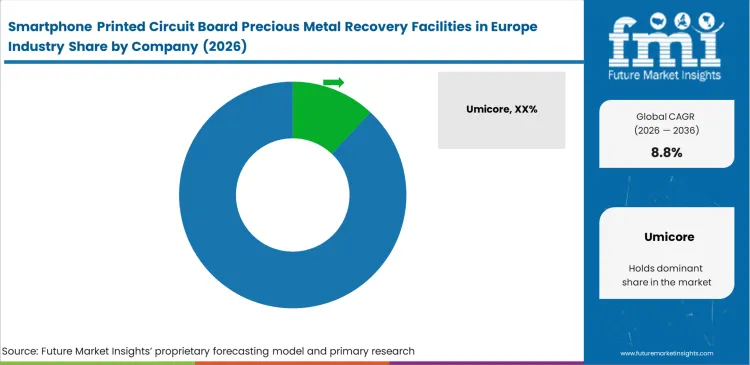
Permitting barriers remain a defining factor in European metal recovery because only a limited number of operators can handle complex processing under long-established environmental authorizations. Market power is shaped by this regulatory position, which gives larger processors stronger control over material intake and purchasing terms. Smaller operators often remain focused on aggregation, while central refiners retain the processing role for more demanding streams. Competition is largely tied to securing clean, presorted smartphone motherboard batches before they move into mixed waste channels that reduce recovery value.
Integrated primary and secondary smelting circuits continue to support a cost and process advantage for established operators. Some processors can feed electronic scrap into broader copper production systems, which improves operating flexibility across recovery stages. Newer entrants without access to primary ore-linked systems usually lack that same processing balance. Margin competition therefore depends more on sorting precision, feed quality, and recovery efficiency than on scale alone. This keeps technical control over input quality central to competitive positioning.
Large telecom operators often avoid single-processor dependence by dividing ITAD contracts across several regional collection partners. Exclusive rights are rarely concentrated in one processing relationship across Europe. Smaller aggregators remain active by securing local collection flows and negotiating downstream processing terms with central smelters. Local consolidation may continue at the collection stage, though metallurgical capacity is still expected to remain concentrated in a limited group of established processing hubs.
Key Players in Smartphone Printed Circuit Board Precious Metal Recovery Facilities in Europe Industry
- Umicore
- Aurubis
- Boliden
- Sims Limited
- Metalor Technologies
Scope of the Report
| Metric | Value |
|---|---|
| Quantitative Units | USD 98.0 million to USD 228.8 million, at a CAGR of 8.8% |
| Market Definition | Industrial sites actively extracting gold, silver, palladium, and platinum from discarded cellular phone motherboards using specialized metallurgical equipment designed specifically to separate precious materials from base substrates. |
| Segmentation | Feedstock channel, Processing route, Recovered metal, Facility model, Output form, and Region |
| Regions Covered | North America, Latin America, Western Europe, Eastern Europe, Asia Pacific |
| Countries Covered | Germany, Belgium, Netherlands, France, Italy, Spain, Sweden |
| Key Companies Profiled | Umicore, Aurubis, Boliden, Sims Limited, Metalor Technologies |
| Forecast Period | 2026 to 2036 |
| Approach | Feedstock tonnage processed through certified European metallurgical plants multiplied by average precious metal yield per metric ton. |
Source: Future Market Insights (FMI) analysis, based on proprietary forecasting model and primary research
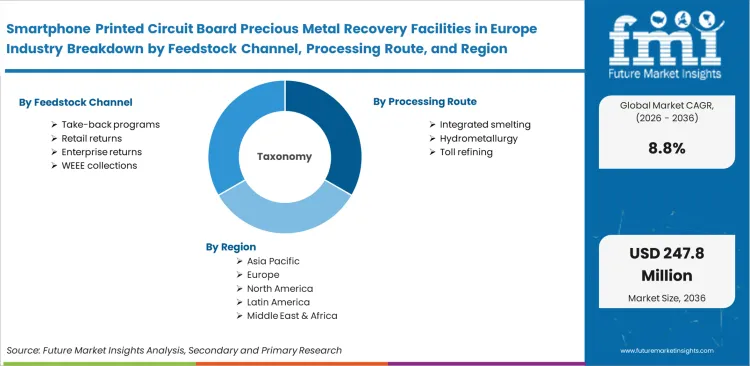
Smartphone Printed Circuit Board Precious Metal Recovery Facilities in Europe Industry Analysis by Segments
Feedstock channel
- Take-back programs
- Retail returns
- Enterprise returns
- WEEE collections
Processing route
- Integrated smelting
- Hydrometallurgy
- Toll refining
Recovered metal
- Gold
- Silver
- Palladium
- Platinum
Facility model
- Multimetal refiners
- Specialized recyclers
- ITAD-linked plants
Output form
- Bullion intermediates
- Metal salts
- Copper-rich residues
Region
- Germany
- Belgium
- Netherlands
- France
- Italy
- Spain
- Sweden
Bibliography
- European Environment Agency. (2025). Waste electrical and electronic equipment (WEEE) collection rate (Indicator) | Indicators and signals | European zero pollution dashboards.
- WEEE Forum. (2025). Towards more meaningful and robust WEEE management targets that foster circularity in the EU economy: Research in advance of a new WEEE Act and the Circular Economy Act.
- Jadoun, S., Chinnam, S., Jabin, S., Upadhyay, Y., Jangid, N. K., & Zia, J. (2024). Recovery of metals from e-waste: Facts, methods, challenges, case studies, and sustainable solutions. Environmental Science & Technology Letters, 12(1), 8-24.
- Morell, J., Ribas, D., Tristany, I., Guimerà, X., & Dorado, A. D. (2025). Metal recovery in mobile phone waste: Characterization of metal composition and economic assessment through shredding and screening processes. Waste Management, 196, 93-105.
- Pietrantonio, M., Pucciarmati, S., Forte, F., De Angelis, D., & Fontana, D. (2025). Recovery of metallic gold, silver and copper from end-of-life mobile phones by hydrometallurgy. Journal of Material Cycles and Waste Management, 27, 2395-2403.
This bibliography is provided for reader reference. The full FMI report contains the complete reference list with primary source documentation.
This Report Addresses
- Historic processing volumes across major European hazardous waste facilities.
- Yield expectations for current generation smartphone circuit boards.
- Processing cost benchmarks for thermal and chemical extraction methods.
- Base metal dilution requirements for integrated smelting operations.
- Regulatory compliance burdens for cross-border electronic scrap movement.
- Secondary market pricing models for intermediate bullion bars.
- Strategic purchase patterns among enterprise ITAD operators.
- Long-term capacity forecasts for critical multi-metal refineries.
Frequently Asked Questions
What is the smartphone PCB recycling industry size Europe?
Revenue is set to reach USD 98.0 million in 2026. These metric signals structural dependence on centralized infrastructure over fragmented local operations.
What valuation is projected for 2036?
Demand outlook propels total valuation to USD 228.8 million by 2036. Sustained investment reflects aggressive critical raw material security mandates.
What is the anticipated Europe phone PCB recovery CAGR?
Sales are expected to increase at a CAGR of 8.8% through 2036. This exact rate depends entirely on rising bullion prices masking high operational costs.
Which companies process smartphone PCBs for precious metals in Europe?
Giant multi-metal operators including Umicore, Aurubis, and Boliden handle most of the volume. Smaller regional aggregators feed these central hubs.
What metals are recovered from smartphone PCBs in Europe?
Gold, silver, palladium, and platinum constitute the core high-value output. Base elements like copper serve mostly to cover logistical overhead.
How much gold is in a smartphone circuit board?
Smartphone boards contain significantly higher gold density than standard desktop components. Refiners actively assay batches to ensure precise metallurgical calibration.
Why does integrated smelting hold dominant share?
Integrated operations leverage existing deep-water logistics and massive thermal capacity. Standalone plants simply lack primary ore flow needed to dilute toxic electronic scrap contaminants.
Which recovered metal drives primary profitability?
Gold recovery subsidizes all other separation costs. Facility chemists prioritize gold leaching circuits above silver or palladium to ensure maximum immediate revenue realization.
How does Germany compare to Belgium in growth?
Germany leads at 9.5% driven by strict domestic compliance tracking. Belgium tracks at 9.1% leveraging legacy deep-water infrastructure. Both depend on consolidated volume.
What operational friction slows capacity expansion?
Strict environmental permitting prevents new smelter construction. Legacy operators hold virtual monopolies on complex hazardous waste processing authorizations across Europe.
How do multimetal refiners manage toxic slag?
Integrated sites blend electronic scrap with primary mining concentrates. Massive dilution allows internal handling of lead and bismuth byproducts without external disposal fees.
Why do buyers prefer bullion intermediates?
Solid bars allow precise core drilling for assay laboratories. Valuation disputes drop significantly compared to testing liquid metal salts containing suspended impurities.
What forces telecom operators to verify local recycling?
Extended producer responsibility laws penalize brands if devices export illegally. Companies must trace complete destruction and recovery within approved European networks.
How does smartphone PCB yield differ from general IT scrap?
Mobile device boards contain double gold density compared to desktop computer scrap. Mobile lots are separated precisely to prevent high-grade material dilution.
Why do independent shredders struggle with precious metal extraction?
Simple mechanical shredding loses fine gold dust into low-value copper fractions. Only complex metallurgical processes recover microscopic precious metal traces effectively.
What risk do batteries present during processing?
Hidden lithium cells cause thermal events inside rotary furnaces. Strict manual removal protocols are mandated before mainboards enter automated lines.
How do legacy permits act as a competitive barrier?
European environmental agencies rarely issue new licenses for processing brominated flame retardants. Existing authorization holders dictate processing terms to independent brokers.
What role do ITAD companies play?
ITAD operators aggregate low-volume corporate returns into massive refinery-ready shipments. These intermediaries handle physical collection logistics while refiners focus strictly on chemistry.
Why is cross-border scrap movement difficult?
Basel Convention paperwork delays intra-European shipments for months. Massive temporary storage costs are faced by companies while awaiting hazardous transport authorization.
How do robotic sorting systems improve margins?
Machine vision correctly identifies high-yield vintage motherboards. These specific batches are sold to premium toll refiners rather than bulk smelters.
What happens to fiberglass board substrates?
Pyrometallurgical operations burn epoxy resin as a free fuel substitute. Natural gas consumption is lowered by utilizing this internal energy source.
Why do toll refiners penalize mixed plastic loads?
Excess plastic throws off critical thermal balances inside smelting furnaces. Traders strictly discount any circuit board batches arriving with attached device housings.
How do bullion prices affect refinery intake?
Depressed gold prices force manufacturers to pause low-grade board processing. Financial controllers stockpile material until market rates cover high chemical separation costs.
What defines 2036 end state for this sector?
Local mechanical shredding will vanish entirely. All meaningful mobile device recovery will consolidate into three or four massive multi-metal super-refineries operating precise chemical extraction.
Preview the report firsthand - request a free sample
Get SampleGet the brochure for pricing and purchase details.
Get PDFTable of Content
- Executive Summary
- Global Market Outlook
- Demand-side Trends
- Supply-side Trends
- Technology Roadmap Analysis
- Analysis and Recommendations
- Market Overview
- Market Coverage / Taxonomy
- Market Definition / Scope / Limitations
- Research Methodology
- Chapter Orientation
- Analytical Lens and Working Hypotheses
- Market Structure, Signals, and Trend Drivers
- Benchmarking and Cross-market Comparability
- Market Sizing, Forecasting, and Opportunity Mapping
- Research Design and Evidence Framework
- Desk Research Programme (Secondary Evidence)
- Company Annual and Sustainability Reports
- Peer-reviewed Journals and Academic Literature
- Corporate Websites, Product Literature, and Technical Notes
- Earnings Decks and Investor Briefings
- Statutory Filings and Regulatory Disclosures
- Technical White Papers and Standards Notes
- Trade Journals, Industry Magazines, and Analyst Briefs
- Conference Proceedings, Webinars, and Seminar Materials
- Government Statistics Portals and Public Data Releases
- Press Releases and Reputable Media Coverage
- Specialist Newsletters and Curated Briefings
- Sector Databases and Reference Repositories
- FMI Internal Proprietary Databases and Historical Market Datasets
- Subscription Datasets and Paid Sources
- Social Channels, Communities, and Digital Listening Inputs
- Additional Desk Sources
- Expert Input and Fieldwork (Primary Evidence)
- Primary Modes
- Qualitative Interviews and Expert Elicitation
- Quantitative Surveys and Structured Data Capture
- Blended Approach
- Why Primary Evidence is Used
- Field Techniques
- Interviews
- Surveys
- Focus Groups
- Observational and In-context Research
- Social and Community Interactions
- Stakeholder Universe Engaged
- C-suite Leaders
- Board Members
- Presidents and Vice Presidents
- R&D and Innovation Heads
- Technical Specialists
- Domain Subject-matter Experts
- Scientists
- Physicians and Other Healthcare Professionals
- Governance, Ethics, and Data Stewardship
- Research Ethics
- Data Integrity and Handling
- Primary Modes
- Tooling, Models, and Reference Databases
- Desk Research Programme (Secondary Evidence)
- Data Engineering and Model Build
- Data Acquisition and Ingestion
- Cleaning, Normalisation, and Verification
- Synthesis, Triangulation, and Analysis
- Quality Assurance and Audit Trail
- Market Background
- Market Dynamics
- Drivers
- Restraints
- Opportunity
- Trends
- Scenario Forecast
- Demand in Optimistic Scenario
- Demand in Likely Scenario
- Demand in Conservative Scenario
- Opportunity Map Analysis
- Product Life Cycle Analysis
- Supply Chain Analysis
- Investment Feasibility Matrix
- Value Chain Analysis
- PESTLE and Porter’s Analysis
- Regulatory Landscape
- Regional Parent Market Outlook
- Production and Consumption Statistics
- Import and Export Statistics
- Market Dynamics
- Global Market Analysis 2021 to 2025 and Forecast, 2026 to 2036
- Historical Market Size Value (USD Million) Analysis, 2021 to 2025
- Current and Future Market Size Value (USD Million) Projections, 2026 to 2036
- Y-o-Y Growth Trend Analysis
- Absolute $ Opportunity Analysis
- Global Market Pricing Analysis 2021 to 2025 and Forecast 2026 to 2036
- Global Market Analysis 2021 to 2025 and Forecast 2026 to 2036, By Feedstock Channel
- Introduction / Key Findings
- Historical Market Size Value (USD Million) Analysis By Feedstock Channel , 2021 to 2025
- Current and Future Market Size Value (USD Million) Analysis and Forecast By Feedstock Channel , 2026 to 2036
- Take-back programs
- Retail returns
- Enterprise returns
- WEEE collections
- Take-back programs
- Y-o-Y Growth Trend Analysis By Feedstock Channel , 2021 to 2025
- Absolute $ Opportunity Analysis By Feedstock Channel , 2026 to 2036
- Global Market Analysis 2021 to 2025 and Forecast 2026 to 2036, By Processing Route
- Introduction / Key Findings
- Historical Market Size Value (USD Million) Analysis By Processing Route, 2021 to 2025
- Current and Future Market Size Value (USD Million) Analysis and Forecast By Processing Route, 2026 to 2036
- Integrated smelting
- Hydrometallurgy
- Toll refining
- Integrated smelting
- Y-o-Y Growth Trend Analysis By Processing Route, 2021 to 2025
- Absolute $ Opportunity Analysis By Processing Route, 2026 to 2036
- Global Market Analysis 2021 to 2025 and Forecast 2026 to 2036, By Recovered Metal
- Introduction / Key Findings
- Historical Market Size Value (USD Million) Analysis By Recovered Metal, 2021 to 2025
- Current and Future Market Size Value (USD Million) Analysis and Forecast By Recovered Metal, 2026 to 2036
- Gold
- Silver
- Palladium
- Platinum
- Gold
- Y-o-Y Growth Trend Analysis By Recovered Metal, 2021 to 2025
- Absolute $ Opportunity Analysis By Recovered Metal, 2026 to 2036
- Global Market Analysis 2021 to 2025 and Forecast 2026 to 2036, By Facility Model
- Introduction / Key Findings
- Historical Market Size Value (USD Million) Analysis By Facility Model, 2021 to 2025
- Current and Future Market Size Value (USD Million) Analysis and Forecast By Facility Model, 2026 to 2036
- Multimetal refiners
- Specialized recyclers
- ITAD-linked plants
- Multimetal refiners
- Y-o-Y Growth Trend Analysis By Facility Model, 2021 to 2025
- Absolute $ Opportunity Analysis By Facility Model, 2026 to 2036
- Global Market Analysis 2021 to 2025 and Forecast 2026 to 2036, By Output Form
- Introduction / Key Findings
- Historical Market Size Value (USD Million) Analysis By Output Form, 2021 to 2025
- Current and Future Market Size Value (USD Million) Analysis and Forecast By Output Form, 2026 to 2036
- Bullion intermediates
- Metal salts
- Copper-rich residues
- Bullion intermediates
- Y-o-Y Growth Trend Analysis By Output Form, 2021 to 2025
- Absolute $ Opportunity Analysis By Output Form, 2026 to 2036
- Global Market Analysis 2021 to 2025 and Forecast 2026 to 2036, By Region
- Introduction
- Historical Market Size Value (USD Million) Analysis By Region, 2021 to 2025
- Current Market Size Value (USD Million) Analysis and Forecast By Region, 2026 to 2036
- North America
- Latin America
- Western Europe
- Eastern Europe
- East Asia
- South Asia and Pacific
- Middle East & Africa
- Market Attractiveness Analysis By Region
- North America Market Analysis 2021 to 2025 and Forecast 2026 to 2036, By Country
- Historical Market Size Value (USD Million) Trend Analysis By Market Taxonomy, 2021 to 2025
- Market Size Value (USD Million) Forecast By Market Taxonomy, 2026 to 2036
- By Country
- USA
- Canada
- Mexico
- By Feedstock Channel
- By Processing Route
- By Recovered Metal
- By Facility Model
- By Output Form
- By Country
- Market Attractiveness Analysis
- By Country
- By Feedstock Channel
- By Processing Route
- By Recovered Metal
- By Facility Model
- By Output Form
- Key Takeaways
- Latin America Market Analysis 2021 to 2025 and Forecast 2026 to 2036, By Country
- Historical Market Size Value (USD Million) Trend Analysis By Market Taxonomy, 2021 to 2025
- Market Size Value (USD Million) Forecast By Market Taxonomy, 2026 to 2036
- By Country
- Brazil
- Chile
- Rest of Latin America
- By Feedstock Channel
- By Processing Route
- By Recovered Metal
- By Facility Model
- By Output Form
- By Country
- Market Attractiveness Analysis
- By Country
- By Feedstock Channel
- By Processing Route
- By Recovered Metal
- By Facility Model
- By Output Form
- Key Takeaways
- Western Europe Market Analysis 2021 to 2025 and Forecast 2026 to 2036, By Country
- Historical Market Size Value (USD Million) Trend Analysis By Market Taxonomy, 2021 to 2025
- Market Size Value (USD Million) Forecast By Market Taxonomy, 2026 to 2036
- By Country
- Germany
- UK
- Italy
- Spain
- France
- Nordic
- BENELUX
- Rest of Western Europe
- By Feedstock Channel
- By Processing Route
- By Recovered Metal
- By Facility Model
- By Output Form
- By Country
- Market Attractiveness Analysis
- By Country
- By Feedstock Channel
- By Processing Route
- By Recovered Metal
- By Facility Model
- By Output Form
- Key Takeaways
- Eastern Europe Market Analysis 2021 to 2025 and Forecast 2026 to 2036, By Country
- Historical Market Size Value (USD Million) Trend Analysis By Market Taxonomy, 2021 to 2025
- Market Size Value (USD Million) Forecast By Market Taxonomy, 2026 to 2036
- By Country
- Russia
- Poland
- Hungary
- Balkan & Baltic
- Rest of Eastern Europe
- By Feedstock Channel
- By Processing Route
- By Recovered Metal
- By Facility Model
- By Output Form
- By Country
- Market Attractiveness Analysis
- By Country
- By Feedstock Channel
- By Processing Route
- By Recovered Metal
- By Facility Model
- By Output Form
- Key Takeaways
- East Asia Market Analysis 2021 to 2025 and Forecast 2026 to 2036, By Country
- Historical Market Size Value (USD Million) Trend Analysis By Market Taxonomy, 2021 to 2025
- Market Size Value (USD Million) Forecast By Market Taxonomy, 2026 to 2036
- By Country
- China
- Japan
- South Korea
- By Feedstock Channel
- By Processing Route
- By Recovered Metal
- By Facility Model
- By Output Form
- By Country
- Market Attractiveness Analysis
- By Country
- By Feedstock Channel
- By Processing Route
- By Recovered Metal
- By Facility Model
- By Output Form
- Key Takeaways
- South Asia and Pacific Market Analysis 2021 to 2025 and Forecast 2026 to 2036, By Country
- Historical Market Size Value (USD Million) Trend Analysis By Market Taxonomy, 2021 to 2025
- Market Size Value (USD Million) Forecast By Market Taxonomy, 2026 to 2036
- By Country
- India
- ASEAN
- Australia & New Zealand
- Rest of South Asia and Pacific
- By Feedstock Channel
- By Processing Route
- By Recovered Metal
- By Facility Model
- By Output Form
- By Country
- Market Attractiveness Analysis
- By Country
- By Feedstock Channel
- By Processing Route
- By Recovered Metal
- By Facility Model
- By Output Form
- Key Takeaways
- Middle East & Africa Market Analysis 2021 to 2025 and Forecast 2026 to 2036, By Country
- Historical Market Size Value (USD Million) Trend Analysis By Market Taxonomy, 2021 to 2025
- Market Size Value (USD Million) Forecast By Market Taxonomy, 2026 to 2036
- By Country
- Kingdom of Saudi Arabia
- Other GCC Countries
- Turkiye
- South Africa
- Other African Union
- Rest of Middle East & Africa
- By Feedstock Channel
- By Processing Route
- By Recovered Metal
- By Facility Model
- By Output Form
- By Country
- Market Attractiveness Analysis
- By Country
- By Feedstock Channel
- By Processing Route
- By Recovered Metal
- By Facility Model
- By Output Form
- Key Takeaways
- Key Countries Market Analysis
- USA
- Pricing Analysis
- Market Share Analysis, 2025
- By Feedstock Channel
- By Processing Route
- By Recovered Metal
- By Facility Model
- By Output Form
- Canada
- Pricing Analysis
- Market Share Analysis, 2025
- By Feedstock Channel
- By Processing Route
- By Recovered Metal
- By Facility Model
- By Output Form
- Mexico
- Pricing Analysis
- Market Share Analysis, 2025
- By Feedstock Channel
- By Processing Route
- By Recovered Metal
- By Facility Model
- By Output Form
- Brazil
- Pricing Analysis
- Market Share Analysis, 2025
- By Feedstock Channel
- By Processing Route
- By Recovered Metal
- By Facility Model
- By Output Form
- Chile
- Pricing Analysis
- Market Share Analysis, 2025
- By Feedstock Channel
- By Processing Route
- By Recovered Metal
- By Facility Model
- By Output Form
- Germany
- Pricing Analysis
- Market Share Analysis, 2025
- By Feedstock Channel
- By Processing Route
- By Recovered Metal
- By Facility Model
- By Output Form
- UK
- Pricing Analysis
- Market Share Analysis, 2025
- By Feedstock Channel
- By Processing Route
- By Recovered Metal
- By Facility Model
- By Output Form
- Italy
- Pricing Analysis
- Market Share Analysis, 2025
- By Feedstock Channel
- By Processing Route
- By Recovered Metal
- By Facility Model
- By Output Form
- Spain
- Pricing Analysis
- Market Share Analysis, 2025
- By Feedstock Channel
- By Processing Route
- By Recovered Metal
- By Facility Model
- By Output Form
- France
- Pricing Analysis
- Market Share Analysis, 2025
- By Feedstock Channel
- By Processing Route
- By Recovered Metal
- By Facility Model
- By Output Form
- India
- Pricing Analysis
- Market Share Analysis, 2025
- By Feedstock Channel
- By Processing Route
- By Recovered Metal
- By Facility Model
- By Output Form
- ASEAN
- Pricing Analysis
- Market Share Analysis, 2025
- By Feedstock Channel
- By Processing Route
- By Recovered Metal
- By Facility Model
- By Output Form
- Australia & New Zealand
- Pricing Analysis
- Market Share Analysis, 2025
- By Feedstock Channel
- By Processing Route
- By Recovered Metal
- By Facility Model
- By Output Form
- China
- Pricing Analysis
- Market Share Analysis, 2025
- By Feedstock Channel
- By Processing Route
- By Recovered Metal
- By Facility Model
- By Output Form
- Japan
- Pricing Analysis
- Market Share Analysis, 2025
- By Feedstock Channel
- By Processing Route
- By Recovered Metal
- By Facility Model
- By Output Form
- South Korea
- Pricing Analysis
- Market Share Analysis, 2025
- By Feedstock Channel
- By Processing Route
- By Recovered Metal
- By Facility Model
- By Output Form
- Russia
- Pricing Analysis
- Market Share Analysis, 2025
- By Feedstock Channel
- By Processing Route
- By Recovered Metal
- By Facility Model
- By Output Form
- Poland
- Pricing Analysis
- Market Share Analysis, 2025
- By Feedstock Channel
- By Processing Route
- By Recovered Metal
- By Facility Model
- By Output Form
- Hungary
- Pricing Analysis
- Market Share Analysis, 2025
- By Feedstock Channel
- By Processing Route
- By Recovered Metal
- By Facility Model
- By Output Form
- Kingdom of Saudi Arabia
- Pricing Analysis
- Market Share Analysis, 2025
- By Feedstock Channel
- By Processing Route
- By Recovered Metal
- By Facility Model
- By Output Form
- Turkiye
- Pricing Analysis
- Market Share Analysis, 2025
- By Feedstock Channel
- By Processing Route
- By Recovered Metal
- By Facility Model
- By Output Form
- South Africa
- Pricing Analysis
- Market Share Analysis, 2025
- By Feedstock Channel
- By Processing Route
- By Recovered Metal
- By Facility Model
- By Output Form
- USA
- Market Structure Analysis
- Competition Dashboard
- Competition Benchmarking
- Market Share Analysis of Top Players
- By Regional
- By Feedstock Channel
- By Processing Route
- By Recovered Metal
- By Facility Model
- By Output Form
- Competition Analysis
- Competition Deep Dive
- Umicore
- Overview
- Product Portfolio
- Profitability by Market Segments (Product/Age /Sales Channel/Region)
- Sales Footprint
- Strategy Overview
- Marketing Strategy
- Product Strategy
- Channel Strategy
- Aurubis
- Boliden
- Sims Limited
- Metalor Technologies
- Umicore
- Competition Deep Dive
- Assumptions & Acronyms Used


